Tag Archives: Colin Higgins

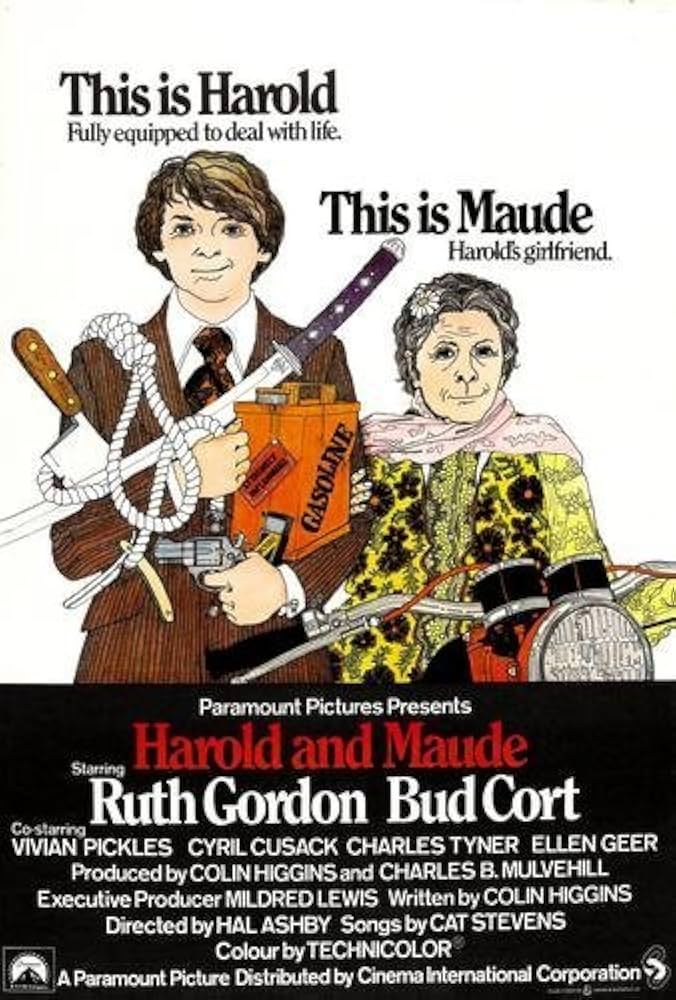
Harold and Maude (1971)

By Richard Winters

My Rating: 9 out of 10

4-Word Review: Falling for older woman.

Harold (Bud Cort) is a young man still living at home with his mother (Vivian Pickles) who is an upper-class socialite that dominates Harold at every turn. Harold resents his mother’s control and thus stages fake suicides as a way to rebel. She in turn devises ways to ‘cure’ him of his death obsession by buying him a new car, which he turns into a mini hearse, setting him up on blind dates and even trying to get him recruited into the army. All of these ploys fail, and the real turnaround doesn’t occur until he meets Maude (Ruth Gordon) a kooky old lady with a carefree spirit. The two nonconformists form a strong bond and eventually a romance. When Harold announces that he plans to marry her it causes shock and disgust with all those who know him.

While this film has become a huge cult hit, there’s even a theater in Essen, Germany where it’s been shown, outside of a 10-week period during COVID, continuously since June 6, 1975, it was a box office flop when first released. Many prominent critics at the time panned it including Roger Ebert who gave it only 1 star out of 4. The two main reasons for this were the ultra-dark humor and offbeat storyline, which might’ve been a bit ahead of its time, but also some of it I suspect had to do with the editing. Director Hal Ashby, who was an editor before he ventured into directing, does a lot of long takes here, which is unusual for a comedy. Usually, humorous films consist of quick takes and a fast pace, but here the jokes particularly Harold’s suicide pranks are very drawn out to the point you don’t really see the joke happening until the payoff. While I loved this approach and consider to be the genius of both the movie and Ashby others especially in that time period could consider it off-putting and confusing as audiences are used to having their comedy spelled out for them and not to have to search for it.

The acting is splendid with the two leads nailing their characters perfectly. Cort was warned that if he took this role, he’d be type casted for ever after and it’s true his career flatlined, but with his slim physical build and unique face his choice of leading parts would’ve been limited anyways. Gordon on the other hand was in the midst of a career resurgence and her appearance here helped cement her for old lady roles for the next decade and a half.

While overshadowed it’s important not to forget the supporting cast, who are all fantastic as well. Vivian Pickles is great as Harold’s domineering mother. The argument could be made that she’s too much of a caricature and they would be right, but the scene where she answers Harold’s dating profile for him really had me laughing. Charles Tyner as the one-armed army recruiter who becomes shocked when Harold gets too enthusiastic about killing is good as is Eric Christmas who becomes physically repulsed when describing how sex might go between a young man and an old lady. Tom Skerrit billed as ‘M. Boorman’ in refence to Nazi war criminal Martin Boorman whom he once joked was probably ‘hiding out as a motorcycle cop’ is highly engaging as an exasperated policeman futility trying to write Maude a traffic ticket.

Spoiler Alert!

On the negative end, while minor, I did feel that Harold’s suicide pranks would be very hard if not impossible to pull off. The opening one which has him dangling from the ceiling with his feet clearly off the floor should’ve logically killed him. The scene where we see him through a window presumably setting himself on fire only to then immediately have him appear in the room is something he would not have been able to pull off alone and would’ve at the very least needed the help of someone else, but the film acts like he did it all on his own.

Maude’s car stealing doesn’t make sense either. She seemingly is able to simply hop into someone’s car and drive off with it like everyone just leaves their car doors unlocked and the keys in the ignition, which isn’t likely. If the explanation was that she was hotwiring them then this should’ve been shown, if even just briefly.

Maude’s suicide at the end was a mistake and I agree with critic Vincent Camby who complained that this made the movie seem ‘hypocritical’. She was a character that was so excited about life that it made no sense why she’d suddenly decide to end it. Some may say that she was haunted by memories of when she was in a concentration camp, but if that were the case then why didn’t she do it already at ag 50, 60, or 70? It also makes her seem selfish as she knew how Harold felt about her and killing herself was going to make him extremely upset and yet her response when he becomes horrified at the news that she’s taken some pills is quite detached like she never bothered to take his feelings into account. She was at the age where she could’ve fallen over dead at any moment from natural causes and the film should’ve ended with her dying that way instead.

My Rating: 9 out of 10

Released: December 20, 1971

Runtime: 1 Hour 31 Minutes

Rated PG

Director: Hal Ashby

Studio: Paramount

Available: DVD, Blu-ray, Amazon Video, Pluto TV, YouTube
Silver Streak (1976)

silver

By Richard Winters

My Rating: 8 out of 10

4-Word Review: Murder on a train.

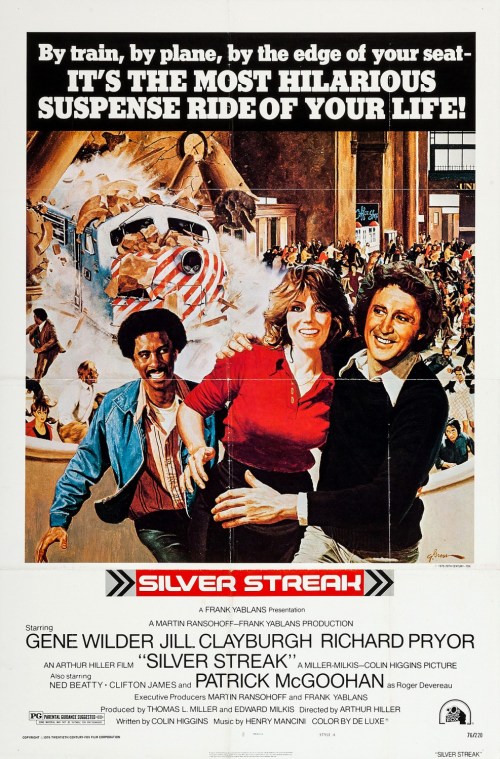
George (Gene Wilder) is a book editor taking a train ride from Los Angeles to Chicago. Along the way he gets into a relationship with Hilly (Jill Clayburgh) who is staying in the neighboring compartment. After a night of drinks they go back to her bed and begin making-out only for George to see a murdered body of a professor, whom Hilly works for as his secretary, get thrown off the train. Nobody else sees it except for him and everyone, including Hilly, believe it was a figment of his imagination, but George persists by doing the investigating himself. He goes to the compartment that the professor was staying in to see if he’s there, but instead he meets two men (Ray Walston, Richard Kiel) who throw him off the train. George then must find a way, in the middle of the empty desert, to get back on the train, so as to warn Hilly, whom he fears may be their next victim.

The script was written by Colin Higgins who up to that time was best known for having done Harold and Maude. He said he had always fantasized about meeting a beautiful blonde on a train and when it never panned-out in real-life he decided to write it into a story. Initially he was expecting an uphill battle to get it sold, but to his amazement it instead set-off a bidding war between Paramount and 20th Century Fox who both wanted to purchase the rights and it ended up selling for a then record $400,000. Originally Amtrak was going to be used as the setting for the Silver Streak, but the company became panicked that the film could cause bad publicity for them and ultimately refused to allow the studio to use any of their trains, so the film crew was forced to go north of the border and use the Canadian Rail System in its place while still pretending that it all takes place in the US when really all exteriors are Alberta, Canada and the skyline that gets seen in the distance that’s supposed to be Kansas City is really Calgary.

The reason the film works so well is that the comedy is on-target the whole way, but also manages to deftly blend it in with some nerve wracking action making the viewer let out belly laughs while also sitting-on-the-edge-of-their-seat at the same time. The pace is brisk with some amazing and very realistic stunt work that not only shows the train crashing through the wall of Chicago’s Central station, but also a few scenes with the character’s dueling it out on the roof of the locomotive as it’s going at high speeds. In fact the only slow spot in the entire movie is when Gene and Jilly make-out in the train car, which goes on too long and may make some people, including my conservative parents who watched the film with me when I first saw it on Showtime in 1982, as thinking this might be more a soft core porn flick than an action thriller and about ready to turn-if-off before it finally gets going with the plot.

Wilder, who was not Higgins’ first choice for the role as he intended it to be played by George Segal, is quite engaging and this was the first of several pairings that he did with Richard Pryor, who doesn’t appear until an hour in, but manages to take over quite nicely and makes a strong, memorable impression. Patrick McGoohan is sinister as the villain and one of the rare instances where in an otherwise comedy the bad guy isn’t funny and instead nasty, usually in comedies it’s considered mandatory that all the characters, even the bad guy, have some amusing moments, or lines, but McGoohan is just mean, which enhances the suspense element. Scatman Crothers, who initially seems to be playing an insignificant roles as the train’s porter, but in the end becomes quite crucial in getting everyone saved. Richard Kiel is good, though he speaks no dialogue, as one of McGoohan’s henchmen, in a role quite similar to the Jaws character that he played in two James Bond films that came out a year later, he even walks around with the same mangled up dental work in his mouth.

Spoiler Alert!

While the film works for the most part quite flawlessly I did find a few tidbits to quibble about. One is the scene where Gene accidentally bursts open the patrician door that divides his room from Jill’s who is busy dressing and doesn’t act startled when he suddenly breaks into her room, which I would think anyone, especially in a state of undress, would’ve responded with a scream and a look of shock, which would’ve made the segment funnier if she had.

Later on a police chief, played by Len Birman in a very bad impression of Mike Connors from ‘Mannix’, tells Gene that they know he’s innocent and have simply been putting-up manhunt posters with his picture on it for his own safety, so they could catch him and get him away from the evil McGoohan and his cronies who want to kill him. However, after he explains this he then hands Gene a gun and some bullets and tells him to come along with his men to help nab McGoohan who is still on the train, but how would this police chief know that Gene could handle a gun and was trained on how to shoot it, let alone even need him since his own men were well armed with rifles and could easily shoot down the bad guy themselves? There’s also another moment where the police chief shoots into a large crowd in an effort to hit McGoohan, which sends everyone into a panic and would be considered a major act of negligence for a cop to do.

Another scene has McGoohan explaining to Jill, Gene, and Richard about how he and his men never meant to really kill the professor, or at least not upfront, but when he did die that’s when they had to immediately ‘get’ a lookalike as an imposter to give everyone the idea that the professor was still alive. However, how exactly where they going to be able to find someone who looked so similar to the professor in such a quick, speedy way and then get him on the non-stop, fast-moving train?

The biggest exaggeration for me though is when Gene unhooks the back part of the train from the engine, while standing on a thin ledge and holding on for dear-life via a small metal rail and then able to successfully hop onto the train car that he had just decoupled from the other one. With them both going at high speeds I don’t think he’d be able to do it. Of course in the movie it gets done by a professional stunt man, who was able to time it, and rehearse it, to make it look easy, but in reality the average person would’ve either slipped, or missed grabbing the rail and thus fallen to the side of the tracks. This though could’ve actually been funny as we would then see Gene’s body roll on the ground and initially make it seem like he was hurt, or injured and then have him look up in aggravation and go: ‘Damn, I got thrown off the train for a fourth time!”

My Rating: 8 out of 10

Released: December 8, 1976

Runtime: 1 Hour 54 Minutes

Rated PG

Director: Arthur Hiller

Studio: 20th Century Fox

Available: DVD, Blu-ray, Amazon Video, YouTube