Tag Archives: Cloris Leachman

The Muppet Movie (1979)

By Richard Winters

My Rating: 7 out of 10

4-Word Review: How they became famous.

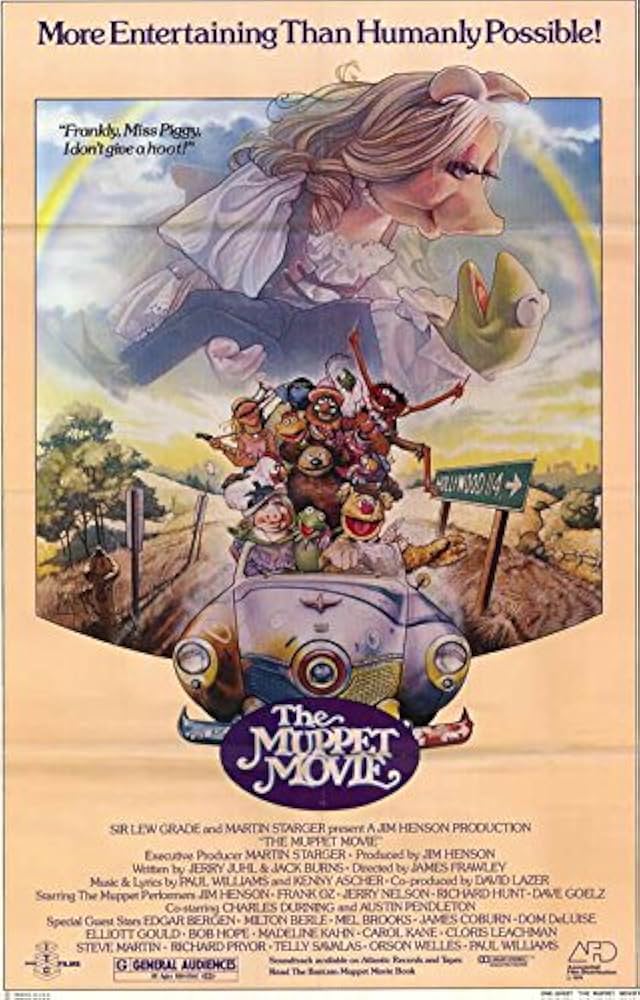
Kermit (Jim Henson) is a lonely frog living in a Florida swamp who dreams of one day making it to Hollywood and becoming famous. He then meets talent agent Bernie (Dom Deluise) who hears Kermit singing a song with a banjo and becomes convinced that the frog has what it takes to become a star. He hands him his card and tells him to give him a visit when it makes it to California. Kermit then sets-off on a cross-country trip and along the way meets several other characters all looking for their big-break including Fozzie Bear, a struggling comedian, and Miss Piggy (Frank Oz) who wants to become a fashion model. They tag along on the trip with Kermit while pilling into Fozzie’s Studebaker as he drives them to the west coast, but then they meet up with Doc Hopper (Charles Durning), an owner of restaurants who specializes in frog legs, who wants Kermit to be his new spokesmen in some commercials that he’s producing, but Kermit declines. However, Doc refuses to take no for answer and chases after the gang and using increasingly more sinister methods in order to get the frog to change his mind. 

Due to the success of ‘The Muppet Show’ creator Jim Henson was given financing to produce his own movie featuring the same puppet characters audiences had grown to love from the program. Since this would be a large-scale production great effort had to be put into making the muppets appear real and able to blend into an actual outdoor setting versus having everything done on a sound stage like it was in the TV-show. Henson refused to compromise on anything and insisted that money would not be a limitation, and this included the segment where Animal, one of the muppet characters, grows to giant proportions. Initially the idea was to keep the puppet the same size and place him on a miniaturized set, which would’ve cut down on costs, but Henson felt this didn’t look convincing enough, so instead they constructed Animal’s head to gigantic proportions that measured over sixty feet, which called for way more money and was very time consuming, but ultimately worth the effort. 

The story itself is pedestrian and relies, similar to the TV-show, with rapid fire quips and comebacks much like in old vaudeville. On the surface the humor is corny, and some could find the whole thing silly, but enjoyment comes with the puppet characters that are made to be like caricatures of humans, and their amusing responses and reactions. It’s also filled with a lot of great songs all written by the talented Paul Williams, who appears briefly. Normally in movie musicals the songs end up sounding the same and it starts to feel like we’re just listening to the same loop done over and over, but here each music bit has a distinct beat and a good toe-tapping quality, which not only adds to the fun, but actually helps move the story along versus holding it up. 

The only drawback is the massive amount of guest star appearances. There are many familiar faces, but most of them are only in it for a half-minute, or so and few of them have anything that’s actually funny to say, or even moderately clever. Performers like Bob Hope, Richard Pryor, Madeline Kahn, and Edgar Bergen, in his last screen appearance before dying just a couple weeks later, are essentially wasted in bits that add nothing and could easily have been excised and not missed. However, there’s a few cameos that do work including Steve Martin as an annoyed waiter, Cloris Leachman as a receptionist allergic to animal hair and Orson Welles who comes on near the end and has the film’s best line. Mel Brooks also quite memorable in an over-the-top send-up of a German mad scientist. 

Durning though is the one exception as he is more like a main cast member and in it quite a bit. Of course, he’s an outstanding character actor and a personal favorite and he shines here as well particularly with his attempt at a Cajun accent, but it seemed a bit ridiculous for a guy to go to such extreme measures just to get Kermit to be in his commercials. A better storyline would’ve had Kermit witness Durning turning one of his family members, perhaps one of his distant frog cousins, into a frog legs meal and thus threaten to turn Durning into the authorities and this would cause him to chase after him in order to try and keep him from squealing.  It also would’ve been nice had he shown a change-of-heart at the end and come around to being a friend to the muppets versus remaining an adversary. It comes close at one point when Durning realizes he doesn’t have any real friends like Kermit does, but I would’ve liked to have seen him come to grips with his aggressive personality and make amends to do better moving forward. 

My Rating: 7 out of 10

Released: June 22, 1979

Runtime: 1 Hour 35 Minutes

Rated G

Director: James Frawley

Studio: Associated Film Distribution

Available: DVD, Blu-ray, Amazon Video, YouTube
Walk Like a Man (1987)

walk

By Richard Winters

My Rating: 1 out of 10

4-Word Review: Raised as a wolf.

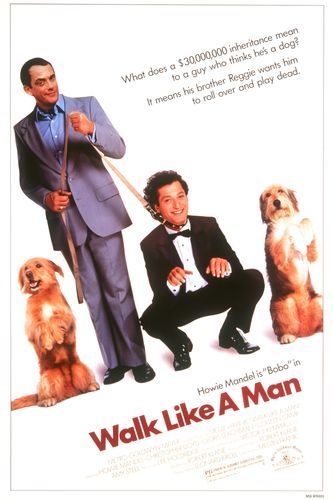
Henry (Christopher Lloyd) travels with his family to Alaska in the search of gold. His oldest son Reggie though doesn’t like the cold and so after finding his fortune Henry tells his family they’re leaving via a dog sled. Reggie is told that he’s now old enough to push the sled, which he doesn’t like, so when his father isn’t looking he hops onto the sled where his mother (Cloris Leachman) and younger 2-year-old brother, nicknamed Bobo, are. Bobo ends up getting pushed off the sled and lost in the icy wilderness where, despite the arduous search by his father who perishes while looking for him, is presumed dead. 28 years later a biologist named Penny (Amy Steel) comes across a man (Howie Mandel) with a pack of wolves. He gets identified through a tattoo as being the lost son and ‘returned’ to a now grown Reggie (Christopher Lloyd), his mother and Reggie’s wife Rhonda (Colleen Camp). Reggie has no interest in caring for his brother, who behaves like he’s a wolf, but because he’s squandered his father’s fortune and because Bobo was given a $30 million inheritance, Reggie agrees to let Penny teach him how to write, so he can ultimately sign over his money to Reggie.

The script was written by Robert Klane who burst onto the scene during the late 60’s with both ‘The Horse is Dead’, a highly irreverent, politically incorrect novel, but still quite funny, and ‘Where’s Poppa’, about a man trying to kill his senile mother. The latter got made into a movie, which was directed by Carl Reiner with the script written by Klane, that’s considered a landmark in dark comedy. So, how someone goes from doing stuff that’s highly inventive to this empty-headed, bare bones ‘comedy’ is hard to fathom, but the results are ‘blah’. The plot is threadbare and hinges on a lot of slapstick scenarios that prove to be predictable and overly-extended. Instead of picking up the pace, as a good comedic scene should, it saps the energy right out making the movie, as a whole, strained and boring.

The problems start out right away during the Alaska scene, which was clearly shot on a soundstage using fake snow, where the young Bobo falls off the sled, which if you think about it is quite horrifying as there is simply no way a toddler could survive in that climate. There’s no chance the wolves would ‘raise him’ either and instead would just eat him. Also, when he gets found by Penny he’s seen running around wearing a loincloth, but if he thinks he’s a wolf he shouldn’t be wearing anything at all just like the other wolves. Where did he find this cloth to wear, or did the wolves make that when they took up parenting him?

The running joke of Reggie’s neighbor, played by George DiCenzo, getting upset because Bobo keeps trampling through his freshly paved cement driveway, is overdone. The first time it happens it’s good for maybe a slight chuckle, but then several months later it goes back to Bobo doing it again, but the neighbor should’ve learned from the past and built a fence, or partition around the cement to prevent Bobo from going on it, or at the very least not be so shocked when the driveway gets ruined again since its already happened several times already.

The only interesting aspect is seeing Lloyd, who has later described this film as an ’embarrassment’, playing the lead. Usually he does likable, but eccentric character roles, so seeing him actually carry a film, which he does well despite the mess, is interesting and in fact he’s the only thing that gives it any energy and when he’s not in it it all falls flat. Mandel on the other hand isn’t dynamic enough to make his scenes work and his wolf routine is more tiresome than funny.

Leachman steals it as the mother with child-like instincts. She does have a few funny lines and her sitting with Bobo as Penny tries to teach him to read and write and her reactions to things being almost as clueless and fanciful is Bobo’s is definitely amusing. Steel, while quite bland, is good simply because she’s the only normal one in the movie, which when doing wacky comedies it’s nice to at least have one sensible person to help ground things.

I’ll give a point to the segment dealing with a trip to mall and the infamous sneezing scene, which did get me to laugh-out-loud, but everything else clunks badly. The final courtroom battle is especially cringey. Showing clips of ‘funny moments’ during the closing credits, which weren’t all that great when we saw them the first time, and acting like it’s some sort of ‘highlight reel’ just extends the pain further. If anything they should’ve shown bloopers and outtakes of the actor’s messing up their lines, which would’ve been funnier than hearing them speak the actual ones.

My Rating: 1 out of 10

Released: April 17, 1987

Runtime: 1 Hour 26 Minutes

Rated PG

Director: Melvin Frank

Studio: MGM

Available: DVD

Lovers and Other Strangers (1970)

lovers1

By Richard Winters

My Rating: 6 out of 10

4-Word Review: Marriage: Pros and Cons.

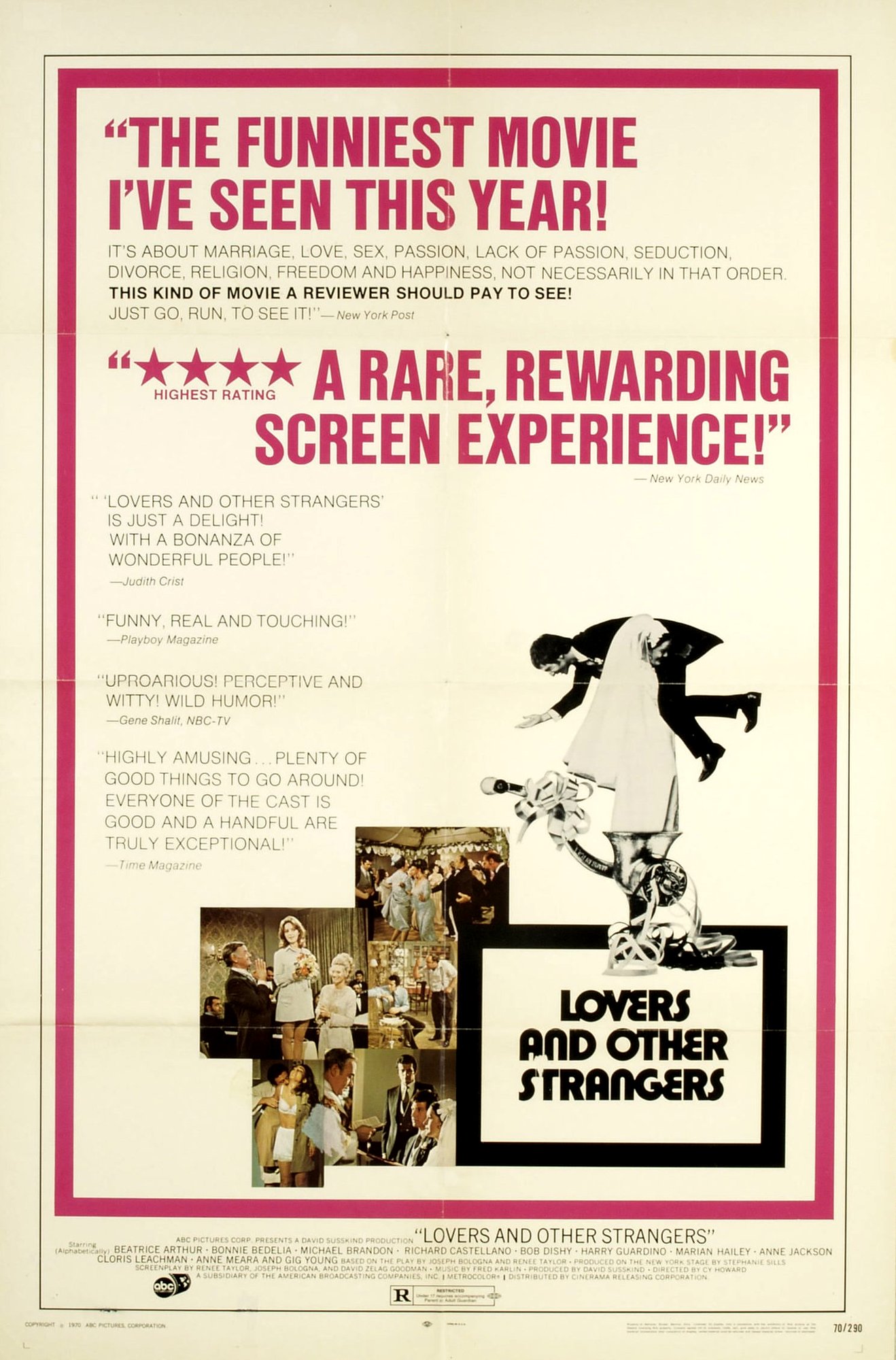
Mike and Susan (Michael Brandon, Bonnie Bedelia), who have been living together for a year and a half, have decided to get married, but as the wedding draws near Mike begins to have second thoughts. Meanwhile Susan’s parents, Hal and Bernice ( Gig Young, Cloris Leachman) have issues of their own as Hal is having an affair with Kathy (Anne Jackson) who is Bernice’s sister. Their other daughter, Wilma (Anne Meara), who is already married, but starting to regret it since her husband (Harry Guardino) seems more interested in watching old movies on TV than having sex. Mike’s parents, Frank and Bea (Richard S. Castellano, Beatrice Arthur) also have problems as they try to convince Mike’s older brother Richie (Joseph Hindy) to stay married to Joan (Diane Keaton) even though they’ve grown incompatible. Then there’s wedding usher Jerry (Bob Dishy) who spends his time trying to ‘score’ with nervous, nebbish bridesmaid Brenda (Marian Hailey) who can’t seem to decide whether she’s into Jerry or not.

While the film, which was based on the hit Broadway play of the same name written by real-life couple Joseph Bologna and Renee Taylor, who adapted it to the screen, was a major success at the box office and received high critical praise it does in retrospect come-off like just another episode of ‘Love American Style’ or even ‘The Love Boat’. There are certainly some funny lines of dialogue and interesting insights at how the younger generations view marriage differently from the older one, but besides the very brief wedding scene, we never see the cast come together and interact as a whole making the movie and characters seem more like a collection of non-related vignettes than a cohesive story. It’s also quite talky with no action to speak of, so unless you’re really into conversational comedy you may get bored.

Mike and Sue, who act as the main characters, get overshadowed by the supporting players and become almost like an after thought the more the movie progresses. The opening sequence with them in bed together and contemplating marriage, which at the time was meant for shock effect since it was still considered taboo to have sex before marriage, will be lost on today’s audiences where living together is now by far the norm. I also found it hard to believe that they’d be able to fool both sets of parents for a whole year by pretending they were rooming with same sex roommates, Sue told her parents she had a roommate named ‘Phyllis’ and Mike told his folks he lived with ‘Nick’, but after awhile I’d think the parents would get suspicious especially when they’d never meet or speak to these other roommates even after a year’s time.

The segment where Mike tells Sue he doesn’t want to get married because he still likes hitting-on other women and then proceeds to pinch the ass of some lady on the street, all while in front of Sue, won’t go over to well with today’s viewers and for that matter shouldn’t have gone over well with Sue either even though she takes it all in stride like it’s no big deal while most other wives/girlfriends would’ve been highly upset. Having Mike inform Sue that he she has ‘fat arms’ could really upset a lot of women as many can be insecure about their bodies and dwell on these types of comments for a long time and not take it so casually like Sue does here. I thought she should’ve brought it back up later, out-of-the-blue in a non-related scene with something like ‘do you really think my arm’s are fat?’, which could’ve been funny.

There’s problems with the casting too especially Anne Meara playing Cloris Leachman’s daughter even though in reality she was only three years younger than her and looked it. I was also baffled why Meara’s real-life husband and longtime comic partner Jerry Stiller, who does appear very briefly in a minor role, wasn’t cast as her husband here. Harry Guardino does a fine job in the hubby role, but Stiller and Meara had a special chemistry and that would’ve shined through with the two onscreen. I also felt that Anne Jackson and Cloris should’ve switched roles. Having the very dynamic Cloris stymied in a boring bit of a clueless housewife was a waste of her immense talents and she would’ve been better able to display the anxiety of Anne’s character in a funnier way.

Bea Arthur and Diane Keaton, who both make their film debuts here, are quite good as is Richard S. Castellano whose repeated line of “So what’s the story’ became a popular catchphrase though the numerous close-ups of his face does make his fat bottom lip too pronounced. Marian Hailey, who left the acting profession in the 80’s and became children’s book author who now goes by Marian Hailey-Moss, is excellent too and perfectly conveys the persona of a single woman who is quite intelligent and well read, but also painfully insecure and indecisive. My favorite though is Gig Young as a philandering husband who tries to make everyone happy, but ultimately fails. This was his last great performance before alcoholism killed his career and his conversation with Jackson at end as they sit in two adjoining toilet stalls in a public bathroom is the film’s funniest moment though the house that his character owns, which is supposed to nestled in the rich swanky suburbs looks like a shambles, at the least exterior, as it’s painted with a watery white color that has spots where it completely exposes the red brick underneath looking like a rundown place that has been poorly maintained, which I don’t think was the intention.

My Rating: 6 out of 10

Released: August 12, 1970

Runtime: 1 Hour 44 Minutes

Rated GP

Director: Cy Howard

Studio: Cinerama Releasing Corporation

Available: DVD, Blu-ray

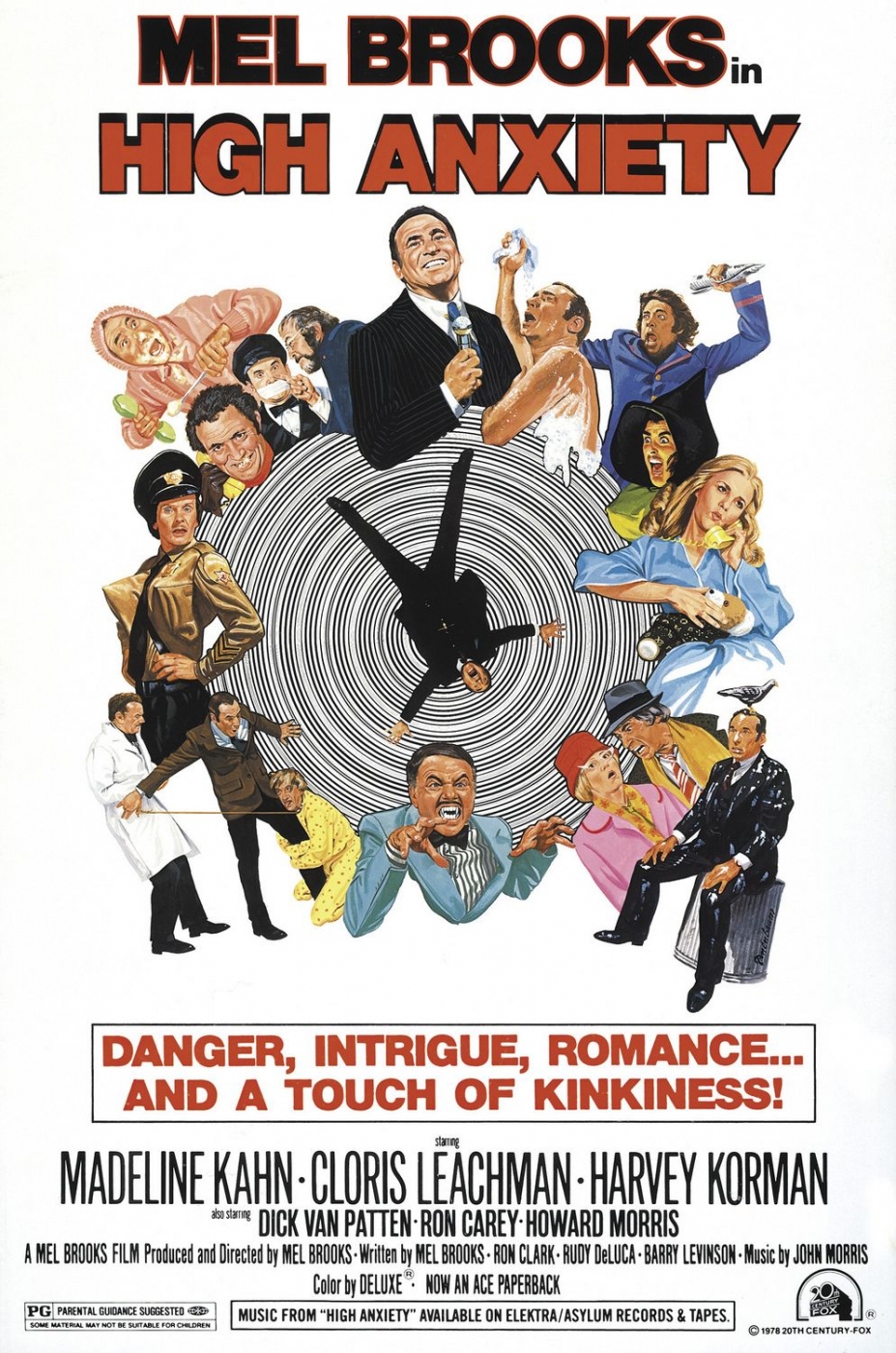
High Anxiety (1977)

By Richard Winters

My Rating: 7 out of 10

4-Word Review: He’s afraid of heights.

Dr. Richard Thorndyke (Mel Brooks) is hired as the new resident psychiatrist at the Psycho-Neurotic Institute for the Very, Very, Nervous where he is to replace another Dr. who died under suspicious circumstances. While there he becomes aware of many odd things occurring making him believe that the people running the hospital, Dr. Charles Montague (Harvey Korman) and Nurse Diesel (Cloris Leachman), have a scheme going on where they take in rich patients and pretend their conditions are worse than they really are, so that they can keep the patients hospitalized for indefinite periods and thus bilk the patient’s rich families for large sums of money. Richard, together with Victoria (Madeline Kahn) who is the daughter of another patient that is being held there against his will, become determined to expose the scheme, but his adversaries use nefarious tactics to try and stop him by taking advantage of his extreme fear of heights.

Per an interview that Mel Brooks gave with NPR in 2013 he revealed that he wrote a letter to Hitchcock in 1976 telling him that he wanted to do a parody of his movies and was interested in getting his feedback. Hitch wrote back saying that they should get together in his office to go over ideas. In fact it was Hitch’s suggestion to have the scene involving the birds pooping on Brooks. When the film was completed he got his own private screening and afterwards he sent Brooks a case of expensive French wine with the note: “A small token of my pleasure, have no anxiety about this.”

Two of my favorite moments include a Psycho parody where a bellhop (played by a young and soon-to-be famous director in his own right, Barry Levinson) who stabs Brooks with a newspaper while he’s in the shower. The afore mentioned Birds parody is good too with the bird droppings made up of mayonnaise and chopped spinach, but because a helicopter was used during the segment it scared a lot of the pigeons causing real bird do-do to get mixed in with the fake stuff.

I enjoyed the bits involving a parody of the ‘gliding camera’ a technique used in many films where a camera shot begins on the outside of a building, but then somehow ‘glides through’ a wall and goes inside a place without any barrier. Here the camera shatters the glass as it tries to ‘glide through’ the window of the hospital, but Brooks almost ruins the moment by having the characters react by looking up to where the noise occurred, but then going back to their conversation, which makes no sense. If a camera operator has just crashed through a window, most people would get up from their seats and inspect the damage, which would’ve overplayed the joke, so they should’ve just had the characters not respond to the crashing noise at all. This same issue occurs at the end where the camera operators are heard talking just before they crash through a wall, but the scene would’ve played better without the banter.

The plot, as thin and goofy as it is, has some interesting moments. I especially enjoyed the segments done inside the lobby of the Hyatt Regency in San Francisco and the way it takes advantage of the glass elevators there. The scene involving actor Ron Carey blowing up a picture that he took there in order to solve a crime is cool because it goes back to the old way of developing film, which will be a good education for today’s younger viewers who are more used to digital.

The performances are first-rate with Brooks in an uncharacteristic straight part though he still gets in a few zany moments including a segment where he’s a baby who falls from his high-chair. Leachman though steals it in a brilliant send-up of Nurse Ratched from One Flew Over the Cuckoo’s Nest. In fact it’s her contorted face with no make-up and a faint mustache that leaves a lasting impression. She has stated that she disliked doing the role, but it’s so hilarious that I wished her part had been given a wider storyline.

My Rating: 7 out of 10

Released: December 25, 1977

Runtime: 1 Hour 34 Minutes

Rated PG

Director: Mel Brooks

Studio: 20th Century Fox

Available: DVD, Blu-ray, Amazon Video, YouTube
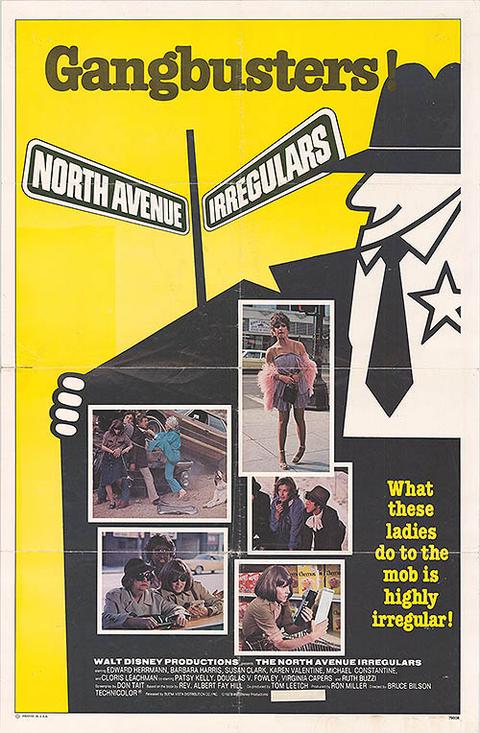
North Avenue Irregulars (1979)

By Richard Winters

My Rating: 7 out of 10

4-Word Review: Church ladies battle mobsters.

Reverend Michael Hill (Edward Herrmann) becomes the new pastor at the North Avenue Presbyterian Church, but right away things get off to a rocky start when the church’s funds get gambled away on a horse race. When Hill tries to retrieve the money he finds out that it is an illegal gambling joint run behind a dry cleaning business, who are always able to skillfully remove their presence before the police arrive. Hill goes on TV to lambaste organized crime in their town, which catches the attention of two treasury agents (Michael Constantine, Steve Franken) who want Hill to help them close down the gambling joints by having him hire men from his church to place bets at the parlors, but all of the men refuse. Hill then asks for the help of the church women who agree to do it and after some initial setbacks begin to make headway in taking down the area mobsters.

Usually I always say it’s important for films that are aimed for a young audience to have children playing the protagonist, but in this case the children characters have only small supporting roles and yet the film still manages to deliver the laughs. The main reason is the talented female cast who have distinctive personalities and convey comic form in different ways. Cloris Leachman is amusing as the middle-aged cougar with long finger nails, Virginia Capers is quite funny too as a heavy-set woman who doesn’t allow her big build to stop her from running several blocks in order to tail the bad guys and the variety of vehicles she drives with funny phrases painted on their windshields, which are all from her husband’s used car dealership, are humorous too. Barbara Harris as a suburban mother who chases the mobsters while driving in a station wagon packed full of kids in it is great too.

What may be surprising to many is that it’s all based on true events that occurred to Revenrend Albert Fay Hill when he took over as the minister at the North Avenue Presbyterian Church in New Rochelle, NY in 1961. It was there that he became a crusader against organized crime after the murder of a young man for not repaying his gambling debts. Like in the movie his fight gained the attention of US Treasury agents who wanted him to get his male parishioners to place bets with the mobsters, but the men all refused so he recruited their wives whose efforts managed to shut down several gambling houses, which lead to a front page write-up in The New York Times as well as Look magazine.

Of course the movie exaggerates things for comic effect, but it’s forgiven because the stunts are quite funny, which culminates in a massive car pile-up consisting of the demolition of 14 cars at the cost of $155,000. The scene involving the church getting blown up is amusing too because behind-the-scenes when it was first done the cinematographer forgot to put film in the camera forcing the crew to painstakingly rebuild the church just so they could try to do it all over again.

The film’s only weak element is Herrmann whose performance is certainly sincere and likable, but he’s never funny while Constantine is hilarious as the exasperated agent who has a virtual nervous breakdown dealing with the women and for that reason the film would’ve been more engaging had he been the lead character. I was also confused why the Reverend was  a single parent as there’s no explanation I could remember for what happened to the wife. In the book that this film is based, and in the true-life incident, the minster was married, so why was it decided that he should be single here? I got the idea it was because they wanted to create a romance between he and his secretary played by Susan Clark, but since nothing much comes from that it seemed unnecessary.

My Rating: 7 out of 10

Released: February 9, 1979

Runtime: 1 Hour 40 Minutes

Rated G

Director: Bruce Bilson

Studio: Buena Vista

Available: DVD, Amazon Video, YouTube

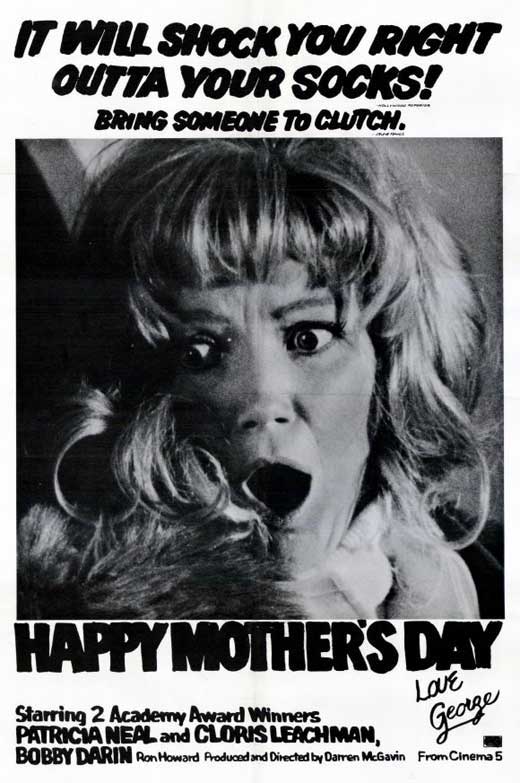
Happy Mother’s Day, Love George (1973)

By Richard Winters

My Rating: 3 out of 10

4-Word Review: Searching for his father.

Johnny (Ron Howard) is a young man who arrives in a small seaside town searching for the identity of his parents. After speaking with the various eccentric personalities that live there he come to the determination that a waitress at a local cafe named Ronda (Cloris Leachman) is his mother, but she refuses to divulge who the father is and he begins to suspect that the secret may lie in the strained relationship that she has with her sister Cara (Patricia Neal).

It’s hard to tell what motivates people to take on certain projects. Darren McGavin had a great career in front of the camera, but this remains outside of a few TV episodes that he did, his only foray as a director. Yet it means little as the story is quite pedestrian and moves at a slow pace making it seem more like a drama and it takes until the third act before there are any chills at all.

The on-location shooting, which was done in the seaside towns of Mahone Bay and Lunenburg that are both situated in the Canadian province of Nova Scotia, is quite scenic and it almost seemed like McGavin and his crew had access to the entire town as the camera follows Howard walking up and down the residential streets while homeowners stare out their windows at him at each house that he passes. If this was a film specializing in the New England vibe it would be a success, but as a horror film the plot progresses too slowly and by the time the mystery finally gets answered you really don’t care  anymore.

The eclectic cast is interesting and really the only reason to watch it. Bobby Darin, in his last film, shows great potential as a feisty short-order cook, but his screen time is painfully limited. Neal gets in a few snarky remarks, but not much else and Leachman essentially channels the same character that she played in The Last Picture Show.

The one that gets the showiest part is Tessa Dahl who was Neal’s daughter in real-life and looks almost exactly like her to the point that I initially thought she was Neal at first. Her British accent helps add some flair as does her knife-wielding finish. Even more ironic is the fact that she has grown in recent years to suffer serious mental health issues much like her character.

As a novelty this film, which was reissued as Run Stranger Run, might be worth checking out just to see Opie with dark brown hair instead of his trademark red, but as a horror flick it lacks punch and has very little scares.

Alternate Title: Run Stranger Run

Released: August 17, 1973

Runtime: 1 Hour 30 Minutes

Rated PG

Director: Darren McGavin

Studio: Cinema 5 Distributing

Available: VHS

Foolin’ Around (1980)

foolin around 2

By Richard Winters

My Rating: 4 out of 10

4-Word Review: Redneck falls for hottie.

Wes (Gary Busey) is a college student who has moved from Oklahoma to Minnesota to attend the university. Desperate for some extra cash he takes part in a program run by the student science department where he gets strapped to a chair and given an electrical shock every time he gives a ‘right’ answer. The procedure is facilitated by Susan (Annette O’Toole) who’s an attractive coed there. Wes is immediately smitten, but finds himself in an uphill battle as she is already engaged to Whitley (John Calvin) an obnoxious stuck-up social climbing man whose equally arrogant mother (Cloris Leachman) wants her to have nothing to do with Wes and tries to completely shut him out of her life.

Although far from a critic darling this obscurity still manages to have a few funny scenes. The best are Wes’s encounters with Whitley particularly when Whitley tries parking his car in wet cement or trying to subdue an out-of-control carpet cleaner in his office. Wes’s conversation with Susan’s grandfather (Eddie Albert) high up on the edge of a skyscraper under construction is nerve-wracking particularly when Albert walks out to the end of a beam hundreds of feet up and then challenges Busey to do the same. The film also has a unique car chase that features an automobile made to look like a giant hot dog as well as a hang gliding segment through the Minneapolis skyline that is downright exhilarating.

Busey does well as an amiable doofus in a part that seems best suited for his acting ability. O’Toole is at the peak of her beauty and Leachman manages to get a few choice moments as the meddling mother. Tony Randall is fun as a snooty butler with a French accent and it’s great to see William H. Macy in an early, but brief part near the beginning.

The on-location shooting done in the state of Minnesota adds some verve particularly the segment done on the sidelines of an actual Vikings-Rams football game. Unfortunately the script is threadbare with certain gags that become labored and lame and a romantic angle that is sappy and contrived. It is also hard to believe that Susan would for even a remote second consider marrying the Whitley character who is a one-dimensional arrogant asshole to the extreme. It is even more absurd that she would fall in-love with Wes as she is clearly out of his league both physically and intellectually and it’s about as farfetched as Busey ever one day winning the Academy Award.

My Rating: 4 out of 10

Released: October 17, 1980

Runtime: 1Hour 40Minutes

Rated PG

Director: Richard T. Heffron

Studio: 20th Century Fox

Available: VHS

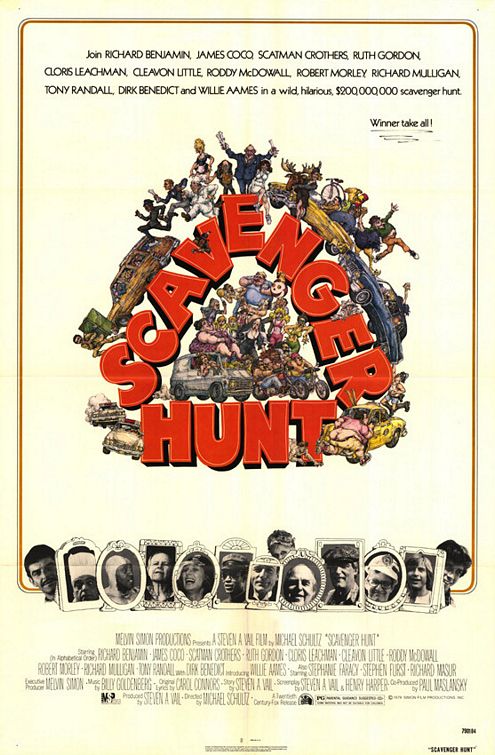
Scavenger Hunt (1979)

scavenger hunt 3

By Richard Winters

My Rating: 6 out of 10

4-Word Review: Mad dash for money.

When rich toy inventor Milton Parker (Vincent Price) dies all of his relatives gather for a reading of his will hoping to get a giant share of his 200 million dollar estate. There’s his greedy sister Mildred (Cloris Leachman) along with her child-like grown son Georgie (Richard Masur) and shyster lawyer Stuart (Richard Benjamin) his servants (Cleavon Little, Roddy McDowell, James Coco, Stephanie Faracy) a dimwitted cab driver (Richard Mulligan), his nephews Kenny (Dirk Benedict) and Jeff (Willie Aames) as well as his son-in-law Henry (Tony Randall) and his four children.  At the reading they are given a list of items each having a certain point total and told that whoever can collect the most items by the end of the day will be given the inheritance. Everyone then splits off into five teams and scours the city of San Diego looking to collect everything from a fat person, to a toilet and even an ostrich.

The natural inclination would be to write this movie off as being lame right from the beginning as the characterizations are quite broad, the action very cartoonish and the humor at an almost kiddie level, but farce/slapstick is a legitimate movie genre, so lambasting it simply for being silly isn’t really fair. Yes, you will have to park your intellect at the door to enjoy this one, but I found myself laughing more than I thought and it is great mindless escapism for the whole family without ever being crude or offensive. It also has Cloris Leachman who adds to her already legendary and eclectic resume by playing another extreme character and flying with it.

The film has a few hilarious bits including the servants stealing a toilet inside the bathroom of a post hotel and then later on while in a science lab getting attacked by a ‘giant soufflé’. Benjamin’s confrontation with an angry gang of bikers led by Meat Loaf is pretty good and the wild car chase that ensues at the end isn’t bad either. The film successfully interweaves moments of cynical humor as well, which helps make it more agreeable to older teens and adults.

There are also a myriad of famous faces in bit parts that are funnier than the main cast. I loved Ruth Gordon as a tough talking old lady and Robert Morley as the lawyer heading the estate whose facial expression when Leachman hugs him is a gem. Henry Polic II appears as a motorcycle cop who comes into contact with laughing gas and then loses his uniform and there is Arnold Schwarzenegger as an overzealous fitness instructor. I also really liked Scatman Crothers who appears for a while as Mulligan’s partner and then disappears only to come back in a pivotal part at the very end and even sings over the closing credits.

The only thing that really got on my nerves was Richard Masur as the overgrown man-child named Georgie. Acting wise he does it pretty well, but there is never any explanation why a grown man would be acting so infantile. Was he mentally challenged, or just mentally ill? It is never explained, but comes off more as creepy than funny. I also didn’t like Faracy initially as the dumb French maid, but she grew on me and eventually I came to adore her especially when she tells off Coco. Randall, as a beleaguered father is pretty much wasted, but I did like Julie Ann Haddock as his oldest daughter who later went on to play Cindy Webster on the first three seasons of ‘Facts of Life’.

African American director Michael Schultz shows quite the flair for variety. He started his career doing black-themed films like the classic Cooley High and Car Wash only to turn around and direct the Bee Gees in Sergeant. Pepper’s Lonely Club Hearts Band and then this one, which is in every way diametrically different from his earlier work, but still an accomplishment for his ability to take on such varying works and genuinely be successful at them.

Filmed entirely on-location in San Diego this film can be great fun for kids of all ages even those that are over 40.

My Rating: 6 out of 10

Released: December 21, 1979

Runtime: 1Hour 55Minutes

Rated PG

Director: Michael Schultz

Studio: 20th Century Fox

Available: VHS, YouTube