Tag Archives: Christopher Plummer

The Boss’ Wife (1986)

By Richard Winters

My Rating: 3 out of 10

4-Word Review: She comes on strong.

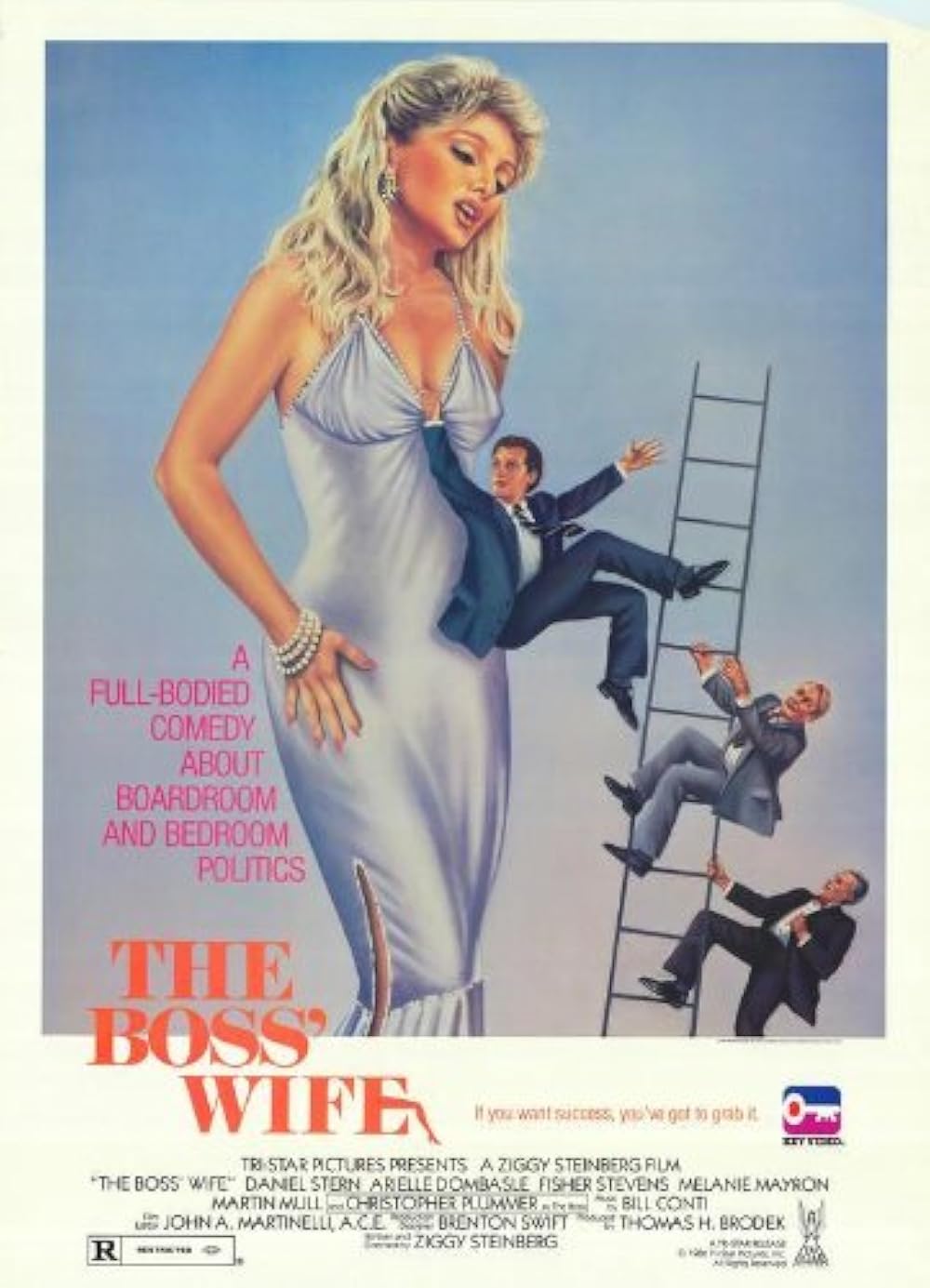
Joel (Daniel Stern) works at a stock firm and wants to impress his boss (Christopher Plummer) with some stock analytics and competes with fellow employee Tony (Martin Mull), who’s a major corporate brown noser. The boss though is not the smartest and misreads everything including thinking that Joel is a smoker, which he isn’t, and giving him the nickname of ‘smoky’. He also thinks that Joel is gay and having a fling with Carlos (Fisher Stevens), which neither is true, but this allows the boss’ wife Louise (Arielle Dombasle) to openly come-on to Joel while the boss, so worried that Joel may come on to him, feigns naivety at what his own wife is doing. Joel tries to avoid the woman because he fears that if he doesn’t, he’ll get caught, which will not only hurt his job advancement, but also his shaky marriage to Janet (Melanie Mayron). 

The film is the product of Ziggy Steinberg who started his careers in the 70’s writing for episodes of TV-shows and then graduating to feature films like Porky’s Revenge and then ultimately Another You, which to date has been the last writing gig he’s done. This film marked his debut as both a writer and director, but the results are so-so. The concept is predictable and better suited for an episode of ‘Three’s a Company’, which he also wrote for, than the big screen. While the attempt is for screwball the pacing is slow and not a lot of gags going on and as satire/parody its target is so obvious and been done so many times before that it hardly seems worth the effort as one could simply watch How to Succeed at Business Without Really Trying and get a lot more laughs. In fact, the only amusing moment comes when Plummer has a toy choo-choo train ride onto his desk carrying drinks and hamburgers and then Stern fumbling around to get ketchup on his burger, which causes a red mess on the boss’ desk.

The acting from the two male leads is adequate. Stern’s character is benign, but he plays it in a likable way making you connect to him and his quandaries. Plummer is quite good particularly with the way he roles his blue eyes every time he comes to a mistaken conclusion to something. Stevens has some good crude moments who initially starts out as Mayron’s employer only to create a haphazard buddyship with Stern while on the train. 

Dombasle though is quite possibly the film’s weakest link. She enters in almost like a fantasy figure and has little dialogue. Why this voluptuous woman would get so focused on Stern for no apparent reason doesn’t make a lot of sense. He does not stand out in any way and therefore a woman like her would overlook and even ignore him. She comes onto him in such a shameless and extreme manner even while in public you could argue she was mentally ill. Even if she’s desperate for sex cause she’s not getting enough from her older husband she could still, with her money, find ways to get it, through like male escorts, than groveling in such a ridiculous level towards a chump like Stern. Later it does come out that she is ‘attracted to men who resist’, which helps explain her motivations a little, but it would’ve been more entertaining had the Mull character paid her, or worked out some deal with her, to come onto Stern in  order to get him into trouble with Plummer, which would’ve offered a nice unexpected twist, which unfortunately the script doesn’t have. 

Spoiler Alert!

The final 10-minutes in which Plummer corners Stern in his rental home with both his wife and Stern’s and the myriad excuses Stern comes up with to try and get out of the jam is sort of funny, but it takes too long to get there. That frantic, hyper-pace should’ve been present from the very beginning and it just isn’t. Stern’s character arc where he finally concludes that the company culture is too conform-ridden for his liking is strained as well. If anything, he should’ve figured that out long before he goes to a company party and asked to where a silly hat like everyone else, which was one of the least problematic things at that place and yet this is where he suddenly decides to ‘draw-the-line’. 

My Rating: 3 out of 10

Released: November 7, 1986

Runtime: 1 Hour 23 Minutes

Rated R

Director: Ziggy Steinberg

Studio: Tri-Star Pictures

Available: DVD-R, Amazon Video, YouTube
The Return of the Pink Panther (1975)

By Richard Winters

My Rating: 7 out of 10

4-Word Review: Tracking down stolen diamond.

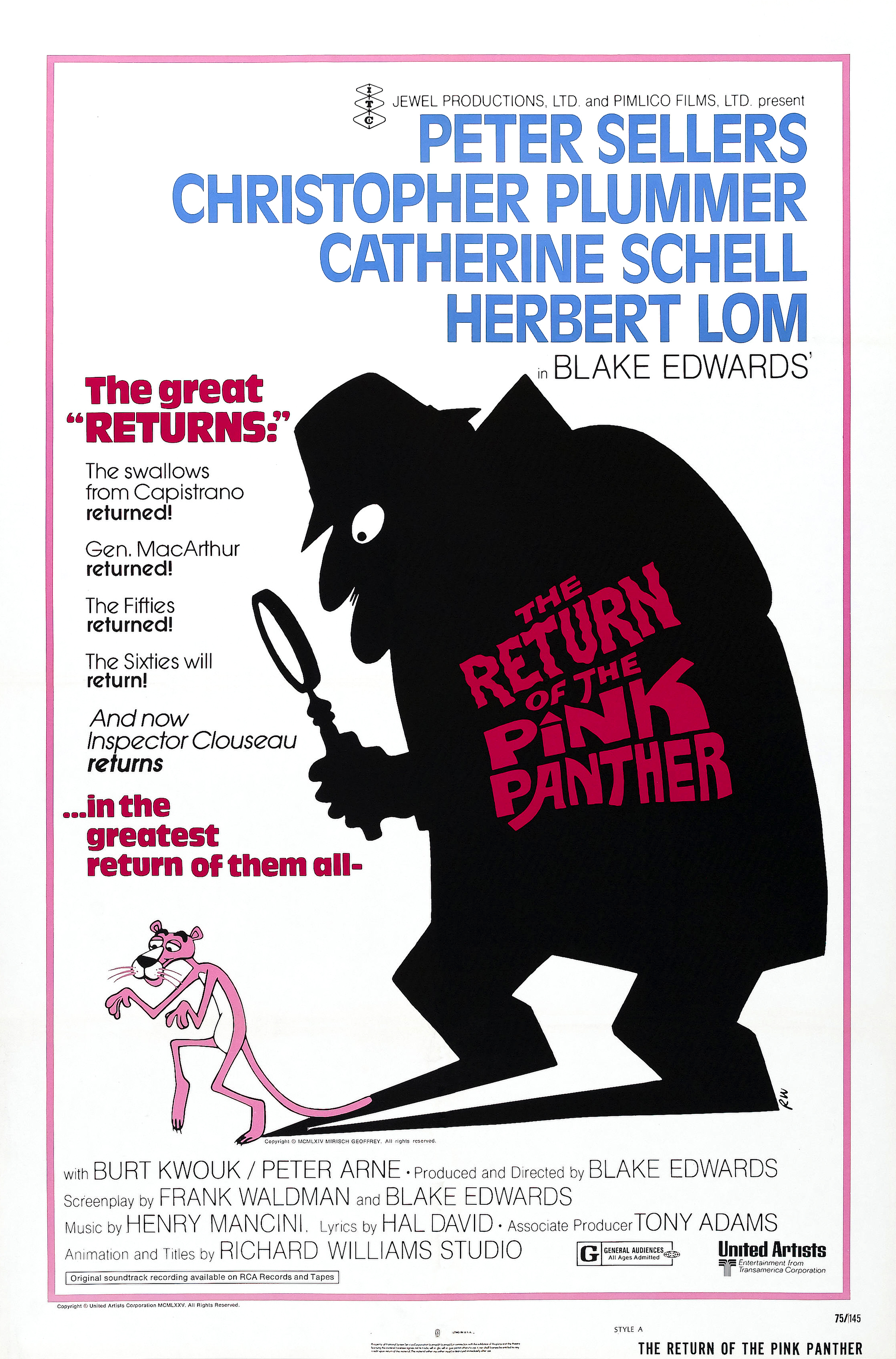
Inspector Clouseau (Peter Sellers) has been demoted to street cop by Chief Inspector Dreyfuss (Herbert Lom) due to Clouseau’s continual incompetence, which is starting to drive Dreyfuss completely mad. However, inside the country of Lugash a prized diamond known as the Pink Panther is stolen and since Clouseau had success retrieving it the first time it went missing during a heist he is put on the case to find it again much to Dreyfuss annoyance. Clouseau suspects that the culprit is Charles Litton (Christopher Plummer), who is a notorious thief. Clouseau attempts to use several different disguises in order to infiltrate Litton’s home that he shares with his wife Claudine (Catherin Schell) in order to find incriminating evidence against Litton so that he can turn him in, but his attempts to try and a take Litton down prove to be comically inept. 

This marked the fourth installment of the Pink Panther series and the first in 10-years that reunited writer/director Blake Edwards with Sellers. Both had said after doing the second film A Shot in the Dark, that they never wanted to work with the other again due to much infighting during the production, but both had since then fallen on hard times. Edwards was by the early 70’s considered box office poison after the colossal failure of Darling Lilli which managed to recoup a measly $3 million from a $25 million budget and his other films from that era Wild Rovers and The Carey Treatment hadn’t done much better. Since Pink Panther had been his last success, he was interested in reviving it and even wrote up a 14-page treatment but found no takers amongst the major studios. Then producer Lew Grade agreed to finance it in exchange for Edward’s wife Julie Andrews agreeing to star in a British TV-special that he wanted to produce. Since Sellers career had also bottomed out, he came onboard to most everyone’s surprise without much hassle.

The film was shot in many scenic locations including Morrocco giving the optics an exotic flair and the proceedings a sophisticated European vibe making it seem like a step-up from just a silly comedy. In the first two installments all the characters were written to be funny and goofy particularly the second film, which had been based on a stage play. Here though the comedy is wisely given over to Sellers while the couple he’s after remain savvy, which makes it more intriguing as you want to see how this inept idiot takes them down, or is able to trip them up at their own game. I also liked how funny bits are interspliced with some legitimate action, especially the opening scene that features the heist, which could’ve easily fit into a realistic film dealing with a robbery. These moments help add a bit of relief from all the laughs, a sort of chance to catch your breath, while making the plot seem like it’s not just all about being a farce.

Lom adds terrific support as Clouseau’s exasperated supervisor, and his assertive acting style works nicely off of Sellers clownish one making the interplay between the two a highlight. It’s good too that Plummer replaced David Niven, who played the character in the first one, but wasn’t able to do it here due to scheduling conflicts, as Niven would’ve been too old and not plausible to have outrun the bad guys like Plummer does. 

My only issue is that Claudine is shown attempting to hold in her laughter at Clouseau right from the start like she knows he’s an idiot before she even met him, but this goes against the premise. Clouseau is considered an accomplished detective by the outside world hence why he was selected to head the case and it’s only the people that work with him and know him who are aware of his ineptness. This is the whole reason why Dreyfuss gets driven mad by him because the rest of the world celebrates the man that he knows is really a fool, so Claudine should’ve initially thought of him as being sharp and only came to the conclusion he was incompetent by the end after having dealt with him. It actually would’ve been funnier had she and Charles feared Clouseau upfront having believed his celebrated reputation and misreading his bumbling as being ‘genius’ ploys and remained that way throughout. In either case seeing her covering her mouth and shielding her giggles makes almost seem like she’s falling out of character and a blooper, similar to how Harvey Korman would unintentionally crack-up during Tim Conway’s antics on the ‘The Carol Burnett Show’ and for that reason it should’ve been avoided. 

My Rating: 7 out of 10

Released: May 21, 1975

Runtime: 1 Hour 54 Minutes

Rated PG

Director: Blake Edwards

Studio: United Artists

Available: DVD, Blu-ray, Amazon Video, YouTube

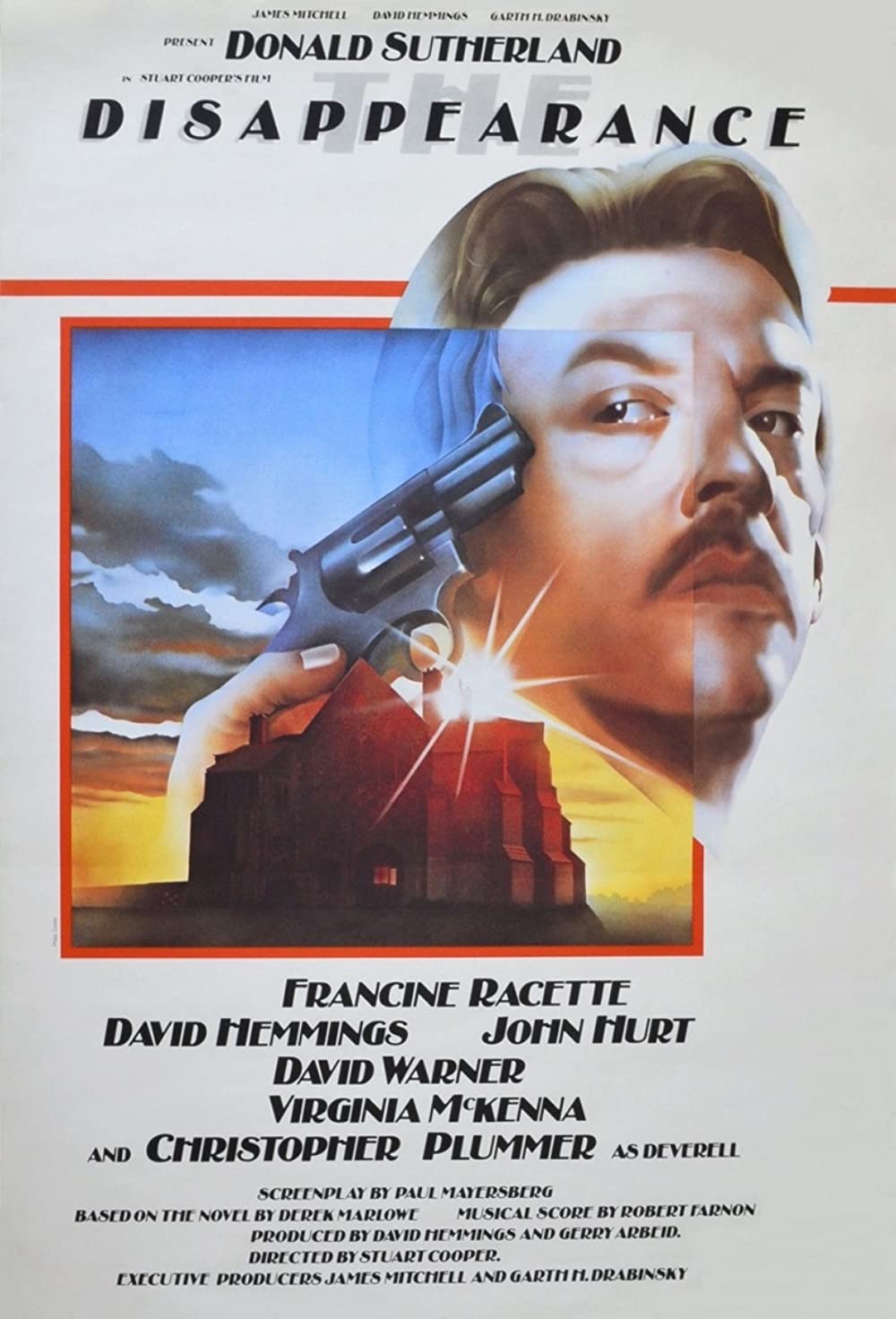
The Disappearance (1977)

disappearance

By Richard Winters

My Rating: 7 out of 10

4-Word Review: Where is his wife?

Jay Mallory (Donald Sutherland) is a professional assassin who works for a secret organization that contracts him out to do hits all over the world. After returning home from his latest assignment he finds that his wife Celandine (Francine Racette) is not there. Since they had a tumultuous relationship he initially presumes she left on her own accord, but then his friend and fellow hit man Burbank (David Warner) informs him that her disappearance may have something to do with his last hit. The organization that employs him now calls with another assignment, but this time they’re reluctant to give any details, which is unusual. Jay is afraid he’s being set-up as Burbank told him that the company is known to ‘retire’ those that are deemed no longer useful or trustworthy. He decides though to go through with the assignment as he’s curious how it will play-out and confident enough in his ability to get out of any jam, but soon finds himself faced with an entangling twist he never expected.

The film is a fascinating portrait of what can be done with creative direction. Stuart Cooper, who’s not exactly a household name and in fact this was his last theatrical film until 2010 when he did Magic Man, lends some interesting directorial touches that makes the story and characters more interesting than they might otherwise. What I especially liked was the non-linear narrative in which the movie cuts back and forth between the past to the present day. These types of storylines are typically frowned upon by Hollywood studios as they’re considered to be ‘too confusing’ for mainstream audiences to follow, but I had no such difficulty and felt it allowed in added nuance that would not have been present had the plot been approached in the conventional way. Nonetheless when the film tanked at the box office upon its initial release the studio insisted that the film be re-cut where the story would be presented in the standard linear format, but this version did even worse, so fortunately for the DVD/Blu-ray release it was brought back to its original way and labeled as being the ‘director’s cut’ though Cooper actually had no input on it, but eventually approved once he viewed it.

It’s also highly atmospheric particularly with the way it captures the cold, wintry climate of Montreal in the dead-of-winter. Having been born and raised in Minnesota I can tell a fake winter scene done on an indoor sound stage using artificial snow within seconds, but here the cold, including the mounds of snow drifts and nasty hollowing wind, is quite vivid and helps to symbolize the cold nature of the characters and the business they’re in.

I was a little more lukewarm with the acting. Sutherland can certainly be an outstanding leading man, but he seems too kind and sensitive for a person making a living killing others for money though I did like the scene where he plays memory games with his wife while at home, which brings out how crucial paying attention to detail is for his line of work. The supporting players are all familiar faces though I felt Warner was a bit wasted and underused. Virginia McKenna, best known for her starring role in the classic Born Free, is seen for only a brief bit though her interaction with Sutherland is quite pivotal while Christopher Plummer doesn’t appear at all until the final 15-minutes, but still manages to come-off with a memorable presence.

Spoiler Alert!

The film’s biggest downfall though is with the ending, which becomes one twist too many. Up until that point the twists had been a logical fit that made sense when you went back and thought about it. Then at the very end Sutherland gets shot and killed while walking home from the grocery store, but it’s never shown who did it, or why. Maybe it was the secret organization that wanted to ‘retire’ him, but this needed to be shown and explained. Just leaving the viewer hanging with a violent, but vague scenario isn’t satisfying and cheapens the rest of it.

My Rating: 7 out of 10

Released: September 17, 1977

Runtime: 1 Hour 31 Minutes

Rated R

Director: Stuart Cooper

Studio: Trofar

Available: DVD (Region 2), Blu-ray

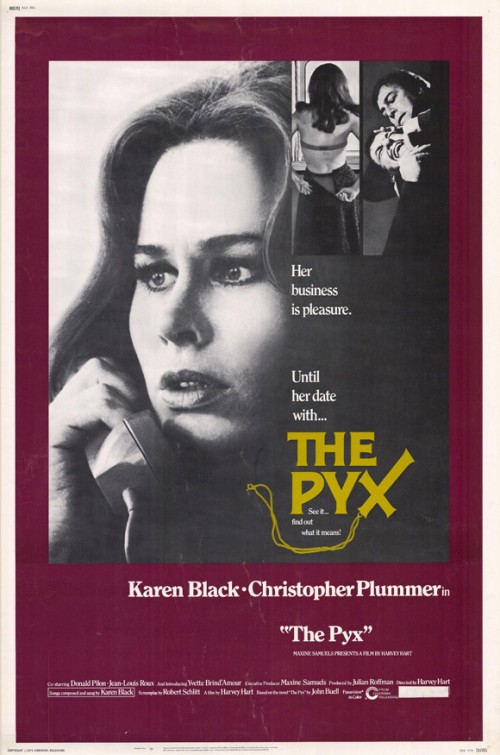
The Pyx (1973)

By Richard Winters

My Rating: 5 out of 10

4-Word Review: Religious cult wants prostitute.

A woman is seen falling from a high-rise tenant building to her death and Police Sergeant Jim Henderson (Christopher Plummer) is assigned to the case. When he inspects the body he finds that in her right hand she is holding a crucifix and in her left one is a small metal container known as a pyx. The victim is later identified as being Elizabeth Lucy (Karen Black) a heroin addict who works as a prostitute. The film then cuts back and forth between showing Elizabeth when she was still alive and the circumstances that lead to her death as well as Jim’s dogged search to find her killer, which may be connected to an underground religious cult.

The film, which is based on the novel of the same title by John Buell and shot entirely on-location in Montreal, has a nice eerie atmosphere.  The cutting back and forth between the two linear stories is interesting and this is the type of mystery that is complex, but not too much. There are just enough clues given to keep it intriguing without so much thrown in that it becomes convoluted. The slow pacing is okay because it keeps things on a realistic level and everything remains plausible and gritty.

Unfortunately the story has no payoff. The slow reveal of the religious cult offers nothing new or exciting and seems to be borrowing elements from other horror flicks that have dealt with the same theme. Except for a few brief moments the film is devoid of any action and the shootout on a yacht is edited in such a quick way that it’s hard to follow what happened. The overuse of nighttime shots gives the film a grainy appearance that looks more like it was a victim of a low budget and poor lighting.

The two leads give good performances and Plummer looks almost unrecognizable with a bowl haircut and appearing almost 20 years younger than he already was. The music was composed by Harry Freedman and star Black does the vocals, which is distinctive and gets the viewer into a spiritual mood, but there aren’t any frights and it’s hard to put this thing into any type of category as it’s really not a horror film at all.

Even as a standard mystery it’s only average and just enough to hold your interest. Ultimately it goes down a familiar path that we’ve seen too many times before and is devoid of any true shock or surprises.

My Rating: 5 out of 10

Released: September 13, 1973

Runtime: 1 Hour 47 Minutes

Rated R

Director: Harvey Hart

Studio: Cinerama Releasing Corporation

Available: DVD-R, Amazon Video

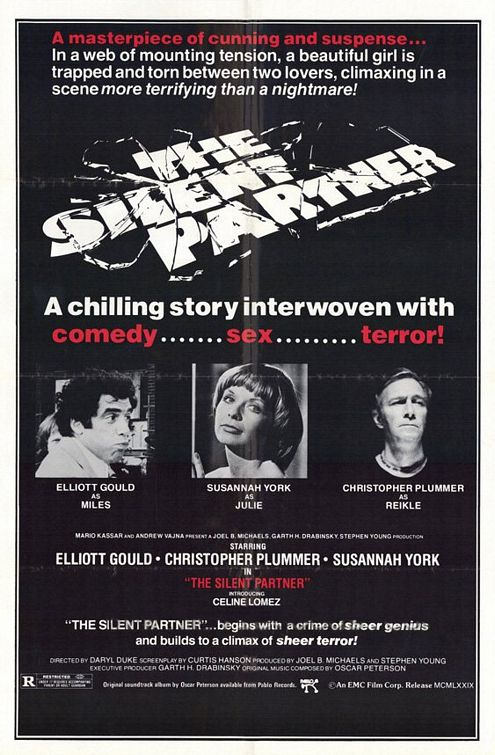
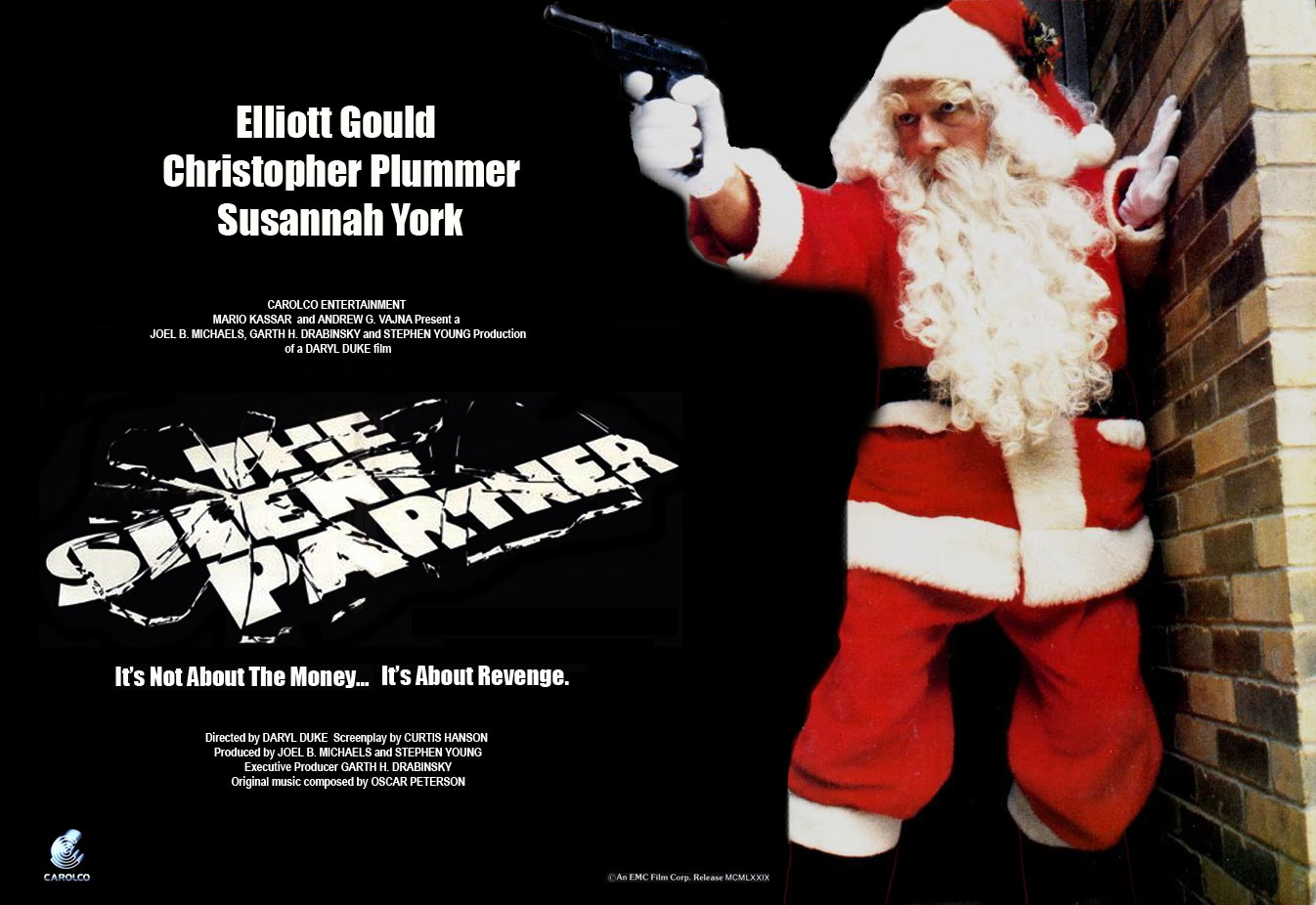
The Silent Partner (1978)

silent partner 2

By Richard Winters

My Rating: 8 out of 10

4-Word Review: Bank teller outsmarts robber.

This is an ingenious, slick, and really fun caper movie that puts a whole new spin on the old bank robbery theme. Here Elliot Gould plays a bank teller named Miles who, by sheer accident, becomes aware that a man named Harry (Christopher Plummer) is planning on robbing his bank. Miles decides to take the money from his till and put it into his lunchbox. Then when Harry robs the bank it is actually Miles the teller that gets the money while Harry goes away with very little. Yet this is only the beginning as Harry and Miles continue to play a crafty game of cat- and-mouse, which leads from one interesting twist to another.

Gould plays against type here and he does quite well. Usually he tends to be loud, argumentative, and anti-authority, but here he is quiet and unassuming. It’s the type of character you think wouldn’t have the guts to pull off what he does, which makes him all the more intriguing. In fact he just keeps surprising you all the way along, stringing the very psychotic and dangerous Harry in ways you couldn’t imagine. It is only his final move that seems to be testing the odds too much.

Plummer makes a terrific adversary. He is dashing and handsome as ever, but with an intensely sinister edge and an icy cold gaze.

Susannah York as Miles’ love interest Julie is wasted. Her character seems thrown in for good measure and at no time seems interesting. There is no chemistry between them and the whole love angle is forced and unnecessary. Celine Lomez, as Elaine the other female character, is different. She is stunningly beautiful and much cagier. She plays between both Harry and Miles and you are never sure which side she is really on. Her acting isn’t spectacular, but she is sensual and has a nice French accent. Her gory and gruesome demise though is unwarranted and works as a drawback to the movie.

There are a few other negatives about the film. One is the drab setting that takes place in Toronto and yet we hardly see any of it. Having the bank itself set inside a boring shopping mall is not too visually exciting. The same goes for Miles’s bland apartment. The supporting characters, especially the other bank employees are incredibly dull. Their lines and basic presence all seem to have been written in simply as ‘filler’. A young John Candy plays one of these co-workers and his comic talents are wasted.

Still the story is creative and has enough unique twists that it overcomes the technical shortcomings and manages to be a highly entertaining flick.

silent partner 1

My Rating: 8 out of 10

Released: September 7, 1978

Runtime: 1Hour 46Minutes

Rated R

Director: Daryl Duke

Studio: EMC

Available: VHS, DVD, Amazon Instant Video

Eyewitness (1981)

eyewitness

By Richard Winters

My Rating: 4 out of 10

4-Word Review: Janitor loves news reporter.

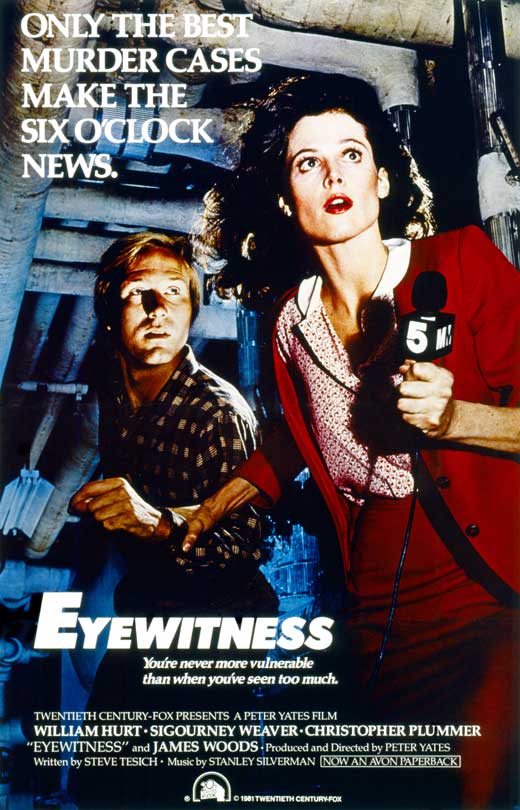
Daryl (William Hurt) is a nighttime janitor at a large Manhattan office building. He spends his otherwise lonely existence obsessing over a local news reporter Tony Sokolow (Sigourney Weaver) and records every news broadcast she is in and watches them each night when he gets home. Then a murder occurs in his office building and Tony covers it for her program. Daryl tries to use his inside knowledge to get closer to Tony, but is reluctant to tell her all the information he knows since he fears that it was his friend Aldo (James Woods) who committed the crime.

Hurt, who usually plays the intellectual type, does well here in the low-key role. Weaver is also excellent doing what she does best which is playing a tenacious no-nonsense woman who can take care of herself. My favorite part with her is when she is accosted by a couple of men with guns, but doesn’t scream, keeps her composure, and manages to get away.

The romantic angle is the film’s strong point. Tony’s on-camera interview with Daryl when she tries to get more information out of him, but he instead gushes about his undying love for her is funny. It is refreshing that when Daryl tells Tony about how he obsesses over her she doesn’t freak out and consider him a stalker, but instead is charmed by it. The two use each other for their own purposes, but the viewer is giving the impression that these are genuinely nice people who just have very contrasting personalities and approaches, which is what makes the budding relationship interesting. However, having them go to bed together and confirm their affections for each other seemed anti-climactic as it was more intriguing wondering if Tony really was starting to have feelings for Daryl, or just using him to get information and the film should have stayed at this level until the very end.

The mystery portion gets lost in the shuffle. The film is slow with very little tension. There are a few good action moments, but there needed to be more. The scene where Daryl almost gets crushed in a trash compactor had definite potential, but needed to be played-out longer. The part where he and Tony are attacked by a dog is very intense, but the climatic sequence where Daryl is chased by the killer through some horse stalls is certainly slick and well-shot, but it comes too late and I had already become bored and detached with it. The identity of the killer was a definite surprise, but it is also a bit preposterous and a little too convenient in the way it somehow manages to tie all the characters into it especially Tony.

Director Peter Yates does some excellent on-location shooting of New York City especially with the crowded streets and neighborhoods as well as Central Park, but the musical score is sparse and lacking. There is a pleasing jazzy score near the beginning that has a nice easy going beat to it, but then outside of a few tense moments there is nothing. This creates a film that is too quiet. Adding an urgent score could’ve helped make it more compelling, or at the very least given it more energy and personality.

There are a lot of familiar faces in supporting roles, but the majority of them are wasted. Morgan Freeman and Steven Hill as the police investigators who banter endlessly
with each other are dull and useless. Kenneth McMillan as Daryl’s handicapped father is dynamic, but pointless to the story as a whole. Christopher Plummer is always reliable, but he has done better. James Woods is good because he is a master at playing unhinged characters and I liked the casting of Irene Worth as Tony’s mother simply because she looked almost exactly like what Sigourney would end up looking when she reaches that age. This is also a great chance to see Pamela Reed in an early role as Daryl’s fiancée.

The film ends up biting off more than it can chew and the idea of mixing a cutesy romance with a murder mystery doesn’t gel and leaves a sterile effect in both areas.

My Rating: 4 out of 10

Released: February 13, 1981

Runtime: 1Hour 43Minutes

Rated R

Director: Peter Yates

Studio: 20th Century Fox

Available: VHS, DVD, Netflix streaming