Tag Archives: Anthony Perkins

Pretty Poison (1968)

By Richard Winters

My Rating: 7 out of 10

4-Word Review: Manipulated by attractive teen.

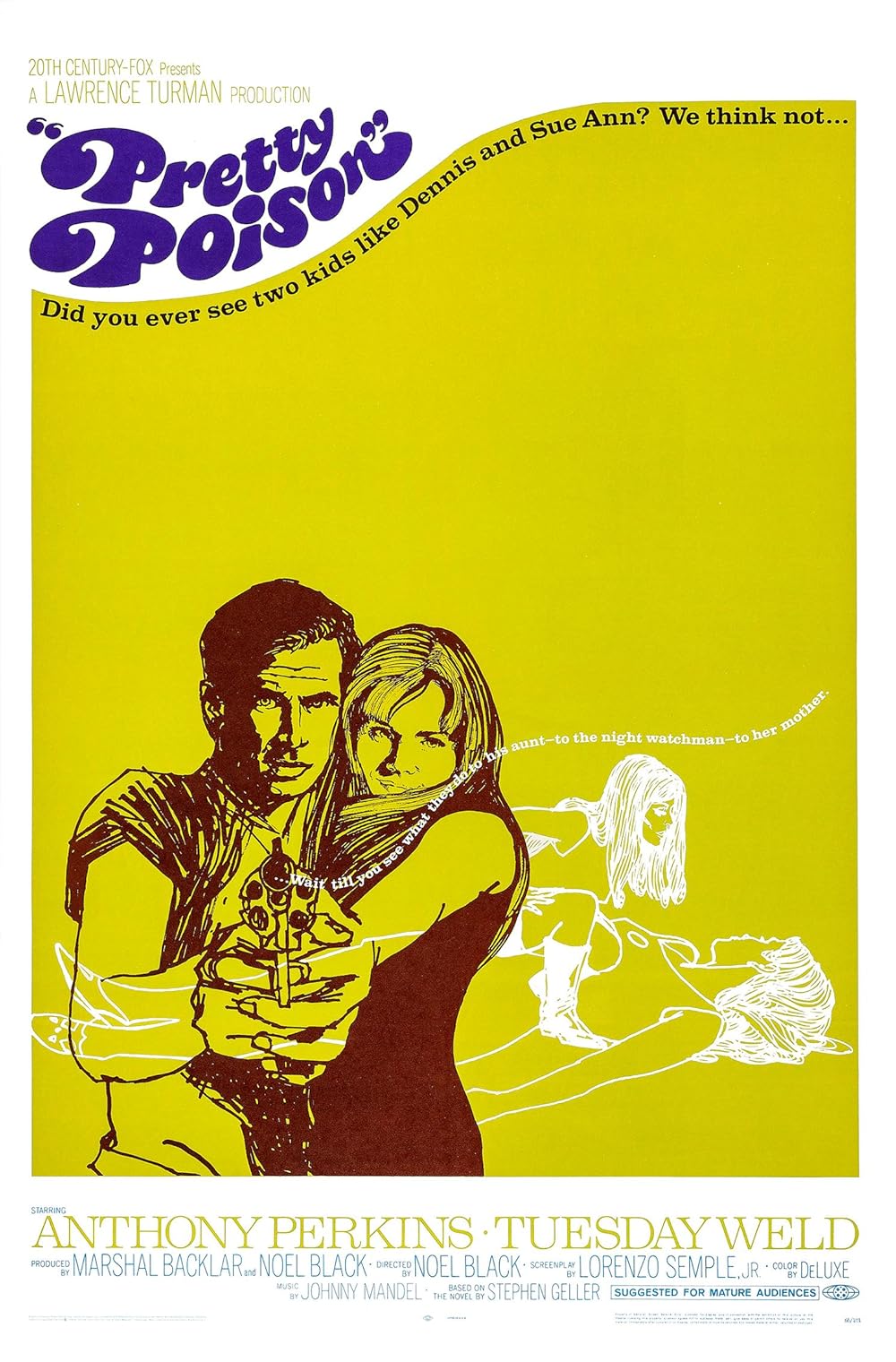
Dennis (Anthony Perkins) has been released from the mental institution after serving several years there for setting a home on fire. He gets a job at the local factory but finds it boring and begins to escape into fantasies. He spots pretty 17-yeard-old Sue Ann (Tuesday Weld) while she rehearses with her high school marching band and immediately becomes smitten. He’s never had experience dating anyone, so he decides he’ll pretend to be a CIA agent on a secret mission as a way to impress her and get her attention. He’s disgusted at the way the factory where he works at dumps pollution into the river and thus comes up with a scheme to destroy it using her help, but when a security guard spots them, Sue Ann kills him. Dennis is shocked with Sue Ann’s brazenness and realizes she’s not as innocent as she appears. He tries to cover-up the killing but finds that Sue Ann’s only getting started as her next target is her mother (Beverly Garland). Will Dennis try and stop it, or figure that appeasing her murderous desires may be the only way to keep her from going after him?

The film is based on the 1966 debut novel ‘She Let Him Continue’ by Stephen Geller and directed by Noel Black, who was just coming off the success of his award winning short Skaterdater and this was considered perfect material for his feature film debut. He described the story as “a Walter Mitty type who comes up against a teenybopper Lady MacBeth”. It was shot on-location in Great Barrington, Massachusetts, which gives it a quant small town atmosphere where supposedly ‘nothing ever happens’ and Beverly Garland gives a terrific supporting performance as the caustic mother.

However, Black had no background in working with actors leading to many confrontations behind-the-scenes between he and Weld and keeping the shooting production on schedule proved equally challenging, which got the studio to believe they’d hired a director who was in over-his-head and helped bring in added pressures. When the movie finally did get released, it fared poorly at the box office. Black felt this was because of the recent assassinations of Martin Luther King and Robert Kennedy, which made the studio timid to distribute it and thus few people saw it though in recent years its acquired a small cult following. 

One of the elements that really makes it work is Perkins who gives a splendid performance. Initially I thought it was a mistake to cast him as he would seem too much like his earlier, more famous character of Norman Bates, but he plays this part much differently. Here he comes off as smarter and less crazy. He does dabble in make believe at times but only does it to mask his insecurities and lack of life experience. Watching his emotional arc where he goes from feeling confident, thinking he’s in control with this supposedly naive young teen, only to ultimately have to grapple with his slow realization that it’s really she who’s pulling-the-strings is the most captivating thing in the movie. 

Weld seemed initially to be perfectly cast as she had already shown a propensity at playing characters quite similar to this one in classic episodes of ‘Route 66’ TV-show and ‘The Fugitive’. However, her age clearly belies her as she was 24 at the time it was filmed and looking nowhere near 17. Having a true teen playing the role may have made what she does even more shocking. She later said in interviews that she hated working on this project mainly because Black wouldn’t let her improvise her lines and you could see she just wasn’t fully into it, and it diminishes somewhat the full effect.  

Spoiler Alert!

While it’s intriguing the whole way the ending, which has Dennis calling the police and allowing himself to be put into jail, didn’t have quite the bang I was hoping for. Dennis had fallen hard for Sue Ann to the extent he felt she had ‘changed his life’ and gave meaning to his otherwise lonely existence. When people are in love with someone, they tend not to see the same red flags that others do, so even though she does some evil things I was expecting him to make excuses for it. Like she killed the nightwatchman not so much because she was a sociopath, but more because of her ‘love’ for him and knowing it would help him in his ‘secret mission’. The murder of the mother could’ve been approached the same way in his mind. She killed her only so they could be together, and he would view it as an ‘unselfish’ act versus a selfish one.

Seeing someone who starts out a bit cocky thinking he can ‘trap’ others with his fantasies only to learn that his own fantasy had trapped him would’ve been quite ironic. He could still be convinced of her love even as he’s arrested and thus his final meeting with her, in which he realizes that she’s betrayed him by going to the police, would’ve had more of an impact.

I didn’t feel that Dennis should’ve had to spoon-feed to his psychiatrist, played by John Randolph, that Sue Ann was really the killer, as the doctor should’ve been smart enough to figure this out for himself. Watching the psychiatrist then follow Sue Ann around in his car as she finds another man (Ken Kercheval) that she intends to manipulate leaves things too wide open. What exactly will this lead to? Will the doctor stop her from killing again before it’s too late, or will Sue Ann realize she’s being followed and have the doctor killed? This is something I feel the film should’ve answered. 

My Rating: 7 out of 10

Released: September 18, 1968

Runtime: 1 Hour 29 Minutes

Rated R

Director: Noel Black

Studio: 20th Century Fox

Available: DVD, Blu-ray, Amazon Video, YouTube
Double Negative (1980)

By Richard Winters

My Rating: 4 out of 10

4-Word Review: Who killed his wife?

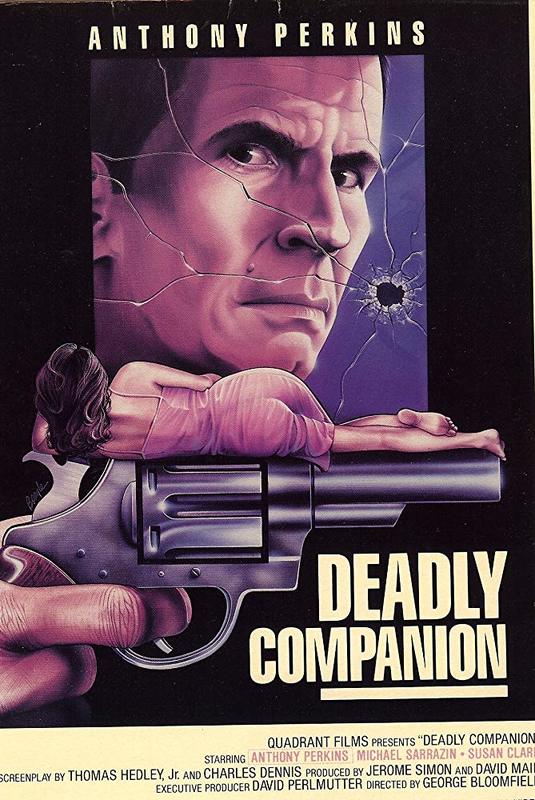
Michael (Michael Sarrazin) is a photojournalist tormented by fragmented memories of his wife’s murder. Paula (Susan Clark) is his girlfriend who’s trying to help him sort through these flashbacks, so he can find some answers. However, she too has things to hide as she’s busily paying off a man named Lawrence Miles (Anthony Perkins) who threatens to go to the police about what he knows about the killing. There’s also Lester (Howard Duff) a private investigator who sticks his nose too deeply into the case and finds himself at deadly odds with both Lawrence and Paula.

The film is based on the 1948 novel ‘The Three Roads’ written by Ross Macdonald under his real name Kenneth Millar. Macdonald later went on to have a stellar career writing novels about private investigator character Lew Archer and this story has plenty of potential but gets mishandled and ultimately becomes a misfire. A lot of the problem stems from the production employing three different writers who all had different perspectives on where they wanted the story to go and then relying on director George Bloomfield to cram it all together, which he doesn’t succeed at. The result is a fragmented mishmash that takes a long while to become intriguing and even then, remains interesting only sporadically. Lots of extended scenes particularly at the beginning that should’ve been trimmed and a poor pacing that barely manages to create any momentum.

It doesn’t help that the main characters are wholly unlikable and uninteresting. Clark especially comes off as arrogant right from the beginning when we see her drive by what appears to be Amish people in a horse and buggy fighting through the snow and cold while she enjoys things in her warm ritzy car, which makes her seem detached and uncaring. The scene where she’s trying to procure an important real estate deal and then gets hampered by Michael playing loud music in the other room, so she then excuses herself and promises to be right back. I was fully expecting her to yell at Michael for his misbehavior, but instead she strips off her clothes and the two make love, but it seemed like sex should be the last thing on her mind during such an serious business meeting and what would happen if the clients, who were just a door away and waiting for her return, would walk in on them? 

Sarrazin doesn’t cut it either. I know he’s been lambasted by critics in his other film appearances for being too transparent and forgettable and yet I’ve usually defended him as I feel he can sometimes be effective even given the right material. Here though he falls precariously flat. Some of it is the fault of the writing which doesn’t lend him to create a character with any nuance, or likability, but in either case he’s a complete bore and the viewer isn’t emotionally invested in his predicament. His flashback moments where he sees himself in some sort of prisoner of war camp doesn’t make a lot of sense, or have much to do with the main plot, and seems like something for a whole different movie. 

On the other hand, Perkins is fantastic and the only thing that livens it up to the extent that he should’ve been given much more screen time as the film sinks whenever he’s not on. It’s great too at seeing SCTV alums like John Candy, Eugene Levy, Joe Flaherty, Dave Thomas, and Catherine O’Hara in small parts where with the exception of Candy they’re not comical but instead make a rare turn at being dramatic. Duff is kind of fun and has one great moment, really the only good one in the movie, where he gets trapped in an elevator and must escape being shot by Perkins, who has his arm lodged in the otherwise closed doors, by desperately running back and forth in the closed space that he’s given. Michael Ironside has a memorable bit too as a bar patron who becomes incensed at Sarrazin when he refuses to allow him to buy him a drink. 

Spoiler Alert!

The denouement just leaves more questions and fails to tie up the loose ends as intended. For one thing it shows Sarrazin as being the one who strangled his wife, which I had started to suspect a long while earlier, so it’s not a ‘shocking surprise’ like I think the filmmakers thought it would. It also has Perkins leaving the scene, as he was having an affair with the woman, and even briefly speaking to Clark who witnesses him going, so why he’d insist Clark needs to pay him hush money didn’t make much sense. Sure, he could still go to the police and say that it was Sarrazin that did it, but Perkins fingerprints were at the scene of the crime, so I’d think either way he’d get implicated, and Clark could come forward saying she was a witness who saw him leaving. If anything, Clark should’ve been pushing him to go to the cops versus bribing him to stay away.  

Also, the way it gets shown, Clark comes into the bedroom after Sarrazin has already strangled his wife, so all she sees is him weeping over his wife’s dead body. For all she knew, from that perspective, is that Perkins really did kill the woman and Sarrazin was simply the first to come upon her dead body and thus for it to be crystal clear Clark should’ve entered while he was still in the middle of the act versus when he was already done.

Beyond that is that question of why would Clark want to stay with someone she knew had such violent tendencies? Wouldn’t she be afraid he could get upset at some point and do that to her? Sarrazin even asks her at the very end if she is afraid and her only response is: ‘aren’t you’? This though only muddles things further cementing it as a botched effort. 

Alternate Title: Deadly Companion

My Rating: 4 out of 10

Released: May 12, 1980

Runtime: 1 Hour 36 Minutes

Director: George Bloomfield

Studio: Quadrant Films

Available: Amazon Video

Psycho III (1986)

psycho3

By Richard Winters

My Rating: 3 out of 10

4-Word Review: Norman gets a girlfriend.

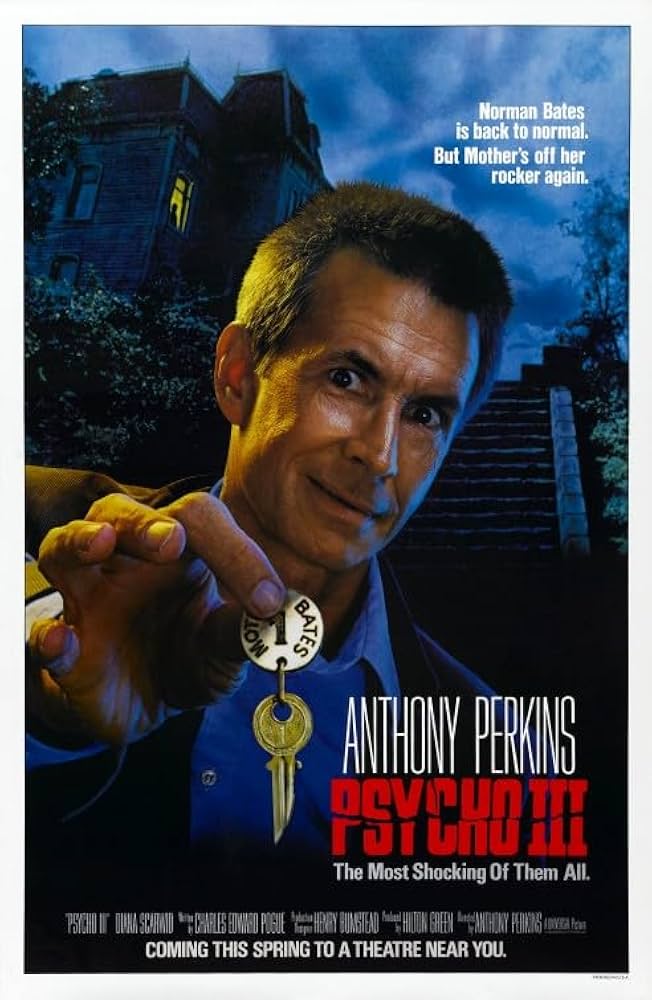
The story begins a month after the one in the second installment ended with police searching for the whereabouts of Emma Spool (Claudia Bryar) whom Norman (Anthony Perkins) killed and now keeps her preserved body in his home and yet curiously the police don’t suspect him. Meanwhile a roving journalist named Tracy Venable (Roberta Maxell) does and she keeps trying to get interviews with Norman in an effort to weed-out the truth while also snooping around his property any chance she gets. Maureen (Diana Scarwid) is a nun who’s lost her faith and thus left the convent and rents a room at the Bates Hotel. She closely resembles Marion Crane, one of Norman’s earlier victims, which sets off his desire to kill again, but when he goes into her room in an attempt to stab her he finds that she’s already slit her wrists and bleeding profusely, which sets off his emotional senses to help her and thus he takes her to the nearest hospital, which in-turn gets her to fall for him and the two begin a romantic relationship once she gets out. Norman also hires a wanna-be music artist named Duane (Jeff Fahey) to help out around the hotel as an assistant manager, but Duane becomes aware of Norman’s mother fixation and tries to use it against him just as an assortment of strange murders reoccur on the premises.

The third installment of the franchise is by far the weakest and it’s no surprise that it didn’t do as well at the box office and pretty much nixed anymore sequels getting released with the Part IV one, which came out 4 years later, being made as a TV-movie instead of a theatrical one. Perkins, who made his directorial debut here, starts things off with some intriguing segues and a good death scene of showing a nun falling off of a high ledge, but the storyline itself is getting quite old. Watching the ‘mother’ committing murders is no longer scary, interesting, or even remotely shocking. The script offers no new intriguing angles and things become quite predictable and boring very quickly.

Perkins gives another fun performance, which is pretty much the only entertaining element of the film, and Scarwid is compelling as a young emotionally fragile woman trying to find her way in a cold, cruel world. Maxwell though as the snooping reporter is unlikable and thus if she is meant to be the protagonist it doesn’t work. Fahey’s character is also a turn-off as his sleazebag persona is too much of a caricature and having him predictable do sleazy things as you’d expect from the start is not interesting at all.

The whole mystery angle has very little teeth and the way the reporter figures out her the clues comes way too easily. For instance she goes to Spool’s old apartment and sees a phone number scrawled out several times on a magazine cover sitting on the coffee table, so she calls it and finds out it’s for the Bates Motel and thus connects that Norman most likely had something to do with her disappearance, but wouldn’t you think the police would’ve searched the apartment before and seen that same number and made the same connection much earlier? Also, what kind of landlord would leave a place intact months later after the former tenant fails to ever come back? Most landlords are in the business to make money and would’ve had the place cleaned-out long ago and rented it to someone new.

The fact that the police don’t ever suspect Norman particularly the town’s sheriff, played by Hugh Gillin, is equally absurd. Cops by their very nature suspect everybody sometimes even when the person is innocent. It’s just part of their job to be suspicious and constantly prepare for the worst, so having a sheriff not even get an inkling that these disappearances could have something to do with Norman, a man with a very hefty and well known homicidal past, is too goofy to make any sense and starts to turn the whole thing especially the scene where a dead corpse sits right in front of him in a ice machine, but he doesn’t spot it, into a misguided campiness that doesn’t work at all.

I didn’t like the whole ‘party scene’ that takes place at the hotel, which occurs when a bunch of drunken football fans decide to stay there. I get that in an effort to be realistic there needed to be some other customers that would stay there for the place to remain open, though you’d think with the hotel’s well-known history most people would be too afraid to. Either way the constant noise, running around and racket that these people put-on takes away from the creepiness and starts to make the thing resemble more of a wild frat party than a horror movie.

Spoiler Alert!

The death by drowning scene is pretty cool, but everything else falls unfortunately flat. The final twist where it’s explained that Spool really wasn’t his mother after all sets the whole narrative back and makes the storyline look like it’s just going in circles and not moving forward with any revealing new information making this third installment feel pointless and like it shouldn’t have even been made. Screenwriter’s Charles Edward Pogue’s original script had Duane being the real killer while the Maureen character would be a psychologist who would come to visit Norman and who would be played by Janet Leigh, who had played Marion Crane in the first film. Her uncanny resemblance to one his earlier victims would then set Norman’s shaky mental state to go spiraling out-of-control, which all seemed like a really cool concept, certainly far better than what we eventually got here, but of course the studio execs considered this idea to be ‘too far out’ and insisted he should reel it back in with a more conventional storyline, which is a real shame.

My Rating: 3 out of 10

Released: July 2, 1986

Runtime: 1 Hour 33 Minutes

Rated R

Director: Anthony Perkins

Studio: Universal

Available: DVD, Blu-ray, Amazon Video, YouTube
Psycho II (1983)

psycho2

By Richard Winters

My Rating: 7 out of 10

4-Word Review: Norman Bates comes home.

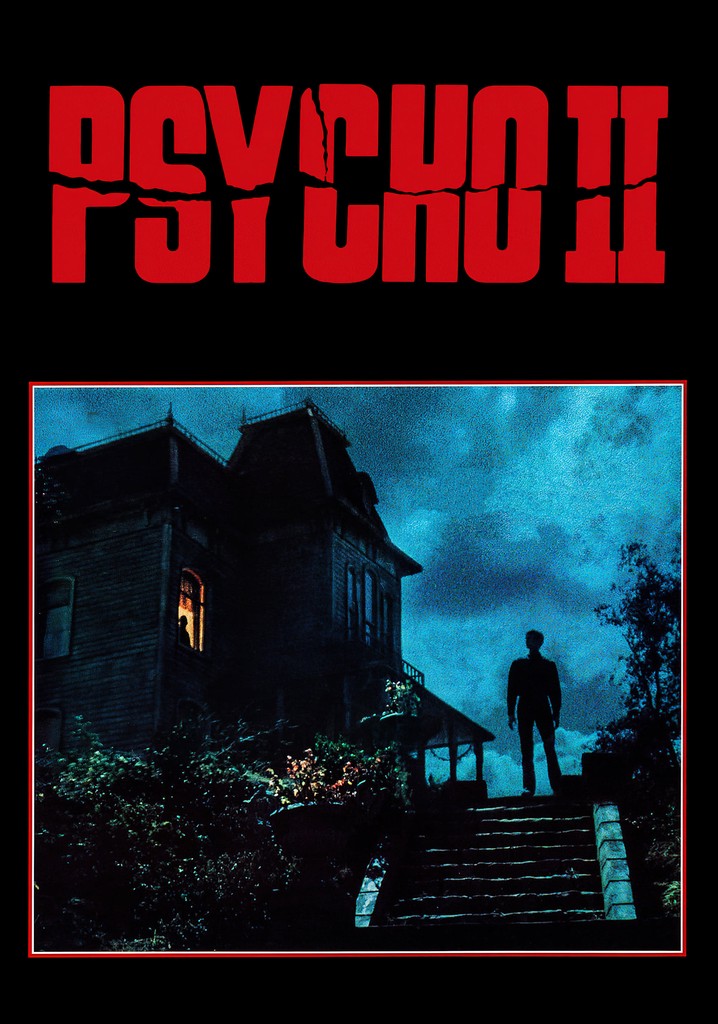
After 22 years of being confined to a mental institution over the murders of 5 people Norman Bates (Anthony Perkins) is now deemed to be no longer a menace to society much to the protest of Lila Crane (Vera Miles) whose sister Marion was one of his victims. With nowhere else to go Norman returns to the old house that he shared with his mother and tries to restart his hotel business that had been run while he was incarcerated by Warren (Dennis Franz) who had allowed the place to be turned into a flophouse for drug users and is immediately fired. To help bring in an income he gets a job at a nearby cafe as a cook where he meets Mary (Meg Tilly) who works there as a waitress. The two quickly start-up a friendship and when Norman learns that she’s broken-up with her boyfriend and no place to stay he offers a bedroom in his house for her to sleepover, but soon Norman starts receiving notes and even phone calls from someone perpetuating to be his mother and then murders begin occurring by someone dressed as an old lady. Has Norman gone back to his old homicidal ways, or is it someone else trying to make it look like it’s him, so that he’ll be rearrested and sent back to prison?

The attempt to make a sequel to the Hitchcock classic had been discussed for years and apparently even the master himself had considered it, but the studios generally nixed the idea figuring there was just no way to upstage the first one. Then Robert Bloch, who written the novel that the first one was based on, came out with a second installment also called ‘Psycho II’ that was published in 1982 that helped spark new interest in the franchise. However, the book’s plot was far different than this one. In the novel version Norman escapes from the mental institution while dressed in a nun’s outfit and then hitches a ride with another nun whom he kills and then rapes. After absconding with her van he then picks up a males hitch-hiker whom he plans to kill and then use his body to fake his own death. Police later find the burning van and charred remains, but are unable to identify who it is. Meanwhile across town a movie is being made about Norman’s life and Norman’s psychiatrist fears that Norman is going to go there to kill everyone in the production, so he decides to become a ‘technical advisor’ to the film to help watch out for the crew, but while there he starts to become more worried about the film’s director who’s a spitting image of Norman from 20 years earlier and he reveals an unhealthy infatuation with the actress playing Marion Crane.

While I found the book to be highly creative the studio execs disliked its satirical elements regarding the movie business and discarded it while hiring Tom Holland, who had some success with the 1978 horror TV-Movie ‘The Initiation of Sarah’ and also the screen adaptation of The Beast Within to write a script with a more conventional storyline. While this story isn’t bad, I personally liked the Bloch version better, this one does have some logic holes mainly around releasing someone who’s killed several people from well published crimes and clearly suffering from a severe mentally ill state and yet somehow convincing the parole board and public at-large that he’s now ‘cured’, which really pushes the plausibility meter. The film also portrays Norman as being a likable guy just trying to find his way, which is awkward since the viewer is technically supposed to be fearing him, but half the time ends up sympathizing with him instead and this dueling dichotomy doesn’t work.

The acting though is terrific especially Perkins who makes his portrayal of Norman into an almost art form and the most enjoyable element of the movie though he initially was reluctant to recreate the role complaining that it hurt his career playing the part in the first one and it had caused him to become typecast, but when he found out that they were planning to cast Christopher Walken in the part if he rejected it he then decided to come-on board. Dennis Franz is also a delight as nobody can play a brash, blue-collar out-of-shape ‘tough guy’ quite like him and his taunting, loud-mouth ways help bring an element of dark humor to the proceedings.

Spoiler Alert!

My favorite though was Meg Tilly who helps tie all the of the craziness around her together by being the one normal person of the whole bunch. Reportedly she and Perkins did not get along and she refused to attend the film’s premiere though the frostiness of their relationship doesn’t show on the screen and the two end-up working well together. The only thing that I didn’t like was the misguided twist of her turning out to being the daughter of the Vera Miles character and in cahoots with her in her attempt to drive Norman crazy. For one thing if this were true then it should’ve been Meg instigating the idea of her moving into the house with him versus Norman coming up with the idea and her seeming reluctant.

The film has some good creepy camera angles of the home, which seems even more frightening here especially with the way it’s isolated desert setting gets played-up. There’s also a couple of gory killings, which I liked, but the second-half does drag and the movie could’ve been shortened by a good 20-minutes. However, the film’s conclusion where Norman learns the his mother’s sister, played by Claudia Bryar, is actually his real mother and she was behind the recent murders was a perfect ironic angle that took me by surprise and I loved it. Why he would then proceed to kill her with a shovel I didn’t really get as it seemed they could’ve started-up some weird bond and became a homicidal couple, which would’ve been more frightening, but still it’s a cool twist either way and helps make this a decent sequel.

My Rating: 7 out of 10

Released: June 3, 1983

Runtime: 1 Hour 53 Minutes

Rated R

Director: Richard Franklin

Studio: Universal

Available: DVD, Blu-ray, Amazon Video, YouTube
Psycho (1960)

psycho

By Richard Winters

My Rating: 9 out of 10

4-Word Review: Don’t take a shower.

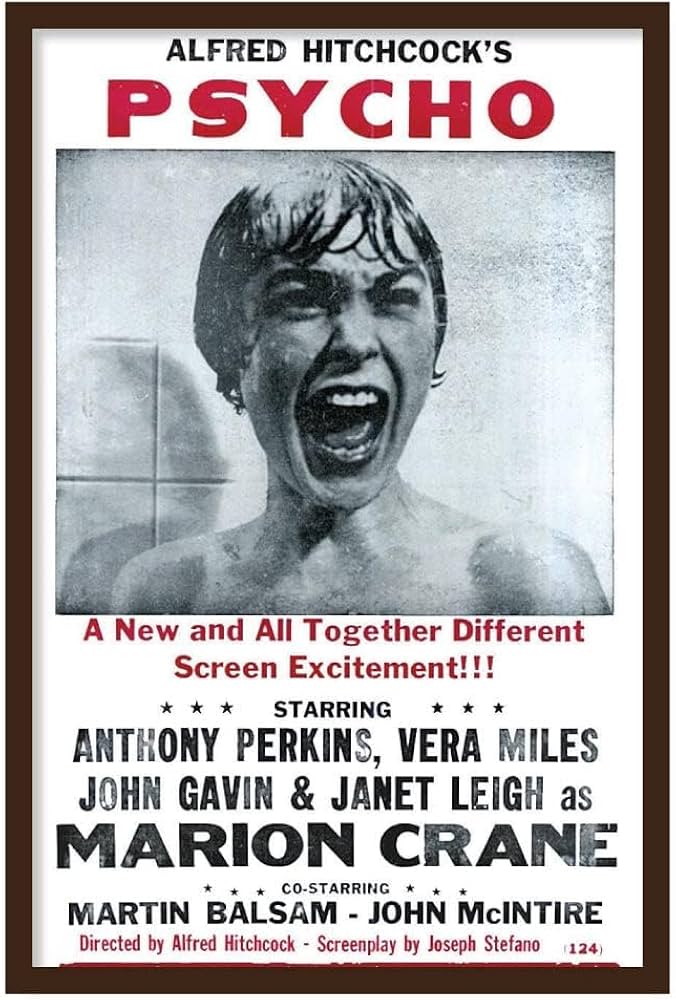
Marion Crane (Janet Leigh), who works as a secretary at a real estate firm, steals $40,000 in cash from her boss (Vaughn Taylor), who trusted her to take the money to the bank, in order to help her boyfriend Sam (John Gavin) pay off his debts. As she’s traveling to where he lives she encounters a rainstorm causing her to take the nearest exit. There she drives into the lot of a isolated lodge called Bates Motel, run by a young man named Norman (Anthony Perkins) who’s still living with his mother in an old rundown house that sits ominously on a hill behind the hotel rooms.  Norman becomes immediately smitten to the woman, who signs the hotel ledger under an assumed name, and invites her to have dinner with him in the hotel office. Marion, who sees him as a awkward, but otherwise harmless guy who’s still dominated by his mother, agrees. After they eat she departs back to her room and takes a shower when what appears to be his mother, who considers all women to be ‘whores’, stabs and kills her. Norman then cleans-up the evidence by submerging the dead body and her car in a nearby swamp. Soon a private detective named Arbogast (Martin Balsam) begins investigating the case and what he finds out leads Marion’s boyfriend Sam and her sister Lila (Vera Miles) to the property where they’ll unravel a shocking secret.

The film, which at the time was considered ‘too tawdry and salacious’ to be made into a movie and thus the studio refused to give director Alfred Hitchcock the required funding and forcing him to use his own funds and crew to produce it, was based on the novel of the same name by Robert Bloch. Bloch began writing it in 1957 when coincidentally in the neighboring town not more than 35 miles from his came to the light the criminal activities of Ed Gein who killed two people while also digging up dead bodies and then skinning them in an effort to create a ‘woman suit’ he could wear so he’d ‘become his dead mother’ who had dominated him for the majority of his life. Rumors were that Gein’s crimes had inspired the book, but Bloch insisted that he had almost finished with the manuscript before he became aware of the real-life case and then became shocked with how closely it resided with his story.

While the film follows the book pretty closely there are a few differences. In the book the Marion character dies from decapitation while in the movie it’s from stab wounds. The Norman character is described as an overweight man in his 40’s while in the movie he’s thin and in his 20’s, which I felt was an improvement as it made more sense why Marion would feel less guarded around him and put herself in a more vulnerable position than she might otherwise as she still viewed him as a ‘wet-behind-the-ears’ kid. It also helps explain why Norman blunders his interview with the detective and virtually incriminates himself because he was too sheltered and not worldly-wise enough to handle pressure situations.

The film is full of a lot of firsts. It was the first to show a toilet or use the word transvestite, but what I really liked though is that it takes a different spin on the character of the victim. Typically, even today, victims are portrayed as being virginal and angelic beings particularly women, but here it works against that. Right away with the opening scene in the hotel room we see she’s definitely no virgin and what’s more she’s having sex outside of wedlock in an era where ‘good girls saved themselves for marriage’. Having her then be susceptible to corruption by stealing from her employer, or not feel frightened initially by Norman and even superior to him further works against the grain of the ‘sweet, fragile damsel in distress’ cliche and makes her seem more human since she’s not perfect and vulnerable to the same vices as everyone else, which in-turn gives the more an added darker dimension.

The film’s hallmark though is its memorable camera work from a close-up of the victim’s unblinking eye, still not sure how Leigh could’ve kept her eyes open for as long as she does, to the interesting way the house gets captured from the ground looking upward on a hill towards the sky with the creepy night clouds floating behind it.  My favorite one though is the tracking shot showing Norman walking into his mother’s room and then having the camera stop right at the top of the door frame and then spin around towards the hallway as he then leaves the room and carries his mother down the stairs. The only shot that I didn’t care for is when the Martin Balsam character gets stabbed at the top of the stairs, but instead of immediately falling over backwards and then rolling down the stairs, which is what would happen 99% of the time, he instead somehow ‘glides’ down an entire flight of stairs backwards while remaining upright and only finally falling to the floor once he hits the bottom, which goes against the basic laws of physics and to me looks fake and goofy, but other than that it’s a classic and still holds-up amongst the best horror movies made.

My Rating: 9 out of 10

Released: June 16, 1960

Runtime: 1 Hour 49 Minutes

Director: Alfred Hitchcock

Studio: Paramount

Available: DVD, Blu-ray, Amazon Video, YouTube
Remember My Name (1978)

remember

By Richard Winters

My Rating: 7 out of 10

4-Word Review: His ex-wife returns.

Neil (Anthony Perkins), who works as a local carpenter, is married to Barbara (Berry Berenson). While the two have their share of ups-and-downs they mostly find a way to work it out and get along. Then comes Emily (Geraldine Chaplin) whose been recently released from jail. She begins harassing the couple for no apparent reason. After she breaks the window of their home Barbara insists on pressing charges. Neil though resists while divulging that he had previously been in a relationship with her and because of certain things that occurred has a misplaced sense of guilt to cover-up for her actions. Barbara does not understand this and the two break-up while Neil decides to rekindle things, but while Emily initially seems receptive she may actually harbor ulterior motives.

Alan Rudolph does a marvelous job of directing this emphasizing the working-class existence with a pale color scheme and great use of on-location shooting, which gives the viewer a vivid and intimate portrait of the character’s lives and their environment. The use of showing that Emily had previously been in prison without actually saying it by simply using certain sounds and visuals as she sleeps is a genuinely inspired moment as is the use of the brief dialogue that reveals things slowly and deliberately using subtle hints that achieves a certain fragmented narrative.

Chaplin is brilliant and convincing in the lead and her unique colored eyes helps build a riveting psycho-like effect though with her extremely thin frame it’s hard to imagine she’d be able to take-on and even beat-up the Alfre Woodard character as she does though one could possibly justify it by saying she learned fighting skills while in jail. Perkins is also quite good, but the use of his real-life wife Berenson, who didn’t have a lot of acting training, hurts as her time on screen is rather blah including the otherwise tense confrontation that she has with Emily when Emily invades her home, which might’ve been a more interesting scene with a better qualified actress in the part.

While the first-half is quite slow I was thoroughly gripped and found the whole thing fascinating, but this tapered-off by the third act when Perkins and Chaplin rekindle things while at a restaurant. The scene gets done in amusing way as the couple keeps ordering alcoholic drinks one after the other, much to the consternation of the waiter, played by Terry Wills, but having Perkins go back immediately to Chaplin with almost no apprehension kills the intrigue. This is a woman that supposedly murdered someone before, so how does he know she can be trusted? Having him more defensive and cautious and even conflicted as he was technically still married would’ve helped continue the tension instead of deflating it.

Spoiler Alert!

The scene in which the Moses Gunn character, who was having a bit of a fling with Emily, goes back to her apartment apparently to murder Perkins who had been temporarily staying there, could’ve been done better. It’s only intimated that Gunn kills him as we see a nervous look on Perkins face as he hears somebody at the door and then it cuts away to the outside of the building with loud crashing music to display that there was violence, but I really felt it should’ve gotten played-out visually. Perhaps it could’ve been done Rear Window-style with it being captured through the windows, which would’ve stayed consistent with the film’s detached tone, but to leave the story’s most crucial moment up to speculation was a letdown.

The same can be said to Alfre Woodard’s character who promises revenge on Chaplin, but it never comes. A good physical confrontation between the two could’ve added some much needed action, which otherwise is sorely missing and makes the film seem incomplete. Having Chaplin terrorize the couple by messing up their flower garden is a bit too tame as any squirrel or raccoon could’ve done the same thing while putting a bloody animal on their doorstep, or nailing a graphic picture of the person she had killed before would’ve been far more frightening.

Overall I liked the style, but the attempt to keep things buttoned-down all the way through doesn’t work. At some point, just like with the ticking time bomb mentality of its main character, it needed to explode with violence that would’ve awakened the viewer with a shocking effect. The fact that this is only slyly hinted at is a letdown and doesn’t give the movie the strong pay-off that it should.

My Rating: 7 out of 10

Released: October 1, 1978

Runtime: 1 Hour 34 Minutes

Rated R

Director: Alan Rudolph

Studio: Columbia Pictures

Available: DVD-R, Tubi

ffolkes (1980)

ffolks2

By Richard Winters

My Rating: 5 out of 10

4-Word Review: Loves cats, hates women.

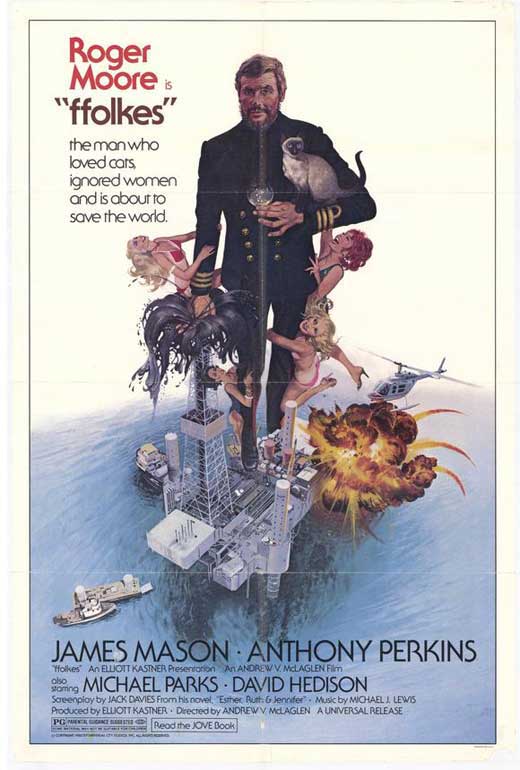
Rufus Excalibur ffolkes (Roger Moore) is a cat loving misogynist who dislikes women because he grew up the youngest of five sisters and forced to wear their hand-me-downs until he was age 10. As an adult he is a counter-terrorism expert and trains a team of men to go onto ships at sea that have been hijacked. When a North Sea oil production platform nicknamed Jennifer gets taken over by a group of men posing as reporters their leader (Anthony Perkins) demands an enormous ransom and it’s up to ffolkes and his team to board the platformed and kill the terrorists without allowing the ship, which has been booby-trapped with bombs by the criminals, to blow-up.

The film, which was based on the novel ‘Esther, Ruth & Jennifer’ by Jack Davies, who also wrote the screenplay, starts out well and has all the ingredients to being a compelling thriller. The on-location shooting done on an actual ship makes the viewer feel like they’re out at sea themselves and I found the foot chase done on the vessel during a raging rainstorm to be riveting. Perkins makes for a particularly slimy villain and Micheal Parks, as the mastermind who constructs and implements the bombs, was also impressive wearing glasses that make his eyes look like they’re bulging and it’s just a shame these two men had to co-star together as they’d be able to eat-up the scenes had they been allowed to do it alone without any henchmen.

The ffolkes character works against type playing a good-guy that tests the viewer’s assumption of what’s acceptable behavior for a protagonist. Too many movies create a hero-like caricature of someone who is overly noble, brave, and virtuous until it becomes boring and contrived. At least here the guy we’re supposed to cheering for is interestingly flawed therefore more human-like than super-heroes in most other films, especially those made today, who are just too-good-to-be-true.

ffolkes though does spend too much time sitting in the background working on a crochet of a cat while giving-off glib remarks and not being as active as he should. He’s also constantly drinking scotch at all hours of the day, straight out of the bottle, which should’ve made him inebriated and this most likely would’ve come into play at some later point where he wasn’t able to pull-off an intricate task because he was too drunk, but after introducing his drinking problem during the first half, it gets completely forgotten by the second.

While the character acts extraordinarily arrogant and cocky he’s not able to pull-off the assignment quite as easily as you’d think for someone with his amount of confidence. One scene has him stupidly walking right into a gunmen and it takes the sheer luck of someone hiding in a lifeboat to save him. Another scene has him almost killed by one of his own men making him seem like he’s not as good of an instructor as his reputation suggests and all leads to him unintentionally coming-off more like a deluded idiot than the crafty mastermind with a few personality quirks that he’s supposed to be.

The story, while having a solid set-up, ultimately becomes the biggest letdown. For one thing it never shows us how they’re able to pull-off the fake explosion of Ruth, another oil platform. They talk about rigging it to seem like it exploded to fool the bad guys, and we do see something exploding, but no explanation of what it was since the real Ruth secretly remains standing. Also, most ships have a radar system, which should’ve shown that the real Ruth never went away and that they had been duped, but for whatever reason they never catch-on.

The ending surprisingly lacks very little action, which is what was blamed for the film’s poor reception at the box office. People are expecting a movie that stars Moore to have a lot of stunt work and special effects and for the most part it never happens. The villains go down too easily making it not very satisfying to see them go. There needed to be more wrinkles to the scenario and more unexpected twists as the pay-off and climactic finish is weak making one feel, despite the excellent performances, like it wasn’t worth sitting through.

Alternate Title: North Sea Hijack

My Rating: 5 out of 10

Released: April 3, 1980

Runtime: 1 Hour 38 Minutes

Rated PG

Director: Andrew V. McLaglen

Studio: Universal

Available: DVD, Blu-ray

The Black Hole (1979)

By Richard Winters

My Rating: 4 out of 10

4-Word Review: Area of gravitational acceleration.

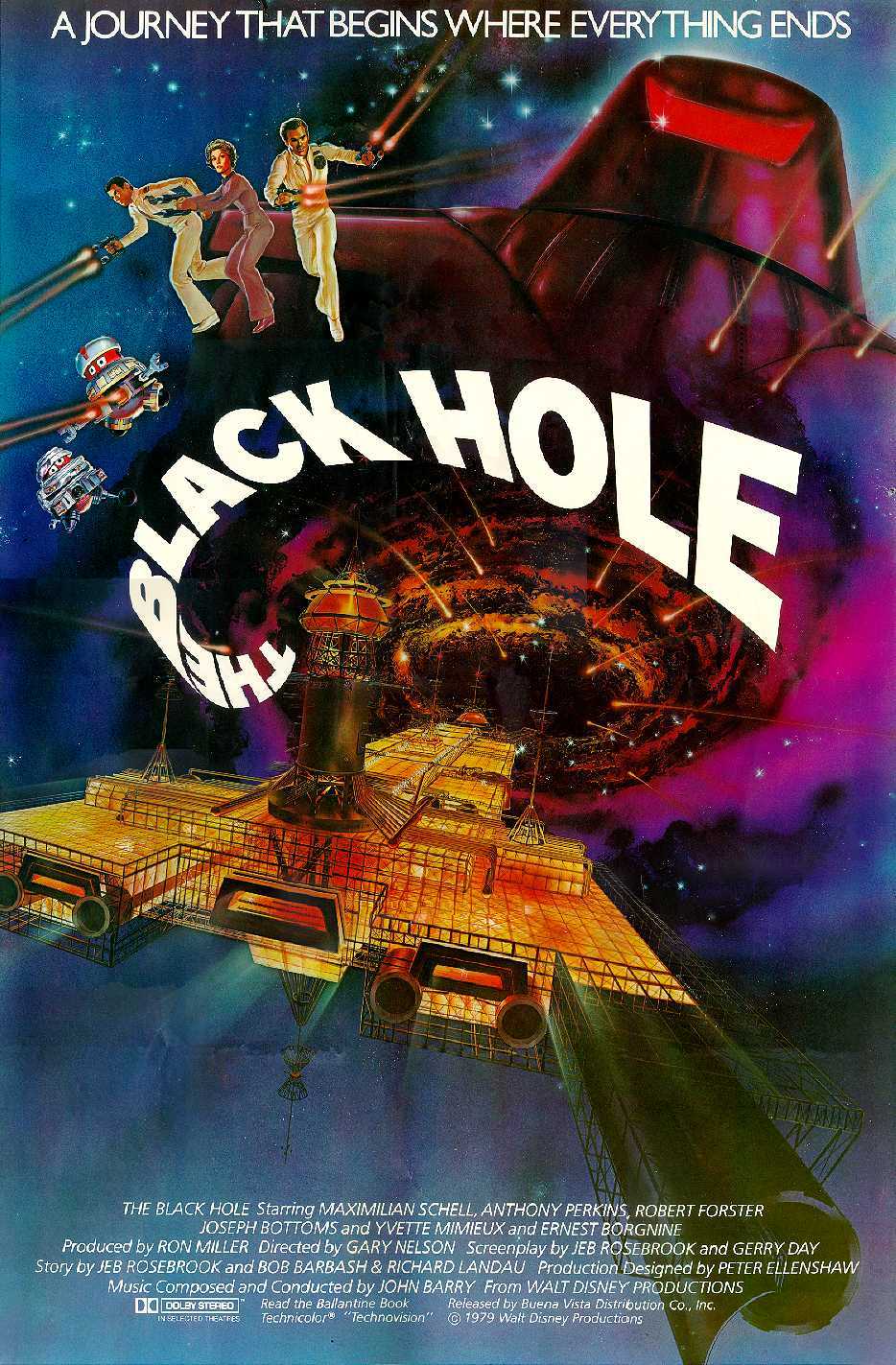
On their return trip to earth a crew of 5-people (Robert Forster, Yvette Mimieux, Joseph Bottoms, Anthony Perkins, Ernest Borgnine) on board the USS Palomino spot a large spaceship and are baffled at its ability to withstand the gravitational force of the nearby black hole. They decide to investigate the ship and find that it is being run by Dr. Hans Reinhardt (Maximilian Schell) who has been for the past 20 years the sole human survivor after the rest of the crew supposedly returned to earth, the members of the Palomino though are suspicious about this explanation since the robed android drones seem to strangely have human-like qualities. They become further alarmed when they learn that Reinhardt plans on taking the ship through the black hole, which they feel will lead to a sure death to all those on board.

For the most part the special effects look awesome  and one gets a true feeling of the vastness of space in this one with Reinhardt’s ship getting captured in a way that makes it look large and impressive. Even the interiors give off a sort-of mansion-like feel and that the characters are inside of a large scale vessel with many rooms as opposed to simply being sets on a soundstage.

Unfortunately the script lacks imagination and becomes just another formulaic madman in space scenario that offers no new twists to the genre. The tone is extremely downbeat and despite being produced by Disney doesn’t seem to be something aimed for kids. The story is also devoid of action and when there finally is some it’s short and fleeting and comes off like a second-rate laser shoot-out.

The characters don’t show enough contrasting personalities and are too old. Usually pre-teens relate better to movies with performers around their same age range, but here everyone is middle-aged and in Borgnine’s case even well past that. Bottoms is the youngest and should’ve carried the film, but his acting is so transparent you end up wishing he hadn’t even been in it.

It’s also ridiculous that Mimieux could communicate with the ship’s robot via ESP even though mental telepathy cannot be substantiated by the scientific community and therefore should not be introduced into a sci-fi flick that is supposedly trying to be taken seriously.  I did enjoy Perkins in his part, but he should not have been the one to turn around one of the drones and unmask them to expose a shriveled face underneath, which for trivia purposes was the film’s director Gary Nelson, since it will remind viewers too much of a similar reveal scene near the end of Psycho of which he famously starred in.

Schell as the resident nutcase is a complete bore in a performance that is so pathetically cliched that it borders on camp. He reminded me of James Mason’s character from 20,000 Leagues under the Sea, which was also produced by Disney and should’ve been enough to have Mason invited back to play the part here as he would’ve been far more interesting.

The robots outshine the humans particularly Roddy McDowell and Slim Pickens, who strangely go uncredited, as the voices of the  ‘good guy’ droids. However, the army of villainous androids that try to stop the crew from escaping walk too stiffly almost like mimes playing into the cliche of how people perceive robots to move, but by the year 2132, which is when this story takes place, you’d think technology would’ve improved enough to have created androids that would’ve had more fluid-like motions. They’re also too easy to pick-off almost like sitting ducks in a shooting gallery, which saps the shoot-outs of any tension.

The ending is the biggest disappointment as it never clearly explains what happens to the crew when they go through the black hole. There’s a lot of heavy-handed imagery including a cool hell-like visual, but nothing conclusive, which makes the whole thing a big buildup to nothing.

My Rating: 4 out of 10

Released: December 21, 1979

Runtime: 1 Hour 38 Minutes

Rated PG

Director: Gary Nelson

Studio: Buena Vista

Available: DVD, Amazon Video, YouTube

Catch-22 (1970)

catch 22 2

By Richard Winters

My Rating: 8 out of 10

4-Word Review: The insanities of war.

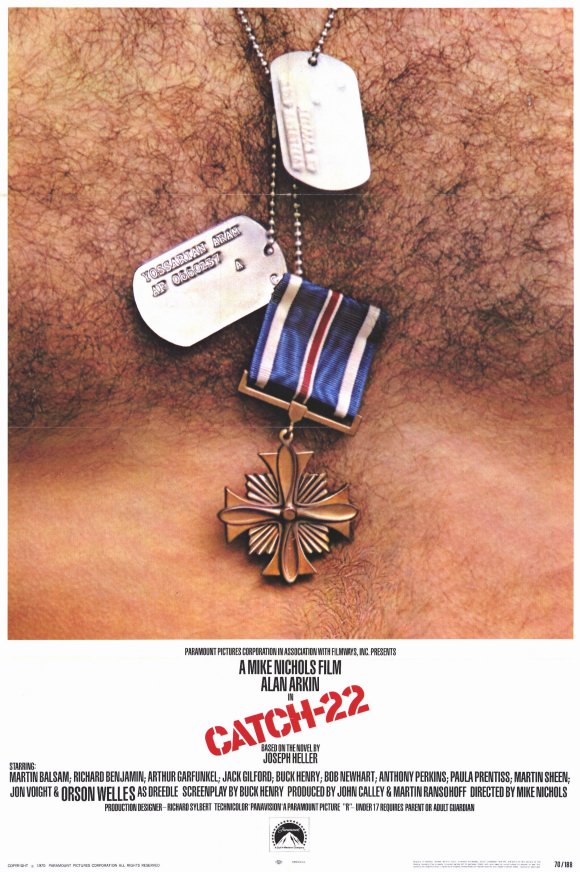
Having to fly numerous combat air missions has sent Word War II fighter pilot John Yossarian (Alan Arkin) to the brink of insanity. He goes to his unit’s psychiatrist Dr. Daneeka (Jack Gilford) asking him if he can be sent home. The doctor admits that anyone who feels that they are going crazy shouldn’t be flying, but there’s a problem known as ‘Catch-22’, which states that anyone who no longer wants to fly combat missions isn’t crazy but normal and therefore John’s request is denied and he is forced to remain while observing how utterly ridiculous everyone else is, particularly his military superiors, even though they’re considered to be the ‘normal’ ones.

The film is based on the best-selling novel by Joseph Heller, who started writing his novel in 1953 and would only spend 1-hour each day working on it until finally completing it 8 years later. The story is very loosely based on some of his experiences and emotions that he had as a fighter pilot during the war and it’s always nice watching something that was done, no matter how satirical, from an insider’s perspective and his numerous potshots at the nonsense that makes up the military hierarchy could easily be parlayed to anyone who has had to deal with bureaucracy at any level.

Certain changes were made in the novel’s transition to the big-screen, but overall screenwriter Buck Henry does well in bringing the fragmented narrative vibe of the book to the film. I was really impressed with the aerial sequences, which used the B-25 Mitchell and took 6 months to film. The cinematic style was years-ahead-of-its-time as well including having things occur in the background of a scene that has no connection to what the characters in front of the camera are discussing and at times even oblivious to.

The film features many laugh-out-loud segments with my favorite being the part where Yossarian attends a military award ceremony and accepts his medal while being, to the shock of the military brass that is handed out the medal, stark naked. Anthony Perkins, who plays the hopeless chaplain, is also quite funny in a rare, but interesting turn in a comedic role.

One of the things that I didn’t like about the film, although it didn’t bother me quite as much as it did when I first saw the movie many years ago, is the way the tone shifts from being quirky and hilarious at the beginning to somber and serious towards the end. I realize that the novel works in the same way, but the first half of the film successfully balanced the line of exposing the absurdities of war in a comedic vein while still showing the serious consequences without ever getting overwrought, so it’s a shame that the second half couldn’t have worked the same way instead of leaving the viewer with a gloomy, depressed feeling when it’s over and almost forgetting completely about the comedy that came before it. I also believe this is why this film failed at the box office while the similar M*A*S*H succeeded simply because that movie remained funny all the way through.

Arkin, in the lead, is miscast and seems too old for the part. His nervous, hyper persona doesn’t work and would’ve been more effective had it been toned down by being played by a younger actor who was more emotionally detached. The rest of the supporting cast though is great including Martin Balsam who makes cinematic history by being the first actor to ever appear sitting on a toilet in a movie.

My Rating: 8 out of 10

Released: June 24, 1970

Runtime: 2Hour 2Minutes

Rated R

Director: Mike Nichols

Studio: Paramount

Available: DVD, Amazon Instant Video, YouTube

Lovin’ Molly (1974)

lovin molly

By Richard Winters

My Rating: 4 out of 10

4-Word Review: Two men one woman.

Molly (Blythe Danner) is a free-spirited woman living in a small Texas town during the 1920’s. Gid (Anthony Perkins) and Johnny (Beau Bridges) are best friends who also both like her. Molly likes them as well, but can’t seem to decide which of the two she loves better, so to solve things she gets married to Eddie (Conard Fowkes). This doesn’t go over well with the other two, but as time goes by she continues to see them and even has children from both of them, which causes a stir in her small community. Not only does she become the product of the local gossip, but virtually ostracized as well. However, Molly is undeterred about what everyone else thinks and sticks to her independent ways.

Based on the Larry McMurtry novel the film was directed by the legendary Sidney Lumet, but you would hardly know it. The production looks cheap and rushed and lacks atmosphere or period detail. The scenes are flatly shot with very little visual design or imagination. The whole thing comes off as something that did not get any major studio backing and was forced to look to private investors for funding, which unfortunately was just not enough.

Filming it on location in Bastrop, Texas which is also the setting of the story helps a little as the town has many historical buildings, which heightens to some extent the period atmosphere, but I would’ve liked to have seen more of it. The dry Texas landscape is also nicely captured and makes the viewer feel like they are living in the state themselves with each and every shot. The one thing though that really impressed me was how realistically the characters aged as the story, which spans 40 years, progresses. In most films the actors are forced to wear a ton of makeup, which gets overdone, but here very little of it was used and it looked far better.

Danner, who these days is best known as the mother of Gwyneth Paltrow, is excellent in a rare turn as a leading lady and even appears fully nude from the front and back. Perkins is solid in support and I enjoyed seeing Bridges with a bowl haircut. The star though that really steals it is Edward Binns as Perkins’ father whose caustic and to-the-point remarks are gems.

Fred Hellerman’s flavorful bluegrass score is pleasing, but the film itself fails to elicit much emotion. The only times that it does become mildly interesting is when the characters do a voice-over narration by reading off of passages lifted directly from its source material making me believe that this should never have been filmed in the first place and left simply in its novel format.

My Rating: 4 out of 10

Released: April 14, 1974

Runtime: 1Hour 38Minutes

Rated R

Director: Sidney Lumet

Studio: Columbia Pictures

Available: DVD (Region 2), Amazon Instant Video