Tag Archives: Anjanette Comer

The Baby (1973)

baby1

By Richard Winters

My Rating: 7 out of 10

4-Word Review: Family harbors man-baby.

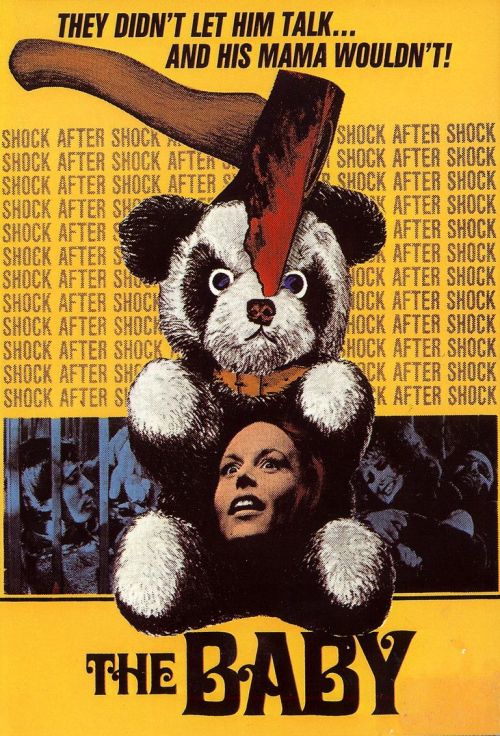
Ann (Anjanette Comer) is a social worker who, still tormented by the car accident that has left her husband severely brain damaged, decides to throw herself into her work by focusing on a bizarre case in which a mother (Ruth Roman) and her two daughters (Marianna Hill, Susanne Zenor) take care of a third sibling (David Mooney, but billed as David Manzy) that is a grown man, but permanently trapped in an infant state. As Ann meets with the family she becomes convinced that ‘the baby’ has potential for intellectual capacity and it’s only because of the abuse that he receives from his embittered mother, who harbors a grudge for men after her husband walked out on her and is now taking out that anger on her son, that is holding him back. She devises a plan to kidnap the son, so that she can take him out of that toxic environment in order to help him, but when she does the mother and her two daughters plot a violent revenge in order to take him back.

It took many years for screenwriter Abe Polsky to get his friend Ted Post, who appears onscreen during the party scene, to agree to film his script as he insisted that it was, in his words, ‘too negative’. His ambivalence for the material shows as visually it’s given the TV-movie treatment that lacks atmosphere, or a visually provocative approach the would help accentuate the darkly quirky elements of the story. While this has still attained a cult following it’s mainly because of the offbeat story and might’ve gotten more fans and attention had the direction been equally offbeat instead of so basic.

The acting on the other hand is a stand-out. Ruth Roman, a one time leading lady during Hollywood’s Golden Age, but by the 70’s was relegated to low budget horror, is terrific with her raspy voice and chain smoking making her like a snarly version of Suzanne Pleshette. The caustic confrontations between her and Comer, who initially seems like the angelic, law abiding one, helps accentuate their contrasting personalities. Comer of course is quite good too. She’s played many offbeat characters, but here comes-off as the noble, straight one and does so convincingly, which is detrimental for pulling off the stories plot point. Hill, as Roman’s twisted amoral daughter, is interesting as well though there was no need for two daughters as they both shared seemingly the same personality and could easily have been merged into one and since Hill gives her part a little better nuance she should’ve been cast while Zenor cut out completely.

Mooney as the man-child though is the scene stealer. He got into his part by observing special needs children and his infant mannerisms is on-target to the extent it’s creepy. Having him put into a crib though that he supposedly couldn’t get out despite being a grown man physically doesn’t really gel as even toddlers can ultimately figure out a way to get out of one. Putting him into a big cage that would sit in the middle of the ‘nursery’ would’ve been more sinister visually as well as realistic. The source of his infantile state, that he’s seemingly been abused by a cattle prod all these years to not grow up, or to even learn to talk, or walk, is equally ridiculous. Explaining that his condition was caused by being in a car accident when he was an actual baby, which then trapped him in that state forever due to brain damage would’ve been far more easier to swallow while also tying it in to Comer’s husband’s condition that eventually becomes a key element.

The scene with the young babysitter, played by Erin O’Reilly, didn’t make sense either. She’s portrayed as being just this average teen taking care of the baby like she would a real one for extra money, but there’s no way any teen would be comfortable changing the diaper of a grown man, as it’s still a man’s body no matter how he behaves, and not come away feeling sick and perverse. by doing it Thus the part should’ve been played by some kooky older woman, perhaps a friend or cousin to the mother, who was lonely and liked taking care of the ‘baby’ due to sharing the same man-hating instincts, or had a secret quirk where she enjoyed having a male in a subservient condition.

Spoiler Alert!

The third act had holes in it as well as Comer kidnaps the ‘baby’ and brings him home with her, but the mother and sisters don’t call the police to get him back. Supposedly this is because the mother is afraid the years of abuse, that Comer has become aware of, would come to light, but it would still be her word against theirs and I felt they should’ve responded more aggressively maybe even hiring a lawyer to take the case to court and then becoming impatient with the slow legal process and then finally deciding to take matters into their own hands, but just having them sit around the house for several days/weeks waiting to see what Comer does next doesn’t really jive.

The ultimately twist though I did like and took me by surprise. I’m usually able to guess where movies are going and can get it right most of the time, but this one is novel and for that gets high marks despite its other issues.
baby2

My Rating: 7 out of 10

Released: March 4, 1973

Runtime: 1 Hour 24 Minutes

Rated PG

Director: Ted Post

Studio: Scotia International

Available: DVD, Blu-ray, Fandor, Tubi, Amazon Video, YouTube
Fire Sale (1977)

By Richard Winters

My Rating: 3 out of 10

4-Word Review: Burn down the store.

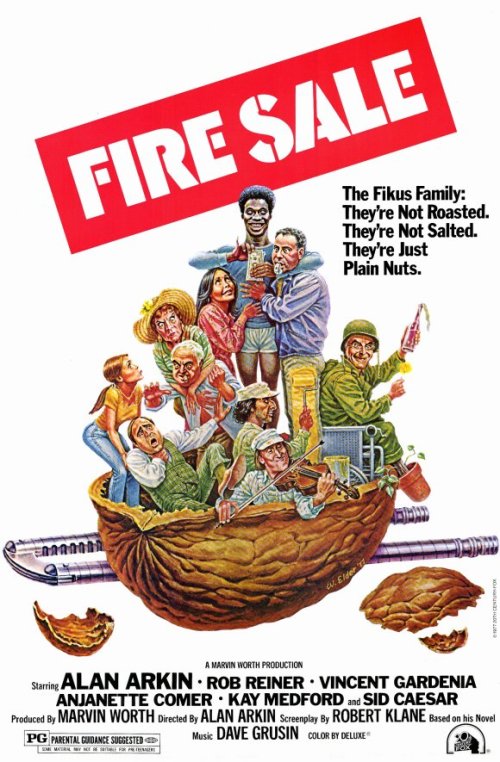
Benny Fikus (Vincent Gardenia) is the elderly owner of a struggling clothing store, who has decided the only way to recoup costs will be to have it burn down and then collecting money on the fire insurance policy. He has convinced his mentally ill brother Sherman (Sid Caeser), who still believes that WWII is happening, that the store is really a front for the Nazi Headquarters and thus motivating Sherman to destroy it. To make his alibi iron-clad Benny takes a trip with his wife Ruth (Kay Medford) to Florida when the arson is expected to occur. During the trip Benny has a heart attack causing his son Russell (Rob Reiner) to take over the business. When he realizes that the place is bankrupt he decides to cash-in the fire insurance policy and use those funds to help regenerate the place. When Benny recovers from his heart attack and realizes what Russell’s done the two, along with Russell’s older brother Ezra (Alan Arkin), go on a mad dash to stop Sherman from setting the fire before it’s too late.

It’s hard to imagine just how badly botched this thing is as I approached it with high expectations. Arkin had already directed the brilliant Little Murders, which is one of the best dark comedies ever made. Robert Klane, who wrote the screenplay and book of the same name that the movie is based on, had also 6 years earlier written the screenplay for Where’s Poppa?, another cult masterpiece. So, with those great films already under the filmmaker’s belts you’d expect good things from this and yet it’s pretty awful right from the beginning.

The main problem is that there’s no running theme. Little Murders centered around the isolating effects of urbanization and Where’s Poppa? dealt with the harsh realities of caring for elderly parents.  This film though has no point to it. Lots of sloppy, slapdash comedy as director Arkin and writer Klane seem more concerned with getting a cheap laugh than telling a story. The sets have no cinematic style making it look better suited for a low-grade sitcom. The score by Dave Grusin, is too generic with overtones more on-par with a cartoon. A good movie should have music that is distinct and matches the tone of the script, which this one doesn’t.

I’ve always considered Reiner the weakest link from the classic ‘All in the Family’ TV-show and while his talents have been much better served as a director this movie was made when producers were still trying to turn him into a star, but the attempt fails. That only thing that he does that could be considered ‘comical’ is the running joke of him going into wheezing fits from his asthma every times he gets stressed-out, which gets overdone. He shares no chemistry with Arkin and they’re too far apart in age to be a believable brotherly pair.

Anjanette Comer, who was married to Klane at the time this was filmed, gets wasted in a thankless bit as Arkin’s beleaguered wife and the scene where she tries to commit suicide by locking herself inside a refrigerator is pointless because it never shows how she got rescued. Caeser as the would-be arsonists relies too heavily on  zany slapstick that is inconsistent in tone with the rest of the film.

Medford, as Arkin’s and Reiner’s put-upon mother, is alright, but the person that impressed me most was Gardenia whose frantic, over-the-top delivery as the exasperated father/business owner is quite good and his energy, even though he is not the star, helps propel the film. He’s even good when he’s in a comatose state and doesn’t move at all. I was particularly amazed during a segment where Reiner and Arkin crawl over him during an altercation and Arkin accidently kicks him in the head, but Gardenia does not flinch and remains very much in character.

My Rating: 3 out of 10

Released: June 9, 1977

Runtime: 1 Hour 25 Minutes

Rated PG

Director: Alan Arkin

Studio: 20th Century Fox

Available: DVD-R (Fox Cinema Archives)

Banning (1967)

By Richard Winters

My Rating: 4 out of 10

4-Word Review: Golf pro seeks revenge.

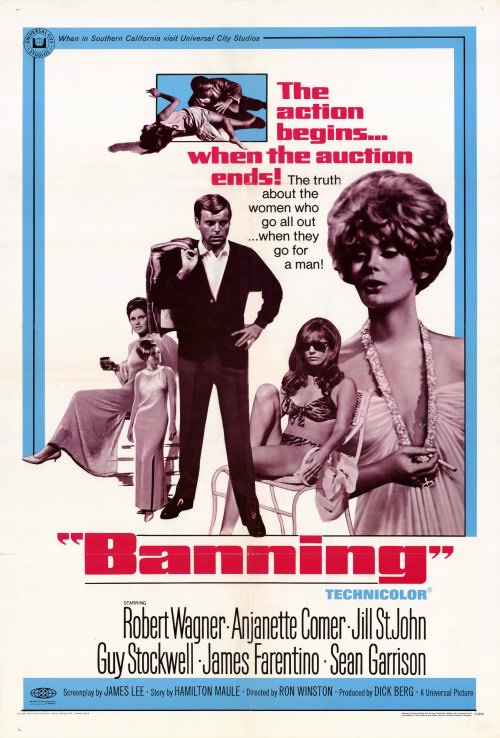
Mike Banning (Robert Wagner) was at one time an up-and-coming golf star, but then his promising career came crashing down when he was accused of trying to rig a game by bribing his competitor. In reality it was his competitor Jonathan Linus (Guy Stockwell) who did the bribing and when Mike refused to go in on it Jonathan tabbed him for the crime. Now Mike has returned to the golf club that Jonathan and his rich wife Cynthia (Susan Clark) own. He demands to be given a job or he’ll tell the truth about what happened, but after securing a position at the club Mike then must deal with the mob who bankrolled his initial PGA run and now demand repayment, which forces Mike into the type of scheme that he had earlier avoided.

This is the type of film that could be deemed ‘dead-on-arrival’ as the characters  are so painfully cliched in the most soap opera-like extreme that it’s almost laughable, but strangely it’s still captivating. Most likely this is because we as regular people still get-off seeing the rich and powerful self-destruct by not only eating up each other, but many times themselves as well. Realizing that people with a lot of money don’t really ‘have-at-all’ and in many cases can be even more miserable is sort of satisfying and to that extent this movie succeeds admirable.

Unfortunately the sets are not as gaudy and over-the-top as they needed to be. When the characters are excessive the backdrop needs to match it and in this case it doesn’t. The golf club appears to be just some set piece created inside a studio and this visual sterility defeats the campiness by ultimately stymieing the melodrama into a formulaic programmer.

Wagner though is what really kills it by performing his role like he were sleepwalking. He shows no energy or nuance and simply goes around with this perpetual irritated look on his face and nothing more. How can a movie stimulate any interest when its lead has no panache? Even Jill St. John who Wagner later married in real-life buries him with her presence to the point that he doesn’t even seem worthy enough to share the same screen with her.

In support Howard St John (no relation to Jill) is fun as a conniving elderly rich tycoon who pretends to be drunk when he really isn’t as well as Anjanette Comer playing in a rare straight role. Her career has been marked with so many cult movie parts that seeing her play someone who is normal becomes genuinely diverting. Unfortunately Gene Hackman, who is miscast as an aging golf-pro even though he was in reality the same age as Wagner, gets wasted.

The climactic golf match manages to be surprisingly captivating and proves that the game can have a certain cinematic flair if done right, but some of the film’s other stabs at action don’t work so well. The car chase is a particular problem as it becomes painfully clear that Wagner really isn’t driving a vehicle, but simply sitting in front of a green screen instead, which pretty much helps to cements this as a dated relic.

My Rating: 4 out of 10

Released: June 30, 1967

Runtime: 1 Hour 42 Minutes

Not Rated

Director: Ron Winston

Studio: Universal

Available: None at this time

Quick, Before it Melts (1964)

quick 1

By Richard Winters

My Rating: 2 out of 10

4-Word Review: Stuck in the cold.

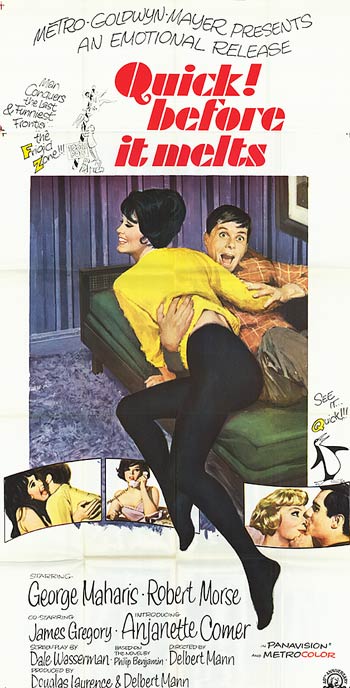
Oliver Cannon (Robert Morse) is a lowly newspaper reporter who gets sent to the Antarctica by his boss Mr. Sweigert (Howard St. John). Sweigert not only dislikes Oliver, but also wants to keep him away from his daughter Sharon (Yvonne Craig) who intends on marrying him. To his surprise Oliver accepts the assignment feeling that the South Pole is the ‘last great frontier’ and wanting to expose the harsh environment of the region to his readers who may not otherwise realize quite what it is like. Yet once he arrives he quickly wishes to leave, but can’t. He then concocts a plan with Peter (George Maharis), who is  another  American stranded  there, to fly in a planeload of beautiful women, so at least their time there can be enjoyable and sexy.

The script is virtually plotless and amounts to nothing more than broadly written, flatly comical scenarios loosely tied into the Antarctica theme. It’s basically just another contrived, generic ‘60s sex comedy that lacks bite or imagination. The only mildly amusing part about it is the real-life penguin that acts as a carrier pigeon by delivering mail and messages to the various residents.

I was surprised that Maharis chose to be in this as he was a strong, highly underrated dramatic actor who was one of the main reasons for the success of the acclaimed TV-series ‘Route 66’. In fact he left that show before the end of its run mainly to take advantage of all the movie offers that were coming in, but choosing to do this silly thing as his first one especially when he isn’t even the star of it is baffling. His career ultimately was ruined when he was caught having sex with a gay hairdresser inside the men’s bathroom of a gas station during the mid-‘70s, but appearing in fluff like this certainly didn’t help it.

Morse on the other-hand seems well suited for the material and performs admirably. This film also has, in her film debut, Anjanette Comer who later had roles in many interesting cult films. In fact both Morse and she later reteamed to star in The Loved One just a year after doing this one. That film is far superior and a movie you should definitely see while avoiding this one at all costs.

My Rating: 2 out of 10

Released: October 5, 1964

Runtime: 1Hour 38Minutes

Not Rated

Director: Delbert Mann

Studio: MGM

Available: DVD (Warner Archive)