Tag Archives: Alfred Hitchcock

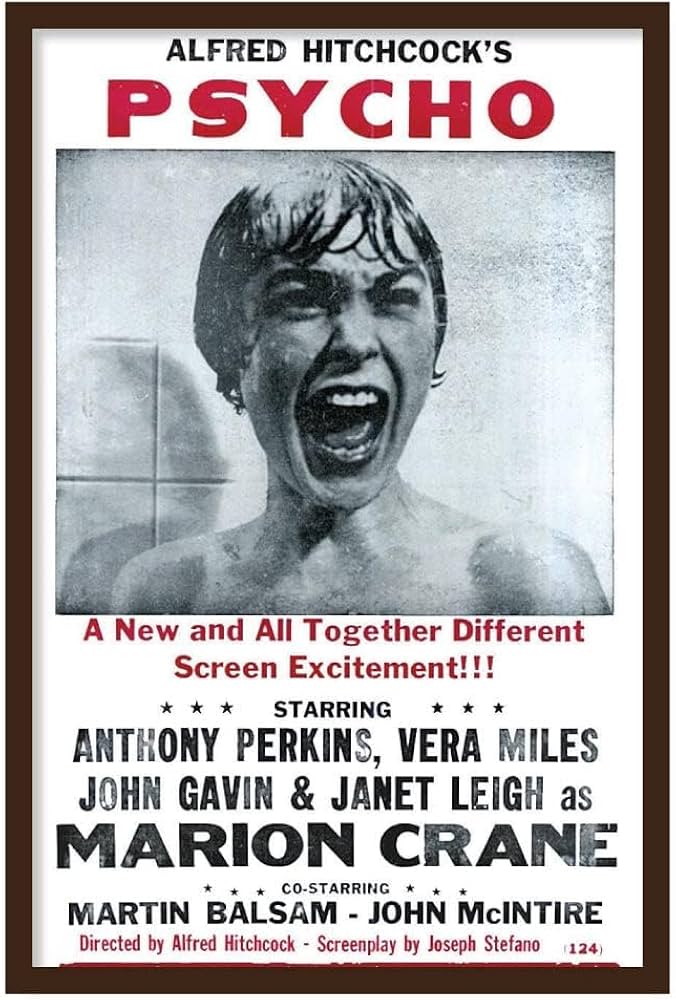
Psycho (1960)

psycho

By Richard Winters

My Rating: 9 out of 10

4-Word Review: Don’t take a shower.

Marion Crane (Janet Leigh), who works as a secretary at a real estate firm, steals $40,000 in cash from her boss (Vaughn Taylor), who trusted her to take the money to the bank, in order to help her boyfriend Sam (John Gavin) pay off his debts. As she’s traveling to where he lives she encounters a rainstorm causing her to take the nearest exit. There she drives into the lot of a isolated lodge called Bates Motel, run by a young man named Norman (Anthony Perkins) who’s still living with his mother in an old rundown house that sits ominously on a hill behind the hotel rooms.  Norman becomes immediately smitten to the woman, who signs the hotel ledger under an assumed name, and invites her to have dinner with him in the hotel office. Marion, who sees him as a awkward, but otherwise harmless guy who’s still dominated by his mother, agrees. After they eat she departs back to her room and takes a shower when what appears to be his mother, who considers all women to be ‘whores’, stabs and kills her. Norman then cleans-up the evidence by submerging the dead body and her car in a nearby swamp. Soon a private detective named Arbogast (Martin Balsam) begins investigating the case and what he finds out leads Marion’s boyfriend Sam and her sister Lila (Vera Miles) to the property where they’ll unravel a shocking secret.

The film, which at the time was considered ‘too tawdry and salacious’ to be made into a movie and thus the studio refused to give director Alfred Hitchcock the required funding and forcing him to use his own funds and crew to produce it, was based on the novel of the same name by Robert Bloch. Bloch began writing it in 1957 when coincidentally in the neighboring town not more than 35 miles from his came to the light the criminal activities of Ed Gein who killed two people while also digging up dead bodies and then skinning them in an effort to create a ‘woman suit’ he could wear so he’d ‘become his dead mother’ who had dominated him for the majority of his life. Rumors were that Gein’s crimes had inspired the book, but Bloch insisted that he had almost finished with the manuscript before he became aware of the real-life case and then became shocked with how closely it resided with his story.

While the film follows the book pretty closely there are a few differences. In the book the Marion character dies from decapitation while in the movie it’s from stab wounds. The Norman character is described as an overweight man in his 40’s while in the movie he’s thin and in his 20’s, which I felt was an improvement as it made more sense why Marion would feel less guarded around him and put herself in a more vulnerable position than she might otherwise as she still viewed him as a ‘wet-behind-the-ears’ kid. It also helps explain why Norman blunders his interview with the detective and virtually incriminates himself because he was too sheltered and not worldly-wise enough to handle pressure situations.

The film is full of a lot of firsts. It was the first to show a toilet or use the word transvestite, but what I really liked though is that it takes a different spin on the character of the victim. Typically, even today, victims are portrayed as being virginal and angelic beings particularly women, but here it works against that. Right away with the opening scene in the hotel room we see she’s definitely no virgin and what’s more she’s having sex outside of wedlock in an era where ‘good girls saved themselves for marriage’. Having her then be susceptible to corruption by stealing from her employer, or not feel frightened initially by Norman and even superior to him further works against the grain of the ‘sweet, fragile damsel in distress’ cliche and makes her seem more human since she’s not perfect and vulnerable to the same vices as everyone else, which in-turn gives the more an added darker dimension.

The film’s hallmark though is its memorable camera work from a close-up of the victim’s unblinking eye, still not sure how Leigh could’ve kept her eyes open for as long as she does, to the interesting way the house gets captured from the ground looking upward on a hill towards the sky with the creepy night clouds floating behind it.  My favorite one though is the tracking shot showing Norman walking into his mother’s room and then having the camera stop right at the top of the door frame and then spin around towards the hallway as he then leaves the room and carries his mother down the stairs. The only shot that I didn’t care for is when the Martin Balsam character gets stabbed at the top of the stairs, but instead of immediately falling over backwards and then rolling down the stairs, which is what would happen 99% of the time, he instead somehow ‘glides’ down an entire flight of stairs backwards while remaining upright and only finally falling to the floor once he hits the bottom, which goes against the basic laws of physics and to me looks fake and goofy, but other than that it’s a classic and still holds-up amongst the best horror movies made.

My Rating: 9 out of 10

Released: June 16, 1960

Runtime: 1 Hour 49 Minutes

Director: Alfred Hitchcock

Studio: Paramount

Available: DVD, Blu-ray, Amazon Video, YouTube
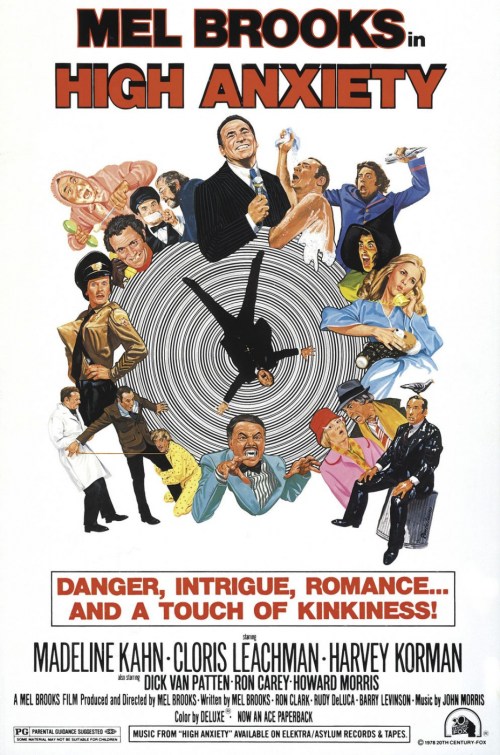
High Anxiety (1977)

By Richard Winters

My Rating: 7 out of 10

4-Word Review: He’s afraid of heights.

Dr. Richard Thorndyke (Mel Brooks) is hired as the new resident psychiatrist at the Psycho-Neurotic Institute for the Very, Very, Nervous where he is to replace another Dr. who died under suspicious circumstances. While there he becomes aware of many odd things occurring making him believe that the people running the hospital, Dr. Charles Montague (Harvey Korman) and Nurse Diesel (Cloris Leachman), have a scheme going on where they take in rich patients and pretend their conditions are worse than they really are, so that they can keep the patients hospitalized for indefinite periods and thus bilk the patient’s rich families for large sums of money. Richard, together with Victoria (Madeline Kahn) who is the daughter of another patient that is being held there against his will, become determined to expose the scheme, but his adversaries use nefarious tactics to try and stop him by taking advantage of his extreme fear of heights.

Per an interview that Mel Brooks gave with NPR in 2013 he revealed that he wrote a letter to Hitchcock in 1976 telling him that he wanted to do a parody of his movies and was interested in getting his feedback. Hitch wrote back saying that they should get together in his office to go over ideas. In fact it was Hitch’s suggestion to have the scene involving the birds pooping on Brooks. When the film was completed he got his own private screening and afterwards he sent Brooks a case of expensive French wine with the note: “A small token of my pleasure, have no anxiety about this.”

Two of my favorite moments include a Psycho parody where a bellhop (played by a young and soon-to-be famous director in his own right, Barry Levinson) who stabs Brooks with a newspaper while he’s in the shower. The afore mentioned Birds parody is good too with the bird droppings made up of mayonnaise and chopped spinach, but because a helicopter was used during the segment it scared a lot of the pigeons causing real bird do-do to get mixed in with the fake stuff.

I enjoyed the bits involving a parody of the ‘gliding camera’ a technique used in many films where a camera shot begins on the outside of a building, but then somehow ‘glides through’ a wall and goes inside a place without any barrier. Here the camera shatters the glass as it tries to ‘glide through’ the window of the hospital, but Brooks almost ruins the moment by having the characters react by looking up to where the noise occurred, but then going back to their conversation, which makes no sense. If a camera operator has just crashed through a window, most people would get up from their seats and inspect the damage, which would’ve overplayed the joke, so they should’ve just had the characters not respond to the crashing noise at all. This same issue occurs at the end where the camera operators are heard talking just before they crash through a wall, but the scene would’ve played better without the banter.

The plot, as thin and goofy as it is, has some interesting moments. I especially enjoyed the segments done inside the lobby of the Hyatt Regency in San Francisco and the way it takes advantage of the glass elevators there. The scene involving actor Ron Carey blowing up a picture that he took there in order to solve a crime is cool because it goes back to the old way of developing film, which will be a good education for today’s younger viewers who are more used to digital.

The performances are first-rate with Brooks in an uncharacteristic straight part though he still gets in a few zany moments including a segment where he’s a baby who falls from his high-chair. Leachman though steals it in a brilliant send-up of Nurse Ratched from One Flew Over the Cuckoo’s Nest. In fact it’s her contorted face with no make-up and a faint mustache that leaves a lasting impression. She has stated that she disliked doing the role, but it’s so hilarious that I wished her part had been given a wider storyline.

My Rating: 7 out of 10

Released: December 25, 1977

Runtime: 1 Hour 34 Minutes

Rated PG

Director: Mel Brooks

Studio: 20th Century Fox

Available: DVD, Blu-ray, Amazon Video, YouTube
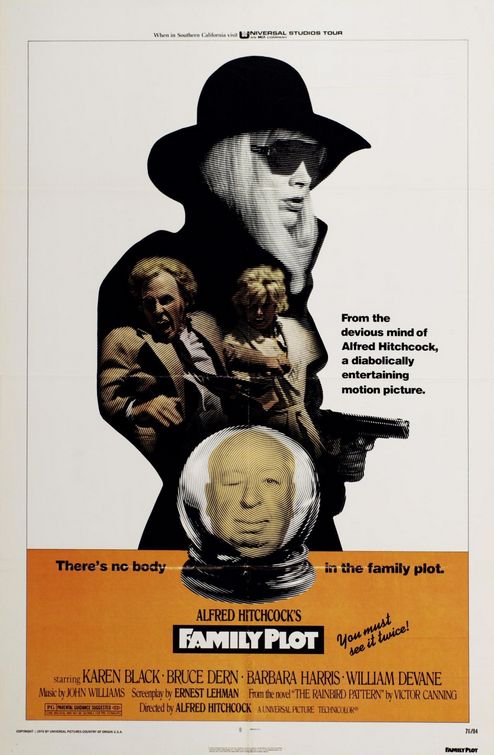
Family Plot (1976)

By Richard Winters

My Rating: 4 out of 10

4-Word Review: Alfred Hitchcock’s last movie.

Blanche Tyler (Barbara Harris) is a phony psychic whose client, the rich heiress Julia Rainbird (Cathleen Nesbitt) offers her a reward of $10,000 if she can use her ‘psychic abilities’ to find Julia’s long-lost nephew who was given up for adoption years earlier. Blanche employs her boyfriend George (Bruce Dern) who works as a cabbie in-between acting gigs, to find the man. George ends up stumbling upon someone who he thinks may be him, Arthur Adamnson (William Devane), but ends up getting in-over-his-head when Arthur proves to have ulterior motives.

The film’s claim-to-fame is that it was the last one directed by Alfred Hitchcock, which is probably the only good thing to say about it. Technically it’s not bad, but it’s not terribly interesting either. Everything that gets done here has been done before in other films with more interesting results. This includes a sequence where Blanche and George’s car goes careening down a mountain highway with no breaks, which isn’t exciting at all and looks clearly shot in front of a green screen.

After completing the far edgier Frenzy I was expecting Hitch to try and push the envelope even more, but instead he draws back with a pedestrian story that’s full-of-holes.  It was based on the novel ‘The Rainbird Pattern’ written by Victor Canning, which had a darker tone. Screenwriter Ernest Lehman wanted to capture that same tone here, but Hitch pushed him instead for a lighter quality that borders on camp, but ultimately comes off as gimmicky. The ending is particularly limp and for someone once dubbed the ‘Master of Suspense’ there is very little of it here.

The only moment that stuck out for me is where Blanche and George sit down to eat hamburgers. Normally actors in films rarely eat the food that they’re served and will usually either take small nibbles, or simply leave it on the plate without taking a single bite, but here both Dern and Harris take big bites from their burgers while continuing to talk. At one point a piece of burger spits out of Dern’s mouth as he speaks and he instinctually holds up his hand in front of his mouth in an embarrassment, which was strangely left in. Most directors would’ve quickly stopped the scene and reshot it, but instead Hitch decided to let it continue, which adds an odd realism probably not seen anywhere else.

The casting is the only real bright spot especially Devane, who normally played good guys, but takes a turn as a villain here and does quite well. In fact it’s the best performance of his career. Unfortunately the two women (Harris and Karen Black who plays Devane’s girlfriend) are wasted and for the most part have very little to do. Black’s role could’ve been cut out completely in a film that especially when compared to the director’s earlier works is a huge disappointment.

My Rating: 4 out of 10

Released: April 9, 1976

Runtime: 2 Hours 1 Minute

Rated PG

Director: Alfred Hitchcock

Studio: Universal

Available: DVD, Blu-ray, Amazon Video, YouTube