Tag Archives: 80’s Movies

Johnny Be Good (1988)

By Richard Winters

My Rating: 2 out of 10

4-Word Review: College recruiters are sleazy.

            Johnny Walker (Anthony Michael Hall) is a star high school quarterback who finds that during his senior year he is being bombarded by college recruiters who try any means, legal, or otherwise, to get him to come to their school. Johnny enjoys taking advantage of it, which consists of going to their campuses and being lavished with parties, women, money, and other gifts. His girlfriend Georgia (Uma Thurman) doesn’t approve as she is afraid he may be tempted to cheat on her.

In some ways this is an interesting idea as the topic of college recruiting and some of the corruption that goes along with it has not been presented in any detailed fashion in too many other films, so it seems fresh. The film starts out as very farcical and humorous showing all these middle-aged men dressed like Herb Tarlek from WKRP in Cincinnati  slobbering over Johnny wherever he goes and promising him just about anything. The film though switches gears awkwardly. The majority of it is crude and adolescent, but then turns into a serious and preachy morality tale at the end. This uneven approach doesn’t work as the goofy comedy is so over-the-top that any attempt at seriousness is lost. It would have worked better and been more riveting had it been presented as a drama.

The comedy isn’t all that hilarious either. There are some amusing bits here and there, but most of it falls flat. Even the film’s best comic moment gets botched. It entails Johnny being lead onto a platform on the field’s fifty yard line by a recruiter’s attractive, sexy wife who tries to get him to have sex with her.  Some of the other people at the party follow them and project their antics onto the stadium’s scoreboard. Unfortunately Johnny resists and ends up running away even though I thought it would have been a lot funnier seeing them actually having sex. I suppose the filmmakers feared that audiences would not want their hero cheating on his girlfriend, but if you spend time setting up a wild scenario then you need to go for the gusto.

This also brings up another problem with the movie, which is that all the nudity, at least in the theatrical 84 minute version I saw, is cut out. Apparently there is an R-rated version available with more nudity intact, but why cut it out to begin with? This film’s sophistication level is extremely low and typically when the script consists of nothing more than crude comedy the nudity at least helps.

The third problem with the film is that the adults are portrayed as being so stupid that they seem almost inhuman. I know it became trendy during the teen movies of the 80’s to show adults and other authority figures as being clueless, unhip, and basically just plain out-of-it, but this film goes too far with it. Georgia’s parents are particularly irritating. The casting of Marshall Bell as Georgia’s overly authoritative father was a mistake as he looks and behaves too much like Paul Gleason, who plays the coach.

Hall is okay in the lead, but the part where he is sitting in his room playing on his drums even though his drumsticks never makes contact with any of them while looking at football highlights on the TV is annoying. For one thing the look on his face makes it appear that he is in some sort of trance and the scene goes on too long and then gets shown again during the end credits.

Although the part is not very demanding it is still fun to see Thurman in an early role as the girlfriend. Robert Downey Jr. is also amusing in an early role as Johnny’s best friend although he looks pudgy and out-of-shape and not in condition for playing football. His father Robert Downey Sr. appears as an investigator.

By far and away the best part in the film is Paul Gleason as the high strung coach Hisler. He plays an extension of the part that he did in The Breakfast Club   and is even more hyped-up. He steals every scene he is in and is the most memorable thing about the film and helps save it from being a complete disaster.

Legendary sports announcer Howard Cosell appears as himself in a couple of amusing cameos, which is fun, but his hand shakes so much as it is holding the telephone receiver that he is talking into that it becomes distracting. Former Chicago Bears quarterback also appears as himself, but most young football fans today probably won’t even know who he is.

My Rating: 2 out of 10

Released: March 25, 1988

Runtime: 1Hour 31Minutes (R version) 1Hour 24Minutes (PG-13 version)

Director: Bud S. Smith

Studio: Orion Pictures

Available: VHS, DVD, Netflix streaming
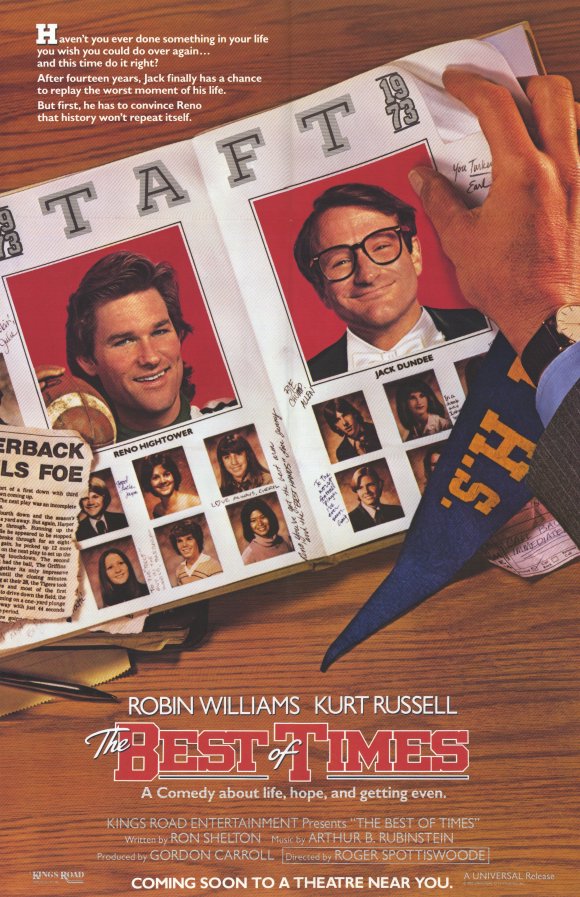
The Best of Times (1986)

best of times

By Richard Winters

My Rating: 2 out of 10 

4-Word Review: Play the game over.

            Robin Williams plays Jack Dundee, a man who on November 15, 1972 dropped a sure touchdown pass in a football game with their chief rival Bakersfield. Now, 13 years later, he still dwells on it all the time and even watches old film footage of it in his basement. He becomes obsessed with playing the game again with all of the same players. The problem is that most everyone has moved on including their star quarterback Reno Hightower (Kurt Russell) who is now working as a local car mechanic due to a knee injury that he suffered during that game. Jack persists and eventually gets a game scheduled, but that proves to be only part of the battle.

The script, by Ron Shelton, has an interesting point that could touch anybody. Who out there doesn’t want to go back and relive some past mistake, or regret, and make it better? The fact that he also lives in a small town and is constantly being reminded of it hits home as well. I was born and raised in a small, Midwestern town, so I know it can be hard to live down certain things. So, in context, it is a great theme. As people age and fall into a dull routine of a dead-end job and marriage it is sometimes an event that happened to them when they were younger that matters and in that capacity it is a great idea.

The problem is that the execution of it is contrived and dull. The first 45 minutes are spent with endless conversations of the ‘dropped pass’ that goes nowhere. Some of the psychological tactics that Jack uses to motivate not only his teammates and those from the other team into playing the game is somewhat interesting, but not terribly funny. In fact there is very, very little in this movie that is funny, or even halfway creative for that matter. It seems to be nothing more than the regurgitated ‘feel good sports formula’ that has been done a million times before without adding anything new. The final game sequence has all the expected clichés and what should be exciting and thrilling becomes boring and tiresome. I was almost hoping that Jack would drop the damn thing again when he had his second chance, which gets shown in annoyingly slow motion, as it would have been funnier and if anything given us some sort of surprise as everything else is painfully predictable.

The only time this movie that gets even slightly amusing, and I do emphasize amusing as there is nothing in here that is at any time hilarious, is when they bring back all the old players who are now middle-aged and out-of-shape and try to hold a practice. Having now grown to middle-age myself I can say succinctly that you can’t go back again even if you want to and the movie brings this up in some of the vignettes, but then doesn’t go far enough with it.  Instead, just as the film should be gaining some sort of momentum, it gets bogged down with a meandering segment involving the men trying to reconcile with their wives after some inconsequential tiff.

There is also the fact that if someone who has not moved on in their life and dwells on something as much as Jack does than in most cases would be unable to have long-term relationships with other people, or even hold down jobs. Yet here our hero is in a pretty good marriage and a cushy job. It would have been more interesting and probably funnier had the Jack character been a crook, or living on the absolute fringes of society and not been able to adjust to life until he had a second chance at the catch. Of course this would have been considered too ‘edgy’ by most Hollywood producers and I’m sure test audiences of which Hollywood is very dependent on would not have approved, which probably explains why the character is so boringly normal.

For what it’s worth Williams gives an energetic and engaging performance. The character is not all that well developed, but Robin gives it some life and helps make the movie passable. Russell seems a bit a dull here despite being an always durable actor. I realize the character is a bit passive, but having him transform into an aggressive, angry leader at the end seemed forced and phony. I was also disappointed that legendary character actors appear here including Carl Ballantine, Dub Taylor, Kathleen Freeman, and R.G. Armstrong and are given nothing more than a line of dialogue a piece and in the case of Ballantine only one word, which seems outrageous.

I have nothing to recommend here. I am giving it two points simply because the production values are high enough that it doesn’t look amateurish, but the flat, slightly implausible storyline needs to be injected with some sort of originality. Even for fans of Williams I would say stay away from it as seeing him in such blah proceedings doesn’t make it worth it.

My Rating: 2 out of 10

Released: January 31, 1986

Runtime: 1Hour 44Minutes

Rated PG

Director: Roger Spottiswoode

Studio: Universal

Available: VHS, DVD, Amazon Instant Video

Happy Birthday Gemini (1980)

happy1

By Richard Winters

My Rating: 5 out of 10

4-Word Review: Gay son comes out. 

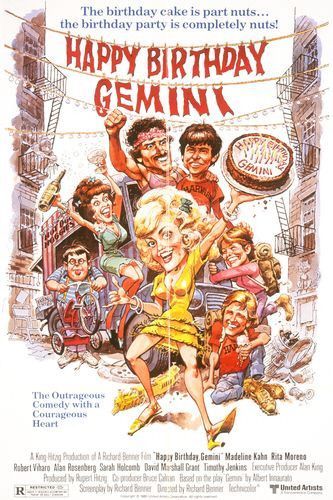
A brother and sister by the name of Judith and Randy Hastings ( Sarah Holcomb, David Marshall Grant) travel to Philadelphia over the summer to visit their college friend Francis Geminiani (Alan Rosenberg).  Judith dated Francis during the school year and wants to continue the relationship. Francis though has come to terms with his homosexuality and realizes that he is now more attracted to her brother.  The story examines their adjustments and attitudes to this news as well as the many eccentric characters that make up the neighborhood.

Despite not rating well with the critics, I kind of liked this movie for the most part. The film was directed by Richard Benner who received acclaim for the directing the groundbreaking Canadian film Outrageous. I think he captured the row houses and inner-city neighborhoods of Philadelphia well. My Mother is from the city and I spent many summers visiting there. I enjoyed the bright color schemes of the different houses as well the character’s costumes. The movie has a very European feel featuring a lot of long takes and a leisurely pace. The characters are also much more open-minded and accepting of each other’s transgressions than you would usually find in an American film.  The toe-tapping ragtime music and upbeat ending help fill it out.

Kudos must also go to Madeline Kahn and her performance as Bunny Weinberger. I was very impressed with this woman’s comedic skills after seeing her in What’s Up Doc as well as in Paper Moon. I didn’t think anything could top those, but this comes close. Her portrayal of a foul-mouthed, ditzy blonde with a very heavy eastern accent is outstanding and a highlight of the whole movie.  Her scenes in a courtroom where she has to defend herself from a battery charge as well as a nicely photographed scene where she threatens to jump off an abandoned building are two of her best moments.

Where the film fails is in the fact that there is little cohesion between the scenes. The film goes off on long tangents, particularly with the Bunny character, until it seems like Francis’s problem is only a side-story. There is a lot of extraneous dialogue that goes nowhere and was not needed. A 115 minute runtime is much too long for this kind of material.  For a comedy the laughs are lacking and the script needed to be injected with a lot more witty conversations and sharp one-liners. Rita Moreno is completely wasted as the character of Lucille Pompi.  She has nothing funny to say and it would have been more entertaining if they had built up more conflict between her and the Bunny character as the two had very contrasting values. The subject matter itself is no longer fresh or groundbreaking and the film failed to put any new or interesting spin on the topic. Although I liked the positive message I still felt that it glossed over the homophobic sentiments that are still out there and did not do its subject matter any real justice.

Fans of Kahn should see this, but others may find it placid and lacking in any type of distinctive quality.

My Rating: 5 out of 10

Released: May 2, 1980

Runtime: 1Hour 47Minutes

Rated R

Director: Richard Benner

Studio: United Artists

Available: VHS

Dirty Dancing (1987)

dirtydancing1

By Richard Winters

My Rating: 5 out of 10

4-Word Review: Rubbing bodies is sexy.

Some of my lady friends at the office were surprised to hear that I had never seen this film and suggested that I watch and review it for my next column.  Since Hollywood is now planning on remaking this movie and several websites have already started up protesting it as fans of the original feel this can’t be duplicated, now more than ever seems to be a good time to give this movie a look.

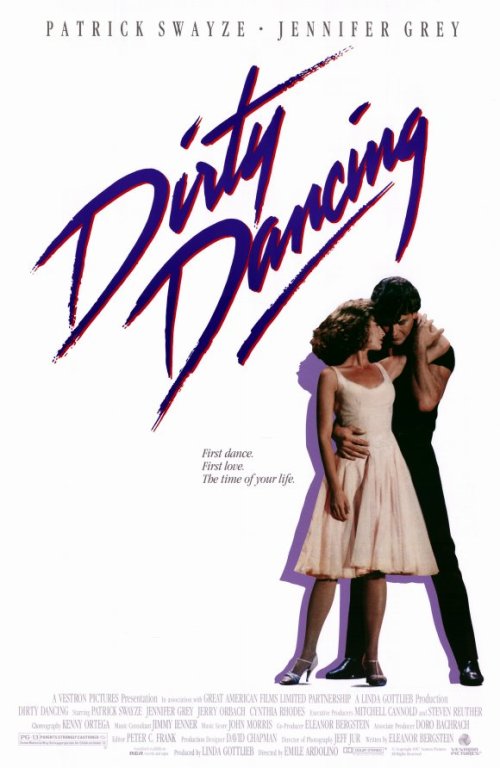
The plot, which is paper thin, deals with a seventeen year old girl named Frances ‘Baby’ Houseman, who while vacationing with her family at a resort in the Catskills Mountains of New York in the early 60’s, becomes involved with the craze of dirty dancing that is done behind the scenes by some of the young people. When one of the lead female dancers named Penny Johnson (Cynthia Rhodes) gets pregnant and has to bow out in order to get an abortion, Francis agrees to take her place in the dance routine. She has no experience with the dancing, but after spending long hours practicing with the male hunk Johnny Castle (Patrick Swayze) she gets pretty good at it and the two fall in love in the process.

The story is loosely based on the real-life experiences of screenwriter Eleanor Bergstein, who traveled to the Catskills during the summers of her youth with her family and got involved with some of the dirty dancing contests that they had up there. The name of Frances that is given to the character was actually the name of her older sister and the nickname of ‘Baby’ was what Eleanor was called in her teen years.

The first thing that impressed me about the film was the on-location shooting. I had also been to upstate New York during the summers in my younger years and felt that the area was quite scenic. The film does a good job in recreating this to the extent that it also becomes like a third character. The only problem was the fact that it was actually filmed in North Carolina and Virginia, but they disguise it well and the ambience of the Catskills is still there.

The chemistry between the two stars is what makes the movie and spiraled it into the hit that it became. I felt the energy and I liked it despite the fact that apparently behind the scenes the stars did not always get along. I thought the casting of Grey, daughter of legendary entertainer Joel Grey, was overall a good choice. The producers wanted someone who could really dance and she fit the bill even though she was actually ten years older than the character she was portraying. However, I did feel it became somewhat of a problem during some of her exchanges with the Johnny character who was supposedly in his twenties. I would have thought that a young lady of only seventeen would have been a little more intimidated dealing with an older man and even a little awkward at times and yet their ‘spats’ came off more like two adults arguing.

I really liked Frances’ relationship with her father Jake (Jerry Orbach). It was a nice and respectful one with neither side talking down to the other. The scene where the two have a falling out and Francis comes to him to ask forgiveness is actually quite emotional. However, the part where Jake, who is also a Dr., helps Penny when she becomes ill after having an abortion with an untrained physician seems a bit glossy. Normally that situation would prove fatal to the woman, but somehow Jake is able to make her ‘all better again’ simply by using medicines inside his doctor bag and she wasn’t even forced to go to the hospital. I also thought that the fact that Frances kept her dancing a secret from her parents seemed to be a bit of a stretch as she spent so many hours with Johnny that I would have thought they would become suspicious as to where she was all that time.

For the most part the recreation of the 60’s era is all right. However, I did not like instituting 80’s songs into the mix. ‘Hungry Eyes’ and ‘She’s like the Wind’ are good songs on their own, but have a distinctly different sound than music from the 60’s. By putting them into the soundtrack they become jarring and, for this viewer at least, threw me out of the time period of the story completely. To me it was a sign of poor filmmaking.

The movie is formulaic and predictable to the extreme, which was the reason that I never went to see it when it first came out because basically if you’ve ‘seen the previews then you’ve seen the movie’. It is always nice if a movie can give you some sort of unexpected twist, or surprise, or even some new level of insight, but this film offers none. Even on a soap opera level the scenarios and complications are awfully light and there are a few moments of hackneyed drama. If one’s only demand is to see a predictable teen romance then on that level it is competently done. If a viewer were to demand anything more than that then they will most assuredly be disappointed.

My Rating: 5 out of 10

Released: August 21, 1987

Runtime: 1Hour 40Minutes

Rated PG

Director: Emile Ardolino

Studio: Vestron Pictures

Available: VHS, DVD, Blu-ray

Body Double (1984)

By Richard Winters

My Rating: 6 out of 10

4-Word Review: Sex through a telescope.

During the 70’s and 80’s director Brian DePalma, a fan of Alfred Hitchcock, made a lot of stylized thrillers using many of Hitchcock’s trademark devices.  He even storyboarded every shot that he did just like Hitch. Unfortunately a lot of these films had rather flimsy plots and characters and were over-directed, drowning out what little story there was. DePalma tried so hard to imitate Hitch that he ended up showing no original vision himself and made the viewer crave even more at seeing a genuine Hitchcock film.  This film, which I first saw when it was released 26 years ago, I felt was the best of DePalma’s Hitchcock imitations. Upon viewing it a second time many years later I found a lot more holes despite one clever twist and some good camerawork.

The story is about Jack Scully (Craig Wasson) who is a struggling out of work actor who is offered a place to stay by a man named Sam (Gregg Henry). The house is a very modernistic place looking almost like the Space Needle in Seattle.  Jack is offered the home on condition that he takes care of the place while Sam is away on business.  During his stay Jack becomes obsessed with the attractive neighbor lady named Gloria Revelle (Deborah Shelton) who he watches through a telescope.  She does an erotic dance in her bedroom each night at the same time while wearing a revealing negligee. The dance itself is not real exciting and would probably bore most people after a minute or two, but Jack becomes hooked on it and watches it endlessly night after night.  Eventually he starts following the woman around during the daytime and even tries to start up a relationship with her. He also begins to notice another man, who is very creepy looking, is also following her and eventually he witnesses him murdering her, but Jack becomes convinced there is more to it.  With the help of a porn star named Holly Body (Melanie Griffith), who he meets along the way, the two set out to try and solve the mystery.

Wasson makes for an incredibly weak male lead. This helps somewhat because the character is very weak, but it is hard for the viewer to relate or care about him.  His best scenes come during his endless auditions and rather thankless treatment he receives from directors, producers, and acting coaches.  These are one of the few scenes that the film gets right as it hits the nail right on the head showing just how degrading working as a low paid, nameless actor can be in Hollywood. The porn star character is also weak as she is too cliched and predictable making her more annoying than anything despite the fact that Griffith plays the part pretty well.  The character was based on real-life porn star Annette Haven who gets listed in the credits as a ‘technical advisor’. I did like Gregg Henry though who makes for a great sleazy villain as well as Dennis Franz in a small, comic relief type role as a brash, stressed-out B-movie director.

The film also has a lot of rather implausible elements that prevents the viewer from getting as involved in it as they should. One of the biggest ones is when Jack sees Holly Body performing in a adult video that he has rented and becomes convinced that she may be connected to the case when he sees her do the same type of dance that the neighbor lady did, so in order to meet up with her he auditions as the male lead in her next X-rated production. Now I’m not completely sure how casting in these productions work, but having some guy with no experience starring and having sex with the industry’s biggest female star at the time seems to be a bit of a stretch. I would also think that a guy who was not used to having sex in front of the camera and with everyone staring at him might get nervous and be unable to ‘perform’ especially in what was still the pre-Viagra age.

The porn scenes themselves aren’t too interesting, or exciting.  This industry is no longer quite as underground, or taboo as it once was, so the shock factor is gone.  The characters and situations are handled in such a placid way that the viewer is given no real insight into the business, or the people who work in it.  The industry has evolved a lot in the past twenty-five years, so the scenes here become irrelevant.

There were a few things that I did like.  The scenes where Jack follows Gloria around in the shopping mall are pretty well handled despite the fact that I think they could have had a little more action here and there also needed to be more customers in the background.  However, the bird’s eye view, which is another patented Hitchcock type shot, showing Jack following Gloria around who is also being followed by the killer is good.  This part also features the one definitive moment from the film that I remembered after all these years.  It involves Gloria throwing away her old panties when she buys some new ones and then having Jack fish through the garbage, retrieve the panties, and put them in his pocket as a sort of ‘souvenir’.

Some of the shots during the actual murder are also really innovative especially the way the camera captures the giant drill, which is the killer’s weapon.  Probably the best shot of the entire film occurs when the killer drives the drill into the victim, which then goes through her body as well as the floorboards and then pops out of the ceiling from the floor below.  Yes, it is rather gory, but I still thought it was a really cool shot anyways.  I also thought the innovative design to the house that Jack stays in had potential, but I wished they had shown a little more of the place from different angles and given us more of a feel of the inside instead of having all the action occur in just one room.

Overall the film is slick, but very shallow and superficial.  The neighbor lady especially seems like a male fantasy.  DePalma gets too hyper with the camera.  I really don’t like his ‘spinning camera’ shots.  He spun it around Jack and Gloria as they kissed and it was tacky and cliched.  Once, in the film Blow Out, he spun the camera around so much in one scene that it started to actually make me feel dizzy and nauseous. The film has a scene during the closing credits showing how a body double is used during a film production, which is amusing and interesting, but a bit out of place for a thriller.  You walk away from the movie wondering how much more entertaining it could have been had Hitchcock himself been able to direct it.

My Rating: 6 out of 10

Released: October 26, 1984

Runtime: 1Hour 54Minutes

Rated R

Director: Brian De Palma

Studio: Columbia Pictures

Available: DVD (Special Widescreen Edition), Amazon Instant Video

A Soldier’s Story (1984)

soldier

By Richard Winters

My Rating: 6 out of 10

4-Word Review: Murder at army base.

This film is based on the off-Broadway play that won the Pulitzer Prize for best drama in 1982 and was written by Charles Fuller. Many of the performers in the play ended up reprising their roles in the film including the stars, Adolph Caesar and Howard E. Rollins, Jr. Director Norman Jewison spent many years trying to get the green light for the project and ended up being rejected by just about every studio. Finally Columbia Pictures gave the go-ahead, but only after Jewison agreed to do it for no salary and all the performers agreed to be paid at the minimum union scale.

The story is actually pretty well written and I’m surprised that so many studio heads refused it by using the excuse that it wasn’t ‘commercial enough.’ The plot involves the murder of a black army sergeant (Caesar) and the subsequent investigation by a black army captain (Rollins) brought in from Washington. The period is around the end of World War II and the setting is an all black army base in the deep South, which leads to many expected racial tensions. What sets this story apart from others of its type is the fact that the racism and underlying tensions is not just white vs. black, but also, and more prominently, black vs. black.

Caesar plays a memorable victim. He is hated by his own men due to his harsh treatment of them. When he is killed everyone is a suspect and as his men recount their dealings with him, it is easy to see why. Yet this is also no one-dimensional character. The story does a very good job of letting us understand why this man has become the way he is. The viewer can’t help but come away feeling sorry for the man and genuinely sad for the way he ended up. The suspects are equally complex, so the film easily becomes quite riveting as it goes along.

Rollins gives an outstanding performance as the head of the investigation. It’s sad that his career, and ultimately his life, was cut short by his drug addiction because he makes a solid impression here. I liked the way he remained stoic throughout despite having to deal with a myriad of different personalities and at times overt racism. Denzel Washington is also very good in a pivotal role.

There were a few things that were thrown in that I felt were not necessary and ended up hurting the film as a whole. One of them is the musical score. It has a very bouncy, ragtime sound to it that would be good if this was a comedy. However, for a drama it seems completely out of place and at times is even jarring. The film has a few musical interludes as well. A couple of them are by Patti LaBelle, who I think is a great singer, but in this film she is out-of-place. It starts to take away too much of the grittiness of the story, which should be the central theme. I also found the use of slow motion to be distracting. It occurs twice. Once during the murder scene and another time during a baseball game between the soldiers.

Overall the film succeeds enough with its story and characters that the viewer is forced to think and feel, which is always a good thing. I can’t say that the resolution was anything shocking, but it does manage to keep you guessing. However, this is one rare case where I might have actually preferred seeing the stage version.

My Rating: 6 out of 10

Released: September 14, 1984

Runtime: 1Hour 41Minutes

Rated PG

Director: Norman Jewison

Studio: Columbia Pictures

Available: DVD, Amazon Instant Video, Netflix Streaming

Tetsuo, The Iron Man (1989)

tetsuo2

By Richard Winters

My Rating: 6 out of 10

4-Word Review: Man turns into metal.

This is one of the most bizarre and fascinating films ever made. It reminded me a lot of David Lynch’s Eraserhead, but with a little more linear storyline and engaging tongue and cheek humor.  It all depends on one’s tolerance as to how much they will enjoy it. Some will find it weird and alienating while others will insist it’s brilliant.

The story centers on a very strange man, played by the film’s director Shinya Tsukamoto, who has a freakish compulsion to stick scraps of metal inside his body.  He cuts his leg open and crams a metal pipe inside of it, which causes him excruciating pain.  He runs through the streets screaming and is hit by a car driven by a man (Tomorowo Taguchi) who is never given any name.  The driver and his girlfriend think that they have killed him and decide to dump the body along a riverbank and then make love in front of it. The next day the man notices while shaving that a metal nail is protruding out of his cheek. Soon metal parts start to grow from every part of his body until he is completely unrecognizable.

Despite being made over twenty years ago I found the special effects to be awesome and able to stand-up to today’s standards. The opening part where the man stuffs a metal pipe into his cut open leg appears so real that it made me cringe. The amount of metal growing out of the main character’s body becomes almost mind boggling and has to be seen to be believed.  The immense metal suit that the actor ends up wearing and having to walk around in is massive and I wasn’t sure how he could even move in it as it looked incredibly heavy.  The stop-action photography is fluid and watching the metal metamorphose in different and imaginative ways is fun. I found the grainy black and white photography to be highly effective and it helps accentuate the nightmarish vision of the story.

The story also features dreamlike segments while although not always making sense and sometimes jarring to the story, still are memorable. The scene where the main character is chased through the catacombs of an isolated train station by a woman who has turned into a robotic mass of metal is cool.  There are a few kinky elements that are shocking, tasteless, and hilarious all at the same time. They include the man’s girlfriend with a mesmerizing stare who becomes a zombie during one of these visions and rapes him with a metal pipe that has sprouted out of her vagina.  Then, a few scenes later, he turns around and rapes her with his penis that has turned into a giant whirring drill.

Although I applauded the film’s no-holds-barred creativity that seemed years ahead of its time, I did feel that it was confusing and disconcerting.  There are too many jump cuts and wild images thrown at the viewer without any explanation. It does finally come together at the end, which is good, but I would have liked a better set-up. I wanted to see more character development, which basically is none and some explanation for why all of this was happening.  A little more conventional narrative could have gone a long way. I also felt that it became too one-dimensional. Metal grows into more metal that grows into yet even more metal until it becomes almost boring. Although the running time for the picture is only 64 minutes I felt that this was actually too long and I would have wanted it shortened even more as the story seems to play itself out and have nowhere to go.

(Spoiler Alert)

Fortunately it is saved by a very satisfying over-the-top ending that nicely brings it all together.  The strange man inexplicably comes back to life and the two duel things out in the vacant city streets. The apocalyptic over-tones here are terrific and the last sequence where the two fuse together to form one giant metal mountain has to be one of the most extraordinary images ever to be put on celluloid.  Their final conversation is insanely funny.

(End of Spoiler Alert)

Again, as I stated before, this is not going to be for everyone. There is a real underground look and feel here that is going to offend some while amaze others. Nonetheless it has justifiably acquired a large cult following that seems to never stop growing and it has spawned several sequels that have all been done by the same director. This one though is still the best of the series. I recommend it to those with perverse, offbeat tastes and an extremely dark sense of humor.

My Rating: 6 out of 10

Released: July 1, 1989

Runtime: 1Hour 7Minutes

Rated NR (Intense Imagery, Rape, Graphic Violence, Language)

Director: Shin’ya Tsukamoto

Studio: K2 Spirit

Available: VHS, DVD (Special Edition)

Eating Raoul (1982)

By Richard Winters

My Rating: 8 out of 10

4-Word Review: Get rid of perverts.

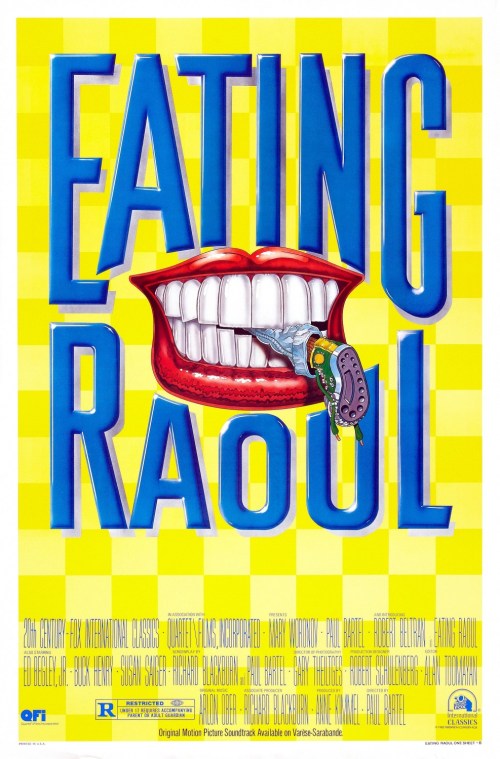
Paul and Mary Bland (Paul Bartel, Mary Woronov) are a very conservative couple that do not approve of open sexuality. They live in an apartment that is filled with swingers and spend most of the time trying to avoid them while abhorring their behavior.  Their dream is to purchase a large house in the countryside and convert it into a restaurant.  The problem is they have bad credit and are unable to secure any type of loan, so they decide to run an ad in the newspaper promising to fulfill and play-out people’s sexual fantasies. They insist everyone must pay in cash and then lure them to their apartment where Paul hits them over the head with a frying pan and kills them. That way they are able to collect the money they need while ridding the world of all the ‘perverts’.  However, a local con-man by the name of Raoul finds out about their act.  He is a young, good looking, self-described ‘hot-blooded Chicano’ who has the hots for Mary.  He allows them to continue with their scheme as long as he can have the dead bodies afterwards, which he then sells to a company who uses them to make dog food. Things go well for a while, but then complications ensue and that’s when it really starts to get crazy.

Paul Bartel’s hilarious script was initially rejected by all the studios and he spent six futile years trying to get it financed. It was only after his parent’s sold their house and gave him the money that he was able to get the film produced. It definitely has a very low budget look with a grainy film stock that gives it almost a home movie feel. However, this is a perfect example where a creative script can help overcome the film’s other shortcomings.  There are some genuinely funny moments the best is probably the swinger’s party and the infamous hot tub scene. This is the one thing that I remember most vividly about the film when I first saw it decades ago. I knew it was coming and still found myself laughing out loud when it did.  The swingers themselves are an obnoxious riot and you actually find yourself looking forward to seeing them get killed.

Writer, director, and star Bartel continues with his theme that perversion is a normal part of the human makeup.  Everyone has their own private sexual fetishes and fantasies that is unique only to them and may not be understood by others. He started this philosophy with his short film Naughty Nurse in 1969 where an otherwise respectable doctor and nurse would spend their lunch hour playing weird sex games. He continued it with his initial feature film Private Parts in 1972 that had a handsome young man who enjoyed having sex with a doll that he could fill up with water over real women and the weird relationship that transpired with the teen girl who lived next door and got-off watching him do it.  Here it continues with the sexual fantasies of Paul and Mary’s customers that become increasingly more outrageous (and hilarious) as they go on. Even the very strait-laced Paul and Mary have their own perversions. They dislike the actual act of sex and never do it. Instead they sleep in separate beds and cuddle with stuffed animals instead of each other, which is just as funny in the other way.

When I initially saw the film I thought Bartel was having a major ego trip by casting himself as being married to a very attractive lady like Woronov. He was a pudgy and bald man who in real-life would most likely not be able to attain such a woman. Upon second viewing I ended up liking the odd casting and felt it helped make the film stronger.  Usually beautiful women are shown as simmering with sexuality and even sex symbols, so I appreciated the way it went against type. It also helped to define how Paul and Mary had a very special understanding with each other that did not conform to conventional wisdom, which sometimes happens. I also enjoyed the way Mary stays true to Paul even when she ends up being severely tested.

I admired Woronov’s performance the second time around as well. She was majoring in sculpting in 1963 at Cambridge University when her class decided to take a field to the Andy Warhol factory. She became so impressed with the place that she stayed while the rest of the students went back.  She starred in some of his experimental films and now 80 independent/underground films later she has become a major cult icon.  I was only 18 when I first viewed this and at the time my hormones where more fixated on her sleek body as she does have a few good, but brief nude scenes. Her acting though indeed helps carry the film.

Successful Latino actor Robert Beltran is good in his part as Raoul, which also marked his film debut. I enjoyed the contrast of his aggressive, streetwise character against the stifled Blands. There is also shades from Roman Polanski’s classic Cul-de-sac where a coarse stranger disrupts the unique chemistry of an otherwise isolated couple.

Susan Saiger is fun as Doris the Dominatrix. I felt it was nice how the film starts out with her as a kinky woman with a whip at a party, but then turns around with a scene showing her as an everyday housewife and raising a kid during her off hours. I liked how Paul and her managed to get past their differences and form an interesting friendship.

Famous character actors pop-up in amusing cameos. Ed Begley Jr. is an over-the-top hippie sex freak. Edie Mclurg appears near the end of the film as one of the swingers. Famous dwarf actor Billy Curtis is one of the customers and has a pet Doberman that is bigger than he is! The best cameo goes to Buck Henry who plays an amorous bank manager who makes advances towards Mary and then the funny way he tries to back-track when he gets caught.

This film has acquired a major cult-following that seems to grow by the year.  Yes, there are some flaws. The beginning is a bit cheesy and awkward and it took me about 20 minutes before I could get into it. I also wondered, with so many people being killed, why the suspicions of the police, or anyone else, was never aroused. There is also the fact that not everyone would get killed by being hit over the head with a frying pan, some might just get knocked unconscious. Still, I found myself laughing at a lot of places. I think people who are fans of black humor will enjoy this especially since it doesn’t sell itself out and stays true to form the whole way.

Sadly Paul Bartel died in 2000 from cancer and I felt his full potential was never fully realized. This became is most popular work and although he did several films afterward, none of them were as good.  Mary Woronov continues to be quite busy even at the age of 68. A documentary about her life and career is set to be released later this year and I look forward to seeing it.

My Rating: 8 out of 10

Released: March 24, 1982

Runtime: 1Hour 30Minutes

Rated R

Director: Paul Bartel

Studio: Films Incorporated

Available: VHS, DVD

Two Moon Junction (1988)

By Richard Winters

My Rating: 6 out of 10

4-Word Review: Voyuers will like it.

            A young woman named April (Sherilynn Fenn) who is from a well-to-do Southern family and engaged to be married meets a rugged hunk named Perry (Richard Tyson) who works as a laborer at a travelling carnival and the two immediately share a strong sexual attraction.  She considers getting out of her engagement, but her controlling grandmother Belle (Louise Fletcher) puts the crooked town sheriff (Burl Ives) on Perry’s tale in order to ‘rid them of the problem’.

Normally ‘hot and steamy’ love triangles that take place in the south seem over-done, redundant, and cliché filled, but for some reason this one works to an extent. For one thing the sex scenes, especially the one at the end that takes place at the Two Moon Junction locale, is quite explicit with an abundance of nudity by actress Fenn who is pleasing in the buff. And for the lady viewers there is even a scene featuring naked male bodies, both front and back, near the beginning of the film. If that isn’t enough there is also actor Tyson who is seen ninety-eight percent of the time without his shirt.

For sex it fares pretty well and rises just enough above the tired 80’s clichés to make it seem fresh. However, the story is rather placid and fails to dig deeper than its basic storyline.  The stylish atmosphere is nice, but there needed to be more tension and action.  I wanted the Fletcher and Ives characters to be meaner. Adding some tongue and cheek humor to a genre that even back then was becoming tired would have really helped.  There are times when it seems to want to go there but then it pulls back.  Having veteran character actors like Fletcher, Ives, Herve Villechaize, and Dabbs Greer was a real nice touch, but they needed to be given more to do. In Ives case, whose last film this was, I felt he was wasted and in that regard I came away from this thing disappointed.

Tyson works surprisingly well in the male lead.  He resembles a Fabio wannabe and I would normally have found him annoying, but he displays just the right level of cockiness to stay interesting. The fact that he also shows some negative traits helps keep the character real. However, the part where he breaks into April’s parent’s large estate and then promptly starts to take a shower seemed absurd and ridiculous. And just where did he find that bathrobe that fit him so well? Or did he bring one along with him? I suppose the plumbing might not be so good at the ragtag traveling carnival he worked at, but still.

Fenn is surprisingly strong as the female lead. This was definitely a three-dimensional character and the internal struggle that she had at being attracted to a man that she knew she shouldn’t be was nicely realized. The parts where she would breakdown into bouts of sobbing after her sexual liaisons with Perry were effective and heartfelt.

Kristy McNichol was a nice sight as a bi-sexual cowgirl named Patti Jean and she looked even better when she went topless. The fact that she revealed some latent lesbian tendencies towards April seemed to me to create interesting dramatic variables, but the film fails to go with it and the character disappears, which was another disappointment.  However, Patti and April’s dance together on the barroom dance floor created some nice provocative imagery.

It also during the opening of this barroom scene that you can spot the movie’s most revealing mistake; as the camera pans across the floor you can clearly see the shadow of the camera as well as the cameraman reflecting along the shiny wooden floorboards. It is always surprising to me the fact that if I the viewer can see a mistake like that right away how come an entire production crew misses it? Or do they see it, but are too lazy to reshoot, so they hope that it will just ‘pass-by’ the viewer? Either way it is the sign of sloppy filmmaking.

This also marks the acting debut of Milla Jovovich who plays April’s younger sister Samantha.  She was only thirteen at the time, but she already had a stunning face and it is easy to see why she caught the attention of producers and photographers as a model. However, her acting ability here seemed limited and her facial expressions where undisciplined.  She also shows little awareness of the camera, or how to play to it.

The film is superficial and lacking in many ways and it fails to have the necessary edginess that would have given it cult potential, but I still found it to be passably entertaining. Voyeurs who watch it for the sex may find it a little bit better.

My Rating: 6 out of 10

Released: April 29, 1988

Runtime: 1Hour 44Minutes

Rated R

Director: Zalman King

Studio: Lorimar

Available: VHS, DVD

Funny Farm (1988)

funny1

By Richard Winters

My Rating: 3 out of 10

4-Word Review: Novelist moves to country.

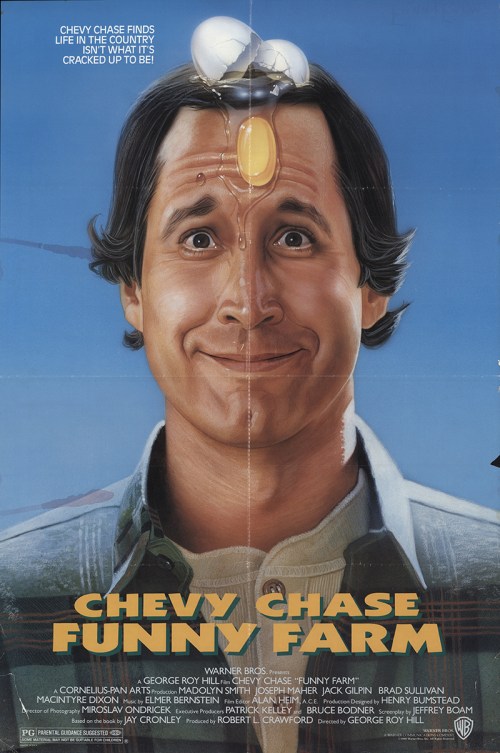
Uninspired comedy about a man named Andy Farmer (Chevy Chase) who receives an advance from a publishing company, which he uses to quit his job and buy a cabin out in the country with his wife Elizabeth (Madolyn Smith) in order to write his novel. Unfortunately the local citizens are eccentric in very clichéd ways and their time there is spent dealing with one crazy misadventure after another.

Right from the start this film proves to have no footing in reality. Publishing companies only pay advances to authors who are already published and proven. They do not shell out $10,000 to some average unpublished Joe with only a vague idea for a story. Many publishers won’t even look at a finished manuscript from someone unless they are already represented by an agent and have some sort of track record, which renders this entire premise as ridiculous.

The movie starts off too quickly with them moving to the country without any set-up. The characters themselves are extremely bland and the script does not take advantage at all of Chase’s cynical, sardonic humor, or impeccable comic timing. Smith is certainly pleasant on the eyes, but things could have been more interesting had they been played-up as spoiled city slickers like the Lisa Douglas character from the TV-series Green Acres and then forced to adjust.

The humor is sloppy and uninspired and shows no level of sophistication. It is thrown in haphazardly without any consideration for story progression, or character development.  Much of it is not funny and the whole thing seems like a stretched out episode from the old Newhart TV-series and in fact the film was shot in Vermont were that series took place. The only mildly amusing moment comes when Andy goes fishing with some of the men from town and ends up accidently throwing them all overboard and even that is worth only a small chuckle. The final segment were Andy and Elizabeth convince everyone in the town to act like people from a Norman Rockwell painting and have them study covers from old issues of the Saturday Evening Post, as  they think this will make things seem more appealing to prospective buyers, is utterly preposterous.

The only time this film has any possibilities is when Elizabeth ends up not liking the story that Andy has written. Being a writer myself and having dealt with other writers I can attest that this can happen more than you think. In fact famous horror novelist Richard Laymon stated that his number one rule of things not to do was giving your manuscripts to friends and family members to read because it can create needless acrimony. Things get dicey when Elizabeth writes a story that sells, but the sterile script by Jeffrey Boam fails to take full advantage of this scenario and the results become as disappointing as everything else.

I did like that it was shot on location. The cottage is nestled away in a scenic area and the viewer gets the feeling that they are ‘getting away from it all’ along with the characters.  Capturing it during all four seasons is another plus. I also thought that the realistic looking stuffed squirrel was cool and I wish I could find one of those for myself.

Sadly, this was director George Roy Hill’s last film. He had much more success with Butch Cassidy and the Sundance Kid, Slapshot, and The Sting to name just a few. None of his genius shows up here as it is quite mechanical and formulaic.

My Rating: 3 out of 10

Released: June 3, 1988

Runtime: 1Hour 41Minutes

Rated PG

Director: George Roy Hill

Studio: Warner Brothers

Available: VHS, DVD, Blu-ray, Amazon Instant Video