Z.P.G. (1972)

By Richard Winters

My Rating: 5 out of 10

4-Word Review: Having babies is forbidden.

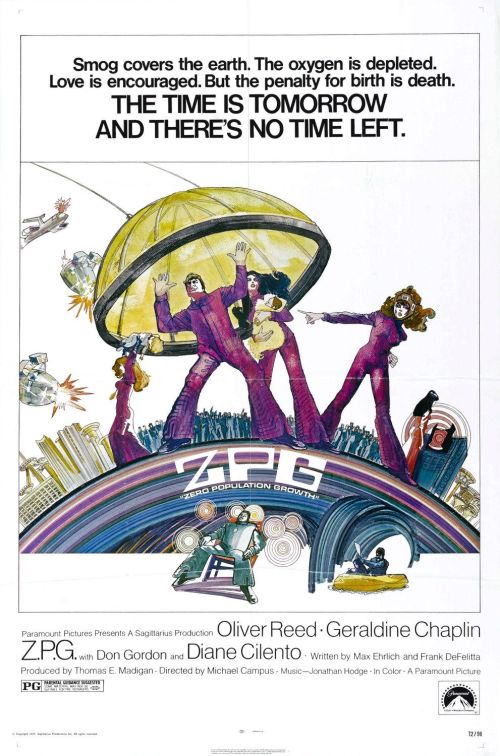
In the future the earth has become overrun with smog that blankets everything and has killed off all plant and animal life and forces everyone to wear breathing masks when outside. In effort to control the population growth the government orders that no one can have babies and instead must visit ‘Babyland’ where childless couples will be given life-sized robotic dolls to take care of instead. Russ (Oliver Reed) and Carol (Geraldine Chaplin) are a young couple who defy this order and secretly have a baby, but when their neighbors (Don Gordon, Diane Cilento) find out and threaten to go to the authorities the couple is forced to go on the run.

This film was both a critical and commercial failure when first released, but was later turned into a novel called ‘The Edict’ that was a success and helped gain the film a bit of a cult following. The special effects though aren’t too great with an opening shot showing this flying vehicle that looks like it was connected to a crane flying over a city’s skyline that resemble miniature toy models, which to me should make it prime fodder for an episode of ‘Mystery Science Theater’. Blanketing everything with smog doesn’t help as part of the fun of watching a Sci-fi film is seeing the elaborate set design and this film has none.

I didn’t like that everyone wears the exact same black uniform either. This is not the first sci-fi film to do this, but it always comes off as phony to me. Do style and fashion trends just go out the window in the future? Every society in every time period has always had individuality and those that break away from the mainstream, so expecting that every single person in the future conforms to the norm and agrees to wear the exact same outfit as everyone else is just not believable.

The plot is skeletal and not well thought out.  The first half plods along too slowly as it’s obvious from the start that Carol wants to have a baby and watching her come to this foregone decision is too draggy and the story should’ve started out right away with her having the child and then going from there to trying to hide it. Also, if the government really wanted to prevent people from having children why didn’t they just force every female to have a tubal ligation instead of trusting that after having sex they would go to their bathroom and press a button on an ‘abortion machine’ on the wall that would apparently send radiation, via a red glowing light, into the woman’s uterus.

The acting is good and Chaplin’s performance comes off as quite sincere. It’s also good to see Oliver Reed in a rare good-guy role although the script really doesn’t give him much to do. Cilento as the intrusive neighbor is by far the scene-stealer. The segment where she must be coached via a government official talking to her on a television monitor to show love for her robot child is one of the film’s best moments as is the later scene where she eventually destroys the doll by bashing its head onto a cement sidewalk.

Spoiler Alert!

The ending was the only time that I found myself slightly intrigued. Watching the couple get trapped inside a dome where after 12-hours they were set to be gassed to death and then having them dig their way out of it and into an underground cavern where via a inflatable raft they were able to escape was mildly interesting, but having them end up on an island where old nuclear weapons were buried was not satisfying. Did they end up dying of cancer? How could they survive without any plant or animal life and was anyone else on the island besides them? The ending like the rest of the film leaves far more questions than answers.

My Rating: 5 out of 10

Released: May 25, 1972

Runtime: 1 Hour 37 Minutes

Rated PG

Director: Michael Campus

Studio: Paramount

Available: DVD, Blu-ray, Amazon Video, YouTube

Car Wash (1976)

By Richard Winters

My Rating: 2 out of 10

4-Word Review: Having fun washing cars.

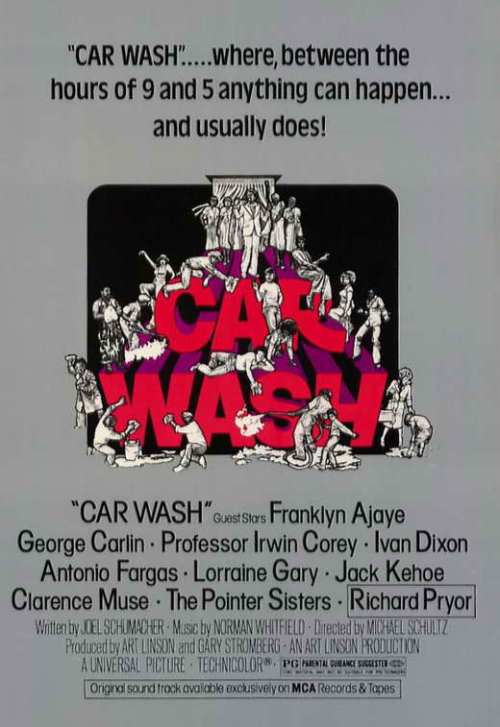
A look at the day-in-the-life of those working at a L.A. car wash. Mr. B (Sully Boyar) is the owner and frets about his employees not working hard enough, but too afraid to fire any of them for fear of retribution. Behind-the-scenes he’s having an affair with his young, but plain-looking receptionist Marsha (Melanie Mayron) who in-turn is more interested in a man with money and gets excited when a well-dressed one asks her out on a date. Lonnie (Ivan Dixon) is a recently released convict working at the car wash and raising a family, but finding it hard on the salary he’s given, which Mr. B refuses to raise. Duane (Bill Duke) is a Black Muslim revolutionary now going by the name Abdullah who preaches power to the people while Mr. B’s son Irwin (Richard Brestoff) who has just graduated from college and groomed to take over the business is more interested in being a part of the working class instead.

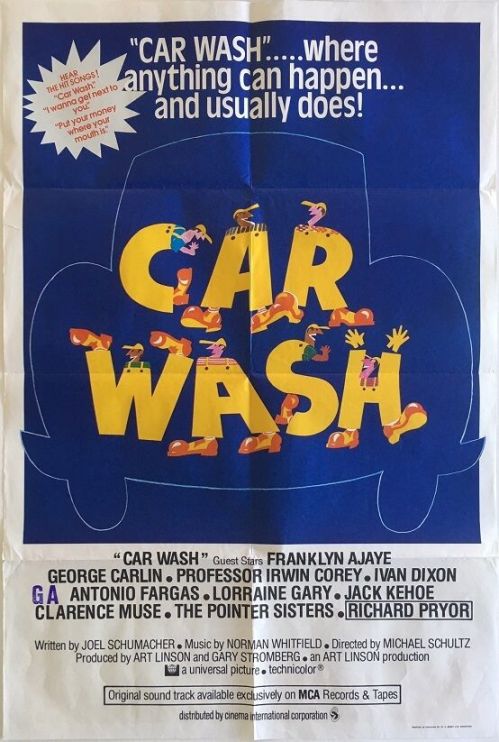
In many ways this could be described as a precursor to Clerks with a cinema vertite feel that captures the daily experience of working a mundane job quite well. The humor is restrained and never goes over-the-top making the dialogue between the cast and the pranks they play on each other believable and like something that could play out in just about any car wash or blue collar job across the country. The disco soundtrack, which includes the iconic title tune by Rose Royce, which is actually better than the movie itself, helps add to the 70’s ambiance as well as the fact that it was filmed on-location at an actual car wash, which has since been demolished, at 610 South Rampart Boulevard in Los Angeles.

Unfortunately there’s not enough plot, or character development to hold it all together. The loosely structured approach, which initially comes off as fresh and original, eventually grows tiring without any type of genuine drama or story line to keep it compelling. There are also too many amusing bits that could’ve been strung out longer and even enhanced, but instead end up getting dropped almost as quickly as they’re introduced.

The cast is filled with too many characters and it’s hard to keep track of them, or understanding why they’re needed. At most car washes I’ve been there’s usually only one employee, or maybe two at the most, to wax the car, or rub it down after it’s been through the wash, but here it takes literally 5 or 6 guys to work on one car, which seems ridiculous. Cutting the cast down would’ve helped and having it centered around one main person instead of doing the ensemble thing would’ve been even better.

The appearances of George Carlin and Richard Pryor add very little and their screen times are so brief I was surprised they even accepted the parts. I was also disappointed that Lorraine Gary’s part was so short too. She’s best known for playing Roy Schieder’s wife in the Jaws films. Here she plays a stuck-up Beverly Hills housewife who’s more concerned about how her car looks than in the fact that her young son is sick. Her haughty attitude creates a delightful culture clash and I really thought she could’ve added some funny friction had she stayed in it all the way through and I really thought she would especially after her son throws up in the car just as they are leaving the lot making me think she would’ve simply backed-up the car and had them clean out the vehicle’s interior, since they had just done the exterior seconds before, but instead she apparently just goes on driving, but who would do that?

There are also potentially interesting story lines that never get adequately explored. The affair between Mr. B. and Marsha was one of them, but another had to do with a ‘pop bottle bomber’ that was terrorizing the city. At one point the crew thinks it’s an old man (Irwin Corey) that comes into the place, but find that’s a false alarm, but it would’ve been exciting had they eventually come into contact with the real one, which could’ve added intriguing dynamics both with the characters and plot.

Originally this was to be a musical, but for whatever reason Universal nixed that idea and decided to turn it into a plain-old comedy instead. I’m not necessarily a fan of musicals, but in this case the songs and dance numbers would’ve helped tie everything together as the script is otherwise too unfocused to remain captivating past the first 30 minutes.

My Rating: 2 out of 10

Released: September 3, 1976

Runtime: 1 Hour 37 Minutes

Rated PG

Director: Michael Schultz

Studio: Universal

Available: DVD, Blu-ray, Amazon Video, YouTube

Oh, God! You Devil (1984)

By Richard Winters

My Rating: 1 out of 10

4-Word Review: God versus the devil.

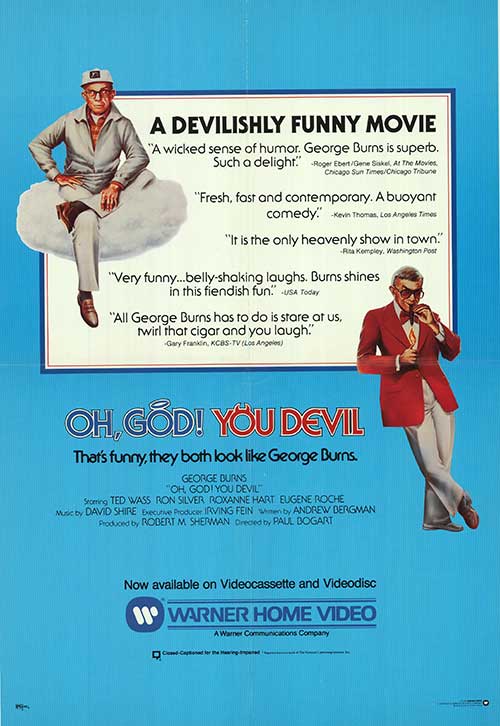
Bobby Shelton (Ted Wass) is a struggling songwriter who is becoming increasingly frustrated at his inability to make it big. He blurts out at one point that he’d be willing to sell his soul if it could get him success and this catches the attention of the Devil (George Burns) who goes by the name Harry O. Trophet. He offers to become Bobby’s agent as long as Bobby signs a contract that gives him his soul after an indefinite period of time. Bobby, so desperate to reap the benefits of fame and fortune that has alluded him all his life, decides to take him up on the offer and soon becomes a world famous rock star named Billy Wayne. Yet Bobby misses his girlfriend Wendy (Roxanne Hart) who he can no longer see because he’s inhabiting a different identity. He longs to go back to his old way of life and tries to contact the services of God (George Burns) to dissolve the contact he signed and return him back to the way it was before.

After the critical shellacking of Oh, God! Book II the studio realized their mistake and attempted to take the theme in a whole new and hopefully fresh direction. They commissioned both Josh Greenfield and Andrew Bergman to write separate scripts and then ultimately choose Bergman’s over the other one. While the idea may sound funny the way it gets handled is not. All Bergman does is simply rework the Faust legend while offering very little that is new or inventive to it. The plot gets handled in an extremely heavy-handed and melodramatic manner that is neither funny nor engrossing. Bergman shows little feeling for the material and the story plods along in a predictable and boring way.

Wass, who no longer performs in front of the camera and has since 1995 worked exclusively behind-the-scenes as a director, is extremely weak. His performance is one-note and his constant deer-in-headlights expression is annoying. The film doesn’t do a good job of portraying his desperate situation either. Despite making very little money he’s still able to somehow afford a chic-looking apartment and maintain a relationship with a very hot-looking woman. I realize the point of the movie is to show that he already had a good thing going and just didn’t realize it, but his situation should’ve been shown to be more bleak in order to have his signing of the contract make more sense.

Burns is the only thing that saves it. He had never played a bad-guy before, so seeing him fall into the devil character as well as he does is fun and some of the lines that he conveys are the only amusing bits in the movie. However, the big showdown between God and the devil in which the two play a game of poker is not interesting at all and they needed to do something that offered more action, which is badly missing from the film otherwise.

This marked the final movie to date in the Oh, God! franchise. There were discussions a few years back about reviving it with Betty White playing the role of God, but because of her advanced age no insurance company would back it, so the idea got scrapped, which is a shame as this would be one reboot I’d be interested to see.  It would be nice if someone would make a film that more closely resembled the ‘Oh, God!’ novel by Avery Corman, which had a satirical tone that none of the three films replicated.

My Rating: 1 out of 10

Released: November 9, 1984

Runtime: 1 Hour 37 Minutes

Rated PG

Director: Paul Bogart

Studio: Warner Brothers

Available: DVD, Amazon Video, YouTube

Farewell, My Lovely (1975)

By Richard Winters

My Rating: 4 out of 10

4-Word Review: Searching for missing lady.

Based on the Raymond Chandler novel of the same name the story centers on private eye Phillip Marlowe who meets Moose Malloy (Jack O’Halloran) a recently released convict that asks Phillip to find his girlfriend Velma who worked as a dancer at a nightclub, but who has now gone missing. Marlowe decides to take the case, but finds a wide array of strange clues that leads him on a bizarre trail that has many twists.

The novel was filmed before in 1944 as Murder, My Sweet that starred Dick Powell, which has become a classic. This remake was noted for being able to stay closer to the source novel by retaining aspects of the story that was considered too provocative for 1940’s standards, but the edition of these elements really doesn’t make the mystery any more interesting. The direction doesn’t convey any feel for the material and despite the intricate plot everything plods along at a rather mundane pace. I also never really felt that the setting effectively reflected the 40’s as much as it could’ve.

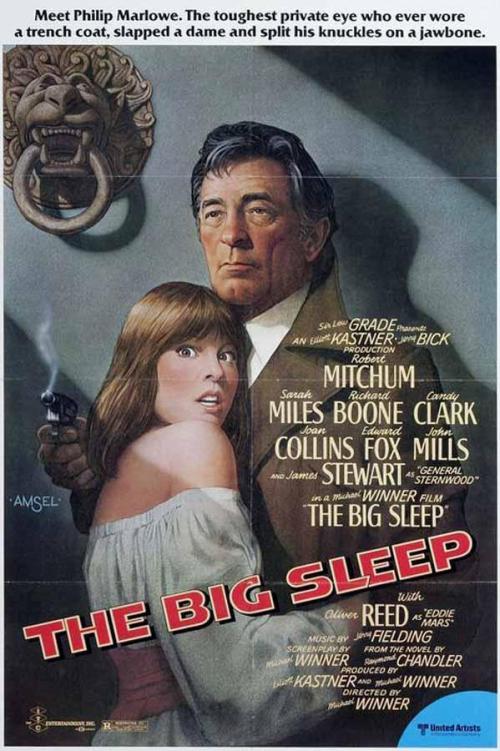
The biggest issue though is Mitchum. The guy is certainly a legendary actor and his performance here isn’t bad I actually thought his timing with the way he conveys his lines was on-target, but he’s just way too old for the role. In the novel Marlowe was described as being in his 30’s, but Mitchum was 57 and looking more like 67. The guy comes-off as washed-up with no charisma, or ability to win a fight even though he does get into a few altercations anyways, which doesn’t seem believable.

The eclectic supporting cast is the only thing that makes it mildly interesting. Sylvia Miles got nominated for supporting actress Oscar as a lonely alcoholic lady with a secret, but I actually enjoyed Charlotte Rampling as a beautiful, but cold and conniving gold digger much better. It’s also great to see Kate Murtagh as this overweight woman who runs a whorehouse. Fat woman are usually never given prominent roles in most Hollywood films, but here she plays an intriguing part that culminates with a surreal, nightmarish segment that helps give the film a little extra verve that’s otherwise missing.

The film also has a couple of great cameos. One features Sylvester Stallone in a non-speaking role as a thug, which was just before he broke it big with Rocky. I found the cameo though by author Jim Thompson, who’s best known for writing such novels as ‘The Getaway’ and ‘Pop. 1280’ to be far more interesting. He plays the elderly husband to Rampling and the scene where he opens up a door to find her kissing Mitchum on a couch and all he does his just shut the door back-up and leave to be the funniest moment in the movie.

The budget should’ve been bigger as it’s not stylish. If you’re going to redo a classic you’ve got to go all-out, but the effort here is half-hearted. Yet despite this the producers forged ahead with another Marlowe film that had Mitchum again playing the part. That one was called The Big Sleep and will be reviewed later this month.

My Rating: 4 out of 10

Released: August 8, 1975

Runtime: 1 Hour 35 Minutes

Rated R

Director: Dick Richards

Studio: Embassy Pictures

Available: DVD, Amazon Video, YouTube

Oh, God! Book II (1980)

By Richard Winters

My Rating: 3 out of 10

4-Word Review: God returns to earth.

Tracy (Louanne) is an 11-year-old girl who one day meets God (George Burns) when he invites her via a fortune cookie into the lounge of a Chinese restaurant where he asks her to help him spread the word that he exists. She then, with the help of her friends, creates posters that say ‘Think God’ which she puts up all over town, but this gets her suspended from school and then her parents (David Birney, Suzanne Pleshette) consider having her sent to a mental hospital after she keeps insisting that she’s spoken to the Almighty directly.

This follow-up to the 1977 hit lacks the freshness and originality of the first. The studio had initially wanted the John Denver character to return, but the producers insisted they wanted a ‘fresh start’ and not just continue the storyline from the first film. While the characters are different, the plot line remain the same causing the film to come-off like a boring reworking of the first one instead of a continuation.

Louanne, who now goes by Louanne Sirota, is adorable, which helps, but her hairstyle looks like something out of the 1940’s. She also believes in God right from the start even before she meets him, which doesn’t allow for any type of interesting character arch. It’s also quite  hard to believe that her ‘Think God’ poster campaign would have any affect and that a nonbeliever would somehow suddenly become a raging theist after spotting one of the amateurish looking signs.

Another issue is the God character who is full of idiosyncrasies. For one thing the concept of evolution gets glossed over and the film makes it like how we see things now in regards to animal and plant life is exactly how God envisioned them when they were created at the beginning of time. He also mentions having to sometimes sneeze, but why would a spirit need to do that? At another point he talks about answering phone calls, but why would there be telephones in Heaven?

It’s also confusing why God, who is supposedly an omnipotent being that knows what each person is thinking and feeling would need the help of a young child in order to ‘reach people’. He also seems like a cruel jerk as he coaxes this girl into this ad campaign, which puts her into a very traumatic situation as it gets her suspended from school and even on the brink of being put into an institution. If God is all-powerful why can’t he simply make himself appear on everyone’s TV at the same time in order to let everyone know that he exists instead of putting a young child through such unnecessary stress?

The humor is lacking and the only funny lines are the ones dealing with the big breasts of David Birney’s girlfriend (Denise Galik). I also didn’t understand why the word book gets put into the film’s title as there was never any second Oh God! novel written. Was this supposed to be a play-on-words in regards to the books of the Bible? If so then that joke, like just about everything else in the film, falls flat.

My Rating: 3 out of 10

Released: October 3, 1980

Runtime: 1 Hour 34 Minutes

Rated PG

Director: Gilbert Cates

Studio: Warner Brothers

Available: DVD, Amazon Video, YouTube

Jennifer on My Mind (1971)

By Richard Winters

My Rating: 3 out of 10

4-Word Review: Girlfriend becomes heroin addict.

While vacationing in Venice Marcus (Michael Brandon) meets up with Jennifer (Tippy Walker) a young free-spirit whose beauty and carefree ways immediately smitten him and the two begin a relationship, but Jennifer’s impulsive ways doesn’t allow it to last. He later learns that she’s a heroin addict and tries to help her overcome it, but to no avail. After she disappears for several months she then suddenly shows up at his doorstep wanting to rekindle old-times. At first he’s happy to see her, but then learns that her addiction has grown worse and after reluctantly giving her an injection that turns out to being fatal he then goes into a panic and tries to get rid of the dead body as he fears he’ll be implicated for her death otherwise.

After the success of Love Story screenwriter Erich Segal was a hot commodity and given free-reign to write any concoction he wanted and this script, which is based on the Robert L. Simon novel ‘Heir’ is the result.  The story though is poorly structured and seems to focus more on Marcus and his efforts to get rid of the body than on giving any meaningful insight to the drug addiction experience. There’s also severe shifts in tone where it’s dramatic one minute and then has weird dream-like humorous segues where Marcus sees visions of his dead grandfather (Lou Gilbert) who cracks corny jokes.

Director Noel Black, whose career looked bright after doing the critically acclaimed cult hit Pretty Poison, manages to infuse some nice on-location scenery, particularly that of Venice,  but technically botches many other moments. The worst comes when Jennifer tries to jump off the roof of her house, but she goes from being in her backyard to on the rooftop in a matter of seconds, which isn’t realistic. She then jumps off it even though it’s a 2-story building with another rooftop of a different section of the home beneath her, which is where she should’ve landed, but instead the film in a poorly edited bit that doesn’t even show the actual jump has her landing in a flower bed.

The Marcus character, who has inherited his grandfather’s fortune and therefore doesn’t have to work for a living, is too smug to be likable and most viewers will find his privileged situation off-putting. He also doesn’t seem, despite his insistence, to be all that ‘in-love’ with Jennifer especially with the callous ways he tries to get rid of her body and in one really creepy moment even professes to the corpse that he feels closer to her now than when she was alive. I also couldn’t understand why this non-descript guy would be constantly attracting the attention of violent bikers and hippies. One instance occurs when he is doing nothing more than standing at a pier of a lake and within seconds finds himself surrounded by three bikers who come out of nowhere and then later on as he’s driving down a busy highway some hippies decide to harass him at random but no one else.

Jennifer character is equally annoying as the viewer learns little about what makes her tick. Walker’s acting career ended after this film as she left Hollywood disillusioned with the business after having an affair with George Roy Hill when she was only 16 and he was 42 while filming The World of Henry Orient. Her life, like the character in the film, then  took a strong downward spiral as she opened up an art gallery in New Haven, Connecticut which eventually closed. In a 2015 interview published in the New Haven Register she was living in a cramped 1-bedroom apartment that was infested with cockroaches after having spent several years being homeless and surviving off of social security and what little monthly money her brother in Texas sent her.

The film’s  only saving grace are the performances of its supporting cast . I enjoyed Peter Bonerz as a psychiatrist who barrages into Marcus’ home and tries to give him an impromptu therapy session. Chuck McCann is amusing too as a motorist who tries to help Marcus change a flat, Barry Bostwick and Jeff Conaway enliven things as two antagonistic minstrels and Robert De Niro is great as a gypsy cab driver. Otherwise this thing is a complete mess that like a bad car accident is garish enough to keep you watching, but offers nothing in return.

My Rating: 3 out of 10

Released: November 10, 1971

Runtime: 1 Hour 30 Minutes

Rated R

Director: Noel Black

Studio: United Artists

Available: DVD-R (MGM Limited Edition Collection), Amazon Video

Private Resort (1985)

By Richard Winters

My Rating: 3 out of 10

4-Word Review: Teens hit on women.

Jack (Johnny Depp) and Ben (Rob Morrow) are two teen pals staying at a luxury resort in south Forida. They enjoy all the bikini-clad women there and make every effort to hit on as many as they can. They become attracted to the middle-aged Bobbie Sue (Leslie Easterbrook) whose boyfriend is The Maestro (Hector Elizondo) a master jewel thief. When she leaves her hotel key on a beach chair the boys mistakenly think she did it on purpose in order to invite them back to her room. They sneak into the room, but come into contact with The Maestro instead who thinks Ben is the hotel barber there to give him a haircut. When Ben ruins Maestro’s perm he goes on a vengeance swearing that he will kill Ben if he ever sees him again and forcing the two boys to go into hiding.

Obviously the only reason to watch this thing is to see the early work of its two stars who have since both disowned their participation in this and reportedly swore that they would burn every negative of this movie that they could find after they first watched it. For the most part though their presence here is amiable and for the women and gay viewers you get ample views of both of their bare behinds including one brief bit where old lady Dody Goodman swats Morrow’s bare ass cheeks with her hand. I was surprised though why the two stars weren’t featured on the film’s promotional poster seen above instead of two bland, smiling male models that it does use.

The supporting cast features a bevy of hot-looking women who may look good in a swimsuits, but lack discernible personalities and play-up the bimbo act too much. Elderly actress Goodman is good for a few chuckles and even does some karate. It was also interesting seeing Phyllis Franklin, who has a small bit as the ‘Dog Lady’ who looks almost exactly like Alice Pearce, the original Mrs. Kravitz in the TV-show ‘Bewitched’ and could easily pass off as her daughter. Elizondo though should be embarrassed about being in this one and I hope he was paid well for having to play a part that was so shamelessly campy.

The scenery, which was filmed at the Ocean Reef Club in Key Largo, Florida, is pleasing, but the story is lacking. I admit I chuckled at it more than I thought and I suppose the ending, which features Elizondo shooting up the place with a machine gun deserves some mention, but it’s still pretty lame. Calling this an ‘adult comedy’ is an oxymoron as you take away the nudity and sexual innuendos and you’re left with a mindless plot that is sillier than a Saturday morning kiddie cartoon. I was also confused why Depp and Morrow were even at this resort in the first place. They looked like they could still be in high school and even if they were college age I couldn’t fathom how, with the income most college kids have, how they could’ve afforded a room there as the place looked pretty swanky and made for adults who were well-off.

My Rating: 3 out of 10

Released: May 3, 1985

Runtime: 1 Hour 22 Minutes

Rated R

Director: George Bowers

Studio: TriStar Pictures

Available: DVD, Amazon Video, YouTube

Over the Edge (1979)

By Richard Winters

My Rating: 5 out of 10

4-Word Review: Out of control teens.

The teenagers in the planned community of New Granada, Colorado find themselves bored and constantly getting into trouble. The town was designed for adults with no consideration given for them. The recreation center is their only outlet, but that closes at 6 PM allowing for too much idle time in the evenings. Vandalism and other petty crimes soon commence, but when one of the teens (Matt Dillon) gets shot and killed by a cop (Harry Northup) his friends rebel by locking all the parents inside the local Junior High School while they’re having a meeting and not allowing them to leave.

The story, which was co-scripted by Tim Hunter who went on to even greater success by directing River’s Edge, which had a similar theme, is based on true events that occurred in the early 70’s in a planned community of Foster City, California. Like in the film no consideration was given to the teens during the planning phase causing them to become bored and resort to crime and rebellion, which lead to an article being written about in the San Francisco Examiner that attracted the attention of Hunter and Charles S. Haas who thought it could make good material for a movie. They traveled to the town and interviewed many of the teens first-hand to get a good idea about their feelings and thoughts.

There are elements about the movie that I enjoyed, which is mainly the way it captures the community, which was filmed on-location in the Colorado towns of Aurora and Greeley. I especially liked how the cinematography focuses on the barren desert landscape and the cookie-cutter homes built in the middle of it without showing any downtown, which helps to accentuate how unimaginative and soulless a lot of these suburban places really are.

The presence of Matt Dillon, in his film debut, helps as well. He was 14 at the time and only attended the audition simply as an excuse to get out of going to school without any intention of actually getting a part, but onscreen he shows a strong acting flair and outshines his other co-stars to the extent that he should’ve been made the lead and it’s a shame when his character exits so quickly.

The idea by director Jonathan Kaplan was to try and make this seem like a documentary, which works to some extent. I liked how the cast was made up of  little known actors that most viewers will not recognize makes it seem like ordinary people and not actors at all. The use of the music though is what I had a problem with. The songs that get heard in the background by such bands as Cheap Trick, The Ramones and The Cars are perfect and convey a punk attitude that the kids were feeling, but the instrumentals that are played during some of the action sequences was not needed. Again, if this is supposed to seem like a documentary then very little music should be used as real-life doesn’t have an ongoing soundtrack and by implementing one in, even if it was composed by the director’s father Sol Kaplan, was a mistake.

I also had a problem with the film’s climactic sequence in which the teens lock the adults in the school and then go about vandalizing their cars outside. This is the film’s only unique moment and should’ve been played-up much more, but the tension from this doesn’t get stretched out as much as it should. I would’ve liked this scene to take up more of the movies and played out almost like a thriller by trapping the adults in the place for several days until you start to fear they might never get out and even turning-the-tables on them by having the kids order them around and forcing them to do humiliating things just for their own amusement.

Although the movie received very little reception when it was first released, which was only a limited engagement, it has managed to find a cult following and critical acclaim since. There are some keen moments particularly the way it portrays the out-of-touch adults who are always convinced that their kids are ‘angels’ while it’s someone else’s that is the troublemaker, but the script makes its point early and then just proceeds to repeat it over and over again until it gets redundant.

My Rating: 5 out of 10

Released: July 7, 1979

Runtime: 1 Hour 35 Minutes

Rated PG

Director Jonathan Kaplan

Studio: Orion Pictures

Available: DVD, Amazon Video, YouTube

Journey Through Rosebud (1972)

By Richard Winters

My Rating: 3 out of 10

4-Word Review: Draft dodger visits reservation.

Danny (Kristoffer Tabori) travels to a South Dakota Indian reservation as he tries to escape the draft and troubles at home. He meets up with Frank (Robert Forster) who is an Indian living there and who has issues of his own, which is mainly his alcoholism and that at the age of 32 he still lives with his mother in a ramshackle home with no prospects at a secure, good paying job. Danny learns first-hand of the struggles of the modern-day Indian while also take part in some of their rituals and customs.

The film’s best element is the performance by Forster who goes outside his comfort zone by playing a Native American and doing it with conviction. Normally he’s entertaining as a brash-talking tough guys, but here his character is much more restrained and in one sad moment even falls to the ground and begins crawling around in a drunken state while those around him look on with contempt and disdain that is gut-wrenching to see while also exposing his courage as a performer by putting himself in such a pathetic looking state that not all actors would be willing to do even if the script called for it.

Tabori is equally enjoyable and in the few films that I’ve seen him in I’ve become convinced that he was a potentially strong leading man who never quite got his fair shot. His thin frame and youthful age belie a strong inner presence that helps to make his dynamic between Frank and himself potentially interesting, but the film neglects to follow through with it enough.

As for the action there is unfortunately not enough of it. The only time something does occur is when a group of Indians go on private land to rustle and kill cattle, which includes a very grisly shot of them slashing the animal’s throat that may make many viewers uncomfortable. Otherwise it flatlines from the first frame to the last and almost comes off like a minor league educational film dealing with the issues of reservation life than a movie with an actual story. In fact it’s so slow that I started to feel a group of amateurs with good intentions, but limited ability made it, but instead it was directed and written by a couple of Hollywood veterans who should’ve known how to better pace a story, so why that wasn’t done here I don’t know.

The film received a very limited release with the explanation that the studio didn’t think they could find the right target audience for it, but I think it was more to the fact that they knew it was boring and no one, even those that connected with the theme, would want to sit through it. The film is more like some small day trip excursion where someone visits a small no-name town, takes part in benign events there and then leaves without any of it having much impact on them, which is exactly how the viewer feels after watching the movie.

My Rating: 3 out of 10

Released: March 2, 1972

Runtime: 1 Hour 33 Minutes

Rated GP

Director: Tom Gries

Studio: GSF

Available: None at this time.

Summer School (1987)

By Richard Winters

My Rating: 5 out of 10

4-Word Review: No vacation this summer.

Freddy Shoop (Mark Harmon) is not happy about having to teach remedial English to nine students during the summer break. He was about to fly off to Hawaii with his girlfriend, but then got picked at the last minute to teach the class when Mr. Dearadorian (Carl Reiner) who normally teaches it wins the lottery and decides to quit his job. At first Freddy lets the kids goof around and even takes them on a few field trips, but when his tenure gets threatened unless all the kids pass the test he decides he better take it seriously and make deals with the kids to do the same.

The biggest surprise here was finding that Mark Harmon could actually be funny. He was the son of a former Heisman Trophy winner and a quarterback himself at UCLA during the 70’s who I always felt had the doors open for him in the acting biz simply because of his chiseled good looks and nothing more. I remember first watching him in the 80’s TV-show ‘St. Elsewhere’ and finding him to be quite boring there and yet here he shows a whole new side of himself and in a lot of ways is the most engaging thing about the movie.

The film also manages to avoid the pitfalls of other 80’s comedies by not aiming for the gross out, sophomoric humor that permeated so many other teen films from that decade. Everything here is surprisingly restrained and in a lot ways this helps to make it funnier because it keeps things at a more realistic level. It’s also great to see a teen film that doesn’t deal with the generation gap or portray the adults as being overly stuffy, or out-of-it as Harmon comes off as being just as cool as the students.

While the film does have its share of amusing moment, with the driving lesson that Harmon gives to one of his students (Kelly Jo Minter) being the funniest, there are a lot of potential comic ideas that it never follows through on, which limits it from being as funny as it could’ve been. It also never bothers to explain where Harmon’s car keys were as one of the students took them on the first day forcing Harmon to go looking for them, but never shows how he found them, or where they were hidden.

The character of Chainsaw (Dean Cameron) I felt was a bit on the lame side. For one thing he looks too old for a high school student and was in fact already 24 when he played the part, but what annoyed me more was his obsession with the movie The Texas Chainsaw MassacreNow don’t get me wrong it’s a great movie, but it’s also very well known and obvious. It’s not all that gory either and it was the gore factor that supposedly his character like the most. If the kid was a true horror fan then he’d be aware of the obscure horror movies that the others wouldn’t be and if gore was truly his thing then the Italian giallo films would be more likely something that he’d obsess over.

The film’s feel-good ending in which Harmon is able to reach and inspire each student in some way hurts the film by not portraying the teaching profession in a realistic way. There will always be those students that a teacher will not be able to reach no matter how hard they try, which is one of the more frustrating aspects about the job, but the film never bothers to tackle this issue. Some may argue that this would’ve hurt the otherwise lighthearted tone, but good movies are able to sneak in serious side-issues and still make it work and the fact that this one doesn’t makes it glossy and forgettable.

My Rating: 5 out of 10

Released: July 22, 1987

Runtime: 1 Hour 37 Minutes

Rated PG-13

Director: Carl Reiner

Studio: Paramount

Available: DVD, Amazon Video, YouTube