That Lucky Touch (1975)

lucky

By Richard Winters

My Rating: 4 out of 10

4-Word Review: Journalist and arms dealer.

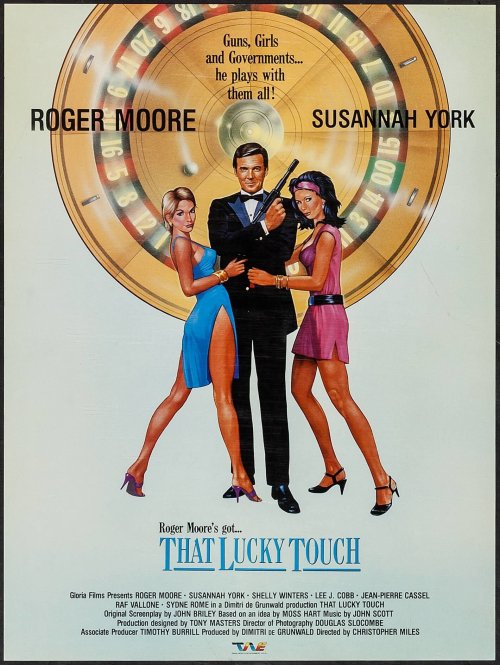
Michael (Roger Moore) is an arms dealer who travels the globe looking for state-of-the-art weapons that he can sell. Julia (Susannah York) is a journalist who writes articles that abhors men who are into guns. The two reside in the same building, but have never met. One night Julia holds a party and while she is seeing her guests out her front door accidentally closes causing her to become locked-out of her apartment. Michael, who is on the outs with his ditzy, live-in girlfriend Sophie (Sydne Rome), decides to use this opportunity to put the moves on Julia. He invites her into his place, so she can call the landlord, but then unplugs the phone, so she’ll think it’s out-of-order and be forced to spend the night. Julia though turns-the-tables by ordering him out on the ledge and into the rainy night while demanding he get into her apartment through an open window. This then begins their love-hate cycle where every time they start to bond one of them finds out something about the other that they hate and thus begin to fight.

While the premise has potential the scenario is poorly plotted and hard to get into though the middle part does have some funny moments. The scene where Lee J. Cobb, who plays an army general, thinks he’s getting an important call from the President, as his red phone is blinking, but instead it’s from his scatterbrained wife, delightfully played by Shelley Winters, is hilarious. The segment dealing with Moore and York trying to get into her apartment is quite good too, but doesn’t get played-out enough as they take a trip to her landlord’s to get the key, but this part is never shown. However, so much time is spent with them trying to find every other way to get inside that I felt we should’ve included this part instead of suddenly cutting away and only implying what happened later.

What I didn’t like was the beginning where the scenes cut back-and-forth between Moore testing out some guns and York typing away without having any idea what they were doing, or why. It’s not until 15-minutes in that it gets revealed that these two live across from each other, which should’ve been established right away. The ending gets botched too as the second-half is spent on the couple, but ends by focusing solely on the secondary characters in an ill-advised screwball finale.

Moore’s acting helps. The glib way that he conveys his acerbic lines are amusing and I came away thinking he was much better in comedy and missed his calling by not doing more of them. York though seems miscast. She’s great in drama, but her comic timing is missing and she’s too hostile to the extent that you start to wonder why Moore’s character would have any interest in her at all. The part was originally intended for Sophia Loren, who would’ve been better and more age appropriate since there was only a few years difference between her and Moore versus the over 10-year gap that he had with York.

The supporting cast is solid especially Winters and Rome, but Cobb is the surprise as he spent his whole career doing dramas, but manages to be the funniest one here and it’s just a shame that this marked his final film appearance, he actually suffered a heart attack during the production. The soundtrack is pleasing too, but the flat script needed better fleshing-out.

My Rating: 4 out of 10

Released: August 7, 1975

Runtime: 1 Hour 33 Minutes

Rated PG

Director: Christopher Miles

Studio: Allied Artists Pictures

Available: DVD (Region 2 Import) DVD-R (dvdlady)

Mortuary Academy (1988)

mortuary

By Richard Winters

My Rating: 4 out of 10

4-Word Review: Two brothers inherit mortuary.

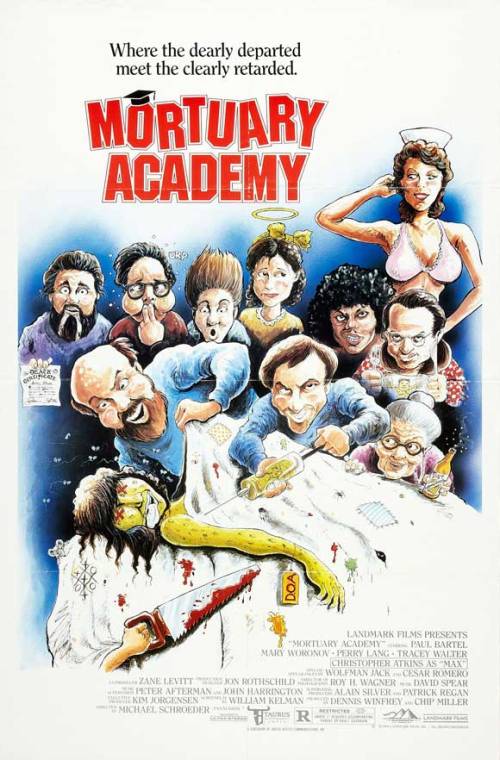
Max (Christopher Atkins) and Sam (Perry Lang) are brothers who inherit a mortuary from their dead uncle. At first they’re not happy as neither one of them wanted to go into that business, but when they realize how much money they can make they change their minds, but there’s one small catch: they must pass the rigorous mortuary course. This won’t be easy as it’s taught by Mary (Mary Woronov) who’s the lover of Paul (Paul Bartel) who are both aware that they’ll lose the place should the brothers take over, so they try to make the course as hard as possible to ensure that they both fail. Meanwhile, Paul has other issues as he’s into necrophilia and wants to have sex with the latest dead body that has been sent in, Linda Hollyhead (Cheryl Starbuck), a teen who died while chocking on popcorn.

The film was clearly trying to capitalize on the earlier success of the cult hit Eating Raoulwhich also starred Bartel/Woronov and both were scripted by Bartel, but the edginess and satirical elements from that one are missing here. Probably the only surprising thing to take away from this is Atkins who proves he can actually act. He started out as a male model and then got into show business simply for his looks and starring in the hit film Blue Lagoon with Brooke Shields, but his effort to broaden his resume by appearing other movies like The Pirate Movie with Kristy McNichol proved downright embarrassing and like he was just another pretty boy face in-over-his-head, but here he’s his funny facial expressions and inability to kiss women got me chuckling. I came away feeling there was no need for two leads especially since the brothers agree on everything making them seem like one person and without Lang, who’s dull, Atkins would’ve had more of a chance to play-up his goofy nervous looks even more.

The supporting cast, with exception of elderly actress Nedra Volz who’s rants about having her last period 50 years ago are a riot, is what really destroys it. One reviewer on IMDb labeled this as a Police Academy- wanna-be and that’s exactly right. The other students aren’t like real people, but instead stereotyped, benign losers saying and doing dumb things simply for a cheap laugh. The biggest travesty is the appearance of Anthony James, who because of his hawk-like facial features gets once again stuck with a role of a would-be psycho-nut and it’s no surprise that he eventually got sick of the type-casting and left the business for good in order to focus his efforts on artistic paintings some of which were quite impressive.

Bartel and Woronov help a bit playing the exact opposite of the couple they did in Eating Raoul where they killed-off those that were into kink, but here they’re the kinky ones. Unfortunately it doesn’t quite work. Bartel’s attempts at sex with a dead body, particularly the scenes at a beach we he momentarily loses her via the incoming tide to a group of frat boys, are funny, but some of their other shenanigans fall flat. Woronov is amusing when she plays a nefarious person, but when she transitions to a good guy and becomes a part of the team, she gets boring.

The biggest issue is the humor, which isn’t dark enough and far too good-natured. The script is gag driven and the special effects poor and tacky. Some would say that because this was a comedy it shouldn’t be gory, but that’s the old-way of thinking as movies like Shaun of the Dead and Evil Dead have proven over-the-top effects actually make it funnier, which is what this film should’ve done. Instead it takes a middle-ground approach making its edgy premise lose all of its zing and only half as good as it could’ve been.

My Rating: 4 out of 10

Released: May 20, 1988

Runtime: 1 Hour 27 Minutes

Rated R

Director: Michael Schroeder

Studio: Taurus Entertainment Company

Available: DVD

Skip Tracer (1977)

skip1

By Richard Winters

My Rating: 7 out of 10

4-Word Review: Highly motivated debt collector.

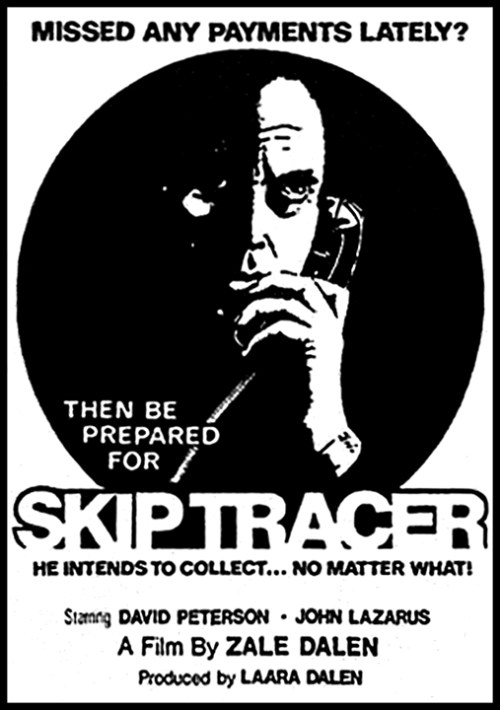
John (David Petersen) enjoys his job working for a collection agency and going after people who are delinquent with their loan repayments. He has achieved ‘Man of the Year’ honors at the company and is motivated on attaining that title again. Brent (John Lazarus) is a young trainee who’s having a hard time getting the hang of it. He asks John for guidance by following him around and observing how he gets things done. John is reluctant at first, but eventually agrees. However, as their partnership evolves John starts having second thoughts about the ugly side of the business.

I worked briefly in the bill collecting business and can say first-hand this film gets it right. Director Zale Dalen must’ve worked in it himself in order to recreate it so accurately and what makes this film so good is the way it reveals the business to those who aren’t familiar with it to the extent that it’s like you’re not viewing it, but instead visiting it. The script smartly stays away from jazzing-up the storyline for the sake of drama and keeps everything on a believable level, which makes the graphic ending all that more startling. Even though it was made 45 years ago it’s still quite accurate to what could easily occur in collections offices today with the only difference being that there would be computers on the desktops now versus typewriters.

Petersen, in his film debut, is excellent, I’ve personally known people just like his character and their obsession with rising up in the company overshadows everything else even if it means becoming a complete jerk. What I didn’t get, and the one element that hurts this otherwise strong film, is that he lives in a rundown apartment and drives a beat-up car. If money is his drive and he’s won Man of the Year honors then I’d think he be living in a far ritzier place. Having the company demote him by taking away his office didn’t jive either. This seems like the type of guy who’d be arrogant enough to walk out of a company that didn’t show him the respect he felt he deserved and with his debt collection skills he could easily find another position at another collection agency, so watching him put up with the abuse from his boss undermines the character.

Spoiler Alert!

The film’s shocking ending is strong and comes as a complete surprise, but I wanted to see more of a transition to the character. He essentially walks away from the job and down the street, but no idea where he ultimately ends-up. I would’ve preferred seeing him begin a new job, something that was much different than bill collecting, in order to make the transition complete because what’s to say he doesn’t just get another job, especially if his experience is in that area, that isn’t much different than the one he left? Keeping things as wide-open as it does isn’t as satisfying as seeing him working some lowly position even at lower pay, which would hit-home to the viewer that no matter how bad things were now we’d know he’d still never go back to his old ways.

End of Spoiler Alert!

This is one of the better films to come-out of Canada when it tried to jump-start its fledgling movie industry back in the 70’s. For his efforts Petersen won the Best Actor award at the 1977 Canadian Film Awards and Dalen won it for Most Promising Newcomer. The film also manages to achieve the amazing feat of making Vancouver, one of the rainiest and gloomiest cities in the world, look sunny and inviting.

My Rating: 7 out of 10

Released: August 17, 1977

Runtime: 1 Hour 35 Minutes

Rated PG

Director: Zale Dalen

Studio: International Film Distributors

Available: Blu-ray

Cotter (1973)

cotter2

By Richard Winters

My Rating: 1 out of 10

4-Word Review: Rodeo clown seeks redemption.

Art Cotter (Don Murray) is a Sioux Indian who works as a rodeo clown, but when his alcoholism causes the tragic death of a rodeo rider he leaves his hometown in shame. Years later he returns hoping to make amends. He meets up with his old friend Roy (Rip Torn) and Roy’s wife Leah (Carol Lynley) and begins living with the two while trying to find work, but before he can fully turn things around tragedy strike again. This time it’s in the form of murder when wealthy rancher Wolfe (Larry D. Mann) turns-up dead with a large bag of money that he was carrying missing. Cotter was the last person to see him alive, so suspicions are cast on him almost immediately. Roy offers to let Cotter hide-out from the mob in his pump shed out back, but Roy has ulterior motives as he believes Cotter committed the crime and begins hassling him for the whereabouts of the cash. Even Leah, who had shown a liking for Cotter earlier, begins to use her sensual appeal, at her husband’s request, to get him to talk leaving Cotter with the harsh realization that nobody, even his friends, believe in him.

This was one of the last of a string of films that were released in the early 70’s dealing with modern-day rodeo stars. Many of those were hits at the box office, so it was a surprise why this one, which was meant to be released to the theaters, couldn’t find a studio to distribute it, so ultimately it ended up becoming, on April 4, 1973, the first movie to ever premiere on cable television, which at the time was still very much in its infancy.

On the surface I was surprised, given the success of the other rodeo movies, that it had to settle for direct-to-cable, but after watching it it’s pretty easy to see why. For one thing the script, which was written by actor-turned-writer William D. Gordon, doesn’t have much to do with the rodeo world. It’s just used as a set-up at the beginning, but seems much more like it should be put into the murder mystery genre instead of a modern day western, or character study. The mystery itself isn’t intriguing and gets wrapped-up too quickly making it flimsy entertainment no matter which category you put it into.

Casting Murray in the lead was another problem as he’s a white guy who doesn’t resemble an Indian at all. In fact the viewer has to keep reminding themselves that his character is one as you’ll forget otherwise. They do give him some make-up to make his skin appear redder, but this just makes him seem more like a white guy with a sunburn. There were plenty of genuine American Indian actors out there at the time, like Ned Romero, that could’ve played the part and made the character more authentic, which Murray’s presence doesn’t.

I was also disappointed that despite what Leonard Maltin states in his review, or whoever wrote it for him, the movie does not give one a good feel for the Midwest and it become painfully clear to this former Midwesterner that it wasn’t even filmed there in the first place. The Midwest has farm fields, which aren’t seen anywhere, and the towns always have a strong city center usually with the courthouse sitting on one block and then the rest of the downtown shops surrounding it. The downtown here has no distinction just a bunch of nondescript buildings plopped in a row and built on a Hollywood studio black-lot, which makes the setting as bland as the rest of the film.

Outside of Murray there are some good performances particularly by Torn and Lynley, but the script is unfocused and in need of dynamic direction. If its motive was to show the plight of the American Indian and racism then an actual Indian should’ve been cast while also bringing in a Native American as a consultant, which might’ve helped the script seem less generic.

My Rating: 1 out of 10

Released: April 4, 1973

Runtime: 1 Hour 34 Minutes

Not Rated

Director: Paul Stanley

Studio: Gold Key Entertainment

Available: DVD

Homework (1982)

homework

By Richard Winters

My Rating: 2 out of 10

4-Word Review: Mother seduces daughter’s friend.

Tommy (Michael Morgan) is a blonde haired teen who hasn’t yet had sex and feels embarrassed about it. To make-up for it he decides to start-up a rock band with his friend Ralph (Lanny Horn). He wants the lead singer to be Sheila (Erin Donovan), but Sheila is too busy working-out in the pool, so she can be a part of the swim team, so he gets Lisa (Shell Kepler). Lisa though is not as talented and seems more interested in getting the attention of rock singer Reddog (Wings Hauser) who would prefer bedding her instead of hearing her sing. Sheila’s mother Diane (Joan Collins) has issues of her own as she’s stuck in a dead-end marriage and feels like the best sex she had was during her younger years. Then Tommy agrees to help her hang a picture in her living room and his youthful body reminds her of the boys she had sex with during her adolescence and she makes a move on Tommy who’s all too happy to oblige.

The most interesting aspect about this production is what occurred off-screen as Collins and her co-stars Lee Purcell and Carrie Snodgrass, as well as Betty Thomas, who has a brief part as Reddog’s secretary, all sued to have their names removed from the credits as they felt the story had been doctored during post production changing the theme in an attempt to become more like Private Lessons and My Tutorwhich had been hits around the same time and both had plots dealing with older women and adolescent boys. Collins though was most upset about the fact that a body double, played by Joy Michael, was brought in to do nude scenes.

For the most part Collins doesn’t really have much to offer except talk to what’s supposedly her husband, who’s never seen and only briefly heard. At one point she calls him George and then later-on she refers to him as Warren. These segments gets mixed-in with scenes of her when she was younger, again played by Joy Michael, and her getting-it-on with guys in the backseat of cars, but despite the nudity these moments are rather boring and don’t add much other than showing how sexually repressed she is now.

Snodgrass barely has any screen-time playing Tommy’s school counselor, which to me seemed a little weird as I would think most guys wouldn’t feel comfortable, nor would women for that matter, talking about their sexual hang-ups with a member of the opposite sex and therefore the part should’ve been played by a man. Purcell is funny as a nervous French teacher, but having her invite male students to her home for after-hours tutoring was ridiculous. The film plays it like she has only innocent intentions, but what kind of sensible grown woman would invite 16 and 17-year-old guys with notoriously raging hormones into her place and not be concerned that they might get the wrong idea, or take advantage of the situation make a move on her, since she lives alone.

The film’s weakest link though is Morgan, who’s too good-looking. This role should’ve been played by a scrawny geek, or a chubby one, with bad acne and thus making his inability to approach women make more sense. Instead with the male model features of Morgan most of the girls would be approaching him and not ignoring him like they do here. His character’s naivety is played-up too much like when he states that by the time kids reach the age of 12 most of them are sexually active, or his belief that his friend Ralph became sexually active at age 7, which is just too dumb to believe anyone would actually think that.

There are a few funny lines, but the story is unfocused and the plot poorly paced. Even with the brief runtime and sexually charged fantasy segments the film still gets quite draggy. The teens are the biggest issue as they’re broad composites rather than three-dimensional people. It’s been awhile since I’ve been in high school, but I don’t remember the kids of the day being quite this wide-eyed. Instead of going-off of their middle-aged presumptions of adolescence the filmmaker’s should’ve interviewed actual high school kids and got their input, which might’ve helped avoid the flat and unconvincing characters that we end-up getting.

My Rating: 2 out of 10

Released: August 27, 1982

Runtime: 1 Hour 29 Minutes

Rated R

Director: James Beshears

Studio: Jensen Farley Productions

Available: VHS

Riding Tall (1972)

riding1

By Richard Winters

My Rating: 4 out of 10

4-Word Review: He can’t stop losing.

Austin Ruth (Andrew Prine) is a rodeo star who hasn’t won a contest in a long while. He’s so down-on-his-luck that the fans routinely boo him as he leaves. He’s so short on cash that he must siphon gas from trucks and drives in a car that forces other passengers to sit on literal springs since he’s too poor to afford seat cushions for his backseat. When his car breaks down he begins walking on the side of the road where he almost gets hit by Chase (Gilmer McCormick) who fell asleep at the wheel. Chase is the preppy daughter from the affluent suburbs who’s running away from her family and their pretensions while also trying to find herself. She has little in common with Austin, but since they’re both alone decide to forge a relationship, but their differing lifestyles, and Austin’s insecurities about his failing life put a damper on their union ever becoming permanent.

This film was released during a period where stories about the modern day rodeo circuit where in seemingly high demand and while some of them like J.W. Coop and Junior Bonner where met with critical praise and box office appeal this one, despite having a CBS Network television broadcast in 1980, has fallen into complete obscurity. Today it’s only known for having been written by Mary Ann Saxon, who was the wife of the late actor John Saxon.

Initially it had a potential. I really like McCormick. Normally I find films that force in a romance that comes out of nowhere to be annoying, but since this guy was having everything working against him I thought he deserved a break and was genuinely interested in seeing the relationship evolve. McCormick is young and cute, but not in the plastic Hollywood sort of way. She also has a great snarky personality, but her character is poorly defined. At one point she angrily snaps at a traffic cop (William Wintersole) and I thought it would be later revealed when she’d be so unusually angry at him, but it never gets explained and seems to simply play-off the fact that because she was young and in college she’d just naturally hate cops, but this is too broad and makes her more of a caricature than a person.

Prine is dull. Granted his character is run-over by life, so it would be expected that he’d mop around, but he still needs to do this in an interesting way, like a good actor would, but he doesn’t. He’s also never shown actually riding a bronco, until the very end. Even if a stunt double needed to be edited in seeing the character actually on an animal riding it, or attempting to stay on it, is needed instead of just a close-up shot of him being bucked high in the air, which was clearly done by having him sit on top of a mechanical bull and looks fake.

There were a couple of amusing moments like when they try to get a hotel room, but the clerk doesn’t want to give them one because she thinks they aren’t married. When Chase states they are the clerk says she doesn’t believe them at which point Chase replies “Why, because we don’t look miserable enough?”. Overall though it just doesn’t click. Not enough happens. A leisurely pace is okay, but there still needs to be some dramatic moments and they never come making this an uneventful and unmemorable viewing experience.

riding2

Alternate Title: Squares

Released: January 17, 1972

Runtime: 1 Hour 32 Minutes

Rated GP

Director: Patrick J. Murphy

Studio: Plateau International

Available: None

St. Helens (1981)

sthelens2

By Richard Winters

My Rating: 6 out of 10

4-Word Review: Codger refuses to evacuate.

Art Carney plays Harry Truman, an 83-year-old man who refused to evacuate from his lodge at the base of Mount St. Helens even as experts warned that the volcano, which had been inactive for 123 years, was ready to explode. Tim Thomerson is the local sheriff who tries to convince him to change his mind and David Huffman is a volcano scientist who travels to the area to study the potential eruption. Initially he tries to get Harry to leave too, but eventually decides to stay, so he can record the eruption from what he believes will be from a safe distance.

The film is based on the actual event which began on March 20, 1980 when local wildlife was observed behaving erratically, and ends with the climactic eruption, which happened on May 18th. I was alive when it occurred and the film manages to correctly reflect the energy of the period where people where both fearful, but also excited. Not everyone though was happy with the movie, David Johnston’s parents were not pleased by the portrayal of their son, played by Huffman who goes by the fictional name of David Jackson, nor 36 other scientists who knew Johnston in real-life and signed a letter of protest.

Since I didn’t know Johnston myself I’ll reserve judgement, but I was not happy about a dumb secondary storyline dealing with a helicopter pilot, played by Ron O’Neal, flying into a flock of quail, which forces him to drop a log that his helicopter was carrying onto a group of men below and almost killing them. Bill McKinney, better known for playing the mountain man in Deliverance, thinks the pilot was intentionally trying to injure them and has his buddies harass and eventually attack the pilot, but this didn’t seem necessary. The men on the ground should’ve easily seen the birds fly into the copter, as it wasn’t that high up, and when it lands there’s clearly blood and feathers on the windshield, which is spotted immediately by the sheriff therefore making the fight scene, which is what it leads to, completely pointless and just put-in as mindless action.

Carney, who was ironically Harry Truman’s favorite actor in real-life, plays the part in a highly entertaining way and helps give the film humor and human interest. Truman really did drive a pink Cadillac and swore a lot, which he does here, but he also owned 16 cats, but the film changes this to him having a dog even though the 16 cats would’ve been far more fun. I couldn’t help but wonder though with the scene where Harry talks to a group of reporters about the greatness of the US constitution and how USA was the ‘greatest country in the world’, which got the reporters to cheer, but today those same statements might give him the derogatory label of ‘nationalist’ and push-back from the reporters instead of applause.

The film is also notable for having two of its stars, who are adversaries here, meet tragic ends in real-life. For Huffman he was stabbed to death in February, 1985 when he tried to chase down a mugger and for Albert Salmi, who portrays a bar owner who plays down the fears of the volcano, ended up, in 1990, killing his wife of 26 years when she filed for divorce, before then turning the gun on himself. I’ve seen Huffman in other films and came away feeling he was a rather bland actor though here he displays a little more spunk. Salmi’s acting is okay, but I didn’t understand why he’s shown working two jobs as he’s a manager of a bar at one point and then supervisor of a saw mill at another. Since the bar he runs is apparently ‘the only one in town’ and seemed packed with people I didn’t get the need for an extra income.

We know how it’s going to end right from the start, so it’s important that the climactic eruption come-off impressively. They do cheat by showing the same footage of the side of the mountain exploding over and over as well as cropping in animated volcanic ash creeping in, which looks tacky. Off-screen wind fans were clearly used to blow dust over the actors and create a white-out effect, but overall it wasn’t too bad and I liked the final shot of a small tree sprouting up amidst the ash. For those who were living during the event, or just curious about the history of it, this is an adequate recreation.

My Rating: 6 out of 10

Released: May 18, 1981

Runtime: 1 Hour 30 Minutes

Rated PG

Director: Ernest Pintoff

Studio: Parnell Films

Available: DVD

The Taking of Pelham One Two Three (1974)

taking

By Richard Winters

My Rating: 8 out of 10

4-Word Review: Subway passengers held hostage.

Four men wearing disguises and going by code names: Mr. Blue (Robert Shaw), Mr. Green (Martin Balsam), Mr. Grey (Hector Elizondo), and Mr. Brown (Earl Hindman) board the same subway car, this one being the Pelham 1-2-3, at different locations. Once all four are onboard they take out their guns and take over the subway car by holding both passengers and conductor hostage. For their release they demand $1 million in ransom to be paid in 1-hour and for every minute that it is late one passenger will be killed. They communicate these demands to Lt. Zack Garber (Walter Matthau) who is a part of the New York City Transit police. As Mr. Blue and Garber communicate with each other over the radio and the city races to meet the crooks demands Garber begins to try and surmise who these men are and how they’ll be able to get away with it since they’re trapped in an underground subway. Garber is convinced that it will not work and the men will eventually be caught unaware that Mr. Green, who used to work for the subway system until he was, in his mind, unfairly terminated, has come up with an ingenious contraption that can override the dead-man’s switch and allow the train to keep running even with no one at the controls.

The film is based on the best-selling novel of the same name by John Godey, who was a subway enthusiast and came-up with the plot after spending many years using the subway system. While the movie rights for the paperback were sold for $450,000, in anticipation that it’d make a great movie, the film almost didn’t get made due to the reluctance of the Metropolitan Transit Authority to allow the production to be filmed on-location.  Much of the reason stemmed from their fear that it might give ‘kooks’ the idea to pull-off a real-life heist, but eventually they caved once screenwriter Peter Stone added in the fictional contraption that could override the dead-man’s switch.

As a caper/action flick it is quite exciting from literally the first-frame to the last, but it’s some of the other added elements that make it a standout. I really enjoyed how the city of New York becomes like a third character and the unique, brash attitude of the people. Every character, no matter how small the part, has a distinct personality and memorable. My favorites were Mari Gorman as the feisty hooker, Michael Gorrin, as the elderly passenger convinced that the subway car must eventually come to a stop even as it careens out-of-control and everyone else panics. I also enjoyed Louie Larebee as an alcoholic woman, who is so drunk that she passes out when the crime begins and sleeps through the whole thing as well as Carolyn Nelson, the real-life wife of the film’s director Joseph Sargent, playing a college coed who believes she can stop the train through sheer mind control and meditation.

On the ground there’s some great character bits too including Tom Pedi as an aging, misogynist who doesn’t like the idea of having to work alongside women, nor that he should stop cursing because of it, who walks right into the line-of-fire when he stubbornly refuses to listen to the kidnappers warnings. Kenneth McMillan, is very funny as an exasperated street cop trying to direct traffic, and Dick O’Neill lends moments of drama as an outspoken transit employee who doesn’t like the idea of giving into the kidnappers demands and isn’t shy about voicing his disapproval, which leads to a tense confrontation with Matthau.

Matthau’s anti-hero take where he seems initially like nothing more than a aloof, laid-back guy, who doesn’t seem to have the cunning, or initiative to defeat the bad guys. At one point even openly insults a group of Japanese reporters who he thinks can’t speak English only to learn to his regret that they can, is excellent and in patented Matthau style seems to be able to do it without much visible effort.

Shaw is solid, but I felt there needed to be an explanation for how he got bought into the scheme, which never comes and ultimately is the film’s only real weak point. His personality is so different from the other men in the group that I couldn’t understand why he’d want to pull-off a robbery with them, nor why, being such a careful planner that his character is shown to be, he’d only realize as the crime is happening that the Mr. Gray was too much of a hot-head and not right for the job, as I’d think he would’ve observed this much earlier during the planning stage and had Gray removed before the actual crime had ever been carried out. Having scenes of the backstory spliced in would’ve helped made it more complete.

This was remade as a TV-movie in 1998 and then as another feature film in 2009 that starred Denzel Washington in the Matthau role and John Travolta playing Shaw’s part. I never saw the TV version and it’s been many years since I viewed the theatrical remake, but I remember finding it a letdown mainly because it centered too much around Travolta, who would go on long rants that bogged down both the pace and plot making it not nearly as exciting as this one.

My Rating: 8 out of 10

Released: October 2, 1974

Runtime: 1 Hour 44 Minutes

Rated R

Director: Joseph Sargent

Studio: United Artists

Available: DVD, Blu-ray, Amazon Video, YouTube

ffolkes (1980)

ffolks2

By Richard Winters

My Rating: 5 out of 10

4-Word Review: Loves cats, hates women.

Rufus Excalibur ffolkes (Roger Moore) is a cat loving misogynist who dislikes women because he grew up the youngest of five sisters and forced to wear their hand-me-downs until he was age 10. As an adult he is a counter-terrorism expert and trains a team of men to go onto ships at sea that have been hijacked. When a North Sea oil production platform nicknamed Jennifer gets taken over by a group of men posing as reporters their leader (Anthony Perkins) demands an enormous ransom and it’s up to ffolkes and his team to board the platformed and kill the terrorists without allowing the ship, which has been booby-trapped with bombs by the criminals, to blow-up.

The film, which was based on the novel ‘Esther, Ruth & Jennifer’ by Jack Davies, who also wrote the screenplay, starts out well and has all the ingredients to being a compelling thriller. The on-location shooting done on an actual ship makes the viewer feel like they’re out at sea themselves and I found the foot chase done on the vessel during a raging rainstorm to be riveting. Perkins makes for a particularly slimy villain and Micheal Parks, as the mastermind who constructs and implements the bombs, was also impressive wearing glasses that make his eyes look like they’re bulging and it’s just a shame these two men had to co-star together as they’d be able to eat-up the scenes had they been allowed to do it alone without any henchmen.

The ffolkes character works against type playing a good-guy that tests the viewer’s assumption of what’s acceptable behavior for a protagonist. Too many movies create a hero-like caricature of someone who is overly noble, brave, and virtuous until it becomes boring and contrived. At least here the guy we’re supposed to cheering for is interestingly flawed therefore more human-like than super-heroes in most other films, especially those made today, who are just too-good-to-be-true.

ffolkes though does spend too much time sitting in the background working on a crochet of a cat while giving-off glib remarks and not being as active as he should. He’s also constantly drinking scotch at all hours of the day, straight out of the bottle, which should’ve made him inebriated and this most likely would’ve come into play at some later point where he wasn’t able to pull-off an intricate task because he was too drunk, but after introducing his drinking problem during the first half, it gets completely forgotten by the second.

While the character acts extraordinarily arrogant and cocky he’s not able to pull-off the assignment quite as easily as you’d think for someone with his amount of confidence. One scene has him stupidly walking right into a gunmen and it takes the sheer luck of someone hiding in a lifeboat to save him. Another scene has him almost killed by one of his own men making him seem like he’s not as good of an instructor as his reputation suggests and all leads to him unintentionally coming-off more like a deluded idiot than the crafty mastermind with a few personality quirks that he’s supposed to be.

The story, while having a solid set-up, ultimately becomes the biggest letdown. For one thing it never shows us how they’re able to pull-off the fake explosion of Ruth, another oil platform. They talk about rigging it to seem like it exploded to fool the bad guys, and we do see something exploding, but no explanation of what it was since the real Ruth secretly remains standing. Also, most ships have a radar system, which should’ve shown that the real Ruth never went away and that they had been duped, but for whatever reason they never catch-on.

The ending surprisingly lacks very little action, which is what was blamed for the film’s poor reception at the box office. People are expecting a movie that stars Moore to have a lot of stunt work and special effects and for the most part it never happens. The villains go down too easily making it not very satisfying to see them go. There needed to be more wrinkles to the scenario and more unexpected twists as the pay-off and climactic finish is weak making one feel, despite the excellent performances, like it wasn’t worth sitting through.

Alternate Title: North Sea Hijack

My Rating: 5 out of 10

Released: April 3, 1980

Runtime: 1 Hour 38 Minutes

Rated PG

Director: Andrew V. McLaglen

Studio: Universal

Available: DVD, Blu-ray

Deadly Weapon (1989)

deadly weapon1

By Richard Winters

My Rating: 5 out of 10

4-Word Review: Geek acquires lethal laser.

Zeke (Rodney Eastman) is a high school student frequently picked-on by his jock classmates as well as an abusive alcoholic father. As a refuge he imagines that he’s secretly an alien from another planet and writes stories about it. One day he comes upon a military weapon in a river bed near his home that landed there when the train it was being carried on crashed. He takes it home and begins using it to scare away all of those who harassed him and this catches the attention of Traci (Kim Walker) who used to date the jocks, but now finds Zeke and his newfound laser gun far more interesting. However, Lieutenant Dalton (Gary Frank) is the military official assign to retrieve the weapon and he’ll stoop to any low ball tactic to get it back.

This was another Charles Band production who was notorious for making a lot of low budget sci-fi/action flicks during the 80’s/90’s that were of a dubious quality. This was originally intended to be a sequel to Laserblast, a much maligned bottom-of-the-barrel stinker from the 70’s, but budgetary reasons caused them to pull back on that idea and turn it into a separate story. For what it’s worth this is far better than that one and surprisingly has enough of a budget to mask its shortcomings and even comes-off like it could’ve been Hollywood studio produced. There are though some over-the-top moments like a one-eyed vice principal who beats Zeke with a paddle inside his office and a cliched drunken father who acts like a stereotypical hayseed straight out of the local trailer park that made it seem like it either wanted to be a campy comedy, or unintentionally funny, but it’s hard to tell which one.

The script isn’t realistic as the kid is able to open up the crate that houses the gun with his bare hands without having to use a crowbar even though you’d think such a dangerous weapon like this would be packaged more securely and not so easily accessible to just anyone. Zeke is also able to figure out how to operate it much too quickly. Again, such a dangerous weapon should have a safety feature to make it difficult for unauthorized personal to use, such as having to put in a secret code before it’s operational.

The segment where Zeke and Tracy force four men into the trunk of their car and drive around with them as hostages is kind of funny, but the two able to open the trunk door from the outside too easily. If the men are truly locked into the trunk then a key must be placed into the keyhole to open it, but instead they’re able to raise the door open with their hands and not having to bother to unlock it, which means the men inside should then be able to easily kick the door open and escape.

The film is mostly known for the two stars who are more famous for their appearances in two other cult hits. For Eastman his best remembered for playing Joey in the Nightmare on Elm Street series while Walker’s signature role is that of the snotty Heather Chandler in HeathersWalker is the more interesting of the two as she performs her role in a duplicitous fashion where you’re not sure if she’s a genuinely nice person trying to help Zeke, or just a narcissistic brat looking for attention and escape. Her character though is poorly fleshed-out as she sees Zeke blow-up a building with his gun, which scares off the other jocks, one of whom she is dating, but she then invites Zeke into her car, but how would know she could trust him and he wouldn’t use the gun on her? Why too would this beautiful teen be into a geek like Zeke anyways? To have it make more sense she should’ve been a nerd, who had been bullied by the cool kids and now connected with Zeke’s need to ‘get back’ at them.

Spoiler Alert!

The film’s best moment is the ending, which has a surprisingly surreal vibe as Zeke sees the lights of the military vehicles and thinks it’s from the mother ship of some outer space aliens and goes towards it like they’re going to ‘take him home’ and away from earth where he doesn’t feel he belongs. While this intriguing theme has strong similarities to Liquid Sky and Shirley Thompson versus the Aliens it doesn’t fully gel. Had it been approached with a better realized manner of what genre it wanted to be (satire/sci-fi/action/dark comedy) then it might’ve succeeded, but trying to juggle all four genres together gives it a convoluted feel that’s not quite able to cross the finish line and be fully satisfying.

My Rating: 5 out of 10

Released: August 15, 1989

Runtime: 1 Hour 29 Minutes

Rated PG-13

Director: Michael Miner

Studio: Empire Pictures

Available: dvdlady