Movie Movie (1978)

By Richard Winters

My Rating: 3 out of 10

4-Word Review: Two movies in one.

Initially, the unique concept for this film seems intriguing.  The idea was to recreate the movie viewing experience of the 30’s and 40’s by having a double bill feature along with theatrical trailers in between. The stories would have all the clichés, storylines, and characters from films of that era, but done with a tongue and cheek approach. The same core performers including: George C. Scott, his actress wife Trish Van Devere, Red Buttons, Art Carney, and Eli Wallach would play different characters in all the stories much like doing skits on a variety show. Legendary director Stanley Donen, famous for such films as Singing in the Rain, Royal Wedding, and Seven Brides for Seven Brothers, would direct and the screenplay would be written by Larry Gelbert best known for writing Oh God! and Tootsie.

Unfortunately, it never really takes off. Part of the reason is that the parody is too restrained. There are a few funny lines here and there, but that is about it. This was released two years before the Zucker brother’s groundbreaking hit Airplane that redefined parody and still stands as the standard today. This film doesn’t even come close to that. In fact certain audiences that saw this movie in other countries didn’t get the wry, gentle humor at all and took it seriously. I got the feeling that Gelbert and Donen had gone to the theaters as kids and watched these same types of films. Their affection and nostalgia for this stuff is clearly evident and prevented them from unleashing the over-the-top, in your face farce that would have really made this hilarious and is what most audiences of today expect.

The first feature is entitled ‘Dynamite Hands’ and is a story about a young boxer from the 30’s named Joey Popchik (Harry Hamlin, in his film debut) who becomes a prizefighter in order to pay for his kid sister’s (Kathleen Quinlan) eye operation. This segment features all the expected clichés, but the subtle humor that is injected fails to make it seem fresh or interesting. It was shot in color, but I felt black and white would have been better. The one thing I did like was Hamlin who these days seems pretty washed-up as he appears almost exclusively in direct to video fare, or dumb reality shows with his fat-lipped wife. Yet here he is right on target with his portrayal of the naïve, wet-behind-the-ears, All-American kid and I enjoyed it. Wallach is also fun as the heavy.

The middle segment is a mock theatrical trailer called “Zero Hour” that features Wallach, Scott, and Buttons as WWI flying aces. This was shot in black and white, but is brief and unexceptional. I was disappointed that there wasn’t any silly newsreel footage as this was also a mainstay in theaters during the time and could’ve been a riot.

The third part is a send-up of all the old Busby Berkley musicals and is entitled “Baxter’s Beauties of 1933”.  Scott, who is nicely hammy, plays a famous Broadway producer named Spats Baxter that finds out he is dying from a very rare illness and has only a month to live. He decides to go out on top by putting on the most lavish musical show that he can. Again, like with the others, this segment is a disappointment. The musical numbers, which were choreographed by Michael Kidd, are poorly photographed and with the exception of one routine done on a giant roulette wheel fail to match the spectacular and extravagant quality of Berkley’s. Van Devere’s kitschy performance as an alcoholic, tyrannical leading lady is the only thing that saves it. Gifted actress Barbra Harris is completely wasted in a thankless role of one of the chorus girls that doesn’t take any advantage of her talents.

George Burns, who is credited as the film’s ‘host’, appears only briefly at the beginning, but I would have liked to have seen more of him.

The cast and crew clearly had more fun making this than the viewer had in watching it. The formula is followed too closely and the result is tedium.  Even if you are a fan of films from that period I would still not suggest this as the originals are far better.

My Rating: 3 out of 10

Released: November 3, 1978

Runtime: 1Hour 45Minutes

Rated PG

Director: Stanley Donen

Studio: ITC Entertainment

Available: Amazon Instant Video
The Great Race (1965)

By Richard Winters

My Rating: 3 out of 10

4-Word Review: Slapstick isn’t always funny.

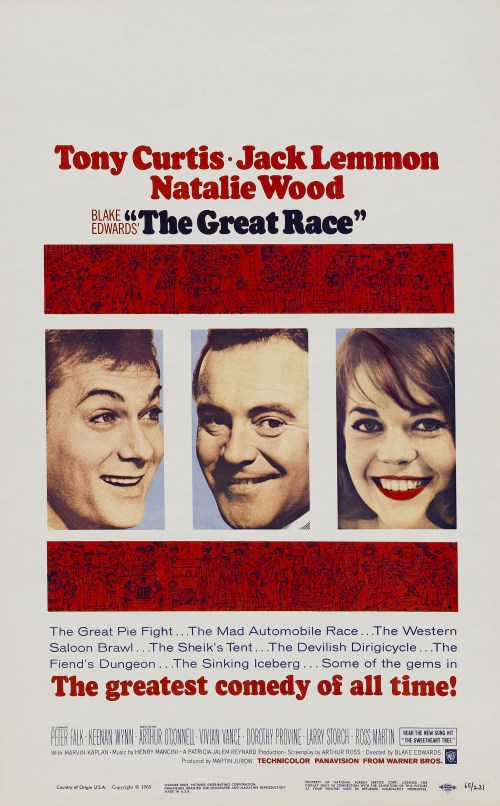
            The Great Leslie (Tony Curtis), who makes a living performing in wild stunts during the early twentieth century, decides to stage the world’s longest car race that will span over three continents. It will pit him against the evil Professor Fate (Jack Lemmon) and Fate’s slightly dimwitted assistant Maximilian Meen (Peter Falk) who will employ any dirty trick that they can in order to win.

It promises to be a grandiose comedy, but comes off as overlong and trite. In fact out of the total 160 minute run time I didn’t find any of it funny, it’s not even good for a chuckle. The gags are unimaginative, strained, and forced. It reverts to all the age-old shtick like a tired pie fight and equally tiring barroom brawl without adding anything new to it. Although the cinematography is excellent the action is cartoonish and will easily bore someone who is looking for something slightly more sophisticated. The film fails to achieve any momentum and seems to rely solely on its many lame jokes and stabs at unfunny humor to carry it.

The story is staggeringly threadbare with nowhere to go. The film’s title is misleading when you factor in that very little of an actual race is ever shown. The script goes off on a lot of side-stories and tangents all of which become increasingly more stupid as it goes along.  The worst one comes near the end when the audience should be gearing up for an exciting climax, but instead are treated to an inane scenario were the group find themselves trapped in a palace and dealing with a drunken prince who looks identical to Professor Fate (Jack Lemmon in a dual role).

It would have been better had there been more participants in the race instead of just the two. At the beginning there are several more drivers, but their vehicles all either crash, or break down right away in a highly uninspired fashion.

Curtis is boring in the lead and having him always seen in white makes him annoyingly clichéd. Lemmon’s character, who wears all black, is irritating as well in the opposite way.  Initially it was fun seeing Lemmon ham it up, but the character gets overplayed. I also didn’t like that medieval castle that he resided in, which appeared to be nothing more than a miniaturized model made of paper.

There are also many irritating logistical flaws that go overboard even for silly slapstick. One of the worst is the scene where both racers are stranded in a blizzard presumable somewhere in Alaska. Then the next morning they somehow find themselves on an iceberg that quickly melts as it floats into warmer waters, but how does that happen when before they were landlocked? Also, the Professor slips into the icy waters several times, which should have killed him.

If there is one good thing I can say about this film it is in the presence of Natalie Wood who plays a feisty feminist named Maggie Dubois. She is stunning and easily steals every scene that she is in. I loved the character’s gumption and I wished that she had been able to have her own car the whole way and competed against the two instead of having the derivative romance with Leslie. I also didn’t particularly care for ‘The Sweetheart Tree’ song that she sings, which is sappy, nor did I like the lyrics getting printed onto the screen along with a small bouncing ball.  Did writer/director Blake Edwards actually expect movie audiences to start singing along with her?

Supposedly this whole mess is a tribute to the slapstick films of the 20’s and 30’s particularly the Laurel and Hardy comedies, but as is the case with most of these things the originals are far better. The production values are high, there is a pretty good dual scene between Curtis and actor Ross Martin, and in the scene requiring a polar bear it is nice to see that a real one was used instead of a guy in a bear costume, which always looks tacky. Still, overall, it is a waste of celluloid that seems geared for an audience that no longer exists.

My Rating: 3 out of 10

Released: July 1, 1965

Runtime: 2Hours 40Minutes

Rated NR (Not Rated)

Director: Blake Edwards

Studio: Warner Brothers

Available: VHS, DVD, Amazon Instant Video

Dog Day Afternoon (1975)

dog

By Richard Winters

My Rating: 9 out of 10

4-Word Review: Money for sex change.

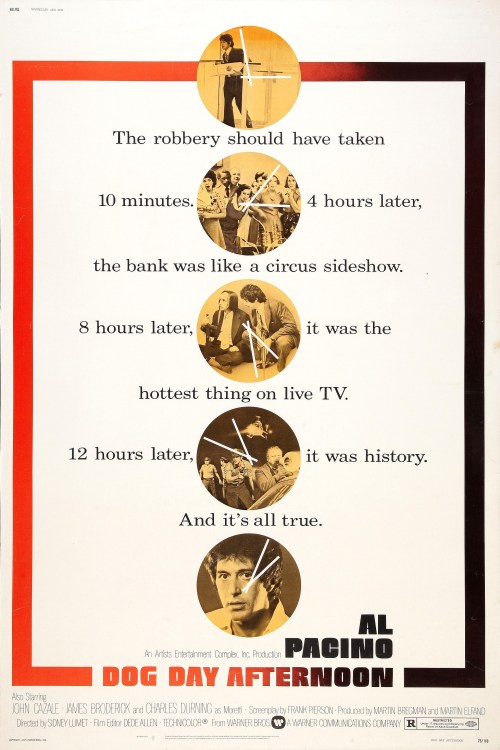
Dog Day Afternoon is a 1975 film based on a true story that took place on August 22, 1972.  It tells the tale of a man by the name of John Wojtowicz, who robbed a Brooklyn bank in order to pay for his gay lover’s sex change operation.  Here the character’s name has been altered slightly to John ‘Sonny’ Wortzik (played by Al Pacino), but otherwise this Oscar-winning script by Frank Pierson pretty much sticks closely to the actual events in this incredible saga about everything that can go wrong will.

Just about everyone who has watched this film will tell you how it manages to grab and pull you in right from the start.  It achieves this without having any special effects, pounding soundtrack, elaborate camera work, or artificial lighting.  Instead of ‘telegraphing all of its punches’ the film draws back and puts more emphasis on the little subtitles like the character’s facial expressions, side conversations, and other nuances that put together make this film very rich and textured.   In essence it successfully ‘shows’ instead of ‘tells’, which is a remarkable achievement since so many Hollywood films seem to want to do the exact opposite.

Director Sidney Lumet allowed for a lot of improvisation by his actors and gave each performer full rein on how to create their character, even the minor supporting ones. The result gives each and every one of the characters a distinct personality. The bank hostages become almost as fascinating as the thieves and it is interesting seeing all the different ways each one responds to the situation and how they interact with the robbers, which at times is both amusing and surprising.

The film also vividly captures 1970’s Brooklyn atmosphere. The sights and sounds of the area as well as the people’s personalities and the anti-establishment sentiment that was still quite prevalent at the time are all right on target.  After you finish watching this movie you feel like you just got back from a trip over there.  I really liked how during the opening credits you are shown all sorts of shots and scenes of Brooklyn, so by the time the story actually begins you are already well entrenched in the setting.

Pacino gives a dynamic performance in the starring role.  Some insist this is the best performance never to be nominated for an Oscar and I might have to agree.  If you are a Pacino fan than you absolutely have to see this, but if you are not a Pacino fan you still should see it because afterwards you might become one.

The supporting cast is stellar.  Sully Boyar, who was a real-life lawyer who did not enter into acting until he was in his 50’s, leaves a strong impression as the stoic bank manager.  As the police captain, the always durable Charles Durning is a blast especially during his frenzied and frantic negotiations with Pacino that almost become the film’s highlight. Another memorable moment is the improvised phone conversation between Sonny and his gay lover played by Chris Sarandon.  John Cazale is also amazing as Pacino’s bank robbing partner.  The partner in the actual incident was only 18 while Cazale was then 39, which created some controversy. However, Cazale is so convincing in the part that it is hard to imagine anyone else doing it as well.

In the end the film’s brilliance comes from its ability to convey the humanity of its characters. You can’t help but feel for the Sonny character despite his many flaws.  This a man who craves acceptance and yet goes through life being betrayed and hurt by everyone he meets. The shocked expression he shows at being betrayed by his own hostages, who he felt he had ‘bonded’ with, is, in my opinion, the most memorable shot of the whole film.

I only have two negative comments about this film and they are both minor.  One is the abrupt ending.  Since the film was made only a few years after the incident there wasn’t much of an epilogue to the characters.  The real John Wojtowicz, who really did look a lot like Pacino, didn’t end up dying until the year 2006.  It would have been a stronger conclusion by showing what happened to the Sonny character through the years and maybe even how he might of changed or grown.  My only other complaint is the fact that actress Carol Kane appears as one of the bank employees, but is shown very little.  A quirky and unique talent such as hers should have been given a bigger role.

Overall this is a great movie that I would recommend to any serious movie fan who can appreciate great film-making in top form.

My Rating: 9 out of 10

Released: September 21, 1975

Runtime: 2Hours 5Minutes

Rated R

Director: Sidney Lumet

Studio: Warner Brothers

Available: VHS, DVD (2-Disc Special Edition), Blu-ray, HDDVD, Amazon Instant Video

Eating Raoul (1982)

By Richard Winters

My Rating: 8 out of 10

4-Word Review: Get rid of perverts.

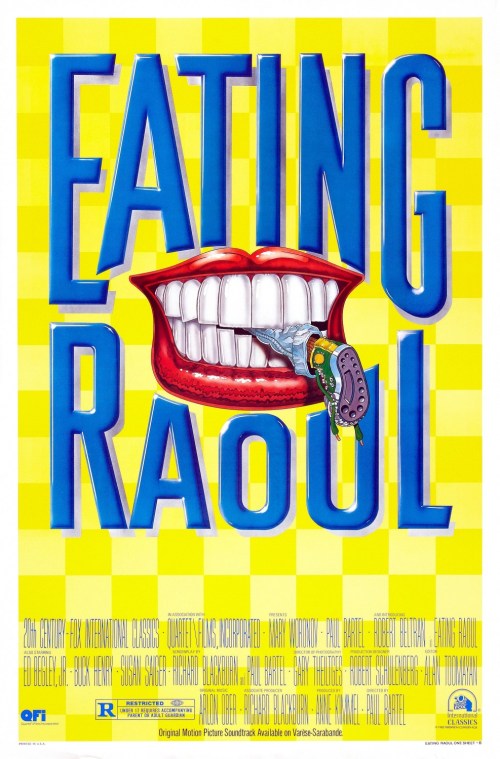
Paul and Mary Bland (Paul Bartel, Mary Woronov) are a very conservative couple that do not approve of open sexuality. They live in an apartment that is filled with swingers and spend most of the time trying to avoid them while abhorring their behavior.  Their dream is to purchase a large house in the countryside and convert it into a restaurant.  The problem is they have bad credit and are unable to secure any type of loan, so they decide to run an ad in the newspaper promising to fulfill and play-out people’s sexual fantasies. They insist everyone must pay in cash and then lure them to their apartment where Paul hits them over the head with a frying pan and kills them. That way they are able to collect the money they need while ridding the world of all the ‘perverts’.  However, a local con-man by the name of Raoul finds out about their act.  He is a young, good looking, self-described ‘hot-blooded Chicano’ who has the hots for Mary.  He allows them to continue with their scheme as long as he can have the dead bodies afterwards, which he then sells to a company who uses them to make dog food. Things go well for a while, but then complications ensue and that’s when it really starts to get crazy.

Paul Bartel’s hilarious script was initially rejected by all the studios and he spent six futile years trying to get it financed. It was only after his parent’s sold their house and gave him the money that he was able to get the film produced. It definitely has a very low budget look with a grainy film stock that gives it almost a home movie feel. However, this is a perfect example where a creative script can help overcome the film’s other shortcomings.  There are some genuinely funny moments the best is probably the swinger’s party and the infamous hot tub scene. This is the one thing that I remember most vividly about the film when I first saw it decades ago. I knew it was coming and still found myself laughing out loud when it did.  The swingers themselves are an obnoxious riot and you actually find yourself looking forward to seeing them get killed.

Writer, director, and star Bartel continues with his theme that perversion is a normal part of the human makeup.  Everyone has their own private sexual fetishes and fantasies that is unique only to them and may not be understood by others. He started this philosophy with his short film Naughty Nurse in 1969 where an otherwise respectable doctor and nurse would spend their lunch hour playing weird sex games. He continued it with his initial feature film Private Parts in 1972 that had a handsome young man who enjoyed having sex with a doll that he could fill up with water over real women and the weird relationship that transpired with the teen girl who lived next door and got-off watching him do it.  Here it continues with the sexual fantasies of Paul and Mary’s customers that become increasingly more outrageous (and hilarious) as they go on. Even the very strait-laced Paul and Mary have their own perversions. They dislike the actual act of sex and never do it. Instead they sleep in separate beds and cuddle with stuffed animals instead of each other, which is just as funny in the other way.

When I initially saw the film I thought Bartel was having a major ego trip by casting himself as being married to a very attractive lady like Woronov. He was a pudgy and bald man who in real-life would most likely not be able to attain such a woman. Upon second viewing I ended up liking the odd casting and felt it helped make the film stronger.  Usually beautiful women are shown as simmering with sexuality and even sex symbols, so I appreciated the way it went against type. It also helped to define how Paul and Mary had a very special understanding with each other that did not conform to conventional wisdom, which sometimes happens. I also enjoyed the way Mary stays true to Paul even when she ends up being severely tested.

I admired Woronov’s performance the second time around as well. She was majoring in sculpting in 1963 at Cambridge University when her class decided to take a field to the Andy Warhol factory. She became so impressed with the place that she stayed while the rest of the students went back.  She starred in some of his experimental films and now 80 independent/underground films later she has become a major cult icon.  I was only 18 when I first viewed this and at the time my hormones where more fixated on her sleek body as she does have a few good, but brief nude scenes. Her acting though indeed helps carry the film.

Successful Latino actor Robert Beltran is good in his part as Raoul, which also marked his film debut. I enjoyed the contrast of his aggressive, streetwise character against the stifled Blands. There is also shades from Roman Polanski’s classic Cul-de-sac where a coarse stranger disrupts the unique chemistry of an otherwise isolated couple.

Susan Saiger is fun as Doris the Dominatrix. I felt it was nice how the film starts out with her as a kinky woman with a whip at a party, but then turns around with a scene showing her as an everyday housewife and raising a kid during her off hours. I liked how Paul and her managed to get past their differences and form an interesting friendship.

Famous character actors pop-up in amusing cameos. Ed Begley Jr. is an over-the-top hippie sex freak. Edie Mclurg appears near the end of the film as one of the swingers. Famous dwarf actor Billy Curtis is one of the customers and has a pet Doberman that is bigger than he is! The best cameo goes to Buck Henry who plays an amorous bank manager who makes advances towards Mary and then the funny way he tries to back-track when he gets caught.

This film has acquired a major cult-following that seems to grow by the year.  Yes, there are some flaws. The beginning is a bit cheesy and awkward and it took me about 20 minutes before I could get into it. I also wondered, with so many people being killed, why the suspicions of the police, or anyone else, was never aroused. There is also the fact that not everyone would get killed by being hit over the head with a frying pan, some might just get knocked unconscious. Still, I found myself laughing at a lot of places. I think people who are fans of black humor will enjoy this especially since it doesn’t sell itself out and stays true to form the whole way.

Sadly Paul Bartel died in 2000 from cancer and I felt his full potential was never fully realized. This became is most popular work and although he did several films afterward, none of them were as good.  Mary Woronov continues to be quite busy even at the age of 68. A documentary about her life and career is set to be released later this year and I look forward to seeing it.

My Rating: 8 out of 10

Released: March 24, 1982

Runtime: 1Hour 30Minutes

Rated R

Director: Paul Bartel

Studio: Films Incorporated

Available: VHS, DVD

Two Moon Junction (1988)

By Richard Winters

My Rating: 6 out of 10

4-Word Review: Voyuers will like it.

            A young woman named April (Sherilynn Fenn) who is from a well-to-do Southern family and engaged to be married meets a rugged hunk named Perry (Richard Tyson) who works as a laborer at a travelling carnival and the two immediately share a strong sexual attraction.  She considers getting out of her engagement, but her controlling grandmother Belle (Louise Fletcher) puts the crooked town sheriff (Burl Ives) on Perry’s tale in order to ‘rid them of the problem’.

Normally ‘hot and steamy’ love triangles that take place in the south seem over-done, redundant, and cliché filled, but for some reason this one works to an extent. For one thing the sex scenes, especially the one at the end that takes place at the Two Moon Junction locale, is quite explicit with an abundance of nudity by actress Fenn who is pleasing in the buff. And for the lady viewers there is even a scene featuring naked male bodies, both front and back, near the beginning of the film. If that isn’t enough there is also actor Tyson who is seen ninety-eight percent of the time without his shirt.

For sex it fares pretty well and rises just enough above the tired 80’s clichés to make it seem fresh. However, the story is rather placid and fails to dig deeper than its basic storyline.  The stylish atmosphere is nice, but there needed to be more tension and action.  I wanted the Fletcher and Ives characters to be meaner. Adding some tongue and cheek humor to a genre that even back then was becoming tired would have really helped.  There are times when it seems to want to go there but then it pulls back.  Having veteran character actors like Fletcher, Ives, Herve Villechaize, and Dabbs Greer was a real nice touch, but they needed to be given more to do. In Ives case, whose last film this was, I felt he was wasted and in that regard I came away from this thing disappointed.

Tyson works surprisingly well in the male lead.  He resembles a Fabio wannabe and I would normally have found him annoying, but he displays just the right level of cockiness to stay interesting. The fact that he also shows some negative traits helps keep the character real. However, the part where he breaks into April’s parent’s large estate and then promptly starts to take a shower seemed absurd and ridiculous. And just where did he find that bathrobe that fit him so well? Or did he bring one along with him? I suppose the plumbing might not be so good at the ragtag traveling carnival he worked at, but still.

Fenn is surprisingly strong as the female lead. This was definitely a three-dimensional character and the internal struggle that she had at being attracted to a man that she knew she shouldn’t be was nicely realized. The parts where she would breakdown into bouts of sobbing after her sexual liaisons with Perry were effective and heartfelt.

Kristy McNichol was a nice sight as a bi-sexual cowgirl named Patti Jean and she looked even better when she went topless. The fact that she revealed some latent lesbian tendencies towards April seemed to me to create interesting dramatic variables, but the film fails to go with it and the character disappears, which was another disappointment.  However, Patti and April’s dance together on the barroom dance floor created some nice provocative imagery.

It also during the opening of this barroom scene that you can spot the movie’s most revealing mistake; as the camera pans across the floor you can clearly see the shadow of the camera as well as the cameraman reflecting along the shiny wooden floorboards. It is always surprising to me the fact that if I the viewer can see a mistake like that right away how come an entire production crew misses it? Or do they see it, but are too lazy to reshoot, so they hope that it will just ‘pass-by’ the viewer? Either way it is the sign of sloppy filmmaking.

This also marks the acting debut of Milla Jovovich who plays April’s younger sister Samantha.  She was only thirteen at the time, but she already had a stunning face and it is easy to see why she caught the attention of producers and photographers as a model. However, her acting ability here seemed limited and her facial expressions where undisciplined.  She also shows little awareness of the camera, or how to play to it.

The film is superficial and lacking in many ways and it fails to have the necessary edginess that would have given it cult potential, but I still found it to be passably entertaining. Voyeurs who watch it for the sex may find it a little bit better.

My Rating: 6 out of 10

Released: April 29, 1988

Runtime: 1Hour 44Minutes

Rated R

Director: Zalman King

Studio: Lorimar

Available: VHS, DVD

W (1974)

w1

By Richard Winters

My Rating: 1 out of 10

4-Word Review: Ex-husband is psycho.

For all you trivia buffs out there it may be good to know that Oliver Stone was not the first person to make a film with the twenty-third letter of the alphabet as its title, although that one technically has a period after it.  The first one was in 1974 and starred British super-model Twiggy. She had just made a splash in Ken Russell’s brilliant musical The Boy Friend and this film was supposed to send her to superstardom by proving that she could act by placing her in a completely different genre. Unfortunately for her it never happened.

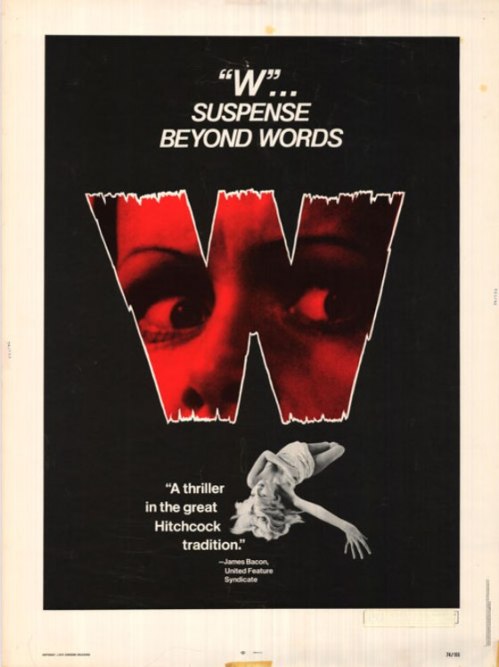
The film is a thriller and the tagline read ‘W…suspense beyond words’. It is a story about a woman who has remarried but it still being stalked by her psycho ex-husband (Dirk Benedict). His name is William and at all of the scenes of his murders, or ‘accidents’, he scrawls the letter ‘W’, hence the film’s title.

At the time the critics came down hard on Twiggy’s performance, but I kind of liked it. She comes off as very innocuous and vulnerable and in this kind of role it works.  Her present husband was played by Michael Witney, who at the time was her real-life husband.  He was eighteen years older than her, but the age difference is not apparent.  You can tell that the two are genuinely fond of each other and that chemistry helps.  Yet they have no real onscreen presence and too much of the time is spent with only them in it, which hurts.

Viewers enjoyed Eugene Roche’s performance in a supporting role as a detective.  His gritty, matter-of-fact approach is refreshing and gives him some distinction over the other characters who are very transparent. Unfortunately he gets phased out rather quickly and this is too bad because it is the type of persona that could have really carried the film.

Where this film really fails is that way too much time is given to extraneous dialogue that is not interesting and does not propel the plot along.  The scenes are also excruciatingly slow and in great need of quicker cuts and edits.  I would have like to have seen cutaways showing the Twiggy’s character’s relationship with her ex-husband and how that all started, but it is never shown. She doesn’t even end up talking about it until well over an hour into the film and then it is only done briefly.

This is also one of the first thrillers that I have ever seen that has no creepy or pounding music score.  In fact the music is very soft and melodic like something you would hear in an elevator. There is also extended amount of footage showing the couple going sailing, walking hand in hand in a park, or spending time at their lavish beach house, making it seem more like a dreamy romance movie.  Some scary imagery, or just a few shocks are badly needed.  There is one nightmare sequence that has a little potential, but it lasts less than ten seconds and that just isn’t enough.

The film also has a lot of loopholes that completely throws you out of the story.  One is the fact that as they are becoming increasingly terrorized by this ex-husband they decide not to go to the police, but instead call on the services of a private detective, who has ulterior motives and just ends up making things worse. There is also a scene where the killer cuts off two of his fingers and attaches them to the victim’s burned body so when the police identify the body using the fingerprints they think it is the killer.  However, I wasn’t exactly sure how he pulled this off. Certainly he wouldn’t have the skill or time to actually graft the fingers onto the body and even if he did you would still think that the police would notice that the victim had too many fingers.

The biggest head scratcher of them all has got to be the fact that the prison in which the ex-husband resides gives daily tours to the public.  Now I have toured a prison myself in Boise, Idaho, but that was only after the prison had been closed and the prisoners shipped off to another facility.  Here the visitors can get right up next to the prisoners and observe them without any guards, or protection.  The person leading them around is not armed and dresses and acts like a tour guide to a museum.  I would think one of the prisoners could easily obtain a homemade knife of some kind, grab one of these visitors, and use them as a shield to break out. Of course in this film that doesn’t happen, but in real life I think it would, which just makes you wonder what kind of drugs were they on when they made this.

My only interest in watching this film to begin with was seeing Dirk Benedict playing the psychotic.  He is probably best known for the character of Face in the 80’s TV-show ‘The A-Team’.  Not that he is a real great actor or anything, but he has had a career where he usually always plays the nice guy, so I was interested in seeing him as the bad guy. Unfortunately he doesn’t appear until the final ten minutes and these scenes are strained and probably the most boring of the whole film.  His character is also poorly fleshed out with no reason given to his erratic, crazy behavior thus turning him into a cliche.

I came into this film expecting very little and I went away not even getting that much. Being an avid collector of lost films can be fun because every now and then you can come across a real gem, but that was definitely not the case here.

My Rating: 1 out of 10

Released: June 8, 1974

Runtime: 1Hour 35Minutes

Rated PG

Director: Richard Quine

Studio: Cinerama Releasing Corporation

Available: None

Deep End (1970)

deep

By Richard Winters

My Rating: 7 out of 10

4-Word Review: He will have her.

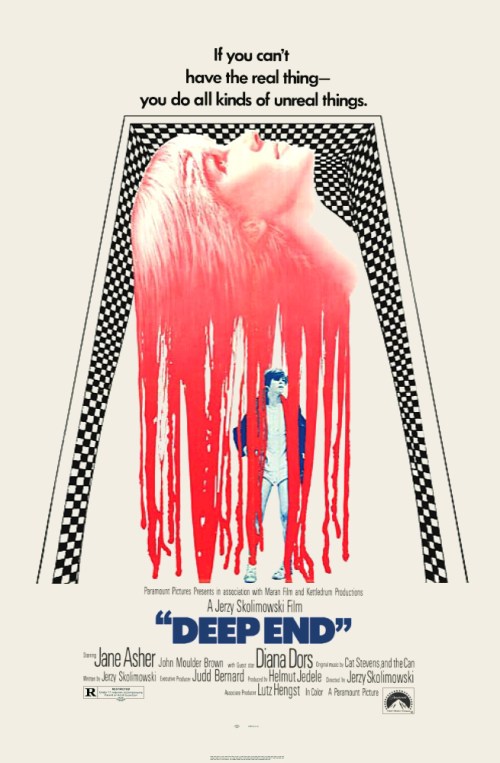
This is a moody drama detailing the story of a 15 year old boy named Mike (John Moulder-Brown) who goes to work at a public bath in London.  There he meets an alluring red-headed woman named Sue (Jane Asher).  She begins flirting with him, which causes him to become infatuated with her.  He starts following her around and even tries to scare off her two boyfriends as she is seeing both a man her own age as well as an older, married one.  Sue, who seems to enjoy manipulating all the men in her life, treats it all like it’s a silly game that ultimately ends with tragic results.

One of the things that really helps this film stand-out is the believability of the Mike character.  It was fascinating seeing all the different sides to his personality and I felt each one rang true for a boy his age.  There are times when he seems streetwise and even savvy and then there are other moments when he is immature, irresponsible, and emotionally out-of-control.  Although his obsession with Sue borders on being frightening I did like how he comes up with clever ways to help her like the ingenious way he finds her diamond that fell from her ring and into the snow.  I also liked how he becomes shocked at seeing a semi-nude poster of Sue outside a club, as she works as a stripper part-time, and how he steals it away in order to ‘protect her honor’.

Sue on the other hand seems almost all bad with very little good traits, but still equally believable.  She is mean and catty with everyone, abuses animals, and comes up emotionally hollow at every turn.  However, I could see how a young man of his age could become trapped by her seductive ways and perceived ‘maturity’, which makes the obsession itself as intriguing as their personalities.

Acclaimed writer/director Jerzy Skolimowski seems very much in control here and what buttons to press and when to do it.  I liked the color schemes especially his use of the color red. Having Cat Stevens do the music score gives the soundtrack and nice distinction.  I also liked how he foreshadows the film’s final shot several times during the movie.

I did end up having a few qualms with the film.  I wanted Mike’s initial interactions with Sue to be a little more extended than just the brief flirting that is shown.  The film takes place in buildings that are all old, rundown, and murky, which in some ways is good because it helps reflect the murky personalities of the characters.  Yet I wasn’t sure if this was all intentional or just the result of working on a low budget.  I would have liked a few scenes done against a more appealing background just to allow for  more visual variety.

The ending, especially the final shot, is very provocative and perverse.  It reminded me in a way of Nicholas Roeg’s excellent film Bad Timing: A Sensual Obsession (1980). Everything gets played out in such an odd way that it keeps you guessing until the final second as to what happens, which ends up staying with you long after the film is over.

Diana Dors, who was a popular British actress during the 50’s and 60’s and even considered a sex symbol for a time, gets a great cameo bit here that has to be seen to really be appreciated.  She plays a sexually frustrated middle-aged woman who rents a room at the public bath and then tricks Mike into coming into the room with her. She grabs his hair and shakes his head while describing a sexual fantasy that she has going on in her head.  When she is done she throws him back to the floor and says “You can go now, I don’t need you anymore.”

My Rating: 7 out of 10

Released: September 1, 1970

Runtime: 1Hour 33Minutes

Rated R (Sexual Situations, Adult Theme, Brief Nudity)

Director: Jerzy Skolimowski

Studio: Paramount

Available: DVD, Blu-ray (Import)

Dirty Mary Crazy Larry (1974)

dirty1

By Richard Winters

My Rating: 5 out of 10

4-Word Review: Fast cars fast women.

During the 70’s car chase movies were all the rage.  Smoky and the Bandit, Convoy, Vanishing Point, and Two-Lane Blacktop were just a few.  Most of these films followed the comedy adventure blueprint closely resembling the politics of the time where the police were the befuddled authority figures and those being chased symbolized the downtrodden masses looking to break free from the values and customs of yesteryear and find their own identities. Dirty Mary Crazy Larry is pretty much the same as the rest with a few notable exceptions the biggest being its very downbeat ending, which was quite talked about at the time of its release and one of the main reasons this film continues to have a strong cult following today.

The story is based on the novel by Richard Unekis called The Chase. It involves an out of work race car driver named Larry and his mechanic (Peter Fonda, Adam Roarke) who decide to rob a grocery store to make ends meet. Much to their dismay they are accompanied by a hooker named Mary (Susan George) and the three spend the rest of the film riding in Larry’s Dodge Charger with a powerful V-8 engine and avoiding the relentless pursuit of the police.

The screenplay follows the book pretty closely, but does make a few ill-advised changes. One is that in the book the two leads characters were career criminals who robbed for a living. I thought this made more sense and gave the characters a little more grounding.  I didn’t understand why a race car driver and his mechanic would suddenly be pushed to robbery, or what lead them into their fix. The robbery is executed in much too sophisticated a way for a pair of novices as they kidnap the store manager’s wife and daughter and then threaten to harm them unless the manager opens up the store’s safe. They also rig his home phone up to a tape recorder device so every time he calls home he hears the voice of the two and thinks they are still there even though they had already hit the road.  Criminals who had done this all their lives would be brazen enough not only to come up with this idea, but to also pull it off.  People with no background in robbery most likely would not.  There is also no explanation as to why they chose this store and how they planned the whole thing out, which would have helped.

Another change that was made was the addition of the Mary character.  In the book it was just the two men, which made it more gritty.  Although easy on the eyes the character serves no fundamental purpose to the story line.  All she does is have very redundant arguments with Larry that quickly become tiring.  I began to realize that these shouting matches were put in solely as filler material and it ends up getting inane.

Although I have like Peter Fonda in other films, most notably Easy Rider, I did not feel his laid back persona fit this part.  Larry is indeed a potentially interesting character as it is a person who can only find solace when he is taking extreme risks and driving real fast, but Fonda seemed unable to bring out this edginess effectively and his incessant gum chewing ends up becoming real annoying.

Vic Morrow probably gives the film’s best performance as the sheriff.  Normally the police are portrayed as bumbling idiots in this type of genre, but here they were a little more human and I liked the way that he was a bit of a non-conformist himself in the relentless way  he pursued the trio.

I also liked the attempt by the film makers to put in more realistic elements to a car chase that is never shown in most movies. One particular scene involves a pick-up truck that has nothing to do with the chase pulling out and getting side-swiped by Larry’s car.  For a minute the film becomes somber as they think they may have killed the other driver, which is good. Too many chase films always show other drivers and pedestrians miraculously getting out of the way and never being hit or injured even though in reality a lot of them probably would. The subject of seat belts also comes up, which is another pet peeve that I have with these films.  The occupants of these cars are never shown wearing them and with the stunts that they do they would all end up injured and killed without them.  They don’t wear them here either, but at least Larry does mention to Mary that she should put one on and there is also an amusing scene where a big yellow billboard stating ‘There is only one word for people that don’t wear seatbelts…STUPID’ which is shown briefly just before one of the out-of-control police cars goes careening through it.

Of course the best thing about the film and the one thing that has made this film so famous is the notorious ending, which is a downer for sure. If you consider this a spoiler then please don’t read any further, but the truth is when I first saw this film many years ago I already knew it was going to have a downbeat ending, but it kept me more intrigued because I didn’t know how it would happen.  Unless you count the film’s opening shot there is no foreshadowing of it and it happens very suddenly where the victims end up not knowing what hit them, which is also realistic.  Personally I loved it and most other viewers seem to also.  Too many chase movies have the good guys being able to escape one close call after another when in reality the odds will catch up with you sooner or later and with this film that is what happens, which in some ways can be considered ‘refreshing’. The scene is captured well and features one of the best explosions I have seen and without any of that tacky computerized special effects. I also liked the way the film ends very abruptly after it happens without any denouncement.

Normally I argue against Hollywood remakes, but this is one instance where it would be a good thing.  One of the main problems here is the film’s low-budget.  Although I felt they captured the central California countryside nicely (it was filmed in and around Stockton) the indoor sets are quite bland and dull. A bigger budget, tighter script, and some flashy camera work could work wonders here.  Too many times Hollywood seems driven to remake films that were already good the first time and only ends up tarnishing the original instead of remaking films that didn’t quite work on the first run and trying to make them better.

My Rating: 5 out of 10

Released: May 17, 1974

Runtime: 1Hour 33Minutes

Rated PG

Director: John Hough

Studio: 20th Century Fox

Available: VHS, DVD, Amazon Instant Video

Closely Watched Trains (1966)

closely watched trains

By Richard Winters

My Rating: 7 out of 10

4-Word Review: Boy loses his virginity.

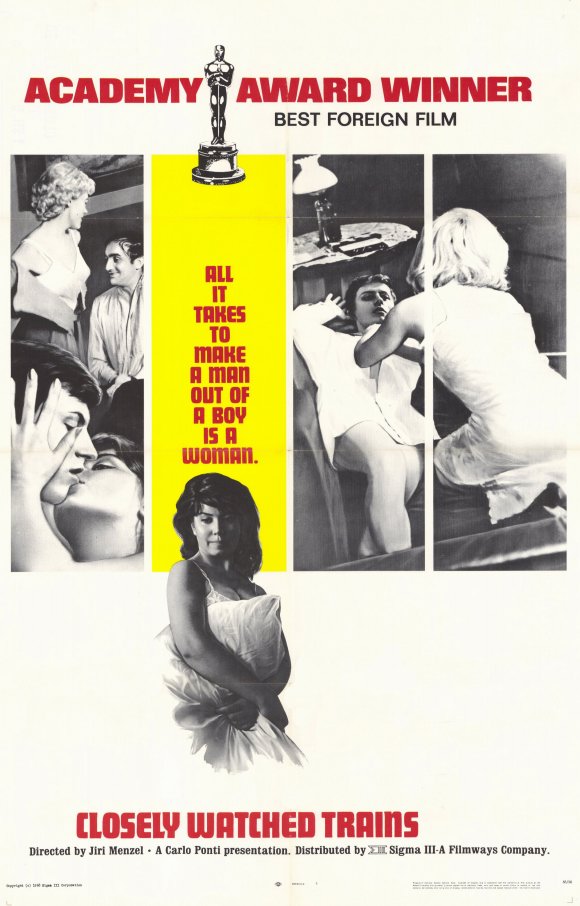
This is an engaging, amiable Czechoslovakian import that won the Academy Award for best foreign film of 1966. The story pertains to a young man named Milos (Vaclav Neckar) who follows in his father’s footsteps and gets a job at the local railway company during World War II. He almost immediately becomes bored with it and gets preoccupied with a beautiful young train conductor named Messa (Jitka Scoffin). The two have a sexual tryst, but Milos is unable to ‘rise to the occasion’.  He becomes despondent and even tries to commit suicide, but is saved at the last minute. While he is recuperating in the hospital the Dr. informs him that he suffers from premature ejaculation.  Milos then spends the rest of the time scouring the village for some prostitutes that he can ‘practice on’ so that he can learn to control his condition and become a ‘real man’.  A subplot involves plans to blow-up a German train carrying some high level ammunition.

Despite the fact that it is very leisurely paced and everything happens at one not very exciting location I still found the film to be immensely enjoyable. I had the feeling that director Jiri Menzel spoke straight from the heart with this one. The bleakness of the characters situation and the poor, hopeless conditions of their country is vivid and yet the ingenuity and perseverance of the human spirit never fades. Anyone who has dealt with an oppressive situation will most assuredly relate. The fact that this film stays so highly amusing and touching despite the depressing elements is what makes this a winner.

In a lot of ways this was years ahead of its time. The very liberal sexual attitudes and provocative scenes were stuff not yet seen in most movies and didn’t really become the norm, even for European films, until the 70’s and 80’s. Although not extreme there is indeed some lingering eroticism and even nudity. One segment involves Milos’s very amorous co-worker Hubicka (Josef Somr) rubber stamping the naked rear of Zdenka (Jitka Zelenohorska) who works as the station’s secretary. When her shocked mother finds out about this she parades her daughter all around town, exposing her rear to everyone, so that they can witness the ‘outrageous crime’ while the amused Zdenka finds it a turn-on.  There is also another scene, which another reviewer considered to be the most unique scene ever put on film that involves an old woman and a goose. I’ll agree it is very different, but I am not exactly sure what she was doing with it, or if I want to know, or if it is even legal, but it does indeed catch your attention.

Of course the drawback to this is the fact that the character’s attitudes seem far too modernistic for the era. At no time did I feel like I was really being transported back into the 1940’s.  There was also a little too much preoccupation with the sex angle and I felt there needed to be a little more balance with the actual war.

The Milos character is a bit too wide-eyed. He looks literally like a ‘deer-in-headlights’ through the entire progression of the movie. He seems overtly naïve for someone of 18. I know it was done for comical purposes, but having his mother dress him for his first day of work was going over the top. For the first half of the film he has hardly any dialogue and it is difficult for the viewer to relate to him, or get inside his head. Things do even out at the end when he ‘transforms into a man’, which I liked, but the opening half paints him too much as a caricature.

If there was one thing that really rubbed me the wrong way it would be the downbeat ending. I didn’t think it was necessary and tended to go against the film’s theme, which was human survival and coping. Still, it’s a good film with a great message. The budget was clearly very low, but it’s entertainment value high.

My Rating: 7 out of 10

Released: November 18, 1966

Runtime: 1Hour 33Minutes

Rated NR (Not Rated)

Director: Jiri Menzel

Studio: Filmove

Available: VHS, DVD (The Criterion Collection)

The Innocents (1961)

innocents 1

By Richard Winters

My Rating: 6 out of 10

4-Word Review: Children frighten their governess.

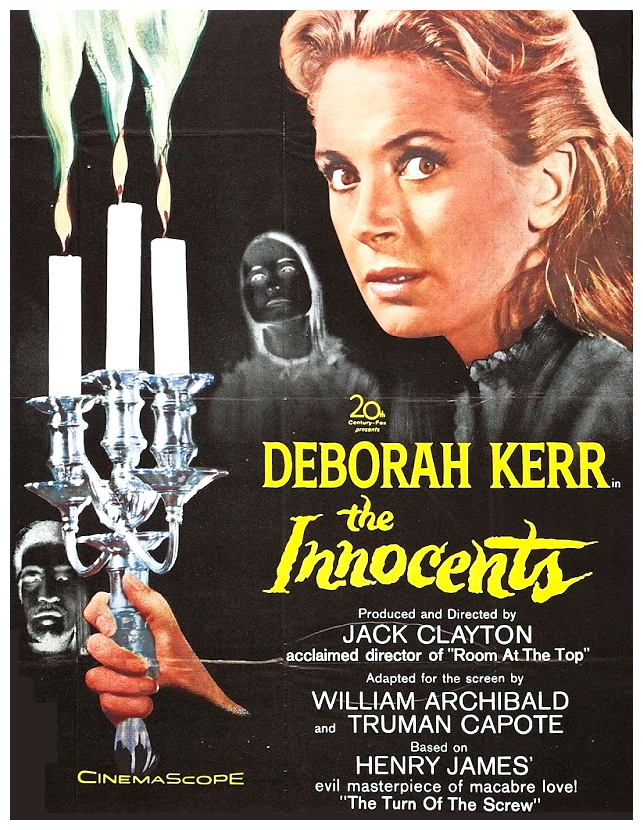
Legendary British actress Deborah Kerr plays Miss Giddens, the governess hired to care for two children at a sprawling English estate. However, the children are not exactly as they seem. Strange occurrences and behaviors begin to manifest as well as several ghostly sightings, which leads Miss Giddens into believing that the children may actually be possessed.

The film is based on the Henry James novel The Turn of the Screw. I have not read the book, but those that have feel this is a pretty satisfying adaptation. I did like the slow, methodical pacing. It helps to build the tension as well as enhance the mystery. Things are revealed in deliberate layers, which kept me intrigued throughout.

Director Jack Clayton shows a marvelous handle on the material.  The estate that they chose for the setting is perfect and captured well in glorious black and white by famed cinematographer Freddie Francis.  There is a lot of spooky imagery throughout including a creepy nightmare sequence in the middle.  The garden with its hulking, strange statues is used quite effectively especially in the haunting finale.  The music also grabs your attention right from the start with a very eerie song that is played before you see a single image on the screen. The song is similar to the one used in Rosemary’s Baby.  In fact there are several things here that reminded me of that film as well as The Shining.

Kerr was a good choice for the increasingly frightened governess.  I loved that scared expression on her face, which becomes progressively more frequent. Yet she is also effective when the character decides to become proactive by taking matters into her own hands and singlehandedly trying to ‘cure’ the children herself.  This also helps make both the character and the story a more multifaceted because you are never sure if this stuff is really happening or all just inside her head.

What really impressed me the most though was the performances of the two children especially Martin Stephens who plays Miles the young boy. His character shifts through many different moods, playing an innocuous child one minute and then a menacing, volatile one the next. He does each one flawlessly and becomes practically mesmerizing in the process.  Pamela Franklin is also fine in the role of Flora. This was her film debut. Eight years later her career would peak playing her signature role as Maggie Smith’s nemesis in The Prime of Miss Jean Brodie.

Another thing that I liked about the children is that they are initially portrayed as being normal and even engaging.  This is unlike other films with a similar theme like Children of the Damned or Children of the Corn where the kids are given creepy features right from the start. Here it works better and is more chilling to the viewer because the children’s dark side is unsuspected.

Unfortunately, despite the film’s impeccable technical quality, I still went away feeling unsatisfied. Part of the problem is that nothing really happens.  The ghosts appear but then do nothing but just stand there, which quickly becomes tiresome. One scene in particular has the camera constantly cutting back to the lady ghost standing across the lake until she starts to look like a mannequin, which I suspect she was.  The buildup is good, but I would have liked more of a payoff.  The ending is much too vague and gives no explanation as to why this was happening, if it was happening, or whatever became of the main character.

I couldn’t help but feel that this story would have worked better as an episode from one of the old horror anthology series like The Alfred Hitchcock Hour or even The Twilight Zone where it could have all been compacted into an hour. A hundred minutes seems like much too long for such little to happen. It is also interesting to note that in 1972 a film came out entitled The Nightcomers starring Marlon Brando that attempts to speculate what happened to the children before the main character of the governess arrives and before James’s original story begins.

My Rating: 6 out of 10

Released: December 25, 1961

Runtime: 1Hour 40Minutes

Rated NR (Not Rated)

Director: Jack Clayton

Studio: 20th Century Fox

Available: VHS, DVD