The Bliss of Mrs. Blossom (1968)

By Richard Winters

My Rating: 6 out of 10

4-Word Review: Lover in the attic.

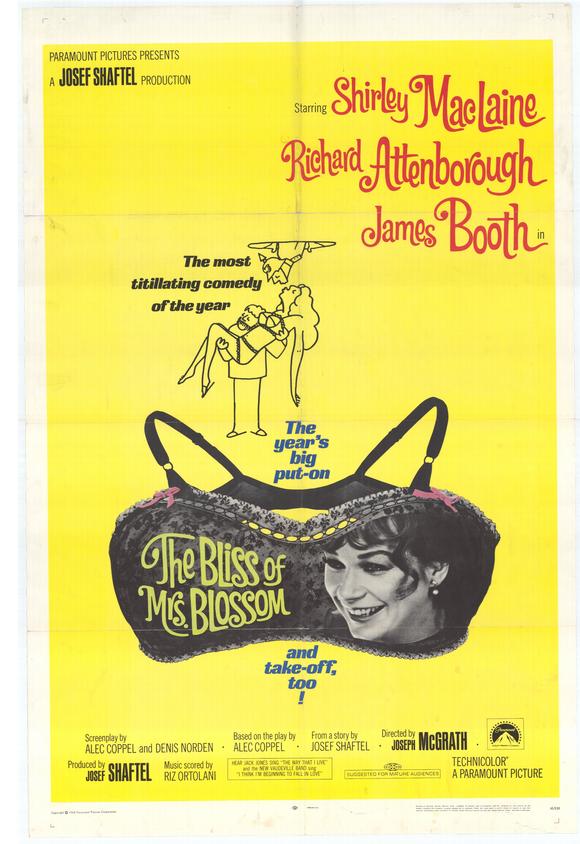
This wacky film nicely exudes the mod, experimental wave of filmmaking that permeated the era of the late 60’s. The story takes place in London and is about a clothing manufacturer’s wife named Harriet Blossom (Shirley MacLaine) who one day calls her husband Robert (Richard Attenborough) while he is at work to tell him that her sewing machine has broken down. Robert sends his lowly assistant Ambrose Tuttle (James Booth) over to their house to help her fix it. Harriet is a bit bored with life and feels neglected by her husband, so she not so subtly seduces Ambrose and then hides him in the attic where he soon takes up residence.  He comes out only when Robert is away, but the unexplained strange noises that Robert hears and the many close calls make him think he is going insane and leads him to a nervous breakdown.

Director Joseph McGrath’s highly visual style is the real star. The lighting, editing, camera angles, set design, and costumes are creative and imaginative.  The home that was chosen for the setting has a nice architectural flair especially the attic and billiards room, which seems to be draped by a large stain glass window. Certain film professors show this movie to their classes as an example of how stylish direction can help accentuate a story as well as deftly define its era. I was disappointed to see that although McGrath is still alive he hasn’t done a film since 1984, which is a shame as it is obvious from this that he is quite gifted and I would have liked to see him doing more.

This is generally considered a vehicle for MacLaine, but to me her performance isn’t interesting. I think she is a first rate actress, but her character here is the only normal one in the film and she acts more like an anchor trying to corral the craziness around her. Booth, as her lover, goes to the other extreme, but doesn’t fare any better. He is too clownish and is always wearing various disguises and going through different personas, which makes the character unrealistic and cartoonish. If anything, out of the three main leads, it is actually Attenborough who does the best. His nervous and confused facial expressions are priceless. The scenes were he comes home from work and to ‘unwind’ pretends to be a conductor of a large orchestra while listening to a loud record, is amusing.

The colorful supporting cast though, full of legendary British Pros, is what steals the film. Some of them appear just briefly, but they still make a memorable and funny impression. Barry Humphries, playing a male character and not Dame Edna, is good as an art dealer. John Cleese, in one of his very first roles, is engaging as an argumentative postal clerk.  The best however is far and away Freddie Jones as the snippy, suspicious, relentless detective that will leave no stone unturned in his pursuit of Ambrose, who once he moves into Harriet’s attic proceeds to completely drop of society and disappear.

Although generally entertaining the plot doesn’t go anywhere and is simply a set-up for a lot of absurdity. What is worse is the fact that this based on a true story that in its own right was very intriguing.  In the real-life incident that took place in 1913 a 33 year old woman by the name of Dolly Oesterreich met a 17 year old named Otto Sanhuber. She, like the character in the movie, was a bored wife of a wealthy textile manufacturer, and took in the young man as her ‘sex slave’, which he readily accepted. To avoid possible suspicion she had him move into their attic, where he remained for five years and despite some close calls was never caught.  When the Oesterreich’s moved to Los Angeles in 1918 Dolly made sure that their new home had an attic as well and Otto then took up residence there and the deception continued until 1920 when Otto finally ended up killing the husband.

Of course none of that happens here. In fact Ambrose is fond of the husband and considers the three to be one big happy ‘family’, which is offbeat for sure, but not particularly satisfying. Again, this film does have some funny moments. I thought the scene where Robert invents the world’s first inflatable bra only to have the system go awry during an exhibition, which forces the model’s breasts to grow to unbelievable proportions before they go floating in the air, to be hilarious.  Still the end result of this production can best be described as cinematic soufflé.

My Rating: 6 out of 10

Released: September 11, 1968

Runtime: 1Hour 33Minutes

Rating: NR (Not Rated)

Director: Joseph McGrath

Studio: Paramount

Available: VHS
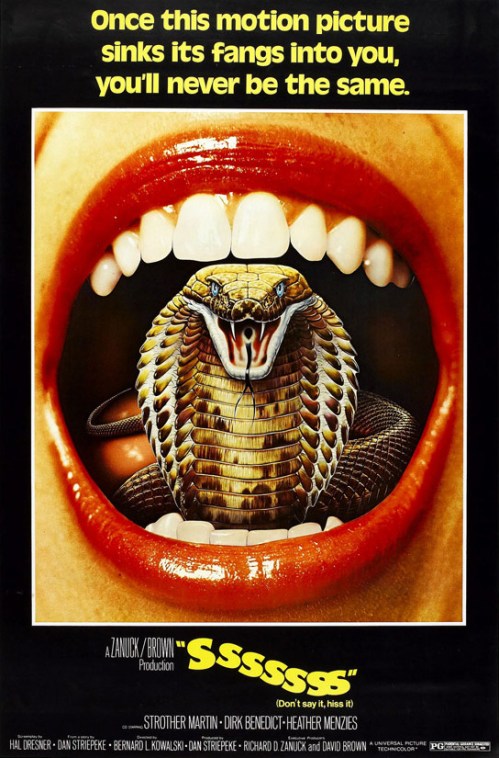
SSSSSSS (1973)

ssss

By Richard Winters

My Rating: 6 out of 10

4-Word Review: Man turns into snake.

            Dr. Carl Stoner (Strother Martin) hires a college student named David Blake (Dirk Benedict) to work as his lab assistant on his research of snakes. David also finds himself attracted to the Dr.’s daughter Kristina who also works with her father on his research. However, unbeknownst to both of them the kindly Dr. has come up with a serum that can change a man, over the course of several weeks, into a king cobra snake.

Although clearly done on a limited budget, this film really impressed me in a few areas. The first was that the actors performed with actual snakes. The snake handling that Martin did was simply amazing. I found myself captivated in one scene where he takes a live Black Mamba out of its cage and grab its head and then force feeds it through a special type of mechanical tube. Another scene has him taking a King Cobra out of its cage where, while in front of a viewing audience, he is able to grab its head and make it secrete its venom into a jar. To top that off the film climaxes with a mongoose attacking and killing a cobra, which is quite violent. I almost wished that this had simply been done as a nature documentary as it could have been just as frightening and fascinating. The chilling throaty sounds that the King Cobra makes, which is all perfectly natural, would be enough to scare most people. There is even a segment where actor Reb Brown gets bitten by a snake on his foot and it is done in slow motion.

Another thing that was impressive was the make-up effects done by John Chambers. Benedict really starts to look like a snake and the final transformation is incredible.

The areas were the film is limited is in the horror portion itself. For one thing it takes too long to get going. The metamorphosis doesn’t start to get interesting until the final fifteen minutes.  The David character seems much too passive and trusting as he allows the Dr. to continue to inject him with the fluid even after he starts to have weird side-effects. The Dr. character is not menacing, or creepy enough to be scary.  For most of the movie he seemed pretty cool and I found it hard to cheer against anyone who is able and willing to handle snakes the way he does. The music is another problem as it is too soft and melodic without the jarring and foreboding undertones that is needed to help accentuate the tension. The setting is bland we get no sense of the locale outside of the Dr.’s residence, which looks too much like a studio back lot. The entire production has a cheap TV-movie quality and it is photographed in a flat, unimaginative way.

The side-story involving the budding romance between David and Kristina is uninteresting and unnecessary. The segment where the two go skinny dipping and their genitals are strategically covered by trees and plants at every conceivable camera angle looks cheesy.

            If you are into snakes, or make-up used for special effects, then you may find this film satisfying.

My Rating: 6 out of 10

Released: July 2, 1973

Runtime: 1Hour 38Minutes

Director: Bernard L. Kowalski

Rated PG

Studio: Universal

Available: DVD, VHS

Venom (1982)

By Richard Winters

My Rating: 3 out of 10

4-Word Review: Kidnappers versus deadly snake.

            Phillip Hopkins (Lance Holcomb) is an 8-year old boy and son of a wealthy couple. When his parents leave for a trip the family’s maid and chauffeur (Susan George, Oliver Reed) conspire to kidnap the boy and hold him for a ransom with the help of a ruthless gunman (Klaus Kinski).  Unbeknownst to any of them the boy has mistakenly acquired a black mamba snake that escapes from his cage. As the culprits try to pull off their crime they become trapped in the house by the deadly reptile that starts to attack them one-by-one.

For starters the cast is one of a kind. Besides the performers listed above the film also has Sarah Miles as a Dr. with a serum to help fight the snake’s poisonous venom. Nicol Williamson appears as the police negotiator and Sterling Hayden, in his last film role, plays the boy’s grandfather.  How anyone could manage to direct a cast with such legendarily huge egos and eccentric personalities seems hard to fathom and probably explains why original director Tobe Hooper left the production after only ten days of shooting and was replaced by Piers Haggard. Supposedly Reed and Kinski were at odds with each other during the entire production and their animosity clearly shows on screen. For the most part the talents of the cast is wasted with a script that is limited and filled with characterizations that allow for no range.

I did like Hayden in the scene where he is forced to go searching for the snake in a darkened room and armed with nothing more than a lamp and a makeshift weapon. George is also fun playing a duplicitous character for a change and I was disappointed that she gets killed off so soon. However, she does make the most of it with a very theatrical death scene. Probably the best performance in the whole film is that of the boy. He has a very sweet, young looking face and the widest most innocent pair of blue eyes you’ll ever see and the kind that most casting directors would kill for. The kid plays the frightened part well and does an effective asthma attack. He hasn’t done much since, but I am sure that if he wrote a book dealing with his experiences on the set and his interactions with that cast that if would most assuredly be a best-seller.

The set-up is good and I found myself riveted to it for the first half-hour. I liked the idea that an actual mamba snake was used. There is a part where the snake is slithering towards the camera and opens its wide, black mouth and hisses straight at the camera, which could be enough to get most viewers to jump out of their seat. Director Haggard uses the novel idea of shooting scenes from the snake’s point-of-view and he does it through a fuzzy and slightly distorted lens to help replicate the snake’s vision. The only problem I had in this area is that the snake is seen slithering throughout the picture inside the home’s venting system, which is shown to be very clean and spotless, which didn’t make sense to me since the home was old making me think that the metal piping would be more corroded and rusted.

Despite the excellent concept the film’s second hour is quite boring. The characters don’t have enough to do and spend most of the time standing around. The interplay between Kinski and Williamson brings no tension. There is one cringe inducing scene where the snake crawls up Reed’s pant leg, but overall the scares are quite sparse. The climatic sequence is too convenient and becomes more of a disappointment then a shock. It is hard to say if the film would have been better if Hooper had stayed on or not. Reportedly none of the footage that he shot is in the final cut. The film is based on a novel by Alan Scholefield, which I suspect is probably more intriguing and after watching this makes me interested in reading it.

My Rating: 3 out of 10

Released: January 29, 1982

Runtime: 1Hour 33Minutes

Rated R (Mature Theme, Violence, Language) 

Studio: Paramount

Director: Piers Haggard

Available: DVD

Midnight Run (1988)

By Richard Winters

My Rating: 8 out of 10

4-Word Review: Chased by the mob.

Jack Walsh (Robert De Niro) is a bounty hunter that is looking to get into a less stressful profession. He is offered 100,000 to find bail jumper Jonathan Mardukas (Charles Grodin) who worked as an accountant for the mob and skimmed 15 million from them. Jack thinks he can use the money to open up a coffee shop, but finds that the FBI is in hot pursuit of Mardukas as well. There is also rival bounty hunter Marvin Dorfler (John Ashton) who wants his hands on Mardukas and the money. Jack even finds himself chased by the mob looking to silence Mardukas before he can turn states evidence.

The catalyst of the film is the relationship between Jack and Jonathan and how it slowly turns into an unusual friendship during their long adventure. Both Grodin and De Niro have diametrically opposite personalities and acting styles, which is why this thing really works. The relationship ebbs and flows on the antagonistic level most of the time and the friendship really doesn’t build until the very end and even then it is tenuous, which is nice.  Too many times in ‘buddy’ movies such as this the sentiment becomes forced, but fortunately here it is very balanced and their interactions believable throughout.

Grodin was an inspired choice. I have always thought the guy to be a very talented, underappreciated, and unique comic performer. However, he was not a big name star and the studio heads originally wanted Robin Williams for the role and then even considered changing the sex of the Mardukas character to female and having Cher play the part, but director Martin Brest liked Grodin’s style during his audition and held out until he got him even though it meant losing the backing of Paramount and forcing them to go with Universal.

Grodin adds a lot that the other two stars, as very talented as they are, just wouldn’t be able to do.  One is a completely improvised conversation that he has with the De Niro character while they are stuck inside a train car, which is the one scene from this film that I remember most clearly from having first seen it over twenty years ago. There is another improvised scene involving Mardukas and Jack pretending to be FBI agents and going into a local bar looking for counterfeit bills that makes great use of Grodin’s sardonic humor and deadpan delivery.

John Ashton is a riot as Marvin the rival and slightly dim-witted bounty hunter. He is so over-the-top obnoxious and crude that you can’t help but laugh at it. He takes the caricature of the tough, brash, gruff, blue collar Chicagoan to a hilarious extreme. He is like legendary football coach Mike Ditka on speed. Denis Farina, as the mob boss, is also good as is Joe Pantiliano as the frantic bail bondsmen.

Another thing that makes this movie so successful is that it is able to work on three different levels in a very cerebral way. Not only is it a very good comedy and character study, but it’s not half bad with the action either. The best sequence here is when the two men get swept away by a strong river current, which has the actual actors doing most of the stunts.

Of course the script, by George Gallo, does have a few holes and implausibility’s that can’t avoid being mentioned since some of them are integral to the main plot. The biggest one is when Marvin, in an attempt to impede Jack and find his whereabouts, gets on the phone with Jack’s credit card company and identifies himself as Jack and is able to easily find out where the card was last used and have it cut off. However, with every credit card company I have worked with I am forced to give some more identification before I am given any information including my social security number, a secret word or phrase, or a PIN and yet here Marvin isn’t required to give any of that. There is also that fact that when Jack finds out that his credit card is being rejected he doesn’t just get on the phone with his credit card company and get it straightened out, which is what anyone else would do.

There is also a segment where Jack is somehow able to fleece the FBI badge from agent Alonzo Mosely (Yaphet Kotto), which Jack then uses to impersonate him with during his trip with Mardukas. However, this just would not have been possible as the two men met only briefly inside a car with Alonzo sitting in front and Jack in back scrunched between two other agents who keep a close eye on him. The FBI has also been searching for Mardukas for six years and yet Jack is able to find him easily, which to me seemed too convenient.

The excessive swearing is another issue. Yes, sometimes cursing can help build the grittiness of the characters, but here it goes overboard. Officially the word ‘Fuck’, or a variation of it, gets said a total of 119 times, but I was convinced it was more than that. Its overuse is so redundant that it almost becomes a distraction.

            All things considered this is still a winner. This is one of my favorite De Niro roles and in my opinion his best foray into comedy as I feel his work in the Meet the Parents series is generally wasted. There is also an emotionally strong scene when Jack goes back briefly to visit with his ex-wife and fourteen year old daughter. Normally these types of scenes end up being clichéd, but here it really hits the mark, especially Jack’s interactions with his daughter.

My Rating: 8 out of 10

Released: July 20, 1988

Runtime: 2Hours 6Minutes

Studio: Universal

Rated R (Language)

Director: Martin Brest

Available: DVD, HDDVD, VHS, Amazon Instant Video 

Lady in Cement (1968)


My Rating: 4 out of 10

4-Word Review: Tony solves the case.

Frank Sinatra returns as detective Tony Rome in this sequel to the 1967 hit. Here, while going on a diving expedition off the coast of Florida, he finds a naked woman underwater with her feet encased in cement.  He then meets a large and mysterious man by the name of Gronski (Dan Blocker) who hires him to find the girl’s killer, but he is not so sure that Gronski himself may have something to do with it.

            One of the things I really liked about the film as well as in the first one is the very cynical, world-weary, streetwise nature of the detective character. It seems to be a part that Sinatra was born to play and he does it well. I don’t think it was too far off from Sinatra’s real personality, which is why it works. I loved the cryptic dialogue and snappy one-liners. The banter is fun and intoxicating. It was the best thing about the first film and continues to be the case in this one. If anything it is the one thing that really carries it.

            The mystery itself is dull.  In the first film the case was more intriguing and complex. Here it seems mechanical and uninspired. It gets played out in a formulaic way with the standard suspects that seem borrowed from other, better stories. The twists and turns aren’t exciting, or surprising. The movie is more concerned with being amusing and filled with hip banter making the case itself seem like a side-light and not allowing the story to move forward. Yes, the bickering is fun, but there still needs to be a plot to match it and that was not the case here. The suspense is lacking with a final denouncement that is nothing special. The climatic fight sequence is particularly clichéd and forced.

            The opening bit where Tony finds the dead woman underwater is poor as well. It happens right away with no build-up even though I felt one was needed. I would think if a dead person had been trapped underwater for any period of time there would be some discoloration and decay. Instead the woman looks gorgeous, wearing a provocative expression one would find on an erotic model. Her skin is unblemished and she even still has her lipstick and make-up on, which I thought was unrealistic and pretty much ruins the story’s validity before it even gets going.

            The presence of actor Dan Blocker is a major asset and helps the film’s appeal. Blocker was probably better known for playing the character Hoss in the hit TV-series ‘Bonanza’. The fight sequences that he is in are amusing because he can simply throw the other men around like they are toys and seems unstoppable in the process. Like in the TV-series he exudes a lot of charm and is very engaging. There is even a brief in-joke where he is sitting in his room watching an episode of ‘Bonanza’. He and Sinatra make an unlikely, but interesting pair although when shown together he does make Frankie look puny, out of shape, and even a bit washed-up by comparison.

            One of the biggest issues I had with the first film was that there were a lot of loopholes. Particularly one scene where Tony kills a man and then he glibly tells the police that it was ‘clearly self-defense’ and he is never brought in for questioning, or arrested. That just didn’t jibe with me as there are many cases where a person kills someone in self-defense, but the case still ends up being brought to trial. Tony is very good friends with the police chief (Richard Conte), but I still didn’t think that would make him untouchable. At least here when Tony gets framed for a murder the police tell him they are going to have to take him in, which seems more plausible.  This culminates into an extended car chase sequence, which due to the long edits, slow speeds, bird’s eye view camera shots, and laid-back music, make it one of the least riveting and most uninteresting car chases you’ll ever see.

The production values are high and I have no real complaint on it from a technical stand point.  Everything is slickly handled despite a weak story.  There are some strong homophobic undertones, which may offend some, but I felt it fit the era. If you like Sinatra then you will find this passable, but if you enjoy a good mystery then don’t bother because in that area this thing falls flat.

My Rating: 4 out of 10

Released: November 20, 1968

Runtime: 1Hour 33Minutes

Director: Gordon Douglas

Studio: 20th Century Fox

Available: VHS, DVD

The Detective (1968)

detective

By Richard Winters

My Rating: 8 out of 10

4-Word Review: Up against the system.

Many people may not realize that Frank Sinatra was the original choice of Harry Callahan for Dirty Harry.  Due to various reasons he turned down the part despite the fact that he was interested.  You can’t help but wonder what that film might have been like had he accepted.  A good indication may be the character of detective Joe Leland that he plays hereIt has a similar theme of a tough cop tired of ‘the system’ and breaking off on his own to solve a bizarre case.

The murder itself is particularly gruesome and ahead of its time as it deals with the killing of a gay man found nude on the floor of his apartment with his genitals cut off. The actual shot of the victim is conveniently framed so that a fern, yes a fern, is strategically placed over the offending area, which is a little corny.  Yet the dialogue and description of the case seems incredibly graphic for the time. Ol’ Blue Eyes even says the word penis, which I think has to be a movie history first.

The way it deals with the homosexual topic is also surprisingly enlightening. Gays are not labeled as ‘sick’ and ‘perverse’, at least not by the Leland character. In one good bit the Sinatra character even slugs another officer, played by Robert Duvall, in retaliation for getting  rough with a gay man that he was questioning for no apparent reason except that he was gay.

There is another electrifying sequence involving Leland questioning the victim’s live-in lover and chief suspect. The part is well played by actor Tony Musante who gives his character all sorts of weird body gestures and nervous ticks, which makes the viewer feel uneasy but still compelled to keep watching until it becomes a fascinating experience. The Leland character again shows an amazing amount of compassion and enlightenment for the gay lifestyle during the interrogation, which should be enough to give this film a landmark status.

However, for all of its apparent sophistication, there are also things that hold it back and make it dated. One is reverting to what was a trend in the 40’s and 50’s, which was to film a person driving their car while sitting in front of a blue screen and holding onto a steering wheel that is not connected to any dashboard. It was considered a ‘ingenious’ way to stay under budget and not having to go through the ordeal of mounting a camera onto an actual car, but for today’s sharp audiences it comes off looking obvious and cheesy.

The casting of Sinatra is another drawback. He was already 53 at the time and he looked it.  The part seems to be screaming for a younger, more rugged method type of actor like Steve McQueen or Paul Newman, who would have done better.  Sinatra overplays the tough guy thing too much until it becomes one-dimensional and boring. The character needed more personal quirks and odd habits in order to make him more filled out and interesting.  He also wears outfits worn by the ‘old school’ investigators of yesteryear even though the character is one looking to break from tradition and fighting the mainstream.

I also wasn’t quite sure why Lee Remick’s role as Sinatra’s love interest was necessary. I usually dislike it when crime dramas feel the need to work in a romance angle as a side story because it usually bogs everything down and in this case was no different. Now Remick is always reliable and her character was interestingly flawed, but how that was supposed to connect with everything else was not clear.

The story works in three different parts. The first deals with the murder and the homosexual community of the period.  The second analyzes the politics of the police department while the third involves a mysterious suicide of a successful businessman. The third part, which doesn’t start until the second hour of the film, was the most intriguing for me. The suicide is shown from the point-of-view of the victim. They literally took a camera and heaved it over the edge of a building until it crashes directly onto the pavement below, which actually made me flinch. It is not until the very end where you see how all three of these parts come together, but the twist is excellent and made viewing this film well worthwhile.

Overall the cinematography, editing, writing, directing, and supporting acting are first rate.  There are a lot of familiar faces in supporting roles including: Jack Klugman, William Windom, Lloyd Bochner, Jacqueline Bisset, Horace McMahon and Al Freeman Jr. They all do splendidly. The subject matter and the way it is handled easily elevates this from other melodramas of the period.  The resolution should make this entertaining even for today’s viewers and enough to overlook a few dated elements.

My Rating: 8 out of 10

Released: May 28, 1968

Runtime: 1Hour 54Minutes

Rated R

Director: Gordon Douglas

Studio: 20th Century Fox

Available: VHS, DVD

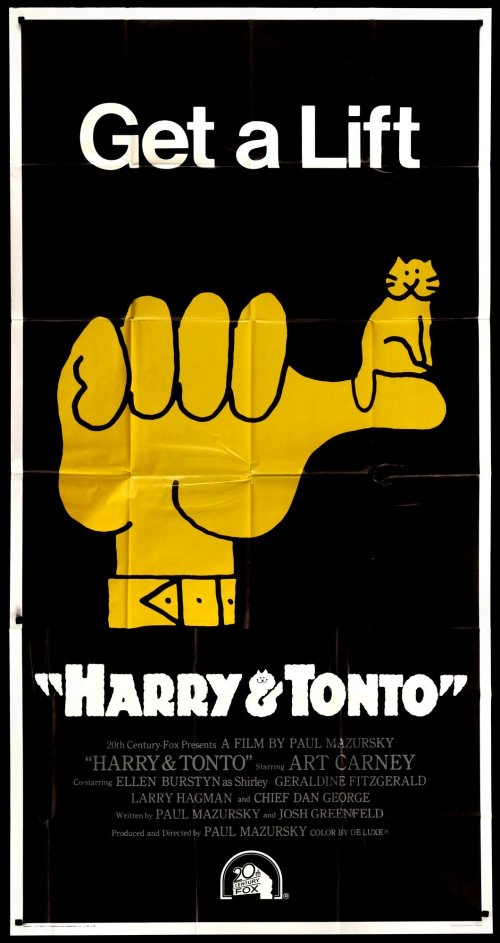
Harry and Tonto (1974)

harry1

By Richard Winters

My Rating: 6 out of 10

4-Word Review: Old man and cat.

Harry Combes (Art Carney) is a 72 year old retiree living in a small New York apartment with his pet cat Tonto and finds out that the complex is about to be torn down and he must leave. At first he moves in with his son (Phil Bruns) and his family, but it does not work out. He decides to take a cross-country odyssey with his cat where he meets a variety of interesting people in this senior citizen variation of Easy Rider.

One of the great things that sets this film apart from others that deal with aging is that there is no death, dying, illness, or senility here. Instead of learning to adjust to the ending of one’s life, our character instead realizes that old-age is just another stage in a person’s existence and full of new experiences and possibilities. I thought it was cool and interesting how he meets a 15 year old teen girl runaway (Melanie Mayron in her film debut) named Ginger and the two set out to try and find themselves as well as search for life’s answers. They share a lot more in common than one might expect and only prove that life is a continual exploration no matter what stage you are in.

The Harry character is refreshingly laid-back and easy going unlike most elderly characters who tend to be betrayed as stuck in a bygone era. Although he does reminisce about the ‘old days’ with his friends, he does not expound on boring stories of yesteryear with young people, nor act like he has all the answers simply because he is older. He approaches everyone in a non-judgmental way that allows each person he meets to be themselves. He proves to be a lot more flexible and open-minded than the other, younger adults in the film including his own children.

There were only a few scenes involving the Harry character that I didn’t like. One is when he refuses to leave his apartment even as the wrecking ball crew stands outside. The police end up having to be carry him out while he still seats in his favorite chair, which seemed forced and unrealistic. There is another scene where he is at the airport ready to board a plane, but he refuses to allow, for no particular reason, the security to search the cage that has his cat in it even though it is accepted procedure.  This may have been writer-director Paul Mazursky’s way of showing that Harry could at times be set in his ways, but to me it went beyond being simply stubborn and more into the irrational and was not consistent with his behavior in the rest of the film.

The script has a lot of amusing and even touching slice-of-life vignettes as well as characters that are quirky, but not absurd.  The scene with Harry meeting an old Indian medicine man named Sam Two Feathers that is played by elderly Indian actor Chief Dan George is well handled. George had no formal acting training, but his raw delivery is an inviting change of pace.  I also enjoyed at the very end when he meets a woman with a bounty of pet cats that his played by comedian Lenny Bruce’s mother. Again, she had no acting training, but the scene captures her natural out-going personality and it is fun.

I felt Phil Bruns gave an outstanding and overlooked performance as Harry’s older son Burt.  The constant nervous and stressed-out expression on his face seemed to be a perfect composite of the middle-aged suburban male that is overrun with job demands and family responsibilities.  Larry Hagman is good as well in a brief, but memorable appearance as Harry’s other son Eddie. He spends the first part of his visit with Harry trying to impress him with how ‘good’ things are going only to end up breaking down when it becomes painfully obvious that he is desperate and broke.  Even director Mazursky gives himself a cameo as a gay prostitute who makes a pass at Harry.

If the film has any faults it is the fact that it is too amiable. I would have liked to have seen a little bit more action and comic misadventure. I thought it could have been funny and intriguing to see Harry inside a hippie commune, which is where he takes his two teen passengers. Instead he lets them off without going himself, which seemed like a missed opportunity.  There is another part where he inadvertently hitches a ride with a high-priced hooker (Barbra Rhoades) who immediately starts to get ‘horny’ when he Harry gets in. She drives the car off the road and parks it in the middle of the dessert and then the film cuts away. I think this could have been hilarious had this scene been extended. I was also disappointed that the very talented Ellen Burstyn is seen only briefly playing Harry’s daughter Shirley. This was even more of a shame because Burstyn gets cast against type here playing a character that is rather edgy and opinionated and there was strong potential for some good drama.

There are a few extended conversations where Harry discusses with some of his old friends their inability to perform sexually and how they hadn’t had sex for well over twenty years.  With the advent of Viagra, a product that was invented and manufactured right here in good old Indianapolis, these types of topics are no longer as relevant and make the film seem dated.

Of course the one thing that holds it all together and propels the movie from beginning to end is the outstanding Oscar winning performance of Carney, who until then was best known as the comic side-kick Ed Norton from the classic series The Honeymooners. Although he seemed perfect for the part he was not the Producers first choice and had to lobby hard to the get the role.  He was actually only 55 years old when the film was made and to help compensate he openly wore his hearing aid, which gets shown a lot, as well as dying his hair gray.

His win on Oscar night in 1974 became an historic upset. He was going up against very stiff competition that night including Dustin Hoffman for Lenny, Jack Nicholson for Chinatown, and Al Pacino for The Godfather Part 2. When Carney’s name gets called the look of shock on his face is very apparent as even he was not expecting it.  The moment is worth a look and can be seen on YouTube for those who are interested.

My Rating: 6 out of 10

Released: August 12, 1974

Runtime: 1Hour 55Minutes

Rated R

Director: Paul Mazursky

Studio: 20th Century Fox

Available: VHS, DVD

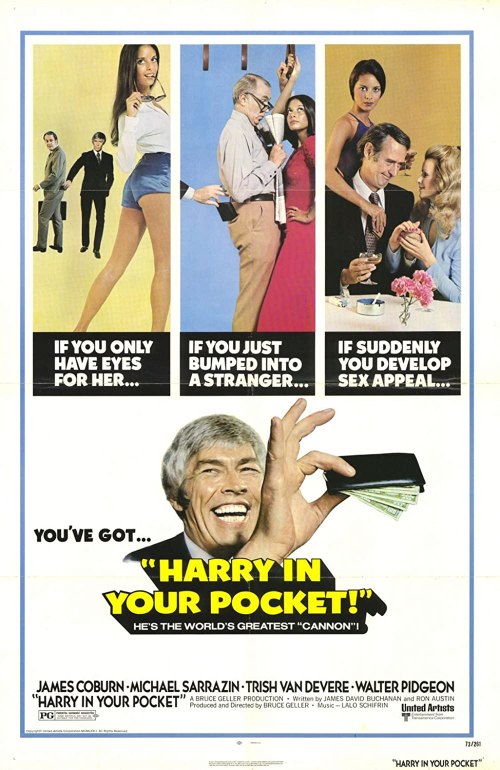
Harry in Your Pocket (1973)

harr1

By Richard Winters

My Rating: 4 out of 10

4-Word Review: They take people’s wallets

Ray (Michael Sarrazin) is an amateur pickpocket who has no luck trying it on his own. He meets Sandy (Trish Van Devere) who has just lost everything and the two decide to get into the pickpocket racket as a simple means for survival.  They get hooked up with Harry (James Coburn) and his mentor Casey (Walter Pidgeon) who teach them the fine art of pickpocketing while preying on summer tourists in Seattle.

The film’s main selling point is the ensemble cast that work off each other quite well. Coburn is engaging and energetic as usual. It is hard to imagine him giving a poor performance and he can usually make even the dullest material interesting and his appearance here proves no exception.

Pidgeon is equally diverting as the elder member of the group. His career was already fading at this point and this ended up being one of his last performances. It is unique in the fact that his character suffers from a major cocaine habit and it is quite possibly the only time in film history where you will see a 77 year old main sniffing up the white stuff, which he does on several occasions.

Sarrazin, who unfortunately passed away last year, is dependable as always. I know female fans fell in love with his big, sad, baby blue eyes, but some critics lambasted him as being ‘boring’ and ‘transparent’, but I always have found him quite competent in dramatic roles in a nice, quietly understated manner.

Surprisingly though it is Van Devere who comes off best and practically ends up carrying the film. She was never given enough varied roles for me to ever formulate any real opinion of her, but here she does quite well. I liked her savvy nature and some of her snappy comebacks. Despite being surrounded by all men she handles herself with ease and even seems at times to intimidate them.

The only problem I had with her character is how she is introduced.  She meets Ray at a train station and after talking to him finds out that he stole her watch. She goes running after him while leaving her luggage and purse unattended. When she is able to retrieve her watch from him she returns only to find that someone has now stolen her suitcase and purse.  She takes this sudden predicament too much in stride and doesn’t even go to the police about it. Instead she decides to get into Ray’s life of stealing even though she has no criminal past. She even ends up going to bed with Ray later that very same afternoon even though I would think most people would be too stressed out for sex at a time like that let alone doing it with a stranger.

The film was done on-location in Seattle. Normally I always applaud films that are shot outside of the studio back-lot, but here it becomes almost a distraction.  Director Bruce Geller seems much too preoccupied with capturing the scenery than he does in propelling the story. There is one segment that takes place in the middle of the film that deals with the four characters taking a very long, drawn out boat cruise that almost morphs into an advertisement sanctioned by the state of Washington’s department of tourism. It features very little dialogue and no character development and seems only done as an excuse to show the picturesque landscape. It even has them feeding the seagulls in slow motion, which really gets to be too much.

If the film fails anywhere it is in the fact that it is too somber and dramatic for its own good. I would have thought this type of idea would have worked well as a comedy, but instead everything is kept at a generally serious level.  Yes, some of the tactics that they use to rob the people have amusing moments, but it tends to play itself out quickly. It sticks pretty much to the tried and true character driven formula that was trendy during that era, but also very predictable and downbeat. The music score has a depressing quality that I did not like and although on a technical end this film is passable it also unremarkable.

My Rating: 4 out of 10

Released: September 23, 1973

Runtime: 1Hour 43Minutes

Rated PG

Director: Bruce Geller

Studio: United Artists

Available: Amazon Instant Video

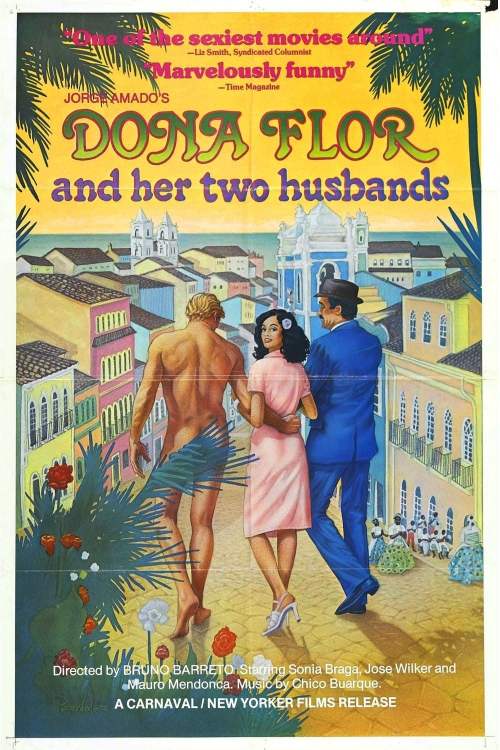
Dona Flor and Her Two Husbands (1976)

dona1

By Richard Winters

My Rating: 6 out of 10

4-Word Review: One is not enough.

This is an oddly structured Brazilian film that became a world-wide hit due to its explicit, edgy storyline.  It details the account of a woman named Dona Flor (Sonia Braga) whose first husband Valdomiro (Jose Wilker), was a bit on the wild side. After gambling away all of their money he dies. She becomes determined not to make the same mistake twice, so she remarries another man who is a doctor (Mauro Mendonca) and a much more responsible mate, but also stiff and boring. Problems ensue when the first husband, who she misses because he was more erotic and exciting in bed, comes back in the form of a ghost who only she can see.

The movie on a whole is well made. The characters are all likable and the theme music, which is played throughout the film, is appealing. The on location shooting is also quite distinctive. It really gives you a genuine, rare flavor of a small Brazil village and the people who inhabit them.

My main complaint with the film is that it takes the entire first hour just too illustrate her marriage with her first husband and the second hour to show her mourning and eventual remarriage. It’s not until the FINAL FIFTEEN MINUTES that the scenario the whole film is based on actually happens. When it does it is lively and funny, but the majority of the movie is surprisingly low key and melodramatic. The highly touted sex scenes are overrated. They are too brief and spread out very thinly.

Braga does well in her star making vehicle. She is able to convey both a simple, sweet nature as well as a sultry, sensual one. She has a pretty face and really does look great naked.

My Rating: 6 out of 10

Released: November 22, 1976

Runtime: 1Hour 50Minutes

Rated R

Director: Bruno Barreto

Studio: Embrafilme

Available: VHS, DVD (Director’s Cut)

Bye Bye Brazil (1980)

By Richard Winters

My Rating: 6 out of 10

4-Word Review: Entertainers traveling throughout Brazil.

This movie is a slightly surreal comedy-drama detailing a caravan of five entertainers who travel the Brazilian countryside putting on vaudeville like shows underneath a makeshift tent.  The film works in a vignette style as it analyzes the many scenarios and difficulties that the group encounters as well as making a very strong statement to the poverty and hardships befallen on the townspeople that they meet. In fact if there is one lasting image that the film gives it is that one.

The story is pretty much character driven and the characters are all by and large highly amoral. They reflect the desperation of their audiences, which they quietly hope someday to rise above, but never do.  There are a few fleeting moments where they amazingly and surprisingly decide ‘to do the right thing’, which ends up being the film’s most memorable scenes, but most of the time they are ‘rough around the edges’ and the viewer is forced to appreciate them with all their frailties brightly exposed.

Jose Wilker plays Lorde Cigano who is the leader of the group and a lifelong con-man. He closely resembles character actor Stuart Margolin, who was famous for playing the character of Angel on the classic 70’s series The Rockford Files where he was always trying one amusing scheme after another and the character here works in much the same way. He has a few good lines as well as a funny running gag where he displays obscene toys to attractive woman he meets in order to ‘turn them on’.

Betty Faria plays Salome who does erotic dances during their performances.  She lies and cheats as much as Lorde and is more than willing to fall back to being a prostitute whenever the group is in need of money. Although she does have a few nude scenes she is really not all that attractive, or young, as she was already hitting 40 at the time that the film was made.  However, her worn looking face does help accentuate the hardened lifestyle of the character. Her best scene is when she is ‘servicing’ one of her clients who is a fat, balding middle-aged man who expounds the entire time they are having sex about the many virtues of his wife.

Fabio Junior plays Cico the young man who joins the group because he feels it is a chance to escape the sad existence of a peasant farmer only to find that life on the road can be in many ways just as grueling and thankless. Junior is a famous singer in Brazil and his chiseled, boyish good looks didn’t seem to be a realistic fit for the impoverished farm family that his character came from in the movie.  He shows no concern for his pregnant wife and spends the entire time trying to seduce Salome, which makes him irritating and unlikable.  I did though like the fact that he was the one character who evolved and became introspective at the end.

The character of Daso, which is played by actress Zaira Zambelli and is Fabio’s wife, was a bit frustrating. The film makes it clear that she is aware that Fabio is fooling around with Salome and she doesn’t seem to care. She also excitedly jumps into becoming a prostitute at her husband’s insisting when the group falls on hard times. However, I wanted more explanation, or history given to the character to help understand this, but the story does not supply any.

I was also disappointed with the handling of the Swallow character who performs feats of strength during their productions as well as acting as the group’s driver. Swallow is mute, but easily is the most likable and durable, but he runs away half-way through the picture and never returns. I would have liked the character to have stayed during the entire duration as he helped give balance to the others, or at the very least some detail to his eventual fate.

The film becomes almost a like a Brazilian travelogue as the viewer encounters everything from the small dessert towns, to the exotic rain forests. However, the budget was clearly low and I didn’t feel the cinematography captured the majestic essence of the landscape as much as it could’ve, or as I had expected. The story and situations are not all that unique, or creative, but it stays nicely amiable throughout.  The funniest part of the whole film may actually be the lyrics of the song that is sung at the very end during the closing credits. This is not a great movie, but not a bad one either.

My Rating: 6 out of 10

Released: February 9, 1980

Runtime: 1Hour 40Minutes

Rated R

Director: Carlos Diegues

Studio: Carnaval Unifilm

Available: VHS, DVD