The Little Girl Who Lives Down the Lane (1976)

By Richard Winters

My Rating: 3 out of 10

4-Word Review: She is all alone.

Rynn (Jodie Foster) is a 13-year-old girl living alone in a big house in the countryside. Her father has leased the place for three years from nosy landlady Mrs. Hallet (Alexis Smith) and her adult son Frank (Martin Sheen) who continually makes lecherous advances towards Rynn. No one has seen her father and when anyone asks for him she comes up with excuses, which starts to make everyone in town suspicious. She meets fellow teen Mario (Scott Jacoby) who she lets in on her secret and the two devise a plan that will rid them of the meddlesome Hallets.

Although she has stated in interviews that this is the least favorite out of all the movies that she has done I can’t think of anyone more perfect for the part of an independent headstrong young woman than Foster, who has always carried that persona. Despite the vast age difference she easily carries the picture from her older co-stars. There is even a nude scene involving her character although it was done by her older sister Connie working as a body double. This was done despite her adamant protests as was a scene where she goes to bed with Jacoby, which she has said made her extremely uncomfortable and probably explains her dislike for the film.

Sheen is menacing as the perverted Frank, who enjoys ‘younger girls’ and his ongoing banter and advances with Rynn is consistently creepy and tense. Alexis Smith is excellent as the mother and her worn face and attitude gives her a witchy presence and it is too bad she couldn’t have remained for the entire movie. I also found Jacoby engaging and amiable and I really enjoyed his character, which I found a bit surprising since he is best known for playing dark, sinister characters in Rivals and the TV-movie Bad Ronald.

The on-location shooting, which was done in both the Canadian province of Quebec and in Maine, is excellent and gives one a nice taste of small town life on the east coast. There is some nice synthesized music that gives the film a dark tone. The premise is offbeat and to some extent, at least during the first half, it is enough to keep you intrigued.

My main issue with the film is the fact that not enough happens. Almost all the action takes place in the main room of the house, which eventually becomes dull, especially visually. There are no scares, or shocks and the twists aren’t all that clever, or surprising. In fact the final twist I saw coming long before it happens. There are times when cutaways would have been helpful and spiced things up particularly when Rynn talks about a visit from her mother and her ‘long red finger nails’, which we never see and is just described. The conclusion leaves A LOT of unanswered questions making this thing empty and incomplete. The final shot is one very long take of a close-up of Foster staring at a subject while the credits role by, which eventually becomes annoying and it would have been better had they done a freeze-frame instead of forcing her to sit and stare at something way longer than humanely possible. Also, composer Mort Shulman is badly miscast as the policeman. His acting abilities are clearly limited and he shows no presence or authority and makes the scenes he is in weak.

It is hard to know what genre to put this in. It is really not scary and the mystery angle has too many loopholes to being taken seriously. The story, based on a novel by Laird Koenig, seems rather tame despite some dark elements and geared more for teens, or young adults.

My Rating: 3 out of 10

Released: December 25, 1976

Runtime: 1Hour 40Minutes

Rated PG (Brief Nudity, Mild Cursing)

Director: Nicholas Gessner

Studio: American International

Available:  VHS, DVD, Netflix Streaming
Still of the Night (1982)

By Richard Winters

My Rating: 4 out of 10

4-Word Review: This teddy bear bleeds.

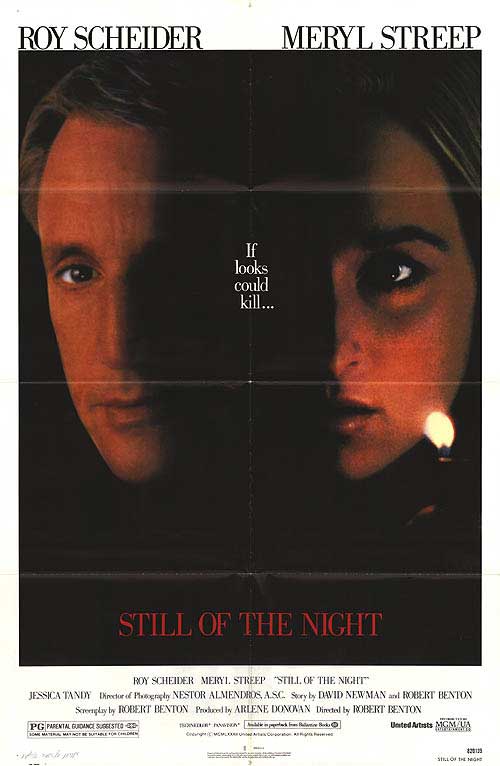
Successful psychiatrist Sam Rice (Roy Scheider) finds himself immersed in a tangled web of murder and deceit. One of his patients, wealthy art dealer George Bynum (Josef Sommar), is found murdered. A mysterious woman named Brooke Reynolds (Meryl Streep) visits him and states that she was George’s mistress and Sam suspects that she may be the killer. He tries to do his own investigation, but the police start to doggedly tail him thinking he may know more than what he is letting on.

This was yet another homage to Alfred Hitchcock, this time done by writer/director Robert Benton, who is an excellent filmmaker in his own right.  This one has all of the style, but none of the substance.  The concept is slickly handled, but it misses Hitch’s flair as well as his wry sense of humor.

Normally I have never been too impressed with Scheider as a leading man.  He has always seemed transparent and his range of characters as well as emotions that he can convey are limited. Here though, as an evasive middle-man, his acting abilities work quite well and I actually found him perfect for the part.

Streep does not fare as well.  Her acting is almost always impressive and I admire her prolific career, but this is one of her few roles that takes no advantage of her talents. She seems to have an almost ghost-like presence. I didn’t find her character to be compelling, nor intriguing. I had no interest in her fate nor her relationship with Rice.

Joe Grifasi was a poor choice as the lead investigator Joseph Vitucci. He showed none of the characteristics of a seasoned police detective and looked and acted more like a disheveled kid just out of college. The rest of the supporting cast is dull and cardboard. It would have been nice if one eccentric character had been put in to liven things up.

Probably the most interesting aspect of the whole movie is a nightmare segment that the George character has that comes in the middle of the story. I liked some of the creepy imagery that was used including a bleeding stuffed teddy bear. I also enjoyed how afterwards Sam debates the dreams meaning with his mother Grace (Jessica Tandy) who also has a background in psychology, but I thought it was a bit of a stretch when she suggests he go to the police about it as dreams can be interpreted in many different ways and hold no relevancy in a court of law. I thought it became even more far-fetched when at the end Sam uses some of the symbolism in the dream to figure out the identity of the killer.

The film has a few plot holes and certain things that just don’t add up.  Some of the ones that hit me was when Brooke talks about seeing George off in a cab that night and then the next morning reading in the papers that he had been murdered, which is preposterous.  Most newspapers go to press between ten and midnight, the dead body might not yet have even been discovered until later that day, or even a few days later. There is also a segment where Sam makes a $15,000 purchase on a painting he doesn’t even want at an auction simply so he can use it as an excuse to write a note on the bidding card warning Brooke that the police are after her. Also, when Sam does not find Brooke at her apartment her friend tells him that she is at her parent’s house in some town called Glen Cove, but she is not sure of the street name and yet Sam is able to find the place in the middle of the night with hardly any effort. Also, I found some of the conversations that George has with Sam during their sessions to be unintentionally funny.

There is enough intrigue to keep you somewhat interested, but the result is mild. I did like the idea of building the tension up through slow subtle means instead of the quick shocks that you see done in a modern suspense movie, but it is still slow going. The music played over the opening credits is more suited for a romance and does nothing to create the right mood for a thriller. The lighting in literally every shot is dark and shadowy, which certainly helps with the atmosphere, but after a while it gets to be too much. I was also not impressed with the climactic sequence. The protagonist is too helpless and defenseless and does not fight back, which severely limits the action. Having it occur at an ocean-side house does create a nice ambience, but the chase that is involved there could have been more extended and the camerawork during the segment is unimaginative.

My Rating: 4 out of 10

Released: November 19, 1982

Runtime: 1Hour 33Minutes

Rated PG

Director: Robert Benton

Studio: MGM/UA

Available: VHS, DVD, Amazon Instant Video

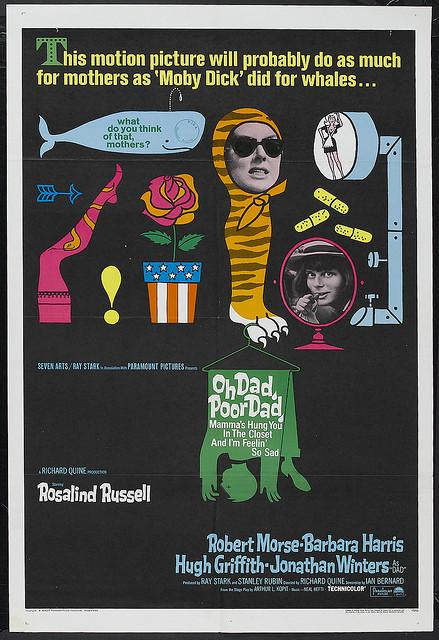
Oh Dad, Poor Dad, Mama’s Hung You in the Closet and I’m Feelin’ So Sad (1967)

oh dad poor dad

By Richard Winters

My Rating: 1 out of 10

4-Word Review: Overprotective mother dominates son.

This is an awful, awful film based on the Arthur Kopit stage play of the same name. Overly domineering mother Madame Rosepettle (Rosalind Russell) keeps her son Jonathan (Robert Morse), who is 25, in a near infantile state. She also travels around with her dead husband in a coffin. Problems ensue when they arrive at a resort and meet up with nubile Rosalie (Barbra Harris) who tempts Jonathan and threatens to break him away from his mother’s clutches.

If done right this film could have, I suppose, gained some sort of cult following. Yet it is so poorly realized and so thoroughly botched that it is impossible to know where one could begin to improve it as it deserves to be in the top ten of worst movies of all time.

One of the problems is the setting itself. For some reason it was filmed in Montego Bay, Jamaica. This certainly does provide for sunny and exotic scenery, but it does not at all work with its twisted, dark subject matter. The music score is also really bad. It was done by Neal Hefti the same man who did the music for the “Batman” TV-show and the soundtrack here sounds just like that one. He also has the theme song sung by children which is as irritating as nails scratching on a blackboard. The color schemes are garish and ugly. The humor is flat and the story itself is threadbare. When you get past the weird fringes all you have left is a stale, plodding coming-of- age tale.

Morse seems a natural for the part as the ‘man-child’ since he has always had a very boyish face. Yet, in an attempt to show that he is never let outside, he is made to look extremely pale and the effect is a bit sickening to look at. His infantile state is played too much to the extreme and comes off as pathetic. It is not at all funny even in an absurd, or dark way.

Russell’s presence makes it somewhat interesting. She was a legendary actress and this was certainly a very unique career move. Maybe she wanted to prove herself versatile after her Mother Superior part in The Trouble with Angels, which she had done just a year before doing this, yet in hindsight it was bad judgment. Seeing her in the strange part is fun for a few seconds, but eventually it gets over-the-top. She ends up looking like Faye Dunaway’s Joan Crawford in Mommie Dearest. You do however get to see her wear a variety of wigs and even do a wild water ski stunt at the end.

Harris has always been one terrific actress and she is good even here and the only reason I’m giving this film one point. She made a career out of playing neurotic women, but here plays a more normal one and it is interesting to compare this performance with her others.

Jonathan Winters (no relation) adds some amusing bits doing voice-over as the dead father. He was brought in after the film was completed and some of his lines have nothing to do with the plot.

The message of the story is nebulous. The video box cover states that it is a study of “human confusion”. Yet the characters seem too extreme to be relatable on any human level. They also don’t evolve and act the same idiotic way at the end as they did at the beginning so neither they nor the viewer come to any better understanding of anything. It is a complete waste of time.This film deserves its near extinct status and isn’t fun even as a curio.

My Rating: 1 out of 10

Released: February 15, 1967

Runtime: 1Hour 26Minutes

Rated NR (Not Rated)

Director: Richard Quine

Studio: Paramount

Available: VHS

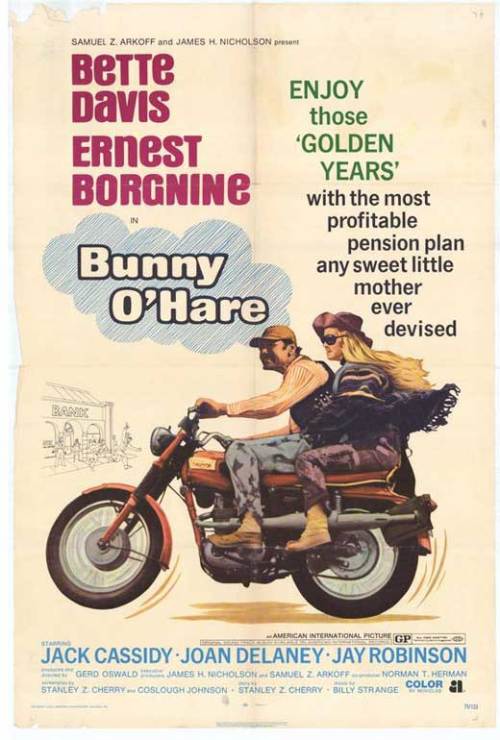
Bunny O’Hare (1971)

bunny

By Richard Winters

My Rating 2 out of 10

4-Word Review: Bette becomes a hippie.

Extremely odd Bette Davis vehicle made in her later years when her career had crested and she was forced to be less choosy about her projects. The story has to do with a lonely widow named Bunny O’Hare (Davis) who losses her home to foreclosure and is rendered homeless. She meets an older man named Bill Gruenwald (Ernest Borgnine) who is an escaped bank robber. Together they dress up as hippies and rob banks throughout the state of New Mexico in order to survive.

Davis is exceptional. Usually she plays cold, manipulative characters, but here she gives a perfect, touching performance as a nice old lady. She is terrific in every scene that she is in and the only bright spot in what is otherwise a misfire. Borgnine though seems wasted and thrown in only as a stock character.

The story really has nowhere to go. The intention was to make the film a mixture of social satire and slapstick, but it fails on either end. The novelty wears off quickly and it soon becomes derivative. Initially their ploy to rob the banks seemed clever as Bill releases a bird into the bank, which causes such a distraction that they are able to rob it without detection, but it becomes tiring when it gets played-out again and again. The police are portrayed as being universally bumbling and making it seem like a six-year old could rob a bank and easily get away with it. I also did not like the banjo music being played as they are trying to get away from the cops as it seems too similar to the much better film Bonnie and Clyde and in fact the original title for this movie was going to be ‘Bunny and Claude’.

The casting of Jack Cassidy as Lieutenant Greely, the policeman who becomes obsessed with capturing them, should’ve worked.  He was very adept at playing cold, cunning, slightly offbeat characters as evidenced by his Emmy Award winning performances on the old Columbo TV-show as well as the cult TV-series He and She. He was the husband of actress Shirley Jones and the father of Shaun and David Cassidy whose career was unfortunately cut short when he ended up dying in a fire in 1976 after falling asleep with a lit cigarette. His unique talent here is stifled because the character is portrayed as being unrealistically dimwitted and saps any possible energy from the scenes that he is in.

Actress Joan Delaney makes a terrific addition as his female counterpart R.J. Hart. She is young, attractive, and hip. She plays off of Greely’s old, regimented ways quite well and it is a shame that, with the exception of a very brief appearance in the 1991 comedy Scenes From a Mall, this ended up being her last film.

The New Mexico landscape is nice, but I got the feeling that the location shooting had not been scouted out sufficiently. The police station didn’t look authentic at all. It seemed like scenes where shot in any building that they were able to attain a film permit. The lighting consists of one bright spotlight put on the subject while the sides of the frame and the background are dark and shadowy. Sometimes, in a good movie, this is done for artistic effect, but here I felt it was more because that was all they could afford. This one is for Bette Davis completest only.

Well known character actors John Astin and Reva Rose appear as Bunny’s two grown children, but are essentially wasted. The then acting governor of New Mexico, David Cargo, plays one of the state troopers.  Larry Linville, who would later become famous for playing Major Frank Burns on the classic TV-series M*A*S*H, can be seen very briefly at the end, but has no lines of dialogue.

My Rating: 2 out of 10

Released: October 18, 1971

Runtime: 1Hour 28Minutes

Rated PG

Director: Gerd Oswald

Studio: American International Pictures

Available: Netflix Streaming

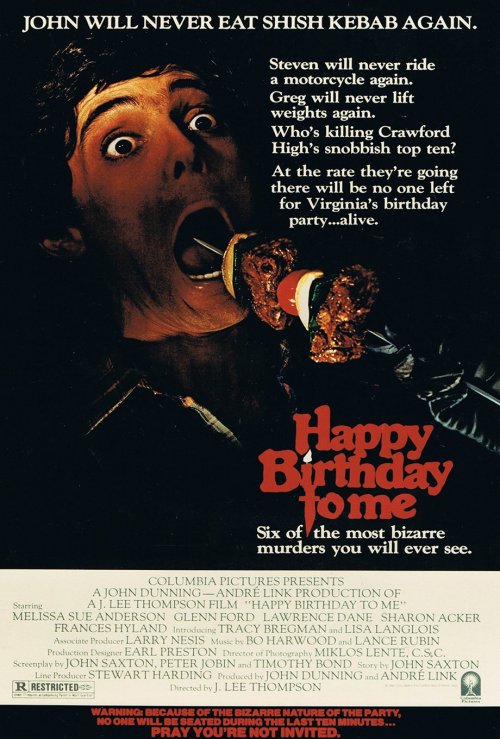
Happy Birthday to Me (1981)

happy2

By Richard Winters

My Rating: 3 out of 10

4-Word Review: This birthday isn’t happy.

            Virignia Wainwright (Melissa Sue Anderson) attends a private school where she is a part of a snotty clique whose members start getting killed off just before her 18th birthday. Due to a freak accident suffered years before she has blackouts causing suspicions that she may be the culprit. With the help of her psychiatrist Dr. David Faraday (Glenn Ford) they try to come up with some answers.

Despite being listed as a slasher film and having gained a loyal cult following I found the gore factor to be disappointing. The killings are quite brief and the camera quickly cuts away before much blood, or anything else is shown. The famous shish kebab murder that is captured on the film’s poster is poorly executed. Apparently there was more footage of the killings, but in order to get an R-rating director J. Lee Thompson was forced to cut a lot of it out. However, it would be nice to get a director’s cut version as I am sure today’s horror fans may feel cheated otherwise. The grossest sequence for me wasn’t the killings at all, but instead the scene where Virginia undergoes brain surgery and her skull is vividly cut open and one can see the brain pulsating and expanding inside. The deaths really didn’t seem all that creative and clever despite the film’s reputation and if anything my favorite death scene didn’t involve one of the killings but instead was the part where Virginia and her mother are riding in a car that goes off a bridge and then fills up with water, which is surprisingly intense.

I also had some major issues with the film’s opening murder that features a young girl getting strangled while inside her car. For one thing the killer’s hands didn’t seem to be all that tight around her neck and when the girl manages to escape there are no marks around her neck even though realistically there should be. Also, when she escapes she runs for only a few feet and then stops behind a nearby parked car and acts like she is now ‘safe’ even though most people would run several blocks and probably wouldn’t stop until they found someone else that could help, or the police. The victim also speaks, but if someone has been strangled as severely as she has her voice would have to be effected by it and she might not be able to say anything, or at least speak in a very raspy tone, which is not the case here.

For the most part I found the film to be boring and predictable. I never once got scared, or even all that intrigued. The movie is jammed with every cheesy 80’s horror movie cliché that you can think of. Normally film’s from this genre run no more than 90 minutes and sometimes even less. Going 110 minutes as this one does is much too long for a plot that is paper-thin.  However, the very macabre ending is excellent and almost makes up for it. The surprise twist isn’t bad either although a bit implausible.

Anderson, best known as Mary Ingals from the long running TV-show ‘Little House on the Prairie’, isn’t bad. A shot of her at the end where she is carrying a birthday cake and looks up and smiles is both chilling and sexy and quite possibly the film’s pinnacle. There is no nudity although director Thompson teases the viewer by having her undress to get into the shower, but the camera never gets past her bra and panties.

Hollywood icon Ford is wasted and his tired appearance is almost sad. His wardrobe features him wearing an open shirt showing his bare chest and it looks ridiculous for a man his age. There is another scene where the police dig up a skull on the school’s grounds and the Ford character asks to take a look at it and the police promptly hand it over to him, which I found to be equally ridiculous as that is a crucial piece of evidence that would only be handled by a forensic expert.

If anything Sharon Acker as Virginia’s alcoholic mother Estelle gives the best performance.  Her overwrought slightly hammy scene near the end gives the film some much needed energy.

There were a few other loopholes and inconsistencies that irritated me enough to be mentioned here. One is that years earlier Virginia had a birthday party and all her friend’s snubbed her and didn’t show up, so they could instead go to a party held by a girl who was more wealthy and popular, which made me wonder why then would Virginia want to remain friends with them like she did.  Another part involves a member of their clique named Alfred (Jack Blum) who the girls initially think is storing the severed head of one of their murdered friends. They later realize that this was simply a realistic looking plastic mold that he had made to resemble her, which makes them feel ‘relieved’ enough to continue to socialize with him. However, anyone who makes plastic molds of heads from someone they know that has just been killed seems just as creepy to me and enough to make most normal people concerned, which the characters here are not. There is also no explanation at the end for how the killer, whose identity I will not divulge, was able to come up with such an elaborate and realistic disguise. The gory effects are also not convincing and could have used Tom Savini’s help

Like I said I found the film’s ending to be pretty cool and enough for me to suggest this film to horror fans, but only if they are willing to stick around for it.

My Rating: 3 out of 10

Released: May 15, 1981

Runtime: 1Hour 50Minutes

Rated R (Violence, Language, Adult Theme)

Director: J. Lee Thompson

Studio: Columbia

Available: VHS, DVD, Amazon Instant Video

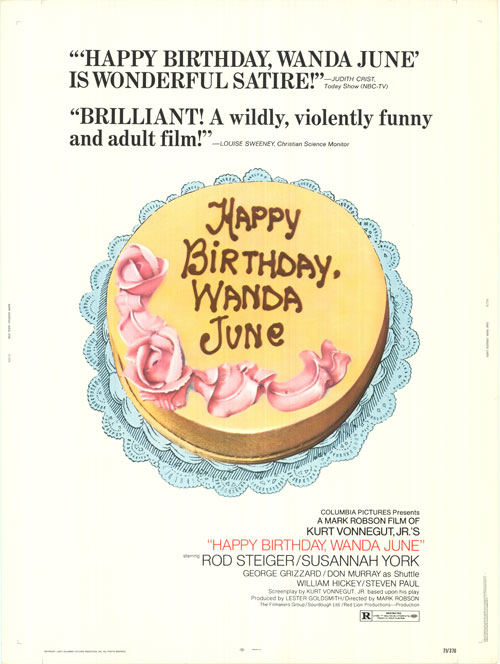
Happy Birthday, Wanda June (1971)


happy birthday wanda june

By Richard Winters

My Rating: 5 out of 10

4-Word Review: Macho men are annoying.

Since today is my birthday I’ve decided to spend the next two days reviewing films with a birthday theme. Today’s review is based on a play by celebrated writer (and Indianapolis native) Kurt Vonnegut Jr., who also wrote the screenplay.  It examines what happens when an egotistical man and war hero from the past (Rod Steiger) returns home after abandoning his family eight years earlier.

Vonnegut’s script takes a lot of shots and makes some great comments about the empty bravado of the male image and the male’s changing role and expectations in modern society.  The protagonist, Harold Ryan, is deftly written as a relic from the past harboring all the age-old macho characteristics and clinging onto embellishments of the past while unable to evolve, or even communicate with those around him. Dr. Woodley (George Grizzard) represents the more educated and new-age man who is peaceful, sensitive, and cultured. The story revolves around the two battling for the same woman (Susannah York) and culminates with an interesting and off-beat symbolic type of showdown.

Director Mark Robson does an adequate job of implementing a cinematic quality to what is otherwise a filmed stage play. The cutaways involving dead characters that are now in heaven and speak directly to the camera help, but there needed to be more of them and more evenly placed. I would have also liked a few scenes shot outside and in the daytime as the perpetual indoor scenery becomes stagnating and claustrophobic.

Steiger, normally a very good and diverting actor, seems miscast here. He is never convincing as a tough guy and it affects the story’s impact. York, another fine actress if given the right role, doesn’t seem right for her part either although she does look surprisingly sexy in a skimpy waitress outfit during a flashback scene.

I did like the child performers and felt that they did better than their adult counterparts. Steven Paul is excellent as Paul Ryan who initially idolizes his father until exposed to his many flaws. Pamelyn Ferdin is cute as Wanda June, the girl who gets hit by an ice cream truck and spends the entire time jaunting through heaven. Ferdin later became a famous animal activist and was runner-up for the Regan MacNeil role in The Exorcist. Linda Blair was of course great, but Ferdin’s uniquely piercing gaze always made me wonder if she might have ended up playing the part better.

William Hickey is engaging and amusing as Harold’s best friend. Don Murray almost steals it from everyone as Herb Shuttle a very vapid man whose pathetic attempts at trying to be macho are hilarious and make up most of the film’s humor.

The one thing that eventually ruined it for me was the main character who is too obnoxious. At least Archie Bunker in ‘All in the Family’ had a vulnerable side, but the guy here is ignorant without being funny and having to watch the callous way he treats everyone is straining and unpleasant. Also,the musical score is dreary and almost non-existent.

My Rating: 5 out of 10

Released: December 9, 1971

Runtime: 1Hour 45Minutes

Rated R (Adult Theme, Language)

Director: Mark Robson

Studio: Columbia

Availability: None 

The Notorious Landlady (1962)

By Richard Winters

My Rating: 4 out of 10

4-Word Review: Landlady could be killer.

            William Gridley (Jack Lemmon) is an American who has arrived in London and looking for a place to stay. He rents a room from a home owned by Carly Hardwicke (Kim Novak) a gorgeous woman who Bill immediately becomes smitten with. The problem is that many people think Carly has killed in her husband even though his body has not been found. When Bill gets word of this he becomes determined to investigate the case and prove her innocence.

You would think a script written by Larry Gelbart and Blake Edwards would be funnier and full of zany scenarios and slapstick, but instead it gets grounded in a lot of dialogue for much of the first hour and forty-five minutes and only starts to get interesting during the final fifteen. The conversations lack any wit, or sharp one-liners, and the premise plods along at a much too leisurely pace. There is a segment where Bill accidentally sets fire to the patio, but I think this was simply thrown in for some action as there is very little else of it. The plot is formulaic and fails to add any new twist or perspective and once it is over it is easily forgettable. Lemmon’s character is bland and transparent and more than a little naïve since he falls in love with her immediately and is then convinced that she is innocent even though he has only known her for a day.

The best part comes at the very end where the two find themselves at a recital for a group of senior citizens that are all sitting in covered wheelchairs. This scene gets drawn out amusingly and includes a bit where an old lady named Mrs. Dunhill (Estelle Winwood) is pushed down the side of a hill, which is nicely captured in a silhouette style with Bill chasing after her. Winwood, who was already seventy-nine at the time, hams it up perfectly as the daffy old woman.  Of course all this comes much too late to really help the picture, or story, but at least it saves the film from being a complete bore, which it otherwise would have been.

Novak gives a surprisingly strong performance and a convincing British accent that I wish she had spoken in for the entire duration.  She was always a stunner, but here she may look her all-time best. One scene taken with her in the bathtub was highly risqué at the time and doesn’t leave much to the imagination. British character actor Lionel Jeffries is engaging as the inspector, but Fred Astaire is essentially wasted as Bill’s boss. The production values are decent, but the results are middling.

My Rating: 4 out of 10

Released: July 26, 1962

Runtime: 2Hours 3Minutes

Rated: NR (Not Rated)

Director: Richard Quine

Studio: Columbia

Available: VHS, DVD (Region 1 & 2)

Taking Off (1971)

taking off 1

By Richard Winters

My Rating: 9 out of 10

4-Word Review: Running away from home.

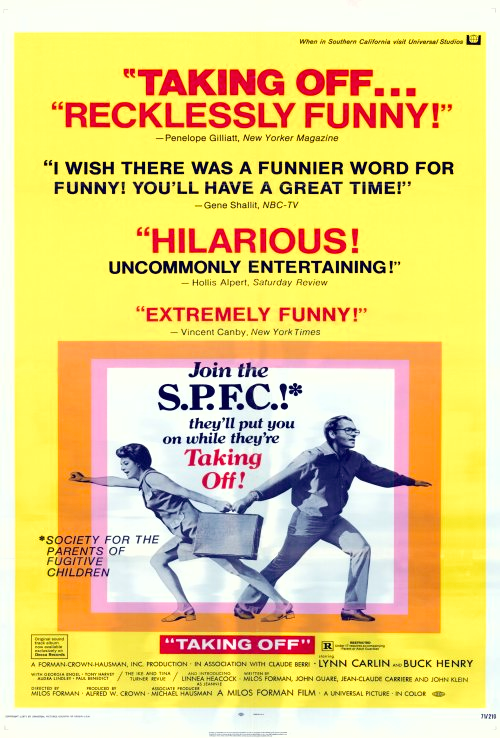
This is a thoroughly entertaining gem that takes a look at the early 70’s American culture through a foreigner’s eyes in this Milos Forman’s first American feature. The comedy bounces playfully from the wry, to the absurd and even the satirical without ever losing its charm.

The film examines what happens when parents Larry and Lynn Tyne (Buck Henry, Lynn Carlin) find that their daughter Jeannie (Linnea Heacock) has run away. Instead of focusing on the teen, as most films tend to do, it instead looks at the parents. It shows that the adolescent years can be as awkward for the father and mother as it is for the teen and parenting is a journey much like growing up is. I especially liked the part of the message showing how people in their forties have a need to run away and find themselves too.

The film matches its unique perspective with offbeat humor. You get to see parents smoking pot for the first time in order for them to experience what the kids go through. Another scene has them getting together for a wild game of strip poker. There are also amusing cutaways of auditioning singers, which is where the daughter runs away too. One of the singers is a sweet young thing who sings a soft melody that is laced with the word ‘fuck’ and has to be heard to be really appreciated.

Both actors who play the parents are excellent. Balding, bespectacled Henry fits the mold as the overworked, henpecked father/husband quite well and it is fun to see him display isolated moments of unexpected rebellion. Carlin conveys a nice characterization of an overwrought mother who wants to communicate with her daughter, but has no idea how.

Jeannie is the one we learn the least about, which is actually to the film’s benefit. This isn’t just the Tyne’s daughter, it’s everybody’s daughter complete with all the trials and tribulations that every parent goes through with their teen. In fact the film’s most definitive moment is probably the freeze-frame shot of disdain on the daughter’s face as her parents try to entertain her and her boyfriend with a song from ‘their’ generation. It’s the type of look that defines the parent/teenager relationship no matter if it’s today, tomorrow, or a hundred years from now, which may help to make it accessible to today’s viewers despite an overabundance of early 70’s period flavor.

Characters actors Audra Lindley, Paul Benedict, and Vincent Schiavelli are terrific in support. This also marked the film debuts of Georgia Engel and Kathy Bates. Ike and Tina Turner appear as themselves.

My Rating: 9 out of 10

Released: March 28, 1971

Runtime: 1Hour 33Minutes

Rated R (Language, Adult Theme, Brief Nudity)

Director: Milos Foreman

Studio: Universal

Available: DVD (Region 2)

Planes, Trains & Automobiles (1987)

planes

By Richard Winters

My Rating: 6 out of 10

4-Word Review: Thanksgiving on the road.

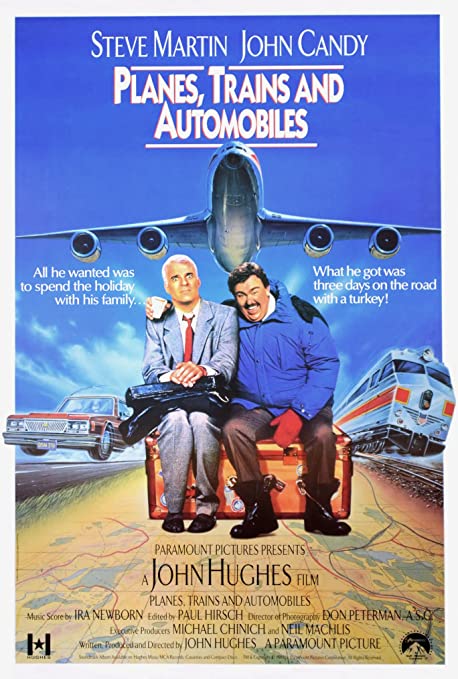
This movie’s plot, which is threadbare , deals with a middle-aged businessman named Neal Page (Steve Martin) who is trying desperately to get home to Chicago to celebrate the Thanksgiving holiday with his family. During his trip he inadvertently meets Del Griffith (John Candy) an overweight, slightly obnoxious shower curtain hanger salesman. Neal initially cannot stand the man, but is forced to sit with him through his plane flight when he is not able to get the first class seat that he had reserved. Unfortunately due to a snowstorm their flight is rerouted to Wichita, Kansas and the two men find themselves paired together again as they try any means of transportation possible to get themselves to the Windy City. Along the way they begrudgingly start up a friendship.

Martin is okay as the exasperated businessman. This film marked a transition for him as he was now moving away from roles where he played clownish, vapid, but lovable idiots and more into crusty and curmudgeon middle-aged men. He is basically used for his annoyed reactions at all of Candy’s crazy antics and for that part he is fine, but there are a wide assortment of other actors that could have played the part just as well if not better. Martin at times still goes back to some of his old shtick like the dopey way he puts on a clenched teeth grin when he is trying to run real fast, which I never found to be particularly funny when he was doing it way back with skits on Saturday Night Live and still don’t find it funny when he continues to do it now.

Candy is by far the best thing about the film and ends up saving the movie from being an uninspired, goofy mess. The character does at times border on being a caricature, but fortunately writer-director John Hughes pulls back just enough to let you see him as a real person. He does indeed have some laugh-out-loud moments. I chuckled at the way he tries to clear his throat when the two men are stuck in a motel room together. The part where he manages to get both his coat sleeves stuck on some car seat levers and he is forced to drive the car with his two legs is hilarious. I also liked the way he gyrates to a Ray Charles song that he listens to while driving and the conversation that he has with a policeman (Michael Mckean) when their burned out shell of a car gets pulled over is a classic.  I thought the idea of having him be a salesman for shower curtain hangers hit just the right note of absurdity and the fact that he carries around a little box displaying all the different types of hangers he has was novel. The only thing I didn’t like about the character is that at the end we find out that he is somehow rendered homeless simply because his wife died 8 years before. This doesn’t make a lot of sense, for one thing he seemed to have a lot of success selling his merchandise, so I’m sure he had money and for another thing there are many men and women whose spouses end up dying, but that doesn’t mean they no longer have a home to go to. To me it just ends up being a cheap excuse for a sloppy sentiment and it should have been avoided.

The late John Hughes’s writing and directing leaves a lot to be desired especially for the sophisticated viewer. The humor that is used is extremely broad and many times downright cartoonish. He seems to be either not confident in himself as a filmmaker, or in the intelligence of his audience to ever be subtle and subdued, but it would have been nice if a little bit of that had been thrown in. He also uses way too many poor plot devices that are simply used to propel the paper-thin story along and would be considered hack writing at most and something that a third grader could come up with. For instance why does the engine of train that the two men are riding in suddenly break down? No logical explanation is given and what are the odds of that happening as well as having Neal’s rental car missing when all the rest of the cars are there. There is also the cab driver named Wolf who decorates his cab with all sorts of pornographic pictures and other provocative ornaments, which is at first funny until you realize that he supposedly works in Wichita, which is a small conservative city and no one would be riding his cab for long and he would be out of business. If there is no truth to the joke then the joke will fail, which it does here. The same goes for the crude, gross, and very hick pick-up truck driver that relies way too heavily on stereotypes and seems to be put in solely as filler.

I did like the fact that it was filmed on-location as the stark wintry like landscapes does indeed put the viewer in the holiday frame of mind. I also liked the fact that for the most part real snow is used. I was born and raised in Minnesota and I can spot the fake stuff right away and I always find it annoying. I liked that many performers from Ferris Bueller’s Day Off appear in brief cameos including: Ben Stein and Edie McClurg although it would have been nice if they were given a little more to do. Kevin Bacon also appears as does William Windom who is amusing as a one of Neal’s clients who can’t decide on what photo layout to use. I was disappointed that he wasn’t given any lines of dialogue, but the fact that he does reappear at the very end after the credits  makes up for it a bit. I also must mention the burned-out skeleton car that the two men drive in, which is the damnedest looking thing since the bus filled with bullet holes in The Gauntlet.

The music score is awful. It has too much of that tinny, synthesized 80’s sound that is unoriginal and does not fit the mood, or tone of the picture in any way. It also gets overplayed in certain scenes and hurts the film’s overall enjoyment.

I would say this movie would be great for the whole family as it does rely a lot on the broad, fast paced humor that most kids love. However, there is one scene where Martin goes into a long, F-word laden rant with McClurg when he can’t find his rental car. The rant in itself is funny, but some might say it is not appropriate for children. Of course these days I have heard kids as young as six, or seven using the word and I have also heard it used just in casual conversation by people I pass by while walking the streets of Indianapolis, so trying to shield the child from it may be futile and they will all sooner or later hear it in abundance anyways.

My Rating: 6 out of 10

Released: November 25, 1987

Runtime: 1Hour 33Minutes

Rated PG: (Adult Language, Crude Humor)

Director: John Hughes

Studio: Paramount

Available: VHS, DVD, Blu-ray, Amazon Instant Video

Seance on a Wet Afternoon (1964)

seance on a wet afternoon

By Richard Winters

My Rating: 6 out of 10

4-Word Review: Psychic is a phoney.

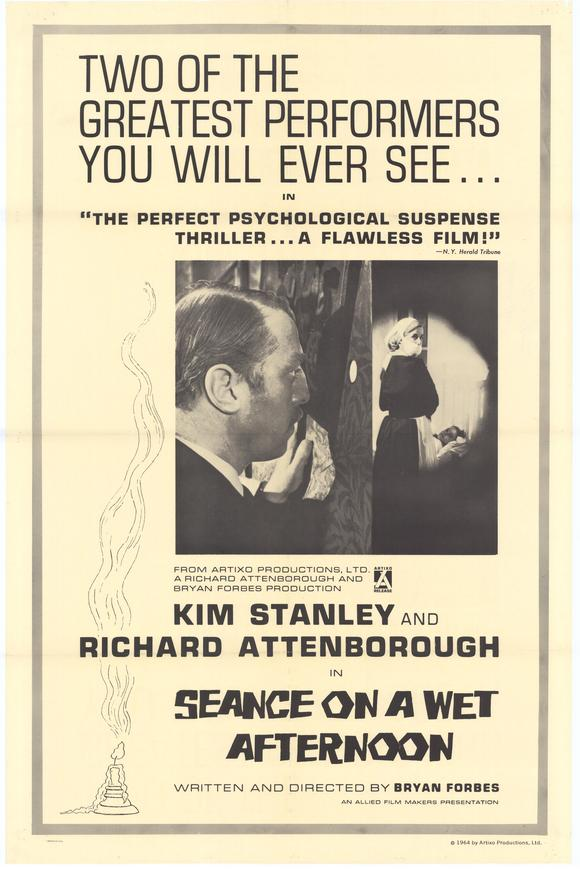
Myra Savage (Kim Stanley) is an emotionally unbalanced woman and failed psychic who comes up with an idea that she hopes will revive her career. The plan is for her husband Billy (Richard Attenborough) to kidnap Amanda Clayton (Judith Donner) who is the young daughter of a rich businessman. They will then place her at a strategic location and hold a public séance at which time Myra will ‘miraculously’ predict her whereabouts. This will then, they hope, make her famous and world renowned, but of course things don’t work out as expected.

This is indeed a unique and unusual film that taps into some rare qualities. First and foremost is the black and white cinematography. Every camera shot and angle has a certain evocative flair that is well captured and vivid. The on-location shots pick up just the right amount of ambiance and lighting with each setting. The music score is great and helps create excellent tension. You also will love the little girl that they kidnap. She is adorable without it being forced. Her matter-of-fact sensibilities are a great contrast to Attenborough and Stanley whose characters are child-like and pathetic.

Yet the film doesn’t completely work. The story is handled in a plodding and methodical way without any twists or surprises. There is very little action, some definite slow spots and the conclusion is limp.

If you watch it for the performances then you will be more intrigued. Stage actress Stanley gives a rare film appearance here. It is easy to see why she took the role even though she was known to dislike doing films. The takes are long and give almost unlimited possibilities in creating a character, which is what all stage actors enjoy. She does well and at times may remind one of another legendary actress Geraldine Page who would have also been perfect for the part. Attenborough proves almost her equal. His expressions of shock and worry are memorable. The interplay between the two is fun especially towards the end when this otherwise passive man stands up to the domineering woman.

Overall there are some unique moments, but it is just not suspenseful enough and results in being only slightly above average.

My Rating: 6 out of 10

Released: November 5, 1964

Runtime: 1Hour 55Minutes

Rating: NR (Not Rated)

Director: Bryan Forbes

Studio: Artixo Productions

Available: VHS, DVD (Region 1 & 2)