Garde A Vue (1981)

garde1

By Richard Winters

My Rating: 6 out of 10

4-Word Review: Interrogation of a lawyer.

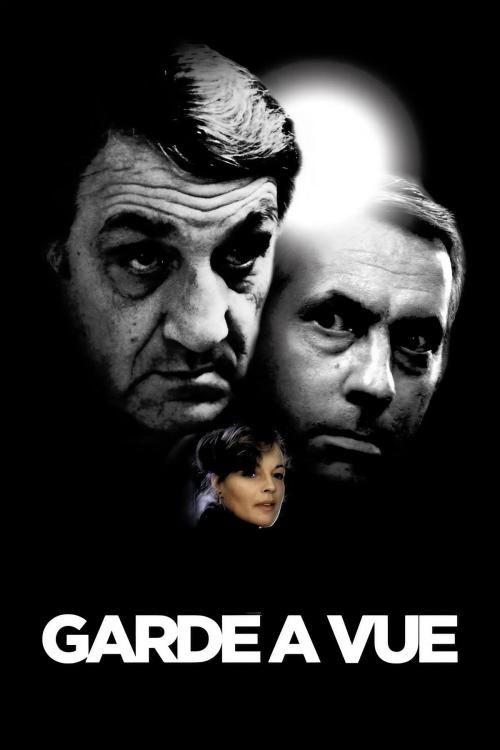
Jerome (Michel Serrault), is a rich and powerful lawyer who is brought into a police station late one night during New Year’s Eve in order to be questioned about the rape and murder of two young girls. Antoine (Lino Ventura) is the lead investigator while Marcel (Guy Marchand) sits in the back and assists him during the interrogation. At first the conversation is light and civil, but as Antoine brings more circumstantial evidence to the forefront Jerome becomes nervous yet insists he’s still innocent. Marcel even implements some physical force against him, but Jerome’s stance never changes. In another room Antoine has a conversation with Jerome’s wife, Chantal (Romy Schneider), who confides to him that she secretly suspected Jerome to be in-love with an 8-year-old girl. Once Jerome gets confronted with this his story soon begins to change.

The film is based on the novel ‘Brainwash’ by John Wainwright and shot entirely in a studio soundstage and in chronological order. Why director Claude Miller would want to film a story that had very little if any cinematic elements to it is a mystery and if anything this might’ve fared better as a stage play. I was initially impressed with the police station room as you’d swear it was an authentic building and not just a prop built for the production. The drenching rain seen pouring down outside the windows is impressive as it gives the viewer a claustrophobic feel and I liked how eventually, when the clock hits midnight, you hear car horns honking outside to represent the New Year. However, every interrogation room I’ve seen, and I watch a lot of confession videos on Youtube from real-life cases, the rooms are very small and with no windows and the film would’ve been better served had it reflected a setting like this as it would’ve brought out better the psychological tension of the suspect and his feelings of the ‘walls closing in on him’, which with here you don’t get.

You can’t help but connect this movie with The Offencewhich starred Sean Connery and was directed by Sidney Lumet. That movie came out 8 years before this one, but had the exact same theme of a suspect being brought in over the murders of some school girls. That movie was well directed but did annoy me for the fact that in that one the suspect, played by Ian Bannen, did nothing, but give off this smirk the whole time.  This one has a much better back-and-forth between the investigator and suspect, which helps keep it compelling as more evidence gets introduced. However, in the Lumet film it had constant shots of this big bright light shining into the camera giving the viewer a point-of-view feeling of what someone in that situation would feel and thus helping hype the sense of urgency of wanting to get out of there, or say anything one needed to in order to stop the pressure, which this film doesn’t do very well. Both films though have cutaways showing the dead girl’s bodies from a distance in a secluded area, which are visually creepy, though again Lumet’s film scores a bit higher in that category too.

Spoiler Alert!

Ultimately the ending is a letdown and rather baffling as it features Jerome caving and admitting to a crime that he really didn’t commit due to the perceived police pressure. For one thing it’s hard to imagine that a seasoned lawyer would be that dumb and wouldn’t just ‘lawyer up’ himself and demand counsel of his own when interrogation got to be too much. I’ve seen a lot of true life interrogations where the pressure put on the suspect was far worse and those people refused to buckle, so seeing the character fall to pieces so relatively quickly especially when he was educated to know better makes the whole thing pathetic.

Didn’t quite get why the wife shoots herself at the end either. Supposedly it’s because she feels guilty about tabbing him for the murder when the real killer eventually gets exposed, but she did it out of honesty as she really felt he had a thing for young girls, so why should she feel tortured about saying something she truly believed? It would’ve been more surprising if she had pulled the gun on Jerome himself as he got into the car and shot him as she would feel, even if he hadn’t been arrested for this crime, that he still had some dark perversions and thus should be killed before he goes and carries out his fantasies on some other girl. Of course if she lied about him having a thing for an 8-year-old in order to get back at him over their contentious marriage then her guilt and suicide would’ve been more plausible, but I didn’t get that from watching it, so if that was ultimately her motivation then the filmmakers should’ve done a better job at intimating it.

This is the rare case where I’d say the Hollywood remake, which came out in 2000 as Under Suspicion and starred Gene Hackman and Morgan Freeman was much better done. It had a better visual balance that didn’t keep the whole thing stuck inside a police room and it better tied-up loose story ends that this one leaves open.

My Rating: 6 out of 10

Released: September 23, 1981

Runtime: 1 Hour 27 Minutes

Not Rated

Director: Claude Miller

Studio: AMLF

Available: DVD, Blu-ray

Silver Streak (1976)

silver

By Richard Winters

My Rating: 8 out of 10

4-Word Review: Murder on a train.

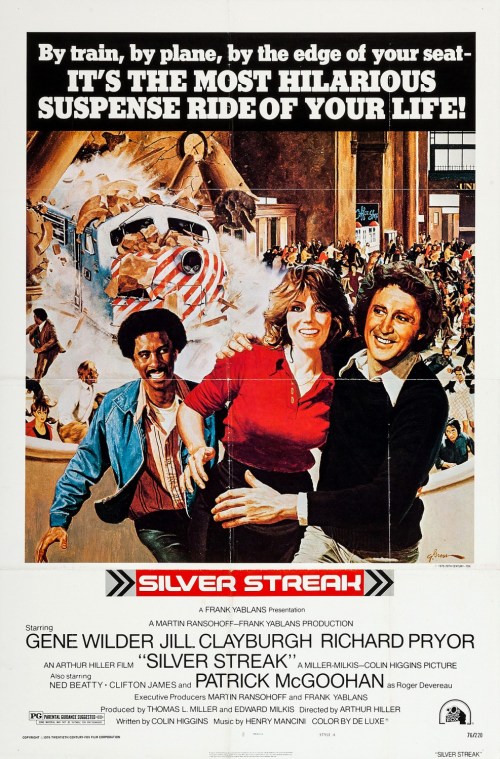
George (Gene Wilder) is a book editor taking a train ride from Los Angeles to Chicago. Along the way he gets into a relationship with Hilly (Jill Clayburgh) who is staying in the neighboring compartment. After a night of drinks they go back to her bed and begin making-out only for George to see a murdered body of a professor, whom Hilly works for as his secretary, get thrown off the train. Nobody else sees it except for him and everyone, including Hilly, believe it was a figment of his imagination, but George persists by doing the investigating himself. He goes to the compartment that the professor was staying in to see if he’s there, but instead he meets two men (Ray Walston, Richard Kiel) who throw him off the train. George then must find a way, in the middle of the empty desert, to get back on the train, so as to warn Hilly, whom he fears may be their next victim.

The script was written by Colin Higgins who up to that time was best known for having done Harold and Maude. He said he had always fantasized about meeting a beautiful blonde on a train and when it never panned-out in real-life he decided to write it into a story. Initially he was expecting an uphill battle to get it sold, but to his amazement it instead set-off a bidding war between Paramount and 20th Century Fox who both wanted to purchase the rights and it ended up selling for a then record $400,000. Originally Amtrak was going to be used as the setting for the Silver Streak, but the company became panicked that the film could cause bad publicity for them and ultimately refused to allow the studio to use any of their trains, so the film crew was forced to go north of the border and use the Canadian Rail System in its place while still pretending that it all takes place in the US when really all exteriors are Alberta, Canada and the skyline that gets seen in the distance that’s supposed to be Kansas City is really Calgary.

The reason the film works so well is that the comedy is on-target the whole way, but also manages to deftly blend it in with some nerve wracking action making the viewer let out belly laughs while also sitting-on-the-edge-of-their-seat at the same time. The pace is brisk with some amazing and very realistic stunt work that not only shows the train crashing through the wall of Chicago’s Central station, but also a few scenes with the character’s dueling it out on the roof of the locomotive as it’s going at high speeds. In fact the only slow spot in the entire movie is when Gene and Jilly make-out in the train car, which goes on too long and may make some people, including my conservative parents who watched the film with me when I first saw it on Showtime in 1982, as thinking this might be more a soft core porn flick than an action thriller and about ready to turn-if-off before it finally gets going with the plot.

Wilder, who was not Higgins’ first choice for the role as he intended it to be played by George Segal, is quite engaging and this was the first of several pairings that he did with Richard Pryor, who doesn’t appear until an hour in, but manages to take over quite nicely and makes a strong, memorable impression. Patrick McGoohan is sinister as the villain and one of the rare instances where in an otherwise comedy the bad guy isn’t funny and instead nasty, usually in comedies it’s considered mandatory that all the characters, even the bad guy, have some amusing moments, or lines, but McGoohan is just mean, which enhances the suspense element. Scatman Crothers, who initially seems to be playing an insignificant roles as the train’s porter, but in the end becomes quite crucial in getting everyone saved. Richard Kiel is good, though he speaks no dialogue, as one of McGoohan’s henchmen, in a role quite similar to the Jaws character that he played in two James Bond films that came out a year later, he even walks around with the same mangled up dental work in his mouth.

Spoiler Alert!

While the film works for the most part quite flawlessly I did find a few tidbits to quibble about. One is the scene where Gene accidentally bursts open the patrician door that divides his room from Jill’s who is busy dressing and doesn’t act startled when he suddenly breaks into her room, which I would think anyone, especially in a state of undress, would’ve responded with a scream and a look of shock, which would’ve made the segment funnier if she had.

Later on a police chief, played by Len Birman in a very bad impression of Mike Connors from ‘Mannix’, tells Gene that they know he’s innocent and have simply been putting-up manhunt posters with his picture on it for his own safety, so they could catch him and get him away from the evil McGoohan and his cronies who want to kill him. However, after he explains this he then hands Gene a gun and some bullets and tells him to come along with his men to help nab McGoohan who is still on the train, but how would this police chief know that Gene could handle a gun and was trained on how to shoot it, let alone even need him since his own men were well armed with rifles and could easily shoot down the bad guy themselves? There’s also another moment where the police chief shoots into a large crowd in an effort to hit McGoohan, which sends everyone into a panic and would be considered a major act of negligence for a cop to do.

Another scene has McGoohan explaining to Jill, Gene, and Richard about how he and his men never meant to really kill the professor, or at least not upfront, but when he did die that’s when they had to immediately ‘get’ a lookalike as an imposter to give everyone the idea that the professor was still alive. However, how exactly where they going to be able to find someone who looked so similar to the professor in such a quick, speedy way and then get him on the non-stop, fast-moving train?

The biggest exaggeration for me though is when Gene unhooks the back part of the train from the engine, while standing on a thin ledge and holding on for dear-life via a small metal rail and then able to successfully hop onto the train car that he had just decoupled from the other one. With them both going at high speeds I don’t think he’d be able to do it. Of course in the movie it gets done by a professional stunt man, who was able to time it, and rehearse it, to make it look easy, but in reality the average person would’ve either slipped, or missed grabbing the rail and thus fallen to the side of the tracks. This though could’ve actually been funny as we would then see Gene’s body roll on the ground and initially make it seem like he was hurt, or injured and then have him look up in aggravation and go: ‘Damn, I got thrown off the train for a fourth time!”

My Rating: 8 out of 10

Released: December 8, 1976

Runtime: 1 Hour 54 Minutes

Rated PG

Director: Arthur Hiller

Studio: 20th Century Fox

Available: DVD, Blu-ray, Amazon Video, YouTube

Eureka (1982)

eureka1

By Richard Winters

My Rating: 6 out of 10

4-Word Review: He discovers some gold.

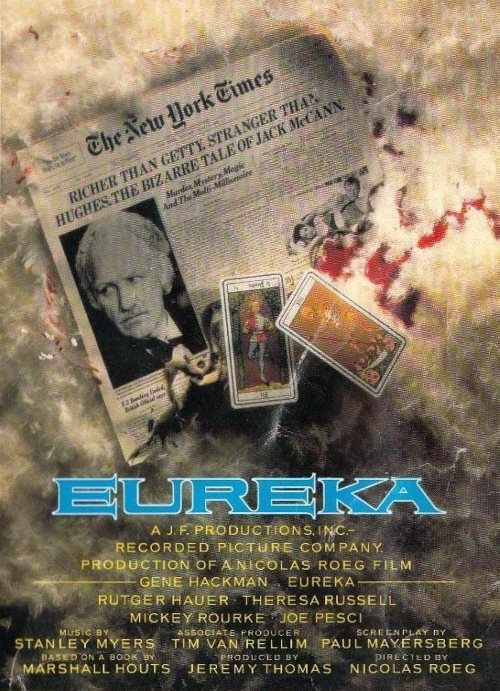
Jack (Gene Hackman) has been searching the Yukon for over 15 years in the hopes of one day coming upon some gold. Then one day he finds it and becomes super rich. 20 years later he’s living on his own island, married, and with a grown daughter named Tracy (Theresa Russell). Jack though has grown ornery through the years and has managed to alienate most of his family including Tracy’s husband Claude (Rutger Hauer) whom Jack can’t get along with and the two regularly argue to the point that it also affects his relationship with his daughter. Jack is also at odds with the local mobsters headed by Mayakofsky (Joe Pesci) who wanted to open a casino on the island and are willing to resort to any violent means necessary in order to get that done.

The film is based loosely on the life of Sir Harry Oakes who, like with the main character here, scoured many countries looking for gold for 15 years before finally laying claim to a fortune. He then retired to the Bahamas and ultimately was found murdered in 1943 in a crime that has remained unsolved. The studio though did not know what type of audience to aim the film to and thus shelved it for a year only to release it to limited theaters where it managed to recoup a paltry $123,572 out of its initial $11 million budget making it one of the biggest box office bombs in history.

As a visual exercise, given its director, its a spellbinding ride. Director Nicholas Roeg approaches it as a fable-like tale and creates the artic in a surreal type of way giving it an almost outer-worldly look and feel. To an extent this works and there’s a few memorable scenes including a barefoot man lying in the cold who blows his head-off, via a loaded gun, in one very unexpected, shocking moment that’s very realistically grisly. The death by blowtorch, which happens a bit later is effectively vivid as well. However, there’s other metaphysical elements like a mysterious stone that gets handed to Jack that alludes a bit too much to a magical quality and takes away that this is actually based on a true story and instead makes it seem like it’s all just a made-up metaphorical fable, which starts to have a pretentious quality.

The plot is too thin and the second act labors badly. Joe Pesci is a dynamic actor, but here his part is boring and he doesn’t come-off as threatening enough to give his scenes the proper tension. There’s also no insight given to why the gangsters choose to pick-on Jack, as this is a man who is quite rich and could hire his own protection and enforcers and not someone you’d think could be easily intimidated. So why bother with him at all and just find another island to build a casino on? In the real-life incident Harry Oakes went out of way to try to ban casinos from the entire island nation as he did not approve of gambling and thus caused the ire of the criminal underworld, but the movie doesn’t bother to explain this and thus makes the motivations of the bad guys confusing.

Acting-wise its a joy to watch especially Hackman. He has played so many heroes in his film career that it’s fun seeing him be a jerk and he does it well particularly when he gets on his alcoholic wife about ‘laying off the sauce’. Ed Lauter, who’s usually a heavy, is entertaining with this constant nervous look on his face as he ends up being the reluctant middle-man who gets played by both sides. Rutger Hauer is brilliant as usual giving each of his moments a creepy finesse as only he can do. Two of his more memorable bits are when he swallows a small piece of gold while in Jack’s presence and when he has a meltdown at a formal dinner party and angerly, even frighteningly, demands they all must go home.

Of course being that she’s the director’s wife you get ample visuals of Theresa Russell with and without clothes on. The two became a couple while filming Bad Timing a few years earlier and despite a nearly 30-year age difference got married. I’ve often think it’s odd though when a husband directs a movie in which she’s in bed naked with another man, in this case Hauer, who’s also sans clothes. Don’t know if many other husbands would like that idea as the erotic scenes weren’t necessarily needed though I kind of wonder if it’s not another case of the trophy wife syndrome where the old guy wants to brag to the world: look at this hot little number I get to go home to and you don’t and thus the nude scenes are just there to make all the other guys jealous.

Spoiler Alert!

The climactic court room scenes, in which Hauer is placed inside a cage during the proceedings, aren’t effective. Mainly because he acts as his own lawyer and questions Russell on the stand who goes on a long, teary-eyed, rant about her father and his perceived psychological motives, that ceases to be the proper question/answer decorum that would be expected in a regular court setting. It’s unlikely that any judge would let this go on the way it does, or that the jury, or other attorneys would be so captivated as they are and not begin rolling their eyes after awhile, or objecting to the histrionics. Having Hackman killed off doesn’t help things as he was the guy the viewer most connected with while Hauer was a creepy guy who behaved erratically and expecting the audience to suddenly emotionally side with him at the end was an overreach.

Released: May 20, 1983

Runtime: 2 Hours 10 Minutes

Rated R

Director: Nicholas Roeg

Studio: United Artists

Available: DVD-R, Blu-ray

Strange Shadows in an Empty Room (1976)

strange

By Richard Winters

My Rating: 4 out of 10

4-Word Review: Cop’s sister dies mysteriously.

Tony (Stuart Whitman) is a tough-as-nails veteran cop who gets the shocking news that his younger sister Louise (Carole Laure) is found dead at a party she had attended. Initially he presumes it’s George (Martin Landau) a middle-aged doctor whom she’d been having an affair with and who gave her a injection at the party, but later he realizes there might be more to the story than he thought and begins investigating other avenues that leads him to a wild and completely unexpected conclusion.

The film was directed by Alberto De Martino who had done other Italian produced films that were rip-offs of better known Hollywood hits with this one clearly being inspired by Dirty Harry. It was filmed in Montreal and Ottawa, Canada, but done by an Italian film crew making it seem more like an overseas production with very little Canadian elements to it. Overall the quality looks cheap and the story has a lot of twists that don’t make a lot of sense, or are believable.

Two that stood out right away to me is during the party scene where Louise fakes illness simply to get George’s attention to make him come over there and away from his wife. Then when he tries to help her she lets him know it was all a gag. A few minutes later she passes out for real and he responds in a worried way, but you’d think since he got taken advantaged of just moments earlier he’d presume this was just another prank and not take it seriously. Also, at her funeral Tony begins to suspect there’s more to her death than what is known and requests an autopsy be done, but an autopsy is standard procedure that should be done after any unexplained death, especially since the victim was so young, and thus seems absurd that he should have to request it only as her body is already in the casket and ready to be buried.

Whitman, who was nearing 50, looks too old for this kind of thing and it’s hard to imagine he would, in reality, be able to physically keep up with these much younger suspects who force him to chase them around in airports, along crowded city sidewalks, and even in hospitals. He’s not the most ethical guy either as he has no problem drowning one of the men he’s questioning in a sink of water as a method of interrogation, which should normally get an officer in trouble. There’s also no glimpses of his personal life, so we never learn anything about him, or see any other dimension except for his rough cop persona. Most other cop movies, or at least the good ones, do have a few scenes dealing with the policeman’s private side, but here there’s none, which makes the character flat and uninteresting. Having the victim be his sister didn’t make too much sense since she was clearly quite a bit younger than him and making her his daughter would’ve been more believable and more devastating when he has to come to terms with her darker side.

The supporting characters are, just like with Whitman’s, poorly fleshed-out. It’s hard to be intrigued who the suspects are when they all seem alike and say and do nothing that’s interesting. The film does have one long car chase, which has some impressive stunts, but it seemed unnecessary as the man driving away from the cops really didn’t have much to hide and is essentially not interrogated once Whitman catches up to him, and he offers only a little piece to the puzzle, so why tear up the city streets and completely destroy two cars if he’s not in dire trouble? Better to have saved this for the finale with the bad guy who really is the culprit than just some minor player who isn’t seen, or heard of again.

I did enjoy the foot chase through the hospital that comes at the end and even goes through a maternity ward and ultimately onto the roof of the place. The story does feature many twists and I did appreciate the way it shows how policeman can make the wrong guesses on who they think is guilty and go on many long tangents that don’t lead anywhere before they realize their mistake. However, more effort should’ve been made to create unique characters as the ones provided here are wooden and banal.

Alternate Title: Blazing Magnum

My Rating: 4 out of 10

Released: March 9, 1976

Runtime: 1 Hour 39 Minutes

Rated R

Director: Alberto De Martino

Studio: Fida

Available: DVD, Blu-ray, Amazon Video, YouTube

A Perfect Couple (1979)

perfect2

By Richard Winters

My Rating: 5 out of 10

4-Word Review: Meeting through dating service.

Sheila (Marta Heflin) is a singer in a traveling rock band run by Ted (Ted Neeley) who is quite demanding and openly berates and even fines members of the group who do not follow his orders. Alex (Paul Dooley) is a middle-aged Greek man still living at home with his domineering father (Tito Vandis) and extended family who berate him at every turn for not conforming to the family orthodox. Both are single and lonely and decide to join a dating service. From there they get connected and go on a first date at an outdoor orchestra concert where it rains and they both get wet. Despite the mishap Alex pressures Sheila for a second date, but miscommunication causes problems here as well. They eventually go their separate ways by dating other people they meet at the service, but Alex feels the need to try one more time to make it work and thus goes on tour with Sheila’s band as they hit the road, but finds their communal lifestyle is not for him.

The inspiration for the movie came while Robert Altman was shooting A Wedding and intrigued with the idea of what would happen if Paul Dooley’s character in that film started dating Sandy Dennis’ character and thus decided to write a whole movie about them. Problems though started right away during rehearsals when Dooley, who’s allergic to cats, could not handle being in the same room with Dennis, who was a major cat lover and would usually bring her pets to the reading, which would send him into a severe allergic reaction. Even when she quit bringing the felines with her it still caused issues with Dooley due to the cat hairs on her clothing. Altman then cut Dennis from the cast and had the part rewritten for Heflin, who was 33 at the time, but looked much younger like she was only 22 or 23 and thus accentuating the differences between the couple.

The film starts out with the two already on their first date instead of showing them viewing potential dates through the taped interviews that the service had available, which I felt was needed. As a guy I could see why Dooley would get into a young, semi-hot chick like Heflin as lonely guys, no matter their age, can instantly ‘fall-in-love’ with a woman from their looks alone, but both need to agree to the date before they go and I couldn’t understand why Heflin would to go out with a guy who was way older and didn’t seem to have much going for him. Maybe all of the other prospects were total duds and he was the best of the lot, so she decided to give it a try, or maybe she had some sort of father complex, but that’s something that still needs to be revealed and the fact that it isn’t leaves a big gaping logic hole.

The characters are palatable to some extent, but behave in ways that makes them at times quite infuriating. Dooley is especially problematic. Granted he’s playing someone who is socially clumsy and not real slick with the dating thing and trying a bit too hard to make it all work, but still insisting that he enter her apartment even when she makes it quite clear that she’s more comfortable just saying goodbye at the door is creepy. Having him show up at her place unannounced and demanding she see him for a second date and not leaving until she relents makes it even worse. There needs to be someone to tell him that his behavior is out-of-line and this isn’t a way to ‘woo a woman’ and in many cases will justifiably scare them off. Unfortunately the Heflin character doesn’t do this. Even though everything he does makes her quite uncomfortable she never protests it and lets him keep having his way, which makes her as annoying as he is.

Their unique living arrangements brings up even more issues. For Heflin I could understand her situation and it made sense. Sure the band manger is a demanding jerk, but I could see her feeling the need to put up with it because she wanted to break into the rock singing business and felt this was part of the crap she had to get through while she works her way up. For Dooley, his living arrangements are just downright baffling as he plays a 50-year-old who’s still residing at home with his father who’s highly demanding forcing Dooley to become a pathetic, obedient simp when around him. I could understand if the guy was like 20 how this might be somewhat believable, but by 50 he should’ve broken away a long time ago and the fact that he hasn’t needs to be explored and explained as it’s highly unusual and seems to intimate that there’s a serious personality disorder of some kind that begs for analyzation that never comes.

The entire runtime has the two going through every bad date moment you could think of. They have absolutely nothing in common and repeatedly talk past each other, so there’s no constructive communication whatsoever and yet somehow at the end they ‘fall in love’, but how? To make a relationship work there needs to be a connecting bond, but the film fails to show what it is making it quite shallow. There’s also an abundance of music played by the band Heflin’s a part of called ‘Keepin’ Em off the Streets’, which gets way overdone. There’s 12 different numbers, which bogs down the pace and makes it seem like a band’s demo reel instead of a movie.

The only memorable bit is when Allan F. Nichols, who co-wrote the script, appears as Dana 115, one of Heflin’s dates for the night and he has a physical confrontation with Dooley, which ended up making me laugh, but that’s about it. Nothing else happens that is either amusing or insightful. A fluffy movie that doesn’t go far enough to be either compelling or memorable.

My Rating: 5 out of 10

Released: April 6, 1979

Runtime: 1 Hour 47 Minutes

Rated PG

Director: Robert Altman

Studio: 20th Century Fox

Available: DVD

My Bodyguard (1980)

my1

By Richard Winters

My Rating: 7 out of 10

4-Word Review: Hiring protection from bullies.

Clifford (Chris Makepeace) is a new student at a tough Chicago high school who finds himself at odds with the bullies who are headed by Melvin (Matt Dillion), who goes by the nickname ‘Big M’. He and his cronies want Clifford to pay them ‘protection money’ in order to defend him from Linderman (Adam Baldwin) who is a big, loner kid that supposedly killed his own brother. Clifford refuses and thus gets constantly hounded by them, so he decides to go to Linderman and offers him a deal where he’ll pay him some money each week and even agree to do his homework if he’ll become his bodyguard. At first Linderman declines, but eventually comes on board, which is enough to get Big M and his gang to leave them alone. Then a few days later Big M returns with his own ‘bodyguard’ named Mike (Hank Salas), a big muscular guy, who challenges Linderman to a fight, which he at first resists.

This teen movie is unusual in that it was not based off of a novel as its source material, even though you’d be convinced it was, and although a novel version of the story was eventually written after the film was released, it’s ultimately an original idea by screenwriter Alan Ormsby. Ormsby was at that point better known for writing low budget horror movies, with a couple of them he even starred in, and seemed the least likely to have penned something as good natured as this. It also stands out from other teen movies in that its music isn’t some pounding rock score, but instead soft classical that helps give it distinction and let it stand-out from just about all the other high school flicks out there particularly those from the 80’s.

Kids today may not relate to a school where every student doesn’t have an I-phone, a laptop, or piercings, but if you were a teen back then this movie captures that experience to a T. Everything from the bland school lunches where you had to drink milk out of a small carton to the creaky old school buildings (this one was filmed on-location at Lake Forest High) gets recreated. The teens are all realistically geeky and awkward, even Joan Cusack, in her film debut, looks nerdish especially as she smiles exposing a mouth full of metal. Many who see this, or see it again, it will bring back a fondness to their own school days to the point it may even make you feel you’re right back there.

Chris Makepeace is perfectly cast as a sensitive youth who must learn to ‘make connections’ or ‘network’ his way around the new environment and use what social skills he has to maneuver through the teen jungle. Dillon, in only his third movie, makes for a believable bully and Baldwin, in his film debut, is also excellent and while his character doesn’t say much he gives off a very effective almost creepy stare that proves memorable. In support I really got a kick out of Paul Quandt, who’s only film appearance this was, as a scrawny tyke who befriends Makepeace and always supplies funny side comments and reactions. You also get to see Joan and Jon Cusacks’ dad, Dick Cusack, as the school’s much put upon principal.

The only segments and characters that really don’t work are the scenes involving Makepeace’s home-life that are a bit unusual since he resides in a hotel that his father, Martin Mull, manages. He has no mother since she died in a car accident years earlier and Mull behaves more like a big brother, who is into looking at naked women with his son through their telescope, than any type of disciplinarian. Ruth Gordon plays Mull’s goofy mother and while Gordon is quite amusing her scenes go on too long and don’t have much if anything to do with the main plot. Mull’s moments don’t help either though one could argue that his scenes do have some outside connection to the theme as it shows adults have to deal with their own type of bullies in this case his crabby and demanding boss, played by Craig Richard Nelson, who is always threatening to terminate his employment.

Spoiler Alert!

The ending is different too in that it essentially says fighting may sometimes be necessary though many administrators of today try to persuade against the idea that violence is the answer and there are other more constructive ways to tackle conflicts. Of course watching Makepeace clobber Dillon while Baldwin handles Salas is quite satisfying especially since the whole rest of the movie is watching the kids, including even Baldwin, getting humiliate by the bullies, so the bad kids do ultimately get a much deserved come-uppance. However, just because one person ‘kicks some other person’s ass’ means only that they were the more skillful fighter, or just bigger physically, and not necessarily the moral superior.

Still it’s a very pleasant movie that has a rites of passage/ fleeting moment in time quality. The situation is portrayed as a growing pains issue and not a dire one. This is well before mass shootings and all of the ugliness you see happening in schools today where everything spews out into the adult world. Here it was still done at a time where these problems were contained within the school walls, which is the best thing about it.

My Rating: 7 out of 10

Released: July 11, 1980

Runtime: 1 Hour 36 Minutes

Rated PG

Director: Tony Bill

Studio: 20th Century Fox

Available: DVD, Blu-ray, Amazon Video, YouTube

The Adventure of Sherlock Holmes’ Smarter Brother (1975)

sherlock

By Richard Winters

My Rating: 6 out of 10

4-Word Review: Sibling solves the case.

Gene Wilder plays Sigerson Holmes, the jealous younger brother of Sherlock, who is upset that his sibling is so famous for solving crimes while he sits in obscurity having not seen as much success though he feels he’s just as smart if not smarter. One day Sigerson gets a case that his brother doesn’t want to get involved in due to him desiring to lay low for awhile. It involves Jenny Hill (Madeline Kahn) who’s a beautiful music hall dancer who is being blackmailed by an opera singer named Eduardo (Dom DeLuise) over a lewd letter she sent him years ago. However, the document proves to be much more than just a letter and is in fact an important paper that foreign powers will pay high price to get their hands on. Eduardo agrees to sell it to the evil Professor Moriarty (Leo McKern), but will only hand it over to him during one of his operas, which Sigerson and his loyal partner Orville (Marty Feldman) plan to attend in order to intercept the paper before it gets into the wrong hands.

Gene Wilder was approached by producer Richard Roth to do a parody of Sherlock Holmes, but Wilder didn’t like the idea of poking fun of what he felt was an iconic character. Roth told him to think about it and then approached him a week later. By this point Wilder said he had come up with a better idea instead of it being about Sherlock it would focus on his jealous brother Sigerson. Roth found the premise intriguing and suggested Wilder begin writing the screenplay which he did while working on Young Frankenstein. Once completed he asked his friend Mel Brooks to direct, but Brooks declined saying he didn’t like working on projects that were not his own idea, so Wilder took the reins himself calling it a ‘terrifying commitment’.

While the movie has some good moments the Sigerson character is not interesting. For one thing he’s poorly defined. One minute he’s cunning and sharp and then the next he proves dimwitted and clumsy almost becoming another Inspector Clouseu. The comedy should feed off the character, but with it unclear whether he’s brilliant or buffoon it never catches its stride and for the most part the scenes with him in it are boring and the audience doesn’t care if he solves the case nor feel that there’s any redemption if he does. He’s also genuinely unlikable particularly with the way he snaps at Jenny Hill making you almost want to despise the guy and hope he doesn’t succeed. Also, if he really is Sherlock’s brother then I felt there needed to be some scenes with them together and the interplay between the two could’ve been amusing if done right, but this never happens.

Wilder directs the film the way most actors turning director do by having the scenes more extended and allowing the actors to drive the pace and momentum versus the editing. With a so-called ‘zany’ comedy like this that doesn’t work and there’s several segments that go on too long until it becomes dull and looking a bit amateurish. The biggest example of this is when Jenny arrives a Sigerson’s place to tell him about the letter. Their interplay doesn’t go anywhere and ultimately in order to get out of it the characters, for some unexplained reason, break-out into song and dance making it seem like its a musical, which it isn’t, but either way it’s dumb and not funny. During Jenny’s music hall show, which Sigerson and Orville attend, she sings a long song there too, which wasn’t needed and saps the comic energy.

There are though some offbeat moments much of which comes from McKern a usually serious actor who shines in his campy part and really plays it up to the point that he becomes the highlight. The part where he goes to a fortune telling machine, that he has inside his residence, is inspired and his visit with Eduardo in which the two strangely fondle each other and even go to bed together that gives off weird homoerotic vibes is good too in a sort of bizarre ‘what am I looking at’ type of way.

The best part though is when a giant saw blade cuts off the back of Wilder’s and Feldman’s trousers causing their bare behinds to be exposed. They then go to a formal dance party and shock everyone who sees their asses with them still not aware that they’re showing. What’s so interesting about this part is that they both have really good looking butts especially Feldman. You’d think with his freaking looking face that his rear wouldn’t be so hot either, but it amazingly is, so in keeping with our current male ass scorecard we still have Dabney Coleman, who bears his behind in Modern Problemscoming in first and Tim Matheson’s in Impulsebeing a close second and then Wilder and Feldman tying for third place.

My Rating: 6 out of 10

Released: December 14, 1975

Runtime: 1 Hour 31 Minutes

Rated PG

Director: Gene Wilder

Studio: 20th Century Fox

Available: DVD, Blu-ray

Crimes and Misdemeanors (1989)

crimes1

By Richard Winters

My Rating: 7 out of 10

4-Word Review: Threatening to tell wife.

Judah (Martin Landau) is an eye doctor whose mistress of several years, Dolores (Anjelica Huston), is threatening to tell his wife (Claire Bloom) about their affair. Judah tries to persuade her not to, but she insists on going through with it unless he gets a divorce, which he refuses to do. Feeling he has no other option he hires his brother (Jerry Orbach) to do a hit on her in order to get her off of his hands. Once the job is done Judah then becomes wracked with guilt and though he had been a non-believer for many years begins to rekindle the fear of the wrath of God for what he’s done. Meanwhile Cliff (Woody Allen) is a struggling documentary filmmaker who gets a job filming a movie of a obnoxious comedian (Alan Alda) who’s highly narcissistic and difficult to deal with.

The film is unusual in that it has two correlating stories that go on at the same time with very little that links them. The only connecting thread is a Rabbi, played by Sam Waterston, who is friends with both Alda and Landau, as well as Cliff and Judah getting together briefly at a party to have a discussion near the end. Otherwise it’s like two separate movies with one being semi-funny while the other is made to be more like a searing drama and character study. While it’s engaging most of the way I felt the segment dealing with the egotistical celebrity wasn’t interesting or comical enough to be worth having especially since Alda didn’t seem able to convey an obnoxious jerk in a way that was amusing. The film also goes off on several tangents including Cliff counseling his sister about a date she had where a man tied her up and defecated on her that didn’t have anything to do with the main story and just taking up runtime for no reason. There’s also segments that I did find intriguing like the mysterious phone calls Judah gets late at night where the caller immediately hangs up when Judah answers that I felt should’ve been explored more.

A good way to have solved this and would also have tied-in Allen’s character better would’ve had him filming a documentary on Judah who could’ve been portrayed as this heroic eye doctor who saved the vision of underprivileged kids, or even gone to Africa for awhile to help heal the vision of the kids there and thus his efforts were considered a suitable material for a film. Alda’s character could’ve been cut out totally and not missed. Judah could’ve still be conniving behind-the-scenes about how to get rid of the other woman and thus the irony of him being lionized in front of the camera, but a complete jerk behind it would’ve been even more accentuated and interesting.

As it is the moments with Landau are still quite strong. His career during the 80’s had nearly tanked with him having to accept co-starring roles in low budget horrors just to keep busy only to finally get his name revitalized with his role in Tucker: A Man and His Dreams in 1987 that lead to an Academy Award nomination for best supporting actor and helped him get better quality work including this one. Here his expressive blue eyes come into play particularly after the dirty deed gets done and he begins having reoccurring visions of himself as a boy going to synagogue and quarreling with his moral depravity, which is effective.

This is also the rare movie where Allen plays someone who is actually likable. Normally his incessant whining and misguided belief that he’s more sexually attractive than he is and can bed any hot women I’ve found annoying, but here he’s more of a ignored chump who’s still struggling to make a name for himself and this makes him endearing. Instead of aggressively coming onto women in tacky ways he instead shyly courts Mia Farrow who plays a sort-of nerdette here and their scenes together are cute.

Spoiler Alert!

The ending in which Allen and Landau meet briefly and he tells Allen about this ‘great’ movie idea in which a husband finds away to kill off his mistress, which is essentially what he’s really done, and feels no guilt afterwards doesn’t really work. For one thing it’s hard to believe that he’d wake-up one day, as he describes, and no longer feel any remorse and could just go on normally as he had felt so guilty about it earlier that you’d think it would’ve left some sort of lasting affect. The viewer should’ve also seen this realization play-out visually through the story versus having him just describe it.

I realize Allen’s whole point was to show that the universe doesn’t dispense justice and sometimes people really can get away with murder and can go on living happy lives unlike in the movies where it’s expected that the bad guy should suffer some consequence. Yet realistically I actually think Landau would’ve been caught, or at least been more of a suspect than he is. He was already questioned by the police earlier due to all the phone calls he had with the victim and I don’t think his flimsy excuse would’ve sufficed. Since he had been to her apartment many times including even on the night of the murder that most likely one of the other tenants would’ve spotted him coming and going and all the police would’ve had to do was show his picture around for him to be easily fingered by someone else living in the building. Thus watching Landau confidently leave his discussion with Allen thinking he could go on happily with his life only to have a detective there with handcuffs would’ve been funnier and in a lot ways ultimately more believable.

The film’s promotional poster, as seen above, doesn’t get the mood of the scene right. If you look at the poster it seems like Landau is the despondent one who’s suffering from inner turmoil while Woody is nonchalant, but if you watch the movie it’s Landau that is at complete ease while Woody is in turmoil over Mia getting married to Alda, so the poster is essentially misleading.

My Rating: 7 out of 10

Released: October 12, 1989

Runtime: 1 Hour 44 Minutes

Rated PG-13

Director: Woody Allen

Studio: Orion Pictures

Available: DVD, Blu-ray

I Love My…Wife (1970)

ilove

By Richard Winters

My Rating: 6 out of 10

4-Word Review: He’s bored with marriage.

Richard (Elliot Gould) is a medical student when he meets Jody (Brenda Vaccaro) and the two quickly fall-in-love and get married. She then gets pregnant while he’s still in school and they don’t believe they have enough money to financially support a child, so they initially consider an abortion, but at the last minute Richard changes his mind and feels they should have the child. Jody though gains a lot of weight during the pregnancy, which Richard finds unattractive. Once the baby is born she’s unable to burn-off the excessive pounds causing their sex life to go even further into the tank. He has a few flings with some of the nurses before finally setting his sights on Helene (Angel Tompkins) a beautiful model who’s married to a baseball star (Dabney Coleman). At first she resists his advances, but the two eventually bed and then fall-in-love. She insists that Richard leave his wife, so that they can be together and no longer have to meet-on-the-sly. Richard tries to break-up with Jody, but because they have two kids finds that he can’t and instead begins lying to Helene as he plays both women at the same time, which soon turns into a losing situation.

The odd way this thing opens really hurts it and although it does improve a bit as it goes along some viewers may not be patient enough to stick with it. Having the opening credits deal with Richard’s relationship with his mother (Helen Westcott) and the sheltered way that she raised him isn’t funny and because the mother never appears again in the movie it wasn’t worth introducing her at all. Since the wife is the main focus I felt the opening scenes should’ve dealt with their dating period, which the movie breezes over too quickly. The clips from old movies, which get spliced in from time-to-time, add nothing and make it seem too much like Myra Breckenridge, which came out around the same time and best left forgotten. At least in that movie the clips came at predictable intervals, but here it’s sporadic making it seem, when they do get shown, as jarring and out-of-place.

Gould certainly excels at this type of role and he’s quite possibly the only actor who could play a shallow person and still manage to make it come-off as semi-likable. Vaccaro though is the real surprise as she’s usually best at drama and initially I felt she was miscast, but she comes through in making her character complex and even amusing as she goes through her tirades, some of it justified, at Gould. This is also the first movie to ever explore the issue of women who gain weight during their pregnancy, but can’t lose it afterwards and how this could affect their sex life, which I felt deserved kudos for being ground-breaking. The film makes the mistake though of showing too much from her point-of-view to the extent that we start to sympathize with her over the main character and almost start to dislike him in the process.

The introduction of Helene really does help as it’s her presence that gives the story a unique angle. Before this it comes-off more like your typical run-of-the-mill flick about a cad of a husband who can’t stay faithful, which has been done a lot and this movie doesn’t add anything insightful in that vein. However, the affair itself is interesting. For one thing she plays hard-to-get and doesn’t just jump immediately into the bed sheets at Gould’s beck-and-call, which is good as too much of the time, especially in 70’s movies, the women seem way too easy in a way that isn’t realistic. What I liked even more though is that the affair really doesn’t solve anything. Sure he finds her hot and sexy and they do get along, but she also has demands of her own and Gould finds himself in the same quandary as with his wife showing how extra marital flings really aren’t the ‘escape’ that they’re intended, but instead more of a problem.

Spoiler Alert!

The script by Robert Kaufman brings out many harsh truths about marriage and doesn’t insult us with any placid answers. Yet when the movie should go hard it goes soft instead. I liked how Vaccaro, who spent the whole time trying to win him back, finally gives up and starts seeing someone else, but Gould though upset and rebuffed, doesn’t learn anything from it. He goes back to the bar and tries picking-up an attractive stewardess he meets like he’s now making some sort of ‘fresh start’ when the film spent its entire running time exposing how this ‘cruising for chicks’ is a vicious cycle that just leads to more emptiness. Seeing Gould’s character change, or learn from his mistakes and display some regret would’ve been a far better way to have ended it.

My Rating: 6 out of 10

Released: December 21, 1970

Runtime: 1 Hour 38 Minutes

Rated R

Director: Mel Stuart

Studio: Universal

Available: DVD-R (dvdlady.com, modcinema.com)

The Wild Life (1984)

wild

By Richard Winters

My Rating: 5 out of 10

4-Word Review: One week before school.

The summer is winding down and the teens in suburban Los Angeles get ready to head back to school. Conrad (Eric Stoltz) has just graduated the previous year and is now planning to move into his own apartment, but finds it to be expensive and his salary working at a bowling alley doesn’t pay enough, so his buddy Tom (Chris Penn) volunteers to move in with him as his roommate and thus share the costs. The two though don’t see eye-to-eye on things particularly Tom’s penchant for wild parties, which Conrad fears will get them kicked-out. Conrad’s younger brother Jim (Ilan Mitchell-Smith) is fascinated with the Vietnam War and getting into trouble by smoking and underage drinking, which Conrad doesn’t like. Anita (Lea Thompson) is Conrad’s ex-girlfriend who’s having problems of her own as she’s still a teen, but having an affair with a cop (Hart Bochner) who is much older and also married.

The script was written by Cameron Crowe, who had great success with Fast Times at Ridgemont High, and took about trying to emulate that one. Instead of being all about crude jokes and pranks like with most teen flicks of that decade Crowe centered it more on studying the individual teen characters, but unfortunately they’re all rather banal and not that interesting to follow. The first half suffers from a lot of segments that go on too long and doesn’t help the pace. It moves along so leisurely that 20-minutes in I started to wonder when it was going to get on with the story and if there might not even be one though there eventually is. The humor, while amusing at times, is too soft and subtle and could’ve been played-up more to give the thing a much needed jolt. The word ‘wild’ is in the film’s title, but what we end up getting is just the typical teen stuff that hardly lives up to its name. I also could’ve done without the cigarette swallowing, which happens a few times with different people. To me it looked dangerous and enough to make somebody sick and was surprised the characters didn’t puke it out.

Mitchell-Smith has the face of a teen heartthrob, but his squeaky voice is a distraction and I would’ve considered dubbing it though I suppose funny sounding voices at that age as they go through the ‘big change’ may just reflect the reality. His character  is a bit over-the-top with his bravado and at one point challenges a guy who’s much bigger than him to punch him and in another segment he lies down on the street in front of a moving car. This type of behavior seems too reckless and brazen and isn’t normal. Teens are known to take some unwise risks, but it usually catches up with them, but never does here, which I found annoying. Also, when someone shows extreme bravery in one instance they can, as human nature goes, be amazingly scared about something else, but we never are shown that balance and thus making the character come-off as unrealistic.

Eric Stoltz has the same issue in reverse as he’s too clean-cut and responsible. Would’ve been nice and created a more three dimensional person had he been deviant at some point. Lea Thompson, who was already 23 at the time, looked too old to be playing a teen, and in fact just a year later got cast as the mother of a teen in Back to the Futureso I felt her appearance here didn’t work, I did however enjoy Chris Penn he’s definitely a doofus, but a lovable one and all his scenes elicit a chuckle. Robert Ridgely as the slick apartment manager, Hart Bochner as the corrupt cop with a mustache, and Rick Moranis as a preppy clothing store salesmen, with a puffy hairdo, are all funny too and help to give the proceedings a needed zing.

The third act does bring in a party, which gets out-of-hand, but not as much as it could’ve. Having all these people crammed into a tiny apartment should’ve created some fist fights when a boyfriend would catch another guy touching his girlfriend by accident due to having such little space between them. Spraying beer and food fights should’ve also followed, but never do, which makes these party goers too docile and well behaved. Having the guys break down the wall and evade the apartment next door and shock the neighboring couple (Ed Berke, Jessica Rains) was inspired, but we should’ve been shown these neighbors reactions the next day when the apartment manager surveys the damage. Overall though there’s just not enough here that stands-out especially from all the other teen flicks from that era and thus it’s easily and quickly forgotten.

My Rating: 5 out of 10

Released: September 28, 1984

Runtime: 1 Hour 36 Minutes

Rated R

Director: Art Linson

Studio: Universal

Available: DVD-R (Universal Vault Series)