The Burning (1981)

By Richard Winters

My Rating: 3 out of 10

4-Word Review: Cropsy doesn’t look good.

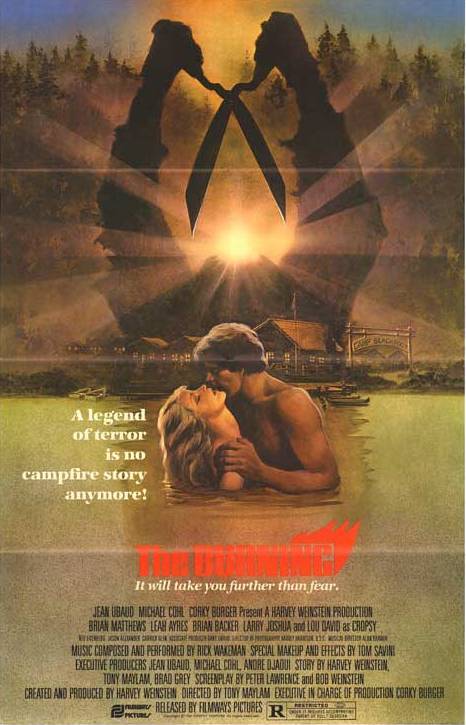
A summer camp caretaker named Cropsy (Lou David) is badly burned during a practical joke gone horribly wrong. Five years later and disfigured he gets out of the hospital and goes on a murderous rampage using a pair of gardening shears. However, he kills young campers at a completely different campsite and who had nothing to do with his accident.

Jason Alexander, in his film debut, is great. He shows a lot of charisma and pretty much carries the movie. You not only get to see him with a full head of hair, but for the lady viewers you also see his bare behind along with Fisher Stevens’s. This is also Holly Hunter’s first film, but she is seen very little. The teen characters here look like real teenagers instead of college- aged young adults like in most of the other films in this genre. They also have a little more distinctive personalities and aren’t quite as cardboard as usual. The women are good looking and there is a gratuitous nude scene involving actress/model Carole Houlihan.

On the Blue Underground DVD version make-up artist Tom Savini hosts a bonus feature, but warns everyone at the start not to watch it until they have seen the film so as not to ‘spoil’ it for them. However, it is hard to figure out what exactly it is that he would be spoiling as the movie is routine to the extreme. There are absolutely no interesting plot twists or surprises. It is also hard to believe that anyone could get a pair of simple gardening shears to do the things this killer gets them to do. The only really scary scene in this film is at the beginning where you get to see a close-up of actor Lou David’s strangely shaped nose. The camera slowly zooms into him as he is sleeping and you feel almost like you are being driven into his extremely large nostrils that seem to get bigger and bigger.

Savini’s special effects really don’t seem all that impressive especially in this day and age. There is a scene on the infamous raft killing sequence where it is quite obvious that the neck that the shears are cutting through is plastic and not really that of the actor’s. Also during the opening sequence when Cropsy runs out of the cabin while on fire he is not wearing anything on top of his head yet when the camera cuts to an outdoor shot of him it is obvious that the stunt double has something on his head.

I found this to be as bad and as uninspired as all the other Friday the 13th rip-offs. This is good only as a curio at seeing Alexander, Stevens and Hunter in their film debuts.

My Rating: 3 out of 10

Released: May 8, 1981

Runtime: 1Hour 31Minutes

Rated R

Director: Tony Maylam

Studio: Filmways Pictures

Available: DVD, Amazon Instant Video

Yesterday, Today and Tomorrow (1963)

By Richard Winters

My Rating: 8 out of 10

4-Word Review: Gotta love Sophia Loren.

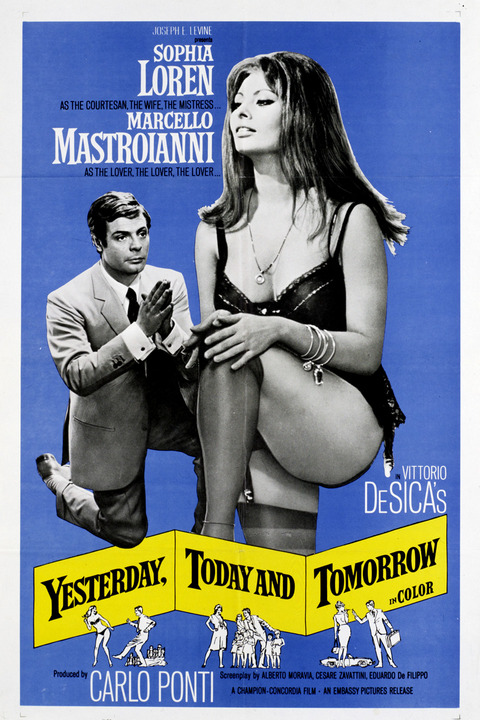
This is a delightful comedy that won the Academy Award in 1964 for best foreign film. It consists of 3 vignettes all starring Sophia Loren and Marcello Mastroianni and directed by the legendary Vittorio De Sica.

The first segment is entitled ‘Adelina’ and is a story about Adelina (Loren) who lives in poverty and sells cigarettes for a living. She is arrested for selling contraband products, but is released when it is found that she is expecting with the condition that six months after she delivers the baby she will be forced to serve her sentence. However, Adelina and her husband Carmine (Mastroianni) decide that the best way to avoid the sentence altogether is by keeping her continuously pregnant. Once she delivers one child she immediately gets pregnant with another, which creates overcrowding as well as an exhausted Carmine.

This segment is original and amusing throughout. Watching them trying to handle and maintain a household with such a large brood has its share of funny moments including one scene where Adelina tries to give one of her petulant children his medication. This setting vividly shows the poor side of Italian society, but unlike De Sica’s neo-realist films of the 40’s this one has a very engaging and even upbeat quality to it. The impoverished townsfolk become like a third character and their resiliency and support of one another proves to be a major plus to the story. Loren is fantastic in every scene she is in and makes this one special. Mastroianni is interesting playing against type as he is usually debonair and sophisticated, but here is simple and dominated.

The second story entitled ‘Anna’ deals with characters on the completely opposite end of the economic spectrum. Anna (Loren) is a spoiled rich woman who in an effort to alleviate her boredom with her husband who spends too much time working she has an affair with Renzo (Mastroianni). Renzo though fears that he is being used and that Anna has no intention of ever leaving her luxurious lifestyle to be with him.

All of the action takes place in a Rolls-Royce Silver Cloud III convertible as the two characters discuss their relationship while driving through the streets of Rome. This story is not as lively as the first and the characters aren’t as likable. However, the part where Renzo has an accident with the car and Anna’s reaction to it is quite funny.

The third and final act is entitled ‘Mara’ and deals with a prostitute named Mara (Loren) who becomes interested in Umberto (Gianni Ridolfi) a young man living next door with his Grandmother (Tina Pica) and studying to become a priest. The grandmother does not approve of Mara’s ‘profession’ and openly shuns her causing a major discord between the two, but when Umberto decide to drop out of the seminary the two work together to try and bring him back to his senses.

This story, like the first, has many amusing moments. Loren shows impeccable comic ability. I loved how the character goes from sexy seductress to a woman pleading with Umberto to go back to seminary and escape this ‘wicked world’. The shift between having Mara and the grandmother hating each other to becoming friends is equally funny. Mastroianni doesn’t have as much to do here, but still makes the most of it playing one of Mara’s customers who is just looking for a little sex, but is reluctantly thrown into the middle of the controversy.

This segment became famous at the time for a striptease that Loren does for Mastroianni. However, by today’s standards it is not much and hardly even seemed worth mentioning. I actually thought the part where Loren walks outside wearing nothing more than a towel and provocatively singing a flirtatious song to the young Umberto, who has a face that looks like it had not reached puberty, was much steamier.

My Rating: 8 out of 10

Released: December 19, 1963

Runtime: 1Hour 58Minutes

Rated NR (Not Rated)

Director: Vittorio De Sica

Studio: Embassy Pictures

Available: DVD, Blu-ray, Netflix streaming, Amazon Instant Video

Let’s Scare Jessica to Death (1971)

By Richard Winters

My Rating: 5 out of 10

4-Word Review: Crazy lady versus vampires.

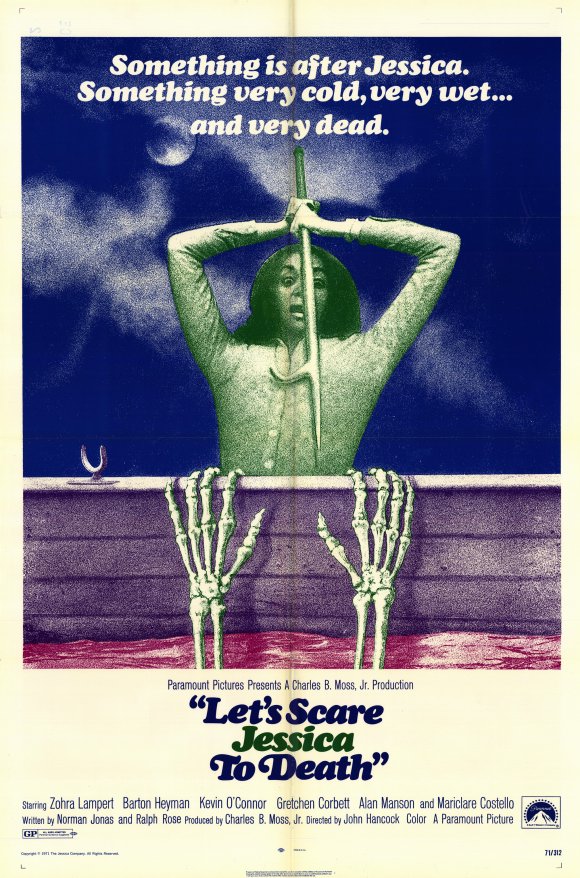
Jessica (Zohra Lampert) is recovering from a nervous breakdown and taken to a secluded Connecticut home for rest and recuperation. Here she starts to see strange visions, but nobody believes her making her the only one aware of the dangers that are brewing around them.

Haunted houses, ghosts, zombies, weird townspeople, madness, vampires, and even a tacky séance this film seems to want to take all the elements from other horror movies and mix it into one. The idea may sound great, but the approach is tepid. This may be due to its low budget, but either way the final result is unexciting. Yes it is creepy and eerie specifically at the beginning, but it never manages to get to the next level with no real scares or even a few minor ones.

The film is also slow with some stodgy drama used as filler. The special effects are minimal and the little that is shown looks unrealistic. Only at the very end do things start to get interesting.

Director John Hancock adds a little flair and had the script been able to reach the level of its scintillating title this film might actually have been special. His framing and photography of the outside of the old house is good. There is also a shot of an early morning sun rising off a foggy lake that makes for a perfect creepy atmosphere. I also like his placement of the howling wind and the whispering voices although he does go to this well a little too often.

One good reason to watch this film is too see Lampert. Although always a supporting player this was to date her only starring vehicle. She has a distinctive look and style that doesn’t match the glamour of a conventional leading lady. Her face exposes a nice fragility to the vulnerable character that she plays and her performance of a tormented person is excellent.

Although she has a pair of unique blue eyes like actress Meg Foster Mariclaire Costello, as the ghost/vampire, is just not frightening. The rest of the characters are boring and seem almost like stand-ins.

I got a kick out of the antique dealer (Alan Manson) who tells Jessica about the death of the original owner of the home that she is now living in. The tale is bland and transparent even though he insists, several times, that it is ‘quite extraordinary’.

Released: August 6, 1971

Runtime: 1Hour 29Minutes

Rated PG

Director: John D. Hancock

Studio: Paramount

Available: VHS, DVD, Amazon Instant Video

Misery (1990)

By Richard Winters

My Rating: 6 out of 10

4-Word Review: She’s his biggest fan.

Paul Sheldon (James Caan) is a writer who has just finished his latest novel. On the way back to his publisher (Lauren Bacall) he gets stranded in a freak snowstorm and ends up being ‘saved’ by Annie Wilkes (Kathy Bates) who is his ‘number one fan’. He is injured so she takes him to her nearby house where she proceeds to make him a helpless prisoner to her tormented and delusional mind.

The story has some interesting underlying elements. The film doesn’t really explore them, but does at least touch on it. It is the metaphor of the artist and the public. He is an educated man and yet his stories appeal to those with less education and what he puts into his work isn’t always what they take out of it. He doesn’t really like these stories and wants to expand his craft, but can’t because the formulaic stuff is what sells. In a way Paul was already trapped by Annie long before he ever got to her house and it is a sad dilemma a lot of artistic people have to deal with.
Bates as Annie plays the part really well. She is the ordinary, bland looking woman that you would never think about or consider dangerous. Her strange, erratic behaviors are slowly revealed until in the end the complete monster inside is unleashed. Screenwriter William Goldman, director Rob Reiner, and Bates herself show a good understanding of the character and what makes her tick. They create a woman who is complex, real, frightening, and at times even sad and pathetic.

Caan is a good competent actor however any one of number of actors could have played the part and maybe even done better. Yet you really sense and feel his confinement and ever growing frustration and when he finally revolts at the end you love it!

On the whole the thriller is pretty standard. There are some tense moments, but it is also routine and by the numbers. I thought it was too well lighted as a good psychological thriller always works best with a lot of shadows. The room Paul is trapped in looks more like it was done on a sound stage than in a real home and the film needed a few more unexpected twists.

My Rating: 6 out of 10

Released: November 30, 1990

Runtime: 1Hour 47Minutes

Rated R

Director: Rob Reiner

Studio: Columbia Pictures

Available: VHS, DVD, Blu-ray, Amazon Instant Video

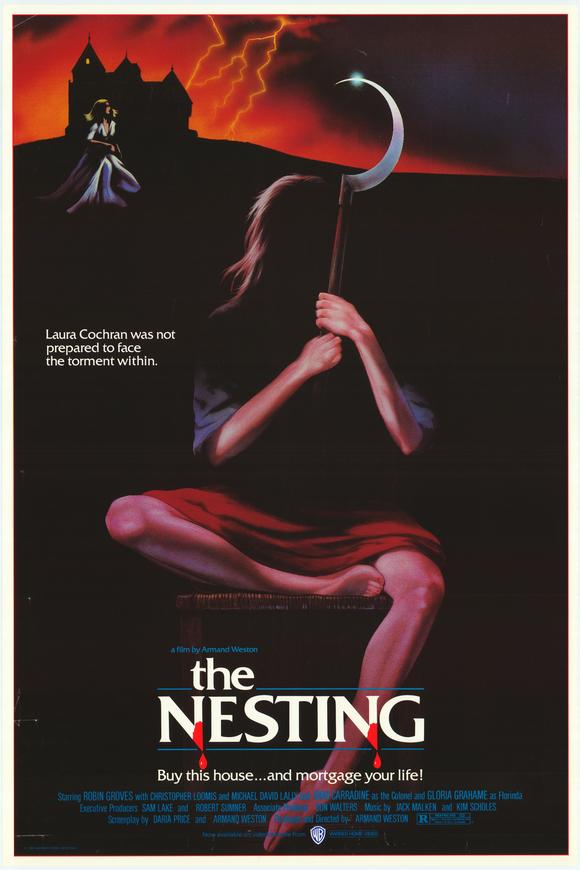
The Nesting (1981)

By Richard Winters

My Rating: 3 out of 10

4-Word Review: House haunted by hookers.

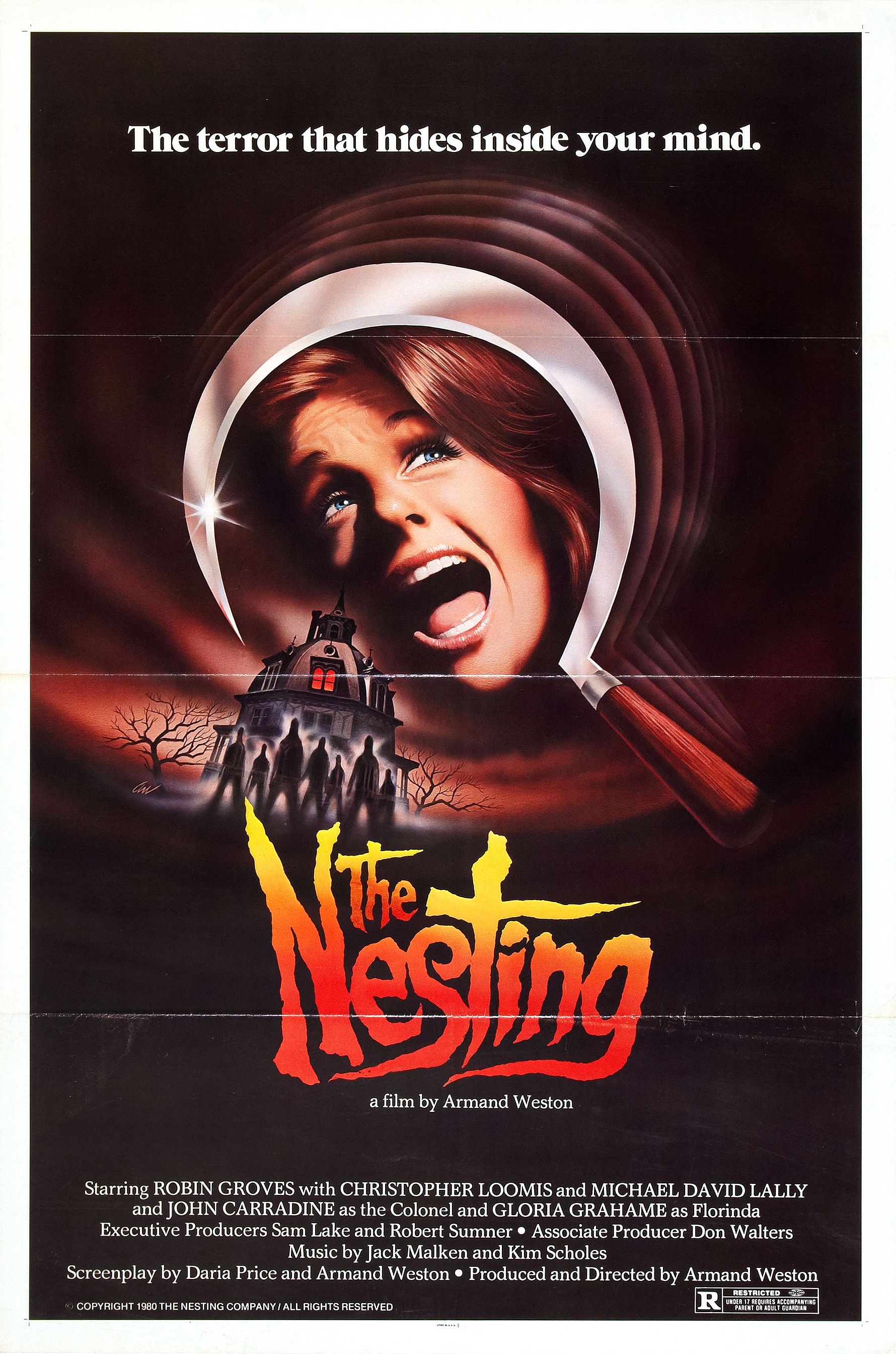
This review will start off a month long theme where in celebration of Halloween every 70’s, 80’s, and 90’s movie reviewed will be a horror one. This film sat in pretty much obscurity until being released by Blue Underground onto DVD and Blu-ray on June 28th. The story deals with Lauren (Robin Groves) a writer who rents an old house that looks strangely similar to the one depicted on the cover of her last novel. Eerie events start to happen and she learns that the building used to be a house of ill-repute and the prostitutes who were murdered there in cold blood are now coming back in ghostly form to seek revenge.

The film was directed by Armand Weston best known for directing porn movies during the 70’s including a couple of edgy, envelope pushing rape and revenge sagas The Taking of Christina and The Defiance of Good.  The directing here is competent enough that it is watchable, but the scares and horror is at a minimum. There are a few moments of creepiness and atmosphere, but it is not sustained and the film is unable to build any momentum, or suspense. The result is rather disjointed and unfocused. The premise borders on being campy and a 104 minute run time is way too long for a plot that offers a meager payoff.

Groves is an unusual choice for the lead. Usually films in this genre cast young college age girls in these roles with high sex appeal and skimpy outfits so that way they will be able to hold the viewer’s (males) attention during the slow parts of which there are many. Groves on the other hand is middle-aged, has an oversized mouth, and a hyper personality that seems better suited for comedy. She does end up having a nude scene, which isn’t bad, but I still felt she wasn’t the right fit.

I did like the idea that the character is given some unusual traits including suffering from agoraphobia (the extreme fear of the outside world) and a kooky creative personality that initially embraces the scares that she receives in the home because she feels it will help stimulate her artistic process. However, the film does not pursue these ideas enough and by the end seemed to have completely forgotten about them.

I was disappointed that Gloria Grahame an Academy Award winning actress was given such little screen time and actually doesn’t even utter a line of dialogue until the final 15 minutes of the movie. This woman was a leading lady during the 40’s and 50’s, but had the misfortune of marrying director Nicholas Ray and then having an affair with Ray’s 17 year old son from a different marriage. She eventually married the son and even had two kids with him, but the resulting scandal ruined her career and demoted her to B-movies afterwards. Still I thought she looked terrific and was better looking than Groves even though she was in real-life twenty-five years older than her. Her best moment is when she crosses a street and then gets hit in rather graphic fashion and run over by a speeding car that gets repeated several times.

Veteran actor John Carradine also appears, but I wished they hadn’t even bothered with him. He appears frail and elderly and speaks his lines in a mumbling fashion.

I did like that the movie was filmed on-location at the Armour-Stiner house in Irvington, New York. This is a unique domed octagonal residence built in 1860 and one of the few left standing. There is even an outdoor scene filmed on the home’s roof where Lauren’s analyst (Patrick Farrelly) falls from a ledge and gets impaled by a weather vane, which proves to be the film’s best gory moment.

The wrap-up and explanation for why Lauren was so strangely attracted to the home is actually kind of neat. I also liked the scene recreating the murderous events where everybody ends up getting shot one-by-one in slow motion. However, the script was in bad need of trimming and revision. There also should have been more special effects sprinkled throughout the production instead of just cramming them all in during the film’s fiery finale.

nesting

My Rating: 3 out of 10

Released: May 3, 1981

Runtime: 1Hour 44Minutes

Rated R

Director: Armand Weston

Studio: William Mishkin Motion Pictures

Available: VHS, DVD, Blu-ray, Amazon Instant Video

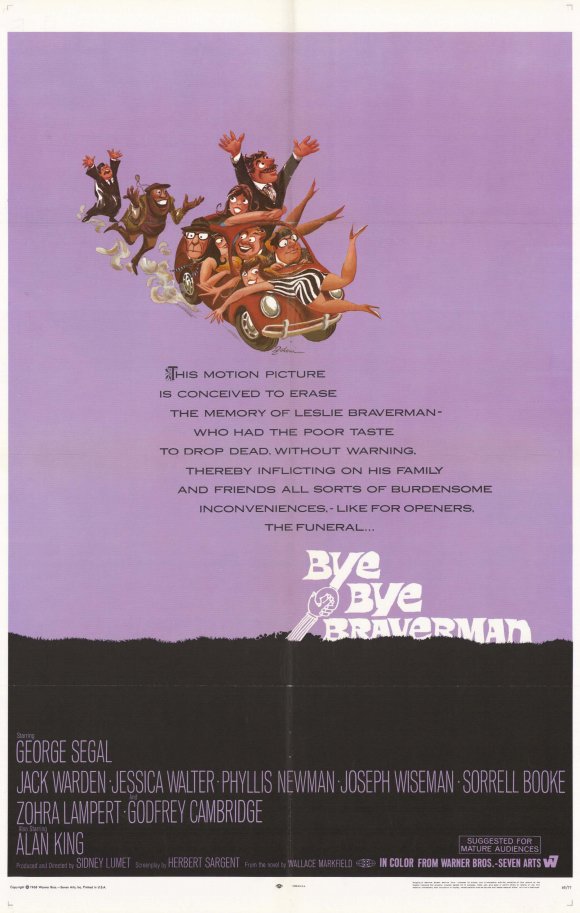
Bye Bye Braverman (1968)

By Richard Winters

My Rating: 6 out of 10

4-Word Review: Where is the funeral?

Four middle-aged Jewish men get together for a mutual friend’s funeral and find that the passage of time has changed many things between them.

There are some really nice vignettes here. The best may be Morroe’s (George Segal) conversation with all the dead people in the grave yard while amidst hundreds and hundreds of tombstones. You also have to love Alan King as the rabbi leading the funeral. Morroe as a middle-aged man becoming disillusioned with life while going through a sort of mid-life crisis is very relatable and his fantasy segments are funny. Godfrey Cambridge also has a great cameo as a black cab driver who runs into them and the group’s difficulties at finding the right funeral are amusingly on-target.

While the film does have its share of delightful moments it fails to ever come together enough to leave any impact. Some of the segments are too talky and the ending fizzles badly. There is also an extraordinarily high amount of footage given to showing a bird’s eye view of the red Volkswagen that they are in driving through the streets of Brooklyn. In some ways this does give one a great glimpse of Brooklyn during the late 1960’s, but it also screams ‘filler’ in the process.

This definitely seems to be the case where the novel by Wallace Markfield that this movie is based on would be the better choice. It’s certainly watchable and mildly entertaining, but the characters and situations need to be better fleshed out.

My Rating: 6 out of 10

Released: February 21, 1968

Runtime: 1Hour 34Minutes

Rated NR (Not Rated)

Director: Sidney Lumet

Studio: Warner Brothers/Seven Arts

Available: DVD (Warner Archive)

El Topo (1970)

By Richard Winters

My Rating: 7 out of 10

4-Word Review: Lust is not good.

This is an experimental film that has received a large and loyal following. Although considered highly controversial at the time it is pretty tame by today’s standards. The story deals with a mysterious gunman named El Topo (Alejandro Jodorowsky) who comes out of nowhere to avenge a town that has been massacred. Once finished with this he takes the perpetrator’s women and goes off into the desert. Here he must prove himself against four different masters whom all appear to be invincible. Yet it is the women and his lustful desires that turn him into a victim. Defeated and demoralized he turns to spirituality and ends up fighting to save some deformed people from a town that has barricaded them into an underground cavern.
The blood, violence, and sexuality are no big deal. The special effects are weak and the editing is choppy. In many ways it comes off looking like an amateurish artifact from a bygone era. Yet content wise it is fascinating and Director Jodorowsky shows a unique and definite talent. It bites off more than it can chew especially with its low budget, but it is far from a failure as certain scenes are guaranteed to leave a strong impression.
It has a reputation of being convoluted, but I found it to be quite lyrical. Once one adjusts to its mesmerizing use of symbolism it becomes almost riveting. The heavy allegorical nature is both intriguing and provocative and the unique vision helps raise it well above the fray.

If nothing else it will keep you engaged. It is fun and interesting to see one man go through such different stages and it effectively gives you a complete understanding of him by showing all the different sides to his personality. Besides having a lot of religious correlations and an overall negative view of women there is also, surprisingly, a lot of comedy and lightheartedness.

It does fail to leave an overall strong impact and the tone is cold and alienating with characters that are unpleasant. I also felt it gets too bogged down with its use of symbolism and need to build everything up to epic proportions is overdone. Still for those that like movies that are weird and different they won’t be disappointed. The castration of a pompous colonel is amazing. The showdowns with the masters are memorable and the game of Russian roulette amongst a group of churchgoers isn’t bad either.

The film promotes a rather curious statement made by its director and used as a tagline on most of its posters and box covers. It states “If you are great ‘El Topo’ is a great picture. If you are limited than ‘El Topo’ is limited.” This statement has always struck me as funny because it allows no room for anyone to criticize the film otherwise they will be labeled as ‘limited’. In any case I give this film 7 out of 10 points, which I guess only makes me 30 percent limited.

My Rating: 7 out of 10

Released: December 18, 1970

Runtime: 2Hours 5Minutes

Rated: NR (Not Rated)

Director: Alejandro Jodorowsky

Studio: Douglas Films

Available: VHS, DVD, Blu-ray

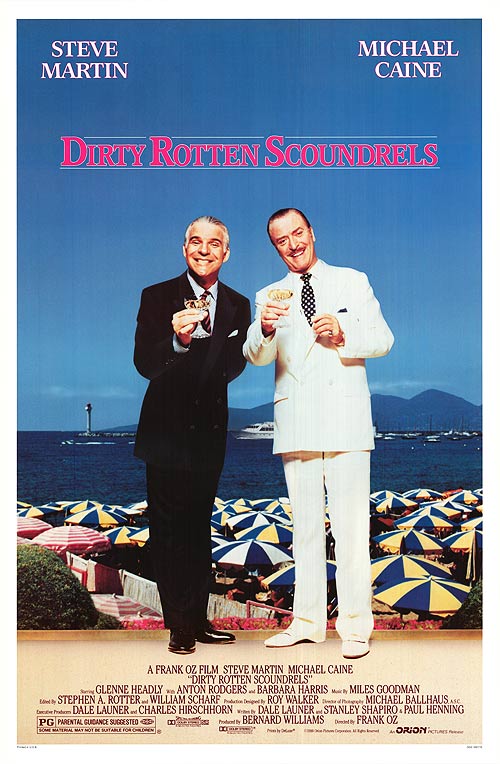
Dirty Rotten Scoundrels (1988)

By Richard Winters

My Rating: 7 out of 10

4-Word Review: Don’t trust these guys.

Freddy (Steve Martin) is a small-time con able to trick women into paying for his meals and sometimes even into their beds, but he is nothing compared to Lawrence (Michael Caine). This is a man that lives in luxury all from money that he has duped from rich women. Freddy decides to team up with Lawrence to learn his craft. The two work together for a while with Freddy playing Lawrence’s crazy younger brother, but the two have a falling out and end up becoming rivals instead. They meet Janey Colgate (Glenne Headley) the supposed daughter of a rich soap manufacturer and compete to see who can con her out of $50,000.

This version is far superior to Bedtime Story, which was reviewed yesterday. The pace is snappier and gets into the scenario more quickly. The scenes are consistently amusing and everything is handled at a slick level. The women aren’t all portrayed as naïve idiots like in the first and in certain cases they are just as corrupt and greedy as the two men. The music is bouncy and playful and helps propel the movie along.

Although both films were shot along the French Rivera this one does a better job of capturing the sunny and exotic locale. When Freddy visits Lawrence at his mansion and looks out at his exquisite seaside view and says ‘I want this’ I felt like saying ‘I want it too’.

I wasn’t sure Martin could top Marlon Brando’s performance from the first film, which was the only thing good about it, but he does. It took a little adjusting at first, but Martin takes the reins and in his usual style makes the part his own. His best segment is when he is in jail and can’t remember Lawrence’s name, which makes terrific use of his improvisational skills. The part where he asks to go to the bathroom is a little bit gross, but funny as well.

Caine is excellent is his part and gives the role more panache than David Niven did in the first one. He even puts on an effective German accent during the segment where he pretends to be a famous German psychiatrist. Believe it or not the parts of Freddy and Lawrence were originally intended for Mick Jagger and David Bowie.

Headley is good in her role as well. She has an attractive quality about her that is distinct and natural and avoids the plastic Hollywood starlet image. Her voice borders on being a little nasally, which could have become annoying, but with this type of part it works.

The best thing about this version though is the twist ending, which helps to maintain the slick level throughout the entire duration of the story. In the first version the ending was highly contrived and unimaginative as well as going against the personalities of the characters. Here it hits-the-mark and works as a nice payoff to the rest of the film.

The only critical comment I have about the movie is that it goes on a bit too long. 110 minutes is too extended a runtime for light comedy.

My Rating: 7 out of 10

Released: December 14, 1988

Runtime: 1Hour 50Minutes

Rated PG

Director: Frank Oz

Studio: Orion Pictures

Available: VHS, DVD

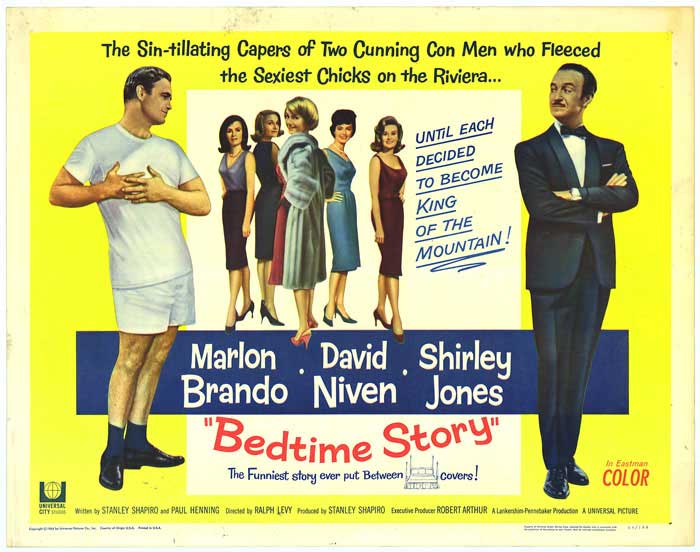
Bedtime Story (1964)

By Richard Winters

My Rating: 5 out of 10

4-Word Review: Con men fleece ladies.

Freddy Benson (Marlon Brando) enjoys conning his way into women’s beds. He uses all sorts of different ruses and has become so good at it he’s made it into a full-time profession. Then he meets Lawrence Jameson (David Niven) and is impressed because not only is Lawrence able to woo them for sex, but he is also able to get into their finances as well. The two work together for a while, but then there is a falling out and they become rivals instead. Along comes Janet Walker (Shirley Jones) a single woman with a supposedly rich father. The two then compete to see which one can con her best.

The movie itself is so-so, but Brando’s performance is excellent. He is far better known for his brooding dramatic performances, but the guy is amazingly engaging here. I loved every scene that he was in and found him to be consistently amusing. I was impressed with how at ease he was in doing comedy and this is a must for all Brando fans as you will see him doing something completely different from anything else he has done. I came away feeling he was perfect for comedy and wishing he had done more of it in his career.

The story though is contrived and formulaic in the worst way. The first hour is particularly tough going as the schemes the two men play are rather lame and something a fifth grader could see through. The women are portrayed as being utter morons and apparently so good-hearted that they will fall for any trick in the book. It would have given it a better balance had a few of them become wise to the men’s antics, but the fact that none of them do makes the whole thing seem horribly stereotyped and insulting to females everywhere. The humor is trite and unsophisticated and it should come as no surprise that the script was written by Paul Henning known for such ‘classics’ as ‘The Beverly Hillbillies’.

If you survive the boring and silly first hour things improve slightly during the second. The antics that Lawrence and Freddy pull on Janet are a little more clever and it is fun to see how each tries to one-up the other. Freddy pretends to be a man stricken to a wheel chair after he becomes traumatized from the rejection of a woman he loved. The only person who can cure him is a famous, but expensive psychiatrist that gets played by Lawrence. Larwrence’s initial examination of Freddy is funny as is the part where Freddy and his wheelchair go wildly out-of-control and crash into a countryside barn.

I was disappointed that there was no twist ending here as I was starting to think there would be and defiantly should have been. Instead it is just another ‘happy’ hollow Hollywood ending that was typical for that era and solidifying this as an empty lightweight exercise that barely deserves any attention at all if not for Brando’s performance.

In 1988 this film was remade as Dirty Rotten Scoundrels that starred Steve Martin and Michael Caine. That film will be reviewed tomorrow.

My Rating: 5 out of 10

Released: June 10, 1964

Runtime: 1Hour 39Minutes

Rated NR (Not Rated)

Director: Ralph Levy

Studio: Universal

Available: VHS 

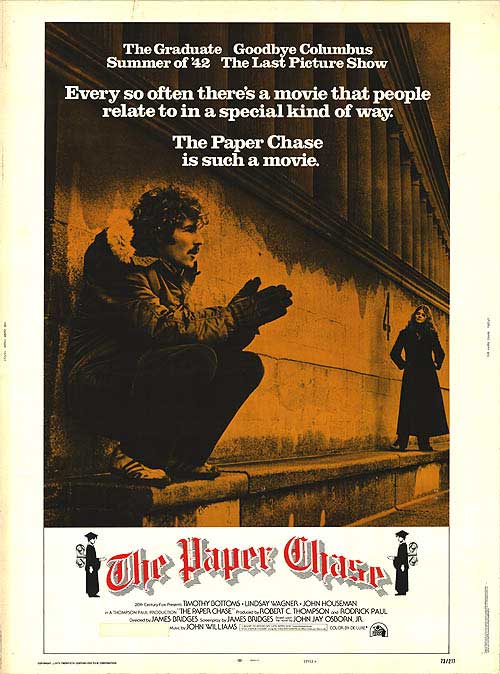
The Paper Chase (1973)

By Richard Winters

My Rating: 9 out of 10

4-Word Review: He can’t please Kingsfield.

James Hart (Timothy Bottoms) attends his first year at Harvard Law School and finds himself obsessed with the notoriously stern Professor Charles Kingsfield (John Houseman). His fascination increases after he begins a relationship with Kingsfield’s daughter Susan (Lindsey Wagner). The rest of the story deals with the pressures and demands of being a law student.

This quite possibly is the quintessential movie about college life. Everything is captured in such a real and revealing way that it will very likely send the viewer back to their college days. Despite being nearly forty years old it doesn’t seem dated at all as it touches on many universals that every generation goes through at that age. If anything it is still quite topical. The few dated elements are actually fun to see including the scene in the pre-cellphone days where the students would line up and wait their turn to make a call on the dorm’s one and only pay phone.

The student characters have diverse personalities and seem like young adults one would meet during their college days, or even see on a campus today. It is nice to have a college movie where students are actually studying. In fact these scenes are some of the best moments in the film including Hart’s dealings with difficult people in his study group.

The Hart character is appealing and relatable. I liked how he is multi-faceted and displays elements from both his own era including his counter-culture hairstyle as well as past ones.

Having it filmed on-location and capturing the different seasons of the year makes the viewer feel like they are attending the school year right along with him. I particularly liked the scene shot in the historic Harvard stadium.

The film also makes terrific use of silent moments as there is very little music. Many college movies dwell on the loud and raucous partying, but there is a lot of quiet time as well particularly the first day of class in a large auditorium wondering what the instructor will be like. The opening sequence done underneath the credits showing an empty classroom quietly filling up with students was not only novel, but brilliant.

Houseman deservedly won the Oscar for his portrayal of the crotchety professor. Outside of a small and unaccredited role in Seven Days in May this was technically, at age 71, his film debut. Some may complain that the character is one-dimensional. We are never shown any type of softer side to him and I am sure most films would have thrown some in, but the fact that they don’t do it makes his mystique more interesting. My favorite moment of his is when at the end of the year the students give him a standing ovation while Kinsgfield responds with his trademark scowl before walking out of the room.

The supporting cast of students is terrific and many were making their film debuts. There is Graham Beckel as Hart’s study partner Franklin Ford who looks like a twin of Brad Dourif. There is also Edward Herrmann and James Naughton as Kevin Brooks a man with a photographic memory, but no analytical ability. My favorite though was Craig Richard Nelson as the moody and belligerent Willis Bell.

Blair Brown can also be seen as one of the female students during the classroom scenes. She speaks in a strange accent and I think she was trying too hard to get the Bostonian sound, but I ended up kind of liking it anyways.

The implementation of Kingsfield’s daughter into the story really didn’t work with me. Lindsey Wagner is a competent actress, but the way they meet on a sidewalk seemed too forced and random. It is also beating extreme odds that Hart would by chance get into a relationship with the daughter of a man that is the complete center of his universe and the fact that she turns out to be hip, sexy, and gorgeous even though she is related to a man who is anything but was also a stretch. It would have been interesting had there been a few scenes and dialogue between Kingsfield and Susan, but none is ever shown.

There is a part involving Hart sneaking into the library when it is closed in order to get into a section that houses the notes taken by the professors when they attended the school as students, which I found to be odd. I have never known any college that has done this and talking with others no one else has either. I was still willing to roll with it but found it frustrating that when Hart takes out the notes written by Kingsfield in 1927 that the camera doesn’t focus in on the page to allow the viewer to see it for themselves. Having Hart simply describe what he sees including some doodling that Kingsfield apparently made on the side of the page is not as satisfying.

I had a few problems with the end as well although it was not enough to ruin what is otherwise a great movie. However, there is a scene showing Kingsfield grading his student’s tests by himself even though most tenured professors who teach large classes have graduate assistants do this for them. It may be more cinematically satisfying especially for the general viewer to see Kingsfield doing the grading, but that is not how it actually works.

Also, when Hart receives the grades in the mail he doesn’t bother to open the letter, but instead turns it into a paper airplane and floats it into the ocean. I didn’t understand the motivation of this because during the film Hart spends an enormous amount of time preparing for the test, so I would think anyone who went through that would want to see what they got. If he wants to turn it into a paper airplane afterwards that is fine, but at least see the results. I spoke to a fan of the film who says he interprets this scene to mean that Hart was more interested in learning the subject for his own enjoyment and not concerned with what he got out of it, but if that is the case the film fails to bring that out earlier and instead seems to show the exact opposite.

My Rating: 9 out of 10

Released: October 16, 1973

Runtime: 1Hour 53Minutes

Rated PG

Director: James Bridges

Studio: 20th Century Fox

Available: VHS, DVD, Amazon Instant Video