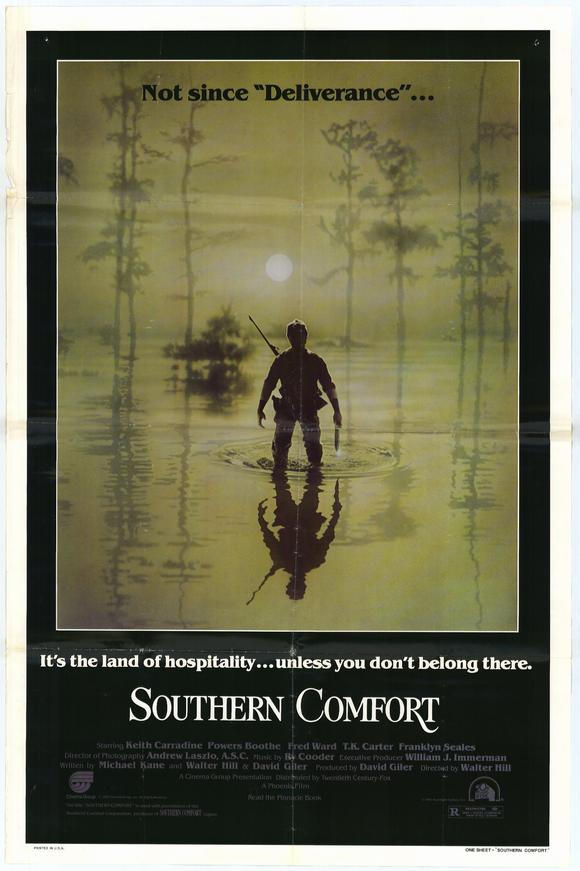
A National Guard unit goes on a training exercise in the Louisiana swamps and finds themselves fighting for their lives from a group of vindictive Cajuns that lurk in the woods.
Just about all the characters are obnoxious, unlikable, and incredibly ignorant. These guys have to be the most undisciplined and poorly managed guard unit out there. It becomes like a comedy of errors and one almost begins to side with the Cajuns. The suspense ebbs and flows poorly and most of the time there is no tension at all. The final sequence takes too long to play out until you end up not caring what happens. It would have been better had the Cajuns not been so hidden and given a face and some distinction. It also would have been a better atmosphere had the story taken place in the summer instead of the winter. The film though is really hurt by the fact that it is too reminiscent of Deliverance which is a better film simply for the fact that it created a more lasting eeriness. Also, the sequence involving the killing and gutting of what looks to be a wild hog is just about as gruesome and graphic as the infamous turtle killing scene in Cannibal Holocaust.
On the positive side there is one good scene involving a very intense attack by a group of vicious dogs as well as a nicely photographed knife fight between actors Powers Booth and Fred Ward. The Cajuns are portrayed as being more cunning and clever than in Deliverance, which makes this a little more of a slick thriller. Ward is very good in his role as one of the surly soldiers and Keith Carradine is surprisingly engaging in his part.
Ultimately this is a grade C Deliverance that despite some good attempts just never comes together. It would be best to just watch the original and avoid this one completely.
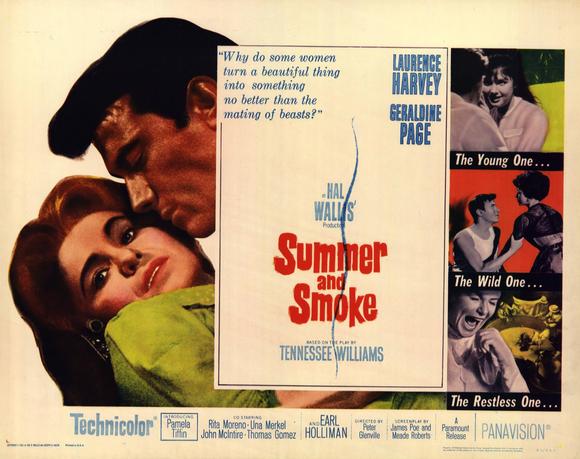
Alma (Geraldine Page) is an adult woman still single and living with her parents. Her father (Malcolm Atterbury) is a minister while her mother (Una Merkel) having suffered a mental breakdown several years’ earlier acts and behaves in a perpetual child-like state. Alma yearns for the affections of John (Laurence Harvey) the dashing doctor who lives next door with his father (John McIntire). However, John’s lifestyle is much too wild for Alma’s repressed tastes, but when she tries to change she finds that it may be too late in this film version of the Tennessee William’s play.
I have been a fan of Geraldine Page for years. She has a terrific ability to play fragile and eccentric characters while doing it with a panache and style. Her characterizations are always vivid and revealing and executed in a seamless fashion. One can become so entranced with her performances that sometimes it becomes more interesting than the story itself. Her appearance here proves to be no exception. She became known for playing a lot of dark, sinister characters, so it was a nice change seeing her play this part. She even does some singing and in fact the scene where she sings to John’s father as he lies on his deathbed for me left the most lasting impression. I always love watching the woman’s body language, gestures, and facial expressions and how she uses them to create a three-dimensional character. Her acting discipline should be studied and emulated by students of the craft everywhere.
Harvey as her co-star was an interesting choice. Despite his reputation as being an over-rated actor and possessing a strange personality off-camera I have found some of his performances to be excellent particularly the one in the original Manchurian Candidate. However, he seems to be better suited playing parts with a cold and aloof presence. The role here demanded more emotion and I didn’t think he could quite hit it. By the end Page was acting circles around him and turning the production into her own vehicle.
The supporting performers aren’t bad. It is fun seeing Rita ‘Hey you guys’ Moreno in an early role playing a young vixen with eyes for John. McIntire is fine in his small role and the part where comes home to find all sorts of drunken people lying about passed out in his living room and hallways is good. Thomas Gomez is memorable simply to glimpse his large almost unbelievable waist size.
I really didn’t like Merkel’s part as the crazy mother. I found it frustrating that there really was never any explanation for why she behaved in such a strange way. Simply saying that she had a ‘breakdown’ wasn’t enough and I wanted more of a scientific or medical reason. It also would have been more interesting to see what she was like before her breakdown, but that is never shown.
Technically the film is well produced. The sets, costumes and performances are all very turn-of-the-century and it helps draw you into the mood and thinking of the era right away. I did not like that the outdoor scenes where done on a soundstage as the foliage and sky look annoyingly artificial.
Most of William’s plays deal with sad, lonely, and pathetic characters and this one proves no exception. However, I was pleasantly surprised that after the expected histrionics this one manages to have a somewhat upbeat ending, which helped distinguish it above some of his others. The characters and situations are all too real and Alma reminded me very much of someone I know and others may know someone like her as well, which on a personal level made this story all the more fascinating.
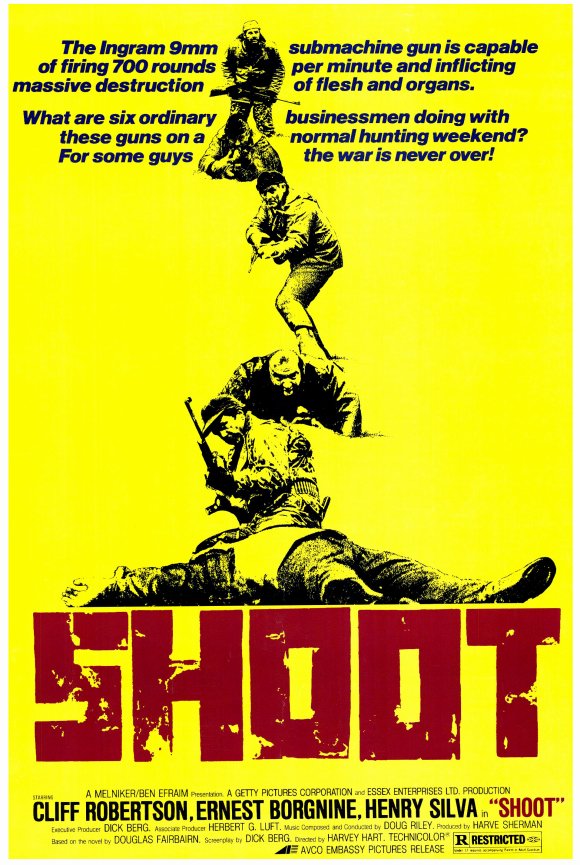
Rex (Cliff Robertson) is a man who really enjoys hunting and especially likes his guns, just watch the way he cleans and caresses it at the beginning, it’s almost obscene. He takes his buddies out on a hunting party in the woods. They come upon a group of other hunters and for some inexplicable reason they begin shooting at each other until one of the men in the other party dies. Rex and his group go back home sure that the police will be contacted and an investigation to pursue, but that doesn’t happen, so Rex thinks they are out for revenge instead. He becomes convinced that the other party plans to attack his group at the exact same spot the very next week. He gets his men ready for battle and dressed in army gear as they prepare for what they believe will be all out warfare.
Part of the problem with this film, which is based on the novel by Douglas Fairbairn, is that it doesn’t make any sense. Rex and his buddies meet the other party from across the river and then the two groups proceed to just stand there in silence like zombies before all the shooting breaks out. There is no reason for why any of it happens and I found it hard to believe this could ever occur in real-life. I am not a hunter myself, but I presume different hunting parties come into contact with each other all the time and it doesn’t end up with them trying to kill each other. I would also think that they may politely greet each other and share some sort of brief conversation in passing. Having all the men not say anything seemed odd and unfounded. The story would have made more sense had the groups spoken to one another and then somebody said something that was insulting and then it escalated. Doing it the way it is done here seems stupid and it is hard for any viewer to get into the plight of characters when there is no reasonable motivation.
The logic for the second half of the story works just as strangely. There is absolutely no reason to believe that the other hunters are planning any type of revenge at the same spot for the next week. The men don’t even know who any of them are. It would have worked better had the other group sent Rex’s group some sort of threatening message, or harassed them in some way to make the threat more real. Watching them prepare and discuss at length for a battle that may never occur is a waste not only of their time, but the viewers as well.
In between there is a long, boring middle part, which includes a scene where Rex visits the widow (Kate Reid) of the man that his group shot while under the pretense that he was an old friend of the deceased. Reid gives an interesting performance, but having her come on to Rex so shamelessly and even tells him that she wasn’t wearing any underwear seemed absurd and unnecessary. A similar scene happens in Rex’s office when the wife (Helen Shaver) of one of his friends aggressively flirts with him as well. Neither of the scenes helps propel the story, or characters and just another clue of a sloppy and unfocused script. There are a few too many shots exposing the boom microphone making me wonder if director Harvey Hart was only going through the motions on this one.
Robertson and Ernest Borgnine as Rex’s friend Lou are adequate, but the characters are painted in one-dimensional ways. The hunters are portrayed as violent prone loons with a penchant for shooting at anything and unable to display any type of sophistication, or rationale. The ultimate anti-gun, anti-violence message is heavy-handed and predictable. This was a trendy theme during the 70’s, but there had been so many better films on the subject that the producers shouldn’t have even bothered to make this one.
The on-location shooting in Ontario, Canada is poorly done. The buildings used for the interior scenes are dull and unimpressive with no visual style or sense. The outdoor scenes are flatly shot and done in the dead of winter, which gives the film a very brown, gray, and drab look. It would have been better had this been done in the summer as the green foliage would have been more scenic. There is also the issue of snow cover. On the first Saturday during their initial hunting trip there is no snow, then on the following Tuesday when Rex visits the grieving widow of the man that they shot there is a good six inches of the white stuff. Then on the following Saturday when they meet in town to get ready for their trip the snow is all gone only to again appear when they get to their hunting site.
I did like the solo trumpet soundtrack although it gets overplayed. The unexpected violent ending is indeed a surprise, but only helps in creating more loopholes. This was another attempt at cashing in on the success of Deliverance by coming up with a similar theme, but lacking the superior execution of the original. Another Deliverance-rip-off that came out in the 80’s Southern Comfort will be reviewed on Monday.
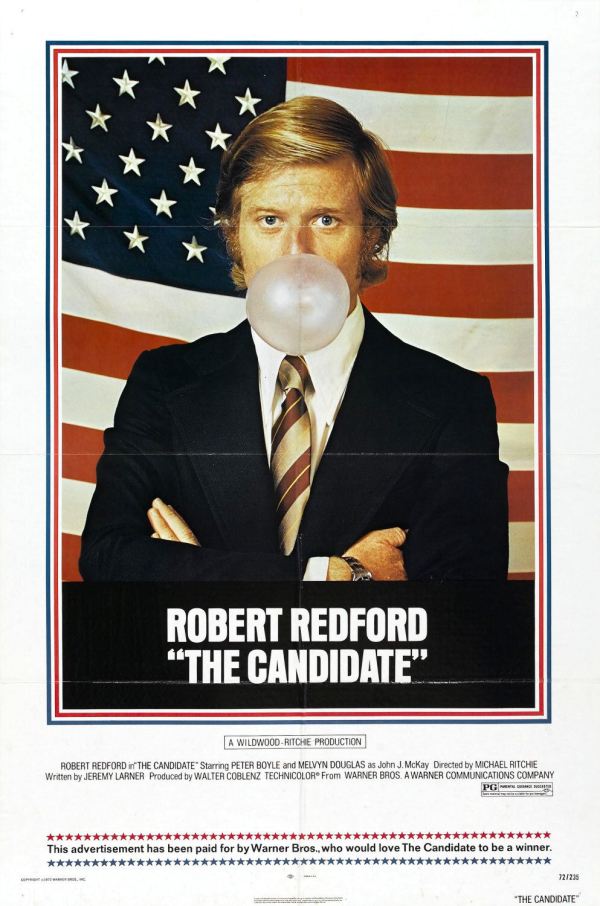
In commemoration of Election Day and the fact that all the campaigning and political punditry will finally be coming to a merciful end we present a rare Tuesday post here at Scopophilia. Although done 40 years ago this wry look at the inner-workings of the political campaign trail is as incisive and timely as ever and hasn’t lost any of its punch. The story deals with Bill McKay (Robert Redford) a young lawyer from California who is persuaded to run for senate against the incumbent Crocker Jarman (Don Porter). McKay represents the youthful idealism while Crocker is very entrenched with the establishment.
The film was directed by Michael Ritchie who may not be a household name, but he is the creator of his own genre. He took the examination of competition and how embedded it is in American culture to new heights. Through his various movies he showed how it infiltrates every aspect of our society and no one is immune to it. From Smile to The Bad News Bears and Downhill Racer he showed how even the most unlikely of individuals can become fiercely competitive when driven. He also made his characters strangely endearing no matter how sordid or ugly the competition made them become.
This film works along those same lines only it shows it from a political perspective. It is smart, fast, cynical, funny, dramatic, revealing, and entertaining all at the same time. This should rank as one of the best movies made about political campaigning. It’s still timely and cutting edge and works almost like a documentary. The quick editing creates a seamless style. The film makes interesting observations without taking away from the flow of the story. In fact one of the reasons it is so captivating is because it is downright educational. When the film is over you feel much wiser to the business of politics and as exhausted as the candidate himself.
Redford is terrific. He has a real gift for underplaying everything to the point that it looks like he isn’t even acting at all. He plays off his pretty boy looks, but doesn’t stay trapped to a heroic image. He harbors a lot of idealistic traits one would want in a candidate and yet he is still quite human. There are some definite shades of John F. Kennedy here. He has a troubled marriage and is even caught fooling around with an admiring female supporter. Although he has honorable ideas he is far from having all the answers. Probably the most interesting insight of this movie is the fact that he ends up getting as sucked into the mechanics and compromises of the political machine as his ‘old school’ foe. It perfectly illustrates how immense and encompassing the political machine is and how no one is really going to change it.
This is an excellent and well-crafted picture that not only hits the bulls- eye, but does it many times over. I love Redford’s final line and Boyle, as his campaign manager, has never been better.
It’s an extraordinary achievement that this actually got made. It’s a relic of its time that is beyond words and is like nothing you have ever seen or will ever see again. This is one of those bad movies that you just have to see and, for a while, even enjoy in all its awfulness as it tells the story of the Village people and their rise to fame.
Unfortunately it’s not overdone enough to achieve that coveted cult status. The humor isn’t corny enough the storylines are not dumb enough and the costumes are not gaudy or the sets garish enough. They don’t even let the Village People try to act and make complete fools of themselves. They do have some speaking lines, but they are wisely brief. Eight minutes is all you need of this phenomenon before its long takes and general empty headedness become overwhelming.
Steve Guttenburg is probably the most annoying even more than he usually is. He is too clean cut and eager to please and his swift rise to success is artificial. The songs he writes are bad even for disco. Hearing lines like “he’s a genius” and “he knows what people want to hear” are probably the film’s single most insulting element.
Most youth oriented movies don’t cast too many older actresses, but this one does. Tammy Grimes, June Havoc, and Barbra Rush put a lot of energy into their parts and in the case of Grimes a lot of camp too. It’s a strange sight to see these three jump onto stage and line dance with the Village People during their last number. Paul Sand is fun in a part that goes against his persona as he plays an aggressive, no-nonsense record producer. Even Bruce Jenner, and I hate to say it, has his funny moments as an uptight lawyer. Yet it is Valerie Perrine that comes off best as her down to earth sensibilities helps to hold the whole thing together.
It is hard to tell what type of audience this film was aiming for, or even what the thinking was. The overall banality seems best suited for pre-teen girls yet the gay overtones snub that. Anyone over sixteen just isn’t going to buy into it and having the whole thing directed by 60-year-old Nancy Walker best known for play Ida Morgestern on the TV-Show ‘Rhoda’ makes it even more confounding. Even members of the Village People have stated in interviews that they dislike this movie. The only possible explanation is that it was made by people on cocaine for other people on cocaine.
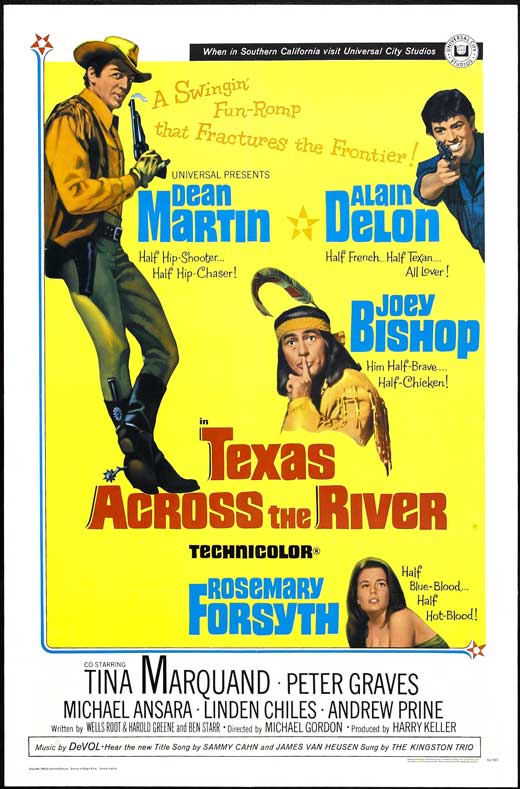
This is a silly western spoof that borders on the inane and is just an excuse to give Martin another vehicle this time in a western setting. The story deals with the wedding between Don Andrea (Alain Delon) and Phoebe (Rosemary Forsyth) being stopped by the arrival of the U.S. Calvary headed by Captain Stimpson (Peter Graves). When they charge Don with murder he escapes to Texas and Phoebe tries to follow him later on. There she meets Sam Hollis (Dean Martin) and his Indian sidekick Kronk (Joey Bishop). Sam becomes smitten with Phoebe and when he later meets up with Don the two become instant rivals while reluctantly working together to allude the Calvary, which arrives in Texas to celebrate its statehood.
In many ways the production takes on Martin’s persona as everything is half-hearted. The humor and scenarios are quite standard. There are a few chuckles here and there, but more misses than hits. It’s so obvious when the actors are standing in front of a blue screen or using a stunt double that it almost looks like an amateur college production. The biggest insult though is that it is all about Texas and yet wasn’t even filmed there. It was done in San Diego and it shows. This is almost like deceptive advertising and for punishment the producers should be forced to spend a summer in the REAL Texas without any air conditioning.
Delon’s presence is good simply because he is French and he gives it a unique flavor, but the film doesn’t portray him as such and instead tries to pull off that he is SPANISH!! He also gets to be too much of a brawny do-gooder and in the end he becomes like Dudly-Do-Right with a French accent.
Bishop is funny simply because he is playing himself. The credits may say he is playing an Indian, but really it’s just Joey in a silly Indian get up. His headband alone looks like it was taken from somebody’s unwanted tie collection. In fact the overall portrayal of the Indians is badly stereotyped and if the film was better known it might merit protesting.
Forsyth gives the film’s best performance. However, having Martin pursue her looks off-kilter since he was old enough to be her father and her and Delon made a better couple. Of course since this is Martin’s vehicle he ends up with her no matter how forced or unnatural it looks.
If you are really easy to please or just a Dean Martin fanatic then you might find this film more passable. The cheek slapping showdown between Martin and Delon is cute and the running joke involving that ‘Texas Tea’ isn’t bad either.
Look carefully for Richard Farnsworth is his first major role as he is almost unrecognizable as the Medicine man.
Bob (Murray Head) is having a relationship with middle-aged divorcee Alex (Glenda Jackson) as well as a family doctor named Daniel (Peter Finch). He jumps between the two of them whenever the mood hits. Both Alex and Daniel are aware of the other and are not happy about it, but feel if they push the issue Bob will simply leave them. The film focuses on the frustrations and loneliness that Alex and Daniel feel in dealing with Bob and their less than ideal situation.
This film is engrossing from beginning to end. Director John Schlesinger was still in top form as the camera work, cinematography, and editing is first rate. Everything is meticulously orchestrated to the point that every shot seems to tell its own little story. The narrative is done in a fragmented style going back and forth between the present day to scenes from when both Alex and Daniel were younger. Much of it comes off like thoughts going on inside someone’s head and the film’s style is masterful and flawless.
What I really liked about this movie is the fact that it focuses not so much on each person’s time with Bob, but actually more on their time away from him. The points this film makes about the difficulties of communication that people have when they are in a relationship as well the glass wall that sometimes gets created is completely on-target. The film’s subtitles and nuances are perfectly balanced and if you are a viewer with more sophisticated tastes then this will be time well spent.
Things are revealed about the characters through visual and subtle means, which I loved. When Alex drops an ashtray and then proceeds to clean it up simply by rubbing the ashes into her rug, or the precarious way she makes herself on cup of coffee in the morning while rushing off to work nicely reflects her out-of-control life and the topsy-turvy way she approaches it. The scenes where Daniel attends a Bar mitzvah is excellent and for me some of the strongest moments in the movie.
The portrayal of the children here is above average as well. They are not cute and well-behaved, but instead realistically rambunctious and mischievous. I liked the wild, endless energy that they display and how easily chaotic they turn their household into, or how the parents had become immune and deaf to all of it. Having the 4-year-old smoke pot while Alex and Bob, who are babysitting, decide to overlook it may be pushing things a bit far, but I still liked the mod approach the film takes, which reflects nicely the unconventional lives of the characters.
The film’s biggest flaw is Head himself. The man is mainly known for his singing career and his acting ability is clearly limited in comparison to Finch and Jackson who are both excellent. The character is dull and the film does not make much of an attempt to analyze him like it does with the other two. In a way Head’s one-dimensional performance works because the character seems to be used as a ‘pretty boy’ who the other two are attracted to because of his looks and youth and therefore revealing the insecurities that they have about themselves as well as giving a pertinent warning that when one pursues someone solely based on their sex appeal the relationship is doomed.
I liked how at the very end Daniel and Alex do meet and have a brief conversation though I wished it had been just a little more extended. Having Finch talk directly to the camera at the closing is a bit disconcerting though what he says is interesting.
My Rating: 9 out of 10
Released: September 8, 1971
Runtime: 1Hour 50Minutes
Rated R
Director: John Schlesinger
Studio: United Artists
Available: VHS, DVD, Blu-ray (The Criterion Collection), Amazon Instant Video
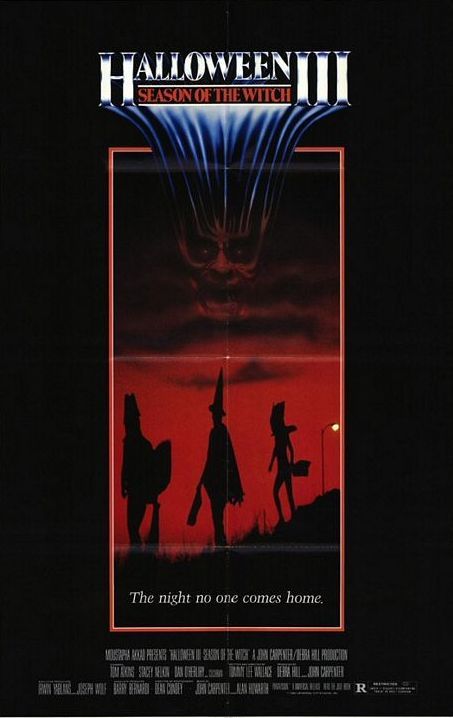
Dr. Dan Challis (Tom Atkins) is an emergency room physician treating a patient (Al Berry) who arrives in the facility clutching a Halloween mask and stating that someone is out to kill him. When the man does end up being killed Dan becomes suspicious that it may have something to do with the mask. He teams up with the victim’s daughter Ellie (Stacey Nelkin) and the two find that the trouble began when her father visited the Silver Shamrock factory. It is here that they meet the company owner Conal Cochran (Dan O’Herlihy) who turns out to be a maniacal man who has created Halloween masks that have a computer chip implanted in them that will kill the children wearing them.
Although listed as the third part of the Halloween franchise there is no Michael Meyers here, nor any of the other familiar characters. The idea was to continue the series by having creepy stories with some connection to the Halloween holiday released each year, but this film did so poorly at the box office that the idea was dropped. The original script by Nigel Kneale was meant to be a dark comedy, but producer Dino De Laurentis wanted to play it as a straight horror film and striped the screenplay of the humor. Had it been kept in the humorous vein it might have worked, but the idea is too ludicrous to be taken seriously with glaring plot holes that defy all logic.
One of the biggest ones is the fact that Cochran plans on killing the children by having them all watch an advertisement his company has created and will be broadcast on all the channels at 9:00 Halloween night. Supposedly there is some sort of signal in the ad that will set of the computer chips in the masks, which the children are all supposed to be wearing while they watch the ad that will kill them instantly while also creating deadly snakes and spiders in the process. How a computer chip could create live creatures is ridiculous enough, but the fact that somehow Cochran does this by using pieces of a Stonehenge rock that he has stolen is even more absurd. There is also the fact that if the commercial airs at 9:00 eastern time it would only be 6:00 on the west coast. Therefore the commercial would be delayed by four hours, which would be enough time for the authorities to figure out what was going on and pull the ad before it ever even aired in California and probably have Cochran under arrest by then.
There also the fact that Cochran seems to have no plan B here. The reason for why he is doing this is murky at best, but what he hopes to gain from it is even more elusive. There is also the question of how he plans to escape once it becomes obvious to everyone what happened. None of this of course is ever explained and these are just a few of a myriad of implausibilities that the story spits out. There are so many of them that they aren’t even worth explaining, but clearly any film that expects the viewer to overlook so many glaring loopholes is not good. The film is like a flimsy outline to an idea that no one bothered to think through with the details.
I was also unimpressed with the masks themselves and couldn’t understand why all the children would be so excited to have them. They looked like something one could pick-up at a cheap dime store and had nothing unique or distinctive about them except that they could supposedly glow in the dark. The factory where the masks where is made is equally unimpressive looking like an old, rundown, non-descript building that had no visual presence. I was expecting the building especially from a company that could create such a nefarious technology as these masks to be sleek, modern, and imposing, which would have helped create a more foreboding feeling. The commercial used to advertise the masks is unimaginative and cheap looking. The jingle used in the ad, which was set to the melody of ‘London Bridges’ because apparently that was under public domain at the time, becomes irritating to listen to and gets overplayed.
One of the few things that I liked about the movie was the fact that the protagonist was a middle-aged man instead of teenagers. The gruesome special effects are okay and veteran actor O’Herlihy shows enough sinister mugs to the camera to be fun. I also liked at the end how Ellie for some unexplained reason turns into a robot and keeps on attacking Dan even as he vigorously dismantles it.
Segments from the original Halloween can be seen in this one. The first time it is shown while Dan is watching TV at a bar it is a clever in-joke, but when it gets shown again near the end it becomes a mistake because it reminds the viewer how much better that movie is compared to this one.
My Rating: 2 out of 10
Released: October 22, 1982
Runtime: 1Hour 39Minutes
Rated R
Director: Tommy Lee Wallace
Studio: Universal
Available: VHS, DVD, Blu-ray, Amazon Instant Video
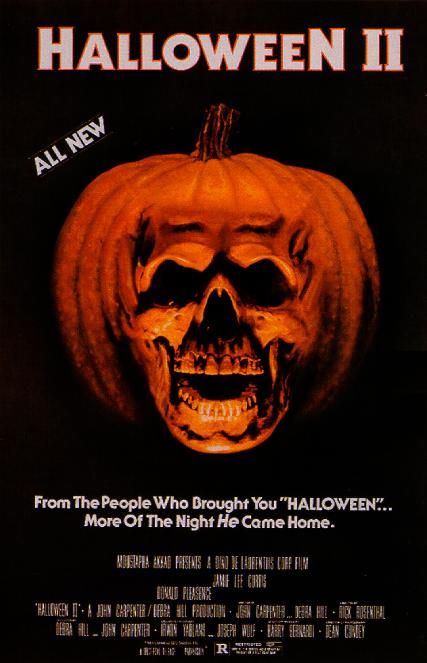
It’s still Halloween night 1978. Laurie Strode (Jamie Lee Curtis) is rushed to the nearby Haddonfield Memorial Hospital to have her wounds attended to while Michael Meyers (Dick Warlock) roams the streets. Eventually he becomes aware of where she is and stalks her in the hospital while killing off anyone who gets in his way.
The film starts out okay. I liked the camera closing in on the pumpkin during the opening credits and revealing the shape of a skull inside. A fiery car crash that burns a kid wearing a similar mask to Michael’s is effectively graphic and showing things from Michael’s point-of-view as he peers inside the neighbor’s homes has shades of Rear Window to it. However, I was confused why it wasn’t shown through the two eye holes of the mask since Michael was still wearing it and that was how it was done in the first film.
Things start to decline as it goes on and deviates too much to the standard slasher formula. I forget where I read it, but I remember somebody writing about the perennial characteristics of a tacky 80’s slasher film and one of them was having a scared cat jump out at someone some time during the film. The scene where the hospital security guard (Cliff Emmich) is going through the dumpster behind the building I started to think that this is the part for the proverbial scared cat and sure enough within seconds one jumps out pretty much cementing this for me as a second-rate shocker.
Donald Pleasance as Dr. Loomis is solid as always. The intensity that he displays is good and seeing him as a good guy for a change since the majority of his career he played dark and twisted characters is refreshing. Curtis is also good in the reprisal of her part, but for the first hour she barely appears at all. I was also confused with the scene where she for some unexplained reason falls into a comatose state and then just as strangely snaps out of it a few minutes later.
The Meyers character becomes a detriment here. Having him constantly getting shot at and then bouncing back up without any rational explanation was irritating. He gets around at too many different places and seems a little too slick. For instance he’s able to cut off the phone lines to the hospital in some unexplained way as well as slashing the tires of every single car in the hospital’s parking lot. Also, where does a guy who has been institutionalized since age six manage to figure out the meaning and origins of samhain, which is a word that he writes in blood on a wall of a classroom?
There are other loopholes as well. For instance the hospital seems extremely dark and shadowy. Most hospitals I have been to are always well lit inside especially the hallways, but here it is almost like there are no lights on at all. The part where Michael stabs a nurse in her back with a thin surgical blade and then is able to lift her from the floor with it is ridiculous because the blade just wouldn’t be strong enough. The knife that Michael steals from an old lady (Lucille Benson) when he sneaks into her house is different from the one that he jams into the desk of a classroom that he breaks into.
The extreme lapses of logic are a big problem. When the film starts to have no bearing in reality then I find it hard if not impossible to get caught up into it. Clearly the screenwriter and director were making up the rules as they went along causing the climatic sequence that should have been suspenseful to be, at least to me, boring and annoying instead.
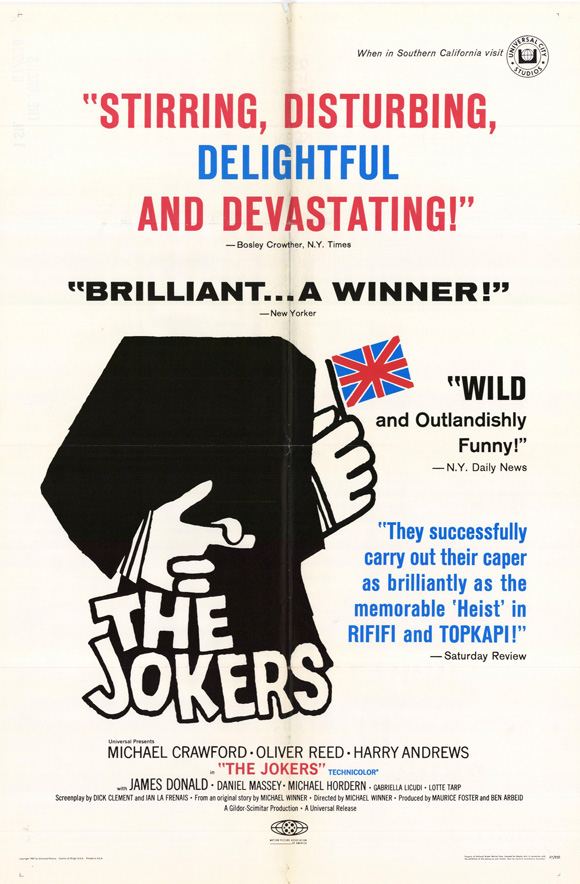
Brothers Michael (Michael Crawford) and David (Oliver Reed) decide that working life is not for them and come up with an elaborate robbery that will afford them enough money to drop out of society for good. Their plan is a clever one as they stage random bomb threats across parts of London, which creates a panic in the city. Then they threaten to blow up the tower of London, disguise themselves as military experts who can go in to diffuse the bomb and then run off with the crown jewels in the process, which they conveniently hide underneath the floor boards of their home.
The film has a great irreverent flair that was common amongst the new wave British films of the late 60’s. The quick edits, fragmented narrative, and quirky humor is similar to Richard Lester’s The Knack…and How to Get It, which also starred Crawford. The comedy, especially its potshots at the establishment, is right on target and engaging. I was surprised that it was directed by Michael Winner as so many of his later films, especially the ones he did with Charles Bronson, seemed so formulaic that I could never imagine he could show so much spunk and flair.
The crime is imaginative and plays out nicely. There is also a neat and completely unexpected twist near the middle that keeps things intriguing to almost the very end.
Crawford shows charm and his boyish looks help strengthen is character. He somehow manages to upstage Reed, which I never thought would be possible and his charisma carries the film. He does though look too scrawny and almost anorexic in parts and having him gain some weight and ‘putting some meat on his bones’ before filming began would have been advisable.
British character actor Harry Andrews is amusing as the exasperated Inspector Maryatt. However, I found James Donald as the completely clueless Colonel Gurney-Simms to be the funniest.
If the film fails anywhere it is in the fact that it loses its satirical edge and focus. It starts out making fun of the upper-crust English society, but then becomes too preoccupied with the crime itself. David and Michael’s interactions with their stuffy, conservative parents (Peter Graves, Rachel Kempson) are cute and I would have liked to see more of it as well as more jabs at ‘respectable’ society. The film’s conclusion is extremely weak. For such a clever movie I was hoping for something a little better. It is almost like they ran out of ideas and threw in some bland denouncement simply as a way to end it because they didn’t know how else to do it. Nothing is more of a letdown then seeing a writer write themselves into a hole that they can’t get out, which is what you get here and it almost ruins the entire film in the process. However, the majority of it is so slick I was willing to forgive it and almost wished there could be more movies like these coming out today.



 Scopophilia