Category Archives: Thrillers/Suspense

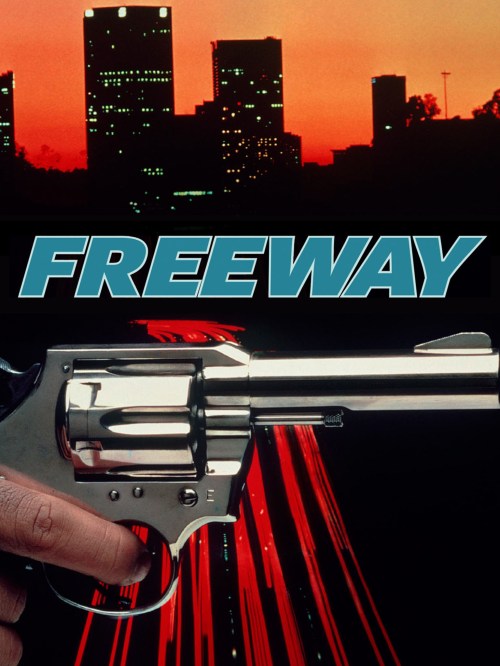
Freeway (1988)

freeway1

By Richard Winters

My Rating: 5 out of 10

4-Word Review: Killer in a car.

Sunny (Darlanne Fluegel) is an emergency room nurse still grieving over the senseless death of her fiancee at the hands of a highway killer (Billy Drago) who drove-up beside them one late night and shot him through their car window. Sunny is constantly hassling the police for updates on the case, but the police sergeant Lt. Boyle (Michael Callan) is aloof and put-off. Frank (James Russo) is an ex-cop who left the force when a drug gang he was investigating annihilated his whole family. He senses Sunny’s despair and the two team-up to find the killer along with radio talk show host David Lazuras (Richard Belzer) whose show gets calls from an unhinged man, who quotes Bible verses and claims to be the one they’re looking for.

The story has some intriguing elements and I liked how initially we don’t know the identity of the assailant, but the concept, which is based on the novel of the same name by Deanne Barkley, is poorly thought-out. This freeway shooter makes headlines for having killed many people, so Sunny wouldn’t be the only one getting on the police about finding the culprit as the entire city, which would be gripped with panic, would also be and if the city’s force wasn’t doing enough then federal agents would be brought-in.

The car that the killer drives, which is an older model with a broken front grill, is similar to the haunted vehicle used in the cult-classic The Carbut because it has a distinct appearance the guy wouldn’t be able to get away with his crimes for too long as surely other people on the very busy L.A. freeways would’ve spotted him and had his license plate, or general whereabouts, called-in. Some drivers would likely have tailed him and even cornered his car with theirs until the police got there. The car also smashes into several other vehicles, and since it was an old clunker, it would need body work, and thus pique the suspicions of the auto repairman who would likely alert authorities. In either event having the killer get away with as much as he does and with only one person emotionally vested into finding him doesn’t gel.

While the leads are bland the supporting cast is interesting. Callan, who was a semi-star during the 60’s before his career cratered, does well as the non-nonchalant police chief and still looking good despite some weight gain around the face. Clint Howard has a fun bit as a porn obsessed mechanic, who agrees to let Sunny drive his prized sports car while he gets her’s fixed. While allowing some random chick to take his car, which no auto mechanic in the history of the world would do, or feel obligated to do, I was willing to accept it using the rationale that he was hoping it might help him score with her later, but the fact that she keeps this ‘loaner’ for days, even weeks, without returning it gets ridiculous.

Country music legend Roy Clark is listed in the part of a CHP officer, but I didn’t spot him. I had a feeling it was played by someone with the same name, I know when I lived in Indy there were 7 other men in the phone book with my name, and since Roy and Clark are both quite common, it seems reasonable that it was somebody else, so listing it in Roy’s filmography on IMDb is a mistake.

The tension isn’t strong and weakens quite a bit by the third act, which is when it should’ve been the strongest. Director Francis Delia, who before this worked on music videos, tries hard to give the proceeding a stylistic touch, which might’ve fared better had the story and characters been thoroughly fleshed-out.

My Rating: 5 out of 10

Released: September 2, 1988

Runtime: 1 Hour 31 Minutes

Rated R

Director: Francis Delia

Studio: New World Pictures

Available: DVD, Blu-ray
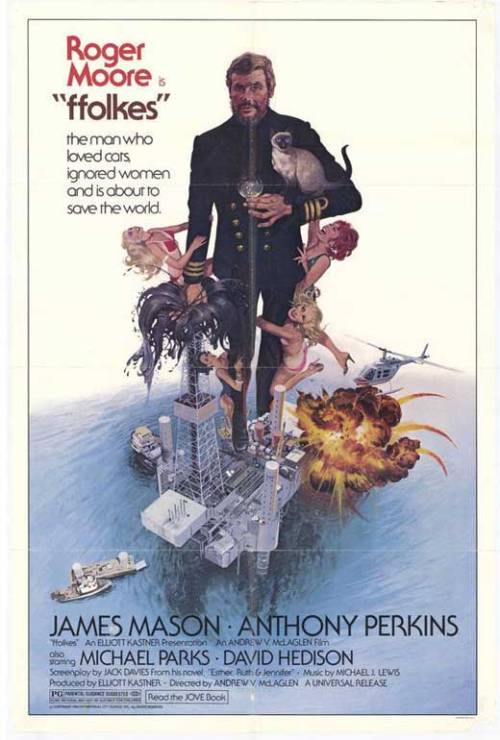
ffolkes (1980)

ffolks2

By Richard Winters

My Rating: 5 out of 10

4-Word Review: Loves cats, hates women.

Rufus Excalibur ffolkes (Roger Moore) is a cat loving misogynist who dislikes women because he grew up the youngest of five sisters and forced to wear their hand-me-downs until he was age 10. As an adult he is a counter-terrorism expert and trains a team of men to go onto ships at sea that have been hijacked. When a North Sea oil production platform nicknamed Jennifer gets taken over by a group of men posing as reporters their leader (Anthony Perkins) demands an enormous ransom and it’s up to ffolkes and his team to board the platformed and kill the terrorists without allowing the ship, which has been booby-trapped with bombs by the criminals, to blow-up.

The film, which was based on the novel ‘Esther, Ruth & Jennifer’ by Jack Davies, who also wrote the screenplay, starts out well and has all the ingredients to being a compelling thriller. The on-location shooting done on an actual ship makes the viewer feel like they’re out at sea themselves and I found the foot chase done on the vessel during a raging rainstorm to be riveting. Perkins makes for a particularly slimy villain and Micheal Parks, as the mastermind who constructs and implements the bombs, was also impressive wearing glasses that make his eyes look like they’re bulging and it’s just a shame these two men had to co-star together as they’d be able to eat-up the scenes had they been allowed to do it alone without any henchmen.

The ffolkes character works against type playing a good-guy that tests the viewer’s assumption of what’s acceptable behavior for a protagonist. Too many movies create a hero-like caricature of someone who is overly noble, brave, and virtuous until it becomes boring and contrived. At least here the guy we’re supposed to cheering for is interestingly flawed therefore more human-like than super-heroes in most other films, especially those made today, who are just too-good-to-be-true.

ffolkes though does spend too much time sitting in the background working on a crochet of a cat while giving-off glib remarks and not being as active as he should. He’s also constantly drinking scotch at all hours of the day, straight out of the bottle, which should’ve made him inebriated and this most likely would’ve come into play at some later point where he wasn’t able to pull-off an intricate task because he was too drunk, but after introducing his drinking problem during the first half, it gets completely forgotten by the second.

While the character acts extraordinarily arrogant and cocky he’s not able to pull-off the assignment quite as easily as you’d think for someone with his amount of confidence. One scene has him stupidly walking right into a gunmen and it takes the sheer luck of someone hiding in a lifeboat to save him. Another scene has him almost killed by one of his own men making him seem like he’s not as good of an instructor as his reputation suggests and all leads to him unintentionally coming-off more like a deluded idiot than the crafty mastermind with a few personality quirks that he’s supposed to be.

The story, while having a solid set-up, ultimately becomes the biggest letdown. For one thing it never shows us how they’re able to pull-off the fake explosion of Ruth, another oil platform. They talk about rigging it to seem like it exploded to fool the bad guys, and we do see something exploding, but no explanation of what it was since the real Ruth secretly remains standing. Also, most ships have a radar system, which should’ve shown that the real Ruth never went away and that they had been duped, but for whatever reason they never catch-on.

The ending surprisingly lacks very little action, which is what was blamed for the film’s poor reception at the box office. People are expecting a movie that stars Moore to have a lot of stunt work and special effects and for the most part it never happens. The villains go down too easily making it not very satisfying to see them go. There needed to be more wrinkles to the scenario and more unexpected twists as the pay-off and climactic finish is weak making one feel, despite the excellent performances, like it wasn’t worth sitting through.

Alternate Title: North Sea Hijack

My Rating: 5 out of 10

Released: April 3, 1980

Runtime: 1 Hour 38 Minutes

Rated PG

Director: Andrew V. McLaglen

Studio: Universal

Available: DVD, Blu-ray

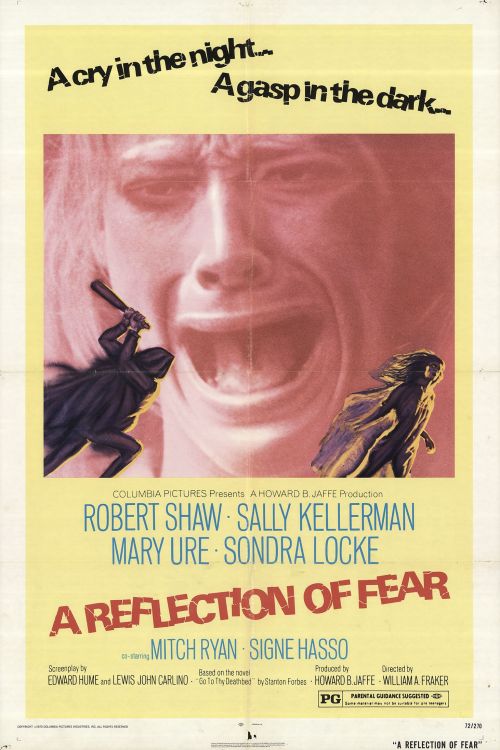
A Reflection of Fear (1972)

reflection

By Richard Winters

My Rating: 4 out of 10

4-Word Review: His daughter is disturbed.

Marguerite (Sondra Locke) is a lonely teen girl living with her mother Katherine (Mary Ure) and grandmother Julia (Signe Hasso). Through her alienation she creates an imaginary world with her dolls including one named Aron who she routinely has conversations with, but who also argues with her from time-to-time. Marguerite’s estranged father (Robert Shaw) comes to visit in order to ask Katherine for a divorce, so that he may marry Ann (Sally Kellerman). He also starts to rekindle things with Marguerite though Ann feels the two are getting much too close and fears they may be forming an incestuous relationship. Soon after both Katherine and Julia turn-up dead having been bludgeoned to death by a mysterious intruder, but who did the dirty deed? Was it an angry Marguerite, or her father, or was it the doll named Aron, who Marguerite insisted spoke to her even though no one else believed her.

The only reason to catch this obscurity is for the performance of Locke who’s absolutely brilliant. Despite being 27 at the time, she still looked like a teen and her attempt at speaking in an English accent is effective and I almost thought it had been dubbed, but it wasn’t. Her presence completely dominates the film making the supporting players seem almost non-existent and it convinced me that her relationship with Clint Eastwood, in which he according to her autobiography wouldn’t allow her to do any other projects that he wasn’t involved in, was a big mistake as she was clearly, as evidenced here, a highly gifted actress that never got her full due.

With that said I was kind of surprised to see Shaw in a film that didn’t allow him to shine and forced him to take a backseat. I can only imagine the reason that he did it was so he could work with his wife Ure, whose alcoholism had relegated her to only supporting parts toward the end of her career and in fact this was her last film before she was discovered dead in her dressing room at the young age of 42 from an accidental drug overdose. The two, for what it’s worth, do work well together. The hateful looks that she gives Shaw here seem authentic and you’d never know the two were a couple in real-life.

The story, with a screenplay co-written by Lewis John Carlino and based on the book ‘Go to Thy Deathbed’ by Stanton Forbes, has potential, but never gels. The scenario seems like it would’ve been better for a half-hour episode of the ‘The Twilight Zone’ and stretching it to a 90-minute length offered in too many slow spots where nothing much seemed to happen. The only time there’s any action is during the murder sequences, which could’ve been played-up more, otherwise it’s a lot of talk that fails to build-up the suspense or mystery in any interesting way.

Spoiler Alert!

The main problem that I had was that it was obvious to me that the doll was just a projection of Marguerite’s repressed anger, so the big reveal where she’s found to be the killer was not a surprise at all and in a lot of ways just a letdown. Had the filmmaker’s made an attempt to show the doll actually speaking instead of only been glimpsed in a shadowy way, which made it clear that he was just a figment of her imagination, then maybe there would’ve been more suspense because the viewer might actually have been made to believe that he was real, but the way it gets done here is not intriguing.

Having Shaw find out at the end that his daughter was actually a boy just made things even more confusing. Some have lauded this has being the first film with a transgender theme and a precursor to Sleepaway Camp, which is great, but what’s it all supposed to mean? Was Marguerite’s transgender issues the reason for her anger and why she lashed out into murder? Was this also the reason why her mother and grandmother kept her locked away and cut-off from potential friends, or was this instead Marguerite’s choice? None of this gets answered, which ultimately makes the film a pointless excursion.

My Rating: 4 out of 10

Released: November 15, 1972

Runtime: 1 Hour 29 Minutes

Rated PG

Director: William A. Fraker

Studio: Columbia Pictures

Available: DVD-R, Blu-ray

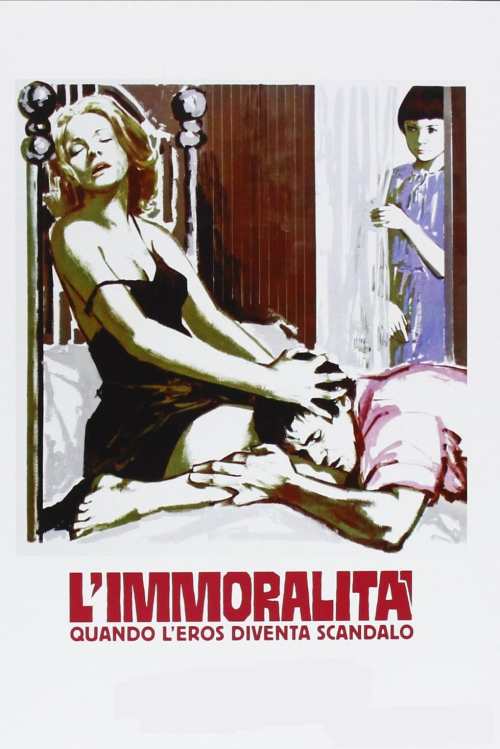
L’Immoralita (1978)

limmoralita1

By Richard Winters

My Rating: 4 out of 10

4-Word Review: Child falls for killer.

Simona (Karin Trentephol) is a lonely 12-year-old who lives with her mother (Lisa Gastoni) and her wheel chair bound step father (Mel Ferrer) in a secluded home on the Italian countryside. One day while walking through the forest that’s near her place she comes upon an injured man named Federico (Howard Ross), who has been shot in the arm by the police for being a dangerous child killer at-large. While he was able to escape the ambush the authorities continue their search, so Simona offers him sanctuary in a small coach house behind her home. It is here that she grows fond of him,but Simona’s mother finds out who she’s been hiding and tries to entice him to kill her invalid husband. Simona,who’s relationship with her mother is already strained, becomes upset that she can’t have Federico all to herself and plots a revenge on both of them.

This film is notorious for its depiction of child nudity and simulated sex. Back in the 70’s Italian filmmakers were on the front lines of shock cinema in their effort to push-the-envelope and attract curiosity seekers looking to see how far the next controversial film would go. This one, while dull and generic story-wise, definitely goes to the extreme at the one hour mark, when a naked Simona jumps out of the tub and then lies on the floor begging for Federico, who’s in the bathroom with her, to ‘make a baby’. While an adult stand-in was then used for the simulated sex it’s still an explicit moment that will disturb most viewers and likely will never get a DVD/Blu-ray release here though in Italy it has.

If you take out the controversial moment, which wasn’t needed and could’ve been implied, the film is otherwise quite sterile. There were a few things I did like including the subtle yet haunting score by the incomparable Ennio Morricone and the film’s faded color. I’m not sure if this was intentional, or just the print of the DVD, but the off-color nicely reflects the immoral characters who seem normal initially, but quickly reveal their twisted natures underneath. Trentephol, whose only film appearance this is, is outstanding. I don’t know where the producers found her, or quite frankly how they got her paent’s permission to play such a difficult role, but she lends an amazing presence particularly her piercing blue eyes that clearly conveys her character’s inner disdain for those around her.

Gastoni, who was quite prolific in Italian films during the 50’s and 70’s, but then went on a sabbatical after doing this one and didn’t appear in another movie until 2005, is good too as an aging, jaded woman where nothing it seems is too vile to upset her. The conversations she has with her daughter are truly warped, but still something you might hear in a family that was as dysfunctional as this one. Even the aging Ferrer, who at one time was a budding star, but relegated to finding work in overseas productions when Hollywood quit calling, gets an intense moment where he angrily points a rifle to his chest and then challenges his wife, who he knows wants him dead, to pull the trigger.

The story’s weakest element is Federico. While we see him dig the grave of one of his victims at the start, we never witness him killing anyone, which hurts the tension as he’s not volatile and threatening enough. Instead he’s overly passive while being lead around by both Simona and her mother. Maybe that was the point, to show how women ultimately control men even the dangerous ones, but it’s not handled in a way that’s interesting. Everything gets played-out in a heavy-handed fashion including a climax that offers little punch.

Alternate Title: Cock Crows at Eleven

My Rating: 4 out of 10

Released: November 20, 1978

Runtime: 1 Hour 49 Minutes

Not Rated

Director: Massimo Pirri

Studio: Una Cinecooperativa

Available: DVD (Import Region 2)

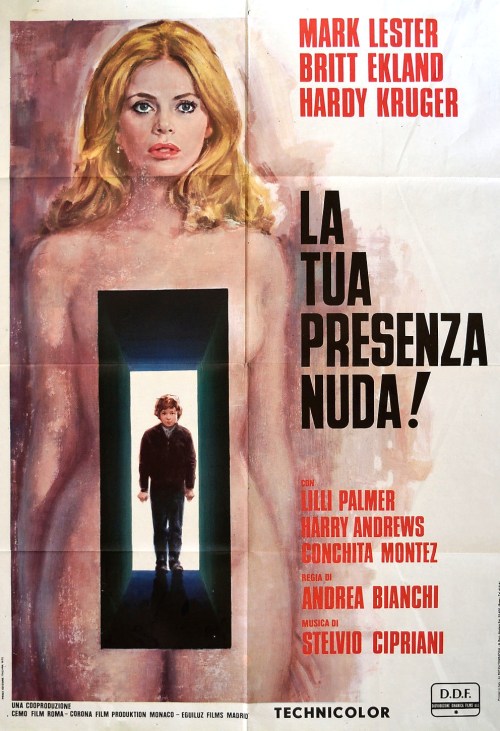
What the Peeper Saw (1972)

peeper1

By Richard Winters

My Rating: 4 out of 10

4-Word Review: Child could be killer.

Elise (Britt Ekland) marries wealthy author Paul (Hardy Kruger) and then after the nuptials comes into contact with his 12-year-old son Marcus (Mark Lester) still grieving over the death of his mother 6 months earlier. Elise had the understanding that the mother, who died from drowning in her bathtub, was accidental, but as she gets to know Marcus she suspects that he may have had something to do with it. She then speaks to his school’s headmaster (Harry Andrews) and learns that Marcus has been having disciplinary issues including that of torturing and killing animals. When Elise tells Paul of her suspicions he refuses to believe it, which pits her against both the father and boy.

While the story may have intriguing elements, though it does sound too much like The Bad Seed, the execution is poor. It starts out right away with Elise meeting Marcus, no backstory scenes showing how Elise met Paul are shown, and right away he acts weird and creepy. There’s no nuance or layers to the story, just one long ‘is he a killer, or not’ scenario that ends up being highly talky with no real thrills. The producers, apparently realizing the proceedings needed some spicing up, hired Andrea Bianchi to come in and add some sexually tinged moments including a scene where a nude Lester, sitting in a bath tub, begins fondling Britt’s breasts, who is sitting outside the tub fully clothed. If that wasn’t shocking enough there’s another scene later where she strips fully naked in front of him, but neither of these moments, as sleazy as they are, makes this otherwise tired and placid plot any more intriguing.

The film’s only real selling point is to see child star Lester playing against type. He shot to fame in the starring role in Oliver!, but all of his roles after that couldn’t capitalize on his talents and like with this one were weak and pedestrian that didn’t give him much to do. Watching him play an evil kid, instead of the angelic lad like we’re used to seeing, is interesting to some extent and he does it surprisingly well, but he’s not in it enough.

As for Britt she’s quite beautiful and the camera focuses on her lovingly, and the male viewers certainly won’t mind her nude scenes of which there are plenty, but her character is poorly fleshed-out. It’s hard to understand why she married Paul as he treats her in a callous way and clearly favors the kid over her, so why stay in a relationship if she’s just going to be the spare tire especially with a psycho kid that’s just going to put her life more and more in danger? Any sensible person would pack-up and leave and the fact that she chooses to stay in such a bad and uncomfortable situation makes her seem as nutty as the rest.

Things pick-up during the final 10-minutes which gets filled with a lot of wild imagery though some of this should’ve been sprinkled though out the film, which is too cardboard otherwise. The final twist is a bit of a surprise, but the whole thing could’ve been better paced. Everything hinges too much on the provocative overtones while the characters are one-dimensional and fail to resonate and thus causing the viewer to remain pretty much detached emotionally from everything that goes on and the twists that do occur fail to deliver any punch.

My Rating: 4 out of 10

Released: October 14, 1972

Runtime: 1 Hour 35 Minutes

Rated R

Directors: James Kelley, Andrea Bianchi

Studio: 20th Century Fox

Available: DVD, Blu-ray

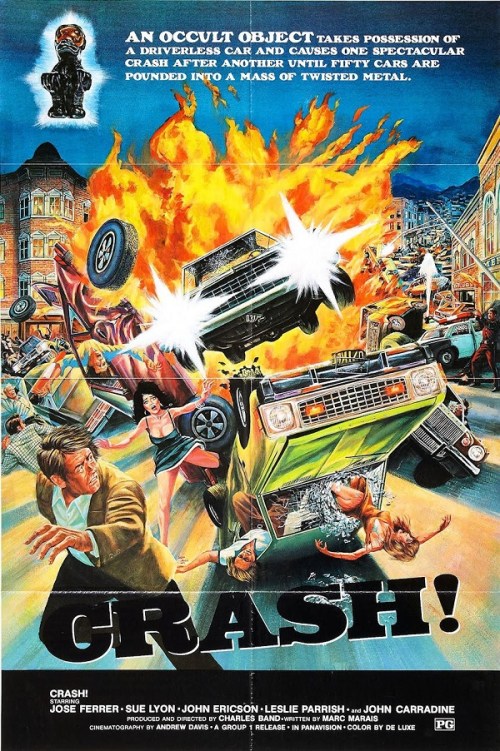
Crash! (1976)

crash

By Richard Winters

My Rating: 4 out of 10

4-Word Review: Wife has occult powers.

Kim (Sue Lyon) and Marc (Jose Ferrer) are a married couple with a 30-year age difference between them. Initially they were a happy twosome, but then Marc got into a car accident that left him bound to a wheelchair and the passion between them lessened. Now Marc resents the fact that Kim no longer seems to love him and worries that his attractive and much younger wife will go off and find another suitor. He plots to have her killed by having his trained doberman jump into her car as she’s driving and attack her. While the dog does injure her it’s not enough to kill her. As she lies in her hospital bed Marc sneaks in and disconnects her from her intravenous tube, which he hopes will be enough to end her life, but he fails to notice that she’s clutching in her hand an artifact that she had bought earlier at a flea market, which gives her special psychic abilities. These powers allow her to terrorize Marc even when she’s not there by making inanimate objects, including both her car and his wheelchair, come to life and begin attacking him. 

This was the first feature length film directed by Charles Band, who has gone on to have a long career both producing and directing B-horror films some of which have been successful. This one reveals his producer mentality by keeping the flimsy plot moving by adding in a lot of action, in this case tons of car stunt footage, to the mask the fact that the story itself doesn’t have much going for it. To a degree the car crashes are well choreographed, but there’s too many shots of police cars getting destroyed, which is reminiscent of the car chase action comedies making this seem more like a silly comedy than a would-be horror film.

The most impressive thing is the driver-less car. This is similar to the concept used in cult flick The Car, but that automobile had a roof over it and darkened windows, so you presumed that a stunt driver was inside controlling it, but here this vehicle is a convertible and there’s no one sitting in it even as it careens down the road. How they were able to pull this off I don’t know, but this fact alone makes it far more interesting to see than the other one even though that one, for whatever reason, received more attention and fanfare despite both coming-out at around the same time.

I was willing to give this 6-points, but then Band makes the misguided mistake of repeating near the end the car crash explosions we’ve seen before making it seem like a ‘highlight reel’. I’m not sure for the reason other than alluding to the mysterious occult power communicating to  Kim about what has gone on while she was in the hospital bed, but it was unnecessary and comes-off like amateurish film-making to the extreme.

The eclectic cast of familiar faces who were once A-list stars, but now forced to accept B-grade material in order to stay busy, is interesting and helps save it a little. I was particularly impressed with Ferrer who gives a convincing performance and doesn’t just ‘phone-it-in’ despite the otherwise subpar quality of the script.

Lyon’s appearance here is intriguing as well as she shot to fame back in 1964 as the beautiful teen Lolita in the Stanley Kubrick film of the same name and was considered one of the most stunning stars of the decade, but here she plays a part that ends-up making her look quite ugly. Not only is her face bandaged up through most of it, but when they do finally come-off she is shown to be full of garish scars. There’s also scenes where her eyes are blazing red and resembling that of a demon. I’m not sure if she took this role to play against her beauty stereotype, which she reportedly was not a fan of anyways, or she just accepted the offer because she needed the work, but the things she does here is about as far removed from Lolita as one could possibly get, so watching this simply for that reason may make it worth it to some.

My Rating: 4 out of 10

Released: December 24, 1976

Runtime: 1 Hour 28 Minutes

Rated PG

Director: Charles Band

Studio: Group 1 International Distribution

Available: DVD, Blu-ray, Tubi, Amazon Video

Diary of the Dead (1976)

diary2

By Richard Winters

My Rating: 5 out of 10

4-Word Review: Two dead old ladies.

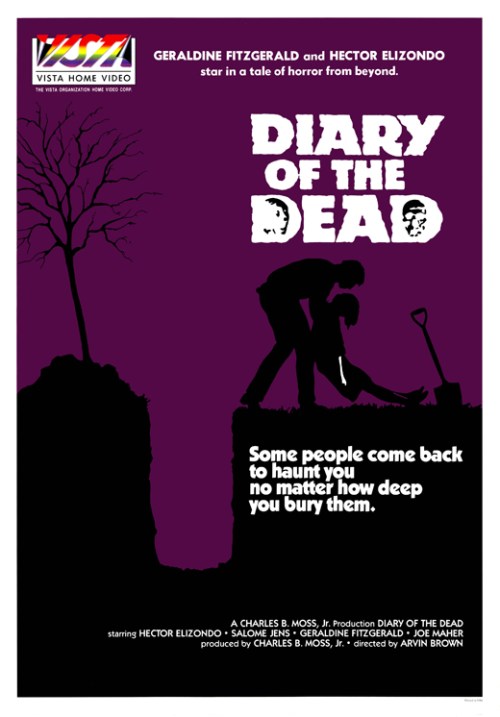
Stan (Hector Elizondo) is married to Vera (Salome Jens) while living in a house that’s owned by Vera’s mother Maud (Geraldine Fitzgerald). Maud and Stan do not get along and she uses the fact that Stan can’t find regular employment as a means to belittle him.  She also tries to convince Vera to leave him. Stan is aware of this, but can’t seem to do much about it. Then one day Maud’s friend Ethel (Kate Wilkinson) comes for a visit. She arrives while Maud is upstairs taking a nap, and is greeted by Stan, but since she had to walk all the way from the bus station to the house and suffers from high blood pressure, she promptly collapses once she gets inside. Stand decides to use this as an opportunity to get rid of Maud by claiming to the attending physician (Austin Pendleton) that the dead body is his mother-in-law, so when Ethel is taken away for cremation everyone thinks it’s Maud instead. Stan then buries Maud’s body, who he has killed on his own, in his backyard, but this catches the eye of his nosy neighbor Walter (Joseph Maher) who had always gotten along well with Maud and feels Stan’s explanation of what happened doesn’t add-up.

The story is based on the 1971 novel ‘One Across, Two Down’ by Ruth Rendell and while the plot has a sufficient amount of twists the direction, by first timer Arvin Brown, is lacking. It’s not liked it’s bad direction, but it has no finesse and seems meant of TV.  It’s no surprise that Brown ended up doing projects exclusively for TV after this one as nothing here is cinematic and approached in such a sterile way visually that it actually detracts from the proceedings.

Elizondo gives a feisty performance that perfectly captures a bitter man going through life with a chip-on-his-shoulder. His arguments and confrontations with Maud lend for some colorful dialogue, but a meddling, cantankerous mother-in-law is nothing new and if anything seems cliched making the material come-off as second-rate and formulaic.

The crime itself isn’t elaborate. In the ‘Columbo’ TV mysteries we’d see the bad-guy pull-off the murder in a way that was carefully thought-out, so the viewer becomes intrigued trying to figure out what flaw the killer overlooked that Columbo will jump on, but here it works in reverse. The crime is spur-of-the moment with a bunch of things that could easily go wrong that will instantly get Stan caught, which isn’t as interesting. Stan is also not a pleasant person, so the viewer is not emotionally invested in him escaping the clutches of the authorities,  If anything you remain ambivalent to what happens, which are ingredients that don’t make the movie interesting.

The film does feature a twist ending, but it’s not something one couldn’t have seen coming as it goes overboard telegraphing it. As an episode of ‘Alfred Hitchcock Presents’ it would’ve worked better, but it gets stretched too thin for feature length. The should also not be confused with the George A. Romero film of the same name that came out 30 yeas later.

My Rating: 5 out of 10

Released: July 20, 1976

Runtime: 1 Hour 33 Minutes

Rated PG

Director: Arvin Brown

Studio: B.S. Moss Enterprises

Available: None

Coma (1978)

coma2

By Richard Winters

My Rating: 7 out of 10

4-Word Review: Who’s killing the patients?

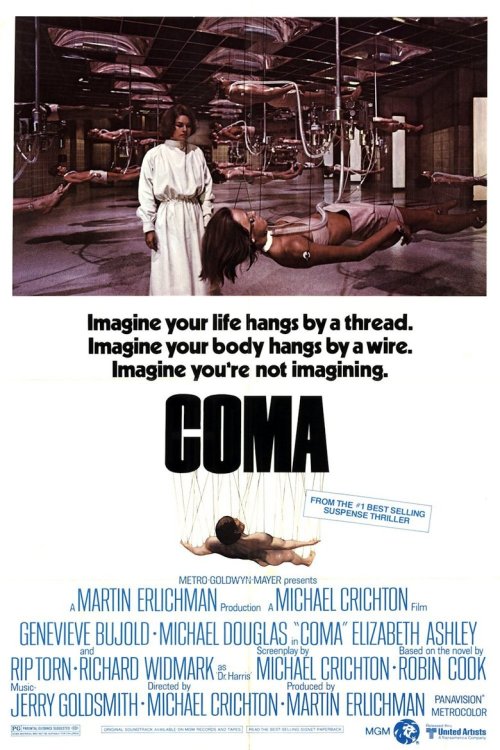
Susan Wheeler (Genevieve Bujold) is a Dr. working as a surgeon at Boston Memorial Hospital, who learns that her best friend Nancy (Lois Chiles) fell into a coma at the hospital while having routine surgery. Susan is convinced that there must be an answer to what went wrong as Nancy was young and had no underlying health conditions. While reviewing the hospital records she finds that a high number of other patients at the hospital ended up having the same fate and all were of a similar age and body type as Nancy. Susan also notices that the patients had surgery in the same operating room and once they became comatose their bodies where shipped off to a remote facility known as The Jefferson Institute.  Susan’s boyfriend Mark (Michael Douglas), who also works at the hospital, tries to convince her it’s all a coincidence, but the more Susan investigates the more determined she is to uncover the truth even if it means putting her job and even her life on the line.

The film is based on the novel of the same name written by Robin Cook. Cook, a physician, decided to dabble in writing on his off-hours and in 1973 got his first novel, ‘The Year of the Intern’, published but it was a financial failure. While that book had been more of a drama he came to realize that thrillers was the genre that had the most commercial success. He studied how, in his words, ‘the reader was manipulated by the writer’, in the thriller novels that he had enjoyed and then listed these techniques on index cards and made sure to use them in ‘Coma’, which lead to that book being a best-seller. Michael Crichton, who had met Cook while he was working on a post doctorate at La Jolla’s Salk Institute, agreed to sign on as the director where he hoped to create a film that would delve into people’s fear of hospitals the way Jaws had connected to people’s phobias about sharks and swimming.

The result is a nice compact thriller that moves along at a brisk pace and takes advantage of both the director’s and author’s medical background to help keep the scenario both realistic and enlightening to the inner-workings of a hospital. There’s a couple of cool foot chase scenes with one occurring between Bujold and actor Lance LeGault inside the hospital while another happens at the ominous looking Jefferson Institute with both being quite intense.

Bujold, despite being different than the protagonist in the novel, who was described as blonde and 23 while Bujold is brunette and 35 at the time of filming, was still a perfect casting choice. I loved her French Canadian accent, which gives her character distinction, but she does appear at times to have reddish nose and cheeks making her seem like she had a rash or cold. What I didn’t like was that the feminist angle of the character, which had been so prominent in the novel, gets played-down here. In the book Susan did not know Nancy and simply took on the case through her own personal initiative to prove herself in an otherwise ‘man’s world’, which was more compelling than the pedestrian way here where she investigates the case simply because she’s heartbroken over the loss of a friend.

It also didn’t make sense to me why she was the only one upset over the deaths of these patients. The patients most likely had family and friends, so why weren’t any of them demanding answers to what happened? We live in a sue-happy culture and medical malpractices are the most prevalent lawsuits out there making me believe this racket wouldn’t have been able to survive too long as lawyers and private investigators, who would’ve been hired by the grieved family members, would’ve been on the case demanding answers from the hospital long before Susan ever even got involved.

The Susan character has the same issues as James Coburn’s did in The Carey Treatment where we have a medical professional with no background in investigating suddenly showing amazing instinct on-the-spot that you’d only expect from a seasoned detective. Having a group of people, like the grieved relatives, working together to solve the case would’ve had more interesting banter and camaraderie, which is missing here. While seeing an individual take down a mighty criminal system is emotionally gratifying it usually takes a strong team of people working in tandem to accomplish that.

Spoiler Alert!

I did find the film’s climax where Susan goes under the knife and risks being another comatose victim, to be quite suspenseful, but I found it strange why this woman, who had done all the legwork to uncover the crime, would then just hand-it-over to the creepy hospital administrator, played by Richard Widmark, to finish the job instead of her going to the police with her findings. The Widmark character displayed a lot of red flags from the start, which is obvious to the viewer, so why is Susan, who had been so super savvy the rest of the time, so dumb at the end and trust a creep like him to do the right thing?

My Rating: 7 out of 10

Released: January 6, 1978

Runtime: 1 Hour 53 Minutes

Rated PG

Director: Michael Crichton

Studio: MGM

Available: DVD, Blu-ray, Amazon Video, YouTube, HBOMax

The Domino Principle (1977)

domino

By Richard Winters

My Rating: 6 out of 10

4-Word Review: Hired for secret mission.

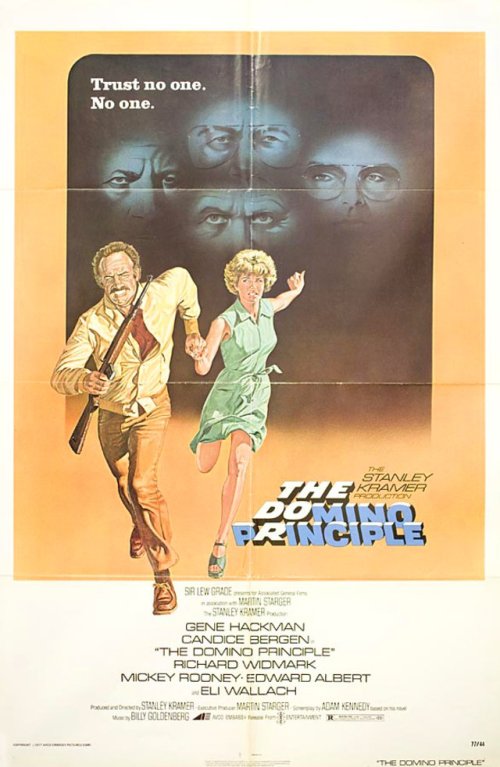
Roy Tucker (Gene Hackman) is in prison for the murder of his wife’s first husband, but gets approached by Tagge (Richard Widmark), who works for a secret organization and who offers to get both Roy and his cellmate Spiventa (Mickey Rooney) out of jail where they can have their freedom again, but with one hitch; he must carry out a mysterious mission that they themselves don’t yet know the details to yet. Roy is suspicious of the group’s intent, but longs to see his wife Ellie (Candace Bergen), so he agrees to go along with it. After getting out of prison through an elaborate escape plan that the secret group hatches Roy is then able to travel to Costa Rica using a passport that the group made for him. It is there that he spends a relaxing week with Ellie, but then Tagge and his men (Eli Wallach, Edward Albert) return and remind him of his commitment, which turns out to being the assassination of an important political figure. Once Roy realizes this he tries to back out, but soon realizes that he jeopardizes the life of his wife, who the group insists they will kidnap an kill, if he does.

The film is based on the novel of the same name written by Adam Kennedy, who also wrote the screenplay and at one time was an actor before eventually turning to writing. While the novel got great reviews the movie didn’t with many critics panning it including Leonard Maltin, who described it as a ‘muddled thriller’. Both Hackman and Bergen, in later interviews, have called it ‘terrible’ and even director Stanley Kramer wrote in his memoirs that he’d like to disown it. Much of the problem could be blamed on the different runtimes with a heavily edited 88-minute cut being completely confusing, but this version that I saw, which ran a full 101 minutes, I found to be captivating, at least through the first 90-minutes.

The real problem I had stemmed around Hackman, who gives a one-dimensional performance. There is one moment where he assaults the Edward Albert character after he refuses to let him see his wife, which I felt was justified and entertaining to watch, but he remains surly too much of the time and it would’ve been nice to have seen some other emotions seep through, if even for a few random moments. Bergin is totally miscast as the middle-aged wife and even wears a brunette wig in an effort to make herself seem older. She stated in interviews that she took the part so she could play an ‘ordinary person for once’ instead of a beautiful, glamourous person like she usually did, but I didn’t understand why she was even offered the role as there were plenty of actresses more Hackman’s age that would’ve been a better fit.

Spoiler Alert!

While I did enjoy the movie for the most part especially its scenic location shooting including one scene that takes place directly underneath the Golden Gate Bridge I did find the twist ending to be extremely dumb. This includes having Roy deciding not to shoot the intended victim by intentionally aiming his shots short in order to miss his human target only to find that his former cellmate Spiventa was also hired for the same mission, but without Roy knowing, and he kills the person while shooting at him from a different angle. The problem is that the viewer thinks Spiventa is already dead as we see him get shot by the mysterious group while underneath the bridge. Why Spiventa would fake his own death, or not tell Roy that he was in on the plan since the two had been quite close, is ever explained. It also doesn’t make sense why Roy would decide at the last second to pull back his shots and not kill the person he was assigned to assassinate. Sure, for moral reasons he probably felt bad about it, but he knew that his wife would be killed if he didn’t follow through, so how he was expecting to save the life of his target while also somehow keeping his wife alive after the group finds out Roy didn’t do what he was supposed to?

The final shot shows Roy, with gun in hand, walking along a beach, apparently intent on hunting down whoever was the behind-the-scenes man from the group who was giving out all the orders, which we the viewer never see. Keeping some elements of the organization a mystery is fine, but what annoyed me is that we see a rifle pointed right at Roy as he walks the beach, but then the film ends without us ever knowing if Roy got shot first, or if he survived to kill the head of the group. Some sort of resolution in this area should’ve been shown and leaving it so wide-open is not intriguing and instead quite frustrating.

My Rating: 6 out of 10

Released: March 23, 1977

Runtime: 1 Hour 41 Minutes

Rated R

Director: Stanley Kramer

Studio: AVCO Embassy Pictures

Available: DVD, Amazon Video, Shout Factory TV, Tubi, YouTube

The Chain Reaction (1980)

chain1

By Richard Winters

My Rating: 7 out of 10

4-Word Review: Nuclear leak contaminates water.

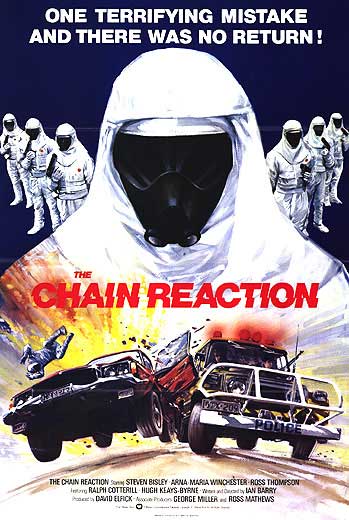
A nuclear waste site in rural Australia becomes affected by an earthquake, which causes a leak that could contaminate the ground water for hundreds of miles. Heinrich (Ross Thompson), an engineer at the facility who was contaminated by the accident and has only 3-days to live, feels it’s his duty to warn others about what happened, but the company wants the matter to kept a secret. Heinrich manages to escape from the lab, but gets into an accident during a rainstorm on a lonely country road. It is here that he’s rescued by Larry (Steve Bisley) and his wife Carmel (Arna Maria Winchester) who live nearby and take him to their isolated home. Since Carmel has a nursing background she tries to take care of Heinrich at their house even though he now suffers from amnesia and cannot remember anything past 1957. The company though has already sent out a search party looking for him and proceed to terrorize all three once they find them.

The film is a slickly shot sci-fi epic that in many ways seems similar to Mad Maxand in fact both films shared many of the same crew members and this even has a cameo by Mel Gibson who appears briefly as a bearded auto mechanic. The camera captures things in a vivid way and the sharp editing keeps the story moving at a fast pace.

While the plot gets smartly handled and I did find the two main characters to be a bit out-of-place particularly Larry whose outfits and hairstyle look almost campy. The two also don’t have an every day quality about them. Thrillers like these are more exciting when the hero is just a regular person with no special skills and yet still forced to beat insurmountable odds, which is unlike Larry who has expert driving skills and owns a trendy sports car with a souped-up engine.

The way the couple rescue the victim, who they don’t know, by taking him back to their place instead of to a hospital was odd too. Carmel has nursing experience, but not the medicines or equipment that you’d find in a medical facility. They also seem unusually trusting by allowing the man to sleep in one of their bedrooms while they sleep in an adjacent one, but don’t bother to lock their door with the wife lying openly nude for the stranger to just walk-in and attack, or gawk at since there’s a window in the hallway to the room, without any restraint.

The film is noted for its car chases, but they only make up a small fraction of the runtime. One occurs for a few minutes during the second act and then there’s another one at the very end. Both are quite exciting and had me sitting on the edge of my seat with the camera showing things from the driver’s point-of-view and many times through the cracked glass of the windshield making you feel like you’re in the car as it happens. However, I was disappointed that they’re weren’t more of them and both chases take place on the same road and essentially go through the same stunts both times.

Spoiler Alert!

The wrap-up is a bit too quick. For such a nifty, well designed and well crafter set-up I was expecting things to get played-out further. There is though the irony of having a helicopter appear with a news crew that captures the chase when it’s over with the idea that now that the news media is on top of it the truth will get out and everything will be resolved. This though is a far cry from the way things are here in this day-and-age where the media is not trusted by many and having them report on something, even a big story such as this, could only make things worse instead of better.

My Rating: 7 out of 10

Released: September 25, 1980

Runtime: 1 Hour 32 Minutes

Not Rated

Director: Ian Barry

Studio: Palm Beach Pictures

Available: DVD (Region 0)