Category Archives: Thrillers/Suspense

Juggernaut (1974)

By Richard Winters

My Rating: 8 out of 10

4-Word Review: Bomb on a ship.

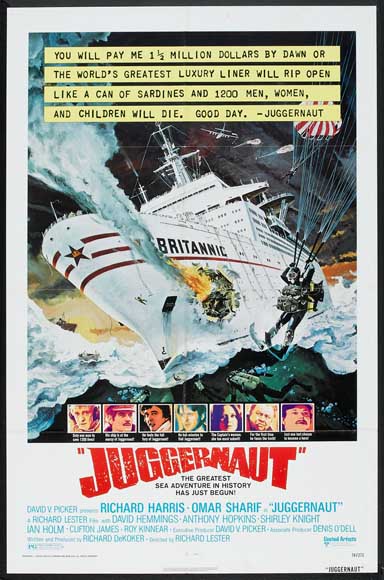
The Britannic, a luxury liner traveling in the North Atlantic and carrying 1,200 passengers, is threatened at being blown up by a unknown man who calls himself ‘Juggernaut’ and states that he has planted a bomb somewhere on the ship. The British government decides not to give into his demands for a ransom and instead flies in bomb expert Anthony Fallon (Richard Harris) who along with his team is assigned with dismantling the 7 bombs and are given little time to do it before they are set to explode.

This film follows the typical disaster flick formula, but it does it so damn well that I was riveted and entertained from the first minute to the last. Director Richard Lester is known for his comedy and implements it into all of his films even when the genre is action. Sometimes this doesn’t work Superman III is a good example where the campiness became too much, but here it makes for a nice balance. The tension is quite strong. The scenes involving the bomb dismantling are not only gripping, but fascinating as you learn the minute intricacies to the bomb mechanics. The extreme close-ups are excellent and make you feel like you are right there. Watching the demolition experts being dropped from a helicopter and into the cold ocean where they are to swim to the liner are impressively vivid. The story moves well and consistently brings in new twists.

Harris is fantastic as the sort of anti-hero. He is gruff, brash and irreverent yet he is good at what he does and knows how to do it. I found myself captivated with him and pulling for him emotionally. Unlike the cookie-cutter pretty boy heroes of most Hollywood movies this guy is real and rugged. I wish more movies could have this type of character in the lead.

The bad guy isn’t quite up to the same level. I liked how the film keeps his identity a mystery until near the end, which helps elevate the intrigue. His weird Scottish/Irish sounding accent heard over the phone is strange and I actually thought it was actor Harris doing it and I still think it might have been. The elaborate ploys used by the police to track him down as well as the culprits abilities to outfox them at seemingly every turn is engaging. It’s just a shame that when they finally catch him it wouldn’t have been for such a stupid oversight on his part, which ruins the mystic that is created and feels like a letdown. However, the final conversation that he has with Anthony over the phone is a gem.

British character actor Roy Kinnear is funny in his role as the ship’s social director. His vintage moment comes when he insists on having the scheduled masquerade party continue despite the fact that everyone becomes aware that the ship may explode at any minute. Kinnear’s patented nervous grin is put to great use here and practically steals the picture.

The supporting characters are above average. Normally in this genre these types of people end up being cardboard and clichéd, but here they were surprisingly multi-dimensional. The dialogue as a nice existential quality and the scenes where they discuss their potential and impending doom is never contrived or forced. I got a kick out of the two kids who were amusingly much more grounded and aware of things than the hyper adults.

If you are into compact suspense films that are tightly paced and without the loopholes and clichés then this film, which is loosely based on actual events, promises to be an entertaining two hours.

My Rating: 8 out of 10

Released: September 25, 1974

Runtime: 1Hour 49Minutes

Rated PG

Director: Richard Lester

Studio: United Artists

Available: VHS, DVD, Netflix streaming 
Deadly Strangers (1974)

By Richard Winters

My Rating: 5 out of 10

4-Word Review: Psycho on the loose.

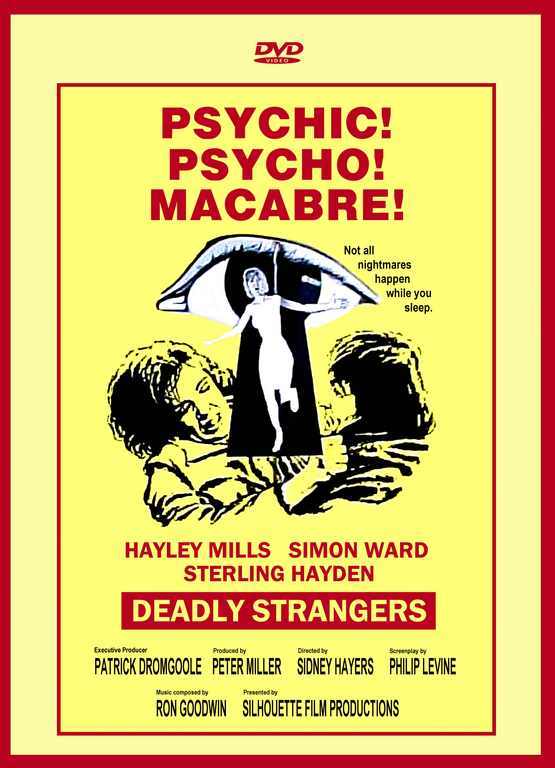
A dangerous mental patient has escaped from a nearby asylum. Belle Adams (Hayley Mills) is the beautiful women whose car has just broken down and she accepts a ride from Stephan Slade (Simon Ward) who just may be that patient.

This seems very similar to See No Evil which also took place in the English countryside and also hid the killer’s identity until the very end. There though it was a big letdown finding out who he was while here it is actually what makes the movie interesting. However, some of the techniques used to conceal the killer’s identity come off as contrived. The opening escape sequence inside the institution, where you see everything from the patient’s point of view is very tacky.

The suspense is minimal and things never really get too intense until the climatic sequence. There are twists and turns throughout, but some of them seem to be put in just to keep the story moving. The overall production values are cheap and the film stock is grainy and faded.

It is nice to see a British movie that doesn’t take place in London. The brown, barren landscape, which looks to have been filmed in the autumn, gives the picture an added visual. The car they drive is another sight as it looks as flimsy as a Yugo.

Mills makes a daring film choice here and it does her well. She no longer has that mousy, awkward look. She is a pretty full grown woman with a nice short haircut. She acts more mature and streetwise without that wide eyed persona that she had in all those Disney movies. Her nude scenes aren’t bad and are even a bit gratuitous.

Ward has never seemed to be that great of an actor. He has always had a tired look on his face and plods through his parts in much the same way. Sterling Hayden is fun playing an aging womanizer and sporting a wild beard and hairstyle. He talks in a goofy Scottish accent and amusingly tries to court Hayley, but unfortunately he is on for only a short time.

The final twist is pretty good, but a real sharp viewer will figure it out before it happens because I did! The film is a nice alternative for Mills despite a tendency to be gimmicky and flat. It is also the only time I have ever seen a policeman pull over a car and when the driver is unable to find his license is simply allowed to drive away.

My Rating: 5 out of 10

Released: February 16, 1974

Runtime: 1Hour 28Minutes

Rated R

Director: Sidney Hayers

Studio: Fox-Rank

Available: VHS

Zig Zag (1970)

By Richard Winters

My Rating: 5 out of 10

4-Word Review: Framing yourself isn’t good.

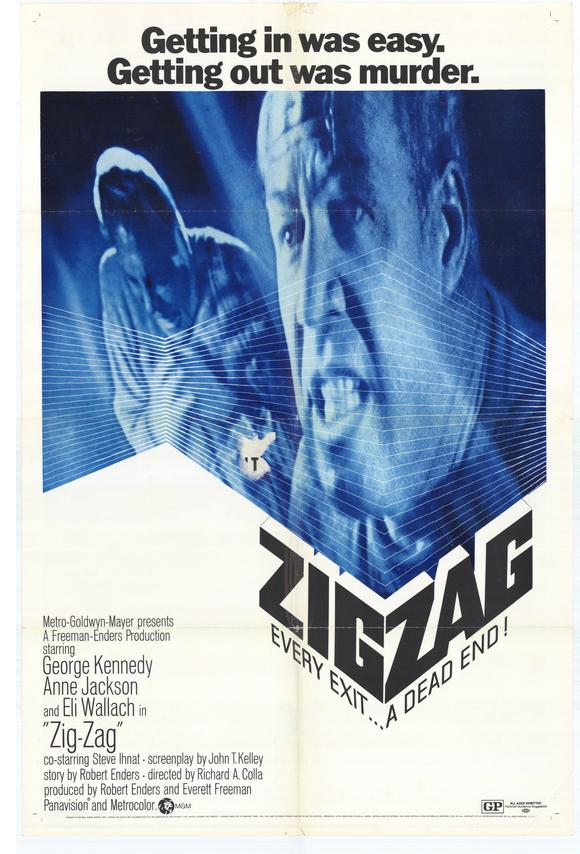
            Paul Cameron (George Kennedy) is an insurance agent and family man who learns that he is dying from a brain tumor and has only a few months to live. In order to provide money for his wife and children he sets himself up as the kidnapper of a wealthy businessman in an unsolved case that offered a $225,000 reward for anyone leading to the conviction of the culprit. After he is found guilty at his trial he faints and the doctors there decide to do experimental laser surgery to remove the tumor. The operation proves to be a success forcing Paul to go on a battle to prove his innocence, or risk spending the rest of his life in jail for a crime he did not commit.

Although he has done well in supporting roles Kennedy proves to be quite weak as a leading man as he shows almost no emotion in any of his scenes. When he is told of his tumor he takes it in a very matter-of-fact way without getting upset at all, which seemed unrealistic. His performance is dull and the few times that he does get upset it comes off as forced. His presence hurts the film and a more engaging, eccentric actor could’ve made it more interesting.

Eli Wallach as Paul’s attorney is terrific and the one thing that injects some energy. He is dynamic throughout and is fun to watch even during the slow parts. It was nice to see him doing a scene with his real-life wife Anne Jackson. As of this writing the two have now been married for 64 years, which has to be one of the longest marriages in Hollywood history.

The supporting cast features a long list of familiar character actors making it like spot-the-star. They include: Dana Elcar, Douglas Henderson, Steve Ihnat, William Marshall, Joan Tompkins, Robert Sampson, Leonard Stone, and Walter Brooke in an interesting duplicitous part.

Richard A. Colla’s direction is impressive. The film opens with a diverting cinema verite-style scene showing Paul going through the examination process before entering the prison, which seems unusually elaborate touch for what is otherwise just a gimmicky script. Another innovative part is when Paul is shown planting evidence at the scene of the crime and only the sounds and ambiance of the locale is heard without any music, which is more effective.  Unfortunately the direction and story become much more conventional towards the middle and it is not as interesting. The film tries to be too many things and does not come together as a seamless whole. The courtroom scenes were too extended for my tastes as we know Paul is innocent, but wants to be convicted anyways, so his many prolonged conversations with his exasperated lawyer who does not know of his scheme seem rather pointless. However, when Paul is cured and then goes on a mission to find the real killer it becomes exciting as the mystery itself proves to be complex and intriguing.

The twist ending did not go over well with audiences at the time of the film’s initial release. It’s a downer for sure, but after seeing so many tacky happy Hollywood endings in my lifetime I can’t say I totally hated it. As a budding screenwriter I enjoy irony and the ending here certainly has that. It’s slickly handled and although I saw it coming others may be genuinely surprised by it. My only complaint is that it’s a bit abrupt and could’ve and should’ve been extended in some way, or given a more effective closure.

If you like a movie with a lot of twists then this film may be worth seeking out. The legendary Roy Orbison sings the title tune during a party scene and it sounds like some of his best stuff. I am surprised it didn’t chart and I wished they had allowed the viewer to hear the complete son before cutting away.

My Rating: 5 out of 10

Released: September 11, 1970

Runtime: 1Hour 45Minutes

Rated PG

Director: Richard A. Colla

Studio: MGM

Available: VHS (as False Witness), DVD (Warner Archive) 

Dirty Hands (1975)

By Richard Winters

My Rating: 7 out of 10

4-Word Review: Their plans go awry.

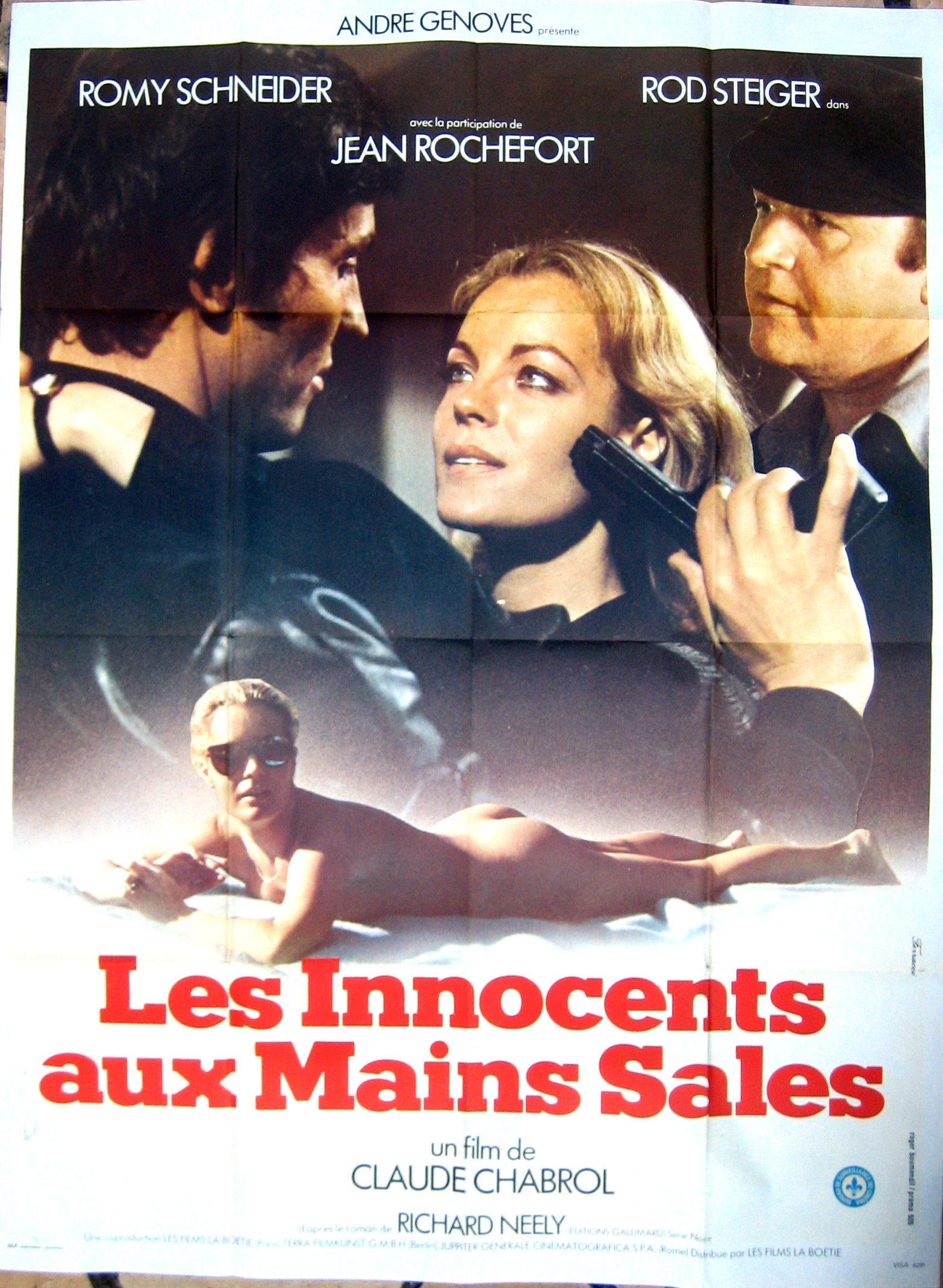
Julie Wormser (Romy Schneider) is married to Louis (Rod Steiger) who is rich, but also 18 years older and suffering from impotency. A young, virile man by the name of Jeff Marle (Paolo Giusti) comes into her life and the two become lovers. They conspire to murder her husband and run off. However, their elaborate plan quickly unravels leading to many unexpected twists and turns.

Story-wise this is one of the better Hitchcock imitations. There are a lot of twists that are interesting and surprising. They are also well-explained and make sense. Nothing is thrown in that is implausible or creates loopholes.  The script is like traveling on a curving, winding road in a fast car and I found myself delightfully surprised, intrigued, and entertained with each new revelation. The film takes its time in explaining each detail and plot point. I liked how the investigators are given almost as much screen time as the culprits and writer/director Claude Chabrol has everything well-thought out and even manages to get you to care for these people at the end.

Schneider is stunning. I loved her blonde tinted hair and chic outfits. She has a sultry nude scene at the very beginning, but it is only from the backside. This was pretty much her vehicle. Her character goes through a wide-range of emotions and she does a great job of conveying each one. Her facial expressions especially as the case unravels and she is being interrogated by the Judge and questioned by her lawyer are captivating to watch and perfectly realized.

Steiger is always fun. His ability to display raw intense emotion is second to none. The character was a bit cardboard as written, but Steiger manages to make him human and I had genuine sympathy for him towards the end. He does tend to border on over-acting at times, but he injects life into the scenes that otherwise could have gotten boring and slow.

Although Chabrol clearly put a lot of care into the script the visual element is lacking. The camera work is conventional and unimaginative. Certain scenes are too dark and shadowy while others look bright and splotchy. The majority takes place in an exquisite looking French Chateau, but Chabrol fails to take advantage of this. The lack of visual style makes the thing look almost amateurish and the grainy, faded DVD transfer does not help. I also felt the dialogue between the two investigators seemed stale and derivative. There was also a part were Julie complains to the investigators that they have dropped into her house for a visit at much too late an hour and then, only a minute later, she is seen walking out of her house and it is broad daylight. Also, when she hits her husband over the head and supposedly kills him in his sleep he is still seen breathing.

If one is looking for a sharp mystery done in the Columbo style then this pick could be a fun, escapist evening. Schneider’s beauty and acting will carry the rest, but just be prepared for production values that are on a TV-movie level.

My Rating: 7 out of 10

Released: March 26, 1975

Runtime: 2Hours 1Minute

Rated PG

Director: Claude Chabrol

Studio: New Line Cinema

Available: DVD

Dead Calm (1989)

By Richard Winters

My Rating: 8 out of 10

4-Word Review: Psycho on a boat.

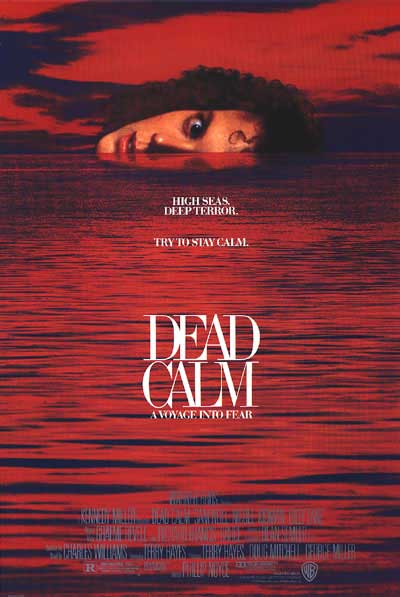
Rae and John (Nicole Kidman, Sam Neill) are a young couple who in an attempt to get over the death of their child go on a cruise along the coral reef in their own private yacht. After many days at sea they come upon a boat with only one survivor. The man (Billy Zane) comes aboard their ship and almost immediately begins to behave strangely. Tensions slowly rise until it becomes obvious that this man is a full blown psychotic who has killed everyone on the first boat and plans to do the same to them.

In many ways this is a foundation to a perfect thriller. The two main characters are sensible and intelligent people who just happen to be at the wrong place at the wrong time. Like with every thriller there are a few minor loopholes, but overall the situations are done in a believable fashion with no extreme jumps in logic. The script is tight and the suspense consistent. The action comes naturally through the scenarios and is not forced or played out too long. Having it take place at sea gives it a distinct flavor and the setting limitations makes the story more creative. It also hits on one of the main ingredients of fear which is isolation.

The only minor liability is the Zane character. At certain points he seems very human and a fascinating psychotic who is definitely no machine-like slasher. There are times when he is calm and complacent and his disturbed traits only surface sporadically thus giving him a much more multi-faceted personality. Unfortunately he is also careless and amazingly dumb, which hurts the tension because it seems to be telegraphing his own demise. Either way Zane is convincing in the role.

The Neill character makes a good counterpoint. He is savvy and no-nonsense. He takes action into his own hands and doesn’t fall into the helpless victim mode like in other thrillers. The Kidman character is another refreshing change of pace. She is not the standard ‘screaming lady in a bikini’, but instead shows equal resourcefulness.

The film does resort to the modern day slasher trend of having a ‘double’ ending. Yet everything else is so slickly handled that you can almost forgive it. For thriller fans this should be a real treat.

My Rating: 8 out of 10

Released: April 7, 1989

Runtime: 1Hour 36Minutes

Rated R

Director: Phillip Noyce

Studio: Warner Brothers

Available: VHS, DVD, Blu-ray, Amazon Instant Video

Marathon Man (1976)

By Richard Winters

My Rating: 7 out of 10

4-Word Review: Dentist doesn’t use novocain.

            Thomas ‘Babe’ Levy (Dustin Hoffman) is a post graduate student at Columbia University and part-time marathon runner who spends a harrowing 48 hours being tortured and terrorized by a sadistic Nazi war criminal. It all starts when his brother Henry ‘Doc’ Levy (Roy Scheider) who works for a secret government organization known as ‘The Division’, secretly tracks Dr. Christian Szell (Laurence Olivier) a dentist at Auschwitz who has traveled to New York in order to collect a cache of diamonds. When Doc moves in too close Szell stabs him and despite being covered in blood Doc manages to make it all the way to Babe’s apartment before collapsing. Szell fears that Doc might have told Babe something before he died and has his men kidnap Babe where they then tie him to a chair in an abandoned warehouse and Szell tortures him by drilling into his teeth forcing Babe to use his running skills in an effort to escape.

This is an original thriller that stays intriguing and intense throughout. In the first thirty minutes alone the viewer is treated to some interesting and exciting scenarios including watching two elderly men drag racing with each other in their antique cars down a crowded neighborhood street. There is also an exploding baby carriage and an exciting fight sequence where Doc battles an attacker who tries to strangle him from behind with a metal wire. This scene is unique in that it cuts between seeing the action up close as well as viewing it from the point-of-view of an elderly man watching from across the street.

Director John Schlesinger shows visual flair with a variety of camera angles and settings. I particularly liked the part where Doc meets Szell at the red steps statue in the Arco Plaza. Having the climactic showdown between Babe and Szell take place in a pump room at the reservoir in Central Park gives the sequence added energy and distinction. I also enjoyed Babe’s cramped, drab, and cluttered apartment that had a very lived-in look and resembled exactly what a bachelor pad with someone on a low income would look like. The scene taking place at a country house is memorable simply for its extreme remoteness. I was disappointed though that although Schlesinger does a great job in setting up the atmosphere of the scene by doing a long shot looking out at the barren landscape the weather suddenly goes from cloudy to sunny in the minute it takes for the bad guy’s car to pull up the driveway. I realize certain scenes are sometimes shot over several days and this is not the first movie to have sudden weather changes during outdoor shots, but it is distracting nonetheless.

The infamous torture scene didn’t work for me. I appreciated the set-up especially the prolonged way that Szell plugs the drill into a wall outlet while talking to Babe in a calm tone. Constantly asking Babe the question ‘Is it safe?” has become a classic line and the fact that the dental torture gets extended when you think it is over is well done. Still, it didn’t seem violent enough and although pain is implied I didn’t think that the viewer really ‘feels’ it. I wanted more shots from Babe’s point of view especially as Szell sticks his metal instruments into Babe’s mouth. A close-up of Babe’s tooth and seeing the drill touch it would have helped as well. Also, Babe needs to scream in pain a lot more, he does it once briefly, but someone going through that would be doing it constantly.  Apparently the producer’s cut out portions of this scene when it upset the test audiences who saw it, but I would like that footage put back in as I feel it would make the movie stronger and give it an added kick that otherwise is missing.

Olivier is tremendous in the villainous role. His face exudes evil and this is one of his best later career roles. Scheider has his best role here and I found Marthe Keller impressive as Babe’s girlfriend. She wears an attractive hairstyle and I couldn’t get over how diametrically opposite she was compared to her character in Black Sunday that was done the very same year. She is definitely an under-rated actress that deserves more accolades as well as more parts in American productions. However, the way Babe pursues her for a date seemed to border on ‘creepy’  and overly aggressive and act as a turn-off to most women.

The film does seem derivative at certain points especially the way it portrays New York as an urban hellhole, which was quite common during the 70’s. The fact that Babe avoids confrontation and is picked on by a Hispanic gang that lives across the street seemed too reminiscent of Hoffman’s earlier film Straw Dogs. There are several flashback sequences showing Babe as a child that is done with faded color and no dialogue and look too similar to the childhood sequences done in Midnight Cowboy, which was an earlier Schlesinger/Hoffman project. Hoffman, for what it is worth, gives another one of his dedicated performances, but this film really does show in glaring detail how very puny he is and I really could have done without having to see his naked rear.

The electronic score is nice and the part where Szell gets recognized by an elderly concentration camp survivor on a busy city sidewalk and who then begins to chase after him is memorable. However, when it is all over I still felt it didn’t completely click. I’m not sure what it is. I know the ending was changed from the one in the book, but I liked this one better and felt Babe’s revenge on Szell was creative. Although controversial and edgy for its time, the torture scene seems too toned down for today’s standards. Either way, if you are looking for a competent and entertaining thriller this should fit the bill, but it is not a classic.

My Rating: 7 out of 10

Released: October 8, 1976

Runtime: 2Hours 5Minutes

Rated R: (Violence, Language, Adult Theme, Brief Nudity)

Director: John Schlesinger

Studio: Paramount

Available: VHS, DVD,  Blu-ray, Amazon Instant Video 

The Nanny (1965)

By Richard Winters

My Rating: 5 out of 10

4-Word Review: Kid doesn’t like nanny.

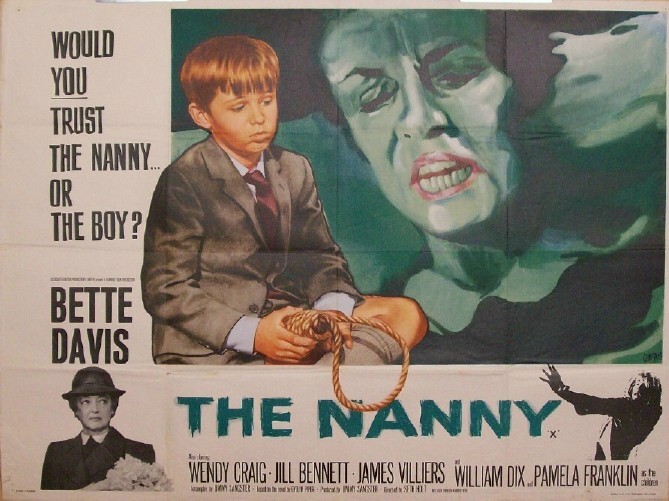
            Bette Davis plays a nanny to an upper-class British family whose oldest son Joey (William Dix) is accused of accidently killing his younger sister. Joey, who is only 10, is sent away to a home for disturbed children. When he returns he accuses the nanny as the one who did the killing and a psychological game of cat-and-mouse ensues.

Davis is sensational. She plays a type of character that she has never done before and the results are fascinating. She is much more subdued and evasive than usual and she falls into the role of the unassuming nanny in a seamless fashion. The different setting works well for her and I commend her tenacity for taking on a project that was not glamorous. She even puts on some thick eyebrows for her part and at times, especially at the beginning, she starts to resemble her most hated rival Joan Crawford.

Dix is amazingly good as the kid and it is a shame that he did only one other picture after this one. I liked the independent nature of the character and he plays off Davis quite well and showed no signs of being intimated by her. Making the adversaries have such extreme age difference and personalities gives the story an interesting edge that helps carry the picture.

The evocative black and white photography helps accentuate the dark-tone. The British setting along with the expected formalities of that culture, particularly that from the father character Bill (James Villers) give the film some distinction.

The first act though goes on way too long. We are given the general premise right up front and then have to spend the whole first hour going through the scenario that Joey doesn’t like his nanny and is suspicious of her again and again until it becomes derivative. When the second act does finally come about it seems too late. The revelation isn’t all that clever or creative and the climactic sequence desperately needed more action and punch. The final result is unsatisfying. The viewer is given an intriguing premise that it can’t sustain to the end ultimately making this a misfire despite the outstanding presence of Davis and some high production values.

There is also the issue of the three-year-old girl who is adorable and an absolute scene stealer and yet right up front you are made aware that she is killed, which makes the proceedings rather depressing. Having to then watch her actual death is disturbing and, for its time period, rather vivid and startling.

My Rating: 5 out of 10

Released: October 27, 1965

Runtime: 1Hour 31Minutes

Rated: NR (Not Rated)

Director: Seth Holt

Studio: Hammer Productions

Available: DVD

The Little Girl Who Lives Down the Lane (1976)

By Richard Winters

My Rating: 3 out of 10

4-Word Review: She is all alone.

Rynn (Jodie Foster) is a 13-year-old girl living alone in a big house in the countryside. Her father has leased the place for three years from nosy landlady Mrs. Hallet (Alexis Smith) and her adult son Frank (Martin Sheen) who continually makes lecherous advances towards Rynn. No one has seen her father and when anyone asks for him she comes up with excuses, which starts to make everyone in town suspicious. She meets fellow teen Mario (Scott Jacoby) who she lets in on her secret and the two devise a plan that will rid them of the meddlesome Hallets.

Although she has stated in interviews that this is the least favorite out of all the movies that she has done I can’t think of anyone more perfect for the part of an independent headstrong young woman than Foster, who has always carried that persona. Despite the vast age difference she easily carries the picture from her older co-stars. There is even a nude scene involving her character although it was done by her older sister Connie working as a body double. This was done despite her adamant protests as was a scene where she goes to bed with Jacoby, which she has said made her extremely uncomfortable and probably explains her dislike for the film.

Sheen is menacing as the perverted Frank, who enjoys ‘younger girls’ and his ongoing banter and advances with Rynn is consistently creepy and tense. Alexis Smith is excellent as the mother and her worn face and attitude gives her a witchy presence and it is too bad she couldn’t have remained for the entire movie. I also found Jacoby engaging and amiable and I really enjoyed his character, which I found a bit surprising since he is best known for playing dark, sinister characters in Rivals and the TV-movie Bad Ronald.

The on-location shooting, which was done in both the Canadian province of Quebec and in Maine, is excellent and gives one a nice taste of small town life on the east coast. There is some nice synthesized music that gives the film a dark tone. The premise is offbeat and to some extent, at least during the first half, it is enough to keep you intrigued.

My main issue with the film is the fact that not enough happens. Almost all the action takes place in the main room of the house, which eventually becomes dull, especially visually. There are no scares, or shocks and the twists aren’t all that clever, or surprising. In fact the final twist I saw coming long before it happens. There are times when cutaways would have been helpful and spiced things up particularly when Rynn talks about a visit from her mother and her ‘long red finger nails’, which we never see and is just described. The conclusion leaves A LOT of unanswered questions making this thing empty and incomplete. The final shot is one very long take of a close-up of Foster staring at a subject while the credits role by, which eventually becomes annoying and it would have been better had they done a freeze-frame instead of forcing her to sit and stare at something way longer than humanely possible. Also, composer Mort Shulman is badly miscast as the policeman. His acting abilities are clearly limited and he shows no presence or authority and makes the scenes he is in weak.

It is hard to know what genre to put this in. It is really not scary and the mystery angle has too many loopholes to being taken seriously. The story, based on a novel by Laird Koenig, seems rather tame despite some dark elements and geared more for teens, or young adults.

My Rating: 3 out of 10

Released: December 25, 1976

Runtime: 1Hour 40Minutes

Rated PG (Brief Nudity, Mild Cursing)

Director: Nicholas Gessner

Studio: American International

Available:  VHS, DVD, Netflix Streaming

Still of the Night (1982)

By Richard Winters

My Rating: 4 out of 10

4-Word Review: This teddy bear bleeds.

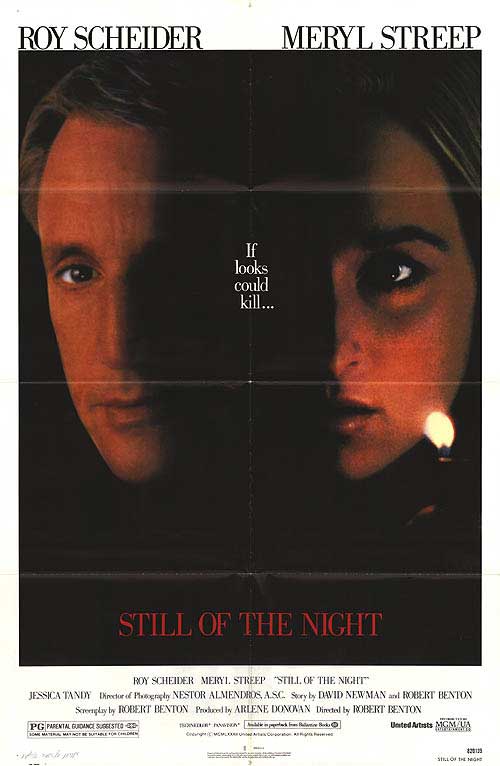
Successful psychiatrist Sam Rice (Roy Scheider) finds himself immersed in a tangled web of murder and deceit. One of his patients, wealthy art dealer George Bynum (Josef Sommar), is found murdered. A mysterious woman named Brooke Reynolds (Meryl Streep) visits him and states that she was George’s mistress and Sam suspects that she may be the killer. He tries to do his own investigation, but the police start to doggedly tail him thinking he may know more than what he is letting on.

This was yet another homage to Alfred Hitchcock, this time done by writer/director Robert Benton, who is an excellent filmmaker in his own right.  This one has all of the style, but none of the substance.  The concept is slickly handled, but it misses Hitch’s flair as well as his wry sense of humor.

Normally I have never been too impressed with Scheider as a leading man.  He has always seemed transparent and his range of characters as well as emotions that he can convey are limited. Here though, as an evasive middle-man, his acting abilities work quite well and I actually found him perfect for the part.

Streep does not fare as well.  Her acting is almost always impressive and I admire her prolific career, but this is one of her few roles that takes no advantage of her talents. She seems to have an almost ghost-like presence. I didn’t find her character to be compelling, nor intriguing. I had no interest in her fate nor her relationship with Rice.

Joe Grifasi was a poor choice as the lead investigator Joseph Vitucci. He showed none of the characteristics of a seasoned police detective and looked and acted more like a disheveled kid just out of college. The rest of the supporting cast is dull and cardboard. It would have been nice if one eccentric character had been put in to liven things up.

Probably the most interesting aspect of the whole movie is a nightmare segment that the George character has that comes in the middle of the story. I liked some of the creepy imagery that was used including a bleeding stuffed teddy bear. I also enjoyed how afterwards Sam debates the dreams meaning with his mother Grace (Jessica Tandy) who also has a background in psychology, but I thought it was a bit of a stretch when she suggests he go to the police about it as dreams can be interpreted in many different ways and hold no relevancy in a court of law. I thought it became even more far-fetched when at the end Sam uses some of the symbolism in the dream to figure out the identity of the killer.

The film has a few plot holes and certain things that just don’t add up.  Some of the ones that hit me was when Brooke talks about seeing George off in a cab that night and then the next morning reading in the papers that he had been murdered, which is preposterous.  Most newspapers go to press between ten and midnight, the dead body might not yet have even been discovered until later that day, or even a few days later. There is also a segment where Sam makes a $15,000 purchase on a painting he doesn’t even want at an auction simply so he can use it as an excuse to write a note on the bidding card warning Brooke that the police are after her. Also, when Sam does not find Brooke at her apartment her friend tells him that she is at her parent’s house in some town called Glen Cove, but she is not sure of the street name and yet Sam is able to find the place in the middle of the night with hardly any effort. Also, I found some of the conversations that George has with Sam during their sessions to be unintentionally funny.

There is enough intrigue to keep you somewhat interested, but the result is mild. I did like the idea of building the tension up through slow subtle means instead of the quick shocks that you see done in a modern suspense movie, but it is still slow going. The music played over the opening credits is more suited for a romance and does nothing to create the right mood for a thriller. The lighting in literally every shot is dark and shadowy, which certainly helps with the atmosphere, but after a while it gets to be too much. I was also not impressed with the climactic sequence. The protagonist is too helpless and defenseless and does not fight back, which severely limits the action. Having it occur at an ocean-side house does create a nice ambience, but the chase that is involved there could have been more extended and the camerawork during the segment is unimaginative.

My Rating: 4 out of 10

Released: November 19, 1982

Runtime: 1Hour 33Minutes

Rated PG

Director: Robert Benton

Studio: MGM/UA

Available: VHS, DVD, Amazon Instant Video

Venom (1982)

By Richard Winters

My Rating: 3 out of 10

4-Word Review: Kidnappers versus deadly snake.

            Phillip Hopkins (Lance Holcomb) is an 8-year old boy and son of a wealthy couple. When his parents leave for a trip the family’s maid and chauffeur (Susan George, Oliver Reed) conspire to kidnap the boy and hold him for a ransom with the help of a ruthless gunman (Klaus Kinski).  Unbeknownst to any of them the boy has mistakenly acquired a black mamba snake that escapes from his cage. As the culprits try to pull off their crime they become trapped in the house by the deadly reptile that starts to attack them one-by-one.

For starters the cast is one of a kind. Besides the performers listed above the film also has Sarah Miles as a Dr. with a serum to help fight the snake’s poisonous venom. Nicol Williamson appears as the police negotiator and Sterling Hayden, in his last film role, plays the boy’s grandfather.  How anyone could manage to direct a cast with such legendarily huge egos and eccentric personalities seems hard to fathom and probably explains why original director Tobe Hooper left the production after only ten days of shooting and was replaced by Piers Haggard. Supposedly Reed and Kinski were at odds with each other during the entire production and their animosity clearly shows on screen. For the most part the talents of the cast is wasted with a script that is limited and filled with characterizations that allow for no range.

I did like Hayden in the scene where he is forced to go searching for the snake in a darkened room and armed with nothing more than a lamp and a makeshift weapon. George is also fun playing a duplicitous character for a change and I was disappointed that she gets killed off so soon. However, she does make the most of it with a very theatrical death scene. Probably the best performance in the whole film is that of the boy. He has a very sweet, young looking face and the widest most innocent pair of blue eyes you’ll ever see and the kind that most casting directors would kill for. The kid plays the frightened part well and does an effective asthma attack. He hasn’t done much since, but I am sure that if he wrote a book dealing with his experiences on the set and his interactions with that cast that if would most assuredly be a best-seller.

The set-up is good and I found myself riveted to it for the first half-hour. I liked the idea that an actual mamba snake was used. There is a part where the snake is slithering towards the camera and opens its wide, black mouth and hisses straight at the camera, which could be enough to get most viewers to jump out of their seat. Director Haggard uses the novel idea of shooting scenes from the snake’s point-of-view and he does it through a fuzzy and slightly distorted lens to help replicate the snake’s vision. The only problem I had in this area is that the snake is seen slithering throughout the picture inside the home’s venting system, which is shown to be very clean and spotless, which didn’t make sense to me since the home was old making me think that the metal piping would be more corroded and rusted.

Despite the excellent concept the film’s second hour is quite boring. The characters don’t have enough to do and spend most of the time standing around. The interplay between Kinski and Williamson brings no tension. There is one cringe inducing scene where the snake crawls up Reed’s pant leg, but overall the scares are quite sparse. The climatic sequence is too convenient and becomes more of a disappointment then a shock. It is hard to say if the film would have been better if Hooper had stayed on or not. Reportedly none of the footage that he shot is in the final cut. The film is based on a novel by Alan Scholefield, which I suspect is probably more intriguing and after watching this makes me interested in reading it.

My Rating: 3 out of 10

Released: January 29, 1982

Runtime: 1Hour 33Minutes

Rated R (Mature Theme, Violence, Language) 

Studio: Paramount

Director: Piers Haggard

Available: DVD