Category Archives: Satire

Sweet Liberty (1986)

By Richard Winters

My Rating: 4 out of 10

4-Word Review: Retelling history Hollywood style.

Michael Burgess (Alan Alda) is an historian who writes a book that is purchased into a movie. To his dismay the screenplay is ‘Hollywoodnized’ and looks nothing like the original story. Michael then attempts to get the script corrected while the movie is being produced.

This is a mechanical comedy with situations, characters, and jokes are that quite predictable. There is not one moment that stands out as hilarious and the direction lacks visual flair. Yet when compared to Alda’s other efforts this one fares better. The dialogue is livelier and the story has more energy and conflict, but as satire it is too light.

There are more subplots than are necessary and take away from the main plot. One involves his relationship with a fellow history professor Gretchen (Lisa Hilboldt) and their constant arguing about whether or not to get married becomes tiring. There is also a storyline involving his interactions with his aging mother, which is played by the legendary Lillian Gish. Of course it is always fun to see Gish in a later day role and this is indeed one of her most amusing, but the segment itself is contrived.

Alda always likes to cast fellow performers around his same age, which would explain the miscasting of Michael Caine. Caine is reliable, but having him play a Colin Farrell like leading man seems best suited for a younger actor. A more virile performer would have made the animosity between the character and Alda’s more distinct and intriguing.

Michelle Pfeiffer is cast as a beautiful actress hired to play the leading lady. Her character is interesting because it shows how on her off time how she is completely different person from the one she is playing in the production. This allows for some light insight into the acting process. The film also touches on the politics and behind the scenes maneuverings that go on during a production although it could have gone a lot further with this.

Having Burgess end up sleeping with Pfeiffer seems to be a stretch. Things become even more incredulous when Gretchen, in a fit of revenge, forms a relationship with Caine. The Caine character is a self- absorbed star with lots of beautiful women chasing after him and the chances of him getting excited or even noticing an average looking woman like her seems unlikely.

The Bob Hoskins character is by far the most engaging. He plays the scriptwriter and tries to educate Michael on the ins and outs of the film business. Saul Rubinek as the film’s director runs a close second. He perfectly creates the frantic traits of someone who must act more like a politician than a director.

Overall this is a film that could have done more with the material. It rates slightly better than some of Alda’s other efforts, but it is still just a pleasant time filler that is easily forgettable. I did however like the original music.

My Rating: 4 out of 10

Released: May 14, 1986

Runtime: 1Hour 46Minutes

Rated PG

Director: Alan Alda

Studio: Universal

Available: VHS, DVD

Lost in America (1985)

By Richard Winters

My Rating: 7 out of 10

4-Word Review: Living in a winnebago.

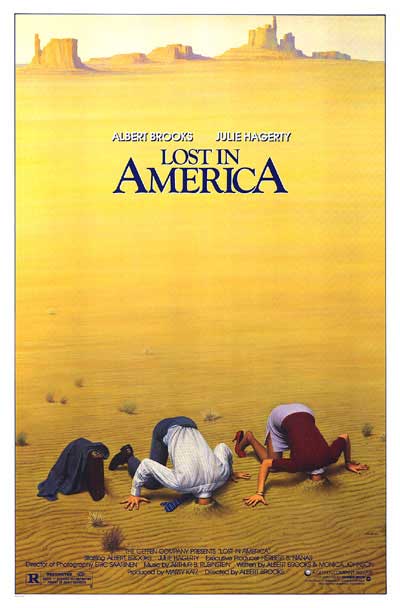
            David Howard (Albert Brooks) becomes upset when he doesn’t get his expected promotion and decides the corporate life isn’t for him and that he and his wife Linda (Julie Hagerty) will drop-out by liquidating all of their assets, buying a Winnebago, and roaming the countryside as free-spirits. Things go horribly wrong right from the start when, in a fit of gambling fever, Linda loses their entire savings at the roulette wheel. This forces David and Linda to desperately look for jobs in the first small town they come to.

The concept is fantastic. Who hasn’t dreamed of doing this at one time or another? Reportedly top executives who saw the film admitted having these very same fantasies at some point. In many ways this film is perfect testament to the 80’s where everything seemed to backtrack to the materialism and conformity of past eras and the idealism of the 60’s became lost. Writer-director Brooks plays it in a realistic and believable way with just enough subtle comedy to bring out the absurdity in each situation, which is what makes it fun.  Had the characters been over-the-top it wouldn’t have worked.

The dry, cynical wit that is Brooks’s signature is in full swing here. It may be an acquired taste to some, but it is distinct and hilarious for those that enjoy it. Some of the best moments include David’s funny rant when he tells off his boss and demands that the company give back the eight years he invested into it and won’t leave until it does. There are amusing conversations between David and the casino owner (Gary Marshall in an excellent cameo) where he begs him to give back the money Linda lost as well as his visit to an employment agency. The couple’s argument at the Hoover Dam is another highlight as is his lecture to Linda about the ‘nest egg’ concept. However, the funniest scene that had me literally laughing out of my seat was when David takes a job as a crossing guard for $5.50 an hour and some ten-year-old boys start to mock him. Even the little things, like when David tells a hotel clerk that they did not make reservations because they have ‘dropped-out of society’ and ‘just living for the moment’ is funny when done with Brooks’s impeccable deadpan delivery.

Julie Hagerty is so ingrained in my mind for her appearance in the cult-classic Airplane that I had a hard time adjusting to her here. Initially, when she is shown in the corporate setting and acting as a serious, responsible adult, I felt it didn’t work because I kept expecting her to say, especially with that high-pitched voice of hers, something dippy and spacey like her character in Airplane always did. However, when she gambles away their savings by incessantly screaming out the number twenty-two she is hilarious and when David lectures her afterwards and she looks up at him with that blank, blue-eyed, deer-in-headlights stare, she is perfect and the casting astute.

The opening sequence is probably the only part that doesn’t work. Having a taped audio interview between talk show host Larry King and film critic Rex Reed played over the opening credits is certainly novel, but David’s prolonged, whiny conversation with Linda while in bed is annoying.  A scene involving a conversation between Linda and a co-worker could have been cut. There is also the fact that everything goes downhill too quickly making the viewer feel almost cheated. It would have been nice to have seen them living the hippie lifestyle for a while and then have the problems begin gradually. There could’ve been a lot of great comedy had it been played straight without the irony of the money problem. Either way it’s entertaining, but brief. Hearing the entire rendition of ‘New York, New York’ by Frank Sinatra is worth the price as is the sight of seeing a giant Winnebago driving up a busy, downtown Manhattan street.

My Rating: 7 out of 10

Released: March 15, 1985

Runtime: 1Hour 31Minutes

Rated R (For a Couple of ‘F-Bombs’)

Director: Albert Brooks

Studio: Warner Brothers

Available: VHS, DVD, Amazon Instant Video

Lord Love a Duck (1966)

By Richard Winters

My Rating: 3 out of 10

4-Word Review: She wants it all.

If you ever wondered where political correctness got its start it was probably southern California in the mid 60’s. Here everything is neutralized and modified so as to ‘keep up with the times’. There’s even a drive-in church where the minister proudly exclaims that the Lord answers every prayer because “whatever happens is the answer”.

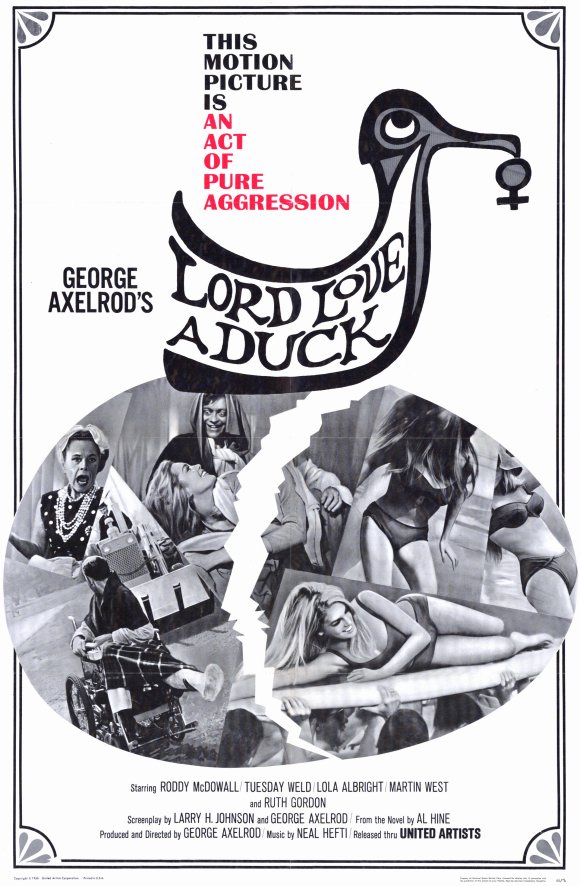
Tuesday Weld plays teenager Barbara Ann Greene who can’t be happy unless she has it all. She meets fellow high-schooler Allan Musgrave (Roddy McDowell) who because of his super intelligence is able to figure out ways for her to get what she wants. Yet the more she gets it the more unhappy she becomes.

It’s a satire on our consumer driven society, but it is too restrained and soft. A supposedly cutting edge film looking at our modernized world should have been filmed in color and not black and white. It also should have been faster paced with a heavier emphasis on the zany and outrageous. Instead we only get hints of this with a lot of slow segments and even some clumsy drama. The funny offbeat bits are spread out to thin and do not make up for the other parts that are boring and contrived.

There are some technical problems too including a lot of ‘outdoor’ shots that were really filmed indoors on a soundstage. They fortunately don’t do this anymore, but when they did it looked tacky. There is also a boom mike that is very obvious to see in several shots.

McDowell is not eccentric, nor unique enough for such an offbeat character. Although perpetually boyish looking he was way, way too old to be playing a high school student as he was 37 when this was filmed. Out of all the performers Harvey Korman comes off as the most amusing playing the overtly congenial school principal.

This film does feature an attractive cast. Of course Weld is always alluring, but she has competition from Jo Collins who was Playboy Playmate of 1965. There is also Lynn Carey daughter of the late actor MacDonald Carey from ‘Days of Our Lives’ fame. She is exceptionally good looking and watching here gyrate in a bikini to the latest dance craze is damn near pornographic. For her age Lola Albright, who plays Weld’s mother, is an absolute knockout and she can officially be crowned as a ‘milf’.

My Rating: 3 out of 10

Released: February 21, 1966

Runtime: 1Hour 45Minutes

Rated: NR (Not Rated)

Director: George Axelrod

Studio: United Artists

Available: VHS, DVD

The Landlord (1970)

By Richard Winters

My Rating: 8 out of 10

4-Word Review: In over his head.

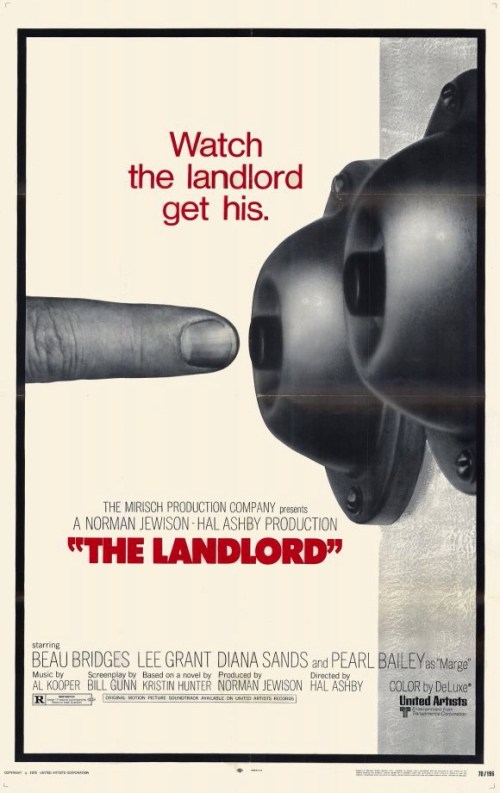
Elgar Enders (Beau Bridges) is a spoiled 29 year-old from a wealthy family who is still living at home with his parents in an affluent suburb of New York.  He decides it is time to ‘make his mark’ by purchasing a rundown building housing black tenants in inner-city Brooklyn.  He plans to evict the people and have the structure renovated into a posh flat.  He starts having second thoughts though as he gets to know the people and learns of their struggles.  He begins a relationship with one of the women (Diana Sands) and soon he is working to upgrade the building as well as trying to enlighten his racist, snobbish parents (Walter Brooke, Lee Grant) to embrace the black movement.

The Enders character is a perfect microcosm to the 70’s period where idealism and efforts to improve inner-city life, as well as some of the harsh realities that came with it, where at an all-time high.  Director Hal Ashby’s first film is full of strong gritty visuals from the rundown, graffiti-laden buildings to the garbage strewn lawns. Everything was filmed on-location and you get a vivid taste of the black experience. It is boosted even more by the detailed cinematography of Gordon Willis, which makes the most of the natural lighting and making you feel like you are right there.   The honest no-holes-barred approach is terrific. It perfectly captures the mood and feel of its era. I was surprised for a first time director, even a really good one like Ashby,  how well-constructed and technically sharp this was, which could have some link to the fact that it was produced by another great director, Norman Jewison, whom I’m sure lent a lot of input.

Initially I found the Elgar character to be off-putting, but that could’ve been intentional.  We first see him sitting on his lawn chair being served a drink by a black servant while talking about his great plan and looking like a spoiled, snot- nosed kid who has been coddled all his life.  The one scene that I remembered from this film when I first saw it over 20 years ago is when he  gets out of his Volkswagen bug to look at the building while wearing a tacky looking Pat Boone white dress suit.  When some of the black men sitting on the building’s front steps tease him a little, he immediately panics and runs eight blocks down the street in terror even though no one was chasing him.  However, he does start to grow on you as the film progresses.  I liked the fact that he faces adversity and is not scared away.  He learns to persist and adapt.  He genuinely starts to care about the people and backs-up what he says to the extent that he single-handedly carries new toilets one-by-one from the hardware store to the apartment building when the plumbing breaks down in an amusing vignette.  He isn’t afraid to tell off his arrogant parents when he needs too and his definition of NAACP is pretty funny.  It is satisfying to see him mature, learning that instituting change is not easy and things are the way they are for a reason.  He eventually is forced to confront his own limitations, but becomes a stronger person for it. This is without a doubt Bridges best performance to date.

There are other great performances as well.  Pearl Bailey is a gem as one of the building’s feisty, older women tenants who is the first to befriend Elgar.  Her awkward visit with Elgar’s equally feisty mother is considered the film’s highlight by many viewers and critics. I also loved the look she gives Elgar at the very end when he tries to wave goodbye to her.  The gorgeous Diana Sands is outstanding playing the role of Francine who has an ill-fated affair with Elgar. She shows just the right balance of sexiness and seriousness and it was a shame that just a few years after this film was made she ended up dying of cancer at the young age of 39. Susan Anspach is fun in one of her early roles as Elgar’s pot smoking sister.  The performance though that leaves the strongest impression is that of Lee Grant who is hilariously hammy as Elgar’s priggish mother.

When I first saw this film I came away thinking that it was uneven and a bit bipolar. It runs most of the way as a gentle, quirky satire filled with goofy cutaways, but then ends with a very stark and frightening scene with Elgar being chased down the grimy hallways of the building by Francine’s angry ax-waving husband (Louis Gossett Jr.) when he finds out that Elgar has gotten his wife pregnant.  The scene is ugly and intense and a far cry from the rest of the film’s gentle tone. Yet upon second viewing I think this scene works and was necessary. It makes a good statement at how volatile temperaments can be of those that are forced to leave in squalor as well showing how easily people, even with the best intentions, can get in over-their-heads when they don’t fully appreciate, or understand the situation that they are getting into it.

The side story involving a mulatto women (Marki Bey) who falls in love with Elgar is solid as well and gives the viewer a keen insight as to how difficult it is for someone who can’t seem to be accepted by either race. The language and conversations are tough and vulgar, but always laced with realism.

The only complaint I have with the film is the portrayal of the white characters who are buffoonish and overly idiotic even for satire.  I thought the idea of having them still use black servants was over-done, but then when one of them shows up at a party wearing blackface it was overkill. I thought it was unfair and unrealistic in the way that the film worked so hard to give depth to its black characters, but then turns around and, with the exception of Elgar, paints the whites as nothing more than broad caricatures.

The Landlord has finally been released on DVD through MGM’s Limited Edition Collection. I would suggest this film for anyone who enjoys an intelligent comedy-drama with something to say. It is also a great chance to see young up-and-coming actors. This includes Hector Elizondo as well as comedian Robert Klein. You can also get a very quick glimpse of Samuel L. Jackson who appears briefly in an uncredited role as a minister near the end.

My Rating: 8 out of 10

Released: May 20, 1970

Runtime: 1Hour 52Minutes

Rated R

Director: Hal Ashby

Studio: United Artists

Available: VHS, DVD