Category Archives: Obscure Movies

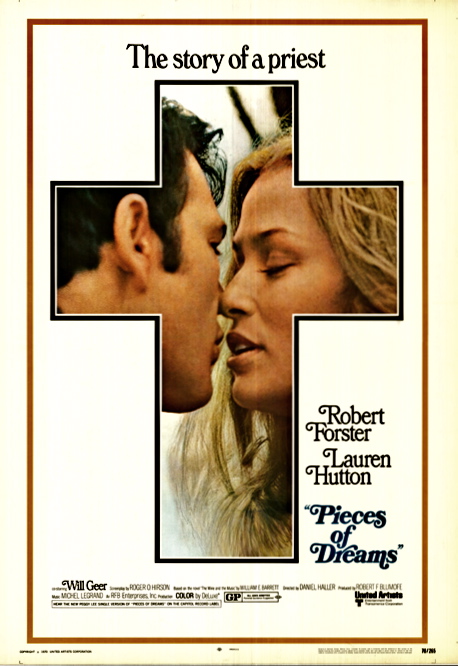
Pieces of Dreams (1970)

pieces1

By Richard Winters

My Rating: 2 out of 10

4-Word Review: Priest breaks his celibacy.

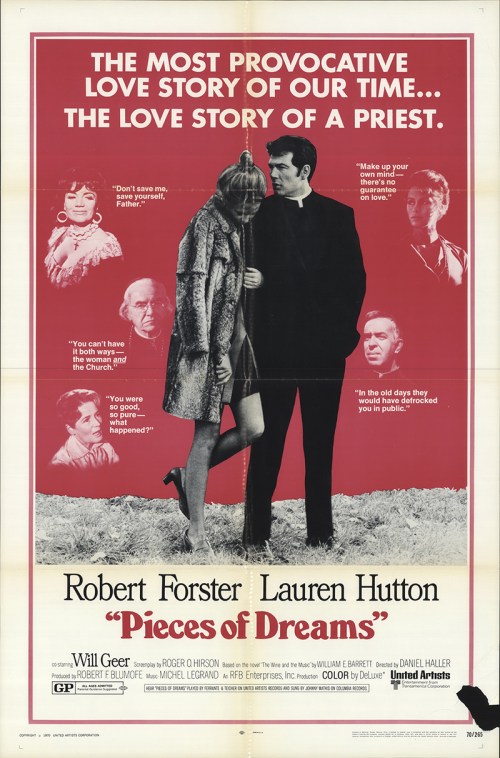
Father Gregory (Robert Forster) is a priest working outside of Albuquerque, New Mexico with a mainly Hispanic church membership. He had been dealing with a 15-year-old boy who was in-trouble with the law only to be called into the hospital late one night to learn that he’d been killed while trying to steal a car. It’s there that he meets Pamela (Lauren Hutton) a social worker from the local community center. The two share widely different viewpoints particularly on the topic of abortion, but despite their differences the two eventually fall in love and their relationship turns intimate. Gregory feels guilty about this due to his vow of celibacy and tries to hide the affair from Paul (Ivor Francis) an older priest whom he lives with and is known to have a prying eye. Gregory decides to ask for a leave in order to get his thoughts together, but learns that trying to find a job on the outside with little work experience can be a difficult task. While he avoids Pamela in order to figure out what direction he wants to take his life the other priests put pressure on her to break it off permanently while trying to guilt-ridden her that she’s destroying a ‘good man’s career’.

This was an unusual career move for Forster who had just completed his signature role in Medium Cool where he was seen running around naked with a nude woman inside his apartment during a provocative moment, so I guess he wanted to tackle a completely different type of character for his next project in an effort to avoid being typecast, but it doesn’t really work. He’s a fine actor, but his streetwise personality trickles through and he never really comes-off as being all that devout and thus making the career arch very expected and no surprise at all. The voice-over narration that he has during the first act, in an attempt to convey to the viewer his inner thoughts, was not needed and off-putting.

Hutton is quite beautiful. She hit her career peak with her work in American Gigolo when she was already middle-aged, so seeing her still quite youthful looking is a treat, at least to the heterosexual male viewer, and you could easily see why she was a former model. Ivor Francis, not necessarily a household name, but competent character actor during the 60’s and 70’s, is quite good as the domineering senior Priest who has his own character flaws that he tries to cover-up even though he’s more than happy to readily expose the ones he sees in others. Will Geer also shines, but isn’t seen until the tail end playing a clergyman who has an amusing line when he tells Gregory that the celibacy demand for Priests ‘will soon be going away’ even though 50 years after this was filmed nothing has changed.

The theme dealing with how religion in theory is meant to be comforting, but in practice can become something that torments people by making them feel guilty and fearing the wrath for what could be considered to others as being minor infractions, like having sexual thoughts, is on-target though not necessarily ground-breaking. Some of the other issues will seem quite dated like the married woman who fears using the pill, or any other type of contraception, as it goes against the teachings of the catholic church, though through the decades this is no longer considered as much of a ‘sin’. There’s also the scene where Gregory lectures a youth who’s in jail for smoking cannabis about how he’s ‘thrown his life away’ while pot is now legal in many states.

The real problem, or when the film ultimately ‘jumps-the-shark’, is when Gregory goes to bed with Pamela, which came off as way too seamless and rushed. Up until then the couple really hadn’t had much in common and were usually arguing over political issues and weren’t for that matter even officially dating. It seemed to me that if someone like Gregory is made to feel extremely guilty for even thinking about sex that is ability to actually perform it would be questionable. Having him run away from her when he started feeling the urge and then avoiding her due to the temptations that she gave him would’ve made more sense then just having him casually hop in the sack without a second thought like he’s just a regular guy on the make and wearing the priest collar is some sort of performance art.

What the filmmakers apparently thought would be a compelling question of would he, or wouldn’t he stay in the church is ultimately given the placid treatment. The romance angle isn’t convincing and despite some good conversational dialogue, and nice on-location shooting of New Mexico in the autumn, the story fails to resonate making the movie woefully trite by the time it finally ends.
pieces2

My Rating: 2 out of 10

Released: September 23, 1970

Runtime: 1 Hour 39 Minutes

Rated GP

Director: Daniel Haller

Studio: United Artists

Available: DVD-R (MGM Limited Edition Collection), Amazon Video
Fools’ Parade (1971)

fools

By Richard Winters

My Rating: 5 out of 10

4-Word Review: Can’t cash his check.

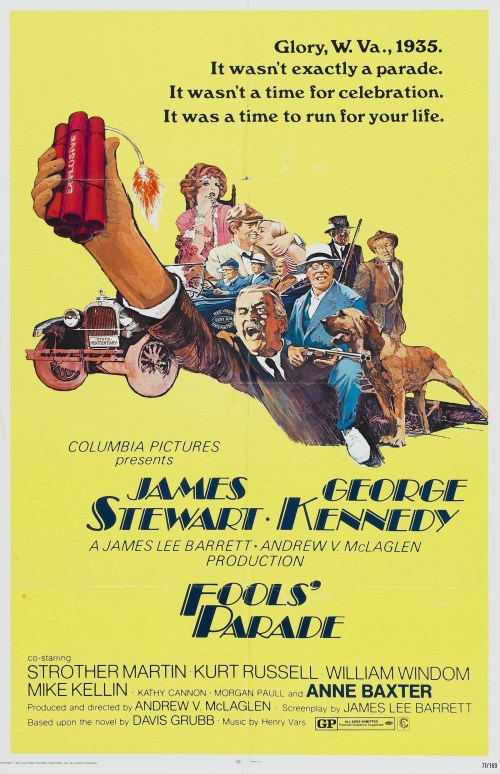
Mattie Appleyard (James Stewart), who lost one of his eyes during a fight years earlier and now wears a glass one, finally gets released from prison after spending 40 years behind bars. Along with him there’s bank robber Lee Cotrill (Strother Martin) and a young convict named Johnny (Kurt Russell) who both get released on the same day. Mattie’s also given a check in the amount of $25,452,32 as payment for his years of prison work. Mattie, Lee, and Johnny plan to use the money to start-up their own grocery store, but since the year is 1935 and many are poor due to the Great Depression they realize they must guard the check carefully and not cash it until it’s fully safe to. During their train ride out of town they become aware after reading the fine print that the check can only be cashed in person at the bank in the town that they’ve just left, so they take another train ride back. Unfortunately for them they don’t know that Mattie’s former prison guard Doc (George Kennedy) has already hatched a plan with the bank manager (David Huddleston) to make sure that the check is never cashed. In-fact the manager has given Doc an advance on the money to have Mattie and his friends wiped-out. Doc has hired a ‘Christian’ hit man  named Junior (Morgan Paull) to do the dirty deed, which Junior agrees to as long as it’s confirmed that people he kills are atheists, which Doc insists they are.

The film is based on the 1969 novel of the same name by Davis Grubb, who is better known for having written Night of the Hunter. It was shot on-location in Moundsville, West Virginia where Grubb was born and raised and it’s the setting that helps give the movie added character. The scenario though is rather odd and seems to want attain a certain quirky tone that it can’t quite reach. Leonard Maltin, in his review, complained about it being ‘unintentionally funny too many times to be taken seriously’. While I’ll agree the tension is lacking I do feel that this was meant to be humorous and some of it is slightly amusing, but it never gels and overall isn’t intriguing. I also felt the Russell character wasn’t needed. Maybe the producers wanted a youthful character added to attract younger members of the viewing public, but he doesn’t say, or do anything that’s funny, or helps move the story along. His romance with Chanty (Katherine Cannon in her film debut) who plays a 16 year-old who’s virginity is up for sale for a price of $100, is too forced, not believable, and adds nothing to the main plot.

There’s also several directorial errors including the first time Stewart takes out his glass eye, which was apparently so painful to wear that shooting could only last for 20-minutes at a time. In the shot we see Stewart put his hand over his eye and then it cuts to Russell’s shocked expression and then back to Stewart where the eye ball is in his hand, but we can see on Stewart’s face, just as he turns that he still has a blue eye in the socket where the glass used to be. When he removes the eye later he keeps the left eye closed in order to represent an empty socket, but the first time he doesn’t.

There’s also issues with Kennedy’s teeth. Initially I thought he was wearing braces, but then during close-ups it looks like there just supposed to be dirty, or rotting, but realistically it’s not done right. If they were truly bad teeth then some of them should’ve fallen out, or broken off instead of looking like they have been covered with black specks. There’s also a scene where he’s sitting in a car putting on his white shoes and his teeth are all white only to have in a later scene going back to them appearing dirty.

The performances are certainly a plus with Stewart’s being especially good and I admire the way he was willing to go out of his comfort zone by playing a type of kooky character he had never done before. Kennedy is also a scene-stealer in quite possibly the funniest thing he ever did. Huddleston is also solid as the corrupt bank manager and the segment where he nervously watches Stewart attempt to light a stick of dynamite inside the bank office is probably the film’s best moment. Kudos though must ultimately go to Anne Baxter who’s quite impressive as an aging, embittered prostitute who runs a whorehouse on a houseboat. I remember being blown away by her performance in The Ten Commandments and then later for her Oscar winning work in All About Eve, but her she’s almost unrecognizable in a role that is both darkly funny and sadly poignant at the same time.

My Rating: 5 out of 10

Released: June 17, 1971

Runtime: 1 Hour 38 Minutes

Rated GP

Director: Andrew V. McLaglen

Studio: Columbia Pictures

Available: DVD-R, Tubi

The Swinging Barmaids (1975)

swinging

By Richard Winters

My Rating: 3 out of 10

4-Word Review: Killer stalks cocktail servers.

With a script written by Charles B. Griffith, better known for having done Little Shop of Horrors, the story centers on Tom (Bruce Watson) a serial killer who stalks women who work at a bar called The Swing-a-Ling Club. His first victim is Boo-Boo (Dyanne Thorne), whom he felt ‘disrespected’ him when she referred to him as ‘sonny’ when she served him his drink, so he quietly followed her home and attacked her and afterwards took photos of her in provocative poses. He then changes his appearance and gets a job at the bar as a bouncer. He proceeds to kill two more of the waitresses, Marie (Renie Radich) and Susie (Katie Saylor) before setting his sights on Jenny (Laura Hippe). However, with Jenny he begins to admire the fact that she insists on staying faithful to her fiancée Dave (Jim Travis) and therefore he considers her to be ‘pure’ deserving of respect instead of a gruesome death. While visiting her at the home of her parents (Milt Kogan, Judith Roberts) he tries to convince her to dump Dave and get with him and he won’t take ‘no’ for answer. Will Lieutenant White (William Smith), who’s been investigating the case and does not consider Tom as a suspect, be able to connect-the-dots before it’s too late?

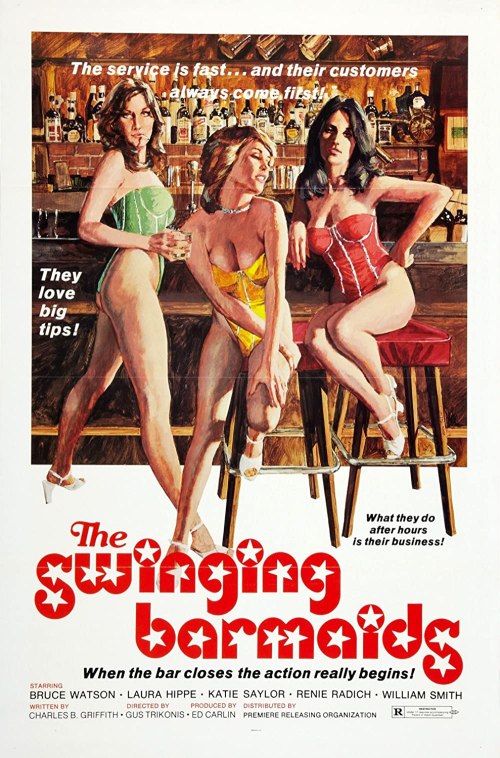
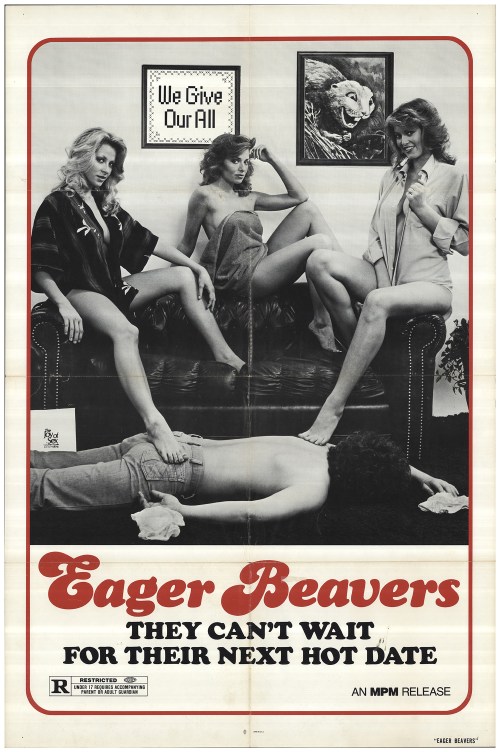
For an exploitation flick this one doesn’t seem all that titillating. The film’s promotional poster seen above alludes to ‘loose women’ having indiscriminate sex, the film was later reissued as Eager Beavers, which pushes this concept in an even more explicit way, but really you don’t see much of that onscreen. The women, who appear to be around 30 and looks-wise are okay, but nothing that would be considered stunning, come-off as basic working-class folks just trying to do their hum-drum jobs and not oversexed vamps in any way. Their personalities are indistinguishable from the other and their conversations deal with run-of-the-mill issues that aren’t compelling, or original. They also speak in a cliched, Flossie-like tough girl way of a New York street hooker, which I found annoying.

Having it shown right away who the killer is doesn’t help matters. Part of the fun of a slasher film, which this isn’t as it was made before that concept came into vogue though still follows the same basic formula, is trying to guess who the bad guy is, but having that quickly revealed losses the potential mystery element that could’ve made it more intriguing. We learn nothing about the killer, other than a police detective ‘profiling him’ as being someone with ‘mother issues’, but this is something the viewer needs to see and learn visually instead of having it explained to them. Smith as the good-guy is weak too. He’s been great in some of his other film roles, but he’s rather detached and downright irritable in this part and there’s long segments where he’s not even seen.

Gus Trikonis’ direction helps to give it a few extra points. While the killings lack blood I did like the way the hand-held camera follows the victim around as she gets chased through her apartment, particularly during the first attack, which lends an authentic, vivid feel as she tries to fight-off her attacker. The underwater photography showing one of the victims getting drowned is impressive as well, but there are some directorial mistakes here too.

One is when Tom kills Marie and then poses her naked body on a deck chair outside on the patio. The club owner Zitto (Zitto Kazann)  comes along and finds her there with Tom hiding behind the bushes and could’ve easily escape undetected, but instead he proceeds to attack Zitto, who is his boss and could identify him, so why not just get away from the crime scene instead of making things potentially worse for himself?

Another segment has Susie inside a film studio looking up towards a bright spotlight where Tom is standing, but because the light is so bright she must shield her eyes and cannot make out who’s talking to her.  When the viewer though is shown a point-of-view shot we can easily identify him, but if we’re really supposed to be seeing things from her perspective then the light should be blinding for us as well.

Another flawed moment has Jenny’s mother getting a call from a Smith warning her that Tom could be dangerous. She’s to pretend that she’s talking to someone else on the other end, so as not to tip-off Tom, who is sitting close by and can overhear what she’s saying. However, in the film the viewer can hear Smith’s voice through the receiver making it seem that if we can hear it then Tom should be able too. To have prevented this the film should’ve cut away every time Smith spoke showing him at the phone booth and therefore never would’ve heard his voice through the receiver.

Some may enjoy the sleazy storyline and Grindhouse reputation, but even on that level, there’s more explicit and violent stuff out there and it all gets handled in a highly routine way. In fact the only unique thing about the production is that both of the leading actors ended up committing suicide. Hippe’s was in 1986 and Watson, who suffered from manic depression, was in 2009.

swinging2

Alternate Title: Eager Beavers

Released: July 16, 1975

Runtime: 1 Hour 28 Minutes

Rated R

Director: Gus Trikonis

Studio: Premiere Releasing Organization

Available: DVD-R

Circle of Two (1981)

circle3

By Richard Winters

My Rating: 4 out of 10

4-Word Review: Old man/young teen.

Ashley St. Clair (Richard Burton) is an aging painter of 60 who has lost his passion and hasn’t either sold, or attempted to do a painting in over 10 years. Sarah (Tatum O’Neal) is an unhappy 15-year-old who’s tired of dating guys her own age as she finds them to be immature and only interested in one thing…sex. She then meets Ashley, first after she sneaks into an adult theater to watch an X-rated movie and then later at a coffee shop. Despite the extreme differences in their ages they still connect through their mutual interest in art. Ashley even begins to paint again and the two share an enjoyable, but platonic friendship. However, once Sarah’s parents (Robin Gammell, Patricia Collins) find out about they put an immediate stop to it by locking her in her room and and in protest Sarah refuses to eat.

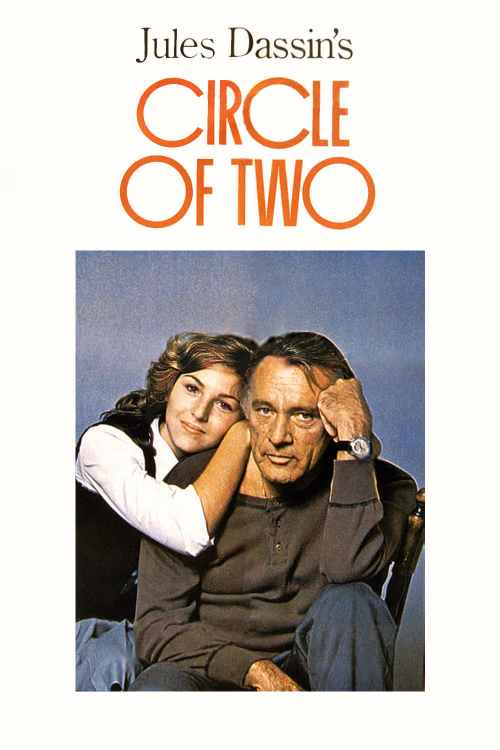
Based on the novel ‘A Lesson in Love’ by Marie-Terese Baird this film marks the final one to be directed by famed Greek director Jules Dassin and in many ways this may be the weakest one that he did. The whole way the relationship gets going is very rushed and forced. Bumping into the same person twice in one day, in the big city of Toronto, doesn’t seem likely and then having Sarah fall so head-over-heels for him to the point she starts spouting out the ‘L’ word quite quickly is dingy. A more plausible scenario would’ve had Ashley teaching an art class (he no longer paints, but still has to bring in an income somehow) of which Sarah attends and then through the course of several months a bond is slowly created.

The sex angle is a complete mess. Fortunately Ashley makes no moves on her, but Sarah does aggressively begin to come-on to him and at one point stands completely naked in front of him. In her autobiography ‘A Paper Life’ O’Neal expressed great discomfort in having to do this scene though I didn’t detect this, but maybe that’s just because she’s such a great actress, but either way the scene was completely unnecessary.  It’s also inconsistent with the character as she broke-up with her boyfriend Paul (Michael Wincott) because he was trying to pressure her into having sex and she was still a virgin, so if she didn’t want sex with a guy her own age why would she want it with one who was way older and is this era of pre-Viagra how could she even be sure he could do it? A better scenario would’ve had sex never coming into play and it was simply their other mutual interests that connected them and it was only outsiders, like Sarah’s parents, that presumed the worst when it really wasn’t occurring.

The one bright spot is the acting with both leads being superb. O’Neal proves that her strong and memorable performance in Paper Moon was no fluke and the only thing that keeps the film watchable. Burton is excellent as well. Although he usually has a strong presence here he wisely takes a step back playing someone who’s weak and tentative, which in many ways reflected his own career at the time where many felt he was washed-up and the years of alcohol abuse certainly did age him making him look even older than 60 when he really wasn’t, and thus a perfect fit for the part. The only issue here is that Tatum seems way too mature for 15 both physically and personality-wise and having her play someone who was 17 would’ve been more appropriate.

While the film remains marginally compelling the talky ending in which Burton goes on a long speech like a tenured professor lecturing to a college class practically ruins it. I was also frustrated that we never learn much about the old man, played by George Bourne Sr., an elderly gentleman who agrees to let Ashley paint his portrait for a fee, which in-turn revitalizes his career and I felt this character should’ve been in it more, or at least a few scenes showing what they talked about as his portrait was being done.

Tatum’s abstaining from all food plays-out poorly as well. For one thing she doesn’t change physically, so we’d never know she wasn’t eating if it weren’t mentioned. She then travels to New York and I was fully expecting her to pass-out in the middle of crowded Grand Central Station from a lack of nutrients, but apparently in-between time she had eaten something, but this should’ve been shown and the fact that it isn’t is a sign of shoddy film-making, which despite Dassin’s previous output, this whole movie ends up pretty much being.

My Rating: 4 out of 10

Released: May 7, 1981

Runtime: 1 Hour 46 Minutes

Rated PG

Director: Jules Dassin

Studio: World Northal

Available: DVD-R, Amazon Video

The Night the Lights Went Out in Georgia (1981)

night

By Richard Winters

My Rating: 3 out of 10

4-Word Review: Not like the song.

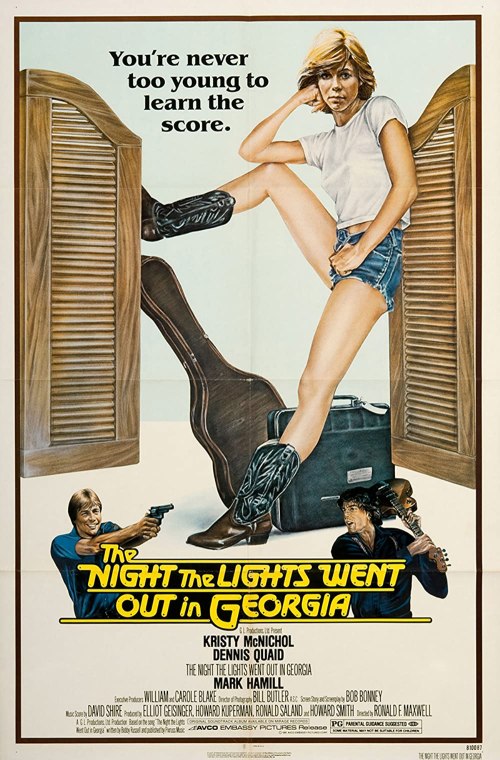
Travis (Dennis Quaid) is an aspiring singer with some talent, but little discipline. He’s achieved one hit song,but his drinking and partying keeps getting him in trouble. Amanda (Kristy McNichol) is his younger sister and though she’s only 16 she is more mature and responsible. She tries to manage Travis’ career by getting him to Nashville, so he can cut a record and get an agent, but his wild ways and their lack of funds, keeps preventing them from getting there. Eventually he gets arrested for public drunkenness and in order to pay the fine is forced to get a job at a local bar. It’s there that he meets Melody (Sunny Johnson) and tries to pursue a relationship, but becomes aware that Seth (Don Stroud), the deputy sheriff, has a thing for her as well and he won’t allow any other guy to talk to her as he’ll fly into a jealous rage and warns Travis of this, but Travis being reckless as always doesn’t let this phase him. As this goes on Amanda begins a romance of her own with with Conrad (Mark Hamill) who works as a state trooper.

Although in theory it’s ‘inspired’ by the song of the same name it technically doesn’t have anything to do with it. In other films that were made from songs like Convoy, Harper Valley PTAand Ode to Billy Joethe central theme was maintained and then expanded on, but here we don’t even get that. The song, with lyrics written by Bobby Russell and then sung by his then wife Vicki Lawrence, had to do with a man getting executed for killing another man who had an affair with his wife even though it was really his kid sister that did the crime. A plot like that could’ve had great potential for being an interesting movie, so why the producers didn’t just go with that original concept I don’t know, but it seems like a travesty for them to retain the song title and I’m surprised the producers of the record didn’t sue.

The plot, as it is here, is limp and uninspired. It basically feeds off of a lot of predictable shenanigans like Travis getting caught in a hotel bed with another man’s wife and then being chased around both on foot and in a vehicle until both he and Amanda are able to get away. In between we get treated to a lot of songs, which normally I’d say was nothing more than filler, which it still is, but since the rest of it is so lame, it comes off more like the best thing in it. Quaid and McNichol do all of their own singing and even wrote their own lyrics and they give energetic performances when onstage, so if you decide to see this thing then I’d suggest fast-forwarding through the rest of it and just stick with the music and you might be pleased.

The acting by Quaid is excellent and Don Stroud is great as the nemesis. McNichol is alright, at least when she’s singing, but otherwise gets pushed to the background and with her super short hair and nagging personality lacks sex appeal and at times looks almost like she could’ve been Quaid’s kid brother instead. The fact that they’re so close and do everything together would make one wonder if there’s something incestuous going on. In the more innocent times of the early 80’s maybe this wouldn’t be the first thought that would pop into people’s minds, but these days I’d suspect others would be wondering the same thing. There’s also no explanation for what happened to their parents. At one point McNichol mentions that she’s orphaned, so there really needs to be a backstory showing of what caused that.

Spoiler Alert!

The biggest gripe though is with the ending in which Travis gets shot and killed by Seth, who also dies in the gunfight. It then concludes with McNichol getting with Hamill, who quits his job as the state trooper, and the two drive-off in her rickety old truck to God knows where. Since the story was mainly about the brother/sister relationship then I felt that’s where it should’ve ended with them in Nashville either getting the record deal, or not. The Hamill character is bland and seemed to be added in with no other purpose, but to extend the already anemic plot. There’s also the fact that he was 29 at the time while McNichol plays someone who was only 16, so them getting into a relationship doesn’t exactly look kosher. Granted the age of consent in the state of Georgia is 16, so I guess in the eyes of law it’s okay, but many today will consider this kind of romance to be cringey, and I can’t help but wonder if that’s the main reason why this film has never had a proper DVD release nor any streaming option.

My Rating: 3 out of 10

Released: June 5, 1981

Runtime: 1 Hour 52 Minutes

Rated PG

Director: Ron Maxwell

Studio: AVCO Embassy Pictures

Available: DVD-R

Vasectomy: A Delicate Matter (1986)

vasectomy1

By Richard Winters

My Rating: 0 out of 10

4-Word Review: Father considers male sterilization.

Gino (Paul Sorvino) is a proud Italian man who has fathered eight children, but now his wife Anna (Cassandra Edwards) doesn’t want anymore kids and pressures him to get a vasectomy. Gino fears the procedure, but eventually agrees only to have an angry confrontation with the doctor (William Marshall), which sends him running away from the operating room. Anna insists that he still must go through with it, or he won’t be allowed back into bed with her until he does. Meanwhile Gino must also worry about his greedy relatives, who’ve concocted an elaborate plan to steal money from the bank he works at and put it out of business.

I don’t know if I’ve ever seen a movie quite this bad. It’s not so much for any technical miscues. No shaky camera, boom mikes getting into the screen, atrocious lighting, schlocky sets, or bad acting. In fact all of those things are okay. What really reeks is the bland script that is poorly paced and not funny. The film starts out really slow and never gains traction. For a comedy there needs to be a lively plot and quick edits, but this thing dies out before it even has a chance to get started. 18-minutes in and I was still waiting for the first laugh and became genuinely confused whether this was meant to be a comedy at all. 

The main plotline is so weak that the inane crooked loan scheme is added jut to pad the runtime. The living situation of the family is rather unrealistic as well. Of course since it was the 80’s, the height of capitalism, the question of whether a family could actually afford 8 kids is never addressed, but most people, even those working at a bank, might find that situation financially challenging. The home looks too well maintained for having all those kids too who would most likely be running around and disorganizing everything. The mother is never shown having to deal with them either. In fact she comes-off as an affluent suburbanite who’s fully in-control of her life and able to out with her lady friends without the typical struggles of having to juggle her personal life with child rearing demands. All 8 kids end up being boys, but what are the odds of that? They’re also all around the same age like she popped them all out simultaneously and all of them get crammed into the same bedroom even though the house they resided in looked big enough that that shouldn’t have been necessary.

Paul Sorvino manages to be solid even though with his rotund belly he does look a bit pathetic during the scenes where he wears a baseball uniform. He does though sing the national anthem surprisingly well, apparently he sang opera to the crew between takes, and the segment where he goes in to the operation and babbles incessantly, is actually kind of amusing. I was not impressed though with Edwards as she looked too young to be his wife like she was still in her 20’s while he was already in his late 40’s. 

While I’m not a violent person I would consider, if I ever met the director of this, Robert Burge, to punching him as I honestly felt like he maliciously stole 90-minutes of my life and I don’t understand what the purpose was for it. 33,000 scripts get submitted yearly, but only 1 percent of those ever gets sold or produced, so how the hell did this one sneak through? Even a crew member from the film stated in his IMDb review that he’d give this a negative rating if he could. Maybe the director was a guy that had enough funds he was able to produce it himself and therefore didn’t feel the need to answer to anybody. If that were the case then this would’ve been an instance where having never made a movie would be better than living with the embarrassment of your name being attached to this mess for all those unfortunate enough to see it.

My Rating: 0 out of 10

Released: September 26, 1986

Runtime: 1 Hour 30 Minutes

Rated PG-13

Director: Robert Burge

Studio: Vandom International Pictures

Available: VHS, DVD-R (dvdlady.com)


The Duchess and the Dirtwater Fox (1976)

duchess2

By Richard Winters

My Rating: 5 out of 10

4-Word Review: She steals stolen money.

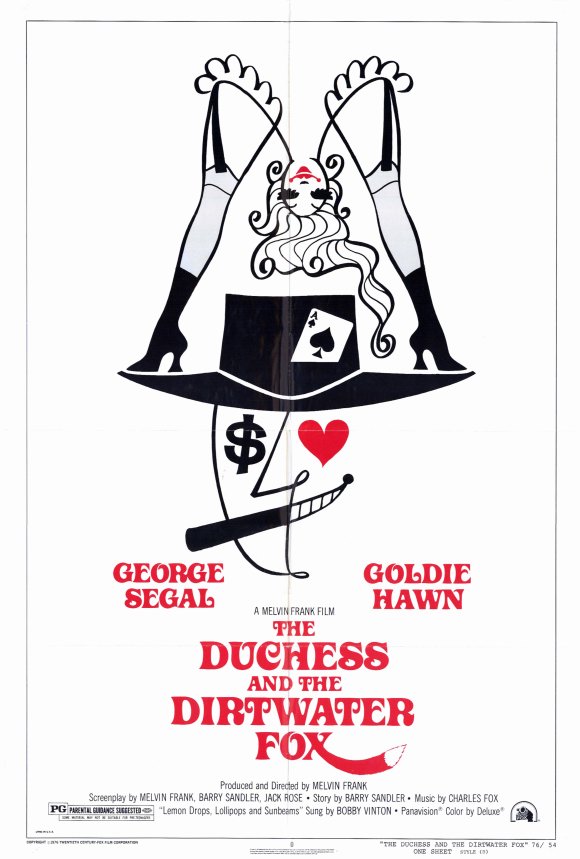
Amanda (Goldie Hawn), who goes by the nickname Bluebird, works as a dance hall girl in the old west, but dislikes having to entertain the leering male clientele and looks for an opportunity that will allow her to live the ‘easy life’. She finally finds it in the form of a rich Mormon family from Utah who are looking for a nanny to watch after their large brood. In order to disguise herself as being one she’ll need to buy herself a suitable outfit, but she has no money. Then Charlie (George Segal), who goes by the nickname Dirtwater Fox, and who has just absconded with over $40,000 of stolen loot from the infamous Bloodworth Gang, walks into the saloon where Bluebird works and immediately starts flirting with her as she performs a dance routine on-stage. Bluebird finds him annoying, but agrees to go up to his hotel room as a prostitute performing a sexual service in order to get the money for her nanny outfit. However, once up there, Dirtwater refuses to pay her, so she drugs his drink, which knocks him out, and steals the briefcase with the stolen money. When Dirtwater wakes-up he goes after her and the two eventually meet back up, but find despite their mutual dislike that they must work together in order to avoid the vengeful clutches of the Bloodworth Gang who are hot-on- their-trail. 

The film was directed by Melvin Frank with a screenplay by Jack Rose, two men whose career peaks was during the 40’s and 50’s, but by the 70’s their senses of humor were quite dated and story ideas placid. After finding inexplicable success with the highly overrated A Touch of Classwhich starred Segal and Glenda Jackson, director Frank became convinced that he had a winning chemistry and wanted to re-team the two in a western romantic comedy. Jackson though rejected the offer and was replaced by Hawn, who quite honestly is the only good thing about the movie. She had been up to this time known for her dumb blonde, ditzy persona, but here goes against type by playing a sharp-tongued, no nonsense lady who takes little crap from anyone. She plays the part perfectly and in the process grows as an actress. Her use of different accents is fun as well as being spot-on and the song and dance routines that she does despite Leonard Maltin calling them in his review ‘misplaced’ are actually quite entertaining and deliciously bawdy. 

Segal though is the film’s detriment. His acting is weak and a good example of this is when he’s caught cheating at a card game and strung up by a noose by an angry mob and yet even as the rope is put around his neck he remains cool and calm when anyone else in that situation would be panicked and struggling to get away. His character is totally unlikable and never grows on the viewer. It should’ve been a signal when Jackson backed-out to have Segal replaced with a younger charismatic actor who was more Hawn’s age instead of forcing her character to fall for someone who was 12 years her junior.

For a western the action is light and fleeting and there’s several scenes including the extended one with the two inside the hotel room where the pace slows up to a complete halt and becomes visually stagnant making it seem almost like a filmed stage play. The film does not play-up the character’s relationship, or illustrate how it grows. When the stagecoach they were riding in goes off a cliff, which they were able to jump out of it in time, they must climb down a steep ravine to get to it in order to retrieve the briefcase of money that was still on it. Instead of filming the scene showing the two helping each other navigate the rocky terrain, which could’ve been both amusing and romantic, the film just immediately cuts to them already there without ever showing how they were able to make it down.

Spoiler Alert!

The most annoying aspect, at least story-wise, comes at the end when Dirtwater and Bluebird find the Bloodworth Gang’s hideout. Dirtwater sneaks into it and immediately detects a loose floorboard, which signaled a hidden trap door leading to where the money was stored, which came-off as too easy. What’s the point of attempting to hide the loot if some stranger can just walk in and in a matter of seconds detect where it’s located? It’s also unrealistic to expect that the money would still be in the bag as most likely the gang members would’ve already split-up the loot amongst themselves.

There’s also the issue of Segal getting shot several times at the end by the gang as does his horse. The horse then collapses to the ground and seemingly dies only to mysteriously, after laying motionless for quite awhile, get up and magically comes back to life without any explanation. Segal on the other-hand is ‘kept alive’ by being coaxed to keep crawling after the money bag, which Goldie holds-out in front of him, but are we to believe that he’s going to manage to continue to crawl hundreds of miles through the desolate wilderness in a bullet-riddled body before they’re able to find medical help?

The idea that Goldie would even want to keep the schmuck alive is dingy. The guy refused to give up the money even as he lay dying and no longer had any use for it instead of just handing it over to someone he supposedly ‘loved’. Anyone else in that same situation would’ve been incensed at his selfishness and just grabbed the money out of his hands and been on their merry way while letting the son-of-a-bitch rot where he was. 

My Rating: 5 out of 10

Released: April 1, 1976

Runtime: 1 Hour 43 Minutes

Rated PG

Director: Melvin Frank

Studio: 20th Century Fox

Available: DVD-R (20th Century Fox Cinema Archives)


Off Beat (1986)

offbeat1

By Richard Winters

My Rating: 4 out of 10

4-Word Review: Not really a cop.

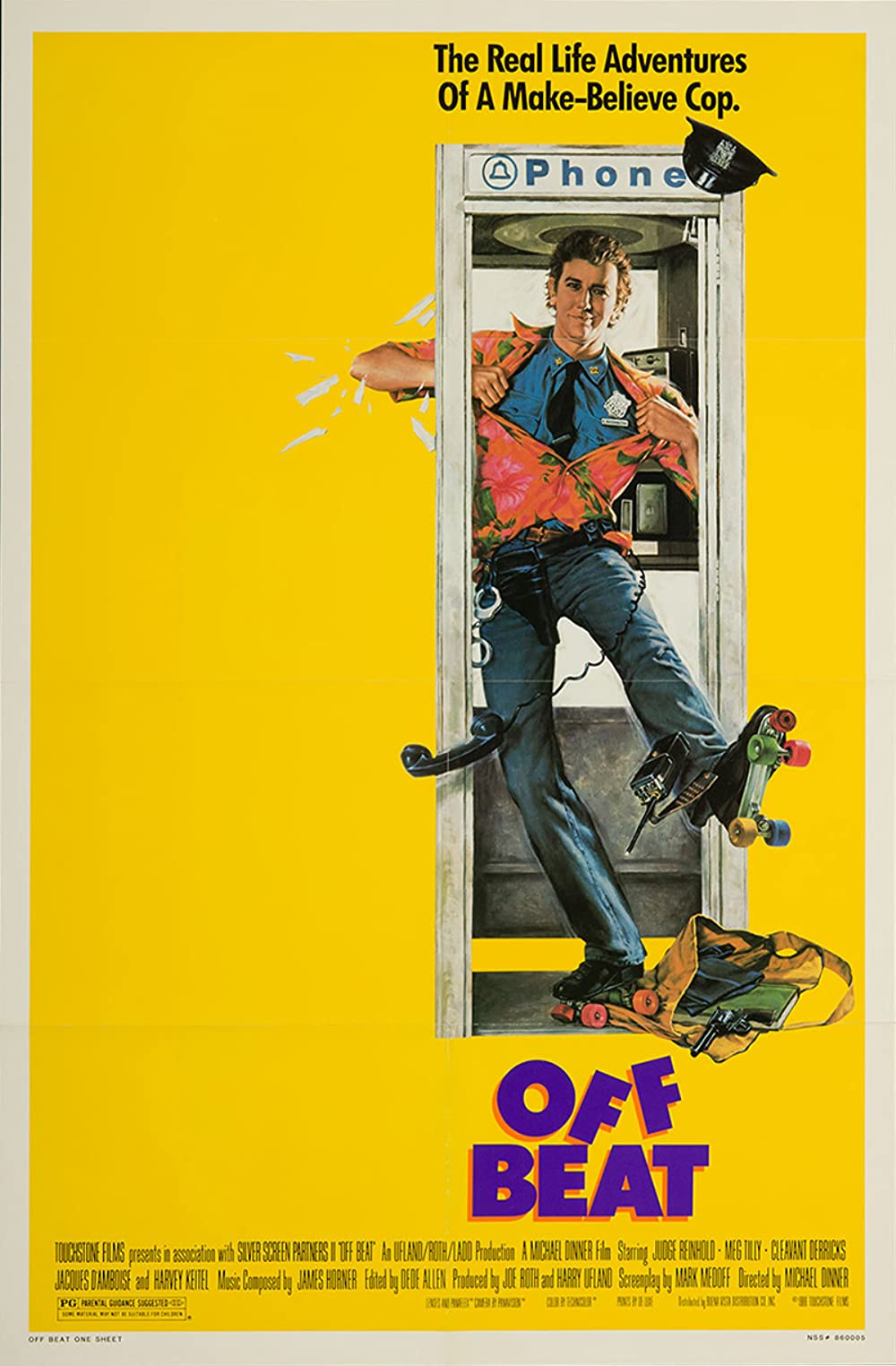
Joe (Judge Reinhold) works in the basement of a library. While he doesn’t hate his job he’s still looking for direction in life and feels he has missed his calling though he’s not really sure what that is. He’s friend with Abe (Cleavant Derricks) who is a New York City cop. One day Joe inadvertently messes-up a criminal sting that Abe was working on and in an effort to make it up to him Joe agrees to volunteer for a charity event that will require him to do ballet. It’s part of a city wide effort to get one policeman from each precinct to take part and Abe was chosen by his supervisor, but he has no interest, so he gets Joe to take his place while Joe pretends that he’s a cop in order to qualify for the audition. Joe is convinced he won’t make the cut, but when he meets the beautiful Rachel (Meg Tilly), who’s a cop that’s also trying out for the performance, he decides to press-on with it and in-turn finds that dancing gives him the interesting challenge that was otherwise missing in his life as well as a romantic relationship with Rachel. 

One of the things that really hurts the film right from the start is the totally wacky premise that seems to stretch all credibility. I found it very hard to buy into the idea that a policeman would be obligated, and in some ways almost forced, to get involved in a charity event that would take-up so much of his free time and require an extraordinary amount of rigorous training for no pay. Asking some cops to spend a few hours on one weekend at a soup kitchen passing out meals to the homeless is more reasonable, but pushing people into ballet that have no skills, or business in doing is just plain far-fetched. I felt too it was testing the friendship to obligate Joe in what turns out to being a very time consuming endeavor. Granted he learns to enjoy it, but upfront I can’t expect anyone to go that out of their way, even for a friend, over some simple mistake that the made earlier. Originally, and I can’t remember where I read this, the premise was for the characters to be prisoners and getting involved in the dance charity event would allow them the potential of getting their sentences shorten, which made much more sense, but the producers wanted to take advantage of the spate of comical cop movies that were popular at the time and therefore changed the characters into cops, but this just makes it dumb. 

The attempted comedy doesn’t gel either. It starts out at a park with undercover cops secretly listening into a conversation of two people, which seemed to have been taken right out of the opening scene in the far better movie The Conversation. It’s not made clear if that was meant to be an attempted parody of that one, but it doesn’t work either way and it’s best not to imitate a classic if you can’t improve on it as it ends up reminding one of that movie and how much more entertaining it was than this one. Later on there’s a bank robbery segment, which again seemed strikingly similar to another 70’s classic Dog Day Afternoonand again it’s not clear if this was intentionally stealing from that one in an effort to be amusing, but it doesn’t click either way. 

Reinhold shows why his Hollywood leading man career never lasted. He’s just not funny and all he seems good at is having that wide-eyed deer-in-headlights look and not much else. Other talented actors like Joe Mantegna, as Reinhold’s dance rival, and John Turturro, as Reinhold’s obnoxious boss, don’t get enough screen time and the friction that their characters create isn’t played-up enough, or results in any interesting confrontation. I did though really like Meg Tilly, who plays against type, as she’s usually cast as soft-spoken, flighty characters, but here plays someone who is tough and outspoken and does quite well.

The script, which was written by Mark Medoff, who had better success penning stageplays like Children of a Lesser God and When You Comin’ Back, Red Ryder?, does have a few heartfelt moments and having a main character feeling lost and directionless in this confusing world will be easily relatable to many, but there are just too many segments where the comedy misses-the-mark. The scenes where Reinhold is forced to try and chase down a thief and another moment where he has to arrest someone, but because he’s not a trained cop he doesn’t really know what he’s doing, could’ve been comical gold, but the film doesn’t play it out enough to be effectively hilarious. It peters-out with a fizzle by the end making it a definite misfire that didn’t do well with either the critics, or at the box office. 

My Rating: 4 out of 10

Released: April 11, 1986

Runtime: 1 Hour 32 Minutes

Rated PG

Director: Michael Dinner

Studio: Touchstone Pictures

Available: VHS, DVD (Region 2)

The Projectionist (1970)

projectionist1

By Richard Winters

My Rating: 5 out of 10

4-Word Review: Projectionist escapes into fantasy.

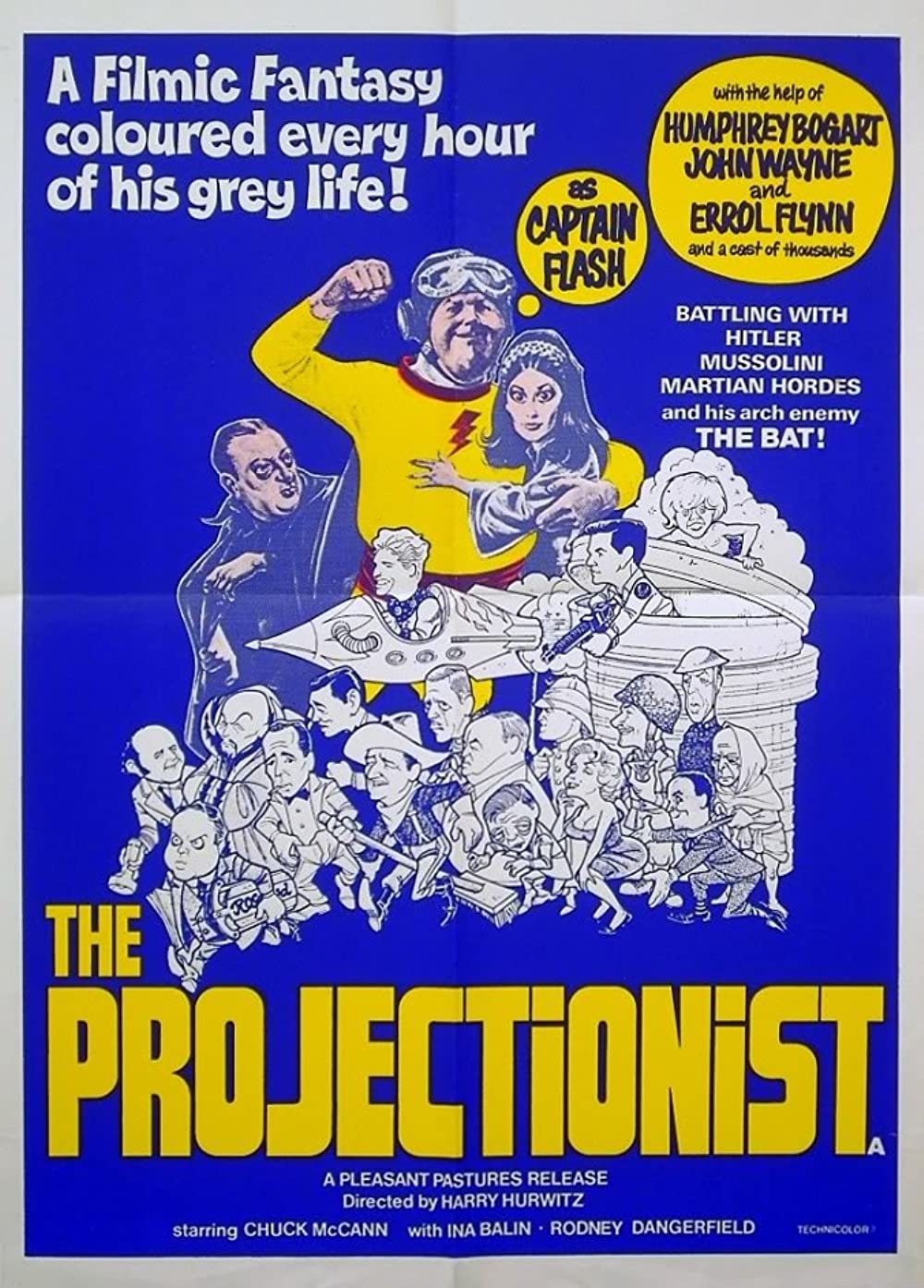
Chuck McCann plays a man named Chuck McCann who works in a projection booth of a New York theater. He spends his isolated days winding the film reels and putting them into the film machines so that they can be broadcast onto the big screen. He finds his job boring and he does not get along with Renaldi (Rodney Dangerfield) who is the head usher at the theater and routinely chews him out for minor infractions. To escape his mundane existence he imagines himself the star of his own movie playing the superhero Captain Flash who helps save a beautiful damsel in distress (Ina Balin) while also fighting-off the evil villain known as The Bat, which he sees as being Renaldi and his way of getting ‘back at him’ without having to do it in real-life.

Writer/director Harry Hurwitz, who appears as an usher who visits Chuck in his film booth, had some creative movie ideas during his career though most of the movies he made were hampered by a low budget and not fully realized enough to break-out and gain mainstream attention. This film, which was his first, is generally considered his best. It was shot in September-October of 1969, at the same time as Myra Breckenridge, with both movies being credited as the first to use superimposition of older movies, known as Hollywood’s Golden era, into the main story. Some of the clips, which features everything from old cartoons to news reel footage, is fun and even at times provocative. The Captain Flash segments, which are filmed in a grainy black-and-white to replicate the other older clips, are amusing and I really enjoyed seeing actual photographs of Chuck when he was younger, from infancy to a teen and then young adult, over the opening credits. There’s even some cool surreal moments where he walks out of the theater he’s working in and on the marquee is advertised the film we’re watching as well as a segment where Chuck the actor walks down the red carpet at the premiere of this film while talking about playing Chuck the character.

McCann, who’s probably best known for co-starring with Bob Denver in the 70’s children’s TV-show ‘Far Out Space Nuts’, reveals definite talent particularly his spot-on impressions of famous stars making you wonder with that much talent why does this character not make an attempt to go on stage at a local amateur night and show his stuff to an audience instead of hiding it away to himself. If the character has stage fright, or social anxiety, and that’s why he’s so shy and lonely then that needs to be brought out, which it isn’t, making the character poorly fleshed-out and in-turn makes the film less interesting.

The segments examining Chuck’s day-to-day activities, between the old film clips, are dull and have low energy. It’s like the production was completely dependent on the old footage to save it, which is not how a good movie works. ALL the scenes in a successful film need to be captivating in some way and a great number of them here fall flat. The character does not grow, or change in any way. In would’ve been fun to see Chuck confront Dangerfield in real-life instead of just fantasizing about it, or making an attempt to ask-out the beautiful woman instead of dreaming about her from afar.

Dangerfield, in his film debut, plays against type. Normally he’s the loser taking-it to the oppressive authority figure, but here he’s the heavy and helps keep it engaging. Ina Balin, on the other-hand, is beautiful, but I found it frustrating that she wasn’t given a single thing to say.

The story doesn’t evolve and ultimately comes-off as an experiment that fails to click. I was also surprised with the dark nature of  some of the old clips including bits with Adolph Hitler, Mussolini, the Klu Klux Klan and even one recreating the assassination of Lincoln, which didn’t have anything to do with the main theme and not sure why they were put-in.

My Rating: 5 out of 10

Released: October 17, 1970

Runtime: 1 Hour 28 Minutes

Rated GP

Director: Harry Hurwitz

Studio: Maron Films

Available: DVD-R

Bum Rap (1988)

bum1

By Richard Winters

My Rating: 3 out of 10

4-Word Review: 72 hours to live.

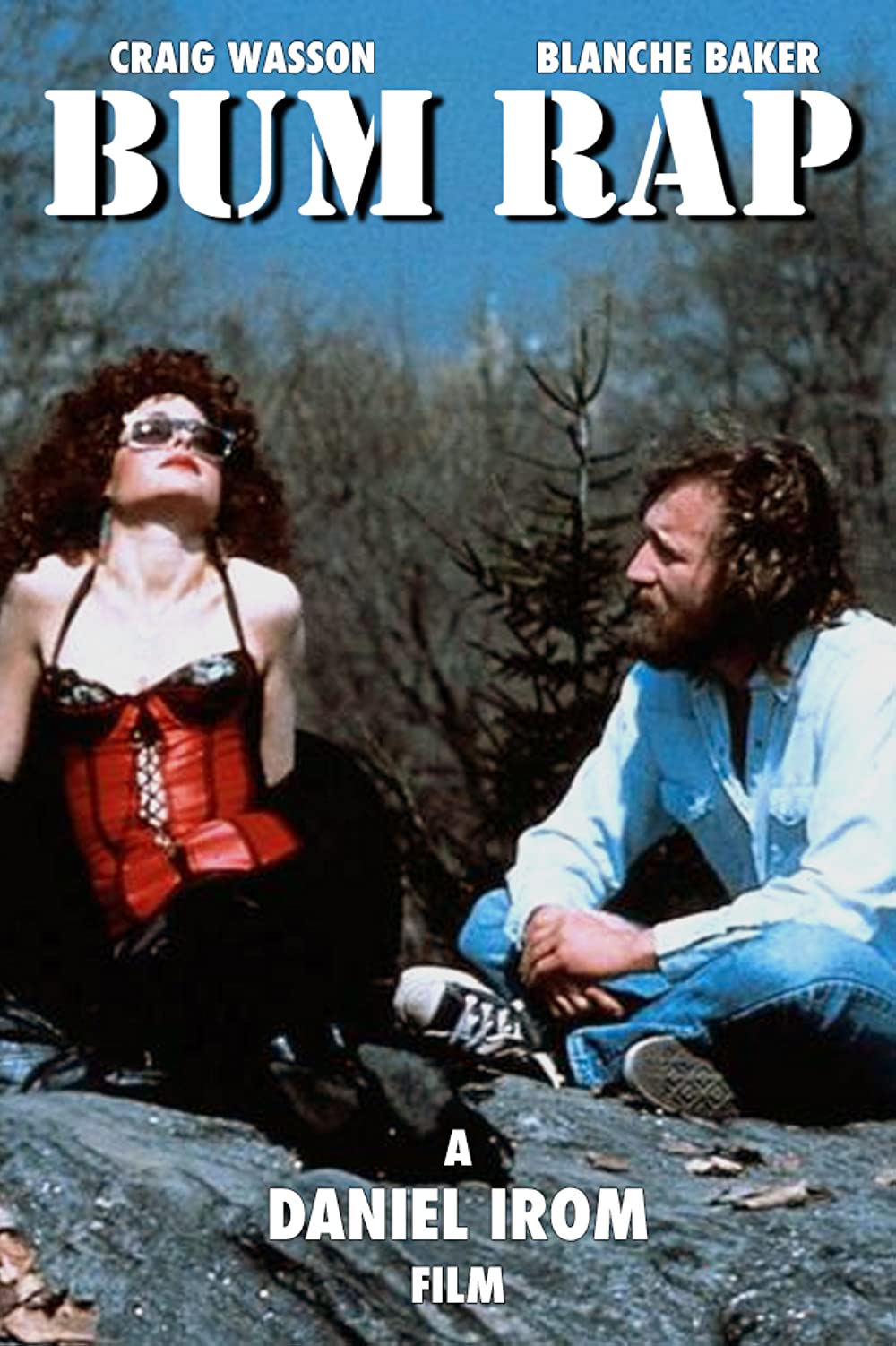
Paul Colson (Craig Wasson) seems to have very little luck. While he works during the day as a New York cab driver he longs to be an actor and he practices his craft while alone in his cab as he waits for a customer. During his free time he attends auditions, but routinely finds himself being turned down for the part. His love life isn’t much better as he’s constantly getting stuck in the ‘friend zone’ with all the eligible women that he meets. Now things have turned even more sour when he goes to a Dr. about a ringing in his ear only to diagnosed with a rare blood disorder that will kill him in only 72 hours. Will Paul find any meaning and happiness with the time he has left? He isn’t sure, but becomes determined to find out by getting together with his friends and parents (Barton Heyman, Augusta Dabney) for one last goodbye while doing so with the company of Lisa (Blanche Baker) a street prostitute he has picked-up and agrees to go along with him for his last hurrah while also harboring the same ambitions of becoming an actor.

The film seems to want to tap into the indie vibe of Stranger Than Paradise, a quirky independent, cult hit that sent it’s writer/director Jim Jarmush into stardom. It even starts out in black-and-white like that one and there are a few keen moments here. When I was younger and just out of college I attended a few acting auditions like this character and found the same thankless experiences as he did; getting turned down not so much for a lack of talent, but more because he auditioned with someone who was sexier and better looking, so naturally they get all the attention and he doesn’t. His dating quandary where he treats the women real nice, and they get along well, but in the end they still chase after a married a man who treats them poorly can be a testament to what happens to a lot of single nice guys and in this area, examining the basic struggles of an ordinary life, it hits the bullseye.

Unfortunately the film fails to gain any momentum, or move along with an intriguing pace. The scenes lack energy and in certain instances, like when he invites his friends over for a game of cards, get bogged down with archaic chatter that does not propel the plot, or reveal anything about the characters. The disease, where the doctors can pinpoint exactly what hour the person will die and in what way, comes-off like something out of a sci-fi movie and hard to take seriously. I didn’t get why it shifts from black-and-white to suddenly color after he gets the grim diagnoses. You’d think it should work in reverse, be colorful when he still thinks he’s got his future ahead of him, only to turn black-and-white when he realizes his time is very limited, or at the very least don’t have it turn color until the very end when he’s learned to accept his condition and die gracefully, or leaves to enter some sort of afterlife

Wasson, who hasn’t appeared in a movie since 2006 and now makes a living as a audio book narrator, has stated that this was his most favorite movie that he was in and it’s easy to see why as he basically propels it along particularly with his impressions of famous actors, but his character’s transition through the 5-stages of grief is much too quick. It’s odd too that he chooses not to tell any of his friends or family that he’s dying as I’d think most other people in the same situation would want to say what’s going to happen to them if for anything to look for some comfort as they grieve.

Blanche Baker, the daughter of legendary actress Carroll Baker, is a good actor, but her character is cliched. As a street prostitute she lets down her guard too easily and quickly. For all she knows this guy could be lying to her about having a terminal illness in order to gain some cheap sympathy and since she’s been a hooker for awhile and spent time with other guys of a dubious quality, I’d think her opinion of men would be pretty low and she’d not be so trusting of Wasson when he tells her his situation and instead be cynical. This idea that all prostitutes have a ‘heart-of-gold’ if you just get past their rough exterior is a stereotype as some of them due to the harsh life on the streets can be genuinely embittered. Having Wasson deal with a more hardened one would’ve not only made it more realistic, but given the scenes some pizzazz as they could bicker and argue, versus having it get so sappy that it becomes cringe-worthy.

I suppose if you give it enough time it does have a way of growing on you emotionally, but the overly choreographed ending takes away all realism. Ultimately it’s a potentially interesting idea that thinks it has a deeper message and statement than it really does.

My Rating: 3 out of 10

Released: September 26, 1988

Runtime: 1 Hour 58 Minutes

Rated R

Director: Danny Irom

Studio: Light Age Filmworks ltd.

Available: None