Category Archives: Obscure Movies

Who can Kill a Child? (1976)

who3

By Richard Winters

My Rating: 6 out of 10

4-Word Review: Children kill the adults.

Tom (Lewis Fiander) and Evelyn (Prunella Ransome), who is pregnant, travel to an island off the coast of Spain in order to find some peace and quiet while on vacation. Once they arrive they find the place conspicuously devoid of any adults with many of the shops and bars looking like they’ve been abandoned. The only people around are children who behave strangely and will not talk to Tom, or Evelyn even when spoken to directly. They then come upon an adult survivor named Padre (Antonio Iranzo) who describes to them how the night before the children suddenly went crazy and began killing all the adults on the island without any provocation. Can Tom and Evelyn escape, or will they become yet another victim?

While there’s been other movies detailing children, or even groups of kids, who murder the adults around them this one is considered the granddaddy of all of them and, though not ever verified, the possible inspiration to Stephen King’s Children of the Corn. The film’s creepiness comes not so much with scares, as there’s very little of that, but more through its quiet atmosphere and isolation that grows increasingly more ominous as it goes. Violence-wise it’s scarce with only the minimum of gore though the sequence done over the opening credits, which has grisly real-life footage of victims of the Holocaust as well as both the Korean and Vietnam Wars is not for the squeamish and may be too explicit and grim for some to sit through.

The script was written in only a matter of 4 short days and it shows with character motivations that aren’t particularly well thought out. For instance I didn’t understand why Tom wouldn’t tell Evelyn about what he saw, in regards to the child beating up and eventually killing an old man, and wanted to somehow play down and even lie about what was going on. This is a pregnant woman who has a right to know about the dangers lurking about. Shielding her from the horrifying realities isn’t going to help her be alert and put up her defenses and if anything just make her more vulnerable to be taken advantage of by the kids. What kind of husband lies to his wife about such urgent matters? Does he think because she’s female she won’t be ‘strong enough’ to handle the truth? If so it makes him sexist and not particularly likable because of it.

Tom also is too slow to respond to things. Even after witnessing first hand the children’s atrocities he doesn’t immediately try to arm himself, get off the island, or board him and his wife off in some sort of safe room with a fortified door. Instead they remain pretty much out in the open in an abandoned hotel with both the entrances and exits wide open for anyone to come into. At one point he even gives his wife a sedative and tells her to take a nap inside one of the hotel rooms while leaving the door open as he goes downstairs to speak to the male survivor, but how does he know a kid won’t sneak into the room while he’s gone?

It’s strange too how the children kill a Dutch woman and even strip off her clothes, but when Tom walks in they all scurry away. If they’ve already killed a vast number of adults why would they fear Tom when he comes in and instead not just attack him too? For that matter why does Tom feel so emboldened to walk in on these kids to begin with? He’s seen what terrible things they can do, so why does he risk exposing himself to them? These clearly aren’t normal kids, so he should remain at a safe distance and view what they’re doing from a hiding spot.

While there’s creepy moments and imagery it all mainly comes during the third act and some more scares and action earlier could’ve helped. The special effects aren’t too great either with the shot of the bloodied old man, whose supposedly just been killed, clearly still breathing as his chest heaves up and down, though Tom carries him away like he’s now nothing more than a corpse. Having Padre describe the violent attacks of the children onto the adults from the previous night was disappointing as this should’ve been played out visually, even if through flashback, as it would be much scarier to see this instead of just being told about it.

Spoiler Alert!

The ending has its fair share of suspenseful moments, but again more logic loopholes. When Tom and Prunella are trapped in a room behind a wooden door a small child crawls through the window space and tries to shoot at them, but Tom manages to hit the kid with a bullet first with a rifle he’s found. The other kids then quit trying to break the door down the couple are in once they hear the shot and all go filing away. Tom says this is because none of the other adults responded with aggression and violence towards them like he did. Once they realized, by hearing the gunshot, that Tom meant business they all backed off knowing that he might kill them as well. However, the kids could not see through the door, the tiny window on it was too high up for them to look through, so for all they knew the gunshot was the sound of the small kid shooting the couple with his gun and therefore they should’ve continued the attack and not immediately stopped.

The children are also able to somehow brainwash their peers into doing their evil bidding by simply looking into their eyes, which somehow puts them under a spell. They even use this power to get the fetus inside Evelyn’s womb to attack her, but where do they get this power from? What kind of entity is behind all of this? Nothing gets answered, which leaves too many questions open and thus not as effective as it could’ve been.

My Rating: 6 out of 10

Released: April 26, 1976

Runtime: 1 Hour 53 Minutes

Rated R

Director: Narciso Ibanez Serrador

Studio: Penta Films

Available: DVD (Region 0), Blu-ray (Region B/2)
My Friends Need Killing (1976)

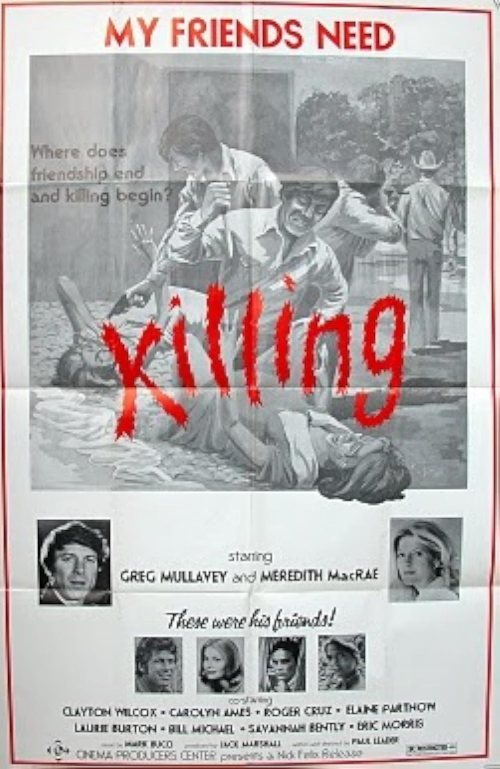
friends1

By Richard Winters

My Rating: 4 out of 10

4-Word Review: Vet. stalks war buddies.

Gene (Greg Mullavey) is a Vietnam Vet. who’s come home after the war, but finding it hard to readjust to civilian life. He’s plagued by memories of not only the war, but some of the crimes that he and his comrades did while over there including the annihilation of a village and gang rape of a woman. He decides that the only answer is to seek out dark justice by visiting with his old buddies one-by-one in their homes and then using the opportunity to kill them when the time is right. Gene’s wife Laura (Meredith McRae) is aware of her husband’s tormented dreams, but not his homicidal plans. She works with Dr. MacLaine (Greg Morris), a psychiatrist, to track Gene down in order to stop his madness and get him the mental help that he needs.

In 1969, Paul Leder, whose attempt at an acting career had stalled, decided to take a stab at directing, which initially didn’t fare any better. His first feature, where he had Mullavey also star, was the absurdist comedy Marigold Man, about a guy named Harry who dreams of planting marigolds from coast to coast, which quickly fell into obscurity. He then hit on the idea of doing a horror film, which he felt, if done right, could do well under the low budget constraints. His first feature, which also had Mullavey in a supporting part, was I Dismember Mamathat fared a bit better than the comedy and enough to gain a cult following. Leder then reverted back to doing two comedies including the notorious Ape, an attempted parody of King Kong, that became a big embarrassment before eventually returning back to horror with this film.

On the surface it’s not bad given the limitations. It’s obviously inspired by Bob Clark’s Dead of Night, that had come out 5 years earlier and had a similar theme of a war vet. unable to get the horrors of what he went through out his mind. That one won some critical acclaim and a cult audience while this one fell through the cracks. For Paul Leder standards though it’s surprisingly watchable. Mullavey gives an effective performance where you sympathize with the man and his torment even as he goes through with his killings. The flashback sequences have a haunting quality and the film is, if anything, adequately gritty.

The killings though are where things get off-kilter. A few of them are disturbing like when he ties up one of his old buddies, while also shooting him in the arm, and then forces him to watch the rape of his wife before killing them both. Some of the others though fail to have the same dark punch. In one instance all he does his hand his old war friend a bottle of pills and tells him to swallow them, which isn’t exactly tense, while another moment has him helping to deliver a woman’s baby. There’s also a scene where Mullavey ties up his victim and then has the man’s arm poked with a syringe where he slowly bleeds to death, but horror movies work better when we see the action of him attacking the other man and just cutting away to him already tied-up misses the potential for excitement.

McRae, who at the time was Mullavey’s real-life wife, gives a poor performance particularly her anemic sounding crying. The use of music is bad too. During the killings it reflects the pounding score you’d expect in a horror flick, but in-between it has a melodic quality that you’d hear in a breezy comedy. The editing, which was also done by Leder, is choppy and too many slow parts in-between the violence. The film, which has a few interesting moments, fails to hold interest all the way through. It’s too talky with a lot of extraneous dialogue that could’ve been cut out. Having the only sound being the voices that Mullavey hears inside his head would’ve worked better.

My Rating: 4 out of 10

Released: December 10, 1976

Runtime: 1 Hour 13 Minutes

Rated R

Director: Paul Leder

Studio: Cinema Producers Center

Available: DVD-R (dvdlady.com)

Stewardess School (1986)

stewardess

By Richard Winters

My Rating: 1 out of 10

4-Word Review: They become flight attendants.

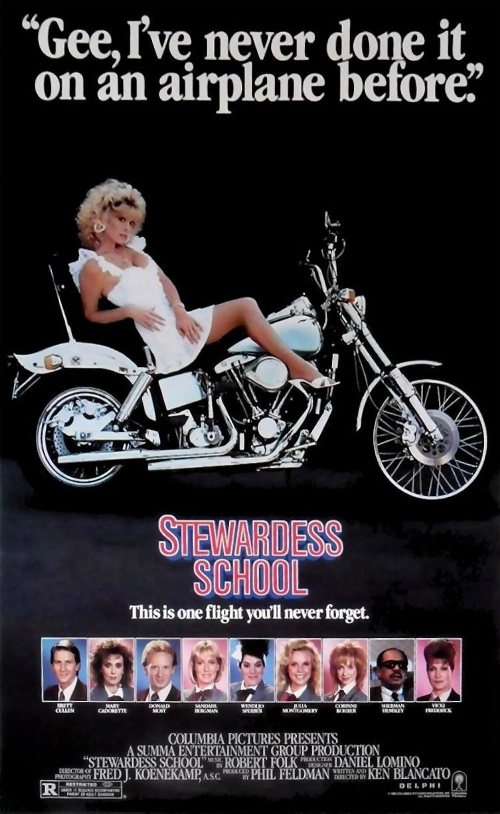
Philo (Brett Cullen) and George (Don Most) are training to become airline pilots, but an unexpected calamity during the flight stimulator test causes them to flunk out. Without a job, or money they decide to enter into a school that trains people to become flight attendants. They feel this way they’ll still be able to be up in the air and can also hit-on all the hot women. They’re class is full of misfits, but somehow they all manage to graduate despite the presence of Miss Grummet (Vicki Frederick) who runs the school and tries to make each of their lives a living hell. After graduation the students get a job with Stromboli airlines, but Miss Grummet is onboard and wants to make sure things do not go as planned while a mad bomber (Alan Rosenberg) wants to blow the aircraft up.

This was another in a long line of Police Academy imitators that did nothing but make that one, which wasn’t too great to begin with, seem like a masterpiece. The film, which per later interviews with star Sandahl Bergman where she attests the cast and crew including the director were snorting cocaine during the production, is nothing but a barrage of lame jokes and uninspired storyline making it pretty much dead on arrival from the first frame in. It doesn’t even have all that much nudity and what little it does comes from gals looking well over 30. The women cast in the leads keep their clothes on even though they’re far more attractive. Judy Landers, who plays a hooker who speaks in the most annoying Flossie-like accent, in order to conform to the caricature of a NY streetwalker, I found to be the most perplexing. She’s clearly sexy and yet is never seen naked even though she goes to a Dr.’s office for a medical exam, but just as she’s set to remove her bra the camera cuts away, which will frustrate certain viewers as the only point for watching this vapid thing is to see some good-looking flesh and if it can’t even succeed with that then it’s pointless to sit through.

I found the characters to be the most irritating as everything gets approached from a 13-year-old perspective with no inkling of nuance. Star Cullen is a prime example as he plays this pilot who can’t see without his glasses even though most people who use them can still make out things when they’re not on but they’re just real fuzzy and yet here this guy doesn’t know when he’s in a shower room full of naked women. The thick coke bottle type of glasses that he does wear was severely dated as by the 80’s the technology had improved that people with bad eyesight could wear lenses that weren’t so thick and obvious.

Wendi Jo Sperber, who is slightly overweight though the film acts like she’s ‘obese’, gets stuck with a part that’s genuinely insulting as it does nothing but make fun of her few extra pounds the whole way through. At one point it even has her spotting a cheese cake in a refrigerator and going ‘oink, oink’, which I found to be quite shallow as they’re can be many reasons for why someone as a bigger body type than others that has nothing to do with overeating.

I did enjoy Mary Cadorette who’s probably best known for playing in the short-lived ‘Three’s a Company’ spin-off ‘Three’s a Crowd’. She definitely gives a likable performance of a terminal klutz. While her clumsiness does get overplayed, with none of the pratfalls ever being funny, I felt the way she overcame her problem by going through hypnosis was a cop-out. A good story should have a character grow and succeed through their own initiative versus having it all go away with the literal snap-of-a-finger.

The worst part may be the ending where the film inadvertently turns into a airplane disaster flick, which has been done better in many other parodies. The mad bomber is too obvious and everyone should’ve been eyeing him suspiciously from the get-go instead of having him being ignored until it was too late. The film should’ve played against type with this part by having the nut turn-out to being what initially seemed like a sweet old lady, or someone else you wouldn’t expect, but of course that would’ve required creativity, which filmmakers here were clearly lacking. The film does stand out in one way as it holds the record for being the most played movie on the Comedy Central cable network, which says more about their subgrade level of programming than anything else.

My Rating: 1 out of 10

Released: August 20, 1986

Runtime: 1 Hour 29 Minutes

Rated R

Director: Ken Blancato

Studio: Columbia Pictures

Available: VHS, DVD-R, Amazon Video, Tubi

Last of the Mobile Hot Shots (1970)

lastmobile

By Richard Winters

My Rating: 4 out of 10

4-Word Review: A game show wedding.

Myrtle (Lynn Redgrave) and Jeb (James Coburn) meet at a game show being taped in New Orleans and find themselves working together as contestants when brought up onto the stage. They end up winning some money, but are told that they cannot collect it until they’re officially married on live television, which they both agree to. After the nuptials they travel to an old mansion known as the Waverly Plantation that has been in Jeb’s family since 1840. Jeb wishes to use the money earned on the game show to fix up the place, but finds his plans being stymied by Chicken (Robert Hooks) a multi-racial half-brother that has been residing at the place and maintaining it for many years. Chicken insists that he’ll become the next owner of the place once Jeb succumbs to terminal cancer, but Jeb wants Chicken off the premises immediately and have the document stating that Chicken is the next of kin to be destroyed. He orders Myrtle to flirt with Chicken until she can get him into a compromising position so that she can steal the document. Once that is retrieved he then wants her to kill him with a hammer while Jeb waits upstairs. Though initially reluctant Myrtle decides to go through with the plan only for Chicken to turn-the-tables on them with an unexpected twist.

While playwright Tennessee Williams is celebrated for his acclaimed work like A Streetcar Named Desire and Cat on a Hot Tin Roof many people don’t realize that his biggest success came early in his career while towards the end,  especially by the mid-60’s through to his death in 1983, his output was very little and what he was able to get produced was generally not well received by either the critics, or the public. This film is based on his play The Seven Descents of Myrtle, which was originally written as a short story in 1942 and published in 1954. Williams then decided to turn it into a one-act play in 1967, but then expanded it to a full length stage production, which premiered on Broadway on March 27, 1968 with Harry Guardino as Chicken and Estelle Parsons playing Myrtle. This version though only ran for 29 performances and was generally considered a failure.

However, director Sidney Lumet saw the production and decided he wanted to take a stab at turning it into a movie. He made several changes to the story with the biggest one being that in the play the Jeb character, who was called Lot, was a closeted transvestite, which is something that the movie doesn’t bring up at all though would’ve been far more interesting had it done this. The play also doesn’t feature the game show segment, which was very surreal and makes the film seem almost like a misguided parody.

I did enjoy the way famed cinematographer James Wong Howe captured the decaying mansion, which was filmed on-location in St. Francisville, Louisiana, a famous small town known for its abundance of historic old buildings. Everything else though falls flat. The opening bit at the game show is funny, but becomes jarring with the second-half, which is more dramatic making it seem like two completely different movies with highly inconsistent tone rammed into one. The Myrtle character is not fleshed-out enough to make any sense, or even seem remotely believable and ultimately like with the rest of them comes-off as an empty composite that is not relatable in any way to real people.

The acting though by Redgrave is quite strong. Normally British actors have a hard time masking their accent, but here she’s able to speak in an authentic Southern dialect without her European voice being detectable in the slightest and she puts on a provocative striptease to boot. Hooks dominates the proceedings and ultimately outclasses Coburn who later admitted regret at doing the project and considered his appearance here to be a low point in his career. Having Williams write the screenplay might’ve helped and I’m not sure why he wasn’t asked, but Gore Vidal doing the task turns the whole thing into an absurd misfire that should never have been attempted.

My Rating: 4 out of 10

Released: January 14, 1970

Runtime: 1 Hour 40 Minutes

Rated X

Director: Sidney Lumet

Studio: Warner Brothers

Available: DVD-R (Warner Archive)

Square DANCE (1987)

square

By Richard Winters

My Rating: 3 out of 10

4-Word Review: Moving to the city.

Gemma (Winona Ryder) is a country girl whose never known life beyond the small Texas farm that she lives on with her grandfather (Jason Robards). She at times though does think about her mother (Jane Alexander) who lives in Dallas and what city living would be like. One day her mother takes a rare trip to the farm and invites Gemma to come live with her. Gemma is turning 13 and intrigued to spreading-her-wings. While she loves her grandfather she’d be interested in trying something new, so she agrees to go with her while promising to write home to her grandfather regularly. Once there she finds the jaded lifestyle of her mother and the people around her not to be to her liking as Gemma is quite religious and reads her Bible often. She does though meet-up with Rory (Rob Lowe) a young man who is mentally handicapped, but professes to love her and the two plan to one day get married despite the opposition by her mother and those around her.

This was a film produced by Michael Nesmith better known for being a part of the Monkees rock band in the 60’s. Some of the other films he produced were of a comical/surreal nature, but this is one of the few dramas that he did (the film was also co-produced by co-star Jane Alexander and actor Charles Haid) and while some of his comedies weren’t so great this thing could’ve used some laughs to help liven it up. While the intentions may have been laudable the result is mostly tedium as its attempts to reflect the slow lifestyle of country living backfires creating a movie that’s too methodically paced to ever become interesting and the fact that it managed to only recoup $225,000 at the box office out of its initial $4 million budget is no surprise.

If you watch this movie for any reason do it for the acting, which is exemplary. Ryder, in only her second film appearance, crafts a shy, awkward and sheltered teen quite well and her performance helps guide the viewer through the lulls. Robards and Alexander are equally fine, which is to be expected, but Lowe is probably the most impressive playing against type. Usually he played cocky, worldly-wise types, but here shines as a kind, but dim-witted soul though his delivery, in retrospect, comes-off too much like Tom Hanks in Forrest Gump. Granted this one came out 6 years before that one, but since that film is more famous than this one you can’t help but compare the two and come away feeling, despite Lowe’s best efforts, that his acting here is a bit affected.

The story is too minimalistic as not enough happens to justify sitting through 90-minutes of it. I had a hard time buying into Gemma believing she could marry a mentally handicapped man and having it work out. Granted she’s not worldly-wise and lacks sophistication, but I felt this type of thinking was too naïve even for someone with her background. Wanting to help the man and take care of him possibly as a guardian of some kind would be fine, but the love aspect gets overblown and makes the film come-off as overly idealized and not realistic.

None of the characters, with the exception of maybe Lowe’s, goes through much of a transition. I was expecting Gemma to become corrupted by the jaded ways of the people she meets and possibly even becoming less religious, or even beginning to question her faith, but none of that happens. Gemma basically remains the same, even after a few tussles, and returns back to the farm like nothing happened, which made me wonder what was the point. There’s way too many loose ends that are left open like the grandfather’s lingering racism and his inability to get along with a black friend he used to play with when he was a kid. Gemma invites the black man over for dinner, but the film fails to show us whether the two men begin talking, or remain silent. A good drama should give us some conclusion to things and see the characters grow, which in this case it doesn’t do making the whole thing seem half-baked and not worth the effort or time.

My Rating: 3 out of 10

Released: January 16, 1987

Runtime: 1 Hour 52 Minutes

Rated PG-13

Director: Daniel Petrie

Studio: Island Pictures

Available: DVD-R

The Last Word (1979)

lastword1

By Richard Winters

My Rating: 2 out of 10

4-Word Review: He won’t move out.

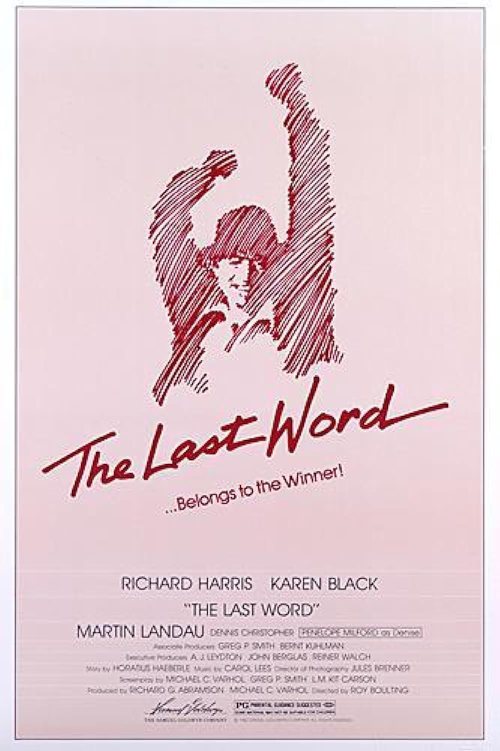
Danny (Richard Harris) is a stubborn and eccentric man who refuses to move out of an apartment building that has been marked for demolition. After his attempts to get a lawyer and also collect welfare prove futile he decides to kidnap the Marshal (Jorge Cervera) who comes to his apartment to serve him his eviction notice. He chains the Marshal to a pipe in his bathroom and then barricades himself and his three children inside. A TV news reporter (Karen Black) feels this will be a juicy story and gets permission to go up to Danny’s place in order to interview him live on the air while the police captain (Martin Landau), who was at one time an old friend to Danny, plots on a way to get him out even if it means deadly force.

This stale drama borrows on a lot elements that have been done before and fails to add anything interesting to the mix. The chief flaw is that there isn’t any explanation for why Danny won’t move out when everyone else in the building does. The apartment itself is quite cramped and nothing special and chances are he could’ve found something bigger, or just as adequate. Without proper motivation the protagonist’s quandry becomes rather irrelevant and even selfish as his stubbornness puts the rest of his family through a lot of needless stress and trauma and having the character be someone who is old and on a fixed income with nowhere else to turn, as much of a caricature as this is, would’ve at least gotten more emotional appeal from the viewer, which with the way it gets done here you really don’t get.

Harris execellent acting helps, but all his inventions start to become a bit cheesy especially his ‘gas masks’ which is nothing more than paper folded around the face with a Campbell’s soup can taped to the bottom, which apparently should be ‘sufficient’ to breath through if under attack, but look laughable and most likely the gas vapors would seep through the paper and thus making them a poor defense. Black, who would co-star with Harris 6 years later in Martin’s Day, plays a serious career driven woman, which is a nice variation from her usual flaky, ditzy types, but her character is unlikable, who initially tries to exploit Danny’s situation for her own gain and having her ‘come around’ at the end to be on his side isn’t enough to make up for it and she should’ve been portrayed as being more emphatic from the beginning.

His three children, played by Penelope Milford, Dennis Christopher, and Natasha Ryan all display the same type of personality and thus become indistinguishable and boring. They all seem to love their father quite a bit and are very loyal and yet refer to him as Danny instead of Dad, which is a bit weird. Landau displays a nice acerbic quality, and the first film where his hair begins to show a few spots of gray, but his character should’ve been the one to go up to the apartment and break into it, especially since he and Danny had a history together, versus having him remain on the ground while his men did the task, which loses out on what could’ve had more dramatic impact.

Spoiler Alert!

The first act is a strain to sit through and is approached in a way that would’ve made it better served as a TV-movie. The second act gets a little more tense when he barricades himself into the apartment and the way he uses all of his different inventions to stop the cops from getting inside is marginally entertaining, but the film leaves way too many things open ended. He eventually gets cuffed and arrested, but no closure as to what happens to him after that. Does he go to trial and win his case? Does he and his family get a new place, or does the building get saved and what happens to the Governor (Biff McGuire) who was exposed as being corrupt? None of this gets answered, which makes the ending like the rest of the film quite unsatisfying.

My Rating: 2 out of 10

Released: October 10, 1979

Runtime: 1 Hour 42 Minutes

Rated PG

Director: Ray Boulting

Studio: Variety International

Available: None

Flashpoint (1984)

flashpoint

By Richard Winters

My Rating: 4 out of 10

4-Word Review: Digging up hidden money.

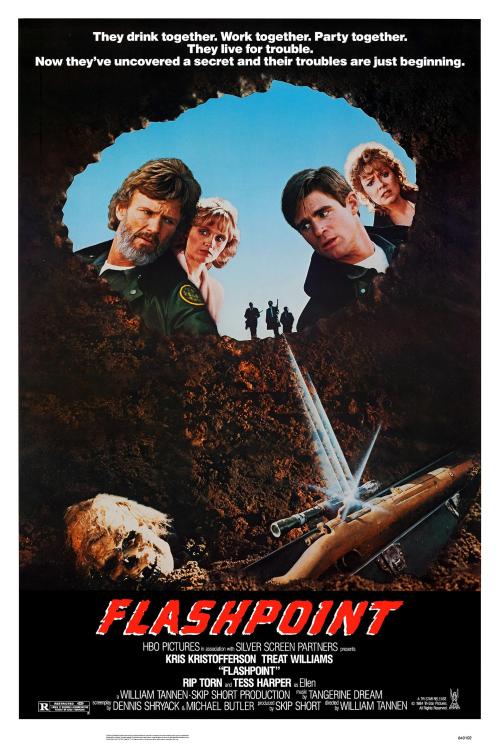
Bobby (Kris Kristofferson) and Ernie (Treat Williams) are border patrol agents who stumble upon a jeep buried in the sand. Once Bobby digs it up he finds a skeleton in the driver’s seat, a scoped rifle, and $800,000 inside a rusted toolbox. Both of them are unhappy in their jobs and Bobby thinks this would be the perfect time to skip town with the loot, but Ernie thinks it’s stolen money and needs to be investigated. Since the bills are all marked with the dates of 1962 and 1963 they presume this is around the time when the bank robbery, which is where they think the deceased driver got the money from, occurred, but upon an old newspaper research at their local library they can find no such robbery happening in the amount that they recovered. Soon they face more problems when a federal man named Carson (Kurtwood Smith) takes over the agency they work at and exerts extreme control over everything they do. Bobby feels Carson is somehow aware of the money they found and knows more about the driver’s identity than he lets on. While Bobby and Ernie hide the money they find Carson and his team of secret agents hot on their path as he sends them on dangerous missions in an attempt to kill them, so they won’t let on to anyone else about what they’ve found.

This is another example where an intriguing story idea, based on the novel of the same name by George LaFountaine, almost gets ruined by lackluster direction. The mystery is interesting enough to keep you invested but there are definite lulls and cheesy side stories that seem to be challenging the viewer to turn it off before it’s over. This was also another case where the setting is supposedly Texas, which gets mentioned quite a bit, and yet it was all filmed in and around Tucson, Arizona, which is a travesty especially since the deserts of Arizona and Texas have noticeably different characteristics. I also felt that if you’re going to have a story based in the desert you should then have the time period during the summer, instead of the winter like here, where the scorching heat could be used as an added element.

Kristofferson isn’t particularly well cast here in a part that was originally intended for Paul Newman. His laid-back style of acting isn’t riveting enough though I’ll give him props for the scene where he gets shot and must crawl several yards in the dirt with one arm that he can’t move due to it being paralyzed by the bullet, which looks quite arduous to do though he does it effectively and realistically. Williams is by far the superior actor and his distinct personality where he’s the idealist, plays-off well from Kristofferson’s more jaded mindset. You even get a full view of Treat’s bare ass, which comes near the beginning and while nobody necessarily asked for it and wasn’t needed to propel the plot some may enjoy it and as male asses go it’s not too shabby.

Rip Torn, whose hair is dyed gray, does well in support where his strong Texas drawl works nicely in the supposedly Texas setting. While he’s only seen sporadically during the first two acts, to the point where I started to wonder why he even bothered to take the role as it seemed miniscule and pointless, he does come on strong during the finale. Kurtwood Smith though is dull, which isn’t exactly his fault as the part is written too much like caricature, and every successful movie needs an interesting and memorable villain, which this one clearly isn’t.

While the action is fleeting it does have one good stunt, which features Treat trying to prevent a plane, which they think holds drugs, from taking-off by reaching in through the window of the cockpit and forcing the pilot to land it. It had me holding by breath, but it got ridiculous when the plane crashes and explodes, but Treat gets saved when he supposedly jumps off and into a lake, but you don’t see this occur and the other men all presume he went down with the plane only to have Treat jump out of the water intact, but if he had dived into the pool then the water would’ve had a ripple effect from where he went in instead of it being calm and placid like it is.

Spoiler Alert!

The twist at the end in where the money and driver of the jeep are connected to the assassination of John F. Kennedy is cool though it leaves more questions than answers. Of course that might’ve been the intention, but still I feel this is a good enough story idea that it should be revisited with a better director and hopefully one day someone talented will decide to remake it in a way that’s more intriguing than what we get here.

My Rating: 4 out of 10

Released: August 31, 1984

Runtime: 1 Hour 33 Minutes

Rated R

Director: William Tannen

Studio: TriStar Pictures

Available: DVD-R

Runners (1983)

runners

By Richard Winters

My Rating: 5 out of 10

4-Word Review: Searching for teen daughter.

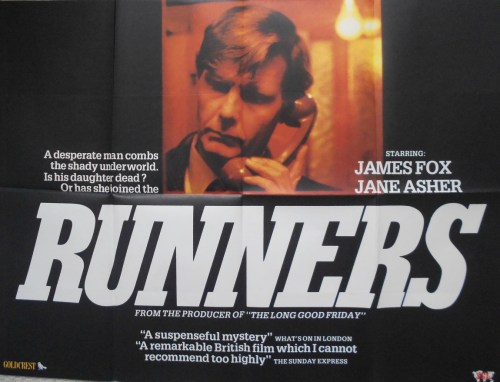
Tom (James Fox) is a suburban father who watches his teen daughter Rachel (Kate Hardie) ride off to school on her bike one day only for her to never come home. The police find her abandoned bike, but no signs of her, making it seem like she was snatched by someone driving in a car that was passing by. As the years go by Tom becomes even more fixated on finding her despite the lack of clues. His marriage begins to crack as his wife (Eileen O’Brien) feels it’s time to move on and that Tom needs to just ‘let it go’ though he refuses. He eventually moves out and into the city of London where he becomes determined to use what few leads he has to track her down on his own. Along the way he meets Helen (Jane Asher) a mother searching for her missing son and the two get into a relationship even as the challenges of finding their missing kids becomes even more daunting. Then one day by complete shock Tom finally sees Rachel and manages to corner her to have a brief conversation, but Rachel clearly does not want to see him and runs away again, but Tom becomes relentless to bring her home even if it means doing it by force.

Originally meant as a TV-movie the film did ultimately spend some time in theaters though it never managed to catch-on and was soon buried by bigger hits of the day. The film though still stands out as being the first appearance onscreen, outside of a brief cameo in a religious documentary from 1976, of actor James Fox, who left the movie scene after doing Performance, which was filmed in 1968, where he suffered a nervous breakdown. He then joined the Billy Graham ministries, known as The Navigators in England, and became a missionary, but found that his interest in acting never left and decided to make a foray back into it after 14 years and unlike other stars who drop out of the business and try to make a comeback, Fox found enviable offerings and even lead roles in major productions making it seem like he was still a much sought after commodity who had never left. His performance here is masterful and he looks like he hadn’t even aged a day as he’s clearly the one entity that helps carry the film and keep it interesting and insightful throughout.

Storywise I felt the first hour worked best and in many ways is highly gripping. The way it gets played-out has a certain spooky quality and the mystery element wraps you in and keeps you intrigued. The dynamics between the husband and wife are realistic and the film deserves props for examining how these situations can wear on people in different ways and how the ongoing stress can eat away at even the best marriages. Fox creates a compelling character and the viewer feels as emotionally worn-out as he does as he partakes on a grim search that manages to only give never ending bleak results.

Unfortunately the second hour is where it falls apart. To a degree it’s nice seeing him finally get a breakthrough, but there’s no explanation for why she ran away. In fact the daughter is almost like a ghost who says little and displays a continuous pouty expression and not much else. She’s shown passing out some sort of religious pamphlets, but we’re never told exactly what this literature says. Her motivations are vague as she expresses unhappiness with her upbringing, but never explicitly states what exactly they are. Without understanding what makes her tick, or why any of this happened, it hurts the film and makes it seem, despite its keen direction, as half-baked and ultimately empty-headed.

Apparently there was a rash of teens running away from home in England during the early 80’s and this film was produced in an attempt to tackle the subject as a sort of ‘ripped-from-headlines’ TV-movie of the week, but the filmmakers never made any effort to interview the kids to find out why they left home and without that understanding the rest of it is pointless. Showing things from the parent’s perspective is great, but at some point we need the kids point-of-view too and without that it lacks insight.

My Rating: 5 out of 10

Released: May 9, 1983

Runtime: 1 Hour 47 Minutes

Not Rated

Director: Charles Sturridge

Studio: Cinegate

Available: DVD-R 

Hawks (1988)

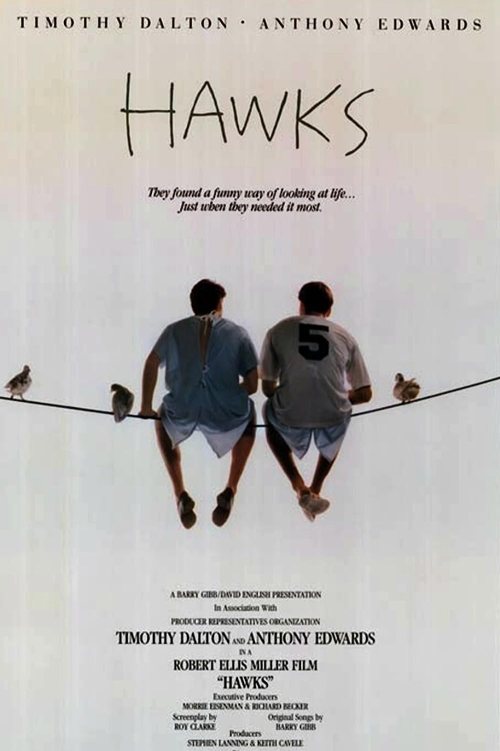
hawks1

By Richard Winters

My Rating: 6 out of 10

4-Word Review: Patients hit the road.

Decker (Anthony Edwards) is a former football player stricken with terminal cancer. He’s put in the hospital where his roommate is Bancroft (Timothy Dalton), who’s dying from the same disease. Bancroft though still wants to have some fun and convinces Decker to sneak out of the facility and go on a road trip to Denmark, so they can have one last fling with the prostitutes in the Red Light District. Decker is nervous at first, as he’d rather commit suicide to put himself out of his misery, but eventually decides to go along where they end up meeting two lonely ladies, Maureen (Camille Coduri) and Hazel (Janet McTeer) who’s also harboring a painful secret.

Based on a short story written by Barry Gibb of The Bee Gees the plot has, despite it’s grim theme, a playful quality and comes-off more like a quirky road movie. The scenery is nice especially when they get into Holland and have an extended scene amidst the picturesque windmills, which you can hear slowly rotating in the wind as they speak. There’s also a few funny moments with the best one coming right at the start where Decker takes a frightened SAAB car salesman (Geoffrey Palmer) on a test drive at reckless speeds and right to the edge of a cliff.

The acting is great with Dalton, who did this between his two stints as Bond and used his notoriety to get it made, which he felt wouldn’t have gotten financed otherwise, being standout and putting to great use his piercing blue eyes, which become even more prominent when he’s wearing his stocking cap. Edwards is also good though he looked wimpy to have ever played football. Some may try to argue that the sickness ate away his weight, but in reality this is the body type he’s always had and the producers should’ve, for the sake of authenticity, had him bulk-up before filming began.

What I didn’t like were the unexplained caveats, like where did these two terminally ill patients manage to get the money to pay for fancy hotels and chic restaurants? It seemed like they could buy anything they wanted, so if that were the case then why couldn’t they get themselves clothes so they didn’t have to run around everywhere wearing nothing but their bathrobes? The sex angle was ridiculous too especially for Decker, who’s so weak he had to be carted around in the wheelchair. If he could barely stand then how the hell is he going to get the energy for sex?

Initially I found Hazel and her clumsiness as annoying as Bancroft did, but like with him she eventually grew on me, but I didn’t think she needed to be introduced already in the first act before she even met the two men. She has a scene on a bridge all alone and I didn’t understand what she had to do with the story, only later during the second act when she appeared again did it make sense, but again her personal troubles could’ve waited to be explained when Bancroft and Decker heard about it. I actually enjoyed more Sheila Hancock, who plays Regina, an aging 50-something hooker they meet, who shows a good propensity at fixing things like TV’s and I wished she’d been the one they had befriended long term and the two younger ladies cut out altogether.

Spoiler Alert!

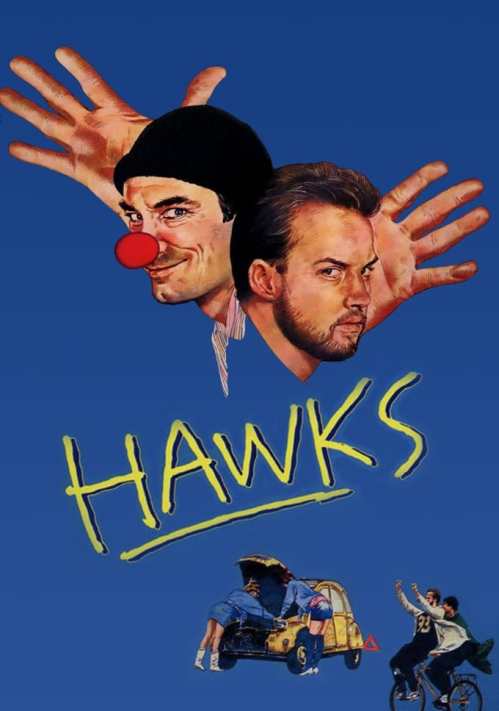
The ending is touching particularly the way the plastic red clown nose comes into play. The wedding in which Bancroft marries Hazel, who’s secretly pregnant by a man who disowns the child, is cute too though I didn’t understand how Bancroft, who had been losing his hair throughout, suddenly seemed to grow it all back as he walked down the aisle. If anything he should’ve been completely bald by that time and it would’ve been more realistic had he been shown that way.

hawks2

My Rating: 6 out of 10

Released: August 5, 1988

Runtime: 1 Hour 47 Minutes

Rated R

Director: Robert Ellis Miller

Studio: Skouras Pictures

Available: VHS, DVD-R (dvdlady.com)

Surrender (1987)

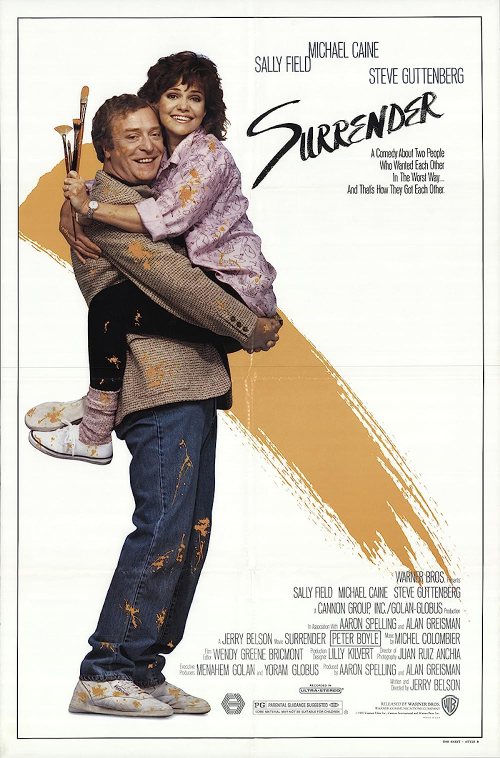
surrender

By Richard Winters

My Rating: 1 out of 10

4-Word Review: Pretending to be poor.

Sean Stein (Michael Caine) is a successful novelist, who after suffering through two contentious divorces, has decided that women are only after him for his money and considers them off-limits. Daisy (Sally Field) is a struggling artist, who is in a relationship with Marty (Steve Guttenberg), a successful attorney with no interest in making a long term commitment. While attending a charity ball that gets overrun by gunmen who rob the place, Sean and Daisy, find themselves tied-up together and despite the stressfulness of the situation slowly get to know each other. The next day, after they ultimately get freed, Sean asks Daisy for a date, but decides to pretend that he’s poor to make sure she loves him for who he is rather than because of his money.

While Jerry Belson wrote several successful comedies during the 70’s and based this story loosely on his own life experiences where he proudly stated that everything that happened to Sean in this movie happened to him in real-life, the pacing and basic comedy scenarios really don’t work. It starts out alright  as they’re several flashbacks showing Sean with his attorney, played by Peter Boyle, battling his ex-wives in court. The different hairstyles that they have as they go through the years is funny and the most creative thing in the movie. I was though disappointed that the two women who play the ex-wives, Louise Lasser and Iman, are never give a single word of dialogue, which wastes the talents of these well-known actresses.

After the first ten minutes though things quickly fall apart. Having armed thieves crash the party that the two are at is particularly troubling as there is no forewarning for why this is happening. People who attending posh parties usually don’t find themselves at gunpoint, so why are they here? Had there been even a fleeting mention of a group of criminals crashing area get togethers then maybe, but here we get no explanation either before, or after giving the plot a haphazard quality like the filmmakers are happy to throw in any crap they want whether it makes sense, or not. The characters respond to what most would consider to be a traumatic experience like it’s just a ‘run-of-the-mill thing’ and by the next day barely remember it, even though many people would have genuine PTSD after it was over.

Caine’s attempts to woo Sally would in most cases have the woman thinking he was a potential stalker. First he comes to her house six hours before their date saying that he couldn’t wait that long to see her and wanted to spend every waking minute with her that he could, which for any sane woman would be a serious red flag. He then kisses her without her consent and begs for immediate sex, or he might not be able to control himself and instead of calling 9-1-1 she gives him a pity fuck. Not only is this unfunny and stupid, but an insult to the viewer’s intelligence that they would find any of this to be a normal, well-adjusted way to start a healthy relationship.

I also thought Caine, who was a raving misogynist who even had signs on the front gate of his home banning women from entering, came around to liking Sally too quickly. Sure she was kind to him when they were tied-up, but an avowed women-hater doesn’t just change his ways overnight, but in this movie that’s exactly what happens, which isn’t realistic. If anything it should’ve been Sally chasing after Caine, who might’ve liked her a little at first, but so set in his ways would still decide to avoid her and only after an extended period of time, and continual prodding by Sally, would he eventually relent.

The pretending to be poor thing isn’t handled well either. I was expecting there to be a lot of comic moments dealing with Caine trying to desperately hide his wealth and background, but that never gets played out. He isn’t even forced to rent himself a seedy, little apartment in order to hide the fact that he lives in a mansion as Sally was apparently never curious about seeing his place, but how many serious relationships are there where they always go to one partner’s home and never the other?

The third act gets even more ridiculous as it has Caine insisting that Field needs to sign a prenup agreement. She’s resistant at first, and even insulted, but then eventually signs it without ever bothering to read it, which is idiotic. She also goes to Vegas and wins 2 million dollars at the slot machine her very first time playing it, which is beating insurmountable odds.

I did like the scene where Caine hands Sally a manuscript he has written, which was published into a book though he doesn’t tell her this and then becomes insecure when she doesn’t immediately like it, which being a budding screenwriter myself, I found funny and despite all the other absurdity in the film, a bit true to life. I was hoping the movie would explore this situation more, but it doesn’t making the rest of it a sore disappointment.

I was surprised why either of these big name stars agreed to do it. I know Caine was willing to be in almost anything for the money, but I’m not sure what Sally’s excuse was and if you ask me I’d find the old reruns of her TV-show ‘The Flying Nun’ to be more entertaining. It’s easy to see why this dumb thing, despite the star quality, has never gotten a DVD or Blu-ray release and nobody’s been clamoring for it either. It bombed badly at the box office too managing to recoup only $5 million of it’s $15 million budget.

My Rating: 1 out of 10

Released: October 9, 1987

Runtime: 1 Hour 34 Minutes

Rated PG

Director: Jerry Belson

Studio: Warner Brothers

Available: VHS, Tubi