Category Archives: Obscure Movies

The April Fools (1969)

By Richard Winters

My Rating: 2 out of 10

4-Word Review: Affair between married people.

Director Stuart Rosenberg was on a high note in 1967.  He had just won rave reviews for his cult hit Cool Hand Luke and many felt he was well on his way to being Hollywood’s next top director only to follow it up with this incredibly vapid and stupid romance movie.

It involves a married man by the name of Howard Brubaker (Jack Lemon) who meets an attractive woman named Catherine Gunther (Catherine Deneuve) at a party. They spend the evening walking around outside and having nothing more than a casual conversation, which is enough to make him decide to leave his wife (Sally Kellerman) and child, quit his high paying executive job, and run off with her to Paris.

The story is pretty threadbare and filled with a lot of characters and situations that are not fleshed out at all.  This almost seems like a partial treatment to a main script that never got completed.  This movie provides no real tension, conflict, or subplots.  Most movies dealing with potential romances usually has one or both of the participants second guessing themselves as to whether they should move ahead with the relationship especially when both of the people are married like they are here.  These two fall in love so amazingly quickly that they make the art and act of dating seem completely unnecessary.

A much better idea would have been to have this quick romance act as only the starting point.  The film then should have cut to 5 or 10 years later where we could have seen how this relationship fared, or evolved. This would have given much better perspective to both the movie and characters.

I also have never felt that two people having an affair is a real good catalyst for a love story because it seems to go against the whole ‘true and everlasting love’ theme that propels most romance stories.  After all if someone can’t stay fully committed to one person what is to say that they will be able to do so with someone else.  To give the argument that they are just ‘crazy’ about this new person doesn’t work because at some point they must have been ‘crazy’ about the person they are currently with or they wouldn’t have married them. So what is to say that in a few years time when the newness of the relationship wears off that the whole vicious cycle won’t just get repeated.  I don’t have the exact statistics in front of me, but research has shown that people who cheat on one person are prone to doing it with their next partner simply because it is in their nature.

In some ways I could see why Catherine would consider leaving her husband, which is well played by Peter Lawford, simply because the guy is a womanizing lout in the worst way.  It is understandable that she may have been initially mesmerized by his wealth and charisma and only had her eyes opened to his shallowness years later.  However, Howard’s marriage didn’t really seem that bad and what is worse is the fact that he had a 5 year old son whom he seemed to have no problem abandoning without even a second thought.

The whole thing comes off like some uninspired idea by some studio head who wanted to make a ‘sure-fire’ hit by throwing together every contrived romantic element he could think of, piecing it together with a flimsy script, and then using the star-power of Lemon and Deneuve to cover up all the holes.  Everything here seems forced and that includes the humor.  Lemon’s duel with Charles Boyer is overdone and irrelevant.  There is also a scene where Howard’s friend (Jack Weston) drives him to the airport while being completely drunk and weaving in and out of on-coming traffic.  Today’s audiences would find this to be highly irresponsible and also terribly unfunny, which it is.

There are some potentially funny ideas that scriptwriter Hal Dresner never seems to think of.  For instance Catherine ends up being the wife of Howard’s new boss.  This could have been a goldmine of a lot of funny scenarios as the two tried sneaking around behind his back. The Lawford character does eventually corner Howard at the airport just as he is ready to board the plane and go off to Paris with Catherine, but even this potential confrontation gets botched badly.

I did really like Deneuve and her presence is the only real good thing about this movie. She looks radiant and I enjoyed the cool, chic way she responds to all the situations she is put in. This also marked her American movie debut.

Lemon though does not fare as well.  He overplays the high-strung businessman persona until it becomes tiresome.  He is nervous and befuddles every second that he is on the screen until you wonder how he was ever able to impress anyone enough to be able to obtain the prestigious position that he has at his company.

The supporting cast is stellar, but not used enough.  Jack Weston has a funny bit as he explains the goofy way that he handled an affair of his own.  Harvey Korman is amusing as a man who tries stealing the alluring Deneuve away from Lemon at the last minute.  It is also fun to see Melinda Dillon in her film debut.  She is best known for her supporting dramatic roles, but here she plays a giggling, ditzy blonde.  She is paired up with comic character actor Kenneth Mars and the two have the makings of being a great hammy couple. Unfortunately they are not given enough screen time, nor enough good lines, to really make it gel. Myrna Loy and Charles Boyer, as a long-time married couple, are essentially wasted.

Besides Deneuve there were a few other things that I did like about the movie.  The Burt Bacharach score is certainly pleasing on the ears.  There is a funky, mod 60’s party that takes place at the beginning of the film that features a lot of weird art exhibits that are nicely realized by award-winning set designer Richard Sylbert. I found the exhibit that featured a faucet dangling in mid-air while running a constant stream of water to be fascinating. I also enjoyed the scene where Deneuve and Lemon go to a wild nightclub where they are handed pop guns as they sit down which they can use to shoot at the rear-ends of the waitresses when they want to get their attention. I thought this was a genuinely neat idea that should be used at every restaurant.

My Rating: 2 out of 10

Released: May 28, 1969

Runtime: 1Hour 35Minutes

Rated PG

Director: Stuart Rosenberg

Studio: National General Pictures

Available: VHS, DVD (Import)

Entertaining Mr. Sloane (1970)

By Richard Winters

My Rating: 3 out of 10

4-Word Review: The first gay marriage.

Based on the Joe Orton play of the same name, this film deals with a handsome young stranger named Sloane (Peter McEnery) who becomes a lodger at an isolated household in the English countryside. He is on the run from a murder he committed and feels this will be a safe haven due to the only other inhabitants being a quirky old lady name Katherine (Beryl Reid) and her equally quirky father Kemp (Alan Webb).  Katherine, or Kath, takes a sexual interest in Sloane despite their wide age difference, which Sloane doesn’t mind as he uses this to manipulate her. When Kath’s brother Ed (Harry Andrews) arrives and takes an amorous interest in Sloane as well, he does the same thing to him. Then Kemp recognizes Sloane as the killer and Sloane is forced to kill him, which culminates with ironic results.

Playwright Orton was years ahead of his time. His plays always had a dark, sexual, even explicit nature to them and his characters were always perverse and amoral in a darkly hilarious way. It is unfortunate that he was bludgeoned to death in 1967 by his jealous gay lover and his career was cut short. However, this adaptation done by screenwriter Clive Exton seems to miss the mark. The dialogue is endless with very little action. The other adaptation of Orton’s work that was made into a film, Loot, was much more lively and full of a lot of campy, zany humor as well as quick edits and imaginative camerawork. This film is visually dull and all the action is jammed into a cramped, dark house with bland decorations. It never really gets going until the final 15 minutes when you get to see the world’s very first gay marriage performed, but by then it is much too late.

For 1970 this film does seem edgy and even controversial in certain parts. The gay erotic subtext is quite strong especially the way the camera scans Sloane’s tan, half naked body. There is also Ed’s pink Cadillac that he drives around, which I got a real kick out of. I liked the way it squeaked as he drove it and was constantly bouncing up and down.  There is also his very provocative hood ornament of a naked man that the camera hones in on. The best part comes when Ed washes his car and is more focused on the ornament, which he lovingly caresses with his towel, than the rest of the vehicle.

However, 40 years later this stuff seems pretty tame and there are too many segments where nothing happens and is handled too conventionally.  It seemed like director Douglas Hickox really didn’t get, or appreciate the material enough, or interpret it in some interesting way because the final result is nothing more than a filmed stage play. The music that is used is terrible and almost enough to get you to turn off the film. It also gets overused and played over scenes when it isn’t needed and hurts the film’s mood in the process.

The biggest problem with the film may actually be with actress Reid herself. Don’t get me wrong this is a wonderfully unique actress who has done some memorable work. I especially liked her in The Killing of Sister George, and she is quite good here as well. However, I do have two issues. The first is a small one. It involves the fact that the character wears dentures. In one scene Sloane supposedly knocks them out and breaks them, but then Reid turns around and screams and you can see that she still has teeth in her mouth.  The other, much more serious issue is the fact that near the beginning of the film she is seen walking through a cemetery in broad daylight wearing a see through blouse. Now with some woman this can be quite sexy and I certainly wouldn’t complain, but when they are 60 and looking more like 70 this is a bad idea, even for perversely comical purposes as it is here it is still a bad idea. What is even worse is when she turns around and a gust of wind blows up her skirt and you can see her entire bare backside, which might be enough to make some viewers sick.

Now, before anyone accuses me of ageism let me relate an interesting experience that happened to me. Back in 2003 I was home from work and decided to take in a movie. I was living in Chicago at the time and I went to the neighborhood theater to see the interesting French mystery Swimming Pool starring Ludivine Sagnier and Charlotte Rampling.  It was a Tuesday and little did I know that it was senior discount day and the place was packed, literally, with people all looking well over the age of 70. The lady that sat beside me looked to be at least 80 and came in using a walker. The film featured an abundance of nudity from the young and attractive Sagnier, which I thought might shock and offend the seniors, but no one reacted to it and everyone went on enjoying the film. Then, towards the end of the movie, 58 year-old actress Rampling starts to take off her clothes and this indeed elicited a nervous response from the crowd. The lady next to me even said ‘oh dear’. In all fairness Rampling didn’t look all that bad naked, but it still hits home the point that even old people don’t want to see other old people naked.

My Rating: 3 out of 10

Released: July 27, 1970

Runtime: 1Hour 34Minutes

Rated R

Director: Douglas Hickox

Studio: Continental Distributing

Available: VHS, DVD (Region 2)

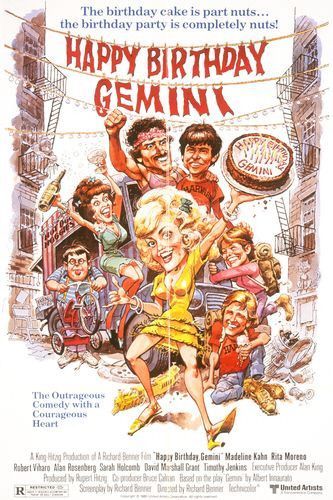
Happy Birthday Gemini (1980)

happy1

By Richard Winters

My Rating: 5 out of 10

4-Word Review: Gay son comes out. 

A brother and sister by the name of Judith and Randy Hastings ( Sarah Holcomb, David Marshall Grant) travel to Philadelphia over the summer to visit their college friend Francis Geminiani (Alan Rosenberg).  Judith dated Francis during the school year and wants to continue the relationship. Francis though has come to terms with his homosexuality and realizes that he is now more attracted to her brother.  The story examines their adjustments and attitudes to this news as well as the many eccentric characters that make up the neighborhood.

Despite not rating well with the critics, I kind of liked this movie for the most part. The film was directed by Richard Benner who received acclaim for the directing the groundbreaking Canadian film Outrageous. I think he captured the row houses and inner-city neighborhoods of Philadelphia well. My Mother is from the city and I spent many summers visiting there. I enjoyed the bright color schemes of the different houses as well the character’s costumes. The movie has a very European feel featuring a lot of long takes and a leisurely pace. The characters are also much more open-minded and accepting of each other’s transgressions than you would usually find in an American film.  The toe-tapping ragtime music and upbeat ending help fill it out.

Kudos must also go to Madeline Kahn and her performance as Bunny Weinberger. I was very impressed with this woman’s comedic skills after seeing her in What’s Up Doc as well as in Paper Moon. I didn’t think anything could top those, but this comes close. Her portrayal of a foul-mouthed, ditzy blonde with a very heavy eastern accent is outstanding and a highlight of the whole movie.  Her scenes in a courtroom where she has to defend herself from a battery charge as well as a nicely photographed scene where she threatens to jump off an abandoned building are two of her best moments.

Where the film fails is in the fact that there is little cohesion between the scenes. The film goes off on long tangents, particularly with the Bunny character, until it seems like Francis’s problem is only a side-story. There is a lot of extraneous dialogue that goes nowhere and was not needed. A 115 minute runtime is much too long for this kind of material.  For a comedy the laughs are lacking and the script needed to be injected with a lot more witty conversations and sharp one-liners. Rita Moreno is completely wasted as the character of Lucille Pompi.  She has nothing funny to say and it would have been more entertaining if they had built up more conflict between her and the Bunny character as the two had very contrasting values. The subject matter itself is no longer fresh or groundbreaking and the film failed to put any new or interesting spin on the topic. Although I liked the positive message I still felt that it glossed over the homophobic sentiments that are still out there and did not do its subject matter any real justice.

Fans of Kahn should see this, but others may find it placid and lacking in any type of distinctive quality.

My Rating: 5 out of 10

Released: May 2, 1980

Runtime: 1Hour 47Minutes

Rated R

Director: Richard Benner

Studio: United Artists

Available: VHS

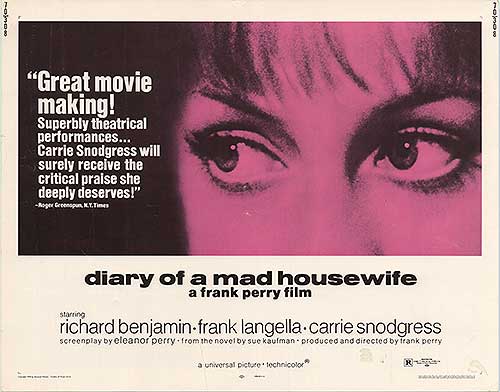
Diary of a Mad Housewife (1970)

diarymad1

By Richard Winters

My Rating: 9 out of 10

4-Word Review: Married to a jerk.

Director Frank Perry may not be a name one throws out when mentioning some of the top directors, but a lot of his early work that he did with his screenwriter wife Eleanor were definite forerunners of the independent film movement and ahead of their time. David and Lisa was their first and it dealt with the budding romance between two patients at a mental hospital. Ladybug Ladybug was their follow-up and it was the true story of what happens when an errant nuclear warning siren goes off and the staff and students of a small rural school think it is for real. There was also the critically acclaimed film Last Summer dealing with the brutal gang rape of a teen girl by her so called ‘friends’.  They also did the revisionist western Doc starring Stacy Keach as well as the brilliantly quirky Rancho Deluxe.  However, it is Diary of a Mad Housewife that I find to be their very best.

It is the story based on the best-selling novel by Sue Kaufman dealing with the character of Tina Balser.  On the outside she seems to be living the American dream. She is married to a up and coming lawyer, living in a swank Manhattan apartment, and the mother of two beautiful girls.  Unfortunately the husband is an obnoxious bore, the girls are spoiled and mouthy, and she feels lonely and depressed.  She decides to have an affair with a novelist, but he ends up treating her just as poorly and when she tells her troubles to a support group, they end up doing the same.

I have seen this film many times over the past twenty years and am always impressed at the fluid way it goes between satire and drama as well as the fact that it doesn’t seem dated at all. The scenes with Richard Benjamin as the jerk husband are hilariously over-the-top.  Yet the scenes involving Frank Langella as the lover who is bitter about his lagging writing career and repressed homosexuality and takes these frustrations out on Tina, are just as interesting, but in a much more subtle way.  In fact these scenes feature some great dialogue and character development and I find them more intriguing with each viewing.  Langella, in his film debut, makes a lasting impression.

The cinematography, editing, and color schemes are also first-rate. Perry does a great job in infusing the counter-culture movement of the time with the old values of marriage and family. The mod party that they go to is well staged with scantily clad mannequins in a provocative poses placed throughout.  The pretentious attitudes of the party goers is nicely captured.  This scene also features the Alice Cooper Band as well as giant pillow fight.

Carrie Snodgrass performance is what really makes this work.  She was nominated for the Academy Award and she should have won it. Her ability to display her characters feelings through such subtle methods as facial expressions, body gestures, and reactions is impressive.  The viewer can easily relate to the character and feel her pain.  Rock singer Neil Young was so impressed with her that he wrote her a fan letter and the two ended up getting into a relationship. Unfortunately because of this she dropped out of Hollywood and didn’t do another movie until almost nine years later.  When she returned all the top roles were no longer accessible and she was relegated to ‘B’ movies and small supporting roles until finally succumbing to cancer in 2004. This was a real shame because her talents were never fully utilized, but at least this was a perfect vehicle for her and one that movie fans today can really appreciate.

In the end though what makes this film so very good is that it makes a great statement on the fact that isolation is a part of modern day living and at some point everyone will have to deal with.  Getting married, having kids, even having a lover or a support group will not necessarily be an effective buffer and may actually only exacerbate it. The whole film kind of reminded me of a statement made by a character on the old ‘Ally McBeal’ TV-show “My loneliest times in life are when someone is lying in bed next to me.”

My Rating: 9 out of 10

Released: August 10, 1970

Runtime: 1Hour 43Minutes (Theater Version) 1Hour 35Minutes (TV Version)

Rated R

Director: Frank Perry

Studio: Universal

Available: VHS

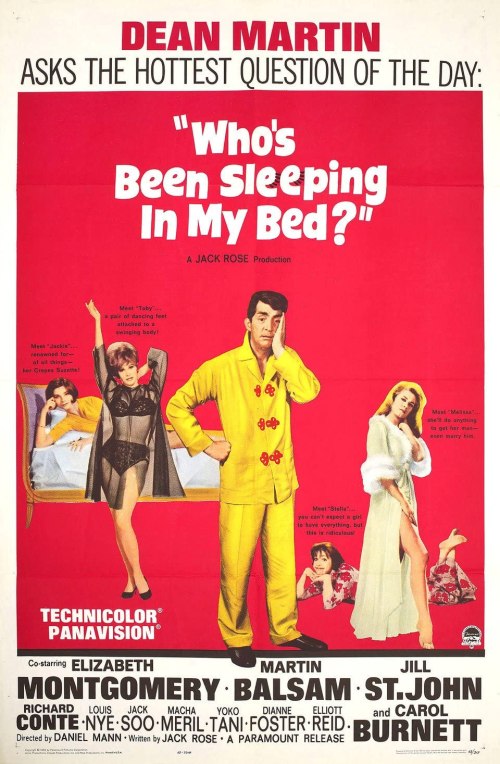
Who’s Been Sleeping in My Bed? (1963)

who1

By Richard Winters

My Rating: 3 out of 10

4-Word Review: Carol Burnett does striptease.

Every time I get annoyed by many of today’s Hollywood comedies that seem to be nothing more than a stretched out idea for an episode of a sitcom, one only has to go back into time to find that the comedies of yesteryear weren’t always much better. Of course there were some classics, but a lot of vapid ones in the mix as well. In fact this one is so trite that it becomes almost agonizing to sit through. It was considered in its time to be a ‘sex farce’, but fails to deliver on either.

The old adage ‘it’s not what you know, but who you know’ has never been truer in this instance. I have attended many screenwriting classes and seminars and can verify there is a lot of good stuff out there that hasn’t been read unfortunately because the authors don’t have the right connections. In this case the screenplay was written by Jack Rose who had previous writing success with such films as My Favorite Brunette, Houseboat, and The Road to Rio. Judging from its lack of creativity Rose probably wrote this real quickly to make some fast cash and the studio heads gave it the green light simply based on his past success without ever looking at it critically.

The plot, if you can call it that, has to do with TV-star Jason Steel (Dean Martin) who plays the part of a popular Dr. on a TV-series.  His TV character matches all the ideal qualities that women want in a man and thus he always has women chasing after him in real-life. He even has the wives of his friends coming on to him. With so many married women telling him how unhappy they are in their marriages he begins to fear that marriage may not be a good idea and thus calls off his impending engagement to beautiful Melisa Morris (Elizabeth Montgomery).  Melisa is devastated by this, so her goofy roommate Stella Irving (Carol Burnett, in her film debut) hatches up a kooky scheme in order to get him to reconsider.

This film gets tiring right from the beginning.  Jason goes out with his buddies every Thursday night to play poker, but then during the game he always gets a call from one of his buddy’s wives telling him they have to see him.  He leaves the game and meets them at his place and then fights off their advances. This silly scenario gets repeated four different times with all four of his friend’s wives and it’s like being told the same dumb joke over and over. This triviality ends up taking up the whole first hour before it moves into the scheme portion, which really doesn’t even measure up to a weak episode of ‘I Love Lucy’.

Out of the whole ninety minutes there are only two scenes that are mildly amusing.  One is when Jason pushes everyone into a pool and they fall in like dominoes and the other is when Stella goes to a strip club and is forced to go onstage and do a striptease when she can’t pay for her drinks, which makes great use of Burnett’s ad-libbing abilities.

Burnett and Montgomery make an interesting pair. Montgomery is a good straight-man to Burnett’s zaniness and with a better script this could’ve been ideal casting. Montgomery did this film just before she started her long running series ‘Bewitched’. She looks gorgeous and gives the film’s best performance.

There is a long list of excellent male character actors here including: Martin Balsam, Jack Soo, Richard Conte, Louis Nye, and Johnny Silver. All of them are wasted with very little to do. Except for the money I don’t know why any of them took their parts.

The satirical jabs at TV-dramas are too gentle and not even good for a chuckle.  If one is considering getting married then I would definitely not suggest it as the script takes so many potshots at the institution that it is liable to give anyone second thoughts.

Although this was made as a vehicle for Martin I feel even fans of Dino will be disappointed. It really doesn’t take advantage of his persona and he seems as bored with the material as the viewer and just going through the paces. Despite the interesting cast this is an all-around disappointment.

My Rating: 3 out of 10.

Released: December 25, 1963

Runtime: 1Hour 43Minutes

Rated NR (Not Rated)

Director: Delber Mann

Studio: Paramount

Available: Netflix Streaming

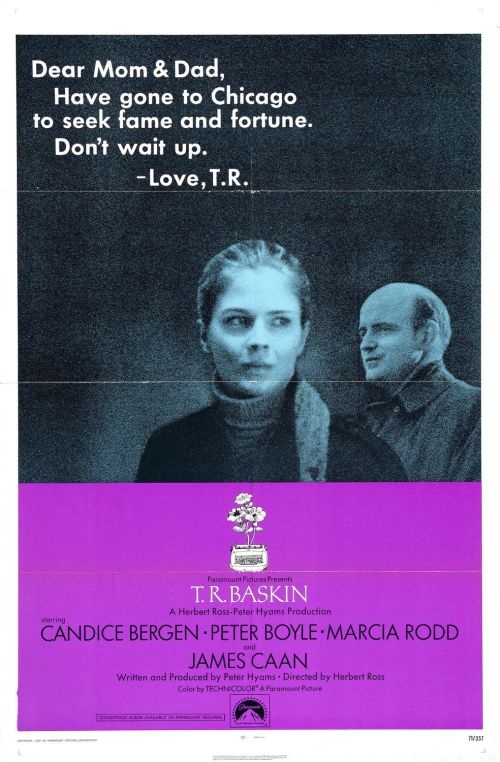
T. R. Baskin (1971)

tr baskin

By Richard Winters

My Rating: 8 out of 10

4-Word Review: Out on her own.

T. R. Baskin (Candice Bergen) is a young woman who leaves the nest by striking out on her own in Chicago. Unfortunately she finds nothing but a lot of loneliness, dead-end dates, crummy apartments, and soul-sucking jobs. Our protagonist becomes so emotionally beaten down that when a traveling salesman named Jack Mitchell (Peter Boyle) calls her looking for a ‘good time’, as he mistakenly is given her number under the impression that she is a prostitute, T.R. accepts his invitation simply as a chance to connect with someone. The film then cuts back and forth between conversations that she has with Jack in his hotel room as well as her experiences when she first gets into the Windy City.

Although this film does have its share of faults I was really taken aback by its strong emotional impact. The film was directed by Herbert Ross who would later do Footloose, The Goodbye Girl, and Steel Magnolias. The screenplay was written by Peter Hyams famous for writing and directing Capricorn One, Narrow Margin, and 2010 to name a few.

The film manages to recreate the monotony and isolation of day-to-day living better than just about any other movie that I have seen. Some of the best scenes include T.R.’s job interview process at an accounting firm as well as a long camera pan showing all the rows and rows of desks in the office and T.R. looking lost in the middle. There is another part where she sneaks back into the office on a weekend day in order to make silly announcements over their intercom system and the images of all the dark shadowy desks looks just as ominous. Another moving moment is when she is shown pacing her lonely apartment as well as her phone conversation with her parents where she tries to convince them that she is doing ‘just fine’, but breaks down into tears the second it ends.

The film leaves you with a strong impression. The music that was selected was first-rate and fits the mood of the picture perfectly. It is a real shame that this sleeper has never been released on either VHS or DVD and has not been shown on television since December of the 1980 when it was broadcast on Cinemax. It is well worth seeking out and certainly deserves more attention.

Bergen is terrific in the lead. This is before she attained her acerbic persona from her ‘Murphy Brown’ days and here comes off as more shy and sensitive. Her delicate and attractive features help capture the viewer instantly.

Boyle is equally good and the introspective conversations that the two have nicely runs the gamut between funny and sad. James Caan, who for some reason appears unbilled, has a nice cameo as an attractive and intelligent man that T.R. falls for only to have him callously break her heart.

If the film has any flaw it is in the fact that it is a bit uneven. It starts out with some terrific dry humor including a hilarious scene when she goes apartment hunting, but eventually the movie becomes too much of a downbeat drama. There are certainly universal truths to many of the sad situations that she goes through, but I found it frustrating that we are never shown her eventual fate. All we see is a small period in her life and then a very abrupt and unsatisfying ending. It would have been nice if the story had cut to five, ten, even twenty years down the road and allowed us to find out if she ever found ‘Mr. Right’ and some happiness.

Despite being made forty years ago this film is as trenchant and timely as it was back then. People who avoid watching older films because they believe that they are ‘dated’ are being foolish. This film has more bearing in reality and the human experience than a lot of the movies out today.

My Rating: 8 out of 10

Released: October 20, 1971

Runtime: 1Hour 30Minutes

Rated PG

Director: Herbert Ross

Studio: Paramount

Available: Amazon Instant Video

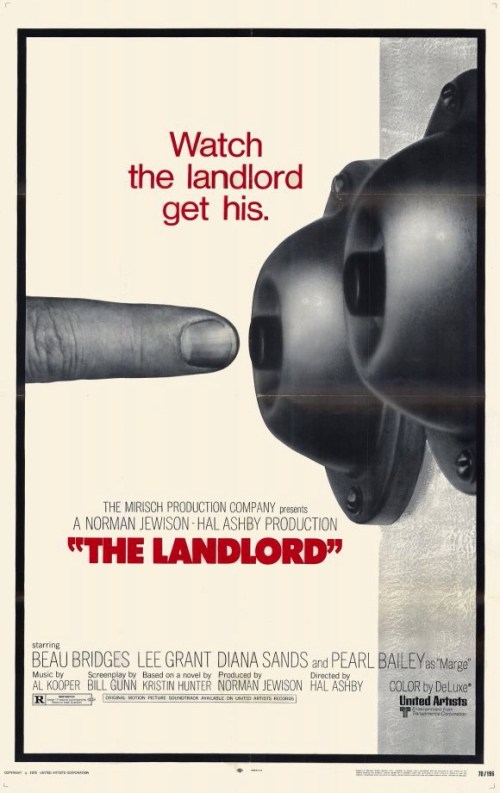
The Landlord (1970)

By Richard Winters

My Rating: 8 out of 10

4-Word Review: In over his head.

Elgar Enders (Beau Bridges) is a spoiled 29 year-old from a wealthy family who is still living at home with his parents in an affluent suburb of New York.  He decides it is time to ‘make his mark’ by purchasing a rundown building housing black tenants in inner-city Brooklyn.  He plans to evict the people and have the structure renovated into a posh flat.  He starts having second thoughts though as he gets to know the people and learns of their struggles.  He begins a relationship with one of the women (Diana Sands) and soon he is working to upgrade the building as well as trying to enlighten his racist, snobbish parents (Walter Brooke, Lee Grant) to embrace the black movement.

The Enders character is a perfect microcosm to the 70’s period where idealism and efforts to improve inner-city life, as well as some of the harsh realities that came with it, where at an all-time high.  Director Hal Ashby’s first film is full of strong gritty visuals from the rundown, graffiti-laden buildings to the garbage strewn lawns. Everything was filmed on-location and you get a vivid taste of the black experience. It is boosted even more by the detailed cinematography of Gordon Willis, which makes the most of the natural lighting and making you feel like you are right there.   The honest no-holes-barred approach is terrific. It perfectly captures the mood and feel of its era. I was surprised for a first time director, even a really good one like Ashby,  how well-constructed and technically sharp this was, which could have some link to the fact that it was produced by another great director, Norman Jewison, whom I’m sure lent a lot of input.

Initially I found the Elgar character to be off-putting, but that could’ve been intentional.  We first see him sitting on his lawn chair being served a drink by a black servant while talking about his great plan and looking like a spoiled, snot- nosed kid who has been coddled all his life.  The one scene that I remembered from this film when I first saw it over 20 years ago is when he  gets out of his Volkswagen bug to look at the building while wearing a tacky looking Pat Boone white dress suit.  When some of the black men sitting on the building’s front steps tease him a little, he immediately panics and runs eight blocks down the street in terror even though no one was chasing him.  However, he does start to grow on you as the film progresses.  I liked the fact that he faces adversity and is not scared away.  He learns to persist and adapt.  He genuinely starts to care about the people and backs-up what he says to the extent that he single-handedly carries new toilets one-by-one from the hardware store to the apartment building when the plumbing breaks down in an amusing vignette.  He isn’t afraid to tell off his arrogant parents when he needs too and his definition of NAACP is pretty funny.  It is satisfying to see him mature, learning that instituting change is not easy and things are the way they are for a reason.  He eventually is forced to confront his own limitations, but becomes a stronger person for it. This is without a doubt Bridges best performance to date.

There are other great performances as well.  Pearl Bailey is a gem as one of the building’s feisty, older women tenants who is the first to befriend Elgar.  Her awkward visit with Elgar’s equally feisty mother is considered the film’s highlight by many viewers and critics. I also loved the look she gives Elgar at the very end when he tries to wave goodbye to her.  The gorgeous Diana Sands is outstanding playing the role of Francine who has an ill-fated affair with Elgar. She shows just the right balance of sexiness and seriousness and it was a shame that just a few years after this film was made she ended up dying of cancer at the young age of 39. Susan Anspach is fun in one of her early roles as Elgar’s pot smoking sister.  The performance though that leaves the strongest impression is that of Lee Grant who is hilariously hammy as Elgar’s priggish mother.

When I first saw this film I came away thinking that it was uneven and a bit bipolar. It runs most of the way as a gentle, quirky satire filled with goofy cutaways, but then ends with a very stark and frightening scene with Elgar being chased down the grimy hallways of the building by Francine’s angry ax-waving husband (Louis Gossett Jr.) when he finds out that Elgar has gotten his wife pregnant.  The scene is ugly and intense and a far cry from the rest of the film’s gentle tone. Yet upon second viewing I think this scene works and was necessary. It makes a good statement at how volatile temperaments can be of those that are forced to leave in squalor as well showing how easily people, even with the best intentions, can get in over-their-heads when they don’t fully appreciate, or understand the situation that they are getting into it.

The side story involving a mulatto women (Marki Bey) who falls in love with Elgar is solid as well and gives the viewer a keen insight as to how difficult it is for someone who can’t seem to be accepted by either race. The language and conversations are tough and vulgar, but always laced with realism.

The only complaint I have with the film is the portrayal of the white characters who are buffoonish and overly idiotic even for satire.  I thought the idea of having them still use black servants was over-done, but then when one of them shows up at a party wearing blackface it was overkill. I thought it was unfair and unrealistic in the way that the film worked so hard to give depth to its black characters, but then turns around and, with the exception of Elgar, paints the whites as nothing more than broad caricatures.

The Landlord has finally been released on DVD through MGM’s Limited Edition Collection. I would suggest this film for anyone who enjoys an intelligent comedy-drama with something to say. It is also a great chance to see young up-and-coming actors. This includes Hector Elizondo as well as comedian Robert Klein. You can also get a very quick glimpse of Samuel L. Jackson who appears briefly in an uncredited role as a minister near the end.

My Rating: 8 out of 10

Released: May 20, 1970

Runtime: 1Hour 52Minutes

Rated R

Director: Hal Ashby

Studio: United Artists

Available: VHS, DVD

Movie Movie (1978)

By Richard Winters

My Rating: 3 out of 10

4-Word Review: Two movies in one.

Initially, the unique concept for this film seems intriguing.  The idea was to recreate the movie viewing experience of the 30’s and 40’s by having a double bill feature along with theatrical trailers in between. The stories would have all the clichés, storylines, and characters from films of that era, but done with a tongue and cheek approach. The same core performers including: George C. Scott, his actress wife Trish Van Devere, Red Buttons, Art Carney, and Eli Wallach would play different characters in all the stories much like doing skits on a variety show. Legendary director Stanley Donen, famous for such films as Singing in the Rain, Royal Wedding, and Seven Brides for Seven Brothers, would direct and the screenplay would be written by Larry Gelbert best known for writing Oh God! and Tootsie.

Unfortunately, it never really takes off. Part of the reason is that the parody is too restrained. There are a few funny lines here and there, but that is about it. This was released two years before the Zucker brother’s groundbreaking hit Airplane that redefined parody and still stands as the standard today. This film doesn’t even come close to that. In fact certain audiences that saw this movie in other countries didn’t get the wry, gentle humor at all and took it seriously. I got the feeling that Gelbert and Donen had gone to the theaters as kids and watched these same types of films. Their affection and nostalgia for this stuff is clearly evident and prevented them from unleashing the over-the-top, in your face farce that would have really made this hilarious and is what most audiences of today expect.

The first feature is entitled ‘Dynamite Hands’ and is a story about a young boxer from the 30’s named Joey Popchik (Harry Hamlin, in his film debut) who becomes a prizefighter in order to pay for his kid sister’s (Kathleen Quinlan) eye operation. This segment features all the expected clichés, but the subtle humor that is injected fails to make it seem fresh or interesting. It was shot in color, but I felt black and white would have been better. The one thing I did like was Hamlin who these days seems pretty washed-up as he appears almost exclusively in direct to video fare, or dumb reality shows with his fat-lipped wife. Yet here he is right on target with his portrayal of the naïve, wet-behind-the-ears, All-American kid and I enjoyed it. Wallach is also fun as the heavy.

The middle segment is a mock theatrical trailer called “Zero Hour” that features Wallach, Scott, and Buttons as WWI flying aces. This was shot in black and white, but is brief and unexceptional. I was disappointed that there wasn’t any silly newsreel footage as this was also a mainstay in theaters during the time and could’ve been a riot.

The third part is a send-up of all the old Busby Berkley musicals and is entitled “Baxter’s Beauties of 1933”.  Scott, who is nicely hammy, plays a famous Broadway producer named Spats Baxter that finds out he is dying from a very rare illness and has only a month to live. He decides to go out on top by putting on the most lavish musical show that he can. Again, like with the others, this segment is a disappointment. The musical numbers, which were choreographed by Michael Kidd, are poorly photographed and with the exception of one routine done on a giant roulette wheel fail to match the spectacular and extravagant quality of Berkley’s. Van Devere’s kitschy performance as an alcoholic, tyrannical leading lady is the only thing that saves it. Gifted actress Barbra Harris is completely wasted in a thankless role of one of the chorus girls that doesn’t take any advantage of her talents.

George Burns, who is credited as the film’s ‘host’, appears only briefly at the beginning, but I would have liked to have seen more of him.

The cast and crew clearly had more fun making this than the viewer had in watching it. The formula is followed too closely and the result is tedium.  Even if you are a fan of films from that period I would still not suggest this as the originals are far better.

My Rating: 3 out of 10

Released: November 3, 1978

Runtime: 1Hour 45Minutes

Rated PG

Director: Stanley Donen

Studio: ITC Entertainment

Available: Amazon Instant Video

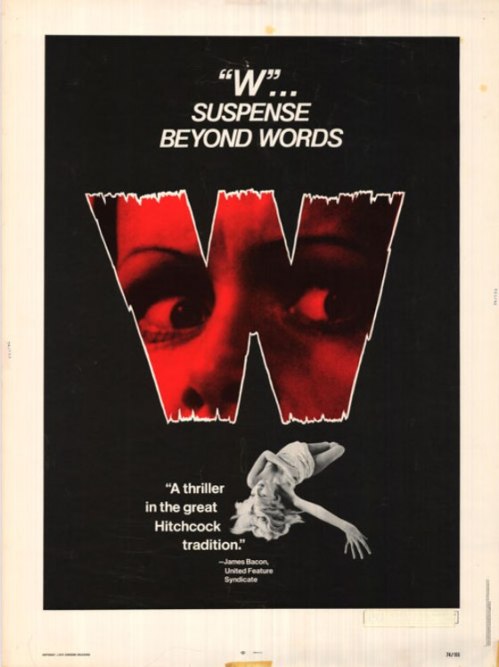
W (1974)

w1

By Richard Winters

My Rating: 1 out of 10

4-Word Review: Ex-husband is psycho.

For all you trivia buffs out there it may be good to know that Oliver Stone was not the first person to make a film with the twenty-third letter of the alphabet as its title, although that one technically has a period after it.  The first one was in 1974 and starred British super-model Twiggy. She had just made a splash in Ken Russell’s brilliant musical The Boy Friend and this film was supposed to send her to superstardom by proving that she could act by placing her in a completely different genre. Unfortunately for her it never happened.

The film is a thriller and the tagline read ‘W…suspense beyond words’. It is a story about a woman who has remarried but it still being stalked by her psycho ex-husband (Dirk Benedict). His name is William and at all of the scenes of his murders, or ‘accidents’, he scrawls the letter ‘W’, hence the film’s title.

At the time the critics came down hard on Twiggy’s performance, but I kind of liked it. She comes off as very innocuous and vulnerable and in this kind of role it works.  Her present husband was played by Michael Witney, who at the time was her real-life husband.  He was eighteen years older than her, but the age difference is not apparent.  You can tell that the two are genuinely fond of each other and that chemistry helps.  Yet they have no real onscreen presence and too much of the time is spent with only them in it, which hurts.

Viewers enjoyed Eugene Roche’s performance in a supporting role as a detective.  His gritty, matter-of-fact approach is refreshing and gives him some distinction over the other characters who are very transparent. Unfortunately he gets phased out rather quickly and this is too bad because it is the type of persona that could have really carried the film.

Where this film really fails is that way too much time is given to extraneous dialogue that is not interesting and does not propel the plot along.  The scenes are also excruciatingly slow and in great need of quicker cuts and edits.  I would have like to have seen cutaways showing the Twiggy’s character’s relationship with her ex-husband and how that all started, but it is never shown. She doesn’t even end up talking about it until well over an hour into the film and then it is only done briefly.

This is also one of the first thrillers that I have ever seen that has no creepy or pounding music score.  In fact the music is very soft and melodic like something you would hear in an elevator. There is also extended amount of footage showing the couple going sailing, walking hand in hand in a park, or spending time at their lavish beach house, making it seem more like a dreamy romance movie.  Some scary imagery, or just a few shocks are badly needed.  There is one nightmare sequence that has a little potential, but it lasts less than ten seconds and that just isn’t enough.

The film also has a lot of loopholes that completely throws you out of the story.  One is the fact that as they are becoming increasingly terrorized by this ex-husband they decide not to go to the police, but instead call on the services of a private detective, who has ulterior motives and just ends up making things worse. There is also a scene where the killer cuts off two of his fingers and attaches them to the victim’s burned body so when the police identify the body using the fingerprints they think it is the killer.  However, I wasn’t exactly sure how he pulled this off. Certainly he wouldn’t have the skill or time to actually graft the fingers onto the body and even if he did you would still think that the police would notice that the victim had too many fingers.

The biggest head scratcher of them all has got to be the fact that the prison in which the ex-husband resides gives daily tours to the public.  Now I have toured a prison myself in Boise, Idaho, but that was only after the prison had been closed and the prisoners shipped off to another facility.  Here the visitors can get right up next to the prisoners and observe them without any guards, or protection.  The person leading them around is not armed and dresses and acts like a tour guide to a museum.  I would think one of the prisoners could easily obtain a homemade knife of some kind, grab one of these visitors, and use them as a shield to break out. Of course in this film that doesn’t happen, but in real life I think it would, which just makes you wonder what kind of drugs were they on when they made this.

My only interest in watching this film to begin with was seeing Dirk Benedict playing the psychotic.  He is probably best known for the character of Face in the 80’s TV-show ‘The A-Team’.  Not that he is a real great actor or anything, but he has had a career where he usually always plays the nice guy, so I was interested in seeing him as the bad guy. Unfortunately he doesn’t appear until the final ten minutes and these scenes are strained and probably the most boring of the whole film.  His character is also poorly fleshed out with no reason given to his erratic, crazy behavior thus turning him into a cliche.

I came into this film expecting very little and I went away not even getting that much. Being an avid collector of lost films can be fun because every now and then you can come across a real gem, but that was definitely not the case here.

My Rating: 1 out of 10

Released: June 8, 1974

Runtime: 1Hour 35Minutes

Rated PG

Director: Richard Quine

Studio: Cinerama Releasing Corporation

Available: None

John and Mary (1969)

By Richard Winters

My Rating: 4 out of 10

4-Word Review: Sex and then relationship.

Considered provocative at the time this film detailed the new phenomenon of the one-night-stand, a fad in the late 60’s early 70’s that quickly went out of style upon the release of Looking for Mr Goodbar in 1977.  The story here details a rather nondescript man and woman (played by Dustin Hoffman and Mia Farrow) who meet at a singles bar and then go back to his place for sex.  The rest of the film involves them considering whether it can grow into a relationship.

The first ten minutes are pretty good. It nicely analyzes all the expected awkwardness one must have of waking up the next morning and not sure who you’ve been sleeping with. I liked how the John character secretly goes through Mary’s purse to find out more about her while Mary does the same with his telephone messages. Unfortunately after this segment Director Peter Yates unwisely decided to put in voice overs of their thoughts. This adds nothing to the proceedings and ends up being heavy-handed. It also takes away one of the fundamental points of good film-making, which is learning about characters through subtle visual observation.

The film is also no where near as sophisticated or daring as I think the film-makers would like us to believe. I expected, and would have like, the male character to have been a life-long swinger who has had many of these flings and now suddenly finds himself attracted to this woman and wants to go in a different direction. Instead we get a Hoffman character portrayed as being someone who has never done this before and only does so at the coaxing of his much more liberated friend.  This leads him to act all shy and unsure and coming off like an extension to the character he played in The Graduate. The end result is getting a very boring, bland person who responds to things in all the predicted ways instead of giving us a fresh new perspective by delving into the mind of someone living a lifestyle many of us have not experienced.  I also got a strong feeling that the film-makers had done very little research into this topic, thus giving the viewer no new insight whatsoever.  It ends up coming off like one of those trendy ‘statement movies’, but with no idea of what statement it actually wants to make.

There is no chemistry between Hoffman and Farrow at all.  Nothing is shown that would indicate why these two would want to pursue this thing any further. I actually found the scenes involving the side-story of Farrow’s affair with an older college professor (Michael Tolan) to be more interesting and filled with stronger more snappy dialogue.

In the end this ‘provocative drama’ deteriorates into being an uninspired love story. It concludes with the tired, cliche ridden scene of having John madly driving around the city of New York looking for this mysterious woman who he is convinced he is in love with despite the fact that he still does not know what her name is.  It is easy to see how, in Hoffman’s very distinguished career, why this film remains one of his lesser known efforts.

On the technical side this film is actually well done.  I liked how it inter-cut between the present day and the past as well as analyzing the previous relationships of the two characters. This film also offers a nice chance to see a young Tyne Daly as Farrow’s roommate.  Cleavon Little from Blazing Saddles fame appears briefly as a would-be film director.  Olympia Dukakis  has an amusing, non-speaking bit as Hoffman’s activist Mother.  This also marks the film debut of character actress Marian Mercer.

My Rating: 4 out of 10

Released: December 14, 1969

Runtime: 1Hour 32Minutes

Rated PG

Director: Peter Yates

Studio: 20th Century Fox

Available: VHS, DVD