Category Archives: Obscure Movies

The Telephone Book (1971)

By Richard Winters

My Rating: 7 out of 10

4-Word Review: She likes obscene calls.

            Due to the recent death of writer/director Nelson Lyon on July 17th I felt it was time to dig up my old copy of this bizarre underground cult flick and give it another view. I stated in another review I made about this film that I considered it The Gone with the Wind of underground moviemaking and I still stand behind it. The film is hampered by its low budget and black and white photography, but I was impressed with it creative camera angles, editing, set design and music. Lyon showed a genuine vision and made the most out of what little resources he had. Even the content, which could be seen as pornographic by some, is presented in such a quick paced and diverting style that it becomes engaging and amusing.

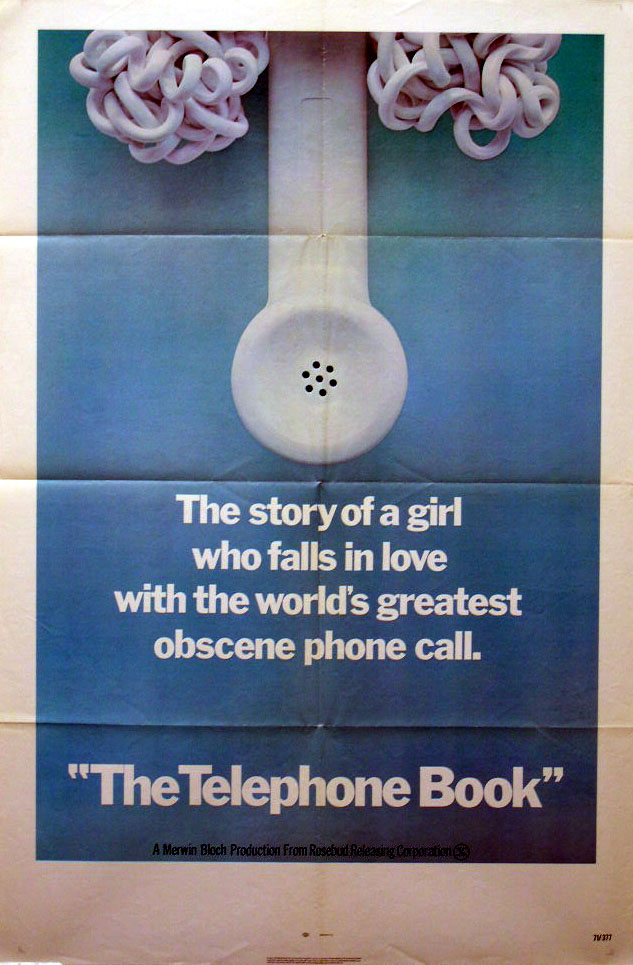
The basic premise deals with Alice (Sarah Kennedy) an over-sexed young blonde living alone in an apartment with walls lined with wall paper that has hundreds of pictures of people in various sex acts. One day she gets a call from an obscene phone caller and she falls in love with him because it was the ‘most sweetest and most beautiful dirty call’ she had ever received and although she had received other obscene calls in her life this one ‘had class’. She becomes obsessed with meeting the man. He tells her that his name is John Smith and that he is ‘in the book’.  She goes through the telephone book to call him up, but because she lives in New York City she realizes there are a lot of John Smiths. The rest of the film deals with her encounters of all the various John Smiths that she meets as well as her climatic meeting with the real John Smith and the very weird conversation that she has with him.

The film’s structure is basically made up of a lot of vignettes all dealing with various forms of perversity. Some famous character actors appear in cameos and some of which prove to be quite outrageous and funny. Barry Morse best known for playing Lieutenant Gerard in the 1960’s TV-series ‘The Fugitive’ has one of the film’s best moments playing Har Poon ‘the greatest stag movie actor of all-time’. He has a scene where 10 naked ladies, at least that is how many I was able to count, all jump on top of him and begin sucking on his various body parts. There is Roger C. Carmel as a psychiatrist who enjoys exposing himself to ladies on a subway train, but when Alice decides to do the same thing in return he becomes shocked and repulsed. Character actress Lucy Lee Flippan makes her film debut here as a ‘reformed’ obscene phone caller who describes how when her husband was away at work and her kids where at school she would call up men at their jobs and talk dirty to them while masturbating  with a banana. There is also William Hickey playing a man suffering from a permanent and incurable erection.

The best appearance though comes from Norman Rose famous for narrating many films. Here he appears wearing a mask of a pig and playing the actual obscene phone caller. He describes how he calls 4 different women a night every week of the year except for two when he goes on vacation to ‘get out of the grind’. He also explains how he has perfected his obscene phone skills to the point that he could seduce the president of the United States if he wanted to, but doesn’t because he has ‘no political ambitions’. The conversation gets weirder including telling Alice about his foray into becoming an astronaut while he seductively washes her hair, but Lyon’s use of imagery during this segment keeps it interesting and even memorable. My only complaint would be that I wished he had taken off the mask so we could have seen what he really looked like.

The film ends with an eye popping animation segment dealing with a giant headless naked woman who squats down and has sex with a sky scrapper that needs to be seen to be believed. This is also the only part of the film that is in color.

Despite the fact that it was all done on a shoestring budget and with no character development I had few complaints although I didn’t understand how the obscene caller was always able to call up Alice and get a hold of her even when she was not at home and at someone else’s place. This was of course before cellphones, but I suppose demanding logic from a film that otherwise revels in the absurd would prove futile. The film did not do well on its initial run, but was rereleased in 2011 to much more positive reviews both here and in Europe. Through word of mouth it is expected to gain the cult following it deserves and maybe eventually a DVD or Blu-ray release.

Kennedy is delightful in the lead, but her appeal may depend on one’s personal tolerance. She looks and acts almost exactly like Goldie Hawn and was her replacement on the ‘Laugh-In’ show when Hawn left to concentrate on her movie career. I enjoyed Kennedy’s giddiness and child-like enthusiasm to all the perversions around her, but her voice sounds like she has sucked in helium and could prove annoying to some.

My Rating: 7 out of 10

Released: October 3, 1971

Runtime: 1Hour 24Minutes

Rated X

Director: Nelson Lyon

Studio: Rosebud Films

Available: VHS, DVD, Blu-ray 

Luv (1967)

By Richard Winters

My Rating: 4 out of 10

4-Word Review: Jump off the bridge.

            Based on the play by Murray Schisgal the film follows the exploits of Harry Berlin (Jack Lemmon) a hopeless neurotic who tries to commit suicide by jumping off a bridge only to be saved by his long lost friend Milt (Peter Falk). Milt wants to use Harry to have him fall in love with his wife Ellen, so that way she will agree to a divorce and free him up to get with a hot young blonde named Linda (Nina Wayne).  Things initially work as planned. Harry and Ellen fall in love and marry and Milt does the same with Linda, but then Milt and Ellen find that they are not compatible with their new mates and long to get back together. The problem is that Harry refuses to grant a divorce forcing them to try and coax him back out on the bridge, so he will finally jump off it and get out of their way.

Lemmon’s performance is the best thing about this otherwise strange experiment. He is like his Felix Unger character put on speed. His weird quirks and idiosyncrasies help propel the story to newer and more absurd heights. In his more straight comedies Lemmon has always seemed a bit benign and showing a nervous energy that is more annoying than funny. Here though he falls into his comic niche bringing out the bizarreness of his character with an almost creepy clarity. I thought it was interesting that although he was a leading man he chose to do an ensemble comedy. Although this film can be deemed a failure I still found it commendable that he was willing to test his acting range and image by taking on an unusual role.

Falk doesn’t fare as well. I thought it was great that he reteamed with Lemmon after performing with him in The Great Race, but his character really isn’t all that funny. May is usually great with sardonic material and has made a career out of performing and writing this kind of stuff, but she really isn’t given all that much to say that is amusing. I liked her charts that she creates for both Milt and Harry measuring all the hours they have been married with all the hours that they have had sex, which has a nice goofy element. Wayne is attractive, but her high, squeaky voice can quickly become annoying. Her acting abilities are limited and she clearly seems outclassed by her supporting counterparts. Had a stronger more established actress been cast in the role it certainly would have helped.

Director Clive Donner doesn’t show a good feel for the material. There are certain parts that are funny like when Ellen and Harry spend their honeymoon at Niagara Falls attacking and physically hurting each other just to see if the other will still love them afterwards. I also liked some of the potshots at modern day suburbia, but other than that this thing falls flat. There are too many scenes that go on forever with jokes and comic bits that are more stupid than clever. The opening sequence has a nice distinctive jazz score along with a montage of kitschy artwork and there is interesting camera work and editing during a sequence at an amusement park, but the rest of it becomes a filmed stage play. The pacing is slow and devoid of the unique directorial flair that could make an offbeat thing like this work. The climactic scene at the bridge is particularly strained and helps cement this as a hopeless misfire.

This movie is probably best known for being the film debut of Harrison Ford who has one word of dialogue and appears as an irate motorist who punches Harry in the face. I wished there had been more of him as although it is very brief he is one of the best things in it.

My Rating: 4 out of 10

Released: July 26, 1967

Runtime: 1Hour 33Minutes

Rated NR (Not Rated)

Director: Clive Donner

Studio: Columbia

Available: VHS, DVD

The Monitors (1969)

By Richard Winters

My Rating: 3 out of 10

4-Word Review: They are watching us.

            Aliens, who dress in suits, long overcoats, and bowler hats, invade earth and an attempt to police everybody’s thoughts and actions while trying to quell a rebel uprising led by Colonel Stutz (Larry Storch). Working for the uprising is Harry (Guy Stockwell) who falls in love with Barbara (Susan Oliver) who secretly sides with the aliens.

The movie starts out with a lot of potential and piqued my interest with unusual montages and camera work. Unfortunately this subsides quickly and soon we are stuck with drab sets, extraneous scenes, and a film unable to hide its low budget roots. I began to wonder if the reason the rebels had their hideout in an abandoned farmhouse was more because the filmmakers could film there without having to pay for a permit than anything else.

The film should have gone completely for parody and farce and if they had done that this might have worked. Instead it seems to drift into a conventional sci-fi narrative complete with a pseudo philosophical climactic debate between the humans and aliens that we have all heard before and does nothing but slow the film down to a tedious level. Adding in the love interest angle between the two leads is contrived and formulaic.

The aliens aren’t too interesting either. There is never any explanation as to how they were able to take over the planet, but the fact that they are unable to even get through a locked door of an old crumbling warehouse made me wonder how they were able to succeed at anything. Equipping them with a little more sci-fi gadgetry would have helped. I realize they don’t have to be carrying around the proverbial ray-gun, but having them break up an angry mob by using ordinary canisters of pepper spray seemed unimaginative.

Spliced into the story are comical TV ads with famous celebrities of the day such as Stubby Kaye and Xavier Cugat promoting the monitors and convincing the public to support them. These commercials are not funny with the only exception being Alan Arkin playing a foreign man who speaks broken English. In the case of former Senator Everett Dirksen it is almost sad. He was very elderly at the time of the filming and he is clearly reading his lines from cue cards and mouthing the words and looking like he is barely functional, or coherent.

The music is another problem. Initially I really liked it as the opening credits feature a computer with a very robotic voice singing the theme. Singer Odetta sings most of the other songs and some of them have a distinctive sound, but they get overplayed and saturated by the end.

The production was shot on-location in Chicago and I loved the aerial shots showing the skyline. I almost wished there had been a little more of them although I did notice that the exact same skyline shots at the beginning get reused in the second half. I didn’t like the idea that it was filmed in the late fall/early winter as the cast is shown shivering in several shots while forced to wear light clothing and their breath is clearly visible.

Susan Oliver gives another solid performance and shown flying an airplane in one sequence as in real-life she was an avid pilot. Sherry Jackson’s presence is minimal, but she is always appealing to the eyes. Avery Schreiber, a comedian known to overact horribly in just every part he is in, comes off as rather amusing here playing the younger brother of Harry who reluctantly joins up with the resistance. Larry Storch, another notorious ham, is engaging as well especially when he appears in drag and later on dressed as General MacArthur.

This is a failed experiment that should have been a lot better. It seems to want to take on the quirky sentiments of the era, but is either too timid, or too unimaginative to go all the way with it.

My Rating: 3 out of 10

Released: October 8, 1969

Runtime: 1Hour 32Minutes

Rated M

Director: Jack Shea

Studio: Commonwealth United Entertainment

Available: Netflix Streaming

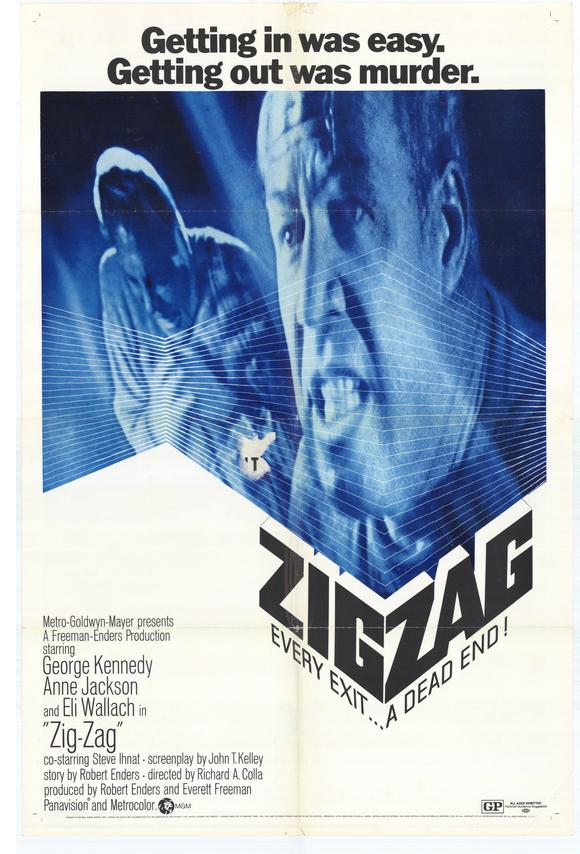
Zig Zag (1970)

By Richard Winters

My Rating: 5 out of 10

4-Word Review: Framing yourself isn’t good.

            Paul Cameron (George Kennedy) is an insurance agent and family man who learns that he is dying from a brain tumor and has only a few months to live. In order to provide money for his wife and children he sets himself up as the kidnapper of a wealthy businessman in an unsolved case that offered a $225,000 reward for anyone leading to the conviction of the culprit. After he is found guilty at his trial he faints and the doctors there decide to do experimental laser surgery to remove the tumor. The operation proves to be a success forcing Paul to go on a battle to prove his innocence, or risk spending the rest of his life in jail for a crime he did not commit.

Although he has done well in supporting roles Kennedy proves to be quite weak as a leading man as he shows almost no emotion in any of his scenes. When he is told of his tumor he takes it in a very matter-of-fact way without getting upset at all, which seemed unrealistic. His performance is dull and the few times that he does get upset it comes off as forced. His presence hurts the film and a more engaging, eccentric actor could’ve made it more interesting.

Eli Wallach as Paul’s attorney is terrific and the one thing that injects some energy. He is dynamic throughout and is fun to watch even during the slow parts. It was nice to see him doing a scene with his real-life wife Anne Jackson. As of this writing the two have now been married for 64 years, which has to be one of the longest marriages in Hollywood history.

The supporting cast features a long list of familiar character actors making it like spot-the-star. They include: Dana Elcar, Douglas Henderson, Steve Ihnat, William Marshall, Joan Tompkins, Robert Sampson, Leonard Stone, and Walter Brooke in an interesting duplicitous part.

Richard A. Colla’s direction is impressive. The film opens with a diverting cinema verite-style scene showing Paul going through the examination process before entering the prison, which seems unusually elaborate touch for what is otherwise just a gimmicky script. Another innovative part is when Paul is shown planting evidence at the scene of the crime and only the sounds and ambiance of the locale is heard without any music, which is more effective.  Unfortunately the direction and story become much more conventional towards the middle and it is not as interesting. The film tries to be too many things and does not come together as a seamless whole. The courtroom scenes were too extended for my tastes as we know Paul is innocent, but wants to be convicted anyways, so his many prolonged conversations with his exasperated lawyer who does not know of his scheme seem rather pointless. However, when Paul is cured and then goes on a mission to find the real killer it becomes exciting as the mystery itself proves to be complex and intriguing.

The twist ending did not go over well with audiences at the time of the film’s initial release. It’s a downer for sure, but after seeing so many tacky happy Hollywood endings in my lifetime I can’t say I totally hated it. As a budding screenwriter I enjoy irony and the ending here certainly has that. It’s slickly handled and although I saw it coming others may be genuinely surprised by it. My only complaint is that it’s a bit abrupt and could’ve and should’ve been extended in some way, or given a more effective closure.

If you like a movie with a lot of twists then this film may be worth seeking out. The legendary Roy Orbison sings the title tune during a party scene and it sounds like some of his best stuff. I am surprised it didn’t chart and I wished they had allowed the viewer to hear the complete son before cutting away.

My Rating: 5 out of 10

Released: September 11, 1970

Runtime: 1Hour 45Minutes

Rated PG

Director: Richard A. Colla

Studio: MGM

Available: VHS (as False Witness), DVD (Warner Archive) 

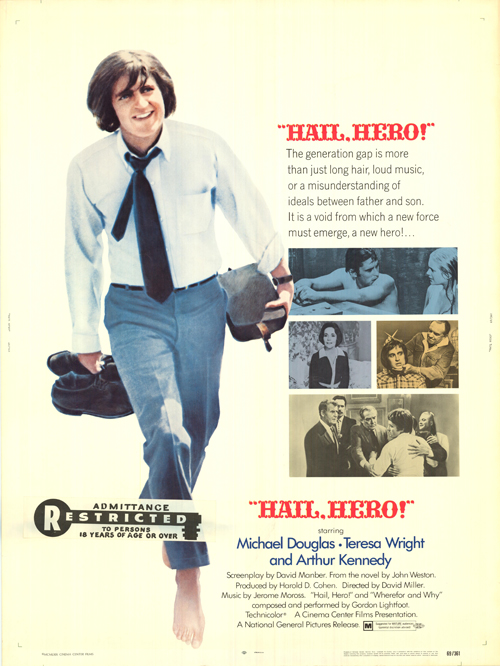
Hail, Hero! (1969)

By Richard Winters

My Rating: 5 out of 10

4-Word Review: Michael Douglas film debut.

Okay all you Michael Douglas fans out there, you know him, you love him, and you’ve seen all his movies, but what was his film debut?  I say this because I have known other fans of stars who are a bit vague when asked about early films of their favorite actors. I remember one lady who was in her 20’s, who I knew from work and professed to be a ‘huge’ Jack Nicholson fan, but when I asked her about some of his early films, which I had enjoyed including Five Easy Pieces, and King of the Marvin Gardens, she drew a complete blank. In fact she was not aware of any of the movies he did before The Shining. I had a similar experience with another lady friend I knew from a different job who professed to be a big Goldie Hawn fan and yet had no idea what film she had won the Academy Award for, which was in 1969 for Cactus Flower a movie that she hadn’t even heard of.  So I was curious how many Michael Douglas fans are actually aware of some of his early work. In fact this film, which was his first, was released when his future wife Catherine Zeta-Jones was only 11 days old.

It is the story of Carl Dixon (Douglas) who is an idealistic, peaceful young man that joins the army simply to please his conservative father (Arthur Kennedy). The film is a pleasant, even touching look at a someone learning to face the difficult and complex issues of adult life and realizing there are no easy answers. The movie doesn’t try to make any type of statement while carefully examining both sides of the issue. There isn’t any ‘bad guy’ here. The characters are real and multi-dimensional. The conversations and debates that they have are ones that went on in many households across the country at that time.

Douglas looks expectedly younger and initially I didn’t even recognize him. His hair is long, at least initially until his father cuts it, and his eyebrows are bushy and his voice much higher pitched. His performance is excellent and the  character his likable and engaging especially with the way he treats everyone with respect and is so generous that he gives his entire suitcase of clothes to a poor family in need.

Kennedy is perfect as the old-school father and my only complaint here is that I wished he had been in more scenes. Theresa Wright, as Carl’s mother, is okay, but she is not given enough screen-time either. She is also caught having an affair, but the film does not delve enough into this, but should have. Louise Latham is terrific giving one of the best performances of her career as a hermit-like woman living alone in a cave alongside the skeletal remains of an Indian baby.

There are some good scenes including Carl’s visit to a senior home where he comes face-to-face with the difficulties of aging as well as when he finds himself ready to strike someone at a party whom he does not agree with and realizing that violent tendencies lurk within anyone even those purporting to be pacifists. Yet the film fails to leave any lasting impression. The ending is weak and the story does not progress enough. The viewer is left feeling almost cheated because we are never shown how these characters evolved. In my opinion the material was insufficient for a feature film.

My Rating: 5 out of 10

Released: October 4, 1969

Runtime: 1Hour 40Minutes

Rated M

Director: David Miller

Studio: National General Pictures

Available: VHS

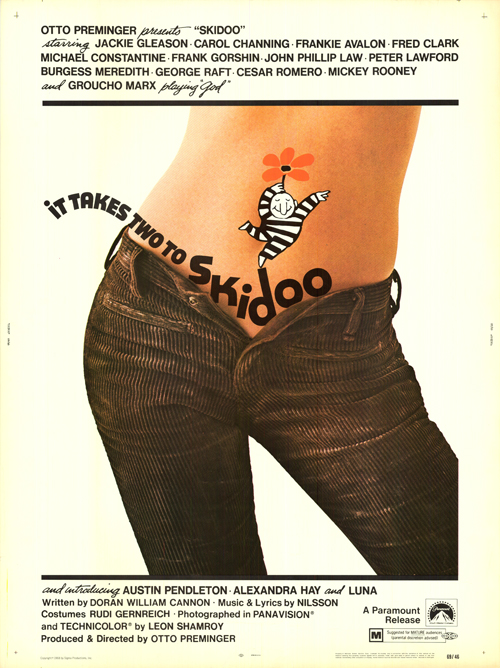
Skidoo (1968)

By Richard Winters

My Rating: 5 out of 10

4-Word Review: They were on LSD.

Jackie Gleason plays family man Tony Banks with mob past who is now trying to go straight yet gets sucked back in by a gangster leader named God (Groucho Marx). He orders Tony to disguise himself as a prisoner so he can infiltrate a prison system and knock off another prisoner and rival named George ‘Blue Chips’ Packard (Mickey Rooney). While in prison Tony mistakenly takes some LSD and goes on a wild drug induced trip.

Story wise it is limp. The humor is weird, but not altogether funny. It tries to satirize a lot of things yet none of it comes together. There is no singular voice or vision let alone cohesion. The pacing is poor and haphazard. It becomes so sloppy and nonsensical that you almost wonder if renowned director Otto Preminger was the one taking the LSD stuff.

The idea of mixing old school comedy with the mod hipness of the day was not new. Many films (and TV shows) of that period tried it with limited success. Yet few went to the extremes as this one. It is still a complete disaster yet odd enough to grab your attention and hold it. In some ways it’s enjoyable and even entertaining if viewed as an oddity and relic of its era.

There are a few good scenes. One involves a weird hippie speech by actor John Phillip Law where he professes a need to be ‘nothing’ which will somehow make him ‘everything’ and ‘anything’. There are also some quirky commercial spoofs at the beginning, a brief glimpse of Packard’s prison cell ‘office’, and the ‘the family tree’ of a crime syndicate. Gleason’s LSD trip really isn’t that funny, but it is still weird enough to stand out.

A lot of talented character actors are wasted with boring bit parts. Gleason though still comes through as his bombastic self. Unfortunately the same cannot be said for Groucho. He looks old and well past his prime. He mouths his lines with little or no energy. His conversation with actress Alexandra Hay seems particularly strange as he ‘talks to her’ but never once actually looks at her. Instead he looks off into another direction in a not so subtle attempt to read his cue cards. He does this in other scenes too. Some may still get a kick out of his presence because at the end he dresses as a hippie and even takes a puff of the weed. You also gotta love his mistress and her very low cut dress.

Austin Pendleton gives the best all- around performance playing the first in what has become a long line of nebbish, bookworm type characters. Carol Channing is a real surprise. She sings and even gives each one of the hippies a shampoo in her kitchen sink. There is also a freaky scene where she does a striptease and then lies half naked on Frankie Avalon’s bed. Her presence also gives Gleason a chance to write her a little love letter where states that how he misses her “even that voice of yours”.

Harry Nilsson’s music in Midnight Cowboy was perfect, but all wrong here. However hearing him sing EACH AND EVERYONE of the credits at the end is a goofy delight.

My Rating: 5 out of 10

Released: December 19, 1968

Runtime: 1Hour 37Minutes

Rated M

Director: Otto Preminger

Studio: Paramount

Available: DVD 

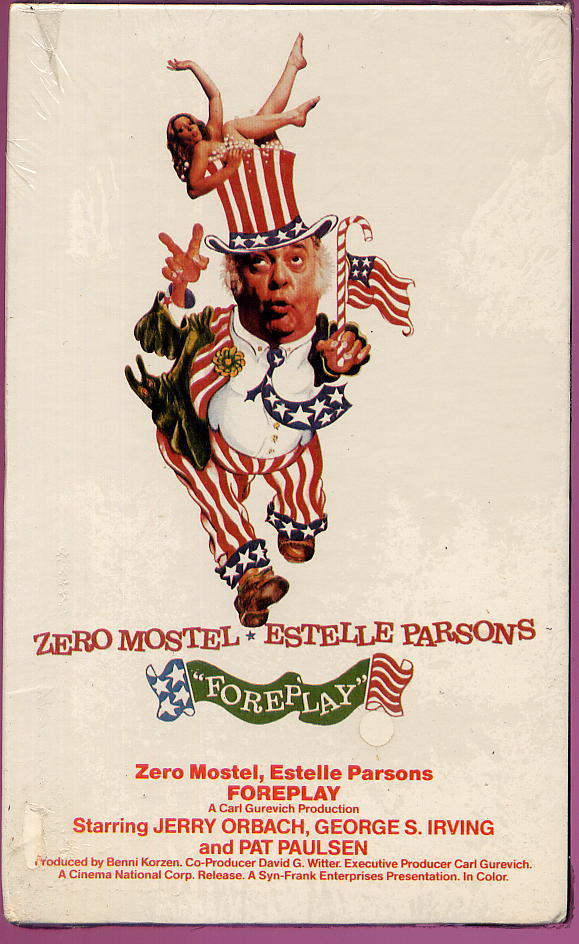
Fore Play (1975)

By Richard Winters

My Rating: 1 out of 10

4-Word Review: This sex goes limp.

This is a boring, flat, and completely disastrous attempt at sex comedy. This is the type of teaser T & A picture that gives all other T & A pictures a bad name. Out of the entire running time there is less than a minute of any actual nudity. The sex jokes are stupid and a child could watch this and not be overly shocked. It also looks like it was meshed together on the smallest of budgets.

The film is structured much like a horror anthology with three different stories all based on the same theme in this case sex. The first one features comedian Pat Paulsen as a lonely man who buys a realistic looking sex doll (Deborah Loomis). The doll is supposed to be Polish, but her accent sound more like it is Swedish. This segment is somewhat interesting because Paulsen plays against type here. He is much more emotional and hostile. He even ends up swearing at his own mother (Sudie Bond). There is also an amusing bit of seeing him trying to get the doll, with her stiff arms and legs, into a taxi cab. However the segment goes by too fast and the ending is really stupid. Paulsen also sings here and it sounds as bad as you might expect.

The second segment features Jerry Orbach as a writer going through writer’s block. Here you see the film’s one and only offensive sight, which is having to witness George S Irving in a bikini bottom. He plays Orbach’s muse and takes him back into time to reverse certain sexual conquests that he initially bombed at. One amusing bit has him in a game where he must undress a beautiful lady in sixty seconds in order to have sex with her. He does only to find that she is frigid. Like with the first segment this one also has a really stupid ending.

The third and final story sounds like a winner, but fails terribly. It consists of Zero Mostel as the President whose daughter is kidnapped. As ransom he is forced to have sex with his wife (Estelle Parsons) on national television, which ends up being incredibly dull and unsexy. The only amusing bit, and it is a very brief one, is when one of the secret service agents has to frisk the first lady before she is allowed to hug her husband. Both Parsons and Mostel play dual roles neither of which is funny.

The film is sleep inducing. Although many sources list it with a very brief running time it ran a full 90 minutes on the print I saw, which of course only means more minutes of boredom.

My Rating: 1 out of 10

Released: March 24, 1975

Runtime: 1Hour 30Minutes

Rated R

Directors: John G. Avildsen, Bruce Malmuth, Robert McCarty

Studio: Cinema National

Available: DVD (Troma)

The Odd Job (1978)

By Richard Winters

My Rating: 2 out of 10

4-Word Review: Hired to kill him.

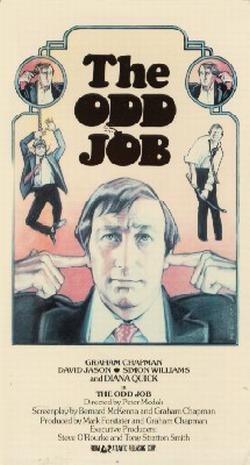
            Arthur Harris (Graham Chapman) comes home one day to celebrate his wedding anniversary only to find that his wife Fiona (Diana Quick) is leaving him. He becomes so despondent that he decides to kill himself. He has a lot of problems doing it, but then he receives a knock on his door by a man (David Jason) looking for some ‘odd jobs’. Arthur decides to hire him to be his killer, but when his wife decides to come back Arthur is thrown into a state of panic trying to avoid being killed.

Normally I love British comedies and this one seemed to have all the ingredients to being a hilarious one, but it never gels. The opening bit where the couple is arguing and Arthur insists that they are ‘happily married’ even if she doesn’t think so is full of great English wit, but everything after that falls into a lull. The jokes become long and elaborate where so much time is spent building the set-up that getting to the punch-line becomes trying. The restaurant scene is particularly drawn-out and unfunny. The ‘zany’ chase sequence in the zoo is derivative and flat.

Quick was not a good casting choice as the spouse. She is too young and beautiful a wife for such a nebbish man. A good comic character actress who was more frumpy and dowdy would have been a better fit. Quick doesn’t show any comic ability, or timing as her affected responses and facial expressions become annoying and tiring. There is also no motivation for why the character decides to come back to her husband and although this is absurd comedy there still needed to be one otherwise the writing comes off as forced and sloppy, which it is.

Chapman doesn’t completely work in his role either.  It seemed strange that he would want to kill himself when a super-hot lady neighbor is more than willing to go to bed with him and even strips off your clothes and hops into the sack before he goes running off in fright. There is also the issue that killing oneself because your wife as left you seems extreme. Most men would probably celebrate if this happened to them and it is hard to relate to a protagonist that seems so pathetic. A stronger motivation, like having him killed in a staged murder, so his family could collect on some life insurance money would have been more effective. There is another part where the police become aware that someone is trying to kill him and for some reason Arthur does not tell them of the bizarre scenario when they ask him about it even though to me it made more sense to let them try to apprehend the man instead of continuing to live in fear of being killed.

The music, which is soft and melodic, was a terrible choice as it does not fit the quirky theme, nor complement the fast-paced comic scenarios. The tacked on ‘surprise ending’ is horrible and pretty much cements the film as a misfire. During his Monty Python days Chapman was famous for walking onto the screen and telling the audience that the sketch they were doing had become too absurd and would now end and I wish he had done that here.

My Rating: 2 out of 10

Released: September 3, 1978

Runtime: 1Hour 27Minutes

Rated PG (Brief Nudity)

Director: Peter Medak

Studio: Columbia-EMI-Warner

Available: VHS

The Sweet Ride (1968)

By Richard Winters

My Rating: 4 out of 10

4-Word Review: Bachelor pad on beach.

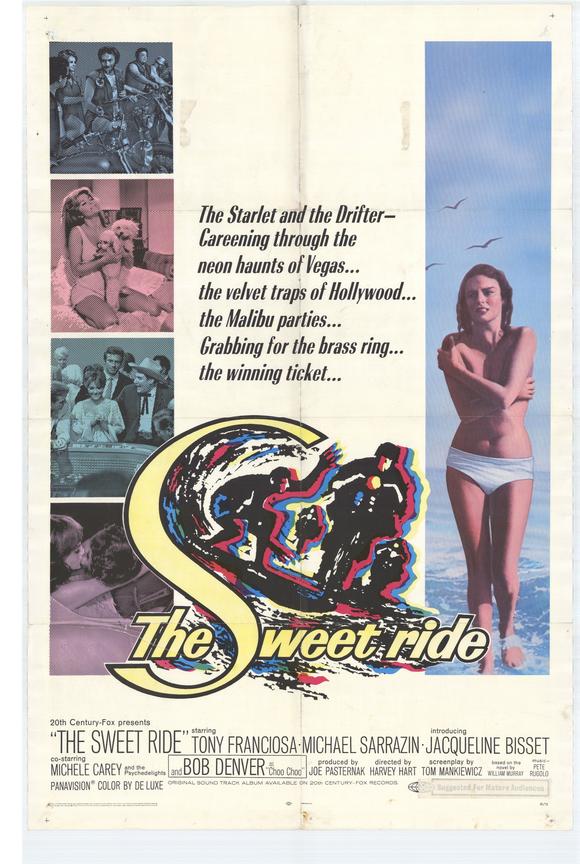
This is an obscure and ponderous film dealing with three bachelors(Anthony Franciosa, Michael Sarrazin, Bob Denver) who live in beach house and one day come upon a beautiful woman named Vickie Cartwright (Jacqueline Bisset) swimming in the ocean. They all make a play for her yet it is Denny (Sarrazin) who she falls for. Eventually though her erratic behavior and secret past become too much for him.

The theme is similar to that of Petulia, which came out around the same time. That film proved more successful because of its intricate, stylish narrative and deeper intellectual understanding. Technically this is well directed, but the color is washed out and there seems to be an ugly brownish tone permeating every shot. Some of the sets look cheesy especially the ones used for the indoor bar scenes. The story is too pedestrian and stretched too thin. It starts with some nice interplay between the three men, but that quickly evaporates and by the second hour it has become really boring. There’s some action at the end, but it’s standard and pointless. The resolution itself is too convenient and the relationship between Denny and Vickie is unexciting.

The story does offer some potentially intriguing undertones, but the film never pursues them. The girl herself is an interesting element. We come to realize through the course of the story that she lives a very, very sad existence. The film could have been meatier had it a given us a wider scope of her life and not just the little tidbits that it does. It also could have shown us more of a background to her character and examined how she came to being the way that she was.

The film’s chief asset is the bachelor pad itself, which is a dream for the single male. It’s well designed and sits right on Malibu beach with a terrific view of the ocean. There is beer and liquor everywhere as well as beautiful women coming in and out. The constant sound of the crashing waves in the background give off a soothing effect and the setting allows this film more points than it might otherwise deserve.

Some credit must also go to Franciosa an actor that never really attained much stature. His role here may actually be his finest moment. He plays the eldest of the three men and is as tan, muscular, and good looking as any forty year old can get. He’s as flippant a character as you’ll ever see and adds zest to each scene that he is in. Some of his sardonic comments about his bachelorhood add insight as to why some people are single and want to stay that way.

Dusty Springfield belts out the opening song and really gives it her all.

My Rating: 4 out of 10

Released: June 12, 1968

Runtime: 1Hour 50Minutes

Rated NR (Not Rated)

Director: Harvey Hart

Studio: 20th Century Fox

Availability: None

Macaroni (1985)

By Richard Winters

My Rating: 3 out of 10

4-Word Review: He writes love letters.

            Due to a business trip Robert Traven (Jack Lemmon) finds himself returning to Italy after four decades. He hadn’t set foot on their soil since World War II. He is old, tired, and grouchy and looking like an extension of the character Lemmon played in Avanti! , which was also took place in Italy.  When he arrives he meets Antonio (Marcello Mastroianni) who tells him he is the brother of Maria, a woman Robert had a relationship with during the war.  Robert decides to go and meet her despite the fact that she is now married. When he gets there he finds that everyone acts as if they already know him. Robert then finds out that Antonio has been writing ‘love letters’ to Maria all this time, but pretending to be Robert. The letters are filled with wild stories and conquests making Robert a cult-hero to the local people.

This movie is high on the charm, but not much else. Mastroianni is engaging and endearing. I wasn’t too crazy about his mustache and I don’t think it was needed, but he otherwise sparkles in every scene he is in and gives the film much needed energy. Lemmon is fun too, but he seems old and tired here. The camera stays locked on his worn, emotionless face during his entire cab ride from the airport to his hotel, which was too much and the main problem with the film in that director Ettore Scola’s scenes are too long. However, together with Mastroianni these two legendary actors make for an interesting duo. The way their friendship blossoms and slowly progresses is natural and pleasing. The best shot of the whole film is watching the two walking along a shore of rocks from a bird’s-eye-view.  Lemmon also plays a bouncy piano piece and I wished they had let him play more of it.

The film gives one a nice sense of Italian city life.  The on-location shooting makes if feel and look authentic. There is a lot of focus on Italian food and desserts that will make one hungry by the time it is over. The soft, melodic music is relaxing and peaceful and perfectly reflects the easy-going nature of the script, but ends up getting a bit over-played.

The film’s main issue is that there is just not enough story here. It is almost a one-joke script dealing with Antonio’s fabricated letters, which is funny for a while  especially when Robert argues with him about some of the lies in the letters and how he would have preferred that they’d be exaggerated differently, but nothing else.  The film takes too long to get there and they tack on a very formuliac and contrived ending dealing with Antonio trying to avoid the mob who is after him for some unpaid debts and Robert’s attempts to save him.  There is also the fact that Maria, who Robert supposedly was in-love with at one time, never speaks a word of dialogue. In fact the two never share much of any type of conversation, which seemed odd. The other family members and friends appear too naïve for believing all of the wild scenarios that Antonio wrote in the letters that would make anyone else skeptical.  By portraying them as being so gullible makes them stereotypes and is unrealistic.

I’m surprised that these two actors of such high stature agreed to take on this limp material, or didn’t demand for more changes when they did. Even if you are fans of these leading men it still isn’t worth seeking out even for a slow night.

My Rating: 3 out of 10

Released: October 24, 1985

Runtime: 1Hour 44Minutes

Rated PG

Director: Ettore Scola

Studio: Paramount

Available: VHS