Category Archives: Obscure Movies

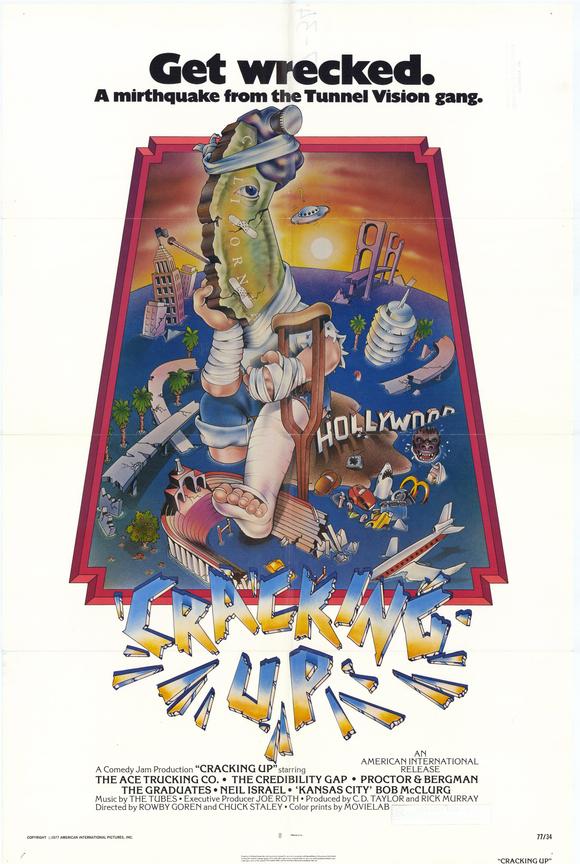
Cracking Up (1977)

cracking up

By Richard Winters

My Rating: 2 out of 10

4-Word Review: It’s the big one.

It’s finally happened the earthquake that destroys California and leaves the entire state in total chaos. News reporters cover the destruction in a parody style and features young comic performers like Michael McKean, David L. Lander, Fred Willard, Harry Shearer and Edie McClurg at the start of their careers and doing their own material.

This film works a bit like Roger Corman’s Gas-Or-It Became Necessary to Destroy the World in Order to Save it in that it has an animated opening and tries to somehow correlate mass destruction while only filming a small set piece inside a studio back-lot. Corman’s film at least had some edgy humor and a cinematic style, but this has neither. It is almost like a low budget comedy variety show with skits that have nothing to do with the main theme. The film has no pace or momentum and slogs along until it becomes utterly boring.

It takes till the final half-hour before any of the otherwise lame humor becomes even passably funny. Of the stuff that I found moderately amusing was the comedian at a roadside diner who beats up an audience member when he doesn’t laugh enough at his stupid jokes there is also a mailman who delivers a dead corpse to a couple who try to come up with different ways to make it useful. The segment where Fred Willard tries to sell a customer a mattress even though the customer thinks he is talking about his penis is okay and the commercial showing a trucker advertising the use of adult diapers and even getting out of his cab wearing one deserves some credit.

However, the majority of the stuff is so mind numbing unfunny that is becomes almost hard to believe. I started to think that the premise of the film was to make it a joke on the audience like with Andy Kaufman reading a long boring novel or the 60’s film from the Netherlands where a man gets in front of the camera and hurls insults and profanities for ninety minutes simply to see how much an audience can take before they would leave. If that was the case then this film almost succeeds and the best advice would be to skip it and not be the intended victim.

My Rating: 2 out of 10

Released: July 4, 1977

Runtime: 1Hour 15Minutes

Rated R

Director: Chuck Staley

Studio: American International Pictures

Available: Netflix streaming, Amazon Instant Video
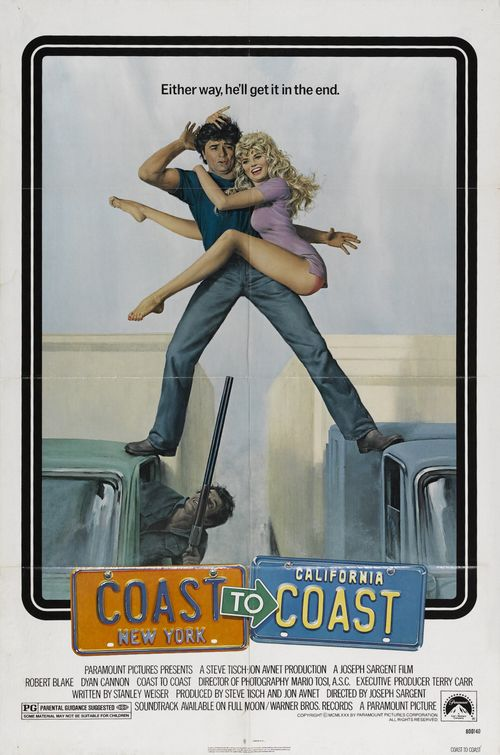
Coast to Coast (1980)

coast to coast

By Richard Winters

My Rating: 4 out of 10

4-Word Review: Kooky couple goes truckin’

Maddie (Dyan Cannon) escapes from a mental hospital after she finds out that her husband (Quinn K. Redeker) had her committed there simply so he could avoid an expensive divorce. On the run she hitches a ride with truck driver Charles Callahan (Robert Blake) who reluctantly takes her in despite having troubles of his own including running from a man named Jules (William Lucking) who is after him for late payments on his truck. Together the two ride all the way from New York to California dealing with calamity and even some romance along the way.

Cannon has not had a lot of success in films where she has been the star, but she scores here and pretty much saves it and deserved top billing over Blake. Her energetic upbeat personality that has just a tinge of the fun-loving despite the circumstances helps keep things moving and entertaining. I loved the fact that she had herself trained on how to drive a big rig, so she could go through exactly what her character did when she first gets behind the wheel. The part where she climbs into some stalls housing a bunch of cows including a wild steer deserves mention for her tenacity, which is something some other plastic Hollywood stars wouldn’t even consider.

Blake on the other hand doesn’t fare as well and his attempts at trying to leave Maddie behind and stranding her in the middle of nowhere does not make his character very likable. He is also a poor choice for a romantic lead and the scenes in the snow where they finally do kiss seem forced and unnatural.

The casting of 60-year-old Maxine Stuart as a tough talking bounty hunter out to nab Maddie is interesting simply for its novelty. Lucking literally puts his body on the line getting chased by a steer that comes very close to nailing him. Michael Lerner is entertaining as the psychiatrist who gets knocked out by a bust of Sigmund Freud and then put into a strait-jacket and left on the side of the road.

The film though is disjointed and the first hour runs flat and fails to gain any momentum. The broad humor is not very funny and the couple’s constant bickering is more tiring than engaging. There is also the problem that the story is all about this great big cross-country trip that they take and yet it was entirely filmed within the state of California. Obviously this was for budgetary reasons, but when the film’s theme centers on a big trip then they should’ve taken the extra step and done everything on-location where the scenery could have helped during the slow parts of which the film has many.

The second hour manages to be a bit of an improvement. The part where Maddie takes her big truck and drives it through her husband’s posh garden party is amusing especially when she proceeds to crash the rig right through the wall of their big house and then careen’s the thing straight through their living room, which is done in slow-motion. This scene as well as the shocked reactions of the snotty party guests is enough to save what is otherwise a misfire.

My Rating: 4 out of 10

Released: October 3, 1980

Runtime: 1Hour 35Minutes

Rated PG

Director: Joseph Sargent

Studio: Paramount

Available: VHS

Ash Wednesday (1973)

ash wednesday 1

By Richard Winters

My Rating: 2 out of 10

4-Word Review: Liz gets a facelift.

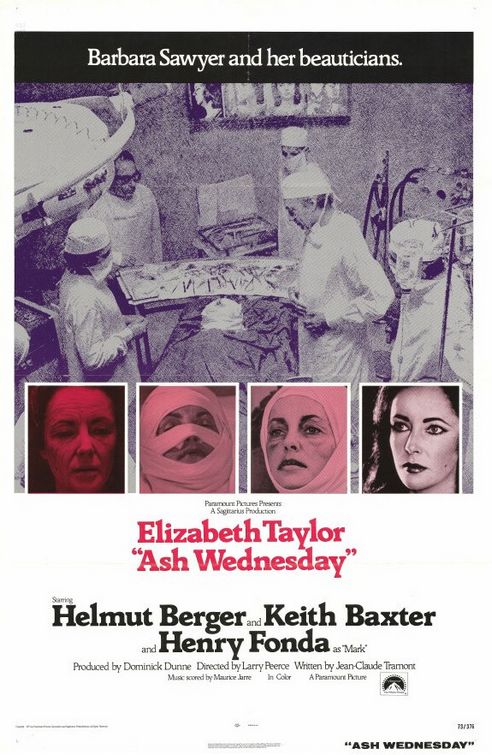
Barbara (Elizabeth Taylor) is not aging gracefully. Her husband Mark (Henry Fonda) is having an affair with a much younger woman, but Barbara is determined to win him back. She decides to get a facelift and then spends her time afterwards at a winter resort in Italy where a young man name Erich (Helmut Berger) becomes intoxicated by her sudden youthful beauty and the two go to bed together. When her husband arrives she still strives to save the marriage, but finds that to him the facelift makes no difference.

The film’s biggest claim-to-fame is the graphic and vivid look at an actual facelift surgery that sickened many viewers who watched the film when it was first released. The footage is explicit, but fascinating as well as I never quite understood how this procedure worked, so seeing it from a medical viewpoint is to a certain extent educational. I also liked that during Barbara’s stay at the hospital she meets a middle-aged man named David (Keith Baxter) who has had several of the some procedures himself and showing that this wasn’t exclusively a woman’s issue although I was confused why a man would spend so much money having facelifts, but then not bother to dye his hair.

The effects of the procedure is a bit misleading because Liz was only 40 at the time and was put into heavy makeup to make her appear much older at the beginning, so the results of the surgery are really just her as she normally looked. The idea that a facelift would have such a galvanizing effect on everyone around her is also not realistic. A recent study found that many people who had the procedure ultimately only looked 3 to 5 years younger instead of the 10-plus that they had hoped for. Sometimes a facelift can make a person look even worse, or in my opinion a sort of ‘duckface’ that this movie doesn’t even hit on, but should’ve.

I also thought that the idea that this woman would want to stay with a man who is openly cheating on her was unrealistic. If this woman was poor, lonely and homely and he was her only source of a social outlet then maybe, but this guy was loaded and I would think most women would simply hire a good divorce lawyer and take the cheating cad to the cleaners and then merrily move on especially when she had already proven to herself that she could attract other more attractive men on her own anyways.

The role itself seems to be an extension of Taylor’s own personality in that of a woman living in an insular world obsessed with shallow problems because she has too much time and money on her hands and unable to either understand or portray an average person in a regular lifestyle even if she wanted to. The wide variety of big puffy hats and scarfs that she wears becomes a bit of a distraction and almost like a character into itself.

Fonda is wasted in another one his typical latter career roles that gives him very little to do. He doesn’t even appear onscreen until the final fifteen minutes and only then long enough to tell her he wants a divorce before promptly leaving.

The opening sequence showing the two stars aging through the years during the credits is interesting and well-done especially seeing Fonda when he was young. The musical score by Maurice Jarre has a nice classic flair to it and lifts this dreary production to a more classy level than it deserves, but unfortunately doesn’t get played much after the beginning.

The film probably would’ve worked better had the surgical procedure not happened right away, but instead been done in the middle and had more of a backstory at the beginning. The facelift scenes are actually the film’s highpoint and it goes rapidly downhill afterwards until it becomes a mind numbing train wreck that isn’t worth watching for any reason.

My Rating: 2 out of 10

Released: November 1, 1973

Runtime: 1Hour 39Minutes

Rated R

Director: Larry Peerce

Studio: Paramount

Available: VHS

12 + 1 (1969)

twelve plus one 2

By Richard Winters

My Rating: 2 out of 10

4-Word Review: Money in the chair.

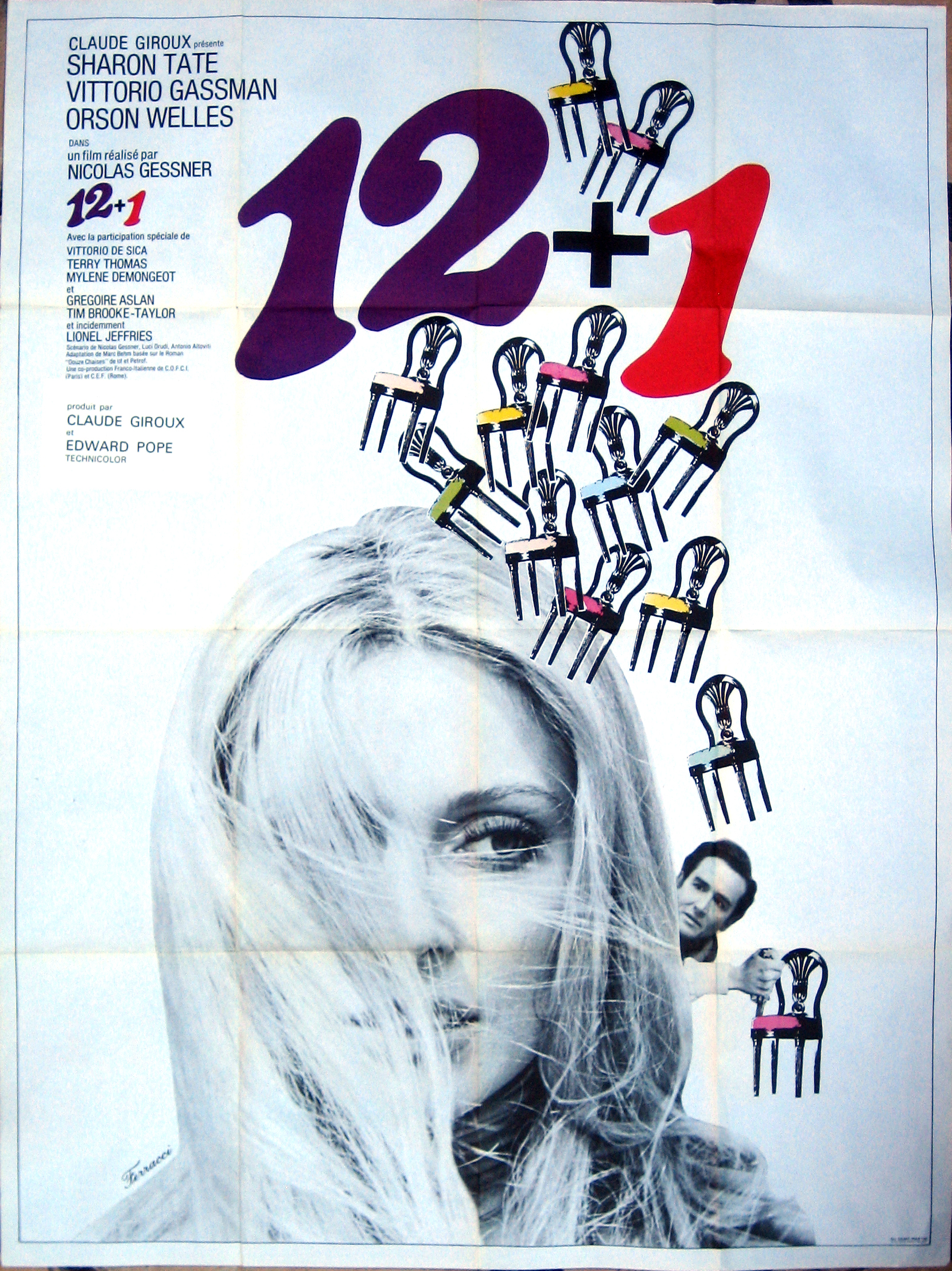
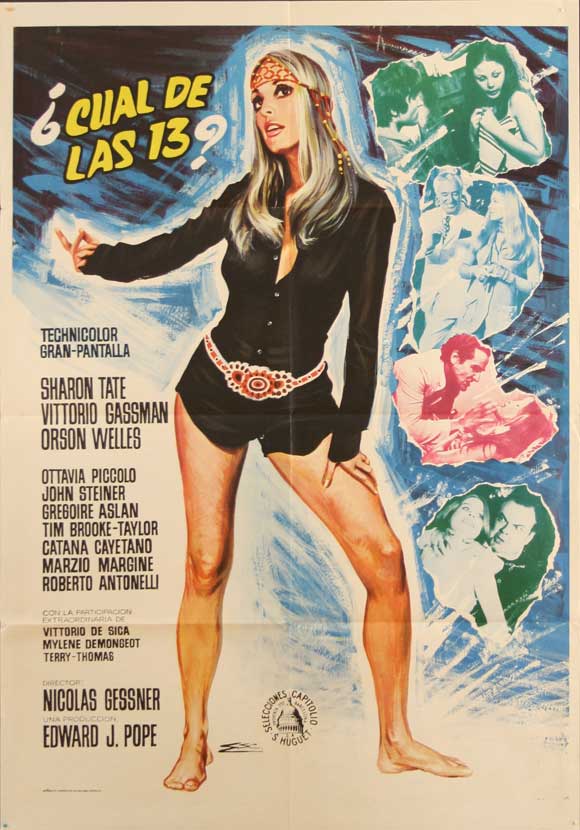
Mario (Vittorio Gassman) is a struggling barber who gets word that his rich aunt has left him a large inheritance. When he gets to her estate he finds the place nearly empty except for some old chairs piled up into a corner. Angered he decides to sell the chairs to a local antique dealer so he can at least make some money off of them. After he sells them he finds a note from his deceased aunt stating that there was a large amount of money sewn up inside one of them. In a panic he goes running back to the shop, but finds that they have already been sold off to various customers, so he along with Pat (Sharon Tate) who worked at the shop and wants to help him as long as she gets a part of the take go on a mad dash to seek out the chairs and retrieve them one-by-one until they can find the money.

The film is based on the classic 1928 Russian novel that has been made into several film versions including one by Mel Brooks that came out a couple of years after this one. I’ve never read the novel, but this film clearly does not do it any justice. The humor is lame and cartoonish and barely able to equal a weak Tom and Jerry cartoon or uninspired Disney flick. The budget is low and the scenes all have a perpetually cheesy, schlocky feel. The Herb Alpert-like music sounds like it was edited in off of an audio cassette recording. The whole thing is quite derivative and dull despite the wide variety of characters and locales.

The film’s biggest claim to fame is being Tate’s only starring vehicle and this didn’t get released until well after her death. She is very beautiful and surprisingly engaging and comical and her presence is the best thing about the movie. She even does a nude scene along with the equally tantalizing Ottavia Piccolo when they both go topless and then get into bed on either side of Gassman, which is the film’s one and only provocative moment.

The supporting cast is full of some old pros that get badly wasted. Terry-Thomas is one of the funniest character actors of all-time, but here he is shockingly boring and forgettable. Orson Welles hams it up in make-up as a pretentious stage actor whose play he is performing in becomes a catastrophe in the film’s only slightly amusing moment.

The color is faded and shot with no imagination or flair. Although there is some nudity the filmmaker’s would have been better served had they cut it out and aimed it solely for the kids as the humor is so broad and silly that only a three-year-old could possibly find it entertaining and even that is no guarantee.

twelve plus one 1

My Rating: 2 out of 10

Released: October 7, 1969

Runtime: 1Hour 34Minutes

Rated R

Director: Nicholas Gessmer

Studio: AVCO Embassy Pictures

Available: VHS

Sheila Levine is Dead and Living in New York (1975)

sheila levine is dead and living in new york city

By Richard Winters

My Rating: 3 out of 10

4-Word Review: Heartbreak in the city.

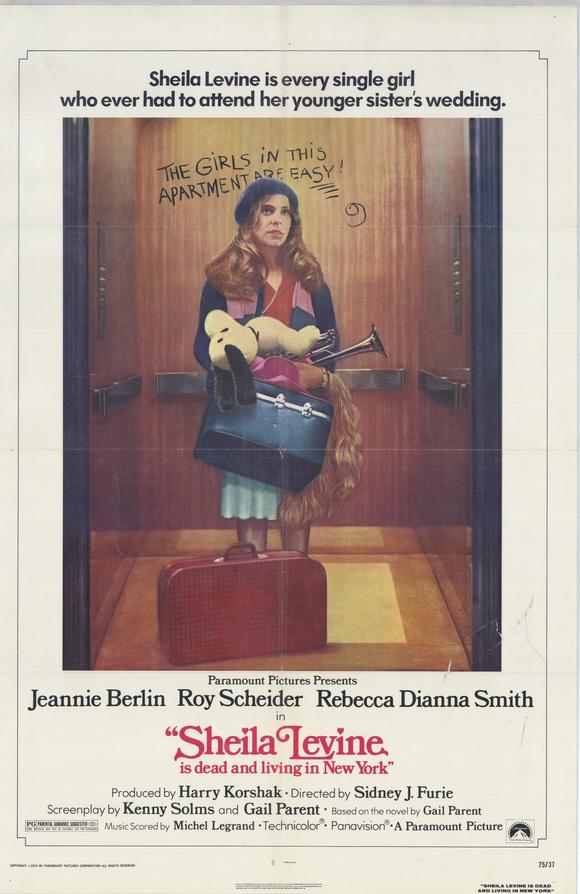
Sheila Levine (Jeannie Berlin) is a recent college grad who moves to New York City in search of a more exciting and glamorous lifestyle, but finds a long line of heartbreak and empty opportunities instead. When her younger sister gets married before she does she becomes jealous, but refuses to give up and continues to strive to make her mark no matter how small it might be.

Based on the Gail Parent novel the film manages to hit a few marks. Her nagging mother and the exchange that she has with a job placement coordinator at an employment agency is good. However, the idea that a woman’s sole purpose in life is to get married and then not have to work afterwards is seriously dated and will not connect with today’s viewers.

The main character isn’t exactly likable either. She is bossy and intrusive with her roommate and seems to think that because she is a college grad that should entitle her to only ‘creative’ and interesting jobs that doesn’t involve typing. She is also strangely naïve as she gets picked up by a middle-aged man (Roy Scheider) at a bar, goes back to his place for sex and then somehow thinks that means he is in love with her and is genuinely shocked when he bluntly tells her that he was simply appeasing his ‘animalistic instincts’. We are supposed to feel sorry for her, but instead it’s more fun seeing her get slapped down.

Berlin is the daughter of Elaine May who was the queen of sardonic humor and I came into this thing with high hopes, but her performance is only so-so. She does indeed look very Jewish and the perfect composite of the Rhoda Morgenstern TV character and a young Joan Rivers. However, her incessant whiny and nasally voice may be too much for some.

Scheider manages to be pretty solid. I was never impressed with his acting range, but here he gives quite possibly his best performance in what is most likely his least known role.Sidney J. Furie’s lifeless direction though makes the production come off like a filmed stage play with scenes that seem to go on forever.

Michel Legrand’s melodic orchestral score is out-of-place and better suited for a romance. There is also a song with a funky 70’s sound that gets played at regular intervals and becomes increasingly annoying.

I was expecting this to be a quirky, dry humored comedy, but found it to be more of a stilted drama that relied too much on the obvious and at times became almost painful to watch. The romantic angle between Scheider and Berlin is unbelievable and ultimately quite corny, which impedes the film from achieving any type of true potential.

My Rating: 3 out of 10

Released: May 16, 1975

Runtime: 1Hour 52Minutes

Rated PG

Director: Sidney J. Furie

Studio: Paramount

Available: YouTube

The Art of Love (1965)

art of love

By Richard Winters

My Rating: 3 out of 10

4-Word Review: Artist fakes his death.

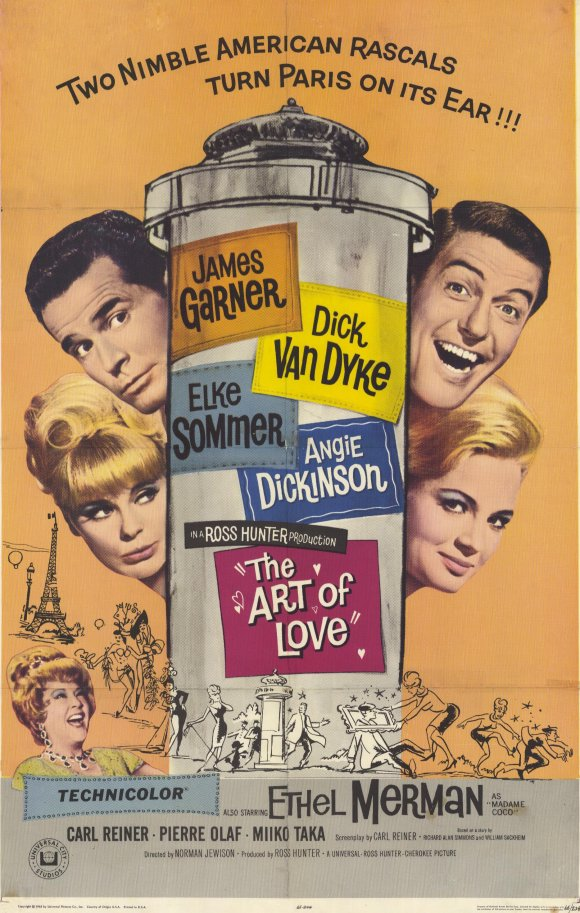
Paul (Dick Van Dyke) is a struggling painter living in Paris who has not been able to make any money with his paintings and feels ready to give up and move back to the states. Casey (James Garner) is his roommate and best friend who tries to convince him to stay by coming up with a scheme where Paul fakes his death by jumping off a bridge and committing suicide, which should bolster the value of his paintings based on the concept that an artist’s work becomes more sought after once they are dead. The plan works, but it forces Paul to go into hiding and allows Casey to make a play at Paul’s fiancée Laurie (Angie Dickinson). When Paul finds out about this he confronts Casey and then things get really zany.

Carl Reiner’s script is trite to the extreme and although it moves at a brisk pace it is not very funny, or even passably amusing. The concept of an artist having to die in order to get his work to sell is an interesting idea to explore, but unfortunately like everything else in the film it is handled in a superficial way and used mainly as a springboard to all sorts of other wild scenarios that become increasingly sillier as it goes along.  Norman Jewison’s direction is dull and unimaginative and despite the fact that it has a European setting it was actually filmed on a Universal studios back-lot, which doesn’t help give it any atmosphere or distinction.

Van Dyke’s character is unrealistically ‘goody-goody’ and clean-cut.  He comes into contact with Nikki (Elke Sommer) a beautiful blonde woman who shows a strong interest in Paul, but he immediately and rigidly rebuffs her like he has no sex drive at all. The comic schtick that he does here is the same stuff we’ve seen him do hundreds of times before and he basically becomes Rob Petrie again simply transplanted into a European setting.

Although he has less comic opportunity Garner is clearly the better actor and has much more of a screen presence. It is easy to see why he continued to get choice movie roles for decades to come while Van Dyke became permanently demoted back to television.

Sommer is wasted in a transparent role. Dickinson, who three years later co-starred with Van Dyke in Some Kind of a Nut is equally forgettable and her constant propensity at fainting becomes increasingly more unfunny the more it occurs.

Ethel Merman makes the most of her role despite its limitations, but every time she speaks she seems to be shouting. Reiner is probably the most amusing out of all the characters in a brief bit as Garner’s shyster lawyer.

I wish I could tell you that there was at least one truly funny moment here, but there really isn’t. The humor is flat and dated and no better than a poor TV-sitcom and in many ways even worse.

My Rating: 3 out of 10

Released: June 30, 1965

Runtime: 1Hour 39Minutes

Not Rated

Director: Norman Jewison

Studio: Universal

Available: None at this time.

Money Talks (1972)

money talks

By Richard Winters

My Rating: 6 out of 10

4-Word Review: It’s all about money.

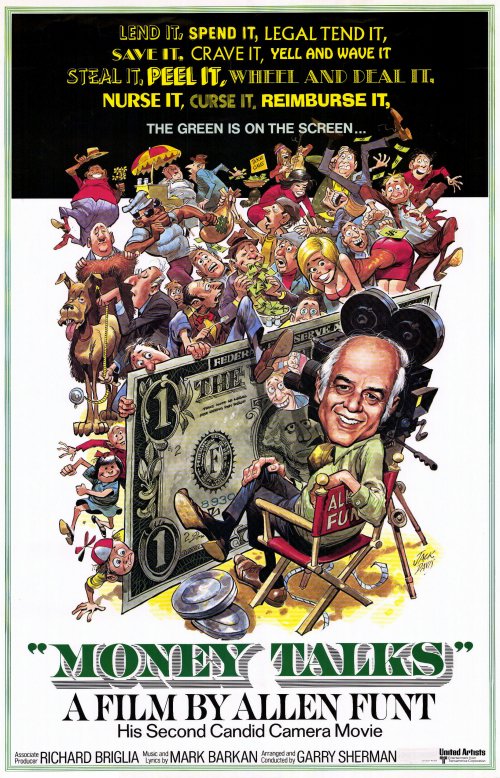
Allen Funt the creator of ‘Candid Camera’ returns with his second cinematic feature all centered around pranks and stunts done on unsuspecting regular people to see just how far they will go when presented with the allure of money. The film examines the deep seated psychological effect that money has in society and how it controls what people do and in some cases what they don’t do.

This feature is an improvement over Funt’s first. Fortunately he keeps the majority of it on a comic level and avoids trying to make unnecessary ‘profound’ social statements. The film is also faster paced and although the music is still annoying it isn’t as bad and has a bit more of a funky beat. Some of the stunts aren’t necessarily all that funny and few become rather redundant and predictable. However, the majority of them I liked and even found fascinating including the one where a woman walks down the street and intentionally allows dollar bills to fall out of a hole in her pocket and drop to the ground behind her and how surprisingly many people would pick them up and chase after her to give them back. The funniest one is where a mild mannered middle-aged woman gets a job answering phone calls for a man who she finds out is a professional hit man. Hearing her diligently taking down an order and answering questions over the price of a hit while trying to mask her shock and remain calm had me laughing-out-loud.

A few of them are definite artifacts of a bygone era including the many relentless attempts a woman goes through to try to retrieve a simple five dollar bill that is lodged beneath a car tire. Another segment has a bare foot hippie girl begging for money on a street sidewalk and her startlingly naïve willingness to go back to a strange man’s apartment who approaches her and says he has shoes for her, which she almost does until Funt and crew advise her not to.

A few of the pranks have celebrities in disguise. My favorite was the one with actress Marian Mercer pretending to be a waitress and asking beforehand how much of a tip the customer planned to give her, so she could plan out what type of service she would give him. The segment where comedian Henny Youngman has no money to pay a hot dog vendor, so instead he tells the irritated man a bunch of lame jokes as ‘payment’ is quite funny and I wished it had been extended longer. Muhammad Ali’s bit isn’t quite as good, but his personality is as engaging as ever.

The film also has some good interviews including an opening bit where a commercial jingle writer comes up with on-the-spot a ditty for the film’s theme, which is not bad. Dominic the knife sharpener becomes almost a show in itself with the flamboyant way that he tries to bargain with Funt over not only how much he should be paid to sharpen his knives, but also for his fee to appear in the film. The interviews with hippies who don’t have jobs and don’t want them could have been more interesting had we seen what happened to them twenty years later and if they were still adamantly in the non-work camp, which I doubt. Funt also interviews his own 6-year-old daughter who is surprisingly more perceptive than you might think.

My Rating: 6 out of 10

Released: August 30, 1972

Runtime: 1Hour 21Minutes

Rated PG

Director: Allen Funt

Studio: United Artists

Available: Amazon Instant Video, Netflix streaming

To All a Goodnight (1980)

to all a goodnight

By Richard Winters

My Rating: 2 out of 10

4-Word Review: Santa stalks sorority babes.

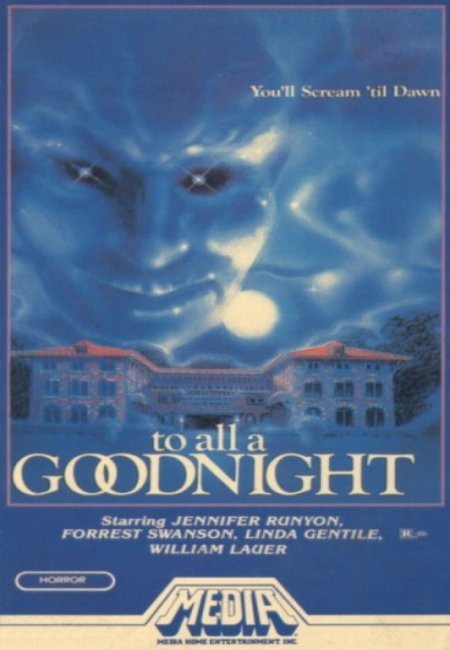
An initiation stunt at a girl’s sorority house goes horribly wrong and one young woman falls to her death off of a balcony. Two years later the girls get ready for a Christmas party by inviting some boys over and soon they are all getting down-and-dirty, but then someone dressed in a Santa Claus suit begins hacking them off one-by-one.

I’m a big fan of David Hess who directed this feature as I feel his performance as Krug in the classic horror movie Last House on the Left was effectively intense and this film is also written by Alex Rebar who starred in the cheesy cult flick The Incredible Melting Man, so I wanted to cut this movie some slack, but found that I couldn’t. Things start out bad from the very beginning with a tacky flashback sequence that is wretchedly acted and photographed and then things go straight downhill from there. Part of the problem is that the scenes featuring extraneous dialogue between a lot of bland, cardboard characters that is usually used at the beginning of most 80’s slasher flicks as a sort of set-up, but here they get strung along throughout the entire movie. The killings themselves are brief and paced so infrequently that you start to forget that this is supposed to be a horror film. The tension is nil and having a setting dealing with snarky, snotty and horny sorority babes is a tiresome cliché.

The killings themselves are poorly photographed in dark lighting, so it is difficult to follow the action. The special effects are cheap and unimpressive. One scene features a couple getting killed while they have sex, which is a poor rip-off of the same scene that was done in Mario Bava’s Bay of Blood. Some fans of the film boast about the scene featuring a death of two people by an airplane propeller, but this is really no big deal because all you see are a few seconds of blood splattering on the outside of the plane and that’s it.

The script is illogical and full of a lot of loopholes. The identity of the killer turns out to be two people using the same disguise, which doesn’t make sense for several different reasons, which is too may to elaborate here. There is also a Leia character played by Judith Bridges who gets accosted by the killer in a shower stall while being completely naked, but for some reason is not killed and instead we see her at the end dancing some nutty dance, but with no explanation as to why. The policemen hired to protect the girls after the first victim is found dead do not dress in uniform and instead look like they are ready to go out to a club to pick up chicks and behave like it, which seemed wholly unprofessional and ridiculous.

Jennifer Runyon makes her film debut here. She had a brief 13-year-run, which included a co-starring role in the 80’s series ‘Charles in Charge’, but has not appeared in anything since 1993’s Carnosaur. She is certainly easy on the eyes, but her voice is too high-pitched and sounds almost like she is 8 or 9 years old or someone who has sucked up helium. Hess also casts his mother Judy Hess in a small role as Mrs. Ronsoni although in the closing credits it gets incorrectly listed as Mr. Ronsoni.

Despite being set at Christmas the action takes place in the warm tropical climate of California, which is okay, but the expectation for a Christmas movie is to have snow and cold. Having the girls trapped in their house because of the frigid weather or being chased by the killer while trudging through deep snow could’ve helped heighten the tension and added an atmosphere.

The pounding electronic music score is the only thing that I liked and helped give this otherwise static and forgettable production a slight distinction.

My Rating: 2 out of 10

Released: January 30, 1980

Runtime: 1Hour 23Minutes (VHS Print)

Rated R

Director: David Hess

Studio: Intercontinental Releasing Corporation

Available: VHS

Charlie Bubbles (1968)

charlie bubbles 1

By Richard Winters

My Rating: 4 out of 10

4-Word Review: He’s detached from life.

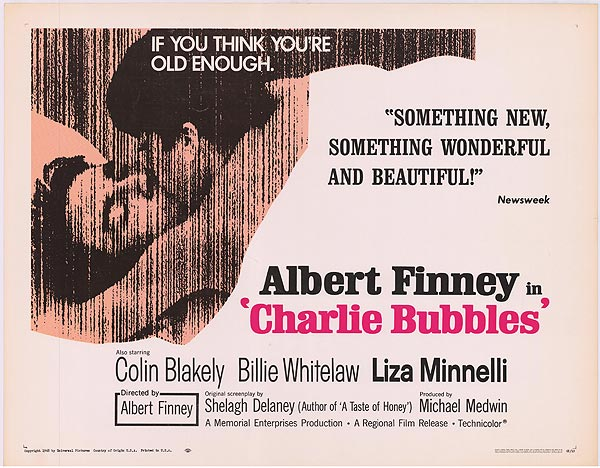
Charlie Bubbles (Albert Finney) is a successful English writer who finds that he is no longer connected to the world around him. He sits in his office and views life from the television monitors around him. He has an affair with his secretary Eliza (Liza Minnelli in her film debut), but it means little. He travels to the countryside to visit his estranged wife Lottie (Billie Whitelaw) and his son Jack (Timothy Garland), but finds the effects of his detachment have worn off on them. No matter how hard he tries he cannot get his son to emotionally connect with him, which he finds troubling.

This is to date Finney’s only cinematic foray behind the camera and on a visual level it proves interesting. Most actors who turn to directing lack the needed cinematic eye, but Finney is just the opposite. The scene, which gets protracted, showing all the action inside Charlie’s sprawling home from within the television monitors that he has set-up is really cool. It’s like in the film Network where you see several monitors on top of each other and two per row. Each monitor shows a different room in the mansion as well as the garage. As the action moves from each room it also moves to a different monitor, which becomes fascinating to follow. The scene inside a hotel hallway with milk bottles and newspapers lined up at each door has an interesting design to it and the part where Charlie and Eliza come upon a lonely marching band in a desolate rundown part of the city has a unique visceral appeal. The massive food fight between Finney and actor Colin Blakely near the beginning of the film deserves a few points as well.

The downside to the direction is that the film is slow and almost as aloof as the character. The scenes become too extended and the dialogue has little to say. The segment inside a roadside diner has the sound of cars passing by it during the character’s conversation, which becomes distracting and unnecessary.

The Charlie character seems almost like he is sleepwalking and barely responds to anything. I realize this is to show his detachment, but it goes overboard. It’s like viewing a corpse who has no screen presence or energy and absolutely no connection with the viewer nor any ability to wrap them in to his quandary.

Minnelli makes for an odd choice to represent the film’s sexual tensions. She was never considered attractive and her constant and incessant chattering while the two ride in a car would be enough to make most men want to throw her out let alone make love to her. The sex scene itself is about as mechanical as you can get and lacks eroticism. It also becomes like a throwaway scene that doesn’t end up having that much to do with the story as a whole.

The viewer needs more of a background to this character in order to make him real and interesting. Simply showing someone who is detached doesn’t mean much unless we know why and if he was at any time any way else. The ponderous ending leaves a lot to be desired and watching this movie is similar to viewing a program on C-Span as it comes-off like a nonevent.

My Rating: 4 out of 10

Released: February 11, 1968

Runtime: 1Hour 29Minutes

Not Rated

Director: Albert Finney

Studio: Universal

Available: None at this time.

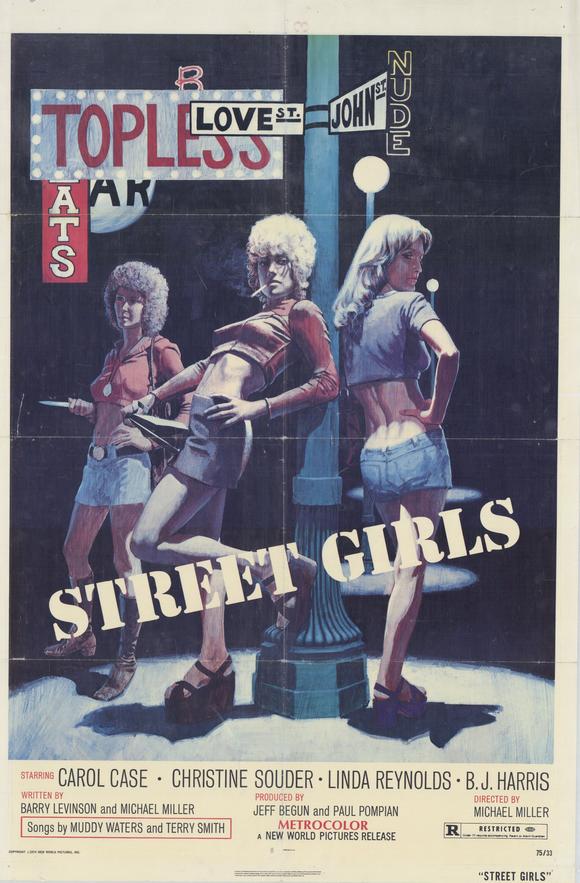
Street Girls (1975)

street girls

By Richard Winters

My Rating: 3 out of 10

4-Word Review: Father searches for daughter.

Angel (Christine Souder) is a young woman out on her own for the very first time. To make ends meet she gets a job at a topless bar, but this leads to working as a prostitute and getting hooked onto heroin by her brutal pimp boyfriend. When her father Sven (Art Burke) goes searching for her he finds himself swept in the seedy side of life and the people who populate it almost as much as her.

This otherwise low budget and forgotten film’s biggest claim to fame is that it is the first feature credited to Barry Levinson as the screenwriter who also worked as the assistant cameraman during the production. Levinson has never talked about it in any interview and it is easy to see why. The script is filled with a lot of rambling dialogue that goes nowhere. The story is basic and boring and seems preoccupied with taking advantage of the ‘shock value’ of its topic which these days has lessened.  It’s more clichéd than anything although the scene where one of Angel’s johns asks her to put on some goggles so that he can, to her shock, pee all over her does deserve mention.

This film is very similar to Paul Schrader’s Hardcore that starred George C. Scott and came out four years later and deals with a desperate father’s search for his daughter who has gotten into the world of porn. I actually like this film a bit better to that one. For one thing this one focuses more on the daughter and her experiences while that one solely centered on the father, which wasn’t as interesting. The father here isn’t quite as one-dimensional either. Yes he has all the caricatures of a middle-aged Midwestern man from the period including being homophobic, but I got a kick out of the way he initially gets into the naked girl dancers and likes it as long as of course it isn’t his daughter that’s doing it.

The acting swings from tolerable to really bad, but I did like Carol Case as Sally who has the most screen time and looks like a cross between Susan Anton and singer Carly Simon. Paul Pompain has a certain menacing quality as the brutal pimp although watching him constantly beat up his prostitutes and even kill one didn’t seem to make any sense as these girls were his may source of income and as my friend stated who watched this movie with me “He’s hurting their resale value.”

The picture is grainy with a faded washed out look and muffled sound that makes it seem almost like someone’s cheap homemade movie and yet it is well enough paced that it remains watchable. The scene where the father and daughter finally meet I found to be surprisingly touching.

My Rating: 3 out of 10

Released: January 16, 1975

Runtime: 1Hour 14Minutes

Rated R

Director: Michael Miller

Studio: New World Pictures

Available: None at this time.