Category Archives: Obscure Movies

Checkered Flag or Crash (1977)

checkered flag 2

By Richard Winters

My Rating: 2 out of 10

4-Word Review: Drivers race off-road.

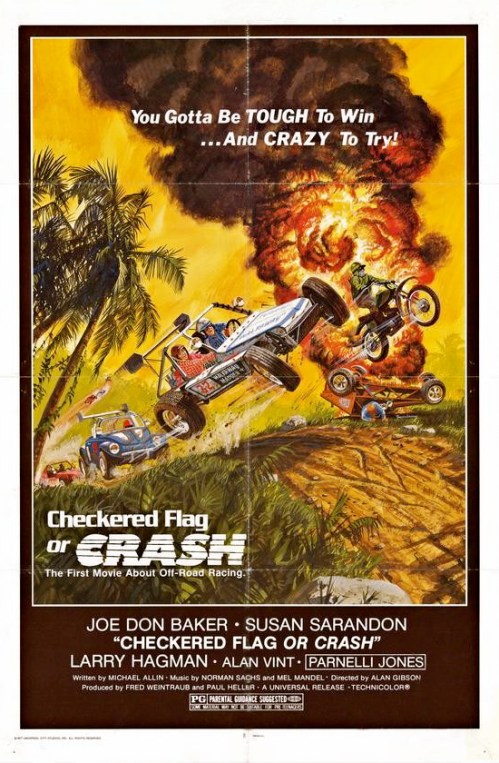
Walkaway Madden (Joe Don Baker) is a lifelong racer who has just broken up with his racing partner of many years and is now going solo, or at least he thinks he is until reporter C.C. Wainwright (Susan Sarandon) arrives and tells him that the company who sponsors his car has hired her to cover the race for their newspaper and thus she’ll be riding along with him. Walkaway isn’t too happy about this as he has very old-fashioned, sexist ideas about a ‘woman’s place’, but begrudgingly accepts it as he has no other choice. Together the two take part in a grueling off-road race that is organized by Bo Cochran (Larry Hagman) and takes them through some of the most treacherous terrain of the Philippines.

The movie might’ve been more exciting had the racing footage been better captured. Instead we get treated to choppy shots of random car wipeouts and flashing, poorly focused images of vehicles buzzing through various locales while shown in a grainy film stock. The editing is so quick that it’s hard to follow what is going on and the only time it is ever impressive is when the camera gets tied to the front of the vehicle and we see firsthand just how bumpy and fast a ride like that must be, but this shot unfortunately is only brief.

There is little or no backstory to any of the racers and therefore no emotionally compelling reason to cheer for any of them. There is also too many of them and all are generic, transparent characters, so when you see someone wipeout it’s hard to remember which one it is, or even care. I did kind of like Daina House as a woman with beautiful model-like features who dresses in all black and just as tough as any of the guys, but her character isn’t shown or played-up enough.

The best thing about the film is the presence of Sarandon who lends a necessary grounded anchor to the silliness that surrounds her. Hagman is terrific as the hyper race promoter and every scene he is in is far more entertaining than any of the racing footage. Baker isn’t bad either. He certainly isn’t any A-list actor, but a very competent B one, who seems at ease in both comedy and action parts.

The film shifts clumsily between being silly and gritty and would’ve done better had it stuck to a more consistent tone. It’s also cheap and amateurish with a terrible, country tinged title tune that gets played throughout. The only reason it gets 2 points is simply for the performances of its three leads.
checkered flag 1

My Rating: 2 out of 10

Released: June 3, 1977

Runtime: 1Hour 31Minutes

Rated PG

Director: Alan Gibson

Studio: Universal

Available: None at this time.
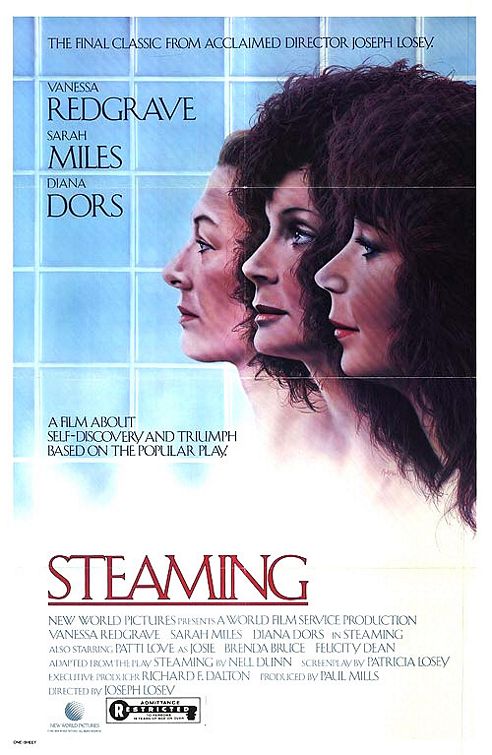
Steaming (1985)

steaming

By Richard Winters

My Rating: 2 out of 10

4-Word Review: Saving a steam room.

Three women (Vanessa Redgrave, Sarah Miles, Patti Love) congregate at a London steam room designed like a Turkish bathhouse. Despite their lifestyle differences they become good friends as they divulge their problems to one another and learn to lean on each other to help them cope with life’s difficulties. Then one day Violet (Diana Dors), who is the bath house owner, informs them that the place is set for demolition, which causes everyone to go on a mission to try and save it.

The film is based on the Nell Dunn play, which was highly regarded at the time, but makes for a very poor transfer to film. It starts out flat and never recovers. The dialogue has too much of a conversational quality that is not interesting and the problems that they discuss are not compelling, or original. The humor from the play is missing and the dry, somber tone only makes things even more boring. The only time it gains any traction is when it’s announced that the place is closing, but everything gets resolved in such a sitcom-styled way that it hardly seems worth the effort to watch.

The entire cast is made up of women and there is an abundance of nudity particularly from Miles, which doesn’t seem like a big deal these days. The biggest issue though is the fact that everything takes place from inside the bath house, which is gray, grimy, and rundown. The film should’ve had some segments shot from different locales if to only allow for some visual variety and to help the viewer understand the characters better by seeing how they react in different social settings.

Miles and Redgrave are wasted in drab roles and this goes likewise for Dors whose last film role this was. Love is the only one that shows any liveliness and although her character is a bit annoying she at least has an emotional breakdown near the middle, which adds some mild dramatic tension.

Joseph Losey was a competent director who made many interesting films, so it’s a shame that his career had to end with such a dud. He was already sick with cancer while he filmed this and like with Dors died a year before it was released. The disease may have sapped his creative energy and explain why this production is so ponderously sterile. It’s certainly a far cry from his other works as well as the Bruce Jay Friedman play Steambath, which had a similar setting, but a much more imaginative plotline.

My Rating: 2 out of 10

Released: September 28, 1985

Runtime: 1Hour 31Minutes

Rated R

Director: Joseph Losey

Studio: New World Pictures

Available: DVD (Region 2)

One Way Pendulum (1965)

one way pendulum 1

By Richard Winters

My Rating: 4 out of 10

4-Word Review: An absurd little movie.

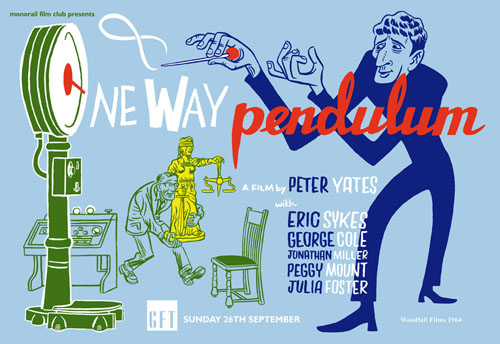
The Groomkirby family is one really absurd bunch. The father (Eric Sykes) wants to build a replica of the Old Baily courtroom in his living room and then have a trial, involving his son Kirby (Jonathan Miller) as the accused, reenacted. His daughter Sylvia (Julia Foster) wishes that she were an ape so that her arms would be longer and discusses this at length with her mother (Alison Leggatt). Kirby steals weight machines, which voices the person’s body weight, off the city streets and brings them back to the family’s attic were he then converts them into machines that sing. There’s also Aunt Mildred (Mona Washbourne) who thinks she’s waiting for a train that never comes as well as Mrs. Gantry (Peggy Mount) who’s paid to come over and eat the family’s unwanted leftovers.

The film is based on the stage play of the same name written by N.F. Simpson and was labeled as being ‘A farce in a new dimension’. John Cleese is purportedly a big fan of the movie and credits it as inspiring many of the absurd ideas that they used in their later Monty Python sketches. It was also directed by Peter Yates who went on to direct such quintessential hits as Bullitt, Breaking Away, and Year of the Comet.

The film certainly does have its share of funny and highly original moments. One of my favorite scenes is where the father carts the props that he needs to build his courtroom down a busy street of London using nothing but a wheel barrow and holding up traffic while he does it. Kirby’s ability to make the weight machines sing and sound like a genuine chorus is fun also as well as the climactic courtroom segment in which a myriad of comically absurd arguments, testimony, motions and reasoning is used until it becomes almost mind bending.

Unfortunately it all gets just a little too weird. Normally I’m a fan of the offbeat, but there still needs to be something to anchor it down and this film lacks it. The dialogue, characters and storyline are so progressively strange that it becomes downright nonsensical. The court case loses its edge as well because the father is somehow able to recreate it and the people in it in some magical way using a machine where kidnapping a magistrate and lawyers and forcing them perform in their makeshift court of law would’ve been funnier.

The movie will certainly satisfy those with inkling for the offbeat and the film seems intent to push the absurdity as far as it possibly can with a cast primed to pull it off, but it ends up being too weird for its own good and parts of it are confusing and hard to get into.

My Rating: 4 out of 10

Released: March 2, 1965

Runtime: 1Hour 20Minutes

Not Rated

Director: Peter Yates

Studio: United Artists

Available: None at this time

Who Killed Mary Whats’ername? (1971)

who killed mary 2

By Richard Winters

My Rating: 3 out of 10

4-Word Review: Who killed the prostitute?

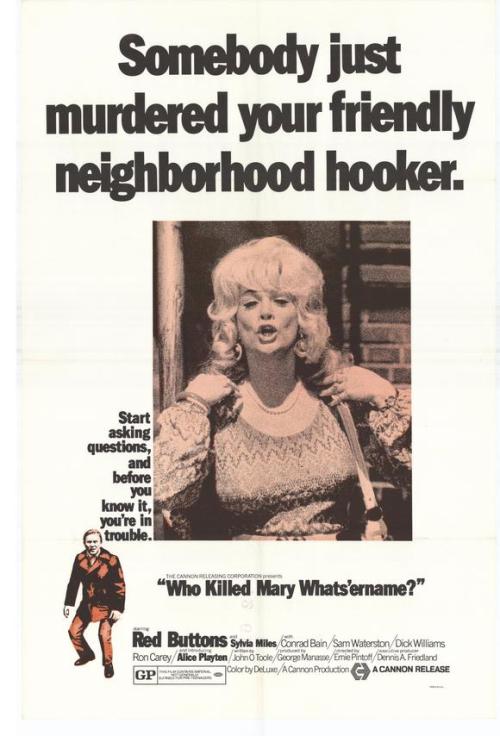
Mickey (Red Buttons) is a retired diabetic boxer who is appalled to learn that a prostitute was killed in her apartment and no one seems to care. He decides to do the investigation himself and even moves in to her old place. He inquiries about her amongst the locals and begins to get a few leads including that of a young filmmaker named Alex (Sam Waterson) who may have inadvertently filmed her leaving with her eventual killer. Soon Mickey’s grown daughter Della (Alice Playten) and Val (Conrad Bain), a man he meets at a bar, are helping him in his quest, but the things they learn only reinforce how unpleasant and dangerous a hooker’s life can be.

I commend the attempt at taking a gritty look at a seedy lifestyle and its open-minded approach to the women who are in it, but the film’s poor execution makes the whole thing come off as quite amateurish and even laughable. Why a man in his 50’s would become so obsessed with finding the killer of a woman he has never known and only reads about in a newspaper is quite hard to fathom. There are probably hundreds of prostitutes that share similarly sad fates, so why get so revved up about this one? The fact that he is able to get his grown daughter and another man he meets randomly at a bar to help him investigate seems equally unbelievable and the way they are conveniently able to find clues and connect-the-dots before solving the case comes off as too easy.

The action sequences, especially the opening one in which we see the prostitute getting killed, are poorly staged and filled with chopping editing that makes it hard-to-follow and phony looking. When the 50-year-old Buttons takes on a gang of young bikers, which are led by Earl Hindman who later became famous for playing the neighbor on ‘Home Improvement’ whose face was always obscured by a fence, it becomes downright silly. Sure the Buttons character has a background in boxing, but that still doesn’t mean he can take on four guys who are twice his size and the sound effects used for the punches are overdone and cartoon-like.

A similar issue occurs when Buttons saves a prostitute from an abusive pimp while Alex films it. The first time this occurs it is mildly diverting, but then when he saves another one, who is being beaten up by some of the old ladies in the neighborhood, it becomes redundant and corny.

The resolution, in which the killer turns out to be someone no one suspected, is flat and forgettable. It is also poorly thought out as he admits to the Buttons character that he killed the two women because he didn’t want any potential witnesses, but then doesn’t bother to kill Buttons or at least make sure he is dead even after he divulges his secret to him. The killer then just casually walks away without ever allowing the viewer to know if he was caught and charged with the crimes.

My Rating: 3 out of 10

Released: November 12, 1971

Runtime: 1Hour 30Minutes

Rated GP

Director: Ernest Pintoff

Studio: Cannon Film Distributors

Available: None at this time.
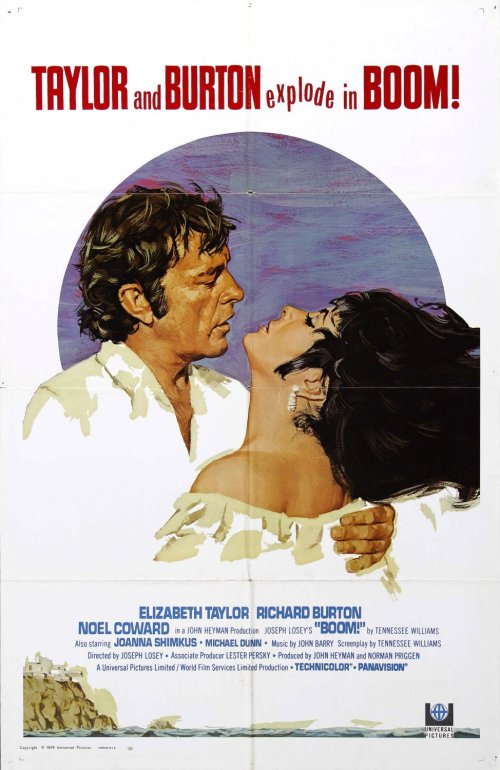
Boom! (1968)

boom

By Richard Winters

My Rating: 4 out of 10

4-Word Review: Bitchy lady rules island.

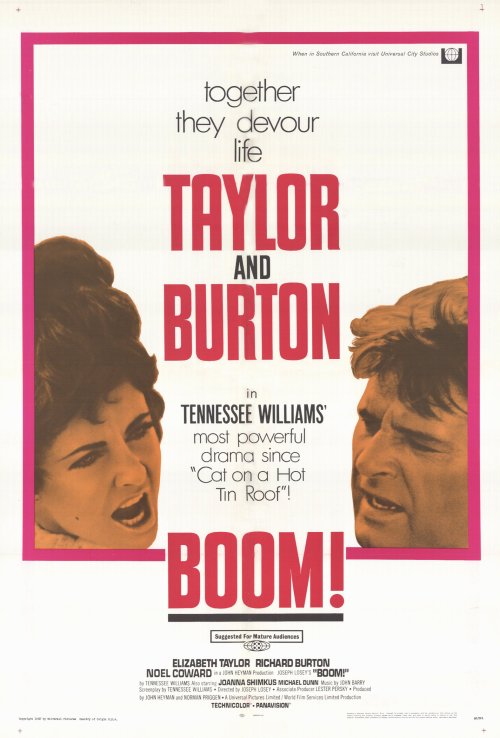
Flora ‘Sissy’ Goforth (Elizabeth Taylor) lives on a secluded island in a large mansion and surrounded by servants who cater to her every whim. She has alienated most everyone she has come into contact with and relies on her secretary Miss Black (Joanna Shimkus) to write down her autobiography that she dictates to her indiscriminately throughout the day. In comes Chris Flanders (Richard Burton) a nomadic poet living on the skids who infiltrates her palace and her oppressed sexual desires with his ruggedness and mystery. Will Sissy fall under his seductive spell, or does this mysterious stranger have even darker intentions?

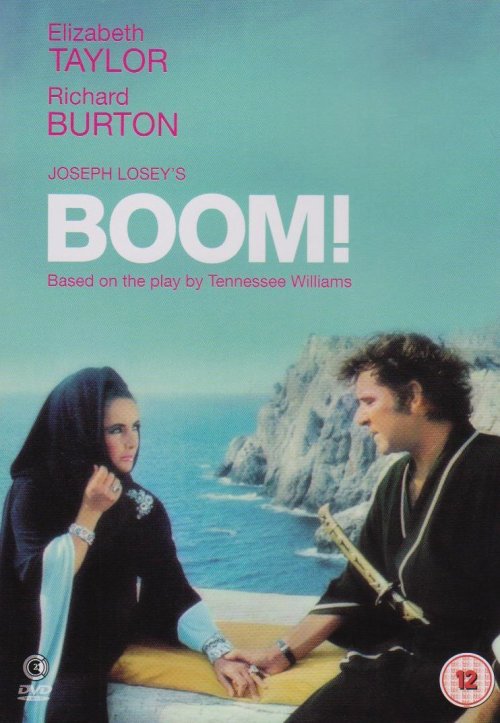
The film was directed by Joseph Losey who is one of the more inventive and groundbreaking directors who ever lived and sadly doesn’t get enough recognition. Unfortunately he was going through a bout of depression when he made this film, which caused him to abuse alcohol and seriously affected the film’s final result although it still manages to be a fascinating visual excursion nonetheless. The location shooting, which was done almost entirely on the island of Sardinia, is dazzling. The shots of the steep cliffs and crystal blue water, which are literally a part of Sissy’s backyard, are breathtaking. The modernistic mansion that she lives in is equally sumptuous particularly with its myriad collection of art paintings and wet bars that seem to pop-up every few feet in whatever room or patio the characters are in.

The acting is also outstanding as Taylor eats up the scenery with her over-the-top bitchiness and unexplained anxiety attacks, which she takes to an unprecedented campy level. The outrageous hat that she wears to her dinner date is quite possibly one of the most bizarre things ever to be put on top of a human head.

boom4

The normally commanding Burton unfortunately comes off as weak in comparison and overall looks uncomfortable in his role. The script originally called for a young man in his 20’s for the part and thus casting Burton, who was already 42 at the time, seemed misguided.

Dwarf actor Michael Dunn is excellent in support. His character utters only three words, but still makes his presence known with the way he shows complete control over his attack dogs while playing of all things Sissy’s bodyguard. Playwright Noel Coward appears in a fun bit as one of Sissy’s friends who she invites over for dinner. The friends secretly disdain each other in private, but put on a superficial friendship when together and apparently this is also how the two performers behaved with each other behind-the-scenes as well.

Unfortunately the script, which was written by Tennessee Williams and based on his play ‘The Milk Train Doesn’t Stop Here Anymore’ leaves much to be desired. The plot meanders on to an unsatisfying conclusion while rehashing old themes that had already been used in his earlier and better known works.

boom2

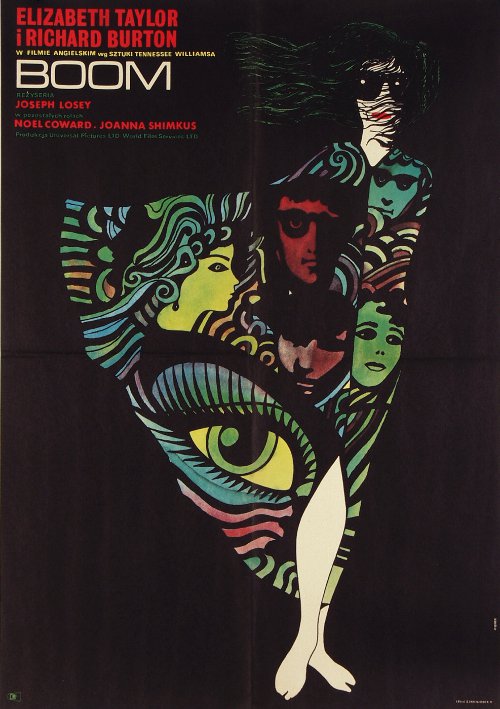
Polish Poster

My Rating: 4 out of 10

Released: May 26, 1968

Runtime: 1Hour 52Minutes

Rated PG

Director: Joseph Losey

Studio: Universal

Available: DVD (Region 2)

The Lady in the Car with Glasses and a Gun (1970)

lady in the car

By Richard Winters

My Rating: 5 out of 10

4-Word Review: Dead body in trunk.

Dany (Samantha Eggar) works as a secretary for Michael (Oliver Reed) who asks her to come to his place one evening to help him type an urgent report that needs to go out the next day. She agrees and then spends the night in his guest bedroom. The next morning she travels with his family to the airport where they board a plane for a vacation while she is instructed to drive their car back home, but along the way she takes a wrong turn and begins to come upon people who say they’ve seen her before even though she can’t remember them. Then she finds a dead body in the trunk and things get really bizarre.

The film, which is based on the novel by Sebastien Jasprisot and remade in 1992 and then again in 2015, has a certain appeal as the story is offbeat enough to keep you intrigued and manages to give a logical, or at least an attempted one, explanation at the end for why everything that occurs to Dany happened and the reason behind it. Unfortunately Anatole Litvak’s direction is bland despite a colorful opening montage and Reed, with his hair dyed gray, is miscast as a stuffy businessman.

One of the biggest issues though is the main character who behaves in ways that make little sense. Going to her boss’s place after work hours to write a report and even be instructed to drive his car back from the airport seems to be going well beyond the normal duties of an ordinary secretary and one that most likely would be met with resistance by anyone else and yet Dany obliges to his demands without question like she is a robot. Later a strange man (John McEnery) enters her car and makes an aggressive pass at her. Instead of leaving or running for help she instead gets into the car with him and takes him back to her hotel and goes to bed with him before she even knows what his first name is.

Spoiler Alert!

At the end we find out that Dany’s boss has set the whole thing up to make it look like Dany shot the man, whose dead body was in the trunk, in order to cover up for his wife (Stephane Audran) who was the one who really did it. Apparently she had been having affairs with many different men and shot this one when he refused to continue to see her. The husband was aware of all of these transgressions and would pay off the men to quit seeing her and when he found out that his wife had killed this one he concocts an elaborate scheme to get her off the hook, but why? Most men would not feel the need to come to the defense of an unfaithful wife especially one that continues to do it over and over again, which makes the whole storyline quite weak since it’s completely off-the-mark in terms of realistic human behavior.

End of Spoiler Alert!

My Rating: 5 out of 10

Released: October 22, 1970

Runtime: 1Hour 38Minutes

Rated R

Director: Anatole Litvak

Studio: Columbia Pictures

Available: None at this time.
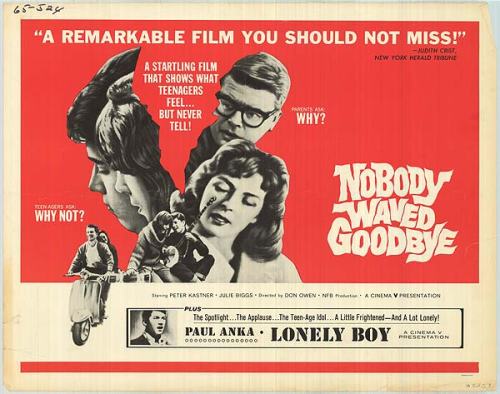
Nobody Waved Goodbye (1964)

nobody waved goodbye 1

By Richard Winters

My Rating: 8 out of 10

4-Word Review: Teen learns hard lesson.

Peter (Peter Kastner) is 18 and looking to spread-his-wings, but doesn’t like what he sees in the adult world. Everyone seems trapped by their dull jobs and mundane routines, which is something he doesn’t want to fall into. He has big dreams. He wants to run away with his girlfriend Julie (Julie Biggs) and live a life based completely on his own whims while never becoming a slave-to-the-system like everyone else. Then he gets in a fight with his parents and they kick him out and after struggling to find work without even a high school diploma his attitude quickly changes.

If you can get past the wretched opening song, which is sung by Kastner and played over the credits, then this film really hits-the-mark. I was impressed with the camera work especially during the dinner time conversations amongst the family members where director Don Owen shoots it with a hand-held camera and zooms in and out on the person’s face as they are speaking. This is something that is quite common today especially on TV-shows, but back then was rarely if ever used, which makes this well ahead-of-its-time and even groundbreaking. I also enjoyed the conversational quality of the dialogue and having two conversations going on at the same time, which again didn’t come into vogue until years later when Robert Altman did it in M*A*S*H.

The film also clearly allows for ad-libbing amongst its actors. There is a scene in which Peter and Julie go paddle boating and come upon a large sofa submerged in the water and then comment on it. Clearly the filmmakers didn’t put the sofa into the lake simply to film the short scene that has nothing to do with the rest of the story, but it still helps set the tone for keeping things fresh and real.

Kastner is great and it’s refreshing to have a protagonist in a film that you like at some points and feel like wringing-his-neck at other times. Too many movies today, especially Hollywood ones, create lead characters that are politically correct caricatures while this movie instead has real human beings that are not tailored made to conform to the likings of any particular demographic.

It’s a shame to say that a movie that came out over 50 years ago is still considered cutting-edge, but compared to the tired, formulaic glop coming out today it really is. The script is uncompromised and holds-no-punches while keeping things gritty and stark and making profound, universal points along the way. I also found it fun that the main character here, who was clearly a baby boomer, displays the same anti-establishment, anti-work attitude that now gets placed squarely onto the ‘dreaded millennials’ and yet it seems the boomers were just as reluctant to get into the rat race as all the generations that have followed them and therefore shouldn’t be waiving their finger at anyone.

nobody waved goodbye 2

My Rating: 8 out of 10

Released: August 13, 1964

Runtime: 1Hour 20Minutes

Not Rated

Director: Don Owen

Studio: National Film Board of Canada

Available: None at this time.
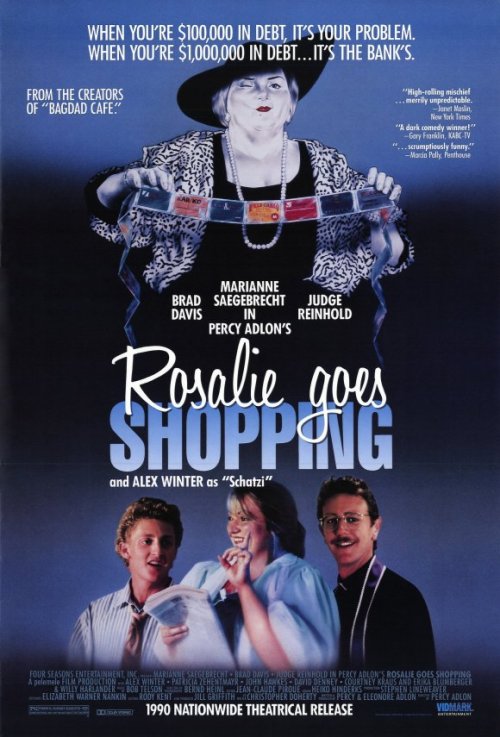
Rosalie Goes Shopping (1989)

rosalie goes shopping

By Richard Winters

My Rating: 4 out of 10

4-Word Review: Shopaholic turns to crime.

Rosalie (Marianne Sagebrecht) is a German immigrant who has married an American crop duster (Brad Davis) and moved onto a small ranch just outside of Stuttgart, Arkansas. There they raise a large family while also becoming obsessed with American consumerism by recording all the TV-shows on their VCR, but only so they can watch the commercials. Rosalie becomes a particularly obsessive shopper buying things that she really doesn’t need even when her money and credit become tapped out. She then figures out a way to hack into the accounts other people and companies via her home computer, which allows her to continue to pay for all her items by embezzling it from others.

This marks the fourth teaming of director Percy Adlon and star Sagebrecht and straight after their big success in the cult classic Bagdad Café. The film was made on-location in Arkansas, but financed by a German production company. I’m not sure what camera lens was used or the film stock, but the color contrast is quite unique and gives the whole thing an Avant-garde appearance. The storyline is original as well and veers off into unpredictable ways while making a great point, which is that unbridled capitalism can be just as dangerous and oppressive as any other form of government.

Sagebrecht is a delight and the moment where tears trickle down her checks as she becomes homesick for her native land while watching home movies taken in Germany is touching. Judge Reinhold is funny as the priest who becomes aware of Rosalie’s shenanigans through hearing them during confession, but completely exasperated about what to do about it. Brad Davis, a highly underrated actor who died too young, plays a rugged country man that’s completely against type from his more famous roles in the homoerotic films Midnight Express and Querelle.

Unfortunately the script, which was co-written by Adlon and his wife Eleonore veers too far into the whimsical and shows too much of a naiveté in regards to cyber technology. The idea that Rosalie could somehow ‘guess’ what everybody’s password was even those used by big companies and major banks is too farfetched and even if she did somehow figure them out all they’d have to do is change them once they realized their accounts had been hacked, which would’ve ended Rosalie’s cybercrimes right there.

The fact that she is able to cover up her crimes by doing even more outrageous ones and never, ever having to face the consequences of her actions is far too fanciful. It also makes light of a genuinely serious issue where the poor and lower middle-class do not have the same resources to get out of their financial predicaments as the rich do. They also do not have the convenience to magically cheat-the-system like the character here and those that do will almost always have it catch up with them where they will ultimately face harsh repercussions no matter how ‘justified’ they may have felt they were in doing it.

Some may argue that this was just a wish-fulfillment comedy, but even then there still needs to be some realm of possibility to it for it to be satisfying and this has none and it also makes the so-called clever twists lose their edge once you realize that none of it is plausible.

My Rating: 4 out of 10

Released: May 19, 1989

Runtime: 1Hour 34Minutes

Rated PG

Director: Percy Adlon

Studio: Pelemele Film

Available: VHS, DVD (Region 2), Amazon Instant Video

Another Nice Mess (1972)

another nice mess 1

By Richard Winters

My Rating: 2 out of 10

4-Word Review: Spiro and Tricky Dick.

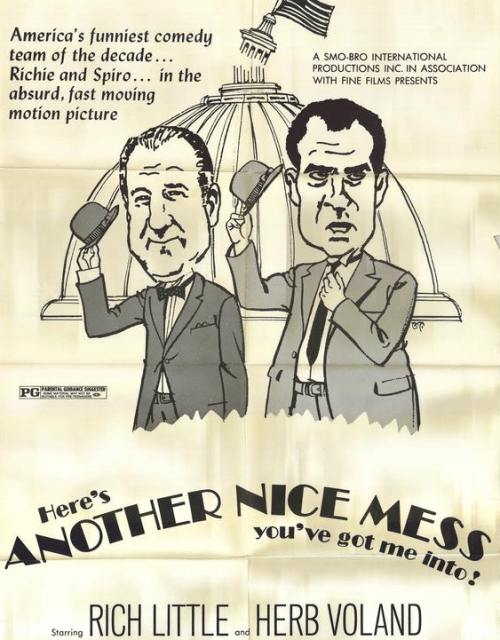
This film is an odd, misfired concoction from writer/director Bob Einstein (Albert Brooks’ older brother) who had just won an Emmy for his writing on ‘The Smothers Brothers Show’ and decided to try his creative muscle at filmmaking. The idea might’ve seemed clever at the time, but it has not aged well. The premise has President Richard Nixon (played by Rich Little) and Vice President Spiro Agnew (played by Herb Voland) behaving like Laurel and Hardy and spending the entire runtime going through some of that classic duo’s more famous routines.

If you were alive during Nixon’s administration than this may come off as being a bit funnier than to those who weren’t however, taking potshots at the President is no longer fresh and for the most part even a bit tiring to watch. The vaudeville-like routines are predictable and this thing had me bored two-minutes in and even with its brief running time still was a major drag to sit through.

Voland is much funnier than Little and seems to imitate the comic legend of Stan Laurel far better than Little does with Hardy, but the characters are played up to be completely moronic and having to watch them do and say one mind numbingly stupid thing after another becomes very one-dimensional.

The film Hail was a Nixon satire that came out around the same time, but that film fared much better and was even quite clever at times. The main reason was that they had a plot while this one is just a non-stop gag reel with a first-graders level of sophistication.

If there’s one redeeming quality for watching this it would be in seeing Steve Martin in his film debut playing a hippie. He doesn’t have his patented white hair here and instead it’s long, curly and brown. I probably wouldn’t have even recognized him if it weren’t for his voice and mannerisms.

My Rating: 2 out of 10

Released: September 22, 1972

Runtime: 1Hour 6Minutes

Rated PG

Director: Bob Einstein

Studio: Fine Films

Available: None at this time.

The Honkers (1972)

honkers 3

By Richard Winters

My Rating: 5 out of 10

4-Word Review: Rodeo star is selfish.

Lew Lathrop (James Coburn) is an aging rodeo star who returns to his hometown after an extended absence, which stirs up resentment and trouble wherever he goes. His wife Linda (Lois Nettleton) still has feelings for him despite her anger at him leaving her and never being able to stay faithful. It seems that the only true friend that he has and one that remains loyal to him even through his many shortcomings is rodeo clown Clete (Slim Pickens), but even this gets put to the test when Lew decides to jeopardize is family life once again when he decides to go after local hottie Deborah (Anne Archer) a young woman just past the age of consent who enjoys flirting with older men and shows no reluctance in having her way with them.

The film was directed by actor Steve Ihnat who never saw the final product put on the big screen as he died from a sudden heart attack at the young age of 37 five days before the film’s release. Much like with Junior Bonner and JW Coop, which came out at the same time, this has an authentic feel with the necessary level of grittiness and good rodeo footage,  but the scenes go on too long and the pace is too laid back. One shot has Coburn walking down the city sidewalk for a full several minutes with nothing else happening. Extended shots of a downtown parade and broncos bucking off cowboys in the rodeo ring are all nice, but fail to propel the plot, which seems pretty thin anyways and almost makes this come off like a documentary than a feature film.

Coburn is his usual engaging self, but seems genuinely uncomfortable getting on the broncos and even a bit out-of-place in the role. Pickens is outstanding in support it what may be the best film role of his career. Usually, especially with his country accent, he would get subjugated to hillbilly parts, but here he gets to show his dramatic side by playing a rodeo clown, which is what he did for many years in real-life before becoming an actor. Archer, in only her second film role is quite seductive and possibly at her most beautiful though the many shots showing her wearing headbands start to make her resemble Pocahontas.

Filmed entirely on-location in Carlsbad, New Mexico director Ihnat manages to take full advantage of the rustic western landscape and brilliant blue sky of the region, which is a major plus. The ending has a nice surreal quality and the story does manage to pick up a bit during the second half, but it still could’ve been better trimmed and more compact.

My Rating: 5 out of 10

Released: May 17, 1972

Runtime: 1Hour 42Minutes

Rated PG

Director: Steve Ihnat

Studio: United Artists

Available: None at this time.