Category Archives: Obscure Movies

The Plumber (1979)

plumber 1

By Richard Winters

My Rating: 9 out of 10

4-Word Review: He destroys her bathroom.

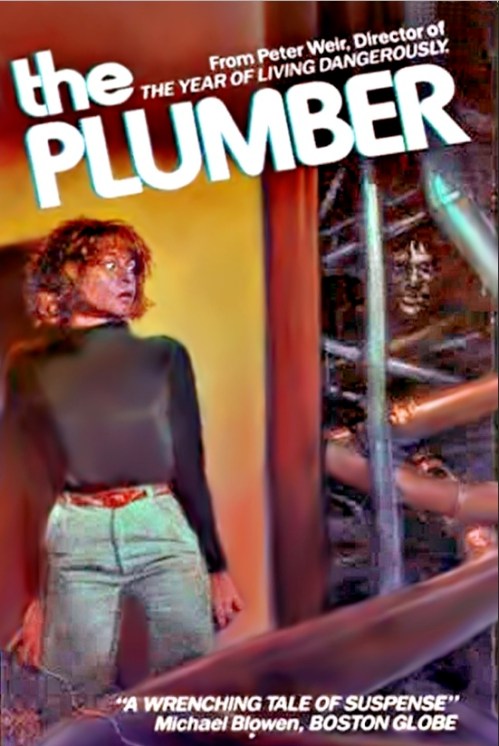
Jill (Judy Morris) works inside her cramped apartment while her husband (Robert Coleby) goes off each day to teach at a local college. She is an educated woman who spends her time writing a thesis for an anthropology paper, but finds herself at a loss when one day a talkative plumber by the name of Max (Ivar Kants) enters her place insisting he needs to check her pipes. Even though there is nothing wrong with her bathroom he proceeds to tear it up anyways while conversing with her on a wide-range of increasingly uncomfortable topics. Her husband and her best friend Meg (Candy Raymond) feel she is making a big deal out of nothing and find the plumber to be nothing more than slightly eccentric, which makes Jill feel even more powerless to Max’s increasingly odd antics.

This film is an excellent testament to what a great director can do with very little.  What appears on the surface to be a low budget, one-joke flick is instead a cleverly disguised observation of the class system and the underlying prejudices and assumptions that exist on both ends. The story playfully jumps back and forth from being a black comedy to a thriller to even a psychological study, which not only helps to make it quite original, but highly unpredictable as well.

To me the most amusing aspect about it is the way we have this super intelligent, well-educated woman who can write long dissertations involving ancient African cultures, but when it comes to people in her own environment she is at a loss and unable to know how to respond or react to a stranger who on the outside should be completely inferior to her intellectually, but routinely gets the upper hand nonetheless. Having everyone around her ambivalent to her situation simply hits home how disconnected an individual can be to their surrounding even when they think that they aren’t.

Kants gives a great performance by creating a character whose ultimate motivation is never clear. Is he intentionally trying to terrorize her or like with her bathroom just trying to tear her down? He seems to do this not so much for who she is, but for what she represents, which is fighting back at a pretentious society that he feels unfairly looks down on him.

If this film, which is based on an actual incident that occurred with a couple of director Peter Weir’s friends, has any faults it is with the location. The apartment, where the majority of the action takes place, is incredibly cramped to the point that I was surprised a film crew could’ve even fit into it. Weir tries to dress up the place with some interesting African artwork, but it still looks drab and helps to make the visual portion of the film quite boring. Having Jill reside in a ritzy home in the suburbs would’ve made more of an interesting contrast and seeing the plumber tear up her posh bathroom would’ve been even funnier.

The fact that Jill immediately opens the door and lets Max inside without asking for any identification is another issue as it comes off as being too reckless and trusting.  Granted it was made in a more innocent era and the character does expound on this later on, but it is something that will make the film seemed dated or even off-putting to today’s viewers. I was also surprised that it took Jill so long to complain to the apartment’s landlord about the plumber’s antics as most people would’ve gone to him after the very first day.

In either case this is still a highly intriguing film that I’ve seen many times and continue to find just as funny and interesting with each viewing.

My Rating: 9 out of 10

Released: June 8, 1979

Runtime: 1Hour 15Minutes

Not Rated

Director: Peter Weir

Studio: The Australian Film Commission

Available: VHS, DVD
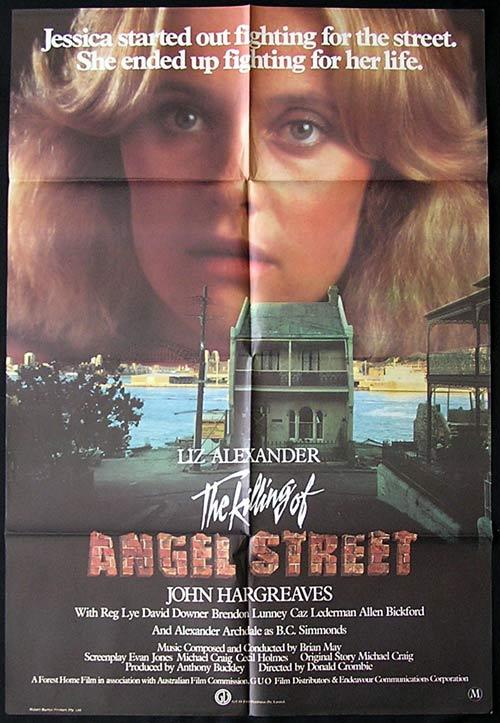
The Killing of Angel Street (1981)

killing of angel street

By Richard Winters

My Rating: 6 out of 10

4-Word Review: Their homes get demolished.

Jessica (Elizabeth Alexander) is a quiet woman who suddenly finds herself embroiled in a heated battle between homeowners and developers who want to build beachfront property on their land and tearing down their homes in the process. Jessica’s father (Alexander Archdale) is one of the homeowners whose place will be destroyed if the developers have their way. Since she has no experience in fighting these matters she employs the assistance of local union leader Elliot (John Hargreaves) to help her in her fight and the two quickly start-up a relationship, but just as they feel they are making some headway Jessica begins to get harassed by complete strangers who break into her home and threaten her life unless she agrees to back-off.

This film is based on the same real-life incident that was also the inspiration for Heatwave, which came out a year after this one. What I found so interesting is how both films took the same incident, but managed to veer into two very diametrically opposite directions with it. Heatwave viewed the situation from all different perspectives including that of the antagonist while this one only looks at the viewpoint of the lead character and uses the premise as a catalyst to what surmounts to being a basic thriller.

While I felt Heatwave was the superior film I did feel this movie was better at creating an emotional impact with the viewer. You get to know the residents better here and are more sympathetic to their cause as well as witnessing the human side and its impact. The shots of houses getting torn down is especially strong as well as the shot near the end where you see the crumbling skeletons of the buildings all in a row and looking like remnants of some sort of war zone.

The film suffers from the weak presence of its lead actress whose performance comes off as being much too rehearsed and lacks any type of spontaneity. Hargreaves, who became one of Australia’s best known lead actors, is wasted in a benign supporting role and is not seen very much. Archdale practically steals it in a touching portrait of an old man clinging to the only thing he has left, but the pronounced bags under his eyes almost becomes a distraction.

The film’s final 20 minutes are the best. This is where Jessica finds herself kidnapped and hung upside down over the side of a tall building, which is quite intense, as well as a myriad of almost surreal events where she runs into evil people and ugly situations wherever she turns including that of a humiliating and unnecessary full body search while inside the seemingly safe confines of a police station.

The story though veers way off from what actually happened making this an almost fictional account and barely related to the real Juanita Nielsen whose true-life story inspired this one. The real event had far more interesting twists and I’m not sure why neither film chose to stick to the facts and it almost begs for a talented filmmaker to come in and create a film that examines the events and people as it actually occurred.

My Rating: 6 out of 10

Released: October 1, 1981

Runtime: 1Hour 35Minutes

Not Rated

Director: Donald Crombie

Studio: Forest Hill Films

Available: VHS

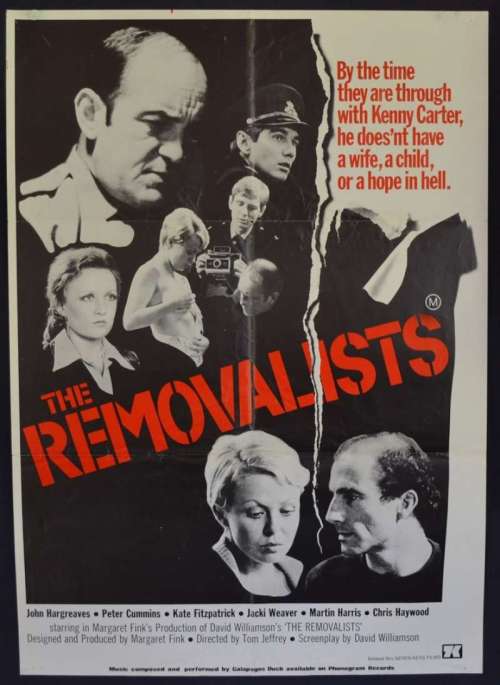
The Removalists (1975)

removalists 1

By Richard Winters

My Rating: 6 out of 10

4-Word Review: Cops abuse their authority.

Having just graduated from police training Neville (John Hargreaves) is both excited and nervous about joining the force. His first day on the job working at a small police station with the conservative and boisterous Sargent Dan Simmonds (Pete Cummins) as his new boss gets off to a rocky start and then gets even worse when two sisters arrive to report an incident. Kate (Kate Fitzpatrick) is the older of the two who says that her shy younger sibling Marilyn (Jacki Weaver) has been abused by her husband Kenny (Martin Harris) and will require the services of the two policemen to help move her things out of her apartment and keep Kenny under control while they do it. The two cops oblige, but to everyone’s shock the Sargent immediately becomes physically abusive to the husband when he enters the place and while he has him handcuffed. The beatings escalate throughout the day until Kenny looks to be on the brink of death forcing the two officers into a heated argument over what type of alibi they should use should the victim eventually die.

The film was written by the talented David Williamson and based on one of his stage plays. Williamson is noted, especially in Australia, for his darkly humored subject matter and scathing wit with this one being no exception. It starts out with a caustic tone that just proceeds to get stronger as it progresses. The actions by the Sargent are disturbing and reprehensible, but the fact that the character doesn’t see it that way and expounds on the importance of ‘self-control’ and having a rigid morality shows just how out-of-touch he is with his own contradictions, which makes him quite human and strangely engaging while also making a great commentary on the abuse of police power.

This also marks the film debut of legendary Australian actor John Hargreaves who went on to have a remarkable film career with a wide array of interesting roles before unfortunately dying at age of 50 from AIDS. His portrayal of a nervous and hesitant new recruit is humorously on-target, but the way his character becomes more emboldened as the day wears on is even more interesting.

The film’s downfall is the fact that the sets are visually dull. To some extent this works particularly in the rundown apartment that the majority of the action takes place in because it helps to symbolize how trapped the characters are with their own deteriorating and misguided value system, but it still ultimately gives the film too much of a low budget and unimaginative look. The story itself is predictable and although laced with darkly amusing moments could’ve been funnier and played-up more.

My Rating: 6 out of 10

Released: October 16, 1975

Runtime: 1Hour 33Minutes

Not Rated

Director: Tom Jeffrey

Studio: Seven Keys

Available: DVD (Region 0)

Heatwave (1982)

heatwave 1

By Richard Winters

My Rating: 8 out of 10

4-Word Review: Fighting to save homes.

Stephen (Richard Moir) is an English architect employed by Robert (Bill Hunter) to construct a massive high-rise building in downtown Sydney that will be financed by Peter (Chris Haywood). However, the construction will require the demolition of several row houses and the eviction of those living in them. Kate (Judy Davis) takes up the cause by protesting the development and along with Mary Ford (Carole Skinner) are able to get a temporary block on the building project by getting the local builder’s union to instill a green ban. Stephen tries to fight this by attending the group’s meetings and airing out his side of the issue, but in the process finds himself more and more sympathetic to the residence especially when he finds out that Peter isn’t a completely honorable businessman and has no plans to use Stephen’s building design at all. When Mary mysteriously disappears he joins forces with Kate to try and find her only to unearth even more troubling and dark revelations along the way.

This film is based on a true-life incident and one of two movies made about it with the other one being The Killing of Angel Street, which will be reviewed here next month. The real-life event centers on Juanita Nielsen (1937-1975) who took up the anti-development cause when it was found that her home was pegged to be demolished in order to make way for three high-rise buildings in the Victoria Street neighborhood of Sydney. Her efforts managed to delay the project for three years, but the developer eventually became impatient and hired men to harass the residents who were trying to stop it and in the process kidnapped Nielsen even though her body has never been found and no one has ever been convicted of her murder.

The film here depicts Nielsen through the fictional character of Mary Ford, but what surprised me was that Ford is not the central person. Instead we only see her briefly at the beginning before she disappears and is generally forgotten while writer/director Phillip Noyce adds other fictional characters and story lines around her, which wasn’t as interesting as the actual case and I’m not sure why they didn’t just stick with the facts.

However, this still a highly intriguing thoroughly riveting plot that keeps you on the edge of your seat from the beginning. Part of what I liked about it is the way it shows things from the different perspective of the various characters while bringing out the myriad of complexities where nothing is black-and-white and no one is completely right or completely wrong. The viewer gets torn about whose side to be on, but fascinated with each new rapid-fire twist that comes about.

There are definite shades of L’Avventura here where a main character disappears and is essentially forgotten until it seems almost like she had never existed in the first place. The script offers no easy answers and instead shows in vivid and almost brutal detail how taxing and frustrating fighting for social change can be and the hopelessness one feels when they realize that all of their efforts may have made little or no difference.

My Rating: 8 out of 10

Released: March 8, 1982

Runtime: 1Hour 32Minutes

Rated R

Director: Phillip Noyce

Studio: Roadshow Film Distributors

Available: VHS, DVD (PAL, Region 0)

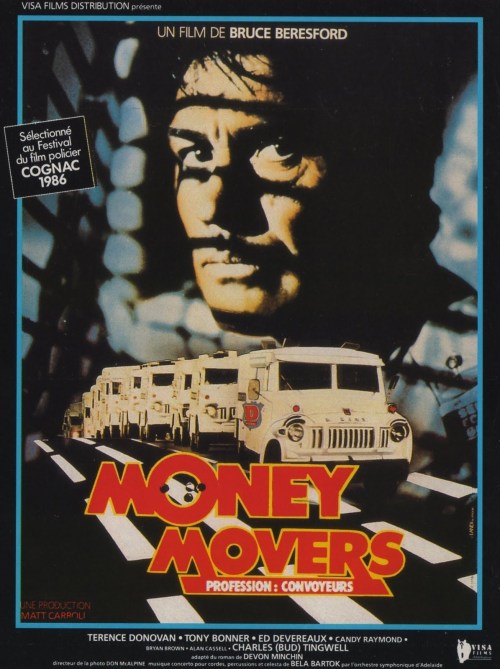
Money Movers (1979)

money movers 2

By Richard Winters

My Rating: 8 out of 10

4-Word Review: Employees become the thieves.

Lionel Darcy (Frank Wilson) runs an Australian armored truck business that transports payroll funds from one location to the other. After there is a robbery to one of his trucks he tries to increase security measures in order to prevent another one from occurring unaware that his own employees, with help of a local crime boss (Charles ‘Bud’ Tingwell) are planning an even bigger attack and everyone, even the police detective hired in to investigate the first crime, are in on it in one or the other.

The film is based on a novel by Devon Minchin, who worked as head of security for The Beatles when they were on tour in Australia and also owned at one time Australia’s largest armored car security company. The story itself is based on two real-life robberies that occurred in Sydney during the summer of 1970.

To me what stands out most about this film is how everyone, with the sole exception of Darcy, is thoroughly corrupt. There is no ‘good-guy’ in this movie, but instead of that being a turn-off it becomes almost like a running-joke where the viewer waits to find out what dark vice each new character will reveal to have. Fortunately they and their vices remain strangely engaging and this is mainly because none of them are portrayed as being inertly ‘evil’, but instead people sucked into an already screwed-up system and simply trying to make a living and doing it in the only way they know how.

Ed Devereaux , who plays a retired cop named Dick Martin, becomes the film’s reluctant protagonist although his presence gets refreshingly underplayed while having him look worn, aged and genuinely overwhelmed yet still remaining dedicated to his cause and ultimately managing to put a monkey wrench into the proceedings. Darcy, the only other non-corrupt character, is equally engaging albeit in an unconventional way as his utter cluelessness as just how criminally overrun his own company is, is a perfect comical testament to how many business owners and CEOs are thoroughly detached from the companies they run and the people they supposedly control.

The violence is graphic and impactful and one of the most memorable elements of the movie particularly during the final shootout that occurs inside the garage of the armor car company. There is none of this staged nonsense where the men have ‘manly’ fistfights that always get coupled with that annoying smacking sound-effect. Instead it gets captured in quick, ugly ways where the men desperately do whatever ugly tactic they can to stop the other one. The action is stark and unglamorous while given a bestial quality like starving animals fighting over a last piece of meat that leaves the viewer feeling like they’ve just witnessed an actual crime as it happened.

The film’s beginning is admittedly confusing and there should’ve been some backstory given before it jumps right away into the crime that features a dizzying array of shootings and double-crossings before the viewer is even able to figure out who is who. Yet after this awkward first part it manages to settle down while becoming a rapid-paced, in-your-face crime thriller that has proven to be highly influential and years-ahead-of-its-time.

money movers 1

My Rating: 8 out of 10

Released: February 1, 1979

Runtime: 1Hour 32Minutes

Rated R

Director: Bruce Beresford

Studio: Roadshow Film Distributors

Available: VHS, Amazon Instant Video 

It Rained All Night the Day I Left (1980)

it rained all night 1

By Richard Winters

My Rating: 2 out of 10

4-Word Review: Stuck in the desert.

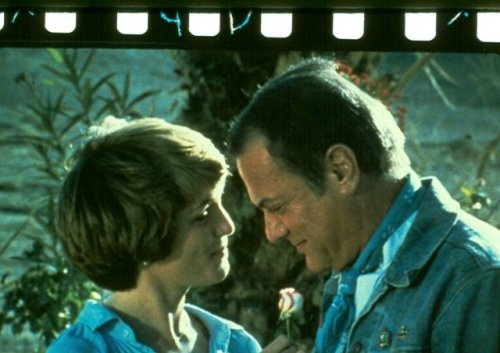
Robert and Leo (Tony Curtis, Louis Gossett Jr.) are two losers working as gun runners who transport their goods in an old beat-up VW that looks to be seriously on its last leg. They meet up with The Colonel (Sally Kellerman) who is the widow of an actual Colonel that fought during WW II. She is now living alone with her nineteen year-old daughter Suzanna (Lisa Langlois) in an isolated ranch in the middle of the African desert. She hires Robert and Leo to help her oversee the water that she pumps to a nearby village. Since she feels that the members of this village had something to do with her late husband’s murder she has cut off their supply to it and only lets them have access to it at certain times of the day, which the two men feel is harsh. They do some investigating on their own and believe that it is neighboring rancher Killian (John Vernon) who is the real culprit to the murder, but trying to convince The Colonel of this, who has a romantic interest in Kilian, is another matter completely.

This obscure, low budget film is pretty much a botched mess from the get-go. Too much emphasis is put on comedy, but filmed by people who have no idea what is funny which forces the actors to carry-on with broadly written banter and insipid slapstick-like scenarios that is intended to be humorous, but falls resoundingly flat instead. The story and setting has some potential, but resorts to contrived, uninspired romance that becomes completely boring.

I’ll give Kellerman credit for lasting over six decades in the business, but her acting never seems to be effective. Her character is supposed to be a domineering, tough-as-nails lady, or at least that is how she is introduced as she even insists that the men refer to her as ‘sir’, but this quickly evaporates until she becomes just another aging, lonely female looking for love and companionship, which isn’t compelling, or original. Langlois as the daughter is equally transparent while delivering her lines as if she were half asleep. Why an attractive young lady such as herself would ever fall for a struggling 55-year-old man like the one Curtis plays here makes little sense and is pretty dumb.

The film is saved to a minor degree by the presence of Curtis. He was a top billed star during the ‘50s and 60s, but by the ‘80s his career had plummeted severely to the point that he was accepting minor, supporting roles in direct-to-video fare that next to no one saw. This film isn’t much better than those, but here at least he retains his engaging persona and helps lift the dead material to a somewhat tolerable level and his pairing with Gossett is odd enough to make it semi-intriguing.

This is a sad, almost embarrassing follow-up project for director Nicolas Gessner who had achieved critical acclaim with the Jodie Foster hit The Little Girl Who Lives Down the Lane. Why he would choose this oddball thing to tackle next is a mystery as I’m sure he must’ve been offered better scripts, but in either case it’s a misfire that never manages to click at all.

My Rating: 2 out of 10

Released: August 6, 1980

Runtime: 1Hour 24Minutes

Not Rated

Director: Nicolas Gessner

Studio: Gaumont

Available: None at this time.

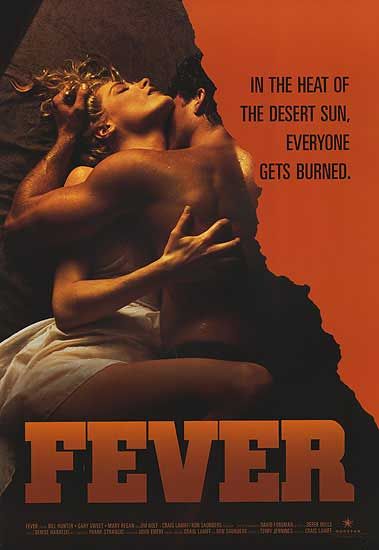
Fever (1989)

fever 1

By Richard Winters

My Rating: 6 out of 10

4-Word Review:  Suspense in the desert.

This review will be a first in a series in which we celebrate Australian cinema by reviewing one film each week from Down Under. Today’s movie centers on Jack Welles (Bill Hunter) who comes upon a suitcase full of money after a shootout with a drug dealer. He decides to keep the loot and take it home to his lovely wife Leanne (Mary Regan) unfortunately when he gets there he finds that she is in bed with another man named Jeff (Gary Sweet). The enraged Jack attacks Jeff, but Jeff and Leanne manage to fight him off while knocking him out in the process. Thinking that they’ve killed him they take his body out to the desert and dump it into a vat. The problem is that Jack isn’t dead and he proceeds to relentlessly chase the two while also being followed by a busy-body deputy named Morris (Jim Holt) who thinks that Jack is hiding something and who in-turn is also being followed by criminal kingpin Mr. Tan (Lawrence Mah) who is out to retrieve his drug money.

For the most part this film works pretty well and has a story that is compact and original and will keep the viewer guessing all the way through to the end. It also has some particularly novel camera angles including seeing the inside of a car, with the driver still at the wheel, as it flips over.

The film manages to avoid most of the expected loopholes that you usually see in these types of stories, but there are still a few discrepancies. The biggest one is that Jack recovers from the blow to his head a bit too quickly and magically. There is no dried blood, or bandages needed despite the fact that he does initially bleed when he is first hit. In fact there is no sign of even a cut and no after effects like headaches, swelling or dizziness that most assuredly would affect anyone else after being hit over the head with a vase and knocked unconscious. There is also a scene near the end where, in an effort to find his wife, Jack barges into a lady’s washroom and kicks open all the stall doors before finding a woman sitting on the toilet, but for some reason she doesn’t scream or react at all when he does this, which is weird.

The casting is another issue. Hunter is way older than the actress who plays his wife and it doesn’t look right or make sense. Why would such a young beauty settle for some tubby middle-ager? It clearly wasn’t for love or money and the actor playing her lover has too much of the chiseled male model features of a soap opera star. The solution would’ve been to cast performers to play the wife and lover that were of the same age and looks range as Hunter.  Average looking, middle-aged people have sex and affairs in real-life, so why can’t characters on the big screen ever reflect this?

The story also suffers by having characters that are not likable and nobody to root for. Any screenwriting coach will tell you that no matter how clever, or creative the plot may be if it does not have three dimensional characters then it won’t work.

However, with all that said there are still enough unexpected twists to keep it interesting particularly the ones that occur during the final ten minutes. The last one is especially good and one I would never have guessed, nor seen done in any other film, so the movie gets kudos for that.

My Rating: 6 out of 10

Released: February 1, 1989

Runtime: 1Hour 23Minutes

Rated R

Director: Craig Lahiff

Studio: Genesis Films

Available: VHS

Laughter in the Dark (1969)

laughter in the dark

By Richard Winters

My Rating: 6 out of 10

4-Word Review: Man obsesses over teen.

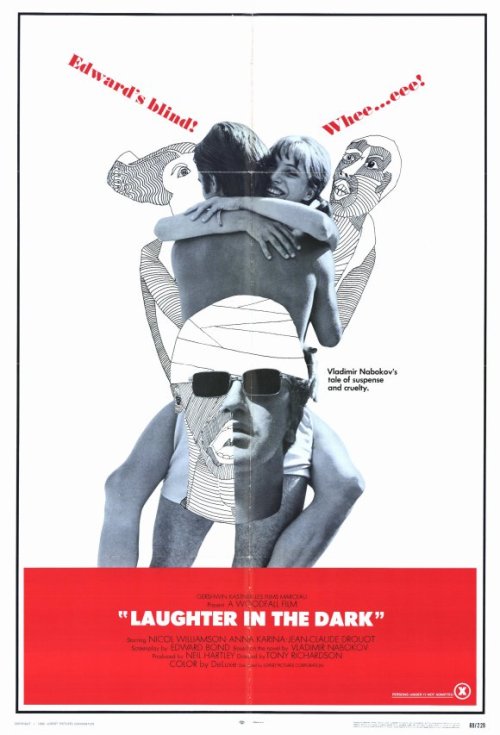
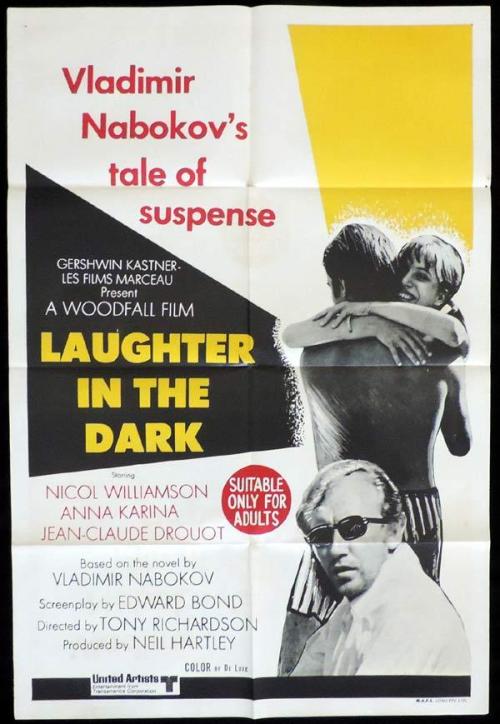
This film is based on an early novel by Vladimir Nabokov, who is more famous for writing Lolita and the story here has a similar theme to that one. The plot revolves around Edward (Nicol Williamson) who is a successful middle-aged art curator, but bored with his marriage and looking for an escape. While watching a film inside a theater one day he spots the beautiful Margot (Anna Karina). While she is only 18 he becomes madly obsessed with her and tries to start-up a relationship. She initially resists, but then realizes that he has a lot of money and decides to play-him. On the side she has a passionate relationship with Herve (Jean-Claude Drouot) who begins to work for Edward as his assistant. Initially Edward has no clue that Herve and Margot are cavorting around behind his back, but eventually he catches on and plots a dark revenge only to find himself as the victim.

While the story has its share of intriguing moments it suffers from featuring a main character that is not relatable.  Fantasizing about having sex with a beautiful, younger woman is fine, but he shouldn’t expect her to automatically reciprocate those same feelings and even if she does he should be concerned that it is only because of his money, which are thoughts that he never once seems to consider. He also spouts out right from the beginning of how much he ‘loves’ her like a lovesick 14-year-old, but a man his age would normally be wise enough to realize that there is a big difference between that and sexual attraction, which is all that this really is.

It also takes way too long for Edward to catch on to the affair occurring between Herve and Margot even though anyone else would’ve seen the red flags a mile-away. It is for these reasons and the way he gets taken advantage of time and again that makes the character come off as suffering from some serious mental defect that is not in any way a normal for even a halfway intelligent person.

It all would’ve worked much better had Richard Burton remained on as the film’s star. He was the original choice for the part and even filmed a few scenes before being kicked off the project due to repeatedly showing up drunk. Williamson is a fine actor and has an impressive resume, but he’s rather benign here while Burton would’ve been able to bring in an extra dimension and because he was older would’ve made the contrasting age difference between him and Margot even stronger.

Karina on the other hand is stunning and an absolute beauty to behold. She was much older than what the part called for, but her wicked, conniving performance more than makes up for it as she eats up every scene that she is in and everyone else in it.

It was filmed on the island of Majorca, which allows from some exotic Mediterranean scenery and Raymond Leppard’s harpsicord soundtrack is pleasing. I also, for the most part, enjoyed the story, which manages to remain intriguing all the way up until its unsatisfying conclusion. The drama though, particularly at the beginning, is clumsy and the whole thing ultimately comes off as a good director’s weakest work.

laughter in the dark 2

My Rating: 6 out of 10

Released: May 11, 1969

Runtime: 1Hour 44Minutes

Rated X

Director: Tony Richardson

Studio: Lopert Pictures Corporation

Available: None at this time.

Life Size (1974)

life size 1

By Richard Winters

My Rating: 5 out of 10

4-Word Review: A sex doll obsession.

Michel (Michel Piccoli) runs a successful dental practice, but finds that his life is empty and his marriage to his wife Isabelle (Rada Rassimov) is no longer working. He has cheated on her before, but those affairs left him with the same empty feeling, so this time he decides to take a different route by purchasing a life size sex doll that looks so real that she almost seems human. He takes her everywhere and even brings her along to a visit with his mother (Valentine Tessier) so she can meet his new ‘girlfriend’.  The doll becomes the centerpiece of his very existence and he spends every waking moment he can with her until he sees footage, from a closed circuit camera that he has set-up in his house, of one of friends having sex with her while he was away. He becomes outraged at her ‘betrayal’ and decides that her punishment will be ‘death’.

The film, which can best be described as an early, distant cousin to Lars and the Real Girl, definitely has its share of unique and memorable moments. Writer/director Luis Garcia Berlanga does an admirable job of analyzing just what might happen if sexual fantasy gets taken to its most extreme level. The scenes showing Michel taking the doll to a clothing store in order to be measured and fitted with the latest fashions and marrying the doll in a makeshift wedding are by far the film’s two best segments.

However, it’s Michel’s scenes with his wife that I found to be the most unsettling. The scene where he fondles his wife’s naked breasts late at night as she sleeps while looking at a picture of the doll is quirky enough, but then later on, in the film’s most disturbing moment, she tries immersing completely into his sexual fantasy by pretending to be a sex doll herself in a desperate attempt to win him back.

What is initially considered the sexual substitute to the real thing soon becomes the preferable choice here and it reminded me of an article I read in a science journal a few years back about young men in their 20’s forced to be prescribed Viagra because they were no longer able to achieve erections with their wives/girlfriends because the proliferation of porn on the internet had somehow dulled their senses to real sex to the point that they found it to be a ‘turn-off’. Now, if you are a fan of porn then that’s great and I don’t mean to be appear like I’m trying to knock it, but I did find it fascinating that elements of that article correlated to what this film was showing and how successful this movie was at foreshadowing the phenomenon’s that we are now seeing in our modern day culture.

Although the film is adequately directed and more of a psychological study than a perverse sleaze feast it’s still not an overall success. The main issue is that the main character acts overtly freaky about the doll from the very beginning without enough backstory to tell us why and simply saying it’s due to a unhappy marriage is not enough. A far more compelling concept would’ve been to portray the main character as being more ‘normal’ by having him feel awkward about the doll and even a bit embarrassed only to grow increasingly more obsessed as the film progresses until his ultimate infatuation with it shocks even him.

Alternate Titles: Grandeur Nature, Love Doll, Tamano Natural

My Rating: 5 out of 10

Released: August 21, 1974

Runtime: 1Hour 41Minutes

Rated X

Director: Luis Garcia Berlanga

Studio: Cinema International Corporation

Available: None at this time.

Another Chance (1989)

another chance 1

By Richard Winters

My Rating: 2 out of 10

4-Word Review: Jaded playboy seeks redemption.

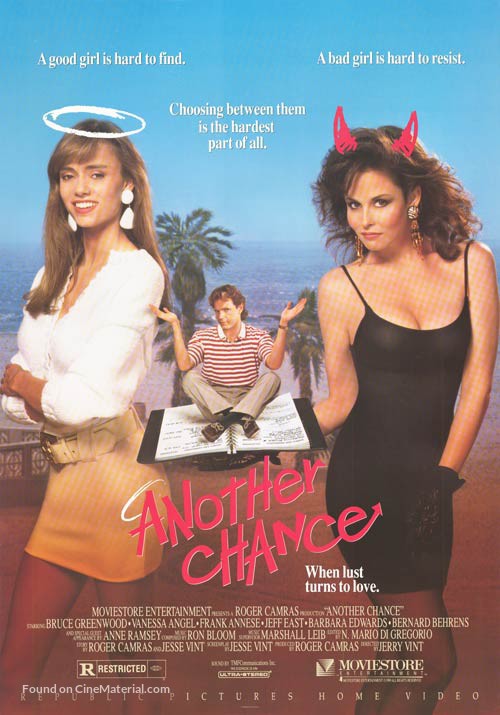
John Ripley (Bruce Greenwood) enjoys trying to bed every attractive woman that comes along. He even has his dog Rocky trained to bite on their purses and lead them over to him wherever he may be sitting. He is a big star on the daytime soaps and uses this position to take advantage of every young, nubile starlet willing to go to have sex with an established actor if it can in some way help boost their career. Then he meets the beautiful Jackie (Vanessa Angel) and starts to have strong feelings for her, but she catches him with another woman and it’s all over. He tries to win her back, but in the process loses his job and home. While working a part-time gig at a look-a-like show he gets into an ugly confrontation with a psychotic man resembling Humphrey Bogart (Robert Sacchi) who pulls out a gun and shoots him on the spot. John then finds out that he has been banished to hell, but pleads for one more shot at redemption, which he is given, but only if he can win back Jackie’s heart.

The film, which was written and directed by B-actor Jesse Vint, certainly has a crazy wide open storyline that seems to want to mix in the mindset of today’s modern world with that of spiritual one, which doesn’t work at all. Initially I thought the heaven and hell thing was thrown in simply as a plot device, but the more it continued the more I became convinced that this movie was intended to be religious one even though it gets enveloped inside the jaded world of modern day Hollywood, which just makes it all the more loopy.

In more competent hands this might’ve worked as an interesting curio, but the script needed to be better focused and the editing much tighter. The narrative is too heavy-handed to take seriously and everything gets photographed in a flat sort of way making the whole thing seem on par to a TV-movie instead of a theatrical one.

Greenwood gives an engaging performance and helps make a potentially unlikable character more tolerable. Angel is good too and it’s too bad she couldn’t have been in more scenes. The supporting female cast is overall quite attractive, but they’re all made to dress and act like bimbos. Anne Ramsey is on-hand for a brief bit as John’s crabby landlady and Allan Rich has a supporting role as a sleazy agent, but overall the one thing I liked most about the movie was Rocky the dog and that’s about it.

My Rating: 2 out of 10

Released: May 5, 1989

Runtime: 1Hour 38Minutes

Rated R

Director: Jesse Vint

Studio: Moviestore Entertainment

Available: VHS