Category Archives: Obscure Movies

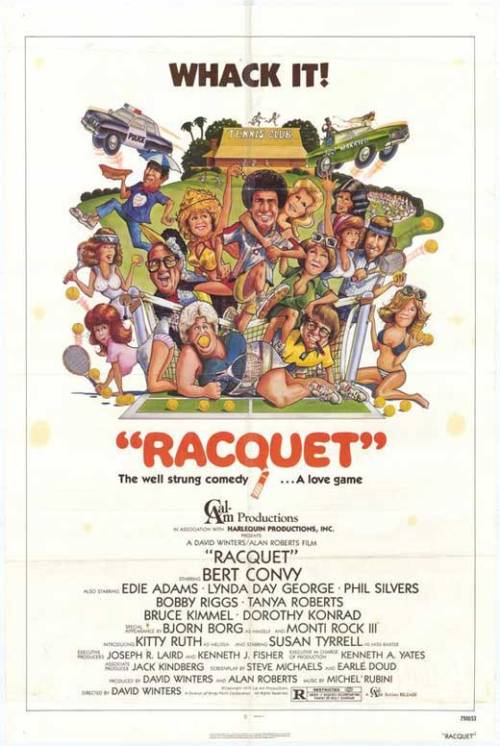
Racquet (1979)

racquet-1

By Richard Winters

My Rating: 0 out of 10

4-Word Review: Tennis champ gets old.

Tommy Everett (Bert Convy) is an aging tennis star who is learning to accept that he no longer has the skill that he once did. His life though is not in order and he needs money so that he can purchase his own tennis court and use it to give lessons to the rich clientele of Beverly Hills. Since he doesn’t have the capital for a down payment he sleeps with Leslie (Edie Adams) who is the wife of Arthur (Phil Silvers) a rich financier. During their lovemaking he asks her for the cash and she initially agrees even though she doesn’t intend to come through with it. In one last attempt to prove his virility he decides to take on tennis great Bjorn Bjorg in a televised match that he hopes will prove that he still has what it takes.

This so-called comedy is so frighteningly unfunny that you have to wonder why anyone would’ve been paid to write-it as its desperate attempts at humor are downright embarrassing. The script went through many rewrites and it shows as there is no cohesion and the action meanders badly until it all becomes quite pointless.

Supposedly this was an attempt to cash-in on the success of Shampoo, which was far better and so superior to this one it’s isn’t worth trying to compare except to say that was a classic and this isn’t. The jokes here are too strained and the innuendoes so juvenile that it makes sitting through not worth it on any level. The movie would’ve been improved had it stayed focused on the tennis angle, but instead it goes off on Convy’s romances and sexual conquests until you completely forget about the tennis part until it finally goes back to it at the very end.

Convy’s presence, especially in the lead, makes things even worse. He was a great game show host, but in the acting realm he was a hack to the point that he comes off looking like he never had even a day of acting training.

The supporting cast if filled with an array of familiar faces, but due to the script’s limitations end up being badly underused. Susan Tyrrell’s take of a snobby real estate agent should’ve been great, but isn’t. Tennis legend Bobby Riggs is fun, but not funny and Dorothy Konrad gets a few laughs, but it all comes at the expense of her obesity, which is tacky.

Phil Silvers is the only good thing in the movie and he even manages to elicit a few chuckles especially the part where he dresses and acts like a giant turkey. Yet even this, like with everything else in the film, is pretty sad and only proves to what pathetic extent it was willing to go to just to get a cheap laugh.

My Rating: 0 out of 10

Released: June 7, 1979

Runtime: 1Hour 29Minutes

Rated R

Director: David Winters

Studio: Cal-Am Productions

Available: None at this time
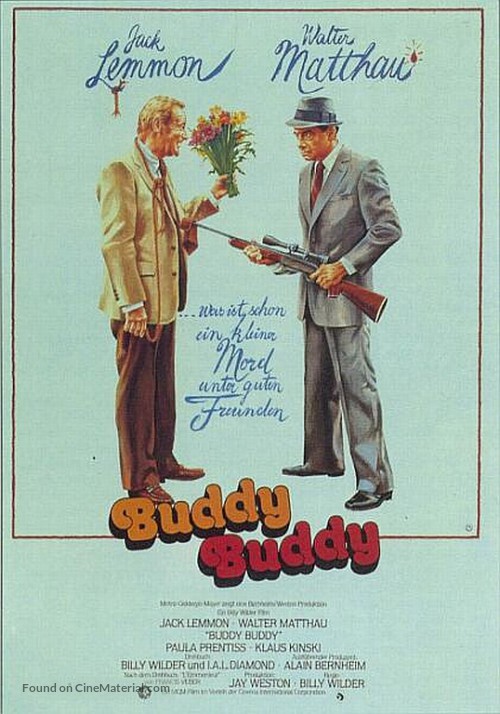
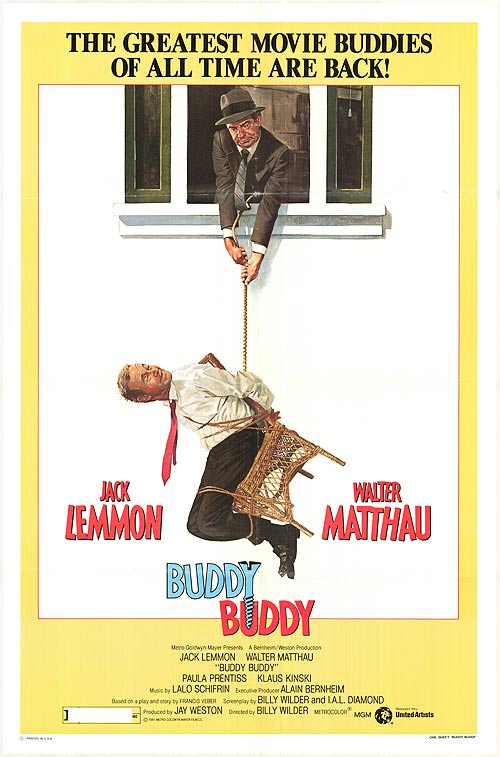
Buddy Buddy (1981)

buddy-buddy-2

By Richard Winters

My Rating: 7 out of 10

4-Word Review: Suicidal man hampers hit.

Trabucco (Walter Matthau) checks into a hotel intent on completing a hit by shooting a mob informant before he can testify at trial. He’s already killed the two other informants with relative ease, but now finds this one to be much more complicated due to having to deal with Victor (Jack Lemmon) who resides in the adjoining room. Victor is upset that his wife Celia (Paula Prentiss) has left him for a sex therapist (Klaus Kinski) and proceeds to try to hang himself by tying the noose around the water pipes in the bathroom, but all he succeeds at doing is busting the pipes and creating a flood. Trabucco decides to ‘befriend’ the man in order to keep an eye on him and prevent him from trying to kill himself again, which he feels will only lead to unwanted attention from the authorities. However, Jack causes more problems for him than the police ever could.

This was the last film directed by Billy Wilder who stated in more than a few interviews that he considers this movie to be his poorest effort and his least favorite. Matthau and Lemmon have pretty much said the same thing as well. The film was a critical flop and lost 3.5 million at the box office, which helped to prevent Wilder from ever helming another movie again.

However, I was delightfully surprised at how funny I found this movie to be. It’s not exactly laugh-out-loud hilarity, but on a low-key level it works. The part where Lemmon gets tied to a chair and his mouth gagged while he screams at an ambivalent housekeeper (Bette Raya) to free him is quite good and the part where the two men going gliding down a clothes chute is fun too.

The whole thing is a remake of the French film A Pain in the A__, but it implements changes to the plot that improves it from the original. For one thing the dialogue is funnier, the two men have more genuine conversations and they even develop a bit of a bonding. The film adds more characters too like the beleaguered Captain Hubris played by Dana Elcar who tries in vain to protect the witnesses from Trubacco, but with little success. The distinctive musical score by Lalo Shifrin is also big improvement.

Lemmon is quite funny as he plays a sort-of hyped-up version of his Felix Unger character. Matthau seems a bit stymied in a role that allows for very little expression, but he still manages to make the most of it. My favorite performance though was that of Kinski who takes a rare comic turn and utters the movies best line: “Pre-ejaculation means always having to say you’re sorry.”

Having the two actually work together to complete the hit and then make an escape from the cops is good and something that did not occur in the original. The resolution, which takes place on a tropical island, is a bit of an improvement over the first one though it’s still not perfect. In either event it’s a relatively solid comedy that offers a few good laughs and deserves more attention especially for fans of Lemmon/Matthau.

buddy-buddy-1

buddy-buddy-3

My Rating: 7 out of 10

Released: December 11, 1981

Runtime: 1Hour 36Minutes

Rated R

Director: Billy Wilder

Studio: MGM

Available: VHS

A Pain in the A__ (1973)

pain-in-the-ass-1

By Richard Winters

My Rating: 6 out of 10

4-Word Review: Loser irritates hit man.

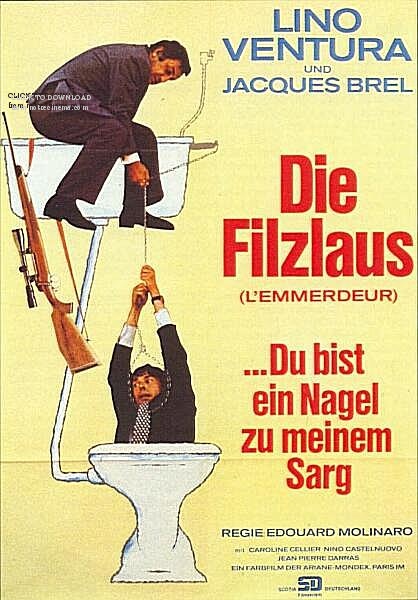
Ralf (Lino Ventura) works as a hit man and is hired to assassinate Louis Randoni (Xavier Depraz) who plans to testify against the mob. Ralf checks into a hotel room and plans to shoot Louis as he tries to enter the courthouse from his hotel window, which sits across the street from the court building. As he prepares for the hit he becomes distracted by Francois (Jacques Brel) in the neighboring room who attempts to kill himself after his wife leaves him. Ralf is concerned that Francois’s actions will elicit unwanted attention, so in an attempt to quiet him he ‘befriends’ him, which leads to many ironic scenarios.

The film was written by the prolific Francis Veber and based on his play. Ultimately it’s just a one-joke premise, but what makes it work are the two characters particularly the hit man who is portrayed in a serious way and never once betrays the essence of who he truly is, which is that of a cold blooded killer intent on doing his job and then moving on to his next. The comedy comes from his perturbed reactions at having to deal with a loser that despite his best intentions he can’t seem to ever get rid of.

Famous singer Brel does quite well as the clingy pest who is so wrapped up in his own personal quandaries that he fails to notice that his new ‘friend’ really isn’t his friend at all. Brel’s boyish looks plays well off of Ventura’s constantly stern expression and the plot becomes almost a constant play on errors as each one misreads the other.

The overall set design though is boring and the majority of action takes place solely inside the two hotel rooms, which eventually makes the proceedings quite static. It would’ve been nice to have had more of a conversation between the two as Brel does almost all of the talking while Ventura simply remains quiet while looking bored and angered, which is fun for a while, but more of a character arc could’ve been implemented.

The ending is a cop-out and not satisfying at all. I also felt Ventura was a bit too old and the character would’ve been more intimidating had it played by someone younger and more rugged although for the record Ventura plays the role perfectly especially when he gets injected with a drug that makes him tired and reluctantly  dependent on Brel’s guidance.

In 2008 Veber directed a remake of this film, which met with some success. Also in 1981 director Billy Wilder did an American version of this with Jack Lemmon and Walter Matthau playing the two leads. That film ended up adding a few changes and will be reviewed tomorrow.

pain-in-the-ass-2

My Rating: 6 out of 10

Released: September 20, 1973

Runtime: 1Hour 31Minutes

Rated PG

Director: Edouard Molinaro

Studio: Mondex Films

Available: VHS

Midnight (1989)

midnight

By Richard Winters

My Rating: 1 out of 10

4-Word Review: Horror hostess is goofy.

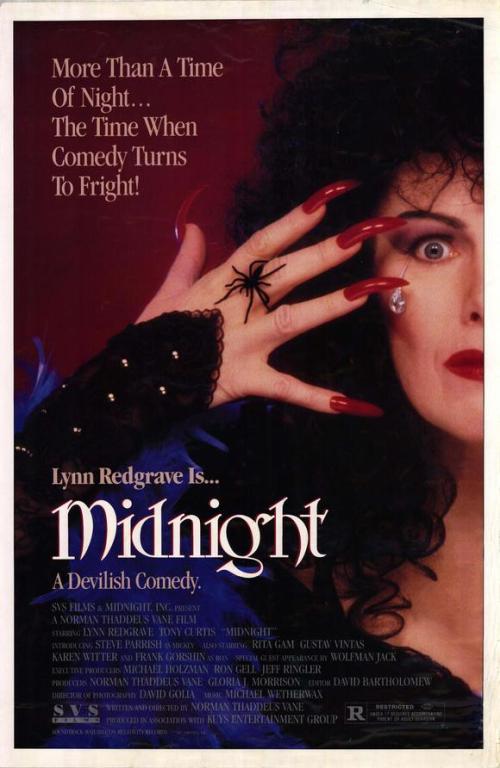
Midnight (Lynn Redgrave) is a Goth dressing host of a late night TV-show where she rises from a coffin to help introduce a bad B-movies. She has managed to attain a strong cult following and Mr. B. (Tony Curtis) the head of the TV-station where she works wants her to sign over the syndication rights, but she continually refuses. She then meets Mickey (Steve Parrish) and the two get into a relationship, but when he proves to be unfaithful dead bodies begin turning up including that of Mr. B.’s. Is Midnight the killer, or is she being framed by someone else lurking in the shadows?

There are a few snappy lines here and there, but overall this thing is a complete bore and too poorly paced to be entertaining. The film shifts so clumsily between comedy, satire and horror that it becomes hard to figure what audience the filmmakers where attempting to draw-in.

Redgrave’s send-up of Elvira and Vampira misses the mark completely. The wacky outfits that she wears is indeed eye-catching, but the camp level gets played up too much and the fact that she continues to display the same goofy persona that she has in front of the camera even while at home gets overdone and eventually quite annoying.

Curtis is far more entertaining and should’ve been giving a larger role. His hanging death in which he struggles in mid-air with a rope around his neck is actually impressive, but I did spend most of the film thinking about the white mop that was on top of his head and wondering if it was his real hair, or a wig. Parrish, as the young love interest, is thoroughly dull and drains what little energy this film has right out with his presence.

The strangulation death that occurs under water deserves some merit and I did enjoy the exteriors of Mr. B’s mansion as well as Midnight’s, but the attempts to satirize the behind-the-scenes wheeling’s-and-dealings of the entertainment world fall horribly flat and eventually becomes a joke onto itself.

My Rating: 1 out of 10

Released: July 5, 1989

Runtime: 1Hour 26Minutes

Rated R

Director: Norman Thaddeus Vane

Studio: Kuys Entertainment Group

Available: VHS

Till Death (1978)

till-death-1

By Richard Winters

My Rating: 1 out of 10

4-Word Review: His dead wife returns.

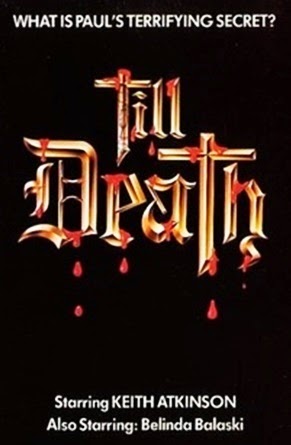
Paul (Keith Atkinson) marries Anne (Belinda Balaski) only to have her perish on their wedding night. When he goes to visit her at her crypt he hears her wails and breaks into her coffin where he finds her to be alive. They spend the rest of the night talking until supernatural events begin to occur, which convinces Paul that things aren’t quite what they seem.

This very low budget film sat on the shelf for 6 years and it was for good reason. It is boring and uneventful and at times down right hokey. The sappy opening title tune is the most horrifying thing about this turkey and has no place in a horror film or any other movie for that matter. The car crash borders on being laughable. There is a shot of Balaski being quite literally swallowed out of the car with an over-the-top panicked expression while Atkinson, with an equally over-the-top panicked expression, tries to save her. The shot is quick and might have passed had it only been shown once, but the director keeps going back to it almost repeatedly until it becomes both corny and annoying.

The second half is about as static as you can get. Atkinson releases Balaski from her crypt and then the two have one long, sterile conversation that goes nowhere.  Since the woman was supposedly thrown from a car one would expect her to be a mangled up mess, but when the coffin gets opened there is not a scratch on her. The payoff for sitting through this thing is nothing as there is no interesting twist of any kind. It’s a dud from start to finish and filled with a lot of clichéd foggy atmosphere that’s supposed to be creepy, but wouldn’t scare a first-grader.

My Rating: 1 out of 10

Released: February 4, 1978

Runtime: 1Hour 20Minutes

Not Rated

Director: Walter Stocker

Studio: Cougar Films

Available: None at this time.

Offerings (1989)

offerings

By Richard Winters

My Rating: 2 out of 10

4-Word Review: Mute killer sends gifts.

As a child John Radley (Richard A. Busewell), who is mute, gets bullied by the neighborhood kids and the only one that befriends him is Gretchen (Loretta Leigh Bowman). Years later after he escapes from the mental institution, where he resides for killing his emotionally abusive mother (Rayette Potts), he returns to the same town while taking revenge on those kids who are now teens by hacking up their bodies and then packaging their body parts into little ‘gifts’ that he sends to Gretchen as a token of the ‘love’ that he feels for her.

Making a successful low budget horror movie requires one to pretty much follow the same formula as Sam Raimi did with The Evil Dead, which is to emphasize the gore, special effects and atmosphere while keeping the pace fast and cerebral. This movie unfortunately proceeds in the exact opposite direction with scenes that go on too long and dialogue that is extraneous. If you cut out all the needless footage and just kept the moments that actually helped propel the story you’d be left with literally only 8 minutes of its otherwise 94 minute runtime.

The murders are few and far between and its cheesy soundtrack is a complete rip-off of Halloween’s. Watching a guy getting his head squeezed inside a vice is the only killing worth catching and even this one isn’t all that great and as it’s seen via a shadow on the wall with apparently a watermelon used in place of an actual head. The film’s humor is equally sporadic and not enough to save what comes off as just another mechanical slasher retread.

There are problems with the killer a well as he’s barely seen and never says anything, which ultimately makes him quite transparent. How he is able to climb an electric fence without being electrocuted or get shot at and still keep walking is never explained. The fact that he has a severely deformed face and moves like a zombie would easily attract other people’s attention and they would report his whereabouts to the police who most likely would have the guy apprehended before he was even a few minutes outside of the mental hospital’s grounds.

There is also a scene where Gretchen and her friend Kacy (Elizabeth Greene) watch a horror movie on TV and they make fun of how ‘dumb’ the victims are in their attempts to escape from their killer even though these women end up doing many of the same stupid things. If you’re going to mock other movies then you better make sure your film is an improvement, which this isn’t.

My Rating: 2 out of 10

Released: October 12, 1989

Runtime: 1Hour 34Minutes

Rated R

Director: Christopher Reynolds

Studio: Arista Films

Available: DVD

Open House (1987)

open-house-1

By Richard Winters

My Rating: 0 out of 10

4-Word Review: Selling homes is murder.

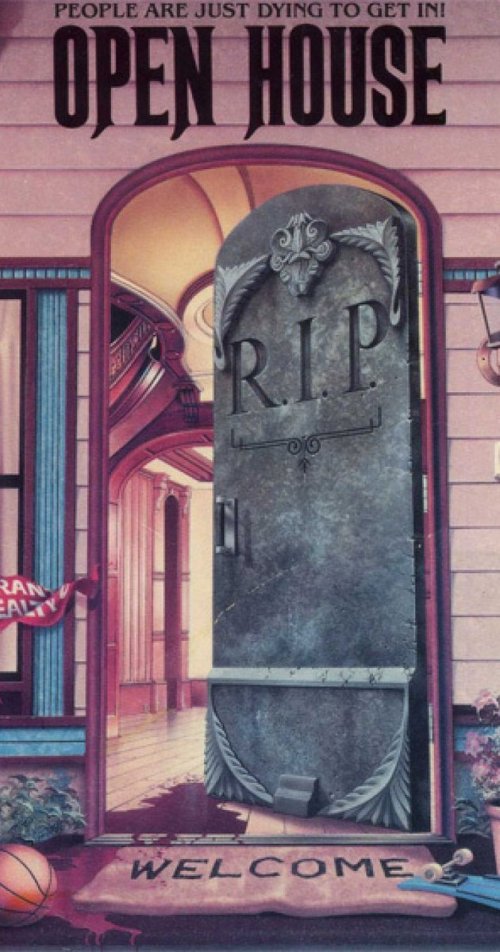
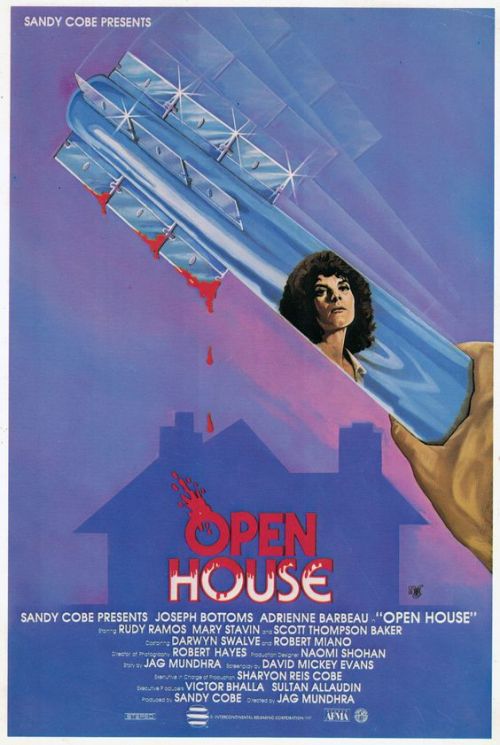
Real Estate agents throughout southern California are turning up dead and no one has a clue as to who’s doing it. Then late night radio talk show host Dr. David Kelley (Joseph Bottoms) starts getting calls from a man who identifies himself as being the killer. David and the police try to track the man’s calls before David’s girlfriend Lisa (Adrienne Barbeau), who just so happens to be a real estate agent herself, becomes the killer’s next victim.

By the late ‘80s slasher films were starting to become more like dark comedies with some of them even being outright parodies, which is what I initially thought this one was going to be. There are some comical touches at the beginning before it completely devolves into the tired old slasher film cliché. No scares or tension and a storyline that plods along at a snail’s pace. The identity of the killer and his backstory is lame and the film’s generic synthesized sounding music score is not a good fit for a horror movie.

Barbeau, who is the former wife of horror director John Carpenter and has done alright starring in films from this genre before, gets stuck with some really bland material here and has little to work with. Apparently she only took the part to help pay for her son’s tuition. Bottoms, whose career never blossomed like his older brother’s, was clearly on the down slide when he took this one and his presence adds nothing.

There’s one good murder involving the killer hacking off the fingers of one of his victim’s with a shot showing the fingers wiggling on the floor before the killer, for whatever reason, puts them into his pocket. The camera also stays locked on the victim’s dead bodies longer than what is usual including having it focus on a dead woman’s corpse hanging by its neck from a rope for what seems like several minutes. I might even give it a point for being the first horror film that has a killer who wears dentures and at one point he even takes them out, but overall this thing lacks imagination or inspiration. It was directed by Jag Mundhra who went on to do a lot of Bollywood films and I don’t think he had a true passion or interest in horror movies as his direction is quite mechanical and the overall production falls agonizingly flat.

open-house-2

My Rating: 0 out of 10

Released: October 1, 1987

Runtime: 1Hour 35Mintues

Rated R

Director: Jag Mundhra

Studio: Intercontinental Releasing Corporation

Available: VHS

Love with the Proper Stranger (1963)

love-with-3

By Richard Winters

My Rating: 6 out of 10

4-Word Review: He gets her pregnant.

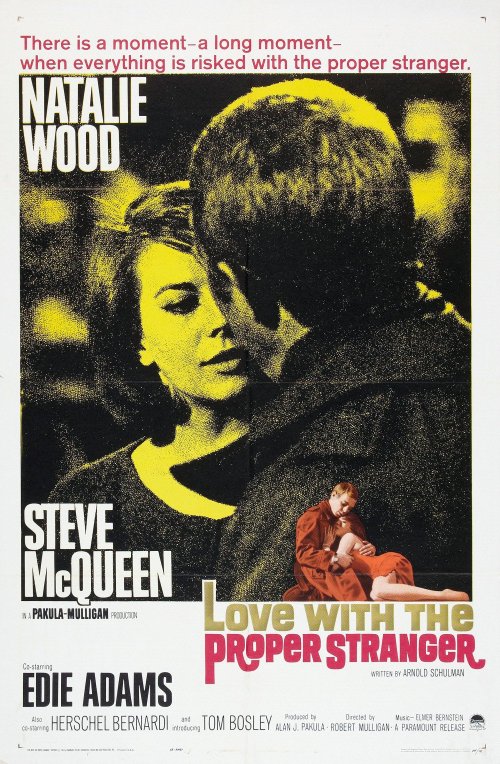
Rocky (Steve McQueen) is a bachelor enjoying his single lifestyle by having one-night-stands with a wide assortment of women while happily avoiding the responsibilities of marriage. Then he meets up with Angie (Natalie Wood) a woman he had sex with months earlier and who now finds herself pregnant. She comes to Rocky hoping that he can help her find a doctor to perform an abortion. Rocky at first barely even remembers her, but then agrees to help her and even offers to pay for half of the costs. Yet as things progress Rocky finds himself beginning to care for Angie and even considers the one thing he thought he’d never do, which is marriage.

The script, by the prolific Arnold Schulman, is certainly edgy for its time and seemed almost groundbreaking and I was surprised it didn’t elicit more controversy especially since it was released to theaters on Christmas day.  The film works for the most part though I was frustrated that we are never shown Rocky’s and Angie’s first meeting. It gets talked about slightly, but there really needed to be a flashback showing how it all came about especially since Angie didn’t seem like the type of woman who would go to bed with a guy so quickly.

Wood gives an outstanding performance and manages to dominate the film even when she’s with McQueen, which was no easy feat. I did find it hard to believe that such a beautiful woman would be stuck having to accept a pudgy, klutzy loser like Anthony (played by Tom Bosley in his film debut) as her only possible suitor. She had told no one else about her pregnancy, so I would think many eligible bachelors would be beating down her door to get at her. The fact that Rocky doesn’t immediately remember her is also absurd. Sure, he may have slept with a lot of women, but nobody no matter how many other sex partners they’ve had would ever forget a gorgeous face like Wood’s.

McQueen’s role almost seems comical especially with his character’s hot-and-cold dealings with Angie and his inability to ever communicate with her effectively. My one caveat was his constant wheezing after climbing several flights of stairs. I realize this was to represent his need to give up cigarettes and in turn the other ‘bad habits’ of his lifestyle, but it got annoying and even distracting to hear.

As a drama/romance it’s okay, but would’ve been better had it been filmed in color. The segments are too drawn out and quite talky, which made me believe that this was originally a stage play, but to my shock it wasn’t even though it probably would’ve fared better there. I was also disappointed at the lack of a suitable wrap-up for Bosley’s character who came off like a major schmuck at first, but then he grows on you as the film progresses.

My Rating: 6 out of 10

Released: December 25, 1963

Runtime: 1Hour 42Minutes

Not Rated

Director: Robert Mulligan

Studio: Paramount

Available: VHS, DVD (Region 0), Amazon Instant Video, YouTube

Going Home (1971)

going-home

By Richard Winters

My Rating: 6 out of 10

4-Word Review: Father and son reunite.

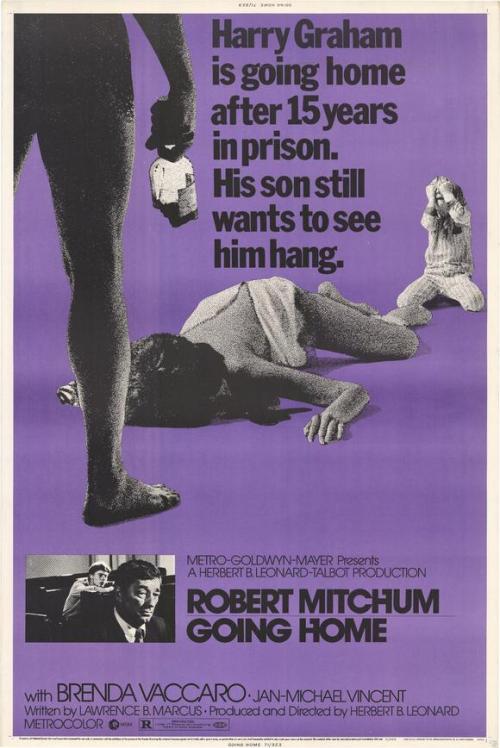
One night during a drunken rage Harry Graham (Robert Mitchum) kills his wife (Sally Kirkland), which gets witnessed by their 7-year-old son Jimmy (Jan-Michael Vincent). 13 years later Harry is paroled and Jimmy uses this opportunity to try and reconcile with his father and find out why he did it, but Harry has moved on. He has a new job and a girlfriend named Jenny (Brenda Vaccaro) and when Jimmy appears it creates an awkward tension that gets progressively worse.

One of the biggest problems with this film is that the characters and their motivations are not fleshed out enough and their actions make little sense. I’ve watched a lot of true-life crime shows and have found that in cases where this situation has occurred in real-life that the adult child will usually cease communication with their father and completely disown them, so it seemed strange why Jimmy would want to restart their relationship. If he was curious to know why Harry did it then he could’ve simply written him a letter with that question, which he never bothered to do while the man was incarcerated.

The film also fails to show what happened to Jimmy during the time Harry was in prison. He is shown arriving at an orphanage, but nothing about what does when he gets there or being put into a foster home and getting adoptive parents, or moving in with relatives, which is what usually occurs. He somehow has no friends or job and if this is because of his childhood trauma then it should get explained or more strongly implied, but it isn’t and it leaves a big void in the story.

Harry’s actions are equally confusing. The murder gets played out at the beginning and we see the stabbed mother crawl down the stairs and beg Jimmy for help and then Harry comes down and looks at the dead body before turning towards the boy with a guilty expression, but if  he feels so bad about what he has just done and the traumatic impact he’s put his son through then he should’ve thought of that beforehand. I would’ve expected to see a completely different set of emotions in the man’s eyes like anger, rage, insanity or even fear because now he knows he’ll will be going to prison, but guilt wouldn’t play into it, at least not that quickly if ever.

Mitchum’s character is straddled with conveying only one emotion throughout, which is guilt. We never tap into the other side of the man that propelled him to commit such a heinous act and his explanation, which is that he ‘just got drunk’ is insufficient. The character also pops up too conveniently at times. One moment is when Jimmy goes back to their former home, which has now been turned into a whorehouse and he hides in the basement. Harry comes looking for him and despite the fact that there are many people there and it’s a large place he immediately goes to the cellar, but how would he have known to look there? Another segment has him magically coming to Jimmy’s rescue when his son is accosted by a group of sailors underneath a boardwalk even though he was bowling in another building and would have no way of knowing what was occurring outside.

The film has solid production values and director Herbert B. Leonard shows flair with the location shooting, which was done in both New Jersey and Pennsylvania. There is also a good scene inside a chicken coop  and actor Josh Mostel (Zero’s son) has an interesting film debut playing Harry’s young, flippant parole officer who delights in demeaning his client as much as possible, but the story leaves open too many unanswered questions and isn’t impactful or relevant.

My Rating: 6 out of 10

Released: December 1, 1971

Runtime: 1Hour 37Minutes

Rated GP

Director: Herbert B. Leonard

Studio: MGM

Available: DVD-R (Warner Archive)

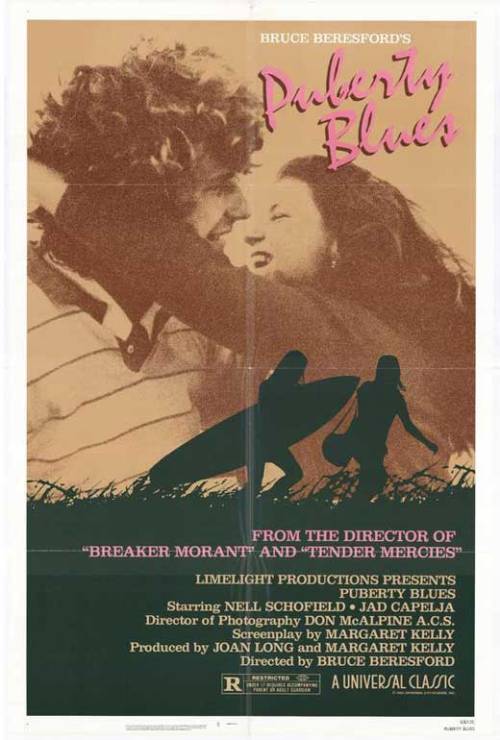
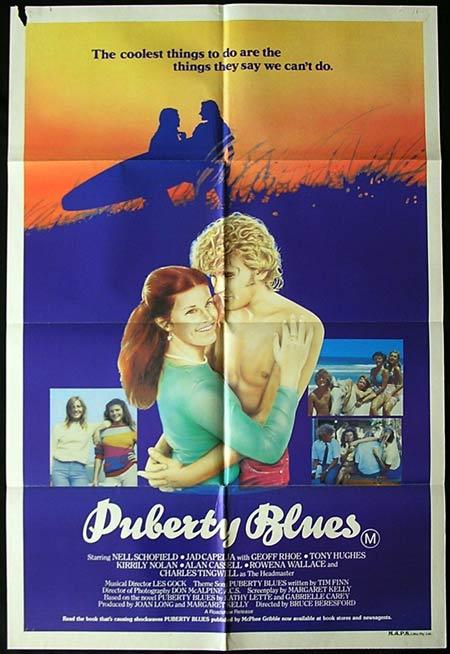
Puberty Blues (1981)

puberty-blues-2

By Richard Winters

My Rating: 6 out of 10

4-Word Review: Girls can surf too!

Debbie and Sue (Nell Schofield, Jad Capelja) are best friends attending high school in the south suburbs of Sydney. They desperately want to fit-in with the surfer group, but find that this means being pressured into having sex and experimenting with drugs and alcohol that starts to take its toll on both their grades and family life. When Debbie thinks she’s gotten pregnant by Gary (Geoff Rhoe) and he responds with indifference she realizes that the surfers aren’t as cool as she thought and pledges to become more independent by trying to do some surfing of her own, which she is told ‘girls can’t do’.

The film is based on the novel by Gabrielle Carey and Kathy Lette who became best friends at age 12 and at 16 began writing stories based on their high school experiences. While attending a writer’s workshop they met Margaret Kelly who worked as a writer in television and was impressed with the girl’s output. She got their stories optioned into a screenplay while the girls went on to write a weekly newspaper column under the byline of The Salami Sisters and their stories were eventually published into a novel. The big change between the movie and the novel is that in the book the girls were only 13 while in the movie it gets upped to 16 since that was Australia’s age of consent.

Director Bruce Beresford ends up tearing away the mystique from teen life in much the same way that he did to suburbia in Don’s Party, which leaves the viewer with a far more caustic take on the high school experience than the Hollywood version, which tends to play up the teen scene like it’s just one big raucous party. Here the cool kids are vapid, crass creatures who are unable to hold any type of interesting conversation. Their parties are lifeless affairs where they aimlessly sit around and get drunk because they have nothing better to do while the sex is shown to be an unpleasant experience for the girls who get pressured into doing it before they’re ready and leave feeling used afterwards.

This was more the way I remembered high school being and I was impressed with the film’s honesty, but the pace is too leisurely and not enough happens. There is some drama when Debbie thinks she is pregnant, but it takes an entire hour just to get there and a comical segment dealing with a goofy fight amongst the surfers, which was not in the book, is completely unnecessary.

The film though does have some funny bits including a scene where Debra brings her boyfriend Bruce (Jay Hackett) over to meet her parents (Kirrilly Nolan, Alan Cassell) as well as the shots showing the interior and exterior of Bruce’s van. This though gets coupled with an uncomfortable moment dealing with a homely girl (Tina Robinson Hansen) who gets tricked into getting into the guy’s van where she is forced into a gang bang before being coldly thrown onto the curb afterwards.

The best part is the ending where the girls grow in confidence and become unafraid at challenging the status quo. Seeing the shocked expressions  of the cool kids as they watch the girls get on surf boards for the first time and succeed at something they were told only guys could do is a treat and makes the rest of the film worth sitting through.

Many years later this movie spawned a TV-series as well as a special that aired in 2012 on Australian TV where Nell Schofield traveled back to the locations where the film was made. Unfortunately her costar Jad Capelja was not present as she had already killed herself in 2010 after spending years battling drug addiction and mental illness.

puberty-blues-1

My Rating: 6 out of 10

Released: December 10, 1981

Runtime: 1Hour 27Minutes

Rated R

Director: Bruce Beresford

Studio: Roadshow Film Distributors

Available: VHS, DVD (Pal Region 0), Blu-ray (Region B/2)