Category Archives: Obscure Movies

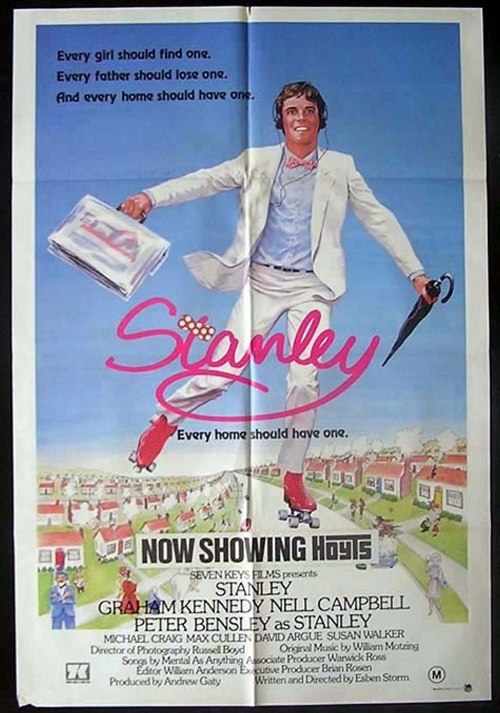
Stanley: Every Home Should Have One (1984)

stanley

By Richard Winters

My Rating: 4 out of 10

4-Word Review: Trying to be normal.

Stanley (Peter Bensley) is a lovable eccentric living on a boat for the past 10 years whose had limited contact with the outside world. His father Sir Stanley (Michael Craig) is a powerful business tycoon who wants his son to take over his company, but after Stanley tries to get the board members to eat dog food his father decides he’s wants his son committed until he can learn to be ‘normal’. Stanley doesn’t want to be put away, so he escapes from his father and moves-in with an adopted suburban family who he hopes can teach him the finer points of normalcy, only to find they are more screwed-up than he is. In the meantime his father hires his butler (Max Cullen), who at one time used to work for the secret service, to track Stanley down and bring him back.

Quirky might be an understatement for this odd comedy with an unusual sense of humor that some viewers might not appreciate, or even get. The script hinges on a lot of non-sequiturs and offbeat situations that are loosely tied together. The emphasis is on odd points-of-view that may appeal to some . For those who are game it kind of works with a fresh indie vibe though by the end it wears itself out.

The main character is likable, but not as unique as he should’ve been. He only acts bizarre at the beginning, but after that becomes pretty normal and only reacts and responds to the goofy people around. The film’s title acts like he’s ‘special’, but really he’s not. In fact Graham Kennedy and Sue Walker, who play the married couple he moves-in with, are far funnier and the movie should’ve centered entirely around them as they’re the only two that get any genuine laughs.

Stanley’s romance with Amy (Nell Campbell), a woman he meets at an employment agency, is a subplot that wasn’t needed. Amy comes-off as cold and prickly and her sister Sheryl (Lorna Lesley) seemed to be a better fit as she conveyed the same wide-eyed optimistic approach to life as Stanley while Amy was the complete opposite. His constant badgering her for a date makes him seem like a creepy stalker who won’t take ‘no’ for answer. Having her eventually cave to Stanley’s unending persistence sends the wrong type of message making it seem like harassment is a ‘good thing’ and can get the other person to eventually ‘fall-in-love’ with them if done right when in reality it almost always leads to a restraining order instead.

The film’s theme is the same as the one in the 60’s cult classic King of Hearts, where the ‘crazy’ people are actually the normal ones while those that are considered ‘normal’ are really screwed-up, but the message here is handled in a heavy-handed way and not particularly insightful. The comedy itself dies-out by the final third culminating in a tired, slapstick chase that doesn’t even include Stanley’s incredibly tiny red car, which was the only interesting element in the film and should’ve been used more for comic effect.

My Rating: 4 out of 10

Released: March 6, 1984

Runtime: 1 Hour 33 Minutes

Not Rated

Director: Esben Storm

Studio: Seven Keys

Available: None
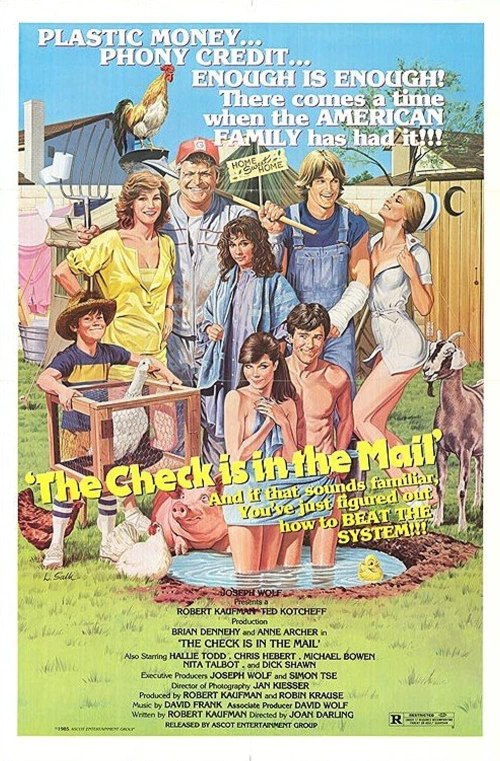
The Check is in the Mail (1986)

check1

By Richard Winters

My Rating: 3 out of 10

4-Word Review: Suburban man drops-out.

Richard (Brian Dennehy) is a married father who’s finding the suburban American Dream not as satisfying as he thought. While he does live a semi-comfortable existence the bills and other demands are making him stressed and he feels the only way to fight it is by dropping-out. He turns his front lawn into a vegetable garden, buys goats and chickens, and even turn-off the electricity. While this gives him some local fame and even a subject of a TV-news report, it does not go-off well with the rest of his family, but Richard, who used to be a social activist during his college days, feels the need to stay the course.

While the film has an interesting premise, the script, which was written by Robert Kaufman, who had success in the early part of his career, but was clearly slumming by this point, goes nowhere. It takes almost 40-minutes in before the dropping-out part even begins and before that meanders around in a lot of loosely related stuff that makes it seem almost like a sketch comedy and not a cohesive story. Certain elements, like Richard’s gambling problems, get glossed over and the film makes no attempt at analyzing anything in any type of realistic way.

With that said there were a few funny bits. The chant that Richard starts and gets others to follow along at an airport is good. Him taking the his car out for a spin in order to test out the supposedly repaired brakes while the forcing the mechanic (Richard Foronjy) to ride along is entertaining too. I also got a kick out of Richard vacationing in Hawaii and sleeping overnight by the pool in order to be able to get a deck chair and how everyone is so desperate to get one and keep it that when a man who cannot swim jumps into the pool no one tries to save him even his own wife for fear they’ll lose their seat. The neighbor’s birthday party, which gets disrupted by Richard’s goats and chickens, who inadvertently raid the place via an open window, is quite funny and the best part of the movie. There are though some really dumb moments like Richard’s wife (Anne Archer) visiting a psychiatrist (Harry Townes) that gets needlessly prolonged, cliched, and not necessary.

Dennehy is likable and while consumers getting upset and losing their temper in public at modern-day inconveniences was a little more socially acceptable then than it is now, as this behavior could get him labled a ‘male Karen’ by today’s standards, he’s able to pull it-off in a way that makes you want to cheer for him instead of judging him as being ‘entitled’. Dick Shawn and Nita Talbot appear late in the film as Dennehy’s neighbors in scenes shot after the main production had wrapped and done by a different director (Ted Kotcheff). While these moments help give energy to a film that otherwise flat-lines, and Shawn even ad-libs, it still would’ve been better had they been introduced earlier.

Dropping-out is certainly something that everyone has secretly thought of at one time or another, but this film doesn’t do it justice. It fails to dig deeply into the subject and misses out on a lot of potentially unique scenarios and insights. The result is a mish-mash of quirky concepts that doesn’t add up to much and fails to makes any type of meaningful, or impactful statement.

My Rating: 3 out of 10

Released: May 2, 1986

Runtime: 1 Hour 22 Minutes

Rated R

Director: Joan Darling, Ted Kotcheff (uncredited)

Studio: Ascot Entertainment Group

Available: VHS

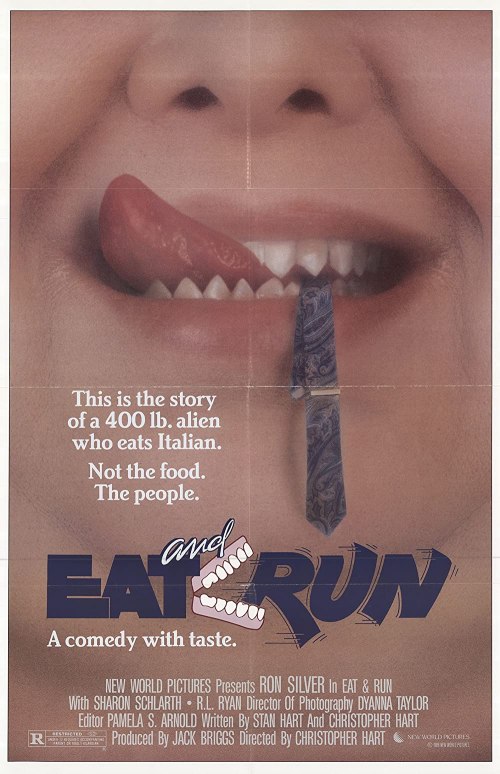
Eat and Run (1987)

eat2

By Richard Winters

My Rating: 2 out of 10

4-Word Review: Alien eats Italian people.

Murray (R.L. Ryan) is a large, bald-headed creature from another planet who begins devouring any Italian person that comes along. This started when he ate some Italian food and liked it so much he decided that the people who made it must be good to eat too. Mickey (Ron Silver) is a police detective trying to find out why so many Italians in the city are disappearing. He begins an affair with Cheryl (Sharon Sharth) a judge who has a propensity of letting criminals off with light sentences. When Mickey arrests the creature it was found-out that his rights were violated when Mickey read him his Miranda warning in English despite the fact that the alien didn’t understand the language, which causes Cheryl to drop all charges against him. She then dumps Mickey for the creature and the two move in together. Their relationship goes well initially until the alien realizes that Cheryl is Italian and thus begins eyeing her as his next meal. Can Mickey save her before she gets eaten?

This is yet another example of an Airplane-wanna-be that mimics the same rapid-fire jokey-style of that film, but was written by those who didn’t have the clever sense of humor of the Zucker brothers to pull it off. This one was done by the father and son team of Stan and Christopher Hart. Stan had spent years writing for ‘Mad’ magazine as well as winning several Emmys for his work on the ‘Carol Burnett Show’, but his humor is dated. I’m okay with some jokes misfiring, but it went 15-minutes in before I even chuckled a little. The gags are quite corny and done with a lack of style or creativity. It also relies on a lot of running jokes, like Mickey’s tendency to narrate the movie while talking to himself, which annoys those around him, which wasn’t funny the first time it happened, and proceeds to get redundant and stupid the more it continues.

The film lacks cohesive logic. I realize this was supposed to be just a silly movie, but the concept should be thought-out at least a little. For instance, where did this alien come from and how did he get here? None of this gets shown, or answered. It’s like the Harts were more concerned with dishing-out lame gags and couldn’t be bothered with the basic foundations for a story. For that matter, why does the alien always spit out the buttons worn on the shirts of his victims after he’s eaten them? Is it because they’re too hard to digest and if so why doesn’t he also spit out their watches and belt buckles as I’d presume they wouldn’t agree with his stomach either.

There’s no special effects to speak of. Normally I’d complain with movies like these that they compromise too much on the gore, but this film doesn’t even attempt to show it. The creature just approaches the victim, exposes his razor sharp teeth, and then the camera cuts away while he eats them, which takes only seconds even though animals that eat large prey can take a long time to chew-up their victims, so having it done so quickly is a cop-out.

I have no idea why Silver would’ve taken on this project as he had already starred-in several Hollywood produced productions, so he didn’t need to do low budget work to make an income. My guess is that he wanted to take a stab at comedy and the Hollywood producers wouldn’t let him, so he had to turn to the indie route to find any takers. The experiment though doesn’t work. Silver just isn’t cut-out to be funny and if anything gets upstaged by the tubby lesser known Ryan who steals each scene he’s in without ever speaking a word of dialogue.

The film’s biggest travesty though is that it features a mime. I was hoping at least that the creature would eat him as retribution to all those who find them universally annoying and yet this stupid movie can’t even do that. Had the mime been killed-off  I would’ve given it higher marks, but when that didn’t happen it cemented this as being a complete dud.

My Rating: 2 out of 10

Released: February 20, 1987

Runtime: 1 Hour 25 Minutes

Rated R

Director: Christopher Hart

Studio: New World Pictures

Available: DVD (Region 4)

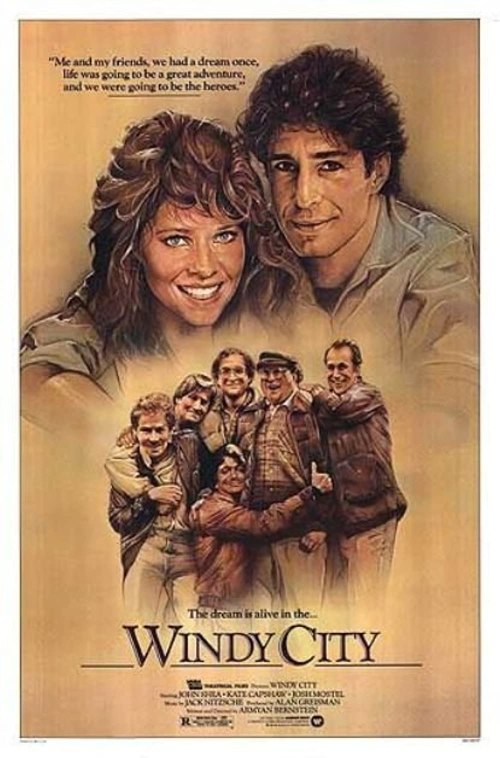
Windy City (1984)

windy1

By Richard Winters

My Rating: 3 out of 10

4-Word Review: Keeping the gang together.

Danny (John Shea) is a struggling writer living in Chicago. When he was young he had big dreams of being a best-selling novelist, but now that he’s older he’s finding adulthood to be a lot tougher than he thought. He’s also broken-up with his longtime girlfriend Emily (Kate Capshaw) and dealing with his best friend Sol (Josh Mostel) who’s dying of leukemia. He wants the gang from childhood to get together one last time and take Sol out on the lake in a sailboat ride and pretend that they are pirates. Sol always fantasized about being one when they were kids and Danny wants to do something special for him before he passes-away, which could be at any time, but the other friends now have family and job obligations to meet and don’t think they’ll be able to make the trip, which Danny finds disappointing.

This was yet another entry in a string of films that came out in the early 80’s dealing with the baby boomers growing out of their 60’s hippie phase and into the less idealistic adulthood years of the 80’s. While none of them were all that great this one ranks at the bottom and a lot of the reason for it is that it’s too shallow. Star Shea, who looks almost exactly like Micheal Ontkean, is a perfect example as he looks like someone snatched off of a model magazine cover and his character displays no faults of any kind. He’s so caring, gracious and generous, which along with his pristine pretty-boy looks, make it almost nauseating. He does have insecurity in regards to his writing, but every writer has this and thus the arguing that culminates from this with his girlfriend becomes quite redundant and doesn’t propel the story.

Maintaining the same clique of friends that you had growing-up isn’t realistic. At least in The Big Chill it analyzed how the member’s of the old college gang had changed and how they weren’t as close as they were and that this was inevitable even though this film acts like somehow it can be overcome, which it can’t. Sol is the only interesting member and the story should’ve been centered around him and maybe one, or two close friends from the old crew that have remained together while the rest moved-on, which would’ve been more authentic. The extra friends don’t add much anyways and respond and say predictable cliched stuff making them more like clutter than anything.

Danny’s relationship with Emily is superficial too and there’s no concrete reason is given, or shown to what caused their break-up. Danny’s inability to move-on from her and the way he snoops into her window late at night would make him a creepy stalker by today’s standards. Having him careen down the streets of Chicago in a desperate attempt to stop her wedding, like in The Graduate, which gets mentioned, is pathetic. I was impressed though when he tries to jump over a drawbridge, which I thought, since this film is so irritatingly romanticized, that he would make, but instead he goes right into the river, which is the best part of the whole movie. ..it’s just a shame he didn’t stay there.

I did enjoy the picturesque scenery of Chicago, but felt there needed to be more of it especially since the city’s nickname is in the film’s title. I did get a kick out of the football game in the park that the guys play. Usually when a bunch of middle-agers get together for a game it’s rather informal, but here they had actual refs and even spectators, which I found amusing. The rest of the movie though is strained and will have many rolling-their-eyes. The best example of this is when Sol tells Danny that he’ll send him sign after he’s dead, in this case blowing Danny’s hat off of his head, so I knew right away when he says this that a scene of Danny’s hat getting blown-off and him looking up into the heaven’s will occur at the very end and sure enough that’s exactly what happens, which makes this film not only rampantly corny, but also painfully predictable though female viewers may rate it more favorably.

My Rating: 3 out of 10

Released: September 21, 1984

Runtime: 1 Hour 43 Minutes

Rated R

Director: Armyan Bernstein

Studio: Warner Brothers

Available: VHS

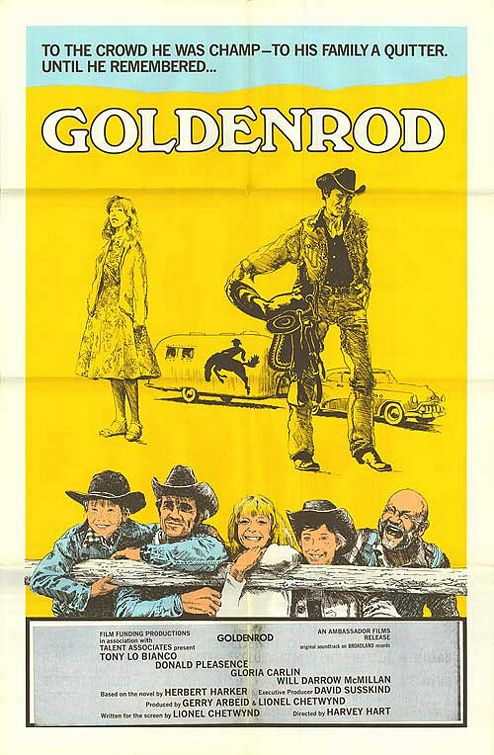
Goldenrod (1976)

goldenrod1

By Richard Winters

My Rating: 4 out of 10

4-Word Review: Injured champ seeks comeback.

Jessie (Tony Lo Bianco) is a successful rodeo rider who’s idolized by his oldest son Ethan (Will Darrow McMillan). His fortunes though take a turn for the worse when he’s seriously injured by a horse who stamps on his hip. Doctors tell him he’ll never be able to ride again, which causes him to become depressed. His wife Shirley (Gloria Carlin) leaves him for another man (Donnelly Rhodes) forcing him to go searching for other employment. After doing odd jobs he finally gets hired by John (Donald Pleasance) a alcoholic who lives alone on a farmstead and promises big things, but delivers little. Jessie’s depression worsens and he even attempts to kill himself, but his son Ethan saves him. Ethan then tells him that he wants to be a rodeo rider, hoping that the money he wins can help get the family back on track, but Jessie worries that Ethan will face the same hardships that he did and tries to talk him out of it, but to no avail.

This Canadian entry, which was filmed on-location in the province of Alberta, and partially shot at the world famous Calgary stampede, works off the same formula as the Canadian classic Goin Down the Road, which focused on two losers with big dreams who get in way over-their-heads. Jessie character is the same way. When he’s winning he’s arrogant and thinks he’s above the common man only to then learn a hard lesson. This type of character arc though isn’t interesting as the viewer shares no emotional connection in the protagonist’s plight and in some ways delights at seeing his misfortune since he was so diluted at the start that it all seems like a good comeuppance to bring him back down-to-earth.

Lo Bianco plays the part surprisingly well being that he was an Italian-American born and raised in Brooklyn, so why the producers felt he’d be a good pick to play a Canadian cowboy is a mystery, but he pulls it off and even manages to speak in a Canadian accent while losing his Italian one that he spoke with in The Honeymoon KillersThe character though is almost cartoonish with a child-like optimism that you’d think by middle-aged would’ve been vanquished. He starts to show some humility towards the end, but more of it should’ve come-out already at the beginning in order to make him appealing and relatable.

The film focuses quite a bit on the wife at the start only to have her disappear and then eventually come back at the very end, but this is too much of a departure and the movie should’ve cut back and forth, at least a little bit, showing how she was getting along with her new hubby while Jessie struggled raising the kids. Also, you’d think if she really loved the kids she’d want to stay in contact with them and not just abandon them, which is how it comes-off. Pleasance, who spent the 70’s dotting-the-globe working on films in three different continents, gets wasted in a role that starts out with potential, but ultimately doesn’t lead to much.

The picturesque scenery is nice, but the benign story doesn’t have anything unique or memorable. The dialogue lacks a conversational quality and used more to help narrate the story and describe what’s going on that in a good film should’ve been shown visually. I was surprised too that it takes place in the 50’s because it wasn’t until halfway through when a poster advertising a rodeo and the date on it is 1953 that I had even became aware of this. Up until then it could’ve easily been the 70’s. The only two things that give it a bit of a period flavor are the older model cars, but since some people like to drive these refurbished vehicles I didn’t consider it a tell-tale sign that it was a bygone decade. There’s also brief shots of the Canadian Red Ensign, which was the Canadian Flag before the Maple Leaf one, which didn’t come into effect until 1965. Otherwise this could’ve easily been a modern day story and probably should’ve been as setting it in the past doesn’t give it any added insight.

My Rating: 4 out of 10

Released: September 22, 1976

Runtime: 1 Hour 37 Minutes

Not Rated

Director: Harvey Hart

Studio: Ambassador Film Distributors

Available: None

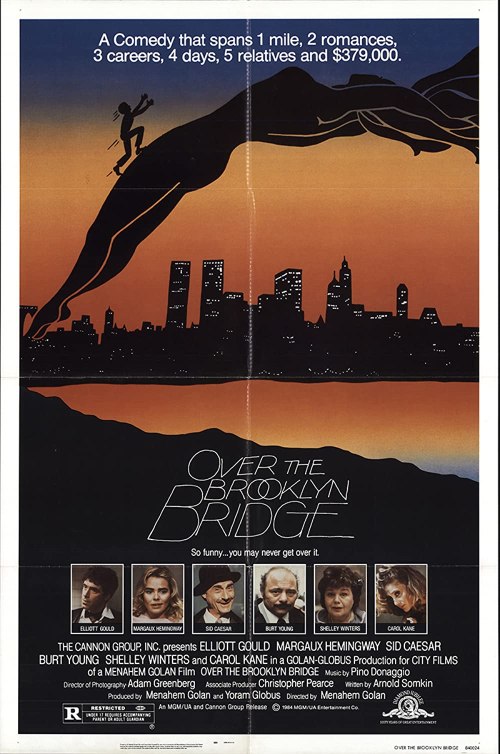
Over the Brooklyn Bridge (1984)

over1

By Richard Winters

My Rating: 3 out of 10

4-Word Review: Hoping to buy restaurant.

Alby (Elliot Gould) is tired of slaving away as a cook at a small Brooklyn diner run by both he and his mother (Shelley Winters). He dreams of owning a swanky restaurant in downtown Manhattan and finds the perfect place, but he needs help with the financing. He goes to his rich uncle Benjamin (Sid Caesar), who at first is reluctant to loan him the needed money, but eventually agrees. However, it comes with one big stipulation; Alby can get the money, but only if he ends his relationship with his live-in girlfriend Elizabeth (Margaux Hemingway), who his uncle has never liked since she’s not Jewish.

From the outset I internally groaned when I saw that it was produced by Cannon Pictures, which was notorious for making a lot of cheesy action flicks during the decade, but this one is approached differently. The script, by Arnold Shulman, who died at the young age of 48 before filming of his screenplay had even begun, is much more personal than the usual Cannon fodder as it delves into the close-knit, extended Jewish family who can be both a source of great support and hindrance.

I was happy too, at least initially, to see Hemingway get another shot at a co-starring role. She was a model, and granddaughter of Ernest Hemingway, who broke into the movie scene with the controversial hit Lipstickwhere she played a rape victim, which was too demanding of a part for someone with so little acting experience. This role here was more reasonable, but without sounding too harsh, I couldn’t stand her voice. Her famous sister Mariel has a very pretty sounding one, so why Margaux got stuck with such an unusually raspy one that belied her otherwise young age I didn’t understand. I know when I watched Lipstickwhich was released 8 years earlier, her voice was only slightly raspy making me believe her smoking caused it to get worse and in my opinion the reason why her onscreen career never took-off.

Gould’s presence doesn’t help either. During the 70’s he was a cinematic counter-culture hero taking it to the establishment, but by the 80’s that persona was no longer in vogue, so he had to settle for benign, nice-guy parts, which is clearly not his forte. He tries hard, and at one point tells-off a few people in semi-classic Gould-style, but for the most part he’s quite boring. His attempt to portray a 36-year-old even though he was actually 45 doesn’t quite work and there’s no explanation for why this frumpy guy with a limited income is able to snare such a young, good-looking babe.

Winters, who seems born to play the meddling, overly-protective Jewish mother, which she did to great success in Next Stop, Greenwich Village, but here her character is too subdued making her presence transparent. Ceasar is a surprise. After his work in the 50’s TV-show ‘Your Show of Shows’ his later parts couldn’t quite match his unique talents, but he scores both on the comedy and drama end here. Carol Kane is a delight as she courts Gould and talks breathlessly about philosophy as she hurriedly walks in a New York subway and then later at her place reveals some very bizarre sexual fetishes. Burt Young has some very funny scenes too as Gould’s cynical friend who doesn’t shy away from expressing his low opinion of marriage.

The story though is too simple for such an a relatively long runtime and by the second-half becomes strained. The idea that Gould had such a great relationship with Hemingway as the movie wants us to believe is dubious as she immediately dumps him the second his uncle tells her to leave him and then callously throws Gould out of the apartment instead of being honest and telling him about her meeting with the uncle and then talking it out like a truly close couple would. Later when Gould, who still doesn’t understand why the break-up happened, calls her to get an explanation and try to make amends, she coldly hangs-up making it seem like he was way more into her than she was into him and thus causing this to be a weak romance instead of a strong one.

My Rating: 3 out of 10

Released: March 2, 1984

Runtime: 1 Hour 43 Minutes

Rated R

Director: Menahem Golan

Studio: Golan-Globus Productions

Available: VHS, DVD-R

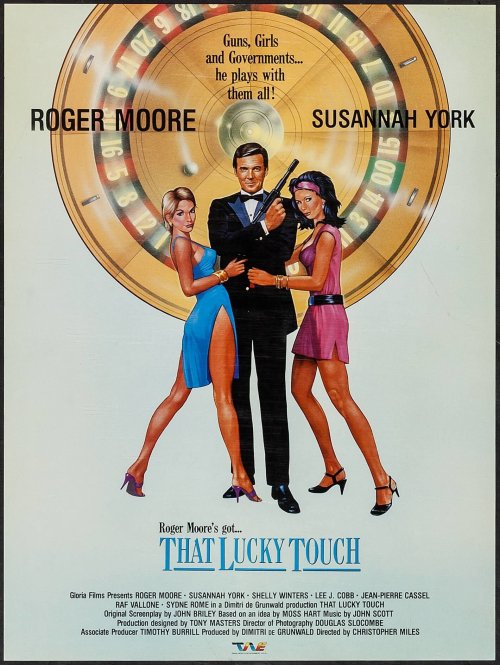
That Lucky Touch (1975)

lucky

By Richard Winters

My Rating: 4 out of 10

4-Word Review: Journalist and arms dealer.

Michael (Roger Moore) is an arms dealer who travels the globe looking for state-of-the-art weapons that he can sell. Julia (Susannah York) is a journalist who writes articles that abhors men who are into guns. The two reside in the same building, but have never met. One night Julia holds a party and while she is seeing her guests out her front door accidentally closes causing her to become locked-out of her apartment. Michael, who is on the outs with his ditzy, live-in girlfriend Sophie (Sydne Rome), decides to use this opportunity to put the moves on Julia. He invites her into his place, so she can call the landlord, but then unplugs the phone, so she’ll think it’s out-of-order and be forced to spend the night. Julia though turns-the-tables by ordering him out on the ledge and into the rainy night while demanding he get into her apartment through an open window. This then begins their love-hate cycle where every time they start to bond one of them finds out something about the other that they hate and thus begin to fight.

While the premise has potential the scenario is poorly plotted and hard to get into though the middle part does have some funny moments. The scene where Lee J. Cobb, who plays an army general, thinks he’s getting an important call from the President, as his red phone is blinking, but instead it’s from his scatterbrained wife, delightfully played by Shelley Winters, is hilarious. The segment dealing with Moore and York trying to get into her apartment is quite good too, but doesn’t get played-out enough as they take a trip to her landlord’s to get the key, but this part is never shown. However, so much time is spent with them trying to find every other way to get inside that I felt we should’ve included this part instead of suddenly cutting away and only implying what happened later.

What I didn’t like was the beginning where the scenes cut back-and-forth between Moore testing out some guns and York typing away without having any idea what they were doing, or why. It’s not until 15-minutes in that it gets revealed that these two live across from each other, which should’ve been established right away. The ending gets botched too as the second-half is spent on the couple, but ends by focusing solely on the secondary characters in an ill-advised screwball finale.

Moore’s acting helps. The glib way that he conveys his acerbic lines are amusing and I came away thinking he was much better in comedy and missed his calling by not doing more of them. York though seems miscast. She’s great in drama, but her comic timing is missing and she’s too hostile to the extent that you start to wonder why Moore’s character would have any interest in her at all. The part was originally intended for Sophia Loren, who would’ve been better and more age appropriate since there was only a few years difference between her and Moore versus the over 10-year gap that he had with York.

The supporting cast is solid especially Winters and Rome, but Cobb is the surprise as he spent his whole career doing dramas, but manages to be the funniest one here and it’s just a shame that this marked his final film appearance, he actually suffered a heart attack during the production. The soundtrack is pleasing too, but the flat script needed better fleshing-out.

My Rating: 4 out of 10

Released: August 7, 1975

Runtime: 1 Hour 33 Minutes

Rated PG

Director: Christopher Miles

Studio: Allied Artists Pictures

Available: DVD (Region 2 Import) DVD-R (dvdlady)

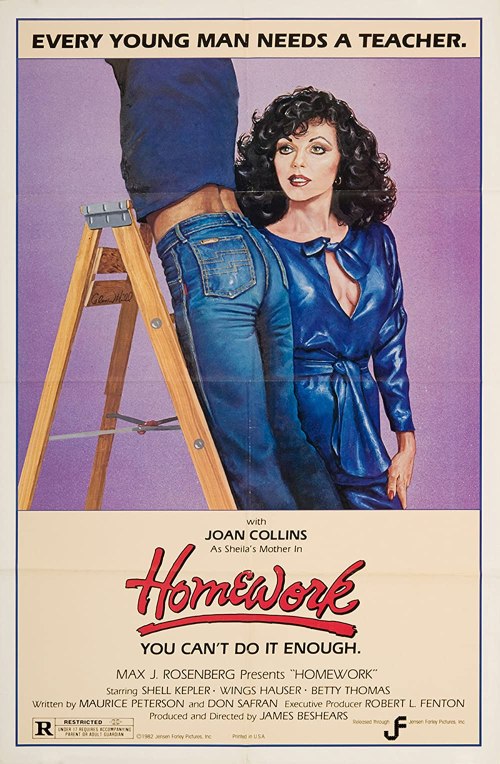
Homework (1982)

homework

By Richard Winters

My Rating: 2 out of 10

4-Word Review: Mother seduces daughter’s friend.

Tommy (Michael Morgan) is a blonde haired teen who hasn’t yet had sex and feels embarrassed about it. To make-up for it he decides to start-up a rock band with his friend Ralph (Lanny Horn). He wants the lead singer to be Sheila (Erin Donovan), but Sheila is too busy working-out in the pool, so she can be a part of the swim team, so he gets Lisa (Shell Kepler). Lisa though is not as talented and seems more interested in getting the attention of rock singer Reddog (Wings Hauser) who would prefer bedding her instead of hearing her sing. Sheila’s mother Diane (Joan Collins) has issues of her own as she’s stuck in a dead-end marriage and feels like the best sex she had was during her younger years. Then Tommy agrees to help her hang a picture in her living room and his youthful body reminds her of the boys she had sex with during her adolescence and she makes a move on Tommy who’s all too happy to oblige.

The most interesting aspect about this production is what occurred off-screen as Collins and her co-stars Lee Purcell and Carrie Snodgrass, as well as Betty Thomas, who has a brief part as Reddog’s secretary, all sued to have their names removed from the credits as they felt the story had been doctored during post production changing the theme in an attempt to become more like Private Lessons and My Tutorwhich had been hits around the same time and both had plots dealing with older women and adolescent boys. Collins though was most upset about the fact that a body double, played by Joy Michael, was brought in to do nude scenes.

For the most part Collins doesn’t really have much to offer except talk to what’s supposedly her husband, who’s never seen and only briefly heard. At one point she calls him George and then later-on she refers to him as Warren. These segments gets mixed-in with scenes of her when she was younger, again played by Joy Michael, and her getting-it-on with guys in the backseat of cars, but despite the nudity these moments are rather boring and don’t add much other than showing how sexually repressed she is now.

Snodgrass barely has any screen-time playing Tommy’s school counselor, which to me seemed a little weird as I would think most guys wouldn’t feel comfortable, nor would women for that matter, talking about their sexual hang-ups with a member of the opposite sex and therefore the part should’ve been played by a man. Purcell is funny as a nervous French teacher, but having her invite male students to her home for after-hours tutoring was ridiculous. The film plays it like she has only innocent intentions, but what kind of sensible grown woman would invite 16 and 17-year-old guys with notoriously raging hormones into her place and not be concerned that they might get the wrong idea, or take advantage of the situation make a move on her, since she lives alone.

The film’s weakest link though is Morgan, who’s too good-looking. This role should’ve been played by a scrawny geek, or a chubby one, with bad acne and thus making his inability to approach women make more sense. Instead with the male model features of Morgan most of the girls would be approaching him and not ignoring him like they do here. His character’s naivety is played-up too much like when he states that by the time kids reach the age of 12 most of them are sexually active, or his belief that his friend Ralph became sexually active at age 7, which is just too dumb to believe anyone would actually think that.

There are a few funny lines, but the story is unfocused and the plot poorly paced. Even with the brief runtime and sexually charged fantasy segments the film still gets quite draggy. The teens are the biggest issue as they’re broad composites rather than three-dimensional people. It’s been awhile since I’ve been in high school, but I don’t remember the kids of the day being quite this wide-eyed. Instead of going-off of their middle-aged presumptions of adolescence the filmmaker’s should’ve interviewed actual high school kids and got their input, which might’ve helped avoid the flat and unconvincing characters that we end-up getting.

My Rating: 2 out of 10

Released: August 27, 1982

Runtime: 1 Hour 29 Minutes

Rated R

Director: James Beshears

Studio: Jensen Farley Productions

Available: VHS

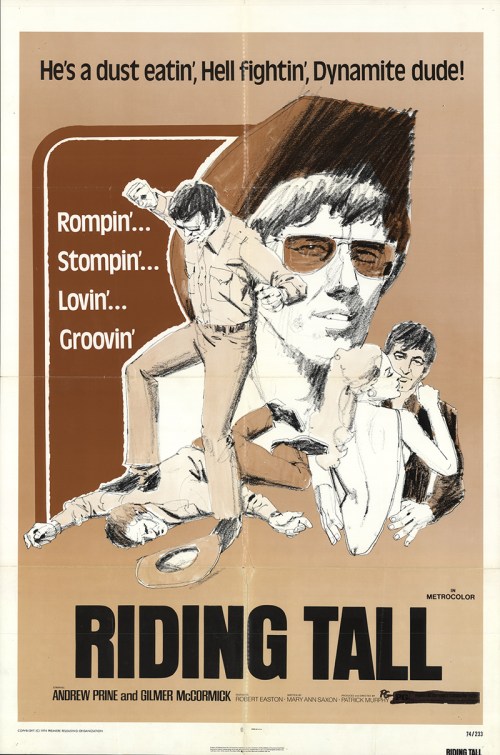
Riding Tall (1972)

riding1

By Richard Winters

My Rating: 4 out of 10

4-Word Review: He can’t stop losing.

Austin Ruth (Andrew Prine) is a rodeo star who hasn’t won a contest in a long while. He’s so down-on-his-luck that the fans routinely boo him as he leaves. He’s so short on cash that he must siphon gas from trucks and drives in a car that forces other passengers to sit on literal springs since he’s too poor to afford seat cushions for his backseat. When his car breaks down he begins walking on the side of the road where he almost gets hit by Chase (Gilmer McCormick) who fell asleep at the wheel. Chase is the preppy daughter from the affluent suburbs who’s running away from her family and their pretensions while also trying to find herself. She has little in common with Austin, but since they’re both alone decide to forge a relationship, but their differing lifestyles, and Austin’s insecurities about his failing life put a damper on their union ever becoming permanent.

This film was released during a period where stories about the modern day rodeo circuit where in seemingly high demand and while some of them like J.W. Coop and Junior Bonner where met with critical praise and box office appeal this one, despite having a CBS Network television broadcast in 1980, has fallen into complete obscurity. Today it’s only known for having been written by Mary Ann Saxon, who was the wife of the late actor John Saxon.

Initially it had a potential. I really like McCormick. Normally I find films that force in a romance that comes out of nowhere to be annoying, but since this guy was having everything working against him I thought he deserved a break and was genuinely interested in seeing the relationship evolve. McCormick is young and cute, but not in the plastic Hollywood sort of way. She also has a great snarky personality, but her character is poorly defined. At one point she angrily snaps at a traffic cop (William Wintersole) and I thought it would be later revealed when she’d be so unusually angry at him, but it never gets explained and seems to simply play-off the fact that because she was young and in college she’d just naturally hate cops, but this is too broad and makes her more of a caricature than a person.

Prine is dull. Granted his character is run-over by life, so it would be expected that he’d mop around, but he still needs to do this in an interesting way, like a good actor would, but he doesn’t. He’s also never shown actually riding a bronco, until the very end. Even if a stunt double needed to be edited in seeing the character actually on an animal riding it, or attempting to stay on it, is needed instead of just a close-up shot of him being bucked high in the air, which was clearly done by having him sit on top of a mechanical bull and looks fake.

There were a couple of amusing moments like when they try to get a hotel room, but the clerk doesn’t want to give them one because she thinks they aren’t married. When Chase states they are the clerk says she doesn’t believe them at which point Chase replies “Why, because we don’t look miserable enough?”. Overall though it just doesn’t click. Not enough happens. A leisurely pace is okay, but there still needs to be some dramatic moments and they never come making this an uneventful and unmemorable viewing experience.

riding2

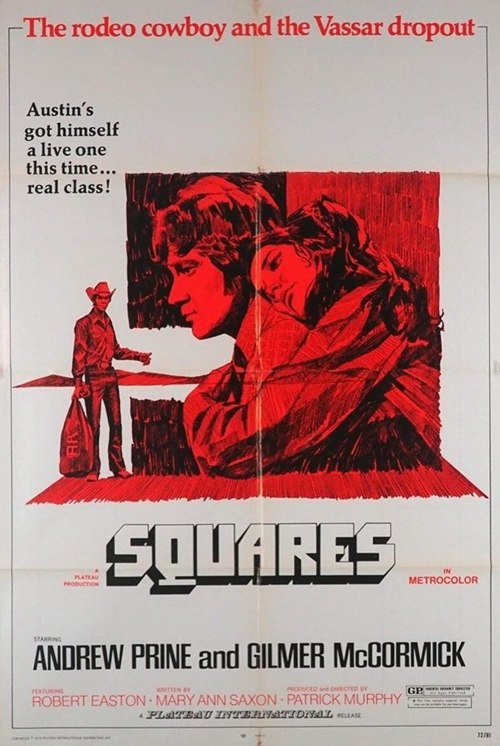
Alternate Title: Squares

Released: January 17, 1972

Runtime: 1 Hour 32 Minutes

Rated GP

Director: Patrick J. Murphy

Studio: Plateau International

Available: None

Deadly Weapon (1989)

deadly weapon1

By Richard Winters

My Rating: 5 out of 10

4-Word Review: Geek acquires lethal laser.

Zeke (Rodney Eastman) is a high school student frequently picked-on by his jock classmates as well as an abusive alcoholic father. As a refuge he imagines that he’s secretly an alien from another planet and writes stories about it. One day he comes upon a military weapon in a river bed near his home that landed there when the train it was being carried on crashed. He takes it home and begins using it to scare away all of those who harassed him and this catches the attention of Traci (Kim Walker) who used to date the jocks, but now finds Zeke and his newfound laser gun far more interesting. However, Lieutenant Dalton (Gary Frank) is the military official assign to retrieve the weapon and he’ll stoop to any low ball tactic to get it back.

This was another Charles Band production who was notorious for making a lot of low budget sci-fi/action flicks during the 80’s/90’s that were of a dubious quality. This was originally intended to be a sequel to Laserblast, a much maligned bottom-of-the-barrel stinker from the 70’s, but budgetary reasons caused them to pull back on that idea and turn it into a separate story. For what it’s worth this is far better than that one and surprisingly has enough of a budget to mask its shortcomings and even comes-off like it could’ve been Hollywood studio produced. There are though some over-the-top moments like a one-eyed vice principal who beats Zeke with a paddle inside his office and a cliched drunken father who acts like a stereotypical hayseed straight out of the local trailer park that made it seem like it either wanted to be a campy comedy, or unintentionally funny, but it’s hard to tell which one.

The script isn’t realistic as the kid is able to open up the crate that houses the gun with his bare hands without having to use a crowbar even though you’d think such a dangerous weapon like this would be packaged more securely and not so easily accessible to just anyone. Zeke is also able to figure out how to operate it much too quickly. Again, such a dangerous weapon should have a safety feature to make it difficult for unauthorized personal to use, such as having to put in a secret code before it’s operational.

The segment where Zeke and Tracy force four men into the trunk of their car and drive around with them as hostages is kind of funny, but the two able to open the trunk door from the outside too easily. If the men are truly locked into the trunk then a key must be placed into the keyhole to open it, but instead they’re able to raise the door open with their hands and not having to bother to unlock it, which means the men inside should then be able to easily kick the door open and escape.

The film is mostly known for the two stars who are more famous for their appearances in two other cult hits. For Eastman his best remembered for playing Joey in the Nightmare on Elm Street series while Walker’s signature role is that of the snotty Heather Chandler in HeathersWalker is the more interesting of the two as she performs her role in a duplicitous fashion where you’re not sure if she’s a genuinely nice person trying to help Zeke, or just a narcissistic brat looking for attention and escape. Her character though is poorly fleshed-out as she sees Zeke blow-up a building with his gun, which scares off the other jocks, one of whom she is dating, but she then invites Zeke into her car, but how would know she could trust him and he wouldn’t use the gun on her? Why too would this beautiful teen be into a geek like Zeke anyways? To have it make more sense she should’ve been a nerd, who had been bullied by the cool kids and now connected with Zeke’s need to ‘get back’ at them.

Spoiler Alert!

The film’s best moment is the ending, which has a surprisingly surreal vibe as Zeke sees the lights of the military vehicles and thinks it’s from the mother ship of some outer space aliens and goes towards it like they’re going to ‘take him home’ and away from earth where he doesn’t feel he belongs. While this intriguing theme has strong similarities to Liquid Sky and Shirley Thompson versus the Aliens it doesn’t fully gel. Had it been approached with a better realized manner of what genre it wanted to be (satire/sci-fi/action/dark comedy) then it might’ve succeeded, but trying to juggle all four genres together gives it a convoluted feel that’s not quite able to cross the finish line and be fully satisfying.

My Rating: 5 out of 10

Released: August 15, 1989

Runtime: 1 Hour 29 Minutes

Rated PG-13

Director: Michael Miner

Studio: Empire Pictures

Available: dvdlady