Category Archives: Mystery

The Verdict (1982)

verdict

By Richard Winters

My Rating: 8 out of 10

4-Word Review: Lawyer makes a comeback.

Frank Galvin (Paul Newman) is a lawyer that has hit rock bottom. He has lost his last four cases and become an alcoholic in the process. His associate Mickey (Jack Warden) hands him what appears to be an open and shut case dealing with a woman who was put into a permanent comatose state after being given the wrong type of anesthesia during the delivery of her child. Both parties are willing to settle out of court and Frank is initially happy to accept the settlement as he is hard up for funds, but after seeing the sad condition of the patient in the hospital he changes his mind.  He becomes convinced that the hospital is trying to hide something, but the other doctors and nurses that where present during the procedure are refusing to talk. He then tracks down the admitting nurse, who was the one person who refused to sign a sworn statement relieving the doctors of any wrong doing. Once he finds her it blows the case wide open.

This marked a turning point in Newman’s career. He was no longer the young, shirtless, virile hero, but now a grey haired, gravely voiced man showing the signs of aging and his roles from then on where all of older characters past their prime. Newman definitely looks tired and washed up and it is so effective that it makes the viewer feel the same way. Yet, he is still able to show the boyish side of his character by way he becomes engrossed with the pinball machine at the bar and getting excited when he achieves a high score.  Newman continues to be one of my favorite actors and his ability to act in a way that seems so effortless never ceases to amaze me. It may seem minor, but I liked when Galvin is forced to take a red-eye flight out of town in order to meet the former admitting nurse (Lindsey Crouse) who has moved to another city, he is shown to be unshaven. Too many times male characters placed in hectic scenarios in most films are clean shaven at all times even when it doesn’t make sense. Yet here Newman’s character isn’t. Being the consummate method actor who was always looking for realism I’m sure he decided to add this extra touch himself. Sometimes what separates the great ones from the average are the little things.

Director Sidney Lumet shows why he is a legend as well. The movie was shot in the late autumn, early winter in Boston. The cold climate and gray skies help accentuate Galvin’s state of mind and stage in life. I remember hearing Lumet state in an interview how he made sure that the color schemes in the entire film where of a dark, brownish color which he felt would reflect the story’s serious tone. In fact the color brown is the one quality I remember most of this film from when I first saw it years ago. I also liked the visual touch Lumet uses of having Frank taking Polaroid pictures of the victim lying motionless in her hospital bed. As the viewer watches the images of the woman on the Polaroids slowly develop it perfectly reflects Galvin’s developing empathy for her. My only quibble is that I wish that Lumet had shown a close-up of the woman so we the viewers could completely take in her sad condition as well. We are only shown the victim from a distance and even then it is never straight on, which doesn’t help us become as upset by her quandary as we should have.

Another thing I appreciated about the script, which was written by David Mamet and based on the novel by Barry Reed who was at one time a practicing attorney, is the fact that is focuses on all the behind-the-scenes tasks that a lawyer must do before the case comes to trial. Most courtroom dramas deal almost exclusively with the trial portion, but here we see how the attorneys prep their clients for questioning and cross-examination. We also take in the process of them interviewing potential jurors, researching legal issues, chasing down witnesses, and even discussing potential strategies with their clients. I found the approach here, as opposed to other legal dramas, to be more thorough, revealing, and satisfying.

The grievances that I had with the film all contain spoilers, so if you are interested in watching this movie then you may want to skip the next two paragraphs.

The first problem I had was with the Lindsay Crouse character who plays the admitting nurse whose bombshell testimony turns the tide of the case in the favor of Galvin’s client. Her scenes are certainly riveting and marked with all the classic ingredients of high drama. Her character states that the admittance sheet that she had filled out that day had been altered by the doctor and that she had the original. Yet neither the viewer nor the jury is shown the original making what she says, as compelling as it may be, seem like hearsay. The judge also orders everything that she said to be stricken from the record and not considered when the jurors come to their final decision. Yet the jurors openly ignore this order and side in Galvin’s favor anyways, which I couldn’t completely buy. I didn’t think all twelve of them would disregard the judge’s order especially when no documentation was ever shown to help verify what the witness stated.

I also did not like the Charlotte Rampling character who plays a woman that Frank meets at a bar and begins to date. She is also paid by the opposing attorney Ed Concannon (James Mason) to spy on Frank and give away all his strategies. I didn’t feel it was necessary to show this, or even bring in the character at all. We are already shown earlier that Concannon is underhanded by the way it is implied that another doctor, who was going to be the star witness for Galvin, was paid off not to testify and then just disappears. Having him go further by using Galvin’s girlfriend as a snitch seemed like over-kill. The movie strives for realism and therefore should keep extreme side-story scenarios like this out of it as I am sure it is not something that occurs every day.

The subject matter is serious and somber. On a dramatic level it is excellent and although some may find it slow and depressing others will appreciate the intelligent script and deliberate pace. It is also an unusually quiet film with long stretches with no dialogue, or music, which is a nice change of pace from most films, which feel it necessary to be loud and noisy, or risk losing the audience’s perceived short attention span.

My Rating: 8 out of 10

Released: December 8, 1982

Runtime: 2Hours 9Minutes

Rated R

Director: Sidney Lumet

Studio: 20th Century Fox

Available: VHS, DVD (2-Disc Collectors Edition), Amazon Instant Video

Body Double (1984)

By Richard Winters

My Rating: 6 out of 10

4-Word Review: Sex through a telescope.

During the 70’s and 80’s director Brian DePalma, a fan of Alfred Hitchcock, made a lot of stylized thrillers using many of Hitchcock’s trademark devices.  He even storyboarded every shot that he did just like Hitch. Unfortunately a lot of these films had rather flimsy plots and characters and were over-directed, drowning out what little story there was. DePalma tried so hard to imitate Hitch that he ended up showing no original vision himself and made the viewer crave even more at seeing a genuine Hitchcock film.  This film, which I first saw when it was released 26 years ago, I felt was the best of DePalma’s Hitchcock imitations. Upon viewing it a second time many years later I found a lot more holes despite one clever twist and some good camerawork.

The story is about Jack Scully (Craig Wasson) who is a struggling out of work actor who is offered a place to stay by a man named Sam (Gregg Henry). The house is a very modernistic place looking almost like the Space Needle in Seattle.  Jack is offered the home on condition that he takes care of the place while Sam is away on business.  During his stay Jack becomes obsessed with the attractive neighbor lady named Gloria Revelle (Deborah Shelton) who he watches through a telescope.  She does an erotic dance in her bedroom each night at the same time while wearing a revealing negligee. The dance itself is not real exciting and would probably bore most people after a minute or two, but Jack becomes hooked on it and watches it endlessly night after night.  Eventually he starts following the woman around during the daytime and even tries to start up a relationship with her. He also begins to notice another man, who is very creepy looking, is also following her and eventually he witnesses him murdering her, but Jack becomes convinced there is more to it.  With the help of a porn star named Holly Body (Melanie Griffith), who he meets along the way, the two set out to try and solve the mystery.

Wasson makes for an incredibly weak male lead. This helps somewhat because the character is very weak, but it is hard for the viewer to relate or care about him.  His best scenes come during his endless auditions and rather thankless treatment he receives from directors, producers, and acting coaches.  These are one of the few scenes that the film gets right as it hits the nail right on the head showing just how degrading working as a low paid, nameless actor can be in Hollywood. The porn star character is also weak as she is too cliched and predictable making her more annoying than anything despite the fact that Griffith plays the part pretty well.  The character was based on real-life porn star Annette Haven who gets listed in the credits as a ‘technical advisor’. I did like Gregg Henry though who makes for a great sleazy villain as well as Dennis Franz in a small, comic relief type role as a brash, stressed-out B-movie director.

The film also has a lot of rather implausible elements that prevents the viewer from getting as involved in it as they should. One of the biggest ones is when Jack sees Holly Body performing in a adult video that he has rented and becomes convinced that she may be connected to the case when he sees her do the same type of dance that the neighbor lady did, so in order to meet up with her he auditions as the male lead in her next X-rated production. Now I’m not completely sure how casting in these productions work, but having some guy with no experience starring and having sex with the industry’s biggest female star at the time seems to be a bit of a stretch. I would also think that a guy who was not used to having sex in front of the camera and with everyone staring at him might get nervous and be unable to ‘perform’ especially in what was still the pre-Viagra age.

The porn scenes themselves aren’t too interesting, or exciting.  This industry is no longer quite as underground, or taboo as it once was, so the shock factor is gone.  The characters and situations are handled in such a placid way that the viewer is given no real insight into the business, or the people who work in it.  The industry has evolved a lot in the past twenty-five years, so the scenes here become irrelevant.

There were a few things that I did like.  The scenes where Jack follows Gloria around in the shopping mall are pretty well handled despite the fact that I think they could have had a little more action here and there also needed to be more customers in the background.  However, the bird’s eye view, which is another patented Hitchcock type shot, showing Jack following Gloria around who is also being followed by the killer is good.  This part also features the one definitive moment from the film that I remembered after all these years.  It involves Gloria throwing away her old panties when she buys some new ones and then having Jack fish through the garbage, retrieve the panties, and put them in his pocket as a sort of ‘souvenir’.

Some of the shots during the actual murder are also really innovative especially the way the camera captures the giant drill, which is the killer’s weapon.  Probably the best shot of the entire film occurs when the killer drives the drill into the victim, which then goes through her body as well as the floorboards and then pops out of the ceiling from the floor below.  Yes, it is rather gory, but I still thought it was a really cool shot anyways.  I also thought the innovative design to the house that Jack stays in had potential, but I wished they had shown a little more of the place from different angles and given us more of a feel of the inside instead of having all the action occur in just one room.

Overall the film is slick, but very shallow and superficial.  The neighbor lady especially seems like a male fantasy.  DePalma gets too hyper with the camera.  I really don’t like his ‘spinning camera’ shots.  He spun it around Jack and Gloria as they kissed and it was tacky and cliched.  Once, in the film Blow Out, he spun the camera around so much in one scene that it started to actually make me feel dizzy and nauseous. The film has a scene during the closing credits showing how a body double is used during a film production, which is amusing and interesting, but a bit out of place for a thriller.  You walk away from the movie wondering how much more entertaining it could have been had Hitchcock himself been able to direct it.

My Rating: 6 out of 10

Released: October 26, 1984

Runtime: 1Hour 54Minutes

Rated R

Director: Brian De Palma

Studio: Columbia Pictures

Available: DVD (Special Widescreen Edition), Amazon Instant Video

A Soldier’s Story (1984)

soldier

By Richard Winters

My Rating: 6 out of 10

4-Word Review: Murder at army base.

This film is based on the off-Broadway play that won the Pulitzer Prize for best drama in 1982 and was written by Charles Fuller. Many of the performers in the play ended up reprising their roles in the film including the stars, Adolph Caesar and Howard E. Rollins, Jr. Director Norman Jewison spent many years trying to get the green light for the project and ended up being rejected by just about every studio. Finally Columbia Pictures gave the go-ahead, but only after Jewison agreed to do it for no salary and all the performers agreed to be paid at the minimum union scale.

The story is actually pretty well written and I’m surprised that so many studio heads refused it by using the excuse that it wasn’t ‘commercial enough.’ The plot involves the murder of a black army sergeant (Caesar) and the subsequent investigation by a black army captain (Rollins) brought in from Washington. The period is around the end of World War II and the setting is an all black army base in the deep South, which leads to many expected racial tensions. What sets this story apart from others of its type is the fact that the racism and underlying tensions is not just white vs. black, but also, and more prominently, black vs. black.

Caesar plays a memorable victim. He is hated by his own men due to his harsh treatment of them. When he is killed everyone is a suspect and as his men recount their dealings with him, it is easy to see why. Yet this is also no one-dimensional character. The story does a very good job of letting us understand why this man has become the way he is. The viewer can’t help but come away feeling sorry for the man and genuinely sad for the way he ended up. The suspects are equally complex, so the film easily becomes quite riveting as it goes along.

Rollins gives an outstanding performance as the head of the investigation. It’s sad that his career, and ultimately his life, was cut short by his drug addiction because he makes a solid impression here. I liked the way he remained stoic throughout despite having to deal with a myriad of different personalities and at times overt racism. Denzel Washington is also very good in a pivotal role.

There were a few things that were thrown in that I felt were not necessary and ended up hurting the film as a whole. One of them is the musical score. It has a very bouncy, ragtime sound to it that would be good if this was a comedy. However, for a drama it seems completely out of place and at times is even jarring. The film has a few musical interludes as well. A couple of them are by Patti LaBelle, who I think is a great singer, but in this film she is out-of-place. It starts to take away too much of the grittiness of the story, which should be the central theme. I also found the use of slow motion to be distracting. It occurs twice. Once during the murder scene and another time during a baseball game between the soldiers.

Overall the film succeeds enough with its story and characters that the viewer is forced to think and feel, which is always a good thing. I can’t say that the resolution was anything shocking, but it does manage to keep you guessing. However, this is one rare case where I might have actually preferred seeing the stage version.

My Rating: 6 out of 10

Released: September 14, 1984

Runtime: 1Hour 41Minutes

Rated PG

Director: Norman Jewison

Studio: Columbia Pictures

Available: DVD, Amazon Instant Video, Netflix Streaming

The Innocents (1961)

innocents 1

By Richard Winters

My Rating: 6 out of 10

4-Word Review: Children frighten their governess.

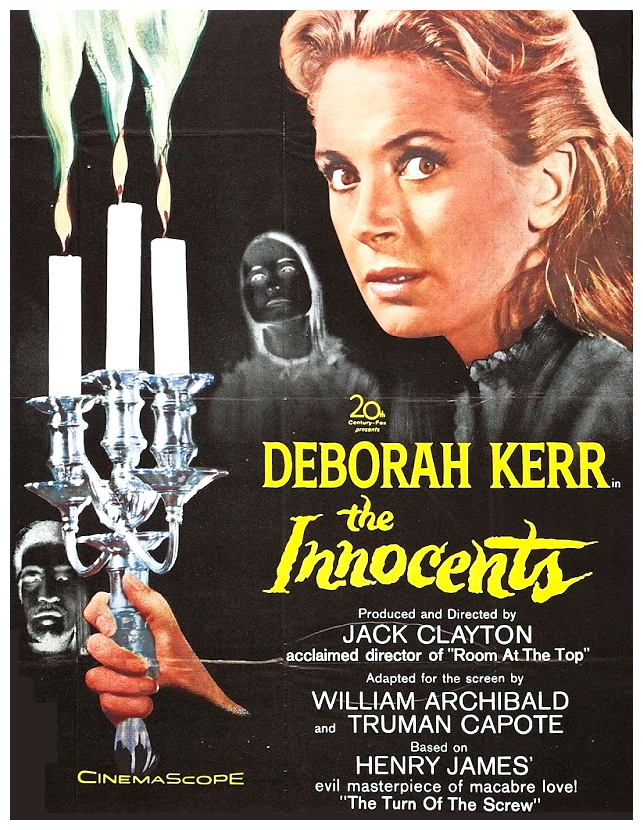
Legendary British actress Deborah Kerr plays Miss Giddens, the governess hired to care for two children at a sprawling English estate. However, the children are not exactly as they seem. Strange occurrences and behaviors begin to manifest as well as several ghostly sightings, which leads Miss Giddens into believing that the children may actually be possessed.

The film is based on the Henry James novel The Turn of the Screw. I have not read the book, but those that have feel this is a pretty satisfying adaptation. I did like the slow, methodical pacing. It helps to build the tension as well as enhance the mystery. Things are revealed in deliberate layers, which kept me intrigued throughout.

Director Jack Clayton shows a marvelous handle on the material.  The estate that they chose for the setting is perfect and captured well in glorious black and white by famed cinematographer Freddie Francis.  There is a lot of spooky imagery throughout including a creepy nightmare sequence in the middle.  The garden with its hulking, strange statues is used quite effectively especially in the haunting finale.  The music also grabs your attention right from the start with a very eerie song that is played before you see a single image on the screen. The song is similar to the one used in Rosemary’s Baby.  In fact there are several things here that reminded me of that film as well as The Shining.

Kerr was a good choice for the increasingly frightened governess.  I loved that scared expression on her face, which becomes progressively more frequent. Yet she is also effective when the character decides to become proactive by taking matters into her own hands and singlehandedly trying to ‘cure’ the children herself.  This also helps make both the character and the story a more multifaceted because you are never sure if this stuff is really happening or all just inside her head.

What really impressed me the most though was the performances of the two children especially Martin Stephens who plays Miles the young boy. His character shifts through many different moods, playing an innocuous child one minute and then a menacing, volatile one the next. He does each one flawlessly and becomes practically mesmerizing in the process.  Pamela Franklin is also fine in the role of Flora. This was her film debut. Eight years later her career would peak playing her signature role as Maggie Smith’s nemesis in The Prime of Miss Jean Brodie.

Another thing that I liked about the children is that they are initially portrayed as being normal and even engaging.  This is unlike other films with a similar theme like Children of the Damned or Children of the Corn where the kids are given creepy features right from the start. Here it works better and is more chilling to the viewer because the children’s dark side is unsuspected.

Unfortunately, despite the film’s impeccable technical quality, I still went away feeling unsatisfied. Part of the problem is that nothing really happens.  The ghosts appear but then do nothing but just stand there, which quickly becomes tiresome. One scene in particular has the camera constantly cutting back to the lady ghost standing across the lake until she starts to look like a mannequin, which I suspect she was.  The buildup is good, but I would have liked more of a payoff.  The ending is much too vague and gives no explanation as to why this was happening, if it was happening, or whatever became of the main character.

I couldn’t help but feel that this story would have worked better as an episode from one of the old horror anthology series like The Alfred Hitchcock Hour or even The Twilight Zone where it could have all been compacted into an hour. A hundred minutes seems like much too long for such little to happen. It is also interesting to note that in 1972 a film came out entitled The Nightcomers starring Marlon Brando that attempts to speculate what happened to the children before the main character of the governess arrives and before James’s original story begins.

My Rating: 6 out of 10

Released: December 25, 1961

Runtime: 1Hour 40Minutes

Rated NR (Not Rated)

Director: Jack Clayton

Studio: 20th Century Fox

Available: VHS, DVD

The Late Show (1977)

By Richard Winters

My Rating: 6 out of 10

4-Word Review: Quirky couple solve mystery.

Ira Wells (Art Carney) is a crusty, old-fashioned detective from a bygone era who has settled down into retirement while renting out a small bedroom in the house of a sweet old lady (Ruth Nelson). One night he is visited by his old friend and fellow detective Harry Reagan (Howard Duff) who has been shot and dies before he can tell him the identity of his killer. Ira makes it a pledge to avenge the death of his friend and bring the killer to justice.  At the funeral he meets a flighty, free-spirited woman by the name of Margo Sperling (Lily Tomlin). She tries to hire Ira to get him to find out who has kidnapped her pet cat and holding him for ransom. Ira initially refuses until he finds out that his friend Harry had been investigating the case before he was shot.

Although billed as a comedy this is really much more of a gritty crime-drama molded as a modern day film noir. I think this is what threw me off when I first saw the film as well as audiences of the time.  With those two leads I was expecting a lot of zaniness especially with the pairing of such divergent characters. There is some subtle humor at times and one instance where Margo drives a van throw the front yards of some houses while escaping the bad guys, but overall the emphasis is really on the characters and the mystery. On this end it is okay. The mystery is intriguing enough to keep you involved and has a few nice twists and an array of weird suspects. Eugene Roche is the most amusing as Ron Birdwell, a man who is constantly trying to sell merchandise that he has stolen and has cluttered throughout his house.

The two lead characters propel the film and are well developed. Both actors play their parts well. I thought this was quite possibly Lily Tomlin’s best performance. It is also one that mostly closely resembles her true personality.  I enjoyed how at first both disdain the other, but then quietly come to appreciate each other and even grow a certain fondness and attachment.  However, I was disappointed that the film did not go further with this.  I thought the characters were highly believable and would have liked to have seen more conclusion as to what happens with their budding friendship. Personally I would have liked the first hour of the movie dealt with the initial case and then had them team up to solve an even more complex one in the second hour. A sequel or series would have been even better as it is certainly a potent premise.

One thing that really impressed me was writer-director Robert Benton’s keen eye for detail even with the little things. Although not always consciously noticed by the average filmgoer, the little things such as lighting, set decoration, and staging can having a very strong effect as to whether the film succeeds, or not.  A good director will always pay close attention to this while the poor one will overlook it, or cut corners. One example of this is Ira’s bedroom, which had the cluttered look most people’s homes have, but most movies fail to effectively recreate, as well as pictures and artifacts from years past that helped explain the character in a visual way. There is also a scene where Ira is doing his laundry at the local Laundromat while Margo talks to him about the case. I thought this was a nice touch as usually movie characters are never shown doing mundane daily tasks even though it is something most regular people have to spend a lot of their time doing. I noticed that he put in his clothes first and then the detergent, which I thought was a mistake. I presumed it was because actor Carney was just going through the motions and not paying attention, but then Margo mentions the error. This might have been an ad-lib on Tomlin’s part, but it is nice that they left it in as it helps accentuate the reality and shows even further how meticulous the detail was. I appreciated the scene involving actor Bill Macy who plays a bartender. Being a recently trained bartender I can attest that he mixed and served the drinks in the correct way, which isn’t always the case in other movies.

The Ira character also wears a hearing aid as did actor Carney in real life. There is one scene where Ira aims his gun and gets ready to shoot at a fleeing suspect, but just before he does he takes out his hearing aid. This makes sense as the loud sound from the blast at such short range would probably destroy the mechanism. The scene is so unusual that they added it into the film’s trailer and actress Tomlin even mentions it when she is interviewed about the film on the Dinah Shore show, which is part of the DVD’s special features. The only quibble I had here was that on the very next shot Ira has the hearing aid back in his ear and I thought it would have been too quick for him to have done that.

The only area where this film fails is in the use of the blood, which is a problem in a lot of movies. Blood is always a very dark red and yet here it is a bright red and looking almost like cherry syrup. When Ira investigates a murder scene he finds a long streak of this bright red stuff going along the carpet that looks quite evident that it was put on with a paint brush.

If you like a mystery that closely resembles the feel and pace of an old Phillip Marlowe case than you may enjoy this. It is technically well made in just about every aspect, but I still went away feeling that the films from the 30’s and 40’s end up doing it better.

My Rating: 6 out of 10

Released: February 10, 1977

Runtime: 1Hour 33Minutes

Rated PG

Director: Robert Benton

Studio: Warner Brothers

Available: VHS, DVD