Category Archives: Movies with Nudity

The Little Girl Who Lives Down the Lane (1976)

By Richard Winters

My Rating: 3 out of 10

4-Word Review: She is all alone.

Rynn (Jodie Foster) is a 13-year-old girl living alone in a big house in the countryside. Her father has leased the place for three years from nosy landlady Mrs. Hallet (Alexis Smith) and her adult son Frank (Martin Sheen) who continually makes lecherous advances towards Rynn. No one has seen her father and when anyone asks for him she comes up with excuses, which starts to make everyone in town suspicious. She meets fellow teen Mario (Scott Jacoby) who she lets in on her secret and the two devise a plan that will rid them of the meddlesome Hallets.

Although she has stated in interviews that this is the least favorite out of all the movies that she has done I can’t think of anyone more perfect for the part of an independent headstrong young woman than Foster, who has always carried that persona. Despite the vast age difference she easily carries the picture from her older co-stars. There is even a nude scene involving her character although it was done by her older sister Connie working as a body double. This was done despite her adamant protests as was a scene where she goes to bed with Jacoby, which she has said made her extremely uncomfortable and probably explains her dislike for the film.

Sheen is menacing as the perverted Frank, who enjoys ‘younger girls’ and his ongoing banter and advances with Rynn is consistently creepy and tense. Alexis Smith is excellent as the mother and her worn face and attitude gives her a witchy presence and it is too bad she couldn’t have remained for the entire movie. I also found Jacoby engaging and amiable and I really enjoyed his character, which I found a bit surprising since he is best known for playing dark, sinister characters in Rivals and the TV-movie Bad Ronald.

The on-location shooting, which was done in both the Canadian province of Quebec and in Maine, is excellent and gives one a nice taste of small town life on the east coast. There is some nice synthesized music that gives the film a dark tone. The premise is offbeat and to some extent, at least during the first half, it is enough to keep you intrigued.

My main issue with the film is the fact that not enough happens. Almost all the action takes place in the main room of the house, which eventually becomes dull, especially visually. There are no scares, or shocks and the twists aren’t all that clever, or surprising. In fact the final twist I saw coming long before it happens. There are times when cutaways would have been helpful and spiced things up particularly when Rynn talks about a visit from her mother and her ‘long red finger nails’, which we never see and is just described. The conclusion leaves A LOT of unanswered questions making this thing empty and incomplete. The final shot is one very long take of a close-up of Foster staring at a subject while the credits role by, which eventually becomes annoying and it would have been better had they done a freeze-frame instead of forcing her to sit and stare at something way longer than humanely possible. Also, composer Mort Shulman is badly miscast as the policeman. His acting abilities are clearly limited and he shows no presence or authority and makes the scenes he is in weak.

It is hard to know what genre to put this in. It is really not scary and the mystery angle has too many loopholes to being taken seriously. The story, based on a novel by Laird Koenig, seems rather tame despite some dark elements and geared more for teens, or young adults.

My Rating: 3 out of 10

Released: December 25, 1976

Runtime: 1Hour 40Minutes

Rated PG (Brief Nudity, Mild Cursing)

Director: Nicholas Gessner

Studio: American International

Available:  VHS, DVD, Netflix Streaming

Harry and Tonto (1974)

harry1

By Richard Winters

My Rating: 6 out of 10

4-Word Review: Old man and cat.

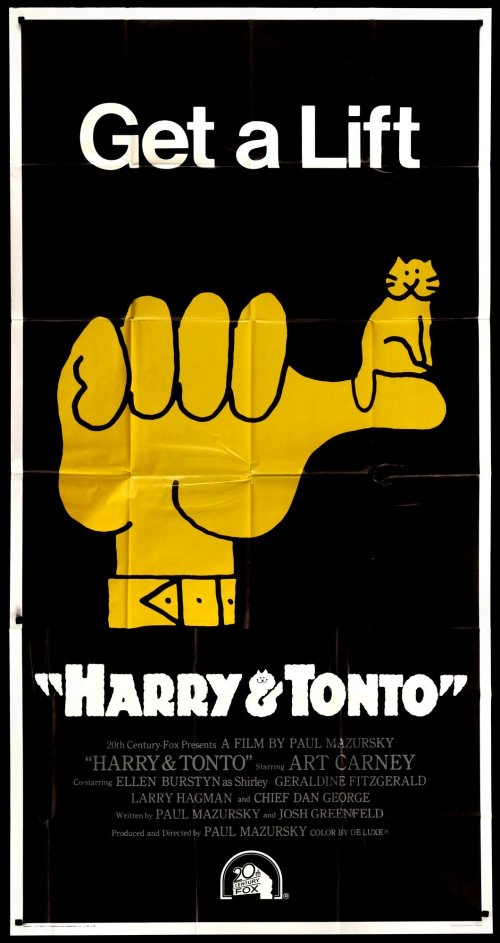
Harry Combes (Art Carney) is a 72 year old retiree living in a small New York apartment with his pet cat Tonto and finds out that the complex is about to be torn down and he must leave. At first he moves in with his son (Phil Bruns) and his family, but it does not work out. He decides to take a cross-country odyssey with his cat where he meets a variety of interesting people in this senior citizen variation of Easy Rider.

One of the great things that sets this film apart from others that deal with aging is that there is no death, dying, illness, or senility here. Instead of learning to adjust to the ending of one’s life, our character instead realizes that old-age is just another stage in a person’s existence and full of new experiences and possibilities. I thought it was cool and interesting how he meets a 15 year old teen girl runaway (Melanie Mayron in her film debut) named Ginger and the two set out to try and find themselves as well as search for life’s answers. They share a lot more in common than one might expect and only prove that life is a continual exploration no matter what stage you are in.

The Harry character is refreshingly laid-back and easy going unlike most elderly characters who tend to be betrayed as stuck in a bygone era. Although he does reminisce about the ‘old days’ with his friends, he does not expound on boring stories of yesteryear with young people, nor act like he has all the answers simply because he is older. He approaches everyone in a non-judgmental way that allows each person he meets to be themselves. He proves to be a lot more flexible and open-minded than the other, younger adults in the film including his own children.

There were only a few scenes involving the Harry character that I didn’t like. One is when he refuses to leave his apartment even as the wrecking ball crew stands outside. The police end up having to be carry him out while he still seats in his favorite chair, which seemed forced and unrealistic. There is another scene where he is at the airport ready to board a plane, but he refuses to allow, for no particular reason, the security to search the cage that has his cat in it even though it is accepted procedure.  This may have been writer-director Paul Mazursky’s way of showing that Harry could at times be set in his ways, but to me it went beyond being simply stubborn and more into the irrational and was not consistent with his behavior in the rest of the film.

The script has a lot of amusing and even touching slice-of-life vignettes as well as characters that are quirky, but not absurd.  The scene with Harry meeting an old Indian medicine man named Sam Two Feathers that is played by elderly Indian actor Chief Dan George is well handled. George had no formal acting training, but his raw delivery is an inviting change of pace.  I also enjoyed at the very end when he meets a woman with a bounty of pet cats that his played by comedian Lenny Bruce’s mother. Again, she had no acting training, but the scene captures her natural out-going personality and it is fun.

I felt Phil Bruns gave an outstanding and overlooked performance as Harry’s older son Burt.  The constant nervous and stressed-out expression on his face seemed to be a perfect composite of the middle-aged suburban male that is overrun with job demands and family responsibilities.  Larry Hagman is good as well in a brief, but memorable appearance as Harry’s other son Eddie. He spends the first part of his visit with Harry trying to impress him with how ‘good’ things are going only to end up breaking down when it becomes painfully obvious that he is desperate and broke.  Even director Mazursky gives himself a cameo as a gay prostitute who makes a pass at Harry.

If the film has any faults it is the fact that it is too amiable. I would have liked to have seen a little bit more action and comic misadventure. I thought it could have been funny and intriguing to see Harry inside a hippie commune, which is where he takes his two teen passengers. Instead he lets them off without going himself, which seemed like a missed opportunity.  There is another part where he inadvertently hitches a ride with a high-priced hooker (Barbra Rhoades) who immediately starts to get ‘horny’ when he Harry gets in. She drives the car off the road and parks it in the middle of the dessert and then the film cuts away. I think this could have been hilarious had this scene been extended. I was also disappointed that the very talented Ellen Burstyn is seen only briefly playing Harry’s daughter Shirley. This was even more of a shame because Burstyn gets cast against type here playing a character that is rather edgy and opinionated and there was strong potential for some good drama.

There are a few extended conversations where Harry discusses with some of his old friends their inability to perform sexually and how they hadn’t had sex for well over twenty years.  With the advent of Viagra, a product that was invented and manufactured right here in good old Indianapolis, these types of topics are no longer as relevant and make the film seem dated.

Of course the one thing that holds it all together and propels the movie from beginning to end is the outstanding Oscar winning performance of Carney, who until then was best known as the comic side-kick Ed Norton from the classic series The Honeymooners. Although he seemed perfect for the part he was not the Producers first choice and had to lobby hard to the get the role.  He was actually only 55 years old when the film was made and to help compensate he openly wore his hearing aid, which gets shown a lot, as well as dying his hair gray.

His win on Oscar night in 1974 became an historic upset. He was going up against very stiff competition that night including Dustin Hoffman for Lenny, Jack Nicholson for Chinatown, and Al Pacino for The Godfather Part 2. When Carney’s name gets called the look of shock on his face is very apparent as even he was not expecting it.  The moment is worth a look and can be seen on YouTube for those who are interested.

My Rating: 6 out of 10

Released: August 12, 1974

Runtime: 1Hour 55Minutes

Rated R

Director: Paul Mazursky

Studio: 20th Century Fox

Available: VHS, DVD

Dona Flor and Her Two Husbands (1976)

dona1

By Richard Winters

My Rating: 6 out of 10

4-Word Review: One is not enough.

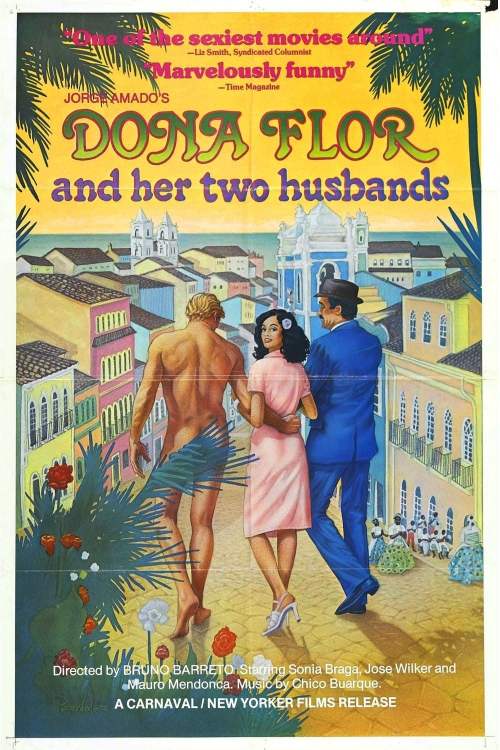
This is an oddly structured Brazilian film that became a world-wide hit due to its explicit, edgy storyline.  It details the account of a woman named Dona Flor (Sonia Braga) whose first husband Valdomiro (Jose Wilker), was a bit on the wild side. After gambling away all of their money he dies. She becomes determined not to make the same mistake twice, so she remarries another man who is a doctor (Mauro Mendonca) and a much more responsible mate, but also stiff and boring. Problems ensue when the first husband, who she misses because he was more erotic and exciting in bed, comes back in the form of a ghost who only she can see.

The movie on a whole is well made. The characters are all likable and the theme music, which is played throughout the film, is appealing. The on location shooting is also quite distinctive. It really gives you a genuine, rare flavor of a small Brazil village and the people who inhabit them.

My main complaint with the film is that it takes the entire first hour just too illustrate her marriage with her first husband and the second hour to show her mourning and eventual remarriage. It’s not until the FINAL FIFTEEN MINUTES that the scenario the whole film is based on actually happens. When it does it is lively and funny, but the majority of the movie is surprisingly low key and melodramatic. The highly touted sex scenes are overrated. They are too brief and spread out very thinly.

Braga does well in her star making vehicle. She is able to convey both a simple, sweet nature as well as a sultry, sensual one. She has a pretty face and really does look great naked.

My Rating: 6 out of 10

Released: November 22, 1976

Runtime: 1Hour 50Minutes

Rated R

Director: Bruno Barreto

Studio: Embrafilme

Available: VHS, DVD (Director’s Cut)

Bye Bye Brazil (1980)

By Richard Winters

My Rating: 6 out of 10

4-Word Review: Entertainers traveling throughout Brazil.

This movie is a slightly surreal comedy-drama detailing a caravan of five entertainers who travel the Brazilian countryside putting on vaudeville like shows underneath a makeshift tent.  The film works in a vignette style as it analyzes the many scenarios and difficulties that the group encounters as well as making a very strong statement to the poverty and hardships befallen on the townspeople that they meet. In fact if there is one lasting image that the film gives it is that one.

The story is pretty much character driven and the characters are all by and large highly amoral. They reflect the desperation of their audiences, which they quietly hope someday to rise above, but never do.  There are a few fleeting moments where they amazingly and surprisingly decide ‘to do the right thing’, which ends up being the film’s most memorable scenes, but most of the time they are ‘rough around the edges’ and the viewer is forced to appreciate them with all their frailties brightly exposed.

Jose Wilker plays Lorde Cigano who is the leader of the group and a lifelong con-man. He closely resembles character actor Stuart Margolin, who was famous for playing the character of Angel on the classic 70’s series The Rockford Files where he was always trying one amusing scheme after another and the character here works in much the same way. He has a few good lines as well as a funny running gag where he displays obscene toys to attractive woman he meets in order to ‘turn them on’.

Betty Faria plays Salome who does erotic dances during their performances.  She lies and cheats as much as Lorde and is more than willing to fall back to being a prostitute whenever the group is in need of money. Although she does have a few nude scenes she is really not all that attractive, or young, as she was already hitting 40 at the time that the film was made.  However, her worn looking face does help accentuate the hardened lifestyle of the character. Her best scene is when she is ‘servicing’ one of her clients who is a fat, balding middle-aged man who expounds the entire time they are having sex about the many virtues of his wife.

Fabio Junior plays Cico the young man who joins the group because he feels it is a chance to escape the sad existence of a peasant farmer only to find that life on the road can be in many ways just as grueling and thankless. Junior is a famous singer in Brazil and his chiseled, boyish good looks didn’t seem to be a realistic fit for the impoverished farm family that his character came from in the movie.  He shows no concern for his pregnant wife and spends the entire time trying to seduce Salome, which makes him irritating and unlikable.  I did though like the fact that he was the one character who evolved and became introspective at the end.

The character of Daso, which is played by actress Zaira Zambelli and is Fabio’s wife, was a bit frustrating. The film makes it clear that she is aware that Fabio is fooling around with Salome and she doesn’t seem to care. She also excitedly jumps into becoming a prostitute at her husband’s insisting when the group falls on hard times. However, I wanted more explanation, or history given to the character to help understand this, but the story does not supply any.

I was also disappointed with the handling of the Swallow character who performs feats of strength during their productions as well as acting as the group’s driver. Swallow is mute, but easily is the most likable and durable, but he runs away half-way through the picture and never returns. I would have liked the character to have stayed during the entire duration as he helped give balance to the others, or at the very least some detail to his eventual fate.

The film becomes almost a like a Brazilian travelogue as the viewer encounters everything from the small dessert towns, to the exotic rain forests. However, the budget was clearly low and I didn’t feel the cinematography captured the majestic essence of the landscape as much as it could’ve, or as I had expected. The story and situations are not all that unique, or creative, but it stays nicely amiable throughout.  The funniest part of the whole film may actually be the lyrics of the song that is sung at the very end during the closing credits. This is not a great movie, but not a bad one either.

My Rating: 6 out of 10

Released: February 9, 1980

Runtime: 1Hour 40Minutes

Rated R

Director: Carlos Diegues

Studio: Carnaval Unifilm

Available: VHS, DVD

Re-Animator (1985)

re animator

By Richard Winters

My Rating: 7 out of 10

4-Word Review: The dead come back.

Daniel Cain (Bruce Abbott) is a student at a nearby medical college who decides to take in as a roommate a foreign student named Herbert West (Jeffrey Combs). West seems a bit anti-social and very intense about his work. He sets up a lab in Cain’s basement where he does experiments to bring back the dead by injecting them with his specially formulated serum. He starts with animals, which makes it intriguing enough for Cain to get in on it, but when they start to move onto cadavers at the school’s medical lab things spiral out of control.

Compared to most low-budget horror films of the 80’s, and I have seen many, this thing is nicely compact and well-paced. There is none of that extraneous dialogue and needlessly slow, drawn out scenes before you can get to any type of action, or horror. It grabs your attention right away with a clever, whimsical opening sequence and a musical score that although does sound similar to the one used in Psycho is still quite effective.

The gory special effects are excellent even when compared by today’s standards. Normally I have no problem watching these things no matter how high the gore factor is, but the scene where the instructor peels the skin off the head of one his cadavers during a class lecture and then cuts through the bone of the skull and takes out his brain had me feeling a bit queasy. The best part comes when Dr. Carl Hill (David Gale) gets his head chopped off at the end of a shovel, which is again well-done, and then has both his body and head injected with the serum. The scenes involving the headless body walking around while carrying this talking head are creepy, hilarious, and highly effective. It is realistically enough looking during a couple of sequences that it had me sitting there wondering how they pulled it off. My only quibble in this area would be the part where West reincarnates a cat that comes back to life and turns homicidal.  It is very clear that this ‘killer cat’ is nothing more than a stuffed animal as its fur looks fake and the body is unrealistically thin.

The film is directed by first-timer Stuart Gordon whose only claim to fame before this was when he was a student at the University of Wisconsin in 1969 and he brought in an audience into an auditorium to watch a play he had written and then locked the doors so they couldn’t get out. He intentionally made the play as boring and annoying as possible just to see how long it would take them to rise from their seats and clamor to be let out. Although this was enough to get him expelled I still admire the guy’s panache. That same type of snarky humor is evident here and woven in, in a way that nicely balances the horror. My favorite scene here, and one that I remember most distinctly from when I first saw it back in the 80’s, is when Dan meets his girlfriend Megan (Barbara Crampton) in the school’s hallway. He starts to kiss her passionately and she feels embarrassed and tells him ‘no, no, no’ and then it quickly cuts to show them in bed where she is saying ‘yes, yes, yes’.

Another thing that differentiates this from other low-budget horror films is the fact that the lead characters are not as bland as usual. I liked the way Dan has a moral quandary and teams up with West on some of his experiments. Both Dan and Megan are better fleshed out as characters and believable. Crampton also looks gorgeous and has a good nude sequence at the end.

Kudos must also go to Robert Sampson an actor who has worked steadily since the 1950’s, but has never become a household name. He plays Dean Halsey father of Meagan and his part takes off after he is accidently killed and brought back to life with Herbert’s serum where he turns into a mumbling, crazed lunatic. This isn’t as easy to pull off as you may think and his catatonic stares are fabulous.

David Gale deserves mention as well playing the evil doctor. His pale skin and sullen face make him look like he is dead from the very beginning and he has the perfect look for a horror film. He clearly relishes his role and hams it up nicely. He started to garner a large cult following after his performance here and offers to play similar roles in other horror films began to pour in when he unexpectedly died in 1991.

The only performance I really didn’t like was that of Jeffrey Combs. I know he has pretty much become the face of the Re-Animator franchise, but this guy seemed hammy without ever being amusing, or funny with it. I didn’t like the square, metal rim glasses that he wore as they were much too typical.  An eccentric character should wear eccentric looking glasses and attire to help accentuate his off-beat personality. I also didn’t dig his accent that seemed to waver between Bavarian, German, Russian, and some weird variant in between.

If you are looking for something different this Halloween then I suggest checking this one out. It has just the right amount of ingredients to be both entertaining and scary at the same time and it can still easily hold-up with today’s jaded viewers.

My Rating 7 out of 10

Released: October 18, 1985

Runtime: 1Hour 26Minutes

Rated R

Director: Stuart Gordon

Studio: Empire Pictures

Available: VHS, DVD, Blu-ray

The Bedroom Window (1987)

bedroom

By Richard Winters

My Rating: 7 out of 10

4-Word Review: What did she see?

Terry Lambert (Steve Guttenberg) is having an affair with Sylvia (Isabelle Huppert) the wife of his boss. The two go back to his apartment one night after an office party to engage in sex. In the middle of the night Terry gets up to go to the bathroom and this is when Sylvia is awakened by a scream coming from outside the bedroom window.  She goes to the window and sees a young woman struggling with a man on the sidewalk. When Sylvia opens the window the man runs away and by the time Terry gets there everyone is gone. The next day Terry reads in the paper about a similar murder to a woman that occurred later that night just a couple of blocks down the street. He is convinced there is a connection and that he should report the incident that Sylvia saw. In order to keep the affair a secret he decides to act as the witness and simply relay whatever Sylvia told him. However, in classic Hitchcock style things quickly spiral out of control and Terry soon finds himself in deep trouble.

Overall, this film is highly entertaining from beginning to end and a terrific Hitchcock imitation that should please even his devotees. However, Guttenberg as the lead seemed, at least initially, to be a poor choice.  The guy has always seemed very bland to me and has never shown any real type of strong onscreen presence. I could not buy into the idea that this guy would be cocky and shrewd enough to have sex with his boss’s wife right under his boss’s nose as Guttenberg seems to convey a very wide-eyed persona and looks like someone who is still in puberty and speaks in a high pitched voice. I did soften my stance on this as the story progressed simply because it would take an extraordinarily naïve person to get themselves into the mess that this character does and in that regard Guttenberg fits the bill perfectly.

His two female costars outshine him badly. Huppert is excellent as usual and may very well be one of the top five actresses alive today. I loved how her character starts out as kind and supportive, but eventually devolves into being cold and conniving. Huppert of course pulls this off almost effortlessly. She also looks great naked and has a pretty good nude scene, both front and back, when she is shown looking out the window.

Elizabeth McGovern, who plays Denise the waitress that Sylvia sees getting attacked, does a fine job as well. As Terry gets more involved with the case the two start to hook-up and end up making, dare I say, a cute couple. I did not like McGovern’s overly heavy Eastern accent that sounded too Bostonian to me even though the story takes place in Baltimore.

Bald, eccentric character actor Wallace Shawn, best known for his roles in My Dinner with Andre and Vanya on 42nd Street is terrific as the defense attorney. His clever cross-examining of Terry during the courtroom scene is a classic.

Curtis Hanson’s direction and script is what really makes this thing gel. The story is based off of a novel by Anne Holden and it manages to stay plausible and believable throughout. The direction is compact without the unnecessary flamboyance that can sometimes take away from the action. The pacing is good as it grabs you right away and holds you in throughout without any slow spots. The twists are well plotted and for the most part surprising. I also thought his recreating of a bar atmosphere at both the trendy nightclub and later at a small neighborhood pub was right on target. I liked that the story took place in Baltimore because outside of John Waters that seems to be a forgotten city in most movies. Hanson uses this setting to make some nice directorial touches like having a bar called The Nevermore with a mural of Edgar Allen Poe and there is even shot of a birthday cake with icing made to look like a raven.

Kevin Williamson is set to do a remake of this film and I will be intrigued to see it. Not that this version was bad because it certainly wasn’t, but a bigger budget and a better male lead could help improve what is already a sound plot.

My Rating: 7 out of 10

Released: January 16, 1987

Runtime: 1Hour 52Minutes

Rated R

Director: Curtis Hanson

Studio: 20th Century Fox

Available: VHS, DVD, Amazon Instant Video

Mixed Company (1974)

By Richard Winters

My Rating: 3 out of 10

4-Word Review: Racist coach adopts kids.

Kathy Morrison (Barbra Harris) works at an adoption agency that specializes in placing minority children into stable homes. Although she already has three children of her own, she comes under pressure to ‘practice what she preaches’ and adopt one herself. Her husband Pete (Joseph Bologna) is the head coach of the Phoenix Suns basketball team who are in amidst of a very long losing streak. He is reticent to the idea as he feels he will soon be fired and also harbors certain latent racist feelings. However, when it is found that they can longer conceive a child of their own due to him suffering from the mumps, they decide to go ahead with the idea. At first they adopt a young African American boy and eventually add a Vietnamese girl and an Indian boy.

The film was written and directed by Melville Shavelson, who only six years earlier had done the successful Yours, Mine, and Ours about a widow woman with eight children marrying a widower with ten. Clearly he was trying to go back to the same well, but the concept is uninspired and forced. The plot is too simple and formulaic. I sat through the whole thing feeling like I had seen it all somewhere else before. There is some snappy dialogue at the beginning, but it quickly runs out of gas. The pacing is poor and it plods along with no real momentum or cohesion.  The lighting is flat and the action is captured like it was made for a TV sitcom instead of the big screen.

The children deliver their lines in a robotic fashion and the script gives them little that is clever, or interesting to say. I did like the six year old Indian boy named Joe (Stephan Honanie) who is cute and precocious, but he does have a propensity to pick his nose and there is one icky scene where he appears to eat what he has picked out of it. The film did generate some controversy at the time of its release for featuring the kids swearing, but this amounts to nothing more than a few ‘damns’ here and there. I kind of liked the fact that the kids weren’t portrayed as complete wide-eyed innocents and their salty behavior seemed realistic, but the problems and issues that they deal with are highly contrived.

Joseph Bologna is a standout. His brash, flippant, hard-edged persona is terrific and fun. It is the one thing that holds the movie together and keeps it from being a complete bore.

The basketball sequences are clearly staged. They do edit in some actual footage, but it’s done on a different film stock, which is distracting. I think the one thing that really bugged me in this area is that Pete eventually gets fired as the coach due to the team’s continual losing. Yet, only a few days later the owner of the team comes back and begs him to return. Besides being a movie fan I am also an avid sports follower and I can attest that this has never happened. Yes, sometimes a coach is fired and then many years later he can return to coaching the same team, but that is usually because it is under different management and it is rare. There was also New York Yankees owner George Steinbrenner who hired and fired manager Billy Martin a total of five different times, but that was an extreme anomaly and he never rehired him after just a few games. I know movies and especially TV-shows never want to show our favorite characters getting fired and STAYING fired even though it happens to real people all the time and it only makes sense that film characters should deal with the same types of hardships.

It is difficult to tell what audience this movie was aimed for. There is not enough action or comedy to keep the kids entertained, but it also lacks the sophistication needed for adults. After a total of 105 minutes it becomes strained and tedious.

My Rating: 3 out of 10

Released: October 18, 1974

Runtime: 1Hour 49Minutes

Rated PG

Director: Melville Shavelson

Studio: United Artists

Available: Netflix streaming

Body Double (1984)

By Richard Winters

My Rating: 6 out of 10

4-Word Review: Sex through a telescope.

During the 70’s and 80’s director Brian DePalma, a fan of Alfred Hitchcock, made a lot of stylized thrillers using many of Hitchcock’s trademark devices.  He even storyboarded every shot that he did just like Hitch. Unfortunately a lot of these films had rather flimsy plots and characters and were over-directed, drowning out what little story there was. DePalma tried so hard to imitate Hitch that he ended up showing no original vision himself and made the viewer crave even more at seeing a genuine Hitchcock film.  This film, which I first saw when it was released 26 years ago, I felt was the best of DePalma’s Hitchcock imitations. Upon viewing it a second time many years later I found a lot more holes despite one clever twist and some good camerawork.

The story is about Jack Scully (Craig Wasson) who is a struggling out of work actor who is offered a place to stay by a man named Sam (Gregg Henry). The house is a very modernistic place looking almost like the Space Needle in Seattle.  Jack is offered the home on condition that he takes care of the place while Sam is away on business.  During his stay Jack becomes obsessed with the attractive neighbor lady named Gloria Revelle (Deborah Shelton) who he watches through a telescope.  She does an erotic dance in her bedroom each night at the same time while wearing a revealing negligee. The dance itself is not real exciting and would probably bore most people after a minute or two, but Jack becomes hooked on it and watches it endlessly night after night.  Eventually he starts following the woman around during the daytime and even tries to start up a relationship with her. He also begins to notice another man, who is very creepy looking, is also following her and eventually he witnesses him murdering her, but Jack becomes convinced there is more to it.  With the help of a porn star named Holly Body (Melanie Griffith), who he meets along the way, the two set out to try and solve the mystery.

Wasson makes for an incredibly weak male lead. This helps somewhat because the character is very weak, but it is hard for the viewer to relate or care about him.  His best scenes come during his endless auditions and rather thankless treatment he receives from directors, producers, and acting coaches.  These are one of the few scenes that the film gets right as it hits the nail right on the head showing just how degrading working as a low paid, nameless actor can be in Hollywood. The porn star character is also weak as she is too cliched and predictable making her more annoying than anything despite the fact that Griffith plays the part pretty well.  The character was based on real-life porn star Annette Haven who gets listed in the credits as a ‘technical advisor’. I did like Gregg Henry though who makes for a great sleazy villain as well as Dennis Franz in a small, comic relief type role as a brash, stressed-out B-movie director.

The film also has a lot of rather implausible elements that prevents the viewer from getting as involved in it as they should. One of the biggest ones is when Jack sees Holly Body performing in a adult video that he has rented and becomes convinced that she may be connected to the case when he sees her do the same type of dance that the neighbor lady did, so in order to meet up with her he auditions as the male lead in her next X-rated production. Now I’m not completely sure how casting in these productions work, but having some guy with no experience starring and having sex with the industry’s biggest female star at the time seems to be a bit of a stretch. I would also think that a guy who was not used to having sex in front of the camera and with everyone staring at him might get nervous and be unable to ‘perform’ especially in what was still the pre-Viagra age.

The porn scenes themselves aren’t too interesting, or exciting.  This industry is no longer quite as underground, or taboo as it once was, so the shock factor is gone.  The characters and situations are handled in such a placid way that the viewer is given no real insight into the business, or the people who work in it.  The industry has evolved a lot in the past twenty-five years, so the scenes here become irrelevant.

There were a few things that I did like.  The scenes where Jack follows Gloria around in the shopping mall are pretty well handled despite the fact that I think they could have had a little more action here and there also needed to be more customers in the background.  However, the bird’s eye view, which is another patented Hitchcock type shot, showing Jack following Gloria around who is also being followed by the killer is good.  This part also features the one definitive moment from the film that I remembered after all these years.  It involves Gloria throwing away her old panties when she buys some new ones and then having Jack fish through the garbage, retrieve the panties, and put them in his pocket as a sort of ‘souvenir’.

Some of the shots during the actual murder are also really innovative especially the way the camera captures the giant drill, which is the killer’s weapon.  Probably the best shot of the entire film occurs when the killer drives the drill into the victim, which then goes through her body as well as the floorboards and then pops out of the ceiling from the floor below.  Yes, it is rather gory, but I still thought it was a really cool shot anyways.  I also thought the innovative design to the house that Jack stays in had potential, but I wished they had shown a little more of the place from different angles and given us more of a feel of the inside instead of having all the action occur in just one room.

Overall the film is slick, but very shallow and superficial.  The neighbor lady especially seems like a male fantasy.  DePalma gets too hyper with the camera.  I really don’t like his ‘spinning camera’ shots.  He spun it around Jack and Gloria as they kissed and it was tacky and cliched.  Once, in the film Blow Out, he spun the camera around so much in one scene that it started to actually make me feel dizzy and nauseous. The film has a scene during the closing credits showing how a body double is used during a film production, which is amusing and interesting, but a bit out of place for a thriller.  You walk away from the movie wondering how much more entertaining it could have been had Hitchcock himself been able to direct it.

My Rating: 6 out of 10

Released: October 26, 1984

Runtime: 1Hour 54Minutes

Rated R

Director: Brian De Palma

Studio: Columbia Pictures

Available: DVD (Special Widescreen Edition), Amazon Instant Video

Diary of a Mad Housewife (1970)

diarymad1

By Richard Winters

My Rating: 9 out of 10

4-Word Review: Married to a jerk.

Director Frank Perry may not be a name one throws out when mentioning some of the top directors, but a lot of his early work that he did with his screenwriter wife Eleanor were definite forerunners of the independent film movement and ahead of their time. David and Lisa was their first and it dealt with the budding romance between two patients at a mental hospital. Ladybug Ladybug was their follow-up and it was the true story of what happens when an errant nuclear warning siren goes off and the staff and students of a small rural school think it is for real. There was also the critically acclaimed film Last Summer dealing with the brutal gang rape of a teen girl by her so called ‘friends’.  They also did the revisionist western Doc starring Stacy Keach as well as the brilliantly quirky Rancho Deluxe.  However, it is Diary of a Mad Housewife that I find to be their very best.

It is the story based on the best-selling novel by Sue Kaufman dealing with the character of Tina Balser.  On the outside she seems to be living the American dream. She is married to a up and coming lawyer, living in a swank Manhattan apartment, and the mother of two beautiful girls.  Unfortunately the husband is an obnoxious bore, the girls are spoiled and mouthy, and she feels lonely and depressed.  She decides to have an affair with a novelist, but he ends up treating her just as poorly and when she tells her troubles to a support group, they end up doing the same.

I have seen this film many times over the past twenty years and am always impressed at the fluid way it goes between satire and drama as well as the fact that it doesn’t seem dated at all. The scenes with Richard Benjamin as the jerk husband are hilariously over-the-top.  Yet the scenes involving Frank Langella as the lover who is bitter about his lagging writing career and repressed homosexuality and takes these frustrations out on Tina, are just as interesting, but in a much more subtle way.  In fact these scenes feature some great dialogue and character development and I find them more intriguing with each viewing.  Langella, in his film debut, makes a lasting impression.

The cinematography, editing, and color schemes are also first-rate. Perry does a great job in infusing the counter-culture movement of the time with the old values of marriage and family. The mod party that they go to is well staged with scantily clad mannequins in a provocative poses placed throughout.  The pretentious attitudes of the party goers is nicely captured.  This scene also features the Alice Cooper Band as well as giant pillow fight.

Carrie Snodgrass performance is what really makes this work.  She was nominated for the Academy Award and she should have won it. Her ability to display her characters feelings through such subtle methods as facial expressions, body gestures, and reactions is impressive.  The viewer can easily relate to the character and feel her pain.  Rock singer Neil Young was so impressed with her that he wrote her a fan letter and the two ended up getting into a relationship. Unfortunately because of this she dropped out of Hollywood and didn’t do another movie until almost nine years later.  When she returned all the top roles were no longer accessible and she was relegated to ‘B’ movies and small supporting roles until finally succumbing to cancer in 2004. This was a real shame because her talents were never fully utilized, but at least this was a perfect vehicle for her and one that movie fans today can really appreciate.

In the end though what makes this film so very good is that it makes a great statement on the fact that isolation is a part of modern day living and at some point everyone will have to deal with.  Getting married, having kids, even having a lover or a support group will not necessarily be an effective buffer and may actually only exacerbate it. The whole film kind of reminded me of a statement made by a character on the old ‘Ally McBeal’ TV-show “My loneliest times in life are when someone is lying in bed next to me.”

My Rating: 9 out of 10

Released: August 10, 1970

Runtime: 1Hour 43Minutes (Theater Version) 1Hour 35Minutes (TV Version)

Rated R

Director: Frank Perry

Studio: Universal

Available: VHS

Avanti! (1972)

avanti1

By Richard Winters

My Rating: 7 out of 10

4-Word Review: Juliet shows her boobies.

Jack Lemmon plays Wendell Armbruster Jr. a conservative, set-in-his-ways businessman who travels to Italy to arrange the return of his father who died in a car accident. To his shock he finds that his father did not die alone, but instead was with his secret lady lover of twenty years. Apparently they would meet every summer and the two had been carrying on the secret affair without any of their family members knowing. Juliet Mills plays Pamela Piggott the daughter of the other woman. She comes to claim the body of her mother and after the two meet a certain romantic spark slowly begins to ignite.

This film is similar to The April Fools, which was another romantic Lemmon vehicle that was done just a few years earlier.  This film though works much better. For one thing there is a nice bit of mystery as to whether this thing will continue on or not and the ending leaves you guessing. Sometimes the best romances in life are the brief flings one has with someone that they know for only a short period of time and then move on and this film nicely captures that. The relationship grows at a realistic pace without ever being forced, clichéd, or sappy. In fact the two at first don’t even like each other.

Lemmon’s character here is much improved from the one in The April Fools. Instead of just being a bland schmuck he is more crusty, argumentative, and confrontational almost like talk show host Bill O’Reilly. His snappy comebacks and one-liners are fun and help hold the movie together. Mills (sister of Hayley, daughter of Sir John and wife of Maxwell Caulfield) is a delight as always playing a serene good-natured character similar to the one she did in her famous TV-show ‘Nanny and the Professor’. The fact that the two leads have such diametrically different dispositions helps give it a spark and make it intriguing.

Director Billy Wilder nicely captures the ambience and scenic beauty of the region and screenwriter I.A.L Diamond’s script is paced with amusing side-stories and characters. However, a 145 minute runtime is too long for such slight material and it spends a little too much time on side-stories that go nowhere. The scenes themselves are stretched out longer than they should with hardly any action and there is too much emphasis on the Neil Simon-like comical banter that ultimately makes this production seem more like a filmed stage play than a movie.

The film though does have some nice moments of humor. The part where the two go the morgue to identify the bodies and the very particular way the administrator sets out the legal documents to be signed and the way he packs them back up is amusing. There is also a scene where the two go skinny dipping and swim out to a small island. Yes, you do get to see both stars in the buff and although Mills isn’t bad, Lemon with his pale, out-of-shape, middle-aged-body, might be a bit too much for some. However, it is funny seeing him swim in the nude, but still leaving on his brown socks, which is a perfect testament to his uptight character. The best part and by far and away the funniest moment in the film comes when a boat load of sailors come by and start whooping and hollering at the nude Pamela. Wendell then tries to ‘protect Pamela’s modesty’ by taking off his wet, dripping socks and holding them over her ample bosoms while she merrily waves to the passing men. It’s a visual thing, but it had me laughing-out-loud.

I did have two issues with the film that I feel should be discussed. The first is the opening bit where Wendell gets on the plane without any luggage and wearing casual attire because he was given too short a notice to change clothes before he had to board the plane. He sees a man with a nice suit on and asks him if they could change clothes. Yes, it is a bit amusing when everyone on the plane, including the stewardesses and the pilots, crowd around the bathroom door in confusion after seeing two grown men go in, but the joke falls flat because it is not in any way believable. Who in their right mind would go into a small bathroom of a plane with a perfect stranger to change clothes with him, especially when there was no money exchanged? Most would probably think he was a kook and tell him to get lost. The first rule they teach you in comic screenwriting 101 is that for the joke to work there needs to be some grain of truth to it, or otherwise it will come off as stupid, which it does here.

The other problem has to do with Pamela and her apparent ‘weight problem’ that gets mentioned not only by her, but by the other characters as well. The truth of the matter is that she looks great and has a figure most women would die for. I noticed this same thing with the Anne Hathaway character in The Devil Wears Pavda where she was labeled as ‘fat’ when compared to the other models even though she looked terrific. Apparently Hollywood, in their never ending quest for ideal beauty, cannot bring themselves to actually cast a plain, over-weight woman in the pivotal role of a love interest even if the script calls for it so instead they get someone who is just slightly under the gorgeous level, but still way above the average woman, and then hope to pass her off as a ‘plain Jane’. The result becomes not only ridiculous, but highly annoying and even insulting especially when it continues to be brought up and discussed.

Overall romance fans should find it appealing as the story has all the necessary ingredients and fits the formula well.

My Rating: 7 out of 10

Released: December 17, 1972

Runtime: 2Hours 20Minutes

Rated PG

Director: Billy Wilder

Studio: United Artists

Available: VHS, DVD, Amazon Instant Video