Category Archives: Movies with Nudity

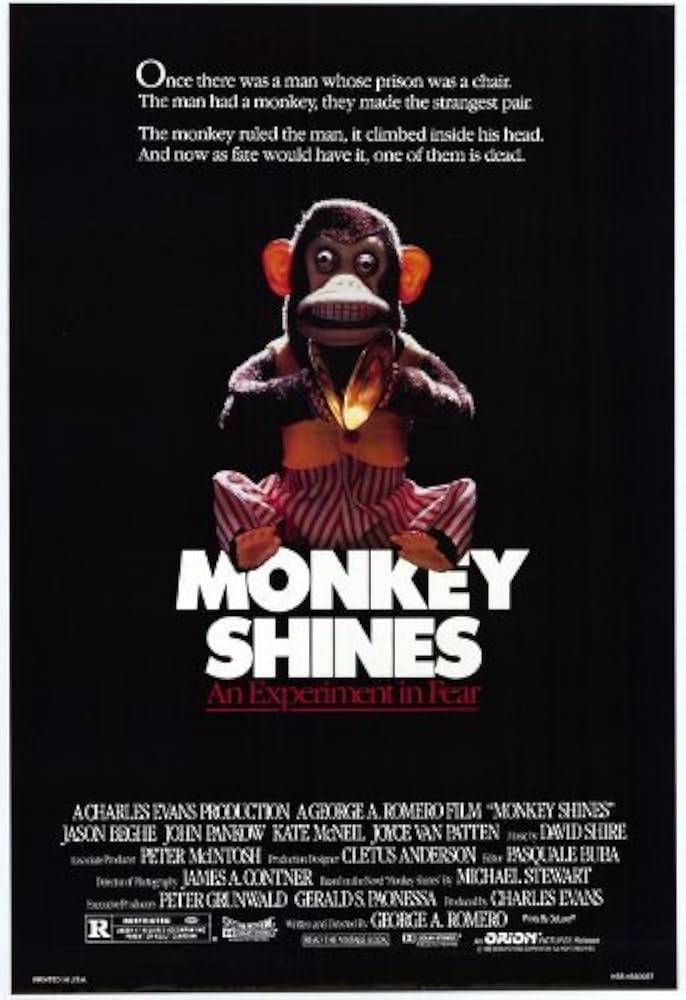
Monkey Shines (1988)

monkey

By Richard Winters

My Rating: 2 out of 10

4-Word Review: Chimp terrorizes paralyzed man.

Allan (Jason Beghe) becomes paralyzed after getting hit by a truck one morning while jogging. Since he’s unable to get along with his live-in nurse, Maryanne (Christine Forrest), or his meddling mother (Joyce Van Patten), his friend Geoffrey (John Pankow) suggests he use a monkey specifically trained to help handicapped patients. Initially Allan likes the monkey, whom he names Ella, as he’s able to do a lot of tasks that helps Allan with the situation that he’s in. However, Geoffrey fails to mention that Ella is no ordinary monkey as she’s been injected with human brain serum in an effort to boost her intelligence. He’s hoping that having the chimp interact with a human will prove that his research studies are a success and allow his department to receive some desperately needed funding. Things though start to take a terrifying turn as the monkey falls-in-love with Allan and fights-off anyone she considers a potential rival including Melanie (Kate McNeil), a beautiful young lady who had helped train Ella for this project. Ella also begins carrying-out Allan’s vengeful fantasies and shows an ability to read Allan’s mind and vice-versa.

The film is based on the 1983 novel of the same name written by Michael Stewart. The script follows the story relatively closely with the biggest difference being the setting where in the book it takes place in England and in the movie it’s in Pittsburgh. While the concept is intriguing, I kept watching just waiting to see how it would turn-out, it doesn’t fully work as a horror movie. Having to watch Allan’s difficulty in adjusting to being fully paralyzed, and even his attempted suicide, was horrifying enough and bringing the monkey in, actually alleviated the tension instead of heightening it.

Had the monkey started to rebel on his own without the scientific experiment angle would’ve been more frightening because we wouldn’t know what was causing it. Showing this super sleazy scientist injecting the chimp with a mysterious serum telegraphs to the viewer right away that something terrible is going to happen, so there’s no element of surprise as the viewer is already braced for trouble from the get-go versus having them come-in less guarded. The ability for the monkey to supposedly read Allan’s mind, or for him to visualize things from the chimp’s point-of-view, made no sense. The injections were supposed to make the animal smarter, not acquire ESP, and since Allan doesn’t receive the same injections how then are the emotions and visions between the two transferable?

The whole thing becomes too preposterous to be able to take seriously and thus the interest level ultimately wanes. I might’ve actually gone with the monkey being possessed from something and that caused him to become so aggressive, but only when he’s alone with Allan, but with other people he remains well behaved and thus Allan’s protesting that he’s become a ‘bad monkey’ would initially fall on deaf ears. Since Allan is so helpless due to his physical state having a chimp run amok and nobody believe him could be genuinely scary without any of the extra nonsense that the movie throws-in.

The Melanie character doesn’t really gel either. For one thing she’s super, super hot; a cover girl quality, so why doesn’t this babe have every eligible suitor in the area chasing after her? Since she could, based on her looks, get any guy she wanted why then would she settle for one that couldn’t move? I was willing to overlook this though as some people can have unusual tastes in who they fall for, but the sex scene between the two seemed way over-the-top. I’ve read where certain paraplegics can still have an active sex life, but someone who is fully paralyzed like this one it didn’t seem it would possible. I’m not a medical expert, so I don’t want to say for sure it couldn’t happen, but it’s gotta be quite a stretch especially with the stylized way it gets captured looking like something straight out of a music video, which makes the movie come-off as even more ridiculous than it already is.

Spoiler Alert!

It was director George A. Romero’s intention to have Allan remain paralyzed, just like in the book, but Orion Pictures was desperate for a hit, so they insisted on a more positive conclusion. The alternate ending, which can be seen as part of the bonus feature in the 2014 Blu-ray release, has Geoffrey’s superior, Dean Burbage, played by Stephen Root, inject the rest of the monkeys in Geoffrey’s lab with the serum and then eventually having those monkeys take-over the Dean’s mind.

My Rating: 2 out of 10

Released: July 29, 1988

Runtime: 1 Hour 53 Minutes

Rated R

Director: George A. Romero

Studio: Orion Pictures

Available: DVD, Blu-ray, Amazon Video, Pluto TV, Roku, 

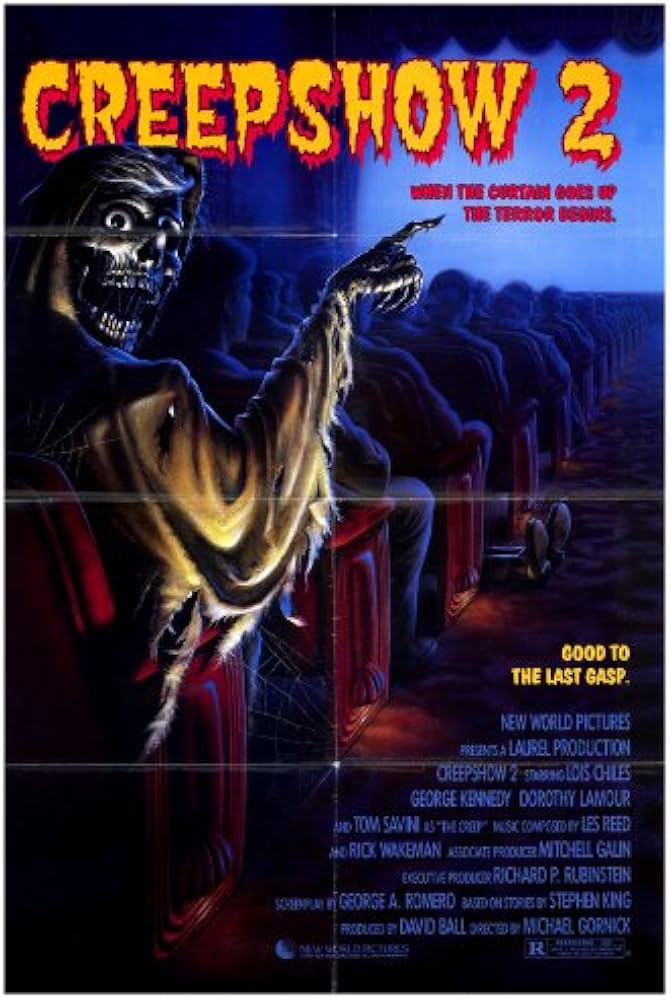
Creepshow 2 (1987)

creepshow2

By Richard Winters

My Rating: 6 out of 10

4-Word Review: Three stories of terror.

Due to the success of the 1982 installment Stephen King and George Romero got together to write a second script based on three of King’s short stories and directing duties were turned over to Michael Gornick who had been the cinematographer on the first one. The budget was much lower than the first, which hampered the special effects and critical reception though it still made $14 million at the box office and has garnered a cult following amongst contemporary audiences.

The first, which is the weakest, stars George Kennedy and Dorothy Lamour, in her last film appearance, as owners of a small-town general store that’s no longer making any profit. An Indian tribe elder (Frank Selsado) gives the couple a bag filled with jewelry as repayment for a debt and then later that night three hooligans lead by the long-haired Sam (Holt McCallany) rob the store and kill the couple. The three think they’ve gotten off scot-free, but then the cigar store Indian that stood in front of the store comes to life and avenges the couple’s deaths by murdering the three boys one-by-one.

This segment takes a while to get going and really doesn’t get interesting until the robbery happens, which should’ve occurred sooner. While the effects of showing the wooden Indian moving around is impressive as it really looks like he’s made of wood and not just somebody in a costume it would’ve been more intriguing had it not given away who the killer was. Simply shown the three being hacked by some mysterious, shadowy figure and then only at the very, very end alluded to it being the Indian.

The second story is better and deals with four college friends (Paul Satterfield, Jeremy Green, Daniel Beer, Page Hannah) going for a swim on a remote lake. They leave their car running and then all dive into the water and swim out onto a wooden raft, but then notice a black, gooey substance that surrounds them. The four feel trapped and when one of the young ladies puts her hand into the water the blob sucks her in and drowns her. The blob then seeps its way through the cracks of the raft and kills another one leaving only two left.

This one is genuinely creepy and I liked how it’s shot under a bright sunny sky making the area appear inviting and no need for anyone to be guarded until it’s too late. The constant shots of the running car sitting on the beach not far from where the swimmers are on the raft, but still unable to get to it, heightens the tension as well as the fact that there’s never any answer to just what this substance is, which in this case accentuates the intrigue. The only thing that I didn’t like is that after being stuck on the raft for an entire day the guy holding the sleeping girl lays her down onto the raft floor, but then uses the opportunity to undress her and admire her breasts, but I’d think with the situation they were in he’d be too exhausted and frightened to think about sex. The ‘twist’ at the end, which shows a No Swimming sign posted in a grove of trees, which the young adults hadn’t spotted, doesn’t totally work because if there’s no swimming in that lake then why would there be a wooden raft in the middle of it and who put it there?

The third story is the best and features a middle-aged woman, played by Lois Chiles, who goes on a drive late one night and accidentally kills a hitchhiker (Tom Wright) when her car goes spinning out-of-control. Instead of offering aid to the man she just drives-off, but then becomes plagued by visions of him constantly reappearing during the rest of her trip making her panic as she attempts to ‘re-kill’ the man, so she can be rid of him once and for all.

Initially this one seemed like a redo of the classic ‘Twilight Zone’ episode that featured actress Inger Stevens who went on a car trip and kept seeing the same hitch-hiker at various intervals on her drive, but this one takes it a step further by having Chiles use her car to literally smash the guy again and again, which gives it a gruesome over-the-top quality that deftly mixes in gore and black humor perfectly.

The film was set to have two other stories, ‘Cat from Hell’ and ‘Pinfall’, but due to budgetary limitations it was decided not to proceed with those and they were never filmed. In the ‘Cat from Hell’ one a hitman gets paid $100,000 to kill a cat that’s supposedly killed three other people. The ‘Pinfall’ one deals with competing bowling teams where the one team kills the other one, by tinkering with the van they ride in, and then the dead team coming back to life as zombies and killing the other team in unique ways by using things only available in a bowling alley, which sounded really cool and it’s a shame this segment wasn’t made as it would’ve been the best of the bunch.

My Rating: 6 out of 10

Released: May 1, 1987

Runtime: 1 Hour 30 Minutes

Rated R

Director: Michael Gornick

Studio: New World Pictures

Available: DVD, Blu-ray, Amazon Video, Plex, Pluto TV, Tubi, Roku, YouTube

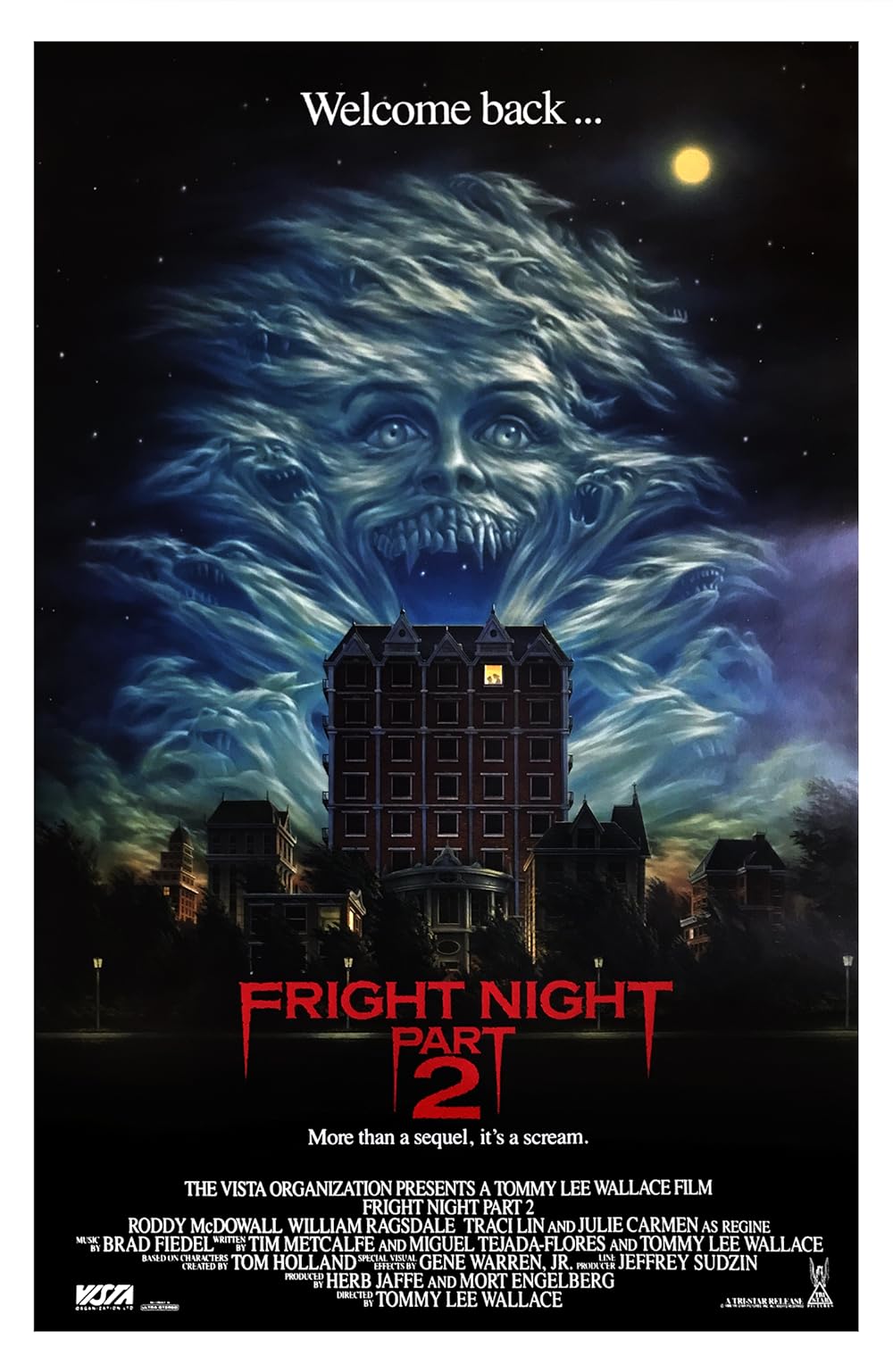
Fright Night Part 2 (1988)

fright2

By Richard Winters

My Rating: 6 out of 10

4-Word Review: Vampire’s sister stalks teen.

Charley (William Ragsdale) is now in college and having been convinced by his therapist (Ernie Sabella) that the ordeal he went through when he was in high school with his next-door neighbor Jerry Dandridge really wasn’t about a vampire, but instead the man had simply been a serial killer. In order to celebrate his successful ‘conversion’ he takes his new girlfriend Alex (Traci Lind) over to visit Peter (Roddy McDowall) who had been instrumental in helping Charley defeat Jerry. While there Charley looks out a window and sees movers hauling in three giant crates that look similar in size to coffins and he begins to fear the old ordeal is starting all over again. He begins dreaming that beautiful woman named Regine (Julie Carmen) visits him in his apartment one night and bites him on his neck and soon he begins showing odd traits like having to wear dark glasses because he no longer likes the sunlight. After going to a party with Peter where Regine is also in attendance, he becomes convinced that she’s really just a performance artist and no longer fears her until Peter takes out his trusty hand-held mirror and notices that he can’t see her reflection. Once Regine realizes that Peter’s on to her she admits that she really is a vampire and out for revenge over what he and Charley did to Jerry who happened to be her brother.

As sequels go this one isn’t bad though there’s quite a few things that are different from the first one, which is mainly a who slew of new faces. Amanda Bearse, who had figured so prominently as Charley’s original girlfriend is nowhere to be seen as she was working on the TV-show ‘Married With Children’ and not able to reprise her role while Stephen Geoffreys, who played Charley’s friend Ed was busy starring in 976-Evil and thus not available.  Director Tom Holland and Chris Sarandon, who had played Jerry Dandridge in the first, were involved in Child’s Play, and thus unable to commit though purportedly Sarandon did visit the shoot in order to offer emotional support.

Tommy Lee Wallace, who was best known for having directed Halloween III: Season of the Witcha film that was a critical and commercial failure when first released, but has through the years gained a cult following, got tabbed to direct this one and his background doing music videos can be clearly sensed here as it features a lot of quick edits and a moody vibe, which I really liked. Regine and her vampire clan that constantly surround her dress almost like a kitschy 80’s rock glam band, which is silly looking and campy, but also in a weird way creepy. Despite the low budget the special effects are still good particularly the monstrous transformations and the climactic sequence that takes place inside an elevator.

While Sarandon was highly impressive in the first version and there was simply no way that any other actor could’ve topped his performance Carmen is an adequate replacement. Too many times when producers can’t get a certain actor they then go out of their way to find someone similar, but here they wisely took the other route by finding someone who was quite the opposite. Instead of being verbally intimidating like with Jerry she does her stalking through being sexually alluring and the result is just as scary.

It’s also great seeing McDowall return as his presence in the first installment had been quite entertaining and his character here remains just as fun and I felt his hair looked better too. In the original the white in his hair appeared to have been sprayed on similar to how a white Christmas tree would look while in this one it’s a more natural looking gray with the white appearing on the edges, but the top part of his head still having a brownish color. I was though confused about how he was able to afford such a spacious pad in a ritzy apartment building that resembled a castle since in the first film he had been living in a cramped, dingy apartment that he was being evicted from and still working at the same job, so where he found the influx of cash to being able to move-up to a new swanky place is not explained.

The two things though that I didn’t care for was having Charley so easily convinced that what he had seen with his own eyes, Jerry being a vampire, was somehow not real, which made the character come-off as weak, easily influenced, and not reliable and like someone you really didn’t feel like rooting for if they could be brainwashed to that effective a degree. Also, having him slowly start to turn into a vampire wasn’t interesting in the least and having the bite mark continue to bleed even after it was bandaged didn’t make sense. Even if the puncture is created by a vampire the blood should still clot like it would with any other wound and not just turn the victim into a hemophiliac, which is what it kind of started to appear like.

The attempts at humor were misguided and genuinely got into the way of the scares and the whole thing would’ve been more effective had it been played straight. Overall though I felt was an effective follow-up and in certain ways even a bit better than the first. Finding a print of it though may be challenging as it’s never been released onto Blu-ray and the DVD issue, which came-out in 2003, is now out-of-print. It’s also not streamed anywhere. Even on its initial release it was only seen at select theaters for a brief time before falling off into obscurity. The main reason for this is that was produced by a production company run by Joseph Mendez, who while the movie was being filmed, was murdered along with his wife by their two teenage sons, which sent the company into bankruptcy and hampered the film from getting out. It also hurt the production of Part 3, which had already been in the planning stages. Infact both McDowall and Holland had a meeting with Mendez about moving forward with the third installment on the morning of his murder. That meeting though had proved to be a bit contentious, so when McDowall heard about the murder the next day he then immediately called Holland and said: “I didn’t do it, did you?”

My Rating: 6 out of 10

Released: December 8, 1988

Runtime: 1 Hour 43 Minutes

Rated R

Director: Tommy Lee Wallace

Studio: New Century/Vista

Available: DVD (out-of-print)

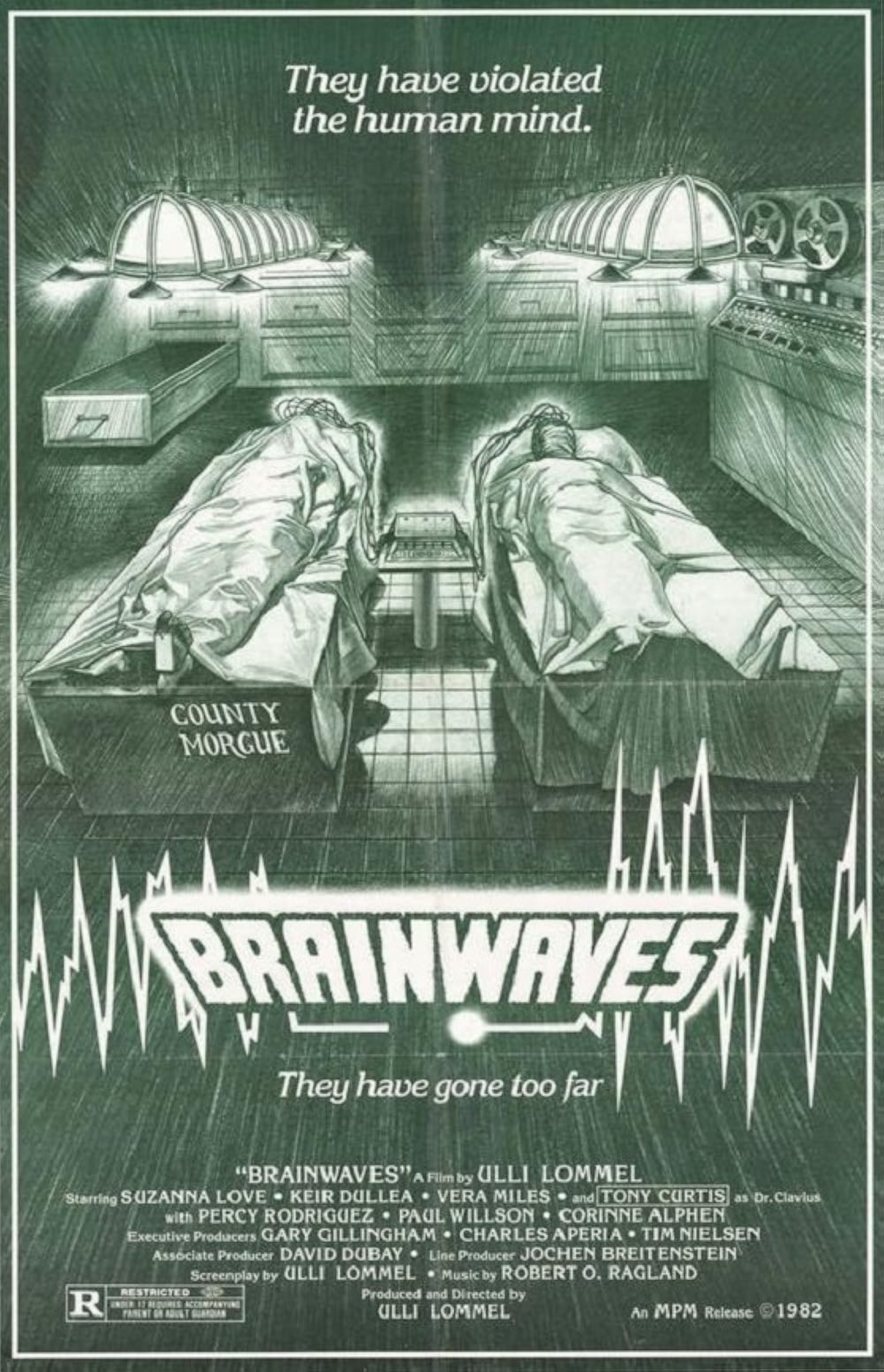
Brainwaves (1982)

brainwaves

By Richard Winters

My Rating: 3 out of 10

4-Word Review: Transferred brainwaves cause nightmares.

Kaylie (Suzanna Love) is a married mother of a young child living in San Francisco. One day while running out to the grocery store she gets the heel of her shoe caught in a trolley car track and this causes her to get hit by a car and suffer severe brain damage. Dr. Clavius (Tony Curtis) is heading experimental surgery that can transfer brainwaves from one victim to another. Kaylie’s husband Julian (Kier Dullea) agrees to the procedure in an effort to bring his wife back to her former state. Unbeknownst to him the other victim was a woman named Leila (Corinne Wahl) who was murdered in her bathtub by an unknown assailant. When Kaylie receives the brain transfer she begins having nightmares about the murderous incident. They then go on a search to try and unravel the mystery, but inadvertently get the attention of the killer who now begins stalking Kaylie in order to silence her before anymore oppressed memories come to light, which could identify him.

The film was directed by Ulli Lommel with a script that he had co-written with Love, who was also his real-life wife. The two had success a couple of years earlier with The Boogeyman and thus it inspired them to attempt another horror film. The concept is great and could’ve created an excellent plot, but the second-half labors too much in the recovery phase inside the hospital, which losses all the tension. The killer, whom we only see from the back, disappears from the story completely during the middle-half to the point you forget about him only to have him finally return by the third act, but by then it’s too late.

Dullea, as the concerned husband, is excellent even though acting here was a major comedown as he was getting leading man roles in major studio productions back in the 60’s, but now was relegated to low budget horror films though with that said he still makes the most of it. The same unfortunately can’t be stated for Tony Curtis, who only got the role because John Huston, who was the original choice, was too ill. Curtis had been a leading man in the 50’s and 60’s, so having to accept a part in such a minor production where he wasn’t even the star was certainly taxing on his ego and it shows as he appears grouchy and irritable throughout and seems like he wanted to be anywhere else, but in this movie.

Spoiler Alert!

The opening murder is okay though you know once she walks into the bathroom and turns on a portable radio that it’s most likely going to end up in an electrocution, so when it does finally occur it’s no surprise. The trolly car incident is nicely shot as well, but the ‘big reveal’ of who the killer is, which turns out to be non other than the victim’s boyfriend, which is the first person you would’ve suspected and thus is a complete letdown. The film should’ve had a wider array of suspects to choose from and played this part out more. The climactic sequence, done near the Golden Gate Bridge, gets shot in slow motion, which gives the proceedings a really tacky look.

The final twist features the dead body of the killer being wheeled into the doctor’s lab where it will apparently be used as a brain donor to another crash victim is cool, but the film then ends when it should’ve continued on with the psycho now chasing after Kaylie inside whatever body his brainwaves got transferred to. By having writer/director Lommel not take full advantage of the myriad plot twists as it could’ve is what really hurts it making it no wonder that it’s box office proceeds was a disastrous $3,111 out of a budget that had been $2.5 million.

My Rating: 3 out of 10

Released: November 19. 1982

Runtime: 1 Hour 20 Minutes

Rated R

Director: Ulli Lommel

Studio: Motion Picture Marketing

Available: VHS, DVD-R (out-of-print)

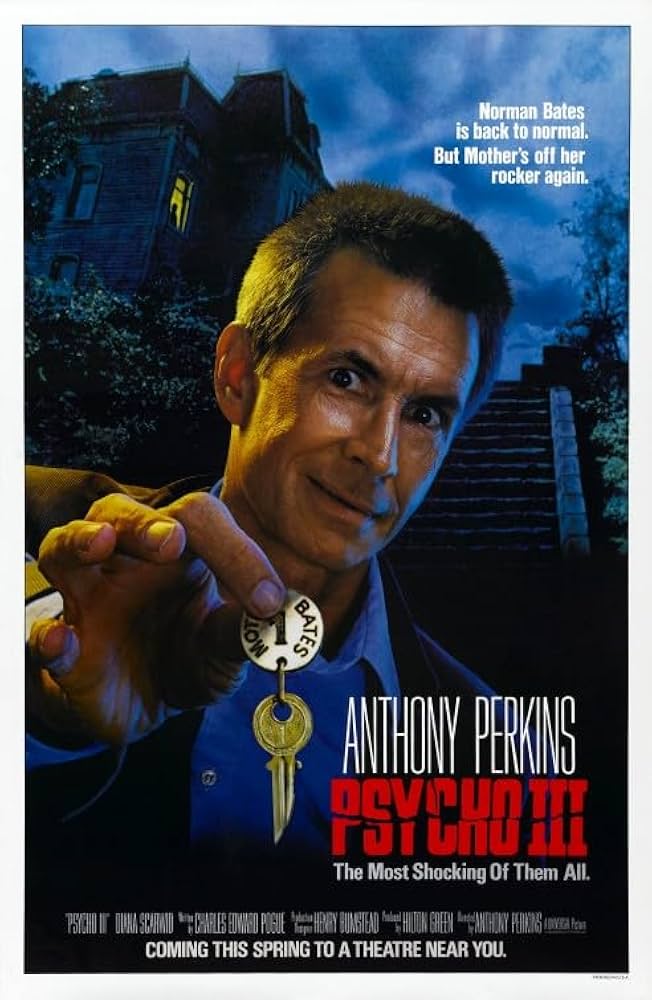
Psycho III (1986)

psycho3

By Richard Winters

My Rating: 3 out of 10

4-Word Review: Norman gets a girlfriend.

The story begins a month after the one in the second installment ended with police searching for the whereabouts of Emma Spool (Claudia Bryar) whom Norman (Anthony Perkins) killed and now keeps her preserved body in his home and yet curiously the police don’t suspect him. Meanwhile a roving journalist named Tracy Venable (Roberta Maxell) does and she keeps trying to get interviews with Norman in an effort to weed-out the truth while also snooping around his property any chance she gets. Maureen (Diana Scarwid) is a nun who’s lost her faith and thus left the convent and rents a room at the Bates Hotel. She closely resembles Marion Crane, one of Norman’s earlier victims, which sets off his desire to kill again, but when he goes into her room in an attempt to stab her he finds that she’s already slit her wrists and bleeding profusely, which sets off his emotional senses to help her and thus he takes her to the nearest hospital, which in-turn gets her to fall for him and the two begin a romantic relationship once she gets out. Norman also hires a wanna-be music artist named Duane (Jeff Fahey) to help out around the hotel as an assistant manager, but Duane becomes aware of Norman’s mother fixation and tries to use it against him just as an assortment of strange murders reoccur on the premises.

The third installment of the franchise is by far the weakest and it’s no surprise that it didn’t do as well at the box office and pretty much nixed anymore sequels getting released with the Part IV one, which came out 4 years later, being made as a TV-movie instead of a theatrical one. Perkins, who made his directorial debut here, starts things off with some intriguing segues and a good death scene of showing a nun falling off of a high ledge, but the storyline itself is getting quite old. Watching the ‘mother’ committing murders is no longer scary, interesting, or even remotely shocking. The script offers no new intriguing angles and things become quite predictable and boring very quickly.

Perkins gives another fun performance, which is pretty much the only entertaining element of the film, and Scarwid is compelling as a young emotionally fragile woman trying to find her way in a cold, cruel world. Maxwell though as the snooping reporter is unlikable and thus if she is meant to be the protagonist it doesn’t work. Fahey’s character is also a turn-off as his sleazebag persona is too much of a caricature and having him predictable do sleazy things as you’d expect from the start is not interesting at all.

The whole mystery angle has very little teeth and the way the reporter figures out her the clues comes way too easily. For instance she goes to Spool’s old apartment and sees a phone number scrawled out several times on a magazine cover sitting on the coffee table, so she calls it and finds out it’s for the Bates Motel and thus connects that Norman most likely had something to do with her disappearance, but wouldn’t you think the police would’ve searched the apartment before and seen that same number and made the same connection much earlier? Also, what kind of landlord would leave a place intact months later after the former tenant fails to ever come back? Most landlords are in the business to make money and would’ve had the place cleaned-out long ago and rented it to someone new.

The fact that the police don’t ever suspect Norman particularly the town’s sheriff, played by Hugh Gillin, is equally absurd. Cops by their very nature suspect everybody sometimes even when the person is innocent. It’s just part of their job to be suspicious and constantly prepare for the worst, so having a sheriff not even get an inkling that these disappearances could have something to do with Norman, a man with a very hefty and well known homicidal past, is too goofy to make any sense and starts to turn the whole thing especially the scene where a dead corpse sits right in front of him in a ice machine, but he doesn’t spot it, into a misguided campiness that doesn’t work at all.

I didn’t like the whole ‘party scene’ that takes place at the hotel, which occurs when a bunch of drunken football fans decide to stay there. I get that in an effort to be realistic there needed to be some other customers that would stay there for the place to remain open, though you’d think with the hotel’s well-known history most people would be too afraid to. Either way the constant noise, running around and racket that these people put-on takes away from the creepiness and starts to make the thing resemble more of a wild frat party than a horror movie.

Spoiler Alert!

The death by drowning scene is pretty cool, but everything else falls unfortunately flat. The final twist where it’s explained that Spool really wasn’t his mother after all sets the whole narrative back and makes the storyline look like it’s just going in circles and not moving forward with any revealing new information making this third installment feel pointless and like it shouldn’t have even been made. Screenwriter’s Charles Edward Pogue’s original script had Duane being the real killer while the Maureen character would be a psychologist who would come to visit Norman and who would be played by Janet Leigh, who had played Marion Crane in the first film. Her uncanny resemblance to one his earlier victims would then set Norman’s shaky mental state to go spiraling out-of-control, which all seemed like a really cool concept, certainly far better than what we eventually got here, but of course the studio execs considered this idea to be ‘too far out’ and insisted he should reel it back in with a more conventional storyline, which is a real shame.

My Rating: 3 out of 10

Released: July 2, 1986

Runtime: 1 Hour 33 Minutes

Rated R

Director: Anthony Perkins

Studio: Universal

Available: DVD, Blu-ray, Amazon Video, YouTube

What Have You Done to Solange? (1972)

solange

By Richard Winters

My Rating: 7 out of 10

4-Word Review: Bearded priest murders schoolgirls.

Enrico (Fabio Testi) is a high school teacher who’s having an affair with Elizabeth (Cristina Galbo) who’s one of his students. While making-out with her on a boat at a park Elizabeth spots a shadowy figure murdering a young girl in a nearby wooded area. The girl turns-out to be one of her classmates, but Enrico convinces her not to tell anyone for fear that it could jeopardize his job. Once the murder gets discovered and reported on the news Enrico goes back to the scene to check for clues only to be photographed by the police who are there doing the investigation. Inspector Barth (Joachim Fuchsberger) spots Enrico in the photo and brings him in for questioning. Enrico denies any knowledge of the killing, but comes under suspicion especially after Elizabeth is later found murdered in her bath tub. Enrico then reconciles with his frigid wife Herta (Karin Baal) in order to have her help him do their own investigation, so they can unmask who the real killer is before the police are able to close in on him.

The film is a unique partnership between a West German production company and an Italian one that was filmed on-location in London. While there are many German actors in the cast the film as a whole is modeled after an Italian giallo and has many of the mystery, gore, and sleaze elements that you’d expect from those. The direction, by Massimo Dallamano, who was a cinematographer of Spaghetti westerns during the 60’s, approaches the material with a visual elegance. The photography is crisp and detailed with some evocative camera work and angles as well as a few graphic shots including the murderers modus operandi, which is shoving a large knife up his victim’s vaginas, which not only gets revealed on the corpses, but also in x-ray version, but also a drowning death in a bath tub that gets played-out moderately well. In most slasher flicks the victim goes down easily when they’re attacked by surprise by their killer, but here this one struggles quite a bit making the killing more drawn-out and thus more realistic.

The plot though, particularly the second act, gets stretched too thin. We have an intriguing set-up and a zesty conclusion, but in-between it meanders. The biggest reason for this is that the protagonist and his quandary becomes neutered and thus all the potential drama from his situation evaporates. Having the inspector tell him upfront that he doesn’t think he did it hurts the tension and would’ve been intriguing if they thought he did, or he even became their prime suspect. Having Enrico make amends with his wife, at the beginning they’re at extreme odds and even close to fully hating each other, further moderates things as the wife could’ve been an interesting possible suspect too, killing the school girls and trying to make the hubby look like he did it in order to get back at him for cheating on her, but then having the two team-up just fizzles away a potentially dark undercurrent to their relationship. Showing Enrico working with the inspector ultimately makes him seem more like a side character in his own movie and by the end like he’s not really the star at all as the inspector completely takes over.

The one performer that does stand-out is Camille Keaton. She’s better known for her starring role in the cult hit I Spit On Your Grave, but here in one of her first performances in the front of the camera she’s quite impressive and she does so without uttering a single line of dialogue. She comes-in real late too to the extent I was starting to think she’d have some minor part and be spotted for only a few seconds, but her character comes-on strong despite not saying anything and is an integral component to the whole mystery. What I liked most about her was her trance-like demeanor and glazed over look in her eyes that’s both effective, creepy, and disturbing at the same time.

Spoiler Alert!

The film’s wrap-up could’ve been better done as it elaborates about the motives of the killer and the elements of the case too much saying things that the viewer should’ve been able to pick-up on during the course of the movie. For instance it describes the sex parties that these teen girls attended, but snippets of these orgies should’ve been shown and not just discussed. The film had no qualms with the violence, so why not have a little explicit sex as well. Also, Keaton’s character going in to have an abortion like it’s going to be some ‘fun activity’ didn’t seem believable. The attempt was to show that she was naive about how rough the procedure would be and thus became ‘traumatized’ by it afterwards, but she still should’ve shown some trepidation upfront as just about anybody else would.

My Rating: 7 out of 10

Released: March 9, 1972

Runtime: 1 Hour 47 Minutes

Rated R

Director: Massimo Dallamano

Studio: Italian International Films

Available: DVD, Blu-ray, Amazon Video, CONtv

White Mischief (1987)

whitemischief

By Richard Winters

My Rating: 7 out of 10

My Rating: Unsolved murder in Kenya.

During the Second World War many British aristocrats with money escaped the tensions and horror in Europe by relocating at a settlement in Kenya that became known as Happy Valley. Here without the typical societal restraints of back-home they were able to indulge in all their provocative desires including rampant drug use and promiscuous sex. One such philanderer, possibly the most notorious of the bunch, was Josslyn Hay the Earl of Erroll (Charles Dance). He had already had various trysts with many of the women there including Alice (Sarah Miles) before dumping her due to her drug addiction. He then sets his sights on Diana (Greta Scacchi). She is married to Jock (Joss Ackland) who is older than her by several decades, and the two share a marriage of convenience with a pre-nuptial agreement that if either falls in love with someone else the other person will not impede it. Earl goes after Diana aggressively and despite some initial reluctance the two eventually become an open couple. Jock puts up a stoic front and allows her to go with him without any resistance, but internally he seethes with rage. Then one night Earl gets shot dead while driving his car in an isolate area. Did Jock pull the trigger?

The film is based on the book of the same name written by James Fox that was published in 1982 and in-turn based on the real-life incident that occurred on January 24, 1941 where the Earl of Erroll, like in the movie, is was found dead in his car and Jock, being the prime suspect, was put on trial, but then found not guilty due to a lack of evidence. For decades it sat as an unsolved case with no answers to what really happened until 1969 when Fox, along with fellow writer Cyril Connelly, became fascinated with the subject and began researching it vigorously. The book contains many interviews with people who lived through the ordeal and give first person accounts of the trial proceedings. Fox even traveled to the Kenya region to get a better understanding of the area and people and came to the conclusion that Jock had been the culprit with new evidence he unearthed, which makes up the book’s entire second-half though officially the case remains open.

The movie’s best quality is its visual element especially its ability to capture the expansive beauty of Africa as the film’s director Michael Radford proudly proclaimed before production even started that “films of Africa should be made by Africans” and you really get that sense here. The screenplay by noted playwright Jonathan Gems is also superb with it’s use of minimalistic dialogue where the conversations and characters never say too much, many times just brief sentences, and the emphasis is much more into what is implied.

On the negative end the attempts at eroticism are pathetic and overdone. The most absurd moment comes when the Sarah Miles character, during the open casket viewing portion of Earl’s funeral, reaches under her skirt and masturbates in full view of everyone before eventually putting her ‘love juices’ on the deceased, which came off as ridiculous and simply put in for a cheap laugh, or misguided ‘shock value’ and hard to imagine it occurred in reality. Both Scacchi’s and Dance’s characters are quite boring and their love scenes lack spark making the whole affair angle seem quite predictable.

The film’s saving grace though is with Ackland’s character where you really get inside his head and see things from his perspective. Normally in most films the jilted spouse is portrayed as someone to fear and a one-dimensional jealous machine who serves no purpose other than to get revenge. Here though we feel his quandary and sympathize with his internal struggle of trying to take the high road while also wracked with hurt and betrayal. Instead of being the culprit we ultimately see him as a sad victim even as his personality completely unravels by the end and because of this aspect I felt the movie works and is worth seeking out. Director Radford probably said it best when he stated that the film was about “people who have everything and yet have nothing. It’s about people who want to possess what they can’t possess” and with the excellently crafted Josh character you can really see that.

This is also a great chance to see acting legend Trevor Howard in one of his last performances. He was suffering severely at the time from his alcoholism and cirrhosis that he comes-off appearing like a wrinkled corpse put upright and there’s several scenes where he’s seen just standing there, but says nothing due to the filmmakers fear that he wouldn’t remember his lines, or if he did wouldn’t be able to articulate them. However, he does come through during a pivotal moment inside the prison when he visits Ackland and what he says and does there is great. John Hurt’s performance is the same way as initially he’s seen little and says no more than a couple of one word responses to the point I thought he was wasted, but then at the end he reappears and comes-on strong in an unique way.

My Rating: 7 out of 10

Released: November 10, 1987

Runtime: 1 Hour 47 Minutes

Rated R

Director: Michael Radford

Studio: Columbia Pictures

Available: VHS, DVD (Import Reg. 2), Amazon Video, Roku 

Mandingo (1975)

mandingo1

By Richard Winters

My Rating: 7 out of 10

4-Word Review: Slave turned into fighter.

Hammond (Perry King) is the son of aging plantation owner Warren (James Mason) who purchases a Mandingo slave named Mede (Ken Norton). Mede proves himself as having superior fighting skills, so Hammond turns him into a prize fighter and makes money off of him. Meanwhile Hammond is also having an ongoing sexual affair with a slave named Ellen (Brenda Sykes), but his father orders him to find a white woman in order to supply him with an offspring, so Hammond marries his cousin Blanche (Susan George), but on their wedding night he rejects her when he realizes she is not a virgin. Blanche becomes jealous of Ellen, whom is secretly carrying Hammond’s child, and causes her to miscarry. She then forces Mede to have sex with her, so she’ll become impregnated with a black baby and bring humiliation to Hammond. After the birth, when Hammond realizes what has happened, he then goes on a violent revenge not only against Blanche, but also Mede whom he once considered his prize possession, but will Mede just accept his punishment, or use his strength to finally turn on his master?

The story is based on the 1957 novel of the same name written by Kyle Onstott. Onstott had written a book about dog breeding with his adopted son, but that didn’t do too well, so at the age of 65 he became motivated to write a book that he hoped would be a bestseller and make him a lot of money. He decided a sensationalistic material was the way to get attention and thus choose to write a story based on many ‘bizarre legends’ he had heard growing up. It was printed by a small publisher and it soon got him the national attention that he craved and sold 5 million copies that not only lead to a series of books on the same theme, but also a 1961 stage play that starred Dennis Hopper. The film rights was purchased by noted producer Dino De Laurentiis and became a very rare exploitation film that was given a big budget and a major studio release.

Critics at the time gave it almost unanimously negative reviews including both Roger Ebert and Leonard Maltin, but today it’s seen in a slightly more favorable light. Personally, if you’re going to do a movie on slavery, a notoriously dark moment in human history, and you’re want to do it honestly, then a graphic portrayal of it such as this should be in store. It may make the viewers cringe throughout, but that’s kind of the purpose. On a purely shock value scale this thing delivers in an almost mechanical sense. It’s just one scene after another that should leave even the most seasoned audiences with their mouths agape. While it’s hard to pick just one moment that’s the most shocking as there are an incredible amount of them I felt the fight sequence where both men literally bite the flesh off the other until blood spurts out of the one’s neck is for the me the infamously top moment though having Mason using a black child as his own personal foot stool, or hanging a 60-year-old black man, played by Richard Ward, naked and upside down to be paddled not only by Hammond, but also by Charles (Ben Masters) who stops by to visit and immediately takes part while another black child looks on amused by it, comes in as a close second.

On the technical end I liked the way it was shot by cinematographer Richard H. Kline. Initially I found the decrepit look of the mansion, which was filmed at the Ashland-Belle Helene Plantation in Geismer, Louisiana, to be problematic as everything looked old and rundown, but you’d think if it had really been done in the time period it was lived-in then it should look new and just built. The overgrown lawn was an added issue as it made it seem like it was an abandoned place, but back then maybe they didn’t all use manually powered lawn cutters, or care to, so I was willing to overlook that portion. I did though love the use of natural lighting, electricity wasn’t a thing, so sunlight coming in from the windows was about it and the use of shadows nicely illustrated the dark personalities of the characters.

The acting is excellent and I was especially impressed with Mason who can seem to go from playing nice guys to villain with an amazing ease as most actors are usually just good at doing one or the other. Some complained about his attempt at a southern accent, but for a guy born and raised in Britain I thought he disguised it pretty well. Susan George, most noted for playing frightened damsel-in-distress types, does a terrific turn as an evil bitch who’ll stop at nothing to get her revenge. King is also impressive as he shows at times to have a certain conscious and appalled at what he sees, but ultimately is unable to get over the hump and becomes just as evil as the rest despite convincing himself and his slave girlfriend that he’s somehow ‘more reformed’.

My Rating: 7 out of 10

Released: July 25, 1975

Runtime: 2 Hours 7 Minutes

Rated R

Director: Richard Fleischer

Studio: Paramount

Available: DVD, Blu-ray, Amazon Video, YouTube

The Dogs (1979)

dogs

By Richard Winters

My Rating: 4 out of 10

4-Word Review: Canines on the attack!

Henri (Victor Lanoux) is a doctor who opens up a clinic in a planned community. He finds to his surprise that many of his patients are coming in complaining about dog bites. He then becomes aware of Morel (Gerard Depardieu) who runs a club were participants learn how to train their dogs to protect them from attacks. However, these same dogs have now become more of a menace that’s putting other citizens in the town in danger including the mayor who becomes a victim. Henri is soon at odds with his girlfriend Elisabeth (Nicole Calfan) who gets a guard dog after she is raped and she is more attached to the dog than him.

The story certainly has some interesting ingredients including the fact that the dogs themselves  aren’t really the threat, but more their owners who train them to be aggressive, which is a nice change of pace from other films from that era that would show animals attacking for seemingly no reason, or that they had become possessed by something evil. Here the set-up is more realistic and plausible and the residents are wealthy living in plush homes helps convey the idea that even ‘nice’ neighborhoods can have evil dwelling underneath and no place is ever completely ‘safe’.

Depardieu goes against type playing the villain and he approaches the part in a fascinating way where he’s not outwardly creepy at the start, but more just an awkward individual who genuinely believes, which is a mindset that he continues to have to the very end, that he’s the ‘good guy’ who’s simply helping vulnerable people find ways to adequately protect themselves. He also has a profound love for his dogs whom he likes more than people, that comes to prominence during a graphic birthing seen where the mother dog isn’t able to come through it. His performance is even more impressive when you factor in that he suffered a dog attack of his own in real-life just a few months before being offered the role and he took the part hoping it would alleviate his pent-up fears and he certainly goes all out here including allowing the dogs to attack and bite him while wearing protective clothing during the training exercises that he conducts.

On the other end, as his adversary, I didn’t find Lanoux to be half as impressive. For one thing he never comes-off seeming like much of a doctor nor ever seen wearing a white physician jacket and works inside a place that resembles a rented out business office than a legitimate clinic. He looks and behaves more like a detached business man walking through his role and never being as emotionally charged as the part demanded.

Calfan, as the girlfriend isn’t convincing either. She leaves her job late at night all alone even though she’s well aware of the crime in the area, which makes it seem like she’s foolishly walking into trouble and the subsequent rape attack gets played-out in a cliched and mechanical way. He recovery is too quick as she’s back to be her normal self again almost instantaneously without showing any of the post traumatic effects that victims of the crime typically do. Her character’s arch offers some intrigue as she at one moment ‘jokingly’ tells her dog to attack Lanoux and then at the last second calls him off, which understandably frightens Lanoux and made me believe she was mentally moving into a dark mindset and she would become the source of danger, but this doesn’t lead to anything. By the end she ‘snaps out of this phase’ and goes back to being her normal self even to the extent turning into the hero, which I didn’t find interesting at all and it would’ve been far more memorable had she slowly became the threat.

The film is too leisurely paced. We know upfront that these dogs, and the people who own them, are something to be feared, but the actual attacks take too long to get going and when they do they’re too quick and ultimately start to play-out in a redundant fashion. The chills and thrills are limited and there’s not enough surprises or twists. There are also some disturbing segments including a dog getting kidnapped and then bound with a muzzle while dangling in the air by a rope as it whimpers, which many viewers including animal lovers will most likely find highly unsettling.

Alternate Title: Les Chiens

My Rating: 4 out of 10

Released: March 7, 1979

Runtime: 1 Hour 40 Minutes

Not Rated

Director: Alain Jessua

Studio: A.J. Films

Available: DVD (French), DVD-R (dvdlady.com)

A Day in the Death of Joe Egg (1972)

deathjoe

By Richard Winters

My Rating: 9 out of 10

4-Word Review: Caring for disabled child.

Bri (Alan Bates) and Sheila (Janet Suzman) are a British couple caring for their daughter Josephine (Elizabeth Robillard), who they’ve nicknamed ‘Jo’ or ‘Joe Egg’. Sheila had a narrow pelvic, which caused Jo’s birth to be a difficult one. The couple had wanted the delivery to occur at home, but due to the complications they were forced to go to the hospital. Initially Jo seemed to be a healthy baby, but she began to suffer from ongoing seizures that eventually put her into a coma. She never came out of it and by age 10 sits in a wheelchair unable to speak, care for herself, or show any type of emotional response to anything. Bri and Sheila pretend to have ‘conversations’ with her in an attempt to lessen the stress of caring for her. Bri feels she should be placed in an institution, but Sheila won’t hear of it, which causes a rift to form in their marriage. Eventually Bri becomes so frustrated with the situation he begins to consider killing Jo and even starts to joke about his intentions to not only his wife, but also their friends (Peter Bowles, Sheila Gish).

The film is based on the stage play of the same name written by Peter Nichols who used his own experiences of caring for a child with cerebral palsy as the basis for the story. It premiered at the Citizen’s Theatre in Glasgow, Scotland in 1967 before eventually moving to Broadway a year later where it starred Albert Finney and Zena Walker and won rave reviews. The movie was filmed in 1970 and completed on time, but the studio decided to then shelve it fearing due to the downbeat storyline that they’d have no way to market it and it would be unable to find an audience. It was only after Suzman’s acclaimed performance in Nicholas and Alexandra that they eventually released it to theaters hoping to capitalize off the attention she got from that one in order to get people to see this one.

Many sources refer to this as being a ‘black comedy’, but I found absolutely nothing funny and in fact it’s instead brutally bleak. I guess the humor as it were was in the way the parents have ‘conversations’ with the kid, but this doesn’t really come-off as being even the slightest bit amusing particularly when you have the child just sitting there with her eyes rolled-up in her head and resembling someone who has died.

This doesn’t mean I didn’t like the film as in-fact I found it quite powerful, but clearly much more from the dramatic end. I admired the way it pulls-no-punches and forces the viewer to confront some very uncomfortable questions like what is the point of caring for a child that will never be able to recognize them, or show any response, or emotion to anything? Granted there’s many kids with disabilities out there and some can grow to lead productive lives, but when one is in a literally vegetable state such as this it does make it infinitely more severe and emotionally challenging. Director Peter Medak approaches the material, which is certainly no audience pleaser, in an earnest way with many varied cutaways and dream-like segments including one memorable moment where Bri and Sheila are on a gray, stormy beach and he imagines throwing the baby carriage that the child is in into the sea, which helps give the production a moody, surreal-like vibe and keeps it on the visual scale quite inventive.

The acting is superb especially Suzman whose character must deal with the inner turmoil of dealing with the stark reality a child who won’t ever grow into anything, but also a husband, whom she loves and is emotionally dependent on, who wants out. It’s interesting too seeing Sheila Gish in a supporting role as a friend who places a high degree on physical appearance and can’t stand anything that is ugly, or deformed and yet she in real-life many years later lost an eye to skin cancer and was forced to walk around with an eye patch.

I was most impressed though with Robillard whose career never really took-off, but proves up to the challenging task here and was picked out of over 100 other children who auditioned for the role. Remaining motionless and unresponsive and whose only noise is periodic moans isn’t as easy as you’d think especially when everyone else is moving and speaking around you. The best moments of the whole movie is when Sheila envisions what Jo would be like if she were a normal kid and we see shots of her jump roping and playing with the other children, which effectively accentuates their sad situation even more.

Spoiler Alert!

The ending, where Bri essentially runs away from home and leaves Sheila alone with the kid, I felt was realistic and most likely what would happen to most any couple stuck in the same environment. The shots of seeing Sheila lying down in bed fully aware that Bri is gone and looking almost at peace with that to me spoke volumes. My only complaint is that I felt the couple’s tensions and cracking of their relationship should’ve been apparent right from the start. They seemed to get along too well at the beginning, but with the child already age 10 by that point and with no signs of ever getting better I felt there should’ve already been plenty of arguments and disagreements and sleeping in separate bedrooms instead of showing them still having a robust sex life and only by the second act do things finally start falling-apart between them.

My Rating: 9 out of 10

Released: June 4, 1972

Runtime: 1 Hour 46 Minutes

Rated R

Director: Peter Medak

Studio: Columbia Pictures

Available: DVD-R