Category Archives: Movies with Nudity

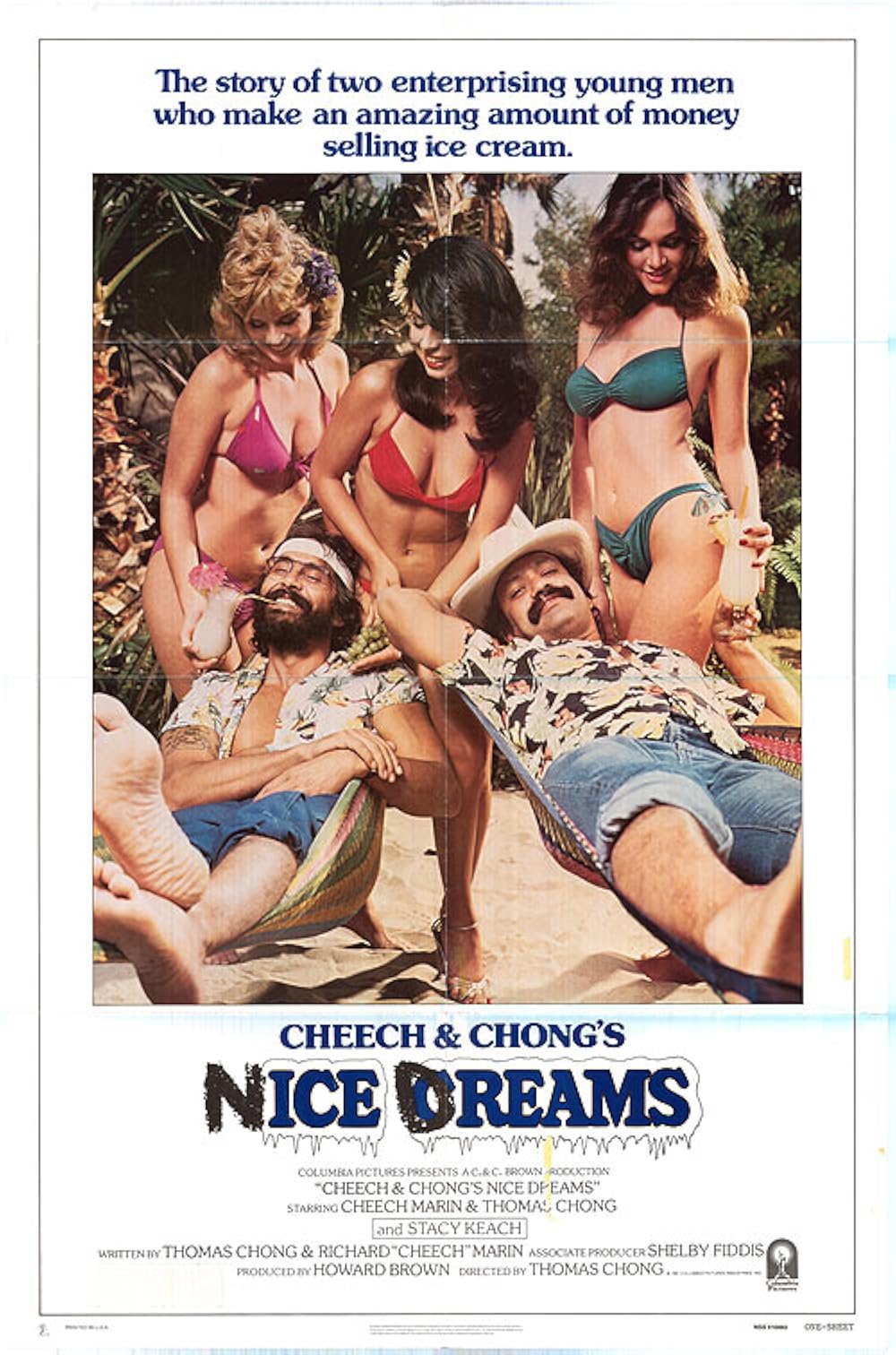
Nice Dreams (1981)

By Richard Winters

My Rating: 3 out of 10

4-Word Review: Ice cream side effect.

Cheech (Cheech Marin) and Chong (Tommy Chong) have become rich by driving around in an ice cream truck that appears to be selling ice cream, but in reality, it’s marijuana and the side effect of taking too much of it is that it can turn people into lizards. Sargent Sardenko (Stacy Keach) who has been on the two’s trail since the first installment has been smoking the weed for a while in order to get into the mindset of a dope user and thus better able to figure them out, but in the process, it has turned himself into a stoner and no better than the people he’s chasing after. When he takes Cheech and Chong’s stuff the lizard side effects become apparent, and he tries to conceal from his two deputies (Tim Rossovich, Peter Jason) who become increasingly more suspicious of his bizarre behavior. Meanwhile the duo’s fortune takes a bad turn when Chong, under the heavy influence of cocaine, signs away all of his fortune to Howie (Paul Reubans), a mental patient. In an effort to get their money back they track him down to the hospital where he resides, but Cheech gets mistaken as being a fellow patient and is soon strapped into a strait jacket and locked into a cell. 

The third installment of the series made a lot of money, $35 million at the box office, but the majority of that was in the first 2-weeks where loyal fans flocked to it, but it leveled off after that making it apparent that for general audiences it wasn’t received as well. The biggest problem for me is that it’s too disjointed. The surreal effect worked in the first two, but here it gets in the way and a more conventional storyline was needed to make it compelling. Case in point is the fact that it starts out with the two already in the business and making cash while residing in a posh, oceanside pad. I liked the messy, rundown shack that they lived in in the second film and kind of wanted to see them stay there as its extreme cluttered state made it bizarrely eye catching and like a third character. If they had to move that’s fine but show that occur in the movie as well as them attaining their newfound fortune versus them already in the new lifestyle when the film begins, which doesn’t make it seem like a continuation from where the second left off, but instead a completely new story altogether. 

I didn’t like the way the Sardenko character got portrayed here at all. In the first film he was the main source of the energy and his almost insane passion to catch the two and his by-the-book brash manner made him a fun heavy and somebody you liked to see get rattled. He was also the perfect overblown caricature of how the counterculture viewed cops during that era, so his presence had a definite point, but here all of that gets thrown out by having him just laying around smoking pot and behaving like every other stoner out there. The irony of him becoming who he despises is lost, had we seen the transition during the course of the film where he at least starts out the way we remembered him from the previous movie and then became a stoner by the end, it might’ve worked better, but as it is it seems like a whole new character connected by name only and isn’t half as fun to watch. 

There are still some funny moments like when Chong gets mistaken for Jerry Garcia while eating inside a Chinese restaurant and when Cheech runs around a hotel naked while trying to escape the clutches of a jealous boyfriend, but there’s no momentum as the plot doesn’t really seem to be progressing anywhere. Part of the reason for this is that the two relied heavily on storyboarding while keeping the script to a minimum, which in fact was only 3 1/2 pages in length and Cheech stated in interviews it was only this long because it was double-spaced. 

Improv can be wonderful if done right and there are moments here when it hits the mark, but the slow bits in-between hurt it. Had it been tied together inside a more cohesive storyline it would’ve really helped and just coming up with wacky scenarios on the seeming fly starts to wear thin.  The climactic scenes inside the asylum don’t work at all and the cameo by Dr. Timothy Leary, a friend of Cheech’s, is more annoying than funny especially with his incessant laugh and monotone delivery. Yet because this one made money, they continued to make more with their next film, which will be reviewed next, being a definite improvement. 

My Rating: 3 out of 10

Released: June 5, 1981

Runtime: 1 Hour 27 Minutes

Rated R

Director: Tommy Chong

Studio: Columbia Pictures

Available: DVD, Amazon Video, YouTube

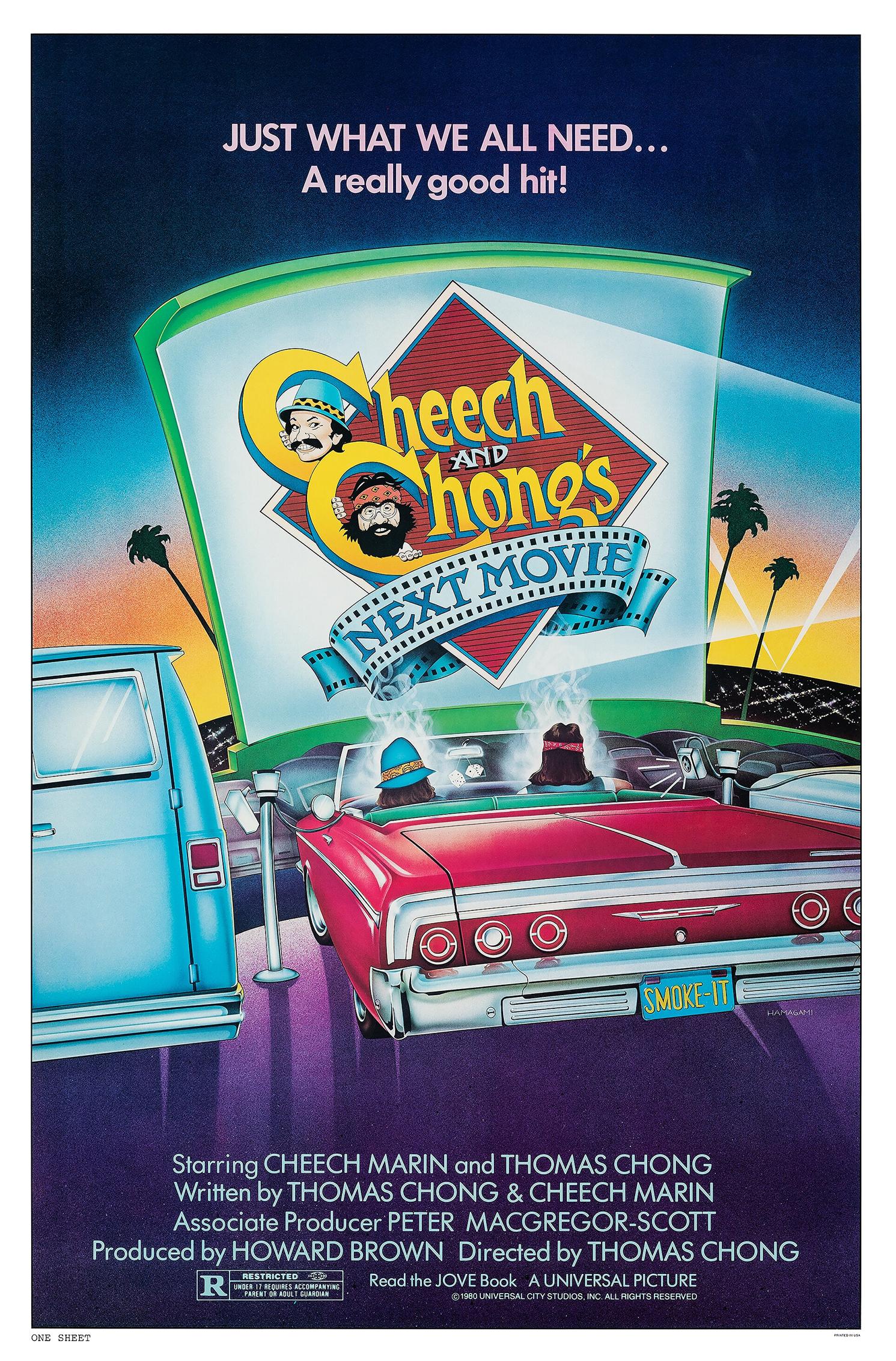
Cheech and Chong’s Next Movie (1980)

By Richard Winters

My Rating: 6 out of 10

4-Word Review: Chong meets Cheech’s cousin.

Chong (Tommy Chong) and Cheech (Cheech Marin) have moved in together in a decrepit place that puts new meaning to the word pigsty. Chong doesn’t have any interest in finding a job and spends his days playing his electric guitar at an ear-splitting level that disrupts the rest of the neighborhood. Cheech does work but gets fired forcing the two to go to the unemployment office where Cheech meets-up with his old girlfriend Donna (Evelyn Guerrero). The two get-it-on inside her office, which soon gets her fired. She then calls Cheech later on and the two agree to a date at his house. To get Chong out of the way Cheech has him get together with his cousin Red (Cheech Marin). Red is getting kicked out of his hotel room for nonpayment, so Chong helps him get his stuff out including a 20-pound bag full of marijuana (in the edited TV-version it’s described as a bag full of ‘diamonds’). The two then spend the rest of the night meeting up with different people and attending various nightclubs before ultimately being kidnapped by some outer space aliens while Cheech sits home alone dreaming of his rendezvous with Donna, who to his knowledge, never gets there.

This is, in my opinion, the best installment of the Cheech and Chong film series and an upgrade from their first film. This one has the same cinema vertite approach as that one but is able to tie it in better with a more consistent atmosphere that at times becomes almost surreal. Chong travels with Red late at night and the goofy people they meet along the way becomes very similar in theme to After Hoursor at least the Los Angeles version of that and had it been amped up just a little more it might’ve been just as good and memorable but just misses the mark yet kooky enough to keep it engaging. Thomas Chong’s direction is leisurely paced, which helps add to the offbeat vibe and his character is more engaged. In the first film Chong was strung-out most of the time making him boring and giving all the funny lines to Cheech, but here it’s more equal, making it a true buddy movie. The drug use isn’t emphasized as much either and doesn’t come off like it’s promoting the use of it like in the first one.

Some of the set pieces are impressive especially their messy house, which is so dirty and unsanitary that it’s almost like an art form the way the production team got it to look that way. I’ve seen some cluttered places before in movies, but never in quite the authentic way as here as it seems great care was taken to give it a legit look and making the scenes shot inside the place both fun and jaw-dropping at the same time. There’s no doubt though that had slacker stoners with no cleaning skills moved in together it would end up looking very similar to the place here. I also enjoyed seeing their neighbor’s place, played by Sy Kramer, who’s overly efficient ways are a far cry from theirs and the confrontations between them needed to be played-up more especially after the two steal and destroy his car and while his vehicle does get returned to him it’s in a highly damaged state, but without seeing his reaction shot we miss half the comedy potential.

It’s fun seeing Cheech play dual roles, speaking in a voice that sounds entirely unlike his own and proving he’s a much more talented actor than one might initially suspect. Edie McClurg gets one of her best roles as a rich uppercrust suburbanite who with only a few drinks becomes increasingly ditzy as the night wears on. Paul Reubens is entertaining as a no-nonsense hotel desk clerk and Michael Winslow has some engaging moments doing ‘sound effects’ while inside the unemployment office and old man John Steadman laughing at every single thing Winslow does.

This film also supposedly is the final onscreen appearance of veteran actress Mary Anderson, who is probably best known for her work in Alfred Hitchcock’s classic thriller Lifeboat. Here she has an uncredited bit as an old lady inside a music store, but the woman is seen for less than two seconds and within a group of other people making it hard to fathom why she’d come out of retirement, her first acting work in 15 years, just to give off an annoyed expression for a brief second and then call it a day. The woman doesn’t really look like her either making me think that since Mary Anderson is a very common name, they got the wrong one and it’s a different actress entirely.

I also can’t end this review without mentioning a glaring continuity error in which the car that Chong and Cheech are riding in goes out of control and ends up crashing into somebody’s front yard but the fence surrounding the yard remains intact. However, for the car to have gotten onto the lawn it would’ve had to have crashed through the fence, so showing it with no damage at all makes no sense.

My Rating: 6 out of 10

Released: July 18, 1980

Runtime: 1 Hour 35 Minutes

Rated R

Director: Tommy Chong

Studio: Universal Pictures

Available: DVD, Blu-ray, Amazon Video, YouTube

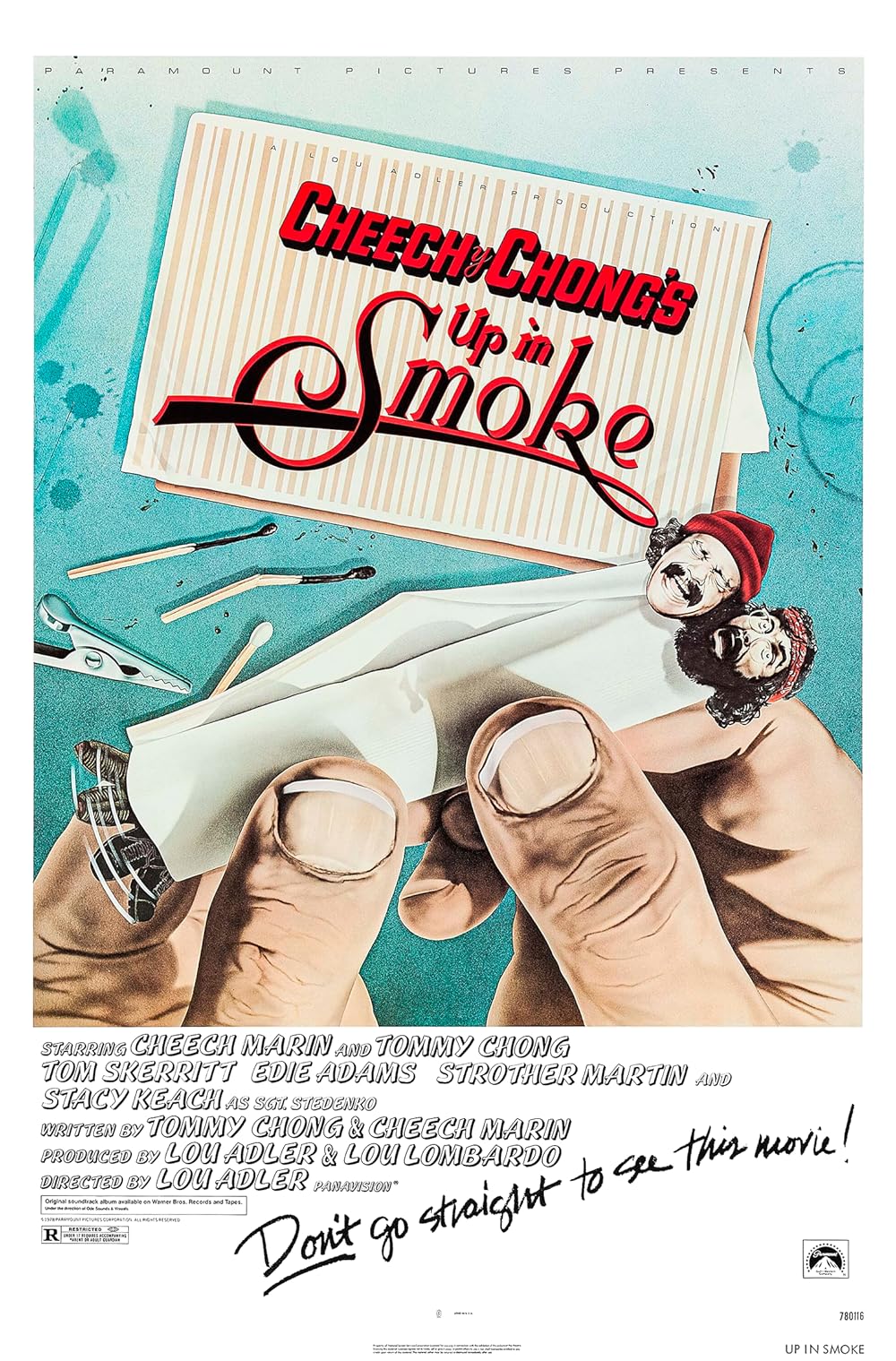
Up In Smoke (1978)

By Richard Winters

My Rating: 5 out of 10

4-Word Review: Two stoners become friends.

Anthony (Thomas Chong) is told by his father (Strother Martin) that he must find a job, or he’ll be kicked out of the house. Anthony then hitches a ride with Pedro (Cheech Marin) and the two quickly become friends based on their mutual interest of getting high on drugs. Soon they’re involved in many adventures including being shipped off to Tijuanna. In order to get back into the country they agree to drive a van that unbeknownst to them, is made completely of hardened marijuana, which gets them quickly put on the radar of Seargent Stelko (Stacy Keach) who along with his crack team of incompetents chases the two relentlessly in order to haul them into jail and make the country’s streets safe again. 

Cheech Marin was trying to avoid the draft when he went to Canada in 1969, which is where he met Thomas Chong, already a Canadian citizen who was starting up his own improv called ‘City Works’ after seeing Second City improv in Chicago while touring as a musician. The two became a comedy team who would come out to warm up audiences before concerts, but in many cases were more popular than the bands they were introducing. This then caught the attention of producer Lou Adler, who signed them to a contract to create record albums, which were so profitable that they graduated into making a movie, which Adler directed, that recreated many of the same skits they had used during their stage routines.

The movie upon its initial release with its open drug use was considered quite controversial and lead to many critics at the time to condemn it but nonetheless proved to be a big money-maker grossing $104 million on a $2 million budget.  Today the film is seen in a much softer light and in 2024 was elected for preservation by the National Film Registry by the Library of Congress.

I remember watching this when it came out and laughing at much of it particularly the car scene where the two smoke a giant marijuana cigarette and then get pulled over by the police. The film also does a terrific job of showing the East L.A. vibe possibly better than any other movie out there. You feel immersed in the culture and get a vivid feel of the era and setting especially at the end when the two go onstage and take part in the Battle of the Bands at the Roxy Theater. The film also has a leisurely pace, much like a French film, where it doesn’t feel the need to have a highly structured plot like in most American films and putting the emphasis more on atmosphere, which is a refreshing change of pace. Some of the supporting players, including Strother Martin who refers to his son as the ‘anti-Christ’ and Stacy Keach as the hardnosed police detective as well as his loyal, but bumbling deputy, played by Mills Watson, but without his patented mustache, who later went on to play the same type of role in the TV-show ‘The Misadventures of Sheriff Lobo’, are all perfect and help add to the fun.

On the negative end the two leads and their interactions, are poor. Cheech never even bothers to learn his buddies name and just continues to refer to him as ‘man’ for the duration of the pic, which might be the intended comedy, but offers no character development. They never grow or change and instead are paralyzed in a permanent caricature. Marin is funny, and in fact the only source of the humor, but Chong is underdeveloped. He spends most of the time strung out on drugs, or going through a bad trip, to the point that he seems catatonic and allowing all the energy to go to Marin, which is fine as he makes the most of it, but it barely seems like a buddy pic when it’s only one guy getting all the laughs. 

Without sounding like somebody’s old-fashioned parent I must agree with the initial sentiment that found this movie to be glorifying drug use and thus toxic to the day’s youth. The film acts like using drugs is just harmless fun. The scene involving actress June Fairchild, who later became homeless due to her own real-life addictions, where she sniffs some Ajax by mistake thinking it’s cocaine, but has no bad reaction to it and instead gets just as an enjoyable high is a problem. Granted I realize it’s supposed to be ‘funny’, but I could see a parent being concerned that it’s sending the wrong message to impressionable teens. 

My Rating: 5 out of 10

Released: September 15, 1978

Runtime: 1 Hour 26 Minutes

Rated R

Director: Lou Adler

Studio: Paramount Pictures

Available: DVD, Blu-ray, Amazon Video, YouTube

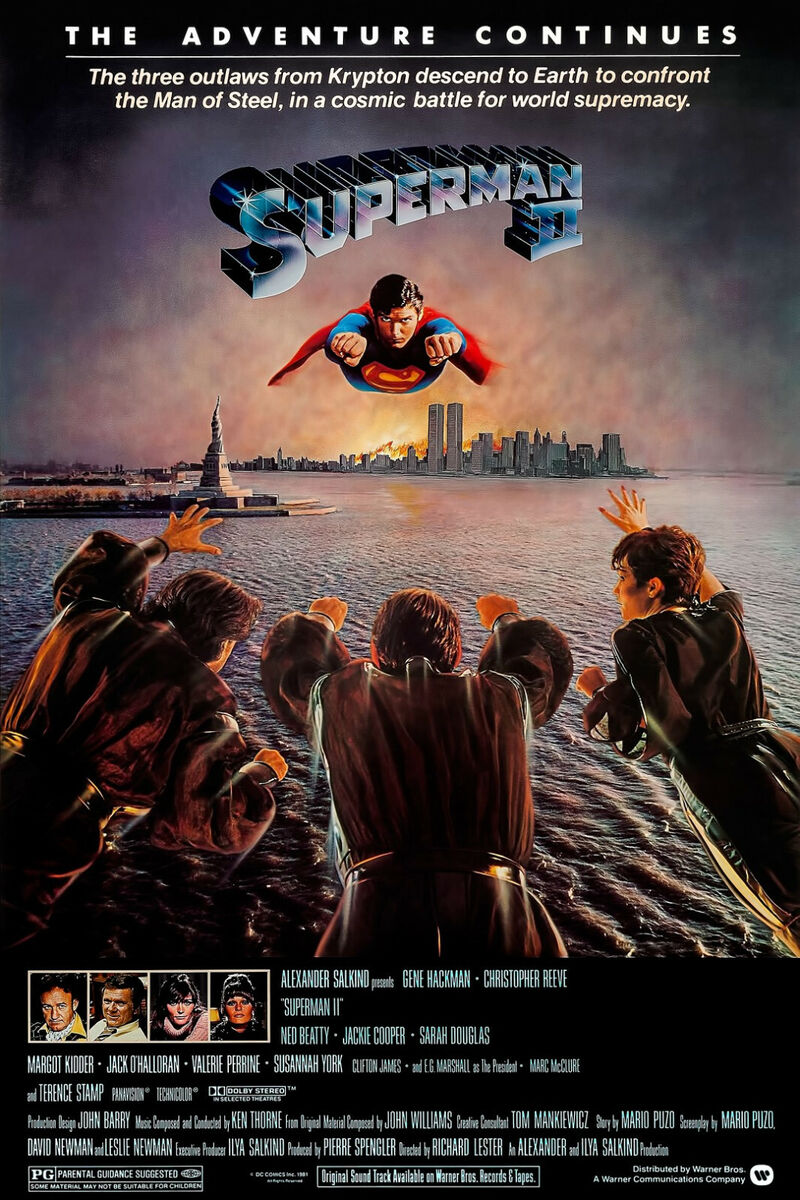
Superman II (1980)

By Richard Winters

My Rating: 8 out of 10

4-Word Review: Superman loses his powers.

Superman (Christopher Reeve) flies to Paris in an attempt to save Lois Lane (Margot Kidder) who was assigned to go there to cover terrorists who’ve taken over the Eiffel Tower and threatening to detonate a hydrogen bomb unless their demands are met. Superman manages to take control of the bomb and lift it into outerspace where it goes off, but unbeknownst to him the explosion also releases Zod (Terrence Stamp), Ursa (Sarah Douglas) and Non (Jack O’Halloran) from their imprisonment inside the phantom zone. The three now fly towards earth planning to take it over with the superpowers they’ve been given from the sunlight. Meanwhile Clark falls in love with Lois and admits to her that he’s Superman. He takes her to the artic to see his Fortress of Solitude and it’s there that he listens to a past recording of his mother Lara (Susannah York) advising him that if he wishes to marry Lois that he will then have to enter a crystal chamber where he’ll then lose his powers, which he does. Now that Zod and his evil associates have taken over the country by invading the White House he becomes powerless to do anything about it as he desperately searches for a way to regain what he gave up.

The production had many behind-the-scenes upheaval including run-ins between director Richard Donner and the producers who insisted that he was going over budget. Initially it was deemed necessary to film both the first segment and the sequel at the same time, but due to money concerns they stopped filming part 2 with 75% of it already completed in order to finish the first part and get it out to theaters. During the pause the producers then fired Donner and replaced him with Richard Lester. Lester was known more for his zany comedies and had a different directorial style than Donner. His approach was to insert campiness into the story and move it away from the dark elements. This caused several scenes to be refilmed some of which without the original cast including Hackman who refused to come back to do reshoots causing a few of his scenes to be dubbed while Brando had sued the producers for his share of the gross profits causing all of his scenes to be taken out completely and replaced mostly with York who ended up speaking the lines that he would’ve and for the most part does a far better job of it.

While the Donner version was released onto DVD in 2006 and is a bit different this review will stick with the one that was shown in the theaters and I felt is quite well done. Unlike with part 1 this one gets right to the action without the stagy back story from the first, which I found boring. The showdown between Superman and the evil three done on the streets of Metropolis as well as the massive destruction that the villains cause the small redneck town of East Houston are very exciting with great special effects that should please anyone. The comedy bits that Lester inserted I didn’t feel went that over-the-top and in some ways were helpful as it released some of the tension as these were some really nasty bad guys, who caused massive destruction, so inserting a campy chuckle here and there I didn’t feel was that out of order.

The script doesn’t have as many plot holes like in the first one. The only major issue to quibble about is when Superman goes into the chamber that sucks away his powers. Why though is it necessary that he should have to give up his powers just because he wants to get married is a whole different discussion that’s worth questioning, but I get that there needed to be a dramatic conflict, so we’ll roll with it. However, it’s never explained how Clark and Lois get themselves out of the artic and back to civilization as they ‘flew’ into the Fortress using his flight powers, but once he was made mortal, they couldn’t rely on that on the way out and without any other mode of transportation I wasn’t sure how they were able to travel and nothing gets shown, but should’ve.

Spoiler Alert!

His long trek back to the Fortress in an attempt to retrieve the powers is equally problematic as he is shown doing it completely on foot, which could take many weeks, or longer to do. He’s also shown wearing nothing more than a light jacket while he does it without any head covering, which now that he’s human, wouldn’t be enough to shield him from the brutal elements and frigid cold and he most likely would’ve died before he got there from either frost bite, or pneumonia. How he’s able to get the powers back aren’t sufficiently explained either. Supposedly it’s because of a green crystal that Lois dropped and is still there when he returns, but if the control module was already destroyed then how would this get it to work again?

End of Spoiler Alert!

The acting is again what really makes it fun. Hackman is once more excellent as Luthor as here he plays it both ways as the ‘middleman’ between Zod and Superman where one minute he’s arrogant and confident and then the next he’s nervous and pleading. It’s a shame though that Perrine and Beatty, his cohorts in crime, aren’t in it as much as I felt the three together had a great chemistry. Gotta love Kidder as a brash Lois who manually squeezes oranges for Vitamin C as she’s become a self-described ‘health nut’ all the while a cigarette dangles from her mouth. Stamp is really good too as the main villain and his intense performance is what keeps the tension going, which again is why the comedy bits aren’t a problem here, though in Part III this does become a major issue, which will be discussed in the next review.

My Rating: 8 out of 10

Released: December 4, 1980

Runtime: 2 Hour 7 Minutes

Rated PG

Directors: Richard Donner, Richard Lester

Studio: Warner Brothers

Available: DVD, Blu-ray, Amazon Video, YouTube

Superman (1978)

By Richard Winters

My Rating: 8 out of 10

4-Word Review: The Man of Steel.

As the planet Krypton gets set to be destroyed by its exploding sun, Jor-El (Marlon Brando) and his wife Lara (Susannah York) put their child on a spaceship that takes him to the planet earth. It is there that his spaceship crash lands into a wheat field that his spotted by Jonathan (Glenn Ford) and Martha (Phyllis Thaxter) who take the child in and treat him as their own. The boy is named Clark (Christopher Reeve) and as he grows, he begins to show amazing abilities including running faster than is humanely possible and incredible strength. Once he becomes an adult, he gets a job as a reporter at the Daily Planet newspaper where he meets fellow reporter Lois Lane (Margot Kidder). He even saves her, while dressed as a superhero, from a helicopter accident and becomes known initially as the ‘caped wonder’ before finally being coined as Superman. His publicity attracts the attention of criminal mastermind Lex Luthor (Gene Hackman) who devises a plan to steal missiles and use them to create an earthquake along the San Andreas fault and thus casting off coastal California into the ocean and turning the desert land he purchased into prime real estate. Superman attempts to stop him, but Lex has found one thing that can stop him: a meteorite known as kryptonite.

At the time this film, which suffered from numerous behind-the-scenes problems and infighting, was made it was the most expensive one ever produced with a whopping $55 million budget. While the effects were mesmerizing for many back-in-the-day I don’t know if they still all hold-up. The flying segments particularly over the Statue of Liberty is impressive to a degree but can’t quite equal today’s technology and appears like two people in front of a greenscreen as does the giant red sun that moves in to destroy Kyrpton. Watching the young Clark Kent running alongside a train looks tacky too like he’s being held up by invisible wires, which he was, and his feet aren’t really ever touching the ground. In all fairness though the earthquake segment and the destruction of the Hoover Dam and the shaking of the Golden Gate Bridge remains top notch.

The script though, which takes on quite a lot and had to be slimmed down from its original 500-page version that was written by Mario Puzo, feels rushed at times and glosses over certain things that I felt should’ve been a little more drawn-out particularly when the Kents find the boy crash land in the field. The film makes it look like they just left the remains of the spaceship in the field making me think other people in the area would’ve also come upon it later and would start a panic that some alien had come out of it and invaded the town. Later on, we come to realize that the ship got hidden inside their barn, but there’s no scene showing them transporting it, or how they went about doing that, which I felt should’ve been put in for the simple sake of clarity.

Watching Superman orbit the earth in an attempt to get it to spin backwards and supposedly ‘turn back time’ is kind of cool to see and an interesting concept though not totally plausible. Making the world rotate the other way would certainly change some things like having the sun rise in the west instead of the east and have the ocean waves go in a different direction among other things, but causing everything to essentially ‘rewind’ and go back to the way they were even bringing certain people who had died suddenly back to life just wasn’t completely convincing though it’s not enough to hurt the movie as a whole.

Most fans will likely tell me I’m quibbling about the Clark Kent disguise though when you really think about it it’s not much of a disguise at all. I admit watching this muscular guy dressed in a suit and acting all clumsy and wimpy is amusing especially the way Reeve plays it but besides combing his hair in a different direction than when he’s Superman the only other difference is that he wears glasses. However, that would be tantamount to saying someone who does wear glasses but then comes to work one day without them would not be recognized by any of his friends, or co-workers especially when he’s still speaking in the same voice making me believe that Lois and Jimmy, played by Marc McClure, should and would’ve caught on to this pretty quickly. I realize the comic book did it this way, but when it got updated into a movie, they should’ve reenvisioned it a little by adding more to the Clark get-up like besides just glasses he’d also have a mustache, or goatee and speak a bit differently, so having those close to him not catch-on would be more understandable.

I think what I enjoyed most was Hackman, who didn’t play a lot of villains during his career but is highly enjoyable here. Initially he didn’t want to take the part as he felt playing a campy character would tarnish his reputation of being a serious actor, but the change of pace does him good and proves if anything how versatile he is. His refusal not to shave his head, as the Lex Luthor in the comic is bald, works in his favor as his hair gets styled differently in each scene in order to represent him wearing a wig, which creates a creative visual. Valerie Perrine is great too as his girlfriend Miss Teschmacher who helps contrast his delusional personality with her more grounded sensibilities and I just loved the way he’d yell out her name every time he got annoyed with her, which is the comedy highlight.

The rest of the supporting cast though, made up of big name starts like Trevor Howard, Maria Schell, and even Larry Hagman didn’t seem needed and given such few lines I was surprised why they’d even take the roles unless it was because of the money. Brando is an equal waste. He’s given top billing and paid an exorbitant amount of money including a percentage of the profits despite refusing to memorize his dialogue and even having his lines written on the baby’s diaper for him to read off of as he puts the child into the spaceship. Had the producers skipped the unimportant ‘star power’ and cast lesser knowns in these roles they could’ve saved themselves a lot of money, which in retrospect might’ve lessened the tensions they had with director Richard Donner for going over budget and ultimately lead to his firing and a very tumultuous follow-up Superman II, which will be covered in the next review.

My Rating: 8 out of 10

Released: December 10, 1978

Runtime: 1 Hour 23 Minutes

Rated PG

Director: Richard Donner

Studio: Warner Brothers

Available: DVD, Blu-ray, Amazon Video, YouTube

Any Which Way You Can (1980)

By Richard Winters

My Rating: 7 out of 10

4-Word Review: Betting on a fight.

Philo (Clint Eastwood) is still working as a trucker, still travels around with his pet orangutan Clyde, and still lives at home with his mother (Ruth Gordon) while getting involved in some bare-knuckle fights on the side to earn some extra money. He also continues to be harassed by the Black Widow biker gang who constantly hound him to even a past score. Things begin to change a bit when he meets back up with Lynn (Sondra Locke) who apologizes for her behavior from before and wants to rekindle their romance. Philo resists at first, but eventually the two get back together and she even moves-in with him in a spare room, but pressure mounts when fight handicapper Jack Beckman (Harry Guardino) comes-up with the idea of pairing Philo with Jack Wilson (William Smith), whose fighting skills mixes both martial arts and boxing. Jack figures it would be a match that would generate much betting interest and uses his men and money to convince Philo to take part in it. While Philo does initially agree he eventually backs out due to pressure from Lynn as she feels it’s too dangerous, but Jack, who has Mafia money riding on the fight, won’t take no for an answer and kidnaps Lynn in an effort to get Philo to reconsider. 

This is one of those sequels that’s a vast improvement over the first and much of the credit goes to Stanford Sherman, who wrote over 18 episodes for the 60’s ‘Batman’ TV-show and shows a good knack for balancing campy humor with interesting action. He’s also able to tie-in everything that goes on, so it doesn’t come off like a disconnected mess like with the first installment that had characters and situations coming-out of nowhere that wasn’t cohesive. Here each character has a purpose and everything that happens has a reason and connects with the main theme making for a much slicker production even when some of it gets silly.

Much more attention goes to the ape here though it’s not the same one as in the first film. That one was named Manis who was deemed to have grown too big for the part, so he got replaced by Buddha who has some amusing segments with his best moments coming when he tears up some cars, including one being driven by a bad guy, played by Michael Cavanaugh, as he’s trying to get away and another scene where he wears a dress and then ‘flashes’ an amorous hotel owner. However, in a book by Jane Goodall entitled ‘Visions of Caliban’ it was asserted that Buddha was badly beaten by his owner during the production after he stole some doughnuts on the set and was eventually clubbed to death forcing them to bring in a third ape named C.J. to do the publicity tour for the movie after filming had wrapped. 

Like in the first one the movie also features a lot of bare-knuckle brawls though these aren’t quite as interesting since Clint wins every one of them, so there’s never any tension. To keep it realistic, and give it better balance, they should’ve had him lose one, possible in humiliating style, and the rest of the movie could’ve been having him trying to defend his title and the audience would’ve been more emotionally invested in seeing him do it.  Would’ve been nice too had they not implemented that annoying punch sound effect that to me puts the fight at a cartoon level and I wished more movies from the period did it like The Whole Shootin’ Matchwhich didn’t feel the need to have that effect put in and thus actually made the fighting grittier and more intense in the process. 

While the film is way too long, there’s no reason for a runtime of 2-hours with such a slight and goofy plot, which should’ve have not been more than 85-minutes. However, it saves itself with some genuinely inspired moments including when real-life couple Logan and Anne Ramsey, who play a traveling husband and wife who stay in the hotel room next to the two apes whose noisy love making turn them on as does Clint and Sondra in adjacent room while Ruth and the elderly hotel clerk, played by Peter Hobbs, also make it in the motel office, I found to be quite amusing and almost worth the price of admission. The climactic bout between Clint and Smith and the way it galvanizes people from all over to witness it and bet money on it, including the Black Widow biker gang, who survive a ‘taring’ earlier, is good fun making it worth checking out on a slow night. 

My Rating: 7 out of 10

Released: December 17, 1980

Runtime: 1 Hour 56 Minutes

Rated PG

Director: Buddy Van Horn

Studio: Warner Brothers

Available: DVD, Blu-ray, Amazon Video, YouTube

Hurricane (1979)

hurricane

By Richard Winters

My Rating: 3 out of 10

4-Word Review: Tropical cyclone strikes island.

Charlotte (Mia Farrow) is the daughter of Navy Captain Charles (Jason Robards) who was appointed governor of a small island of Alava, which is under U.S. control. She comes to the island for a visit as she hasn’t seen her father in quite a while and immediately becomes attracted to Matangi (Dayton Ka’ne) who works as a houseboy at her father’s estate. A romance blossoms between the two and when her father finds out he puts Matangi in jail on trumped-up charges, but Charlotte is able to find a way for him to escape, but as they go on the run her father sets out to find them and put Matangi back behind bars just as a massive hurricane descends.

The film is a remake of the 1937 movie that was directed by John Ford and in itself an adaptation of the novel of the same name by James Norman Hall and Charles Nordhoff. After completing the runaway hit King Kong, another remake of a 1930’s movie, producer Dino De Laurentiis became inspired to tackle a second classic from the same era. He was most enthused with this one due to the hurricane effects as he was convinced that with modern technology it could be more vivid than the original and even hired the same man, Glen Robinson, who did the special effects for that one to recreate it here, but with modern film capabilities that had been unavailable when the story was first produced. So much focus was admittedly put into the ending that things like character development, which director Jan Troell had come onboard to work-on, were largely ignored causing Troell to consider it an unpleasant experience and he spent the remainder of his career making films in his homeland of Sweden as he felt after this that working on a Hollywood project wasn’t to his liking.

The casting of Farrow is part of the problem as the role called for a woman in her 20’s even though she was already well into her 30’s, but since she had what Dino described as an ‘eternal face of an 18-year-old’ he decided to hand her the part anyways. Her character though is so one dimensional that her time on the screen isn’t captivating. Ka’ne, who was an Hawaiin surfer with no acting experience, does better than expected though he only did one other movie after this before retiring from the business and working the rest of years as a compost truck driver and hotel doorman. Max Von Sydow is good in support playing a doctor who utters the film’s best line, most likely ad-libbed from his well-known atheist roots where he asks why a painting of Adam would require him to have a belly button since if he was created from dust then he’d have no need for an umbilical cord.

The biggest issue is the romantic angle as it occurs too quickly. An interesting relationship is one that has a challenge and this one should’ve had several as Mia’s father was clearly not going to be happy about her seeing Ka’ne and therefore she should’ve been apprehensive about getting involved, or even suspicious as how did she know he wasn’t just using her for leverage to get the old man to soften his stance on policies Ka’ne wanted changed? Instead, they fall into each other’s arms in a seamless few minutes and the whole first hour is spent with them dreamily swimming around in the ocean in a lovesick fashion, which is dull. Having the character of Moana appear, played by Ariirau Tekararere, who was the woman Ka’ne was arranged to marry, offers some potential, but since she barely speaks and when she does it’s in her native tongue without the benefit of subtitles, her presence doesn’t offer much.

Spoiler Alert!

The finale, which is all about the hurricane, is somewhat exciting, but it’s not perfect. The destruction of the homes appear like they’re miniature models and seeing constant shots of blowing rain becomes tiring, but watching the people leave the church while Priest Trevor Howard continues to pray at the pulpit is kind of funny and having the ship burst through the wall was cool too.

However, I wasn’t exactly sure that the couple really got ‘saved’ at the end like the viewer is supposed to believe. Yes, they survived the storm but were now stuck on a tiny sandbar in the middle of the ocean with no source of food, or transportation. Unless some help came along, which wasn’t guaranteed, they weren’t going to survive long. Thus, it’s not a real ‘happy’ ending because although they weren’t killed right away like the others doesn’t mean they won’t die an even more painful death of starvation.

My Rating: 3 out of 10

Released: April 12, 1979

Runtime: 2 Hours

Rated PG

Director: Jan Troell

Studio: Paramount

Available: DVD, Blu-ray (Import Reg. A/B/C)

Perfect (1985)

perfect3

By Richard Winters

My Rating: 2 out of 10

4-Word Review: Reporter investigates aerobics craze.

Adam (John Travolta) is a reporter working for Rolling Stone magazine who gets sent on assignment to Los Angeles. While there he becomes intrigued with the health fitness craze and believes the workout clubs are becoming like the singles bars of the 80’s. He asks his editor Mark (Jann Wenner) permission to write a secondary story focusing on this new phenomenon and he agrees. Once he begins attending the club he becomes infatuated with Jessie (Jamie Lee Curtis), one of the instructors. He asks her for an interview, but she refuses based on a past experience she had with another journalist, but Adam continues to pressure her. Eventually the two begin dating only for Jessie’s initial fears to ultimately get exposed when she reads the story he’s written about the club, before it gets sent to the press, and realizes it’s a negative take on the people in it, many of whom are her friends, which leads to a serious strain on their relationship. 

The film is loosely based on the real-life experiences of Aaron Latham who worked as a reporter for Rolling Stone during the late 70’s. He had already written the screenplay for Urban Cowboywhich also starred Travolta and was also directed by James Bridges, so this reteaming was expected to be a huge hit, but instead it lost over $8 million at the box office despite initially doing well on its opening weekend. A lot of the problem is that journalists aren’t considered likable people and most of the American public by and large despise them. The fact that this one behaves exactly the way you’d expect, being more than willing to exploit their subject, particularly with the way he treats the Marilu Henner and Laraine Newman characters, in order to get a juicy spin on a story, just makes him all the more despicable. 

His character is quite blah as well. We never learn why he wanted to get into journalism and if some backstory had been given, and not just starting out with him working in the obituary section and trying to move his way up, then he might’ve had more depth. It’s confusing too why such a good-looking, jet-setting guy, wouldn’t have a girlfriend. Maybe if he’d been through a rough break-up and thus wanted to avoid it that might’ve been understandable but should’ve been explained. Even just having some casual dates would’ve made sense but having him just all alone with no reason only adds to make the character even more transparent. 

Curtis as an actress is excellent and the movie is worth sitting through solely because of her and she’s looking really hot here too. However, her character’s responses to things seemed a bit off. She makes it quite clear upfront that she’s not interested in an interview, but Adam doesn’t take no for answer and proceeds to continue to hound her, which should make her hate him even more, but for some reason it doesn’t. Yes, he does help get her car started when her battery dies, so as a thank you she might’ve been willing to do a simple interview, but instead her repayment is to go to bed with him while still refusing to do any interview, even though I felt realistically it should’ve worked the other way. 

The concept itself isn’t intriguing. I lived through the 80’s and really didn’t care why people got into the aerobics thing. Revealing that some of those that did was because they were lonely and looking to meet someone to hook-up, isn’t exactly groundbreaking. The entire supporting cast is incredibly dull including Jann Wenner, the original co-found of Rolling Stone magazine, who essentially plays himself as Adam’s boss, but his performance is lackluster, and a professional actor should’ve been given the role. 

Spoiler Alert!

My biggest gripe came at the end where Curtis keeps going back to Travolta even as he does all the things that irritates her about reporters like secretly recording their conversations while in a car. That alone should’ve gotten her to dump him, which she does for a while, but then she returns. One forgiveness is okay, everybody deserves a second chance, but then he does it again with the negative story. Granted having the article revealing that she had an affair with her coach years ago wasn’t his fault as his editors put that into the story later on, but she had no way of knowing that. From her perspective he betrayed her trust and therefore the relationship should’ve been permanently over. She didn’t care for reporters right from the beginning and all he did was affirm her confirmation bias. It would’ve been more believable had she instead liked journalists and maybe wanted to be one herself and therefore kept given him the benefit of the doubt, but the way it gets done her makes little sense. 

My Rating: 2 out of 10

Released: June 7, 1985

Runtime: 2 Hours

Rated R

Director: James Bridges

Studio: Columbia Pictures

Available: DVD, Amazon Video, YouTube

Barfly (1987)

barfly

By Richard Winters

My Rating: 6 out of 10

4-Word Review: Drunks at a bar.

Henry Chinaski (Mickey Rourke) is a bum who has very little money, lives in a small rundown apartment that’s more like a sleeping room, and spends most of his time getting drunk at a bar across the street called The Golden Horn. It’s here where he gets into arguments with Eddie (Frank Stallone) the bartender. During one of their confrontations the two go out back and have a fistfight behind the building, which Henry unceremoniously loses. Feeling embarrassed and dejected he goes on a crusade to ‘win his title’ back by finding food in order to regain his energy, but when he rips a sandwich out of another customer’s hand, since he doesn’t have money he must steal from others, he gets thrown out of the bar by Jim (J.C. Quinn) the bar owner. He then stumbles his way to another waterhole named Kenmore where he meets Wanda (Faye Dunaway) a fellow alcoholic. The two create a makeshift bond and end-up going back to her place, an apartment paid for by a married man who covers for her life necessities, as a kept woman, as long as she’s willing to put-out when he wants it. Just when Henry thinks he might be falling in-love she betrays him by have a tryst with Eddie. Feeling dejected Henry turns back to the bottle only to have Tully (Alice Krige) show-up at the doorstep. She’s a publisher offering him a check of $500 in compensation for some of the poems and short stories that he had submitted, which she found to be both gifted and profound. Henry though isn’t sure he can accept the money as he’s more comfortable being poor and not used to being liked, or a part of the upper class, which for decades he had found snotty. Then Wanda comes back into his life and when she finds out about Tully she makes a personal vendetta to ‘put her out’ as she feels rightly or wrongly that Henry is ‘hers’ and no other woman can have him.

The film is based loosely on the life of Charles Bukowski, who used the character of Henry Chinaski in five of his novels and was considered his alter-ego. It was produced by the notorious Cannon Group a production company that had a portfolio of a hodge-podge of movies some of them of a decent quality and others that were anything but. Although they had made a commitment to finance this one it almost didn’t get made as the studio was going through a period of financial distress and felt this one required too much money to fund, so they threatened to pull-out until director Barbet Shcroeder appeared at their office with a Black and Decker power saw warning that he would cut-off one his fingers to show the world that ‘Cannon was cutting-off a piece of him by pulling out of the project’, which was enough to get the execs to change their mind.

As a film it works mainly because it used authentic Los Angeles locations, many of which Bukowski frequented in real-life, as the setting. The dismal interiors really help create a vivid look making the viewer feel they’re as trapped in the skid row surroundings as the protagonist and with no discernable way to get out. The apartment sequences are especially engaging not only for the scene, that comes near the end, where Henry finally busts in on his noisy neighbors where he has a memorable confrontation, but also at the beginning when he accidentally goes into an apartment that isn’t his, but since it looks just as bleak as his sans for some decorative window curtains, he at first doesn’t even know it.

As a character study it’s revealing though it does hinge on how much tolerance the viewer will have towards someone whose decidedly self-destructive at every turn. Rourke plays the part in an over-the-top way particularly the weird style he walks almost like he’s trying to put a touch of camp to it and I don’t blame Bukowski, who stated in a later interview that Rourke was ‘too exaggerated and a bit of a show-off’ in the part, which Bukowski ultimately felt that he ‘didn’t get right’ though he later warmed-up to it and possibly other viewers may as well.

Dunaway seemed more problematic playing a woman on the skids was definitely not a part of her repertoire and she seems miscast. She almost makes-up for it by appearing topless during the bathroom scene and then getting into a climactic catfight with Krige at the end, but I didn’t understand why the woman would be wearing what appeared to me as female business attire as that was something her character was not and therefore she should’ve had something more ragged to wear even if it was just a simple jeans and T-shirt.

Spoiler Alert!

The film has many quirky moments including the two paramedics that come to visit Henry on a couple of occasions, which almost steals the movie and make this seems more like a surreal, dark comedy than a drama. The leisurely pace I liked and seems more suited for a European audience that isn’t so plot driven, but I would’ve liked seeing Henry working more at his craft. He’s only shown writing a couple of times, which is so brief that I really didn’t think he was that committed to it and almost like a novice writing words on notebook paper making it a complete surprise when a publisher eventually does show-up. You’d think if he hadn’t even bothered to type out what he had written most publishers would’ve thrown it away making the moments with the agent seem almost dream-like and more a fantasy than the intended reality.

I was a bit turned-off by the ending. I remember reading an article back in the 80’s that this movie was an example of a ‘downbeat ending’ that Hollywood studios were shying away from. During the 70’s sad endings had become the standard, but by the 80’s they tended to not register as well with the public and thus making upbeat conclusions became the norm. However, the article had specifically pointed out this movie as having an ending, which ‘wasn’t a happy one’, but I didn’t get that impression. I thought maybe it would have Henry getting knocked out by Eddie during their fight ‘rematch’, but the camera tracks out of the bar, so we never see the results of the confrontation and it’s all left open, so it’s neither sad nor happy. My only conclusion is that the article’s author felt this was a ‘sad’ ending because Henry went back to his old ways of drinking versus becoming a successful writer, but for some people success is a scary thing and falling into their familiar habits, as bleak and destructive as they may seem to others, offers a weird form of security, so I felt it ended on a high note because Henry was doing what was right for him and with the type of people he felt comfortable with. Being rich and famous would never have worked with his personality and therefore he was better off without it.

My Rating: 6 out of 10

Released: October 16, 1987

Runtime: 1 Hour 37 Minutes

Rated R

Director: Barbet Schroeder

Studio: The Cannon Group

Available: DVD, Blu-ray, Amazon Video

Johnny Got His Gun (1971)

johnny1

By Richard Winters

My Rating: 4 out of 10

4-Word Review: Left with no face.

Joe (Timothy Bottoms) finds himself stuck on a hospital bed, covered with a white sheet and unable to communicate with any of the doctors or nurses. As a soldier fighting in WWI, the last thing he remembers is being hit with an artillery shell and he presumes he’s injured and the medical staff is just trying to make him well again, but ultimately, he comes to the conclusion that he’s lost all of his limbs and even his face. The only thing left is his brain, which allows him to relive the memories of the past, but with no ability to express himself, or see or hear anything, like a prisoner in his own body. Locked away in a utility room, so his disturbing condition won’t be seen by others, he tries to suffocate himself but finds even that to be impossible. Eventually he’s able to use morse code by banging his head against his pillow to alert the staff that he’s still conscious and not a vegetable, but his demands to be toured around in a glass coffin in order to show the public the horrors of war go unheeded.

The film is based on the 1939 novel of the same name by Dalton Trumbo, which was inspired by the real-life case of Curly Christian, a Canadian WWI soldier who lost all four of his limbs during battle. The book was met with many accolades from the critics and was even considered for a movie as early as the 1940’s when it was to star a young William Holden, but funding for the project fell through. By the 1960’s when anti-war sentiment grew during the Vietnam years renewed interest in bringing the novel to the big screen mounted and plans were put in place to have Luis Bunuel direct, but yet again funding became an issue and the pre-production was paused for several years until Trumbo himself decided to take it on by working with private investors to get the required capital. The modestly budgeted film was then given a limited release in the summer of ’71 but was never a hit and largely forgotten until revived in 1989 when the heavy metal group Mettalica used footage from the film in their music video ‘One’.

The film has some interesting aspects including having the present-day scenes shot in black-and-white while Joe’s memories and dreams are done in color. Timothy Bottoms, in his film debut, is excellent. For most of the movie we only hear his voice-over of his thoughts, but within that limitation he plays it well and uses his tone eloquently to convey his emotions and inner angst. The supporting cast such as Jason Robards as Joe’s caustic father help give the movie a bit of an edge and Diane Varsi as the sympathetic nurse who shows compassion with Joe’s dismal predicament and quarrels internally about what to do including considering shirking her professional responsibility in order to put him out of his misery, is quite good too.

The structure though doesn’t fully work. The memories of past events, including his home life and upbringing, are too general, stuff that could’ve happened to anybody and thus nothing stands-out. The dream sequences don’t have enough visual flair and are much too talky. Trumbo may be the master of the written word, but his cinematic sense is lacking, and the film drones along putting the viewer to sleep instead of reeling them in emotionally. The anti-war message may have been ground-breaking for the ’30’s, but by the time of the movie’s release there were too many other art mediums saying the same thing, so what gets said here is nothing new and comes-off as redundant and even preachy.

My biggest complaint though is that we never see Joe’s actual physical state. During the whole movie he remains conspicuously covered by a white sheet, which I found to be a cop-out. I wasn’t opposed to keeping what he looked like a mystery for most of the way as revealing it right away would’ve taken away the shock effect, but at some point, it needed to be exposed to the viewers horrified eyes. Just constantly describing something doesn’t work in movies, maybe in books, but in film one should always go for the visual. Not sure why it wasn’t done here. Maybe they thought it would be too costly to create the special effects, or the gruesomeness would sicken the audience, but wasn’t that supposed to be the whole point? By keeping it at a ‘tasteful’ level it misses-the-mark and one of the main reasons why the movie doesn’t have as strong of an impact as it could’ve.

My Rating: 4 out of 10

Released: August 4, 1971

Runtime: 1 Hour 52 Minutes

Rated PG

Director: Dalton Trumbo

Studio: Cinemation Industries

Available: DVD, Blu-ray, Amazon Video