Category Archives: Movies with Nudity

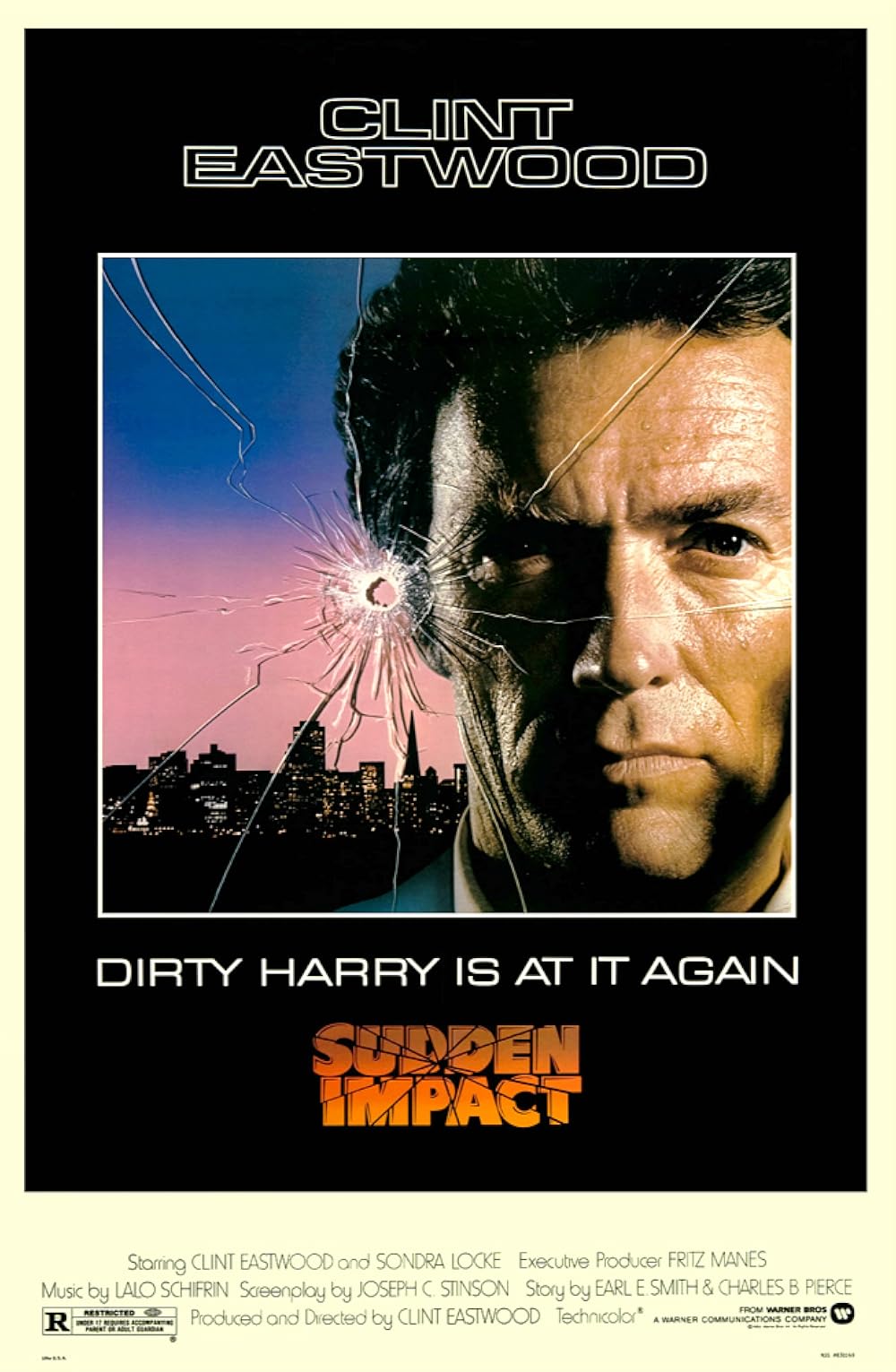
Sudden Impact (1983)

By Richard Winters

My Rating: 6 out of 10

4-Word Review: Harry investigates revenge killings.

Inspector Harry Callahan (Clint Eastwood) continues working in the San Francisco police department despite his perpetual disregard of proper police procedures, which gets many of the crooks that he has arrested freed due to legal technicalities. His superiors are frustrated with him, but since he does get results keeps him on the force though reassigned to the small town of San Paulo where he works with a sheriff Jennings (Pat Hingle) in hopes he’ll be less problematic. It’s there that he comes upon a case of various men being found shot to death in similar ways. This is being done by Jennifer (Sondra Locke) an artist in residence who 10 years earlier was raped along with her younger sister by a group of men and now she’s out to get her revenge by killing them off one-by-one. Harry is starting to piece together the clues but is surprised that Jennings is reluctant to follow-up on them giving him the impression that the sheriff may have something to hide.

The story is based on a script written by Charles B. Pierce better known for his rural horror movies from the 70’s that were shot in Arkansas and loosely based off of real events like The Town that Dreaded Sundown. This was meant to be a starring vehicle for Locke, but when Eastwood decided to renew the franchise after several years of dormancy, he felt the plotline here would be a good fit for the next Dirty Harry movie and thus hired Joseph Stinson to revise it.

The result is a mish-mash that’s never quite as compelling as it should. For the majority of the runtime Eastwood’s heroics and Locke’s crimes are working in a parallel universe and not connected making it seem like two different movies. Harry’s non-stop shootouts with crooks becomes redundant and cartoonish while Locke’s killings and flashbacks make it too reminiscent of other better-known films like I Spit on Your Grave and Death Wish. The bad guys are caricatures to the extreme making their moments boring and predictable. If the violence wasn’t so over-the-top you’d be convinced, like critic Pauline Kael mentioned in her review, that this thing was meant to be a parody.

Locke and Eastwood are both good and this is the last film that they did together as a couple before their break-up. In Locke’s case I liked how her cynical and brash persona mixes with Eastwood’s brooding and quiet one. Eastwood speaks more here than in the previous entries, but the character doesn’t seem to be evolving. The opening scene inside a courtroom where Harry is shocked to learn that the criminals he apprehended will be set free because he didn’t get a search warrant seemed ridiculous as after being on the force for so many years, and going through the exact same predicaments in the earlier films, that you’d think by now he’d learn his lesson and do things that conform within the legal framework, or at the very least not be so surprised when a judge sees it differently. The number of near-death shootouts he goes through is exhausting making me wonder how he maintained his mental state and didn’t take the vacation time when he’s asked even if he’s ‘not up for it’.

My biggest grievance though is with the structure. I really felt it would’ve worked better had it been approached as a mystery. We could’ve still seen the killings being done, but the identity of the killer would’ve been masked. Instead of Locke being an artist she could’ve been on the police force working on investigating the case and Harry could’ve started up a friendship/quasi relationship with her and at the start been impressed with her work only to slowly become aware that she was intentionally mudding the evidence. Sheriff Jennings too could’ve initially been portrayed as a ‘good guy’ with down to earth sensibilities that Harry liked and then as it progressed would his intentions become more dubious. The flashback sequences, which get interspersed throughout, could’ve instead been saved until the very end.

Spoiler Alert!

The film also continues to reveal Harry’s zig-zagging moral logic. In the first film he was all for playing outside the rules, then in the second installment he came to determine that vigilantism wasn’t the answer. Now here, by letting Locke off-the-hook and not arresting here, he’s acting like street justice is okay. It makes you wonder; is he really growing as a person and seeing things differently or simply floating along with whatever way the plotline wants?

My Rating: 6 out of 10

Released: December 9, 1983

Runtime: 1 Hour 57 Minutes

Rated R

Director: Clint Eastwood

Studio: Warner Brothers

Available: DVD, Blu-ray, Amazon Video, YouTube

The Enforcer (1976)

By Richard Winters

My Rating: 7 out of 10

4-Word Review: Partnering with a woman.

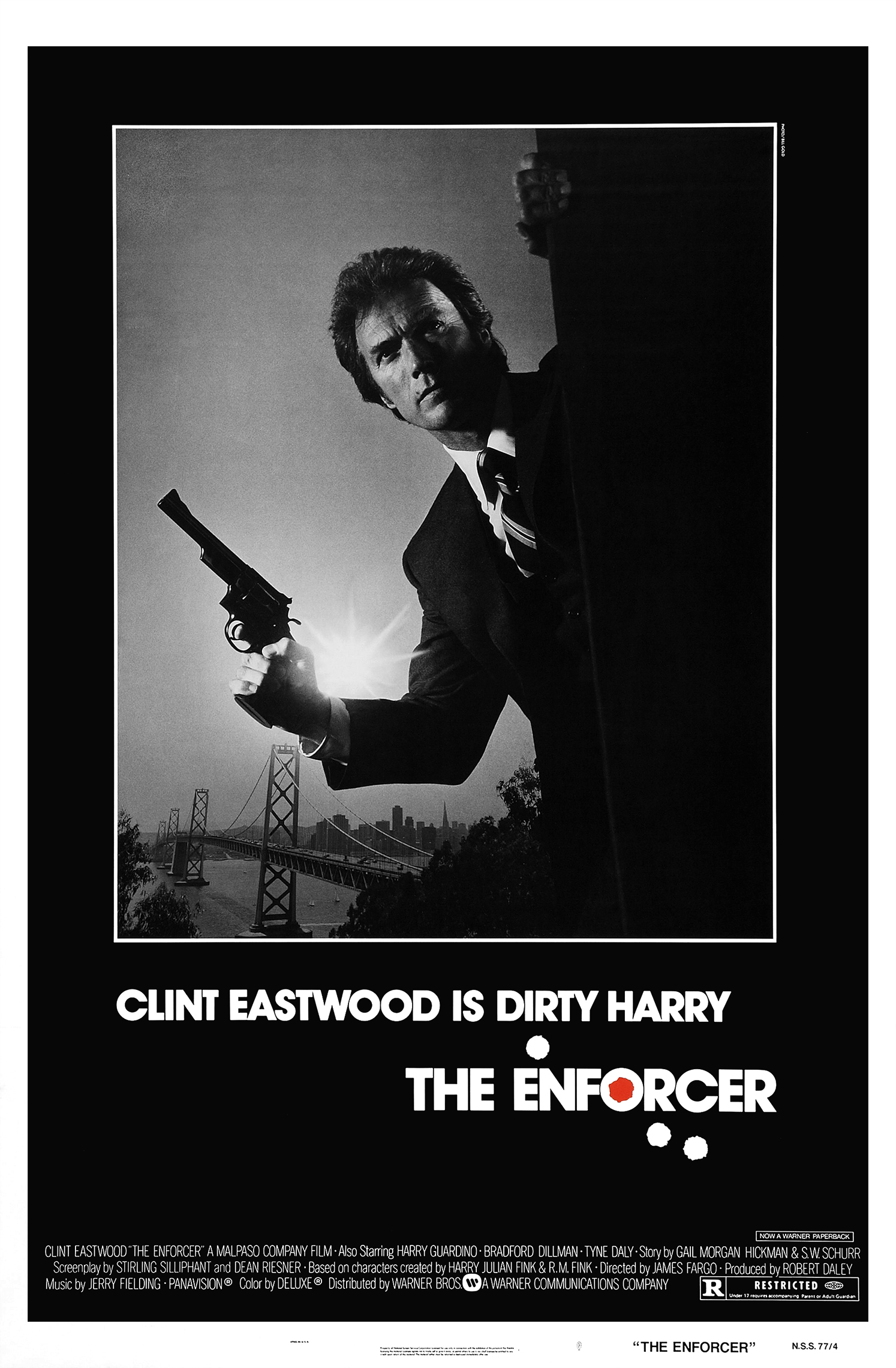
Bobby Maxwell (DeVeren Bookwalter) leads a group known as the People’s Revolutionary Strike Force that is made up of young adults engaged in underground criminal activities. Harry (Clint Eastwood) must work with Big Ed (Albert Popwell) the leader of a black militant group, in an effort to track down Bobby before they do any more damage, but his efforts are stymied by his superior Captain Jerome Kay (Bradford Dillman) who arrests Big Ed before Harry is able to get the information he needs. Things are further complicated by pairing him with Kate (Tyne Daly) as his new partner. Harry doesn’t think much of having women on the force and feels she won’t be able to meet the demands of the job though Kate is intent to prove him wrong.

The original script was written by two young San Francisco area film students who based it off of the 1974 kidnapping of Patty Hearst by the Symbionese Liberation Army. Then after watching some Dirty Harry movies, they decided to rewrite it by incorporating his character into the story. They then visited the Hog’s Breath Inn, a restaurant owned by Eastwood, and handed the script to his business partner Paul Lippman, who in turn gave it to Eastwood. Another script by Stirling Silliphant had already been given to Clint that involved Harry being partnered with a lady cop, a concept that he liked, though he didn’t feel there was enough action in it, so he hired Dean Reisner for a rewrite that would combine elements of both scripts, which is what ultimately became this movie.

The franchise seems to have lost some of its magic. Watching Harry come upon a crime in progress and casually blow away the criminals is no longer as riveting, or shocking and in many ways comes-off as predictable and even cartoonish. The first film did a good job of showing how police work wasn’t always exciting and sexy and could entail doing some boring duties, but here it creates the idea that it’s one pulverizing shootout after another. I didn’t care for the pounding score played over the chase sequences, which the first one didn’t do and was better for it as the music gets a bit distracting and more formulaic like something out of a cop TV-show. Bradford Dillman’s character, as an exasperated police chief, is a complete caricature like a puppet created solely so it can yap at Harry and get him to snarl in return. I wasn’t so crazy either about the humor that seeps in as the first two films had a very serious tone though the scene involving a group of old ladies sitting around a table writing love letters while inside a whorehouse is a definite gem. 

The casting is unique particularly Bookwalter as the head of the criminal gang, who up to this point was best known for starring in Andy Warhol’s experimental film Blow Job, which was a 35-minute movie that had the camera focus solely on Bookwalter’s face as he received fellatio. He also had a brief bit in the second installment of the series playing a naked man who gets killed in a shootout during a sex orgy. Here though he doesn’t have enough of an acting presence to make his moments onscreen interesting like Andrew Robinson did in the first one. He pretty much just seems like a male model with an angry stare and a gun. It’s the same result with popular radio deejay Machine Gun Kelly (Gary D. Sinclair) who gets cast as the priest who runs cover for the bad guys but clearly doesn’t have much acting ability and it’s quite possible that Eastwood intentionally put these guys into these roles knowing this, so that way they’d have no chance of upstaging him. 

I did though like Tyne Daly as Harry’s new partner. She had rejected the role three times due to issues with the script and how her character was portrayed but eventually agreed to get on board once her demand for revisions were met and I’m sure glad she did. She’s not sexy, or beautiful, which is good, and portrays a no-nonsense quality and genuinely seems like she wants to prove herself and dedicated and thus making her appealing right from the start. The only issue is that she’s constantly carrying around a shoulder purse, but why? I’ve never seen a policewoman have one and it seems ridiculous as it impedes her ability to chase after people as she has to grab a hold of it so it doesn’t flop against her body as she moves. 

Spoiler Alert!

Fortunately, the two don’t end up falling in love, the original script had this happening, but this was one of the things Daly insisted had to be taken out before she’d agree to do it, which is good because in real life, especially between professionals, that shouldn’t be occurring. Having her die at the end took me by surprise but is good too as it shows how dangerous police work is and how not every time is the good guy going to come out of a shootout unscathed. 

My Rating: 7 out of 10

Released: December 22, 1976

Runtime: 1 Hour 36 Minutes

Rated R

Director: James Fargo

Studio: Warner Brothers

Available: DVD, Blu-ray, Amazon Video, YouTube

Magnum Force (1973)

By Richard Winters

My Rating: 8 out of 10

4-Word Review: Harry battles renegade cops.

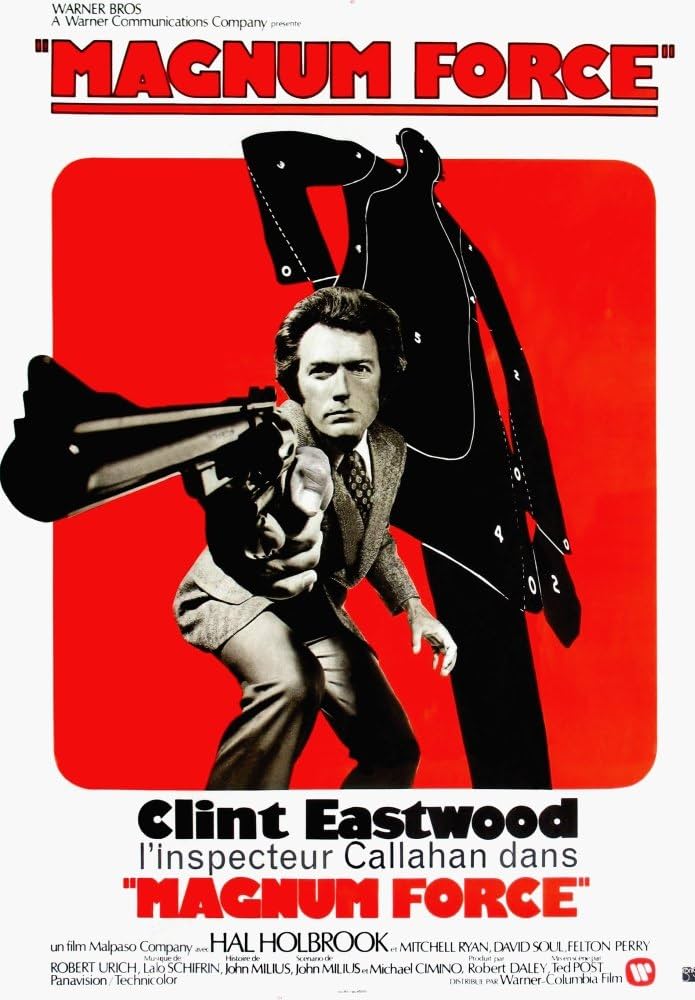
Somebody is killing San Francisco’s well-known criminals who have been able to manipulate the courts in a way that they’ve gotten off and have not served any time. “Dirty” Harry Callahan (Clint Eastwood) isn’t sure at first who’s behind it, but every time he tries to get investigate his superior, Lt. Neil Briggs (Hal Holbrook) tells him to essentially ‘back off’ and go back to stakeout duty of which he’s been assigned, but in his off hours he continues to pursue it. He comes to the conclusion, after a pimp is shot at close range while sitting in the driver’s seat of his car, that a policeman pretending to be a traffic cop is behind it. He then begins to focus in on four new recruits (David Soul, Robert Urich, Kip Niven, Tim Matheson), who all show remarkable aim on the gun range, as being the ones behind it, but how does he prove it before they kill again, or set their sights on him in order to keep him quiet?

In this follow-up to the classic Dirty Harry the direction isn’t as stylish as Don Siegal didn’t return to helm this one, so the reins were handed over to Ted Post who’s better known for his TV work and which Eastwood knew through them working together on the ‘Rawhide’ TV-show from the 50’s. While not all bad there were certain segments that appeared a bit off like when the motorcycle cop pulls over the mob boss, played by Richard Devon, who’s riding in a limousine. The car clearly comes to a stop on a well-traveled bridge, but when the men inside the vehicle get shot you can see through the rear window that the car now appears parked in some urban neighborhood street. The segment where Harry drives into the parking garage of his apartment complex and then gets out of his car after parking it only to be surprised when the four renegade cops, who are also parked there on their motorbikes, begin speaking to him, is botched too as Harry would’ve seen them already there when he drove up and thus the scene should’ve been shot from his point-of-view through the front windshield of his car.

The action segments though are top notch. The scene inside an airplane where Harry disguises himself as a pilot in order stop hijackers from taking it over is both funny and tense as is his shooting down thieves trying to rob a grocery store. The gun range segment, where he and David Soul compete to see who’s the most accurate shooter, is well-handled as is the final chase inside an abandoned airplane hangar in a shipyard. There’s also a cool, but grisly sex orgy shootout in which a naked woman’s body tumbles out a high-rise apartment and then down several flights. You can also spot a nude Suzanne Somers during a poolside massacre.

The film also features the infamous Drano scene where a pimp, played by Albert Popwell, forces a prostitute, played by Margaret Avery, to swallow drain cleaner, which inspired a group of criminals in Ogden, Utah to try and replicate it when they robbed a record store and took the employees hostage on April 22, 1974 in what became known as the Hi-Fi Shop murders. However, instead of instantly killing the victims like it did in the movie it instead created blisters on their mouths and internal burning, which caused them to go through extreme suffering for hours.

My biggest complaint is how Harry is too nice and has lost some of his edge that made him so interesting. In the first film he was described as someone that didn’t like minorities, but here he’s matched up with an African American partner, played by Felton Perry, right off-the-bat with no complaints. He’s also seen with children in one segment and seems to enjoy them, but I’d think with Harry’s irritable temperament he’d find kids running around and making noise to be annoying. A downstairs neighbor lady, played by Adele Yoshioka, comes on to him quite strongly, she literally walks out into the hallway as he’s coming home and asks him what she needs to do in order to go to bed with him, which seemed too forward even for the carefree 70’s. I agree with John Milius who wrote the original draft of the screenplay where that scene was not in there but got added later at Eastwood’s behest. Harry was not the sociable type and if anything, he’d be doing prostitutes simply as a release for his sex drive. The character really didn’t have the capacity nor desire for a relationship and if he was married to anything it would be his job and mowing down bad guys making this romantic segment forced and not believable.

The bad guys are a bit too cliched and dull, especially the mob bosses, which is a far cry from the first one where Andrew Robinson made his psycho character quite distinct and intriguing. One scene has a group of mafia guys sitting around a table eating Chinese food, but none of them says a word, which to me was not realistic. Even bad people still follow sports, weather, and current events and would like to chat a little with those around them, supposedly these are their ‘friends’ since they work closely together, and not just eat in stone cold silence, which paints them too much as robots with no life, or personality outside of being killing machines.

While it’s fun seeing Urich and Soul in early roles and in Urich’s case looking downright boyish, the four renegade cop’s presence onscreen is quite flat. There’s no distinction between their personalities and no backstory given to how they came together, or what brought them to becoming vigilantes. Did they have a loved one, for family member die at the hands of a criminal who then was given a lenient sentence? This is never explained, or elaborated on, but really should’ve.

It’s also confusing to have Harry, who in the first installment was fed-up with the politics of policework and looking to work ‘outside the system’ suddenly dislike these guys for doing what he himself had previously advocated. Would’ve been more interesting had they invited him to join the group, and he initially obliged thinking this would be a good to solution to criminals getting off easy only to eventually realize the group was taking things too far and then work to stop them. 

My Rating: 8 out of 10

Released: December 25, 1973

Runtime: 2 Hours 3 Minutes

Rated R

Director: Ted Post

Studio: Warner Brothers

Available: DVD, Blu-ray, Amazon Video, YouTube

Dirty Harry (1971)

By Richard Winters

My Rating: 10 out of 10

4-Word Review: Cop doesn’t like rules.

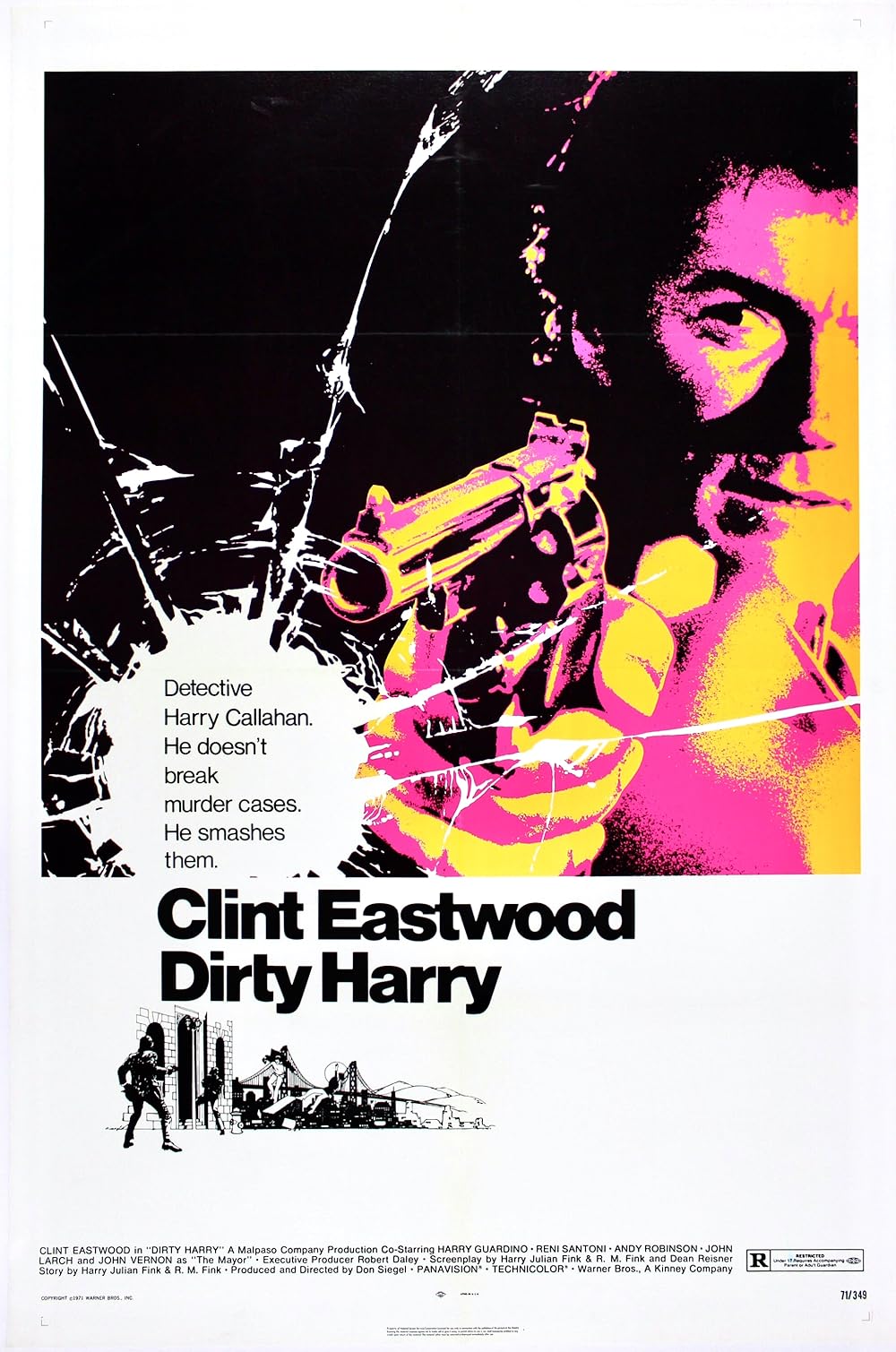
A psychotic who goes by the nickname of Scorpio (Andrew Robinson) has pledged to kill one person a day unless the city of San Francisco forks over $100,000 with his first victim being a woman (Diana Davidson) taking a swim in a pool on a rooftop of a high rise. The mayor (John Vernon) agrees to give into the killer’s demands much to the objections of Harry Callahan (Clint Eastwood) a hard-nosed cop who believes criminals are coddled by the system at the expense of their victims. Yet Harry, who’s known by his fellow cops as Dirty Harry, which he acquired for his well-known ability to circumvent rules that he doesn’t agree with, must go along with the demands of his department forcing him to act as the delivery of the ransom. This causes him to go through the humiliation of running all around the city at the whim of Scorpio who gives him directions of where to go next via different pay phones in the area. When Harry almost gets killed by doing this and then asked to be the delivery guy again, he walks out insisting that appeasing the killer is the wrong way to go. This causes even further irritation when Scorpio is later caught by Harry and then freed on a technicality convincing him that he must work on his own time in order to get the Scorpio put away permanently.

The script was written by the married team of Harry Julian Fink and his wife Rita. The inspiration came from the real-life Zodiac case who terrorized the city of San Francisco during the late 60’s and was never caught. The main character was supposed to be someone in their 50’s and was originally offered to Frank Sinatra, who had difficulty holding the Smith and Wesson gun, and decided to bow out. It was then offered to Paul Newman, Steve McQueen, who had just gotten done playing a cop in a movie and didn’t want to have to do another one, as well as George C. Scott and Burt Lancaster who both rejected it due to their feelings that the story’s theme was right-wing.

As a cop film it’s by far one of the best and has a lot of unique moments. Because Bullit had come out just a few years earlier, which featured a very famous car chase, it was decided not to replicate that one and instead we get treated to some very exciting foot chases with one occurring inside a factory mill and another at Kezar Stadium late at night. What makes these chases so interesting is that there’s no musical score played over them like in most movies, but instead we hear the pounding of their feet on the pavement and other outside ambience that helps to make these sequences grittier and more captivating. When the music does get played it’s when Scorpio is aiming his rifle to kill someone, but has the distinct sound of female vocals, which composer Lalo Schifrin put in to represent the voice he felt Scorpio was hearing inside his head.

Eastwood has made a career of playing this type of role, but here it comes off as fresh and like it was perfectly written for him and no one else could’ve played it better. His patented grimace and squint really work here and it’s interesting seeing the way his crusty exterior softens a bit as the film progresses and I liked the contrast of pairing him with a younger, less experienced cop, played Reni Santoni, that Harry initially thinks very little of, but eventually grows to like and respect. The conversation that he later has with Reni’s wife, played by Lyn Edgington, in which they discuss the emotional toll that being a cop can do to an individual really exposes the challenging job that it is as does Harry’s night on patrol where he’s forced on the spot without preparation to take on many difficult tasks including talking a man down from jumping off a building. This all helps to unglamorized the life of a cop while also revealing the underlying stressful nature of the position and why so many men and women that do it will eventually get burned out. 

Andrew Robinson, in his film debut, is excellent as well with a distinct eyes and face that looks constantly creepy. Normally I’d complain that we learn very little about his character nor the motivation for why he kills, but keeping him as an enigma helps put the focus on the main message, which is the rights of the victims and cops who try to protect them and by making Scorpio have a distinct personality would’ve humanized him and thus deluded the theme. Even so Robinson makes the most of each scene he’s in and he consistently stands out no matter what he’s doing, like the almost comical facial expression he makes when he gets stabbed in the leg. I also liked how after he does get stabbed that he then continues to walk and run with a limp versus other films where someone gets injured and they quickly recover, and it eventually becomes all but forgotten. 

Spoiler Alert!

My only complaint is how at the very end Harry throws away his badge and walks off the job. Director Don Siegel and Eastwood argued about this with Eastwood feeling Harry wouldn’t do this as being a cop was the only job he knew and his relentless pursuit for justice and putting bad guys away would overpower his urge to quit. Even if he was unhappy with some of the police procedures, he’d still put up with it, or fight to improve things from within. This is why at the end he should’ve taken out his badge and looked at it like he was thinking of throwing it, but then eventually put it back into his pocket. 

My Rating: 10 out of 10

Released: December 23, 1971

Runtime: 1 Hour 42 Minutes

Rated R

Director: Don Siegel

Studio: Warner Brothers

Available: DVD, Blu-ray, Amazon Video, YouTube

The Boss’ Wife (1986)

By Richard Winters

My Rating: 3 out of 10

4-Word Review: She comes on strong.

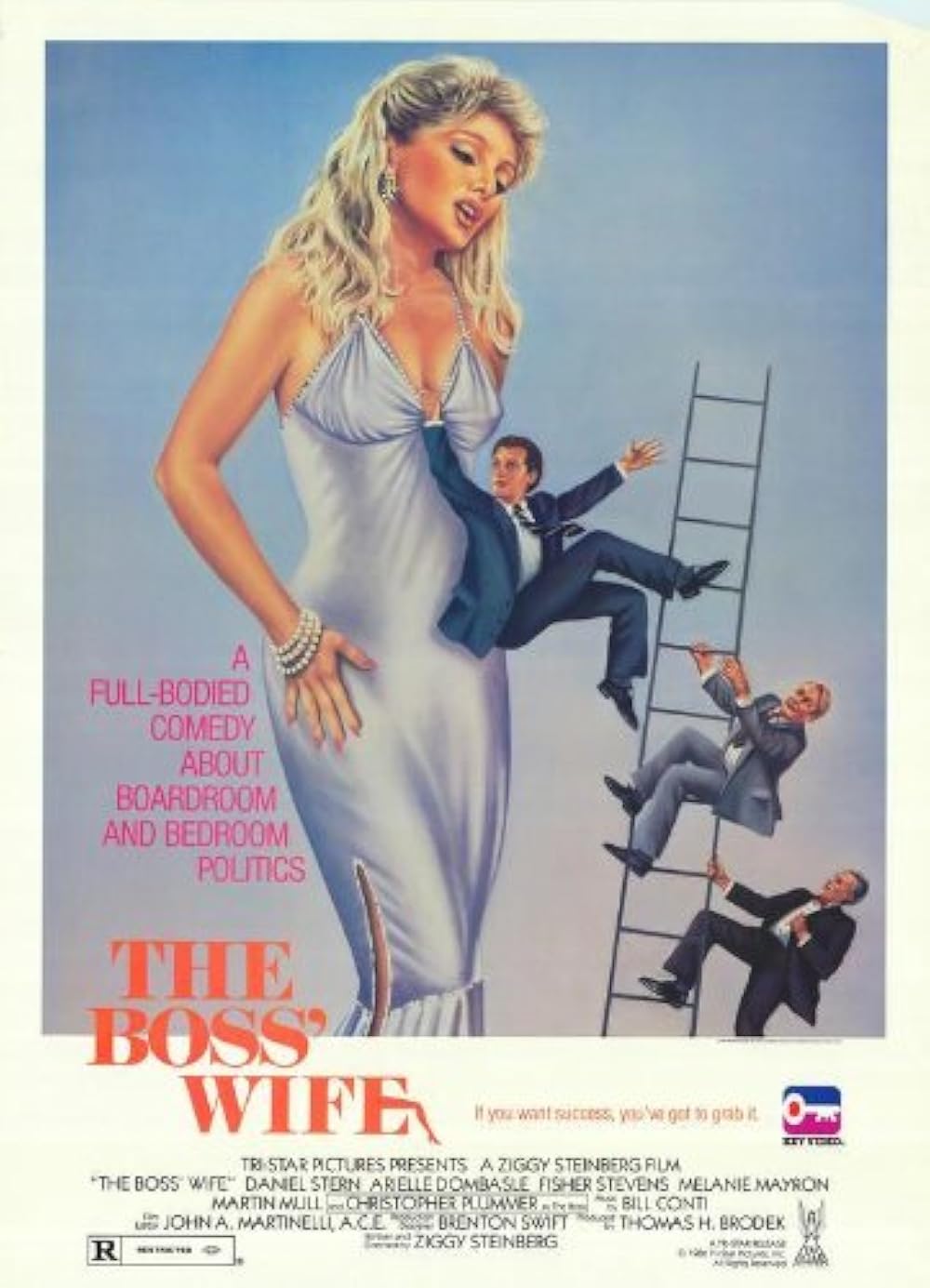
Joel (Daniel Stern) works at a stock firm and wants to impress his boss (Christopher Plummer) with some stock analytics and competes with fellow employee Tony (Martin Mull), who’s a major corporate brown noser. The boss though is not the smartest and misreads everything including thinking that Joel is a smoker, which he isn’t, and giving him the nickname of ‘smoky’. He also thinks that Joel is gay and having a fling with Carlos (Fisher Stevens), which neither is true, but this allows the boss’ wife Louise (Arielle Dombasle) to openly come-on to Joel while the boss, so worried that Joel may come on to him, feigns naivety at what his own wife is doing. Joel tries to avoid the woman because he fears that if he doesn’t, he’ll get caught, which will not only hurt his job advancement, but also his shaky marriage to Janet (Melanie Mayron). 

The film is the product of Ziggy Steinberg who started his careers in the 70’s writing for episodes of TV-shows and then graduating to feature films like Porky’s Revenge and then ultimately Another You, which to date has been the last writing gig he’s done. This film marked his debut as both a writer and director, but the results are so-so. The concept is predictable and better suited for an episode of ‘Three’s a Company’, which he also wrote for, than the big screen. While the attempt is for screwball the pacing is slow and not a lot of gags going on and as satire/parody its target is so obvious and been done so many times before that it hardly seems worth the effort as one could simply watch How to Succeed at Business Without Really Trying and get a lot more laughs. In fact, the only amusing moment comes when Plummer has a toy choo-choo train ride onto his desk carrying drinks and hamburgers and then Stern fumbling around to get ketchup on his burger, which causes a red mess on the boss’ desk.

The acting from the two male leads is adequate. Stern’s character is benign, but he plays it in a likable way making you connect to him and his quandaries. Plummer is quite good particularly with the way he roles his blue eyes every time he comes to a mistaken conclusion to something. Stevens has some good crude moments who initially starts out as Mayron’s employer only to create a haphazard buddyship with Stern while on the train. 

Dombasle though is quite possibly the film’s weakest link. She enters in almost like a fantasy figure and has little dialogue. Why this voluptuous woman would get so focused on Stern for no apparent reason doesn’t make a lot of sense. He does not stand out in any way and therefore a woman like her would overlook and even ignore him. She comes onto him in such a shameless and extreme manner even while in public you could argue she was mentally ill. Even if she’s desperate for sex cause she’s not getting enough from her older husband she could still, with her money, find ways to get it, through like male escorts, than groveling in such a ridiculous level towards a chump like Stern. Later it does come out that she is ‘attracted to men who resist’, which helps explain her motivations a little, but it would’ve been more entertaining had the Mull character paid her, or worked out some deal with her, to come onto Stern in  order to get him into trouble with Plummer, which would’ve offered a nice unexpected twist, which unfortunately the script doesn’t have. 

Spoiler Alert!

The final 10-minutes in which Plummer corners Stern in his rental home with both his wife and Stern’s and the myriad excuses Stern comes up with to try and get out of the jam is sort of funny, but it takes too long to get there. That frantic, hyper-pace should’ve been present from the very beginning and it just isn’t. Stern’s character arc where he finally concludes that the company culture is too conform-ridden for his liking is strained as well. If anything, he should’ve figured that out long before he goes to a company party and asked to where a silly hat like everyone else, which was one of the least problematic things at that place and yet this is where he suddenly decides to ‘draw-the-line’. 

My Rating: 3 out of 10

Released: November 7, 1986

Runtime: 1 Hour 23 Minutes

Rated R

Director: Ziggy Steinberg

Studio: Tri-Star Pictures

Available: DVD-R, Amazon Video, YouTube

Good Luck, Miss Wyckoff (1979)

By Richard Winters

My Rating: 1 out of 10

4-Word Review: Spinster teacher is raped.

Evelyn Wyckoff (Anne Heywood) is a middle-aged single woman who teaches high school in a small town in Kansas. She has never married and is showing signs of severe depression, which alarms her best friend Beth (Carolyn Jones) as well as the older couple (R.G. Armstrong, Joycelyn Brando) whom she’s living with. Both her doctor (Robert Vaughan) and her psychiatrist (Donald Pleasance) believe it’s because she is not in a relationship or having any sex and that she needs to get out more and meet people. She attempts at starting something with fellow teacher Chester (J. Patrick McNamara) but finds him to be too shy and embattled with his own problems to be able to recognize her interests. She also considers friendly bus driver Ed (Earl Holliman) only to call it off when she learns he’s married. Left alone after school one evening she comes into contact with Rafe (John Lafayette), a black man who works as the janitor, who sees her loneliness as a weakness that he can exploit. He comes onto her strongly and abrasively eventually forcing her to submit to his sexual demands, but she doesn’t go to the authorities and instead starts to enjoy the degradation and continues to come back for more until the rest of the students and teachers find out about it putting her job and reputation in peril.

The story is based on the 1970 novel of the same name written by William Inge. The film rights were sold in 1971 but sat on the shelf for many years until producer Raymond Stross found it and felt it would be a good vehicle for his actress wife Heywood who had already made a name for herself in tackling controversial, edgy material and even sought it out, so this was considered a perfect next project. While she had received critical accolades for her earlier work, The Fox, where she played a lesbian in a  relationship with Sandy Dennis, which was envelope pushing for its era, this one did not go over as well and was genuinely lambasted causing her career to take a downfall from which it couldn’t recover and she ended up retiring from acting just a decade later.

On a surface level it’s okay. The recreation of the 1950’s Kansas, while shot in Stockton, California, is still effective and the personalities of the people isn’t as cliched. There are those that show prejudices and oppressive mind sets, but there’s a healthy balance that don’t, which helps make it feel more realistic. The supporting cast is full of familiar faces though most of them are wasted in small roles that don’t add much and Carolyn Jones, in her last feature film appearance, stands out best albeit with an awful hairstyle.

The biggest detriment, besides the flat direction and booming music score, is Heywood who doesn’t offer enough nuance to her part. I’ll commend her for taking on a very difficult role that required at age 48 to be fully nude and allowing herself to be put into some very vulnerable and demeaning positions, but her facial expressions and responses are one-note. Her constant crying for no reason, which alarms those around her, and unexplained impulsive behavior, like smashing a mirror during a party, is too dramatic. Instead of using this to reveal that she’s unhappy it makes her seem more like a complete mental case that has far worse issues than just being lonely and I felt more sympathy for her friends trying to put up with her erraticism than I did with the main character who for the most part is rather whiny and annoying.

There’s never any explanation for why she’s unable to get into a relationship. She’s attractive, so you’d expect there would be eligible suitors who’d ask her out. All we see is a bus driver who’s already married, but what about other single men who would have to be out there? Why don’t we ever see one of them make a move and if so, how would she respond to them, which would be far more revealing than anything she says to her shrink, which amounts to talky pseudo-science.

The rape scene isn’t either shocking or effective and seems to come out of nowhere. It occurs in the middle of the second act, but before then we see the Rafe character only once while cleaning the chalk boards for a few seconds, so we have no idea what makes him tick, or why he chooses to prey on this woman and none of the others. Had she made the first move in an attempt to connect with someone and relieve her of her isolation, and this then inadvertently incited some inner aggression with him it might’ve made more sense and worked with the flow of the story, but the way it gets handled here makes it seem like two different movies: one dealing with the pain of being alone and the other about a man who enjoys exploiting women.

Ultimately nothing comes together. We don’t learn much about the protagonist. Yes, she’s sexually repressed, but the root cause is never made clear. The fact that she accepts her degradation at the hands of Rafe makes her even more confusing. When her friend Beth says that she feels like she didn’t really know her at all I the viewer felt like saying the same thing. The result is shallow using shock elements that are no longer effective causing the film to be both forgettable and boring.

My Rating: 1 out of 10

Released: April 13, 1979

Runtime: 1 Hour 46 Minutes

Rated R

Director: Marvin J. Chomsky

Studio: Bel Air/Gradison Productions

Available: DVD, Blu-ray, Tubi

Smile (1975)

By Richard Winters

My Rating: 9 out of 10

4-Word Review: Producing a beauty pageant.

Santa Rosa, California is the site of this year’s Young American Miss Pageant. Each person that’s involved in the pageant approaches it differently. Bob (Bruce Dern), a middle-aged man who works as a car salesman, sees his position as a judge on the panel as a diversion from his otherwise mundane suburban life. Brenda, the pageant’s executive director, considers it a way to display her perfectionist qualities of control and leadership. Her husband Andy (Nicholas Pryor) views the proceedings in a much more cynical fashion and another added element to their already troubled marriage. Tommy (Micheal Kidd), the dance choreographer, approaches it as just another paycheck while Doria (Annette O’Toole), one of the contestants, considers it an opportunity to bolster her name and face even though Robin (Joan Prather), who’s competing against Doria, enjoys the whole thing just for the experience and isn’t concerned with who wins it, at least not initially.

The film marks the third entry in director Michael Ritchie’s American Dream trilogy and one of many he did dealing with competition and how this can change people in both good and bad ways with The Bad News Bears being the most famous of those. The gifted Jerry Belson wrote the script that was based on Ritchie’s own experiences as a pageant judge and many of the situations shown here were ones he went through. Unfortunately, despite the script being absolutely top notch to the extent of being one of the best satires ever written and equal to the more well-known Network that came out a couple years later the movie has not been seen by many, and the title has in recent years been eclipsed by the horror movie franchise. The is because the film’s studio, United Artists, had no confidence in the material and didn’t believe it would generate any profit and thus released it to only 4 theaters nationwide and thus few people ever saw it though in the following decades it has generated a small cult following and even a stage musical.

The finely etched, well-defined characters are what really sets it apart and each of them could be the centerpiece of their own movie if they wanted. Dern, who usually plays psycho roles, is excellent as a father who’s still clinging to his optimism even as everything around him deteriorates. Pryor equally good as his friend and counterpart who finds the suburban dream to be full of letdowns and lies and tries adamantly to break through Dern’s upbeat shield in order to get him to see the truth too. Feldon, best known as Agent 99 in ‘Get Smart’ TV-show, is terrific as well as a complete control freak and her defining moments coming during a scene in her living room, with all the furniture draped in protective plastic, and where she tries to literally goad her husband Andy into killing himself.

Even the minor characters display a unique angle and perspective on things including the janitor (Titos Vandis), who seemingly has a bottle of alcohol hidden everywhere, and makes keen observations on the others as well the music director (William Traylor) whose sarcasm and sexism knows no bounds. Geoffrey Lewis is memorable too as a marketing director who tries to promote the wholesome image of the contest only to in one really funny moment blurt his true cynical feelings about it. Prather and O’Toole though are the ones who drive it as it’s through them we see the inside mindset of those being judged and it’s interesting how at the start it’s O’Toole who’s the more jaded of the two while Prather is the wide-eyed one, but by the end after her experiences here Prather has more than been able to catch up with her.

Spoiler Alert!

The direction is done in a way that makes it seem like a docudrama where everything is captured through an unfiltered lens showing it as it happens with none of the scenes being set-up in a way that makes it feel staged, which is to its benefit. However, this gets ruined, in one of the movie’s few weak points, when Dern’s son Little Bob (Eric Shea) gets caught taking polaroids of the women in their undress. Instead of hearing the dialogue of the people when they catch him, as well as Dern’s when he finds out, which could’ve been quite revealing, music gets played over it, which is jarring as it reminds the viewer they’re watching a movie, even though it had spent the rest of the time trying to convince us we were seeing reality as it unfolded.

The ending is a bit of letdown too. Ritchie and Belson wanted the winner to be a complete surprise both to the cast and crew, which explains why the camera swerves around in a jerky style as even cinematographer Conrad Hall didn’t know who it was and thus had to try to find her when her name is announced. However, having it be a girl (Shawn Christianson) who has no lines of a dialogue, and only seen briefly in a few group shots, was a mistake. The attempt was to show how pointless these contests are and how not much thought or care goes into who’s picked, as evidenced by one of the judges seen flipping a coin before he makes his decision, but it still should’ve been someone we had seen and heard earlier. Maria O’Brien, who plays an obnoxious contestant who annoys the others so much they even sabotage her talent act, would’ve been a better choice and the film would’ve still made the same point and allowed a little more of a lasting emotional effect. With the way it gets done here the viewer leaves feeling miffed and confused.

My Rating: 9 out of 10

Released: March 20, 1975

Runtime: 1 Hour 57 Minutes

Rated PG

Director: Michael Ritchie

Studio: United Artists

Available: DVD, Blu-ray

Dead Ringers (1988)

By Richard Winters

My Rating: 7 out of 10

4-Word Review: Twin brother’s relationship erodes.

Twins Elliot and Beverly (Jeremy Irons) work at a clinic as gynecologists with Elliot being the more outgoing of the two. Elliot routinely dates women many of them patients at their clinic but will then ‘hand them off’ to Beverly who is the shyer of the two and unable to get women without Elliot’s help. Since Elliot likes variety in his relationships, he’s okay with Beverly getting the women once he’s lost interest in them and the women can never tell the difference. Things though begin to change when Claire (Genevieve Bujold) enters into the picture. She, like the ones before her, was a patient whom Elliot is quickly able to hook-up with and then after a brief fling is given to Beverly, but this time Beverly falls for her in a deep way and not so eager to drop her. Claire also becomes aware that she’s been tricked by the two and has a confrontation with Elliot about it while she continues to see Beverly on the side. Beverly though becomes conflicted with his dual loyalties unable to handle how fractured his relationship with his brother, who he used to be quite close to, has become spiraling him into a depression that ultimately leads to a dangerous drug addiction. 

In 1981 David Cronenberg became interested in doing a movie about twins and producer Carol Baum sent him articles about Steward and Cyril Marcus. These were identical twins who were gynecologists working and living together in New York City. On the morning of July 17, 1975 both were found dead inside Cyril’s cluttered apartment in what had initially been perceived as being a suicide pact, which was later ruled out, but both did die within a few days of the other. While their deaths generated may articles and even a novel the cause to what circumstances lead to them dying together has remained open and thus Cronenberg decided to ‘answer’ that question with this story though he had to go through many years of different producers, screenwriters, and various different drafts before this version was finally given the green light.

If you’re a fan of Cronenberg, particularly his gore, which he’s best known for, then you may be disappointed with this as there really isn’t much. There are still some disturbing moments including the garish genealogical instruments that Beverly pays an artist, played by Stephan Lack, to create which he then plans on using on one of his patients, to the shock of his medical staff, which is a creepy moment. There’s also a dream sequence where Claire bites off a membrane connecting the two brothers, which is cool, but brief. There was also a scene shot that had the head of one of the twins coming out of the stomach of the other one, but this didn’t go over well with the test audiences, so it got cut, but I really wished had been left in. 

It’s really Irons and his incredible performance as the twins that makes this such an engaging movie to watch. Having one actor playing dual roles has certainly been done before, but never quite this effectively. Even though they look exactly alike I really got the sense these were two different people and Irons ability to craft such diverse personalities and postures, this was achieved by putting his weight on the balls of his feet while playing one of them and having his weight put on his heels while playing the other helps to, in a very subtle way, create a strong distinction and a hypnotic presence that sucks you into the story and never lets you go. 

My only quibble is that rarely have I seen twins that you couldn’t tell apart in some way. I noticed that Irons did have some minor moles on his right cheek and then another on the left side of his head near his eye. In the movie both of the brothers have these lesions in the exact same place, but I think in reality they wouldn’t, so they could’ve masked the moles on one of the characters through make-up, so it would only show on one of them and that could’ve been a way to tell them apart physically. There’s also the issue with one of them given a women’s name, which Claire does question at one point. Beverly gets quite defensive when it’s brought up insisting that his name is spelled in the ‘masculine’ way, but on the credits it’s spelled out just like it would had the name been given to a female, so I felt there should’ve been more explanation of why he’d been given an unusual name as it was something that would certainly come off as odd to many and I don’t think I’ve ever heard of a man with that name. 

I also had some problems with Bujold’s character as she seems to be plopped in solely to get the story going and start the process of having the brother’s strong bond dissolve, but for a character to generate such a pivotal thing I think she should’ve stood out more. What was it about this woman that created a division between the boys that the other women hadn’t? I would’ve liked seeing her more involved in the conflict possibly confronting Elliot in an angry way, not the conciliatory one we see here, and forbidding Beverly to see him, which would’ve helped make her more prominent versus just being a story device. 

My Rating: 7 out of 10

Released: September 23, 1988

Runtime: 1 Hour 53 Minutes

Rated R

Director: Michael Cronenberg

Studio: 20th Century Fox

Available: DVD, Blu-ray, Peacock, PlutoTV, Roku,Tubi, Amazon Video, YouTube

Straw Dogs (1971)

By Richard Winters

My Rating: 8 out of 10

4-Word Review: Man defends his home.

David (Dustin Hoffman), a nerdy mathematician, has been given a research grant and uses it to relocate to the rural countryside of England with his wife Amy (Susan George). They move into a farmhouse that was once owned by Amy’s father and they hire four men (Del Henney, Ken Hutchinson, Jim Norton, Donald Webster) to fix up the roof. The men though don’t work much and spend most of the time making fun of David and ogling Amy. After several bad encounters, including the grizzly death of their pet cat, David fires them and hopes that’ll be the last it, but things only get worse. When a teen girl named Janice (Sally Thomsett) disappears her violently drunken father Tom (Peter Vaughan) thinks it was caused by Henry (David Warner) a mentally handicapped man that Janice had shown an affinity for. Tom, along with the four other men, become a lynch mob determined to find Henry and bring him some ‘street justice’. David and Amy, while returning from a church service, hit Henry with their car as he’s running from the other men. David agrees to take the injured Henry into his home until a doctor can arrive, but the five men insist on getting inside to beat and kill Henry for his perceived crime. Since David had avoided having any confrontation with the men previously even when they had openly mocked him, they presume he’ll be a pushover this time as well, but David has finally decided to take a stand and will defend his home from the intruders in any way he can. 

While it was controversial at the time many now consider this the pinnacle of director Sam Peckinpah’s career and his directorial touches are supreme. The capturing of the brown empty vast landscape of nothingness, shot during the winter of 1971, brings out a surreal sense making it seem like the characters are living in a purgatory outer world where everything is dead and helps explain the deadness of the men’s souls that have been forced to endure their entire lives there. The climactic sequence where David’s home comes under siege is deftly handled. Normally in thrillers pounding music gets played during these segments to ramp up the tension, but here there’s only the sound of a distance foghorn, which makes it much more creepy, distinct, and helps accentuate the isolation. 

Some have been critical of the film’s violence especially at the time when there was activism going on that tried to stymie violent material on both TV and movies with the idea that violence was a ‘learned’ behavior and if people didn’t see it so much in entertainment, then they wouldn’t do it in real life. Peckinpah though saw it differently as he felt violence was an instinctual reaction that couldn’t just be ‘unlearned’ and that in certain situations it was necessary and not every conflict could be resolved peacefully, a message the film brings out quite well. 

While Susan George gives an excellent performance, as do the four villainous men, particularly Vaughan as their ringleader making them some of the creepiest bad guys in film history, I did find her character confusing. I didn’t understand why she’d marry a guy that she found by her own admission cowardly even bringing up that he was ‘running away’ from problems he was having at his university and his ‘hiding behind his studies’ in order to avoid it. She also shows no respect for his work and several times even vandalizes his chalk board that has his mathematical equations, so what attracted her to him in the first place? Would’ve made more sense had she initially idolized him for his academic status and then became painfully aware of his meekness as the film progressed, which would’ve made for a more interesting arch.

Spoiler Alert!

The film is based on the 1969 novel The Siege of Trencher’s Farm by Gordon Williams, but with many changes some of which worked while others didn’t. In the novel the couple had an 8-year-old girl, but in the film there is no child. To a degree it doesn’t make that much of a difference though when the bad guys attack the house it might’ve heightened the urgency more knowing that David was not only defending his ‘home’, but also the safety of his terrified daughter. The biggest change that the film does is that it creates a connection between Henry and Janice where Janice sneaks away with him during a church party where she invites him to be intimate with her, but in the process, he accidentally kills her, which seemed too similar to Of Mice and Men. It’s confusing too why this teen girl, who outside of her buck teeth seems reasonably attractive, would feel the need to throw herself at a mentally handicapped man, or get flirty with David, who is married. Why can’t she find guys her own age to fool around with? Knowing the hormones of most teen boys that shouldn’t be too hard, so without further explanation to her psyche, which doesn’t happen, her ‘inviting’ of Henry is quite unnatural and forced. 

In the book Henry is instead a child killer who’s being transported back to prison when the vehicle he’s in gets stuck in the snow, which allows him to escape. At the same time Janice, who’s mentally disabled, which isn’t made clear in the movie, runs away from a Christmas party where she ends up dying from the exposure to the cold, but otherwise it has nothing to do with the escape of Henry and is only presumed to have a connection by the five men, which makes more sense and the screenplay should’ve have kept it this way.

On the other hand, in the book none of the attacking men die and are only badly injured, but I think death gives it a more final resolution, so the movie scores there. I also liked how David is forced to resort to items he can find around the house, much like in the film Last House on the Left, which came out a year later, to fight off the bad guys versus the cliched machoism of having a big gun to blow them away and it also helps to show how intellectual wits can ultimately be used to overpower the otherwise physically stronger attackers. 

The rape scene in which the wife gets assaulted by not only one, but two men was another problematic moment as the book had no such segment. For one thing it makes it seem like she’s actually enjoying the attack, at least with the first one, and she recovers from it much too quickly and doesn’t even bother to tell David about it and able to go on relatively normally afterwards, which didn’t seem realistic and thus I think it should’ve been excised since it comes off as exploitive and doesn’t have that much to do with the main plot. 

My Rating: 8 out of 10

Released: December 22, 1971

Runtime: 1 Hour 57 Minutes

Rated R

Director: Sam Peckinpah

Studio: 20th Century Fox

Available: DVD, Blu-ray (Criterion Collection)
Still Smokin (1983)

By Richard Winters

My Rating: 2 out of 10

4-Word Review: Stoners travel to Amsterdam.

Cheech and Chong (Cheech Marin, Thomas Chong) travel to a film festival in Amsterdam dedicated to Burt Reynolds and Dolly Parton. Along the way Cheech gets mistaken as Reynolds and afforded the luxurious hotel room that should’ve been for him. The two take full advantage of it by ordering expensive dinners and drinks while signing it off on the hotel bill to be paid by the promoters. The promoter (Han Man in’t Veld) learns that the real Burt and Dolly won’t be showing up leaving the entire festival in shambles, but then the two stoners decide to save it by agreeing to do an improv comedy routine live in front of an audience where the Queen Beatrix of the Netherlands will be present. 

While the two may still be ‘smokin’ the film series has by this point completely lost all of its fire. My biggest complaint, which I’ve had with all of the previous installments, is that there isn’t enough story going on and had there been it would’ve been funnier. For instance, instead of the movie starting out with the two already celebrities it should’ve shown how they got into improv and learned the craft. Maybe it could’ve been because their drug dealing was no longer feasible and they were tired of constantly being harassed by the cops, so someone suggested improv as a side hustle. The two might’ve resisted at first, but then with nothing to lose decide to go on stage and try it out. To their surprise they become a hit, and this would then lead to fame and offers. Had it been done this way we would’ve at least had a plot and character development, but instead we’re just informed that they’ve become stars already, which makes it disjointed from the previous installment where they were driving around in the desert, still employed by the Arabs who wanted them to get into the adult film business.

The routines are flat almost shockingly so, as I’ve been involved in improv since moving to Austin 10 years ago and to be honest total amateurs stepping onstage for the first time and just coming up with a bit on the fly are far funnier than anything these supposed pros do here. I’m still impressed with their ability to change characters and speak in different accents, but their interplay doesn’t go anywhere. The skits as they are deals with an undercover cop (Chong) trying to arrest a drug dealer (Cheech), there’s also a gun debate between the two, a wrestling match where the two try to take on an opponent who’s invisible and yet another where they’re gay men trapped in a sci-fi movie, which may be deemed as offensive by today’s viewers as it relies heavily on gay stereotypes and mannerisms.

I remember in our improv group, like with most, somebody would usually yell out ‘scene’ when it was deemed that it had gone on too long and needed to end and I felt somebody should’ve been jumping into this movie and doing the same thing. The set-ups are okay and have potential, but don’t go anywhere that is interesting, or even slightly amusing. There are also certain bits that have no payoff at all but could’ve really used them. The best example of this is when the two continue to ‘sign-off’ on all of their elaborate room service expenses, but by the manager’s own admission, runs out of money, so who ends up paying for all those lavish meals and luxuries? I was fully expecting some moment to come where a massive bill showing of what they owed to come back to haunt them and their eyes getting all big, which could’ve been humorous, but it never happens proving how poorly thought the whole thing is. 

The final 20-minutes relies solely on concert footage of the two reenacting past skits that had been made famous from their record albums. These I found gross as the humor focuses too heavily on body fluids and stuff that would amuse only a seventh grader. I can be game for a dirty joke, if it’s clever, as anyone and have never been accused of being a prude, but when you have two grown men onstage crawling around pretending to be dogs who go through the motions of taking a shit and then smelling it, is when I checkout. Yes, the audience in the movie appears to be enjoying it, but I believe that was more from the shock value as back then some of this stuff was still considered pushing-the-envelope, but by now the edge has worn off and will be passee for many of today’s viewers. 

My Rating: 2 out of 10

Released: May 6, 1983

Runtime: 1 Hour 31 Minutes

Rated R

Director: Thomas Chong

Studio: Paramount

Available: DVD, Blu-ray, Amazon Video, PlutoTV, YouTube