Category Archives: Movies with Nudity

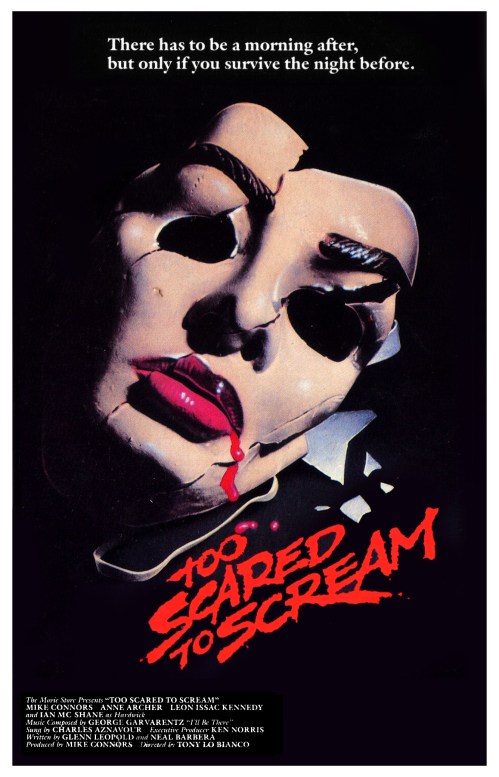
Too Scared to Scream (1984)

tooscared3

By Richard Winters

My Rating: 3 out of 10

4-Word Review: Who’s killing the tenants?

Female tenants living in a New York City high-rise building are turning-up dead in brutal fashion. Lieutenant Alex Dinardo (Mike Connors) and his younger, female partner Kate (Anne Archer) are convinced that the culprit is Vincent (Ian McShane) who works as the overnight watchmen at the apartment building and since all the crimes happen during his shift he quickly becomes suspect number one. Though getting enough evidence in order to arrest him becomes a delicate matter. Alex then decides to asks Kate to move-in to the building as a new tenant and thus keep tabs on what Vincent is doing and hopefully lure him into a situation where he’ll incriminate himself, but Kate soon finds herself in over-her-head as the killer is on-top of what’s going on and he soon bates her into a dangerous game of cat-and-mouse where Alex and the other policemen are not able to help her.

The film was an attempt at creating an American version of an Italian giallo complete with gory murders and an intricate mystery where you don’t know who the real killer is until the final twist ending. It’s also the only film to date to be directed by actor Tony Lo Bianco. Severely straddled during production as it was shot in 1982, but due to the production studio that financed the project going bankrupt it was never released until 3 years later where it was given little fanfare and came and went with few people seeing it.

The biggest problem with it is that it plays-up McShane’s role too much. Granted he’s a gifted actor who’s best known today for his work in the TV-series ‘Deadwood’, but by overemphasizing his character it makes it seem right from the start that he’s the culprit and thus making the investigation uninteresting because you feel it’s just a matter of time before he’s found out and thus little mystery, or intrigue. Granted there are a couple of other suspects, but they seem thrown-in simply as red herrings and aren’t seen much. The story would’ve had better tension had the suspects shared equal screen time and a more balance of clues making it seem like any one of them could’ve done it and thus some genuine interest at getting at what the truth is versus having it seem like it’s all spelled-out from the start. If anything Maureen O’Sullivan, who plays McShane’s near comatose mother whom he takes care of, is far more captivating, despite the fact that she doesn’t speak any line of dialogue and trapped in a wheelchair, then anything McShane himself does.

The unusual pairing of a 60-something male cop alongside a female one that appears to be only around 30 should’ve been what the film focused on as I found their contrasting personalities and different ways they approached their police work to be something that could’ve been played-off of more. Unfortunately the film taps into this just slightly and then quickly moves on and thus misses the opportunity for what could’ve lead to captivating confrontations and debates. Connor does seem a bit too old for this kind of thing and seeing him trying to chase down a young athletic man who was only 20 came-off as almost laughable and I was surprised he didn’t just fall over from a heart attack, or exhaustion before he ever managed to get near the guy. Having him lose a fight to the younger guy and have to depend on his partner to bail him out of it was realistic, so it gets props there, but the way he goes about his police work, which includes physically beating-up on suspects, is highly unethical and should’ve gotten him demoted, or fired.

Spoiler Alert!

I had issues with Archer’s character as well. This comes when she agrees to move into the apartment and work undercover, but seems woefully unprepared for it. She manages to carry a gun with her when she goes down to the basement of the building to do laundry, but then when she gets back to her place she does a goofy aerobics workout where she gets caught off-guard, but wouldn’t a seasoned cop know to carry a weapon on her at all times especially when she’s intentionally making herself a target to the killer? Also, what kind of person walks into their apartment and then doesn’t turn around and immediately lock the door once they’re inside? If you want to argue that this was intentional (I don’t think it was) because she wanted to lure the killer inside, so as to apprehend him, then fine, but she should then make damn sure she was a gun in-hand, pointed at him, when he does, which in this case she didn’t.

You must likely won’t be able to guess who the true killer is, but it’s not worth sitting through. The script doesn’t offer any clues, or hints either, so even an alert viewer won’t figure it out, but that doesn’t mean it’s a good mystery because it really isn’t. The story is sloppily put together without much imagination, or character development. Unlike a true giallo the murders are quick and without much blood, so if you’re a gorehound this thing won’t suffice. The concept had potential, but the execution is half-hearted.

My Rating: 3 out of 10

Released: September 28, 1984

Runtime: 1 Hour 40 Minutes

Rated R

Director: Tony Lo Bianco

Studio: International Film Marketing

Available: Blu-ray (Import), DVD-R

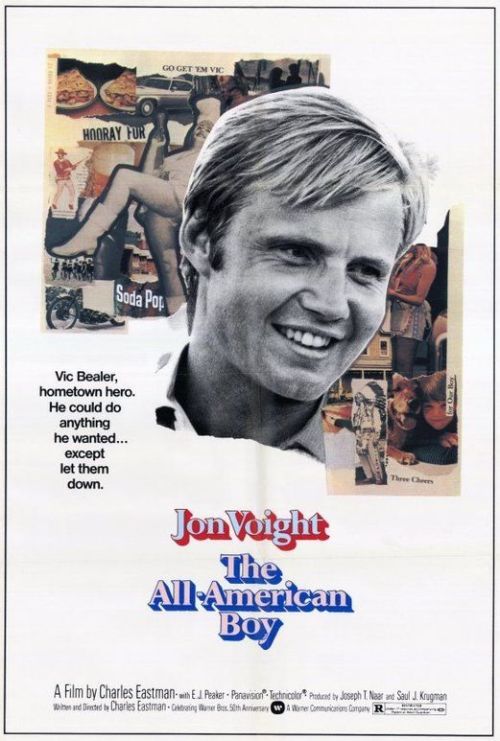
The All-American Boy (1973)

american

By Richard Winters

My Rating: 4 out of 10

4-Word Review: Amateur boxer seeks fame.

While Jon Voight is best known in the world of boxing movies for having done The Champ in 1979, which some consider infamous, his first go-around was actually this one though it remained stuck on the studio shelf long after it was filmed only to be released after his success in Midnight Cowboy. He plays the character of Vic (Jon Voight) a talented, good-looking man whose shown ability in the amateur ring and now is ambitious about making the Olympic team. Arty (Ned Glass) takes him under-his-wing, even lets him stay at his place, while he trains him, but then all of sudden Vic decides he doesn’t want to be a boxer anymore, to the shock of everyone, and never bothers to give anyone any explanation as to why.

The script was written by Charles Eastman, who also directed, and who was the brother of Carole Eastman, who wrote the script for Five Easy Pieces under the pseudonym of Adrien Joyce. Like with his sister’s script it works as a character study and the story is broken up in sections, in this case ‘The Manly Art in Six Rounds’. At various times, usually every 10-minutes, a title will appear on screen such as ‘Round 1’, or ‘Round 2’, but honestly I didn’t see the point  and it doesn’t really make it more interesting and could’ve easily be discarded and probably should’ve been.

On the writing end, particularly the dialogue, it works. Eastman creates a conversational quality where what the characters say is never ‘too on the nose’ (screenwriter’s lingo for being too specific) and the viewer must read into it in order to understand what they mean. In that area the film works, but it’s also highly talky and begins to have a stagnant feel. There’s also very little about the actual sport of boxing. If you’re expecting something like Rocky where there were long segments dealing with the his preparation you’ll be out of luck here. I got particularly frustrated with the scene dealing with Vic getting ready for a contest where he’s seen standing around while other participants and fans enter into the arena, which gets drawn-out, and then just as the fight is supposed to begin it cuts away showing Vic on the phone describing what happened, but to have to sit through a long build-up just to see no action is a letdown.

There finally is some boxing about 50-minutes in and the choreography in the ring, with each participant getting some hits on the other, appears realistic though there’s no blood, or bruising. What makes this segment unusual is more what occurs amongst the audience where one of the spectators, played by Noble ‘Kid’ Chissell, a former professional boxer from 1924 to 1934, begins to masturbate underneath his raincoat, which he has over his lap, which becomes painfully obvious to the other people around him.  Why this was put-in I don’t know. It’s not clear either whether he’s getting-off on the two boxes, or his attraction is to one of the pretty ladies in the audience (I’d presume it was the boxers), but such a bizarre character doing such a strange thing in public needed better fleshing-out and quite frankly more screentime as cringe or not I found his appearance to be one of the few diversions and far more intriguing than the main star.

Seeing a young Anne Archer, who looks almost like an adolescent here, this counts as her film debut since it was filmed before either The Honkers or Cancel My Reservationwhich were both released earlier, is a pleasure though her character doesn’t have a lot to do. E.J. Peaker is quite good as Vic’s on-again, off-again girlfriend, who has a memorable bit inside a recording studio as she attempts to boost her singing career. Jeanne Cooper, better known for her work on ‘The Young and Restless’, which lasted for 5-decades, is quite striking. The best acting though goes to Ned Glass, who is engaging as the foul-mouth manager who spews the F-word seemingly non-stop.

The ending in which Vic gets on a helicopter and is cheered on by his fans and supporters who gather to see him off is the film’s best moment. It’s not like anything super exciting happens, but the location, filmed in the hills just outside of Vacaville, California, where the grass is dark brown, but the trees that dot the landscape remain green gives-off a surreal effect. It goes on for a full 20-minutes all in this vast brown countryside with characters running around in it and at certain points even sliding down the hillsides. The unusual topography leaves a lasting impression and I’ll give props to the filmmakers for taking full-advantaged of it and the one element that allows this otherwise sterile production to stand-out.

My Rating: 4 out of 10

Released: October 24, 1973 (Filmed in 1970)

Runtime: 1 Hour 58 Minutes

Rated R

Director: Charles Eastman

Studio: Warner Brothers

Available: DVD-R (Warner Archive), Amazon Video

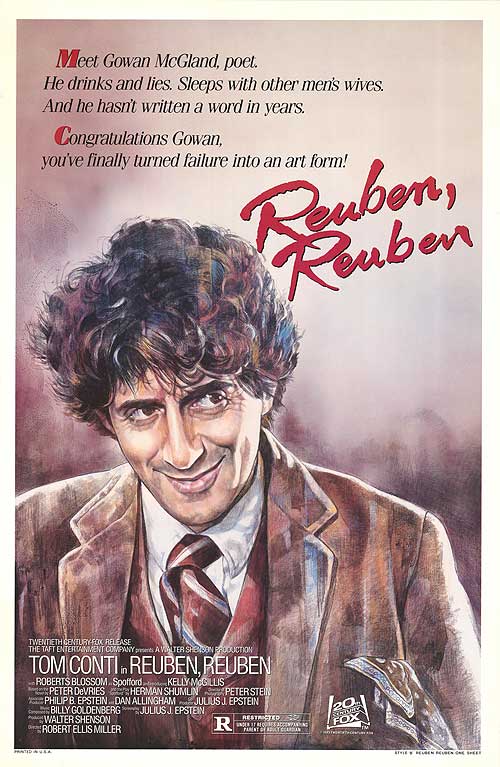
Reuben, Reuben (1983)

reuben1

By Richard Winters

My Rating: 6 out of 10

4-Word Review: Housewives lust for poet.

Gowan (Tom Conti) is a middle-aged poet going through writer’s block who hasn’t written anything in 5 years and manages to remain solvent by touring around a college town and reciting his older writings to women’s clubs. The stress though of not being able to produce anything new causes him to turn to alcohol and further rescinds his writing ability. Geneva (Kelly McGillis) is a college student several years his junior who spots him on a train one day and agrees to pay his fare when he’s found not to have any money. This generosity manages to have a profound affect on him and he makes a commitment to mend his ways while also going out with Geneva on casual dates. The awkward love affair doesn’t go far as Gowan continues to drink and embarrass her every time they go out. When Geneva finds out she’s pregnant the two then must decide how they will proceed.

Unusual romantic flick that has all the ingredients of failing, but manages somehow to have a certain light appeal. Much of this is thanks to McGillis, who in her film debut really shines and while this film is not one of her better known ones I still consider it her best work. Normally film’s dealing with May-December romances don’t work because the younger partner is always portrayed as being wide-eyed and naïve, but here it’s Geneva that’s the sensible one who calls all the shots and remains in control. This change of pace gives the old theme a refreshing new spin and made it palatable enough to hold my interest and in certain moments even becomes touching.

Conti gives a good performance, but he seems more like a caricature. He wears the same dowdy outfit all the way through making me wonder if that was the only suit he owned and if so whether he reeked of odor. I found it hard to believe that this guy, who looks like he was living on the streets, would attract all these frustrated housewives who’d be rushing to go to bed with him. With all the alcohol he consumed I’d have serious questions whether he’d be able to perform, or how sex with him could possibly be much better than with their husbands as I would think it might actually be worse.

Supposedly this was all meant as ‘satire’ and based loosely on the life of Dylan Thomas. Possibly in book form, as this was based on the novel of the same name by Peter De Vries and then later turned into a stage play, it might’ve worked, but as a film set in the modern day it’s confounding. Thomas hit his fame in the 30’s and 40’s when movies and television where just getting started and therefore writers held more clout, but by the 80’s there were so many other types of celebrities that some frumpy looking drunk guy who used big words to create long poems wouldn’t be someone a suburban housewife would get all that excited over. The opening sequence shows the reactions on their faces as they listen to him recite some of his writings and while one of them has a confused look on her face I felt they all should’ve and for my money that would’ve been really funny.

Spoiler Alert!

The finale, which Leonard Maltin in his review calls ‘curious’, but I’d describe more as ill-advised is the one thing that really hurts it. I’m not sure what the thinking was other than Dylan Thomas died young so possibly they felt Gowan needed to die too, but it was the wrong decision. Normally I get annoyed with movies that tack-on a happy ending and have everything work-out even when it’s not earned, but this film works in reverse by throwing in a very sad one that comes out of nowhere and doesn’t fit the tone of the rest of the movie, which for the most part had been quite whimsical.

The way it gets done is pretty dumb too as he elects to hang himself inside his apartment after he finds out all of his top teeth, many of which have been rotting for years due to neglect, would have to be removed. While losing teeth is no one’s idea of fun it does happen to a lot of folks of all ages and dentures (this was made before the advent of implants) if fitted properly aren’t always that noticeable, so to kill yourself over something like that seemed awfully rash.

Just as he’s about to hang himself he gets inspired again to write and even excited about finding new women to sleep with, but then a lovable sheep dog named Reuben runs into the room (you’d think someone planning to kill himself would have the sense to shut his door and lock it) and being overly affectionate jumps-up and knocks down the chair that he’s standing on, which comes-off as being more farcical than anything. I was fully expecting the wooden beam that the rope was tied around to break from the stress of all the weight, which in reality I think it would, but instead it doesn’t and he’s left hanging leaving me genuinely baffled. For such an otherwise light and quirky movie to end this way was very jarring.

My Rating: 6 out of 10

Released: December 19, 1983

Runtime: 1 Hour 41 Minutes

Rated R

Director: Robert Ellis Miller

Studio: 20th Century Fox

Available: DVD, Blu-ray

The Baby Maker (1970)

babymaker1

By Richard Winters

My Rating: 4 out of 10

4-Word Review: Paid to give birth.

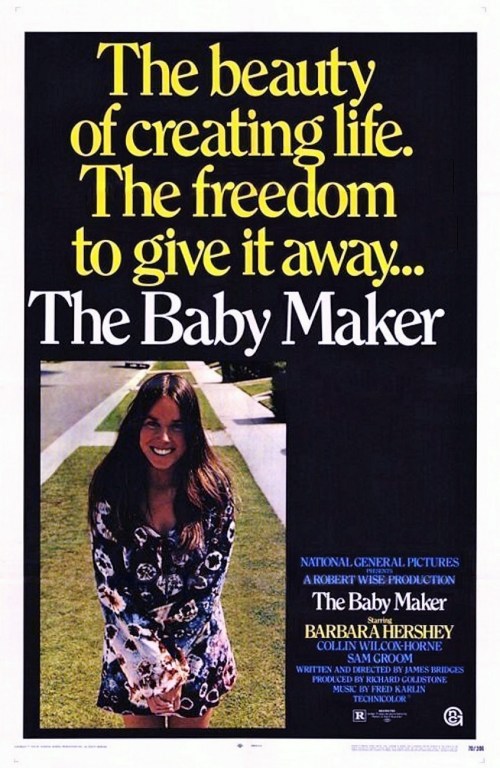
Tish (Barbara Hershey) is a young, free-spirited women who’s a part of the hippie movement and looking for alternative ways to make money without having to do the usual 9-to-5 job. She becomes aware of the idea of being a surrogate mother hired to give birth to a baby from a couple who cannot have one themselves. The couple in this case are Jay (Sam Groom) and Suzanne (Collin Wilcox Paxton) who are middle-aged and due to a medical complication the wife is unable to have children. They agree to pay Tish an upfront allotment of money as well as covering the rent for the apartment that Tish shares with her boyfriend Tad (Scott Glenn). Things start smoothly enough, but ultimately underlying tensions soon surface like Suzanne’s concern that Tish is getting involved in too much physical activity and with her husband’s seemingly infatuation with the young woman. Tish’s boyfriend also begins to have problems with the agreement especially since Tish has stated she’ll not have sex with him during the course of the 9-month pregnancy.

This was the first film directed by James Bridges, who got his start writing teleplays for the ‘Alfred Hitchcock Presents’ TV-show before blossoming into a career helming such critically acclaimed efforts as The Paper Chase and Urban CowboyWhile the film is not perfect I did feel on the technical end it was well done with vivid cinematography that makes the viewer feel quite intimate to both the characters and their setting as well as a good time capsule to how things looked back in that era. The subject matter was quite unique for the period that even had some film critics labeling it as a ‘travesty’ while another called it ‘insufferable’. While I didn’t find it to be either it does show how provocative the issue was and thus overall making it a groundbreaking movie.

More than anything I really enjoyed the performance by Hershey who seems born to play this role and like she’s hardly even acting and instead just being herself. The carefreeness of her character really comes through especially when she decides to impulsively take-off her clothes while in front of the couple whom she’s just met, and jump into their backyard pool. You feel like she’s a perfect composite of most of the flower children back then and highly revealing to what made them tick. What I didn’t like though was how we never learn what gave her the idea to be a surrogate mother and I felt the film should’ve started from this point instead of having her already done it one time before without any backstory to what first gave her the motivation to even consider what at the time was not a typical thing that most people even the young hippies were doing.

I found the supporting characters to less interesting. Glenn, in his film debut, was the most baffling as he plays this overly selfless boyfriend who goes along too graciously with Tish’s idea of having someone else’s baby. Most guys would not be cool with this, or need more time to warm-up to it especially since it would require her sleeping with a married man. Having her then refuse to have sex with him while the pregnancy went on would be way too much for most men to handle, so the fact that he stays with her even after being told this made him seem unrealistic. Had he gotten into the relationship knowing upfront this is what she did for a living then maybe, but she just springs it on him after she’s agreed to the contract, which would’ve made anyone in that same situation quite upset, and justifiably so. I felt too that him ending up sleeping with one of her friends (Helena Kallianiotes) should’ve been understandable given the circumstances and Tish, being the supposedly open-minded, unconventional person that she is, should’ve allowed for it and possibly even invited it instead of growing jealous and throwing blue paint on them like she does.

I had the same issues with the couple. Collin Wilcox Paxton is excellent and light years away from her most famous role of Mayella Violet Ewell, the backwoods southern white woman who falsely accuses a black man of rape in To Kill a Mockingbird, but there’s just not enough tension between her and Tish, or in the scenes with her husband, which is the film’s biggest failing. It seems more concerned with tackling a novel concept in as genteel a way as possible, but in the process forgets that this is a drama and there needs to be conflict going on in order to keep it riveting. Certain potentially explosive problems are brought-up, but then quickly downplayed. There’s no surprise twist or altercation. It leisurely limps itself along to a hum-drum finish that has no impact at all and unfortunately ruins an intriguing concept that could’ve gone in many different, interesting directions, but ultimately doesn’t.

My Rating: 4 out of 10

Released: October 1, 1970

Runtime: 1 Hour 49 Minutes

Rated R

Director: James Bridges

Studio: National General Pictures

Available: DVD-R (Warner Archive), Amazon Video

Coming Home (1978)

coming

By Richard Winters

My Rating: 10 out of 10

4-Word Review: Falling for injured vet.

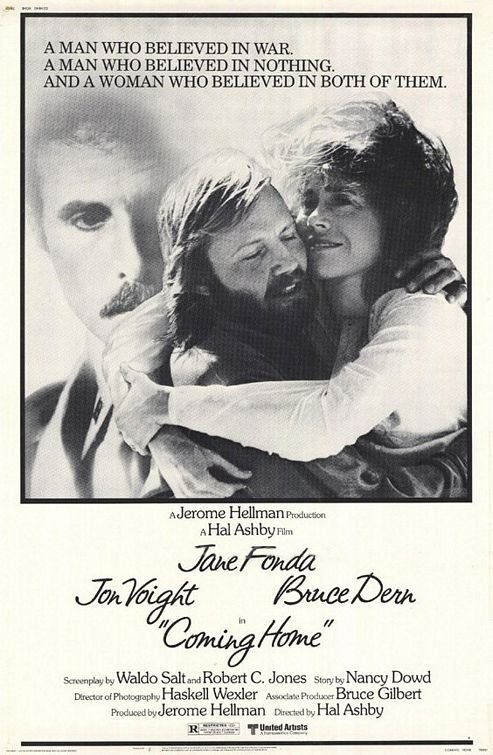
Sally (Jane Fonda) is the military wife to Bob (Bruce Dern) who’s been deployed to Vietnam. Since she now has more free time she decides to volunteer at her local VA Hospital. It is there that she meets Luke (Jon Voight) a former classmate from high school who has now come back from the war a paraplegic. Luke is very embittered about his condition and he’s initially angry and confrontational with Sally. Eventually he softens and Sally invites him to her house for dinner. It’s there that their romance begins to bloom and eventually they become intimate. Bob though, having suffered a leg injury, returns to the states and while Sally and Luke agree to keep their affair a secret Bob soon finds out, which leads to an ugly confrontation between the three.

The idea for the film was inspired by Fonda’s meeting with Ron Kovic, an injured vet who had written his autobiography Born on the Fourth of July that later, in the 80’s, became a movie starring Tom Cruise. Fonda though wanted to make a film with a character that was similar to him and got together with screenwriter Nancy Dowd in 1972 to write a script, which initially focused completely on the hospital setting without the affair, or B-story dealing with the conservative military husband. After many rewrites and bringing in Oscar winner Waldo Scott to help bolster the story the script finally managed to gain interest amongst the studios though many were still cautious about producing a movie dealing with the after-effects of the war, which at that time had never been done before, up until then only films dealing with the war, or those coming back with psychological issues, but not actual physical impairments and thus making this a first in that category.

Since Fonda was instrumental in getting the project produced she was the only choice to play Sally. I think she’s a fine actress who deservedly won the Supporting Oscar for her work here, but since she was on the front lines of the war protest and in many ways even became the face of it, the transition of her character isn’t as profound. Having an actress whose name wasn’t so aligned with left politics and who could better fit-into the part of a conservative housewife would’ve then made the character’s arch more dramatic. I felt too that Sally is too understanding of Luke right-off, the history of them going to high school together should’ve been excised, and instead she should’ve feared Luke when she first encounters him as he does act out-of-control and the romance between them happens too quickly.

Also, once her character changes her hairstyle from the old-fashioned straight to curly it should’ve remained as this visually establishes her character’s changing perspective and not go back to the straight look when she visits Bob in Hong Kong. To remedy this she should’ve decided to keep the curly look even if she feared Bob might not approve, she was technically becoming more empowered with him away anyways, and this would’ve signaled to Bob that she wasn’t the same person he knew when he left, or had the hair change occur after the Hong Kong visit, but having the hair style flip-flop works against the arch, which should be linear and not zig-zagging.

Voight, who won the Best Actor Oscar, and who had to lobby hard for the role as the producers originally wanted Jack Nicholson, is outstanding and there’s not a flaw in his performance with his best moment coming at the very end when he gives a lecture to a room full of high school students about his war experiences. My only complaint, which has nothing to do with his acting and more with the script, is when he bluntly tells Sally, when he goes to her place for dinner, that he dreams of making love to her, which seemed too forward especially since they end up having an impromptu kiss later. Since movies are a visual medium it should’ve settled with the kiss exposing the underlying brewing romance without his character having to explicitly state it. I also found it interesting that the DVD features a commentary track with Voight, Dern, and cinematographer Haskell Wexler, but Fonda is conspicuously not present and I wondered if this may have been due to Voight becoming a hardened conservative as he’s aged and because of their political differences Fonda not wanting to be in the same room with him.

Dern, like the other two, is excellent. His improvisational Dernisms as I like to call them come into play particularly when he gets intense I even learned what the slang term Jody meant, which is what he calls Voight at one point. You also, at the end, get a full view of his bare ass. Now, on the celebrity male naked ass scale I still say it’s a distant third to Dabney Coleman’s in Modern Problems  and Tim Matheson’s in Impulsebut it’s not bad.

Accolades must also go to director Hal Ashby, who was not the first choice as the studio initially wanted John Schlesinger. While Schlesinger could’ve been great I felt Ashby’s use of all natural lighting is what really makes the difference and becomes the over-riding look of the film. He displays keen use of the music too at the end when the song ‘Time Has Come Today’ by the Chamber Brothers is played and the lyrics are used to expose the underlying ticking time bomb of the situation that the three characters are veering speedily into.

My Rating: 10 out of 10

Released: February 15, 1978

Runtime: 2 Hours 7 Minutes

Rated R

Director: Hal Ashby

Studio: United Artists

Available: DVD, Blu-ray

The Swinging Barmaids (1975)

swinging

By Richard Winters

My Rating: 3 out of 10

4-Word Review: Killer stalks cocktail servers.

With a script written by Charles B. Griffith, better known for having done Little Shop of Horrors, the story centers on Tom (Bruce Watson) a serial killer who stalks women who work at a bar called The Swing-a-Ling Club. His first victim is Boo-Boo (Dyanne Thorne), whom he felt ‘disrespected’ him when she referred to him as ‘sonny’ when she served him his drink, so he quietly followed her home and attacked her and afterwards took photos of her in provocative poses. He then changes his appearance and gets a job at the bar as a bouncer. He proceeds to kill two more of the waitresses, Marie (Renie Radich) and Susie (Katie Saylor) before setting his sights on Jenny (Laura Hippe). However, with Jenny he begins to admire the fact that she insists on staying faithful to her fiancée Dave (Jim Travis) and therefore he considers her to be ‘pure’ deserving of respect instead of a gruesome death. While visiting her at the home of her parents (Milt Kogan, Judith Roberts) he tries to convince her to dump Dave and get with him and he won’t take ‘no’ for answer. Will Lieutenant White (William Smith), who’s been investigating the case and does not consider Tom as a suspect, be able to connect-the-dots before it’s too late?

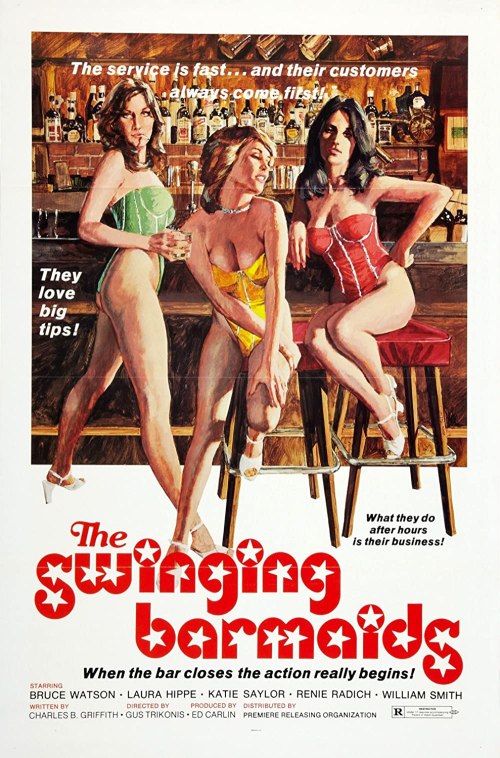
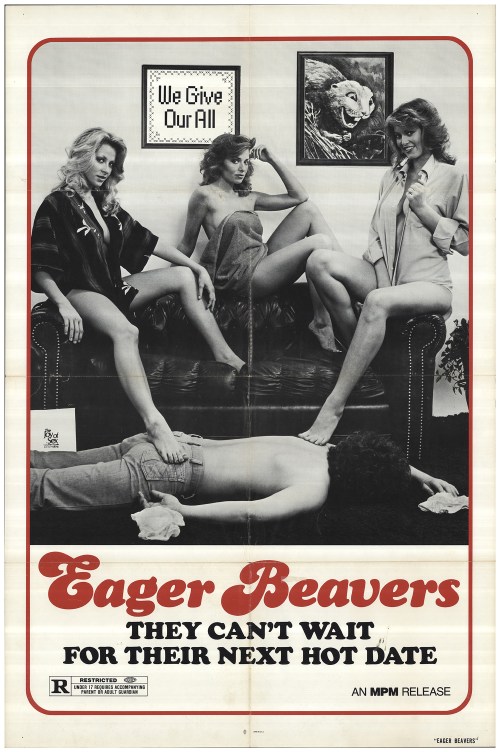
For an exploitation flick this one doesn’t seem all that titillating. The film’s promotional poster seen above alludes to ‘loose women’ having indiscriminate sex, the film was later reissued as Eager Beavers, which pushes this concept in an even more explicit way, but really you don’t see much of that onscreen. The women, who appear to be around 30 and looks-wise are okay, but nothing that would be considered stunning, come-off as basic working-class folks just trying to do their hum-drum jobs and not oversexed vamps in any way. Their personalities are indistinguishable from the other and their conversations deal with run-of-the-mill issues that aren’t compelling, or original. They also speak in a cliched, Flossie-like tough girl way of a New York street hooker, which I found annoying.

Having it shown right away who the killer is doesn’t help matters. Part of the fun of a slasher film, which this isn’t as it was made before that concept came into vogue though still follows the same basic formula, is trying to guess who the bad guy is, but having that quickly revealed losses the potential mystery element that could’ve made it more intriguing. We learn nothing about the killer, other than a police detective ‘profiling him’ as being someone with ‘mother issues’, but this is something the viewer needs to see and learn visually instead of having it explained to them. Smith as the good-guy is weak too. He’s been great in some of his other film roles, but he’s rather detached and downright irritable in this part and there’s long segments where he’s not even seen.

Gus Trikonis’ direction helps to give it a few extra points. While the killings lack blood I did like the way the hand-held camera follows the victim around as she gets chased through her apartment, particularly during the first attack, which lends an authentic, vivid feel as she tries to fight-off her attacker. The underwater photography showing one of the victims getting drowned is impressive as well, but there are some directorial mistakes here too.

One is when Tom kills Marie and then poses her naked body on a deck chair outside on the patio. The club owner Zitto (Zitto Kazann)  comes along and finds her there with Tom hiding behind the bushes and could’ve easily escape undetected, but instead he proceeds to attack Zitto, who is his boss and could identify him, so why not just get away from the crime scene instead of making things potentially worse for himself?

Another segment has Susie inside a film studio looking up towards a bright spotlight where Tom is standing, but because the light is so bright she must shield her eyes and cannot make out who’s talking to her.  When the viewer though is shown a point-of-view shot we can easily identify him, but if we’re really supposed to be seeing things from her perspective then the light should be blinding for us as well.

Another flawed moment has Jenny’s mother getting a call from a Smith warning her that Tom could be dangerous. She’s to pretend that she’s talking to someone else on the other end, so as not to tip-off Tom, who is sitting close by and can overhear what she’s saying. However, in the film the viewer can hear Smith’s voice through the receiver making it seem that if we can hear it then Tom should be able too. To have prevented this the film should’ve cut away every time Smith spoke showing him at the phone booth and therefore never would’ve heard his voice through the receiver.

Some may enjoy the sleazy storyline and Grindhouse reputation, but even on that level, there’s more explicit and violent stuff out there and it all gets handled in a highly routine way. In fact the only unique thing about the production is that both of the leading actors ended up committing suicide. Hippe’s was in 1986 and Watson, who suffered from manic depression, was in 2009.

swinging2

Alternate Title: Eager Beavers

Released: July 16, 1975

Runtime: 1 Hour 28 Minutes

Rated R

Director: Gus Trikonis

Studio: Premiere Releasing Organization

Available: DVD-R

Certain Fury (1985)

certain

By Richard Winters

My Rating: 3 out of 10

4-Word Review: Two gals flee police.

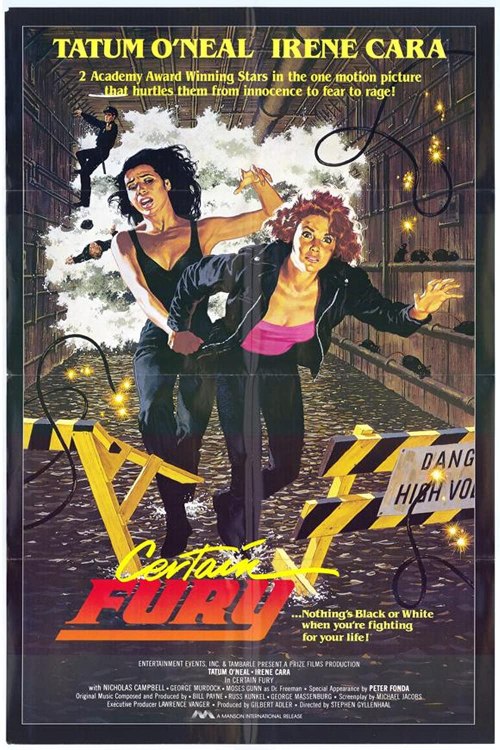
Scarlett (Tatum O’Neal) is a teen prostitute brought to court to face charges of killing a prospective customer. Tracy (Irene Cara) the daughter of a doctor (Moses Gunn) is also attending the courtroom that day. She’s there on charges of drug possession and resisting arrest. Before they can be brought before the judge a shootout occurs inside the packed room in which several deputies are shot and killed. During the ensuing melee Scarlett and Tracy and able to escape and get onto the streets. Neither one knows the other and have many differences in their personalities and temperaments, but find they need to depend on each other in order to survive.

In 1983 Tatum traveled down to New Zealand to star in a movie called Prisoners where she played the daughter of a prison warden who begins a relationship with one of the prisoners who is under her father’s watch. The film though was apparently so bad, or at least so disliked by her father Ryan O’Neal, that after viewing it as part of a preview audience he decided to buy the rights to it in order to keep it from being distributed and to this day very few people have seen it. This film, which was shot in June of 1984, was supposed to get her career ‘back on track’, by casting her as a streetwise 80’s punk, which was considered ‘trendy’ at the time, but was really just as much of a career killer as the other one and Ryan should’ve had the negatives of this one locked-up too.

That’s not to say it’s all bad. The action moments are genuinely impressive. The shoot-out is realistically handled with the gunshots that wound the police appearing authentic. The chase sequence goes on for quite awhile and includes the two going down into an underground sewer where there’s exciting underwater footage as well as a dramatic gas explosion. I even enjoyed the scenes inside a drug den in what seems like hundreds of people all lying around and shooting-up.

The film falters with the characters who aren’t fleshed-out enough to be interesting.  Cara is quite beautiful and looks great nude during a segment where she is attacked by Scarlett’s boyfriend (Nicholas Campbell), but she’s a bit too goody-goody. I would’ve liked more confrontation between the two and Cara being to be just as bitchy as O’Neal. As for Tatum she’s a caricature who lacks any type of depth to be believable. The only thing remotely unique about her is that she can’t read, but with no explanation as to why; is she dyslexic? She’s also snarly the whole time and thus making the two coming together and forming a friendship seem quite forced and mechanical as no one would want to be friends with her especially after she calls Cara the N-word several times to her face.

IMDb, on it’s storyline section for this film, incorrectly states that it takes place in New York, where most anyone would think a plot like this one would happen, but it was actually filmed in Vancouver. You become blatantly aware of this at the end when the camera pan’s the cities’ anemic skyline (it has since improved). I’m sure for tax reasons it was much cheaper to shoot it there, so that’s why the location was chosen, but for authenticity it’s not particularly believable as having such a vibrant underground punk scene like here it would’ve had to be in a giant metropolis instead of a mini-city. In either case this movie is a great example of how if you don’t have well defined characters it will flop no matter how good the action may be.

My Rating: 3 out of 10

Released: March 1, 1985

Runtime: 1 Hour 27 Minutes

Rated R

Director: Stephen Gyllenhaal

Studio: New World Pictures

Available: DVD, Blu-ray, Tubi

Overboard (1987)

overboard

By Richard Winters

My Rating: 1 out of 10

4-Word Review: Rich bitch loses memory.

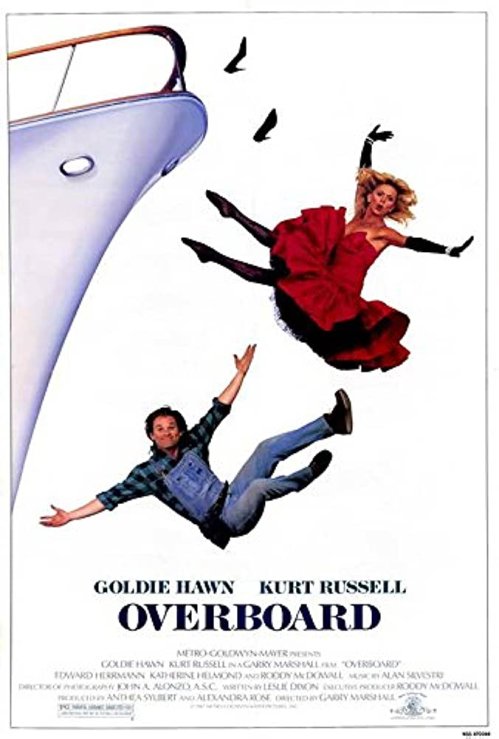
Heiress Joanna (Goldie Hawn) is a wealthy and snobby woman who hires Dean (Kurt Russell), a carpenter, to remodel the closet that she has on her yacht. Since Dean is a widowed father of four boys (Mike Hagerty, Jared Rushton, Jeffrey Wiseman, Brian Price) he’s more than happy to take on the job in order to bring in extra money, but Joanna, treats Dean poorly, is unsatisfied with his work and refuses to pay him. She ends up throwing him overboard with his tools. Later that night while still on the yacht she goes on deck to retrieve a lost ear ring and falls overboard causing her to hit her head and lose her memory. She is rescued and taken to a local hospital. News shows report on the incident along with pictures of Joanna asking if anyone knows who she is. Dean, who is with friends at a bowling alley, sees the report and concocts a scheme to take advantage of her amnesia by pretending she is his wife and bringing her to his home to do chores and take care of his kids in order to repay her debt to him. The  plan starts out seamlessly, but eventually she begins to bond with both the kids and Dean and then her real husband, Grant (Edward Herrmann) arrives at Dean’s residence in order to take her back with him.

Russell and Hawn began their real-life relationship while working on Swing Shift and wanted to do another picture together. This uninspired script, which was written by Leslie Dixon who had better success with Outrageous Fortuneis a misguided hybrid between Houseboat, a 50’s romantic comedy that starred Cary Grant and Sophia Loren, and Swept Away, a classic 70’s Italian film involving a rich, snotty woman stranded on an island with a working-class man. Unfortunately all nuance gets thrown overboard (pun intended) and we get left with the most extreme caricatures possible. While Hawn is certainly a fine actress her over-the-top character is too cliched and heavy-handed to be even remotely interesting or believable and the film falls hopelessly apart before it even gets going.

The basic premise is full of loopholes. The idea that just anyone could show up at a hospital and insist that some woman is his wife when that women shows no recollection of him and he’s able to bring her home without showing any type of documentation, marriage license, or photograph of the two together is beyond ridiculous. Just saying he recognizes a tattoo on her rear end wouldn’t be enough; maybe the two had a one-night-stand, but it wouldn’t be proof positive that he was married to her and yet for this hospital staff it was. Also, it’s very unlikely that Grant, Joanna’s real husband, would be able to get away with denying her existence as long as he does. He pretends he doesn’t recognize her when he goes to the hospital, so he can then bring young women onto his yacht to fool around with, but his friends and most certainly Joanna’s meddlesome mother, played by Katherine Helmond, would’ve seen the news reports too and gotten on him to go retrieve her, but for some reason in this movie rich people don’t watch the news only the poor folks.

Russell seems to enjoy his part, but like with Hawn his character is a tired caricature that’s not remotely original, or unique in any way. While the movie tries hard to get you to like him I still felt what he does with Joanna by tricking her into thinking she’s his wife was highly exploitive and not forgivable even when factoring in the poor way she had treated him.

The four boys are yet another issue. With the exception of the one who talks in Pee Wee Herman’s voice, which was apparently ad-libbed and not a part of the script, there was no distinction between any of them and they all could’ve been combined into just one. It’s also hard to believe that they’d all agree to play along with Dean and pretend she was their mother when they really knew she wasn’t as most kids are notorious for not be able to keep a secret. I was surprised too that the kids would all accept this new woman into their life and forget that their real mother ever even existed. These kids, or at least one of them, would’ve had some bonding with the real one and been reluctant to just let that go and welcome in her ‘replacement’. The kids were also used to having no rules and doing what they wanted while their dad was away at work, so having a new person come in out of nowhere and start enforcing discipline would most likely caused a rebellion instead of them all embracing this newfound orderly lifestyle.

Had the characters and comedy been more subtle like perhaps having the Hawn character not being a super rich heiress, but just a suburbanite living in a better part of town who has a slight disagreement with Russell when he comes to her house to do some work, then this idea might’ve had potential. However, as it is, the caricatures are too silly and overblown for any viewer with discernable tastes to get into. Also, for such slight and predictable material it takes way too damn long to play-out. Should’ve only been 80 minutes not almost 2-hours.

My Rating: 1 out of 10

Released: December 16, 1987

Runtime:  1-Hour, 52 Minutes

Rated PG

Director: Gary Marshall

Studio: MGM

Available: DVD, Blu-ray, Amazon Video

The Sidelong Glances of a Pigeon Kicker (1970)

pigeon

By Richard Winters

My Rating: 5 out of 10

4-Word Review: Cab driver dislikes pigeons.

Based on the novel of the same name by David Boyer, the story centers on Jonathan (Jordan Christopher) a Princeton graduate who spends his days working as a New York cab driver with no ambition to climb up the corporate ladder. Jonathan detests the establishment, but is too old to be a part of the hippie movement, so he rebels from society in other ways by being flippant with his customers and kicking at pigeons in Central Park. His friend Winslow (Robert Walden) has problems of his own as he’s 24, but still a virgin. Jonathan takes Winslow to a party in an effort to find him a woman, but Winslow is so socially awkward that they all turn him down. Back at his apartment Jonathan meets-up with Jennifer (Jill O’Hara) who’s busy trying to ‘find herself’ while living off of her parent’s money. Initially Jonathan resists her advances, but since they’re both lonely he eventually agrees to a relationship with her as long as there are no strings attached. He even brings her to visit his mother (Kate Reid), but then at a holiday party Jennifer makes the mistake of  saying she wants to get married and have kids, which scares Jonathan away and the two break-up only for Jennifer to then sleep with Winslow, which causes Jonathan to become jealous.

This was one of an assortment of youth pictures from the early 70’s trying to analyze the alienation of the love generation and their resistance to conformity and middle class values. These films tended to be much less structured and in certain cases downright experimental, but the subject matter was still considered topical enough that the studio heads at MGM decided to pick it up for distribution only to then quickly drop it when previews of it scored low with test audiences. It was then handed over to a fledgling film company known as Plaza Pictures that re-edited it down to 90 minutes while cutting-out much of the second act in the process and then re-naming it as Pigeons, but this version did no better and the film sat in obscurity for many decades before finally getting a DVD release in 2014.

While I do like offbeat movies I did find the way this one began hard to get into as the lackadaisical pace makes it seem like there isn’t any plot and just a lot of throwaway segments dealing with the angst of big city living. It does improve and manages to even have a few keen moments. John Dexter’s direction, he was better known for his work in the theater as well as his rude behavior towards women, helps a lot. In fact it’s the directing that keeps the thing watchable and despite the modest budget it’s quite polished with the most impressive moment, outside of a taxi car driving off the dock and into the water, is when Jonathan goes under his kitchen cabinet in an attempt to exterminate hundreds of ants. This isn’t as easy as it sounds to get a camera and lighting into such a small space, nor finding all the ants, and I suspect the cabinet was specially made for the production, but still on a small scale it’s impressively done.

The film also features a great supporting cast including Walden in his film debut who is both believable and amusing as Jonathan’s shy and apprehensive friend. O’Hara is equally engaging, she looks exactly like her more famous sister Jenny O’Hara and for awhile I thought it was the same woman. Kate Reid is a scene-stealer as the meddling, oppressive mother and William Redfield has a great moment near the end playing the stepfather who openly has a one-night-stand with a lady he meets at a Christmas party and then comes home late at night to talk to Jonathan about it.

The film’s Achilles heal is the casting of Christopher. He rose to fame as the singer of The Wild Ones, which got him cast as a rock singer for the cult hit Angel, Angel Down We Gowhich generated enough notice that producers decided to take a chance on him in a lead role, but it doesn’t work. His character is unlikable and he lacks a dynamic presence let alone his disheveled mop-head hair-do that resembles a bird’s nest. Having the film begin by showing him kicking at pigeons in Central Park, fortunately his foot doesn’t seem to actually hit any of them, makes the viewer despise him right from the start and things never improve.

Spoiler Alert!

The cop-out ending is a disappointment as it features Jonathan riding off on a train headed to Des Moines, Iowa, but I’ve rarely found anyone who’s been born and raised in New York to move to the farmlands of the Midwest. Sure many New Yorkers have gripes about where they live, most anyone is never completely happy with their home city, but ultimately they remain because it’s what they’re used to. Instead of ending it with him riding away it should’ve made this a part of the movie showing his adapting to a completely new and alien place, which could’ve given the movie some interesting insight and made a stronger impression than it otherwise does.

Alternate Title: Pigeons

My Rating: 5 out of 10

Released: October 28, 1970

Runtime: 1 Hour 46 Minutes (DVD version runs 1 Hour 30 Minutes)

Rated R

Director: John Dexter

Studio: Plaza Pictures

Available: DVD

X Y & Zee (1972)

x

By Richard Winters

My Rating: 4 out of 10

4-Word Review: Wife sabotages husband’s affair.

Zee (Elizabeth Taylor) is the middle-aged wife of Robert (Michael Caine) and the two have been in a tumultuous marriage for many years. Then at a party Robert spots Stella (Susannah York) who is a single mother with two boys. Robert enjoys her much calmer less confrontational demeanor, which is the exact opposite of Zee’s and the two quickly fall into an affair. Zee though becomes aware of what’s going on and becomes determined to put a stop to it one way or the other. At first she is meddlesome by constantly calling-up Stella and warning her about Robert and even going to her place of business to harass her. When that doesn’t work she tries playing into Robert’s sympathy and at one point even attempting suicide, but when all that fails and the affair continues she uses her gay friend Gordon (John Standing) to dig-up some dirt on her and when she finds out the secret that Stella has she uses it to exact her revenge.

Taylor and her over-the-top shrewish performance is the whole reason the movie works and if you watch it for that purpose you won’t be disappointed. Sure she’s played this role a bit too often to the point that it was becoming more of a caricature for her and ultimately what I feel killed her career as by the 80’s she was no longer making films for the big screen, but still when she’s as entertaining doing it as she is here it’s still a joy to watch. Unfortunately she dominates every scene that she’s in that it leaves very little room for her co-stars particularly York who’s completely dull by comparison. York certainly was an accomplished actress, but in this movie she’s unable to go toe-to-toe with her superior co-star and the film suffers for it. A strong actress with a definite presence was needed instead York just quietly sits there looking overwhelmed as Taylor’s character continuously berates her. If anything Mary Larkin, who plays Caine’s nerdy secretary, should’ve been the love interest, Caine ultimately sleeps with her anyways, as she’s so meek that you would feel sorry for her when Taylor got snarky with her, but with York you feel nothing and it’s almost like she’s transparent.

Caine on the other-hand is able to hold his own, but his frothy retorts at Taylor’s abuse is never quite as clever, or entertaining as hers. My biggest issue with his character is why doesn’t he just divorce her as he’s quite wealthy and could easily do it and yet avoids it. He mentions at one point wanting to kill her, but never just divorcing her. Since the couple never had any kids it would be less messy, so why not just take that route and then he could see York, or any other woman for that matter without worrying about Taylor getting in the way. I realize some marriages are held together for weird reasons, even those when it becomes achingly clear that it should end, but for whatever reason it doesn’t. However, after 2-hours of watching this those reasons should eventually become clear, but they never do.

Spoiler Alert!

I sat through almost the entire movie just waiting to find out what the ‘dark secret’ was that York’s character held, as described by Leonard Maltin in his review, only to finally realize it was nothing more than her being a closet lesbian. What’s worse is that nothing much happens once the secret is exposed. Maltin also describes Taylor/York’s lovemaking scene as ‘ranking high in the annals of poor taste’ though this sentence has been removed from his review in the later editions of his book presumably to avoid making him look homophobic, but whatever lovemaking he may of seen I didn’t and I watched the full 1 Hour 49 Minute newly remastered version from Columbia Pictures (same version streaming on Amazon Video), so either a minute of it got snipped on this cut, or Maltin was offended at seeing the two women hug, which is all there is.

Admittedly I was disappointed as I was hoping to see them kiss, or in bed together, which would’ve livened it up a bit and made it worth sitting through, which otherwise is a strain. The lesbian angle should’ve been introduced much earlier and showing Taylor and York not only getting-it-on and enjoying it, but inviting the reluctant Caine in as a threesome. That would’ve made the movie truly sophisticated and ahead-of-its-time, but having it end the way it does with York seeming very ashamed and defeated about her homosexuality makes it dated and out-of-touch with modern-day sentiments. A misguided relic of its period that really doesn’t have much to say and nowhere near as ‘daring’ as the filmmakers thought it was.

My Rating: 4 out of 10

Released: January 21, 1972

Runtime: 1 Hour 49 Minutes

Rated R

Director: Brian G. Hutton

Studio: Columbia Pictures

Available: DVD-R, Amazon Video, Tubi