Category Archives: Movies with a rural setting

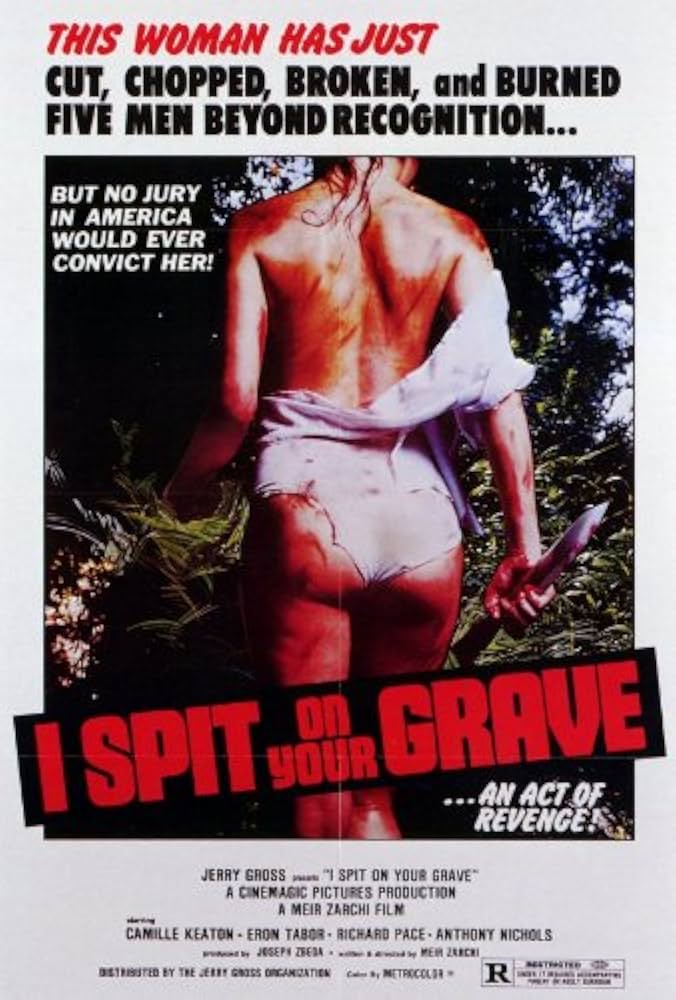
I Spit on Your Grave (1978)

By Richard Winters

My Rating: 7 out of 10

4-Word Review: Assaulted woman gets revenge.

Jennifer Hills (Camille Keaton) is a writer who has decided to get away from the bustle of New York City by renting an isolated cabin by a river that’s just outside of Kent, Connecticut. It’s here that she hopes to finish her novel but finds it hard to do when she inadvertently attracts the attention of Johnny (Eron Tabor) a gas station attendant and two unemployed men named Stanley (Anthony Nichols) and Andy (Gunter Kleeman) who routinely upset her quiet environment with their motorboat. When delivery boy Mathew (Richard Pace), who is mentally disabled and social awkward, comes back to the men describing how when he delivered groceries to her, he ‘saw her breasts’, it gives them the idea to attack her and then ‘offer her up’ to Matthew, so he can finally have sex with a woman. The men chase Jennifer down while she’s relaxing in her rowboat and take her to the backwoods where each of them takes turns raping her over an extended period. Once they finally leave, they give Mathew a knife and tell him to kill her while they wait outside. Mathew though is too afraid to stab her, so he lies and tell them he did when he really didn’t. Eventually, after several weeks, Jennifer recovers from her injuries, both physical and emotional, and decides to seek out the unsuspecting men by killing them off in gruesome ways one-by-one.

This film was and still is highly controversial, some might say it’s the most controversial film ever made and universally condemned by both Roger Ebert and Gene Siskel on their show where they described it as ‘the worst movie ever made’. Ebert even went as far as to write in his review that it made him physically sick to watch it. His review though had a Streisand effect as it garnered it more attention and got people to come to the theater to ‘see what all the fuss was about’ eventually making it quite profitable and a cult classic that’s turned the franchise into marketable one that has given it several sequels and even a 2010 remake.

The inspiration for the story came in October of 1974 when writer/director Meir Zarchi was traveling with his friend and daughter in New York City neighborhood of Jamaican Hills where they came upon a naked, beaten-up woman who told them she had just been raped. When he escorted her to the police, he was appalled at the indifferent treatment she was given and he came home and almost immediately began writing the script.

Almost 2 years later, in August of 1976, he had acquired enough funding so shooting could begin. The argument though was whether this really was a ‘trenchant’ drama meant to expose the brutal nature of rape, versus sanitizing it as other movies at the time tended to do or was simply a cheap way to exploit a difficult subject for money. In a lot of ways, it seems to be the later as gang rapes like the one portrayed here don’t happen too often and it’s usually just one attacker. The fact that the men seem to go away and then suddenly reappear again unexpectedly out of nowhere makes it feel like it’s being played up for tension’s sake and attempting to get the most out of the horror then simply trying to intelligently examine the cruel event.

There’s also no scene showing Jennifer going to the police and being treated poorly, which was supposedly what enraged Zarchi so much during the real event. Without that element it’s harder to justify the plot and there really needed to be a segment showing that.

On the flip side I was impressed with the film’s overall grittiness. It’s like Zarchi had watched Last House on the Left but decided to take out the ill-advised ‘comic relief’ scenes and weird music and just left in the unrelenting tension and to that level it succeeds. Having no soundtrack at all, outside of some organ music that gets played when Jennifer visits a church, helps give it more of a realistic effect almost like we’re watching a documentary where the camera is simply turned-on and whatever terrible things happen is allowed to simply play-out unabated. This along with Keaton’s dynamic performance, where she essentially plays two women, one a victim and the other the perpetrator, is what helps the movie stand out and gives it it’s legs.

Spoiler Alert!

The complaints I had comes more with the third act where Jennifer carries out her revenge. The segment where she entices Matthew to have sex with her again in the woods by the river, so she can put a noose around his neck and hang him, didn’t feel genuine. I would think anyone who had been raped that they wouldn’t want anyone to touch them, or get intimate after such a traumatic event, so allowing herself to get naked and letting a man, one of her former attackers no less, get on top of her, just didn’t seem plausible from a psychological perspective. On the physical end it didn’t seem possible that a young thin woman would be able to pull the rope tight enough to hang someone who clearly weighed more than she.

The second killing where she takes Johnny back to her place and they get naked in her tub had the same problematic issues. She had a gun in her hand when she got out of her car, so why not just shoot him then and get it over with? Why take the chance of bringing him back to her house where he could overpower her? Also, how dumb does this guy have to be that he would completely let down his guard and not think that this woman, who’s assault he happily took part in, could be completely trusted and not try to lure him into a trap?

Her final attack on the two other men is flawed as well as it has her swimming out to the boat that one of them is on, but she comes onboard carrying no weapon. She only gets her hands on the ax when the other guy accidentally drops it into her boat as she tries to side swipe him, but that’s still a very stupid and dangerous way to go about things. If she’s fully intending to kill the guy she should come prepared with something already in hand when she confronts him.

Alternate Title: Day of the Woman

My Rating: 7 out of 10

Released: November 22, 1978

Runtime: 1 Hour 42 Minutes

Rated R

Director: Meir Zarchi

Studio: Cinemagic Pictures

Available: DVD, Blu-ray, PlutoTV, Roku, Tubi, YouTube
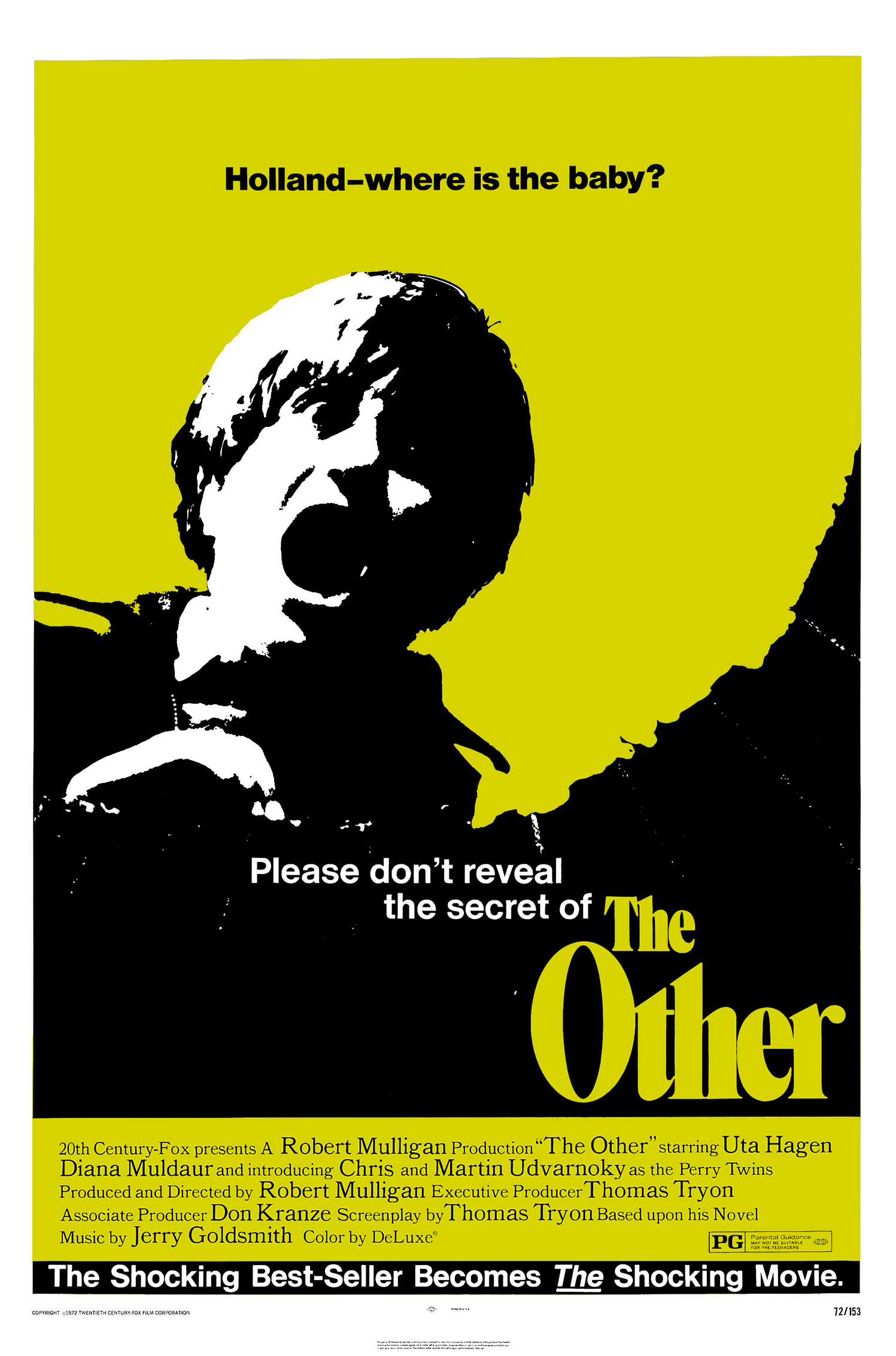
 

The Other (1972)

By Richard Winters

My Rating: 7 out of 10

4-Word Review: Twin brother causes havoc.

Niles and Holland (Chris and Martin Udvarnoky) are twin brothers living with their mother (Diana Muldaur) and aunt and uncle (Norma Connolly, Lou Frizzell) on an isolated farm. Niles becomes good friends with Ada (Uta Hagen) a neighbor lady who taps into Niles’ special abilities. She teaches him a technique in which he can separate his mind from his body and then have it harbor in another body be it a person, or animal, or even a bird. Ada though fears Niles is using this ability for evil purposes when those around him begin turning up dead. When his mother is found at the bottom of the stairs unconscious and stuck to a wheelchair the rest of her life afterwards Ada tries to convince Niles to give up the game, but Niles insists it’s really his brother Holland that’s committing the acts of violence and not him, but Ada refuses to believe him as she’s in on a secret that Niles is refusing to accept.

Tom Tryon, who had been an actor throughout the 50’s and 60’s, became frustrated at the quality of roles he’d been offered and wanted to try novel writing. After watching Rosemary’s Baby and seeing the reaction it got he decided to write his own horror story basing it on some of the experiences he had gone through while growing up in a small New England town. It took nine different rewrites before he was able to get it published where it became a best seller and allowed him to quit acting and become an author fulltime. When it was bought into a movie Tryon retained the rights to the story, which allowed him to write the screenplay though he later admitted to not liking the finished product and blaming it on the casting and editing, which had cut out a significant portion of the story, over 25-minutes of it, based on feedback from test audiences.

On the surface the film really doesn’t seem much like a horror movie, or at least what modern audiences have come to expect from horror. There’s no gore, several of the killings aren’t even shown and just implied, there’s also no shocks, or scares and the majority of the plot takes place outside in the sunshine versus the darkness of night. Initially viewers didn’t take to it too well and it lost money at the box office with many feeling that Robert Mulligan, best known for having done To Kill a Mockingbird, was not the right choice for this type of material with the biggest complaint being that the movie was ‘too beautiful’ and made more like a drama, which had been my feeling when I first saw it years ago on TV. However, after viewing it again in its complete form without any commercials I was able to get into it more and if one is patient, it can have many benefits.

It still could’ve been played up more, and I didn’t like the setting at all. It was shot in Murphys and Angel Camp, California even though the setting in the book had been a small town in the east. Originally Mulligan had wanted to shoot it in Connecticut, but since the story took place in the summer and they weren’t able to begin production until the fall he felt the leaves changing color would have a negative effect and thus choose to do it in the west, but topography is all wrong as all you get is very dry, brown, parched earth that doesn’t allow for much atmosphere. The eastern autumn foliage would’ve been to its benefit and made it even creepier as it would’ve reminded one of Halloween.

Despite this there are some good moments like the twin’s trip to the circus where they sneak behind the curtains and view the participants of the freakshow including witnessing a fetus floating in a glass jar of liquid, which is a great foreshadowing. Niles ability to view things outside himself like witnessing the point of view of a crow as it flies around the property is well done too though the best moment comes at the end when a baby is found missing during the night that creates a panic and is quite riveting both emotionally and visually.

The Udvarnoky twins was an unusual choice as they hadn’t been in any movies before, nor did anything films afterwards and only became aware of the roles through their grade school teacher who sent in their headshots upon learning that a film was being shot in the area and searching for twins to star in it. Originally the part was meant for Mark Lester, who could’ve done it easily since neither twin is ever in the same shot, but the brothers do admirably especially Chris, who sadly died at the young age of 49 from kidney disease, who’s able to carry the film throughout and in just about every scene though their constant whispering may eventually become irritating to some. Uta Hagen, who was known for being an acclaimed acting teacher as well as for her stage work, but had never been in a movie before, is splendid and the one element that keeps it both compelling and unnerving. Good work too by Victor French in a small, but pivotal bit and a young John Ritter.

Spoiler Alert!

The story was actually given three different endings. In the book we find that Niles is sitting inside a mental hospital as an adult and describing what happened through flashbacks. In the version broadcast on TV Niles is able to escape the fire set by Ada, but then through voiceover is heard talking to his dead brother where he states that they’ll be ‘taken away’ (most likely an institution) and will be able to ‘play the game’ there. In the film though we see Niles looking out his bedroom window before being called down to dinner revealing that he had escaped detection by the others who did not suspect him of committing the killings and thus was still free to kill again, which is the scariest.

My Rating: 7 out of 10

Released: May 26, 1972

Runtime: 1 Hour 41 Minutes

Rated PG

Director: Robert Mulligan

Studio: Twentieth Century Fox

Available: VHS, DVD-R

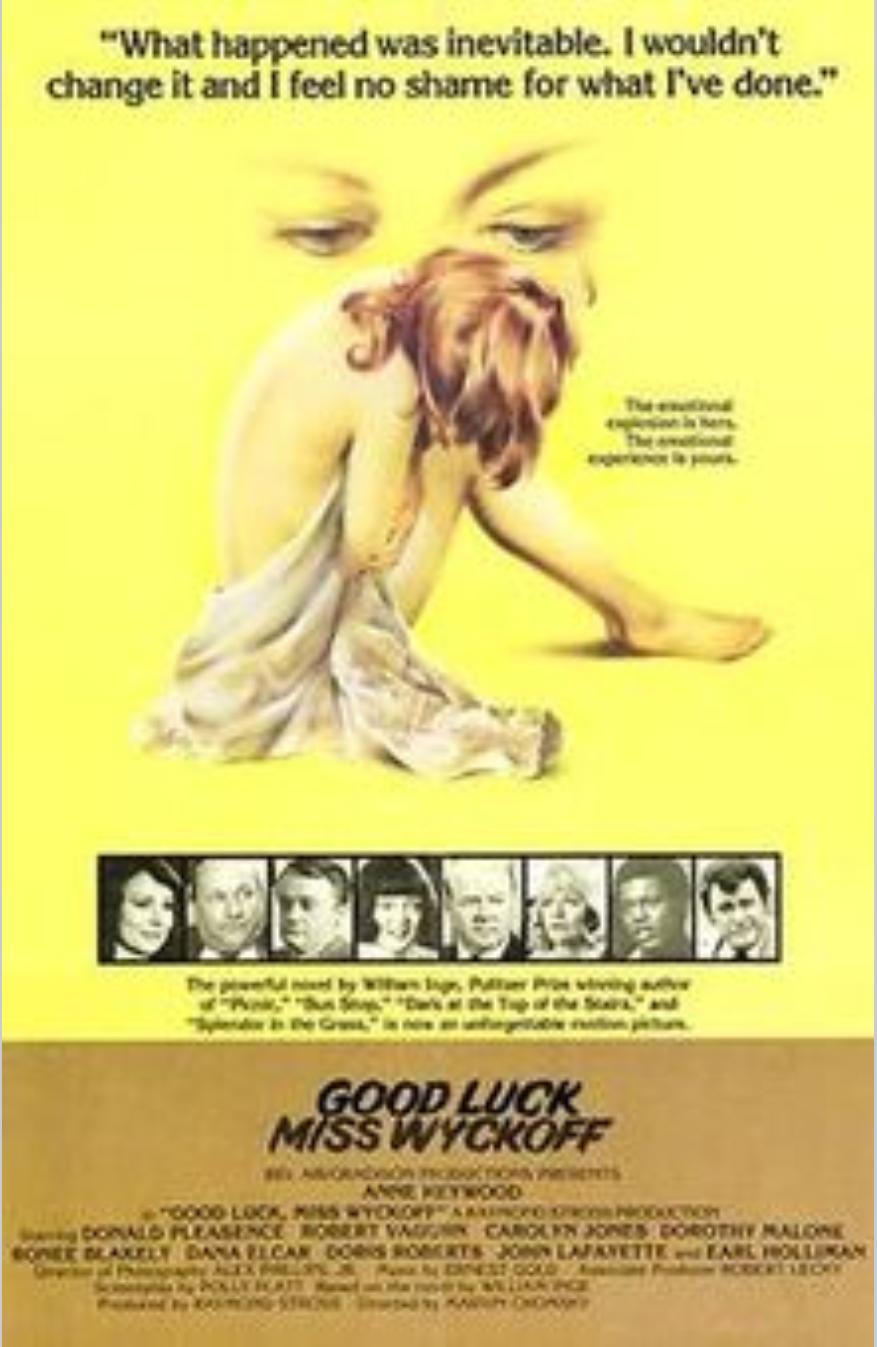
Good Luck, Miss Wyckoff (1979)

By Richard Winters

My Rating: 1 out of 10

4-Word Review: Spinster teacher is raped.

Evelyn Wyckoff (Anne Heywood) is a middle-aged single woman who teaches high school in a small town in Kansas. She has never married and is showing signs of severe depression, which alarms her best friend Beth (Carolyn Jones) as well as the older couple (R.G. Armstrong, Joycelyn Brando) whom she’s living with. Both her doctor (Robert Vaughan) and her psychiatrist (Donald Pleasance) believe it’s because she is not in a relationship or having any sex and that she needs to get out more and meet people. She attempts at starting something with fellow teacher Chester (J. Patrick McNamara) but finds him to be too shy and embattled with his own problems to be able to recognize her interests. She also considers friendly bus driver Ed (Earl Holliman) only to call it off when she learns he’s married. Left alone after school one evening she comes into contact with Rafe (John Lafayette), a black man who works as the janitor, who sees her loneliness as a weakness that he can exploit. He comes onto her strongly and abrasively eventually forcing her to submit to his sexual demands, but she doesn’t go to the authorities and instead starts to enjoy the degradation and continues to come back for more until the rest of the students and teachers find out about it putting her job and reputation in peril.

The story is based on the 1970 novel of the same name written by William Inge. The film rights were sold in 1971 but sat on the shelf for many years until producer Raymond Stross found it and felt it would be a good vehicle for his actress wife Heywood who had already made a name for herself in tackling controversial, edgy material and even sought it out, so this was considered a perfect next project. While she had received critical accolades for her earlier work, The Fox, where she played a lesbian in a  relationship with Sandy Dennis, which was envelope pushing for its era, this one did not go over as well and was genuinely lambasted causing her career to take a downfall from which it couldn’t recover and she ended up retiring from acting just a decade later.

On a surface level it’s okay. The recreation of the 1950’s Kansas, while shot in Stockton, California, is still effective and the personalities of the people isn’t as cliched. There are those that show prejudices and oppressive mind sets, but there’s a healthy balance that don’t, which helps make it feel more realistic. The supporting cast is full of familiar faces though most of them are wasted in small roles that don’t add much and Carolyn Jones, in her last feature film appearance, stands out best albeit with an awful hairstyle.

The biggest detriment, besides the flat direction and booming music score, is Heywood who doesn’t offer enough nuance to her part. I’ll commend her for taking on a very difficult role that required at age 48 to be fully nude and allowing herself to be put into some very vulnerable and demeaning positions, but her facial expressions and responses are one-note. Her constant crying for no reason, which alarms those around her, and unexplained impulsive behavior, like smashing a mirror during a party, is too dramatic. Instead of using this to reveal that she’s unhappy it makes her seem more like a complete mental case that has far worse issues than just being lonely and I felt more sympathy for her friends trying to put up with her erraticism than I did with the main character who for the most part is rather whiny and annoying.

There’s never any explanation for why she’s unable to get into a relationship. She’s attractive, so you’d expect there would be eligible suitors who’d ask her out. All we see is a bus driver who’s already married, but what about other single men who would have to be out there? Why don’t we ever see one of them make a move and if so, how would she respond to them, which would be far more revealing than anything she says to her shrink, which amounts to talky pseudo-science.

The rape scene isn’t either shocking or effective and seems to come out of nowhere. It occurs in the middle of the second act, but before then we see the Rafe character only once while cleaning the chalk boards for a few seconds, so we have no idea what makes him tick, or why he chooses to prey on this woman and none of the others. Had she made the first move in an attempt to connect with someone and relieve her of her isolation, and this then inadvertently incited some inner aggression with him it might’ve made more sense and worked with the flow of the story, but the way it gets handled here makes it seem like two different movies: one dealing with the pain of being alone and the other about a man who enjoys exploiting women.

Ultimately nothing comes together. We don’t learn much about the protagonist. Yes, she’s sexually repressed, but the root cause is never made clear. The fact that she accepts her degradation at the hands of Rafe makes her even more confusing. When her friend Beth says that she feels like she didn’t really know her at all I the viewer felt like saying the same thing. The result is shallow using shock elements that are no longer effective causing the film to be both forgettable and boring.

My Rating: 1 out of 10

Released: April 13, 1979

Runtime: 1 Hour 46 Minutes

Rated R

Director: Marvin J. Chomsky

Studio: Bel Air/Gradison Productions

Available: DVD, Blu-ray, Tubi

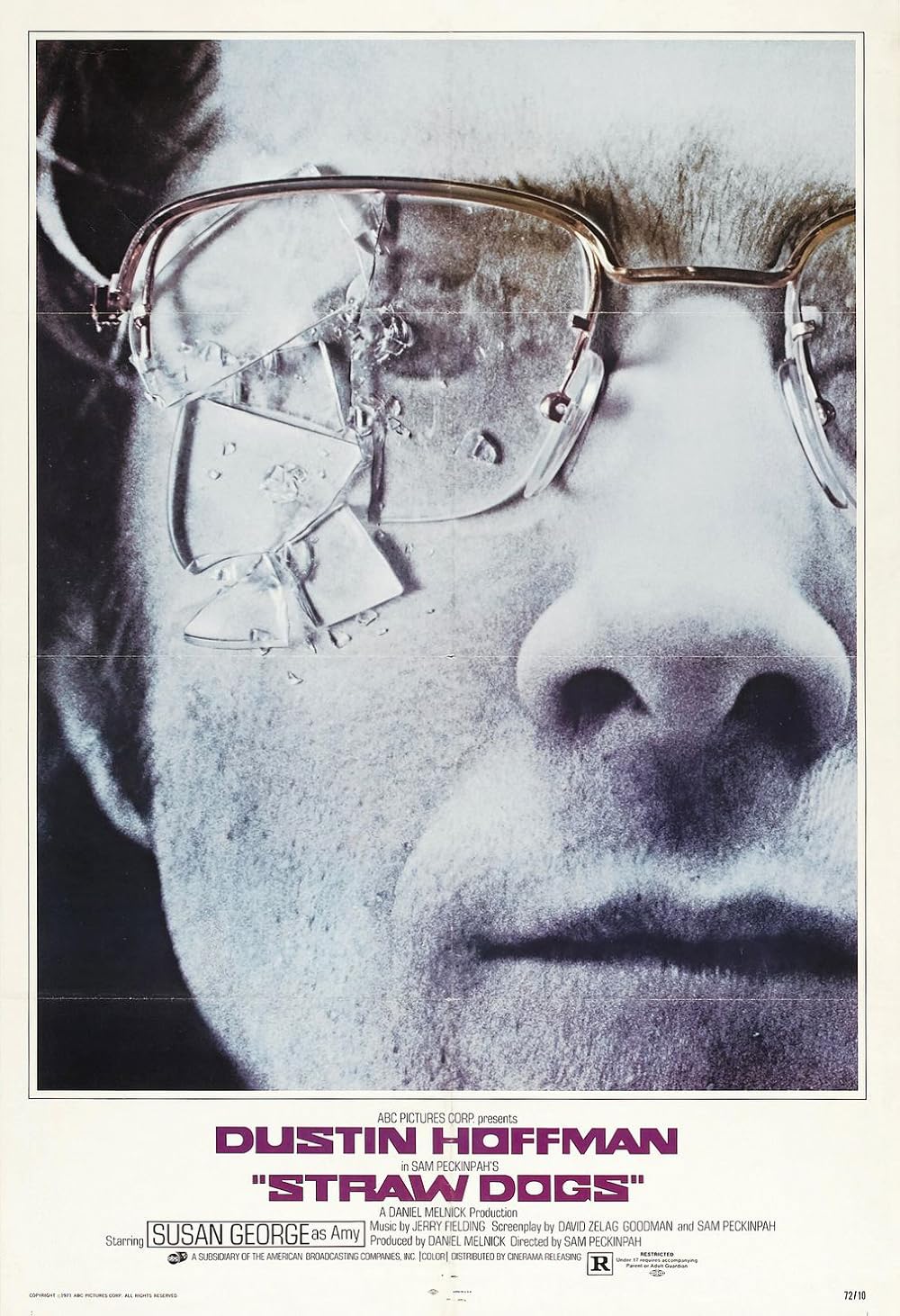
Straw Dogs (1971)

By Richard Winters

My Rating: 8 out of 10

4-Word Review: Man defends his home.

David (Dustin Hoffman), a nerdy mathematician, has been given a research grant and uses it to relocate to the rural countryside of England with his wife Amy (Susan George). They move into a farmhouse that was once owned by Amy’s father and they hire four men (Del Henney, Ken Hutchinson, Jim Norton, Donald Webster) to fix up the roof. The men though don’t work much and spend most of the time making fun of David and ogling Amy. After several bad encounters, including the grizzly death of their pet cat, David fires them and hopes that’ll be the last it, but things only get worse. When a teen girl named Janice (Sally Thomsett) disappears her violently drunken father Tom (Peter Vaughan) thinks it was caused by Henry (David Warner) a mentally handicapped man that Janice had shown an affinity for. Tom, along with the four other men, become a lynch mob determined to find Henry and bring him some ‘street justice’. David and Amy, while returning from a church service, hit Henry with their car as he’s running from the other men. David agrees to take the injured Henry into his home until a doctor can arrive, but the five men insist on getting inside to beat and kill Henry for his perceived crime. Since David had avoided having any confrontation with the men previously even when they had openly mocked him, they presume he’ll be a pushover this time as well, but David has finally decided to take a stand and will defend his home from the intruders in any way he can. 

While it was controversial at the time many now consider this the pinnacle of director Sam Peckinpah’s career and his directorial touches are supreme. The capturing of the brown empty vast landscape of nothingness, shot during the winter of 1971, brings out a surreal sense making it seem like the characters are living in a purgatory outer world where everything is dead and helps explain the deadness of the men’s souls that have been forced to endure their entire lives there. The climactic sequence where David’s home comes under siege is deftly handled. Normally in thrillers pounding music gets played during these segments to ramp up the tension, but here there’s only the sound of a distance foghorn, which makes it much more creepy, distinct, and helps accentuate the isolation. 

Some have been critical of the film’s violence especially at the time when there was activism going on that tried to stymie violent material on both TV and movies with the idea that violence was a ‘learned’ behavior and if people didn’t see it so much in entertainment, then they wouldn’t do it in real life. Peckinpah though saw it differently as he felt violence was an instinctual reaction that couldn’t just be ‘unlearned’ and that in certain situations it was necessary and not every conflict could be resolved peacefully, a message the film brings out quite well. 

While Susan George gives an excellent performance, as do the four villainous men, particularly Vaughan as their ringleader making them some of the creepiest bad guys in film history, I did find her character confusing. I didn’t understand why she’d marry a guy that she found by her own admission cowardly even bringing up that he was ‘running away’ from problems he was having at his university and his ‘hiding behind his studies’ in order to avoid it. She also shows no respect for his work and several times even vandalizes his chalk board that has his mathematical equations, so what attracted her to him in the first place? Would’ve made more sense had she initially idolized him for his academic status and then became painfully aware of his meekness as the film progressed, which would’ve made for a more interesting arch.

Spoiler Alert!

The film is based on the 1969 novel The Siege of Trencher’s Farm by Gordon Williams, but with many changes some of which worked while others didn’t. In the novel the couple had an 8-year-old girl, but in the film there is no child. To a degree it doesn’t make that much of a difference though when the bad guys attack the house it might’ve heightened the urgency more knowing that David was not only defending his ‘home’, but also the safety of his terrified daughter. The biggest change that the film does is that it creates a connection between Henry and Janice where Janice sneaks away with him during a church party where she invites him to be intimate with her, but in the process, he accidentally kills her, which seemed too similar to Of Mice and Men. It’s confusing too why this teen girl, who outside of her buck teeth seems reasonably attractive, would feel the need to throw herself at a mentally handicapped man, or get flirty with David, who is married. Why can’t she find guys her own age to fool around with? Knowing the hormones of most teen boys that shouldn’t be too hard, so without further explanation to her psyche, which doesn’t happen, her ‘inviting’ of Henry is quite unnatural and forced. 

In the book Henry is instead a child killer who’s being transported back to prison when the vehicle he’s in gets stuck in the snow, which allows him to escape. At the same time Janice, who’s mentally disabled, which isn’t made clear in the movie, runs away from a Christmas party where she ends up dying from the exposure to the cold, but otherwise it has nothing to do with the escape of Henry and is only presumed to have a connection by the five men, which makes more sense and the screenplay should’ve have kept it this way.

On the other hand, in the book none of the attacking men die and are only badly injured, but I think death gives it a more final resolution, so the movie scores there. I also liked how David is forced to resort to items he can find around the house, much like in the film Last House on the Left, which came out a year later, to fight off the bad guys versus the cliched machoism of having a big gun to blow them away and it also helps to show how intellectual wits can ultimately be used to overpower the otherwise physically stronger attackers. 

The rape scene in which the wife gets assaulted by not only one, but two men was another problematic moment as the book had no such segment. For one thing it makes it seem like she’s actually enjoying the attack, at least with the first one, and she recovers from it much too quickly and doesn’t even bother to tell David about it and able to go on relatively normally afterwards, which didn’t seem realistic and thus I think it should’ve been excised since it comes off as exploitive and doesn’t have that much to do with the main plot. 

My Rating: 8 out of 10

Released: December 22, 1971

Runtime: 1 Hour 57 Minutes

Rated R

Director: Sam Peckinpah

Studio: 20th Century Fox

Available: DVD, Blu-ray (Criterion Collection)

Adventures of the Wilderness Family 3 (1979)

By Richard Winters

My Rating: 1 out of 10

4-Word Review: Government threatens their home.

After surviving their first harsh mountain winter the Robinson family (Robert Logan, Susan Damante Shaw, Heather Rattray, Ham Larsen) are happy to go outdoors and enjoy the warmer weather of Spring, but there’s an unexpected problem. While doing a survey of the area a Forest Ranger (William Bryant) has surmised that the family doesn’t have rights to the property that they’re on. They must prove it’s a legitimate mining claim or move out.

I’ll give this film some credit, at least initially, that they made an attempt, albeit a feeble one, to mix things up. I was fully expecting more animal attacks, the formula had one occurring every 15-minutes in the first two installments, but with the exception of one minor one that happens to the boy when he runs away from home, there really isn’t any, at least to the family members. There is however, a confrontation between some mountain lions and the family’s pet dog, but the dog is able to fight them off, though I started to wonder how many times he could keep doing this. In the first two films the dog was also instrumental in scaring the other wildlife away, but you would think a domesticated pet would be at a disadvantage to one that had been living in the wild all their lives and were bigger in size. The fact that the dog constantly survives these battles and never even gets injured starts to raise the implausibility meter.

The two kids also feud a bit, which I found refreshing. Even the Brady Bunch had some conflicts between the siblings, as most any normal family does, so seeing everyone here be peachy towards each other the majority of the time is not only boring, but unrealistic. However, their disagreement, which amounts to nothing more than the two not talking to each other, which we don’t even see, but have described by the two parents, doesn’t last for more than a few minutes and then it’s all back to ‘happy family’. 

The mom finally does go back to L.A., something she had lightly threatened to do in the first two films but just like with the kids fighting it doesn’t add up to much as she comes back and says she’ll never leave again. Why then even add these elements if by the end it makes no difference to the story?

On a lesser note, are the bear cubs residing in the family’s cabin who never seem to grow and if anything, appear to have gotten smaller than when they were in Part 2. The Boomer character played by George ‘Buck’ Flower is also an issue as he’s a mountain man but never carries a gun making you wonder how he survives without one. For instance, how does he protect himself as animal attacks happen a lot, at least with the family, and what does he use to hunt for food? Maybe he lives completely off of berries and fish, but by the looks of his protruding belly it appears he’s eating something more.

Out of everything it’s the music that’s the worst. Because the story is so thin there are several segments featuring the family frolicking around while this sappy chorus by studio musicians get played that’s so sugary it’ll give you diabetes just by listening to it. It also has a dated sound from the 1940’s. The 70’s though was a period of many interesting music genres like rock, disco, soul, and even southern rock and media aimed at kids was trying to replicate it like ‘Sesame Street’ that had the Pointer Sisters singing a song that teaches children to count, but with a funky beat. Even religious people got into the times by introducing Christian Rock, so why does this movie have a soundtrack that’s so grossly out-of-step?

Spoiler Alert!

The third act in which the family openly refuses to leave their home after the Forest Ranger insists proves to be a letdown too as there’s no tense confrontation. Instead, the Ranger’s helicopter mysteriously crashes for no reason as the weather was sunny and when the family nurses him back to health he agrees to no longer push them out. However, all it would take is another government official to come along and the conflict would start all over making the tidy wrap-up/resolution unconvincing. The only positive thing to say is this was thankfully the final film of the series.

My Rating: 1 out of 10

Released: November 21, 1979

Runtime: 1 Hour 40 Minutes

Rated G

Director: Jack Couffer

Studio: Pacific International Enterprises

Available: DVD, Amazon Video, Roku

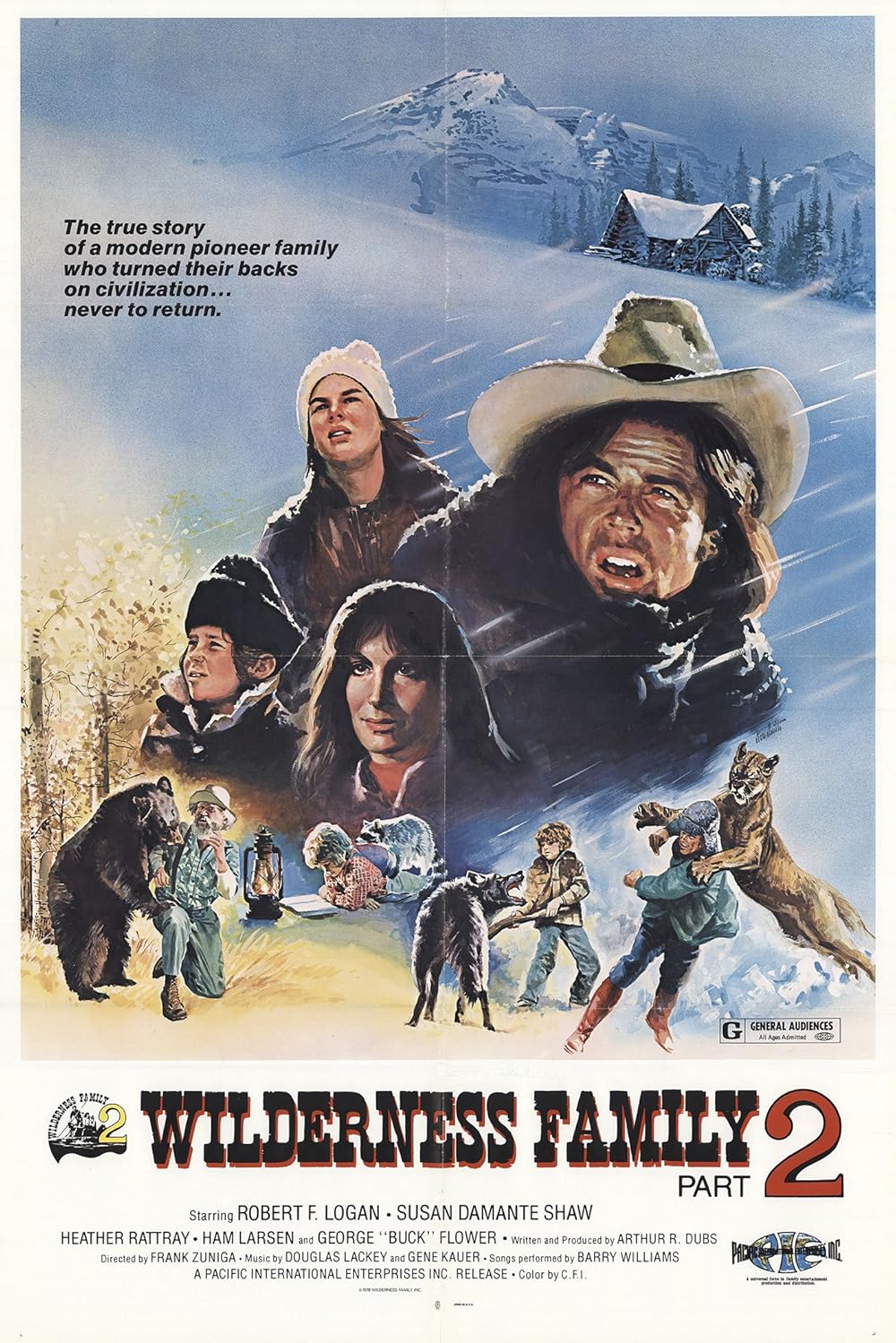
The Further Adventures of the Wilderness Family (1978)

By Richard Winters

My Rating: 1 out of 10

4-Word Review: Family battles the winter.

The Robinson family (Robert Logan, Susan Damante Shaw, Heather Rattray, Ham Larsen), who moved from Los Angeles to the wild of Colorado during the summer, now must contend with their initial winter there. The first snowfall they find beautiful and enjoy sledding down the hill, but once the holiday season has passed, they face the coldest month and excessive snow. This brings out a hungry pack of wolves lead by ‘Scarface’, which is a black wolf with a disfigured appearance. The wolves are so desperate for food they try breaking into the cabin while the father is away forcing the young boy of only 8 to try to shoot them with his rifle while his sister and sick mother take cover.

At this point it’s hard to believe that the family ever even lived in a city as they seem so well-adjusted to the wild it’s like they must’ve been born there. In fact they’re more able to rough-it than Boomer (George ‘Buck’ Flower) an old-timer who has been living in the mountains his whole life and yet when he sleeps alone as a guest in their back cabin and he becomes scared at seeing bear cubs and raccoons come in during the middle-of-the-night it’s actually the family that is shocked why that should bother anyone even though you’d think them originally being from an urban area it would be the reverse. The father also displays an uncanny knowledge like knowing that when a wolverine sprays a scent onto some meat that they had stored they can no longer eat it, but how the hell does somebody who had lived in Los Angeles his whole life prior be aware of that fact? It’s like he has a direct line to Wikipedia before cellphones, internet, or wi-fi was even a thing.

Like in the first there are more animal attacks though this time it all comes from roaming pack of wolves. However, since they had been through some hair-raising attacks before you’d think they wouldn’t venture back outside unless everyone was armed with a rifle. Yet they foolishly go out in the snow with no guns and then become frozen in terror when the wolves move in, but how many times does this same thing need to happen before they learn to come prepared? The previous attacks from the first movie had been so traumatic I was surprised they weren’t looking over their shoulders at every second versus frolicking around in the open without a care in the world until of course it’s too late.

The mother continues to be the only one who has any misgivings about the move, but then all the father needs to do is remind her of the traffic jams of the city and she immediately backs-off. However, those aren’t the only choices. They could just move to a small town, which wouldn’t have traffic congestion either, but still have running water, electricity, neighbors, and no wild animals breaking into their home in the middle of the night, so why not consider that option?

Spoiler Alert!

The climactic sequence is quite similar to the first one where the two kids and the mother are left fighting off animals’ intent on getting inside though here the anti is upped a bit by having the mom bedridden with illness and a raccoon accidentally setting fire to the place, which just makes it more contrived and isn’t gripping, or exciting. What’s worse is that a doctor flies in afterwards via a helicopter to take a look at the ailing mom and announces she is suffering from pneumonia, but then instead of taking her to a hospital he just leaves her there in the cabin with a big gaping hole in the roof with snow and cold pouring in, which will only make her condition worse.

End of Spoiler Alert!

I’ll give some credit to the picturesque wintertime scenery, but the corny song segments, sung by Barry Williams better known for having played Greg on the ‘Brady Bunch’ TV-show, act as nothing more than filler, which bogs an already anemic story down even further. Young children may be a little more forgiving, but adults should find it flat and one-dimensional. What’s worse is that they actually went on to make a third installment, which will be reviewed next.

My Rating: 1 out of 10

Released: November 15, 1978

Runtime: 1 Hour 45 Minutes

Rated G

Director: Frank Zuniga

Studio: Pacific International Enterprises

Available: DVD, Amazon Video, Tubi, Freevee, YouTube

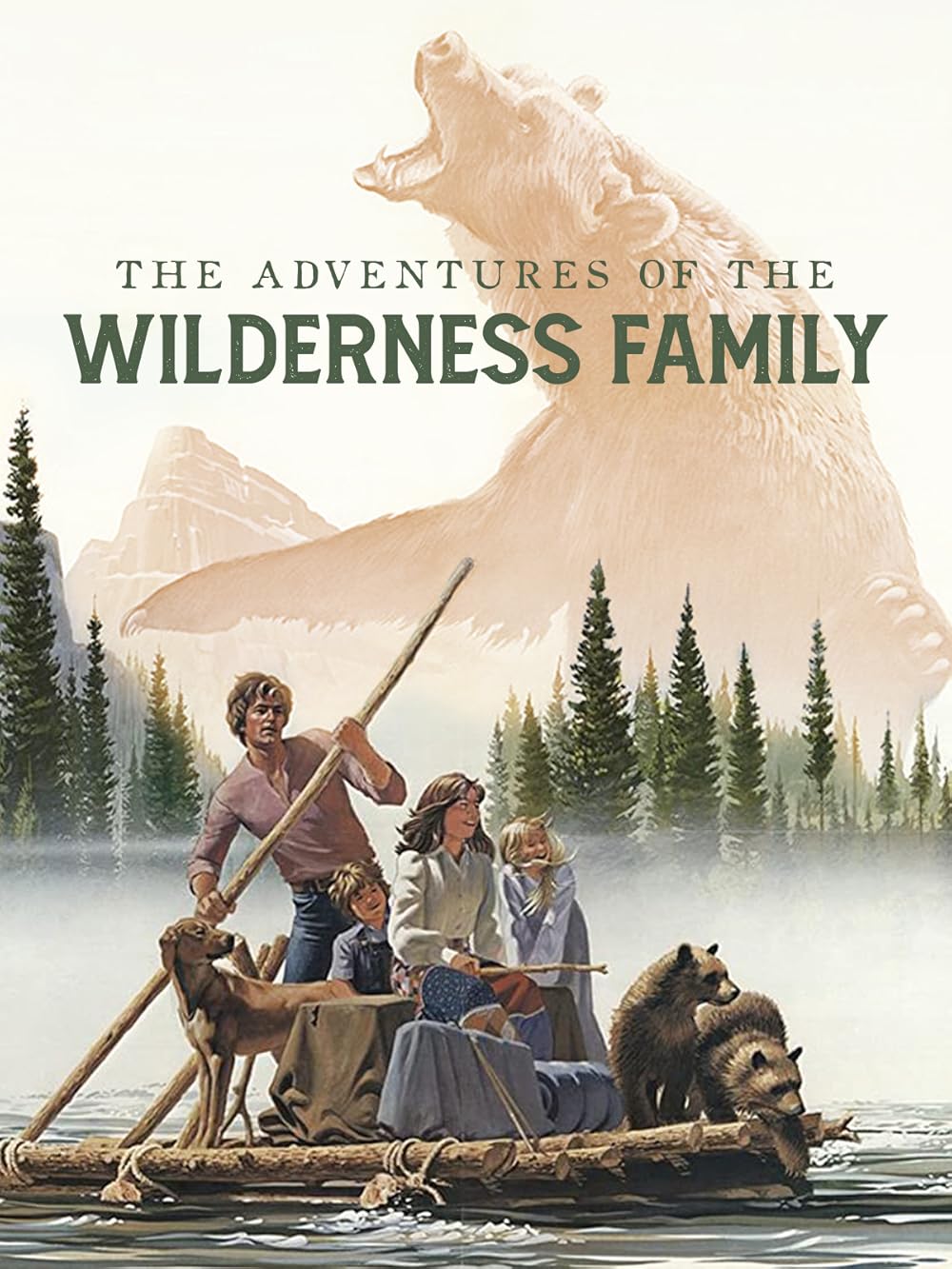
The Adventures of the Wilderness family (1975)

By Richard Winters

My Rating: 3 out of 10

4-Word Review: Living off the land.

Skip (Robert Logan) is a married father of two who finds his job as a construction worker a thankless routine. The smog of Los Angeles, which is where he and his family reside, is affecting his daughter Jenny (Hollye Holmes) who’s having breathing issues and nothing her doctor has prescribed is helping. He’s also tired of the traffic, which is why one day he tells his wife Pat (Susan Damante-Shaw) that he wants to get out of the city and move to the countryside. After some brief thought she agrees. The family then takes residence in an isolated Colorado cabin that’s rundown and filled with rodents. They’re able though to build a new cabin and move in but then must learn to fight the elements including mountain lions, wolves, and even grizzly bears.

Loosely based on the true-life story of a family that moved from Los Angeles to the remote regions of the Pacific Northwest that was written about in a 1974 New York Times article the film takes too much of a glossy approach to what should’ve been a deeper, more complex drama. The family makes their decision to move too quickly, literally on a ride home while in their pick-up. No scenes showing them having to say goodbye to their friends, selling off all of their belongings, or how they come about choosing the piece of open land that they eventually settle on. I felt for satisfactory emotional impact; to be able to fully appreciate the changes this family was going through those scenes should’ve been shown.

There’s also too much agreement amongst them. They’re all cool with leaving the city and don’t show even a fleeting second thought about it. As a kid that would mean giving up all their friends and playmates, TV-shows, and music and all the other conveniences of suburban living that I’m just don’t believe most children would roll with like here. It would’ve been much more of an interesting story had at least one of the kids been opposed to the move or put up a big fuss only to then maybe soften to the idea once they got out there. It could be done in reverse too with a child really excited to only to change their mind once they came face-to-face with the harsh reality of being in a wilderness long term. Going on a vacation to the woods is one thing but permanently leaving the only life you know to relocate to the middle of nowhere would certainly bring I would argue a lot of tears and adjustment and yet absolutely none of that occurs here making it vapid and lacking any type of character arch. 

What had me even more flabbergasted was that these kids get attacked by wolves and even bears and still don’t want to go back to the city. Yes, there would be smog, but I might be willing to begrudgingly accept that if it meant no more wild animal attacks. I was a kid once too, growing up in that time period, and if I got uprooted like that and went through all the hardships they did, I’d be screaming to go back home making the kids here seem unrelatable. The mother does to some extent put up a meek argument about wanting to go back, but it’s done in a light and gentle manner, and she immediately backs down when the others don’t agree, which makes for non-compelling interactions. 

The scenery is pleasant, filmed at the state park near Gunnison, Colorado, but it becomes like a nature propaganda movie where the only accepted opinion is that living in the country is great, even with the challenges, and no other point-of-view is allowed. Having a debate about the pros and cons of both would’ve added more subtext and made it less one-dimensional. The sappy songs done over the action is nothing but a time filler and proves how overall threadbare it is.

Sure there are a few intense moments including the climactic bear attack with the mother and children trapped in a cabin trying valiantly to fight him off, but whole thing works in a loop where every 10-minutes or so there’s some sort of confrontation with a wild animal, the family then considers giving up on the whole wilderness thing, only to agree to stay and then it starts all over again. Eventually by the third act it becomes quite uncompelling.  

My Rating: 3 out of 10

Released: December 19, 1975

Runtime: 1 Hour 39 Minutes

Rated G

Director: Steward Raffill

Studio: Pacific International Enterprises

Available: DVD, Amazon Video, Tubi, Freevee, Plex, Roku, YouTube

Wedding Trough (1975)

wedding

By Richard Winters

My Rating: 1 out of 10

4-Word Review: Man fucks his pig.

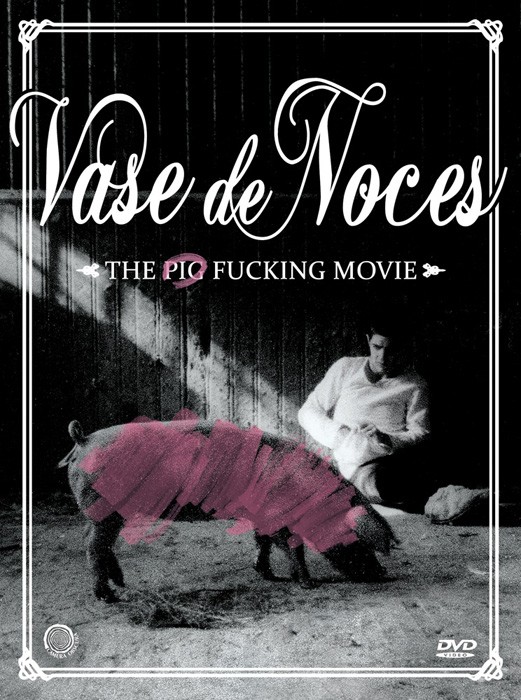
Bizarre, controversial film that was first shown at the Perth International Film Festival in Australia where it was immediately met with outrage and walkouts that quickly got it banned from being shown again by the government, a ban of which still stands today. Since then it’s turned-up sporadically a various film festivals throughout the decades, with the last one being in 2008 in Switzerland, but was never released theatrically and was considered an obscurity before finally getting a DVD issue in 2018. The film has no dialogue and shot in black-and-white at an abandoned farm in the outskirts of Belgium. It was directed by Thierry Zeno who had a noted fascination with all things morbid and followed this one up with a documentary on death and decay called Des Morts. This one deals with taboo subjects of zoophilia and coprophagia, which gets shown graphically. Many label this a horror movie for its grim and unrelenting subject matter, and some have even considered it a forerunner to Eraserhead

The plot description, which will contain SPOILERS, though in this case I feel is a good thing, so you know exactly what you’re getting into if you attempt to watch it, deals with a lonely farmer, played by Dominique Garny, who also co-wrote the screenplay, who begins to have amorous feelings towards his pet pig. One day he gets naked and has sex with it. Later on, the pig gives birth to three piglets. The man tries to bond with his brood by sleeping with them inside a giant basket, but the piglets prefer the comfort of their mother over him. Feeling that he’s now been ‘abandoned by his children’ it sends him into a rage causing him to kill the piglets by hanging them. This causes a great deal of stress for the mother pig who drowns herself in a nearby pond. The farmer now feels guilty about what he’s done, so he ‘punishes himself’ by concocting a drink made of his feces and urine and warms it inside a black pot before then forcing himself to swallow it.

While the sex scenes are simulated, though still graphic enough, the pooping and eating of it isn’t, which many will find gross enough. The hanging of the piglets though is quite unsettling. I’d like to feel that the ones that are hung were stillborn, since they do appear a bit smaller in size from the ones seen running around, but I’m not completely sure. However, the mother pig does become quite stressed in a very real way when she sees the dead piglets and runs around squealing in a high and frantic pitch, which is very disturbing.

Some have for decades sought this movie out as evidenced by the IMDb comments simply their love of shock cinema and this film’s notorious reputation for being at the top of the list. While it is unequivocally gross it’s also boring and disgusting with the abuse of the animals being the worst thing you’ll take from it. Not recommended.

Alternate Titles: Vase de Noces, The Pig Fucking Movie.

Released: April 11, 1975

Runtime: 1 Hour 19 Minutes

Not Rated

Director: Theirry Zeno

Studio: Zeno Films

Available: DVD-R

Thieves Like Us (1974)

thieves

By Richard Winters

My Rating: 6 out of 10

4-Word Review: Convicts escape from jail.

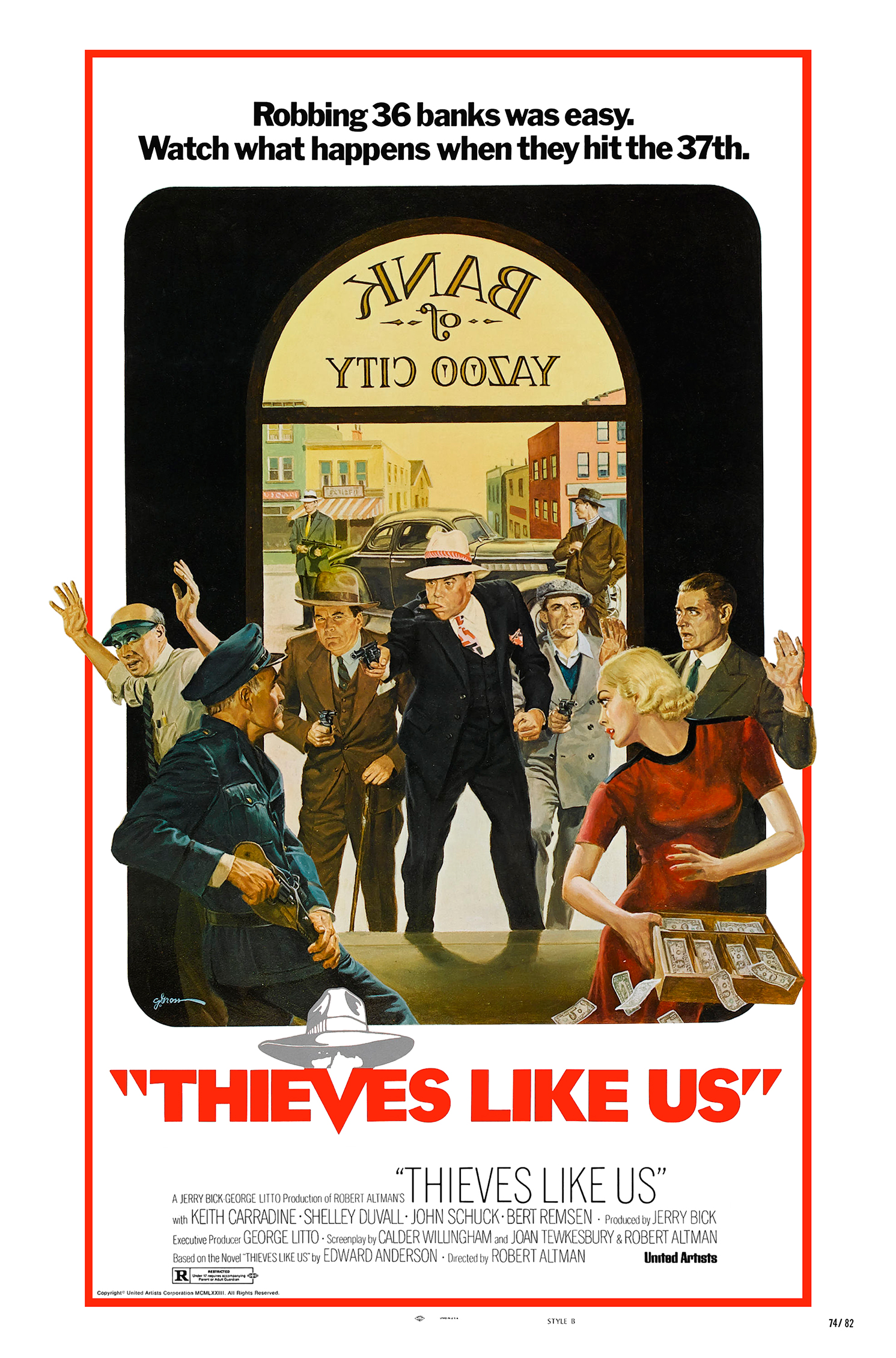
Bowie (Keith Carradine) is a young man stuck in jail due to a murder conviction from when he was a teenager. He teams up with Chicamaw (John Schuck) a middle-aged man to escape from prison and meet-up with T-Dub (Bert Remsen) an older man who has them hide-out at a local auto garage where Bowie meets the owner’s daughter Keechie (Shelley Duvall) and the two start-up a relationship. The three men return to their criminal ways by robbing banks, which goes well for awhile until the quick-triggered Chicamaw shoots and kills a bank clerk, which gets him recaptured and returned to prison. Bowie, who has now gotten Keechie pregnant, feels a loyalty to help get Chicamaw out, but Keechie wants him to settle down and get a conventional job while learning to become a family man. Bowie though resists the urge and after leaving Keechie at a motel cabin owned by Mattie (Louise Fletcher) sets out to help Chicamaw break-out for a second time, but this ultimately leads to tragedy.

The film was based on the novel of the same name written by Edward Anderson and published in 1937. The book had been adapted before in 1949 as They Live By Night, which Robert Altman was not aware of before taking on the project. Joan Tewksbury, his longtime screenwriter, adapted the book in a matter of 4-days, but getting it financied proved challenging and it was only after Altman and two of his other producers offered to mortgage their homes to help bring in needed capital that it eventually got green-lit. Unfortunately once it was completed the studio didn’t know how to promote it and ultimately released it without any advertising budget or fanfare. After a brief 3-week stay in the theaters it fell into obscurity before being resurrected by critical acclaim, which made it do well on cable television and has since gained a small cult following.

The atmosphere is probably the best thing as Altman achieves an authentic 1930’s setting. Other films that try to recreate the era always come-off a bit affected and cliched, but because Altman actually grew up during the period he’s able to give it the needed grittiness and I felt right from the start I was being transported to a different time versus feeling like I’m looking back at a bygone era through a modern day lens. The film has two very memorable moments. One of them is when Bowie goes to the prison to help Chicamaw breakout and meets up with the prison warden who’s residing in this country-style house and feasting on a large dinner. The contrast of this home cooked meal prepared by his wife like they were peacefully living out on a rural farm versus stationed right in the middle of a prison with dangerous criminals is something I really loved. The bank robbery game that the three men play with Mattie’s children where they turn their living room into a make believe bank with the children playing bank clerks and then the men proceed to ‘rob it’ is quite cute as well.

The acting is excellent by Carradine who starts to come into his own during his moments with Duvall, who is also good and does her very first fully nude scene. Lousie Fletcher, who’s first movie this was after she took a 10-year hiatus to help raise her kids, is supreme and helps give the proceedings a very definite, no-nonsense attitude and it’s just a shame she wasn’t in it more though the segments she does have she makes the most of. Tom Skeritt turns out to be a delightful surprise here. Normally I’ve found his work to be rather forgettable and under the radar, but here he stands-out as an alcoholic father who’s a pathetic character with darkly amusing lines.

The film though does suffer from Schmuck’s and Remsen’s characters seeming too much alike and I found the rapport between them to be quite unenlightening. Altman also takes a page out of Hitchcock’s directing book where like with what Hitch did in Frenzy he has the camera pull back away from the action going on inside the building and focusing instead on what’s going on outside. He especially does this during the robberies, which is initially kind of interesting, but he does it too much and then when he finally does show a robbery in progress he does solely from a bird’s-eye view with the camera nailed to the ceiling, which causes the viewer to feel too emotionally detached from what’s happening. He also completely skips over the part where T-Dub gets shot and killed and Chicamaw recaptured, the viewer only learns of this by hearing it reported on the radio, but these are pivotal moments to the story and the film is slow enough the way it is, so this is the type of action that should’ve been played-out.

Spoiler Alert!

The climactic sequence where the cabin that Bowie is in gets surrounded by Rangers and shot-up doesn’t work at all. This is mainly because it’s too reminiscent of the same type of shoot-up done in Bonnie and Clyde that was more famous and riveting. Here it comes-off like a second-rate imitation of that one and does nothing but make you want to go back and see that one while completely forgetting about this one in the process.

My Rating: 6 out of 10

Released: February 11, 1974

Runtime: 2 Hours 3 Minutes

Rated R

Director: Robert Altman

Studio: United Artists

Available: DVD, Blu-ray

Butterfly (1982)

butterfly

By Richard Winters

My Rating: 0 out of 10

4-Word Review: Family has genetic birthmark.

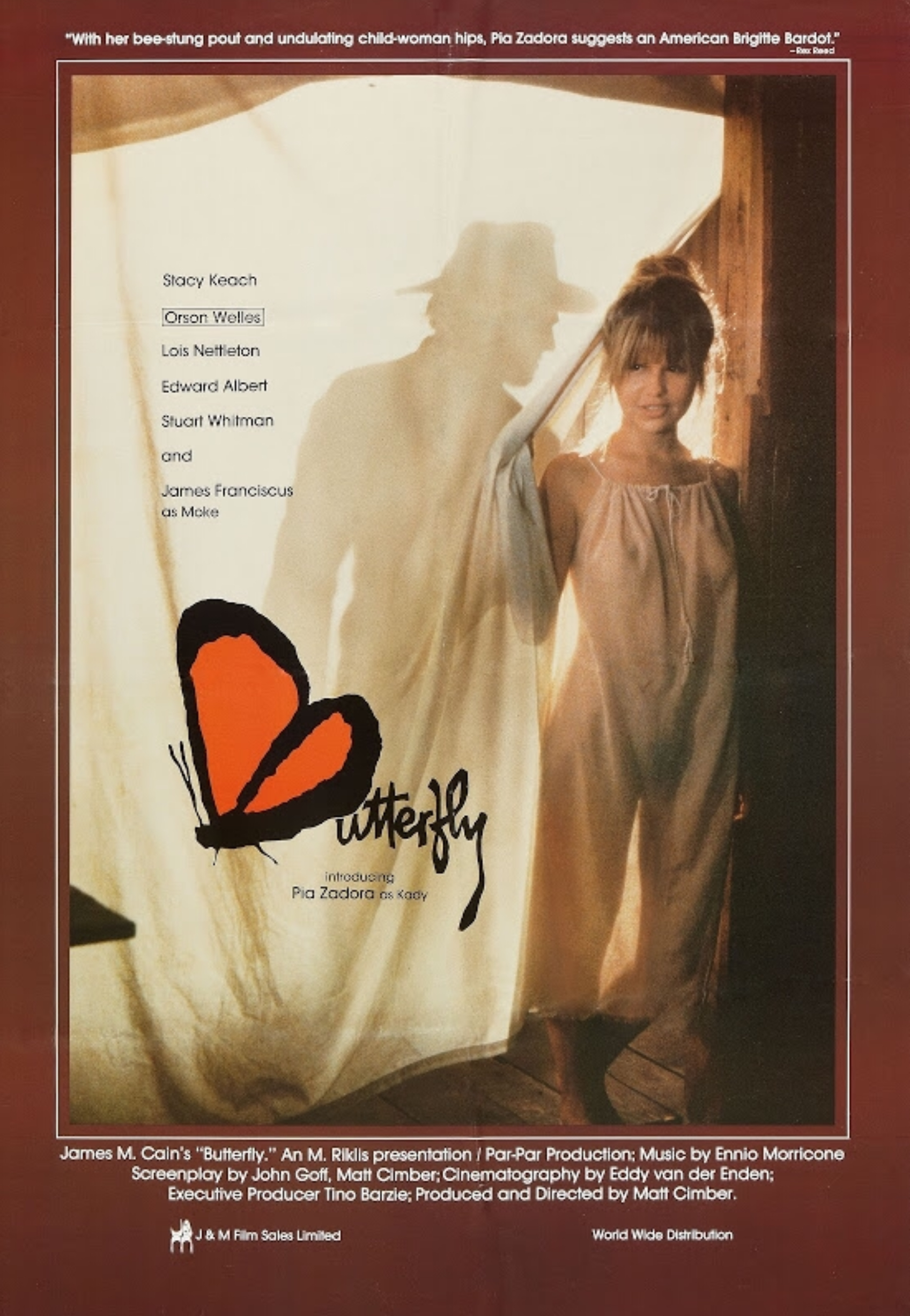
Jess (Stacy Keach) takes care of an unused mine outside of a small Arizona desert town. One day Kady (Pia Zadora) shows up at his doorstep. Jess doesn’t recognize her at first, but then realizes she’s his 17 year-old daughter the product of his marriage to Belle (Lois Nettleton) who abandoned him 10 years earlier for another man named Moke (James Franciscus). She is pregnant by a man who refuses to marry her, so she  wants to steal silver from the mine that Jess protects in order to help her financially with the child who’s on the way. At first Jess disapproves, but Kady uses her provocative body and looks to essentially seduce him and get him to relent. However, a local man named Ed (George Buck Flower) witnesses their stealing from the mine as well as their lovemaking later on, which gets them arrested for incest.

The story is based on the 1947 novel ‘The Butterfly’ by James M. Cain, who at the time was an immensely popular author, who had many of his books made into movies, but due to the controversial nature of this one it had to wait 35 years until it finally went to the big screen. He was inspired to write the story when years earlier, in 1922, he got a flat tire while driving through a mountainous area in California and a farm family that had moved there from West Virginia helped him fix it, but at the time he speculated that the young daughter they had with them was a product of incest.  The movie makes several deviations from the book. In the book Jess was the overseer of a coal mine and the plot took place in West Virginia while the Kady character was 19 instead of 17.

While the plot has some tantalizing elements, and on the production end it’s well financed, the whole thing comes crashing down due to the really bad performance of its lead actress. Zadora at the time had done only one other film before this one, Santa Claus Conquers the Martians, which was universally lambasted. It probably should’ve killed anyone’s career who had been in that, but she continued to struggle on in the business. Then in 1972 while performing in a small role in a traveling musical show, she caught the eye of a rich businessman named Meshulam Riklis, who was 29 years her senior. The two began dating and eventually married in 1977. Her new husband was determined to make her a star even if it meant buying her way in. He put up the entire $3.5 million budget for the film while demanding that she be placed as the star forcing director Matt Cimber to cast all the other parts around her. Riklis even put up big money to help get her promoted to winning the Golden Globes Newcommer of the Year Award, but all of this didn’t get past the critics, or audiences who rightly saw her as undeserving of all the attention and while she did a few other movies after this, which were equally panned, and even a few music videos and singing ventures, she is overall largely forgotten today and hasn’t been in a movie in 30 years.

To some extent her performance isn’t completely her fault as her character is poorly fleshed-out, which is my main gripe. I just couldn’t buy in that this chick on the verge of adulthood would be so extraordinarily naive that she’d come-on to her own father and not see anything wrong with it. First of all why is she sexually into her dad anyways as majority of girls tend to want to go for guys their own age and if not there has to be a reason for it, which this doesn’t give. In either case she should have some understanding that the rest of society doesn’t condone this behavior nor having her aggressively flirt with literally any guy she meets. The fact that she’s so blissfully ignorant to the effects of her behavior made her not only horribly one-dimensional, but downright mentally ill. Sure there’s people walking this planet that harbor some sick, perverse desires, but virtually all of them know they’re taboo and not dumb enough to be so open about, or if they do they learn real fast. Having her unable to understand this, or never able to pick-up on even the slightest of social cues is by far the most annoying/dumbest thing about it.

Keach, who gives a good performance and the only thing that holds this flimsy thing together, has the same issue with his character though not quite as bad. The fact that he doesn’t even recognize his daughter at first is a bit hard to believe. Sure he left the family 10 years earlier, but that would’ve made her 7 at the time and although she has clearly grown I think she’d still have the same face. He gives into his temptations too quickly as at one point he massages her breasts while she’s in the tub. Now if he weren’t religious then you could say he didn’t care about the taboos and had been living so long alone that he’d be happy to jump at any action he could irregardless if they were related, but the fact that he goes to church regularly should make him feel guilty and reluctant to follow through. In the book he’s portrayed as fighting these internal feelings by turning to alcohol, which is the way it should’ve been done here as well.

The eclectic supporting cast does make it more interesting than it should. Orson Welles caught my attention not so much for his role as a judge, but more because of his wacky combover. James Franciscus, who usually played sterile good guys is surprisingly snarly as the heavy and Stuart Whitman has a few good moments as a fiery preacher though even here there’s some logic loopholes that aren’t explained like how did he know Kady was Jess’ daughter, which he mentions while at the pulpit much to the surprise of Jess as he hadn’t introduced her to anybody.

My Rating: 0 out of 10

Released: February 5, 1982

Runtime: 1 Hour 48 Minutes

Rated R

Director: Matt Cimber

Studio: Analysis Film Releasing Corporation

Available: DVD-R