Category Archives: Movies that take place in the South

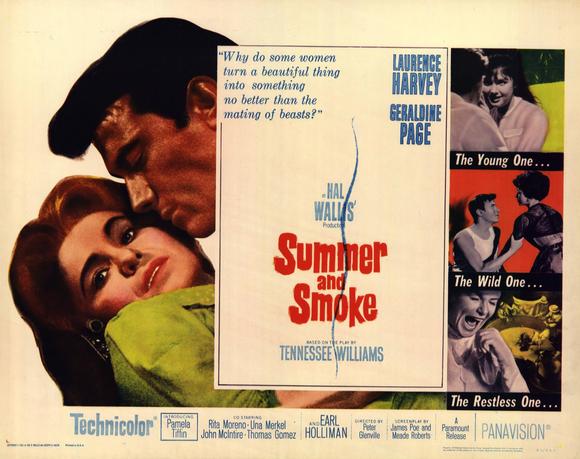
Summer and Smoke (1961)

By Richard Winters

My Rating: 7 out of 10

4-Word Review: She is sexually repressed.

Alma (Geraldine Page) is an adult woman still single and living with her parents. Her father (Malcolm Atterbury) is a minister while her mother (Una Merkel) having suffered a mental breakdown several years’ earlier acts and behaves in a perpetual child-like state. Alma yearns for the affections of John (Laurence Harvey) the dashing doctor who lives next door with his father (John McIntire). However, John’s lifestyle is much too wild for Alma’s repressed tastes, but when she tries to change she finds that it may be too late in this film version of the Tennessee William’s play.

I have been a fan of Geraldine Page for years. She has a terrific ability to play fragile and eccentric characters while doing it with a panache and style. Her characterizations are always vivid and revealing and executed in a seamless fashion. One can become so entranced with her performances that sometimes it becomes more interesting than the story itself. Her appearance here proves to be no exception. She became known for playing a lot of dark, sinister characters, so it was a nice change seeing her play this part. She even does some singing and in fact the scene where she sings to John’s father as he lies on his deathbed for me left the most lasting impression. I always love watching the woman’s body language, gestures, and facial expressions and how she uses them to create a three-dimensional character. Her acting discipline should be studied and emulated by students of the craft everywhere.

Harvey as her co-star was an interesting choice. Despite his reputation as being an over-rated actor and possessing a strange personality off-camera I have found some of his performances to be excellent particularly the one in the original Manchurian Candidate. However, he seems to be better suited playing parts with a cold and aloof presence. The role here demanded more emotion and I didn’t think he could quite hit it. By the end Page was acting circles around him and turning the production into her own vehicle.

The supporting performers aren’t bad. It is fun seeing Rita ‘Hey you guys’ Moreno in an early role playing a young vixen with eyes for John. McIntire is fine in his small role and the part where comes home to find all sorts of drunken people lying about passed out in his living room and hallways is good. Thomas Gomez is memorable simply to glimpse his large almost unbelievable waist size.

I really didn’t like Merkel’s part as the crazy mother. I found it frustrating that there really was never any explanation for why she behaved in such a strange way. Simply saying that she had a ‘breakdown’ wasn’t enough and I wanted more of a scientific or medical reason. It also would have been more interesting to see what she was like before her breakdown, but that is never shown.

Technically the film is well produced. The sets, costumes and performances are all very turn-of-the-century and it helps draw you into the mood and thinking of the era right away. I did not like that the outdoor scenes where done on a soundstage as the foliage and sky look annoyingly artificial.

Most of William’s plays deal with sad, lonely, and pathetic characters and this one proves no exception. However, I was pleasantly surprised that after the expected histrionics this one manages to have a somewhat upbeat ending, which helped distinguish it above some of his others. The characters and situations are all too real and Alma reminded me very much of someone I know and others may know someone like her as well, which on a personal level made this story all the more fascinating.

My Rating: 7 out of 10

Released: November 16, 1961

Runtime: 1Hour 58Minutes

Rated NR (Not Rated)

Director: Peter Glenville

Studio: Paramount

Available: DVD, Amazon Instant Video, Netflix streaming
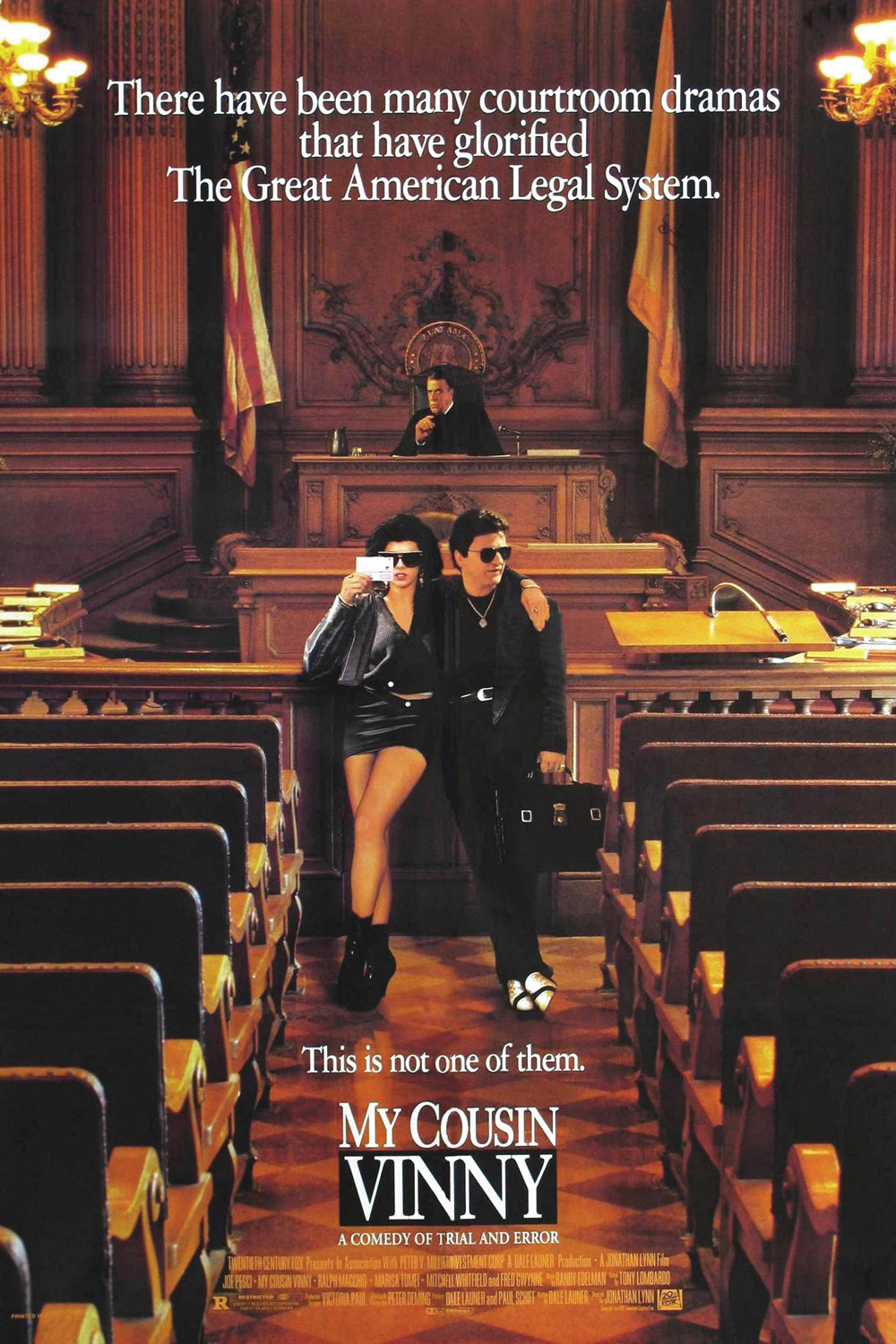
My Cousin Vinny (1992)

By Richard Winters

My Rating: 5 out of 10

4-Word Review: Don’t hire this lawyer.

A huge and much talked about hit upon its release in 1992, My Cousin Vinny is the story about two traveling college friends (Ralph Macchio, Mitchell Whitfield) who, upon going through Alabama, get implicated to the murder of a convenience store attendant that they did not commit. They’re only hope is calling up Macchio’s uncle Vinny from Brooklyn (Joe Pesci) who has only been practicing law for six weeks and has never tried a case.  Even worse is the fact that his brash Brooklyn sensibilities do not mesh well with the trial’s very strict, no-nonsense Judge (wonderfully played by Fred Gwynne in his last film role).

One thing that stood out right away with me was the way this film did not fall into age old stereotypes despite being in a setting that seemed ripe for it.  There is not a single mention of racism anywhere.  Instead the film seems to want to focus on a more contemporary Alabama where the African American characters are, by and large, on equal footing with the whites as well as having a white Sheriff who is not redneck, corrupt, or ignorant.  The two college kids also thankfully break rank from the typical Hollywood films of that era.  These kids are not the rowdy, partying, beer swilling, sex crazed teens that you usually see, but instead believable and most of all likable.  I found them to be so likable that I wished they were in the film more, unfortunately after the first twenty-five minutes they pretty much disappear until the very end, which I found disappointing.  Still it was nice seeing Macchio growing out of his Karate Kid role and looking a little more filled out and mature.

I also want to give mention to the excellent on-location shooting.  Although it was not actually filmed in Alabama, but instead the neighboring state of Georgia, it still nicely captures the look and feel of the south and it does it right from the start.  I have often said good on-location shooting (as opposed to the annoying Hollywood studio back-lot) can enhance just about any story and help create what’s almost like another character.  I have been to Alabama recently and enjoyed the many references to the red, muddy soil that is everywhere down there and the scene where the Pesci character gets his car stuck in it is great.

The comedy runs pretty well, but is much stronger at the start.  The conversations the boys have with the police are quite amusing as is Whitfield’s initial dialogue with the Pesci character who he doesn’t know is a lawyer and instead thinks he is a cellmate there to ‘break them in’.  I also enjoyed the running gag dealing with Vinny using his debating skills to try and ‘negotiate a settlement’ with a tough guy at a bar who refuses to pay up after losing a bet.

Unfortunately there is also a lot of comedy that does not work.  The running gag dealing with Vinny and his girlfriend constantly being awakened in the early morning hours by some unexpected noise at each of the places they stay at starts to get real redundant and silly.

There is also another segment featuring actor Austin Pendleton who plays one of the court appointed attorneys and, without warning or any logical explanation, starts to stutter terribly when he tries to give his opening argument.  I was genuinely shocked to see Pendleton take this part since he was a stutterer in real like and didn’t overcome the problem until he was well into his forties.  He even starred in a 1983 film entitled Talk to Me about a man coping with the affliction. Apparently Pendleton did protest the scene and even labeled it a ‘sick joke’, but eventually did it anyways because he needed the work, which was unfortunate because it comes off as being forced and uncomfortable.  Most lightweight comedies, which in the end this is, run about ninety minutes yet this film runs a hundred and twenty minutes, which is too long.  Had some of these so called ‘funny’ scenes been cut it would have shortened the film nicely and even strengthened it.

I should also mention Marisa Tomei who won the Oscar for best supporting actress as Pesci’s girlfriend.  Now her performance isn’t bad, but I didn’t see anything really outstanding about it either.  She spends most of the time wearing garish and gaudy outfits, speaking in a Brooklyn accent that borders on annoying, and playing the caricature of a ditzy girlfriend. Only at the end does she become a little more dimensional when she inexplicably displays some amazingly detailed knowledge about automobiles that for me just didn’t ring true.  I would have given the Oscar to Fred Gwynne, TV’s Herman Munster, as the judge. Some of his courtroom exchanges with the Pesci character are the best parts in the film.  I also really like Lane Smith in the role as the prosecutor. His performances are never flashy, but he is always reliable and gives his characters a nice, quiet dignity.  He is also a genuine southerner, so he fits into his role more easily.

The film is overall passable.  I had no idea how it was going to turn out and it kept me intrigued.  However, once the resolution was made and the mystery solved, I wasn’t completely satisfied.  I was hoping it would be like The Vanishing, the excellent 1988 film from the Netherlands, that went back and reenacted how it all took place.  It would have at least been nice had the film put in a little red herring at the beginning, so the viewer could have tried to figure it out themselves instead of just throwing in a wrap-up that seemed too convenient.

If you are fans of Joe Pesci then you’ll enjoy this movie a little bit more.  His performance as the volatile character in Goodfellas is so etched in my mind that I have a hard time adjusting to him in likable roles, or comedy.  However he manages to be quite engaging throughout.

My Rating: 5 out of 10 

Released: March 13, 1992 

Runtime: 2Hours 

Rated R 

Director: Jonathan Lynn 

Studio: 20th Century Fox 

Available: VHS, DVD, Blu-ray, Amazon Instant Video

The Drowning Pool (1975)

By Richard Winters

My Rating: 7 out of 10

4-Word Review: Way too much water.

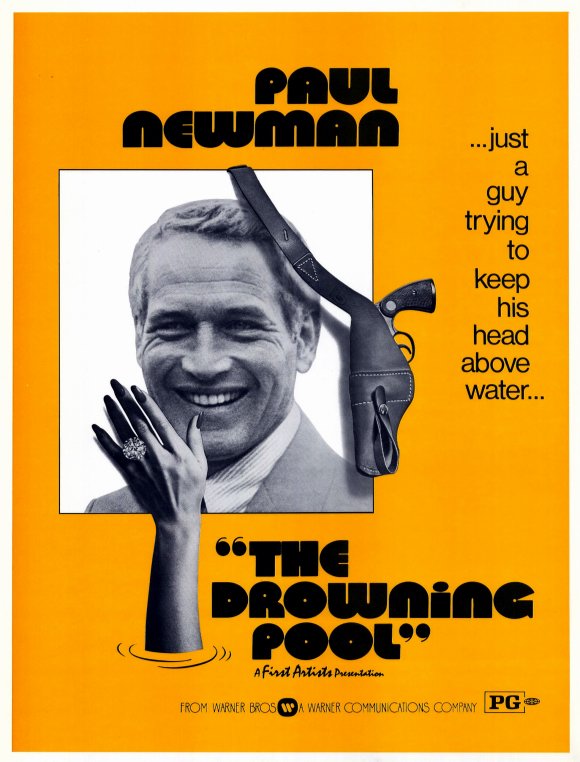
            Detective Lew Harper (Paul Newman) travels to New Orleans in order to help Iris (Joanne Woodward) an old love of his who has now married and living in a large southern mansion that is controlled by her husband’s domineering mother Olivia (Coral Browne). Iris asks Harper to track down a former servant who she has fired and is now sending notes to her husband threatening to describe one of her elicit affairs. Initially Harper thinks it will be a simple straightforward case, but finds many twists and turns including the presence of an oil company looking to buy the land the mansion sits on for drilling. There is also Iris’s over-sexed teen daughter Schuyler (Melanie Griffith) who is always present when there is any trouble as well as the town’s sheriff Broussard (Tony Franciosa) who takes an unusual interest in the well fare of Iris and her daughter.

By itself this is an okay mystery although it takes a while getting there and there are too many characters popping in out of nowhere threatening harm to Harper to point that almost becomes formulaic. Compared to the first Harper this film pales in comparison. It lacks the snappy dialogue that made the first one so fun. The supporting characters are not as well defined, or as interesting and the overall production values are not as slick. I was amazed that with a script written by Tracy Keenan Wynn, Walter Hill, and Lorenzo Semple Jr. that it could be so overall ordinary, but it is. That doesn’t mean it is not passable, or entertaining, but it lacks the zing from the first.

I also didn’t like the change of location. Harper with his very detached approach worked better with the jaded Hollywood types. Here he just seems out-of-place. The mansion setting is boring and predictable. However, the scene where Harper is taken by boat along a swamp and to a pit bull farm where the animals are trained for dog fighting is special.

As for the supporting characters Richard Jaeckel, who has appeared with Newman before in several good scenes including the drowning one in Sometimes a Great Notion, is good as ‘bullet head’ a corrupt policeman who is constantly harassing Harper. Harper later turns the tables playing a game of Russian roulette with him that is great. Murray Hamilton is also quite good as the evil oil baron Kilbourne and the all red jumpsuit that he appears in is something else.

On the female end you have to love Melanie Griffith as the devious, nympho teen. She plays that type of part so well that I don’t think there is any other actress that could ever do it better. I did not like Gail Strickland as Mavis who is Kilbourne’s wife.  When we first see her she is a conniving, cocky, flirtatious woman, but then in a later scene turns into a whimpering, whiny mess begging Harper for help when she barely knows him. This extreme contrast didn’t work with me and I thought that a woman who marries a rich, but shady businessman and has been involved in some underhanded maneuverings herself should have a little better ‘plan B’ in place and not sink to such a pathetic helpless level the minute things unravel. Woodward is wasted in a boring role that allows for very little range. I wished she had played Strickland’s part as I think she would’ve made it more interesting.

The one scene that really stands out and makes this movie special is the part where Harper and Mavis are trapped in a hypo-therapy room in an old, abandoned asylum. Newman does most of his stunts here including being sprayed by a fire hose while locked in a strait jacket. The sequence where they plug up all the drains and then turn on all the showers in an attempt to float up the pool of water and escape out the skylight is amazing as is the moment where the gallons of water comes rushing through the door toppling furniture and people. This scene is incredible on many levels and should make it into the top twenty of best movie moments ever.

My Rating: 7 out of 10

Released: June 25, 1975

Runtime: 1Hour 48Minutes

Rated PG

Director: Stuart Rosenberg

Studio: Warner Brothers

Available: VHS, DVD, Amazon Instant Video

White Lightning (1973)

By Richard Winters

My Rating: 3 out of 10

4-Word Review: Corrupt Sheriff gets smacked.

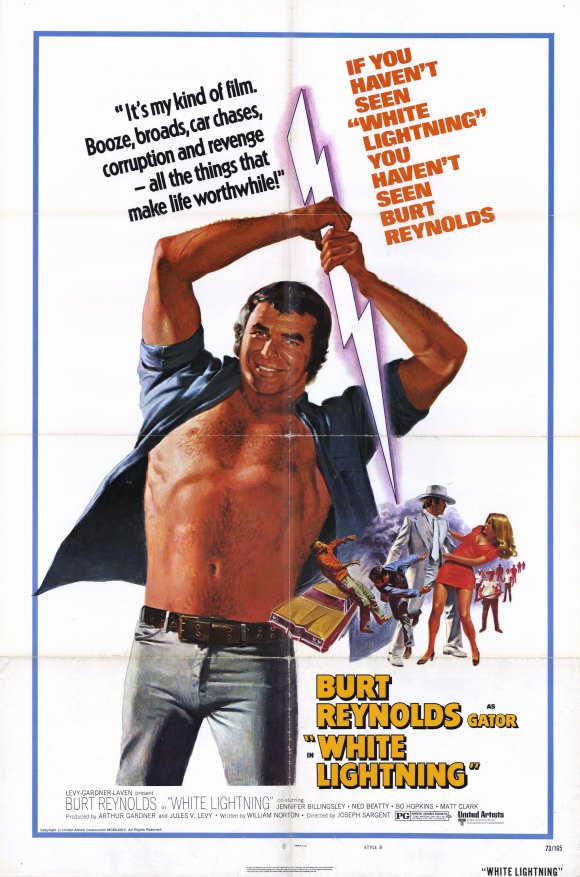
Corrupt sheriff J.C. Connors (Ned Beatty) drowns a young man and woman in a backwoods swamp because they were ‘young hippie protesters’ who dared talk back to him. The victim’s older brother Gator McKlusky (Burt Reynolds) finds out about it and swears revenge. Although he is in prison he is let out when he agrees to work as an undercover agent for the feds who are after the sheriff for various unsolved crimes, but unable to attain enough evidence for a trial and conviction.

The story and scenarios are formulaic to the extreme and offer nothing new to an already uninspired genre. The characters are annoyingly clichéd southern stereotypes.  The pacing is poor and filled with drama that is stale and action that is lacking.  The dialogue is derivative and there is not enough tension, or plot devices to hold the viewer’s interest.

The opening sequence done over the credits is probably the best scene in the film. It takes place in a swamp with just enough dead trees sticking up above the water line to give it a nice gothic feel. There is no dialogue and the slow banjo ballad is perfect for the southern atmosphere. I was dismayed that the score, by Charles Bernstein, didn’t stay on this level throughout as towards the end it starts to sound too much like something from a 70’s action flick, which is not as effective.

A few car chases are the only other thing that allows for mild diversion. They certainly are not on par to the ones from Bullit, or The French Connection, but they are photographed well enough to offer some excitement. I liked how during the final chase the point-of-view shifts back and forth between the police cars and Gator’s. There is a sequence where, in an effort to avoid an oncoming cop car, Gator lofts his car from a river bank onto a moving barge. It was not a perfect landing as only the front end of the vehicle manages to connect with the ship while its rear-end hangs out over the water, which was apparently a mistake. However, I thought this offered good realism as most drivers, especially those going at high speeds, would be unable to judge the distance enough to even hit the boat. This also offered a brief exchange in which Gator is informed that the car’s under carriage is damaged as most car chase films never deal with the good guy’s auto getting wrecked even though it should, but still no explanation for how he was able to pay for it when it his informed it will be costly, which he instead just laughs off.

It was great to see Bo Hopkins, who plays Reynold’s partner in crime, in a likable role for a change. R.G. Armstrong on the other hand gets straddled with doing another slimy character, but he does it so very well that it never gets tiring. Jennifer Billingsley is enticing as the oversexed, flirtatious nymph. Matt Clark is fun as Dude Watson, who argues incessantly with Gator before finally agreeing to work with him.

Ned Beatty is horribly miscast as the sheriff. He has been a terrific character actor in countless other roles, but he is overwhelmed and uncomfortable here. He is unable to convey the necessary menacing and intimidating quality to make him a memorable bad guy. The character never shows enough psychosis, or stupidity for me to believe that he would kill a young couple over something petty and expect to get away with it.

Reynold’s has always been able to convey an almost effortless charm and charisma, but here it is barely able to carry the film. His goofy good-ole-boy laugh becomes obnoxious and irritating. I was also not too impressed with the character’s parents (Dabbs Greer, Iris Korn) who seemed more than willing to let the mysterious death of their younger son go without any investigation, or uproar, which to me seemed pathetic.

The on-location shooting done in Arkansas may be the film’s one and only saving grace. I have traveled to the state and felt that the locale was captured perfectly and allowed for a vivid southern feel, but it is still not enough to make this worth seeing.

My Rating: 3 out of 10

Released: August 8, 1973

Runtime: 1Hour 41Minutes

Rated PG

Director: Joseph Sargent

Studio: United Artists

Available: VHS, DVD, Amazon Instant Video

Number One (1969)

By Richard Winters

My Rating: 0 out of 10

4-Word Review: Heston plays a quarterback.

            Ron Catlan (Charlton Heston) is an aging quarterback for the New Orleans Saints football team. At one time he was the best in the league and even won a championship, but now at age 40 his skills are declining and there’s a second string quarterback eager to take his place yet Ron isn’t emotionally ready to move on from the game even though he knows he should.

This is the type of film that gives dramas a bad reputation. The dialogue and scenarios are soap opera like. A few amusing bits would have helped eleviate an otherwise relentlessly downbeat tone. The same basic issue gets talked about and discussed over and over again until it is nauseating. There is no beginning middle and end to this thing. The storyline is introduced right from the start and then goes nowhere with it. The pacing is unbearably slow with no action and conversations that are general in nature and have no verve. The brief cutaways that are used are heavy handed and add nothing.

Heston looks goofy in a Saints helmet. Apparently he was unable to throw the ball accurately, or at a long distance, so they were forced to show a close-up of him going through the throwing motion, but then cut to a long shot of a professional player completing the throw, which becomes obvious and tacky looking. He also has the same grouchy expression on his face the whole time and the character is unlikable and uninteresting. The viewer never becomes emotionally caught up in his plight and it surprised me that the filmmakers ever thought that they would.

The climactic sequence consists of Catlan being hit by three Dallas Cowboy players, which injuries him enough to end his career. The intention was to make this stark and jarring for the viewer and the image of him lying on the field can be seen on the film’s promotional poster as seen above.  Supposedly the actual hit done during filming was so violent that it ended up cracking three of Heston’s ribs. However, capturing the hit and making the intended impact on the viewer is botched. The edits are too fast and it goes by so quickly that it doesn’t seem like a big deal when you see it. Most people will see similar types of hits during actual games while watching them on a regular Sunday. If anything the scene should have been done in slow motion and I am not sure why it wasn’t since other segments of the football action was.

The music choice was another mistake. I realize that the setting is New Orleans and in order to help create the ambience of the city director Tom Gries decided to give the film a jazz score and even has jazz legend Al Hirt make a cameo appearance, but the soft, light, laid back jazz sound does not coincide with the hard hitting and high adrenaline elements of the game.

Bruce Dern is terribly wasted. The women seem to give stronger performances than their male counterparts, but the movie is so bad as a whole that it hardly seems to mean anything.

The Saints seemed to be an odd choice as the football team since they had become an expansion team only two years prior to this film being made. I like the team’s unique colors and logo, but in the movie Catlan has supposedly won a championship with the team in prior years, which doesn’t make sense if one knows the team’s history.

I wrote previously in this column that The Longest Yard may very well be the best football movie ever made and if that is the case then this film is clearly the worst one. This film even makes the actual game itself and the action shown on the field seem boring and uninspired.

My Rating: 0 out of 10 

Released: August 21, 1969

Runtime: 1Hour 45Minutes

Rated M

Director: Tom Gries

Studio: United Artists

Available: None

The Longest Yard (1974)

longest1

By Richard Winters

My Rating: 8 out of 10

4-Word Review: Prisoners play football game.

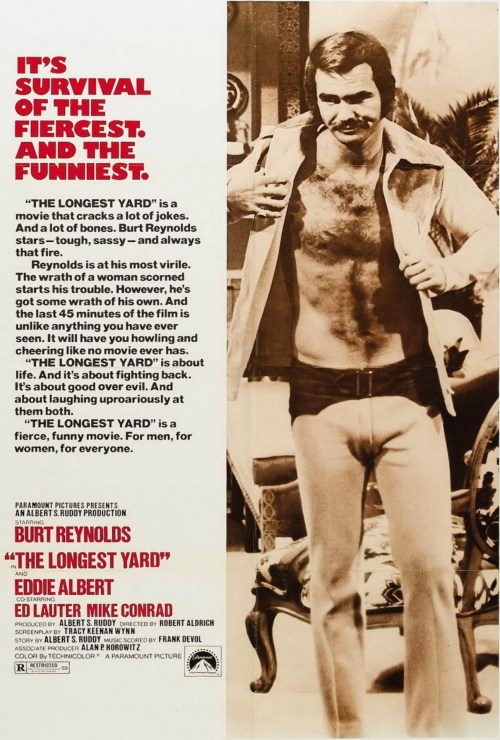
            Burt Reynolds is Paul Crewe a down-on-his-luck former professional football player who was kicked out of the league due to a point shaving scandal. After going on a long car chase with police he is thrown into the Georgia State Penitentiary where the crooked warden (Eddie Albert) tries to get him to coach the prison football team. Initially he refuses, but after some ‘convincing’ he eventually agrees to play in one game that will feature the guards versus the inmates. The prisoners use this contest as a way to get back at the guards and their brutal treatment of them while the guards approach it as a way to instill their authority.

Some consider this one of the best sports movies of all-time and I would have to agree it is up there. One of the things I liked about the movie is the way it taps into the emotional aspect of not only playing the sport, but watching it. There can be deep seated psychological reasons for why a spectator, or fan, roots for one team over the other.  The prisoners that cheer on their team use the game, as fleeting as it may be, as a sort of equalization and revenge factor to the guard’s authority and corruption. Watching the scenes showing the prisoners cheering their team as they score a touchdown is almost as emotionally charging as the action itself.  Director Robert Aldrich does a great job of using the prison setting and the game as a microcosm of 70’s society and the conflict between the counter-culture and the establishment as well as the haves and have-nots.

The game is nicely choreographed.  The hits look real and the plays are shot in a bird’s eye view just like watching an actual game on TV. The action is easy to follow and it is evident that the filmmakers have a good understanding and appreciation for the sport.  Outside of the final play that is done in slow motion there is none of the fluky, theatrical stuff thrown in that you usually see in most other films of this type. I found myself getting emotionally tied into the action even though I had seen the film many times before.

The only misgiving I had was the segment where the Richard Kiel character slams an opposing player to the ground and announces “I think I broke his fucking neck.” Of course this has become one of the film’s most popular lines and is made funnier when other players and even the game announcer repeats it several more times, but when the injured player is unable to come-to even after being given smelling salts and is carted off motionless from the field it starts to seem cruel to be laughing.

Another scene that I found surprising and had almost as much impact as the climatic contest is at the very beginning when Paul is shown arguing with his girlfriend Melissa (played by Anitra Ford one of the original models on ‘The Price is Right’ game show). She calls him a whore, which has to be the first and only time in film history that a woman has called a man that, but what is even more amazing is when he violently slaps her and knocks her to the floor.  I don’t think I can remember another time where a protagonist male character has done that to a female and yet the audience is still expected to sympathize with the male, which is interesting. The ensuing car chase is one of the better ones you’ll see and the part where he drives the car into a lake while the song ‘Saturday Night Special’ by Lynyrd Skynyrd is playing on the car’s radio and gets muffled as it goes under the water is cool.

Burt is perfect for the role. I love the glib way he delivers his lines and his laid back persona. The fact that he is an anti-hero with obvious personal flaws makes him even more fun. He seems right at home in the southern setting and filming it at an actual state prison gives the film a nice gritty subtext.

The supporting cast is unique. John Steadman as Pop, one of the prison’s oldest members, is memorable and he is the only other actor with a nose big enough to rival that of Karl Malden’s. It is nice to see Richard Kiel, one of the tallest actors you will ever see, with a speaking role.  The part where he starts to cry when he gets hit in the nose is funny.  Charles Tyner is perfectly creepy as Unger and Michael Conrad is compelling in his role as Nate Scarboro. This is also a great chance to see Bernadette Peters in an early career role as the warden’s ditzy and amorous secretary Miss Toot. She wears one of the worst looking beehive hairdos you’ll ever see although there probably isn’t a beehive hairdo that looks good anyways. Former football player Joe Kapp is good as one of the evil guards.

My Rating: 8 out of 10

Released: August 30, 1974

Runtime: 1Hour 1Minute

Rated R: (Adult Theme, Language, Violence)

Director: Robert Aldrich

Studio: Paramount

Available: VHS, DVD, Amazon Instant Video, Netflix Streaming

A Soldier’s Story (1984)

soldier

By Richard Winters

My Rating: 6 out of 10

4-Word Review: Murder at army base.

This film is based on the off-Broadway play that won the Pulitzer Prize for best drama in 1982 and was written by Charles Fuller. Many of the performers in the play ended up reprising their roles in the film including the stars, Adolph Caesar and Howard E. Rollins, Jr. Director Norman Jewison spent many years trying to get the green light for the project and ended up being rejected by just about every studio. Finally Columbia Pictures gave the go-ahead, but only after Jewison agreed to do it for no salary and all the performers agreed to be paid at the minimum union scale.

The story is actually pretty well written and I’m surprised that so many studio heads refused it by using the excuse that it wasn’t ‘commercial enough.’ The plot involves the murder of a black army sergeant (Caesar) and the subsequent investigation by a black army captain (Rollins) brought in from Washington. The period is around the end of World War II and the setting is an all black army base in the deep South, which leads to many expected racial tensions. What sets this story apart from others of its type is the fact that the racism and underlying tensions is not just white vs. black, but also, and more prominently, black vs. black.

Caesar plays a memorable victim. He is hated by his own men due to his harsh treatment of them. When he is killed everyone is a suspect and as his men recount their dealings with him, it is easy to see why. Yet this is also no one-dimensional character. The story does a very good job of letting us understand why this man has become the way he is. The viewer can’t help but come away feeling sorry for the man and genuinely sad for the way he ended up. The suspects are equally complex, so the film easily becomes quite riveting as it goes along.

Rollins gives an outstanding performance as the head of the investigation. It’s sad that his career, and ultimately his life, was cut short by his drug addiction because he makes a solid impression here. I liked the way he remained stoic throughout despite having to deal with a myriad of different personalities and at times overt racism. Denzel Washington is also very good in a pivotal role.

There were a few things that were thrown in that I felt were not necessary and ended up hurting the film as a whole. One of them is the musical score. It has a very bouncy, ragtime sound to it that would be good if this was a comedy. However, for a drama it seems completely out of place and at times is even jarring. The film has a few musical interludes as well. A couple of them are by Patti LaBelle, who I think is a great singer, but in this film she is out-of-place. It starts to take away too much of the grittiness of the story, which should be the central theme. I also found the use of slow motion to be distracting. It occurs twice. Once during the murder scene and another time during a baseball game between the soldiers.

Overall the film succeeds enough with its story and characters that the viewer is forced to think and feel, which is always a good thing. I can’t say that the resolution was anything shocking, but it does manage to keep you guessing. However, this is one rare case where I might have actually preferred seeing the stage version.

My Rating: 6 out of 10

Released: September 14, 1984

Runtime: 1Hour 41Minutes

Rated PG

Director: Norman Jewison

Studio: Columbia Pictures

Available: DVD, Amazon Instant Video, Netflix Streaming

Two Moon Junction (1988)

By Richard Winters

My Rating: 6 out of 10

4-Word Review: Voyuers will like it.

            A young woman named April (Sherilynn Fenn) who is from a well-to-do Southern family and engaged to be married meets a rugged hunk named Perry (Richard Tyson) who works as a laborer at a travelling carnival and the two immediately share a strong sexual attraction.  She considers getting out of her engagement, but her controlling grandmother Belle (Louise Fletcher) puts the crooked town sheriff (Burl Ives) on Perry’s tale in order to ‘rid them of the problem’.

Normally ‘hot and steamy’ love triangles that take place in the south seem over-done, redundant, and cliché filled, but for some reason this one works to an extent. For one thing the sex scenes, especially the one at the end that takes place at the Two Moon Junction locale, is quite explicit with an abundance of nudity by actress Fenn who is pleasing in the buff. And for the lady viewers there is even a scene featuring naked male bodies, both front and back, near the beginning of the film. If that isn’t enough there is also actor Tyson who is seen ninety-eight percent of the time without his shirt.

For sex it fares pretty well and rises just enough above the tired 80’s clichés to make it seem fresh. However, the story is rather placid and fails to dig deeper than its basic storyline.  The stylish atmosphere is nice, but there needed to be more tension and action.  I wanted the Fletcher and Ives characters to be meaner. Adding some tongue and cheek humor to a genre that even back then was becoming tired would have really helped.  There are times when it seems to want to go there but then it pulls back.  Having veteran character actors like Fletcher, Ives, Herve Villechaize, and Dabbs Greer was a real nice touch, but they needed to be given more to do. In Ives case, whose last film this was, I felt he was wasted and in that regard I came away from this thing disappointed.

Tyson works surprisingly well in the male lead.  He resembles a Fabio wannabe and I would normally have found him annoying, but he displays just the right level of cockiness to stay interesting. The fact that he also shows some negative traits helps keep the character real. However, the part where he breaks into April’s parent’s large estate and then promptly starts to take a shower seemed absurd and ridiculous. And just where did he find that bathrobe that fit him so well? Or did he bring one along with him? I suppose the plumbing might not be so good at the ragtag traveling carnival he worked at, but still.

Fenn is surprisingly strong as the female lead. This was definitely a three-dimensional character and the internal struggle that she had at being attracted to a man that she knew she shouldn’t be was nicely realized. The parts where she would breakdown into bouts of sobbing after her sexual liaisons with Perry were effective and heartfelt.

Kristy McNichol was a nice sight as a bi-sexual cowgirl named Patti Jean and she looked even better when she went topless. The fact that she revealed some latent lesbian tendencies towards April seemed to me to create interesting dramatic variables, but the film fails to go with it and the character disappears, which was another disappointment.  However, Patti and April’s dance together on the barroom dance floor created some nice provocative imagery.

It also during the opening of this barroom scene that you can spot the movie’s most revealing mistake; as the camera pans across the floor you can clearly see the shadow of the camera as well as the cameraman reflecting along the shiny wooden floorboards. It is always surprising to me the fact that if I the viewer can see a mistake like that right away how come an entire production crew misses it? Or do they see it, but are too lazy to reshoot, so they hope that it will just ‘pass-by’ the viewer? Either way it is the sign of sloppy filmmaking.

This also marks the acting debut of Milla Jovovich who plays April’s younger sister Samantha.  She was only thirteen at the time, but she already had a stunning face and it is easy to see why she caught the attention of producers and photographers as a model. However, her acting ability here seemed limited and her facial expressions where undisciplined.  She also shows little awareness of the camera, or how to play to it.

The film is superficial and lacking in many ways and it fails to have the necessary edginess that would have given it cult potential, but I still found it to be passably entertaining. Voyeurs who watch it for the sex may find it a little bit better.

My Rating: 6 out of 10

Released: April 29, 1988

Runtime: 1Hour 44Minutes

Rated R

Director: Zalman King

Studio: Lorimar

Available: VHS, DVD

Stay Hungry (1976)


stay hungry 2

By Richard Winters

My Rating: 3 out of 10

4-Word Review: Read the book instead.

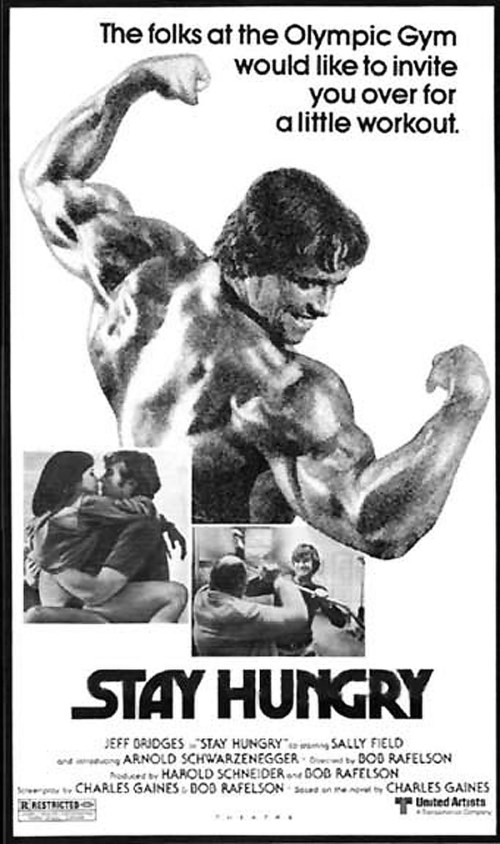
Craig Blake (Jeff Bridges) is a young southern man left alone with his butler in a big mansion when both his parents die in a car crash.  He works at a shady investment firm run by the con-man Jabo (Joe Spinnell).  They have managed to purchase all the other buildings on a block except for a workout gym. Craig is told to meet with the owner of the gym named Thor (R.G. Armstrong) and transact a purchase, so the firm can use the space to build a high-rise office complex.  However, once Craig meets with some of the people working there, including Joe Santo (Arnold Schwarzenegger) who is a body builder and uses the gym to prepare for the Mr. Universe title, as well as the pretty receptionist Mary Tate (Sally Field) he starts to have second thoughts about going through with the deal.

The film is based on the 1972 best-selling novel of the same name by Charles Gaines. There are quite a few differences between the book and the film, with the novel being much better. In the book there is no real estate firm, or potential acquisition of the building. Craig is simply bored with life and goes to a gym on a whim and uses the idea of bodybuilding as a way to find an identity. The book also features a camping trip that the group goes on and a fascinating psychedelic experience that Craig has when he takes an illicit drug that was completely cut out of the movie. The book has much richer characterizations and a profound philosophy that is devoid in the movie.

The film is poorly paced. Nothing really seems to happen and it only comes together at the end and by then it is too late.  Director Bob Rafelson tries to make the movie take on too many things. It shifts awkwardly between drama and sardonic comedy, but fails to achieve any type of cohesion, or momentum.  The flow is more like a European style of filmmaking where the story is told in a more relaxed pace and features long takes and side conversations. However, the dialogue isn’t interesting enough to carry it and the film focuses too much on the relationship between Craig and Mary, which happens too fast and doesn’t seem to have enough chemistry.

I also didn’t like how the character of Craig is portrayed. Bridges gives his usual dependable performance, but he has no southern accent even though he is from the area and everyone else speaks in a very thick one. He talks and acts much more like he is from the west coast and, like the viewer, acts as if he is some detached stranger that is just passing through with no real roots in the area, people, or customs. I think the Hollywood producers intentionally did this because they figured mainstream audiences could not relate to a southerner, who are still straddled with the unfair stigma of being hick, redneck, and racist. So the character was modified to bring broader appeal, but in the process becomes unrealistic and a bit annoying.

On the technical end it is okay although the budget looks limited. Filming on-location in Birmingham, Alabama helps, but I would have liked to have seen more of the area. There are a few unique scenes that make it somewhat enjoyable. One includes Craig stealing a painting off the wall of an office and another involves a throng of half-naked body builders spilling out onto the streets of the city and holding up traffic. There is also a very violent altercation at the end between Craig and Thor that features them battling with each other while using equipment from the gym. The action here is choreographed and edited nicely and looks genuinely real. There is also a brief moment where Field and Bridges go water skiing that was done by the actors themselves and not stunt doubles.

Schwarzenegger is appealing in what is considered his first official acting debut since in his previous two films his voice was dubbed and he had no speaking lines in the other. I liked the way the character is humanized here and shown with a different side to him including having him play the fiddle in a country band. Field is good playing a very feisty and rambunctious character. It also features her in a nude scene although it is from the back only. Woodrow Parfrey also deserves mention as Uncle Albert simply because his eccentric acting style always grabs your attention even in the smallest of roles. He also is the film’s narrator and speaks with the most authentic, best sounding Southern accent out of everyone.

R.G. Armstrong is by far and away the most memorable part of the film. He wears a hilariously awful wig throughout and is slimy in a real goofy way in every scene he is in. His best part comes when he has sex with a couple of prostitutes while on some of the workout machines. He also did, at age 60, his own nude scenes, so you have to give him credit there.

stay hungry 1

My Rating: 3 out of 10

Released: April 23, 1976

Runtime: 1Hour 42Minutes

Rated R

Director: Bob Rafelson

Studio: United Artists

Available: VHS, DVD