Category Archives: Movies that take place in the Big Apple

The Detective (1968)

detective

By Richard Winters

My Rating: 8 out of 10

4-Word Review: Up against the system.

Many people may not realize that Frank Sinatra was the original choice of Harry Callahan for Dirty Harry.  Due to various reasons he turned down the part despite the fact that he was interested.  You can’t help but wonder what that film might have been like had he accepted.  A good indication may be the character of detective Joe Leland that he plays hereIt has a similar theme of a tough cop tired of ‘the system’ and breaking off on his own to solve a bizarre case.

The murder itself is particularly gruesome and ahead of its time as it deals with the killing of a gay man found nude on the floor of his apartment with his genitals cut off. The actual shot of the victim is conveniently framed so that a fern, yes a fern, is strategically placed over the offending area, which is a little corny.  Yet the dialogue and description of the case seems incredibly graphic for the time. Ol’ Blue Eyes even says the word penis, which I think has to be a movie history first.

The way it deals with the homosexual topic is also surprisingly enlightening. Gays are not labeled as ‘sick’ and ‘perverse’, at least not by the Leland character. In one good bit the Sinatra character even slugs another officer, played by Robert Duvall, in retaliation for getting  rough with a gay man that he was questioning for no apparent reason except that he was gay.

There is another electrifying sequence involving Leland questioning the victim’s live-in lover and chief suspect. The part is well played by actor Tony Musante who gives his character all sorts of weird body gestures and nervous ticks, which makes the viewer feel uneasy but still compelled to keep watching until it becomes a fascinating experience. The Leland character again shows an amazing amount of compassion and enlightenment for the gay lifestyle during the interrogation, which should be enough to give this film a landmark status.

However, for all of its apparent sophistication, there are also things that hold it back and make it dated. One is reverting to what was a trend in the 40’s and 50’s, which was to film a person driving their car while sitting in front of a blue screen and holding onto a steering wheel that is not connected to any dashboard. It was considered a ‘ingenious’ way to stay under budget and not having to go through the ordeal of mounting a camera onto an actual car, but for today’s sharp audiences it comes off looking obvious and cheesy.

The casting of Sinatra is another drawback. He was already 53 at the time and he looked it.  The part seems to be screaming for a younger, more rugged method type of actor like Steve McQueen or Paul Newman, who would have done better.  Sinatra overplays the tough guy thing too much until it becomes one-dimensional and boring. The character needed more personal quirks and odd habits in order to make him more filled out and interesting.  He also wears outfits worn by the ‘old school’ investigators of yesteryear even though the character is one looking to break from tradition and fighting the mainstream.

I also wasn’t quite sure why Lee Remick’s role as Sinatra’s love interest was necessary. I usually dislike it when crime dramas feel the need to work in a romance angle as a side story because it usually bogs everything down and in this case was no different. Now Remick is always reliable and her character was interestingly flawed, but how that was supposed to connect with everything else was not clear.

The story works in three different parts. The first deals with the murder and the homosexual community of the period.  The second analyzes the politics of the police department while the third involves a mysterious suicide of a successful businessman. The third part, which doesn’t start until the second hour of the film, was the most intriguing for me. The suicide is shown from the point-of-view of the victim. They literally took a camera and heaved it over the edge of a building until it crashes directly onto the pavement below, which actually made me flinch. It is not until the very end where you see how all three of these parts come together, but the twist is excellent and made viewing this film well worthwhile.

Overall the cinematography, editing, writing, directing, and supporting acting are first rate.  There are a lot of familiar faces in supporting roles including: Jack Klugman, William Windom, Lloyd Bochner, Jacqueline Bisset, Horace McMahon and Al Freeman Jr. They all do splendidly. The subject matter and the way it is handled easily elevates this from other melodramas of the period.  The resolution should make this entertaining even for today’s viewers and enough to overlook a few dated elements.

My Rating: 8 out of 10

Released: May 28, 1968

Runtime: 1Hour 54Minutes

Rated R

Director: Gordon Douglas

Studio: 20th Century Fox

Available: VHS, DVD
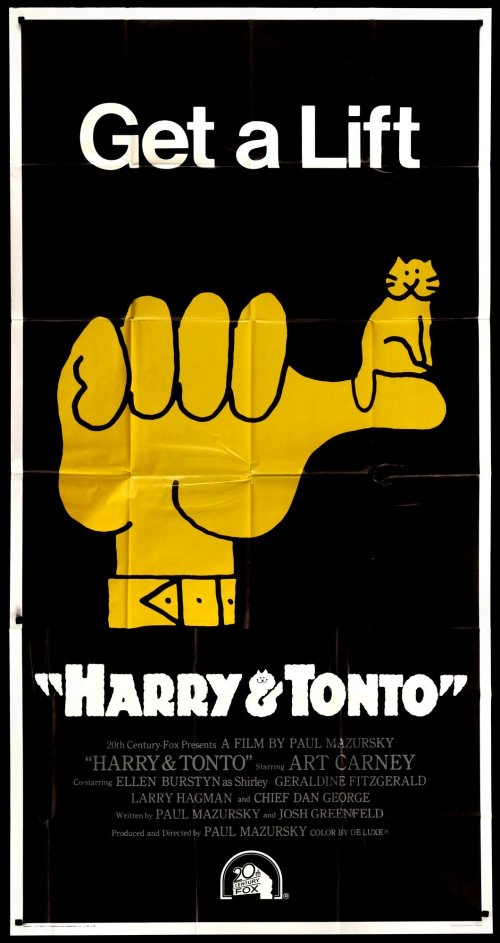
Harry and Tonto (1974)

harry1

By Richard Winters

My Rating: 6 out of 10

4-Word Review: Old man and cat.

Harry Combes (Art Carney) is a 72 year old retiree living in a small New York apartment with his pet cat Tonto and finds out that the complex is about to be torn down and he must leave. At first he moves in with his son (Phil Bruns) and his family, but it does not work out. He decides to take a cross-country odyssey with his cat where he meets a variety of interesting people in this senior citizen variation of Easy Rider.

One of the great things that sets this film apart from others that deal with aging is that there is no death, dying, illness, or senility here. Instead of learning to adjust to the ending of one’s life, our character instead realizes that old-age is just another stage in a person’s existence and full of new experiences and possibilities. I thought it was cool and interesting how he meets a 15 year old teen girl runaway (Melanie Mayron in her film debut) named Ginger and the two set out to try and find themselves as well as search for life’s answers. They share a lot more in common than one might expect and only prove that life is a continual exploration no matter what stage you are in.

The Harry character is refreshingly laid-back and easy going unlike most elderly characters who tend to be betrayed as stuck in a bygone era. Although he does reminisce about the ‘old days’ with his friends, he does not expound on boring stories of yesteryear with young people, nor act like he has all the answers simply because he is older. He approaches everyone in a non-judgmental way that allows each person he meets to be themselves. He proves to be a lot more flexible and open-minded than the other, younger adults in the film including his own children.

There were only a few scenes involving the Harry character that I didn’t like. One is when he refuses to leave his apartment even as the wrecking ball crew stands outside. The police end up having to be carry him out while he still seats in his favorite chair, which seemed forced and unrealistic. There is another scene where he is at the airport ready to board a plane, but he refuses to allow, for no particular reason, the security to search the cage that has his cat in it even though it is accepted procedure.  This may have been writer-director Paul Mazursky’s way of showing that Harry could at times be set in his ways, but to me it went beyond being simply stubborn and more into the irrational and was not consistent with his behavior in the rest of the film.

The script has a lot of amusing and even touching slice-of-life vignettes as well as characters that are quirky, but not absurd.  The scene with Harry meeting an old Indian medicine man named Sam Two Feathers that is played by elderly Indian actor Chief Dan George is well handled. George had no formal acting training, but his raw delivery is an inviting change of pace.  I also enjoyed at the very end when he meets a woman with a bounty of pet cats that his played by comedian Lenny Bruce’s mother. Again, she had no acting training, but the scene captures her natural out-going personality and it is fun.

I felt Phil Bruns gave an outstanding and overlooked performance as Harry’s older son Burt.  The constant nervous and stressed-out expression on his face seemed to be a perfect composite of the middle-aged suburban male that is overrun with job demands and family responsibilities.  Larry Hagman is good as well in a brief, but memorable appearance as Harry’s other son Eddie. He spends the first part of his visit with Harry trying to impress him with how ‘good’ things are going only to end up breaking down when it becomes painfully obvious that he is desperate and broke.  Even director Mazursky gives himself a cameo as a gay prostitute who makes a pass at Harry.

If the film has any faults it is the fact that it is too amiable. I would have liked to have seen a little bit more action and comic misadventure. I thought it could have been funny and intriguing to see Harry inside a hippie commune, which is where he takes his two teen passengers. Instead he lets them off without going himself, which seemed like a missed opportunity.  There is another part where he inadvertently hitches a ride with a high-priced hooker (Barbra Rhoades) who immediately starts to get ‘horny’ when he Harry gets in. She drives the car off the road and parks it in the middle of the dessert and then the film cuts away. I think this could have been hilarious had this scene been extended. I was also disappointed that the very talented Ellen Burstyn is seen only briefly playing Harry’s daughter Shirley. This was even more of a shame because Burstyn gets cast against type here playing a character that is rather edgy and opinionated and there was strong potential for some good drama.

There are a few extended conversations where Harry discusses with some of his old friends their inability to perform sexually and how they hadn’t had sex for well over twenty years.  With the advent of Viagra, a product that was invented and manufactured right here in good old Indianapolis, these types of topics are no longer as relevant and make the film seem dated.

Of course the one thing that holds it all together and propels the movie from beginning to end is the outstanding Oscar winning performance of Carney, who until then was best known as the comic side-kick Ed Norton from the classic series The Honeymooners. Although he seemed perfect for the part he was not the Producers first choice and had to lobby hard to the get the role.  He was actually only 55 years old when the film was made and to help compensate he openly wore his hearing aid, which gets shown a lot, as well as dying his hair gray.

His win on Oscar night in 1974 became an historic upset. He was going up against very stiff competition that night including Dustin Hoffman for Lenny, Jack Nicholson for Chinatown, and Al Pacino for The Godfather Part 2. When Carney’s name gets called the look of shock on his face is very apparent as even he was not expecting it.  The moment is worth a look and can be seen on YouTube for those who are interested.

My Rating: 6 out of 10

Released: August 12, 1974

Runtime: 1Hour 55Minutes

Rated R

Director: Paul Mazursky

Studio: 20th Century Fox

Available: VHS, DVD
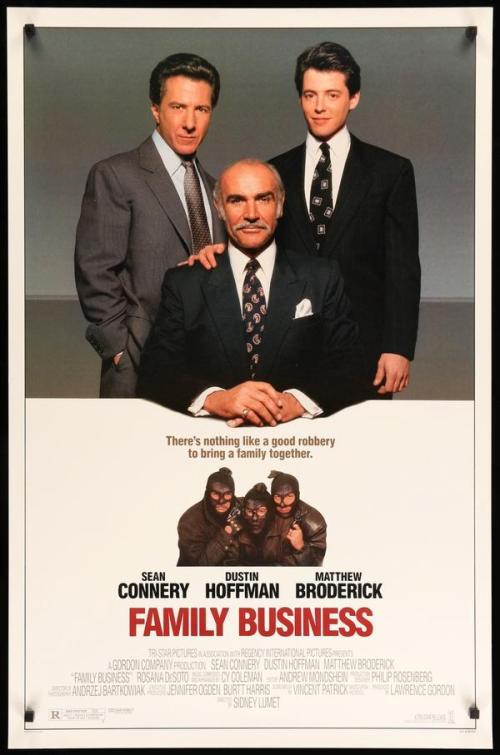
Family Business (1989)

family1

By Richard Winters

My Rating: 4 out of 10

Any movie that casts Dustin Hoffman, Sean Connery, and Mathew Broderick as a father, son, and grandson team of robbers has me hooked before I have even seen the first frame. It was a great bit of inspired casting even if Connery was playing Hoffman’s father and in reality was only seven years older than him.  Throw in the fact that it was directed by the late, great Sidney Lumet and you should have a sure fire winner.

The story involves the grandfather Jessie (Connery) getting out of jail and trying to rekindle relations with both his son Vito (Hoffman) and grandson Adam (Broderick).  Vito wants nothing to do with his father as he has done time himself by getting mixed-up in some of his father’s old schemes and is now trying to go straight by working as a manager at a meat packing facility. However, Adam, who is going to college and has a promising career ahead of him, idolizes his grandfather and relishes the idea of pulling off a robbery himself. He has even come up with one that all three of them can do together. The robbery is unique in that they aren’t stealing from a bank, jewelry store, home of someone rich, or even a priceless artifact at a museum, but instead some important research materials at a science lab.

The crime itself is not elaborate and could have been easily pulled off with just one person. I was anticipating something a little more daring and exciting especially since Jessie and Vito were career criminals. It also takes too long to get to it. The first fifty minutes are spent with them endlessly arguing and rehashing the same old points.

The second part is a little more interesting as it deals with Adam getting caught while the other two are able to get away and all the dilemmas that they then face. Even here the drama becomes strained and talky.  The ending fizzles and leaves no emotional impact.  I saw a lot of similarities with this film and Sidney Lumet’s last film that he did before he died, which was Before the Devil Knows You’re Dead.  Both of these movies deal with robberies and the consequences of family members betraying one another and yet that film was far more gripping while this one falls flat.

I thought Connery was highly engaging and would have enjoyed seeing him take over the movie. Hoffman gives a solid dramatic performance, but his character is bland.

The Adam character got on my nerves. He had been given everything in life and yet refuses to appreciate it and seems almost ungrateful to his father for working so hard to give him a better life. He acts cocky about going through with the robbery and yet when they get there he is ill-prepared and confused. I understand sometimes people become curious about those that live a different lifestyle than they do and that they don’t fully understand, but I still felt there needed to be a little more balance.  I just didn’t understand why this kid would want to throw it all away just so he could be like his career criminal grandfather.

The film gives one a good taste of New York. I liked how it showed the different neighborhoods and boroughs. Not only do we get a good feel of the Bronx, but we also see Flushing, Brooklyn, and downtown Manhattan. Most films that take place in the Big Apple seem to concentrate in only one section of it while this one tried to give a broader feel.

The indoor sets are nicely realized. Everything from the trashed halls of the prison to Vito’s modernistic, sleek apartment, to the science lab and even Jessie’s small, cramped apartment looked authentic and distinct.

I did notice a few logistical errors. One is the fact that they discuss plans of the robbery in a lot of public places, which seemed just plain careless to me especially since these were ‘professional’ thieves. One discussion takes place at a bar, another on a busy sidewalk with pedestrians going by, and the third at a funeral with mourners standing right behind them. There is also the fact that they park their car on the side of the road in front of the lab and put a sign in the windshield stating that they are out of gas and will be back in one hour. I thought this seemed dumb because a policeman could come by and do a check on the license plate to find out who the owner is. Then, the next day when the robbery is reported, they would only have to put the two together to trace the culprits. There is also a scene were Vito fires one of his employees at his plant for stealing. He punches him violently in his office that is surrounded by windows and is in full view of the other workers.  The man leaves with a broken nose and bloodied face, but the workers do not react and go on with their tasks like nothing happened, which didn’t strike me as believable.

The music score is another problem.  It has a big band, show-tune type melody and sound, which might have worked for a Broadway production, but here it seems completely out-of-sync with the mood and tone of the story.

Although competently done this thing still seems like a misfire namely because the material isn’t diverting, or interesting enough for the cast that it has. I was expecting a little more razzle-dazzle and a lot more action and excitement. I almost felt that if this same story had been approached in a comic vein it might have done better.

My Rating: 4 out of 10

Released: December 15, 1989

Runtime: 1Hour 50Minutes

Rated R

Director: Sidney Lumet

Studio: TriStar Pictures

Available: VHS, DVD, Amazon Instant Video

Wait Until Dark (1967)

wait

By Richard Winters

My Rating: 8 out of 10

4-Word Review: They want the doll.

Horror writer Stephan King, in his non-fiction book ‘Dance Macabre’, lists Wait Until Dark as the scariest movie ever made and Alan Arkin as one of the scariest film villains. Of course that is a statement that could be wildly debated, but as a thriller it is very well structured with a original storyline, a fantastic heroine, and a terrific climatic sequence that still rates as one of the best.

The film is based on the hit Broadway play by Frederick Knott and follows that script very closely.  It centers on a recently blinded woman named Susy Hendrix (Audrey Hepburn) who accidently acquires a doll filled with heroin and then becomes terrorized by the three drug dealers (Alan Arkin, Jack Weston, Richard Crenna) when they come to retrieve it. Trapped in her small apartment by the three men with her phone line cut off, she decides her only possible recourse is to smash all the light bulbs and then, in the pitch blackness, use her handicap to her advantage and try to escape.

Normally stage plays transferred to film don’t usually work too well namely because all the action takes place in one setting, which eventually creates visual boredom, but here this becomes an asset.  As the story progresses the viewer begins to feel claustrophobic and as entrapped as Susy as well as successfully tapping into the fear of isolation. The lighting is also impressive.  It may not be something one consciously thinks about, but good lighting can really help accentuate a film’s mood and style, which it does here.  I enjoyed the interesting color schemes and the contrasts between light and shadows that becomes more apparent as it goes along.

Of course the element that really makes this film special is the fantastic performance of Hepburn, which I consider to be her best.  She was nominated for the Academy Award and she should have won it.  She displays just the right level of emotions, which creates empathy from the viewer almost immediately. Her reactions as well as the fear and panic that she shows are very convincing. Arkin, as the villain, tends to get a little too flashy and hammy. I felt Hepburn easily out performed him and everyone else. The film just would not have been as good had anyone else played the part.  This also marks her career pinnacle as she went on a nine year sabbatical after this and when she did finally return, the films she did weren’t all too great.

I also like Julie Herrod as the child named Gloria who lives upstairs and becomes a very crucial link to the story.  So many movies portray children as either total brats, or overly wide-eyed innocents solely put on this planet to say cute and amusing things on cue.  Here the balance is just right and so believable she will remind you of kids that you know in real life as it certainly did with me.  She is sneaky and precocious at certain times, but also genuinely helpful and concerned at others, just like adults are.  The line she says to the Hepburn character just before she runs out to find help is a gem.

The climatic sequence still ranks as one of the best.  The clever ways that this petite, handicapped woman manages to outwit the brutal thugs are classic.  The viewer also gets the satisfaction of seeing the character grow and find an inner strength that she didn’t even know she had. It also features a very well staged scare/shock that sent viewers jumping out of their seats when it was first released and still does today as evidenced by the other people who watched the film with me and all screamed out loud when it happened.

As with any film released 40 years ago, there are some dated qualities that do hurt it.  Some of the ‘tough guy’ talk between the thugs seems a bit stilted.  The film was released a year before the ratings system took effect, so there is no cursing, but a little bit of it would have helped make it more authentic.  It would have also been a little more gritty had the bad guys actually carried guns instead of the brass knuckles and silly looking knives.  Air travelers of today will also be shocked at just how easily it was for people to get through airports in the old days.

However, even with these few weaknesses I still feel this film is a pretty solid, compact thriller that can be used as a blueprint for all other thrillers to follow.  There is also the excellent music score by Henry Mancini that is really creepy although the song played over the closing credits should have been avoided.

My Rating: 8 out of 10

Released: October 26, 1967

Runtime: 1Hour 48Minutes

Rated NR (Not Rated)

Director: Terence Young

Studio: Warner Brothers

Available: VHS, DVD, Blu-ray, Amazon Instant Video

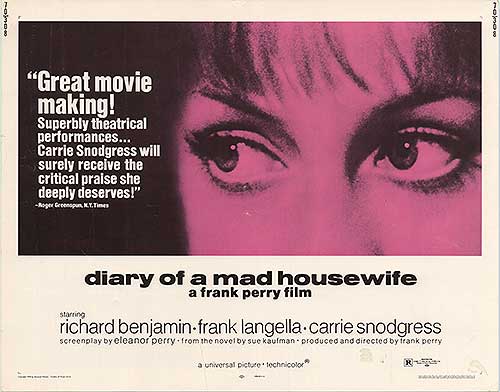
Diary of a Mad Housewife (1970)

diarymad1

By Richard Winters

My Rating: 9 out of 10

4-Word Review: Married to a jerk.

Director Frank Perry may not be a name one throws out when mentioning some of the top directors, but a lot of his early work that he did with his screenwriter wife Eleanor were definite forerunners of the independent film movement and ahead of their time. David and Lisa was their first and it dealt with the budding romance between two patients at a mental hospital. Ladybug Ladybug was their follow-up and it was the true story of what happens when an errant nuclear warning siren goes off and the staff and students of a small rural school think it is for real. There was also the critically acclaimed film Last Summer dealing with the brutal gang rape of a teen girl by her so called ‘friends’.  They also did the revisionist western Doc starring Stacy Keach as well as the brilliantly quirky Rancho Deluxe.  However, it is Diary of a Mad Housewife that I find to be their very best.

It is the story based on the best-selling novel by Sue Kaufman dealing with the character of Tina Balser.  On the outside she seems to be living the American dream. She is married to a up and coming lawyer, living in a swank Manhattan apartment, and the mother of two beautiful girls.  Unfortunately the husband is an obnoxious bore, the girls are spoiled and mouthy, and she feels lonely and depressed.  She decides to have an affair with a novelist, but he ends up treating her just as poorly and when she tells her troubles to a support group, they end up doing the same.

I have seen this film many times over the past twenty years and am always impressed at the fluid way it goes between satire and drama as well as the fact that it doesn’t seem dated at all. The scenes with Richard Benjamin as the jerk husband are hilariously over-the-top.  Yet the scenes involving Frank Langella as the lover who is bitter about his lagging writing career and repressed homosexuality and takes these frustrations out on Tina, are just as interesting, but in a much more subtle way.  In fact these scenes feature some great dialogue and character development and I find them more intriguing with each viewing.  Langella, in his film debut, makes a lasting impression.

The cinematography, editing, and color schemes are also first-rate. Perry does a great job in infusing the counter-culture movement of the time with the old values of marriage and family. The mod party that they go to is well staged with scantily clad mannequins in a provocative poses placed throughout.  The pretentious attitudes of the party goers is nicely captured.  This scene also features the Alice Cooper Band as well as giant pillow fight.

Carrie Snodgrass performance is what really makes this work.  She was nominated for the Academy Award and she should have won it. Her ability to display her characters feelings through such subtle methods as facial expressions, body gestures, and reactions is impressive.  The viewer can easily relate to the character and feel her pain.  Rock singer Neil Young was so impressed with her that he wrote her a fan letter and the two ended up getting into a relationship. Unfortunately because of this she dropped out of Hollywood and didn’t do another movie until almost nine years later.  When she returned all the top roles were no longer accessible and she was relegated to ‘B’ movies and small supporting roles until finally succumbing to cancer in 2004. This was a real shame because her talents were never fully utilized, but at least this was a perfect vehicle for her and one that movie fans today can really appreciate.

In the end though what makes this film so very good is that it makes a great statement on the fact that isolation is a part of modern day living and at some point everyone will have to deal with.  Getting married, having kids, even having a lover or a support group will not necessarily be an effective buffer and may actually only exacerbate it. The whole film kind of reminded me of a statement made by a character on the old ‘Ally McBeal’ TV-show “My loneliest times in life are when someone is lying in bed next to me.”

My Rating: 9 out of 10

Released: August 10, 1970

Runtime: 1Hour 43Minutes (Theater Version) 1Hour 35Minutes (TV Version)

Rated R

Director: Frank Perry

Studio: Universal

Available: VHS

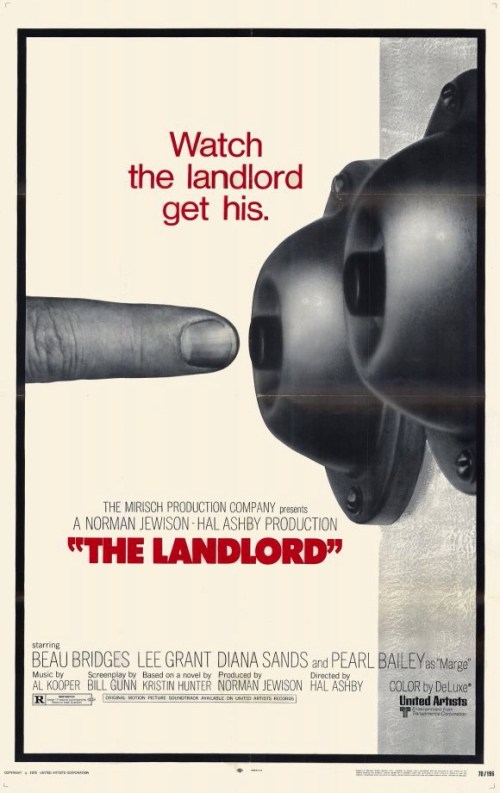
The Landlord (1970)

By Richard Winters

My Rating: 8 out of 10

4-Word Review: In over his head.

Elgar Enders (Beau Bridges) is a spoiled 29 year-old from a wealthy family who is still living at home with his parents in an affluent suburb of New York.  He decides it is time to ‘make his mark’ by purchasing a rundown building housing black tenants in inner-city Brooklyn.  He plans to evict the people and have the structure renovated into a posh flat.  He starts having second thoughts though as he gets to know the people and learns of their struggles.  He begins a relationship with one of the women (Diana Sands) and soon he is working to upgrade the building as well as trying to enlighten his racist, snobbish parents (Walter Brooke, Lee Grant) to embrace the black movement.

The Enders character is a perfect microcosm to the 70’s period where idealism and efforts to improve inner-city life, as well as some of the harsh realities that came with it, where at an all-time high.  Director Hal Ashby’s first film is full of strong gritty visuals from the rundown, graffiti-laden buildings to the garbage strewn lawns. Everything was filmed on-location and you get a vivid taste of the black experience. It is boosted even more by the detailed cinematography of Gordon Willis, which makes the most of the natural lighting and making you feel like you are right there.   The honest no-holes-barred approach is terrific. It perfectly captures the mood and feel of its era. I was surprised for a first time director, even a really good one like Ashby,  how well-constructed and technically sharp this was, which could have some link to the fact that it was produced by another great director, Norman Jewison, whom I’m sure lent a lot of input.

Initially I found the Elgar character to be off-putting, but that could’ve been intentional.  We first see him sitting on his lawn chair being served a drink by a black servant while talking about his great plan and looking like a spoiled, snot- nosed kid who has been coddled all his life.  The one scene that I remembered from this film when I first saw it over 20 years ago is when he  gets out of his Volkswagen bug to look at the building while wearing a tacky looking Pat Boone white dress suit.  When some of the black men sitting on the building’s front steps tease him a little, he immediately panics and runs eight blocks down the street in terror even though no one was chasing him.  However, he does start to grow on you as the film progresses.  I liked the fact that he faces adversity and is not scared away.  He learns to persist and adapt.  He genuinely starts to care about the people and backs-up what he says to the extent that he single-handedly carries new toilets one-by-one from the hardware store to the apartment building when the plumbing breaks down in an amusing vignette.  He isn’t afraid to tell off his arrogant parents when he needs too and his definition of NAACP is pretty funny.  It is satisfying to see him mature, learning that instituting change is not easy and things are the way they are for a reason.  He eventually is forced to confront his own limitations, but becomes a stronger person for it. This is without a doubt Bridges best performance to date.

There are other great performances as well.  Pearl Bailey is a gem as one of the building’s feisty, older women tenants who is the first to befriend Elgar.  Her awkward visit with Elgar’s equally feisty mother is considered the film’s highlight by many viewers and critics. I also loved the look she gives Elgar at the very end when he tries to wave goodbye to her.  The gorgeous Diana Sands is outstanding playing the role of Francine who has an ill-fated affair with Elgar. She shows just the right balance of sexiness and seriousness and it was a shame that just a few years after this film was made she ended up dying of cancer at the young age of 39. Susan Anspach is fun in one of her early roles as Elgar’s pot smoking sister.  The performance though that leaves the strongest impression is that of Lee Grant who is hilariously hammy as Elgar’s priggish mother.

When I first saw this film I came away thinking that it was uneven and a bit bipolar. It runs most of the way as a gentle, quirky satire filled with goofy cutaways, but then ends with a very stark and frightening scene with Elgar being chased down the grimy hallways of the building by Francine’s angry ax-waving husband (Louis Gossett Jr.) when he finds out that Elgar has gotten his wife pregnant.  The scene is ugly and intense and a far cry from the rest of the film’s gentle tone. Yet upon second viewing I think this scene works and was necessary. It makes a good statement at how volatile temperaments can be of those that are forced to leave in squalor as well showing how easily people, even with the best intentions, can get in over-their-heads when they don’t fully appreciate, or understand the situation that they are getting into it.

The side story involving a mulatto women (Marki Bey) who falls in love with Elgar is solid as well and gives the viewer a keen insight as to how difficult it is for someone who can’t seem to be accepted by either race. The language and conversations are tough and vulgar, but always laced with realism.

The only complaint I have with the film is the portrayal of the white characters who are buffoonish and overly idiotic even for satire.  I thought the idea of having them still use black servants was over-done, but then when one of them shows up at a party wearing blackface it was overkill. I thought it was unfair and unrealistic in the way that the film worked so hard to give depth to its black characters, but then turns around and, with the exception of Elgar, paints the whites as nothing more than broad caricatures.

The Landlord has finally been released on DVD through MGM’s Limited Edition Collection. I would suggest this film for anyone who enjoys an intelligent comedy-drama with something to say. It is also a great chance to see young up-and-coming actors. This includes Hector Elizondo as well as comedian Robert Klein. You can also get a very quick glimpse of Samuel L. Jackson who appears briefly in an uncredited role as a minister near the end.

My Rating: 8 out of 10

Released: May 20, 1970

Runtime: 1Hour 52Minutes

Rated R

Director: Hal Ashby

Studio: United Artists

Available: VHS, DVD

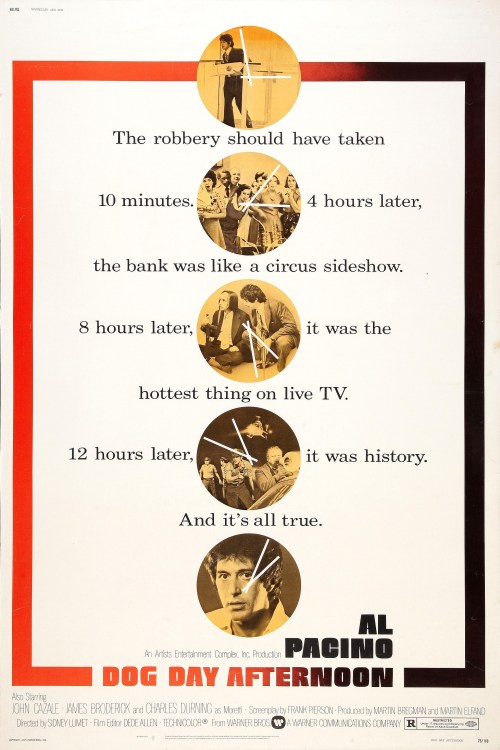
Dog Day Afternoon (1975)

dog

By Richard Winters

My Rating: 9 out of 10

4-Word Review: Money for sex change.

Dog Day Afternoon is a 1975 film based on a true story that took place on August 22, 1972.  It tells the tale of a man by the name of John Wojtowicz, who robbed a Brooklyn bank in order to pay for his gay lover’s sex change operation.  Here the character’s name has been altered slightly to John ‘Sonny’ Wortzik (played by Al Pacino), but otherwise this Oscar-winning script by Frank Pierson pretty much sticks closely to the actual events in this incredible saga about everything that can go wrong will.

Just about everyone who has watched this film will tell you how it manages to grab and pull you in right from the start.  It achieves this without having any special effects, pounding soundtrack, elaborate camera work, or artificial lighting.  Instead of ‘telegraphing all of its punches’ the film draws back and puts more emphasis on the little subtitles like the character’s facial expressions, side conversations, and other nuances that put together make this film very rich and textured.   In essence it successfully ‘shows’ instead of ‘tells’, which is a remarkable achievement since so many Hollywood films seem to want to do the exact opposite.

Director Sidney Lumet allowed for a lot of improvisation by his actors and gave each performer full rein on how to create their character, even the minor supporting ones. The result gives each and every one of the characters a distinct personality. The bank hostages become almost as fascinating as the thieves and it is interesting seeing all the different ways each one responds to the situation and how they interact with the robbers, which at times is both amusing and surprising.

The film also vividly captures 1970’s Brooklyn atmosphere. The sights and sounds of the area as well as the people’s personalities and the anti-establishment sentiment that was still quite prevalent at the time are all right on target.  After you finish watching this movie you feel like you just got back from a trip over there.  I really liked how during the opening credits you are shown all sorts of shots and scenes of Brooklyn, so by the time the story actually begins you are already well entrenched in the setting.

Pacino gives a dynamic performance in the starring role.  Some insist this is the best performance never to be nominated for an Oscar and I might have to agree.  If you are a Pacino fan than you absolutely have to see this, but if you are not a Pacino fan you still should see it because afterwards you might become one.

The supporting cast is stellar.  Sully Boyar, who was a real-life lawyer who did not enter into acting until he was in his 50’s, leaves a strong impression as the stoic bank manager.  As the police captain, the always durable Charles Durning is a blast especially during his frenzied and frantic negotiations with Pacino that almost become the film’s highlight. Another memorable moment is the improvised phone conversation between Sonny and his gay lover played by Chris Sarandon.  John Cazale is also amazing as Pacino’s bank robbing partner.  The partner in the actual incident was only 18 while Cazale was then 39, which created some controversy. However, Cazale is so convincing in the part that it is hard to imagine anyone else doing it as well.

In the end the film’s brilliance comes from its ability to convey the humanity of its characters. You can’t help but feel for the Sonny character despite his many flaws.  This a man who craves acceptance and yet goes through life being betrayed and hurt by everyone he meets. The shocked expression he shows at being betrayed by his own hostages, who he felt he had ‘bonded’ with, is, in my opinion, the most memorable shot of the whole film.

I only have two negative comments about this film and they are both minor.  One is the abrupt ending.  Since the film was made only a few years after the incident there wasn’t much of an epilogue to the characters.  The real John Wojtowicz, who really did look a lot like Pacino, didn’t end up dying until the year 2006.  It would have been a stronger conclusion by showing what happened to the Sonny character through the years and maybe even how he might of changed or grown.  My only other complaint is the fact that actress Carol Kane appears as one of the bank employees, but is shown very little.  A quirky and unique talent such as hers should have been given a bigger role.

Overall this is a great movie that I would recommend to any serious movie fan who can appreciate great film-making in top form.

My Rating: 9 out of 10

Released: September 21, 1975

Runtime: 2Hours 5Minutes

Rated R

Director: Sidney Lumet

Studio: Warner Brothers

Available: VHS, DVD (2-Disc Special Edition), Blu-ray, HDDVD, Amazon Instant Video

John and Mary (1969)

By Richard Winters

My Rating: 4 out of 10

4-Word Review: Sex and then relationship.

Considered provocative at the time this film detailed the new phenomenon of the one-night-stand, a fad in the late 60’s early 70’s that quickly went out of style upon the release of Looking for Mr Goodbar in 1977.  The story here details a rather nondescript man and woman (played by Dustin Hoffman and Mia Farrow) who meet at a singles bar and then go back to his place for sex.  The rest of the film involves them considering whether it can grow into a relationship.

The first ten minutes are pretty good. It nicely analyzes all the expected awkwardness one must have of waking up the next morning and not sure who you’ve been sleeping with. I liked how the John character secretly goes through Mary’s purse to find out more about her while Mary does the same with his telephone messages. Unfortunately after this segment Director Peter Yates unwisely decided to put in voice overs of their thoughts. This adds nothing to the proceedings and ends up being heavy-handed. It also takes away one of the fundamental points of good film-making, which is learning about characters through subtle visual observation.

The film is also no where near as sophisticated or daring as I think the film-makers would like us to believe. I expected, and would have like, the male character to have been a life-long swinger who has had many of these flings and now suddenly finds himself attracted to this woman and wants to go in a different direction. Instead we get a Hoffman character portrayed as being someone who has never done this before and only does so at the coaxing of his much more liberated friend.  This leads him to act all shy and unsure and coming off like an extension to the character he played in The Graduate. The end result is getting a very boring, bland person who responds to things in all the predicted ways instead of giving us a fresh new perspective by delving into the mind of someone living a lifestyle many of us have not experienced.  I also got a strong feeling that the film-makers had done very little research into this topic, thus giving the viewer no new insight whatsoever.  It ends up coming off like one of those trendy ‘statement movies’, but with no idea of what statement it actually wants to make.

There is no chemistry between Hoffman and Farrow at all.  Nothing is shown that would indicate why these two would want to pursue this thing any further. I actually found the scenes involving the side-story of Farrow’s affair with an older college professor (Michael Tolan) to be more interesting and filled with stronger more snappy dialogue.

In the end this ‘provocative drama’ deteriorates into being an uninspired love story. It concludes with the tired, cliche ridden scene of having John madly driving around the city of New York looking for this mysterious woman who he is convinced he is in love with despite the fact that he still does not know what her name is.  It is easy to see how, in Hoffman’s very distinguished career, why this film remains one of his lesser known efforts.

On the technical side this film is actually well done.  I liked how it inter-cut between the present day and the past as well as analyzing the previous relationships of the two characters. This film also offers a nice chance to see a young Tyne Daly as Farrow’s roommate.  Cleavon Little from Blazing Saddles fame appears briefly as a would-be film director.  Olympia Dukakis  has an amusing, non-speaking bit as Hoffman’s activist Mother.  This also marks the film debut of character actress Marian Mercer.

My Rating: 4 out of 10

Released: December 14, 1969

Runtime: 1Hour 32Minutes

Rated PG

Director: Peter Yates

Studio: 20th Century Fox

Available: VHS, DVD
The Anderson Tapes (1971)

By Richard Winters

My Rating: 8 out of 10

4-Word Review: They can hear everything.

In Sean Connery’s long and storied career in which he has played in a wide variety of films, The Anderson Tapes somehow always gets lost in the shuffle, which is unfair as it is really an offbeat gem waiting to be discovered and appreciated.  Fortunately in October it was finally released to DVD and the print is excellent and there is now discussions of a remake, but see the original first.

It involves a man by the name of Duke Anderson (Connery), who upon being released from prison, seeks to borrow money from the mob in order to finance a high scale robbery of an apartment building that is filled with affluent tenants. The problem is that Duke is being tailed by the government who, through means of sophisticated electronic devices, are able to record everything he says and does.  Even by today’s standards I thought the gadgetry and the way it was used was quite clever.

Many things help make this film stand out. One is the very distinctive music score by the legendary Quincy Jones.  It has a weird electronic, techno quality to it that nicely compliments all the gadgetry in the story.

The casting is also interesting.  Martin Balsam, who made a career playing typical, everyman characters, appears here as a flaming gay interior decorator, which he does hilariously well. Comedian Alan King gets cast in a serious role as the crime boss. Even the casting of Connery is offbeat.  Usually he plays characters with strong personalities who are very much in control.  Here he plays a character who is constantly forced to compromise and trying desperately just to hold everything together  he even ends up getting rejected by his girlfriend (played by Dyan Cannon) for another man and all Connery’s character can do is stand there looking dumbfounded.

The script has some really sharp dialogue. This is probably the third or fourth time that I have seen this film and yet I was still impressed by some of the great lines that I hadn’t caught from the previous viewings.  One should actually make a point to watch this film twice just so they can take in all the great writing, which coincidently was done by Fran Pierson the same person who did Dog Day Afternoon.

The most unique thing about the movie though is the actual robbery sequence, which is made memorable due to director Sidney Lumet’s innovative approach.  It is told in semi-flashback form where you see a scene of the robbery and then it cuts to a scene where the victim recounts what happened to the police, which makes for some creative segues. The robbery victims are full of odd quirks and quite amusing.  Two of the best ones involve Margaret Hamilton best know as the wicked witch from the Wizard of Oz who plays a cursing, argumentative elderly woman in this her final film role. I also like the bedridden, paraplegic young boy (Scott Jacoby) who is far more resourceful than anyone thinks and ends up single handily ruining all of their well thought out plans.

This sequence also edits in scenes of the police force quietly getting set-up to raid the building.  I especially like the shots of the S.W.A.T. team members sliding along a rope from one high rise rooftop to another.  It is photographed in a realistic way so you see them dangling high in the air with nothing but the street below, which made me cringe a little.  This is also a great chance to see Garret Morris in a pre-Saturday Night Live role playing the head of the S.W.A.T. team.

There is very little that I didn’t like in this film that I otherwise found to be original and engaging from start to finish. However, of the two issues that I do have, one is the ending, which in typical 70’s fashion was a bit of downer. It does have a twist to it, but it is not as clever as I think the film-makers thought it was.  There is also a glaring factual error that in a film as sophisticated and polished as this should never have happened.  It deals with a woman on a phone stating that she is calling from Wichita Falls, Kansas.  Now Kansas does have a city of Wichita, but Wichita Falls is actually in Texas.

I highly recommend this movie not only to those who may be fans of Connery or director Lumet, but also to those who enjoy movies with an offbeat story and approach.

My Rating: 8 out of 10

Released: June 17, 1971

Runtime: 1Hour 39Minutes

Rated PG

Director: Sidney Lumet

Studio: Columbia Pictures

Available: VHS, DVD, Amazon Instant Video

Thieves (1977)

By Richard Winters

My Rating: 1 out of 10

4-Word Review: A couple drifting apart.

Sally and Martin Cramer (Marlo Thomas, Charles Grodin) are a middle-aged, married couple whose relationship is slowly drifting apart.  They were once connected through their youth and idealism, but now Martin is older and more cynical. He just wants to settle down and live the quiet life as he feels ‘the world is not worth saving’. Sally is still the idealist, she teaches at an inner-city school and even wants to adopt a young African-American boy, which Martin does not want because of the boy’s propensity to steal things. Sally is also pregnant and considering an abortion. The film consists mainly with them arguing about these issues while considering divorce and having affairs.

The film did not go over well with the critics at the time of its release and I was surprised because it was written by renowned playwright Herb Gardner.  I was impressed with Gardner’s talents after seeing the film A Thousand Clowns, which was based on one of his plays. I enjoyed his offbeat characters and situations as well as the sharp one-liners.  I was expecting more of the same here, but found this to be flat and slow going. The idea of having a couple argue almost endlessly for the entire movie can be tough to pull off, but has been successfully done. Most notably in Made for Each Other starring real-life husband and wife Joseph Bologna and Renee Taylor as well as Can She Bake a Cherry Pie?. However, in both of those films the characters were eccentric and interesting and their fights were lively and animated.  Here the characters are dull to the point that there is really no reason to care how their marriage turns out, or even what happens to them. Their arguments become almost soap opera like. Yes, some of the dialogue is eloquent and you can tell it was done by a playwright, but there still needed to be more action and cutaways. The overall mood of the film is very downbeat and paints the city of New York and modern life in general as an urban hellhole.  There could be some truth to this, but it ends up becoming real depressing when the viewer gets beaten over the head with it the whole time.

Although billed as a comedy there is very little of it. The majority is heavy drama and the comedy that they do have comes off as forced, unimaginative, and heavily reliant on stereotypes. For instance Sally makes all her inner-city students put their weapons into a box before they enter her class. I thought it would have been more believable had one of them decided to use them on her, but they never do. Despite the ‘rough and tough’ image the kids seem strangely compliant.  Martin is a principal at a snotty private school, so his problems are at the other end. One scene has him ‘negotiating’ with a spoiled ten year old to come out of his limousine and into class, which is equally contrived.  There is also the strange neighbor who lives in the apartment beneath theirs and is played by actor Hector Elizondo.  He makes random, weird comments throughout that supposedly are used for comic relief, but end becoming quickly irritating.

I thought it would be fun to see Marlo Thomas in a film role as she has done very few of them in her career. She is most well-known for playing the part of Ann Marie the struggling actress in the 60’s TV-series That Girl. Her character was known to be very naïve and proper in that series. Here her character is more jaded and savvy, which makes for an interesting comparison although she is known as a feminist and liberal activist in real-life, so if anything this character more closely identifies with her true personality. She does end up giving an excellent performance overall. Charles Grodin does not fare as well. Usually his sardonic humor and dry approach can elevate even the blandest material, but here the maudlin script ends up pulling him down. Even Grodin fans who have seen this film stated that he seems to be just going through the motions. I also didn’t like the fact that he has a flute and ends up constantly playing the same sad tune. Noted character actors Gary Merrill and Mercedes McCambridge appear as homeless people, but are not given a single line of dialogue, which I found to be frustrating and a waste of their talents.

If there is one positive thing to say about this dreary production that has no visual or cinematic style it is in the presence of Irwin Corey, who plays Sally’s racist and scatological father.  He manages to liven up all the scenes that he is in and I came away impressed as he is mainly a stand-up comedian famous for his bawdy Professor Irwin Corey act. I was even more impressed to find that as of this writing he is still alive and well at the ripe old age of 97 and still doing his comedy act while married to the same woman for over 70 years. A documentary about his life and career called Irwin and Fran is set to be released later this year. Judging just from the trailer it looks more interesting and enjoyable than this film.

My Rating: 1 out of 10

Released: February 11, 1977

Runtime: 1Hour 32Minutes

Rated PG

Director: John Berry

Studio: Paramount

Available: Netflix Streaming