Category Archives: Movies that take place in Florida

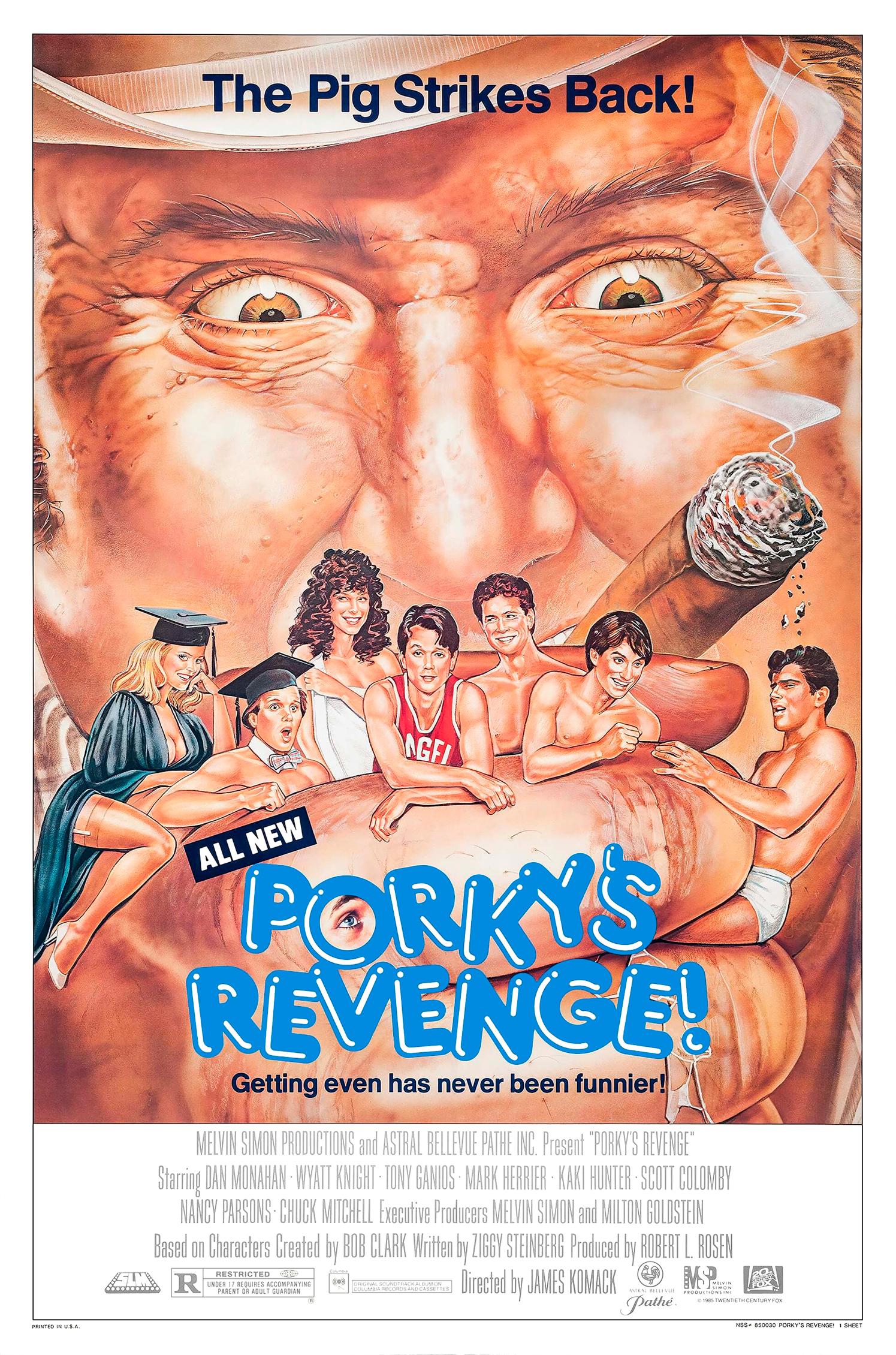
Porky’s Revenge (1985)

By Richard Winters

My Rating: 4 out of 10

4-Word Review: Rescue from shotgun wedding.

Porky (Chuck Mitchell) has rebuilt his casino that was destroyed by the teens in the first film by turning it into a riverboat. To help pay for this he extorts Coach Goodenough (Bill Hindman) for money and other such favors since he owes him on a gambling debt. Pee Wee (Dan Monahan) and his friends try to come to their coach’s rescue by sneaking onto the boat and taking pictures of the illegal gambling activity, which they hope to show to the district attorney. Porky though catches them in the act and threatens revenge, so to get out of their jam they agree to throw their next basketball game, so that Porky can bet against them and win a lot of money. Meanwhile Meat (Tony Ganios) is having problems of his own when he gets ‘forced’ into having sex with Porky’s daughter Blossom (Wendy Feign) causing Porky to insist that the two now must get married.

While fans of the franchise traditionally rate this at the weakest of the three films I found it to be a step up and even, at least at the beginning, to be moderately amusing particularly the pool scene where the cheerleaders concoct a scheme to get the boys to take off their bathing suits and prance around in front of the parents naked. The script was written by Ziggy Steinberg, whose career is the perfect encapsulation of Hollywood, where if you’re considered ‘up and coming’ you can find plenty of work, but the second your material is perceived as getting stale you can quickly become a leper and no offers to be found. This though came at a point where he was still a sought-after commodity, and I felt the script was better structured and seemed much more like a sequel continuing the elements from the first one versus going off on wild tangents like the second one did.

It helps having Chuck Mitchell back as the title character. It’s not like his acting is all that great, but his big presence and gruff, unfiltered delivery keep it fun and he offers a bona fide nemesis for the kids to go after. The casino boat is impressive, and the majority of the film’s $8 million budget was used just to build it. Seeing it get destroyed, which comes near the end, is exciting too and probably more memorable than the destruction of Porky’s original backwoods casino.

The characters though lack growth. Pee Wee for example is still obsessed about getting laid even though he had already lost his virginity in the first film, so his personality needed to evolve into something else. He should, especially being a senior, be the confident one who now takes some insecure freshman under his guidance to show him how it’s done instead of acting as a perpetually immature junior high kid, which by this point is no longer even remotely interesting.

The pranks continue to go overboard and boarder on cruelty. The one that gets played on Beulah Balbricker (Nancy Parsons) is especially stupid. She is set up to believe that she’s going to have a rendezvous with her long-lost boyfriend Snooky (Sandy Meilke), so she goes to a hotel room lying in bed in her nightie waiting for him to enter, so that they can return to their ‘passionate ways’ of the past. In reality though it would never work that way. These two had not seen, or corresponded with each other in many years, so there was no guarantee that both would still have the same feelings for the other. Since so much time had passed they were by this point theoretically strangers, so to avoid embarrassment and possible rejection they would instead get together at a restaurant, or over drinks in order to ‘catch up’ with things and then if they still both felt the same spark they might check into a hotel room, but nobody would just do that right off the bat.

I did though like the way her character changes, she’s the only one that does, by having her behaving like a completely different person once she’s finally able to get together with the real Snooky. However, I feel it would’ve made more sense had she been portrayed as someone who had never had sex versus one that just hadn’t had it in a while. Having her being lifelong frigid would’ve explained better why she was so hyper obsessed with suppressing everyone else’s sexuality. A better payoff would’ve had her really have sex with Tommy (Wyatt Knight) and found much to her surprise to liking it and this would then inspire her evolution.

Spoiler Alert!

The prank involving the bridge operator (Mal Jones) gets botched as well. It hinges on him believing that Wendy (Kaki Hunter) and Tommy are jumping off it to commit suicide, which distracts him enough so that he leaves to bridge operator room and allows Pee Wee to go in and close the bridge and thus destroy Porky’s boat that is trying to go underneath it. However, the bridge isn’t high enough from the water to be that dangerous. In fact, if it was truly that dangerous then both Tommy and Wendy would’ve died when they jumped off of it, but they don’t so the operator would never have been fooled. If anything, he would’ve thought they were just a couple of teens going out for a late-night skinny dip and wouldn’t have panicked at all.

My Rating: 4 out of 10

Released: March 22, 1985

Runtime: 1 Hour 32 Minutes

Rated R

Director: James Komack

Studio: 20th Century Fox

Available: DVD, Blu-ray
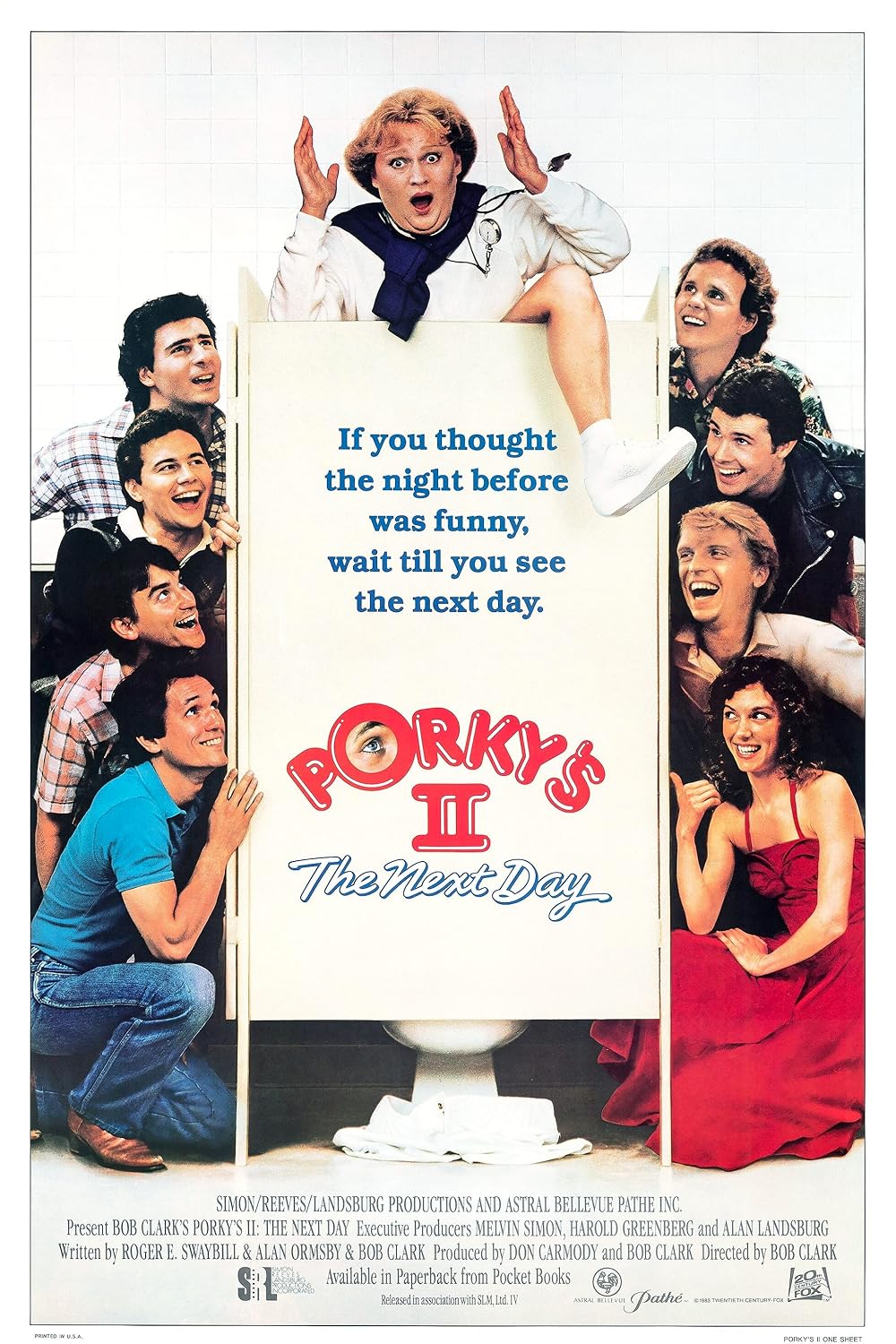
Porky’s II: The Next Day (1983)

By Richard Winters

My Rating: 0 out of 10

4-Word Review: Banning a Shakespeare play.

Now that Pee Wee (Dan Monahan) has lost his virginity to Wendy (Kaki Hunter) they decide that their next project will be putting on a production of ‘Romeo & Juliet’ at their high school, which will be directed by Mrs. Morris (Ilse Earl) Pee Wee’s mother. Problems though ensue when John Henry (Joseph Runningfox), a Seminole Indian, gets cast in the lead where he will then kiss Wendy, a white woman, on stage, which gets the local Klux Klan upset and they proceed to ambush things, so it won’t be able to proceed. There’s also outcry from a local Reverend named Bubba Flavel (Bill Wiley) as he and his religious constituents feel that the play is ‘obscene’ and therefore must be shut down in the name of ‘decency’. The teen cast then visits the office of County Commissioner Bob Gebhardt (Edward Winter) hoping he can use his influence to help keep the play going and while he initially promises them that he will, he eventually renegades. This angers the kids, and they devise an elaborate revenge on not only him, but the Klan and Reverend Flavel.

It’s quite clear that writer/director Bob Clark, who was working on Christmas Story while helming this one, had no idea that the first installment was going to be as big of a success as it was and there had clearly been no plans for a sequel. When the studio came begging for one, he felt obliged and spent 6 months, with the help of two other screenwriters, to come up with something. The result though is a movie in desperate search for a story with a script that’s a mishmash of over-the-top nonsense. What made the first one so good was that as crude as it was it still showed teens as they were with dialogue and situations that rang true, but here all of that gets thrown out with everything played up in an extreme way simply for the sake of a cheap laugh.

The most annoying aspect are the one-dimensional characters particularly the Reverend who is a cartoonish caricature in a silly send-up of a southern preacher. The same goes with the City Commissioner that is well played by Winter, which helps keep it remotely entertaining, but portraying a politician as being sleazy and two-timing is quite cliched and redundant. The return of Beulah Ballbricker, played by Nancy Parsons, is problematic as well. In the first film she was very strict with the rules, but here she’s turned into a religious fanatic, which seems like two different people. The scene where she sits on a toilet and begins singing loudly is dumb. Sure, people may talk on the phone while taking a dump, or read a magazine, or even browse the internet, but bellowing out a loud rendition of ‘That Old Black Magic’ while in a public stall is not one of them making her beyond ‘goofy’ and more into someone who should be institutionalized.

The pranks come off as unnecessarily cruel especially the scene in a graveyard where Pee Wee is made to believe that he accidentally killed a prostitute while having sex with her, which could be quite traumatic for someone and yet his ‘friends’ act like it’s ‘all in fun’. What’s worse is that Pee Wee never brings it up afterwards apparently having no qualms whether a sex worker dies at his hands or not just as long as he’s not blamed, which unintentionally makes him cold and uncaring.

The climactic bit where Wendy dresses up as a big bosomed 17-year-old prostitute who makes a major scene at a posh restaurant in an effort to embarrass the commissioner gets overdone too. For one thing it’s seems awfully extreme to put so much effort to get revenge on what’s nothing more than a tacky high school play with cheap props that isn’t going to make any money and cast members who weren’t all that excited about being in it, so why get so upset if it gets canceled? It also begs the question why these kids are so sure they can get away with their hijinks and not suffer any consequences. The ‘prank’ that gets done inside the restaurant causes a lot of damage and since these teens live in the same community as the adults they would most assuredly get recognized by someone and be either arrested for causing a disturbance and handed a very hefty bill for the repairs, or their parents would, which for them would be just a bad.

The only small funny bit, and I kid you not, comes at the very end during the closing credits, when the head waiter at the now ravaged restaurant tries to save face by convincing the patrons that it had all been an ‘April Fool’s joke’, which got me to chuckle. It’s also kind of amusing how Pee Wee gets so aroused by pics in National Geographic, or sexually stimulated by strippers who aren’t even naked, but just scantily clad enough to excite him anyways, which in this porn saturated era probably wouldn’t be deemed all that titillating, so in that aspect it’s interesting, but everything else is a disaster. It doesn’t even have Porky. How can you have a film titled ‘Porky’s’ if that character never actually shows up though he does reappear in the third installment, which will be reviewed next.

My Rating: 0 out of 10

Released: June 24, 1983

Runtime: 1 Hour 38 Minutes

Rated R

Director: Bob Clark

Studio: 20th Century Fox

Available: DVD, Blu-ray
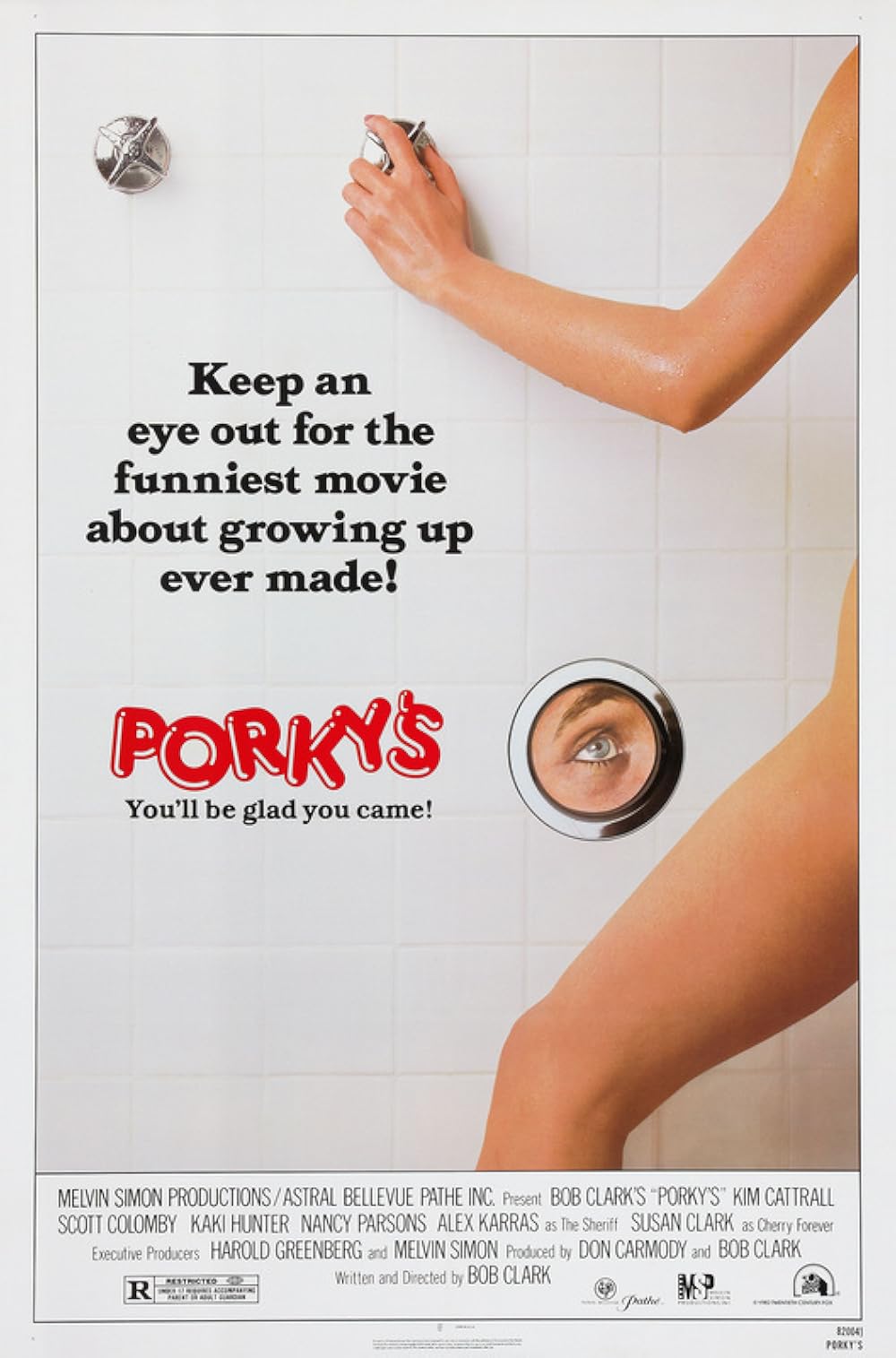
Porky’s (1981)

By Richard Winters

My Rating: 6 out of 10

4-Word Review: Revenge on nightclub owner.

Pee Wee (Dan Monahan) is a teen living in the Florida everglades during the 1950’s who suffers from a small penis size, which has prevented him from losing his virginity. He and his high school pals have hatched a plan of pooling their money together and then hiring a prostitute, which they can then all have sex with. Their first attempt doesn’t work out, so they decide to go to a nightclub that sits in a lagoon on stilts and is called Porky’s, which is the nickname of the owner of the establishment, ‘Porky’ Wallace (Chuck Mitchell) that he attained for being overweight. The boys feel they’ll be able to hire one of the strippers at the club to have sex with and Porky agrees to ‘set it up’ and takes their money only to then have the teens fall through a trap door and into the water below. This enrages Mickey (Roger Wilson) who set-up the deal and he becomes consumed with getting revenge on Porky, but when he goes there to ‘settle things’ he gets badly beaten-up, which sends him to the hospital and convinces his friends that even sterner justice is needed in order to get the proper payback.

I remember when this movie came out and there were TV ads capturing people as they left the theaters and getting their first reaction. At the time this was considered ‘outrageous’ and many of the folks in the ad seemed either shocked or embarrassed. Nowadays though it’s unlikely most will consider it extreme, and some might even call it boring particularly in between the moments when it’s raunchy. The idea for it was conceived in 1972 by writer/director Bob Clark who based the story on his own experiences as a teen going to school in rural Florida during the 50’s. The studios though didn’t like the script, and it got shopped around for years before finally getting modest funding out of Canada where it could be used as a tax write-off and thus even though it was filmed in the U.S. by an American director it still gets labeled as one of the highest grossing films in Canadian movie history.

The critics like with the studio heads, didn’t care for it with both Siskel and Ebert naming it one of the worst movies to come out of the 80’s though when compared to the other teen sex comedies from that decade this one doesn’t seem all that bad. The characters have distinct personalities and much of the dialogue while raunchy seemed realistic for that age group and not all that different from what got talked about during my own high school days. The film also manages to tackle some serious topics like antisemitism, which was also a part of that era, so it has an adequate balance and doesn’t just stay hyper-focused on the sex.

On the negative end Nancy Parsons as the female coach version of Nurse Ratched is one-dimensional and Kim Catrall, playing a cheerleader nicknamed ‘Lassie’, plays too much of the bimbo caricature to be even remotely interesting. Neither is the fault of the actresses, who are okay, but more the writer. On the other hand, I loved the bit part of Susan Clark playing a prostitute. She had been in a few Disney movies just before this and later the TV-show ‘Webster’, so seeing her playing against the family image is fun.

I also loved Kaki Hunter who seems just as dirty minded as the guys and how she’s very average looking as I’ve found those types tended to be a little more ‘easy’, as evidenced by her doing it with Pee Wee, in order to get the guys’ attention and make up for not being as attractive versus in other teen flicks where it’s only the super-hot ones that sleep around. In that vein too I enjoyed the fact that during the shower scene when the boys are peeping at the girls there’s an overweight one impacting Pee Wee’s ability to see the thin ones, which is realistic too as in most high schools there’s a mix of body types and not all skinny like most other teen comedies would make you believe.

I did have some problems though with the nicknames mainly with Pee Wee and ‘Meat’ the name for Tony Ganios’ role. Supposedly this is for their penis size, but how would anyone know what their penises looked like? Normally one gets nicknames for physically attributes that everyone can see for instance if they’re a short height they could be called ‘shorty’. Yes, there is a scene where all the boys strip naked together, but their nicknames had already come about long before then. One could argue that maybe it started while they took showers after gym class, but in my high school if some guy was caught looking at another’s genitals, they’d be accused of being ‘gay’, which during that time period would be considered a stigma.

While the plot is lean and there are a few lulls there are enough comical moments to keep it afloat. The segment dealing with Nancy Parsons character going to the principal to ‘report’ seeing a penis in the girl’s shower and advocating for all the boys to undress so she could spot which one had a dick with a mole on it, is a gem especially with the way the camera zooms in on a hanging portrait of a smiling Dwight Eisenhower like even he too is in on the humor. The demolishing of Porky’s bar, which comes near the end, isn’t bad either and helps to make this thing a minor cult classic.

My Rating: 6 out of 10

Released: November 13, 1981

Runtime: 1 Hour 38 Minutes

Rated R

Director: Bob Clark

Studio: 20th Century Fox

Available: DVD, Blu-ray
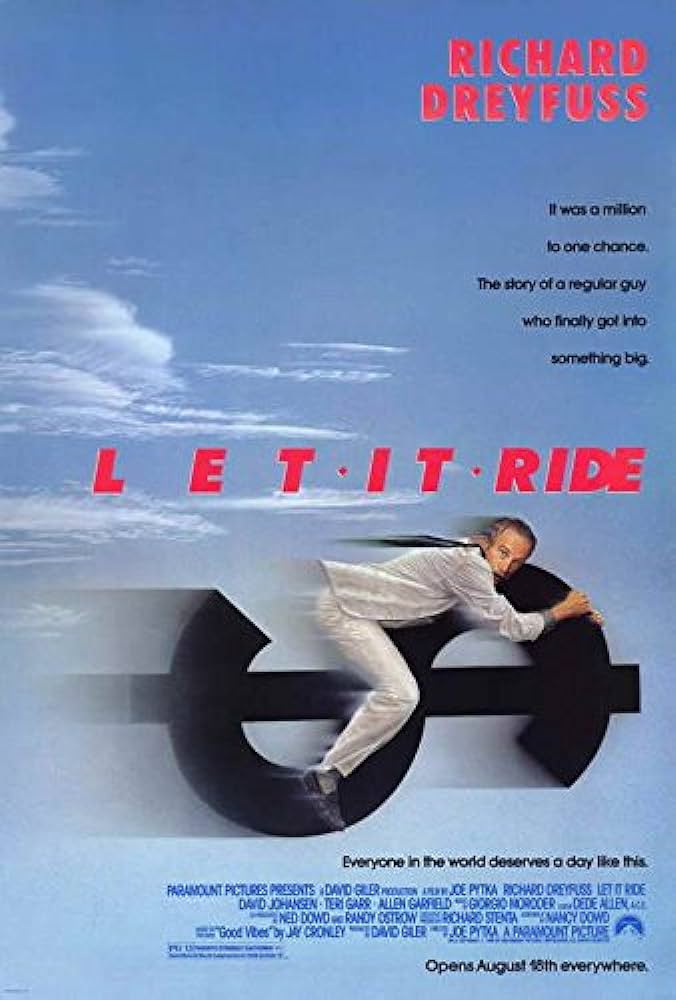
Let it Ride (1989)

let

By Richard Winters

My Rating: 5 out of 10

4-Word Review: Betting at horse racing.

Jay (Richard Dreyfuss) along with his friend Looney (David Johansen) are two struggling Miami cab drivers. One day Looney, who secretly records discussions that his passengers have while in the backseat of his cab, overhears a tip by two men of an upcoming horse race. He passes on the recording to Jay. Jay has not had much success in betting and has even promised his wife Pam (Teri Garr) that he will quit, but he can’t pass up this opportunity and places a wage on the horse that had been discussed. It turns out to being a photo finish in his favor and he spends the rest of the day making more bets by using all of his winnings as his wagering. Soon, he finds himself getting richer and richer even as his wife comes to the track in an effort to get him to stop. Will his luck hold, or run out?

Probably the best thing about the movie is the acting particularly by Dreyfuss, who’s known for playing aggressive, snarky types, but here comes-off as surprisingly sympathetic. You genuinely feel for the guy and his need to win at something and has one comically touching moment where he kneels at the toilet of a grimy bathroom stall and prays/pleads to God for a break. Garr, who reunites with Dreyfuss as the two starred 10 years earlier in Close Encounters of the Third Kind where they also played a husband and wife, is equally engaging though while seen right at the start disappears for quite awhile only to reappear briefly during the second act where it would’ve been better had she remained in it all the way through.

In support Johansen, better known as Buster Poindexter the lead singer of the punk band the New York Dolls, is amusing as Jay’s ever losing friend and Robbie Coltrane has some great reaction moments as the ticket seller. Jennifer Tilly almost steals it as a voluptuous vamp while Allen Garfield gets in a few funny quips as her Sugar Daddy boyfriend. A young Cynthia Nixon, wearing braces, can be seen as a underage girl trying to sneak in a bar with a phoney ID though her part doesn’t have all that much to do with the main plot and Michelle Phillips, singer from the Mama’s and the Papa’s, as a rich women who comes onto Jay at a luncheon.

The story, which is based on the 1979 novel ‘Good Vibes’ by Jay Conley, starts out well. I enjoyed the way it captures the working class life of Miami versus the usual glossy look at the chic neighborhoods of the area. All the actors including the stand-ins and those milling about in the background have a very ordinary, everyday quality, which nicely captures how people, who sometimes have very little money, will still flock to the track in a desperate attempt to ‘make it big’ even though it rarely ever happens. The shooting, done on-location at the famed Hialeah Park Race Track, one of the oldest in Florida, is terrifically done and you feel like you’re right there standing next to the track as the horses go thumping by while kicking up clumps of dirt.

The tone though is inconsistent. Instead of remaining this character study with a slice-of-life quality it instead skewers into becoming a camp comedy. Case in point comes when Jay gets arrested for mistaken identity, but still makes a mad dash to place his bet, which gets filmed in a sped-up fashion including having him crash through a wooden door with a cartoonish flair that’s jarring and out-of-place. It also gets highly exaggerated as in only one day’s time everyone at the track gets to know Jay and cheers him on, which is too quick of a turnaround for such a thing to realistically happen.

Spoiler Alert!

The ending leaves much to be desired as Jay just continues to win and win until his earnings amount to over $600,000 (or $2 million in today’s dollars), but what is causing him to have such a streak of luck? Did God really answer his prayers, or is some other mystic source at play? Everyone knows that you end up losing more than you win at gambling and a winner’s luck will eventually run-out at some point.  Showing a guy who never was good at gambling before without having earned it like learning some special skill, or insight, makes for a flimsy and fanciful movie. Getting lucky on one bet, maybe even a really, really big one that beats long odds, which is how the movie should’ve played it, might happen, but having him just continue to ‘get lucky’ with no explanation is too exaggerated and doesn’t show the harsh downside, which if you’re going to do a story about gambling in any type of realistic way, needs to be shown as well.

My Rating: 5 out of 10

Released: August 18, 1989

Runtime: 1 Hour 27 Minutes

Rated PG-13

Director: Joe Pytka

Studio: Paramount

Available: DVD, Blu-ray, Amazon Video, YouTube

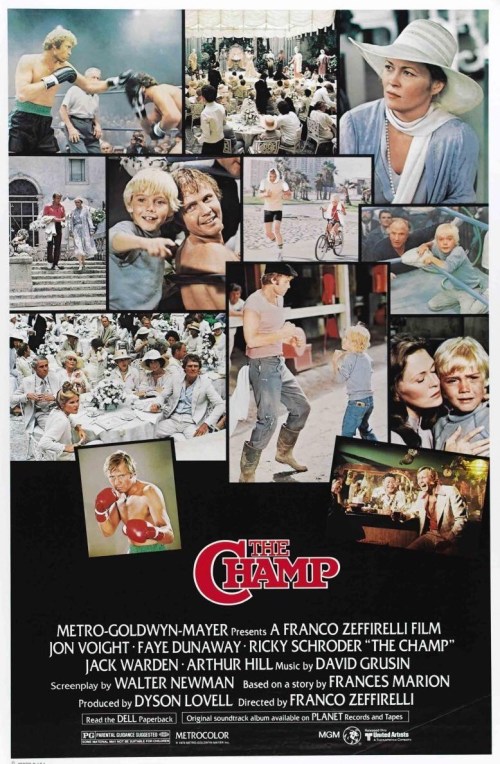
The Champ (1978)

champ1

By Richard Winters

My Rating: 7 out of 10

4-Word Review: Idolized by his son.

Billy (Jon Voight) is a former boxer whose been out of the ring for 7 years. Now at age 37 he works as a horse trainer. His 8-year-old son T.J. (Ricky Schroder) idolizes him and refers to his as ‘The Champ’ instead of dad. Billy though suffers from many inner demons including his perpetual drinking and gambling as well as not making enough money to sufficiently support either himself, or his son. Nonetheless he continues to go out gambling whenever given the chance and he manages to win enough money to buy his son a horse, which they name She’s a Lady. They enter Lady into a race where T.J. meets Annie (Faye Dunaway). Unbeknownst to T.J. Annie is his mother whom she gave up at birth, but now that she’s married to a wealthy man (Arthur Hill) she wants to have custody. Billy refuses to allow it, but when he loses the horse because of a gambling debt and Annie gives him the money to pay it off he eventually relents and has T.J. go live with her while he’s in jail for assault. Once he’s released the father and son reunite, but Billy realizes he must make more money in order to keep him and thus decides to go back into the ring one last time despite warnings from Jackie (Jack Warden), his former manager, that to do so could be life threatening.

The film is remake of the 1931 classic with Wallace Beery playing the part of the father and Jackie Cooper as the son. Director Franco Zeffirelli remembered watching it as a child and it having a profound effect on him. Then years later while he was in his hotel room while on-location filming another feature he saw it come on television and the film again moved him in such a way that he decided he wanted to do a remake. This though wasn’t the first remake as it had already been done in 1953 as The Clown starring Red Skelton though the story had been revised without the boxing theme and the climactic event at the end doesn’t take place at a sporting event, but instead a dangerous stunt that the lead character must do during a live broadcast of a TV special.

While this one stays more faithful to the original concept it was still panned by many critics as being overly sentimental and soap opera-like. Many who were fans of the original felt this one fell far short and complained about the long running time, this one runs of full 2-hours while the older one was only 83 minutes, with the feeling that it stretched the plot out too much and at spots was too slow. Though I’ve never seen the 30’s version I found myself genuinely wrapped up in the drama and the characters.

Many at the time complained that Voight was going back to the same type of Joe Buck character that he played in Midnight Cowboy, but I disagreed. That character was genuinely stupid, but Billy isn’t he’s just down-on-his-luck and suffering from basic human frailties, which made his situation far more compelling.

Schroder is an absolute jewel. He got the part after beating out over 2,000 others and it’s easy to see why. His ability to cry on demand with real tears streaming down his face is amazing and not something other actors are able to do. He’s cute and engaging without it ever getting forced, or overdone. His presence gives the film its energy and virtually the sole reason for why it works as well as it does.

The main complaint that I did have was with Annie. She’s marvelously played by Dunaway, who’s always been one of my favorite actresses and it’s a good role for her acting style as she’s excellent at playing characters that have a bit of a cold and aloof manner while not easily able to show their soft side, but with that said I still couldn’t understand what made the character tick, or her motivations. For one thing she seemed to have nothing in common with Billy, so what brought them together in the first place was a mystery and then having her abandon the kid while she went off living her life seemed pretty extreme. In most cases it’s the father that shirks the responsibility of raising the child, but here it’s reverse, but with no clear explanation as to why. There’s a vague excuse later on that it was so she could ‘pursue her career’, but then this doesn’t explain why she now wants to get close to her son. If she was selfish back then what made her change to suddenly want to be loving and caring? She went 7 years without ever seeing the kid, and did pretty well without him, so why now must she have him? I felt there needed to be some extra context added like she had been addicted to drugs when she had TJ, which then made her deemed unfit to raise him, but now that she had kicked the habit she wanted him back, or maybe she had suffered a miscarriage with her second husband and this made her feel guilty about the child she had let get away and this motivated her to want to seek out TJ, but without any of this added information the character comes-off as transparent, unrealistic, and unrelatable.

I will agree with Leonard Maltin in his review where he states that it looks like Faye wants to go to bed with her own kid. This occurs during the scene where Ricky is on her yacht and looking off in the distance while Faye comes up behind him and begins sniffing his hair like she’s getting turned-on by him. To call this a cringey, awkward moment is an understatement and it’s unintentionally laughable. Why it was left in, or why Zeffirelli thought it would be a good idea to put in I don’t know. The movie manages to recover, but it’s a segment that is indeed ridiculous.

The boxing element is another problem as it gets introduced way too late. It gets briefly mentioned throughout the first 2 acts and there’s even a quick scene where Billy shows up at a gym, but overall it gets played-out as a side-story only to suddenly, 90-minutes in, becomes the main focus, which gives the film a very disjointed feel. Jack Warden’s character doesn’t appear at all until near the end almost like it’s a tacked-on bit that doesn’t really flow with everything else that came before. The boxing scenes are impressive and helps to effectively expose the brutality of the sport, but I felt Billy’s training and decision to enter the ring should’ve been made sooner and the boxing scenes mixed-in throughout, but either way it’s still an competent tearjerker that shouldn’t leave a dry eye in the house.

champ2

My Rating: 7 out of 10

Release: March 20, 1979

Runtime: 2 Hours 3 Minutes

Rated PG

Director: Franco Zeffirelli

Studio: MGM

Available: DVD, Amazon Video, YouTube

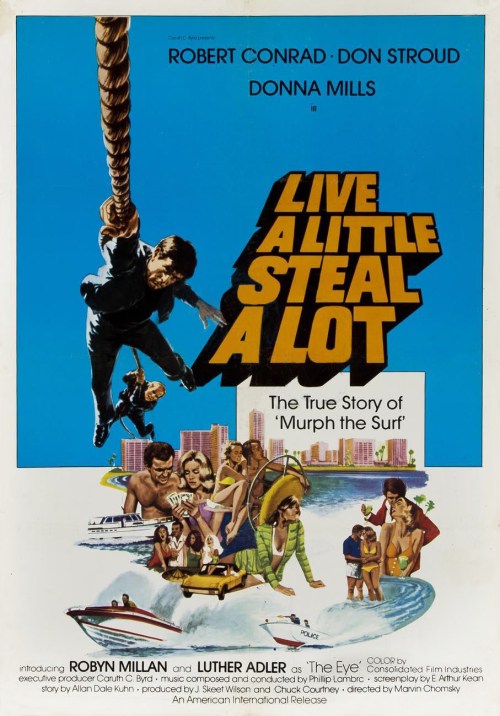
Murph the Surf (1975)

murph1

By Richard Winters

My Rating: 6 out of 10

4-Word Review: A brazen jewel heist.

Jack Murphy (Don Stroud), a successful surfer known as Murph the Surph, and Allan Kuhn (Robert Conrad) who is also a surfer and becomes friends with Jack where they decide to team-up to commit some daring robberies.  They start out robbing people’s homes during the day, but then graduate to even bigger heists including New York’s American Museum of Natural History taking the precious gemstone the Star of India and the Eagle Diamond. However, once they have the jewels in their possession they’re immediately tailed by the police, but Allan comes up with the perfect hiding spot where no one can find the stolen loot, but as the pressure from the cops mount one if not both seem liable to crack.

The film is based on the actual incident, which occurred on October 29, 1964, where three men, Jack Roland Murphy, Allan Kuhn, and Roger Clark robbed the New York Museum of 24 precious gemstones in what was called at the time The Jewel Heist of the Century. However, in retrospect the crime wasn’t as sensational as it originally seemed since the alarm systems, including the ones on the display cases, were all non-operational. All 19 of the exterior windows were left open 2-inches overnight to allow in ventilation and there was no security staff, which seemed to be almost inviting a robbery to happen. The film also changes the story a bit in that in the actual crime three men were involved, but for whatever reason the story here whittles it down to only two.

The unique way the plot gets structured where the heist is broken up into segments and the narrative handled in a non-linear way is what makes the movie interesting. In fact it’s the relationship between the two leads, and the amoral girlfriend that’s wonderfully played by Donna Mills, who sleeps around between the two and eggs them on to commit more and more daring crimes, keeps it engaging. The robbery itself, especially with how easy it becomes, is almost anti-climactic and the other robberies that they do including an amusing one where they rob a rich couple’s house while they are away and then initially get stopped by a cop during the crime only to then have the cop turn his attention to fighting off the homeowners guard dog, which allows the two men to escape, is funny. There’s also an amazing boat chase that’s as exciting as any car one out there.

The performances, particularly by Don Stroud, who used to be a surfer himself before entering into acting, is quite good. Conrad, best known for his work in the TV-show ‘Wild Wild West’ is not bad either though not as engaging. He’s usually best at doing macho types, which is what he is here too. The contrasting personalities of the two, and their constantly competitive natures where they try to one-up the other is entertaining as is how their friendship ultimately begins to dissolve.

The film’s one drawback, outside of  having a modest budget look better suited for a television movie, is there’s no tension. A heist film really needs that and while the irreverence is nice a balance is necessary. A distinct nemesis would’ve helped. There are an array of cops/detectives that are constantly haranguing them, but they don’t have much of a presence. All of the cop roles should’ve been combined into one and then have this person constantly on the radar hounding the guys at every turn, which would’ve then have given it the extra drama and clash that’s otherwise missing. Still it’s a neat idea for a movie and one that should be revisited.

Alternate Title: Live a Little, Steal a Lot

My Rating: 6 out of 10

Released: July 11, 1975

Runtime: 1 Hour 41 Minutes

Rated PG

Director: Marvin J. Chomsky

Studio: American International Pictures

Available: VHS, DVD-R

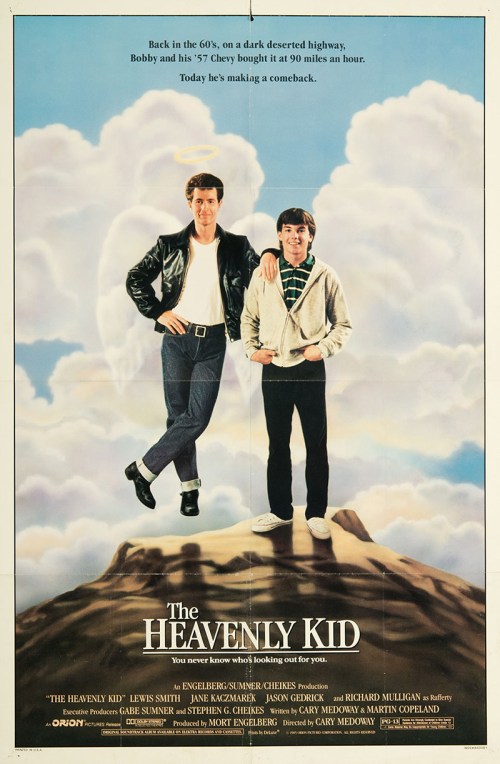
The Heavenly Kid (1985)

heavenly3

By Richard Winters

My Rating: 1 out of 10

4-Word Review: Angel helps out geek.

During the early 60’s Bobby (Lewis Smith) dies in a fiery car crash after the vehicle he was driving goes over a cliff during a game of chicken that he was playing with Joe (Mark Metcalf). His spirit gets sent to purgatory otherwise known as ‘Mid-town’ where he meets Rafferty (Richard Mulligan) who tells him that to get to ‘Uptown’ (Heaven) he’d have to go back down to earth in angel form to help out a human in need. He gets assigned to Lenny (Jason Gedrick) a geeky teen who’s trying in vain to hit on high school hottie Sharon (Anne Sawyer), but to no avail. Bobby is put in charge to teach Lenny how to be ‘cool’ and be able to pick-up chicks, but in the process he learns that Lenny’s dad is Joe, the guy who he raced against before he died, and Lenny’s mother is Emily (Jane Kaczmarek), Bobby’s former girlfriend who he still has strong feelings for.

The movie starts-off with an ill-advised car race that looks like it was ripped straight-out of Rebel Without a Cause. What’s worse is they tack-on this blaring song by Joe Fiore ‘Over the Edge’ that gets played during the crash, which takes away from the drama of the imagery instead of enhancing it. Bobby’s trip to the heavenly way station, which he does via a subway, has comic potential and Richard Mulligan is certainly quite funny, but I didn’t get why there would be a cafeteria, or why they’d eat food. Again, even if they appear in human form they’re still technically spirits as their human body remains on earth after death and decomposes, so why would spirits need to eat and does this mean they’d still have the same digestive system where they poop out what was eaten?

While Gedrick gives a much better performance than his co-star I still felt he was too good looking for the role. A true geek should be scrawny, or overweight, and have bad acne. If he had suffered from those things than his attempted transformation to a ‘cool’ dude would’ve been funnier.

I also thought it was ridiculous that he already had this beautiful woman named Melissa (Nancy Valen) who was really into him, and I think most guys would actually agree better looking than the plastic barbie that he was after. If this doofus is too dumb to realize on his own the good thing that he already has and instead callously takes her for granted simply because he feels the other one is better looking, after all the only reason he’s ‘in-love’ with Sharon is because she’s ‘hot’ then he shouldn’t get ‘help’ from an angel and justifiably deserves to be a lonely loser. I also felt that Melissa should’ve been more geeky since she was into another geek and having her be so pretty didn’t make much sense as other guys would be hitting-on her and since Lenny was not picking-up on her clear signals she would easily move on with somebody else and not hold-out so long, or feel the need to, for Lenny to finally see-the-light.

Spoiler Alert!

The rehabbed car in which Bobby takes what is literally an a rusty, empty shell of an old vehicle and through his heavenly magic turns it into a retro sports car I had problems with. For one thing since it was built on Bobby’s magical powers I would think Bobby would need to be present for it to run instead of Lenny being able to drive it by himself. Also, where did this key come from that Lenny uses to put in the ignition to start the car? This was literally just an old car frame when it was spotted and it’d be doubtful there would be any key in it and if there was it’d be as rusted as the rest of it. If you want to argue that this key was also a part of Bobby’s divine magic then there needs to be a scene with him creating it using his powers and then handing it to Lenny because it comes-off as big logic loophole otherwise.

The shot where Joe wakes-up to see Emily floating up the stairs by herself doesn’t work either. The idea is that human’s can’t see Bobby, who’s the one carrying Emily up the stairs, because he’s an angel, but if a person is being carried their ascension would have more of a jostled appearance instead of looking like they’re riding up an escalator like it does here.

The big reveal, in which it’s found that Lenny is actually Bobby’s son, is problematic since Bobby’s car crash occurs during the early 60’s (1960-63) and the present day for the story is October, 1984, which is when it was filmed. A senior in high school would’ve been born in 1967, or at the very earliest late 1966, so unless Emily was carrying Lenny around in her womb for 3 full years before he finally came out this whole concept just doesn’t work.

The thing that I really couldn’t stand was Bobby who’s a walking-talking cliche. Smith plays the part in a one-dimensional way and he looked too old for a teenager and was in fact 28 when it was shot. His generic advice on how to pick-up women is simplistic to say the least and if he really believes just feeding a woman lines about ‘how nice her hair looks’ is enough to get her to go out with him, or any other guy, then maybe he’s the one that needs the teaching and wisdom instead of dispensing it.

I also couldn’t understand why Lenny’s situation was so ‘dire’ that he needed heavenly intervention. There’s lots of kids who get bullied in school and can’t get a date that don’t have guardian angels come down to help them out, so what makes Lenny so special? Even if you factor in that Bobby is Lenny’s dead father it still doesn’t work because there’s lots of kids out there whose parents die when they’re young who don’t come back to help them as angels, so the questions still remains; what makes Lenny so special and is he deserving of this ‘help’? There’s millions of people out there who are homeless and victims of horrible crimes and abuse, which is who Bobby should’ve been assigned to, not a dopey kid who’s living a comfortable suburban existence and whose only ‘pressing issue’ is that he can’t make it with a stuck-up superficial babe who’s way out of league anyways.

My Rating: 1 out of 10

Released: July 26, 1985

Runtime: 1 Hour 30 Minutes

Rated PG-13

Director: Cary Medoway

Studio: Orion Pictures

Available: DVD, Blu-ray

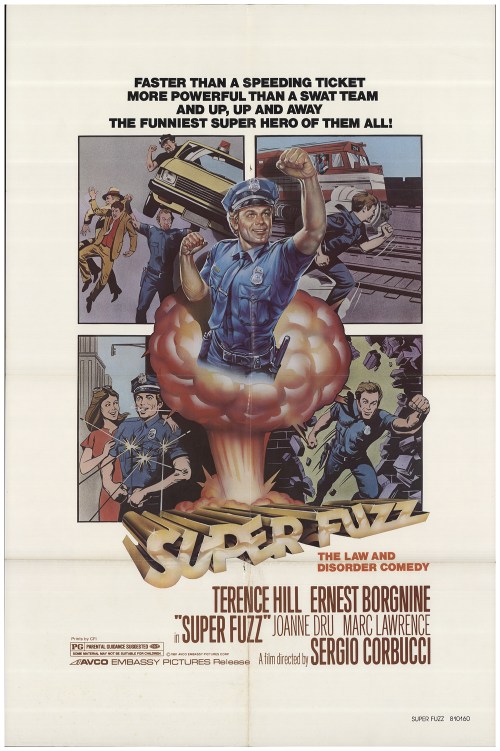
Super Fuzz (1980)

super fuzz1

By Richard Winters

My Rating: 2 out of 10

4-Word Review: Cop acquires super powers.

Dave (Terence Hill) is a newly hired policeman sent to do tasks non of the other officers want to do, which is why he’s given the assignment to deliver a speeding ticket to a remote Native American village deep within the Florida Everglades. Once he arrives he finds the place evacuated due to a secret nuclear missile test being done that he wasn’t aware of. When the bomb goes off and he becomes exposed to the radiation he begins to have various super powers including: super human strength, speed, telekinesis, psychic ability, and even hypnotism. He puts these new found abilities to use during his police work even though his partner, longtime cop Bill Dunlop (Ernest Borgnine), is skeptical about it at first. While the powers come in handy in their efforts to thwart a local counterfeit ring Dave soon realizes that there’s one hitch; if he sees the color red, which was the same color as the plutonium explosion, his powers will temporarily cease.

This was the third and final attempt to make Hill, who’s quite legendary in Italy especially in films where he teamed with Bud Spencer, into an American star. The first two attempts that he did here, Mr. Billion, March or Diewere flops and this effort, which was aimed solely at the kiddie crowd, wasn’t much better and its dismal failure both critically and financially sent Hill back to Europe permanently. Many adults who grow up in the 80’s will remember seeing it on Pay-TV where it was in heavy rotation. I recollect catching bits and pieces of it on Showtime, but the only thing that stood out for me was its cheesy soundtrack that had a chorus singing: ‘Super, Super, Sup-eee-rrr’ every time Dave did one of his tricks.

The film’s biggest downfall are the special effects that amounts to a lot of tacky, fast-action photography that can be seen in a wide assortment of other mindless low budget fare and is nothing special. There’s also just not enough trickery, too much dim witted dialogue, and lame humor in a plot that evolves too slowly to hold the interest of either a child or adult.

Having Dave acquire all these powers after being exposed to nuclear energy instead of getting terminal cancer like anyone else would makes no sense. The story would’ve been helped somewhat by reeling-in the powers aspect and giving him only one special ability instead of allowing him to do virtually anything making him almost like superman. Entering in more limitations than just the color red would’ve, if done right, brought in some tension and creativity, which is otherwise lacking.

While it’s sad in some ways to see a legendary, Academy Award winning star like Borgnine in such mindless tripe he is the best thing in it as he provides much needed energy, which help contrast Hill’s overly laid-back demeanor. Watching the tubby guy dance on top of a giant balloon, or try to dance with Joanne Dru is funny as are his overreactions, which would be considered cartoonish in any other movie, but here only helps to lift it up from its simplistic foundation. It’s also a great chance to see Dru, her first movie appearance in 15 years and also her last, ham it up as the villainous of which she’s pretty good.

The ending though, where Hill is somehow able from a tiny piece of gum to form this gigantic bubble is where the thing, which wasn’t floating too well to begin with, really sinks. How can Dave’s super powers get a piece of gum to expand far more than it should and since bubbles from bubble gum are very flimsy and can easily pop why doesn’t this one end up doing the same? You can also clearly see the seam of the sewn fabric on the bubble, which an actual bubble would never have.

While the movie was notoriously ridiculed by the critics at the time of its release, some critics today have taken more of a softer stance. Maybe it’s because they remember growing up watching it on TV, but feelings of nostalgia doesn’t make it any less stupid. This isn’t even good for kids who I believe are more discerning than adults think and will right away recognize the dated quality, tacky effects and won’t be impressed. 

Alternate Title: Super Snooper

My Rating: 2 out of 10

Released: September 18, 1980

Runtime: 1 Hour 37 Minutes

Rated PG

Director: Sergio Corbucci

Studio: AVCO Embassy Pictures

Available: DVD, Amazon Video

Caddyshack II (1988)

caddyshack2

By Richard Winters

My Rating: 1 out of 10

4-Word Review: A very bad sequel.

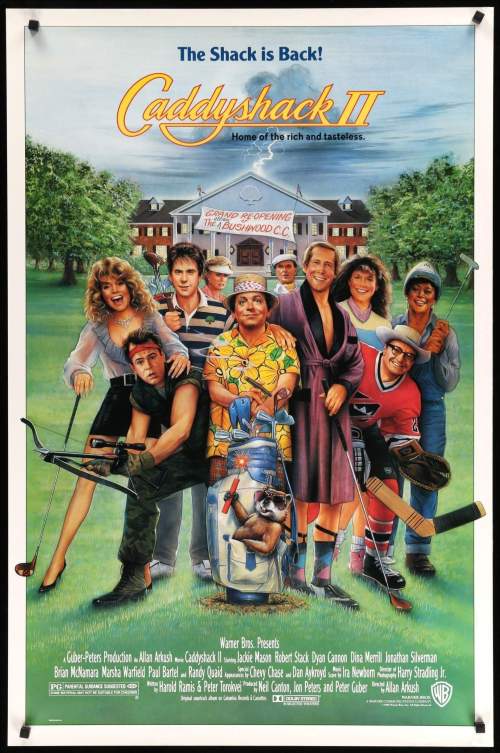
Kate (Jessica Lundy) is looking to fit-in with fashionable society by becoming friends with snooty Miffy (Chynna Phillips) whose parents (Robert Stack, Dina Merrill) run the affluent Bushwood Gold Club. Miffy tries to get Kate and Kate’s father Jack (Jackie Mason) to join the club. Kate, wanting to move-up the social ladder, convinces her father to send in an application and since Jack is financially well-off he’s quickly accepted. However, once Jack arrives his oafish personality and gaudy attire make him a turn-off to the other members. Miffy’s parents also don’t like him since he wants to build low income housing in their ritzy neighborhood. Jack is soon kicked-out of the club and told never to return, which causes Jack to buy the course and turn it into an amusement park and the only way Miffy’s family can win it back is if they challenge him to a golf game.

This is another sequel that had no business being made since the original had a perfect ending and no need for any continuation. Harold Ramis, who directed the first one and gets onscreen credit for co-writing this script, was not interested in making it, but eventually decided to dive in at the insistence of Rodney Dangerfield, who had figured prominently in the first film and wanted to take part in another one. Unfortunately Rodney became displeased with the quality of the scripts that were sent to him and eventually bowed out, which caused Ramis to leave the project as well. Bill Murray didn’t want to recreate his role and neither did Michael O’Keefe, while Ted Knight had already passed away leaving only Chevy Chase to return unless you count the gopher who figures more prominently here. Chase, who later regretted being in this, is the only funny thing about it, and seems for the most part to be ad-libbing his lines as it went along.

The biggest problem is that many of the performers add nothing to the story. This is especially true for Dyan Cannon, who at 50 looks great and would be considered these days as a ‘MILF’, but her character serves no other function other than to fall in love with Mason and appears only sporadically. Jonathan Silverman, who fills-in for the role played in the original by Michael O’Keefe, is barely seen and could’ve easily been cut-out. The normally reliable Dan Akroyd, who plays the part that Bill Murray would’ve, is wasted while speaking in a high-pitched voice that is more annoying than funny.

What I found most irritating is the presence of Robert Stack, who is stiff and pale and looking like an old guy with too much plastic surgery. Ted Knight, who played the role in the original at least had a colorful way of conveying his lines, but Stack speaks his lines like an over-rehearsed robot, which makes his presence quickly forgettable. I was also dismayed that he took over the antagonist role from Dina Merrill, as it initially seemed like she’d be the one to be Jackie Mason’s nemesis, which is a shame as a strong, powerful, yet ruthless woman going up against a putzy guy like Mason could’ve brought out some interesting dynamics that gets lost when it’s just between two aging men.

I was also confused why Randy Quaid is in this as he plays Mason’s obnoxious lawyer, but says things that Mason’s character could’ve easily said himself. I suppose in an attempt to make Mason more likable the writer’s decided to give the more edgy lines to Quaid, but the result is throwing in another character that really isn’t necessary. Apparently had Dangerfield agreed to be in it then his friend Sam Kinison would’ve played this role, who would’ve been better.

The film also fails to recreate the day-in-the-life feel of a country club, which is what had made the first one so engaging. In fact there are a lot of scenes that don’t even take place at the golf club. I also couldn’t stand how Mason renovated the place into a tacky miniature gold-like course, which seemed like a desecration and made me actually want Robert Stack to win the final match, so that he, even as much of a jerk that he and his wife were, could’ve turned the place back into a sensible looking golf course that it should’ve been.

My Rating: 1 out of 10

Released: July 22, 1988

Runtime: 1 Hour 38 Minutes

Rated PG

Director: Allan Arkush

Studio: Warner Brothers

Available: DVD, Hulu, Amazon Video, YouTube

Caddyshack (1980)

caddyshack1

By Richard Winters

My Rating: 7 out of 10

4-Word Review: Blow-up the gopher.

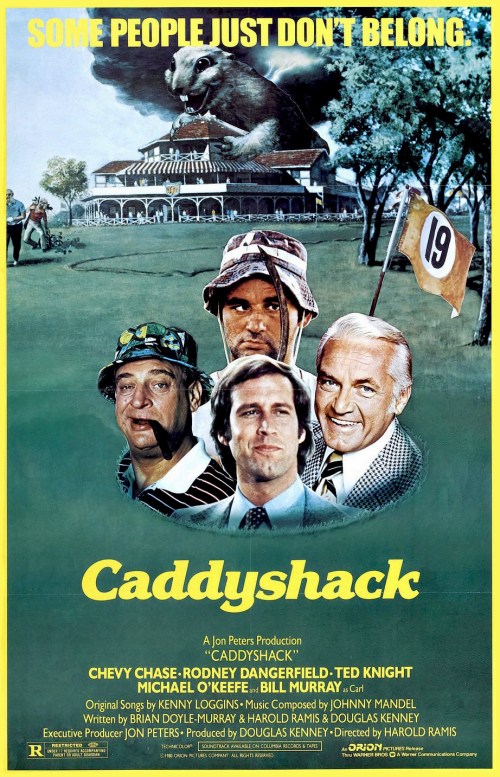
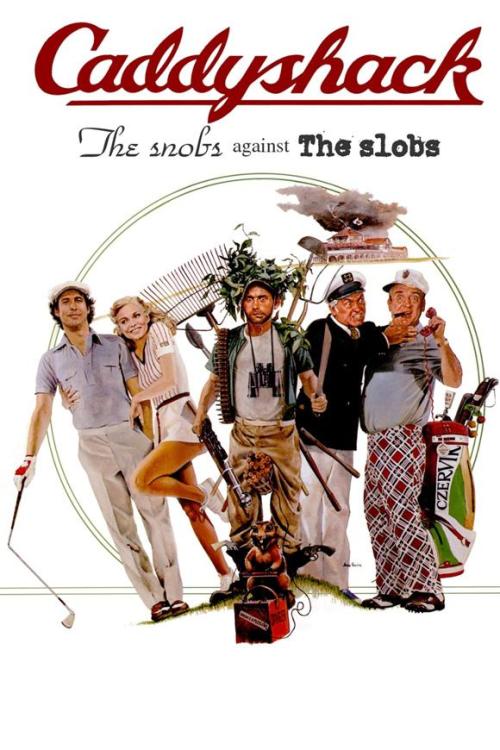
Trying to work his way through college, Danny (Michael O’Keefe) gets a job as a caddie at an exclusive golf course. He becomes friends with Ty (Chevy Chase) who is the son of the club’s co-founder. He also begins caddying for Judge Smails (Ted Knight) in hopes to get on his good side since the Judge is also in charge of the caddie scholarship program, which Danny hopes to win in order to help pay for his education. The Judge and Danny form a hot-and-cold relationship with the Judge usually more annoyed with Danny than not though he does warm-up to him after the Judge accidentally hits an elderly woman with a golf club that he recklessly threw, but gets off-the-hook for taking the responsibility when Danny comes forward and takes the blame. The man though that really causes the Judge’s ire is Al (Rodney Dangerfield) a wealthy real-estate tycoon, who begins golfing at the club and constantly makes fun of the judge at every turn. Al considers the judge to be an uptight elitist snob, while the judge sees Al as being uncouth and lacking in social graces. The two men ultimately square off in a high stakes golf match just as the club’s dim-witted groundskeeper Carl (Bill Murray) rigs the course up with tons of dynamite in an attempt to get rid of a pesky gopher that’s been destroying the grounds.

This was another film that upon its initial release, like with The Shining and  Blade Runnerwas given a lukewarm response by the critics, but has since then become a classic by the vast portion of the movie going public. Part of the reason this one didn’t gel well with the critics is because of what was considered ‘sloppy’ comedy that had very little story and relied too heavily on gags to keep it going. The script, written by Brian Doyle-Murray, brother of Bill, and Douglas Keeney, was supposed to emphasize the caddy’s more and be a coming-of-age comedy, but the producers, much to the writer’s dismay,  decided to throw-in more colorful characters including a gopher who chews up the course and constantly avoids capture, which was an idea that co-writer Douglas Kenney really hated. The result made the story come-off as being too loosely structured and more concerned with creating comical bits than making any type of statement.

I admit when I first saw this movie over 20-some odd years ago that’s how I came away feeling too, but this time I approached it more as a day-in-the-life saga between society’s have-and-have-nots with the caddies portraying the working class while the course’s nouveau riche clientele made up the establishment. When taken in this vein the film works really well and I especially liked the way the Danny and the Judge’s relationship evolves throughout with the judge ultimately much more dependent on Danny than you might’ve originally thought possible.

Of course it’s the comedy that makes it all come together and there’s truly some side-splitting moments including the infamous Babe Ruth candy bar in the pool bit that was the one thing about the movie that I had remembered when I first saw over 2-decades ago and now upon viewing it a second time had me rolling over in laughter even more especially when you realize that it apparently is based on a real-life incident that occurred to writer Doyle-Murray while he worked at a golf club in Winnetka, Illinois. I also really enjoyed the moment where we see Bill Murray’s incredibly makeshift living quarters inside the course’s utility shed that features a reunion between he and fellow SNL alum Chevy Chase. The two had gotten into a well publicized fist-fight behind-the-scenes while working on that show a couple years before, but both managed to work together in this scene, which had been written-in at the last minute by director Harold Ramis for exactly that purpose, without a hitch.

Rodney Dangerfield’s star-making turn as the crass, but wealthy patron is a riot too and I particularly enjoyed his over-sized, multi-purpose golf bag and his nervous fidgeting especially his twitchy legs when he stands, which was all genuine and anxiety driven. Knight quite good too in a perfect caricature of a pompous jerk though he reportedly was vocally upset during the production at the excessive partying and hijinks that went on amongst the rest of the cast members, including a lot of drug use, which he felt was unprofessional. I even liked Cindy Morgan as the Judge’s niece and resident ‘hot babe’ who despite being a blonde was fortunately not portrayed in the stereotype of being dumb, but instead as savvy and observant. Followed 8 years later by a sequel, which will be reviewed next.

caddyshack2

caddyshack3

My Rating: 7 out of 10

Released: July 25, 1980

Runtime: 1 Hour 38 Minutes

Rated R

Director: Harold Ramis

Studio: Warner Brothers

Available: DVD, Blu-ray, HD-DVD, Amazon Video, Hulu, YouTube