Category Archives: Movies from Australia

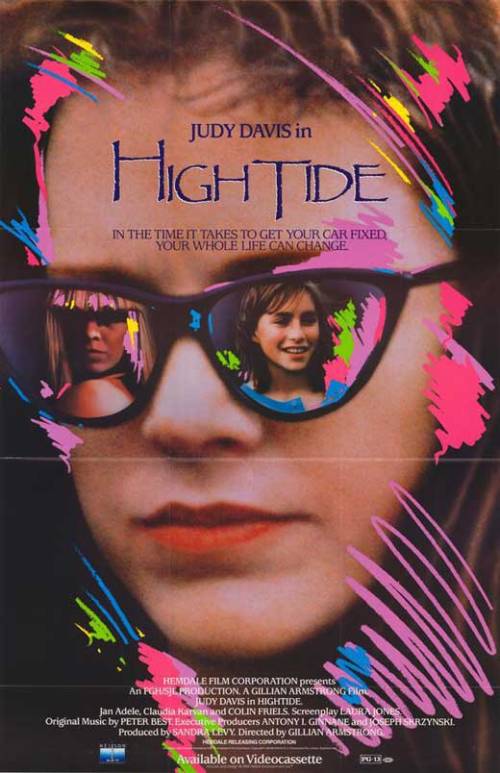
High Tide (1987)

By Richard Winters

My Rating: 8 out of 10

4-Word Review: Mother meets estranged daughter.

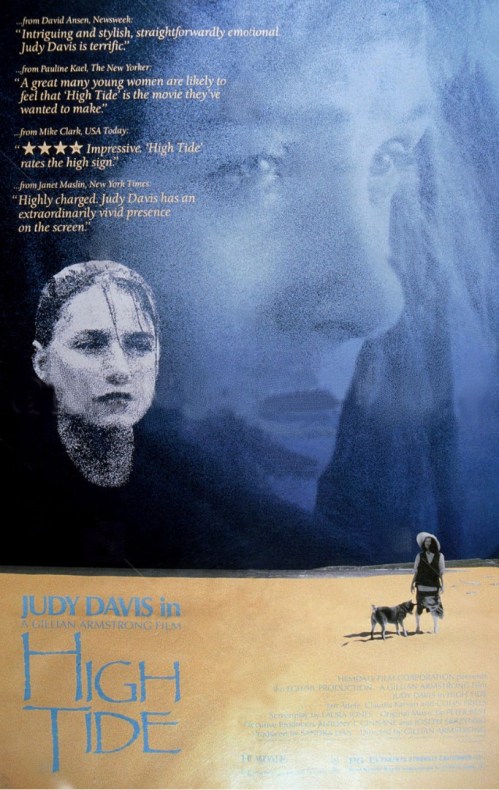
Lillie (Judy Davis) is living on the very edge of show business life working as a backup singer to an Elvis impersonator (Frankie J. Holden). Her lackluster behavior gets her fired and she finds herself without money or shelter. She moves to a trailer home park and begins drinking heavily and it is here while in a drunken state in the public bathroom that she meets Ally (Claudia Karvan). Ally is a 13-year-old girl living with Bet (Jan Adele) who is the mother of Ally’s father who died when she was just an infant. At first Lillie doesn’t know that Ally is actually her daughter, which she gave up at birth. When Bet realizes that Lillie is in the area she warns her not to go near Ally, but Ally and Lillie manage to find ways to get together anyways and form a rapport, but without Ally knowing the deep, dark secret between them. Once she does find out the two must learn to fight through the awkward and emotional state that the tumultuous new awareness creates.

Originally the script called for Lille’s character to be a man meeting up with his lost teen daughter that he had abandoned years earlier, but director Gillian Armstrong felt this had been done before and at her husband’s suggestion changed the lead into a female. In many ways this was a better idea as women are better able to reveal their emotions creating some very strong, heartfelt scenes between them that ultimately makes for a very powerful film.

Many reviewers have expounded on Davis’ performance and she does give a strong one particularly the way her character is put through some very demeaning situations, but still managing to come through them holding her head high and keeping the viewer empathetic to her. Karvan though is quite good too with a beautiful photogenic face that can display an array of emotions with very little effort and who’s likable enough that you’re able to bond with her immediately.

The story progresses casually and at first you have no idea what links these three women as the film intercuts between them in separate situations with no idea where the connecting point is, which to some extent doesn’t grab the viewer in. I did though like the way it captured the nightclub atmosphere showing how for many it temporarily opened the door for their lost and fleeting dreams by having Bet get onstage and sing to a captive audience at a talent contest during the evening only to cutaway showing her back on her drudgery job of driving an ice cream truck the following day.

Once the secret becomes clear the story gets more interesting with the dialogue between the mother and daughter quite compelling. There is however, a long lull during the second act where Lilly intentionally stays away from Ally, which I found frustrating. The main interest of the film is seeing the two working things out together and getting through the guilt and bitterness of the past and at times there’s not enough of that.

Spoiler Alert!

The third act features Ally deciding to go out on the road with Lillie, but to me this thing seemed too precipitous since the two had only begun to get to know each other, why would a young teen, even if she was unhappy in her current situation, want to start living with someone she really didn’t know if she could get along with? This situation also opens up a whole variety of new tangents: like how are the two going to survive with Lillie’s limited job skills and where would they live? I felt this situation should’ve been introduced in the second act and explored much more. Personally I don’t think things would’ve worked out and at the very least brought on, despite their best intentions, a lot of stress and disagreement before it might’ve gotten better. This is something the viewer needed to see though there’s still plenty of nice rewards nonetheless.
My Rating: 8 out of 10

Released: July 30, 1987

Runtime: 1 Hour 41 Minutes

Rated PG-13

Director: Gillian Armstrong

Studio: Filmpac Distribution

Available: VHS

Announcing Australia Sundays

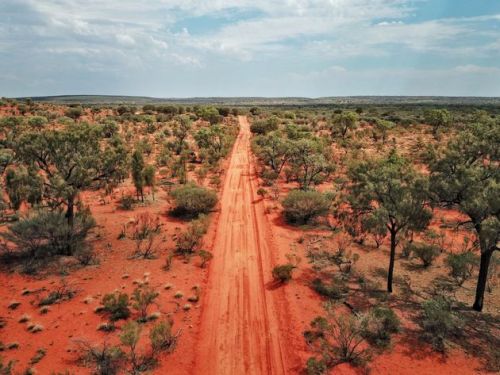
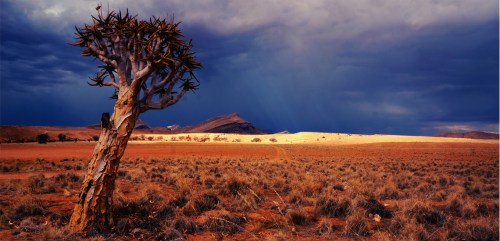
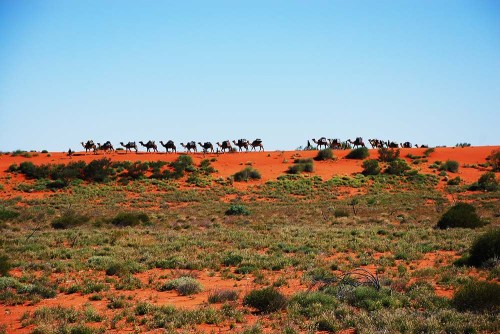
Hey mate, since it’s always summer in Australia when it’s winter here I thought we could warm us up during these long, cold, chilly months ahead by visiting the Down Under, at least on Sundays. Beginning tomorrow and going all the way through March will spend each Sunday reviewing an Aussie flick from the 60’s through the 80’s. Some of these films have never been released here, or reviewed on other blogs, so this will give readers a new awakening to some of the great cinema that is down there. Plus, a chance to see the wonderful topography, animal life, and colorful people that makes up this unique continent, so I hope everyone will enjoy this new weekly series. Until then enjoy these pics.

Long Weekend (1978)

By Richard Winters

My Rating: 7 out of 10

4-Word Review:  A couple battles nature.

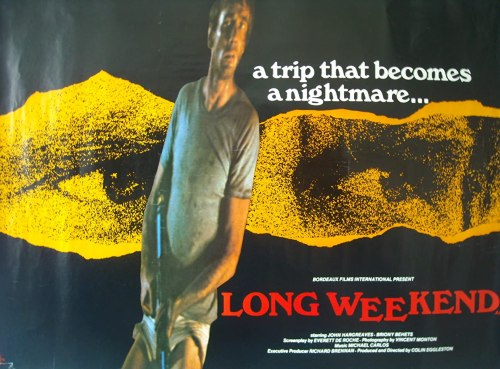
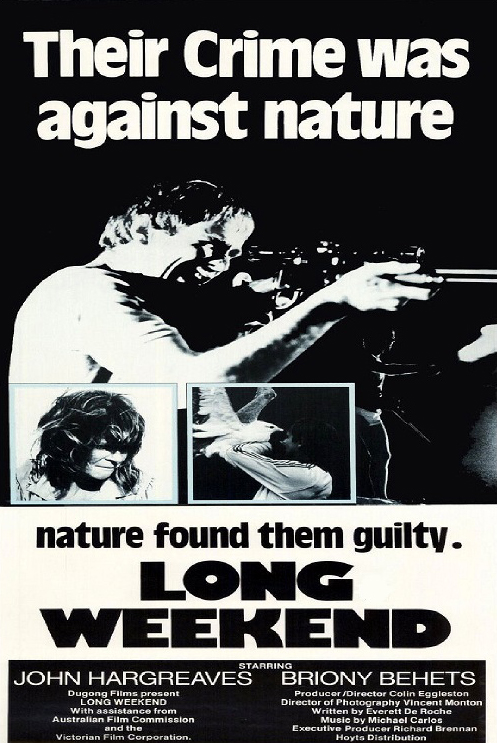
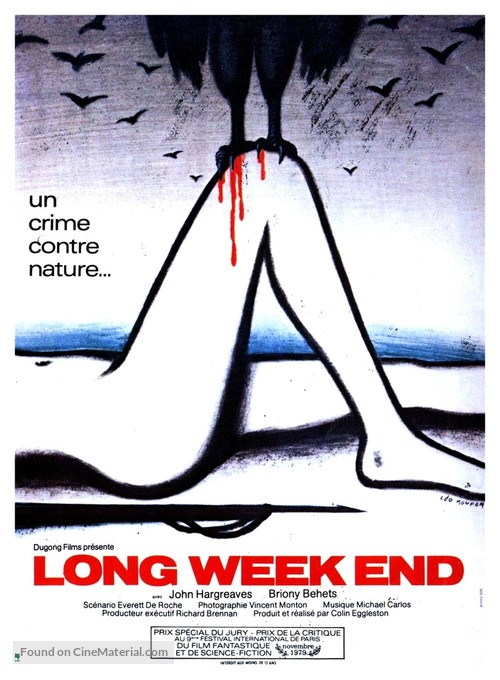
Peter (John Hargreaves) and Marcia (Briony Behets) are a young couple who are constantly at odds with each other. To help smooth things over they decide to take a trip into the wilderness and enjoy the beauty of the outdoors. Along the way they accidently hit and kill a kangaroo with their vehicle. This sets off a chain-of-events that puts them under the increasing attack of various animals. First Peter must fight off an angry eagle who swoops down at him without warning. Then a possum and even a sea cow who stalks Peter while he is swimming. The two decide they must leave the area in order to save their lives, but everywhere they turn there’s another animal waiting for them.

The story idea is certainly an interesting one, but the concept is too wide-open. Scriptwriter Everett De Roche stated that the premise was all about how Mother Earth had her own auto- immune system and when humans started acting like cancer cells she’d attack, which is great, but why just this couple? There are millions of people who behave just like them, so why don’t they end up getting the same treatment?

The plot needed an extra spin to hold it all together, but it never comes. Having this small remote place hold a mystical power that allowed animals to behave differently than they would normally do elsewhere would’ve at least given it some needed focus. Perhaps a backstory too where other people would’ve gone to this same locale and complained about being attacked. Any extra plotline would’ve helped because the idea that these animals would just randomly attack a generic couple in some isolated moment in time that they never did before or after just doesn’t cut-it.

I didn’t like either that the couple bicker right away, but then later on become lovey-dovey only to proceed back to bickering, which is too bipolar. A better approach would’ve had them getting along at the start and then with the stress of the animal attacks tear their relationship apart, which would’ve created a more interesting character arc, which otherwise is non-existent.

I would’ve preferred that the lead characters been played by macho men who arrogantly tear up the wilderness with their SUV’s and kill the animals for shameless sport. Watching these ‘tough guys’ then unravel once the animals went on the offense turning them into sniveling, frightened cowards would’ve been far more of an entertaining payoff while hitting-home the importance to respect nature  in a more stark way.

The animal attacks aren’t all that riveting and take up very little of the runtime, but the creepy atmosphere is amazing. Filmed on the island of Tasmania I enjoyed the point-of-view shots of the SUV driving through the long, tangled unique looking trees that grow down there where when captured at night and through the beams of the vehicle’s headlights come off looking like gnarled fingers protruding from the ground. The intense music and haunting call of the sea cow are also quite unsettling and get even more so as the couple continues to hear it, which helps to make this a memorable horror flick despite the few drawbacks and a great example at how strong directing can help overcome a flat script. Remade in 2008.

My Rating: 7 out of 10

Released: October 2, 1978

Runtime: 1 Hour 35 Minutes

Not Rated

Director: Colin Eggleston

Studio: Hoyts Distribution

Available: DVD, Blu-ray (Spanish), Amazon Video, YouTube

Road Games (1981)

road games 1

By Richard Winters

My Rating: 6 out of 10

4-Word Review: Truck driver pursues killer.

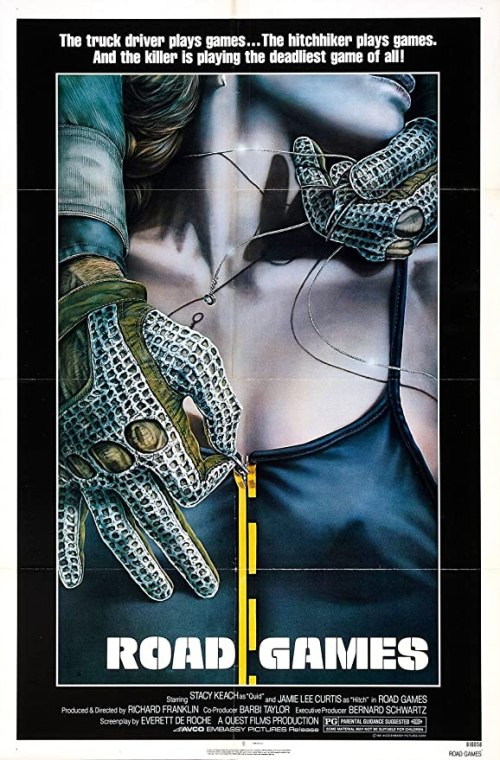
Quid (Stacy Keach) is an American working as a trucker in Australia and hauling a frozen shipment of pigs through the outback and into Perth. Along the way he becomes menaced by a strange man (Grant Page) driving a black van who has a penchant for picking-up prostitutes who then end up dying. Quid is convinced that the man is the serial killer that is being reported about on the news, but before he can go to the police he gets tabbed as the killer himself forcing him, with the help of Pamela (Jamie Lee Curtis) a hitch-hiker he picks up along the way, to find the real killer before he gets arrested for crimes that he did not do.

One of the coolest aspects of this film is its voyeuristic quality where visual clues are a requirement for the viewer to pick up on to figure out what’s going on.  Too many other movies don’t take enough advantage of this idea and usually sell-out by having everything explained through dialogue, but here director Richard Franklin, a major devotee of Alfred Hitchcock, who tried to model the story after Rear Window, keeps the viewer feeling like they’re an active participant.

The film’s drawback, and most likely one of the main reasons it didn’t do well at the box office, is that the tension  ebbs and flows. Too much labor gets put into dressing up the plot with a lot of quirky side stories. This includes having Quid  coming into contact with the same motorists through his travels, which I didn’t think was realistic that these same drivers would be taking the exact same route as him while maintaining the same speeds as he over a several day period, so that no matter where he went they were never far away. I have traveled extensively by car on long road trips similar to this one and have never kept passing the same motorists like Quid does here.

The film also lacks, with the exception of a surprise double ending that comes at the very end,  any type of actual scares. There is a running build-up making you believe that a shock is just around-the-corner, but ultimately it’s a letdown. People watch these things with the anticipation they’ll be jumping-out-of-their-seats at some point, but this is too tame and at certain points it’s almost more like a comedy.

The killer, who was played by a stuntmen and not a professional actor, lacks any type of presence to distinction. For things to get really intense, which it never does, the bad guy has to stand out and make the viewer feel on edge every time they see him, which this transparent guy is unable to do. It would have also been more interesting had his face not been shown until the very end instead of Quid seeing what he looks like early on when he spots him through his binoculars.

I was surprised why the two lead characters were played by Americans since the setting is the down-under and the story better served by performers who were native born. That’s not to say that Keach or Curtis don’t give engaging performances because they do, but I don’t believe there’s too many American truck drivers working in Australia, so there needed to be some explanation for why Keach was there and why, being that he was not from the region, he was so educated about the history of the area, as evidenced when the two camp-out overnight and he tells her the back story of an abandoned telegraph station that sits nearby.

The romantic undertones that are lightly introduced does nothing but sap away the tension. I also found it curious why Curtis would be trusting of Quid upfront as she’d have no idea whether the serial killer could’ve been him and therefore she should’ve been more guarded, which she isn’t.

The climactic sequence features a unique car chase where three vehicles follow each other around the back alleys of Perth late at night, but at very slow speeds, which surprisingly is effective. However, the script should’ve been tighter and the editing quicker. The film’s leisurely pace and colorful supporting characters works against it. There needed to be more shocks, more of a confrontation between Quid and the killer, and basically just more of a conventional thriller-like approach.

My Rating: 6 out of 10

Released: June 26, 1981

Runtime: 1 Hour 41 Minutes

Rated PG

Director: Richard Franklin

Studio: Embassy Pictures

Available: DVD, Blu-ray, Amazon Video

Sweetie (1989)

By Richard Winters

My Rating: 8 out of 10

4-Word Review: Sister is mentally ill.

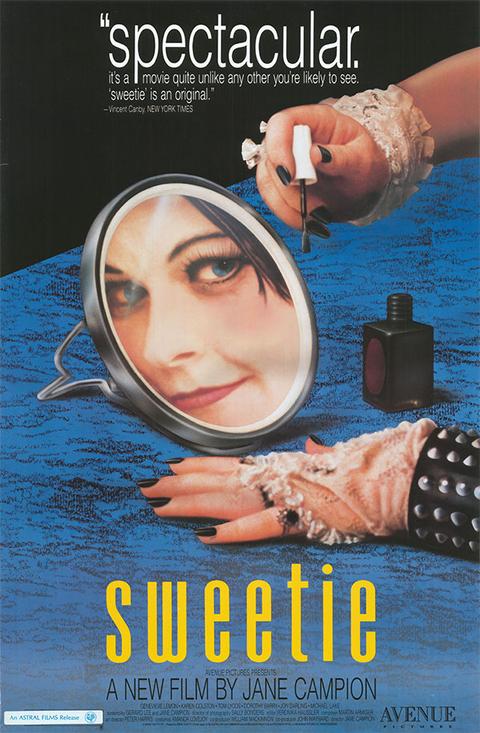
Kay (Karen Colston) has begun a relationship with Louis (Tom Lycos) and things seem to be going smoothly as they move into a home together, but it quickly unravels when he sister Dawn ‘Sweetie’ (Genevieve Lemon) shows up with her boyfriend Bob (Michael Lake). Sweetie has been institutionalized in the past and her wild mood swings and erratic behavior quickly cause turmoil particularly with Kay. She asks her parents (Jon Darling, Dorothy Barry) for help, but her dad refuses to recognize Sweetie’s tragic current state and instead continually hearkens back to her childhood years when she was a cute kid with budding talent who would perform songs and dances to the family’s entertainment and delight.

This is a hard film to critique  as it starts off as a quirky comedy, but by the midpoint it becomes more dramatic and filled with a lot of uncomfortable even cringe worthy scenes as Sweetie’s mental decline becomes achingly apparent. Not only do you feel sad for her, but also for how it causes such a severe strain for the rest of her family, which accurately illustrates how mental illness isn’t just a one person issue as their behaviors will adversely affect those around them too.

The fact that the film’s tone switches halfway through, which would be considered a major no-no by Hollywood standards, is part of the reason why it works as it replicates real-life where sometimes you can have a touching, humorous moment only to suddenly get thrown into a troubling one.  This also shapes what life is like living with a mentally-ill individuals who may seem ‘okay’, but can turn erratic sometimes without warning and this ongoing tension vividly comes through for the viewer until they feel the same way as the characters.

I found the father though to be the most entertaining and interesting. One minute he’s scheming to get Sweetie out of the family car, so they can leave on a trip without her and then the next minute he’s driving back to pick-her-up, so they can be ‘one happy family’ again. While this may sound overly contradictory to some I felt it brought out  the inner turmoil many parents feel in dealing with their grown children where at times they can’t stand them, for whatever reason, but at other points can’t stand to be without them either.

Director Jane Campion, in her feature film directorial debut, adds in interesting touches like having the camera frame the characters off-center where instead of seeing them captured in the center of the screen they are shown in the right-hand corner, which helps accentuate the tone of the subject matter. There’s also an odd time-lapsed cutaways detailing a seedling tree pushing its way through the dirt and above ground, which wasn’t exactly necessary to the main plot, but kind of cool nonetheless.

Campion also wisely doesn’t insult the viewer’s intelligence with pat answers to a complex problem. Mental illness cannot be cured or even  always stabilized with medications, so leaving the viewer with a feel-good ending where everything works out and everybody is happy would be a cop-out and thankfully gets avoided here. Instead the we’re left pondering troubling questions, which stays with you long after it’s over and makes this a far better movie than most because of it.

My Rating: 8 out of 10

Released: September 28, 1989

Runtime: 1 Hour 37 Minutes

Rated R

Director: Jane Campion

Studio: Filmpac Distribution

Available: DVD, Blu-ray (Criterion Collection), Amazon Video

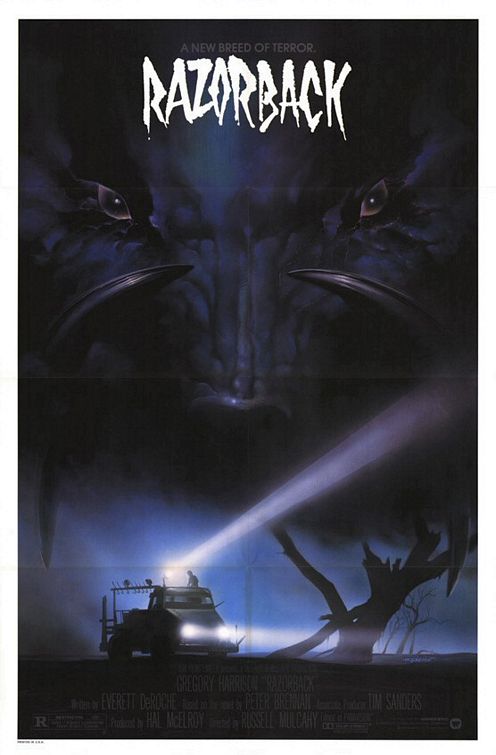
Razorback (1984)

By Richard Winters

My Rating: 6 out of 10

4-Word Review: Giant boar terrorizes outback.

Jake (Bill Kerr), who lives in the Australian outback, gets attacked one night by a giant razorback who takes off with his infant grandson. Jake is later accused as having made up the story as no one can believe that there could be a razorback of such mammoth proportions and yet Jake spends the rest of his life hunting after it and determined to get his revenge for what it did to his grandson. During his quest he meets up with Carl (Gregory Harrison) whose wife Beth (Judy Morris) was also killed by the same wild boar.

The film was directed by Russell Mulcahy, who rose to fame by directing many influential music videos and his unique visual style is what sets this film apart. The way he captures the vast, flat outback is stylish and the dream sequence out in the desert is both creepy and surreal. I also really enjoyed the part where the razorback tears apart a man’s house forcing him to helplessly watch as the part of the home with the TV, which he was watching, goes literally gliding away in front of him, which  may not be realistic, but a very funny image nonetheless.

The story though, which is based on the novel by Peter Brennan, is too indicative of other better known movies. It starts out with Jake going to trial over the death of his grandson and no one believing his account, which is loosely based on the Azaria Chamberlin incident who was an infant that got taken away by a dingo in 1980, but the public didn’t believe the story and accused the parents of killing the child instead. However, in this instance the razorback creates a giant hole in Jake’s house, which should be enough for most people to think that there might be something to what Jake was saying and makes the opening court room bit seem both protracted and unnecessary especially since he quickly gets acquitted anyways.

The second act resembles the film Wake in Fright as Carl and two other men go on a nighttime kangaroo hunt. It also examines the poor way Carl adapts to the rough nature of the outback men, which again seems too similar to the plot of the other film and really wasn’t needed since it slows up the pace, which needed more scares and appearances of the giant razorback that are completely missing during the middle part.

The third act comes off too much like Jaws, with Jake channeling Quint, which might’ve been alright as I found Jake’s rugged individualistic ways to be both endearing and amusing to the point that he could’ve been made the main character. However, is untimely demise is both graphic and cruel and gives the film an unnecessarily mean tone.

Having Carl single-handidly take on the razorback at the end while inside an abandoned warehouse is boring as it rehashes the man vs beast theme that’s been done many times before. I was actually more interested in seeing the townspeople work together to hunt down the boar, which is an idea that the film teases, but then ultimately sells-out on.

My biggest grievance though is the way the beast gets photographed. Supposedly a  giant animatronic model of the razorback was built at a cost of $250,000, but you never really see it. Shots of the beast are edited so quickly that you only get brief glimpses of the animal and never its whole body and no true idea of how big it really is. There’s also no explanation offered for  how it grew so big.

My Rating: 6 out of 10

Released: April 19, 1984

Runtime: 1 Hour 34 Minutes

Rated R

Director: Russell Mulcahy

Studio: Warner Brothers

Available: DVD-R (Warner Archive), Blu-ray (Region B/2, A/1), Amazon Video, YouTube

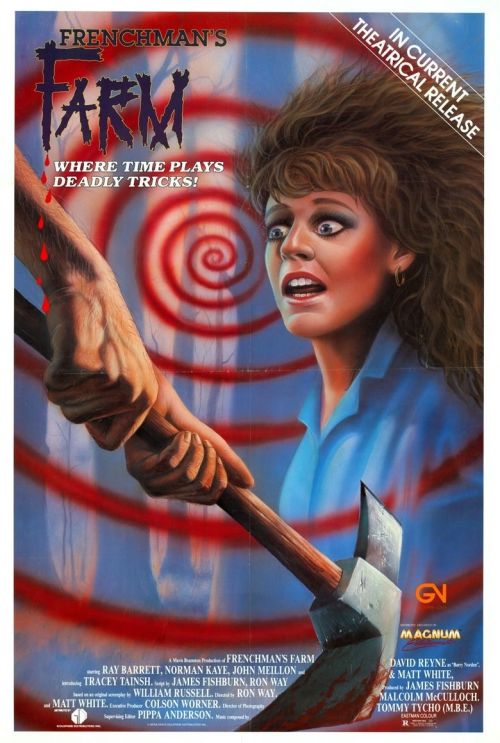
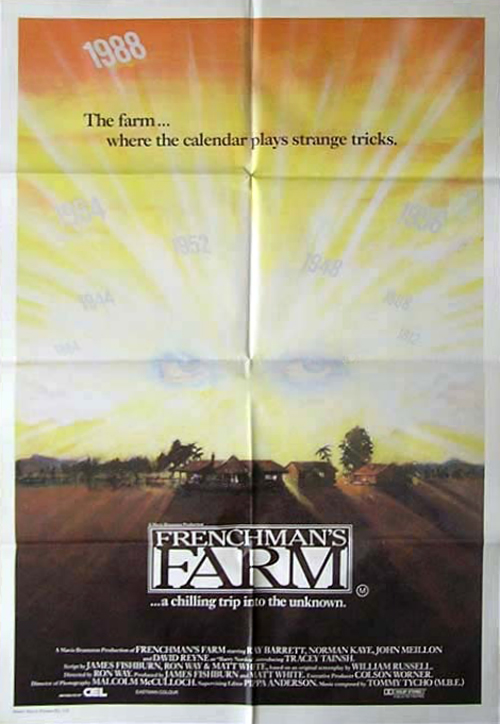
Frenchman’s Farm (1987)

By Richard Winters

My Rating: 3 out of 10

4-Word Review: Witnessing a past murder.

Jackie (Tracey Tainsh) goes traveling in her car throughout the Australian countryside while bush fires rage all around her. When her car breaks down she visits the nearest farmstead for help. It is there that she finds herself suddenly swept back to the year 1944 where she witnesses a murder and then just as quickly she comes back to the present day. When she tries to tell others what happened nobody believes her, but eventually her boyfriend Barry (David Reyne) takes up her cause and with the benefit of old news articles help find the real killer and the secret behind what motivated it.

Although marketed as a horror flick, it seems more like iffy sci-fi and could’ve easily have been targeted to a pre-teen audience since it’s not all that tense, or scary, especially with the majority of it filmed in the bright sunny daytime. When it does finally take place in the darkness of night a cliched thunderstorm gets conveniently put in while the killer is made out to being a ghost who pops in and out like it’s The Ghost and Mrs. Muir.

Initially I kind of liked that that she didn’t stay stuck in the past and was able to be her own detective, which kept me intrigued for awhile yet it started to make me wonder why the time traveling event occurred to begin with, which the movie has no suitable explanation for except to say that the bush fires created some sort of ‘atmospheric disturbance’, but if that was the case why was she the only one affected? The film also does a poor job of recreating a past era, as Jackie and her boyfriend go back to the farm where the murder occurred, but do it in the present day and yet the trees in the backyard where she witnessed the killing 40 years earlier all look the same even though they should’ve either died or grown bigger.

I found it annoying too that the boyfriend, who has a generic ‘surfer dude’ presence, starts to take over the investigation even though it really wasn’t his personal battle to solve. In order for him to take such an interest he should’ve been transported back in time with Jackie, or for a more original touch, it could’ve been Jackie and a female friend who witnessed the killing and then proceeded to becoming amateur sleuths together.

A few veteran Aussie character actors, such as an aging John Meillon, help give it some stature, but the production overall is quite bland and how it ever got considered as being a part of the Ozploitation genre, which stands for Australian exploitation cinema, is beyond me since outside of a brief skinny-dipping minute there’s nothing titillating or shocking about it.

The ‘surprise ending’ is also really dumb and doesn’t even involve the main character who gets phased out of the storyline before the ending even comes about, which is not satisfying for the viewer to follow a character around  for the whole movie only to have her ultimate fate left open to a murky explanation.


My Rating: 3 out of 10

Released: September 9, 1987

Runtime: 1 Hour 38 Minutes

Rated R

Director: Ron Way

Studio: CEL Film Distribution

Available: DVD

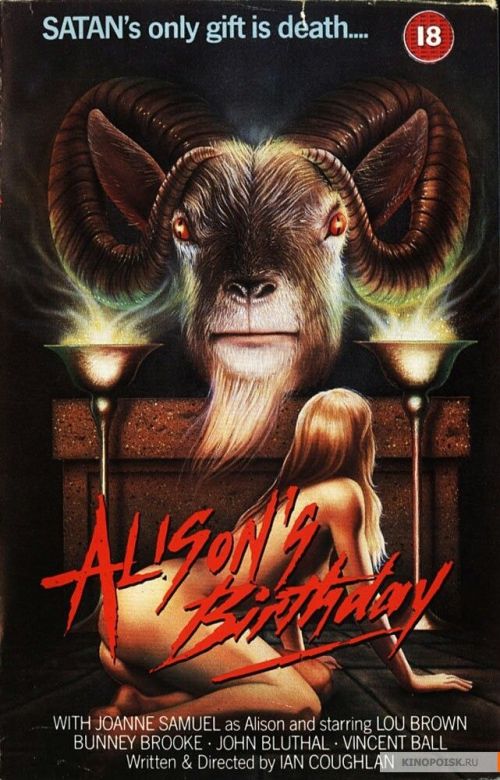
Allison’s Birthday (1981)

By Richard Winters

My Rating: 5 out of 10

4-Word Review: Teen ages very rapidly.

Allison (Joanne Samuel) decides to spend her 19th birthday with her aunt (Bunney Brooke) and uncle (John Bluthal) who live in rural Australia and have been raising her ever since her parents died when she was just a child. However, this visit includes her meeting her elderly grandmother (Marion Jones) for the first time and a mysterious illness that also affects her while she is there. Her aunt and uncle refuse to allow her boyfriend Peter (Lou Brown) to visit causing him to go to great lengths to get her away from them and back to safety as he fears they’ve come under the influence of a cult.

This low budget Australian sleeper managed to become a hit in its own country mainly from its attempts to work against-the-grain of that era by creating a horror film that did not involve blood and gore, but instead relied on good old fashioned creepiness. For the most part it succeeds, but gets hampered by a plot that plays itself out too slowly.

It becomes too obvious that her aunt and uncle have some evil intent in mind and this should’ve been camouflaged better because when the big reveal finally does come about during the third act it’s not surprising at all. The cult that they’re involved with is portrayed in such a cliched way from the tacky black robes that they wear to the Stonehenge-like meeting place that  it seems like high camp. The opening sequence featuring a ouji board and a talking spirit, is equally heavy-handed and almost sinks this thing before it’s barely begun.

Some of the action segments particularly her boyfriend’s attempts to outrun the cult members who try chasing him down is exciting, but he’s in too much of the movie, while Allison remains virtually bedridden making it seem like he’s the main character instead of her. A good protagonist should be able to fight her own battles and in this case she does too little, which doesn’t elicit enough emotion from the viewer to want to cheer her on.

Spoiler Alert!

The film’s twist ending in which, due to the ritual ceremony done by the cult, a young Allison suddenly wakes up to find herself trapped inside the body of her grandmother, is pretty cool and genuinely quite horrifying when you think about it. However, this should’ve occurred during the middle part and the rest of the film spent with her trying to return her spirit back to her youthful body, which could’ve involved a wide array of intriguing and unique elements. Unfortunately this doesn’t happen making the film only a skeletal blueprint of what it could’ve been.

My Rating: 5 out of 10

Released: May 1, 1981

Runtime: 1 Hour 37 Minutes

Not Rated

Director: Ian Coughlan

Studio: Australian Film Institute

Available: VHS

“Crocodile” Dundee II (1988)

By Richard Winters

My Rating: 6 out of 10

4-Word Review: Now that’s a knife.

Mick (Paul Hogan) and Sue (Linda Kozlowski) having been living together in her New York apartment for a year since their last adventures from the first film. Sue’s ex-husband Bob (Dennis Boutsikaris) is working for drug enforcement in South America. He witnesses and photographs the murder of a rival drug cartel leader at the hands of Luis Rico (Hechter Ubarry) and his men. Once Bob realizes that he’s been spotted he runs for cover to his hotel, but the men chase after him and kill him, but not before he sends the film negatives of the killing to Sue. The drug gang then kidnaps Sue in order to get their hands on the negative and it’s up to Mick to find a way to free her while also single-handedly fighting off the gang.

This sequel manages to avoid the missteps of so many others by wisely not trying to replay what we saw in the first installment, but instead taking it into a new direction and therefore allowing the theme and characters to progress. To some degree the plot does come off like an episode of ‘Miami Vice’ and the villains are also incredibly dull and generic. Do we really need bad guy Luis explaining to Sue why he got into the drug dealing business, because of the ‘money’ and ‘power’, as if there would be any other reason?

Having her ex-husband, someone who was never seen at all in the first film, act as a catalyst is problematic too. It seems like one’s ex-spouse; especially someone he hasn’t spoken to in years would be the last person to send crucial photographs to. He works for the DEA, so why not send it to them?

However, even with these issues I still kind of liked seeing Mick forced into action. The first film consisted mainly of him bragging about his exploits, but here we get to see first-hand some of his actual survival skills. It also puts to test his easygoing personality and we see if he can remain amazingly low-key and likable in situations that most other people couldn’t.

Unfortunately unlike in the first flick the comedy does not come from Hogan’s character, but instead from others around him that witness his exploits. Outside of an amusing segment that comes early on in the film where Mick tries to talk a man out of jumping off a ledge his character is portrayed in a darker more intense way although not enough to erase his ever going charm.

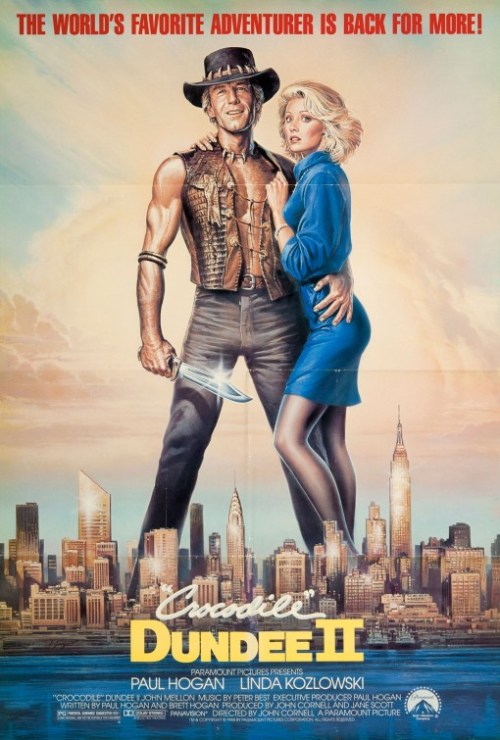
Kozlowski, who ended up marrying Hogan in real-life 2 years after this film was released, is stuck in a thankless supporting role where she doesn’t have much to do. The film poster portrays the idea that the two fight the bad guys side-by-side, but in reality Hogan does most of it while Linda simply tags along and observes. The real scene stealer is John Meillon whose last theatrical film this was. He was in the first one, but his presence there didn’t amount to much, but here his character, working in tandem with Mick, is an integral part of sending the drug gang on a wild goose chase.

The scenes shot in Australia are gorgeous and in fact the spot where the drug gang campout is the same place where Picnic at Hanging Rock was filmed. Charles S. Dutton who plays a man by name of Leroy Brown and pretends to be a drug dealer even though he really isn’t is quite amusing too and overall the film is a mildly entertaining way to spend two hours.

Spoiler Alert!

My only problem is in regards to Leonard Maltin’s review of it where he states that he felt the film was too leisurely paced and wished they’d “get on with it especially when all suspense about the outcome is eliminated”, but after watching it this makes no sense. The bad guys are not fully defeated until the very, very end in fact it quickly cuts to the credits once they are. There’s even some concern that Mick may have accidently been killed, which also occurs at the very end, so it seems that Maltin, who I generally like as a critic, either didn’t really watch the movie, or the whole thing, and therefore has no idea what he’s actually talking about.

My Rating: 6 out of 10

Released: May 20, 1988

Runtime: 1Hour 52Minutes

Rated PG

Director: John Cornell

Studio: Paramount

Available: DVD, Amazon Video, YouTube

“Crocodile” Dundee (1986)

By Richard Winters

My Rating: 7 out of 10

4-Word Review: That’s not a knife.

Sue (Linda Kozlowski) is a newspaper reporter who gets permission to cover a story about an Australian bushman named Mick better known by his nickname Crocodile Dundee (Paul Hogan) who was able to fight off a croc attack before successfully crawling to safety. To do this she travels to the outback, so she can learn about his way of life firsthand. After spending six weeks interviewing him she then invites him back to New York with her. Once there Mick finds the city life and the people in it quite confusing. He also takes an almost immediate disliking to Richard (Mark Blum) Sue’s fiancée.

Loosely based on actual events the laid back story goes down easy and is full of charm, but its basic premise is a bit hard-to-swallow. I thought the idea of having a reporter go clear across the globe to interview some no-name bushman over an obscure and completely unsubstantiated crocodile attack claim just wasn’t realistically worth the time or money. Crocodile/alligator attacks occur yearly all over. Why not save the money by sending the reporter to Florida instead where you could probably just as easily find and interview someone who survived a similar incident?

Most of the time a journalist will be accompanied by a photographer, but here she takes the pictures as well as doing interviews even though with most big time newspapers and many times even the small ones that is never the case. This also brings up the issue of her traveling for weeks all alone in the middle-of-nowhere and even sleeping under the stars with a man she essentially knows little about. What’s to say he wouldn’t attack her at some point and if so who would she call? I believe most women wouldn’t be comfortable in that scenario and thus having a third party present such as a photographer or other chaperone would’ve made far more sense.

The money issue, or the fact that the newspaper apparently pays him to come back to the states with Sue, seemed illogical and wasteful. Why is a newspaper spending money to bring a bushman into a foreign land? If it is to see how he adjusts to it that’s one thing, but the majority of the time Mick spends in New York he is by himself with Sue nowhere near him covering his reactions, so then what’s the point? Later Mick decides to stay in the Big Apple for a longer period, but where does he get the extra money to do that?

The scene where Mick puts a water buffalo into a trance-like sleep is baffling too. Supposedly he does this because they are driving along in a jeep and the buffalo won’t get out of the road and let them pass, but how is putting the animal to sleep where he then plops his big body onto the road going to help? The film then conveniently cuts without any explanation of how there were ultimately able to get around him.

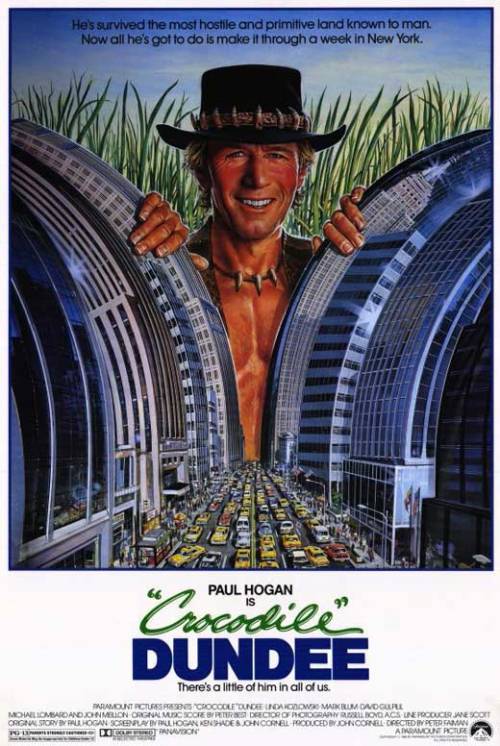
The second act where Mick comes to New York is the funniest, but even here it doesn’t get played-up to its full potential. The amusing scene where Mick meets some prostitutes, but is unaware of what they do is hard to believe. Even a country boy should’ve been aware of the world’s oldest profession especially when he is over 40 and his naivety in that situation just doesn’t completely work. The film’s most famous scene where Mick scares off some muggers by showing them his large hunting knife also proves problematic when you realize that it is unlikely he would’ve ever been able to get that thing past customs.

Hogan’s appealing performance makes it work. However, it would’ve been better had the guy been younger like in his early 20’s instead of well over 40, which would’ve made some of his awe and wonderment seem a bit more genuine and believable.

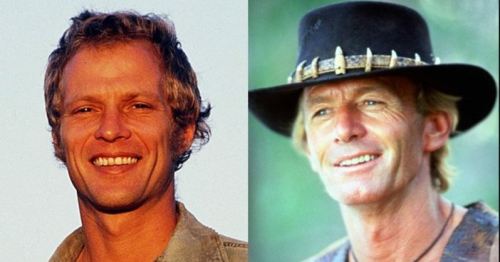
For year’s Hogan, who also co-wrote the script, insisted that the Dundee character was of his own creation, but then later it was found that it was really based on the life of Rod Ansell who in 1977 at the age of 23 got stranded in the wilderness of Australia’s Northern Territory for 7 weeks when the dinghy he was riding in capsized and in the process he fought off a crocodile whose head he kept as a souvenir. His adventures were documented in the film To Fight the Wild, as well as published in a book. He did many TV interviews about his ordeal back in the late 70’s which is where Hogan first became aware of him and then when this film became famous he sued Hogan, but lost the case and the fact that he made no money off of it became a major source of bitterness to him, which lead to his addiction to amphetamines that subsequently lead to his death in a police shootout in 1999.

Here’s a pic of Ansell alongside Hogan’s movie likeness of him:

My Rating: 7 out of 10

Released: April 24, 1986

Runtime: 1Hour 37Minutes

Rated PG-13

Director: Peter Faiman

Studio: Paramount

Available: DVD, Amazon Video, YouTube