Category Archives: Movies Based on Stageplays

Educating Rita (1983)

By Richard Winters

My Rating: 5 out of 10

4-Word Review: Trying to better herself.

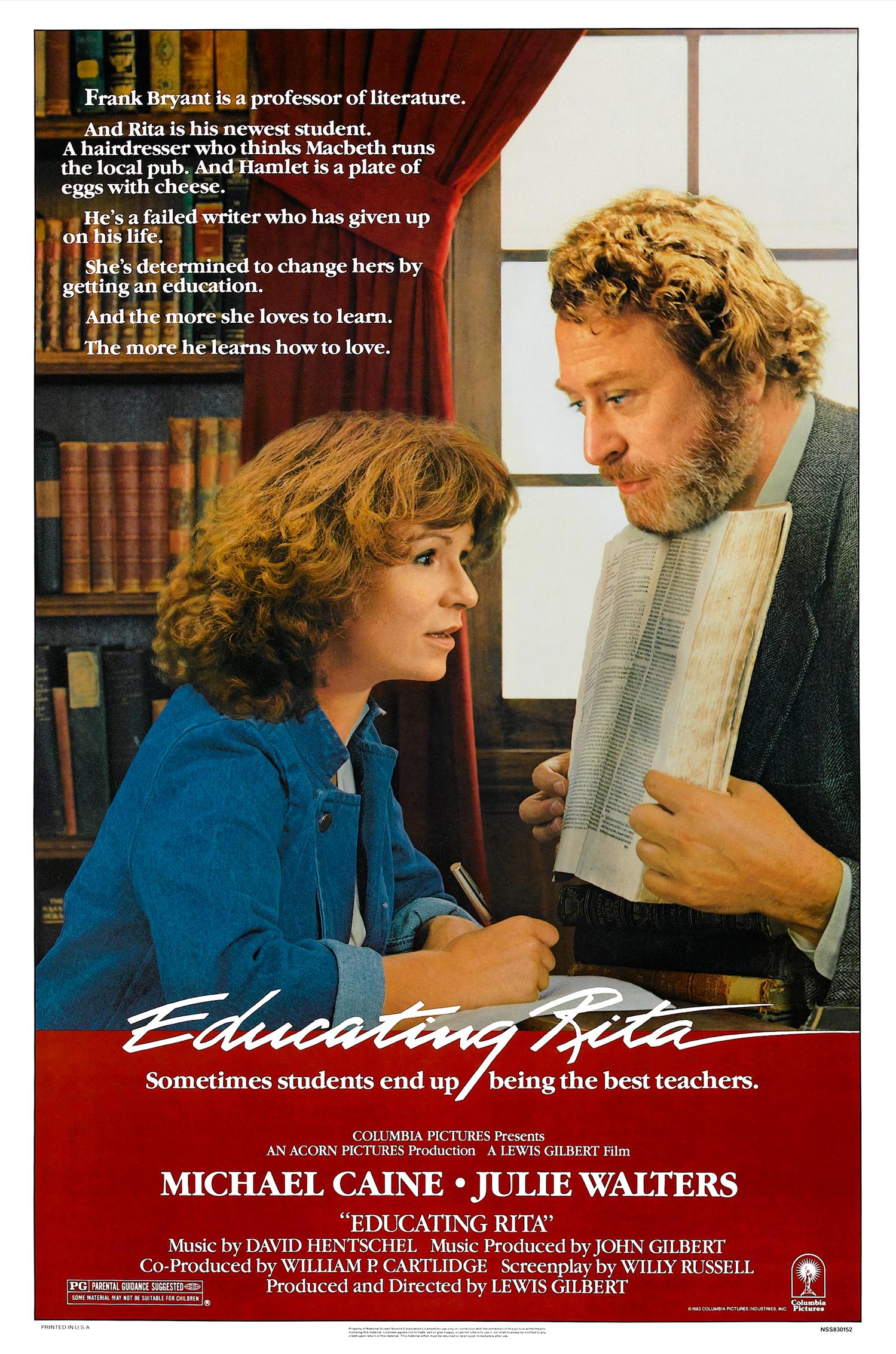
Rita (Julie Walters) is a young working-class woman who finds her job as a hairstylist and marriage to Denny (Malcolm Douglas) to be unrewarding. Denny wants her to have a child, but she fears that will just tie her down more. In an attempt to ‘better herself’ she decides to enroll in Britian’s open university where she takes a course in English literature.  Frank (Michael Caine) is a disillusioned college professor who lost the zeal for his job years earlier and has now taken to the bottle. Rita wants him to be her tutor, but Frank initially resists only to eventually agree. Despite their contrasting personalities the two ultimately form a bond and Frank uses Rita’s passion for learning to reignite his own dormant desires that allows him to breakout of his loveless relationship.  However, Rita too begins to see things differently when her roommate/friend tries to commit suicide and she realizes that things aren’t always greener on the other side of the fence.

The film is based on the play of the same name by Willy Russell that premiered in London in 1980 and also starred Walters in the title role. Unlike the movie the play had only two characters and everything took place inside the tutor’s office.

The story’s theme does have an inspiring quality, which is what galvanized the critics to it, but the main character and her transition is a bit hard to believe. On the surface she’s quite likable and well played by the star, but her ambition seems awfully extreme. It would’ve helped had we seen the moment when she first got the idea to go back to school versus having it just briefly be discussed. Wanting to learn a trade in order to make more money and move out of one’s humble surroundings is both commendable and understandable but becoming well versed on the plays of Henrik Ibsen isn’t really going to do that. To pay the bills she’s still going to be stuck working as a hairdresser, which was supposedly the boring routine she wanted to get out of. Expanding one’s literary knowledge may allow her to have lofty conversations among elites at posh parties, but as a whole she’d still be in her same predicament financially.

The Pygmalion-inspired theme was unnecessary. Without sounding snotty I couldn’t buy into the idea that this working-class woman with a limited education could learn to fully appreciate the great literary works or would even want to. The story acts like all that is needed is a great deal of enthusiasm and you can do accomplish anything, but history is full of people who jump into lofty goals with the best of intentions and still fail. Realistically I think this type of person would’ve eventually gotten overwhelmed and realized she was in over-her-head. To solve this the character should’ve been modified to being someone who was middleclass with a literally background, but who had to drop out because her parents died forcing her to go to work at the factory in order to make ends meet, but still longed to get back into what she really enjoyed and thus hired a tutor to help her, which would’ve been for the discerning viewer easier to swallow.

Rita’s ultimate transition is more off-putting than inspiring. I didn’t like her change in hair color where she goes from blonde to brunette, which makes her seem like a different person instead of someone who’s evolved. There needed to be more challenges and roadblocks. A brief spat with her husband, in which he throws her books into a fire, blows over too quickly and she’s able to grasp the complex material, even able to write in depth term papers with a relative ease that didn’t come off as wholly believable. Having her get a bad grade in a course and using this to reassess her goals would’ve allowed in a broader angle and not have been so fanciful, which the film starts to become.

Caine plays his part wonderfully and he certainly is much more into this role than he was in Blame it on Riowhich he did the same year. However, his character’s motives were difficult to understand. I thought this would’ve been the classic case, which can occur with a lot of academics in higher education, where the students aren’t into learning and are apathetic, which frustrates the professors, and this then turns them to alcohol. Here though that didn’t seem to be the case making him come off more like he was just tuning out on his own accord and thus making him less relatable. I also felt he should’ve been fired much sooner as the young adults attending his classes knew that he was drunk, even verbally said as much, so he likely would’ve been reported, and for him to then on top of this get a second chance when he fell over inebriated during a speech, seemed rather implausible.

I did enjoy the scenes involving Frank’s girlfriend Julia (Jeananne Crowley) and her relationship with a married man named Brian (Michael Williams) and how every time Frank comes into the room, and they are there Brian pretends, as a ‘cover’, that he is speaking to someone on the phone. These scenes, which becomes a running-joke, were amusing, but near the end Frank informs Brian that the phone was disconnected and thus revealing that he was in on their charade. This though doesn’t jive because with the old fashioned rotary phone, such as the ones shown here, there would always be a dial tone when one put the receiver to their ear, except of course if the service had been cut and thus Brian would’ve already known that it had been disconnected when he didn’t hear the tone and no need then for Frank to explain it.

My Rating: 5 out of 10

Released: May 3, 1983

Runtime: 1 Hour 46 Minutes

Rated PG

Director: Lewis Gilbert

Studio: Columbia Pictures

Available: DVD, Blu-ray

Beyond Therapy (1987)

By Richard Winters

My Rating: 3 out of 10

4-Word Review: Therapists nuttier than patients.

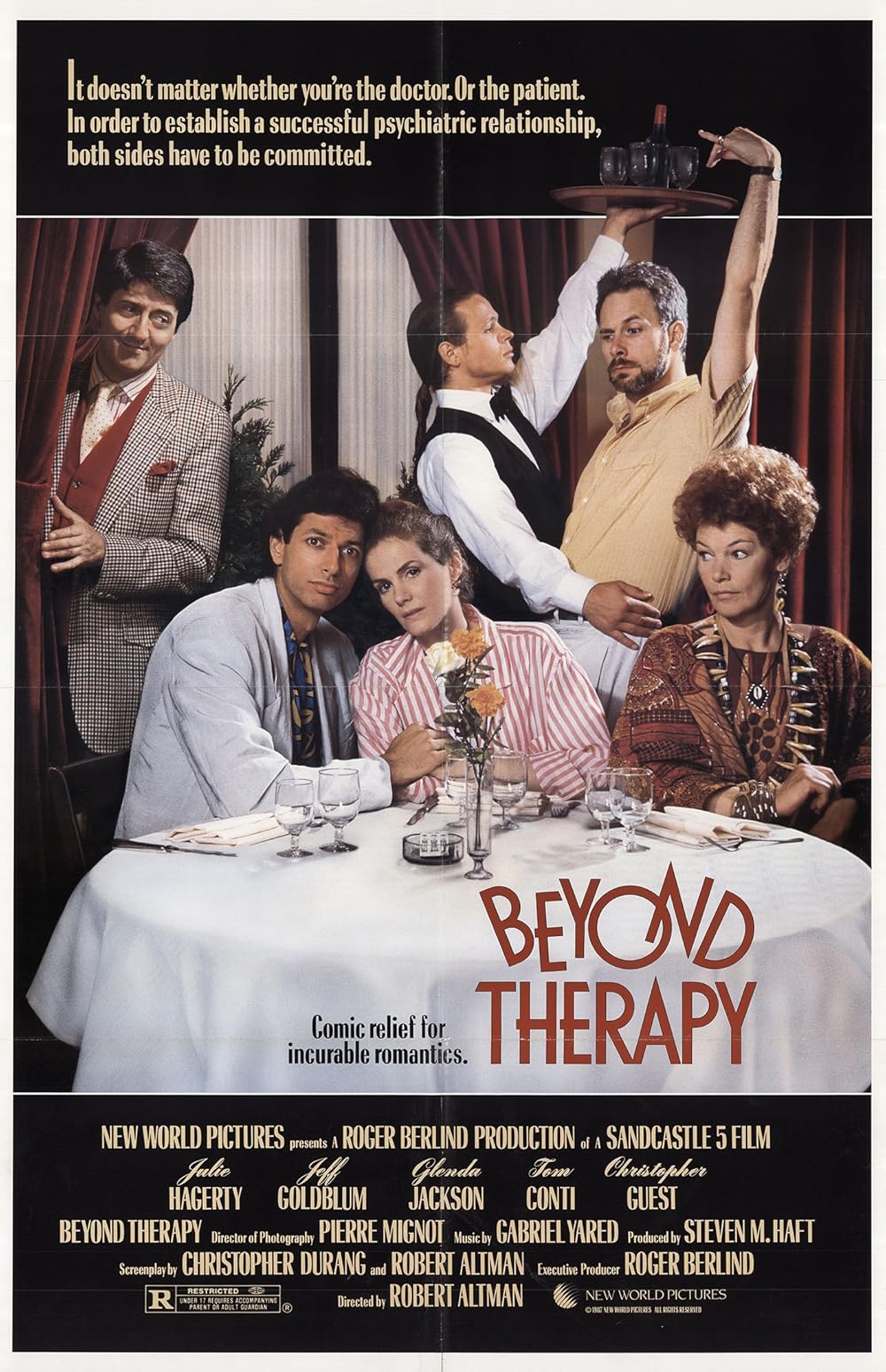
Bruce (Jeff Goldblum) is a bisexual who’s tired of his relationship with Bob (Christopher Guest) and thus decides to place a singles ad looking for a female companion. Prudence (Julie Hagerty) answers and the two meet-up at a restaurant, but they find there’s too many differences between them and fail to hit-it-off. Bruce then goes to Charlotte (Glenda Jackson), his therapist, while Prudence visits Stuart (Tom Conti) who’s her therapist and works in the next room beside Charlotte’s. After some counseling, and at Charlotte’s suggestion, Bob places another ad, but changes some of the personal details, causing Prudence to again answer it thinking it’s a different person. They meet at the same restaurant, but this time things click and they agree to go out again, but Bob and his meddling mother Zizi (Genevieve Page) don’t like the fact that Bruce is seeing somebody else and become determined to ruin the potential relationship as does Stuart, who once had a fling with Prudence, and wants to rekindle the old flame, but only if he can get Bruce out of the way.

The film is based on the hit stage play of the same name by Christopher Durang and while that one got rave reviews this version falls off its hinges right away and a lot of the blame should be pointed at director Robert Altman who rejected the screenplay that Durang had written and instead revised it severely causing Durang to feel that very little of his original work was left and lamenting in later interviews that his experience working on this project was an unhappy one. The story is supposed to be set in New York City, but because Altman was living in Paris at the time he choose to shoot it there, but New York’s ambience, where the single’s scene is quite strong, would’ve helped accentuate the theme and allowed for a more vibrant backdrop versus here where everything takes place in a bland cafe, or in the therapists office, with the exception of a few scenes done in Bruce and Bob’s pad, that hampers the visual flair and makes the production look stagnant and cheap. It also ends with a bird’s eye shot of the Paris skyline, but since everyone was speaking in English and without a French accent it makes it off-kilter, and they should’ve at least pretended it was New York even if it wasn’t.

Goldblum comes off as too detached and thus isn’t effective for this kind of role. Hagerty has her moments and at least gets some laughs, but her open disdain for gay people, along with some of her character’s other quirky hang-ups, may not go over well with viewers. Guest plays the gay lover role in too much of a cliched way making him seem like a walking-talking parody, while Page, as his overprotective mother, is excessively hammy and her exaggerated behavior gets in the way and doesn’t add much.

Jackson is a big disappointment though it’s not all her fault as Altman insists on shooting the majority of her scenes through the window of her office making the viewer feel cut-off from her and like she’s intended to be a caricature. Her confusion over words is more disconcerting than funny. Having a therapist that’s a bit daffy is okay and might even be good enough for a chuckle or two, but here she seems genuinely nuts to the extent that you wonder why Bruce would continue to see her. How she’s able to pick-up words said by Stuart in the other office is never made clear, they also seem to have sporadic sexual rendezvous in the room that’s in-between their offices, but this only gets implied and never actually shown though it should’ve been. Conti’s performance is annoying as he speaks in this fake sounding Italian accent, which he finally drops near the end, but should’ve done way sooner.

There are a few in-jokes in regard to Jackson that I did like. One is a refence where her son, played by Cris Campion, asks her to cry, which she does in a comic sort-of way and I think this was alluding to her performance in A Touch of Classwhere the script asked for her character to cry, but she refused insisting that crying was just something she didn’t do, so here you finally get to hear her do it, which is fun. Later there’s another bit where Bob talks about the movie Sunday Bloody Sundaya film that Jackson was in, though here he describes her as being ‘that English actress’, which is amusing, but would’ve been even funnier had, when he later meets her, he could’ve said ‘you look exactly like the English actress in that movie.’

Spoiler Alert!

While the film does become semi-engaging even with its rough, awkward start it manages to blow it up with a dumb conclusion, which has Bob shooting at Bruce with a toy gun while inside the restaurant. We already know it’s a toy because he tried to use it on Charlotte earlier, so having this extended slow-motion sequence where all the customers duck for cover, doesn’t work and becomes overdrawn instead of funny, or suspenseful. Having the group then remain in the restaurant afterwards and even get served food was equally ridiculous as anyone that would’ve caused that much of a melee would most certainly be asked to leave or arrested by the police for causing a disturbance.

My Rating: 3 out of 10

Released: February 27, 1987

Runtime: 1 Hour 33 Minutes

Rated R

Director: Robert Altman

Studio: New World Pictures

Available: DVD, Blu-ray, Amazon Video, YouTube

Tootsie (1982)

By Richard Winters

My Rating: 7 out of 10

4-Word Review: Pretending to be female.

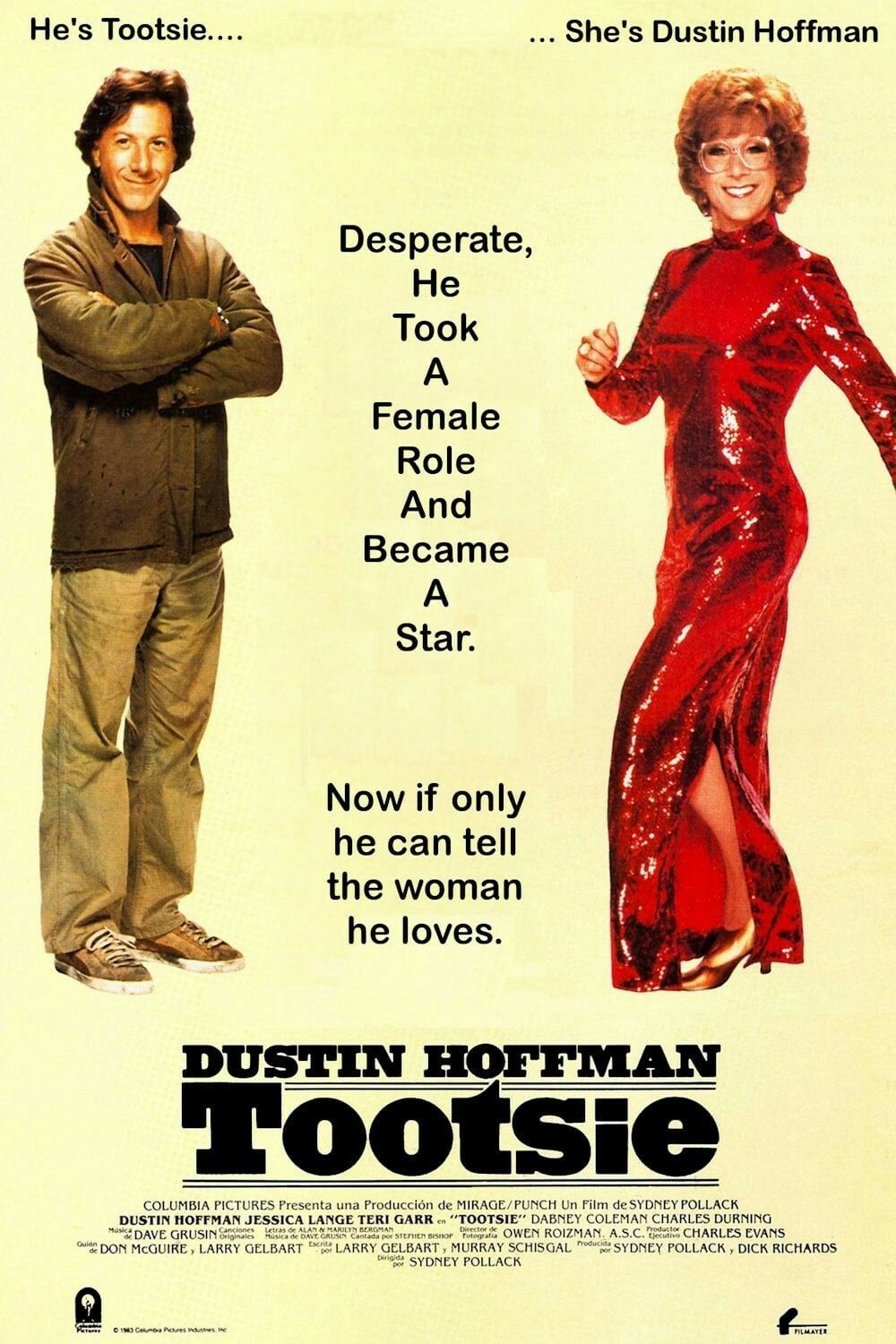
Michael (Dustin Hoffman) is a talented actor but having difficulty finding employment due to his demanding nature and inability to get along with directors. His friend Sandy (Teri Garr) is auditioning for a part in a soap opera, and he helps her prepare for the role and even takes her to the audition only to learn that she was rejected before given any chance to do a screentest. It’s at this same time that he learns his agent George (Sydney Pollack) hasn’t gotten him a chance to audition for another role because in his words ‘no one will work with him’. Michael then decides to disguise himself as a woman named Dorothy Michaels in an effort to get the role that Sandy was turned down for so as to raise money to produce a play that will star Sandy. While he does get the part, he also becomes a big star with everyone believing that Dorothy really is a woman, which cause many complications in both his personal and professional life making him feel like he wants to end the charade and go back to his normal identity, but not quite sure how to do it. 

The genesis for the story began all the way back in 1970 and was based on an off-Broadway play by Don McGuire titled ‘Would I Lie to You?’ about an out of work stage actor who dresses as a woman to get a big part. Director Dick Richards adapted the plot into a screenplay, and it got shopped around for many years, but to no avail. Then in 1980 cross-dressing actor Christopher Morley played the role of a woman named Sally Armitage in the soap opera ‘General Hospital’. The part was played straight with the viewers under the impression that it really was a female, and Sally even gained the romantic interest from the character Luke, played by Anthony Geary, only to eventually reveal that she was really a man, which was a ratings hit and thus lead to renewed interest in this script. Eventually Dustin Hoffman got a hold of it and decided he wanted to take it on under the condition that was given full creative control and even hired his own people, Larry Gelbert and Murra Schisgal, to rewrite the story to his liking. 

Personally, my favorite parts of the film come at the beginning where we see Michael’s struggles as an actor as well as all of his thespian friends giving one a glimpse at just how hard the business is and how few people can make an actual living in it. Watching both him and his roommate Jeff, played by Bill Murray, working as waiters, but still talking about their acting ambitions while on that job was on-target. Garr gives a great performance as a struggling would-be actress who is full of insecurities and letdowns and a perfect composite of many young women who find the auditioning process grueling and thankless and for this reason, I felt she should’ve won the Oscar instead of Jessica Lange as her part as the love interest wasn’t as interesting, or honest. 

Murray is terrific as the roommate in an unusual part for him as his over-the-top clownish, snarky, frat boy persona is kept under wraps and instead he plays the part straight, but his sardonic responses to things are great. Director Pollack, who took on the role of Michael’s agent at the request of Hoffman and thus making it his first acting role in almost 20 years, is quite good too particularly with how his exasperated nature feeds off of Hoffman’s hyper one and their conversation inside his office is the movie’s highlight. Charles Durning has a few key moments as well playing Lange’s lovesick father who begins to fall for Dorothy though any man that would give a woman an engagement ring before they’d even been out on a single date has to be a bit loopy.

Hoffman falls into the woman role easily and it would be hard to recognize him had the viewer not known about the disguise beforehand though I felt the way Dorothy walked and moved her hands and arms made her seem like Mrs. Butterworth the animated character from the maple syrup commercials. It’s also hard to imagine he wouldn’t have been found out a lot sooner especially since he collected a weekly paycheck from the company, which would’ve required him to give them his social security number, which in-turn would’ve exposed who he really was. Being on magazine covers where he supposedly does interviews as Dorothy should’ve been equally problematic as the reporters would’ve asked him (her) about her past like what other stuff did she act in, where was she from, and where did she graduate. Stuff that’s very much standard questions in any interview and when he (she) couldn’t come up with anything or made-up stuff that could easily be background checked would’ve then raised red flags and brought the ruse to a very quick halt.

Spoiler Alert!

Soap operas were no longer broadcast as live and hadn’t been since 1963, so that story angle doesn’t fly either. Yes, I realize the idea was that it was taped and only had to done live as an emergency when one of the tapes got destroyed, but in reality, the taping would’ve been done so far ahead (usually by several weeks) that even if a video did somehow get corrupted there still should’ve been plenty of time to refilm it before reaching the actual air date. 

The ending it a bit disappointing as well. Sure, it’s nice seeing Lange putting her arm around him as they walk down the sidewalk showing that the two had made up after his secret identity was exposed, but it doesn’t answer what happened to his career. He did this whole thing to help finance a play for Sandy, so what became of that? Also, were casting agents so impressed with the way he fooled everybody that they now were willing to hire him, or was he still blacklisted? These were all major motivations for why he did the ruse, so there should’ve been clarity to what became of it. 

My Rating: 7 out of 10

Released: December 17, 1982

Runtime: 1 Hour 56 Minutes

Rated PG

Director: Sydney Pollack

Studio: Columbia Pictures

Available: DVD, Blu-ray, Amazon Video, YouTube

The Prisoner of Second Avenue (1975)

prisoner

By Richard Winters

My Rating: 4 out of 10

4-Word Review: Out of a job.

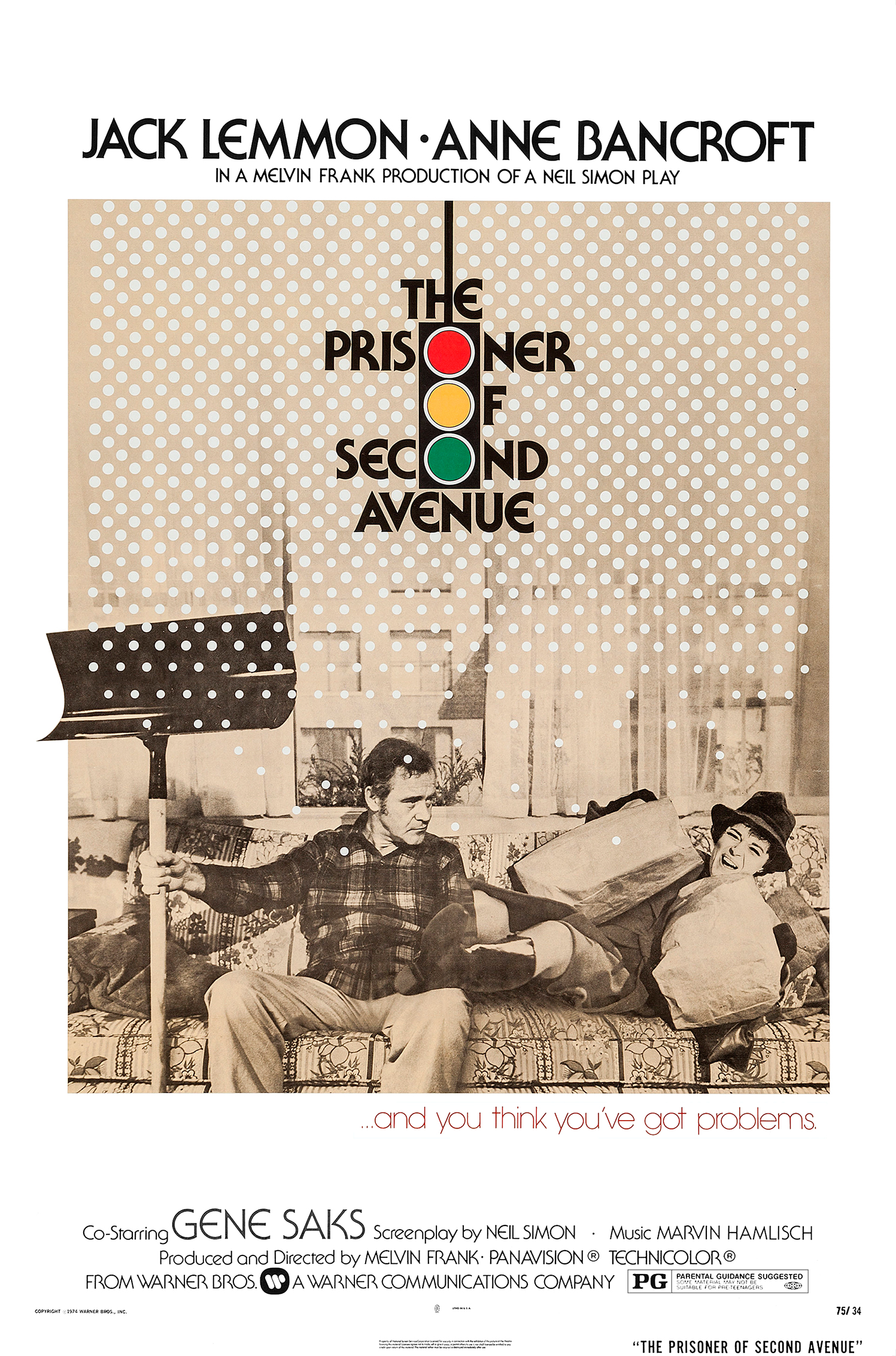
Mel (Jack Lemmon) has just lost his job that he’s had for 22-years and fears that at age 48 it will be hard for him to find another one. Edna (Anne Bancroft) goes out to find employment of her own in order to pay for the bills and while she’s initially sympathetic to Mel’s problems she becomes annoyed at the way he doesn’t do anything about it besides just complain about everything. Having their place get robbed in broad daylight, a garbage collector’s strike, noisy neighbors, and a massive New York heatwave all lead to Mel having a mental breakdown where he begins to believe all sorts of conspiracy theories. He also gets into loud verbal sparring with one of his upstairs neighbors. His brother Harry (Gene Saks) tries to get his two sisters, Pauline (Elizabeth Wilson) and Pearl (Florence Stanley) to chip-in to help pay for Mel’s therapy, but they’re reluctant making Edna feel like she’s in this all on her own while becoming openly frightened at Mel’s deteriorating state.  

The film is based on Neil Simon’s Broadway play of the same name that premiered on November 11, 1971, that starred Peter Falk and Lee Grant. The script was written by Simon but doesn’t do enough to differentiate it from a stage play with a boring visual design that falls flat and barely ever seems to get out of the apartment and when it does the moments are equally uninteresting. The ongoing potshots at New York City living have been done before and nothing that gets said here that is ground-breaking, or even mildly amusing. The plot and humor meanders and are too unfocused to be either riveting, or captivating. 

Lemmon gives a good performance, but he’s played this type of character before and his perpetual complaining about everything and anything quickly becomes tiring. I actually sided with the upstairs neighbor who throws cold water on him when he stands outside bellowing into the night air about his problems, which would annoy anyone. Bancroft’s Brooklyn accent is too affected and her wide-eyed responses to Lemmon’s constant shouting lends no spark making her character come off as transparent. Watching her fight-back a little or even get into a sparring match with Lemmon could’ve added some much-needed comic spark, but for the most part the scenes between them are dull and one-dimensional. 

It’s hard to feel sorry for a guy who makes no effort to help himself. Instead of him being shown moping constantly around the apartment each day in his bathrobe we should’ve seen him going out to job interviews, or even sprucing-up his resume and I was genuinely shocked why none of this happened. How does he really know the job market is so ‘tough’ if he doesn’t venture to go out and test it? Since his wife is able to get a job rather quickly it starts to seem like it’s not so hard to find one making the protagonist and his inactions all the more infuriating. 

Spoiler Alert!

What’s even more confounding is he’s able to somehow ‘snap out of’ his sorry state without actually finding another job. It’s not clear either what event gets him to change his thought patterns he just starts telling everyone that he’s ‘over it’ and back to being his old productive self, but in a good movie this should be seen by the viewer without the character having to explain it. Since he’s still not gainfully employed what’s to say he couldn’t easily fall back into the doldrums and therefore seeing him working at someplace new would’ve been a more complete ending. 

The side-story dealing with him buying a giant snow shovel in order to get back at his neighbor for throwing water on him, isn’t satisfying either. For one thing if money is so tight why waste it on something he really doesn’t need? His revenge plan is a bit confusing too. The idea, I guess, is that he’ll wait for the first big snowfall then climb up on the apartment roof and shovel the white stuff down on the neighbor’s balcony, but this is yet another thing that should’ve been put into action in front of the camera as him just alluding to what he’s going to do isn’t as satisfying. 

My Rating: 4 out of 10

Released: March 14, 1975

Runtime: 1 Hour 38 Minutes

Rated PG

Director: Melvin Frank

Studio: Warner Brothers

Available: DVD, Blu-ray, Amazon Video, YouTube

The Devils (1971)

devils1

By Richard Winters

My Rating: 9 out of 10

4-Word Review: Burned at the stake.

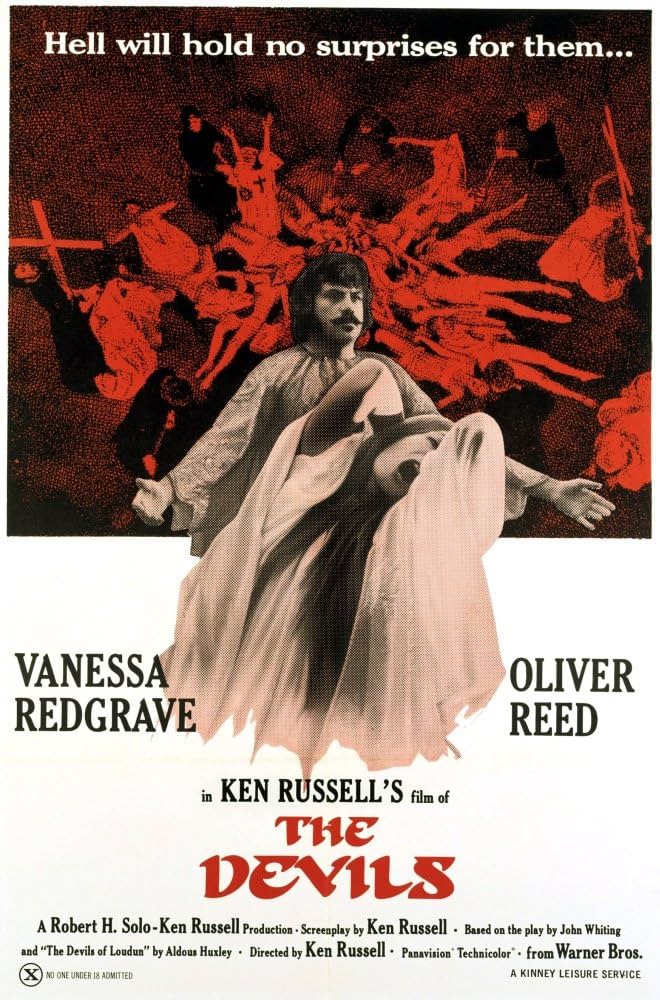
In the year 1634 the governor of Loudon, a small fortified city, dies, making Urbain Grandier (Oliver Reed), a priest with a secretly decadent lifestyle, the one in control. He’s idolized by the townspeople and the head nun at the local convent, Sister Jeanne des Anges (Vanessa Redgrave), secretly has sexual fantasies about him though because she suffers from having a hunch on her back is rarely ever seen outside and Urbain himself doesn’t know she exists. When Urbain secretly marries Madeleine (Gemma Jones) Jeanne becomes jealous causing her to confide to Father Mignon (Murray Melvin) that she’s been possessed by Urbain as well as accusing him of dabbling in witchcraft. This then leads to an inquisition headed by Father Pierre Barre (Michael Gothard) and a public exorcism, which has the nuns in the church strip and perform perverse acts before Urbain and his new wife are arrested and put on trial.

The story is based on the actual event, which was written about in the book ‘The Devils of Loudun’ by Aldous Huxley that was later turned into a stageplay. After the play’s success United Artists became interested in turning it into a movie and signed-on Ken Russell to direct due to his recent success in helming Woman in Love. Russell read the source material and became in his words ‘knocked-out by it’ and ‘wanted others to be knocked-out by it too’. This then compelled him to write an extraordinarily over-the-top script full of sex, violence, and graphic torture that so shocked the studio execs when they read it that they immediately withdrew their initial investment and refused to fund the picture threatening the project from being made even though many of the sets, constructed by set designer Derek Jarman, has already been painstakingly completed, but fortunately for them Warner Brothers swooped-in at the eleventh hour, which allowed the production to proceed.

The film’s release was met with major controversy with many critics of the day, including Roger Ebert who gave the film a very rare 0 star rating, condemning it. Numerous cuts were done in order to edit it down to a version that would allow it to get shown with the original British print running 111 minutes while the American one ran 108. Both were issued with an ‘X’ rating though even these cut out the most controversial scene, known as ‘The Rape of Christ’ segment, in which a group of naked nuns tears down and then performs perverse acts on a giant-sized statue of Jesus. This footage was deemed lost for many years before it was finally restored in a director’s cut version, that runs 117 minutes, that was shown in London in 2002. Yet even today this full version is hard-to-find with Warner Brothers refusing to release it on either DVD, or Blu-ray. They’ve even turned down offers from The Criterion Collection who wanted to buy it. While there was a print Warner released onto VHS back in the 80’s, this same version, got broadcast on Pay-TV, it’s edited in a way that makes the story incomprehensible, and only the director’s cut is fluid enough for the storyline to fully work.

It’s hard to know what genre to put this one into as this isn’t your typical movie and watching it is more like a one-of-a-kind experience that very much lives up to its legend and just as shocking today as it was back then. Yet, outside of all of its outrageousness it is quite effective. Each and every shot is marvelously provocative and the garishly colorful set pieces have a mesmerizing quality. The chief color scheme of white that lines the walls of the inside of the convent seemed to interpret to me the interior of a mental hospital, which helps accentuate the insanity of the frenzied climate. While things are quite over-the-top its ability to capture the mood of the times, the cruel way people treated each other and how they’re all steeped in superstition as well as the dead bodies from the plague that get stacked about, are all on-target and amazingly vivid.

The acting is surreal with both Reed and Redgrave stating in later interviews that they consider their performances here to be the best of their careers. Reed’s work comes-off as especially exhausting as he gets his head shaved and then is ridiculed in a large room full of hundreds of people before burned to death with make-up effects that are so realistic it’s scary. Redgrave, who walks around with her head twisted at a creepy angle, is quite memorable during the scene where she physically punches herself for having sexual fantasies, even puts a crucifix in her mouth at one point and masturbates with a human bone. Dudley Sutton and Murray Melvin with their very unique facial features and Michael Gothard, who initially comes-off with his long wavy hair as an anachronistic hippie flower child, but who becomes aggressively evil as the makeshift exorcism proceeds, all help round-out a most incredible supporting cast.

While the cult following for this remains strong and getting stronger and demand for a proper, director’s cut studio released DVD/Blu-ray is high Warner continues to rebuff the requests. There are though ways to find versions through Bing searches. Streaming services Shudder and Criterion Channel have shown the most complete prints to date, running roughly 111 minutes with most of the controversial scenes, including the Rape of Christ moments though these scenes are of a poorer, grainy and faded color quality since they never went through a professional digital transfer, but overall it’s still one of those movies you should seek-out because not only is it fascinatingly brilliant, but it’s something that could never be  made today and a true testament to the wild, unfiltered cinema of the 70’s that will forever make it the groundbreaking, unforgettable decade that it was.

My Rating: 9 out of 10

Released: July 16, 1971

Runtime: 1 Hour 57 Minutes (Director’s Cut)

Rated R (Originally X)

Director: Ken Russell

Studio: Warner Brothers

Available: DVD-R

Same Time, Next Year (1978)

sametime

By Richard Winters

My Rating: 6 out of 10

4-Word Review: Affair lasts 26 years.

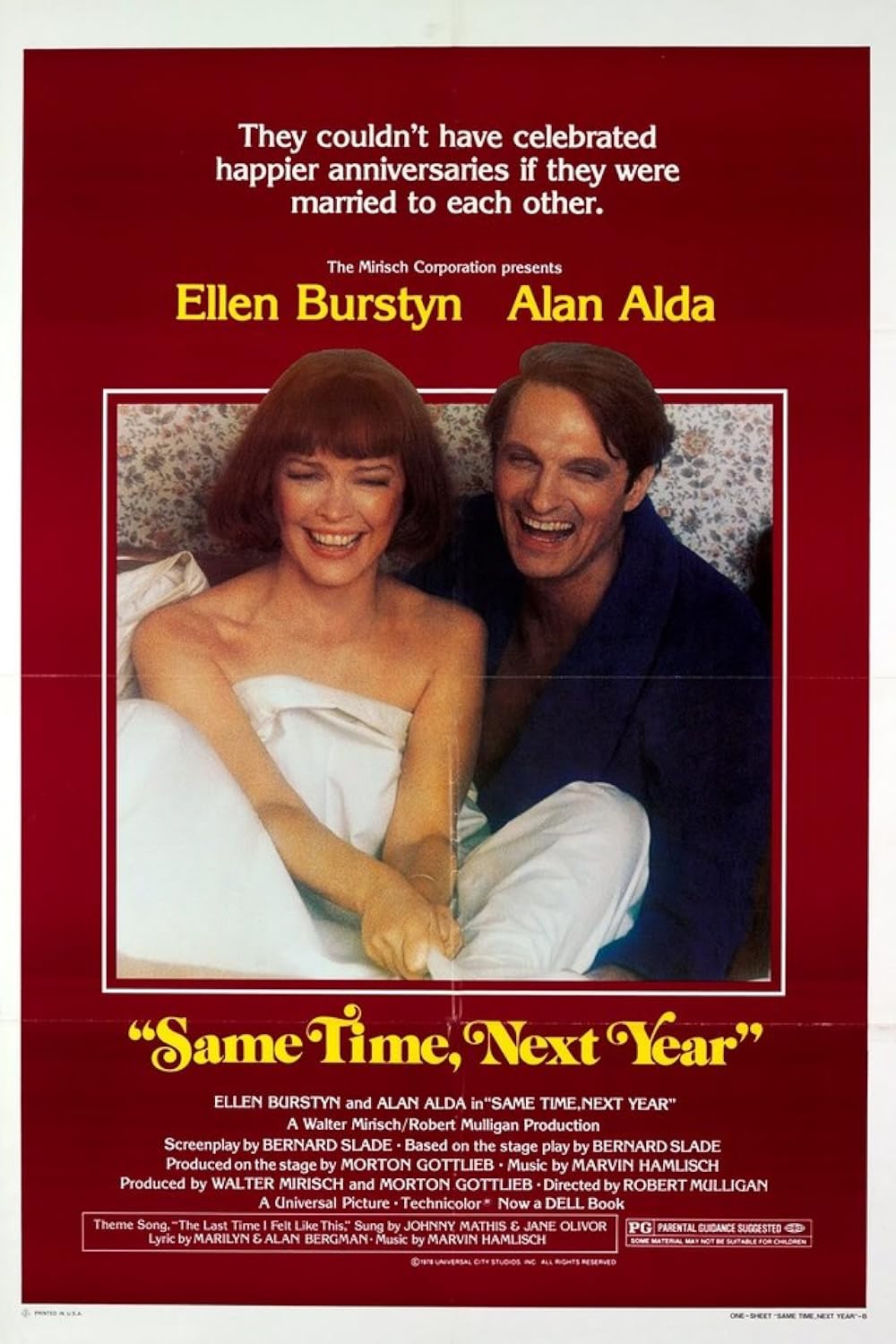
George (Alan Alda) meets Doris while staying at an inn in California in 1951. Both George and Doris are married with kids, but that doesn’t stop them from having a tryst while they’re there since neither of their spouses are with them. They decide to continue to meet each year at the same time and inside the same oceanside cabin. This reoccurring rendezvous lasts all the way up to 1977 and they go through many changes both in their personal lives and personalities, but remain in-love with the other despite never divorcing from their spouses.

While there’s a definite Neil Simon quality to the dialogue and situational comedy it was actually written by Bernard Slade who at that time was best known for creating the sitcoms ‘The Flying Nun’ and ‘The Partridge Family’. Originally it opened as a play on March 14, 1975 and starred Ellen Burstyn and Charles Grodin and ran for 1,453 performances. Slade also wrote the screenplay to which he was nominated for an Oscar.

While the interiors were filmed on a soundstage the outer portion of the cottage was built specifically for the film and when shooting was completed it was decided to move this foundation to a location in Little River, California with the interiors fitted with the furnishings that had been used on the soundstage during filming and then allowing couples to rent it out. This became so popular that the cabin was split into two with one called ‘Same Time’ and the other ‘Next Year’ and can still be rented out for a romantic getaway to this very day.

While the film stays faithful to the stage version I felt there should’ve been added context revolving around how they meet. We see them first making contact as they enter the inn to check-in and then they have dinner at separate tables before Alda invites himself over to eat at Burstyn’s, but we never hear their dialogue and instead get treated to sappy music, which could’ve easily been chucked and not missed. It also fails to answer one of the plot’s more crucial questions: why would a married woman with kids be traveling the countryside all by herself? For Alda it could make some sense as it was socially acceptable for a man to be traveling single for business reasons, but woman at that time were pretty much stuck in the home doing the majority of the child rearing, so what would her reason be for being out on the road all alone? Maybe she was visiting relatives, but you’d think if that were the case they’d let her stay at their place, or she’d bring her kids along, but either way there needed to be an explanation and there isn’t any.

The fact that they’re able to continue to do this for literally two and a half decades without the spouses finding out for the most part begs a lot of questions. What excuses were they giving their families, so that they could continue to keep meeting at the exact same time of year? Having an angry spouse secretly follow them and then unexpectedly show-up could’ve added some extra spice and if this situation had occurred in real-life most likely that would’ve ultimately happened.

While this may sound like nit-picking I had issues with the cabin setting too. Don’t get me wrong it’s scenic and I loved the outdoor moments where you get a great view of the shore and pine trees, but the interior of the place should’ve changed, or been updated with the times instead of the furniture and the placement of it looking virtually the same for 26 years. Make-up work could’ve been done on Ivan Bonar who plays the Inn’s owner and while the two stars age in interesting ways he remains ancient looking right from the start and never changes.

On the plus side I found both Burstyn and Alda to be fabulous and I enjoyed their comic, and sometimes dramatic, interplay even though their transitions in personalities proves a bit problematic. Normally as people age their attitudes and perspectives can shift, but it’s more linear and not herky-jerky like here. For instance during the 60’s Burstyn gets into the flower child movement only to, by the 70’s, become a business owner and a part of the establishment. Alda too goes from hardcore conservative during the 60’s, even admitting to voting for Barry Goldwater, to necklace wearing lib by the 70’s, which seemed like these characters were just conforming to the trends and attitudes of the day like caricatures instead of real people.

Spoiler Alert!

All of the quibbles listed above I could’ve forgiven, but the ending I found annoying. I actually liked the idea that George’s wife dies and he meets someone else and she won’t allow him to keep seeing Burstyn, so he then puts pressure on Burstyn to divorce her husband and marry him, which she refuses, so he then walks-out. This I found to be very realistic as most affairs don’t last this long anyways, so the memories and good times they had would be treat in itself and should be left at that. For Alda then to walk back-in and say it had all been a lie and they could continue to get together ‘forever’ was too far-fetched for a concept that had been pushing the plausibility to begin with. Everything needs to end at some point as even ‘perfect marriages’ will stop when one partner dies. The audience saw the first meeting, so they should’ve been treated to the last one too. Even if it meant having them elderly and entering with their walkers it should’ve been shown and the story given, one way or another, a finality of some sort.

My Rating: 6 out of 10

Released: November 22, 1978

Runtime: 1 Hour 59 Minutes

Rated PG

Director: Robert Mulligan

Studio: Universal

Available: DVD-R

A Day in the Death of Joe Egg (1972)

deathjoe

By Richard Winters

My Rating: 9 out of 10

4-Word Review: Caring for disabled child.

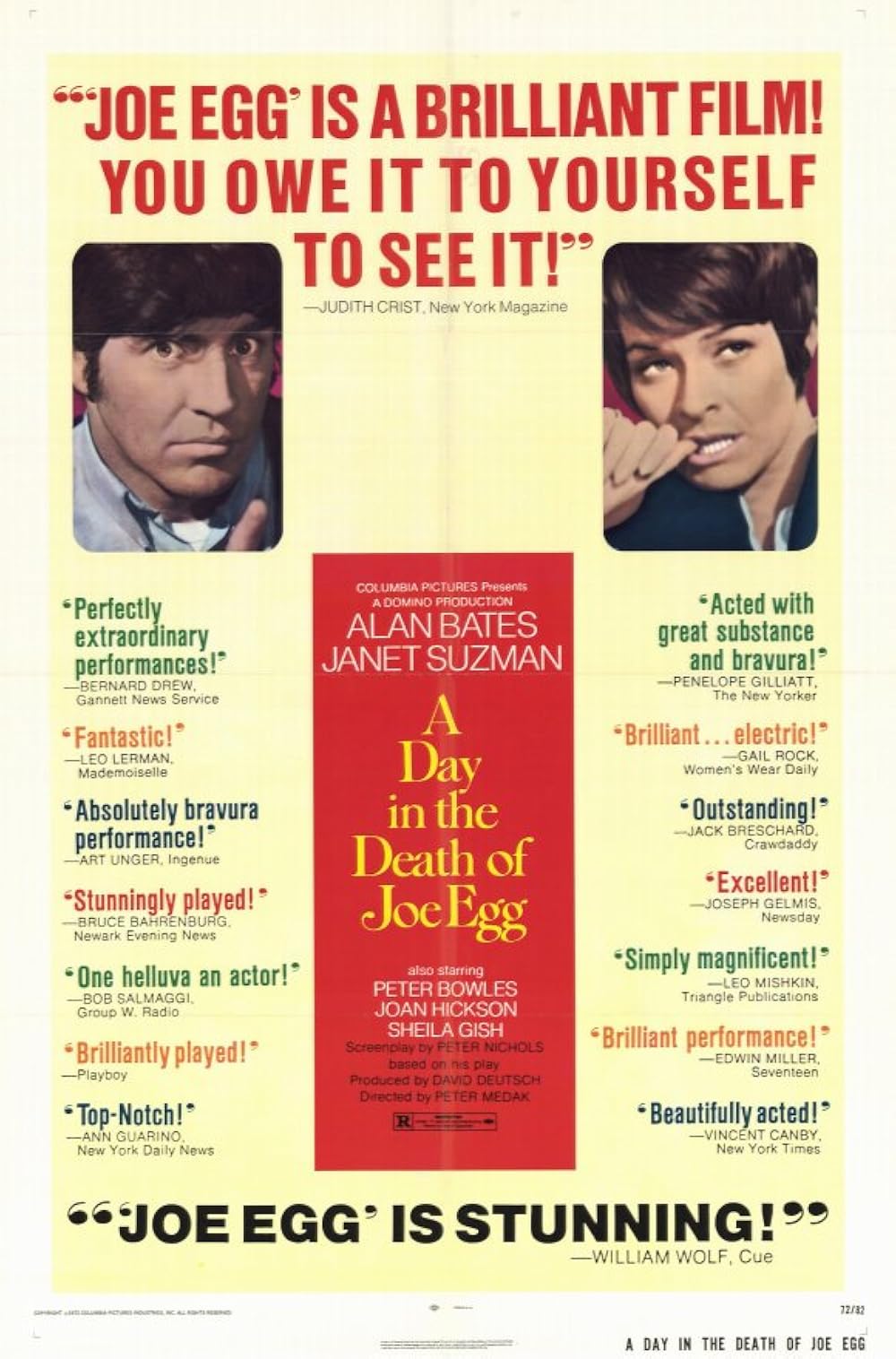
Bri (Alan Bates) and Sheila (Janet Suzman) are a British couple caring for their daughter Josephine (Elizabeth Robillard), who they’ve nicknamed ‘Jo’ or ‘Joe Egg’. Sheila had a narrow pelvic, which caused Jo’s birth to be a difficult one. The couple had wanted the delivery to occur at home, but due to the complications they were forced to go to the hospital. Initially Jo seemed to be a healthy baby, but she began to suffer from ongoing seizures that eventually put her into a coma. She never came out of it and by age 10 sits in a wheelchair unable to speak, care for herself, or show any type of emotional response to anything. Bri and Sheila pretend to have ‘conversations’ with her in an attempt to lessen the stress of caring for her. Bri feels she should be placed in an institution, but Sheila won’t hear of it, which causes a rift to form in their marriage. Eventually Bri becomes so frustrated with the situation he begins to consider killing Jo and even starts to joke about his intentions to not only his wife, but also their friends (Peter Bowles, Sheila Gish).

The film is based on the stage play of the same name written by Peter Nichols who used his own experiences of caring for a child with cerebral palsy as the basis for the story. It premiered at the Citizen’s Theatre in Glasgow, Scotland in 1967 before eventually moving to Broadway a year later where it starred Albert Finney and Zena Walker and won rave reviews. The movie was filmed in 1970 and completed on time, but the studio decided to then shelve it fearing due to the downbeat storyline that they’d have no way to market it and it would be unable to find an audience. It was only after Suzman’s acclaimed performance in Nicholas and Alexandra that they eventually released it to theaters hoping to capitalize off the attention she got from that one in order to get people to see this one.

Many sources refer to this as being a ‘black comedy’, but I found absolutely nothing funny and in fact it’s instead brutally bleak. I guess the humor as it were was in the way the parents have ‘conversations’ with the kid, but this doesn’t really come-off as being even the slightest bit amusing particularly when you have the child just sitting there with her eyes rolled-up in her head and resembling someone who has died.

This doesn’t mean I didn’t like the film as in-fact I found it quite powerful, but clearly much more from the dramatic end. I admired the way it pulls-no-punches and forces the viewer to confront some very uncomfortable questions like what is the point of caring for a child that will never be able to recognize them, or show any response, or emotion to anything? Granted there’s many kids with disabilities out there and some can grow to lead productive lives, but when one is in a literally vegetable state such as this it does make it infinitely more severe and emotionally challenging. Director Peter Medak approaches the material, which is certainly no audience pleaser, in an earnest way with many varied cutaways and dream-like segments including one memorable moment where Bri and Sheila are on a gray, stormy beach and he imagines throwing the baby carriage that the child is in into the sea, which helps give the production a moody, surreal-like vibe and keeps it on the visual scale quite inventive.

The acting is superb especially Suzman whose character must deal with the inner turmoil of dealing with the stark reality a child who won’t ever grow into anything, but also a husband, whom she loves and is emotionally dependent on, who wants out. It’s interesting too seeing Sheila Gish in a supporting role as a friend who places a high degree on physical appearance and can’t stand anything that is ugly, or deformed and yet she in real-life many years later lost an eye to skin cancer and was forced to walk around with an eye patch.

I was most impressed though with Robillard whose career never really took-off, but proves up to the challenging task here and was picked out of over 100 other children who auditioned for the role. Remaining motionless and unresponsive and whose only noise is periodic moans isn’t as easy as you’d think especially when everyone else is moving and speaking around you. The best moments of the whole movie is when Sheila envisions what Jo would be like if she were a normal kid and we see shots of her jump roping and playing with the other children, which effectively accentuates their sad situation even more.

Spoiler Alert!

The ending, where Bri essentially runs away from home and leaves Sheila alone with the kid, I felt was realistic and most likely what would happen to most any couple stuck in the same environment. The shots of seeing Sheila lying down in bed fully aware that Bri is gone and looking almost at peace with that to me spoke volumes. My only complaint is that I felt the couple’s tensions and cracking of their relationship should’ve been apparent right from the start. They seemed to get along too well at the beginning, but with the child already age 10 by that point and with no signs of ever getting better I felt there should’ve already been plenty of arguments and disagreements and sleeping in separate bedrooms instead of showing them still having a robust sex life and only by the second act do things finally start falling-apart between them.

My Rating: 9 out of 10

Released: June 4, 1972

Runtime: 1 Hour 46 Minutes

Rated R

Director: Peter Medak

Studio: Columbia Pictures

Available: DVD-R

Absolution (1978)

absolution

By Richard Winters

My Rating: 7 out of 10

4-Word Review: Pranking a strict priest.

Father Goddard (Richard Burton) is the head of an English Boy’s School and uses his influence to control those who attend and is unflinching on his policies. Goddard constantly displays a cold and detached demeanor particularly with Arthur (Dai Bradley) a handicapped student that the Father doesn’t seem to care for. Benjie (Dominic Guard) on the other-hand is the teacher’s pet and routinely shown favorable treatment. Benjie though grows to resent the Father’s stern ways when he’s told he can no longer visit with Blakely (Billy Connolly) a motorcycle riding vagabond who has set-up an encampment just outside of the school grounds. Benjie decides to play a prank on the Father after hearing the lecture about the seal of confession, which a priest cannot break even if what he’s told is about a murder, so during confession Benjie tells Goddard that he’s murdered Blakely. Goddard initially doesn’t believe him, which sets off a myriad of twists that soon sends Goddard’s life, career and even his sanity spiraling out-of-control.

After the success of The Wicker ManAnthony Schaffer was commissioned by director Anthony Page to write another script that could be made into a movie and Schaffer decided to choose one that had initially been meant as a stageplay, but had never been produced. However, once Schaffer had completed his adaptation Page was unable to find a studio willing to fund it and he was ultimately forced to use his own money and Burton agreeing to slash his normal fee in order to get it made.

The lack of a budget is sorely evident at the start featuring a grainy print with faded color and what initially seems like misplaced banjo music that would be considered more appropriate for a film set in the American south instead of England. Having it shot on-location at Ellesmere Collage helps as many of the local pupils played the students here and the film gives-off a realistic atmosphere about what a boys school would be like with all of the kids looking age appropriate for their grade level and not like, as with other teen school movies, older actors in their 20’s trying to come-off as if they were still adolescents.

Billy Connelly, in his film debut, is terrific and it’s fun seeing Bradley, who was better known for his starring role in KesBurton though is the standout as his jet setting persona that he had at the time with Elizabeth Taylor gets completely erased and he fully sinks into his role of a steely-eyed, cantankerous man who rules with a rigid, iron-fist and whose simple presence wields terror in the boys as he walks-by and to some extent the viewer too. It’s a commanding performance that helps the movie stand-out.

Spoiler Alert!

The story though, while intriguing, doesn’t fully work. It becomes obvious that Goddard is being tricked by the boys, but you feel no empathy for his quandary. He has spent so much time up until then being a jerk that you end up siding with the boys, at least initially, which seriously hurts the tension as normally in a thriller/mystery such as this you’re supposed to side with the protagonist and want to emotionally see them get out of their predicament. Here though you like his mental breakdown and not as invested in finding out the resolution beyond it. The final explanation, dealing with the Arthur character supposedly disguising his voice to sound like Benje’s is too much of a stretch and ultimately hurts the credibility.

Shaffer stated in interviews that this was not meant to be an anti-Catholic movie, but I feel he said this in order not to alienate potential viewers as it’s clearly written by someone who grow-up in the church and had many problems with it. Father Goddard is more a caricature meant to represent Catholicism as a whole and how the religion with its very rigid rules ends up trapping those who follow it with a damned-if-you-do, damned-if-you don’t scenarios leaving its followers in a perpetual state of guilt and paranoia. This becomes quite evident at the end where the Father feels unable to break his seal of confession for fear of divine wrath, but also fears it for the murder he committed and his thoughts of suicide that would equally lead him to hell, per the teachings, making him more a victim of the religion than of the boys, which I feel was the whole point.

My Rating: 7 out of 10

Released: December 8, 1978

Runtime: 1 Hour 35 Minutes

Rated R

Director: Anthony Page

Studio: Bulldog Productions

Available: DVD, Blu-ray, Amazon Video

Equus (1977)

equus1

By Richard Winters

My Rating: 6 out of 10

4-Word Review: Teen blinds six horses.

Martin (Richard Burton) is a disillusioned, middle-aged psychiatrist who gets tasked with finding out why a 17-year-old boy named Alan (Peter Firth) blinded six horses one night in a stable with a sickle. At first Alan is uncooperative during their sessions and will not speak to him and instead sings out commercial jingles repeatedly, so Martin must go to Alan’s parents (Colin Blakely, Joan Plowright) in an effort to find some answers. It is here that he learns the mother is highly religious and taught her son that ‘God sees all’ particularly when it comes to sexual transgressions. Alan though has replaced God with his obsession with horses and idolizes them instead where he essentially makes them his ‘deity’. Martin now must try to break the boy away from this fanaticism in an effort to make him ‘normal’, but realizes when he does that the kid will cease to have passion and become like Martin himself who no longer has any emotions for anything including his own wife whom he no longer shares intimate relations.

Director Sidney Lumet has always had a penchant for turning plays into a movies and with some of them he’s had great success like with 12 Angry Men, but some of his other efforts did not fare as well. This project was met initially with a lot of apprehension, but overall Lumet’s directorial flair adds a lot and cinematically it works for the most part. The effort to get away from the staginess of the story by having several scenes done outdoors, like Martin having a discussion with his friend played by Eileen Atkins, about the case while raking leaves I felt really worked. Again, with cinema you have to have the characters doing something during the dialogue even if it’s some sort of chore as there’s nothing more stagnant than talking heads in a movie. The opening sequence done over the credits is well done too as it features Martin dealing with hostile patients hitting home the point of how burnt-out with his career he is without having it told to us and the white color schemes accentuates the tone one is most likely to see in hospitals.

The controversy came with the portrayal of the horses. In the play there were performed by muscular men inside a horse costume, but for the movie Lumet decided they needed to use real animals. This is okay until it comes to the scene where they get blinded. The play version only intimates the violent act, but with the movie you actually see the sickle go right into the horses’ eyes, which is so realistically done I don’t know how they did it without hurting the animal. This was way before computer effects, so just be warned if you’re an animal lover these scenes may be too graphic to bare and could easily take some viewers out of the story to the extent they may not be able to get back into and might just turn it off altogether.

The casting is a bit problematic. Both Burton and Firth played the roles in the stage version, but by this point Firth was no longer looking like a 17-year-old, he was in fact already 23. I admire his bravery to ride a horse in the nude in one of the movie’s more memorable moments, but he still resembles adult features physically taking away the innocence of the character and the shock of how someone so young, i.e. a teen. could commit such a vicious act. Burton too looks too worn out having spent this period of his career battling alcoholism. Some may say that this fit his role, but his presence seems at times almost lifeless and like he’s just walking through his part. The segments where he speaks directly to the camera become long-winded, stagey and aren’t effective.

The story itself may not work for everyone. It was inspired by a true event, which occurred in 1954, that playwright Peter Shaffer heard about, but did not actually investigate. Instead he wanted to come up with his own hypothesis on how someone could do what this character does without learning the real reason that motivated the actual culprit. Some may find the teen’s motivation here to be interpretive and revealing while others will blow-it-off as pseudo psychology and not able to fully buy into. For example certain viewers will find the scene where the father catches the boy kneeling in front of a picture in his bedroom of a horse and ‘worshipping it’ while wearing a make-shift harness to be quite disturbing though with others this same segment may elicit a bad case of the giggles instead.

My Rating: 6 out of 10

Released: October 14, 1977

Runtime: 2 Hour 17 Minutes

Rated R

Director: Sidney Lumet

Studio: United Artists

Available: DVD, Blu-ray

Ten Little Indians (1989)

tenlittle

By Richard Winters

My Rating: 3 out of 10

4-Word Review: Everybody is getting killed.

Ten strangers get together on an African safari. The group includes: A doctor (Yehuda Efroni), a judge (Donald Pleasance), a captain (Frank Stallone), an actress (Brenda Vaccaro), a General (Herbert Lom), a nanny (Sarah Maur Thorpe), a detective (Warren Berlinger), along with a man named Marston (Neil McCarthy), and a couple with the surname Rodgers (Paul L. Smith, Moira Lister). They’ve been invited by a man named Mr. Owen, but upon their arrival he’s nowhere to be found. Instead they hear his voice that’s been recorded onto a phonograph where he tells them that they’ve been invited because they’ve been accused of committing a crime years ago and gotten away with it, but he intends to put a stop to that by killing them off one-by-one. As each guest gets murdered one of the heads from the ten little Indians statues that sits in the middle of the dining room table goes missing.

The film has the distinction of being the third movie version of the story done by producer Harry Alan Towers as the first one was produced in the 60’s and the second, which also starred Lom, in the 70’s. The story itself is based on the Agatha Christie novel ‘And Then There Were None’ though the ending was changed to replicate the stage play, which was considered more upbeat. While in the novel and play the setting was an island here it’s the desert of South Africa, which I liked as it gives the proceedings a distinct atmosphere. However, there’s an unusual moment at the beginning where the natives help carry the guests’ luggage to the camp site, but then halfway there for no explicit reason they turn on them by clicking their tongues in unison and ultimately abandoning them, which is creepy, but there’s never an explanation for why they do this.

The landscape looks hot and dry though there’s no sweat glistening off the actor’s faces leading me to believe it was shot in the winter time and thus the complaints about the heat, which are casually mentioned are invalid. I did get a kick out of one of the tents, the main one, having an upright piano. Don’t know who in the world would want to painstakingly haul a piano into the desert sands, or essentially the middle of nowhere, but the appearance of it gave me a chuckle. I was also amused by the elevated lift, held together by a frayed rope, that each guest is forced to sit-in as it takes them many feet in the air of a wide gorge, in order for them to get to the campsite. The contraption looks flimsy and it’s rather unnerving seeing them get into it and ride it all the way down.

The acting is entertaining and made-up of many B-stars whose faces you’ll recognize though not necessarily their names. Vaccaro fares best as a bitchy, spoiled, Hollywood star whose career has gone on the decline. Lom is good as an aging man whose memories plays tricks on him, but Stallone, who’s the younger brother of Sylvester and could almost pass of as his twin, has little to add. Berlinger had gained a lot of weight to the point that he’s rounder than a beach ball, is adequate, but the normally reliable Pleasance appears elderly and lacking energy making his presence almost sad. Smith continues in the mold of the jail guard in Midnight Express, a part that made him famous, but his heavy breathing and lurking ways are not interesting and his acting one-note.

The mystery angle doesn’t get played-up too well as the guests get killed-off with a boring regularity making it at times seem almost like a low-grade slasher. The characters don’t respond to their stressful conundrum realistically. For instance one of the guests dies by drinking alcohol that was linked with cyanide, but the rest of them in the ensuing days go on eating and drinking even though you’d think they’d be nervous about ingesting anything for fear that whatever they put in their mouths could also poisoned. They also go back to their tents each night and peacefully sleep despite seeing the other guests get offed by a unseen killer, which would’ve made me, and most others too fearful to get any shut-eye and instead stay wide awake for fear that the killer would attack the minute anyone closed their eyes.

Spoiler Alert!

The tension is nil and there’s really no interest in finding out who the culprit is. In the book everyone dies and the authorities are only able to figure out what happened from a message that they find written by the judge. Here both Stallone and Thorp make it out alive though Thorp lets go of the rope that had been around her neck just as Stallone comes to her rescue making me believe that she would’ve hung herself before he would’ve been able to get her out of the noose. The rescue plane flies over them instead of landing making it unintentionally seem like they had been left stranded and not saved after all. Having everyone die except for Stallone, which is what I thought was going to happen, and then having him arrested for the murders he really didn’t commit would’ve been a much more ironic twist.

My Rating: 3 out of 10

Released: May 17, 1989

Runtime: 1 Hour 38 Minutes

Rated PG

Director: Alan Birkinshaw

Studio: Cannon Films

Available: Blu-ray, Tubi