Category Archives: Movies Based on Novels

Slugs (1988)

slugs

By Richard Winters

My Rating: 5 out of 10

4-Word Review: Town overrun by mollusca.

Mike Brady (Michael Garfield) is a health inspector of a small town who’s finding its residents being killed and skinned by some sort of mysterious entity and the only clue are trails of slime that it leaves behind. Later, Mike and his friend Don (Philip MacHale), who works for the sanitation department, along with high school science teacher John Foley (Santiago Alvarez) determine that the culprit are slugs whose unusual aggressiveness may be tied to leakage from an abandoned chemical waste dump.

Based on the 1980 novel of the same name by Shaun Hutson the script follows the book version closely. Director Juan Piquer Simon is best known for the gory cult hit Piecesbut this movie fares a bit better on the technical end. I liked that it was shot on-location in the US, Lyons, New York, where the fall setting helps accentuate a spooky Halloween feel as Simon’s other horror film was done in Spain, but pretended to be Boston though it was easy to see the difference. The tone is a bit more playful, particularly the bouncy score, and seems to be trying for a light tongue-and-cheek approach though it could’ve used more humor and worked better had it went full into a comedy-horror versus trying to play it completely straight, which doesn’t work.

A lot of the problem is buying into these slugs being that dangerous. They’re small, slow, and squishy and can be easily smooshed with any type of hard object. Having people getting overrun and attacked by them just doesn’t seem believable. The film tries to compensate for this by showing the victims after they’ve been devoured, but a person would have to be awfully slow and inept not to be able to get away as all they’d have to do is just step on the things to eradicate them, which makes the whole concept of them being this threatening aggressor rather lame. I did though like the segment where a couple is busy making love and thus don’t notice the slugs coming into their room and ultimately have their nude bodies covered by them when they fall onto the floor, which has a provocavtive quality and I might give some credit to the final scene where Don gets attacked by them while underwater, but the rest of the slug killings come-off as exaggerated and more unintentionally comical than scary.

The fact that the town’s mayor (Manuel de Blas) refuses to listen to Mike and won’t cut-off the town’s water supply in an attempt to keep the slug infestation (they travel through the pipes) under control is too reminiscent of JawsIn Jaws seeing an elected official refusing to heed the warnings was interesting as it showed how greedy politicians can be just as much a threat to the people as a monstrous shark and maybe even more so, but here the confrontation comes-off as derivative and the actor playing the mayor isn’t as talented as Murray Hamilton who was able to make his character, as slimy as he was, fun and engaging.

The two actors who play the leads are especially bland and it’s no surprise that neither of them had much of a career in front of the camera. Both look like they’d be better suited on a soap opera, and MacHale was a cast member on both ‘Somerset’ and ‘One Life to Live’ as they have chiseled good looks, but a benign presence. In some ways it was refreshing not having teens cast in the lead as so many other horror movies do that, but there still needed to be adult characters that were interesting and multi-dimensional and these guys certainly are not. The lead guy needed some sort of fatal flaw, or some inner weakness he had to overcome that would make him unique, but instead it’s just John Suburbia going through the motions, which for me wasn’t captivating at all. A viewer needs to actually care about these people to get into it and since that doesn’t happen I found the whole thing to get pretty boring the more it went on though the movie poster is cool.

My Rating: 5 out of 10

Released: February 5, 1988

Runtime: 1 Hour 29 Minutes

Rated R

Director: Juan Piquer Simon

Studio: New World Pictures

Available: DVD, Blu-ray, Amazon Video, Tubi, YouTube

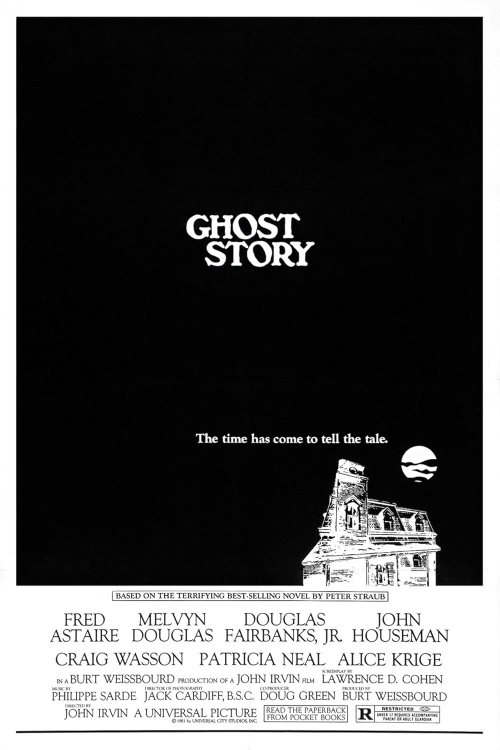
Ghost Story (1981)

ghost1

By Richard Winters

My Rating: 7 out of 10

4-Word Review: Four men carry secret.

Four elderly men, Ricky (Fred Astaire), John (Melvyn Douglas), Edward (Douglas Fairbanks Jr.), and Sears (John Houseman), who all live in the same small Vermont town and are lifelong friends who call themselves the Chowder Society, get together each week to tell each other ghosts stories. Then Edward’s son Don (Craig Wasson) dies after falling out his apartment window. The men begin having reoccurring nightmares focusing on Eva Galli (Alice Krige) a woman they once knew 50 years earlier. Has she come back from the dead to haunt them and their family members? And just exactly what happened to her as she seemed to have left town without a trace? Only the four men seem to know the answer to this and all of them guard this secret quite closely, but once David (Craig Wasson) comes to town, who is Edward’s other son, he becomes determined to break their silence.

The film is based on Peter Straub’s epic novel, which was released in 1978 and was 483 pages long. Many fans of the book complained that the movie overly simplified the plot, but there is just no way you can condense a long book into a two hour screenplay and for what it’s worth I think both director John Irvin and screenwriter Lawrence D. Cohen did the best they could and if anything this might’ve worked better as a TV-miniseries where many of the story’s dramatic angles could’ve been played out more. My main complaint is that in the novel Eve Galli character was portrayed as being a manitou who could change shape being a small child at one point and a wasp at another and the film would’ve been scarier had it taken that approach.

I also didn’t like Wasson, who’s great for giving a deer-in-headlights-look, but not much else, playing both the brothers. I can’t remember if they were twins in the book, or not, but having them be twins here wasn’t integral to the plot and makes it a bit confusing. For instance when the brother falls out the window, where he is naked and full frontal nudity showing, which was bit daring at the time for males, the next shot shows Wasson, as the twin, waking out of deep sleep making it seem incorrectly that it had all just been a dream.

The film’s main selling point is seeing four legendary actors, who were all either in their 80’s, or nearing it, still able to carry a film, which they do quite well and if anything it would’ve been nice seeing them in more of it. Astaire’s presence is especially interesting, he apparently threaten to quit the movie several times during the shooting, as he had mostly done musicals and light fare before this one. The females are strong here too particularly Krige in her film debut, who gets shown nude from both the back and the front, who has a very creepy presence. Jacqueline Brookes as Melvyn Douglas’ wife has a few key moments, but Patricia Neal, as Astaire’s wife, gets barely any speaking parts at all and is entirely wasted.

The recreation of the 1930’s was my favorite part and quite well done with the characters behaving in believable ways and making it seem like they weren’t just caricatures of their era, but real people that could exist today. Finding actors to play the roles of the older men in their younger years and come off closely resembling them is amazing and much credit should go to the casting director Mike Fenton for hiring young men with just the right characteristics of their older counterparts. The only caveat is that it has the incident occurring 50 years earlier, just like in the book, but with all the actors clearly looking like they’re in their 80’s a more accurate time period would’ve been 60 years when these guys would’ve realistically been college aged.

Spoiler Alert!

The effects are good though much of the scares hinges off of sporadic close-ups of ghostly Eva’s decomposed face, which gets a bit redundant. The story leaves open a lot of questions like why does Eva’s ghost wait 50 years to haunt the men; why not begin terrorizing them 10  years later or even 20? Also, why does Eva go after the son’s of one of the culprits who wasn’t even born yet when the incident happened instead of going directly after the old guys who were responsible? Also, how does a ghost take humor form enough so that the Wasson character is able to make love to her, he complains that she’s ‘cold to the touch’, but a spirit should be trapped into being just that, or at best possessing someone else’s body, but here we have Eva literally recreated to modern day and am not sure in ghostly logic terms how that gets done though despite these issues it’s still a fun ride.

My Rating: 7 out of 10

Released: December 15, 1981

Runtime: 1 Hour 51 Minutes

Rated R

Director: John Irvin

Studio: Universal

Available: DVD, Amazon Video, YouTube

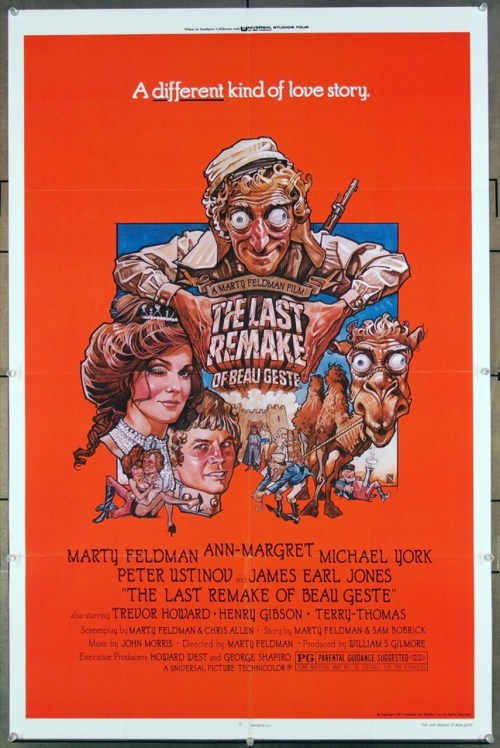
The Last Remake of Beau Geste (1979)

beaugeste

By Richard Winters

My Rating: 4 out of 10

4-Word Review: Brothers join the army.

Sir Hector Geste (Trevor Howard) decides to adopt a son to be his rightful heir and carry on the family name. He goes to an orphanage where he spots Beau (Michael York) a dashing young boy who shows immense prowess. Hector immediately decides he wants him, but it comes with the caveat that he must also take on Beau’s twin bother Digby (Marty Feldman) who’s not nearly as handsome, or brave. After bringing both boys home Hector then gets married to Flavia (Ann-Margret) a much younger woman who’s more in-love with the Blue Sapphire diamond that’s in Hector’s possession than Hector himself. In order to keep Flavia from absconding with it Beau decides to take it out of the family home and bringing it along with him to Africa where he joins the French Foreign Legion. Digby eventually joins and they go on to have many adventures, but Flavia catches up with them determined to get the diamond using any means necessary.

The film is based on the 1924 novel of the same name written by P.C. Wren that had already been made into a movie three other times: in 1926 starring Ronald Coleman, 1939 starring Gary Cooper, and finally in 1966 starring Guy Stockwell. In 1976 when Marty Feldman signed a 5-picture deal with Universal to write, direct, and star in any film project he choose he decided to do a parody on a film he had seen growing up. He mistakenly thought it was Beau Geste, but came to realize once he watched the movie that it was really The Four Feathers that had a similar storyline and came out around the same time. He eventually went with doing this version since he felt ‘The Last Remake of the Four Feathers’ didn’t sound right.

The production, which was filmed in both Ireland and Spain, was met with many obstacles, including having Feldman getting sick during the shoot and putting the production on-hold for many weeks. It eventually went over budget and over schedule and the studio was not happy with Feldman’s final cut and determined to re-edit it while giving Feldman a 2-week vacation under the guise of letting him rest and recuperate. When Feldman returned and found out what the studio had done he became irate, so the studio heads decided to make him a deal; they would show both versions to a test audiences and which ever one rated better would be the one that would be released. Feldman agreed to this and to the studios shock Marty’s cut got much higher ratings, but the studio then went back on their word and released their version instead, which did not fare well with either the critics, or public. To this day Marty’s version has never been seen, but by only a few people even though those that have viewed say it’s much funnier and efforts have been made to find it and give it a proper Blu-ray issue though this has never come to fruition as of yet.

As for this version it’s okay, but it starts out better than it ends. There’s some funny gags here and there, but the humor tends to be quite broad and many of the jokes fall flat especially after the midway point. The best moment comes when Feldman splices his character into the 1939 film version and we see his character speaking to Gary Cooper and they even share a scene together, which I found to be quite innovative for the time period. Everything else though is hit-or-miss and suffers from not enough people being familiar with the source novel and thus the in-jokes involving the story will most likely go over  most viewer’s heads it also makes many changes from the original plot with the biggest one being that in this movie there’s only 2-brothers, but in the book there was 3.

The array of famous faces making cameo appearances is fun for awhile though I felt Peter Ustinov camps it up too much as the evil General Markov and the part would’ve been better served had it been played by Roy Kinnear who instead gets wasted as Markov’s assistant. Howard is quite amusing as the elderly father and I wished he was in it more, but ultimately his character gets confined to his bed for the second and third act. Ann-Margret offers some sexiness, but really has nothing to say or do that’s funny until the very end when she tries to challenge a guy to a fist-fight, which should’ve been played-out more. Terry-Thomas gets some work before his Parkinson’s condition, which is very obvious here with his trembling left hand, became so severe that it forced him out of acting and into a retirement home not more than a year after this was filmed.

Feldman himself is quite good, but I felt he needed to be seen more, which is the biggest problem with the movie in that it’s neither character nor plot driven. Too much nuttiness and wackiness for its own good. If the comedy had been better disciplined and a smaller cast it would’ve worked better, but the barrage of constant craziness all in the name humor eventually gets overblown.

My Rating: 4 out of 10

Released: July 15, 1977

Runtime: 1 Hour 25 Minutes

Rated PG

Director: Marty Feldman

Studio: Universal

Available: DVD-R (Universal Vault Series), Blu-ray

The Day of the Dolphin (1973)

dolphin2

By Richard Winters

My Rating: 3 out of 10

4-Word Review: Training dolphins to talk.

Jake Terrell (George C. Scott) along with his wife Maggie (Trish Van Devere) run a remote island research station where, along with a small team of researchers, try to teach dolphins to communicate with humans. They’re prime subject, which they’ve been working with for 4 years, is Alpha whom they’ve successfully trained to speak some English words, but when they team him up with another dolphin named Beta he goes back to his old ways of communicating and no longer speaks with Jake, or his team. Things become further hampered when Curtis (Paul Sorvino) arrives on the island supposedly under the guise of being a journalist, but in reality he’s a spy there to infiltrate what Jake has been doing with the dolphins and report back to a secret government organization who want to then use the dolphins for their own nefarious means.

With the early success of director Mike Nichols and screenwriter Buck Henry, especially The Graduate, it seemed like these two could do no wrong and they both became a much sought after Hollywood commodity and given many top project offers. This production though came crashing down horribly and stymied Nichols career, which had previously been skyrocketing, for the rest of the decade as he helmed only one other film after this during the 70’s before finally getting his reputation back in order with the critically acclaimed Silkwood.

This thing comes-off as a misfire almost immediately and the biggest problem are the dolphins. There’s just so much they can do, liking mainly jumping in and out of water, until it becomes really boring. The long dream-like segment of watching Jake swim around in the tank with the dolphin adds nothing and got so prolonged that it practically put me to sleep. The only part where the dolphins did hold my attention was when Jake decides to split the two up where Beta is put in a pool on one side and Alpha the other and a steel partition between them. This then causes the dolphins much stress as Alpha angrily smashes his tail repeatedly against the partition in anger, but to no avail. While I did find this moment to be rather intense it does backfire in a way in that it makes Jake and the other researchers seem cruel and you start to not like them, which I don’t think was the filmmaker’s intent.

Having them learn to talk was misguided and makes it seem like a silly flick for kids with no barring in reality. Initially I was okay with them learning a few words as it came-off like they were parrots repeating sounds that they had heard, so it was borderline plausible, but then having it graduate to the point that he and others can have ongoing conversations with them and even ask them questions is when it starts to get too absurd for its own good.  In fact the only moment in the film that’s truly fascinating to see is when a mother dolphin gives birth using actual footage, which made me believe this would’ve been better off had it been done as a documentary and the fictional story left out completely.

Sorvino does add some energy with his scenes and pretty much outclasses Scott, who with his $750,000 salary, which would equate to $5,484,886 in today’s dollars, is quite dull and he manages to get completely upstaged by even the dolphins themselves. All of the main characters are quite one-dimensional, especially Van Devere who seems to agree with Scott on everything and echoes whatever point-of-view he has making her presence completely unneccesary as she’s simply him in a female form.

Having one of the research crew members turn out to being a spy doesn’t work either as the viewer is given no forewarning about this. We’re just informed later that this individual had betrayed them, but a good movie should offer hints upfront that a traitor may be in their midst and thus allow the audience to become more of an active participant as they try and figure out which of them it is. The secret government organization thing gets equally botched. A better scenario would’ve had a former friend, or associate to Jake turn on him and seek revenge by trying to destroy the research facility and all of their findings. He would be constantly lurking about, which would’ve added more ongoing tension that is otherwise lacking and given the bad guy more of a personality versus the bland government agents that are too generic to be either frightening, or memorable.

My Rating: 3 out of 10

Released: December 19, 1973

Runtime: 1 Hour 44 Minutes

Rated PG

Director: Mike Nichols

Studio: AVCO Embassy Pictures

Available: DVD, Blu-ray

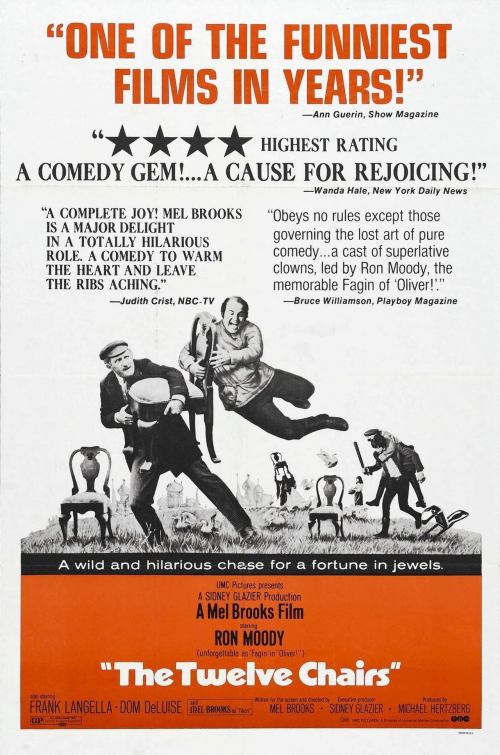
The Twelve Chairs (1970)

twelve

By Richard Winters

My Rating: 7 out of 10

4-Word Review: Which chair has fortune?

Vorobyaninov (Ron Moody), an poor man living in 1920’s Russia, is summoned to the deathbed of his mother-in-law. She confides in him that there’s a stash of priceless jewels sewn into the seat cushions of one of the twelve chairs from the family’s dinning room set. Unfortunately the newly formed Russian state has appropriated all private property and it’s up to Vorobyaninov to track them down. He teams up with Ostop (Frank Langella) a local con-man to help him, but they have competition. Father Fyodor (Dom DeLuise), a priest, also becomes aware of the jewels when he goes to the mother-in-law’s home to give her the last rites. All three go on a mad dash to retrieve the jewels, but the more chairs they manage to find the more frustrated they become.

The film is based on the 1928 Russian novel of the same name by Ilf and Petrov a famous duo who were quite popular during the early soviet period and wrote not only many satirical novels, including this one and its sequel ‘A Little Golden Calf’, but also several short stories, articles, theatrical plays, and even screenplays. The Twelve Chairs novel though was their most popular and has been made into a movie 18 different times. It had already been done 6 times before Mel Brooks did his with the first version being in 1933 and the most recent rendition of it done in 2013 in Italy.

This version is the most popular and a bit of stretch from Brooks’ other films, which relied on a lot of gags and slapstick. This one has its fair share of those though the first act is quite talky and not too much going on. Brooks himself appears as a character, but he can’t really enliven it. It’s not until the men finally come upon the chairs and start tearing them up one-by-one that it really starts to get funny. The chair thing could’ve gotten redundant as the men rip open the seat cushions in pretty much the same quick way, but Brooks manages to approach each of these scenes in a creative way, so instead of becoming monotonous it remains fresh and comical. My favorite of these is when Ron Moody and Frank Langella chase Dom, who has one of the chairs, through an open field that’s done in stop-action.

The film’s detraction though is the casting of the two main characters. Langella is a terrific actor, but not in comedy. He did appear in the dark comedy Diary of a Mad Housewife, where he was very good, but that took advantage of his glib demeanor and pouty expression and his character there was meant to be unlikable. Here though he has nothing amusing to say and remains a complete jerk the whole way. There is one point where he and Moody are in a row boat and Moody states that he’s cold and Langella gives him a jacket to wear, which I guess was Brooks’ attempt to make him likable, but it’s not enough and the movie is really hurt by spending so much time focused on a guy who’s one-dimensionally cold and responds to antics around him in the same sneering way. He was recommended to Brooks by his wife Anne Bancroft who had performed with Langella in a Broadway play that had a short run, but I felt this is one time when he shouldn’t have listened to her.

Ron Moody, a talented actor as well, has the same issue. The character is meant to be dim-witted, but it doesn’t come-off in a natural way. His banter with Langella is flat and annoying with the bickering doing nothing but slowing up the pacing. Without question DeLuise is the funniest. He’s just as conniving and greedy as the other two, but for whatever reason it doesn’t seem as ingratiating. His character’s ineptness had me laughing and he should’ve been the star while Langella and Moody could’ve been shown only sporadically as the occasional nemesis.

Spoiler Alert!

The ending is much different than the one in the book. In the novel version Vorobyaninov kills Ostap by slitting his throat with a razor in order to keep the loot for himself only to find that it’s not there, so he then goes insane. In the movie Vorobyaninov and Ostap team up to become beggars on the street by pretending Vorobyaninov has an epileptic condition and requesting people throw money at him to help him. Wikipedia, in a line that has since been deleted, stated that this was a ‘happier’ ending though trying to make a living being a street beggar all day can’t be all that fun.

What amused me though is that in both versions the jewels are never recovered by the two men. In the movie the jewels were found first by someone else who used it to build a clubhouse for pompous old men making it seem like greed was inevitable. In the book though the money gets used to build a recreational center that can be used by the entire community and thus giving it more of a pro-communist bent.

My Rating: 7 out of 10

Released: October 28, 1970

Runtime: 1 Hour 33 Minutes

Rated G

Director: Mel Brooks

Studio: UMC Pictures

Available: DVD

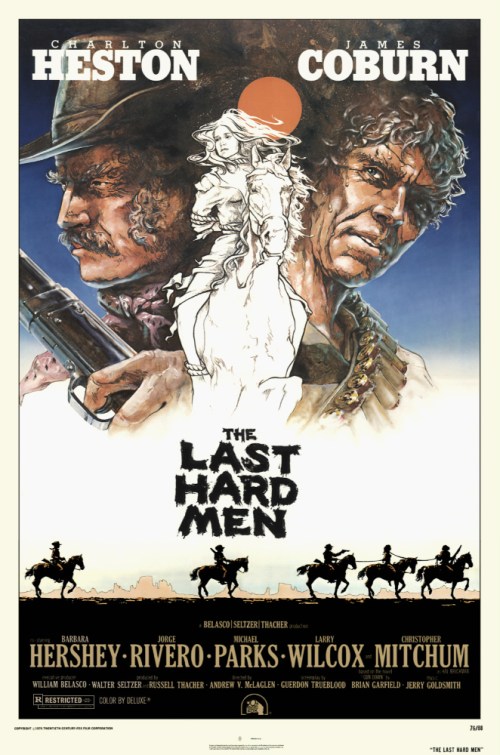
The Last Hard Men (1976)

lasthard

By Richard Winters

My Rating: 3 out of 10

4-Word Review: Kidnapping a lawmen’s daughter.

Based on the 1971 novel ‘Gundown’ by Brian Garfield who’s better known for having written Death Wish, the story is set in 1909 and centers on Sam Burgade (Charlton Heston) a retired lawman living with his grown daughter Susan (Barbara Hershey) who is engaged to Hal (Christopher Mitchum). They though are tormented by Provo (James Coburn) and his gang who have just busted out of a Yuma prison. Provo seeks revenge on Sam because years earlier Sam killed Provo’s Indian wife during a shoot-out. Provo though doesn’t want to just kill Sam, but instead inflict the cruelest revenge possible by kidnapping Susan and then having his men gang rape her while both Sam and Hal are forced to watch.

A stale, unimaginative approach that lacks any atmosphere and makes getting into it rather hard. Coburn and Heston are given equal screen time, so it’s confusing who we’re supposed to be rooting for. Sure Coburn has dark motives, but he also at one point gets rid of one of his own men (Robert Donner) for being a racist, so he’s not completely bad. The film’s biggest transgression is that it never shows, via flashback, the crucial shoot-out between the two that caused Provo to get so angry. Just having Heston briefly describe the incident to his daughter is not enough we needed to see what happened for ourselves especially since Heston becomes downright skittish about what went on and like maybe he had something to hide. Without having it played-out the movie lacks much needed context.

Coburn is a personal favorite, but as the protagonist, which he always does quite colorfully. As the villain it doesn’t work and he seems unable, or unwilling to go to the nasty depth that the script demands and instead leaves this to his henchmen, played by John Quade. Heston is adequate and Mitchum (Robert’s son) certainly displays a youthful, wide-eyed quality and it’s intriguing seeing how he grows from a young man who doesn’t seem rugged enough to take on the challenge to eventually proving himself.

In support I enjoyed Larry Wilcox, but known for starring in the ‘CHIPS’ TV-show, as he’s one of the evil henchmen that manages to show some redeeming qualities and it’s genuinely sad when he gets shot. While I’m a fan of Hershey and appreciated how she took a stretch here by playing a part outside her comfort zone I still felt she was miscast. The character needed to be sheltered and helpless in order to get the viewer to care about her predicament, but she’s too savvy and streetwise from the start making it seem like she can handle matters and take care of herself, which lessens the tension. Having her grow into becoming this way during the ordeal would’ve been more interesting.

Spoiler Alert!

The third act does have a few moments that enliven things including a large bush fire that gets started by Heston that traps Coburn and his men, but the scene that really stood out is the gang rape of Hershey, which gets done in slow-motion on the side of a hill. I’ve seen many films that feature a rape, but never done in this way, which almost gives it a sort-of lyrical quality and the only thing from the movie that stands-out. Yet even this gets botched as Heston doesn’t run out from his hiding spot to save his daughter when it occurs making it seem like he might’ve been cowardly and this was a personality trait he had been hiding only for us to learn that it was because Mitchum who knocked him out, but this seemed implausible. Heston was much bigger than Mitchum and proved to be far more astute than him in everything else, so why would this be the one moment when the young kid would be able to overpower him?

The story would’ve been more intriguing had this moment exposed a flaw in Heston’s character, which would’ve given this otherwise one-dimensional story the depth and unexpected twist that was needed and it’s just a shame it didn’t take it. Certainly if put in better hands this is the kind of material that could have strong potential, but the way it gets played-out here, even with the violent moments, it’s boring and a disappointment.

My Rating: 3 out of 10

Released: June 1, 1976

Runtime: 1 Hour 37 Minutes

Rated R

Director: Andrew V. McLaglen

Studio: 20th Century Fox

Available: DVD, Amazon Video, YouTube

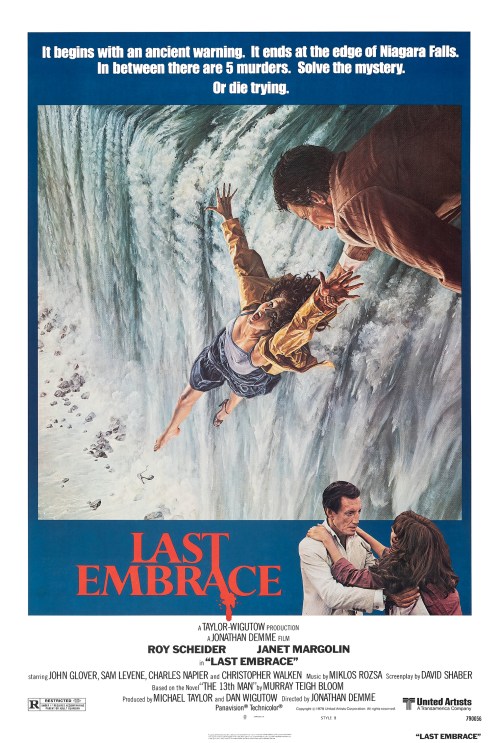
Last Embrace (1979)

lastembrace

By Richard Winters

My Rating: 7 out of 10

4-Word Review: Someone wants him dead.

Loosely based on the novel ‘The 13th Man’ by Murray Teigh Bloom the story centers around Harry (Roy Scheider) a government agent who has a nervous breakdown after his wife gets killed during a shootout while he was on a secret mission. After spending time in a sanitarium he gets out to realize that his agency no longer has any assignments for him and he fears they may want him dead while trying to make it look like an accident. When he gets back to his apartment he finds that it’s been sublet to Ellie (Janet Margolin), a doctoral student at Princeton University. He tries to get her to move-out, but can’t and then starts to receive threatening notes in Hebrew and uses Ellie’s background in that language to help him decipher what they’re saying. Soon the two go on the run convinced that the same person after Harry may also now be targeting Ellie, but nothing is exactly as it seems.

Jonathan Demme, despite his immense talent and admirable film output, never received name recognition and for the greater part of his career failed to have a hit at the box office. In fact it wasn’t until the success of The Silence of the Lambs that he even became a sought after Hollywood commodity. Even then when most people think about that movie it’s Anthony Hopkins, or even Jodie Foster that comes to mind while Demme’s directorial efforts seem overlooked. In many of his interviews this was his biggest complaint and that no matter what he did he could never break-out of the bubble to have his name put over the title like with Spielberg, Scorssese, or Hitchcock. I could understand his frustration as his movies were step above your basic indie flick and while not perfect still had far more going for it than a usual B-picture and if anything this film should’ve been the one that got him noticed.

There’s been many Hitchcock imitations with a lot of them done by Brian Di Palma, but those seemed overdone while this one gets just the right balance. The on-location shooting is splendid with my favorite moments being at Princeton University bell tower and of course the climactic sequence at Niagara Falls. I’ve personally been to the falls, but found this movie made me feel closer and more immersed in it than in person especially with the sequences shot inside the Robert Moses Niagara Power Plant and another done in the Cave of the Winds, which is what really makes the film stand-out. The music score by Miklos Rozsa, has the perfect blend of what would’ve been used by Bernard Herrman, which was Hitch’s main composer, which helps to make this seem like a movie Hitch himself could of very well done himself.

Scheider’s acting is good as he’s constantly cranky and irritable, which anyone going through his situation would be, so it was realistic and relatable, but I really hated the white suits that he wore. For one thing the guy was out of work and no longer a professional agent, so why he felt the need to dress-up all the time when he really wasn’t on the job anymore didn’t make much sense. Why they were all white was even more head-scratching. Outside of Pat Boone I don’t know of anyone who wears a white suit and it made him stand-out in all the wrong ways. If this guy is afraid that he’s being targeted then he should be dressing down so he could then blend-in, which in this movie he definitely wasn’t.

Margolin, best known for her work in the landmark indie flick David and Lisa, is good too especially with her dual personalities where she plays a nerdy student and her alluring, sexy vamp alter ego at other points. She though was not the original choice for the part as Demme wanted Lynn Lowry, who had been in his previous film Fighting Mad, but Scheider, who was dating Margolin at the time, preferred her and studio backed him on it forcing Demme to drop Lowry, but out of guilt he still paid her and allowed her to collect residuals despite her never appearing in any of it.

Spoiler Alert!

The plot is fast-moving and well crafted and keeps you guessing while also introducing a wide array of new twists without ever getting too confusing. The final twist though, in which we find that Ellie is the one after Harry and has been murdering other men as well in a revenge plot for what Harry’s and the other men’s grandfathers did to her grandmother who was gang raped by them at age 15. The idea was to tie the Ellie character to the Biblical avenger of Goel, which sounds cool, but ultimately an overreach. Had Ellie been raped directly by these men then I could see her going out of her way to seek rough justice, but doing it all for a grandmother she barely knew just didn’t seem all that believable. Also, how does this then ‘right the wrong’ by taking vengeance out on the grandchildren of the men who committed the actual crime? The grand kids had no control over what their grandparents did and weren’t even around when it happened, so how is any of this fair, or even make sense?

A better way to have ended it was to have Ellie portrayed as being a crazy kook going after these men due to a belief in some conspiracy theory only for the viewer to finally realize that she was an actual rape victim and Scheider, who we thought was this good guy, was instead the villain. Since she was raped at 15 her features could’ve changed, which would thus explain why Scheider didn’t recognize her initially. With a movie so compelled to have one twist after the other, this would’ve been the ultimate jaw-dropper. It’s just a shame they hadn’t chosen this route as the film, as slick as it is most of the way, leaves the viewer with an empty feeling after it’s over.

My Rating: 7 out of 10

Released: May 4, 1979

Runtime: 1 Hour 42 Minutes

Rated PG

Director: Jonathan Demme

Studio: United Artists

Available: DVD, Blu-ray, Tubi

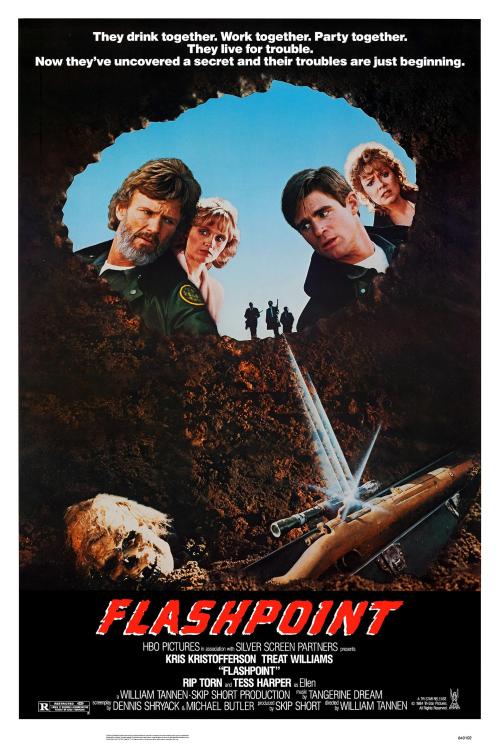
Flashpoint (1984)

flashpoint

By Richard Winters

My Rating: 4 out of 10

4-Word Review: Digging up hidden money.

Bobby (Kris Kristofferson) and Ernie (Treat Williams) are border patrol agents who stumble upon a jeep buried in the sand. Once Bobby digs it up he finds a skeleton in the driver’s seat, a scoped rifle, and $800,000 inside a rusted toolbox. Both of them are unhappy in their jobs and Bobby thinks this would be the perfect time to skip town with the loot, but Ernie thinks it’s stolen money and needs to be investigated. Since the bills are all marked with the dates of 1962 and 1963 they presume this is around the time when the bank robbery, which is where they think the deceased driver got the money from, occurred, but upon an old newspaper research at their local library they can find no such robbery happening in the amount that they recovered. Soon they face more problems when a federal man named Carson (Kurtwood Smith) takes over the agency they work at and exerts extreme control over everything they do. Bobby feels Carson is somehow aware of the money they found and knows more about the driver’s identity than he lets on. While Bobby and Ernie hide the money they find Carson and his team of secret agents hot on their path as he sends them on dangerous missions in an attempt to kill them, so they won’t let on to anyone else about what they’ve found.

This is another example where an intriguing story idea, based on the novel of the same name by George LaFountaine, almost gets ruined by lackluster direction. The mystery is interesting enough to keep you invested but there are definite lulls and cheesy side stories that seem to be challenging the viewer to turn it off before it’s over. This was also another case where the setting is supposedly Texas, which gets mentioned quite a bit, and yet it was all filmed in and around Tucson, Arizona, which is a travesty especially since the deserts of Arizona and Texas have noticeably different characteristics. I also felt that if you’re going to have a story based in the desert you should then have the time period during the summer, instead of the winter like here, where the scorching heat could be used as an added element.

Kristofferson isn’t particularly well cast here in a part that was originally intended for Paul Newman. His laid-back style of acting isn’t riveting enough though I’ll give him props for the scene where he gets shot and must crawl several yards in the dirt with one arm that he can’t move due to it being paralyzed by the bullet, which looks quite arduous to do though he does it effectively and realistically. Williams is by far the superior actor and his distinct personality where he’s the idealist, plays-off well from Kristofferson’s more jaded mindset. You even get a full view of Treat’s bare ass, which comes near the beginning and while nobody necessarily asked for it and wasn’t needed to propel the plot some may enjoy it and as male asses go it’s not too shabby.

Rip Torn, whose hair is dyed gray, does well in support where his strong Texas drawl works nicely in the supposedly Texas setting. While he’s only seen sporadically during the first two acts, to the point where I started to wonder why he even bothered to take the role as it seemed miniscule and pointless, he does come on strong during the finale. Kurtwood Smith though is dull, which isn’t exactly his fault as the part is written too much like caricature, and every successful movie needs an interesting and memorable villain, which this one clearly isn’t.

While the action is fleeting it does have one good stunt, which features Treat trying to prevent a plane, which they think holds drugs, from taking-off by reaching in through the window of the cockpit and forcing the pilot to land it. It had me holding by breath, but it got ridiculous when the plane crashes and explodes, but Treat gets saved when he supposedly jumps off and into a lake, but you don’t see this occur and the other men all presume he went down with the plane only to have Treat jump out of the water intact, but if he had dived into the pool then the water would’ve had a ripple effect from where he went in instead of it being calm and placid like it is.

Spoiler Alert!

The twist at the end in where the money and driver of the jeep are connected to the assassination of John F. Kennedy is cool though it leaves more questions than answers. Of course that might’ve been the intention, but still I feel this is a good enough story idea that it should be revisited with a better director and hopefully one day someone talented will decide to remake it in a way that’s more intriguing than what we get here.

My Rating: 4 out of 10

Released: August 31, 1984

Runtime: 1 Hour 33 Minutes

Rated R

Director: William Tannen

Studio: TriStar Pictures

Available: DVD-R

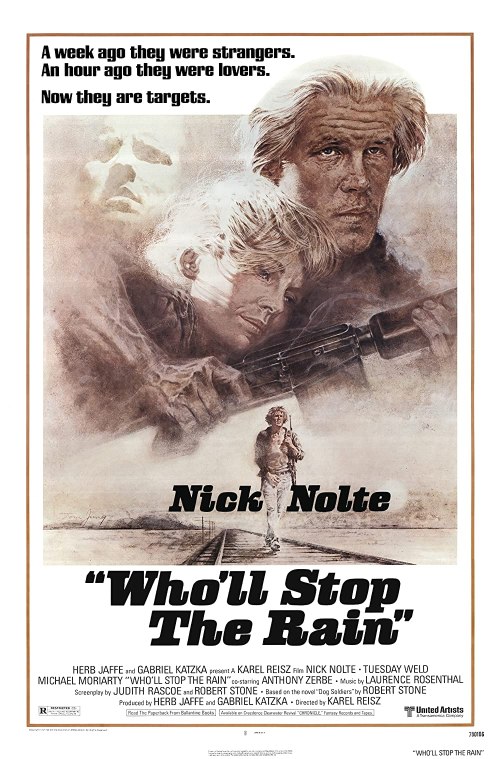
Who’ll Stop the Rain (1978)

wholl

By Richard Winters

My Rating: 8 out of 10

4-Word Review: Drug deal gone bad.

John Converse (Michael Moriarity), a war correspondent working in Saigon, approaches his friend Ray (Nick Nolte), a merchant marine, about smuggling a large bag of heroin out of the country and into the US. Ray has dealt marijuana before, but never the hard stuff and is reluctant at first, but due to his friendship with John he eventually agrees. He is told to go to San Francisco where he’ll drop-off of the drugs for payment with John’s wife Marge (Tuesday Weld). Once he gets there though he realizes he’s been followed forcing both he and Marge to go on a dangerous trip to not only elude the bad guys, but also get rid of the incriminating evidence.

The film is based on the 1974 novel ‘Dog Soldiers’ by Robert Stone, who also co-wrote the screenplay. The theme of the novel was to examine the loss of optimism and youthful ideals of the 60’s and the beginning of the age of cynicism that came during the 70’s, which for that purpose the time period should’ve been 1970 as keeping it in the present day, in this case 1978, makes it seem a bit dated and losses the context of the message. The story itself though is still quite engrossing with some of the most disturbing scenes being the ones dealing with a young, affluent suburban couple (James Granna, Timothy Blake) going to a drug party of sorts that had Ray, Marge and Ray’s friend Eddie (Charles Haid) who give them illicit substance for the first time and their immediate hallucinogenic reaction I found both frightening and impactful.

The performances are uniformly excellent especially Nolte, who was not yet an established movie star and the producers wanting instead Kris Kristofferson for the role only to finally give-in after the persistent lobbying of director Karel Reisz. Tuesday Weld is also dynamic falling into the role of a drab, middle-aged housewife with ease and completely losing the young, sexy starlet appeal that she had previously. My favorite though was Moriarty, whose glazed over eyes and emotionless demeanor perfectly reflects the apathy and soullessness of his character.

On the downside I found the character’s motivations to be confusing particularly the way Marge, who did not know Ray before this, agrees to go with him as he tries to outrun the baddies, but how would know she could trust him, or that he wasn’t in on the scheme? When she dropped her child off with some friends that’s where I felt she should’ve also gone and going back into Ray’s car, instead of calling the police, or advising her friend to do so, seemed reckless and too trusting that this stranger had her best interests at heart. In the book Ray’s intentions are not quite as noble as he decides to bring Marge along more for insurance as he think’s he’s been double-crossed by John, but presumes with Marge along he can use her as a decoy, while in the film it’s because he’s genuinely concerned for her safety. Marge too is betrayed differently as she’s not aware of the drug deal in the film, but in the book she was and I felt these nuances should’ve been brought up in the movie and the fact that they aren’t makes it less realistic and losses the whole point of the story.

John’s relationship with Danskin and Smitty (Richard Masur, Ray Sharkey), the two henchmen to corrupt FBI agent Antheil (Anthony Zerbe) gets botched too. For one thing the make-up effects are too slight as John is put through a wide array of physical tortures by the two in an attempt to get him to tell them where the heroin is and yet after it’s all over the only sign of the struggle is a slight cut on his forehead when instead his entire face should’ve been severely bruised, bloodied, and swelling. Afterwards he becomes too palsy with them even reading a book in their presence and joking around though you’d think he’d remain frightened after what they put him through and never letting down his guard in their presence because he’d know their violent side. I also didn’t like how the two start out as nasty criminals, but by the end become clueless comic foils, which hurts both the tension and grim realism.

The film though does recover especially in the final act when Ray takes Marge to an isolated cabin in New Mexico to hide-out in and then are followed by the villains culminating in a unique showdown. The isolation of the place, which sits amongst the beautiful mountains of the region is both picturesque and tranquil, and is based off of author’s Ken Kesey’s home in California where he wired the nearby trees with lights and sound effects to enhance their LSD experiences, and thus this creates an interesting battle between Ray and the thugs as he uses these same props to disorient them and it helps the movie stand-out with its memorable conclusion.

My Rating: 8 out of 10

Released: August 11, 1978

Runtime: 2 Hours 6 Minutes

Rated R

Director: Karel Reisz

Studio: United Artists

Available: DVD, Blu-ray

Starting Over (1979)

starting1

By Richard Winters

My Rating: 7 out of 10

4-Word Review: Can’t get over ex.

Phil (Burt Reynolds) gets a divorce from Jessica (Candice Bergen), a successful songwriter, when he finds out she’s been having an affair. He then moves to Boston where his brother Mickey (Charles Durning) and sister-in-law Marva (Frances Sternhagen) set him up with Marilyn (Jill Clayburgh) a nursery school teacher. They don’t initially hit-it-off, so he instead goes out with Marie (Mary Kay Place), but that doesn’t go over well either, so he again calls up Marilyn and this time she relents. Despite the usual ups-and-downs things between them begin to gel and soon they decide to move in together only to have Jessica reappear wanting to get back with Phil and Phil becoming torn as to what he should do.

Based on the novel of the same name by Dan Wakefield with a screenplay by James L. Brooks best known for producing the classic TV-show ‘Mary Tyler Moore Show’. Like with that show the story focuses heavily on the pitfalls of dating life with much of it on-target though it does have a serious out-of-touch quality that’s no longer in-tune with today’s generation. The big one is that they meet on their first date inside the women’s apartments, which because of safety concerns doesn’t happen much now and usually it’s always advised to meet in a public setting and not give out personal addresses until you really get to know the person better. There’s also a scene where Jessica, who wears a highly revealing outfit, meet in Marilyn’s apartment and have what we’re told is a civil three hour conversation though in this day and age it’s hard to believe two women, knowing that the other one is clearly after ‘their man’, could be that composed and most likely a fight would break-out and I’m kind of surprised knowing how emotional Marilyn was and wearing her insecurities on her sleeve, that one didn’t happen here.

On the flip side there’s some terrifically funny moments.  One is when Marilyn and Phil initially get off the bus together, before they’ve officially met, and she thinks he’s a stalker, which has a good true-to-life feel. Another great scene is when Phil and Marilyn briefly break-up and he goes to her school, where they’re having a dunk-a-teacher water party and he manages to hit the bullseye with the ball he’s throwing and she’s goes into the water repeatedly before eventually losing her cool and swearing. Phil’s anxiety attack inside a department store is memorable too as his Jessica’s call to Phil at his apartment while he’s serving Thanksgiving dinner to Marilyn and his guests, which creates quite the awkward moment. Phil’s first date with the aggressive Marie is a terrific bit too.

The acting is top notch especially Clayburgh who creates the perfect composite of single women during the 70’s who desperately wants to get into a relationship, but many times allow her fears and anxieties to get in the way. Reynolds is excellent playing against type. Normally he’s a brash womanizer, but here he’s far more reserved and indecisive.  This is also the last movie where he didn’t have his patented mustache and I felt he looked way better and younger without it. Even Bergen, in a much smaller role, is memorable particularly with her off-key renditions of the songs her character has written.

Overall I consider this one of the best romantic movies made. I will admit a modern remake would give the story a more timely update, but the situations nicely reflect the dating conundrums that affect us all.  My only complaint would be with the Clayburgh character, who seemed too insecure to be able to get into a healthy relationship. Most guys would be scared off with her constant emotional outbursts and accusations and I didn’t see why Phil stuck with it. This is one instance, especially since Phil was pretty much a hunk, that I felt the woman he fell for should’ve been better looking, or at least equal to the Jessica character that he left. I just couldn’t understand exactly why, being that there were a lot of women who could easily get into him, he’d choose, or settle for, Marilyn over all the others. Had they had more in common then maybe, but she came-off like a woman who would eventually become a cat lady and too emotionally needy to be someone you could have a long term relationship with.

My Rating: 7 out of 10

Released: October 5, 1979

Runtime: 1 Hour 45 Minutes

Rated R

Director: Alan J. Pakula

Studio: Paramount Pictures

Available: DVD-R, Amazon Video, YouTube