Category Archives: Movies Based on Novels

North Dallas Forty (1979)

north dallas forty

By Richard Winters

My Rating: 8 out of 10

4-Word Review: Ugly side of football.

From the very first frame this film grabs your attention. We see football wide receiver Phil Elliot (Nick Nolte) sleeping in his bed with blood spewing out of his nose and soaking his pillow in red. He wakes up and ambles his way to the bathroom looking like a man of 80 instead of 30. We come to realize that his nose is broken and he sleeps with tissue stuffed up his nostril to keep it from bleeding worse than it really does. We soon learn that this is all part of the business. A player is expected not only to play with pain, but live with it as well. Watching Nolte deal with this is so convincing that it will make you feel like you’re having the same symptoms and bring back vivid memories of any physical discomfort that you once had. It gets so bad that when he is making love to his girlfriend he is having to tell her to switch positions, or not touch certain parts of his body because even sex ends up being too painful. When you read about how many players suffer from lifelong injuries from their playing days you feel almost insulted at how other sports movies seem to gloss over it like it is no big deal when it really isn’t.

The movie is based on the best-selling novel by Peter Gent, who once played wide receiver for the Dallas Cowboys. Although fictionalized to a certain extent one can’t help but see the ugly truth seeping through. Many of the characters closely resemble star Cowboy players from that era including the Mac Davis character Seth Maxwell who has the same personality as real-life quarterback Don Meredith.  There is also B.A. Strother (G.D. Spradlin) who resembles legendary coach Tom Landry. Like Landry he seems devoutly religious and even quotes scripture, but he also is very cold, calculating, and psychologically manipulative.

I thoroughly enjoyed this film and found it riveting from beginning to end. If only all films could be this revealing and honest. The ‘feel good sports movie’ can be nice, but it is becoming too much of a cliché. Most players that get into the business don’t win Superbowls, or championships. They becomes used and abused by a relentless system until their only goal is simple survival and trying not to be cut. Of course I have never played football, but I don’t think the viewer really has to, to appreciate the dead-on truth that is displayed here. Simply being out in the ‘real world’ and working in corporate America should be enough for just about anyone to connect to what the characters here go through.

The dialogue is exceptional and endlessly quotable. Every scene and conversation dissects another ugly side of the business. Some of it is expected, but other parts become rather startling particularly the way players are pushed to play with injuries in order to ‘help the team’ even if there is a strong possibility that it could cause serious and permanent harm.  Some may say things have gotten better, or worse since this was made, but I can’t help but feel that if anything it pretty much the same in a lot of ways, which is why I still maintain that this film is quite possibly the best sports movie ever made.

You also gotta love Charles Durning as the assistant coach constantly carrying with him a bottle of Maalox and looking like the one doing most of the coaching and disciplining while coach Strother stands at a calculated distance. The scene where Durning screams at the players during a team prayer giving in the locker room by a priest is the film’s single most funniest moment. Bo Svenson has one of his best roles playing the very large and intimidating player who goes from being obnoxious and even frightening at parties to looking dumb, confused, and even scared during the games. The only actor I wasn’t impressed with was John Matusek, who was a real-life pro player for a while. It was nice seeing a well-built actor to compliment Svenson, but Matusek just does not have the ability to deliver his lines with any dramatic impact and the fiery tirade that gives Durning at the end fails to be as strong as it should’ve been.

The only other problem I had with this film is the scenes involving the actual game itself. It doesn’t in any way resemble a pro game. The field is small and looks like it was shot at a high school. The crowd is darkened out, looking like there were no spectators at all. I also didn’t like the way director Ted Kotcheff incorporated dramatic music during certain key segments. It came off as heavy-handed and unnecessary. Of course the team’s uniforms and logos look tacky and although this is a little distracting you can’t blame this on the filmmakers as the NFL refused to endorse the film because of its frank nature.

This film hasn’t mellowed at all with age and I was surprised how potent it still is. I would recommend this to anyone, sports fan, or not, who wants to see the game from a different perspective by a player who was there.

My Rating: 8 out of 10

Released: August 3, 1979

Runtime: 1Hour 59Minutes

Rated R

Director: Ted Kotcheff

Studio: Paramount

Available: VHS, DVD, Amazon Instant Video
Paper Lion (1968)

By Richard Winters

My Rating: 6 out of 10

4-Word Review: Scrawny guy plays quarterback.

            Lighthearted adaptation of George Plimpton’s best-selling novel detailing his account of playing for the Detroit Lions football team as a back-up quarterback despite having no real experience.  Alan Alda plays Plimpton and the movie’s main focus is during the team’s training camp and his shock at just how hard and rigorous being a pro-quarterback really is.

The film’s most amusing moments come during the many weeks of practice when Plimpton finds that even throwing a pass is difficult because the defenders are so quick that they are in his face and have him on the ground before he is even able to react. Even taking a hand-off from his center proves to be a difficult process as it jams his thumb. Director Alex March does a fine job of giving the viewer a feeling of Plimpton’s experience by having the defenders come barreling towards the camera until you feel like you’ve been tackled yourself.

What makes the story interesting is the fact that despite being an intellectual man from Harvard Plimpton still ends up having the same competitive spirit as the rest of the players. He becomes determined to prove himself by memorizing the playbook and practicing until he is able to function decently in the position. He even finds himself getting into a potential fist-fight with another man at a bar when the man makes a disparaging remark about the team.  Although the players quickly realize that he is not a legitimate athlete and try to scare him away they become impressed enough with his perseverance and fiery spirit to eventually be willing to play for him, which is a nice touch.

The cast is loaded with actual players and coaches incluing: John Gordy, Mike Lucci, Alex Karras, Sugar Ray Robinson, Roger Brown, Frank Gifford and the then head coach Joe Schmidt. All of them are given a lot of screen time and a surprising amount of lines. Despite what one may think they do an exceptionally good job. They are likable and believable especially coach Schmidt. In fact it is their presence that really helps make the movie succeed and gives the viewer the impression that they are experiencing the NFL as it is, or at least as it was at that time. There is even a segment featuring legendary coach Vince Lombardi, which is special.

Probably the only character that I felt wasn’t necessary was Lauren Hutton as Plimpton’s super-hot model girlfriend.  Now, I have never read the book, so I am not sure if Plimpton had an attractive girlfriend in real-life, or not, but the character here seemed to be put in for eye candy and added little if anything to the story.

The footage shown of an actual exhibition game that the Lions play against the St Louis Cardinals at the old Busch Stadium is vivid. So many times film of this nature will borrow footage from another source and then incorporate it in, but the grainy film stock always makes this evident and distracting and here that wasn’t the case. The camera gets right down on the field with the players and you see the plays and hits up close. You even hear the trash talk and a bit of cursing although they do edit some of that out.

The film’s drawback is that it is too serene for its own good. There is never any dramatic tension, or conflict. The pace and music is so easy going that at times it seems ready to put you to sleep. The film had the backing of the league, which I felt ended up compromising it. Some of the harsher ugly elements of football boot camp were clearly glossed over. I would have wanted something a little bit meatier, even if it had been for a only a few brief scenes. The film hasn’t particularly aged well. The ‘big’ players of yesteryear look rather puny by today’s standards. The game and conditioning has evolved a lot and I felt this story should be revisited in the modern day setting.

My Rating: 6 out of 10

Released: October 23, 1968

Runtime: 1Hour 47Minutes

Rated NR (Not Rated)

Director: Alex March

Studio: United Artists

Available: VHS, Netflix streaming

Black Sunday (1977)

blacksunday

By Richard Winters

My Rating:  6 out of 10

4-Word Review: Blimp wrecks the Superbowl

            Based on the Thomas Harris novel this film involves a female terrorist named Dahlia (Marthe Keller) working for a group called Black September. She plans on killing thousands of people at the Superbowl with the help of a blimp captain named Michael Lander (Bruce Dern), who is also a disgruntled Vietnam vet. As they are putting their plan into place their compound is attacked by an Israeli anti-terrorist group headed by Major David Kabakov (Robert Shaw). He decides not to kill Dahlia when he has the chance, but they confiscate all of their materials including a tape recording by Dahlia talking about a massive terrorist attack planned on U.S. soil in the near future.  Kabakov gives this information to the F.B.I. and they go on the offensive trying to track down what their operation is, as the details are vague, before they can pull it off.

Overall, as a spy thriller, the film is pretty good. I had to chuckle a little at the fact that the government takes the vague threats seriously and acts so swiftly based simply on an obscure tape recording when in real-life our government was warned long before the 9-11 attacks that a terrorist plot was being planned, but did nothing because they didn’t think it was possible. It would be nice to think that the government could one day act as semi-efficiently as it does in films.

There are indeed some memorable moments. One includes Kabakov shoving his gun down the throat of a suspect (Michael V. Gazzo) and giving him a very terse ultimatum ‘Blink for yes; die for no’. There is also an exciting well-choreographed shoot-out chase that starts out in a hotel lobby, goes through the streets and alley ways of the city, and ends up on the ocean beach. Another twisted moment is when Dahlia and Michael go to an isolated hanger in the Mojave Desert to try out a gadget that can supposedly shoot thousands of bullets in a single shot. The image of seeing all the tiny holes created on the wall of the shed from the bullets is cool enough that I was willing to overlook the fact that the wooden beams that crisscrossed the same wall were untouched. This scene also has a good bit of black humor when one of the employees of the hanger, who thinks the machine is a camera, and stands in front of it smiling only to have hundreds of bullets go slicing through him.

Shaw is excellent in the lead although it took me awhile to adjust to him in that type of role simply because he has played so many dark characters so well that it was hard to see him as a good guy. I liked that the character is human and admits to his mistakes, namely to the fact that he doesn’t kill Dahlia when he first has the chance. He also professes doubts about himself and his career, which adds to his multi-dimension. He tends to lean towards rogue tactics when forced, which helped reflect the brutal nature of the business that he was in. Certain lines that the character says are made memorable by Shaw’s dialect and tone that probably no other actor in the part could have done quite as well. I was also amazed at the incredible run he does during the game when he races down several flights of stairs and across the entire football field, which almost becomes a highlight in itself. I know the actor suffered from a weak heart and ended up dying from a heart attack just a year after this film came out, but I was almost surprised that he didn’t fall over from one right there.

Keller is great as the female adversary. Her American acting career never really took off, but that still doesn’t mean that she isn’t a strong actress. Her expression when she is caught in the shower with a gun pointing at her is priceless. I liked how initially she is portrayed as the ‘sane’ one in relation to the Dern character, but by the end it becomes quite clear that she is probably more evil and crazier than he could ever be. Her fight with Michael inside his house when they fear that their intricate plot may be falling apart is definitely her finest stuff.

Dern of course is an exceptional actor whose unique style and odd intensity make him a joy to watch even if the script is poor.  He is certainly well cast here, but I wished he was given more screen time and latitude as I don’t think his talents where given quite enough justice. His best moment maybe the long rant he has during one of his counseling sessions at the V.A. Medical center.

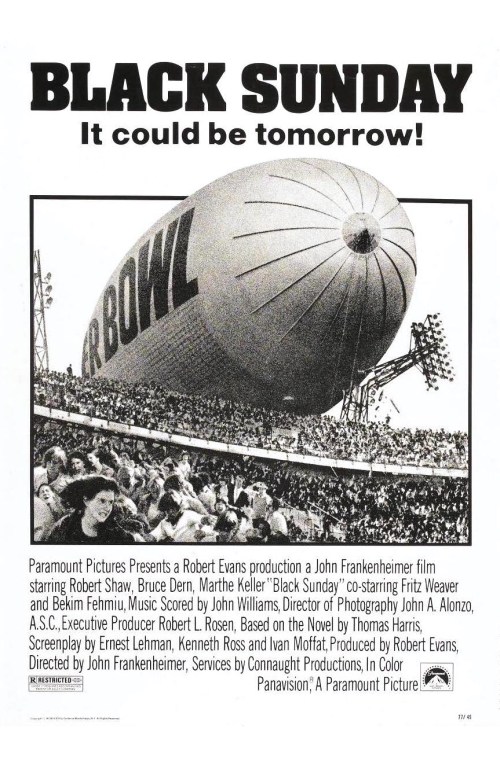
The film’s weakest point is what should’ve been its strongest, which is the segment involving the blimp barreling into the stadium. The set-up is perfect and consists of the some dazzling aerial photography and good up close footage of the football game. However, the actual blimp attack is highly compromised.  For one thing the edits are quick making it hard to follow. A much smaller blimp was used in the long shots and in the scenes where the spectators are running scared onto the field director Frankenheimer put the front end of the blimp onto a crane, which looks tacky and obvious. The blimp’s explosion is fake and when it was all over I felt disappointed. The film’s promotional items, including the film poster as seen above, promised this spectacular event, but then doesn’t come through. It almost makes one feel cheated and ruins the movie’s other good points.

My Rating: 6 out of 10

Released: March 11, 1977

Runtime: 2Hours 23Minutes

Rated R

Director: John Frankenheimer

Studio: Paramount

Available: VHS, DVD, Amazon Instant Video

Straight Time (1978)

straight

By Richard Winters

My Rating: 8 out of 10

4-Word Review: Parolee can’t go straight.

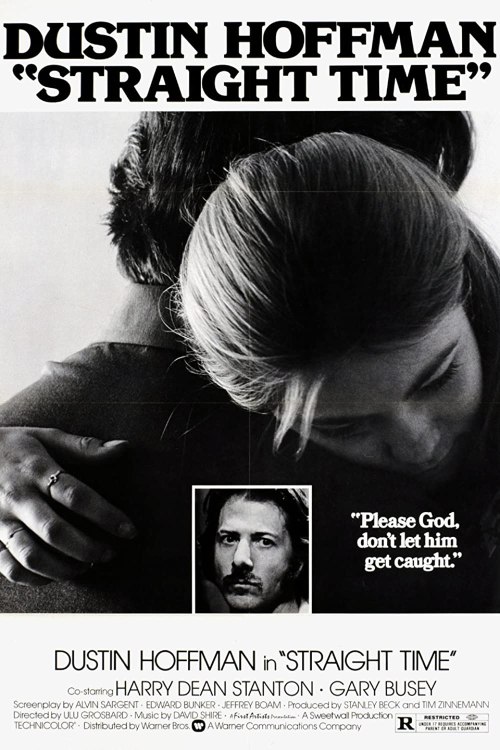
Straight Time is an engrossing, highly realistic drama detailing a parolee by the name of Max Dembo (Dustin Hoffman) who gets released from prison and cannot seem to stay away from the allure of crime despite his initial efforts. The movie is based on the novel ‘No Beast So Fierce’ by Edward Bunker.  Bunker himself was a career criminal who was in and out of jail from 1955 to 1975 and only managed to finally turn his life around when this novel, which he had written while incarcerated and deals with many of his own exploits, got published. Bunker co-wrote the screenplay and appears in a bit part playing a character with a really bad comb-over by the name of Mickey.

I found this film gripping from the second it started and infinitely fascinating the more it progressed. It gives you a whole new perspective on things as you are forced to see it from the viewpoint of the criminal and as an outsider looking in. Every facet of the story and characters is believable and the film does a very good job of being stark and searing without ever getting exploitive, or overtly shocking.  I remember back in 1977 when I toured the new county jail in the town where I grew up when it was first opened and before it housed any inmates. I remember the officer describing the rather degrading procedures all felons had to go through when they were first booked including being stripped searched and forced to take a shower nude while a fully clothed officer stood by and watched them.  The scene where Max and other criminals are ‘welcomed’ to the L.A. County jail worked exactly like that. It was so authentic and frank that it seemed almost like a documentary.

The essence of the story revolves around Max and his relationship with his parole officer Earl Frank that is wonderfully played by noted character actor M. Emmet Walsh. Earl does his job a little too well. He shows a constant distrust of Max and gives him no respect while overzealously tracking his every move until it finally forces Max to snap. It is a terrific indictment on the flawed system as it examines just how hard it is for the criminal to go straight and stay straight even if they want to. It also exposes how it seems almost designed to push the person back into crime in its refusal to ever treat the criminal as a human being. The part where Max finally has enough and overpowers Earl and chains him naked to a fence in broad daylight on a busy L.A. freeway while hundreds of cars drive by him should leave an indelible image on the minds of anyone who sees it.

The remaining supporting cast is great as well. Theresa Russell is surprisingly effective as Max’s girlfriend Jenny Mercer. Usually she has played more glamorous types of roles, but here she is perfect as a very ordinary woman who inadvertently gets caught up in Max’s eventual self-destruction until she finds herself in over her head.  I liked the fact that she wore no makeup and the camera was able to pick up her natural beauty through regular lighting. The only issue I had with her character is that it is never made clear why she would fall in love with Max so quickly and what it was about him that she liked since he shows some clear destructive tendencies right from the beginning. To me it just came off as a bit forced and phony to have an otherwise well-adjusted woman that he meets at an employment agency get so infatuated with him after just one date that she immediately agrees to move in with him, visit him in jail, and even quit her job on the spot and go on the run. I know it is standard practice in a Hollywood film for the anti-hero to always have ‘his girl’ that can be used to humanize and compliment him, but there still needs to be more of an explanation and history shown to her character in order to validate the relationship.

Harry Dean Stanton gives another great performance as Jerry Schue. He was a long-time partner to Max during the robberies he did before landing in prison. Jerry has now turned his life around. He has a nice house in the suburbs, an honest job, and a beautiful wife. However, when Max comes to visit, and the minute his wife leaves the room, Jerry begs him for a crime job that they can do together because he finds his new found life to be boring.  I thought this made a great statement as to how the sterile suburban existence is not the American dream for everyone and how it will not necessarily ‘domesticate’ those that still harbor a reckless urge.  I also found it interesting how Jerry views the art of robbery as an actual profession that he takes a great deal of pride and care in. When one of the men shows up late for a planned robbery Jerry calls him ‘unprofessional’.

The robbery scenes are filmed in a diverting way. In most films the camera gets real close to the action in order to heighten the tension. Here the action is captured from a long shot that allows the viewer to see just how chaotic and frantic a robbery really is as well as showing how the most nervous people in the place are the thieves themselves.

If I have one complaint with the film it is in the fact that the second hour becomes rather difficult to watch as it focuses solely on the self-destructive downward spiral of the main character. Max has some good qualities, which makes it all the more painful to watch. Yes, some of his anger is justified, but his insistence at ‘evening the score’ with everyone who has wronged him ends up only hurting himself. Hoffman is outstanding as usual. It is interesting to compare his role here playing a very violent character with the pacifist one that he played just seven years earlier in Sam Peckinpah’s classic Straw Dogs.

If you are looking for an intelligent, searing drama that is still relevant today then this no-holds-bar character study is highly recommended.

My Rating: 8 out of 10

Released: March 18, 1978

Runtime: 1Hour 54Minutes

Rated R

Director: Ulu Grosbard

Studio: Warner Brothers

Available: VHS, DVD, Amazon Instant Video

The Gypsy Moths (1969)

gypsy

By Richard Winters

My Rating: 4 out of 10

4-Word Review: Skydivers travel to Kansas.

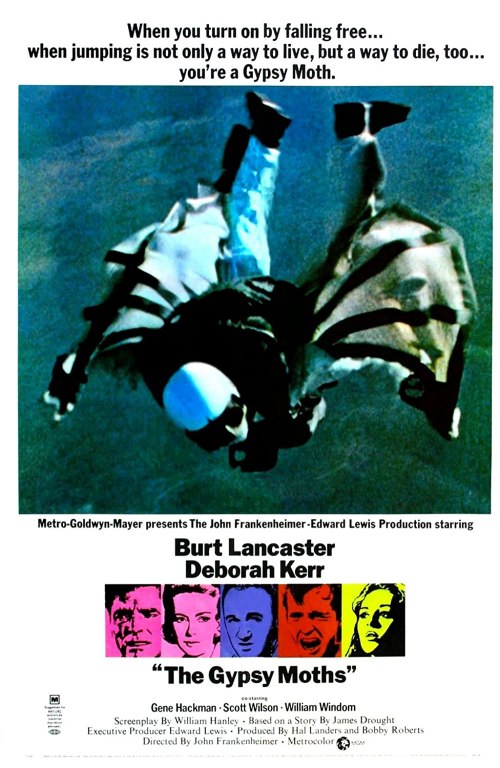
Three skydivers, who make a living going around the country doing airshows for the public, stop off at a small Kansas town on a fourth of July weekend that ends up changing all of their lives. Mike Rettig (Burt Lancaster) is the eldest and the leader of the group. He seems unhappy and suffering from some inner turmoil that he is reluctant to elaborate on.  He ends up having an affair with one of the attractive middle-aged women in town named Elizabeth Brandon (Deborah Kerr).  Joe Browdy (Gene Hackman) is restless and impatient and has a fling with the town stripper (Sheree North).  Malcolm Webson (Scott Wilson) is the introspective member of the trio.  He grew up in the town that they are in and uses the visit as a way to reconcile with his demons from the past.

MGM was hoping for a big hit with this one as it reteamed Lancaster and Kerr 16 years after their famous embrace in From Here to Eternity. The film broke ground as it was the first to feature an established and respected actress who was nearly 50 years of age doing a nude scene. Kerr, who looked great both with her clothes on and off, can be seen fully nude from the front and back during a lovemaking scene with Lancaster.  Yet the film failed to gel with the public.

There were some things that I did like. One is the fact that it was filmed on location in Kansas. The opening shots capturing the countryside of the Midwest really gives a strong visual sense of Americana.  The scenes taking place in the neighborhoods of the small town give the film an added dimension that a studio back-lot just couldn’t do.  The skydiving sequences, which take up the majority of the time, are breathtaking and exciting. The aerial photography makes you feel like you are right there jumping out of the plane and free falling into the air.

The basic plot though is dull and uninteresting.  The characters and situations are contrived and derivative.  It is almost like the story was a second thought to the stunt work and put in merely as filler. I also didn’t like the pretentious quality of the production that made it seem like it was making some sort of profound statement when in reality it was nothing more than second rate soap opera.  The whole thing would have worked better had they skipped the story and made it into a documentary on skydiving instead.

Spoiler Alert!

The most frustrating thing about the movie is the fact that the Mike character dies at the end when he decides, for no apparent reason, not to open his chute and goes, literally, splat on the ground right in front of a throng of spectators. I actually thought this was one of Lancaster’s better later career performances and I was intrigued as to what was causing his character’s inner-strife, but the film offers us no clue, or hint.  I thought there should have been a backstory and even some flashbacks. The ambiguity leaves the viewer cold and unsatisfied and makes the film seem incomplete.

The only possible explanation may come through researching actual Gypsy moths and then correlating the species to the characters. Per Wikipedia, the female gypsy moth is unable to fly. This would then explain why Elizabeth refused to run off with Mike despite her unhappy marriage simply because she could not ‘spread her wings’.  The adult male moth always dies in July, which would then explain Mike’s death. No reason for his demise was needed because his life cycle was ending regardless. July is also the time when the moth lays her eggs, which would explain why Joe and Malcolm, who were much younger than Mike, decided to go off on their own separate ways at the end.

End of Spoiler Alert!

I  ended up finding more misses than hits with this one and can’t help but label it as a misfire.

My Rating: 4 out of 10

Released: August 28, 1969

Runtime: 1Hour 47Minutes

Rated R

Director: John Frankenheimer

Studio: MGM

Available: VHS, DVD

The Eiger Sanction (1975)

By Richard Winters

My Rating: 5 out of 10

4-Word Review: Clint goes mountain climbing.

Dr.  Jonathan Hemlock (Clint Eastwood) is a retired assassin and mountain climber now working as a college art and history professor. However, due to his penchant of collecting rare paintings he is sucked in to doing hits from time to time by an obscure government bureau in order to help pay for his expensive collection of artwork. His assignment this time is to track down the Russian assassin who killed his old army buddy that at one time had saved his life while back in the war. The identity of this killer is not known, the only thing that is known is that the man walks with a limp and is a part of a team of mountain climbers set to scale the foreboding Eiger Mountain in the Swiss Alps.

Eastwood’s foray into the spy genre while entertaining enough to be considered passable still ends up being a misfire. Sure it is fun to see him go a bit against type especially with the accepted image of the spy. Here he wears glasses and actually turns down the advances of beautiful women at least when approached by an attractive student who states she is willing to do ‘anything’ in order to get better grades. It is even fun hearing him speak like a flaming homosexual when he disguises himself as a gay delivering man. However, the overall hokey premise does not suit Eastwood’s rugged persona and mentality. He seems stiff, out-of-place and unemotional most of the way and never believable. I also couldn’t buy into the idea that this paid assassin was actually a deep and philosophical man who abhorred the violence.  A person who becomes as good of a killer as this character is purported to being would have to have some deep dark passion for it in order to spend as much time doing it as he does.

The supporting cast does not fare much better. Dragon (Thayer David) who is head of the secret government bureau that recruits Roger is over-the-top and cartoonish as an albino man who must live in almost complete darkness in an underground temperature controlled room. George Kennedy gets another bland, thankless role this time as Ben Bowman the man who helps train Roger to climb the mountain. It seems like once he won the Academy Award for Best supporting actor in 1967 for Cool Hand Luke his career when straight downward. I also didn’t like the names given to the characters, which were supposedly done as an ‘inside joke’. The last name of Hemlock for the main character is too obvious and naming the black prostitute Jemima seemed even worse.

The only actor and character that comes off well here is Jack Cassidy as the gay man named Miles Mellough who walks around with a pet poodle named Faggot while playing a crafty game of cat and mouse with Jonathan. The character is both threatening and amusing and it was a real shame that he gets killed off in the middle as he could have made the tension more interesting had he stayed on until the end.

Most critics have described the pacing as ‘sluggish’ although I thought it was alright and it gets sprinkled so much with Eastwood’s amusing one-liners that it is always entertaining. The only real issue I had in this area is the first part, which seems unnecessary. It has Jonathan flying out to Switzerland to kill one of the killers only to come back and then fly out again to get the other one. This all becomes redundant and the scene involving the assassination of the first killer is poorly choreographed and edited.

The film’s main redeeming quality is the mountain climbing sequences, which is impressive. I loved the bird’s-eye view camera shots that captured the majestic landscape both in the scenes at Monument Valley as well as in Europe. The fact that Eastwood did almost all of his own climbing and stunts is equally impressive. There looks to be a lot of research put into the making of this film and the climbing segments are well shot and authentic looking. The climax atop of the Eiger becomes a bit drawn out and if anything I found the climb that Eastwood and Kennedy did on the ‘Tootem Pole’ in Utah in the middle of the movie to be more exciting and breath taking.

(Spoiler Alert)

The biggest, most glaring problem that I had with this movie comes at the very end with the ‘surprise’ identity of the killer, which turns out to be the Kennedy character who is finally seen walking with a limp. This though makes no sense because if the man had a limp how was he able to disguise it for so long during the many weeks that he spent with Jonathan during their training and how was he able to climb up the mountain with Jonathan in Utah. The fact that none of this gets answered and almost seems over-looked really makes this thing seem pointless and poorly thought out.

(End of Spoiler Alert)

Rod Whitacker who wrote the novel of which this movie is based labeled this film as being ‘vapid’ and I would have to agree. The story seems to borrow a lot of the same ingredients from other spy films without adding anything new or original of its own.

My Rating: 5 out of 10

Released: May 21, 1975

Runtime: 2Hours 3Minutes

Rated PG

Director: Clint Eastwood

Studio: Universal

Available: VHS, DVD, Amazon Instant Video
The Fury (1978)

By Richard Winters

My Rating: 5 out of 10

4-Word Review: Blow up the body.

Another Brian De Palma/Hitchcock wannabe, this one involving a sinister secret government agent named Ben Childress (John Cassavetes) who wants to use the amazing psychic abilities of a young college-aged man named Robin Sandza (Andrew Stevens) for his own nefarious purposes. While he is in Israel with the father and son he decides to stage a terrorist attack, which he hopes will kill the boy’s father Peter (Kirk Douglas) and allow him to whisk Robin away to an underground research lab where no one will find him. However, Peter manages to survive the attack and goes on a relentless pursuit to find his son. This occurs while a young woman named Gillian Bellaver (Amy Irving) with equally strong parapsychological traits starts to have visions of Robin and his whereabouts while attending a school that specializes in people with these abilities and eventually she teams up with Peter to help him in his quest.

I liked the opening sequence being shot on-location in Israel, which gives the film an exotic feel. The attack is well-handled and comes as a surprise without any set-up, but I felt there was a fatal flaw with the premise. This is namely the fact that with Robin’s amazing psychic abilities you would think he could figure out that his Dad was still alive and be able to find him while also outsmarting the people who are holding him.

The secret agency thing and what they are using him for is vague and we see only a few scenes with him there. I felt this should have been more detailed and less time spent with Gillian at the psychic school, which is not very compelling and rather draggy.     There are a few good action moments, but unfortunately they come at the beginning and end with a talky middle that lacks any real suspense.

However, Peter’s escape from some gunmen by jumping out of an apartment window and onto the ‘L’ tracks along Wabash Avenue in Chicago is amazingly well shot and nerve-wracking.  A scene where Robin tortures a female Dr. (Fiona Lewis) by using his telepathic powers to spin her around a room until  blood oozes from her body and sprays all over the walls and furniture deserves some merits, but I wished it had been more extended. There is also the exploding body that is the film’s final shot and possibly its best and it is shown several times at different angles. I also enjoyed the darkly humorous scene where Robin uses his powers to send a ride at an indoor amusement park out of control and throwing the riders through the window of a nearby restaurant.

De Palma’s trademark over-direction is in full gear. Sometimes it works, but other times it is a distraction. For instance he uses a lot of panning shots showing one person talking and then panning to the other person and then back again. During a funny scene where Peter breaks into an older couple’s apartment while looking for a disguise this really works, but De Palma continues to go to this well throughout and eventually it becomes annoying. There is also a foot chase that is done in slow-motion, which to me sapped the tension and excitement right out of it. He does have a few bird’s-eye view shots, which while not adding anything to the story, are still kind of cool.

Andrew Stevens, son of actress Stella Stevens, is well cast as the young man who starts out likable, but slowly becomes evil as the film progresses. Stevens has a good knack for this as he can go from nice to menacing very quickly and I first noticed this during a classic episode of Murder She Wrote. His clear blue eyes can give off a creepy stare as well.

John Cassavetes is an excellent bad guy.  He is best remembered as an independent film director with a unique vision, but with his dark features, cryptic glare, and intense delivery he can also be a very good villain. I don’t think the film made the most of it, but it was astute casting.

Although billed as the star Douglas does not have the most screen-time and there are long periods where he isn’t seen at all. This was really a vehicle for Irving, who is convincing and makes the viewer sympathetic to her quandary of having super-powers that she does not fully understand, cannot control and doesn’t really want.

It’s an interesting idea, but doesn’t go far enough with it. There weren’t enough twists to justify sitting through almost two hours. The pacing is poor and had it been trimmed to 90 minutes it would have worked better. The special effects are decent, but there needed to be more of them and they might not hold-up to contemporary standards. John Williams’s orchestral sounding score helps elevate what is really just bubblegum material.

This is a great chance at seeing some young stars in their film debuts including Darryl Hannah, Laura Innes, and James Belushi. There is also an amusing scene featuring Dennis Franz with a full head of hair playing a nervous and befuddled Chicago cop.

My Rating: 5 out of 10

Released: March 10, 1978

Runtime: 1Hour 58Minutes

Rated R

Director: Brian De Palma

Studio: 20th Century Fox

Available: DVD, Amazon Instant Video

Diary of a Mad Housewife (1970)

diarymad1

By Richard Winters

My Rating: 9 out of 10

4-Word Review: Married to a jerk.

Director Frank Perry may not be a name one throws out when mentioning some of the top directors, but a lot of his early work that he did with his screenwriter wife Eleanor were definite forerunners of the independent film movement and ahead of their time. David and Lisa was their first and it dealt with the budding romance between two patients at a mental hospital. Ladybug Ladybug was their follow-up and it was the true story of what happens when an errant nuclear warning siren goes off and the staff and students of a small rural school think it is for real. There was also the critically acclaimed film Last Summer dealing with the brutal gang rape of a teen girl by her so called ‘friends’.  They also did the revisionist western Doc starring Stacy Keach as well as the brilliantly quirky Rancho Deluxe.  However, it is Diary of a Mad Housewife that I find to be their very best.

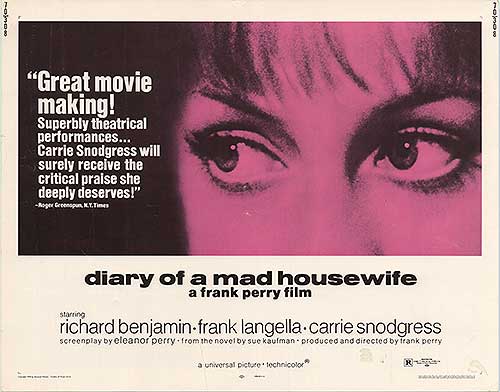
It is the story based on the best-selling novel by Sue Kaufman dealing with the character of Tina Balser.  On the outside she seems to be living the American dream. She is married to a up and coming lawyer, living in a swank Manhattan apartment, and the mother of two beautiful girls.  Unfortunately the husband is an obnoxious bore, the girls are spoiled and mouthy, and she feels lonely and depressed.  She decides to have an affair with a novelist, but he ends up treating her just as poorly and when she tells her troubles to a support group, they end up doing the same.

I have seen this film many times over the past twenty years and am always impressed at the fluid way it goes between satire and drama as well as the fact that it doesn’t seem dated at all. The scenes with Richard Benjamin as the jerk husband are hilariously over-the-top.  Yet the scenes involving Frank Langella as the lover who is bitter about his lagging writing career and repressed homosexuality and takes these frustrations out on Tina, are just as interesting, but in a much more subtle way.  In fact these scenes feature some great dialogue and character development and I find them more intriguing with each viewing.  Langella, in his film debut, makes a lasting impression.

The cinematography, editing, and color schemes are also first-rate. Perry does a great job in infusing the counter-culture movement of the time with the old values of marriage and family. The mod party that they go to is well staged with scantily clad mannequins in a provocative poses placed throughout.  The pretentious attitudes of the party goers is nicely captured.  This scene also features the Alice Cooper Band as well as giant pillow fight.

Carrie Snodgrass performance is what really makes this work.  She was nominated for the Academy Award and she should have won it. Her ability to display her characters feelings through such subtle methods as facial expressions, body gestures, and reactions is impressive.  The viewer can easily relate to the character and feel her pain.  Rock singer Neil Young was so impressed with her that he wrote her a fan letter and the two ended up getting into a relationship. Unfortunately because of this she dropped out of Hollywood and didn’t do another movie until almost nine years later.  When she returned all the top roles were no longer accessible and she was relegated to ‘B’ movies and small supporting roles until finally succumbing to cancer in 2004. This was a real shame because her talents were never fully utilized, but at least this was a perfect vehicle for her and one that movie fans today can really appreciate.

In the end though what makes this film so very good is that it makes a great statement on the fact that isolation is a part of modern day living and at some point everyone will have to deal with.  Getting married, having kids, even having a lover or a support group will not necessarily be an effective buffer and may actually only exacerbate it. The whole film kind of reminded me of a statement made by a character on the old ‘Ally McBeal’ TV-show “My loneliest times in life are when someone is lying in bed next to me.”

My Rating: 9 out of 10

Released: August 10, 1970

Runtime: 1Hour 43Minutes (Theater Version) 1Hour 35Minutes (TV Version)

Rated R

Director: Frank Perry

Studio: Universal

Available: VHS

Fathom (1967)

fathom1

By Richard Winters

My Rating: 4 out of 10

4-Word Review: Dental assistant becomes spy.

The spy genre became a big craze in the late 60’s with the success of the James Bond films.  Studios were busily either coming out with imitations of the genre, like the Matt Helm films with Dean Martin, or spoofs of the genre.  This film, starring the voluptuous Raquel Welch, is a combination of both.

The premise is slightly unique as the Welch character, whose name is the same as the film’s title, is not actually a spy. She is a dental assistant and part-time parachutist. This attracts the attention of the British secret service who want to use her parachuting skills to have her ‘drop-in’ to the island mansion of bad guy Tony Franciosa and plant a bug on his premises. They need this done so that they can monitor his conversations and find the whereabouts of a priceless Chinese dragon statue that they are after.

Initially I was intrigued with the idea of the Welch character being just a regular person who gets trained to be a spy from the ground up. However, this concept almost immediately falls flat and ends up pretty much ruining the whole film.  One of the problems is that the Welch character goes through no training to speak of and agrees to this potentially dangerous mission that comes out of nowhere without any conversation regarding her compensation.  She also ends up thinking way too quickly on her feet and behaving like a seasoned spy without any of the expected awkwardness. The character is also poorly fleshed out having no personal life, relationships, history, or even a few odd little quirks.  There are constant references to her beauty, but this quickly become tiresome.  Raquel’s typically one-dimensional performance doesn’t help.

The storyline becomes too convoluted and suffers from having too many plot twists. Reportedly even the cast members found the story confusing.  The good guys become the bad guys and then become good guys again with boring regularity.  A decent spy film needs one true bad guy who is evil and nefarious and seemingly unstoppable because that is what builds the tension.  This film has no tension whatsoever and the musical score sounds like Herb Alpert or Sergio Mendes, which would be better suited for a romance.

The one thing that did impress me was the stunt work.  There are a few that look genuinely dangerous and are shot and edited very well.  One involves Raquel trapped in a bull ring while wearing a red dress.  There is no question that it is a real bull and several shots have her stumbling to the ground while the bull stands right over her. The editing is so well done that I could not tell when the stuntwoman was put in, as usually I can spot this.  Even if a stunt person was used it still looked quite dangerous and very real.  Another good one features Raquel swimming away from a bad guy who continues to shot at her with a spear gun. Both the underwater and aerial photography in this segment are outstanding.

Alas, none of this is good enough to save the film as a whole.  The tongue-in-cheek humor and pacing is poor, and the film ends up being boring and contrived.

My Rating: 4 out of 10

Released: December 13, 1967

Runtime: 1Hour 39Minutes

Rated NR (Not Rated)

Director: Leslie H. Martinson

Studio: 20th Century Fox

Available: DVD

The Landlord (1970)

By Richard Winters

My Rating: 8 out of 10

4-Word Review: In over his head.

Elgar Enders (Beau Bridges) is a spoiled 29 year-old from a wealthy family who is still living at home with his parents in an affluent suburb of New York.  He decides it is time to ‘make his mark’ by purchasing a rundown building housing black tenants in inner-city Brooklyn.  He plans to evict the people and have the structure renovated into a posh flat.  He starts having second thoughts though as he gets to know the people and learns of their struggles.  He begins a relationship with one of the women (Diana Sands) and soon he is working to upgrade the building as well as trying to enlighten his racist, snobbish parents (Walter Brooke, Lee Grant) to embrace the black movement.

The Enders character is a perfect microcosm to the 70’s period where idealism and efforts to improve inner-city life, as well as some of the harsh realities that came with it, where at an all-time high.  Director Hal Ashby’s first film is full of strong gritty visuals from the rundown, graffiti-laden buildings to the garbage strewn lawns. Everything was filmed on-location and you get a vivid taste of the black experience. It is boosted even more by the detailed cinematography of Gordon Willis, which makes the most of the natural lighting and making you feel like you are right there.   The honest no-holes-barred approach is terrific. It perfectly captures the mood and feel of its era. I was surprised for a first time director, even a really good one like Ashby,  how well-constructed and technically sharp this was, which could have some link to the fact that it was produced by another great director, Norman Jewison, whom I’m sure lent a lot of input.

Initially I found the Elgar character to be off-putting, but that could’ve been intentional.  We first see him sitting on his lawn chair being served a drink by a black servant while talking about his great plan and looking like a spoiled, snot- nosed kid who has been coddled all his life.  The one scene that I remembered from this film when I first saw it over 20 years ago is when he  gets out of his Volkswagen bug to look at the building while wearing a tacky looking Pat Boone white dress suit.  When some of the black men sitting on the building’s front steps tease him a little, he immediately panics and runs eight blocks down the street in terror even though no one was chasing him.  However, he does start to grow on you as the film progresses.  I liked the fact that he faces adversity and is not scared away.  He learns to persist and adapt.  He genuinely starts to care about the people and backs-up what he says to the extent that he single-handedly carries new toilets one-by-one from the hardware store to the apartment building when the plumbing breaks down in an amusing vignette.  He isn’t afraid to tell off his arrogant parents when he needs too and his definition of NAACP is pretty funny.  It is satisfying to see him mature, learning that instituting change is not easy and things are the way they are for a reason.  He eventually is forced to confront his own limitations, but becomes a stronger person for it. This is without a doubt Bridges best performance to date.

There are other great performances as well.  Pearl Bailey is a gem as one of the building’s feisty, older women tenants who is the first to befriend Elgar.  Her awkward visit with Elgar’s equally feisty mother is considered the film’s highlight by many viewers and critics. I also loved the look she gives Elgar at the very end when he tries to wave goodbye to her.  The gorgeous Diana Sands is outstanding playing the role of Francine who has an ill-fated affair with Elgar. She shows just the right balance of sexiness and seriousness and it was a shame that just a few years after this film was made she ended up dying of cancer at the young age of 39. Susan Anspach is fun in one of her early roles as Elgar’s pot smoking sister.  The performance though that leaves the strongest impression is that of Lee Grant who is hilariously hammy as Elgar’s priggish mother.

When I first saw this film I came away thinking that it was uneven and a bit bipolar. It runs most of the way as a gentle, quirky satire filled with goofy cutaways, but then ends with a very stark and frightening scene with Elgar being chased down the grimy hallways of the building by Francine’s angry ax-waving husband (Louis Gossett Jr.) when he finds out that Elgar has gotten his wife pregnant.  The scene is ugly and intense and a far cry from the rest of the film’s gentle tone. Yet upon second viewing I think this scene works and was necessary. It makes a good statement at how volatile temperaments can be of those that are forced to leave in squalor as well showing how easily people, even with the best intentions, can get in over-their-heads when they don’t fully appreciate, or understand the situation that they are getting into it.

The side story involving a mulatto women (Marki Bey) who falls in love with Elgar is solid as well and gives the viewer a keen insight as to how difficult it is for someone who can’t seem to be accepted by either race. The language and conversations are tough and vulgar, but always laced with realism.

The only complaint I have with the film is the portrayal of the white characters who are buffoonish and overly idiotic even for satire.  I thought the idea of having them still use black servants was over-done, but then when one of them shows up at a party wearing blackface it was overkill. I thought it was unfair and unrealistic in the way that the film worked so hard to give depth to its black characters, but then turns around and, with the exception of Elgar, paints the whites as nothing more than broad caricatures.

The Landlord has finally been released on DVD through MGM’s Limited Edition Collection. I would suggest this film for anyone who enjoys an intelligent comedy-drama with something to say. It is also a great chance to see young up-and-coming actors. This includes Hector Elizondo as well as comedian Robert Klein. You can also get a very quick glimpse of Samuel L. Jackson who appears briefly in an uncredited role as a minister near the end.

My Rating: 8 out of 10

Released: May 20, 1970

Runtime: 1Hour 52Minutes

Rated R

Director: Hal Ashby

Studio: United Artists

Available: VHS, DVD