Category Archives: Movies Based on Novels

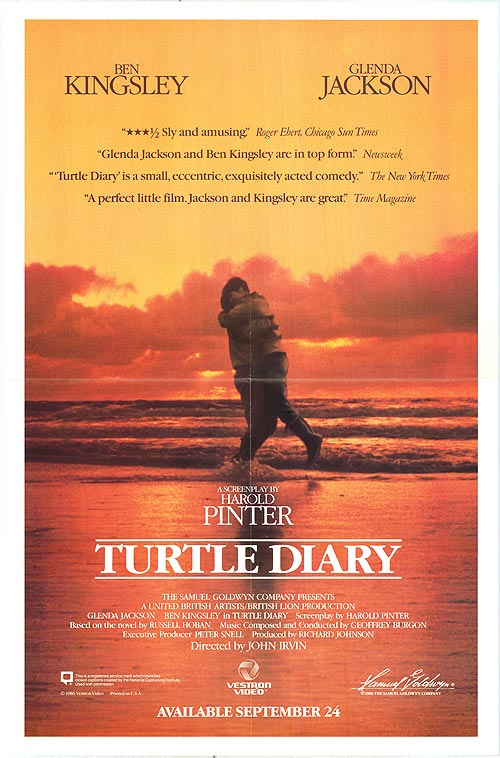
Turtle Diary (1985)

turtle diary 1

By Richard Winters

My Rating: 5 out of 10

4-Word Review: They free the turtles.

William (Ben Kingsley) becomes fixated with the idea of freeing the sea turtles at the London Zoo and returning them to the ocean. Neaera (Glenda Jackson) starts to have the same dream. The two get together and with the help of the kindly zookeeper George (Michael Gambon) begin to execute their plan.

Although well received by the critics at the time of its release I felt the film never seemed to gel. The plot is too thin and there is no explanation as to why William got so worked up about the turtles being in captivity. I felt there needed to be something shown in his history or character to explain this motivation. After all there are thousands and thousands of people that go to this zoo each year and none of them seemed to get worked up about the same idea. Also, why just the turtles? If William’s problem is seeing an animal that is not in their natural habitat then why not free all the species in the complex.

The plan also goes off way too seamlessly. What are the odds that the zookeeper would be in agreement with them and pretty much do all the work for them in setting it up to the point that all they end up doing is driving the turtles to the ocean. The story would have been a lot funnier and exciting had they somehow had to do it all themselves and behind the scenes. As it is here it becomes almost a non-event that barely holds any interest. Also, I have never heard of a zoo that decides not to press charges when they find that the turtles have been stolen or not firing the employee when they find that he had something to do with it.

The way Neaera and William get together is equally uninspired. They seemingly just keep bumping into each other and through sheer circumstance find out they have the same motivations. I was expecting something a little more creative and humorous. Neaera’s attempts at getting William’s address is particularly forced and contrived. In fact almost all of the conversations that they have with the exception of one where Neaera describes a weird dream that she had is very ordinary. The dialogue they have while traveling to the ocean is the blandest and none of it reveals much about the characters who end up being pretty forgettable.

Watching them carry the turtles to the open water has no emotional impact at all. It is not even the climatic sequence as it happens with 30 minutes left of the film. The rest of the movie concerns William’s dealings with the other people in his flat, which is mainly pointless.

The screenplay was written by celebrated writer Harold Pinter, who has an amusing cameo as one of the customers at William’s bookstore. Pinter was famous for his cutting edge and provocative plays of the 50’s, 60’s, and 70’s many of which I found to be quite fascinating, but this thing seems to be the polar opposite. The story and execution is standard while lacking any flair or pizazz. I can handle low-key and subtlety and many times relish it, but there still needs to be something more to it. More quirkiness and humor was needed as well as some tension. The film as it is here is flat and seems to waist a potentially unique idea as well as its cast.

My Rating: 5 out of 10

Released: September 10, 1985

Runtime: 1Hour 37Minutes

Rated PG

Director: John Irvin

Studio: The Samuel Goldwyn Company

Available: VHS

The Split (1968)

the split

By Richard Winters

My Rating: 5 out of 10

4-Word Review: Robbery during football game.

Since today is Superbowl Sunday I wanted to come up with a film from the 60’s with some sort of football theme and decided to dig this one out of the obscure pile that has just recently been released onto DVD through the Warner Archive label. The film has two special distinctions. For one it is the first movie to ever get an R rating under the MPAA’s then new rating system. It also shows scenes from two actual football games. The first one is a game between the Los Angeles Rams and the Atlanta Falcons that was played on December 3, 1967 and won by the Rams 20 to 3. The second game shown was one played a week later between the Rams and the Green Bay Packers where the Rams also prevailed by a score of 27 to 24.  Both games were played at the L.A. Coliseum with the plot of this movie taking place at another part of the stadium during these games although it is clear that the scenes involving the actors was done on a studio soundstage.

The story, which is based on a novel by the prolific Donald E. Westlake, involves a group of criminals who pull of a daring robbery during the football game, but when it comes to splitting up the money things go awry and they are soon turning on each other.

The crime itself isn’t all that interesting and tends to be a bit plodding with a minimum of suspense. Having things go wrong at the end and the group start turning on each other is redundant since they had been bickering amongst themselves from the very beginning. The characters are all unlikable making it hard for the viewer to get wrapped up into the plight of which of them gets the dough and which doesn’t. Personally I was hoping they would all just get killed off and no one would get any money because their constant yelling and fighting quickly becomes tedious and tiring.

The film’s one main highlight is a fight between Jim Brown and Ernest Borgnine, which carries the novelty of the fact that the two had a similar type of confrontation just a year earlier in the film Ice Station Zebra. Here, like in that film, Borgnine seems to get the best of Brown, which doesn’t make any sense because Brown was athletic, muscular and twenty years younger. There is also a scene where Borgnine puts his fist through a picture on the wall and shatters the glass. However, not only does he not wince in pain, which would be expected, but it somehow doesn’t even cause him to bleed.

Brown can sometimes be good in certain supporting roles, but as a leading man he can’t carry the picture. His facial expressions make him look like he is almost bored and just walking through the role. I know he was a great Hall of Fame running back, but that doesn’t mean he will turn into a great actor and casting him in lead roles of major studio pictures seemed awfully risky.

Warren Oates is terrific as always in a supporting role as one of the group’s henchmen. Donald Sutherland is also really good as another member of the group. I loved his Cheshire cat-like grin as well as his bowl haircut that gives him a creepy look. Julie Harris also sports a different style of hairdo from her usual short cut and she looks attractive as well as being near perfect in her part as an icy cold bitch that has no qualms about torturing a man to death in order to find her money.

SPOILER ALERT!

One of the biggest problems I had with the film was a plot twist that should have made it more interesting. It involves the James Whitmore character who plays the landlord of Diahann Carroll who is Brown’s girlfriend and hiding the stolen money in her apartment. Whitmore enters her place when she is alone and tries to rape her. Seeing an old wrinkled guy attacking a hot young black woman is wild in itself, but he also finds a machine gun in her dresser and holds it like he is masturbating with it and spews its bullets into her body like it is his ejaculation, which I found to be edgy and cool. He also finds the money and takes it for himself while making an anonymous phone call to the police to implicate Brown as the killer. However, when the police detective played by Gene Hackman investigates the case they quickly find out it was the landlord who did it, but it was never explained or shown how they came this conclusion as well as the fact that they end up killing him, which is completely glossed over and mentioned just briefly when the other characters read about it the next day in the newspaper. To me this created a major plot hole that needed to be filled.

The film also has a twist ending that doesn’t work and is very confusing. It happens as Brown is walking through the airport at the end with his share of the money and he hears what sounds like Diahann Carroll’s voice calling his name and he turns around with a shocked expression before the frame freezes and cuts to the credits. However, Carroll’s character was clearly killed and Brown saw the dead body, so how did she come back to life? Some viewers have stated that they think the voice was all inside Brown’s head, but that still needs to be explained and would normally prove frustrating to the viewer, but since the film is so bland it really doesn’t matter.

I feel I am being very generous in giving this picture 5 points, but the direction is fast paced and nicely compact and the jazzy Quincy Jones score is groovy. However, it certainly isn’t worth missing the big game for, nor any other game for that matter.

My Rating: 5 out of 10

Released: November 4, 1968

Runtime: 1Hour 30Minutes

Rated R

Director: Gordon Flemyng

Studio: MGM

Available: DVD (Warner Archive), Amazon Instant Video

The Night of the Following Day (1969)

night of the following day 4

By Richard Winters

My Rating: 4 out of 10

4-Word Review: Kidnappers can’t get along.

A teenage girl (Pamela Franklin) is kidnapped by a group of professional killers who then demand a large ransom from her rich father (Hugues Wanner). Things deteriorate as the criminals begin fighting amongst themselves and eventually it all goes awry, which leads to ironic results.

Writer/director Hubert Cornfield creates a picturesque setting and a certain new wave look that subtly runs through it. The music has a new age sound, which helps to create a kind of metaphysical mindset. There are also some good camera angles and interesting edits, so it takes you awhile before you realize that this is just a lot to do about nothing.

The caper itself is too general and formulaic and in the end makes it a lame excuse for a movie. The infighting by the criminals is not that interesting. The characters are so one-dimensional that you really don’t care what happens to them. The twist ending is not that clever and in many ways simply signifies what a waste of time this really is.

Marlon Brando overacts with a part that doesn’t require it. He uses the hip lingo of the day like ‘freaky’ and ‘man’, which doesn’t really mesh with the middle-aged man that he was. His blonde wig looks awful and his trendy clothes including his big belt buckle gives him too much of a kitschy appearance. The attempts at making him a sort of anti-hero that is brave, sensitive, and concerned for his victim’s welfare despite being one of the perpetrators doesn’t work and makes the character a cliché like everything else in the movie.

Franklin is wasted. She goes through all the expected emotions of a kidnap victim, but barely utters a word in the process.

The neighboring policeman is put in to help create some tension, but ends up being annoying instead. However, Jess Hahn as Wally is quite good playing the film’s only believable character. He has very much of an average Joe type of looks and seems at the start to have an insignificant role, but ends up being the only one that holds it up together while the rest become whacked out.

Despite an interesting cast that also includes Rita Moreno and Richard Boone I found this to be a very cardboard thriller that runs out of gas after an okay beginning.

My Rating: 4 out of 10

Released: February 19, 1969

Runtime: 1Hour 33Minutes

Rated R

Director: Hubert Cornfield

Studio: Universal

Available: VHS, DVD

Welcome to Woop Woop (1997)

welcome to woop woop 2

By Richard Winters

My Rating: 6 out of 10

4-Word Review: Oh those crazy Aussies.

Teddy (Johnathon Schaech) is a rather clumsy con man from New York who tries to escape a murder rap by going to the most remote place possible, the Australian outback. However, after coming into close contact with the eccentric people and lifestyles, he decides what he really needs is an escape from there!

This is the type of offbeat comedy that should give all other offbeat comedies a bad name. It takes all the same ingredients from all those other films, meshes them together, and then spits them out in a mechanical fashion. Unlike director Stephan Elliot’s earlier feature Priscilla Queen of the Desert there is nothing deep here to help balance the quirkiness. The film is just made to be silly and at times goes overboard with it. The pace is also too fast. The viewer is never allowed to soak anything in or even take a breath.

Schaech is not good in the leading role. He gives too much of a breezy performance, acting as if the whole thing is a joke. He never once even for a second displays the angst, anxiety, and basic overall exhaustion that anyone else stuck in the same situation would feel.

The portrayal of the Australian people is terrible. They take all the stereotypes of the down under folks and then play it up to the extreme. Here they are not just slightly eccentric people of a rugged and hearty nature. Instead they are complete Neanderthals who live like animals and have no level of sophistication. Yes, it does try to be somewhat fair by showing that Americans may have some primitive defects as well. Specifically in an opening sequence in New York City where every pedestrian is seen shooting at some birds flying by. Still the Australian segments are needlessly overdone and a bit insulting.

The one pleasant surprise is the appearance of Rod Taylor. He plays completely against type here. He’s Daddy-O a self-imposed, self-styled dictator of the town. His performance is gruff, campy, energetic, over-the-top, and hilarious all at the same time. His appearance here may actually be his career pinnacle.
Overall the film is similar in tone to all those formulaic bid budgeted Hollywood actioners, except here it’s aimed at the offbeat crowd. Everything is perfectly packaged to its core audience and overblown all at the same. It’s so forced at points that it almost becomes ridiculous. Yet some of the humor is funny, it has a feel good attitude, and it is without question LIVELY.

Watch for a real fun cameo by Tina Louise at the beginning.

My Rating: 6 out of 10

Released: May 13, 1997

Runtime: 1Hour 37Minutes

Rated R

Director: Stephan Elliot

Studio: Goldwyn Entertainment Company

Available: VHS, DVD

W. C. Fields and Me (1976)

W. C. Fields and me

By Richard Winters

My Rating: 6 out of 10

4-Word Review: Fields had a girlfriend.

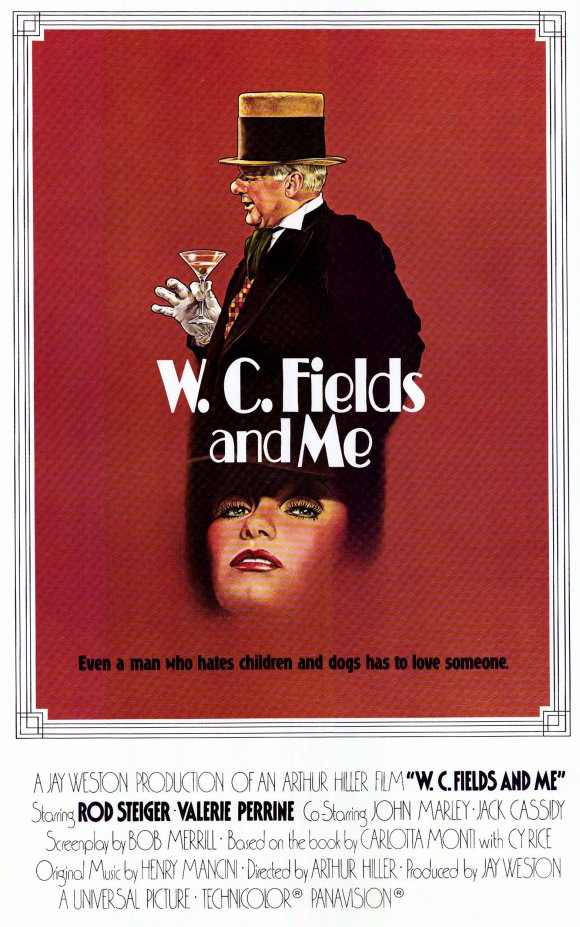
Based on the memoirs from Carlotta Monti who was W.C. Field’s (Rod Steiger) companion for 14 years this film looks at their relationship as well as W.C.’s alcoholism and difficult personality.

This biography is highly romanticized and very light on the details. Apparently only one scene from the book is actually used in the movie. If one watches this in hopes of learning more about Field’s the man they will be disappointed. The tone seems similar to Oliver Stone’s The Doors where the intent is more on perpetuating the myth of its subject instead of tearing it down and showing the complete person. Just about everyone is familiar with Field’s drinking and cantankerous behavior, so having the film dwell exclusively in this area for the entire time is not interesting, or captivating.

The story would have been better served if it had been a complete bio beginning with Fields life as a child and then going all the way through to his death. Apparently he was born to an alcoholic father who beat him forcing Fields to run away from home at the age of 11 and live in a hole in the ground where he became dependent on stolen food and clothing for survival. He was in many fights and in and out of jail for most of his youth. Showing this could have been quite revealing, but instead the film skips past all of it and starts instead with Fields already in vaudeville and recreating a lot of corny comedy routines before having him drive off to Hollywood where his ascent to stardom seems much too easy and superficial.

Things improve during the second act when he begins his love-hate relationship with Carlotta (Valerie Perrine). Part of the reason this works is because Perrine is excellent. Her down to earth sensibilities really help balance the flamboyant ego’s around her and fit the character well. She is the one, not Steiger, who carries the movie and it was worthy of an Oscar nomination.

Steiger thought for sure that he would nab his second Oscar for his portrayal here, but instead didn’t even get nominated. His mimicking of Fields voice comes off as too rehearsed and effected. At times it gets annoying and just makes one want to watch a movie with the real Fields instead. His dialogue is too cutesy using lines borrowed from many of W.C.’s famous jokes and punch-lines. As expected he does induce the character with his famous Steigerisms and manages to not make it a complete misfire that it otherwise is. The scene, near the end, where Fields meets his now grown son that he hadn’t seen since he was three is his best moment.

Jack Cassidy is great in support as actor John Barrymore. The scene where he dies and his friends prop his dead body up into a chair and have him holding a liquor glass is amusing. Dwarf actor Billy Barty is good as Ludwig one of Field’s long-time friends. Some of the scenes the two share together are actually quite touching.

The film does a commendable job of recreating the period atmosphere. The music has a nice soothing quality to it and on the charm level it scores a bullseye. Despite my reluctance I found myself entertained by it, but as a biography it is flimsy, fictional and irrelevant.

My Rating: 6 out of 10

Released: March 31, 1976

Runtime: 1Hour 51Minutes

Rated PG

Director: Arthur Hiller

Studio: Universal

Available: Amazon Instant Video

Deathwatch (1980)

deathwatch 2

By Richard Winters

My Rating: 8 out of 10

4-Word Review: Everyone watches her die.

Based on the David Compton novel this story deals with Katherine (Romy Schneider) who is living in a futuristic society where almost all diseases can be cured and death is very rare. When she is diagnosed with having a rare and incurable illness Vincent (Harry Dean Stanton) tries to get her to appear on his hit reality show ‘Deathwatch’ in which they film in documentary style a person’s slow and agonizing death, which is a huge TV hit. When Katherine tries to escape the publicity and hide from their cameras Vincent has a small camera surgically implanted into the brain of Roddy (Harvey Keitel) one of his cameramen, which then allows  Roddy to follow Katherine around and record her actions without her knowing it. The two then slowly form a relationship that culminates with tragic results.

Director Bertrand Tavernier is in top form. The movie is nicely paced and Tavernier shows a perfect grasp of the material. His use of music wonderfully accentuates the mood and tone. Filmed on-location in Scotland he captures the old buildings of the region with a stylish flair that gives the film an added personality and memorable image. Showing characters walking all alone in the seemingly abandoned streets hits home their loneliness and having the scenes done in decaying buildings and neighborhoods illustrates the decaying values and morals of the world these characters live in. The gray stormy skies brings out the pictures moodiness and the isolated shack in the middle of a vast empty field that the two hide out in captures visually the characters lost and hopeless desperation. The film becomes like an orchestral ensemble moved along by a talented conductor at the peak of his skill.

This is also a great example of using a hand-held camera sparingly and only to create a certain mood, or emotion. Too many films these days seem to have what I call ‘the shaking camera syndrome’ and it is annoying and loses the original intended effect. Here Tavernier employs it during a scene where Katherine is trying to elude the production crew and the viewer feels her frantic tension with each move that the camera makes as well as getting a great cultural feel by capturing the various street vendors along the way.

The story itself is fascinating and years ahead of its time. The issues it brings out about television, ratings, and the cutthroat ugly world of business of entertainment have never been more on-target. This film may even transcend the classic Network with its dire message and that is not easy to do. What I really liked though was the fact that the twists keep coming in layers and all of them are unexpected, but equally fascinating. The story is riveting and compelling from beginning to end.

Schneider is brilliant and beautiful as always giving another one of her impeccable performances. Her character is easily identifiable and the viewer immediately gains her sympathy. She shows an array of different emotions and traits making her a fascinating three-dimensional person. Her presence is the main ingredient that propels the film and without her none of it would have worked and her gorgeous natural smile is wonderful and manages to come on display briefly despite the ugly difficulties of her character.

Keitel is in fine form as well playing a character who finds that when one works for those who are more than willing to exploit others they themselves will eventually be exploited by them as well. Von Sydow appears near the very end and lends stature to the proceedings.

I hate to bring this up because I love the film’s visual design, but I did find it a bit odd that the story is about the hi-tech future and yet all we are shown are old buildings and other gadgets that look very much like they are from the 1980’s. The computer that Katherine works on is laughably archaic and I felt from that end they could have tried harder to create a little more of a futuristic impression. Also, the name of the network ‘NTV’ sounds a little too much like the cable network that used to show music videos.

The recent Blu-ray release from the Shout Factory is excellent and restores the film to its original runtime of 130 minutes. I highly recommend this to those who enjoy Sci-fi fare that is thought provoking and original.

My Rating: 8 out of 10

Released: January 23, 1980

Runtime: 2Hours 10Minutes

Rated PG

Director: Bertrand Tavernier

Studio: Gaumont International

Available: VHS (1Hour 57Minute Version), DVD, Blu-ray

Cattle Annie and Little Britches (1981)

cattle annie and little britches

By Richard Winters

My Rating: 6 out of 10

4-Word Review: She needs a spanking.

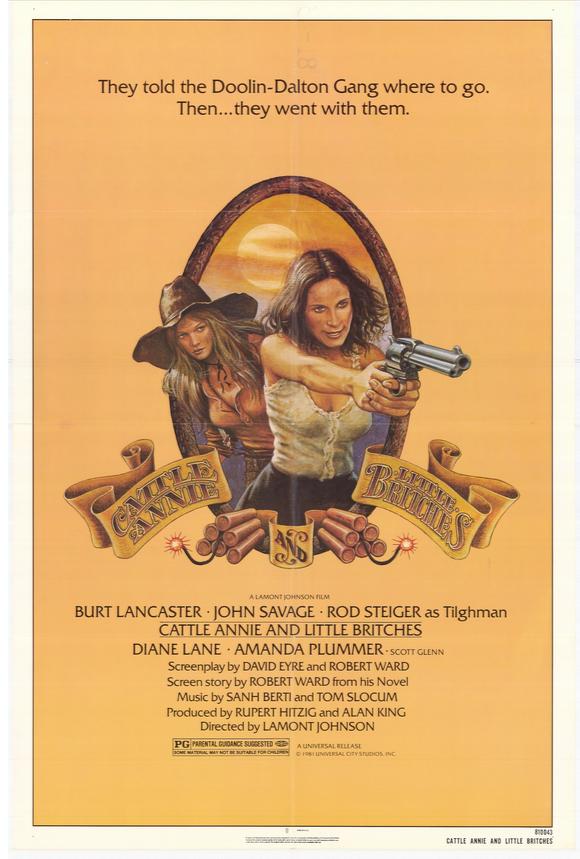
Based very loosely on actual events this film looks at Annie McDoulet (Amanda Plummer) and Jennie Stevens (Diane Lane) two adolescent girls traveling in the Oklahoma Territory of the late 19th century looking for excitement and adventure. Annie becomes transfixed with the stories that she reads about the western outlaws particularly the ones about Bill Doolin (Burt Lancaster), but when they finally do catch up with his gang they find the men to be old, haggard, and tired as well as just one-step ahead of the relentless pursuit of famed western lawmen Bill Tilghman (Rod Steiger).

Plummer, in her film debut, is nothing short of electrifying. She is the daughter of Christopher Plummer and actress Tammy Grimes and she makes her presence strongly felt here. Her vulgarity and tenaciousness are infectious and help propel the film and easily steal every scene that she is in. She has her mother’s distinctively reedy voice and although not beautiful in the conventional sense her facial features still have an alluring quality that she makes the most of.

Lane as her cohort is good as well although not as strong, or riveting. Her plus is the fact that she is simply beautiful with perfect and delicate features of a young lady blooming into adulthood. The fact that her character is more shy and unassuming plays off well against the abrasiveness of Plummer’s and the tussle that the two have near the end is fun.

Lancaster is badly miscast. For one thing the real Bill Doolin was much younger and in fact was shot dead at the young age of 38 and yet here Lancaster was already 66 when he did the part. I also felt that the character was a little bit too good to be true. It just seemed too hard to believe that a rugged western outlaw would be so kind, gentle, understanding and wise. I suppose his fans wouldn’t want it any other way and the part seems to be written to conform to his star status, but the effect hurts the film’s overall authenticity.

Steiger on the other hand is quite strong and director Lamont Johnson makes perfect use of Steiger’s legendarily intense manner. In fact I was disappointed that he wasn’t in more of the film as his presence helps create some much needed tension in a film that at times seems too slow and laid back. His finest moment, and the best part in whole film, comes when he tackles Annie and gives her a nice long hard spanking.

The score, like the film, seems unfocused and creates an unnecessary mish-mash of moods. The vocal ballads done with a minimum of instruments is good as they have a country twang and fit the period, but there are other points when a jazzed up score with modern rock elements is played, which takes the viewer completely out of the setting. There is also too much music played when the natural sound and ambience would have been better especially with a western.

Watching the girls interacting with the gang as well as surprising them with their unexpected toughness is what makes the film interesting. The climatic sequence in which the two decide to go by themselves to get Bill out of jail and the very brazen and clever way that they do it is special. Why Universal decided to abandoned what is otherwise a pleasing little western is baffling. This film is long overdue for a DVD/Blu-ray release and fans of the cast should let the people in charge know as well as taking the studio exec, if he is still around, who decided to put the kibosh on this movie and throw him into a lake.

My Rating: 6 out of 10

Released: April 24, 1981

Runtime: 1Hour 35Minutes

Rated PG

Director: Lamont Johnson

Studio: Universal

Available: None

Topkapi (1964)

topkapi 1

By Richard Winters

My Rating: 8 out of 10

4-Word Review: Granddaddy of heist movies.

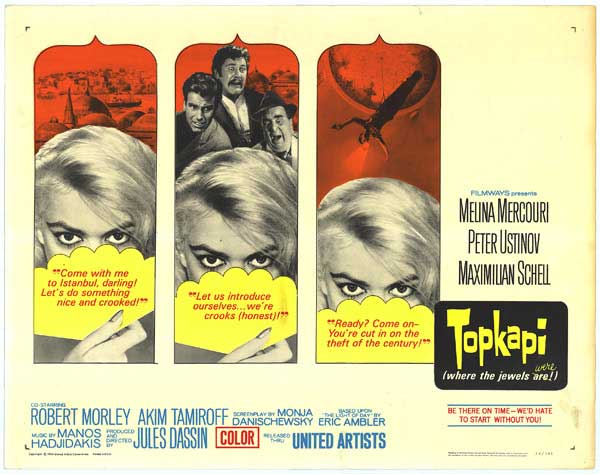
Elizabeth (Melina Mercouri) and Walter (Maximilian Schell) have formed a group of amateur thieves to help them steal an emerald dagger out of the famed Topkapi Palace in Istanbul, Turkey. Problems ensue when one of the original members of the group becomes injured and they are forced to hire on the services of Arthur Simon Simpson (Peter Ustinov) a bungling, portly small-time crook whose on-going ineptitude almost throws their well thought out plans into jeopardy.

This film has become the granddaddy of heist films and rightly so. Based on the novel ‘The Light of Day’ by Eric Ambler the story is well-crafted and nicely detailed. The plan is elaborate, but fortunately believable and plausible. Director Jules Dassin seems to have all the logical loopholes covered. The production design is plush and captivating with just the right amount of offbeat touches to keep it original and cinematic. I found myself enjoying the dry humor and characterizations interspersed in-between the planning and action. The momentum builds evenly without every feeling rushed, or draggy. The on-location shooting is a plus that not only captures the sunny climate, but also the distinct ambience and look of the region.

The climatic sequence involving the actual heist is exciting. The actors do all of their own stunts including Gilles Segal as Guilio being lowered upside down into the palace by a rope being held rigorously by Walter and Arthur and doing most of his maneuvers trapeze style. The whole scene had me holding my breath most of the way and Dassin manages to capture if all from different and interesting angles while allowing the silence to help create the tension.

Ustinov is in fine form and deservedly won the Oscar for best supporting actor. Supposedly the part was originally intended for Peter Sellers, but Ustinov gives the character a lovable quality that I don’t think Sellers could. Ustinov’s rotund physique is an added benefit and his nervous looking facial expressions are consistently amusing with the interrogation scene by Turkish authorities being his best moment. It’s nice to see the character evolve and find a confidence he didn’t think he had while gaining a begrudging respect from the others.

Mercouri sizzles. Normally I am not crazy about women with deep, throaty voices like hers, but she makes it tantalizing. The character is a self-described nymphomaniac and the expression on her face as she watches a group of men spread lotion over their half-naked bodies is worth the price of the film.

The rest of the supporting cast is okay, but I found it odd how very polished they were when Walter insisted that he wanted amateurs for the heist that had no criminal background, or record. Having them behave in a befuddled besides just Arthur would have been more realistic and expected. I also didn’t like that the Guilio never says a single line of dialogue. Apparently the character was a mute, but there is no reason given for it and in the process makes him transparent and boring.

Spoiler Alert!

The only real problem I had with the movie is the ending. As Guilio is exiting the palace a little bird flies through the window while he is closing it, which in turn sets off an alarm, which leads to the gang getting arrested. However, I couldn’t understand how the trapped bird would’ve allowed the police to figure out what happened as an exact replica of the dagger that they swipe is put onto the chest of the sultan figure. To me it just seemed like one twist too many and the scenes showing them inside the prison is campy and forced. These guys had been portrayed as being slick and sophisticated most of the way, so why turn them into clowns at the end. Possibly this was done to show that ‘crime doesn’t pay and no crime portrayed in a film should go unpunished’, which was a code most movies were forced to work under in the past. Either way it doesn’t work and kind of hurts what is otherwise a snappy piece of entertainment.

My Rating: 8 out of 10

Released: September 17, 1964

Runtime: 2Hours

Not Rated

Director: Jules Dassin

Studio: United Artists

Available: VHS, DVD (Region 1 and 2), Amazon Instant Video

Dealing: or the Berkeley-to-Boston Forty-Brick Lost-Bag Blues (1972)

dealing

By Richard Winters

My Rating: 5 out of 10

4-Word Review: Drugs are a trip.

This review was originally slated to post in February, but due to the death on Christmas Eve of Charles Durning I decided to post it now. Durning was one of the all-time great character actors who always brought an amazing amount of energy to every role he played and could do a wide variety of character types well. Although he has very few lines of dialogue in this movie he still manages to become the most interesting part of the proceedings and helps enliven an otherwise slow moving film.

The plot, based on a novel by Michael Crichton, pertains to Peter (Robert F. Lyons) who is a recent Harvard graduate hired by John (John Lithgow) to transport a suitcase full of marijuana from Boston to Berkeley, California. Peter is new at this and things do not go as planned, but he meets beautiful Susan (Barbara Hershey) along the way and the two fall in love. John next hires Susan to transport another suitcase of narcotics, but when she loses the luggage at the airport and then tries to go back and get it she is arrested by corrupt cop Murphy (Durning) who resells some of the recovered stash back out onto the street. In order to get Susan out of jail Peter plays an elaborate game of cat-and-mouse with the cop, which culminates in a violent showdown.

The story is done in a laid-back style similar to the approach taken by many European films. The emphasis is on mood and subtle nuance yet when the Europeans do it this style seems refreshing, but here it is more off-putting. I really had a hard time getting into it as the first hour is slow with too many scenes going on longer than it should. The set-up is too quick and there is not enough background, or history shown to the main character.

The second hour improves. Durning gives the proceedings some pizazz and Peter’s scheming is fun. The shootout done in the snow has flair and style.

The music by Michael Small is impressive. It is one of the most original scores I have heard and really fits the mood of the script. The best is over the opening credits.

Hershey is as always gorgeous and fans may like that she is shown topless. The part of a free-spirited hippy chick seems to be her forte and she excels. However, having her fall for a guy that is rather dull and ordinary didn’t make sense. Sure they make love right away, but I thought that was more just because it was a part of her lifestyle and she does after all go around in a dress without wearing any underwear. She just seemed to be diving into the free love atmosphere of the era. Obviously having Peter fall for her made sense because she is hot, but why would she go head-over-heels for this schmuck when there are so many other guys that would be more than willing to do it with her. The romantic angle was forced and hurt the credibility of the story.

Lithgow is okay in his film debut, but I had problems with the character. One minute he is cool, conniving, brash, and arrogant and then in the next instant he becomes scared, confused, and meek, which was too much of a quick transition.

The under-rated Lyons is excellent and makes for a terrific lead especially with this type of part. Despite being in his 30’s he looks and acts very much like a college kid from that period. His performance is nicely understated and believable throughout.

The on-location shooting in Boston is vivid and people from the area may like to view this just to see how much it has changed. The DVD transfer from Warner Archive is excellent with a nice clarity and vivid colors. The movie itself is slick, but it also has a detachment to it that doesn’t allow the viewer to get as connected with the characters, or the situations like they should and thus making it an interesting period artifact, but nothing more.

Also, Demond Wilson can be seen briefly as one of the drug dealers. He did this just before his signature role of Lamont in the hit TV-series ‘Sandford and Son’. Ellen Barber is real cute as Peter’s girlfriend and so is Joy Bang who later became a registered nurse. Normally I don’t like women with buck teeth, but with her it actually looks sexy.

My Rating: 5 out of 10

Released: February 25, 1972

Runtime: 1Hour 28Minutes

Rated R

Director: Paul Williams

Studio: Warner Brothers

Available: DVD (Warner Archive)

Up in the Cellar (1970)

up in the cellar 3

By Richard Winters

My Rating: 5 out of 10

4-Word Review: Senior citizens watch porno.

This is a variation of the film Three in the Attic and for a time was called Three in the Cellar to try and capitalize off of the success of that one. Ironically both films starred Judy Pace. In this one Colin Slade (Wes Stern) is a nerdy college student who loses his scholarship to a computer glitch. When he can’t get college president Maurice Chamber (Larry Hagman) to help him, he decides to get revenge by seducing both his wife (Joan Collins) and daughter (Catlin Adams).

The production proudly proclaims to be filmed on location in New Mexico, which is obvious from the start and nothing to really boast about since it hurts the film as a whole. Shot in wintertime it’s dusty, desolate landscape leaves the viewer with a cold, lonely feeling, which configures poorly with a story that is supposed to be lighthearted and whimsical. The big, modern cement buildings used as the campus looks like they would be better suited for a corporation than a student body. The students themselves, or what little you see of them, look all suspiciously over the age of 24.

Director Theodore J. Flicker nicely camouflages the fact that this is a very low budget production. His script is compact and well-paced. He frames and cuts his shots so you don’t notice how lacking in personality or energy it really is. Yet he also shows little connection to the student uprisings that dominated the campuses of that era and seems to view it as a sort of silly amusement. He keeps the film at this tone the whole time and thus makes it as silly and forgettable as the characters and situations he tries to satirize

Hagman comes off best. He plays it with a fun mixture of traits from two of his best known characters. He has J.R. Ewing’s arrogance coupled with Major Nelson’s frantic anxiety.

The film also has two fun and unique scenes. One has Hagman climbing up an actual radio tower to save Stern who is threatening to jump off. The second one has a pornographic movie shown to a group of unsuspecting and shocked senior citizens

My Rating: 5 out of 10

Released: August 12, 1970

Runtime: 1Hour 34Minutes

Rated R

Director: Theodore J. Flicker

Studio: American International Pictures

Available: Amazon Instant Video