Category Archives: Movies Based on Novels

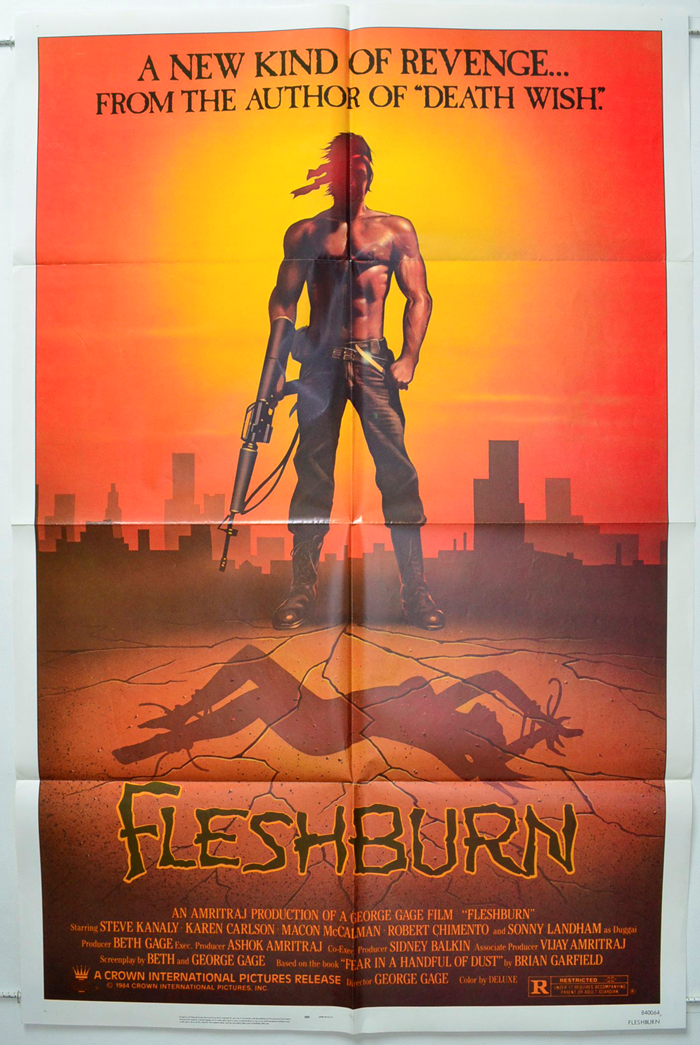
Fleshburn (1984)

fleshburn 2

By Richard Winters

My Rating: 5 out of 10

4-Word Review: Lost in the desert.

Calvin Duggai (Sonny Landham) is a Vietnam vet sent to a mental hospital when four psychiatrists insist he does not know the difference between right and wrong. Eventually he escapes from the place and proceeds to kidnap the four people who had him put away and takes them to the middle of the hot desert where he forces them to try and survive the harsh elements with nothing more than their wits to rely on.

Based on the Brian Garfield novel ‘Fear in a Handful of Dust’ the film moves at a brisk pace and manages to be relatively gripping. The pounding rock music-like score helps build the tension. The idea that the four people decide to remain where they are and not go searching through the desert for help seems slightly odd, but the characters at least come off as real people and some of the things that they do to survive is innovative and yet still believable. The viewer genuinely starts to care for these people and wants to see them survive, which helps keep the film captivating.

70’s adult film star-turned-actor Landham isn’t bad in the lead. His muscular physique is quite intimidating and he has a threatening presence. Steve Kanaly best known for his work on the ‘Dallas’ TV-series is solid as the one who takes over and tries to help the others beat the elements. His best moment comes when he spits out a sharp shell like object that he has hidden in his mouth and into his hand where he uses it to cut the rope that is binding him to a rock.

There is some interesting flashback sequences at the beginning particularly the one showing the Karen Carlson character having an affair with Kanaly much to the dismay of her husband who is also one of the victims and yet the film doesn’t follow-up with it even though it could’ve and should’ve. Despite the story’s vindictive theme it really comes off more like a basic survival saga that could easily have worked as a TV-movie. The film is competently produced and directed, but fails to be distinctive or memorable.

My Rating: 5 out of 10

Released: May 24, 1984

Runtime: 1Hour 30Minutes

Rated R

Director: George Gage

Studio: Crown International Pictures

Available: VHS, DVD, Amazon Instant Video

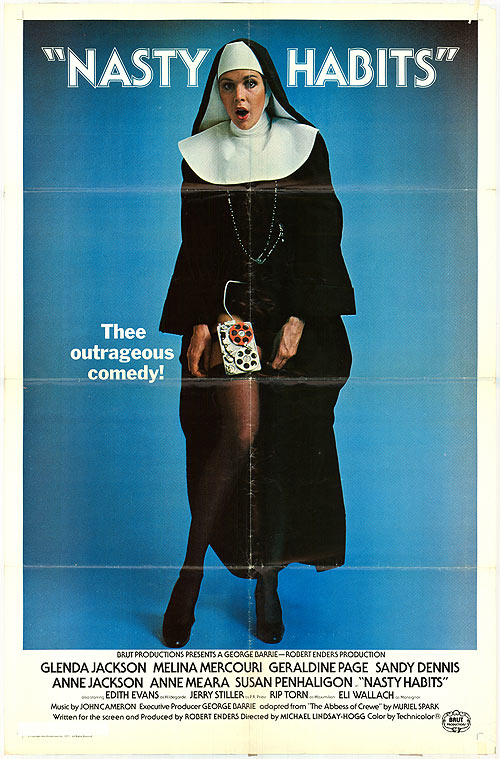
Nasty Habits (1977)

nasty habits 2

By Richard Winters

My Rating: 2 out of 10

4-Word Review: Watergate in a convent.

It’s the Watergate scenario all over again only this time inside a convent with nuns. It’s a unique idea for sure that unfortunately doesn’t work because the screenplay by Robert Enders, which is based on the novel by Muriel Sparks keys in on only one angle and then plays it out until it’s boring. It’s a one-joke movie with nothing standing out as funny. There is also no action to speak of and the dialogue is too dry to elicit even a chuckle.

The once in a lifetime cast is wasted. Dame Edith Evans, in her last film appearance, gets hit the worst as she is given the typical old lady treatment and shown for only a few minutes looking feeble and then promptly dying. Jerry Stiller, Anne Meara, Rip Torn, and Eli Wallach are on so briefly that their appearances seem almost non-existent.

Glenda Jackson comes off best as she manages to give her character an added dimension. The forcefulness of her personality comes through quite clearly for the viewer. However her adversary, which is played by Sue Penhaligon, doesn’t have that same type of strong presence and therefore there is no chemistry or confrontation between the two.

Even the always reliable Sandy Dennis becomes a problem. They have her playing a sort of extended version of her tipsy persona from Who’s Afraid of Virginia Woolf?, but her off- key voice and overall kooky behavior gets overplayed and eventually becomes annoying.

The electronic music score by John Cameron is obtrusive. The pacing is terrible and the lack of momentum will have people turning this off long before it is over, which is good since the climactic sequence falls horribly flat.

There are a few surprise cameos. One is by the late newscaster Jessica Savitch another by former talk show host Mike Douglas, but nothing that helps make this entertaining or memorable.

My Rating: 2 out of 10

Released: March 18, 1977

Runtime: 1Hour 36Minutes

Rated PG

Studio: Brut Productions

Director: Michael Lindsay-Hogg

Studio: Brut Productions

Available: VHS

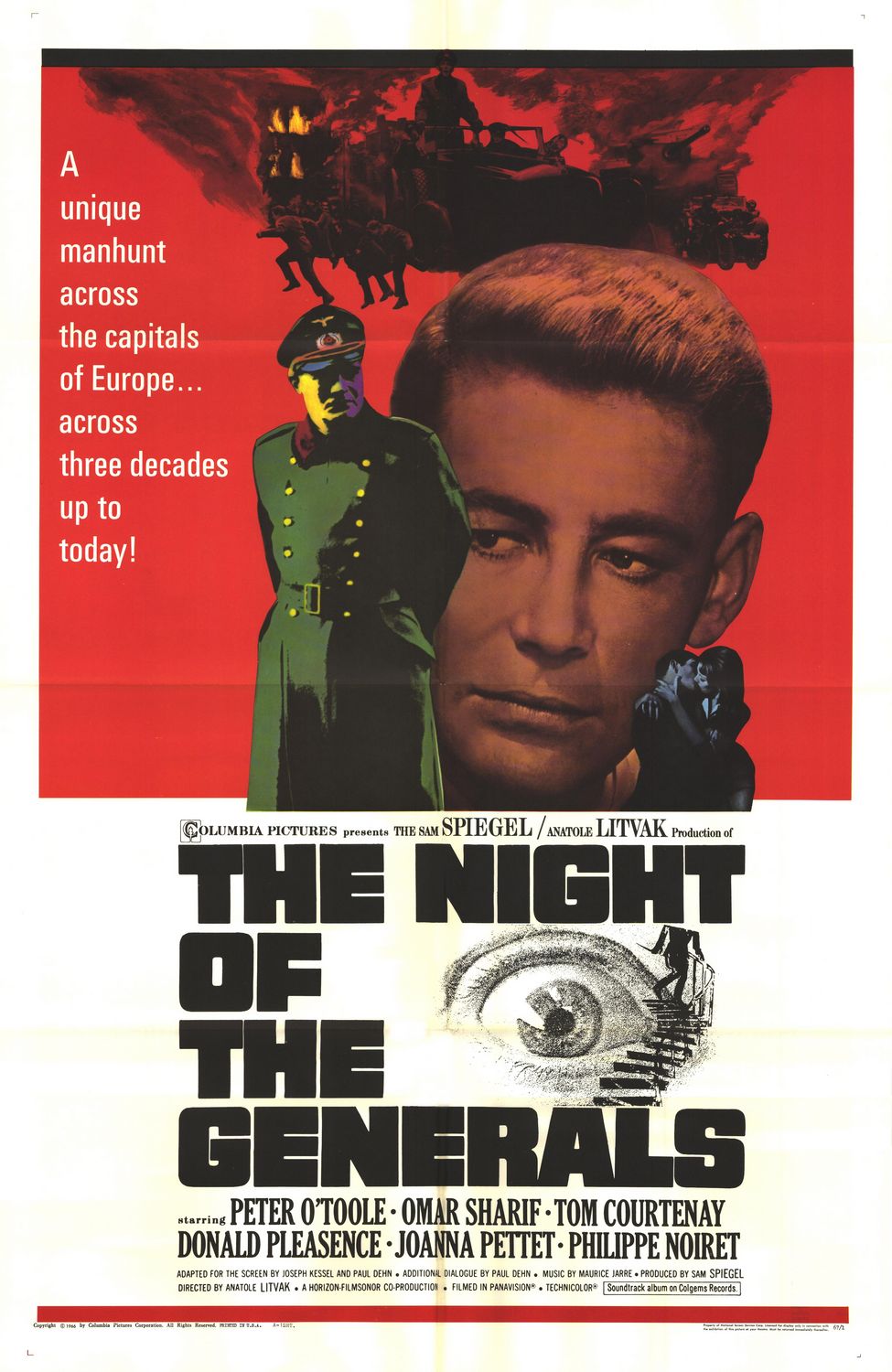
The Night of the Generals (1967)

night of the generals

By Richard Winters

My Rating: 5 out of 10

4-Word Review: A general kills prostitutes.

In 1942 during the height of the war a Polish prostitute is found murdered and sexually mutilated. A witness spotted a man leaving her room who was wearing a uniform that had a red stripe running down the side of his pants, which signified that he was a general. Major Grau (Omar Sharif) who is in charge of the investigation decides to interview three generals (Donald Pleasance, Peter O’Toole, Charles Gray) who were in the vicinity and have no alibi, but finds a lot of pressure not to pursue the case and it takes several decades before it finally unravels.

The storyline is compelling enough to keep you intrigued, but the script is talky with not enough action. Certain story threads seemed unnecessary and the film could have been more compact. The actors are mostly all British, but make no effort to speak in German accents despite playing Nazi roles. The music cues that are used whenever an important plot point is revealed or to transition to another scene are too loud and have a generic quality to them that does not appropriately reflect the time period.

O’Toole gives an interesting performance as psychotic ready to fall completely apart. His extreme emphasis on cleanliness especially to those that serve under him and his nervous twitches steal the film as well as a bit where he commands his men to destroy an entire block of a town simply to get at a couple of snipers. His bizarre reaction to a painting of Vincent Van Gogh that he spots in a gallery is intriguing especially when it occurs twice and his blank blue-eyed stare becomes almost piercing.

Sharif does quite well in support and despite being born and raised in Egypt does a convincing job as a Nazi and I think make-up was used to lighten his skin. Tom Courtenay is good as O’Toole’s assistant and the relationship that they form has some interesting subtexts to it.

Joanna Pettet’s appearance however seemed pointless and although the constant sparring she has with her mother (Joan Plowright) was fun it really didn’t add much to an already cluttered narrative. Christopher Plummer also gets stuck in a thankless part where he is seen for less than five minutes before promptly being killed off.

The identity of the killer gets revealed 45 minutes before the end, which hurts the suspense. I also didn’t like that the Sharif character gets killed off and the rest of the investigation is taken over by a Frenchman (Philippe Noiret) which seemed defeating since we had spent so much time siding with the character’s plight to seek justice despite all the obstacles. The film’s very final moment is supposed to be dramatic and poignant, but instead goes over-the-top and becomes weak and strained.

My Rating: 5 out of 10

Released: January 29, 1967

Runtime: 2Hours 25Minutes

Not Rated

Director: Anatole Litvak

Studio: Columbia Pictures

Available: VHS, DVD, Amazon Instant Video

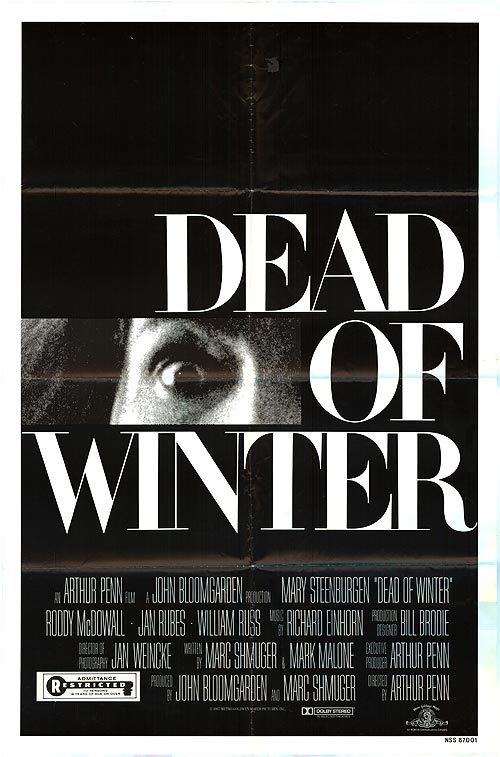
Dead of Winter (1987)

dead of winter

By Richard Winters

My Rating: 6 out of 10

4-Word Review: Trapped in a house.

Being that this has been one of the coldest and snowiest winters in Indianapolis history, which is the current headquarters of Scopophilia, as well as much of the rest of the nation I decided it would be a good time to review a film with cold weather as its theme. After all misery loves company and if we got to suffer through this crap it’s always nice to see film characters have to deal with it as well.

The film is a loose remake of My Name is Julia Ross, which came out in 1945 and starred Nina Foch, which in turn was based on the novel ‘The Woman in Red’ by Anthony Gilbert. Here the title character is Katie McGovern (Mary Steenbugen) a fledgling actress who answers an ad in a paper for an audition to a role in a low budget movie. There she meets a man by the name of Mr. Murray (Roddy McDowell) who hires her on the spot based on her resemblance to their last leading lady who walked out on the production before it was finished. He takes her to an isolated mansion that is owned by Dr. Joseph Lewis (Jan Rubes) to supposedly finish the project by playing a character named Julie Rose, but slowly she realizes this is no movie at all, but instead an elaborate blackmail scheme. Her attempts at escape are futile due to a raging snowstorm outside forcing her to try and come up with a scheme of her own in order to turn-the-tables on her captors before it is too late.

This was director Arthur Penn’s second to last theatrical feature. He had been slumming through the 80’s with movies that never quite hit-the-mark and this one proves no exception. He makes a few attempts to liven it up with my favorite being when they drug Katie and then show things from her point-of-view where everyone talks in an extremely slow way like a tape player running at a very slow speed. There are a few other touches added including some obvious Hitchcock references, which I felt really weren’t needed. Overall though the film seems pretty slow at least through the first hour with only a minimum of tension.

Part of the problem is the casting of the bad guys. While I like the novelty of two elderly men cast as the villains it really doesn’t work overall. Rubes whose character is bound to a wheelchair and speaks in a heavy Czechoslovakian accent seems almost like a cuddly grandfather for most of the way. McDowell has too much of a small frame to be intimidating and there is never any gun or other weapon used against her making me believe that since she was much younger than both of them that had she acted even slightly more aggressively than she does she probably could have overpowered them.

The characters also act pretty stupid at points. Katie goes to this very isolated place, but then when she finally is able to call the police doesn’t have the simple fortitude to know what the name of the nearest town is. She also becomes very aware that these guys are up to no good and even lets them know it only to foolishly take some hot chocolate that they serve her, which not so surprisingly is laced with a sleeping drug.  The bad guys also act dumb by disposing of her driver’s license by sloppily throwing it into the fireplace and then make no attempts to keep her away from it were she eventually spots it.

The wintry atmosphere by-and-large is well handled as cinematographer Jan Weincke deftly captures the gray unrelenting bleakness of the season. It was filmed on-location in Ontario, Canada and there is actual snow on the ground, but the snowstorm itself is fake using artificial snowflakes that they blow in front of the camera that doesn’t look quite right when compared to a real storm.

Things spice up during the final half-hour and features a few interesting twists. However the Rubes character who was stuck in a wheelchair for the entire duration of the film suddenly becomes amazingly agile and nimble using only a fireplace poker to pull himself from the chair and then uses it to balance himself as he chases Katie all around the place and even manages to somehow push himself up a long and winding staircase, which became a bit farfetched. It got to the point where I felt the writers shouldn’t have even bothered to make the character paralyzed in the first place if they were just going to completely sell-out on the concept at the end.

My Rating: 6 out of 10

Released: February 6, 1987

Runtime: 1Hour 40Minutes

Rated R

Director: Arthur Penn

Studio: MGM

Available: DVD, Amazon Instant Video

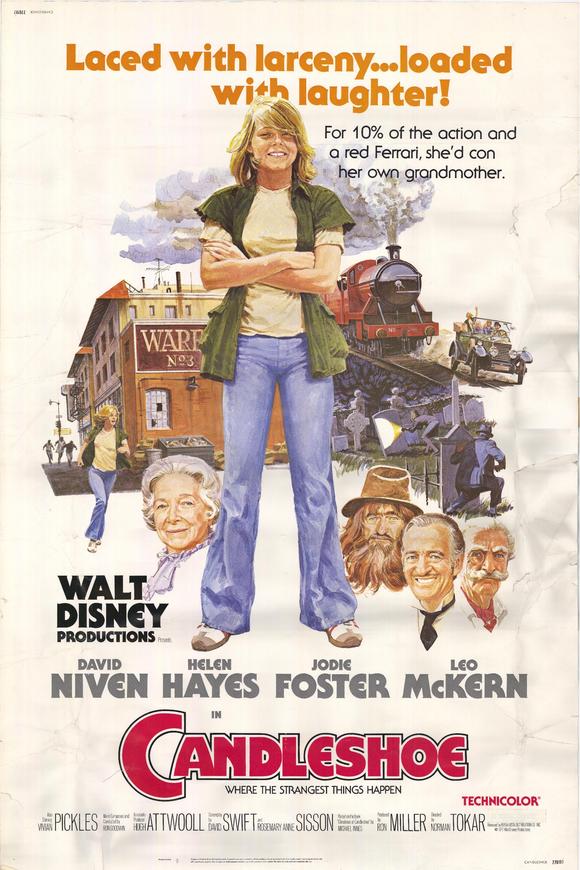
Candleshoe (1977)

candleshoe

By Richard Winters

My Rating: 8 out of 10

4-Word Review: Treasure hidden on estate.

            Jodie Foster stars as Casey a teen living on the tough streets of New York and reselling stolen items for a living. Her abilities come to the attention of small-time crook Harry Bundage (Leo McKern) who gets her to pretend that she is the long lost granddaughter of a rich matriarch by the name of Lady St. Edmund (Helen Hayes).  Bundage has become aware through a former servant that worked there that there is a trove of treasure hidden somewhere on the premises and it is up to Casey to follow the clues and find it.

I saw this movie when it was released in 1977 and the only thing I could remember from it was the little boy who would slide across the polished floors of the mansion. It’s a surprisingly elaborate plot for a children’s movie, but one that is engrossing and interesting. The characters are believable and diverse and it is fun seeing them evolve and learn to get along. Parents should find this as enjoyable as the kids. I was impressed with the way the filmmakers never talk down to their young audience and trust that they will be sophisticated enough to pick up on the little nuances and subtitles, which the film does have.  I found myself longing for this type of family entertainment again. It seems like the family films of today either have kids spewing out a lot of crude nasty things, or they are so sugary sweet and benign that they make you want to throw up, but this film nicely straddles the middle and it really works.

Jodie is great in the lead and the movie wouldn’t have worked as well with another actress in the role. The part nicely takes advantage of Foster’s confident, smart, streetwise persona and almost had me believing that the part was written specifically for her. Later I read how the original director for the film, David Swift, dropped out of the project because he felt Foster was ‘all wrong’ for the role even though I felt she was perfect and other viewers should feel the same.

Helen Hayes is okay in her role, however the character isn’t all that interesting, nor has that much to do. It seems like once she won the Academy Award for Airport in 1970, which helped revive her career, these were the typical ‘sweet old lady’ roles she was perpetually offered afterwards. However, when it comes to the caricature of an old lady Hayes is absolutely perfect almost to the point that it is hard to imagine her ever being young.

David Niven, who plays the butler named Priory, is engaging, but was starting to look frail and elderly. He gets a chance to play several different roles including that of the gardener and chauffeur. The Irish accent that he uses for the gardener part sounded very authentic and I was impressed. His best moment comes at the end when he takes on the McKern character in an imaginative and drawn out duel segment and watching his scared and nervous facial expressions during this is amusing.

I liked the other children who play the orphans that Lady St. Edmond adopts. They are cute in a nice genuine way without it being forced especially the young blonde haired boy named Bobby who speaks in a thick cockney accent. Veronica Quilligan plays Cluny one of the older children who are initially an adversary to Casey. She showed the most disciplined and realistic facial reactions to the action around her while the other kids had lost or vapid looks on their faces. Although she appeared to be about 13 or 14, the same age of the character that she played, I was shocked to find that she was actually 21 when the movie was made.

I was surprised that there wasn’t a car chase scene as every Disney movie from the 70’s seemed to have one. The action for what it is worth is sparse, but enjoyable without ever getting too cartoonish. The ending where the kids take on the band of adult crooks is good and the scene where their car is stopped on the tracks and the train comes just inches from Priory, who is shielding the vehicle, before stopping is a near classic.

I think adults who were kids during this era can watch this film again and still find it entertaining. The kids of today should find enjoyable as well although the ideal age would be between 8 and 14 as I think it is too slow paced for anyone younger.  The film also has a good life lesson in regards to teamwork and how working together and taking advantage of each other’s special talents and abilities can help achieve a common goal.

My Rating: 8 out of 10

Released: December 16, 1977

Runtime: 1Hour 41Minutes

Rated G

Director: Norman Tokar

Studio: Buena Vista

Available: VHS, DVD, Amazon Instant Video

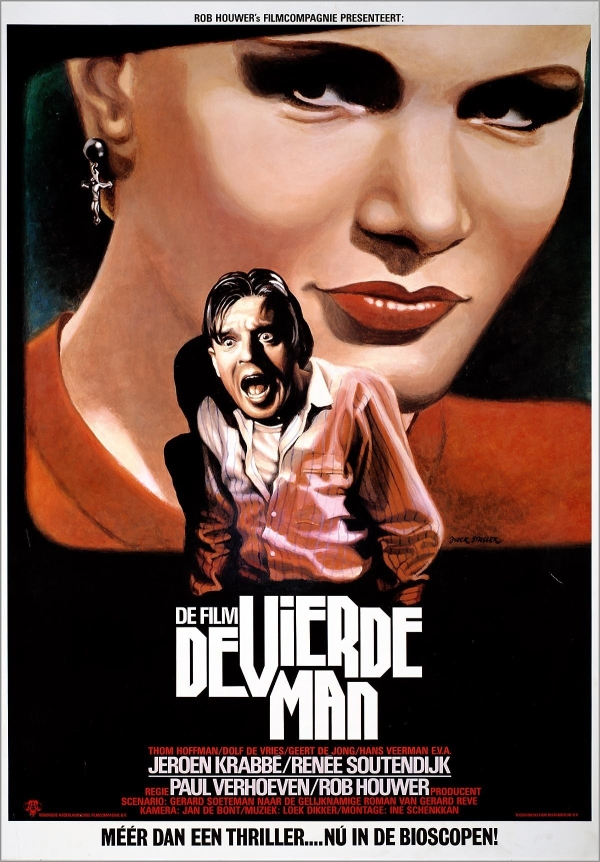
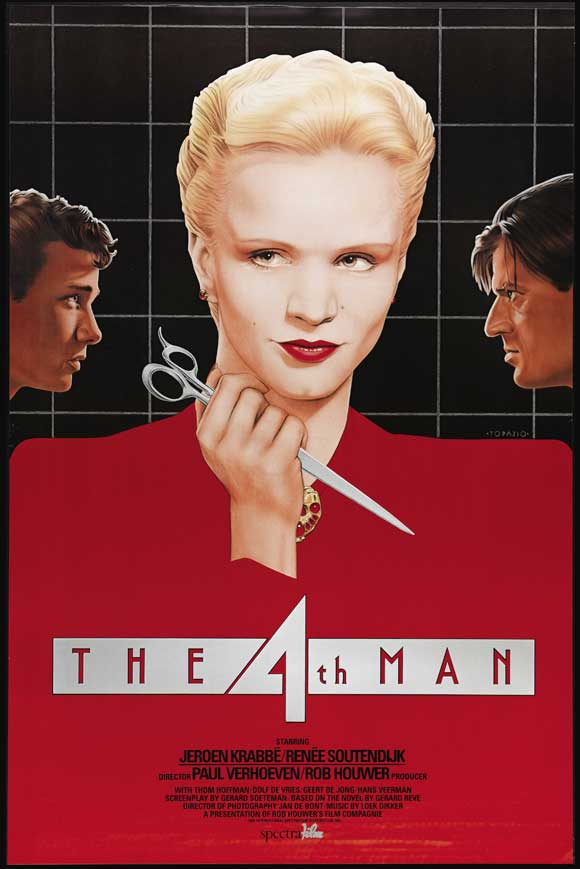
The Fourth Man (1983)

the fourth man 2

By Richard Winters

My Rating: 7 out of 10

4-Word Review: She kills her husbands.

This movie is just about the ultimate in the femme fatale genre as it deals with a temptress (Renee Soutendijk) who marries men who all end up dying in freak accidents. Now she has seduced a fourth one, will he be next?

It is rare to say that you know it is going to be a good movie from the very moment it starts, but that is the case here. The film’s opening could very well be one of the most impressive of all-time as it begins with a startling view of a close-up of an actual spider trapping a fly on its web and then devouring it to the sound of a pounding electronic score that becomes the best part of the whole movie.

The rest of the film works pretty much on the same level with scenes that are provocatively lit and designed as well as a running sensuality that at times is both erotic and perverse. The flowing narrative jumps between reality and dreamy imagery that eventually blend into one and has an underlying subversive nature that keeps you riveted.

The characters are interesting because they work against their gender stereotypes and have a certain ongoing duel with each other. The woman has short hair and a square face and almost comes off looking like a man. She knows how to use her seductive powers and is always in complete control without ever showing any vulnerability. The man is weak and helpless while trying to mask it with an arrogant intellectual veneer.

The ending is the film’s only big letdown as it is too low-key and doesn’t match the energy of the rest of the film while also wrapping things up a little too nicely. A big showdown between the two main characters would have been much more satisfying.

The special effects are weak and help to expose the film’s low budget, but the film is still fun with a snazzy art house flair that became a breakout picture for director Paul Verhoeven.

The movie also contains a shocking scene involving a life-sized crucifix that some may consider blasphemous even though in the end the film’s message is actually spiritually affirming.

the fourth man

My Rating: 7 out of 10

Released: March 24, 1983

Runtime: 1Hour 42Minutes

Rated NC-17

Director: Paul Verhoeven

Studio: International Spectrafilms

Available: VHS, DVD

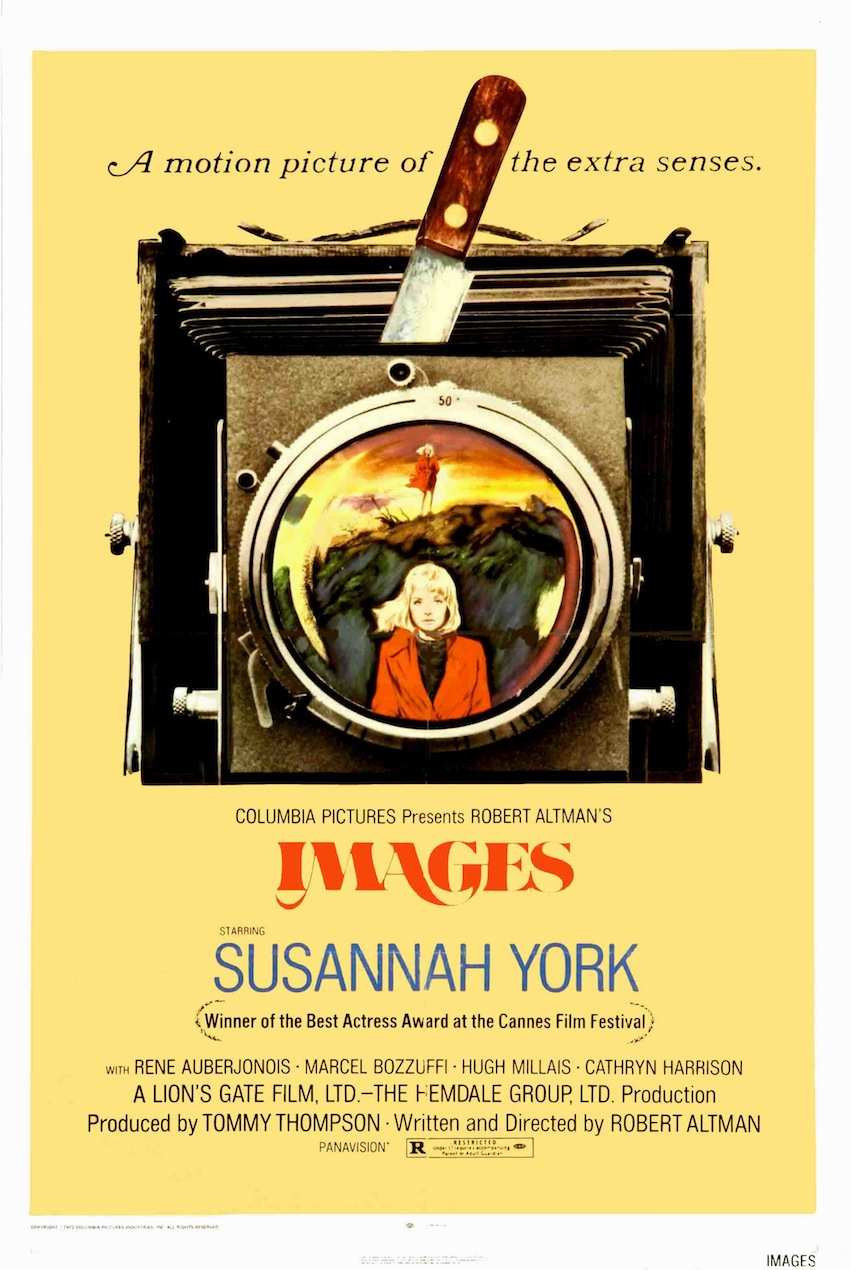
Images (1972)

images

By Richard Winters

My Rating: 8 out of 10

4-Word Review: Demons of the mind.

This is the missing link for any Robert Altman fan or detractor as this is different from any of his other films and completely original from beginning to end. Not only was it way ahead of its time, but proves that he is deftly skilled at handling any directorial task or material.

The story involves a tormented and emotionally fragile woman named Cathryn (Susannah York) who starts to see strange visions. These visions seem so real that she can no longer tell if they are all just inside her head and decides the only way to get rid of them is to mentally ‘kill’ them, but this in turn only leads to further complications.

What really makes this a unique film is that you get inside this woman’s head and actually start to understand her logic and experience her torment. The film also makes terrific use of silence and uses it to accentuate the isolation that the character feels. The setting has a sort of surreal quality and the location of the house is impressively remote.

York has a knack for playing victimized and vulnerable women. In many ways her role here seems like an extension of her character from The Killing of Sister George. Although she makes you sympathetic to her predicament her screams are too screechy and fail to attain the shrillness that would create the startling effect that the filmmakers desired.

The real star may actually be Vilmos Zsigmond and his cinematography. His framing and composition is not only flawless, but breathtaking. He makes the wintertime Irish countryside look like a whole different world and the stillness of the lake that is shown seems almost unreal.

There are a few too many obvious and clichéd shots of mirrors and puzzles and it could also gone much further with its unusual premise. Still this is a unique and entertaining movie that should keep you guessing all the way to the end. The pace is slow, but deliberate with a payoff that is worth it.

My Rating: 8 out of 10

Released: December 18, 1972

Runtime: 1Hour 41Minutes

Rated R

Director: Robert Altman

Studio: Columbia Pictures

Available: DVD

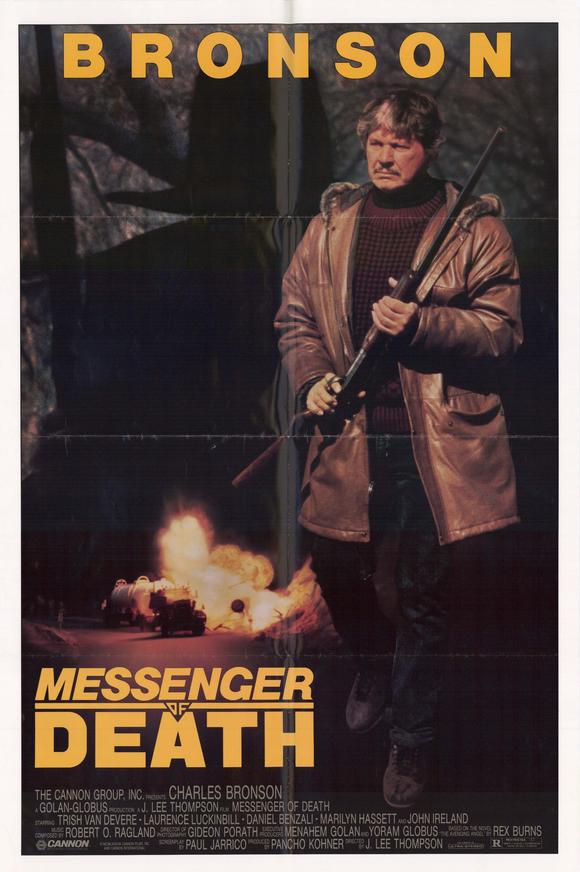
Messenger of Death (1988)

messenger of death 2

By Richard Winters

My Rating: 4 out of 10

4-Word Review: Chuck visits Mormon country.

Three young mothers and their children are shot to death in their home. The police suspect it may have something to do with their religious affiliation, but Denver journalist Garret Smith (Charles Bronson) thinks it’s the water company that is behind it, but as the investigation continues and with the help of fellow journalist Jastra (Trish Van Devere) the identity of who it really is surprises everyone.

The movie is unsettling from the beginning as we witness the brutal murders, which sets things at a downbeat tone. However, it also gets the viewer emotional jarred enough to want to see the killer brought to justice. The mystery is intricate for the most part and keeps you intrigued although by the end I had pretty much figured it out.

For a Bronson flick the action is minimal. There is one big shootout, but it doesn’t last long. The film’s best and most exciting sequence is when two big semi-trucks get on either side of the jeep that Garret and Jastra (Trish Van Devere) are riding in and try crushing it as it moves down the road. The scene is vivid, but suffers from the issue where neither occupant is wearing seatbelts and the vehicle does not have airbags and turns over on itself three times, which would most assuredly kill or permanently injure anyone inside and yet the two are able to miraculously get out without even a scratch.

Bronson does not carry a gun here and he has always had one in so many of his other movies that seeing without one makes him look almost naked. For an ordinary 60-something journalist his fighting skills seem too impressive. I was willing to buy into his ability to fight off a much younger professional hitman one time by using some quick thinking, but then to be able to do it again to the same person later on and give him a severe beating in the process seemed too farfetched.

Veteran character actor Jeff Corey as a fiery preacher is good in support as well as John Ireland who plays his brother. During the mid-80’s Ireland once put a full page add in Variety begging for work, so it’s good to see that those efforts paid off with his appearance here.

To-date this marks Van Devere’s last theatrical project and neither her character nor her performance adds much, but it was still nice to see a man and woman work together and not have it automatically turn sexual or into a relationship. Marilyn Hassett plays Bronson’s wife, but she was 26 years younger than him, which makes seeing them together look a bit weird.

Gene Davis who gave a terrible performance as a serial killer in an earlier Bronson flick portrays one of the hit-men. Fortunately his screen-time is contained, so his limited acting skills don’t ruin the whole picture. The way he dies made me chuckle a little as he gets stabbed while standing at a urinal and yet when he turns around his you-know-what isn’t hanging out even though I thought it probably should’ve been.

The climactic moment where the person behind the murders gets ‘unmasked’ is a little too ‘Hollywood’ and doesn’t pack the punch that a film like this needed and thus gives this already average action flick a slightly below average rating.

My Rating: 4 out of 10

Released: September 16, 1988

Runtime: 1Hour 31Minutes

Rated R

Director: J. Lee Thompson

Studio: The Cannon Group

Available: VHS, DVD, Amazon Instant Video

12 + 1 (1969)

twelve plus one 2

By Richard Winters

My Rating: 2 out of 10

4-Word Review: Money in the chair.

Mario (Vittorio Gassman) is a struggling barber who gets word that his rich aunt has left him a large inheritance. When he gets to her estate he finds the place nearly empty except for some old chairs piled up into a corner. Angered he decides to sell the chairs to a local antique dealer so he can at least make some money off of them. After he sells them he finds a note from his deceased aunt stating that there was a large amount of money sewn up inside one of them. In a panic he goes running back to the shop, but finds that they have already been sold off to various customers, so he along with Pat (Sharon Tate) who worked at the shop and wants to help him as long as she gets a part of the take go on a mad dash to seek out the chairs and retrieve them one-by-one until they can find the money.

The film is based on the classic 1928 Russian novel that has been made into several film versions including one by Mel Brooks that came out a couple of years after this one. I’ve never read the novel, but this film clearly does not do it any justice. The humor is lame and cartoonish and barely able to equal a weak Tom and Jerry cartoon or uninspired Disney flick. The budget is low and the scenes all have a perpetually cheesy, schlocky feel. The Herb Alpert-like music sounds like it was edited in off of an audio cassette recording. The whole thing is quite derivative and dull despite the wide variety of characters and locales.

The film’s biggest claim to fame is being Tate’s only starring vehicle and this didn’t get released until well after her death. She is very beautiful and surprisingly engaging and comical and her presence is the best thing about the movie. She even does a nude scene along with the equally tantalizing Ottavia Piccolo when they both go topless and then get into bed on either side of Gassman, which is the film’s one and only provocative moment.

The supporting cast is full of some old pros that get badly wasted. Terry-Thomas is one of the funniest character actors of all-time, but here he is shockingly boring and forgettable. Orson Welles hams it up in make-up as a pretentious stage actor whose play he is performing in becomes a catastrophe in the film’s only slightly amusing moment.

The color is faded and shot with no imagination or flair. Although there is some nudity the filmmaker’s would have been better served had they cut it out and aimed it solely for the kids as the humor is so broad and silly that only a three-year-old could possibly find it entertaining and even that is no guarantee.

twelve plus one 1

My Rating: 2 out of 10

Released: October 7, 1969

Runtime: 1Hour 34Minutes

Rated R

Director: Nicholas Gessmer

Studio: AVCO Embassy Pictures

Available: VHS

Serial (1980)

serial

By Richard Winters

My Rating: 4 out of 10

4-Word Review: He doesn’t like fads.

The world has turned into one giant fad and everyone and everything is a part of it. Martin Mull is the one remnant of sanity as he tries to survive in it while still keeping his balance.

There is hardly anything cinematic about this picture. Take out some of the ‘dirty’ references and you have a TV-movie. In many ways it’s barely a movie at all, but more of a compilation of skits running along the same theme.

Mull is definitely a good anchor as his glib, sardonic comments help keep this thing churning. The rest of the characters though don’t resemble real people in any way and many of the fads shown weren’t really followed by that many to begin with. It’s pretty restrained and soft and fails to attain the acidic wit of the Cyra McFadden novel of which it is based.

Attacking trendy people isn’t too difficult and this film fails to supply any new perspective on the subject. This is probably the most annoying thing about it, which is that it is as vapid and superficial as the people and lifestyles it tries to mock.

The film does manage to be fast paced and there are a few slightly amusing bits, which could prove entertaining to those on a really, really slow night. Of the good stuff there is a dog groomer who shouts to his barking dogs to “Shut up you sons of bitches.” There is also Mull going to an orgy and having to step through a whole mass of naked bodies before he can find his girlfriend. Kudos also must go out to the climatic finale that features a gay biker gang lead by Christopher Lee who rampage (on their motorbikes!) the home of a religious cult. The running gag of having Tuesday Weld constantly referring to the Pamela Bellwood character as a ‘cunt’ isn’t bad either.

Also, Ed Begley Jr. can be heard on the radio as a DJ in the opening sequence.

serial 2

My Rating: 4 out of 10

Released: March 28, 1980

Runtime: 1Hour 26Minutes

Rated R

Director: Bill Persky

Studio: Paramount

Available: DVD