Category Archives: Kidnapping Movies

The Night of the Following Day (1969)

night of the following day 4

By Richard Winters

My Rating: 4 out of 10

4-Word Review: Kidnappers can’t get along.

A teenage girl (Pamela Franklin) is kidnapped by a group of professional killers who then demand a large ransom from her rich father (Hugues Wanner). Things deteriorate as the criminals begin fighting amongst themselves and eventually it all goes awry, which leads to ironic results.

Writer/director Hubert Cornfield creates a picturesque setting and a certain new wave look that subtly runs through it. The music has a new age sound, which helps to create a kind of metaphysical mindset. There are also some good camera angles and interesting edits, so it takes you awhile before you realize that this is just a lot to do about nothing.

The caper itself is too general and formulaic and in the end makes it a lame excuse for a movie. The infighting by the criminals is not that interesting. The characters are so one-dimensional that you really don’t care what happens to them. The twist ending is not that clever and in many ways simply signifies what a waste of time this really is.

Marlon Brando overacts with a part that doesn’t require it. He uses the hip lingo of the day like ‘freaky’ and ‘man’, which doesn’t really mesh with the middle-aged man that he was. His blonde wig looks awful and his trendy clothes including his big belt buckle gives him too much of a kitschy appearance. The attempts at making him a sort of anti-hero that is brave, sensitive, and concerned for his victim’s welfare despite being one of the perpetrators doesn’t work and makes the character a cliché like everything else in the movie.

Franklin is wasted. She goes through all the expected emotions of a kidnap victim, but barely utters a word in the process.

The neighboring policeman is put in to help create some tension, but ends up being annoying instead. However, Jess Hahn as Wally is quite good playing the film’s only believable character. He has very much of an average Joe type of looks and seems at the start to have an insignificant role, but ends up being the only one that holds it up together while the rest become whacked out.

Despite an interesting cast that also includes Rita Moreno and Richard Boone I found this to be a very cardboard thriller that runs out of gas after an okay beginning.

My Rating: 4 out of 10

Released: February 19, 1969

Runtime: 1Hour 33Minutes

Rated R

Director: Hubert Cornfield

Studio: Universal

Available: VHS, DVD

The Happening (1967)

the happening

By Richard Winters

My Rating: 3 out of 10

4-Word Review: Kidnap him for kicks.

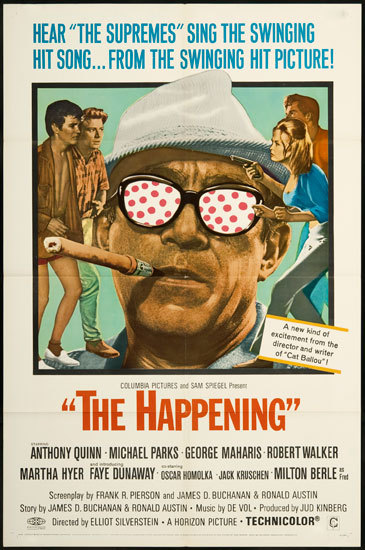
After a night of partying a group of hippies wake up the next morning hung over. Sandy (Faye Dunaway) and Sureshot (Michael Parks) are two strangers that find that they’ve slept together outside for the night and slowly become acquainted. To escape a police raid that is rounding up the drunken partiers and arresting them for vagrancy they hop onto a nearby boat with two other men that they’ve just met Taurus (George Maharis) and Herby (Robert Walker Jr.). They happily go along the lake until some neighborhood kids who are dressed in army gear shoot at them with their toy guns. Taurus doesn’t appreciate this and docks the boat and chases them into their house. Inside is the boy’s father Roc Delmonico (Anthony Quinn) who is a former Mafia Kingpin. He thinks these four strangers are aware of his past and there to kidnap him. The group decides to play along with the ruse hoping to get some money from the ransom and also because they are just bored and looking for some kicks.

The set-up has to be one of the flimsiest I have ever seen and the fact that it took four writers to come up with something that is full of holes and ludicrous is all the more confounding.  The concept seems like something that never got past the first draft and very poorly thought out by everyone involved. The idea that four strangers who have known each other for just a few minutes could get together and kidnap someone that they don’t know on a mere lark is ridiculous. I would think a former kingpin would be better prepared for something like this and have a back-up plan instead of passively and stupidly falling into the kid’s clutches with no idea of what to do. The story would have been far stronger had this been a planned crime.

The film’s overall vapid nature is shocking when you realize that is was done on a good budget by a major studio and top director Elliot Silverstein making me wonder if anyone even cared or thought about what they were making, or simply more interested in getting into the mod mood of the times. The filmmakers portray the younger generation as being one-dimensional thrill seekers with no real or discernible personalities and in the process creates characters that are boring, unrealistic, and uninteresting. The attempts at hipness are shallow, flat, and ultimately annoying.

Despite the low plausibility the movie is slickly done making for periods of fluffy entertainment. Case in point is when the kids have their car pulled over by a policeman (Eugene Roche) when they go through a red-light and carrying Roc tied up in the trunk. In an attempt to create a ‘diversion’ Sureshot decides to get out of the car with his hands up in the air. When the cop tells him to put his hands down he refuses, which then somehow makes all the other cars on the road crash into each other. Yes, it is fun to see a big pile-up, but believing that something like that could happen over something so silly is pushing things too much to the extreme like with a lot of things in this movie.

Things improve during the second half when Roc with the help of the kids turns the tables on everyone he knows after finding out that no one is willing to pay for his ransom. The scene where they tear up his house is kind of funky despite the fact that all the furniture they smash up looks like obvious stage props. Unfortunately the ending is as weak as the beginning and offers no pay off, which most likely will make most viewers feel like they’ve wasted an hour and 45 minutes of their time.

Quinn is good and gives the script and character a lot more energy and heart than it deserves. Dunaway, in her film debut, is hot and plays the part of an immoral lady looking for cheap thrills even when she knows better quite well. Walker Jr. is good simply because he plays the only character that has any type of believability, but unfortunately he is not on enough to be completely effective. Maharis who is best known for his excellent work as Buz Murdock in the classic TV-show ‘Route 66’ is solid as the volatile and slightly unhinged member of the group.

Oskar Homolka has a few memorable moments as an aging crime boss. One scene has him in a steam room along with his henchman wrapped tightly in towels and looking like giant carrots while another segment shows him at a poolside surrounded by a bevy of beautiful bikini clad women, which like the first scene, is visually funny.

The Supremes sing the film’s theme song, which became a top ten hit, but it doesn’t get played until the closing credits and even then not in its entirety.

My Rating: 3 out of 10

Released: May 17, 1967

Runtime: 1Hour 41Minutes

Rated NR (Not Rated)

Director: Elliot Silverstein

Studio: Columbia

Available: None

Misery (1990)

By Richard Winters

My Rating: 6 out of 10

4-Word Review: She’s his biggest fan.

Paul Sheldon (James Caan) is a writer who has just finished his latest novel. On the way back to his publisher (Lauren Bacall) he gets stranded in a freak snowstorm and ends up being ‘saved’ by Annie Wilkes (Kathy Bates) who is his ‘number one fan’. He is injured so she takes him to her nearby house where she proceeds to make him a helpless prisoner to her tormented and delusional mind.

The story has some interesting underlying elements. The film doesn’t really explore them, but does at least touch on it. It is the metaphor of the artist and the public. He is an educated man and yet his stories appeal to those with less education and what he puts into his work isn’t always what they take out of it. He doesn’t really like these stories and wants to expand his craft, but can’t because the formulaic stuff is what sells. In a way Paul was already trapped by Annie long before he ever got to her house and it is a sad dilemma a lot of artistic people have to deal with.
Bates as Annie plays the part really well. She is the ordinary, bland looking woman that you would never think about or consider dangerous. Her strange, erratic behaviors are slowly revealed until in the end the complete monster inside is unleashed. Screenwriter William Goldman, director Rob Reiner, and Bates herself show a good understanding of the character and what makes her tick. They create a woman who is complex, real, frightening, and at times even sad and pathetic.

Caan is a good competent actor however any one of number of actors could have played the part and maybe even done better. Yet you really sense and feel his confinement and ever growing frustration and when he finally revolts at the end you love it!

On the whole the thriller is pretty standard. There are some tense moments, but it is also routine and by the numbers. I thought it was too well lighted as a good psychological thriller always works best with a lot of shadows. The room Paul is trapped in looks more like it was done on a sound stage than in a real home and the film needed a few more unexpected twists.

My Rating: 6 out of 10

Released: November 30, 1990

Runtime: 1Hour 47Minutes

Rated R

Director: Rob Reiner

Studio: Columbia Pictures

Available: VHS, DVD, Blu-ray, Amazon Instant Video

Harper (1966)

By Richard Winters

My Rating: 9 out of 10

4-Word Review: New-age private eye.

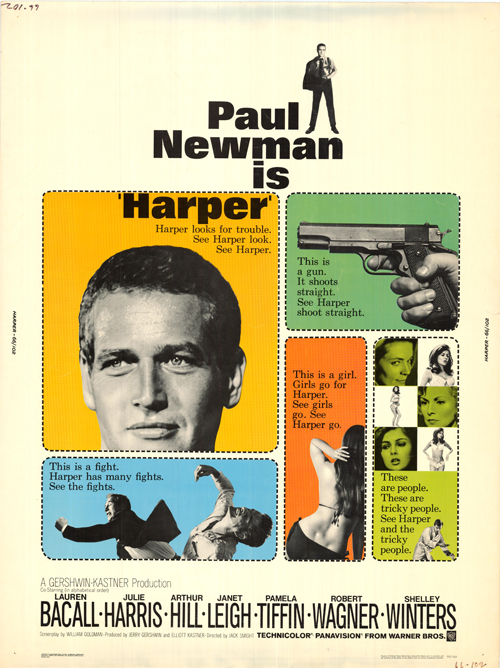
            Detective Lew Harper (Paul Newman) is hired by Mrs. Sampson (Lauren Bacall) a rich woman whose husband has gone missing. She wants a private eye to find him instead of the police due to the fact that her husband was involved in certain illegal business activities, which she doesn’t want to come to light. Harper finds himself immersed in a complex web of intrigue dealing with an array of shady characters, twists, and danger.

Newman is terrific and the Harper character is the perfect private eye for modern audiences. Watching him get out of bed in his dingy, cluttered apartment at the beginning and get ready for the day is excellent and builds characterization in a visual, subtle, and believable way. His cool, laid-back, and detached demeanor is a great contrast to the hyper, jaded, high-strung L.A. types that make up the assortment of suspects. His cynical style attaches the viewer to him right from the start and the banter that he has with everyone is marvelous.

The supporting characters are superb as well and very well-defined. Bacall gets one of her better later career roles as the bitchy eccentric wife. She gets quite a few quotable zingers particularly between her and her step daughter Miranda (Pamela Tiffin) that are close to classic. I also got a kick out of Shelley Winters playing a parody of herself as a way past her prime Hollywood star who is now overweight and an alcoholic. Harper’s attempts to get information out of her by pretending to be a hick who is totally mesmerized by her is quite amusing.

Director Jack Smight is at his directorial peak here. The on-location shooting is splendid. I particularly enjoyed the modernistic building that fronts as a church, but is really used as a cover for criminal activity. It sits out on a sandy hilltop and leaves a strong visual impression as does Harper and Miranda’s car ride along a very winding desert highway to get there. I also liked his ability to capture an abandoned airplane hangar making it almost as evocative to the eye as the foot chase that happens in it. The whole production is consistently slick with color schemes, set design and editing that are all top notch.

William Goldman’s script, which is based on the novel by Ross Macdonald is sensational and one of his best in his already legendary career. The dialogue is sharp one can view it for the lines alone and might need to re-watch it again simply to pick-up on all of them as there are so many your liable to miss some. The mystery is also intriguing and nicely layered to the point that it will keep you guessing and impossible to figure out and fortunately there is a minimum of loopholes. I saw this before and knew the outcome, but still found it an enjoyable and involving ride.

My complaints are few and fortunately do not taint the quality of the picture, which is otherwise high. I didn’t like that Harper had an ex-wife Susan (Janet Leigh) who he is constantly trying to win back. The woman seemed a bit cold and snippy and not the type I would think Harper would fall for, or want to put up with. Having him act so needy to win back her affections hurt the ruggedness of the character who is appealing because of his independent and self-assured nature. There is another scene where a man is shot dead and Harper goes through his coat pockets in order to get some clues to his identity. He finds a matchbook listing a nightclub, which Harper goes to in order to ask questions from the patrons, but I kept thinking it would have been much easier had he just went through the victim’s pants pocket and taking out his wallet and looked at his driver’s license.

If you are looking for a nifty mystery done in the best crime noir tradition then they don’t come much better than this.

My Rating: 9 out of 10

Released: February 23, 1966

Runtime: 2Hours 1Minute

Rated NR (Not Rated)

Director: Jack Smight

Studio: Warner Brothers

Available:  DVD, Amazon Instant Video

Salo, or the 120 Days of Sodom (1975)

By Richard Winters

My Rating: 5 out of 10

4-Word Review: They want sex slaves.

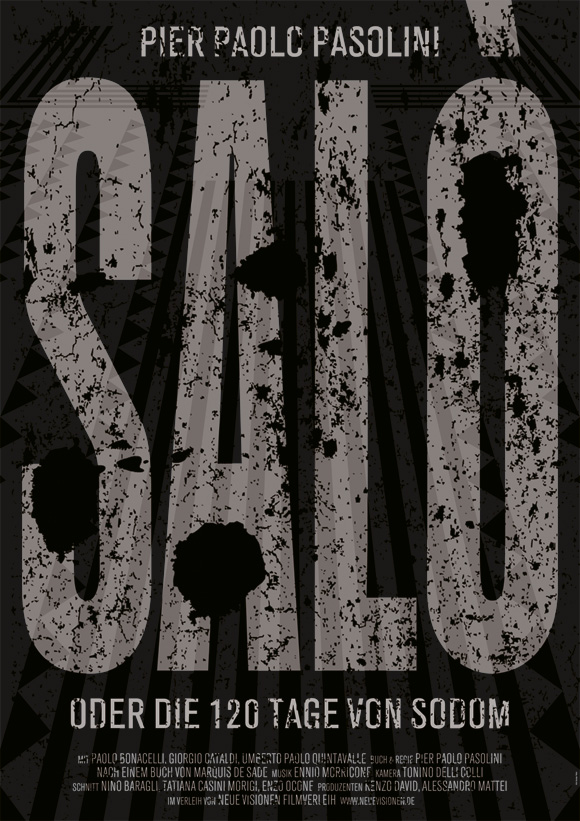
During the end of WW II in a northern city of occupied Italy a group of bourgeoisie men and women round up a group of teenage boys and girls and take them to an isolated mansion where they are forced to become sex slaves. They are also inflicted with cruel tortures in this story based on the writings of Marquis De Sade.

The film is interesting, but only up to a point. Director Pasolini’s natural lighting fetish really works here and he makes it into an art form. His ability to find the perfect moment in the day to shoot the scene and be able to frame the action within the shadows is amazing and along with the color schemes gives it a very distinctive look and an unusual atmosphere.

The acting by the adults is amazing as they project evilness without flaw. The perverted stories they tell in some ways is more shocking than the actual scenes and the casual way they go about their sick behavior achieves an unprecedented level.

The story itself has some good insights. It shows the veneer of civilized behavior and how the passive nature of the victims and society as a whole only helps to allow evil to flourish. There’s also the main point which is that evil is truly a part of the human make-up and hides itself in everybody and can come out if provoked including the victims themselves.

Yet the film makes its point and then hammers it home without pause. The non-stop perversity becomes excessive and the redundancy eventually makes the shock value and message meaningless. Showing the background of these captors might have helped given it more of a balance.

I have nothing against those who wish to ‘push the envelope’ and there is nothing that says movies need to be tasteful, or even entertaining, but I couldn’t help but wonder if Pasolini simply used the material as an excuse to explore his own dark fantasies. Of course DeSade’s actual writings were far more twisted and unsettling then anything you see here and the film is a significantly toned down version.

Actual teenagers were used and there is an abundance of nudity and perversity. Something like this could never have been made here in the states and exactly how it ever got made is more interesting than the film itself. If there was ever a movie begging for a “Making of…” documentary it’s this one. It is also interesting to note that Pasolini was mysteriously killed by a hit-and-run driver just a few days before the film’s official release.

My Rating: 5 out of 10

Released: November 22, 1975

Runtime: 1Hour 56Minutes

Rated NC-17

Director: Pier Paolo Pasolini

Studio: United Artists

Available: DVD, Blu-ray (The Criterion Collection)

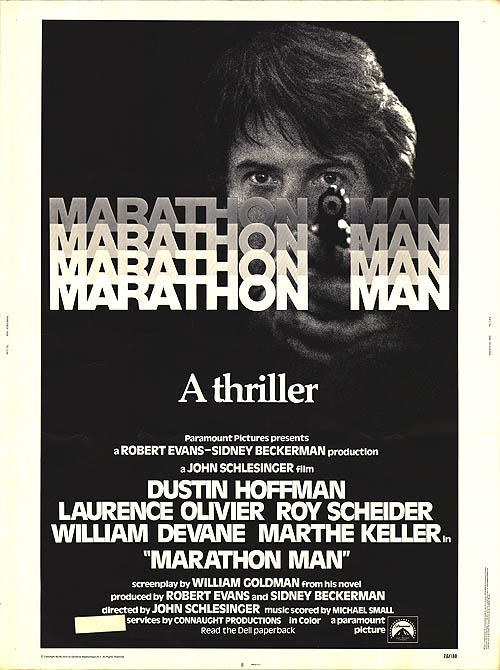
Marathon Man (1976)

By Richard Winters

My Rating: 7 out of 10

4-Word Review: Dentist doesn’t use novocain.

            Thomas ‘Babe’ Levy (Dustin Hoffman) is a post graduate student at Columbia University and part-time marathon runner who spends a harrowing 48 hours being tortured and terrorized by a sadistic Nazi war criminal. It all starts when his brother Henry ‘Doc’ Levy (Roy Scheider) who works for a secret government organization known as ‘The Division’, secretly tracks Dr. Christian Szell (Laurence Olivier) a dentist at Auschwitz who has traveled to New York in order to collect a cache of diamonds. When Doc moves in too close Szell stabs him and despite being covered in blood Doc manages to make it all the way to Babe’s apartment before collapsing. Szell fears that Doc might have told Babe something before he died and has his men kidnap Babe where they then tie him to a chair in an abandoned warehouse and Szell tortures him by drilling into his teeth forcing Babe to use his running skills in an effort to escape.

This is an original thriller that stays intriguing and intense throughout. In the first thirty minutes alone the viewer is treated to some interesting and exciting scenarios including watching two elderly men drag racing with each other in their antique cars down a crowded neighborhood street. There is also an exploding baby carriage and an exciting fight sequence where Doc battles an attacker who tries to strangle him from behind with a metal wire. This scene is unique in that it cuts between seeing the action up close as well as viewing it from the point-of-view of an elderly man watching from across the street.

Director John Schlesinger shows visual flair with a variety of camera angles and settings. I particularly liked the part where Doc meets Szell at the red steps statue in the Arco Plaza. Having the climactic showdown between Babe and Szell take place in a pump room at the reservoir in Central Park gives the sequence added energy and distinction. I also enjoyed Babe’s cramped, drab, and cluttered apartment that had a very lived-in look and resembled exactly what a bachelor pad with someone on a low income would look like. The scene taking place at a country house is memorable simply for its extreme remoteness. I was disappointed though that although Schlesinger does a great job in setting up the atmosphere of the scene by doing a long shot looking out at the barren landscape the weather suddenly goes from cloudy to sunny in the minute it takes for the bad guy’s car to pull up the driveway. I realize certain scenes are sometimes shot over several days and this is not the first movie to have sudden weather changes during outdoor shots, but it is distracting nonetheless.

The infamous torture scene didn’t work for me. I appreciated the set-up especially the prolonged way that Szell plugs the drill into a wall outlet while talking to Babe in a calm tone. Constantly asking Babe the question ‘Is it safe?” has become a classic line and the fact that the dental torture gets extended when you think it is over is well done. Still, it didn’t seem violent enough and although pain is implied I didn’t think that the viewer really ‘feels’ it. I wanted more shots from Babe’s point of view especially as Szell sticks his metal instruments into Babe’s mouth. A close-up of Babe’s tooth and seeing the drill touch it would have helped as well. Also, Babe needs to scream in pain a lot more, he does it once briefly, but someone going through that would be doing it constantly.  Apparently the producer’s cut out portions of this scene when it upset the test audiences who saw it, but I would like that footage put back in as I feel it would make the movie stronger and give it an added kick that otherwise is missing.

Olivier is tremendous in the villainous role. His face exudes evil and this is one of his best later career roles. Scheider has his best role here and I found Marthe Keller impressive as Babe’s girlfriend. She wears an attractive hairstyle and I couldn’t get over how diametrically opposite she was compared to her character in Black Sunday that was done the very same year. She is definitely an under-rated actress that deserves more accolades as well as more parts in American productions. However, the way Babe pursues her for a date seemed to border on ‘creepy’  and overly aggressive and act as a turn-off to most women.

The film does seem derivative at certain points especially the way it portrays New York as an urban hellhole, which was quite common during the 70’s. The fact that Babe avoids confrontation and is picked on by a Hispanic gang that lives across the street seemed too reminiscent of Hoffman’s earlier film Straw Dogs. There are several flashback sequences showing Babe as a child that is done with faded color and no dialogue and look too similar to the childhood sequences done in Midnight Cowboy, which was an earlier Schlesinger/Hoffman project. Hoffman, for what it is worth, gives another one of his dedicated performances, but this film really does show in glaring detail how very puny he is and I really could have done without having to see his naked rear.

The electronic score is nice and the part where Szell gets recognized by an elderly concentration camp survivor on a busy city sidewalk and who then begins to chase after him is memorable. However, when it is all over I still felt it didn’t completely click. I’m not sure what it is. I know the ending was changed from the one in the book, but I liked this one better and felt Babe’s revenge on Szell was creative. Although controversial and edgy for its time, the torture scene seems too toned down for today’s standards. Either way, if you are looking for a competent and entertaining thriller this should fit the bill, but it is not a classic.

My Rating: 7 out of 10

Released: October 8, 1976

Runtime: 2Hours 5Minutes

Rated R: (Violence, Language, Adult Theme, Brief Nudity)

Director: John Schlesinger

Studio: Paramount

Available: VHS, DVD,  Blu-ray, Amazon Instant Video 

Seance on a Wet Afternoon (1964)

seance on a wet afternoon

By Richard Winters

My Rating: 6 out of 10

4-Word Review: Psychic is a phoney.

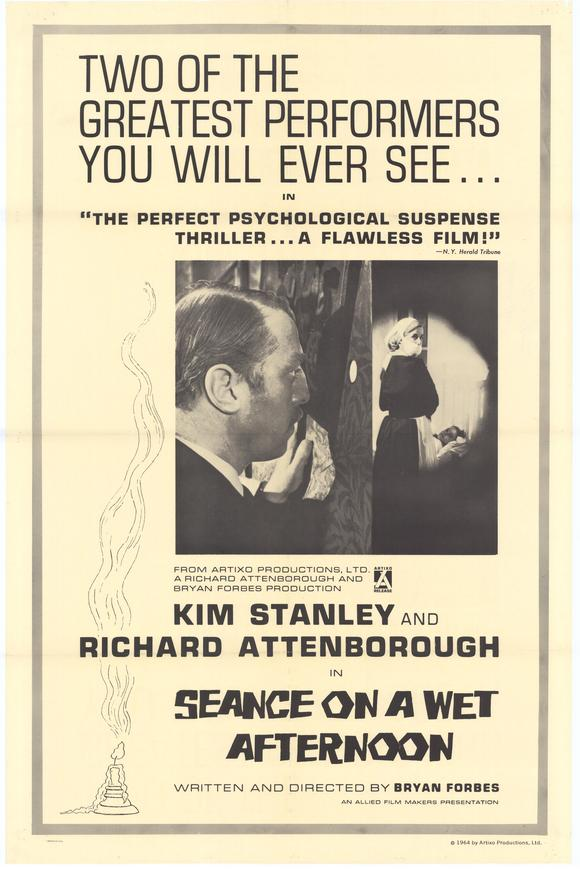
Myra Savage (Kim Stanley) is an emotionally unbalanced woman and failed psychic who comes up with an idea that she hopes will revive her career. The plan is for her husband Billy (Richard Attenborough) to kidnap Amanda Clayton (Judith Donner) who is the young daughter of a rich businessman. They will then place her at a strategic location and hold a public séance at which time Myra will ‘miraculously’ predict her whereabouts. This will then, they hope, make her famous and world renowned, but of course things don’t work out as expected.

This is indeed a unique and unusual film that taps into some rare qualities. First and foremost is the black and white cinematography. Every camera shot and angle has a certain evocative flair that is well captured and vivid. The on-location shots pick up just the right amount of ambiance and lighting with each setting. The music score is great and helps create excellent tension. You also will love the little girl that they kidnap. She is adorable without it being forced. Her matter-of-fact sensibilities are a great contrast to Attenborough and Stanley whose characters are child-like and pathetic.

Yet the film doesn’t completely work. The story is handled in a plodding and methodical way without any twists or surprises. There is very little action, some definite slow spots and the conclusion is limp.

If you watch it for the performances then you will be more intrigued. Stage actress Stanley gives a rare film appearance here. It is easy to see why she took the role even though she was known to dislike doing films. The takes are long and give almost unlimited possibilities in creating a character, which is what all stage actors enjoy. She does well and at times may remind one of another legendary actress Geraldine Page who would have also been perfect for the part. Attenborough proves almost her equal. His expressions of shock and worry are memorable. The interplay between the two is fun especially towards the end when this otherwise passive man stands up to the domineering woman.

Overall there are some unique moments, but it is just not suspenseful enough and results in being only slightly above average.

My Rating: 6 out of 10

Released: November 5, 1964

Runtime: 1Hour 55Minutes

Rating: NR (Not Rated)

Director: Bryan Forbes

Studio: Artixo Productions

Available: VHS, DVD (Region 1 & 2)

Venom (1982)

By Richard Winters

My Rating: 3 out of 10

4-Word Review: Kidnappers versus deadly snake.

            Phillip Hopkins (Lance Holcomb) is an 8-year old boy and son of a wealthy couple. When his parents leave for a trip the family’s maid and chauffeur (Susan George, Oliver Reed) conspire to kidnap the boy and hold him for a ransom with the help of a ruthless gunman (Klaus Kinski).  Unbeknownst to any of them the boy has mistakenly acquired a black mamba snake that escapes from his cage. As the culprits try to pull off their crime they become trapped in the house by the deadly reptile that starts to attack them one-by-one.

For starters the cast is one of a kind. Besides the performers listed above the film also has Sarah Miles as a Dr. with a serum to help fight the snake’s poisonous venom. Nicol Williamson appears as the police negotiator and Sterling Hayden, in his last film role, plays the boy’s grandfather.  How anyone could manage to direct a cast with such legendarily huge egos and eccentric personalities seems hard to fathom and probably explains why original director Tobe Hooper left the production after only ten days of shooting and was replaced by Piers Haggard. Supposedly Reed and Kinski were at odds with each other during the entire production and their animosity clearly shows on screen. For the most part the talents of the cast is wasted with a script that is limited and filled with characterizations that allow for no range.

I did like Hayden in the scene where he is forced to go searching for the snake in a darkened room and armed with nothing more than a lamp and a makeshift weapon. George is also fun playing a duplicitous character for a change and I was disappointed that she gets killed off so soon. However, she does make the most of it with a very theatrical death scene. Probably the best performance in the whole film is that of the boy. He has a very sweet, young looking face and the widest most innocent pair of blue eyes you’ll ever see and the kind that most casting directors would kill for. The kid plays the frightened part well and does an effective asthma attack. He hasn’t done much since, but I am sure that if he wrote a book dealing with his experiences on the set and his interactions with that cast that if would most assuredly be a best-seller.

The set-up is good and I found myself riveted to it for the first half-hour. I liked the idea that an actual mamba snake was used. There is a part where the snake is slithering towards the camera and opens its wide, black mouth and hisses straight at the camera, which could be enough to get most viewers to jump out of their seat. Director Haggard uses the novel idea of shooting scenes from the snake’s point-of-view and he does it through a fuzzy and slightly distorted lens to help replicate the snake’s vision. The only problem I had in this area is that the snake is seen slithering throughout the picture inside the home’s venting system, which is shown to be very clean and spotless, which didn’t make sense to me since the home was old making me think that the metal piping would be more corroded and rusted.

Despite the excellent concept the film’s second hour is quite boring. The characters don’t have enough to do and spend most of the time standing around. The interplay between Kinski and Williamson brings no tension. There is one cringe inducing scene where the snake crawls up Reed’s pant leg, but overall the scares are quite sparse. The climatic sequence is too convenient and becomes more of a disappointment then a shock. It is hard to say if the film would have been better if Hooper had stayed on or not. Reportedly none of the footage that he shot is in the final cut. The film is based on a novel by Alan Scholefield, which I suspect is probably more intriguing and after watching this makes me interested in reading it.

My Rating: 3 out of 10

Released: January 29, 1982

Runtime: 1Hour 33Minutes

Rated R (Mature Theme, Violence, Language) 

Studio: Paramount

Director: Piers Haggard

Available: DVD

Open Season (1974)

By Richard Winters

My Rating: 3 out of 10

4-Word Review: Humans are their prey.

This is the type of film that has a really great concept, but ends up being ruined with its poor execution. It is based on the novel ‘The All-Americans’ by David D. Osborn, who also co-wrote the screenplay. The story involves three ‘All-American’ suburban family men (Peter Fonda, Richard Lynch, and John Phillip Law) who once year go on a ‘hunting trip’ except here they hunt people. They typically pick their victims up at random and then drive them to their isolated hunting lodge in the woods. They feed and entertain them for a week and then give them a few supplies as well as a compass and tell them that the highway is twenty-five miles north.  If they are able to make it to the highway they are free and if not the three men will hunt them down like animals. The victims are always given a thirty minute head start, but none of them ever make it. The movie focuses on a man and woman (Alberto de Mendoza, Cornelia Sharpe) that are having an affair and are kidnapped by the three outside of a truck stop.

The beginning is well-done and quite easily the best part of the whole film. It goes back in time to when the three men where in college and accused of gang raping a young lady.  To the shock of the girl’s mother the prosecuting attorney tells them they have no case because these boys are great athletes with stellar reputations and nobody would believe they would do something like that. I liked this part for two reasons. One is the fact that at least we are given some sort of history to these culprits. A lot of movies never do this and you always wonder how these psychos where able to get away with it for so long. At least here we are given a backstory and somewhat plausible one at that.  Many sociopaths have been able to fool people for years simply because they smart enough to play the respectable role in society and bring out their deviance only when it is completely safe to do so. Also, athletes, especially in the past, where given much more leeway and many of their transgressions would get over-looked. So to me this made a lot sense and helped get me into the movie right away. I also liked the imagery used over the opening credits as well as the very haunting music score.

I also liked how the film then cuts to the present day showing the men at a neighborhood block party and interacting with their wives and kids. The three actors are perfect for their parts.  They were all B-actors who’ve made a career playing sleazy characters and fall into the roles easily. Richard Lynch is especially good. In real life he once set himself on fire in 1967 while taking LSD and his scarred, pale, and rough looking face always makes a creepy impression. Director Peter Collinson does some good camera work with detailed bird’s-eye view shots that show how sprawling the forest is and indeed gives the viewer a very remote feeling.

Unfortunately the rest of the film goes downhill. Part of the problem is that there is just too much talking.  In fact the whole middle section is spent with a lot of drawn out conversations that aren’t interesting, or well-written. It saps the tension out of the film until there isn’t any left.  It isn’t until the very end that they finally get around to letting the victims go out into the woods and then tracking them down. However, this too is poorly handled. The action is limited and not well choreographed. The whole sequence goes by too quickly and comes off like it was nothing more than an after-thought that fails to take advantage of its immense forest setting.  In fact for a film with such a sadistic and exploitive theme there is actually very little violence to speak of and no gore at all. The three bad guys also end up becoming quite banal and one-dimensional. They show no distinctive personalities whatsoever as they agree with each other on everything and seem to do nothing more than laugh and guffaw and each other’s juvenile jokes and antics.

If you are interested in watching this film then please don’t read any further as it may be considered a spoiler:

The film’s twist ending is weak as well. It features actor William Holden (a very accomplished actor and why he took this role, which amounts to nothing more than a cameo, I will never know) playing the father of the girl that the three men raped in college. He secretly followed the men on their hunting trip and decides to have his revenge by gunning them down just like they had done to all their victims. Again, the action here is handled in an unexciting and unimaginative way. I couldn’t buy into the fact that these men, who supposedly fought in Vietnam, would panic so quickly and act like a bunch of scared children the minute they found out that they were being shot at. They show no savvy or survival skills and allow themselves to be easily picked-off in an uninspired fashion.

I have always enjoyed Deliverance and I liked how this film used a variation of that theme where instead of the civilized man going out and coming to terms with the savage of the wilderness they instead go into the wilderness to come to terms with their own, inner savage. More action, better tweaking of the characters, and a faster pace and this film could’ve been a cult classic as the ingredients are all there. As it is now though I think it is much too bland to interest or intrigue anybody.

My Rating: 3 out of 10

Released: November 1, 1974

Runtime: 1Hour 44Minutes

Rated R

Director: Peter Collinson

Studio: Columbia Pictures

Available: VHS