Category Archives: Horror

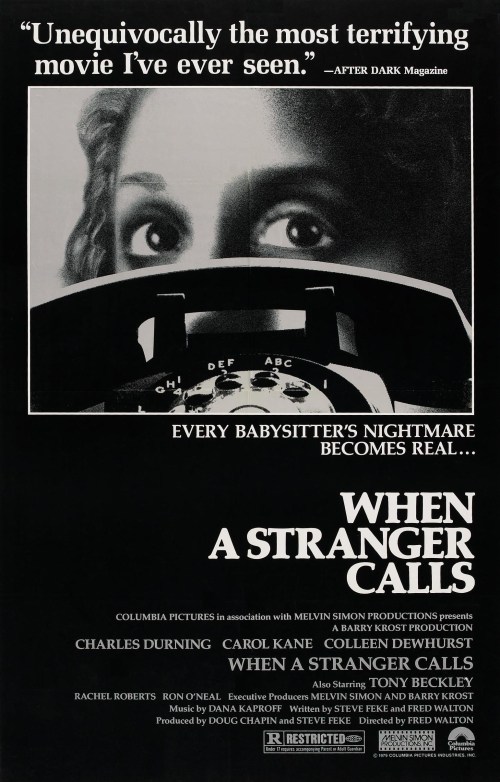
When a Stranger Calls (1979)

By Richard Winters

My Rating: 5 out of 10

4-Word Review: Babysitter receives harassing calls.

Jill Johnson (Carol Kane) gets asked by the Mandrakis (Rutayna Alda, Carmen Argenziano) to babysit their two children, who are already asleep, while they go out for the evening. While Jill is there she starts receiving harassing calls from an anonymous man asking about the children. Jill eventually calls the police who find out that the call is coming from inside the house, but fortunately the police arrive in time before the killer (Tony Beckley) can get to her. She recovers from the incident and moves on with her life by getting married and having two kids of her own only to find that the man has escaped from the mental hospital and coming after her again.

This is an extension to director Fred Walton’s 1977 short film The Sitter with the first 22-minutes almost the same as that one, but not quite. The opening bit is much better handled here with close-ups of a pendulum on a clock swinging back and forth and Jill hearing noises in the house only to find that it’s the ice dispenser in the refrigerator, which are all the scenes that were not in the first film. Kane is also a better actress and her ability to convey fear elicits more tension from the viewer, but I still found it annoying that she reiterates the same line that the babysitter in the first film did where she states to the police that she’s ‘all alone in the house’ when technically there’s supposedly two sleeping kids upstairs.

The second act is where this thing goes off on a wild tangent by focusing almost exclusively on the killer, whose name is Curt Duncan, as he attempts to survive on the streets in the most seedy part of the city while a police investigator named John Clifford (Charles Durning), who worked on the earlier case and is now a private investigator, is determined to kill Duncan for what he did to the two children. To some degree this is a refreshing change of pace as most horror films like to demonize the killer making him seem like a soulless monster who kills people robotically while here the psychopath is portrayed as a vulnerable and confused human tormented by inner demons that he cannot control.

Watching him try to form a bond with a woman (Colleen Dewhurst) that he meets at a bar simply for human contact is interesting because most psychos don’t just murder everyone they meet even though in a conventional horror flicks you’d get the impression that they do. In reality many of them can be married, hold down regular jobs and have what appears to be a normal life only to do their killings on the side and the film scores definite points by examining this aspect that we’re not used to seeing, but it also makes him less scary, which ultimately hurts the tension.

The biggest problem is that Jill the main character completely disappears for a whole hour only to reappear again at the very end, which is too long. If this is a person that the viewer is supposed to care about then she needs to be in the film a lot more possibly cutting back and forth between her recovering from the incident and meeting someone that she will marry while also going back to Duncan and what he’s doing instead of just exclusively concentrating on Duncan as it does.

Spoiler Alert!

The ending in which Duncan tracks Jill down and tries to kill her makes no sense at all. How did the killer, who has no money and is basically homeless, find out where she lived? She has gotten married and most likely a new last name, so just saying he found her address listed in a phone book doesn’t work. How did he know the phone number to the place where she was attending a dinner party and for that matter how was he able to break into her house undetected while squad cars were patrolling it? Better yet how was Charles Durning, who ends up shooting the guy, able to get into the house as just a few minutes earlier he was shown inside a hotel room? Why was the killer so obsessed with tormenting Jill anyways, which are all good questions that never get answered and leaves open too many plot holes to be fully effective.

My Rating: 5 out of 10

Released: October 26, 1979

Runtime: 1 Hour 37 Minutes

Rated R

Director: Fred Walton

Studio: Columbia Pictures

Available: DVD, Blu-ray
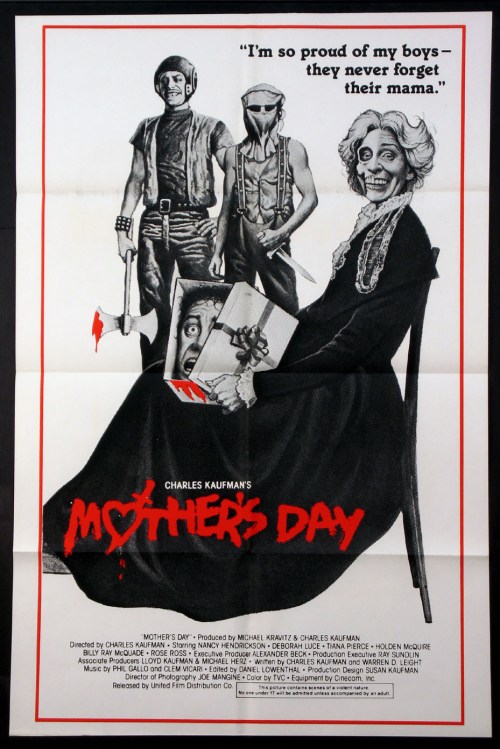
Mother’s Day (1980)

By Richard Winters

My Rating: 5 out of 10

4-Word Review: Rednecks murder for mama.

Trina (Tiana Pierce), Abbey (Nancy Hendrickson), and Jackie (Deborah Luce) are three friends from college, who are now in the adult world but still enjoy getting together one weekend of the year for a ‘mystery trip’ where they go to some place they’ve never been before. This year they decide to take a camping trip into the dense woods of New Jersey. It is there that they come into contact with a redneck family consisting of two grown sons: Ike (Frederick Coffin, but billed as Holden McGuire) and Addley (Michael McCleery, but billed as Billy Ray McQuade) who kidnap the girls and bring them back to their secluded home where they torture and rape them all for the amusement of their twisted mother (Beatrice Pons, but billed as Rose Ross in order to avoid losing her actor’s union membership for starring in a non-union film.)

The film is loosely inspired by the true story of Gertrude Baniszewski, a single woman with 7 children living in Indianapolis in 1965 who got her kids to torture and murder a 14-year-old girl who was boarding at their home while her parents went off to work in a carnival. This same story was done in two other films: An American Crime starring Ellen Page, and The Girl Next Door with Blanche Baker. While both of those movies took a more serious approach this film tries to spin in goofy satire which kind of works and kind of doesn’t.

I enjoyed the graffiti sprayed painted on the walls inside the mother’s home and the silly TV references as well as the two sons arguing over the merits of  whether ‘Punk sucks’ or ‘disco’s stupid’, but the opening bit where the mother attends a weekend encounter group, which was a parody of The Erhard Seminars Training, which was popular during the 70’s, should’ve been cut. For one thing there’s no logical reason why this reclusive old woman would be motivated to attend this group. It also telegraphs too much of the plot by having her car break down and her two sons then jump out of the forest to kill two of the people that she had met at the seminar. Not having the mother and her boys introduced right away but waited until after the girls were kidnapped would’ve created more tension and mystery.

Spoiler Alert! 

The women characters are better fleshed-out than in most other slasher films and a great deal of time is spent showing their backstories. They’re also not made to seem like bimbo party girls, but portrayed more like everyday women who are smart and more average looking, which was a refreshing change of pace.

However, the ending, which consists of them turning-the-tables on their captors and savagely killing them doesn’t work. Had they still been held hostage and forced to kill in order to escape then it might’ve been more believable, but instead they successfully escape and then decide to come back and murder the family for ‘street justice’  after one of them dies. This though was too wide of arch as nothing is shown before hinting at this violent streak that harbors within them. Screenwriter Warren Leight tries to justify it by having the redneck mother remind Abbey of her obnoxious mother back home and thus letting out all of her pent-up frustrations that she with her own mother onto the old woman, but it’s all still too extreme and heavy-handed.

End of Spoiler

Despite all of these issues I still felt this was a step above most other slasher flicks. There’s enough interesting elements to it that I was convinced that director Charles Kaufman, who is the brother of Troma President Lloyd Kaufman and not to be confused with the famous screenwriter with the same name, had the potential of being a good cult film director, but since 1988 he is no longer in the filmmaking business and instead runs the successful bakery Bread & Cie in the Hillcrest neighborhood of San Diego.

My Rating: 5 out of 10

Released: September 19, 1980

Runtime: 1 Hour 31 Minutes

Not Rated

Director: Charles Kaufman

Studio: United Film Distribution Company

Available: DVD, Amazon Video, YouTube


Creepshow (1982)

By Richard Winters

My Rating: 5 out of 10

4-Word Review: Five stories of horror.

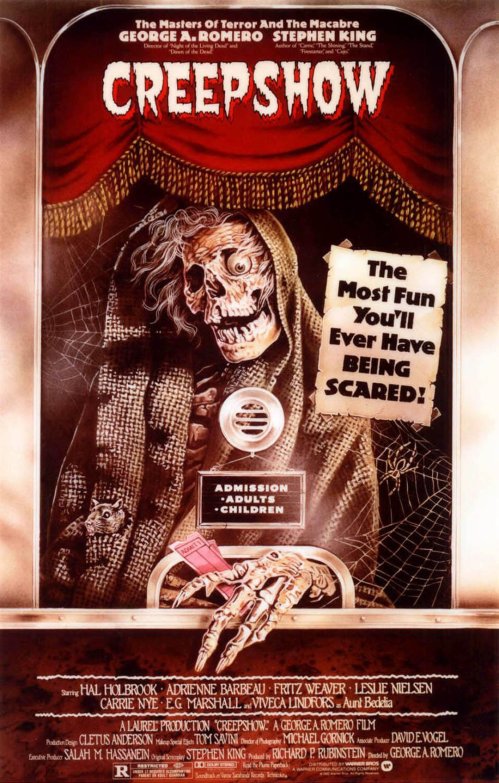
This film was the collaboration of Stephen King, making his screenwriting debut, and George Romero, who filmed the entire thing in his hometown of Pittsburgh, Pennsylvania with many of the scenes done in an abandoned boy’s school. The production was a homage to the horror comics like ‘Tales of the Crypt’ and ‘The Vault of Horror’, which were published between 1950 and 1955 before being shutdown because they were considered ‘dangerous’ to the well being of children and contributing to juvenile delinquency.

The script consists of five stories with the emphasis more on camp than terror and outside of the cool comic book effects fall pretty much flat.  The first story entitled ‘Father’s Day’  comes off more like a one-joke skit and deals with an adult daughter (Viveca Lindfors) who kills her obnoxious father (Jon Lormer) on his birthday with an ashtray and then years later visits him at his grave site where his corpse comes back to life.

The second story entitled ‘The Lonesome Death of Jody Verrill’ should’ve been extended out more as it has some intriguing possibilities to it. It consists of a redneck (played with campy glee by Stephen King) who finds a meteor that’s landed in his backyard, but realizes to his horror that everything it touches grows a greenish foliage including on himself.

‘Something to Tide You Over’ is the third entry and it’s about a man (Ted Danson) being buried alive in the sand and then drowning as the tide rolls in. It’s shot in a way where the viewer sees the water rushing in from the victim’s point of view, which gives it a frightening quality, but suffers from having the victim  too easily lead into the trap and a twist ending that involves a metaphysical phenomenon, but with no suitable explanation for how it could’ve occurred.

‘The Crate’ involves an arctic monster being found inside a crate that was underneath a college stairwell. One of the professors (Hal Holbrook) uses this monster as a way to kill his obnoxious wife (Adrienne Barbeau), but the logic on this one is loopy. First how was the monster able to survive four decades inside a box without any food or water? Having him encased in a block of ice and then unfrozen would’ve been a little more plausible, but the story is further hampered by the casting of Barbeau, who’s too young for the part, which would’ve been better suited for a fat old bitty that was more Holbrook’s age. The biggest question though is why would Holbrook bank on the idea that the monster would kill his wife and not attack him first and why would the wife, or anyone with half a brain, be dumb enough to get tricked into driving all the over to the college campus and then crawling under the stairwell to begin with as the reason he gives her to do it is pretty dumb.

‘They’re Creeping Up on You’ has the most potential and a fun performance by Marshall, but ultimately gets botched. It’s about a rich Howard Hughes-like billionaire (E.G.Marshall) who lives alone in this fancy, hermetically sealed penthouse that gets overrun with cockroaches. Watching the roaches crawl around is creepy and apparently over 20,000 of them were used. Yet having them pile onto each other until they create a roach-like mountain loses the effect, many of them weren’t even roaches by this point but instead nuts and raisins. This segment would’ve been better had it been a fancy penthouse with all the elaborate furniture trappings as King intended instead of a white room with barely nothing in it. This story also features a dead body, which clearly looks like a wax dummy that ultimately ruins the intended effect.

My Rating: 5 out of 10

Released: November 12, 1982

Runtime: 2 Hours

Rated R

Director: George A. Romero

Studio: Warner Brothers

Available: DVD, Blu-ray, Amazon Video, YouTube

The Final Conflict (1981)

By Richard Winters

My Rating: 3 out of 10

4-Word Review: Monks battle the Antichrist.

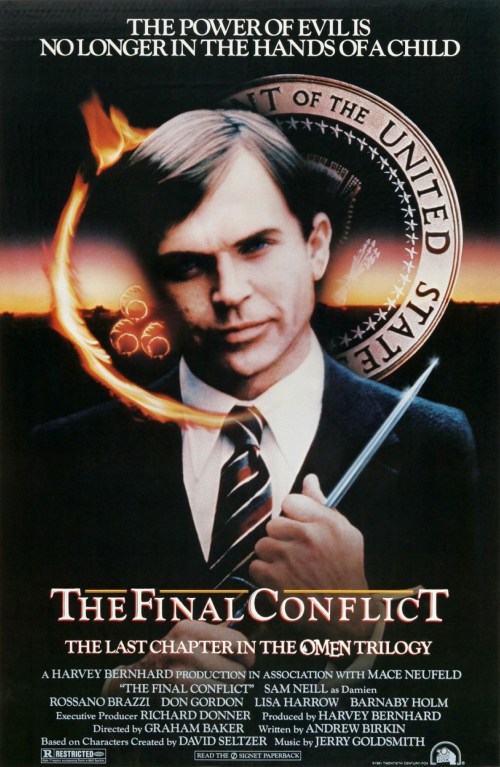
Damien (Sam Neill) is now appointed the US ambassador to England the position his adoptive father once held before he died. He uses this position as well as being the CEO of Thorn Industries to try to halt the Second Coming of Christ, which happens on March 24, 1981 during the alignment of stars known as the Cassiopeia Constellation, but problems occur when they don’t know which child it is. This causes him to order his assistant Harry Dean (Don Gordon) to kill each child born in England between midnight and 6 AM of that day unaware that Dean’s own child was also delivered between those hours and this secret he tries to keeps from Damien until it is too late.

This third entry is an improvement over the second film as it pushes the plot progression forward and enters in all sorts of interesting new wrinkles. The budget is high and allows for different setting locals including a genuine fox hunt, which I found entertaining. Neill plays the part pretty well and unlike in the first two is sinister throughout with his best part coming when he gives a prayer to the devil in a secret room next to a giant crucifix. The film also has a scene that reveals a secret underground movement of devil worshipers, which is made up of hundreds of ordinary, everyday people who get together at a secret, hidden location and take orders directly from Damien. This helps to explain where these people came from who help Damien in his cause, which is  something that was never shown in the second installment, but should’ve.

It also continues the trend of having novel deaths occur including a graphically brutal one that happens inside a TV studio that apparently due to its complexity took two weeks to film. However, the intended shock effect from these, that was so strong in the first film, gets lost here. Instead of being horrifying they become almost laughable especially since they mainly occur to the monks who are each given one of the seven daggers to kill Damien with, but they are so incompetent  that it becomes more like comic relief.

The killing of the infants, which Damien’s followers carry out, are equally goofy and include a segment where a baby carriage with the baby inside rolls down a hill, which will do nothing but remind cinephiles of the famous scene in the classic Russian film Battleship Potemkin. I was also confused during the baptism scene where the Priest supposedly kills the child while baptizing it with water, but it’s not clear what he does as we only see the shocked expression of the mother when he hands the baby back to her, which only creates more questions than answers. Like wouldn’t the priest get arrested for killing the child since he did it in front of so many witnesses and if so wouldn’t he unravel during the subsequent police interrogation and reveal Damien’s plot to them?

Spoiler Alert!

The film’s biggest letdown though comes with its ending. Initially it seemed that Harry and his wife would be forced to go on the run to hide their infant from Damien, which could’ve involved a very exciting cross-country chase, but the film ruins this potentially interesting idea by having the mother get brainwashed by the devil dog to kill the baby herself.  It then ends instead where Damien travels to some church ruins where the Christ child is being hidden, but we never see the baby and no explanation for how it was able to avoid being killed by Damien’s followers. The novel version explains that it was born to a family of gypsies and therefore no record of its birth was made to the authorities, but this is something that should’ve been stated in the movie.

Having his girlfriend Katherine (Lisa Harrow) stab Damien in the back with one of the daggers comes off as being too easy and ultimately makes the climax seem anti-climactic especially after such a big buildup. It also gives off too much of a happy ending feel. This is after all still a horror movie and therefore the viewer should be left it with a certain unsettling feeling when it’s over, which this film doesn’t do.

My Rating: 4 out of 10

Released: March 20, 1981

Runtime: 1 Hour 49 Minutes

Rated R

Director: Graham Baker

Studio: 20th Century Fox

Available: DVD, Amazon Video, YouTube

Damien: Omen II (1978)

By Richard Winters

My Rating: 3 out of 10

4-Word Review: Damien learns his destiny.

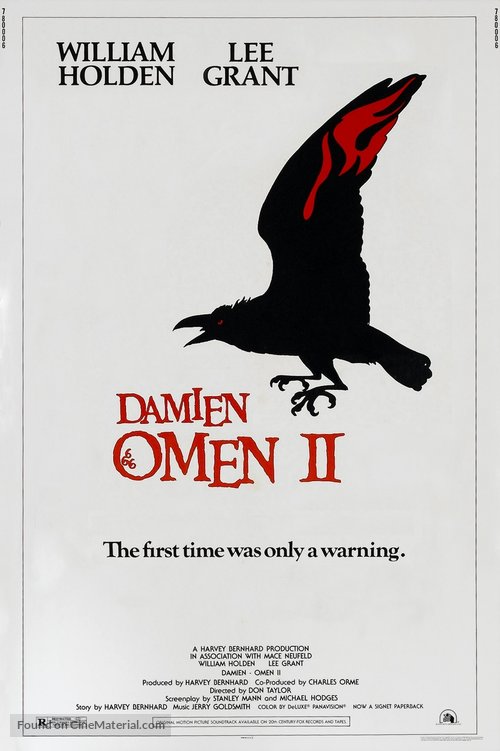
After the death of his adoptive parents, Damien (Jonathan Scott-Taylor) moves in with his Uncle Richard Thorn (William Holden) and his wife Ann (Lee Grant) in Chicago. Thorn is a rich industrialist and Damien lives a privileged life in the suburbs of Chicago alongside his cousin Mark (Lucas Donat), who is set to be heir to his father’s company, but first the two boys are sent off to the military academy. It is there that Damien learns that he is the Antichrist and puts a plan in place where he can kill off Mark and his parents so that he can take over Thorn industries and use it for his nefarious purposes.

It’s unfortunate that David Seltzer, who wrote the script to the original Omen film, choose not to pen this one and instead Harvey Bernhard the film’s producer outlined the story and then hired Stanley Mann to write the script, but the plot is basically a retread of what occurred in the first one with the father this time played by Holden, going through the same realizations that Gregory Peck did in the original, while offering no surprises or interesting twists. Had Seltzer written it he would’ve had it begin where the first one ended with Damien inside the White House having been adopted by the President and his wife, which would’ve offered far more intriguing scenarios than anything that gets played-out here.

The film also suffers from having Damien, much like in the first one, not being all that scary or mean at least not at the beginning. For the most part he behaves like a nice kid. The scene where he takes revenge on a bully at the academy actually had me on his side as well as when he shows-up a teacher in front of the class by knowing all the answers. Having an aunt character, played by Sylvia Sidney, despise him and consider him a ‘bad influence’ doesn’t help things as this is something that the viewer needs to see for themselves and not just have described by another character.

The characters played by Robert Foxworth and Lance Henriksen, who know about Damien’s secret and essentially ‘groom him’, is confusing because it’s never explained how these men would know this, or what their backgrounds are. If there’s a group of devil worshipers out there, or demons sent directly from hell in human form to help Damien in his evil quest than this needs to be elaborated instead of just having them appear knowing things that no else does, but without any explanation.

Like in the first one it’s the death scenes that make it worth watching and there are a few good ones including one that occurs under the ice of a lake and another very gory one that happens inside an elevator, but there’s also some where the victim just falls over dead due to Damien’s powers, which is a letdown. If the film is going to market itself on the death scenes then ALL of them need to be creative and memorable and not just a cherry-picked few.

The pristine, white wintry landscape is nice, although not exactly suitable for a horror film, and I did enjoy Lee Grant who plays the wife role in a far more multi-dimensional way than her counterpart Lee Remick did in the first one, she even gives the film its one unexpected wrinkle, which occurs at the end, but otherwise there’s nothing much else to get excited about here. In between the death there are a lot of boring segments with no tension at all. The movie, which is a bit overlong, does not have the terror increase as it progresses, but instead just gets more drawn-out.

My Rating: 3 out of 10

Released: June 5, 1978

Runtime: 1 Hour 47 Minutes

Rated R

Director: Don Taylor

Studio: 20th Century Fox

Available: DVD, Amazon Video

The Omen (1976)

By Richard Winters

My Rating: 7 out of 10

4-Word Review: He’s the devil’s child.

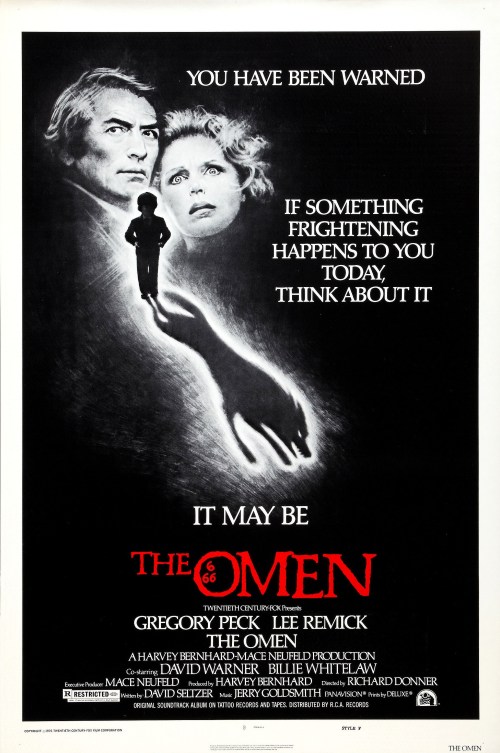
Robert Thorn (Gregory Peck) is an American ambassador living in London who learns that his wife Katherine (Lee Remick) has given birth to a stillborn child. One of the priests at the hospital suggest that he take a newborn whose mother has just died during childbirth and treat it like it were his own, which he does, but without telling Katherine. When they take the child home things start out fine, but eventually a series of strange deaths begin to occur to the people around them convincing the couple that their child may possess some sort of dark power as unbeknownst to them he is the son of the devil.

Considered at the time to be a rip-off of The Exorcist, whose success many other studios were hoping to replicate, this film has managed to rise above the rest of the tacky satanic themed films of that decade and in the process has created a franchise of its own that at this point has spawned 3 sequels, 1 remake, 5 novels, and even a TV-series. While the story does border on being unintentionally campy at many points it still succeeds due to the death scenes that many consider the best moments of the film, but for me the creepiest part is when they go into the small, dingy room of the priest who has every inch of the walls covered with pages of the bible.

The film’s weakest link is the child who’s given only a few words of dialogue making his presence transparent and not frightening at all. If this kid is from hell then he should behave like it by doing mean things that the Patty McCormack character did in The Bad Seed, but he doesn’t and with a few exceptions he behaves pretty much like a normal kid, which ultimately makes him uninteresting.

Spoiler Alert!

While Peck is solid I felt his character arch was too wide as he starts out as a non-believer, or at least we can assume this since he doesn’t take his kid to church until he is already 5, who goes from  being skeptic to paranoid believer too quickly. Having him start out as devoutly religious would’ve made his transition less extreme and might not have required the David Warner character, who ends up ‘educating’ Peck about Damian, being needed at all.

Remick, whose only facial expression is that of panic,  is equally one-dimensional and genuinely wasted. I also felt the scene where she gets knocked off the chair that she is standing and then literally leap frogged over the railing was too exaggerated as she most likely would’ve just fallen onto the upstairs floor instead. Seeing the later shot of her crashing through the roof of an ambulance gets too underplayed by showing only a small trickle of blood coming from her mouth when in reality her entire face would’ve been mangled, but isn’t

Billie Whitelaw as the sinister nanny Mrs. Baylock is terrific and helps add underlying tension, but I felt she should’ve come better prepared to protect the child. Granted she had a guard dog, but there needed to be another weapon at her disposal like a rifle that she could’ve used against Peck when he tried to take the child instead of just throwing herself at him physically in a desperate attempt to stop him, which nonetheless is still a great moment as it’s so rare to see a woman and a man going at it in a physical altercation while on equal footing, which should’ve been enough reason to have this scene extended out even more.

Ultimately though it’s Richard Donner’s outstanding direction and the way he implements interesting touches that keeps this thing engaging throughout instead of being laughable, which it could’ve easily have become otherwise. While it’s been many years since I saw the 2006 remake, and I can’t remember it in much detail, I did come away feeling this one was the better version and infinitely superior to its two sequels, which will be reviewed later today.

My Rating: 7 out of 10

Released: June 25, 1976

Runtime: 1 Hour 51 Minutes

Rated R

Director: Richard Donner

Studio: 20th Century Fox

Available: DVD, Blu-ray, Amazon Video, YouTube

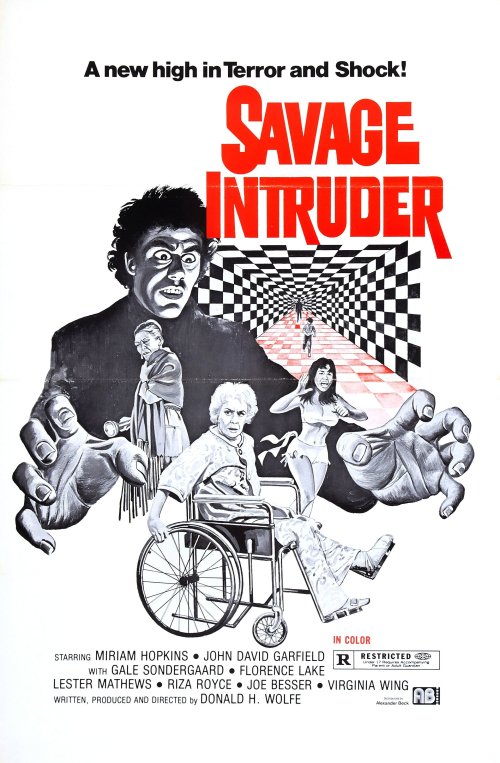
Savage Intruder (1971)

By Richard Winters

My Rating: 3 out of 10

4-Word Review: Aging actress employs psycho.

Katharine Packard (Miriam Hopkins) was once a famous actress, but is now largely forgotten and lives like a recluse in her decaying Hollywood mansion. One day while drunk she falls down the stairs and breaks her hip. Vic (David Garfield) a unemployed vagabond who enjoys cutting off women’s hands after witnessing his mother (Sybelle Guardino) having sex with 5 different men at the same time when he was a child, gets hired as a nurse to help her get around while her hip recovers. Katharine enjoys having a young man around while Vic uses her lust for attention to manipulate her out of her money and live a more privilege lifestyle than he would otherwise. However, Leslie (Gale Sondergaard), who works as Katharine’s personal secretary, is onto what Vic is doing and becomes determined to put a stop to it.

This obscurity does at least offer the chance to see Hopkins, a one time big star of the 30’s and 40’s and at one point a rival to Bette Davies, in her last screen appearance and despite the tawdry material she really puts a lot of energy into it and her presence makes it more fun than it should. Sondergaard, who came out of a 20 year film hiatus to star in this, is quite good too and looks almost like a much scarier version of Morticia from ‘The Addams Family’, especially with her hair down.

David Garfield, who was the son of legendary actor John Garfield, is the only casting choice that doesn’t work. He lacks the same acting skill of his father and comes off like he was stoned and barely into his part at all. His one-dimensional character is dull and why anyone would hire him to take care of an old lady when there’s so many red flags about him right from the start makes the script seem very poorly thought out.

Donald Wolfe, who’s best known for writing a biography of Marilyn Monroe as well as an in depth look at the Black Dahlia murder, lends some interesting touches in his one and only directorial feature. His best bit comes right at the start where the camera captures the Hollywood sign real close-up, focusing on how rusted and tattered it was with no music and only a howling wind blowing while the opening credits appear onscreen.

The violence is more graphic and bloody than you’d expect for a film from that time period, so gorehounds may rejoice, but it also becomes quite redundant as the only thing you ever see are women’s hands getting caught off again and again. The story also lacks any interesting twists and plays itself out in a painfully predictable way with characters that are too dense to figure out what’s going on even after the viewer has already caught on to things way earlier. Shooting it on-location at the sprawling estate of former silent film actress Norman Talmadge is not effective as it doesn’t take full advantage of the large, majestic home by only managing to capture a few of the rooms and doing it with dark, dingy lighting, which despite a few flashes of flair here and there help to ultimately make this a very boring and thankless viewing experience.

My Rating: 3 out of 10

Released: October 4, 1970

Runtime: 1 Hour 40 Minutes

Rated R

Director: Donald Wolfe

Studio: JBA

Available: None at this time.

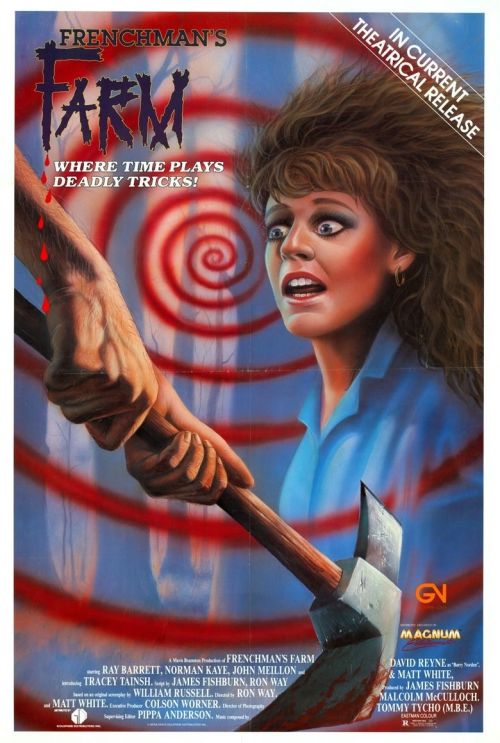
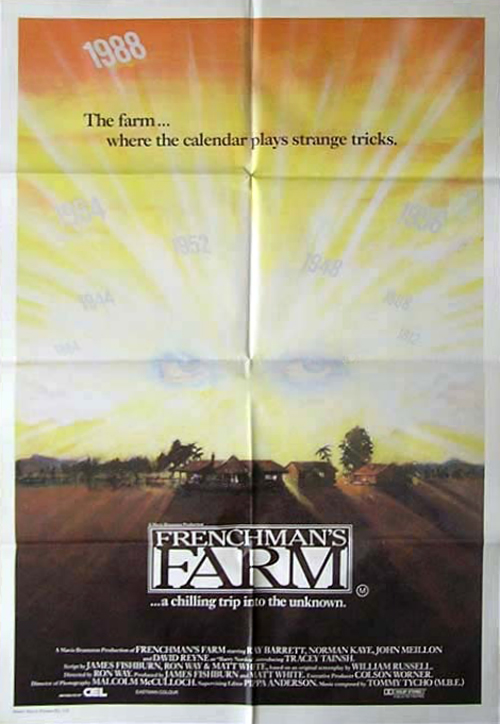
Frenchman’s Farm (1987)

By Richard Winters

My Rating: 3 out of 10

4-Word Review: Witnessing a past murder.

Jackie (Tracey Tainsh) goes traveling in her car throughout the Australian countryside while bush fires rage all around her. When her car breaks down she visits the nearest farmstead for help. It is there that she finds herself suddenly swept back to the year 1944 where she witnesses a murder and then just as quickly she comes back to the present day. When she tries to tell others what happened nobody believes her, but eventually her boyfriend Barry (David Reyne) takes up her cause and with the benefit of old news articles help find the real killer and the secret behind what motivated it.

Although marketed as a horror flick, it seems more like iffy sci-fi and could’ve easily have been targeted to a pre-teen audience since it’s not all that tense, or scary, especially with the majority of it filmed in the bright sunny daytime. When it does finally take place in the darkness of night a cliched thunderstorm gets conveniently put in while the killer is made out to being a ghost who pops in and out like it’s The Ghost and Mrs. Muir.

Initially I kind of liked that that she didn’t stay stuck in the past and was able to be her own detective, which kept me intrigued for awhile yet it started to make me wonder why the time traveling event occurred to begin with, which the movie has no suitable explanation for except to say that the bush fires created some sort of ‘atmospheric disturbance’, but if that was the case why was she the only one affected? The film also does a poor job of recreating a past era, as Jackie and her boyfriend go back to the farm where the murder occurred, but do it in the present day and yet the trees in the backyard where she witnessed the killing 40 years earlier all look the same even though they should’ve either died or grown bigger.

I found it annoying too that the boyfriend, who has a generic ‘surfer dude’ presence, starts to take over the investigation even though it really wasn’t his personal battle to solve. In order for him to take such an interest he should’ve been transported back in time with Jackie, or for a more original touch, it could’ve been Jackie and a female friend who witnessed the killing and then proceeded to becoming amateur sleuths together.

A few veteran Aussie character actors, such as an aging John Meillon, help give it some stature, but the production overall is quite bland and how it ever got considered as being a part of the Ozploitation genre, which stands for Australian exploitation cinema, is beyond me since outside of a brief skinny-dipping minute there’s nothing titillating or shocking about it.

The ‘surprise ending’ is also really dumb and doesn’t even involve the main character who gets phased out of the storyline before the ending even comes about, which is not satisfying for the viewer to follow a character around  for the whole movie only to have her ultimate fate left open to a murky explanation.


My Rating: 3 out of 10

Released: September 9, 1987

Runtime: 1 Hour 38 Minutes

Rated R

Director: Ron Way

Studio: CEL Film Distribution

Available: DVD

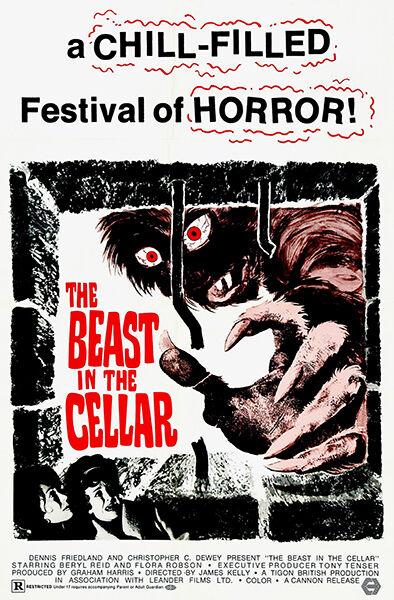
The Beast in the Cellar (1971)

By Richard Winters

My Rating: 4 out of 10

4-Word Review: Elderly sisters harbor prisoner.

Soldiers throughout the English countryside are being gruesomely murdered by what seems to be some wild beast, but the authorities have no idea what type of creature it is, or where it came from. Ellie (Beryl Reid) and Joyce (Flora Robson) are two elderly sisters living together in an isolated rural home, who fear they may know the answer and it has something to do with a dark family secret that lies imprisoned in their basement.

The film’s perceived charm revolves around the casting of two legendary actresses in offbeat roles where they at times come-off both as antagonists and the anti-heroes. Reid is especially interesting because here she’s a child-like individual while just a few years earlier she was a controlling, domineering woman to Susannah York’s child-like one in The Killing of Sister George, so seeing her able to play both parts effectively is fun and impressive.

The banter between the two though needed to be played-up more and I was expecting, given the storyline, more of a campy, dark humored tone, which really never manifests. The dialogue gets too extended, as the women do nothing, but pretty much talk, talk, talk until it seemed to be almost a filmed stageplay with the camera locked in the house and nothing visually stimulating to captivate the viewer.

The scares consist mainly of a handheld camera swinging back and forth  in an apparent attempt to replicate the beast attacking the victim, which ends up being more dizzying and amateurish looking than frightening and the fact that this technique gets done with each attack makes it quite derivative. It would’ve been better had the attacks not been played-out at all, but instead simply revealed the mangled. bloody body afterwards. The film also makes the tacky error of portraying the eyeball, which gets gouged out on one victim, as being shaped like a ping pong ball, which is probably what was used, when in reality it is more oval shaped.

A good horror film should have a frightening image to latch onto, but here that’s lacking despite a few prime opportunities where one could’ve been implemented. Reid’s retelling to the police inspector about the backstory dealing with their basement prisoner has some interesting cutaways making it the best part of the movie, but no shot of the shell-shocked, war weary father even though he’s an integral component to the plot. The ultimate reveal of the beast is highly disappointing in a climactic finish that completely fizzles, which makes sitting through this not worth your time.

My Rating: 4 out of 10

Released: April 14, 1971

Runtime: 1 Hour 28 Minutes

Rated R

Director: James Kelly

Studio: Tigon Film Distributors

Available: DVD, Amazon Video

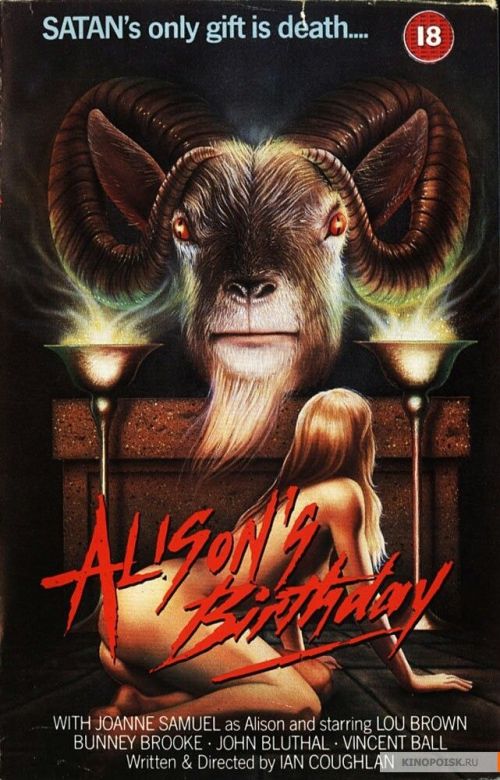
Allison’s Birthday (1981)

By Richard Winters

My Rating: 5 out of 10

4-Word Review: Teen ages very rapidly.

Allison (Joanne Samuel) decides to spend her 19th birthday with her aunt (Bunney Brooke) and uncle (John Bluthal) who live in rural Australia and have been raising her ever since her parents died when she was just a child. However, this visit includes her meeting her elderly grandmother (Marion Jones) for the first time and a mysterious illness that also affects her while she is there. Her aunt and uncle refuse to allow her boyfriend Peter (Lou Brown) to visit causing him to go to great lengths to get her away from them and back to safety as he fears they’ve come under the influence of a cult.

This low budget Australian sleeper managed to become a hit in its own country mainly from its attempts to work against-the-grain of that era by creating a horror film that did not involve blood and gore, but instead relied on good old fashioned creepiness. For the most part it succeeds, but gets hampered by a plot that plays itself out too slowly.

It becomes too obvious that her aunt and uncle have some evil intent in mind and this should’ve been camouflaged better because when the big reveal finally does come about during the third act it’s not surprising at all. The cult that they’re involved with is portrayed in such a cliched way from the tacky black robes that they wear to the Stonehenge-like meeting place that  it seems like high camp. The opening sequence featuring a ouji board and a talking spirit, is equally heavy-handed and almost sinks this thing before it’s barely begun.

Some of the action segments particularly her boyfriend’s attempts to outrun the cult members who try chasing him down is exciting, but he’s in too much of the movie, while Allison remains virtually bedridden making it seem like he’s the main character instead of her. A good protagonist should be able to fight her own battles and in this case she does too little, which doesn’t elicit enough emotion from the viewer to want to cheer her on.

Spoiler Alert!

The film’s twist ending in which, due to the ritual ceremony done by the cult, a young Allison suddenly wakes up to find herself trapped inside the body of her grandmother, is pretty cool and genuinely quite horrifying when you think about it. However, this should’ve occurred during the middle part and the rest of the film spent with her trying to return her spirit back to her youthful body, which could’ve involved a wide array of intriguing and unique elements. Unfortunately this doesn’t happen making the film only a skeletal blueprint of what it could’ve been.

My Rating: 5 out of 10

Released: May 1, 1981

Runtime: 1 Hour 37 Minutes

Not Rated

Director: Ian Coughlan

Studio: Australian Film Institute

Available: VHS