Category Archives: Foreign Films

Britannia Hospital (1982)

Britannia hospital 1

By Richard Winters

My Rating: 7 out of 10

4-Word Review: This hospital needs help.

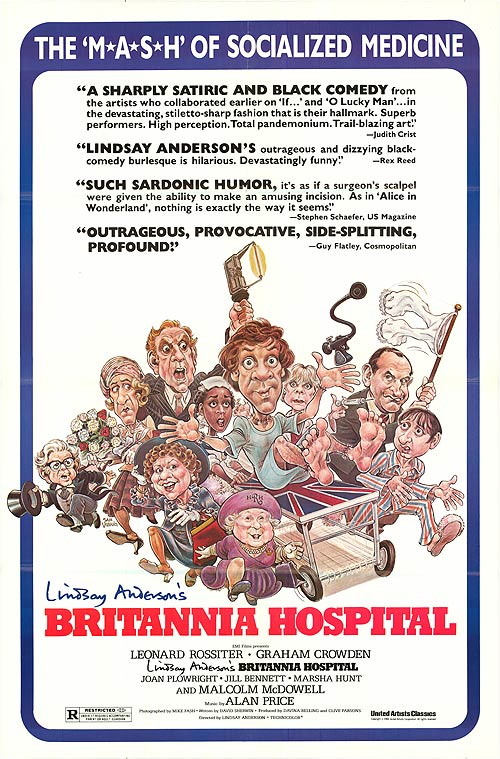
This is another surreal Lindsay Anderson piece that takes many wild forays and yet still manages to come together as a whole in the end. This is as good, as clever, and as pointed as any of his better known stuff. How this got lost in the shuffle is a mystery, but it really deserves a better look.

The plot pertains to a madcap hospital that is in complete disarray. The head surgeon is preoccupied with a ‘mad scientist’ experiment, the staff is threatening to strike, and the rich patients expect preferential treatment. All of this occurs while the Queen is set for a visit. Leonard Rossiter plays the head administrator that tries to keep it all under control.

Of course it’s not really about the hospital at all, but more a satirical look at British society and the arrogance of the upper crust as well as the apathy of the lower one. It shows how very wide apart they are and how the problem is only acerbated by the upper levels refusal to effectively deal with the lower level and their gripes.

The stuffy formalities of the British have never been played out better. At times it even goes for the jugular. Having the Queen and her entourage literally chased through the hospital by an angry mob is the best.

The cast is full of old British pros and all are quite hammy. Rossiter is the jewel. His nervous looking face and body tics have always been funny, but here they come to a hilt.

There are even a few gory segments that could satisfy almost any horror fan. In particular is Professor Millar (Graham Crowden). The scene where he cuts up a human brain, sticks it in a blender, and then has a cameraman drink it up like a milkshake, is outrageously funny.

The ending is a surprisingly sobering with a profound speech that deals not only with the inevitable advent of technology, but also the complexities of society’s problems, and the minimalism of our existence. Overall it’s not bad.

My Rating: 7 out of 10

Released: May 27, 1982

Runtime: 1Hour 56Minutes

Rated R

Director: Lindsay Anderson

Studio: EMI Films

Available: VHS, DVD, Amazon Instant Video

The Anniversary (1968)

anniversary 2

By Richard Winters

My Rating: 6 out of 10

4-Word Review: Bette eats them up.

Since tomorrow will mark the 1st anniversary of when this blog started I wanted to choose a movie that had a similar theme in its title. The anniversary here deals with Mrs. Taggart (Bette Davis) celebrating the date of when her and her now deceased husband where married. Taggart is a bully who enjoys manipulating her grown sons and having her way. On this occasion all three of her sons carries a secret, which will all slowly come out as the evening progresses. Terry (Jack Hedley) is the oldest and is married to Karen (Sheila Hancock) their secret is that they plan on moving to Canada much to his mother’s dismay as she likes having her children close by. Henry (James Cossins) harbors a secret fetish to dress in women’s underwear. Tom (Christian Roberts) brings his fiancée Shirley (Elaine Taylor) to visit with their secret being that she is already pregnant.

If you’re a Bette Davis fan then this is required viewing as she is at her bitchy best. Although Mona Washbourne played the role when it was on stage it was revised by Jimmy Sangster for the screen with Davis’s personality very much in mind. It has all of her famous caricatures and she revels in it. Her insults are like arrows that slice through the other characters until they are mush. She gives her part just the right amount of camp and her infatuation with a statue of a little boy that is hooked up with a hose that when squeezed spurts water out of its front end like he is peeing is priceless.

Hancock makes for a good adversary and in fact out of all the other performers she is the only that seems to be able to stay toe-to-toe with Davis. Apparently Davis did not like Hancock and tried to get her replaced with Jill Bennett. Hancock was aware of this and I think that animosity comes out perfectly on the screen.

Taylor is young and gorgeous and she has one good moment when she tells off Davis, but that is about it. The three male actors are just not as effective as the females. Part of it could be the characters that they play, but on the most part they are rather blah.

Director Roy Ward Baker, who replaced Alvin Rakoff one week into the shooting at Miss Davis’s request, does his best to avoid the filmed stage play look. He opens the movie at an outdoor construction site, which is unusual. He also has a dazzling fireworks display in the middle, but my favorite is when Henry steals women’s bras and panties from an outside clothesline and replaces them with dollar bills in an attempt to ‘pay’ for what he is stealing. Yet despite all this the movie eventually gets stagy and becomes a bit draggy for it.

My biggest complaint is the fact that this type of thing has been done before. There is no new angle or perspective to any of it. Davis rants on and on with the other characters too cowardly to fight back. The little that they do is not enough. This is the type of film that screams for a big payoff, but it never happens. Taggart, as mean as she is, comes through it pretty much unscathed and for most viewers that will probably not be satisfying.

My Rating: 6 out of 10

Released: February 7, 1968

Runtime: 1Hour 35Minutes

Rated NR (Not Rated)

Director: Roy Ward Baker

Studio: 20th Century Fox

Available: DVD

Unman, Wittering, and Zigo (1971)

By Richard Winters

My Rating: 7 out of 10

4-Word Review: These students are killers.

John Ebony (David Hemmings) leaves his job in advertising to follow his dream of becoming a school teacher. He gets a job at an all-boys private school in rural England replacing a teacher who died accidently by falling off a cliff. His pupils soon tell him that they were the ones who killed the teacher and they will do the same to him if he doesn’t do as they say. John can’t find anyone who believes him even his own wife Sylvia (Caroline Seymour) laughs it off. Soon John finds himself a virtual prisoner of his own students and forced to follow their dictates while he tries to figure out who the ringleader is and bring them to justice.

Director John Mackenzie does a terrific job of building the tension slowly. The film works at a deliberate pace allowing the viewer to see things from John’s point-view-of. The slower pace keeps things realistic and therefore more effective. Geoffrey Unswoth’s cinematography is vivid. I loved the way the steep cliffs are captured at the beginning and a camera is thrown off the cliff making the viewer feel like the victim as they see the landscape swirling on screen before completely submerging in water. A nightmare sequence where John dreams of being accosted by the boys in much the same way as his predecessor is visually exciting. The on-location shooting at an actual private boy’s school in Wales only helps to add to the authenticity.

The students themselves are quite effective and much better than their counterparts in the similar Child’s Play where they came off as too robotic. Here they have more diverse personalities. Their snarky behavior and the taunting both to their weaker peers and to John was so on-target that it made me feel like I was right back in high school. Their polite and formal facades are a thin veil to their sinister side that becomes increasingly more apparent as the film goes on. The pinnacle comes when they lock Sylvia in a darkened gymnasium and threaten to gang rape her. The lighting, done exclusively with flashlights and the frenzied action make this a memorably creepy moment.

John makes for a solid protagonist. The viewer can feel and understand his unique quandary and the character is believable enough to help make the movie engrossing from beginning to end. My only quibble would be near the end when the boys ask him to come with them to look for one of the students that have disappeared and he agrees. I thought this was a little hard to believe as it was right after they had tried to attack his wife and the search was being done near the cliffs, which would put John at a vulnerable risk.

The twist at the end is a bit of a surprise and is overall satisfying. Despite what is stated in the review in Leonard Maltin’s ‘Movie and Video Guide’ there is no revelation of any kind after the closing credits. I have seen this film now twice from two different sources and both times the only thing that comes after the credits is the Paramount logo.

My Rating: 7 out of 10

Released: June 13, 1971

Runtime: 1Hour 42Minutes

Rated PG

Director: John Mackenzie

Studio: Paramount

Available: Amazon Instant Video
Scanners (1981)

By Richard Winters

My Rating: 7 out of 10

4-Word Review: His head will explode.

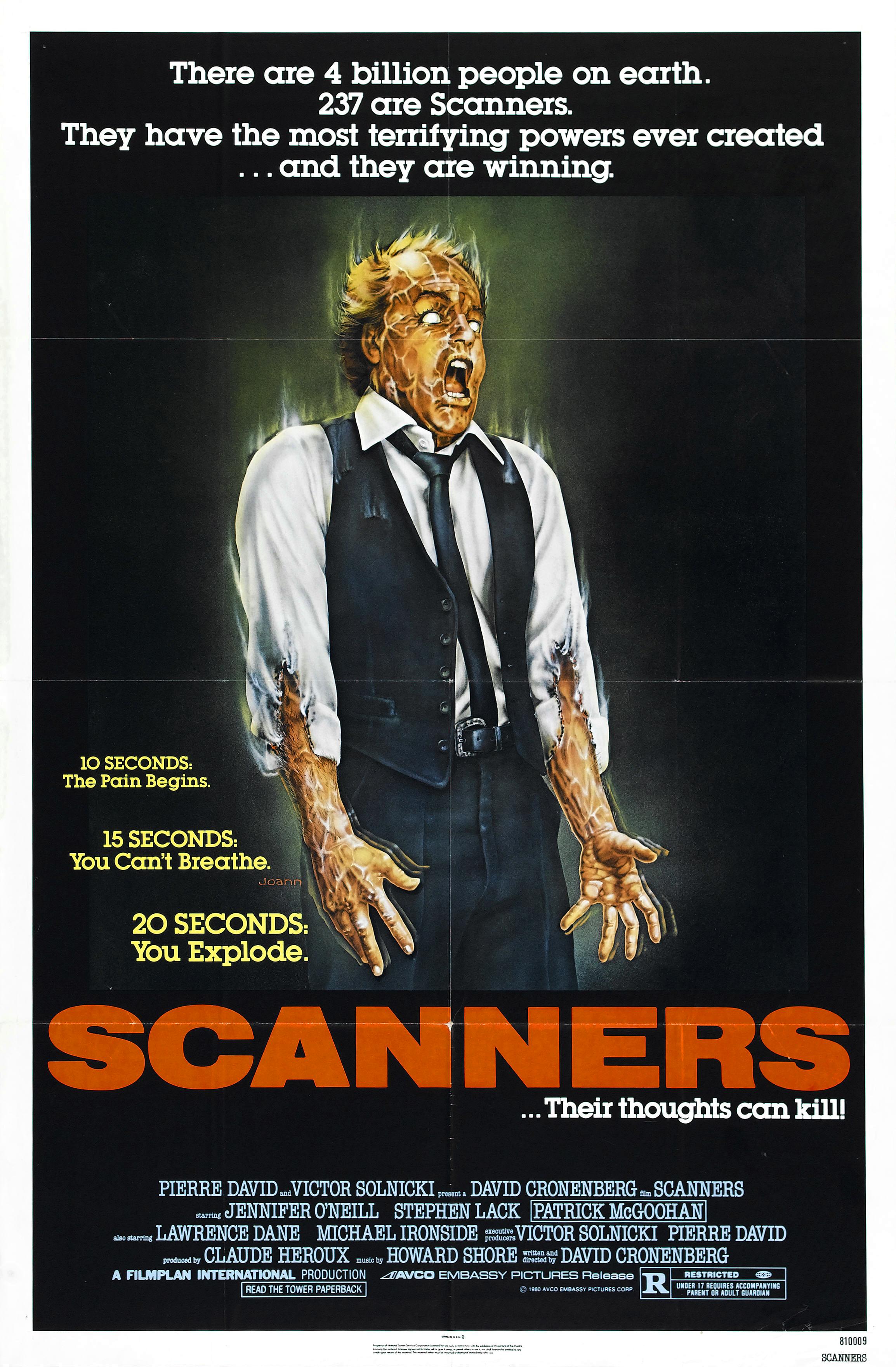
Scanners are people with strange psychic powers that can not only read other people’s minds, but also kill them and even move objects with their brainwaves. A corrupt group of scanners lead by Darryl Revok (Michael Ironside) threatens world domination. Dr. Paul Ruth (Patrick McGoohan) who works for a company that is trying to stop these dangerous people finds a scanner named Cameron (Stephan Lack) that Darryl’s groups is seeking, but has not yet located. Ruth trains Cameron on how to hone in his scanning powers and then track down Darryl’s group and destroy it.

Director David Cronenberg is still in my estimation one of the premiere cult/horror directors around. It is one thing to make a great horror movie when you have a big budget and state of the art special effects, but it is another to make an effective movie when you have little to work with and yet Cronenberg has continually shown that a creative imagination can triumph over all else. He has also shown a refreshingly daring vision throughout his career and seems to have no hesitation in tackling taboo subjects.

This film proves no exception. The story is quite creative and there are continually new and surprising twists thrown in. The special effects are excellent and imaginative. I loved the protruding, blood spurting veins coming out of the arms and heads of Cameron and Darryl during their intense scanner showdown at the end. The melting telephone receiver isn’t bad and off course the exploding head is memorable and deserves its place in the annals of gross cinema history.

With that said I still felt the film could have done a better job at setting up the story. It starts right away with a lot of action before anything is explained and makes things confusing. Some sort of prolog in this case would have been appropriate. Everything also seems rushed. This is a great plot with interesting scenarios and I as a viewer wanted a little more time to soak it all in, but wasn’t given any. The sets and backdrops are redundantly dark and grimy and lack visual design. Overall the film has a seriously dated look and although there are way too many films being remade these days and some that are not necessary this is one movie were I would advocate it especially if done with a high budget and a competent director.

Stephan Lack makes for incredibly weak leading man. He is better known in the art world as a renowned painter and his film career was quite brief. After watching his performance here it is not hard to see why. He has very much of a ‘deer-in-headlights’ look and a voice tone that shown no infliction, or emotion. His lack of charisma or stature seriously weakens the film’s overall effect and why he was chosen for the part is a mystery.

Jennifer O’Neill is gorgeous as Kim a female scanner who works with Cameron in his quest to find Darryl. The woman, who was a former model, has a face that is so beautiful it is mesmerizing no matter what angle she is shown at or emotion that she is conveying. My only complaint is the small streak of gray that was put into her hair, which I found unnecessary especially since she was portraying someone who was Cameron’s same age, which was the early 30’s.

On the villainous side Ironside certainly has the chiseled threatening features of a bad guy. However, I actually thought that Canadian character actor Lawrence Dane who plays one of Darryl’s spies was actually more effective.

The artwork done by the Benjamin Pierce character (Robert A. Silverman) visualizing giant heads and the thoughts inside people’s heads was really cool and avant-garde.

My Rating: 7 out of 10

Runtime: 1Hour 43Minutes

Rated R

Director: David Cronenberg

Studio: AVCO Embassy Pictures

Available: DVD

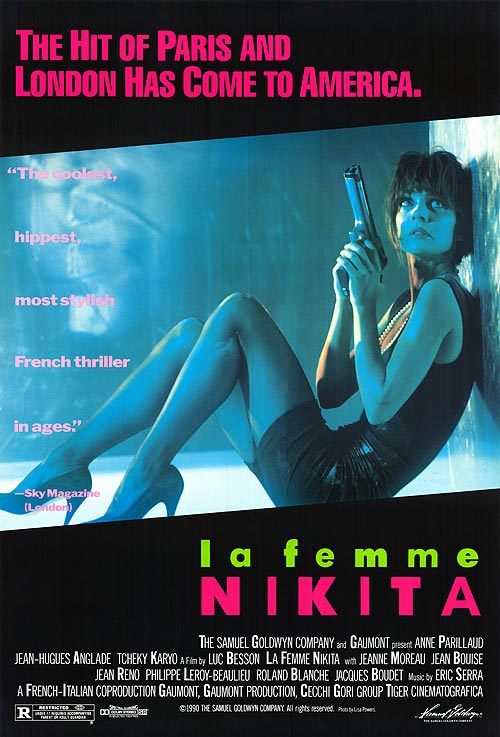
La Femme Nikita (1990)

By Richard Winters

My Rating: 8 out of 10

4-Word Review: Don’t mess with her.

Nikita (Anne Parillaud) is a member of a punk street gang who gets caught by police after a particularly brutal gangland robbery. She gets a light sentence only to be given a chance at becoming a specially trained undercover police agent. She takes it and thus begins a very stylized, action packed variation of Pygmalion.

I do have two grumbles, which I will get out of the way now. First it is hard to believe that such a drug addicted, slender built young thing could be so seasoned in the art of street fighting and gun shooting. It is also hard to believe that these agents can always remember the directions they are given of who to shoot and where to go to escape without it ever having to be repeated or written down. I was sitting on my easy chair and I wasn’t sure I had gotten it all especially since it was said very quickly and quietly. Yet our lady hero gets it all even in the stress of the moment.

Outside of that this it is a very entertaining movie. Actually it is a fun movie, a really fun movie. The action is well choreographed and exciting. The editing is crisp. It makes fun of the action genre and even tries to pull it in different directions and yet still delivers the goods at the same time. Each scene has its own tongue and cheek joke complete with set-up and punchline.

The film also has some unique perspectives. It shows how draining a spy job can be both on the person and their personal life. It also reverses the gender roles by showing the woman as being more assertive and the men (especially her boyfriend) as more passive.

One of the funniest elements of the film is Victor the cleanup guy (Jean Reno). He is similar to the Harvey Keitel character in Pulp Fiction, but far funnier. He takes the flippant, gruff persona to new heights.

My Rating: 8 out of 10

Released: February 21, 1990

Runtime: 1Hour 58Minutes

Rated R

Director: Luc Besson

Studio: Gaumont

Available: DVD, Blu-ray, Amazon Instant Video

Shoot (1976)

By Richard Winters

My Rating: 2 out of 10

4-Word Review: Hunters out for revenge.

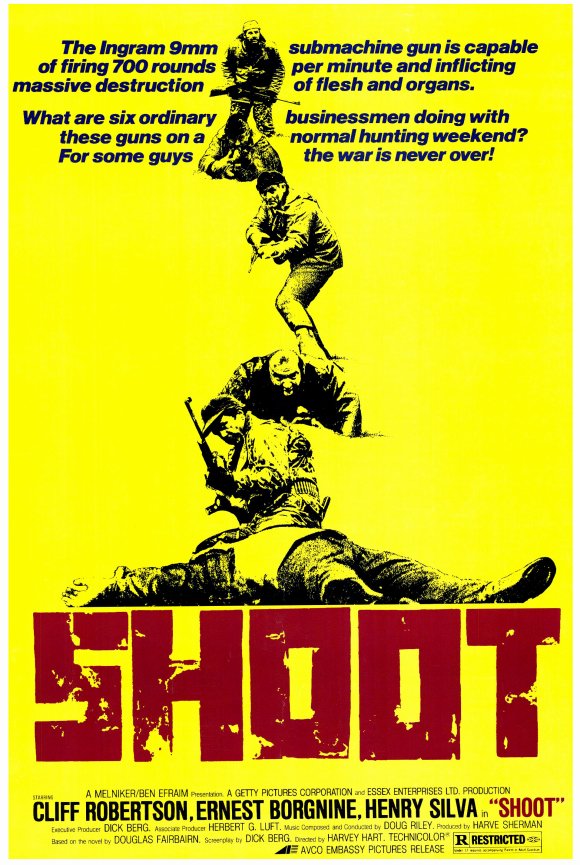
Rex (Cliff Robertson) is a man who really enjoys hunting and especially likes his guns, just watch the way he cleans and caresses it at the beginning, it’s almost obscene. He takes his buddies out on a hunting party in the woods. They come upon a group of other hunters and for some inexplicable reason they begin shooting at each other until one of the men in the other party dies. Rex and his group go back home sure that the police will be contacted and an investigation to pursue, but that doesn’t happen, so Rex thinks they are out for revenge instead. He becomes convinced that the other party plans to attack his group at the exact same spot the very next week. He gets his men ready for battle and dressed in army gear as they prepare for what they believe will be all out warfare.

Part of the problem with this film, which is based on the novel by Douglas Fairbairn, is that it doesn’t make any sense. Rex and his buddies meet the other party from across the river and then the two groups proceed to just stand there in silence like zombies before all the shooting breaks out. There is no reason for why any of it happens and I found it hard to believe this could ever occur in real-life. I am not a hunter myself, but I presume different hunting parties come into contact with each other all the time and it doesn’t end up with them trying to kill each other. I would also think that they may politely greet each other and share some sort of brief conversation in passing. Having all the men not say anything seemed odd and unfounded. The story would have made more sense had the groups spoken to one another and then somebody said something that was insulting and then it escalated. Doing it the way it is done here seems stupid and it is hard for any viewer to get into the plight of characters when there is no reasonable motivation.

The logic for the second half of the story works just as strangely. There is absolutely no reason to believe that the other hunters are planning any type of revenge at the same spot for the next week. The men don’t even know who any of them are. It would have worked better had the other group sent Rex’s group some sort of threatening message, or harassed them in some way to make the threat more real. Watching them prepare and discuss at length for a battle that may never occur is a waste not only of their time, but the viewers as well.

In between there is a long, boring middle part, which includes a scene where Rex visits the widow (Kate Reid) of the man that his group shot while under the pretense that he was an old friend of the deceased. Reid gives an interesting performance, but having her come on to Rex so shamelessly and even tells him that she wasn’t wearing any underwear seemed absurd and unnecessary. A similar scene happens in Rex’s office when the wife (Helen Shaver) of one of his friends aggressively flirts with him as well. Neither of the scenes helps propel the story, or characters and just another clue of a sloppy and unfocused script. There are a few too many shots exposing the boom microphone making me wonder if director Harvey Hart was only going through the motions on this one.

Robertson and Ernest Borgnine as Rex’s friend Lou are adequate, but the characters are painted in one-dimensional ways. The hunters are portrayed as violent prone loons with a penchant for shooting at anything and unable to display any type of sophistication, or rationale. The ultimate anti-gun, anti-violence message is heavy-handed and predictable. This was a trendy theme during the 70’s, but there had been so many better films on the subject that the producers shouldn’t have even bothered to make this one.

The on-location shooting in Ontario, Canada is poorly done. The buildings used for the interior scenes are dull and unimpressive with no visual style or sense. The outdoor scenes are flatly shot and done in the dead of winter, which gives the film a very brown, gray, and drab look. It would have been better had this been done in the summer as the green foliage would have been more scenic. There is also the issue of snow cover. On the first Saturday during their initial hunting trip there is no snow, then on the following Tuesday when Rex visits the grieving widow of the man that they shot there is a good six inches of the white stuff. Then on the following Saturday when they meet in town to get ready for their trip the snow is all gone only to again appear when they get to their hunting site.

I did like the solo trumpet soundtrack although it gets overplayed. The unexpected violent ending is indeed a surprise, but only helps in creating more loopholes. This was another attempt at cashing in on the success of Deliverance by coming up with a similar theme, but lacking the superior execution of the original. Another Deliverance-rip-off that came out in the 80’s Southern Comfort will be reviewed on Monday.

My Rating: 2 out of 10

Released: May 28, 1976

Runtime: 1Hour 39Minutes

Rated R

Director: Harvey Hart

Studio: AVCO Embassy Pictures

Available: YouTube

Sunday Bloody Sunday (1971)

By Richard Winters

My Rating: 9 out of 10

4-Word Review: A bi-sexual love affair.

Bob (Murray Head) is having a relationship with middle-aged divorcee Alex (Glenda Jackson) as well as a family doctor named Daniel (Peter Finch). He jumps between the two of them whenever the mood hits. Both Alex and Daniel are aware of the other and are not happy about it, but feel if they push the issue Bob will simply leave them. The film focuses on the frustrations and loneliness that Alex and Daniel feel in dealing with Bob and their less than ideal situation.

This film is engrossing from beginning to end. Director John Schlesinger was still in top form as the camera work, cinematography, and editing is first rate. Everything is meticulously orchestrated to the point that every shot seems to tell its own little story. The narrative is done in a fragmented style going back and forth between the present day to scenes from when both Alex and Daniel were younger. Much of it comes off like thoughts going on inside someone’s head and the film’s style is masterful and flawless.

What I really liked about this movie is the fact that it focuses not so much on each person’s time with Bob, but actually more on their time away from him. The points this film makes about the difficulties of communication that people have when they are in a relationship as well the glass wall that sometimes gets created is completely on-target. The film’s subtitles and nuances are perfectly balanced and if you are a viewer with more sophisticated tastes then this will be time well spent.

Things are revealed about the characters through visual and subtle means, which I loved. When Alex drops an ashtray and then proceeds to clean it up simply by rubbing the ashes into her rug, or the precarious way she makes herself on cup of coffee in the morning while rushing off to work nicely reflects her out-of-control life and the topsy-turvy way she approaches it. The scenes where Daniel attends a Bar mitzvah is excellent and for me some of the strongest moments in the movie.

The portrayal of the children here is above average as well. They are not cute and well-behaved, but instead realistically rambunctious and mischievous. I liked the wild, endless energy that they display and how easily chaotic they turn their household into, or how the parents had become immune and deaf to all of it. Having the 4-year-old smoke pot while Alex and Bob, who are babysitting, decide to overlook it may be pushing things a bit far, but I still liked the mod approach the film takes, which reflects nicely the unconventional lives of the characters.

The film’s biggest flaw is Head himself. The man is mainly known for his singing career and his acting ability is clearly limited in comparison to Finch and Jackson who are both excellent. The character is dull and the film does not make much of an attempt to analyze him like it does with the other two. In a way Head’s one-dimensional performance works because the character seems to be used as a ‘pretty boy’ who the other two are attracted to because of his looks and youth and therefore revealing the insecurities that they have about themselves as well as giving a pertinent warning that when one pursues someone solely based on their sex appeal the relationship is doomed.

I liked how at the very end Daniel and Alex do meet and have a brief conversation though I wished it had been just a little more extended. Having Finch talk directly to the camera at the closing is a bit disconcerting though what he says is interesting.

My Rating: 9 out of 10

Released: September 8, 1971

Runtime: 1Hour 50Minutes

Rated R

Director: John Schlesinger

Studio: United Artists

Available: VHS, DVD, Blu-ray (The Criterion Collection), Amazon Instant Video

The Jokers (1967)

By Richard Winters

My Rating: 8 out of 10

4-Word Review: Rob to avoid work.

Brothers Michael (Michael Crawford) and David (Oliver Reed) decide that working life is not for them and come up with an elaborate robbery that will afford them enough money to drop out of society for good. Their plan is a clever one as they stage random bomb threats across parts of London, which creates a panic in the city. Then they threaten to blow up the tower of London, disguise themselves as military experts who can go in to diffuse the bomb and then run off with the crown jewels in the process, which they conveniently hide underneath the floor boards of their home.

The film has a great irreverent flair that was common amongst the new wave British films of the late 60’s. The quick edits, fragmented narrative, and quirky humor is similar to Richard Lester’s The Knack…and How to Get It, which also starred Crawford. The comedy, especially its potshots at the establishment, is right on target and engaging. I was surprised that it was directed by Michael Winner as so many of his later films, especially the ones he did with Charles Bronson, seemed so formulaic that I could never imagine he could show so much spunk and flair.

The crime is imaginative and plays out nicely. There is also a neat and completely unexpected twist near the middle that keeps things intriguing to almost the very end.

Crawford shows charm and his boyish looks help strengthen is character. He somehow manages to upstage Reed, which I never thought would be possible and his charisma carries the film. He does though look too scrawny and almost anorexic in parts and having him gain some weight and ‘putting some meat on his bones’ before filming began would have been advisable.

British character actor Harry Andrews is amusing as the exasperated Inspector Maryatt. However, I found James Donald as the completely clueless Colonel Gurney-Simms to be the funniest.

If the film fails anywhere it is in the fact that it loses its satirical edge and focus. It starts out making fun of the upper-crust English society, but then becomes too preoccupied with the crime itself. David and Michael’s interactions with their stuffy, conservative parents (Peter Graves, Rachel Kempson) are cute and I would have liked to see more of it as well as more jabs at ‘respectable’ society. The film’s conclusion is extremely weak. For such a clever movie I was hoping for something a little better. It is almost like they ran out of ideas and threw in some bland denouncement simply as a way to end it because they didn’t know how else to do it. Nothing is more of a letdown then seeing a writer write themselves into a hole that they can’t get out, which is what you get here and it almost ruins the entire film in the process. However, the majority of it is so slick I was willing to forgive it and almost wished there could be more movies like these coming out today.

My Rating: 8 out of 10

Released: May 15, 1967

Runtime: 1Hour 34Minutes

Rated NR (Not Rated)

Director: Michael Winner

Studio: Universal

Available: None

Cannibal Holocaust (1980)

By Richard Winters

My Rating: 7 out of 10

4-Word Review: They were really hungry.

A group of people go into the deep dark jungles of the Amazon looking for a missing film crew. They never find the crew, but they do find some lost film footage of theirs. They bring it back home and play it and what they see is so gruesome that it startles the imagination.

This is truly a gross-out classic. If you have ever watched a horror movie purporting to have gruesome special effects and then walked away disappointed then this one will make up for the rest and everything else in between. No cutaways here and certainly no restraint for good taste. The effects look real and, at times, almost too real. Best of all is the fact that the story is handled in a realistic fashion giving the effects even more credibility. For instance the cutting off of one of the characters legs after he is bitten by a snake looks completely authentic. There is also a castration scene that has to be one of the most vivid ones ever filmed. There is also the cutting up of man’s body into little pieces and some really graphic rape scenes.

The film also doesn’t have that cheap look like with most horror films and it gets you immersed in the jungle atmosphere. It is well paced and builds up some really good tension. The editing is seamless without any of those annoying jump cuts. The music score is melodic, but distinct and effective making it one of the best scores ever made for a horror film. The eventual showing of the lost crew’s footage packs a wallop.

Former adult film star Richard Bolla plays the professor and the leader of the search party. He is credited as the star of the film yet his character is bland and forgettable. His only memorable moment comes when he jumps naked into a river and allows the adolescent girls from a nearby tribe to grope him, which has got to be a cinematic first. My favorite character was Chaco (Salvatore Basile). He is gruff and rough and absolutely nothing seems to faze him. He is so hardened by it all that it actually becomes amusing and I wished he would have stayed on for the duration.

The actual lost film crew is a vile bunch giving the film its main message of just who is ‘civilized’ and who is the savage. Their behavior is so disgusting that most viewers will actually look forward to their eventual gruesome demise.

The same cannot be said for the animals. There are graphic, ugly scenes involving the torture and mutilation of animals and it is not pretty. The animals flail their arms and legs and scream in very real pain and fright. It’s all handled in a distasteful and mocking way with the dissection of a sea turtle making even this jaded viewer feel nauseous. This will certainly be unsettling for animal lovers, but fortunately for those people the DVD release has a version that will cut out these segments while still allowing the viewer to enjoy the rest of the movie.

My Rating: 7 out of 10

Released: February 7, 1980

Runtime: 1Hour 35Minutes

Rated: NC-17

Director: Ruggero Deadato

Studio: United Artists

Available: VHS, DVD

Yesterday, Today and Tomorrow (1963)

By Richard Winters

My Rating: 8 out of 10

4-Word Review: Gotta love Sophia Loren.

This is a delightful comedy that won the Academy Award in 1964 for best foreign film. It consists of 3 vignettes all starring Sophia Loren and Marcello Mastroianni and directed by the legendary Vittorio De Sica.

The first segment is entitled ‘Adelina’ and is a story about Adelina (Loren) who lives in poverty and sells cigarettes for a living. She is arrested for selling contraband products, but is released when it is found that she is expecting with the condition that six months after she delivers the baby she will be forced to serve her sentence. However, Adelina and her husband Carmine (Mastroianni) decide that the best way to avoid the sentence altogether is by keeping her continuously pregnant. Once she delivers one child she immediately gets pregnant with another, which creates overcrowding as well as an exhausted Carmine.

This segment is original and amusing throughout. Watching them trying to handle and maintain a household with such a large brood has its share of funny moments including one scene where Adelina tries to give one of her petulant children his medication. This setting vividly shows the poor side of Italian society, but unlike De Sica’s neo-realist films of the 40’s this one has a very engaging and even upbeat quality to it. The impoverished townsfolk become like a third character and their resiliency and support of one another proves to be a major plus to the story. Loren is fantastic in every scene she is in and makes this one special. Mastroianni is interesting playing against type as he is usually debonair and sophisticated, but here is simple and dominated.

The second story entitled ‘Anna’ deals with characters on the completely opposite end of the economic spectrum. Anna (Loren) is a spoiled rich woman who in an effort to alleviate her boredom with her husband who spends too much time working she has an affair with Renzo (Mastroianni). Renzo though fears that he is being used and that Anna has no intention of ever leaving her luxurious lifestyle to be with him.

All of the action takes place in a Rolls-Royce Silver Cloud III convertible as the two characters discuss their relationship while driving through the streets of Rome. This story is not as lively as the first and the characters aren’t as likable. However, the part where Renzo has an accident with the car and Anna’s reaction to it is quite funny.

The third and final act is entitled ‘Mara’ and deals with a prostitute named Mara (Loren) who becomes interested in Umberto (Gianni Ridolfi) a young man living next door with his Grandmother (Tina Pica) and studying to become a priest. The grandmother does not approve of Mara’s ‘profession’ and openly shuns her causing a major discord between the two, but when Umberto decide to drop out of the seminary the two work together to try and bring him back to his senses.

This story, like the first, has many amusing moments. Loren shows impeccable comic ability. I loved how the character goes from sexy seductress to a woman pleading with Umberto to go back to seminary and escape this ‘wicked world’. The shift between having Mara and the grandmother hating each other to becoming friends is equally funny. Mastroianni doesn’t have as much to do here, but still makes the most of it playing one of Mara’s customers who is just looking for a little sex, but is reluctantly thrown into the middle of the controversy.

This segment became famous at the time for a striptease that Loren does for Mastroianni. However, by today’s standards it is not much and hardly even seemed worth mentioning. I actually thought the part where Loren walks outside wearing nothing more than a towel and provocatively singing a flirtatious song to the young Umberto, who has a face that looks like it had not reached puberty, was much steamier.

My Rating: 8 out of 10

Released: December 19, 1963

Runtime: 1Hour 58Minutes

Rated NR (Not Rated)

Director: Vittorio De Sica

Studio: Embassy Pictures

Available: DVD, Blu-ray, Netflix streaming, Amazon Instant Video