Category Archives: Foreign Films

Eat the Rich (1988)

eat the rich

By Richard Winters

My Rating: 5 out of 10

4-Word Review: Rich feed the poor.

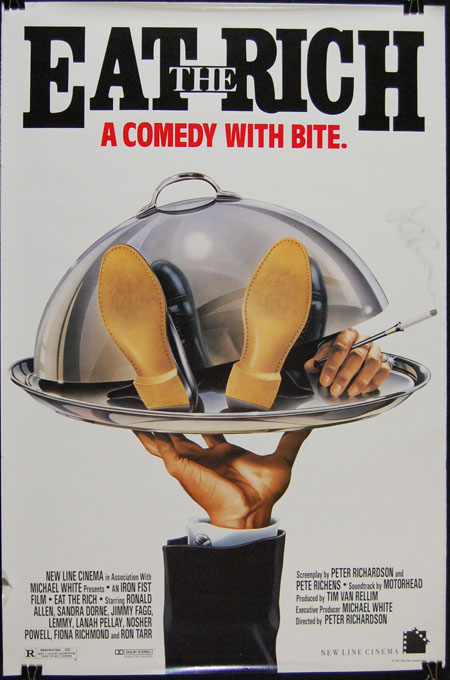
This is an extremely garish mixture of loud music, ugly visuals, and shock comedy. The story is about a waiter, a gay man with a real fun bitchy attitude, who gets fired when he refuses to suck up to the arrogant clientele. He gets revenge by banding together other misfits who return and kill everybody and then feed the dead bodies to new unsuspecting patrons.

Sounds gross and tasteless, but it really isn’t. There’s no nudity or sex and no graphic violence or gore. A little bit more of these things would have actually helped. At least it would have solidified it as the underground shock comedy it seems to be striving to be. Instead it’s cluttered with no real objective or foundation. At times it plays like biting social commentary and at other times nothing more than a silly gross out teen flick

By the time you get to the way off-base ending it becomes obvious that the filmmakers were trying to be outrageous simply as a way to get noticed. There is no real insight to the have and have-nots of society. They simply came upon the idea because they felt it would appeal to the type of audience they were looking for.

This is too bad because had it been a little more polished it might have been a stronger film. Believe it or not there are some clever bits. The jabs at the Queen are a riot. The scene involving terrorism and the Middle East crisis is a true original. The rich characters are so over-the-top obnoxious you have to laugh-out-loud.

The true scene stealer though is Nosher Powell. He is a former stunt man/ stunt coordinator who worked on many of the stunts in the early James Bond movies. Here he plays a sort of Teddy Roosevelt times ten a ‘working class’ politician who bullies everyone and everything. The actor has a rather rough, amateurish delivery which only adds to the saltiness of the character.

My Rating: 5 out of 10

Released: April 22, 1988

Runtime: 1Hour 30Minutes

Rated R

Director: Peter Richardson

Studio: Recorded Releasing

Available: VHS, DVD, Amazon Instant Video

The Marriage of Maria Braun (1979)

the marriage of maria braun

By Richard Winters

My Rating: 8 out of 10

4-Word Review: Maria gets her way.

Maria’s (Hanna Schygulla) husband a soldier in World War II is presumed dead. She decides to make her mark by getting a job and a new lover in the form of a black man named Bill (George Eagles), but complications ensue when her husband Hermann (Klaus Lowitsch) shows up very much alive. Maria enjoys her new found independence and isn’t interested in falling back into her old role, which causes friction with her husband as well as her interactions with others.

Director Rainer Werner Fassbinder creates a unique vision and manages to walk the balance between the gritty and surreal. The lighting is evocative and shadowy and nicely reflects his stage background. The sets are colorful and varied and one becomes almost hypnotically entranced with the visuals. The abandoned buildings and rundown locales especially at the beginning make a strong impression and become like a third character. Fassbinder echoes the desperation of the characters through visual means only without ever having to resort to melodramatics, which alone makes this a classic and far better than some other similar films about the period.

Equally great use is made of sound with two to three layers of it within each scene. Whether it is the noise of a radio, traffic, or someone whistling there is always some noise coming from the background much like in reality, which helps in a subtle way to make the scenes more vivid. I loved the dolly shots constantly moving the camera around in every scene throughout the rooms that the characters are in giving the viewer a full sense of their dimensions and helping breakdown the fourth wall.

Some memorable scenes include the moment when Maria’s husband comes back from the war and catches Maria in a compromising position with her new found lover. There are at least four minutes here where there is no talking from any of the characters and one becomes riveted with the silent reactions of the three, which proves powerful. Even the erotic overtones work. Normally I find that area to be rather clichéd and mechanical, but here the sweat glistening off the naked bodies seems genuinely evocative and enticing.

Many people feel this is a movie about budding feminism and applaud the strong female character. I really wouldn’t argue with that and in many ways it is fun seeing this woman forge her way ahead while remaining poised and stalwart throughout. Her relationship with rich businessman Karl (Ivan Desny) and the way she turns him into a subservient to her every whim while also explaining to him that ‘he isn’t having an affair with her, but instead SHE is having one with him’ is classic, but I also felt it seemed a bit artificial. Having a strong central character is one thing, but this woman seems inhuman. She never shows any vulnerability at any time and appears almost completely removed from the environment around her. Never once does she flinch, compromise, or back down from anything or anyone, which just isn’t possible and makes Maria one-dimensional in the process. A character is more interesting when their flaws are exposed and then they must work hard to overcome them, but this one doesn’t have any, which is my biggest issue with this otherwise excellent production.

My Rating: 8 out of 10

Released: February 20, 1979

Runtime: 1Hour 58Minutes

Rated R

Director: Rainer Werner Fassbinder

Studio: United Artists

Available: VHS, DVD (The Criterion Collection)

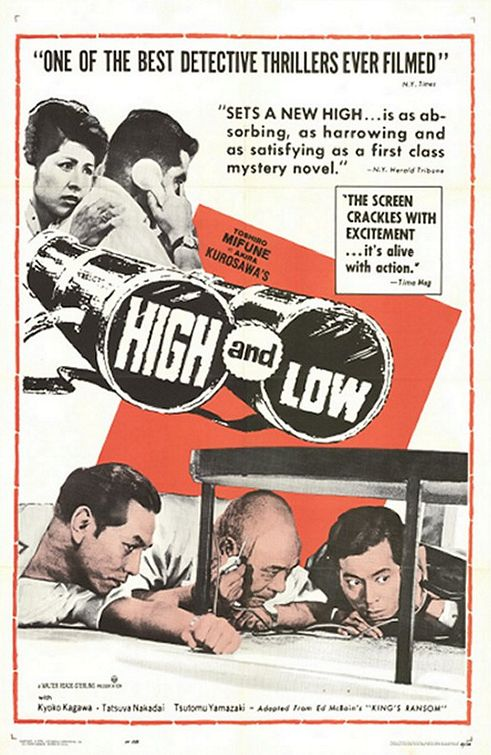
High and Low (1963)

high and low

By Richard Winters

My Rating: 7 out of 10

4-Word Review: Pay ransom go bankrupt.

Kingo (Toshiro Mifune) is an executive of a shoe company who finds out that his chauffeur’s son has been kidnapped and comes under tremendous pressure to pay the ransom even it will make him bankrupt.

As with all of Akira Kurosawa’s films the production values are solid and the story is well paced. The very methodical police work and investigation is interesting and enlightening. It’s certainly nothing like today’s CSI shows, but well done for its period. The ending scene where Mifune faces the kidnapper leaves a strong and memorable impression.

However, on the negative side the set-up to the kidnapping happens too quickly without any type of buildup or tension. Almost the entire first hour takes place inside the living room of Kingo’s hilltop house and it would’ve helped to have some cutaways to other locales.  Mifune, who is billed as the star and gives a great performance disappears during the second hour only to finally reappear at the very end and I felt it would’ve been stronger had he been involved more in the investigation. Also, the revealing of the kidnapper is unexciting and a big letdown.  I had a hard time understanding why a guy who was so very crafty and sophisticated in every facet of his planning of the kidnapping would suddenly get so conveniently dumb and sloppy at the very end.

This is a decent Kurosawa entry, but in my opinion not one of his best. Yet it is still good enough to keep you captivated from beginning to end.

My Rating: 7 out of 10

Released: March 1, 1963

Runtime: 2Hours 23Minutes

Not Rated

Director: Akira Kurosawa

Studio: The Toho Company

Available: DVD, Blu-ray (The Criterion Collection)

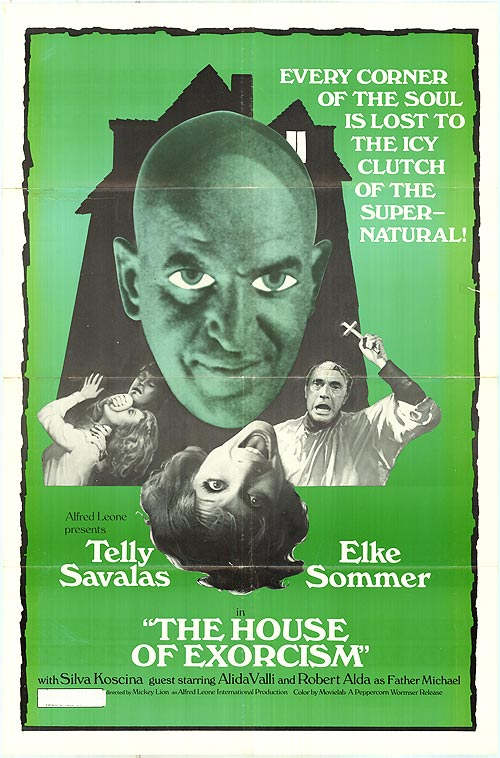
The House of Exorcism (1976)

house of exorcism

By Richard Winters

My Rating: 5 out of 10

4-Word Review: Possessed by the devil.

When Mario Bava’s Lisa and the Devil, which was reviewed yesterday, failed to generate any business at the box office the film was reedited using footage cut from the first film as well as adding some new scenes. In this version Lisa (Elke Sommer) is a tourist in Spain who becomes possessed by the devil right out in broad daylight on the cobbled streets and in front of her fellow tourists. She is taken by ambulance to the nearest hospital and accompanied by Father Michael (Robert Alda). The doctors are unable to explain her condition medically and as she gets worse and more violent it is up to the Father to excise the demon.

This version is an improvement over the Bava one in fact Bava’s name doesn’t appear anywhere on the credits and instead the film’s producer Alfredo Leone is listed as the director under the pseudonym Mickey Lion. Obviously it’s a huge rip-off of The Exorcist and in some ways gets unintentionally funny particularly when the Priest has a conversation with the demon during the exorcism. However, it is still fun and more flamboyant than the original and at least has a coherent plot that helps propel the movie along. The only problem is that the exorcism scenes are intercut with scenes from the original film showing Lisa visiting the mansion and meeting up with the strange characters. Supposedly this is the alternative reality that she is in while the demon possesses her body, but it adds little and bogs down the pace.

Sommer comes off much better here than she did in the first one. The way she contorts her face during the possession sequence is entertaining and she does well under the difficult demands. Telly Savalas as the devil disguised as a butler is still wasted. He doesn’t even seem to be taking the part seriously and seems to give it a tongue-and-cheek approach, which doesn’t work.

Alda’s presence is rather bland, but Carmen Silva who plays Anna his wife before he entered into the priesthood is a stunner. She appears nude in a rather gratuitous flashback segment that should more than appease any self-respecting voyeur.

The ending has a little more pizazz than the original as well where the Father goes into an empty mansion and tries to fight off the demon while having snakes thrown right at him. It’s not the best, but not the worse either.

My Rating: 5 out of 10

Released: July 9, 1976

Runtime: 1Hour 32Minutes

Rated R

Directors: Mario Bava, Alfredo Leone

Studio: Peppercorn-Wormser Film Enterprises

Available: DVD, Blu-ray, Netflix streaming

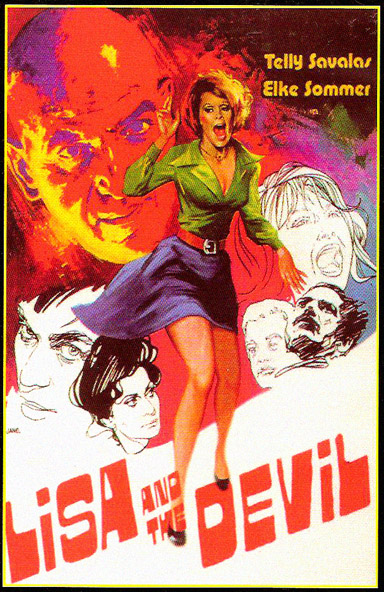
Lisa and the Devil (1973)

lisa and the devil

By Richard Winters

My Rating: 3 out of 10

4-Word Review: Where is the plot?

Lisa (Elke Sommer) is a tourist in Spain who gets lost and finds shelter inside a large mansion run by a butler Leandro (Telly Savalas) and a Countess (Alida Valli). Soon Lisa begins to experience strange occurrences and visions. People turn up dead and then alive again. When she tries to escape she finds that she can’t and is now stuck in a surreal world with no exit.

I am use to watching Italian horror films being strong on the visual end and weak with the plot, logic and character development especially when they attached to either Mario Bava or Dario Argento, but this one goes to the extreme. Nothing makes sense and scenes are thrown in haphazardly and go nowhere. The basic premise is too general and unfocused and the entire production seems to be an exercise in interesting camera work and nothing more. Yes there are a few atmospheric moments, but it all adds up to very little.

Had the special effects been gory or impressive I might have forgiven it, but for Bava standards they are lacking as well. For one thing there is very little gore to begin with and what we do see looks amateurish. The scene where a man gets run over by a car clearly looks like a mannequin and as the driver backs up and runs him over several more times it becomes even more obvious.

Sommer makes for a weak heroine. Her character is as vague and mysterious as all the others, so the viewer never gains any empathy or concern for her fate. Her short shoulder length haircut makes her look middle-aged and dowdy. Also, Sylvia Koscina her costar has facial features that are too similar to Elke’s and for a while I thought she was Elke with a brunette wig. Her best moment is actually her nude scene of which she looks great although I noticed her eye lids constantly fluttering when her character was supposedly asleep.

Normally I love Telly Savalas and he can be effectively menacing, but here he is sorely underused. The character pops in and out sporadically, but really doesn’t do much. I did like that he is constantly sucking on lollipops, which later became his trademark during his run on the ‘Kojak’ TV-series.

I was hoping for some grand over-the-top finale to make up for having to sit through all this, but it never came. The climax, which takes place inside a jet airliner no less, is as underwhelming as everything else. Not surprisingly this film was edited into a completely different story and reissued as The House of Exorcism, which will be reviewed tomorrow.

My Rating: 3 out of 10

Released: May 9, 1973

Runtime: 1Hour 32Minutes

Rated R

Director: Mario Bava

Studio: Leone International

Available: DVD, Blu-ray, Amazon Instant Video, Netflix streaming

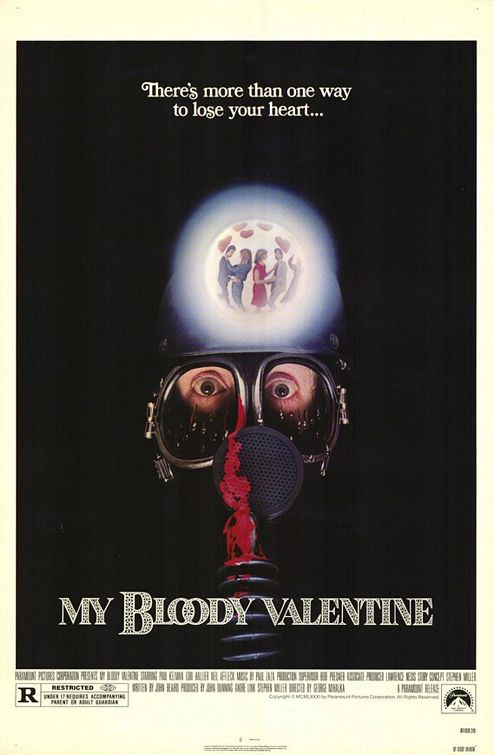
My Bloody Valentine (1981)

my bloody valentine

By Richard Winters

My Rating: 2 out of 10

4-Word Review: A Killer with heart.

After 20 years a small Canadian mining town of Valentine Bluffs has decided to hold another Valentine’s Day Dance. The previous ones were canceled due to one ending in bloodshed by a psychotic mine worker named Harold Warden. Now he is locked away so they think it is safe except the killings start happening again and this time the killer tears the hearts out of the victims and delivers them in heart shaped boxes to their relatives.

This movie has a cool looking poster and a deliciously macabre concept and has also attained a strong cult following including Quinton Tarantino, but I unfortunately was not impressed with it. I found it to be excruciatingly boring and a major strain just to sit through. The direction and writing are uninspired creating predictable scenarios and delivering all the expected teen slasher movie clichés with a monotonous regularity.  Nothing is distinctive or scary and it fails to deliver any suspense or tension. It can’t even make effective use of its unique mine shaft setting. The final sequence takes place there, but it is nothing spectacular. The constant delivering of human hearts in candy style boxes soon loses its effect and eventually becomes stupid especially with the corny poems written on the attached note cards.

The young victims are dull and stereotypical. They look like caricatures from all the other slasher horror films except here they speak with thick Canadian accents. One of them looks like an overweight version of Meathead from ‘All in the Family’. There is also a ‘class clown’ type of character that resembles very closely the ‘class clown’ character from Friday the 13th . Here he does nothing but crack dumb jokes and watching him eventually get decapitated is the film’s single most gratifying moment.

The sheriff character is a real loser. He wears a big belt buckle and dopey haircut that makes him appear to be some middle-aged buffoon who has just stepped out of the 60’s. His logic is also flawed. He decides not to warn the town that a killer is on the loose even after he has killed a couple of people as he is afraid it will create too much of a panic, so instead he waits until seven more people die and the citizens all go into a panic anyways.

Usually in even the poorest of horror films the killings and gore can at least keep things entertaining on a tacky level and yet here they are as dull as everything else. Also, since when has going into a dark and dingy cave been considered a great place to have sex? To me it seems absurd and yet several of the teen couples go into the mine for distinctly that purpose.

Remade in 2009.

My Rating: 2 out of 10

Released:  February 11, 1981

Runtime: 1Hour 30Minutes

Rated R

Director: George Mihalka

Studio: Paramount

Available: VHS, DVD, Blu-ray, Amazon Instant Video


Funny Games (1997)

funny games 3

By Richard Winters

My Rating: 8 out of 10

4-Word Review: Killers like playing games.

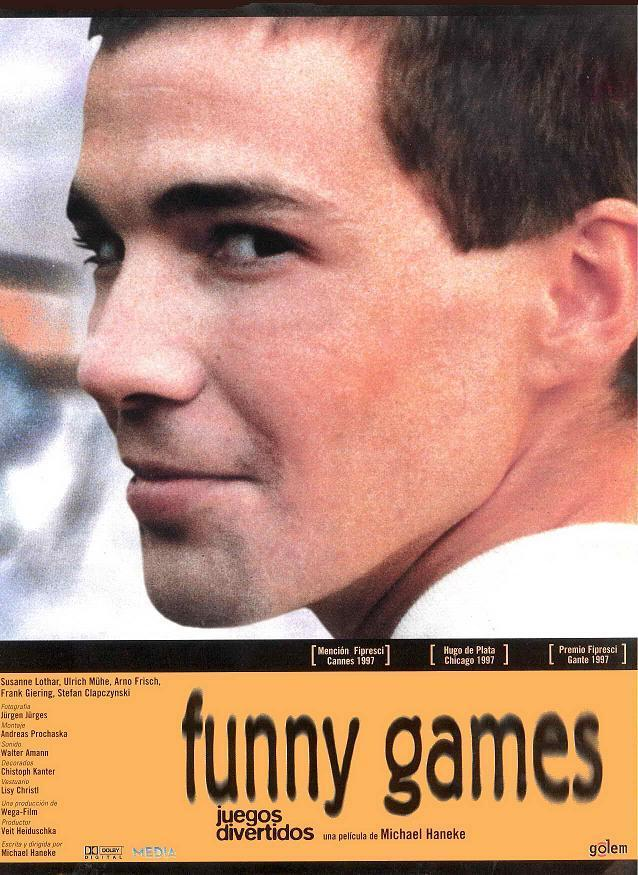
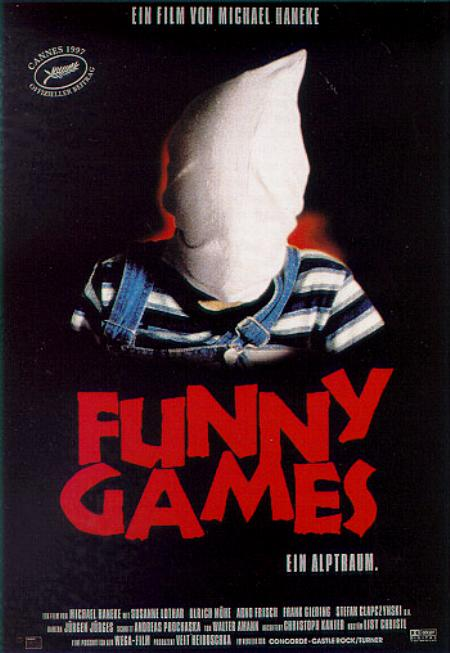
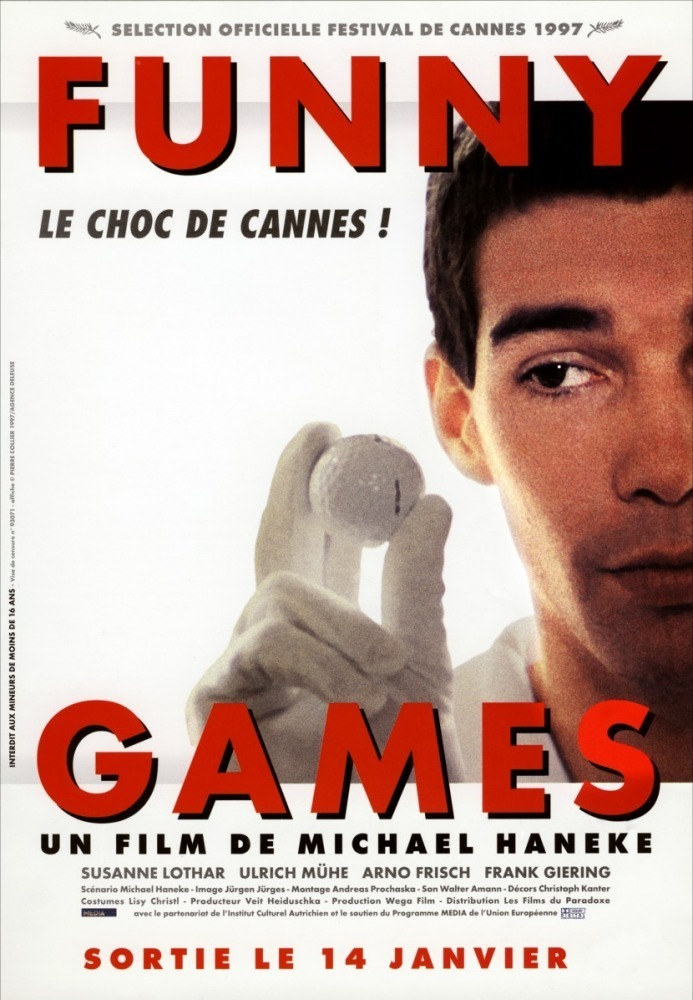
A family is tormented by two young men (Arno Frisch, Frank Geiring) who break into their home and proceed to play ‘funny games’ on them. These games are cruel and humiliating in nature. They are ‘played’ simply to prove that they can. As the film progresses and reveals some very unusual narrative devices it becomes obvious that the real ‘funny games’ are those played on the viewer by writer/director Michael Haneke.

Clearly this is long overdue as it is a revisionist look at the very violent psycho/thriller genre. Last House on the Left and Henry: Portrait of a Serial Killer have both handled the violence and dehumanization theme quite well before, which thus minimizes some of this film’s shock value. Yet Haneke shows an astute awareness of his craft and its manipulative nature. He cuts into all the accepted formalities and conventions of the genre and film making in general that you have to give it high marks. There is one scene, where the camera literally stays locked on the carnage for several minutes that the repugnance of violence really does hit home as intended.

funny games 2

The whole thing is supposed to shake the viewer into reevaluating their own viewpoints. It’s an almost ongoing assault questioning their views on justice, tolerance to violence, prayer and other cosmic forces and even their own fragility. It also tries to force them to analyze why they view these types of films and find them entertaining.

Like the heavy metal music played over the opening credits this thing is raw, abrasive and filled with anger and rebellion. Haneke is clearly upset. Upset at irresponsible directors who make violent films and an overly tolerant public that watches them.

This is an ugly film with an unrelenting nature and flashes of contempt. The average movie goer will probably not like it. However, it you are a connoisseur of cutting edge cinema then you may find the whole thing refreshingly provocative.

funny games 1

Frisch and Geiring as the two killers look and act so much against type that they become two of the most chilling and memorable villains in screen history. Also, Susanne Lothar and Ulrich Muhe who play the husband and wife victims are actually married in real life.

An American version, which was directed by Haneke as well and stars the beautiful Naomi Watts and follows this one almost scene-for-scene was released in 2007.

funny games 4

My Rating: 8 out of 10

Released: May 14, 1997

Runtime: 1Hour 48Minutes

Not Rated

Director: Michael Haneke

Studio: Attitude Films

Available: DVD, Blu-ray, Amazon Instant Video

Daisies (1966)

daisies 1

By Richard Winters

My Rating: 7 out of 10

4-Word Review: Girlfriends rebel from society.

Two young women (Ivana Karbanova, Jitka Cerhova) who are both named Marie decide that society has nothing to offer them and that they will not comply with its norms. They then proceed to jaunt through the streets of Prague causing havoc and destruction everywhere they go and with everyone they meet while also trying to find themselves and their true purpose in life.

This film is similar to Ingmar Bergman’s Persona, which was released the same year. Both films rely heavily on quick edits, jump cuts, bizarre imagery and unconventional narrative structures. The only difference is that at least Persona had a story behind it and two interesting characters. This film has neither. The two women behave too strangely to be relatable and the scenes seem disconnected. This is one film that takes the avant-garde, experimental approach to the most extreme. The result is a bit off-putting and took me until the halfway mark before I could get into it. Others may not even make it that far. Personal taste will gauge how much one gets into it as well as how much they get out of it.

On a completely visual level it is fascinating. The film goes from being black-and-white to color and then back again at random intervals. There is one scene in a restaurant where the scene changes to a different color filter each time a character speaks a different line of dialogue. The segment showing photos of a variety of butterflies done at a rapid fire pace is also interesting. The best part is probably near the end when the girls walk into a banquet hall and proceed to eat up all the food that is in it. In fact the film shows an amazing amount of eating. It seems like every other shot has the girls stuffing their mouths with some sort of edible. However, instead of making you hungry it ends up kind of grossing you out.

If there is anything that got on my nerves it was director Vera Chytilova’s use of sound. There was too much repetition of noises. For instance in the opening scene there is what sounds like a squeaking door that is implemented after each actress says her line that quickly becomes irritating. The slobbering, chewing sound as the girls eat the banquet food is overdone as is their background whispering that occurs near the end.

Many feel this is a movie about budding feminism and I would agree on that for the most part. I enjoyed how the women did not feel that they needed a man in their life to ‘be whole’ and in many ways seemed to manipulate and make fun of the male characters, or simply become bored with them especially when the men would convey to them their ‘undying love’.  However, to me it was more about the rebelling and disdain of the communist regime and living in an environment that promoted hard work and not much else. I liked the segment at the end where the two women proceed to be ‘good’ instead of ‘bad’ and try to clean up the mess that they made while trying to convince themselves that working hard will make them happy even though it really doesn’t.

I’ve seen a lot of weird sixties movies, but this one tops them all by a mile. It certainly doesn’t seem dated and easily transcends its era. Not only was it ahead-of-its-time, but I would maintain that it STILL is.

Although the runtime is listed as being 74 minutes the version I saw, which was from Czech New Wave, came out to being only an hour.

My Rating: 7 out of 10

Released: December 30, 1966

Runtime: 1Hour

Not Rated

Director: Vera Chytilova

Studio: Ustredni

Available: DVD

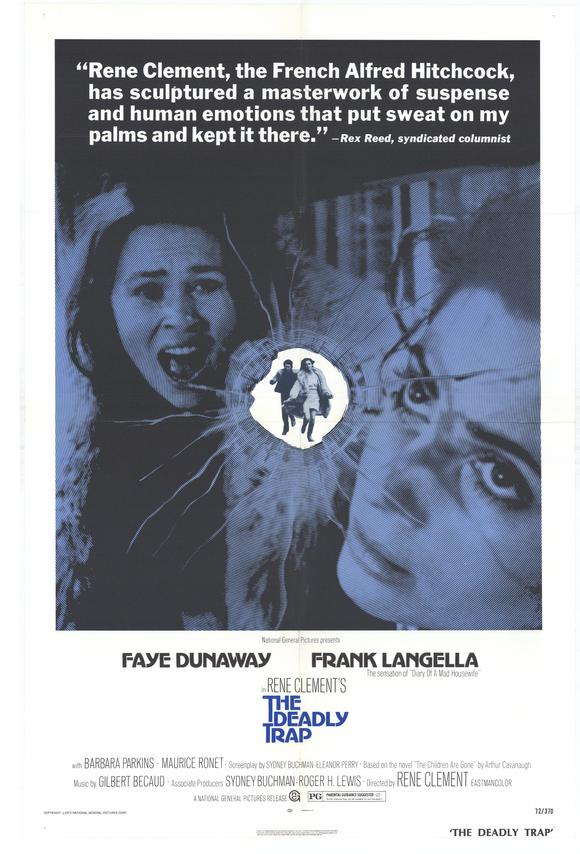
The Deadly Trap (1971)

the deadly trap

By Richard Winters

My Rating: 4 out of 10

4-Word Review: They have their kids.

Philippe (Frank Langella) works at a high-tech job in a large corporation. For years he has been giving trade secrets to a mysterious organization that pays him handsomely for his efforts. Now that he is married and has children he has decided he no longer wants contact with this underground entity, but they refuse to leave him alone. When he is no longer willing to corporate they kidnap his two children, which sends his emotionally and mentally fragile wife Jill (Faye Dunaway) over-the-edge.

Dunaway’s amazing performance is the one thing that really helps propel a film that is otherwise too laid-back. I have always been an admirer of hers, but her performance here is great because it is so different from any of the other characters that she has played. Normally she is cast in parts of strong or manipulative women, but here she plays someone who is very fragile and does it with amazing effectiveness. I felt like she was a completely different person and showed a side to her that I didn’t think she possessed. Her face and expressions accentuate the fragility and she looks quite beautiful.

Langella is good on the opposite end. He plays a cynical and aloof man who snaps at his wife in an annoyed manner at regular intervals. The contrasting personalities and dialogue between them is interesting. In many ways he seems to playing an extension to the character that he did in Diary of a Mad Housewife and given the fact that Eleanor Perry wrote the screenplays for both films makes me believe that there had to be more than just a passing connection there.

The story has some interesting underlying elements that manage to retain a modicum of intrigue, but Rene Clement’s direction is too leisurely. The first hour gets bogged down with too much conversation and certain tangents that go nowhere. It is only in the last half hour that things finally get going and has some interesting twists, but by then it is too late. It would have been better had we seen some sort of face to the organization instead of having them portrayed in such a vague way. The movie is also in need of a lot more action although the part where Jill and her kids get into a car accident and get thrown from the vehicle is impressive since actual bodies where used, which is something I had never seen done before.

Spoiler Alert!

The film features several loopholes that will end up confounding anyone. One is that when the children are kidnapped they are locked in an upstairs room that has a loaded gun stashed away in the closet. The children get their hands on it and use it against their captors, but you would think that a sophisticated and large criminal group that this organization supposedly is wouldn’t be so utterly careless as to leave it there. Also, when it is found that the couple’s downstairs neighbor Cynthia (Barbara Parkins) has a connection to this organization and kidnapping the police shoot her dead at point-blank range instead of just arresting her and interrogating her in order to find the whereabouts of the kids. The biggest problem though is the ending itself where the kids are saved and everybody becomes one big happy family, which doesn’t jive at all with the rest of the film that had a constant murky undertones and a couple that was always squabbling. By having this otherwise dark thriller suddenly become ‘The Brady Bunch’ at the end is jarring in tone. It also doesn’t answer the fact that the organization was never caught and therefore will continue to harass him again, so why should they be all happy when the bad guys could strike at any moment?

My Rating: 4 out of 10

Released: June 9, 1971

Runtime: 1Hour 36Minutes

Rated R

Director: Rene Clement

Studio: National General Pictures

Available: VHS, Warner Streaming

I Love a Man in Uniform (1993)

I love a man in uniform

By Richard Winters

My Rating: 3 out of 10

4-Word Review: Losing touch of reality.

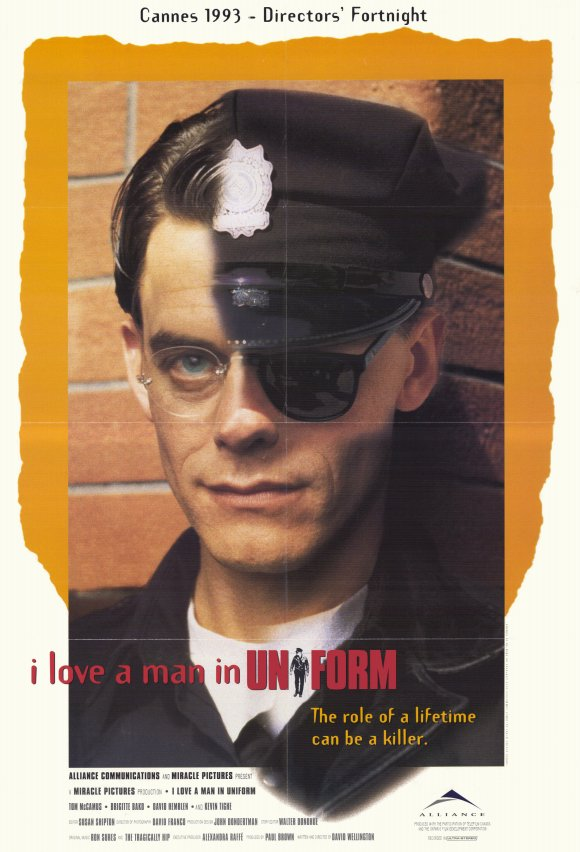
Overly stylish, pretentious drama detailing an actor’s slow decent into madness. Henry (Tom McCamus) an otherwise anonymous bank employee finally gets his big break as an actor playing the part of a cop on a TV show, but then starts to take the role home with him. Intoxicated with the sense of power that he gets playing a man in uniform he eventually can no longer differentiate between the role and himself.

On one hand this is a fascinating and incisive drama. It examines an ambiguous area rarely touched upon anywhere else. Namely how an actor ‘becomes’ his role and how he learns to turn it off. It also questions whether anyone, even a trained actor, can be someone they are not as well as analyzing people’s need to become someone who is important, powerful, and in control.

Yet the film takes this and then suffocates it with a new wave mentality and a thumping techno music score. It looks like something made by a young guy who watched too many episodes of “Miami Vice”. The stylization gets strained. Trying to be both ‘important’ and trendy never gels and the attempt at mixing ‘real life’ grittiness with an artsy flair gets annoying.

The pacing is also off. The character becomes unhinged too quickly. Then we are treated to a never ending scenario of ‘will he or won’t he’ go completely bonkers. There’s about three climaxes too many and a couple of truly unnecessary scenes including a bank robbery, which is particularly dumb.

Star McCamus does his part well, but he also has a really big mole at the top of his forehead, which after a while becomes distracting. Brigitte Bako as the female love interest is pleasant to look at and an overall sweet character. The rest of the characters though are too dull, clichéd, or corrupt to be likable or interesting.

My Rating: 3 out of 10

Released: September 10, 1993

Runtime: 1Hour 39Minutes

Rated R

Director: David Wellington

Studio: Alliance Communications

Available: DVD