Category Archives: Foreign Films

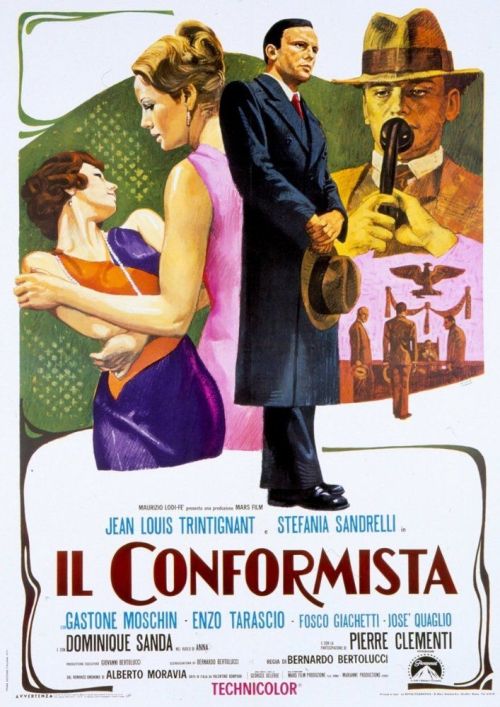
The Conformist (1970)

By Richard Winters

My Rating: 8 out of 10

4-Word Review: Trying to fit-in.

Marcello (Jean Louis Trintignant) is living in Italy during WWII and a member of the fascist secret police. He longs to be a part of acceptable society and partaking in the conventions of what he believes is a normal life including settling down and getting married even if it’s to a woman Giulia (Stefania Sandrelli) that he doesn’t really love. He gets ordered to assassinate Quadri (Enzo Tarascio) who was one of his professors back in college, but who has now been deemed an anti-fascist by the government.  Marcello uses the guise of his honeymoon as an excuse to travel with Giulia to Paris in order to carry out his mission. However, once there he begins to have feelings for the professor’s wife Anna (Dominique Sanda) and becomes unable to carry out the assignment despite being aware that Anna is only using him to get to Giulia, which is who she truly desires.

This film became a benchmark in Bernardo Bertullici’s career and was his first box office success that allowed him the ability to go on and direct even bigger  classics such as The Last Tango in Paris and 1900.  While the visuals are impressively stylistic I do agree with many critics that too much emphasis is placed on the sets, that gives it an almost over-the-top kitschy feel, while drowning out the story, which is handled in a more subtle way, in the process. The plot is still captivating, but a good movie should have a nice balance and as critic Gene Siskel stated in his review it’s more of a ‘show than a story’ and reviewer Keven Thomas labeled it a ‘bravura style Fellini’, which I consider to be a very accurate description.

The story is based on the 1951 novel of the same name by Alberto Moravia, but apparently Bertolucci had never read it when he pitched the idea to Paramount and managed to wow the studio execs into loving the idea simply by relying on the the description of the story giving to him by his then-girlfriend who had read it. When he finally did read it he did so while writing it into a screenplay at the same time.

There are many differences though between the source novel and the film with the movie leaving out a lot of Marcello’s childhood backstory that I felt was needed. The book examines Marcello’s penchant for killing lizards and even the neighbor’s cat as well as his witnessing his father’s abusing of his mother and the vandalization of a family photograph, which the film doesn’t touch on. The book also gets into more detail about why Marcello is tormented by his classmates where in the film we see Marcello being harassed, but it’s never made clear why.

Spoiler Alert!

The ending gets changed too. In the book Marcello has an interesting philosophical debate with Lino, a chauffer who sexually abused him as a child, but this conversation is left out of the movie. Marcello also, along with his wife and child, gets gunned down while driving in their car, but surprisingly the movie doesn’t have this part either. You would think that they would since action makes for a good visual, and I’m not sure for the reason why it was left out/revised except that Bertolucci may have feared it would be too similar to the finale in Bonnie and Clyde and didn’t want to seem like he was replicating that one.

End of Spoiler Alert!

Overall despite these deviations I still found it impactful particularly the ambush scene on a lonely road, which was the one thing that I remembered about the movie after having not seen in for several decades. The strong performances help too especially Trintignant’s brooding portrayal though being French born he spoke his lines phonetically without knowing what they meant and then later had them dubbed by Sergio Graziani in post production. The two lead actresses are splendid too and although the parts were originally offered to the more famous Brigitte Bardot and Anouk Aimee I felt it came off better with the then unknowns particularly Sandrelli who’s energetic and almost child-like at the beginning only to behave like jaded, middle-aged woman by the conclusion.

My Rating: 8 out of 10

Released: July 1, 1970

Runtime: 1 Hour 53 Minutes

Rated R

Director: Bernardo Bertolucci

Studio: Paramount

Available: DVD, Blu-ray
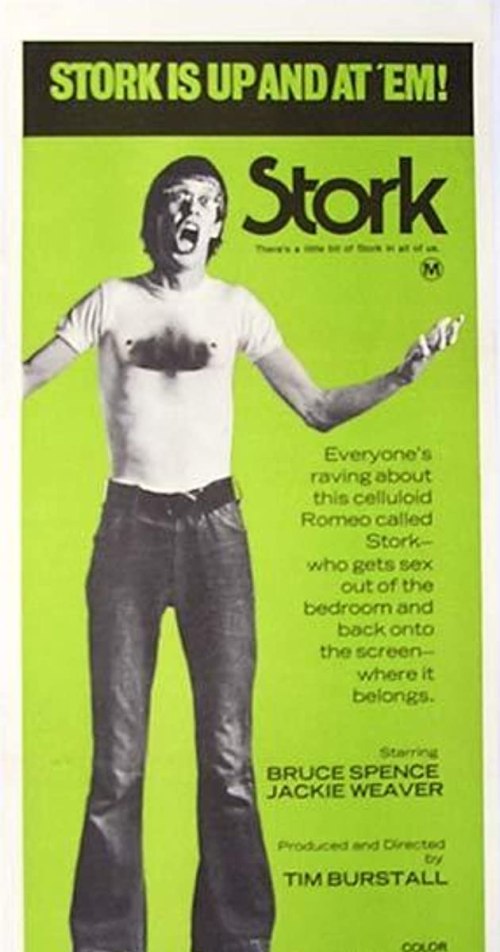
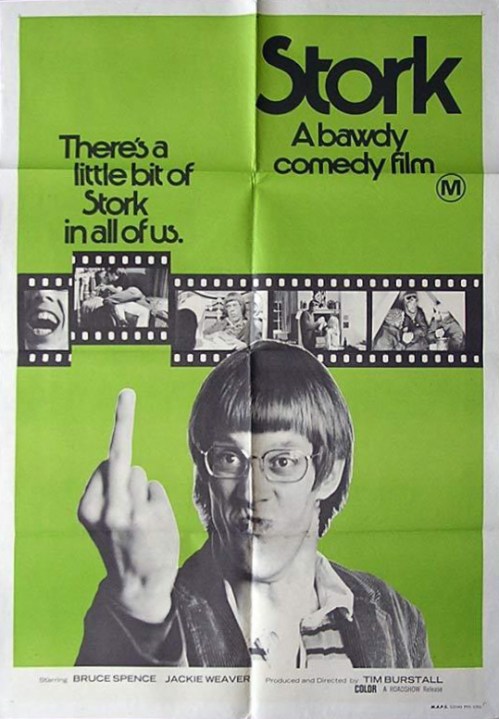
Stork (1971)

By Richard Winters

My Rating: 6 out of 10

4-Word Review: Outcast falls in love.

Graham (Bruce Spence), who goes by the nickname Stork, is a rebellious left-wing radical who finds working to be an impediment to his time and freedom and therefore is routinely fired. After losing his most recent job by doing a striptease in the office he’s allowed to move-in to his friend Westy’s (Graeme Blundell) apartment, which he also shares with Clyde (Helmut Bakaitis), Tony (Sean Myers) and Anna (Jacki Weaver). Anna is promiscuous and sleeps interchangeably with both Clyde and Tony, and on rare occasion, even Westy. Stork wants in on the action, but Anna is more concerned with finding him a job instead eventually though they have sex only to have Anna inform everyone that she is pregnant, but nobody knows whose baby it is.

The film was a landmark in Australian cinema in that it became the first box office success in Aussie history and cemented the idea that domestic films made in Australia could find an audience. Before that most Australian theaters only showed movie from Britain and Hollywood, so this film and its success helped usher in what became known as Australia’s New Wave. This was also the first film written by the prolific David Williamson, which he states was an autobiographical account of his own life and based on the hit play ‘The Coming of Stork’, which also starred Spence.

The funniest aspect of the film is simply Spence himself, whose tall, gangling body and freakish looking face gives the movie its necessary edge. He initially wanted to quit during the production as he felt he wasn’t right for the part nor ready to take on the pressures of movie acting, but director Tim Burstall convinced him to stay, which is good as the movie wouldn’t have worked without him. Weaver is also quite enjoyable playing a more subdued personality, which is in complete contrast to Stork’s, which is what makes their relationship intriguing.

I enjoyed the dream-like segments where Stork imagines himself working at different alternative jobs with the best one being the one he does in Antarctica, but the film is unable to maintain the fast pace style that was needed for the quirky material to work. Too many long, drawn-out segments in-between the fantasy moments that does nothing, but drag the whole thing down. The story is unfocused with too much time spent on Stork looking for a job while the relationship angle get pushed to the side until the third act.

The characters are not well defined either. Stork is certainly a rebel, but what made him become this way? It would’ve helped had we learned more about his relationship with his family and is upbringing, but that never comes. Anna’s sleeping around is quite unconventional particularly doing it with men who live together, but we’re never given much insight to what makes her tick, nor how the men accept this behavior as most, especially during that era, would be possessive and not keen with ‘sharing’ a girl with their friends, but why they’re so opened-minded is never made clear.

Spoiler Alert!

The ending, which has Anna getting married to Clyde, but letting Stork tag along creating another threesome scenario, leaves open too many unanswered questions. It would’ve been nice had more been shown of this new arrangement and whether it was able to work-out, but since it doesn’t it becomes an unsatisfying character study.

My Rating: 6 out of 10

Released: December 27, 1971

Runtime: 1 Hour 25 Minutes

Not Rated

Director: Tim Burstall

Studio: Roadshow Films

Available: DVD (Region 4 Import, Out-of-Print)

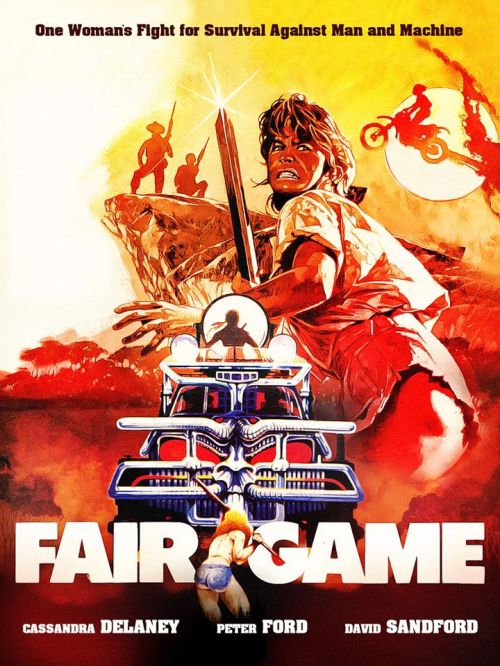
Fair Game (1986)

By Richard Winters

My Rating: 7 out of 10

4-Word Review: Woman harassed by poachers.

Jessica (Cassandra Delaney) runs an animal sanctuary deep in the heart of the Outback. Sunny (Peter Ford), Ringo (David Sandford), and Sparks (Gary Who) are three big-game hunters, who grow bored shooting at kangaroos and set their sights at taking on some of the animal’s inside her property. They decide that Jessica herself may fun to ‘toy’ with too and begin a campaign of harassment that starts with them trying to run her car off the road with their big truck and just proceeds to get more violent and confrontational. Jessica though is determined to turn-the-tables on them even as the stakes against her survival grow continually more dim.

This is the type of film that right from the start goes against the rules of conventional storytelling as there’s very little character development or backstory. The viewer is immediately thrust into the battle while barely even knowing who these people are. Normally, I’d say it should’ve slowed up a bit and let us get some grounding before getting smacked with the action, but honestly in this instance it really wasn’t needed. You get enough of the general idea to know who to root for and the more violence that happens the more enthralled you get with it.

This is how many real crime happen where the perpetrators attack their victim out of nowhere and without warning giving the person very little time to think and forcing them to immediately respond to the danger without being able to ponder their options and in that regard this film, which was intended to be, by admission of the director, nothing more than a ‘comic book’ adventure actually does quite well. Usually I’d like a chance to catch my breath, but here any minor slow-up makes you feel off-kilter as it’s the action that propels it and the whole thing becomes more like an ‘experience’ than a movie.

Many have labeled this as Australia’s version of I Spit On Your Grave, but this is actually better. The different ways that the men terrorize our protagonist is far more interesting than the gratuitous rape that took up so much of the other one. While the men are at times a bit stupid I did like their relentless quality. They don’t get killed off as easily as in a Hollywood film. There were many times when I thought they should’ve been doomed, but they manage to survive it, which made me start to believe they might actually win the battle and thus allowed the tension to grow even higher.

Cassandra, who gained fame by being a co-singer with her mother Lorraine in a rock ‘n’ roll band called The 50’s and then later ended-up marring singer/actor John Denver, is quite good though I initially felt there needed to be more of an arc to her character. Perhaps having her be more timid at the start only to eventually bring out her warrior nature at the end as she’s a little too self-assured right from the beginning, but overall I came to believe it wasn’t necessary. I did think though it was unrealistic that she ran this sanctuary in the middle of nowhere, but didn’t own a gun, but ultimately having her tote a big rifle might’ve looked cliched and it also forces her to come up with creative ways to get rid of the bad guys, which is ultimately more intriguing.

The Outback gets used perfectly as the viewer gets both charmed by it’s beauty and terrified by some of the creatures that live in it including the weird lizard-like things that congregate on Jessica’s front porch and that she’s forced to shoo-away each morning when she walks out. The desolate landscape is also a good metaphor to the men’s soulless nature and also helps heighten the odds to just how alone and desperate Jessica’s situation truly is.

My Rating: 7 out of 10

Released: July 24, 1986

Runtime: 1 Hour 26 Minutes

Rated R

Director: Mario Andreacchio

Studio: CEL Film Distribution

Available: DVD, Blu-ray (Region A/B/C)

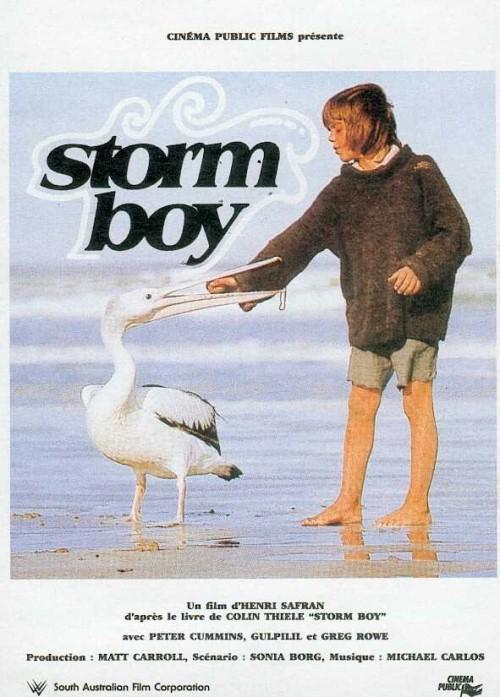
Storm Boy (1976)

By Richard Winters

My Rating: 6 out of 10

4-Word Review: A boy raises pelicans.

Mike (Greg Rowe) is a 10-year-old boy living in a ramshackle home near the ocean on Australia’s southern coast. He lives with his reclusive father Tom (Peter Cummins) who wants no connection with the outside world and won’t even allow his son to have a radio. One day Mike meets Fingerbone (David Gulpilil) an aborigine living alone on the beach due to a falling out with his tribe. Together they come upon a group of hunters shooting at birds. Fingerbone is able to scare them away, but not before they’re able to shoot and kill a mother pelican leaving her young to die of starvation. Mike decides to take the baby birds home with him and despite his father’s initial objections he’s allowed to keep them. The bird’s require a lot of food, but Mike is able to keep them fed and once they’ve grown he and his father set them free, but one of the bird’s, whose name is Mr. Perceval, comes back and Mike grows a strong bond with him.

The film is based on the children’s book of the same name written by Colin Theile, which won many awards. The film has acquired many legions of fans as well, but filming it proved to be quite complicated. Training the birds took 12-months and many times they’d fly off during the filming including one of them flying into a nearby private party that scared many of the party goers there. They also had the challenge of trying to get the Rowe to interact with the bird as he was initially quite scared of them.

Personally I’ve never found pelicans to be all that cute or lovable and their large beaks are an odd sight second only to that of the toucan’s. I did though enjoy seeing the baby pelicans who don’t even have any feathers on them and was hoping more time would be spent on to their feeding and caring, but the movie glosses over this part pretty quickly.

The bird storyline is in fact only one part of the movie as the script also focuses on several other threads including a local teacher (Judy Dick) trying to get the father to allow Mike to attend school with the rest of the children. There’s also a segment where a bunch of young men in dune buggies come out of nowhere late one night and proceed to tear up, with their vehicles, the home that Mike and his father live in. I suppose the reason this is put in is to show how the bird warns Mike of the impending danger, which gets him out of the house, but otherwise it has no connection to the rest of the plot and it’s left a mystery to what motivated these young men to do it nor are they ever seen or heard of again.

The performances are quite good, which is the one thing that holds it all together. Cummins as the father impressed me the most because he is so different here than any of the other parts he’s played. Gulpilil is entertaining too and has some of the most lines, which is the exact opposite from Walkabout where he had none. Rowe is excellent as well despite the fact that he wears the same clothes the whole way through. Only at the very end is he seen wearing something other than his drab green sweater, but I felt for the sake of body odor he should’ve had a variety of outfits to wear all the way through. I realize they were poor, but even poor people don’t usually wear the same clothes everyday for months on end.

Spoiler Alert!

The ending, in which the bird gets shot by a group of hunters, most likely the same ones that killed the bird’s mother, is very predictable, which is the film’s biggest drawback. No real surprises and the life lesson’s are pretty routine and something seen in a lot of children’s stories, so if you take the pelican out of it it’s not all that special. The constant gray, overcast sky gets a bit depressing to look at too, but the film has found a loyal following and was remade to a degree in 2019, where Geoffrey Rush plays a now grown Mike and relating back to his kids about his adventures when he was young. It also stars Gulpilil as the father of Fingerbone Bill.

My Rating: 6 out of 10

Released: November 18, 1976

Runtime: 1 Hour 25 Minutes

Not Rated

Director: Henri Safran

Studio: Roadshow Films

Available: DVD-R (Region Free), Blu-ray (Region 0)

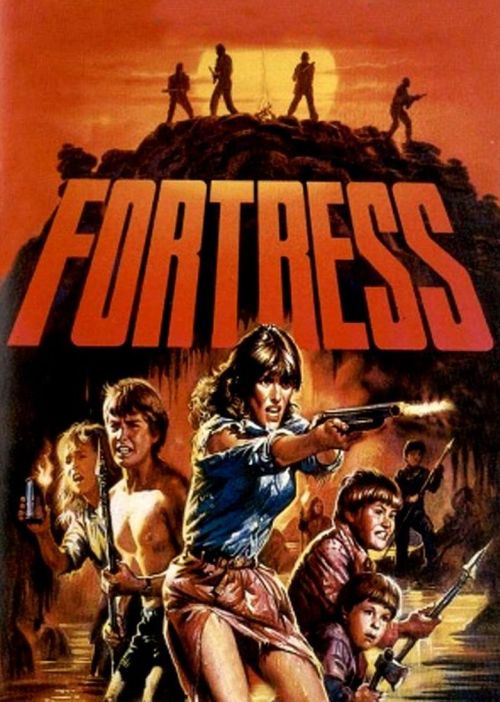
Fortress (1985)

By Richard Winters

My Rating: 7 out of 10

4-Word Review: Australian schoolchildren get kidnapped.

Sally (Rachel Ward) is a school teacher working in rural Australia where she teaches in an old-fashioned one-room school house. The ten students are made up of different ages and an even mix of boys and girls. One morning while class is beginning a group of four masked men invade the building and take the children hostage. They throw them into an underground cave and then put a large boulder over the cave opening to lock them in. Sally and the students go searching through the underground caverns and manage to find another way out, but every time they think they’ve reached freedom the kidnappers always seem to be one-step ahead of them.

The film’s main selling point are the children, which at first I didn’t think would be a good idea. It can be hard to get kids, for many of them this was their first movie project, to show the necessary emotions in an effective way and while they don’t always respond to things quite the way I think a real kid would I still found their resiliency to be uplifting. I also enjoyed seeing how the older boys grew into men during the experience and watching Sally precariously balance her obligation of the being the mature, brave one while still hiding her inner emotions of fear and panic.

The location shooting takes advantage of many different Australian locales including the Buchan Caves where the action in the first act takes place. Later on we’re given exciting view of a them running through the forest late at night in an attempted escape as well as them returning to yet another cave for the climactic finish. The story manages to be reasonably tense throughout though the killers always managing to catch-up with their victims no matter where or how far they go does ultimately test the plausibility. The film’s tone is a bit off-kilter as well. Most of the time it seems to want to be a story of victim empowerment and resourcefulness, but then intermittently throws in some jarring violence, which wasn’t necessary.

Spoiler Alert!

While it’s great seeing these kids remain stoic it also seems hard to believe. After being put in the cave they find a way out where they then spot a farmhouse, which was several miles away only to ultimately realize that the kidnappers have been there waiting for them. They then great treated to a man getting gunned down before their very eyes, but manage to escape from their to yet another cave that is many miles away and again the kidnappers find them and continue their assault of terror. Normally after all this most people, especially young children, would feel overwhelmed and defeated and eventually fall into a traumatized state instead of the warrior mentality that they do. While the good guy fighting back approach may be more of an audience pleaser I wasn’t sure if this was a realistic response when given the daunting circumstances. Also, why would the bad guys not invade the cave the kids are in right away instead of staying back and giving the group ample time to create the makeshift weapons’, stuff that would take hours if not days to make,  in order to be ultimately used against the kidnappers like they are?

The Lord of the Flies – themed twist ending comes out of nowhere and seems too forced to be effective. Watching the group surround the last of the bad guys and viscously stabbing him with their weapons’ in slow motion made enough of a statement and that’s where it should’ve ended. Adding in the denouncement where the kids are back in school and have the heart of the killer placed inside a glass jar in the middle of the room was just too heavy-handed. With what they’ve been through most kids would never want to step foot in that school again and where are the parents during all of this as they’re never shown?  Having a human heart in a jar is pretty nasty and you’d think  one of the kids would’ve talked about it to others and word would ultimately get around.

End of Spoiler Alert!

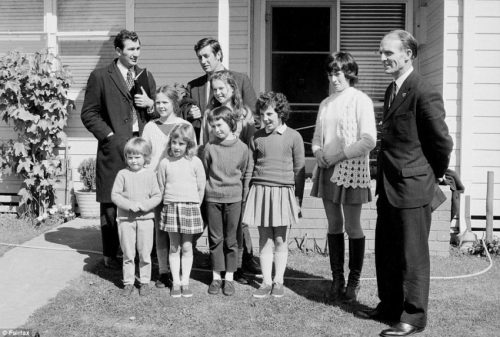
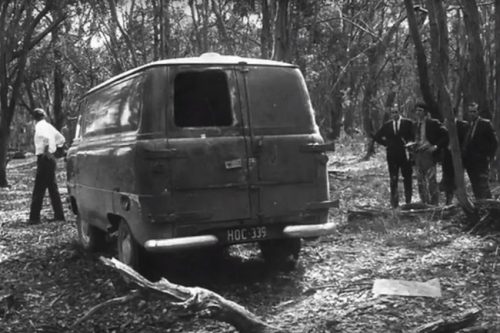
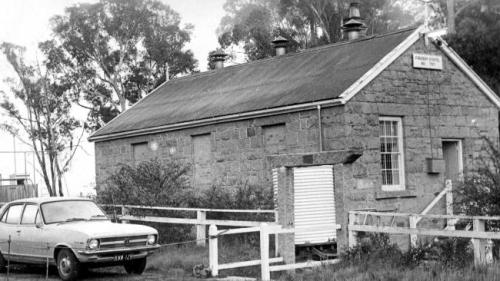
The plot is loosely based on an actual event that occurred in the small town of  Faraday, Australia on October 6, 1972 when Edwin Eastwood and Robert Boland kidnapped a young teacher and her students from a remote one-room school house similar to the one depicted in the movie. However, there are many differences between the real event and what happens in the film. For one there were only 6 students and all of them were girls. They were never taken to a cave either, but instead held in the back of a van. When the kidnappers left the next morning to retrieve the ransom money the teacher, whose name was Mary Gibbs, managed to kick out the back door panel with her leather boots and escape with the children and eventually the two men were later caught.

The irony though is that’s not where the story ends as Eastwood was able to escape from jail in 1977 where he then kidnapped another group of children and their teacher, but was again caught. He then served a 16 year sentence, but was eventually paroled in 1993 and has been a free man working as a truck driver since.

Teacher Mary Gibbs and the six students who were kidnapped during the real-life incident.

The van in which Gibbs and the students were held captive.

The school house in which Mary Gibbs and her six students were taken hostage on October 6, 1972.

My Rating: 7 out of 10

Released: November 24, 1985 (HBO Broadcast)

Runtime: 1 Hour 28 Minutes

Rated: TV-MA

Director: Arch Nicholson

Studio: HBO Premiere Films

Available: DVD

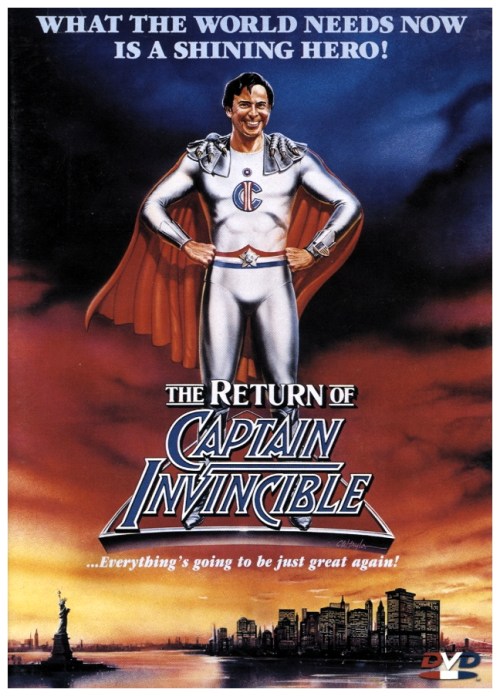
The Return of Captain Invincible (1983)

By Richard Winters

My Rating: 4 out of 10

4-Word Review: Super hero drops-out.

Captain Invincible (Alan Arkin) successfully fights off the Nazis during WWII and becomes a hero to millions, but then by the 1950’s, during the McCarthy era, he is smeared as being a ‘communist’, due to wearing a red cape.  The congressional investigators also accuse him of flying in airspace without a proper license and wearing underwear in public. All of this causes him to drop-out of the superhero business by moving to Australia and turning into a homeless alcoholic. Then his old rival, Mr. Midnight (Christopher Lee) steals a secret weapon called the hypnoray, which puts the whole world at risk. This causes the authorities to plead to Captain Invincible to return and help them stop the madman, but through the years his skills have diminished and he’s not sure he can get back into form to battle crime like he once did.

At the outset this is an inspired concoction made long before the super-hero satire was ever in vogue and there are a few funny bits here and there, but the whole thing gets too bizarre for its own good. The viewer becomes inundated with so much wacky imagery and goofy characters that instead of laughing you’re left scratching your head wondering what’s it all about.

The biggest mistake was adding in musical numbers, which turns the thing into an ill-advised version of The Rocky Horror Picture Show. The original script was not intended to be a musical, but director Philippe Mora had always dreamed of doing one, so he requested that the songs be added in. The first time this occurs it’s kind of fun particularly the line dance done by the well-dressed advisors to the President, which all helps to add to the irreverence, but then continuing to add in more songs bogs everything down  and makes the already sluggish pace even worse. Arkin and co-star Kate Fitzpatrick do not have good singing voices, so hearing them belt-out a half-hearted tune hurts the ears and with no interesting dance numbers to come along with it, these moments become boring visually as well.

Even though the story involves an aging superhero I still felt Arkin was too old for the part and would’ve liked somebody who could have offered more energy. Typical Arkin is great with offbeat material such as this, but everything is so over-the-top that he gets lost in the access and ultimately becomes just a prop. Christopher Lee suffers the same fate although some fans love his rendition of ‘Name Your Poison’ which he sings to Arkin as he tries to entice him to take an alcoholic drink from his personally made wet bar.

The film offers no special effects which becomes most apparent during the segment where Captain Invincible supposedly upends a speeding car, but the camera cuts away, so we never see him do the actual act, and just hits home how cheap the whole production really is. If you’re going to make fun of the Superhero genre you have to at least show some respect for it, which this thing never does. Instead of going off on wild tangents there should’ve been a big showdown between Invincible and Midnight, but it peters out in this area by being too busy trying to be weird when it should’ve worked harder to get a more coherent and interesting story.

My Rating: 4 out of 10

Released: June 11, 1983

Runtime: 1 Hour 36 Minutes

Rated PG

Director: Philippe Mora

Studio: Seven Keys

Available: DVD

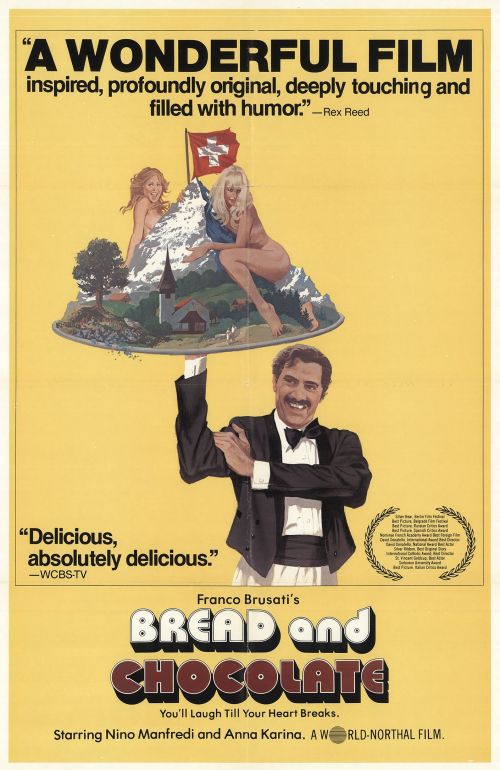
Bread and Chocolate (1974)

By Richard Winters

My Rating: 9 out of 10

4-Word Review: He has no home.

Nino (Nino Manfredi) has moved to Switzerland to work as a guest worker in that country since he’s unable to find employment that pays a living wage in his homeland of Italy. In order to provide for his family he works various odd jobs and then sends the money back home to his wife and kids who he has not seen in years. There are many other foreigners from other countries competing for the same jobs as Nino including a Turkish worker (Gianfranco Barra) who vies for the head waiter position at a fancy restaurant that Nino also wants, but even though the two don’t get along they’re still forced to room together in a cramped attic apartment. Nino’s only source of companionship comes in the form of a friendship that he has with Elena (Anna Karina) a Greek who lives across the street from him in an equally small loft. He moves in with her and her son when he gets kicked out of his other place, but because she’s also a guest worker striving to make ends meet she has no time for a relationship making Nino feel like an unwanted outsider no matter where he goes.

This critically acclaimed film really allows the viewer to get to know their characters and the desperation that they feel. Many viewers today may be unaware of the guest worker program that many European countries took part in during the 60’s and 70’s, so watching this will be an educational experience as well as a good character study. What I found most fascinating though was the issue of racism. Most people wouldn’t consider Switzerland to be a ‘racist’ country, so it’s interesting to see how this element can creep in anywhere and it doesn’t have to hinge on one’s skin color either as the Swiss end up picking on the Italians simply because they aren’t from there, poor and ‘stealing their jobs’, so are therefore in their minds deserving of being looked down upon, much like foreign workers in this country can sometimes feel.

The film also makes keen observations in regards to the rich versus poor and how having a lot of money can sometimes make one a weaker person less able to handle challenges. This comes to a head with Nino’s friendship with an Italian Industrialist (Johnny Dorelli) who despite living a lavish lifestyle commits suicide after losing a custody battle with his ex-wife even though Nino hasn’t seen his family for years and lives in near squalor, but because he’s toughened to the hard times he’s able to preserve and remain upbeat where the rich man couldn’t.

There’s many memorable moments, so many that it would be hard to list as the story and characters are so multi-layered the laughs and insights come in literally just about every frame. Many will consider Nino’s visit with some farm workers who out of desperation have moved into a chicken coop and start behaving like the chickens they tend, which is funny and unique, as the film’s highlight. However, my favorite part came when Nino decides, in an effort to move up in society, to pretend that he’s Swiss and even dyes his hair blond and begins speaking in a Swiss accent. Then while at a bar he watches a soccer match between Switzerland and Italy on the TV and even though he initially cheers for the Swiss team he can’t help but eventually shout out in excitement when Italy scores a goal, which just proves the old saying: You can take a person out of their homeland, but you can never take the homeland out of the person.

The film’s most redeeming quality though is showing the strong bond that forms between the guest workers. Even if they’re at first strangers and from different countries they immediately offer support and friendship to Nino no matter where he goes simply because they are going through the same hardships as he, which becomes a wonderful testament to the hearty human spirit.

My Rating: 9 out of 10

Released: January 18, 1974

Runtime: 1 Hour 40 Minutes

Director: Franco Brusati

Studio: Cinema International Corporation

Available: DVD, Blu-ray (Region B/2)

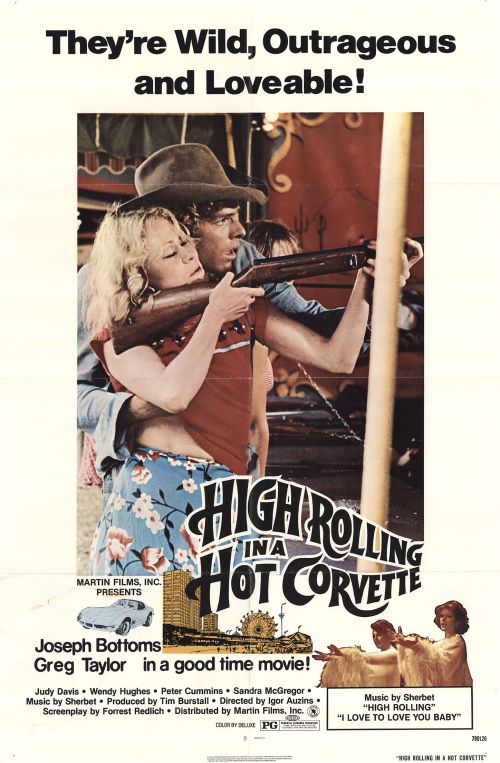
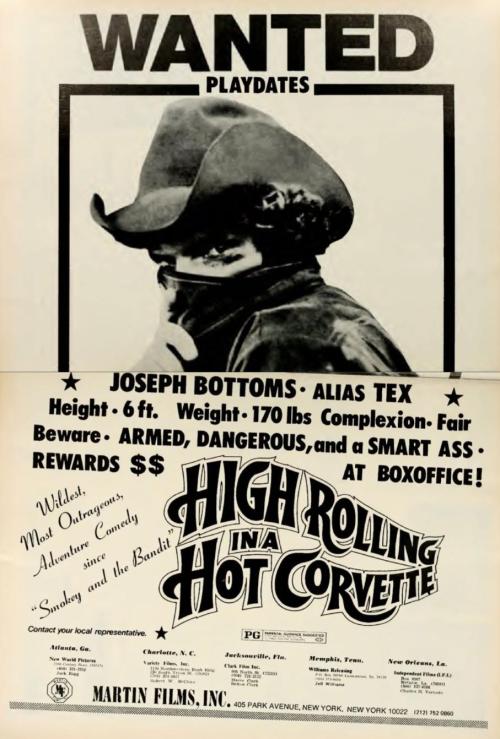
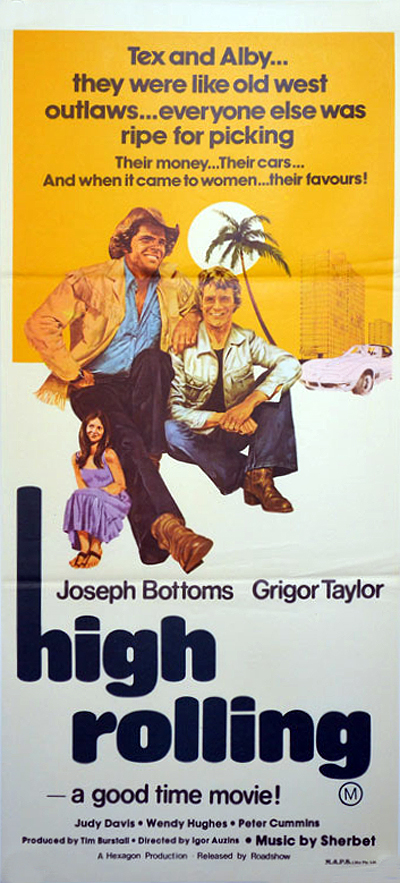
High Rolling in a Hot Corvette (1977)

By Richard Winters

My Rating: 6 out of 10

4-Word Review: Two guys drop out.

Tex (Joseph Bottoms) and Alby (Grigor Taylor) are two friends working at a carnival who decide, after Tex gets fired when he’s caught having sex with a female customer, to breakaway from the grind by heading out to the Gold Coast and Surfer’s Paradise. They hitch a ride with Arnold (John Clayton) who drives a snazzy green Corvette. After he takes the two to a hotel for the night he comes-on to Alby, who beats Arnold up that puts him into an unconscious state. When Tex finds out what happened they decide to make a run for it by driving away in Arnold’s green corvette, which to their shock is loaded with bags of marijuana. They use Arnold’s money from his wallet to help them get into ritzy nightclubs where they meet up with attractive singers Susie and Barbie (Sandra McGregor, Wendy Hughes), but once the money is spent they’re forced to rob a tour bus full of passengers, but just as they’re ready to escape with the loot Arnold returns with his muscular friends and an ugly confrontation ensues.

This is another Australian flick where it could’ve easily been filmed here and you’d never know the difference. Whether it’s intentional or not the American influence is quite strong including having them eat at such restaurants as Kentucky Friend Chicken and McDonald’s. The Outback is the one area that can help Australia stand out, but the two never go there and stick to the lushly green coastal region, which again looks no different than many of the landscapes in the U.S.

They even hire an American actor for the lead, which I felt was a mistake. Apparently they thought it would be easier to sell to distributors abroad if not all the actors spoke with an Aussie accent, but Bottoms, who is the younger brother of the more famous Timothy Bottoms, isn’t a good enough actor to make anything that he does onscreen either interesting or memorable. His reckless wild boy behavior comes-off as affected and forced and the way he aggressively comes-on to women would be considered misogynist and sexual harassment by today’s standards. Plus, there’s never any explanation for why this Texan would be working the carnival scene in Australia to begin with.

The tone of the film when compared to its trailer, which can be seen on YouTube, is far more grim and dramatic. The trailer gives you the impression it’s a comical, freewheeling adventure that will bring you back to your youthful days of rebellion, when really it’s more about them desperately living on the edge, getting beat-up and seeking shelter in an abandoned church when it rains. If anything it makes the creature comforts of suburbia, even with some of the compromises that come with it, seem not so bad by comparison.

These guys aren’t too smart either and it becomes harder and harder to keep siding with them with each jam they stupidly get themselves into. Driving off with the Corvette was just asking for trouble since they didn’t bother to change the license plate, so any cop could scan the number and realize that the vehicle was stolen. When they rob the bus, which is the best moment in the movie, they don’t wear any masks, so they’ll be easily identifiable. It also makes you wonder why if these bums needed money so bad they couldn’t just find a job like the rest of us instead of robbing innocent people, which is not a nice thing to do and makes the viewer not want to like these guys who are, at least in theory, supposed to be the protagonists.

The filmed is helped by the appearances of two young Australian actresses at the start of their careers. Hughes is beautiful as the showgirl that they meet but her part is ultimately too small. I was afraid Judy Davis, who plays a hitchhiker that they pick-up, would have the same fate, but she returns later on to give the cops a wild car chase driving the Corvette that makes it worth it.

The film though lacks any discernable point or message. The characters show no  arc and behave the same way at the end that they did at the beginning. Nothing conclusive is giving to their ultimate fate. Will they be able to live on the road and on-the-edge all of their lives? This hardly seems possible, but the movie makes no effort to answer this question causing it to be vapid and undistinguished from the plethora of other road movies out there.

My Rating: 6 out of 10

Released: August 4, 1977

Runtime: 1 Hour 21 Minutes

Rated PG

Director: Igor Auzins

Studio: Hexagon Productions

Available: DVD-R

Fast Talking (1984)

By Richard Winters

My Rating: 5 out of 10

4-Word Review: Teen gets into trouble.

Steve (Rod Zuanic) is a teen who has a rocky relationship with his alcoholic father (Peter Hehir) and ditzy mother (Julie McGregor). To survive on his own he’s forced to deal marijuana and  steal newspapers, which he then resells to motorists in their cars while they wait at a red light. His shenanigan’s get him into constant trouble especially at school where he’s perpetually dodging capture with his amazing ability to escape out of just about any jam.

Writer/director Ken Cameron was inspired to do this film after working as a high school teacher as well as for his love of Francois Truffaut’s 400 Blows, which he saw while growing up. The realism is on-target and has a certain cinema vertite feel. I went to high school when this film was made and can attest that the behaviors of the students here resembled many that I knew then and it’s amazing that even though this was shot on a continent halfway around the world the adolescent experience in Australia isn’t all that much different than that in the U.S. In fact if it weren’t for the Aussie accents one might think that it had been filmed here.

The story though, which was based on short films that Cameron made before he did feature length productions, isn’t connected enough to be impactful. The script is more like a collection of vignettes than a plot and while there’s some interesting moments it’s too spotty to be fully effective. I enjoyed Steve’s budding friendship with a mechanic (Steve Bisley) who tries to teach him the trade, but the film cuts away from this only to briefly go back to it much later when it should’ve been more of the focus. This same thing occurs when Steve tries to save a greyhound, that he apparently had a deep emotional bond to, from being killed by his father, but this storyline gets introduced almost 60 minutes in and should’ve at least been alluded to earlier.

Zuanic was discovered after Cameron spent three months teaching drama classes in High Schools around Sydney and while he looks like a genuine teen and not a college-aged kid pretending to be one as in other teen flicks his physique is too scrawny. (The painted image of him seen in the film poster above makes him seem much bigger and mature than he really is.) He resembles more of a child at age 12 and nowhere near someone entering manhood. Maybe that was the point, but watching him smoke, swear, steal, and get involved at times in amorous activities gets unsettling to watch because of it. When he confronts those that are bigger than him, which happens a lot since he’s so painfully small, I kept wincing thinking he’s going to get his ass kick despite his cocksure attitude and with no real ability to defend himself. Having the part played by a 17 year-old with a stocky build would’ve been preferable.

Not much insight is given towards Steve’s relationship with his mother, who’s seen only briefly, even though this is the catalyst for his desperate behavior, so I felt it needed to be played-out far more. His constant ability at escaping capture by whatever authority figure is after him is amusing at first, but eventually becomes redundant and unrealistic as at some point he’s going to be forced to face the consequences of his actions, which needed to be shown, but never is. The wide-open ending, apparently done because Cameron thought this would be made into a sequel, but due to the poor box office returns never was, offers no definitive conclusion to our character’s ultimate destiny, which makes the film even more transparent than it already is.

My Rating: 5 out of 10

Released: August 23, 1984

Runtime: 1 Hour 35 Minutes

Not Rated

Director: Ken Cameron

Studio: Filmways

Available: DVD (Region 4), Amazon Video

Nickel Queen (1971)

By Richard Winters

My Rating: 4 out of 10

4-Word Review: Bar owner gets rich.

Meg Blake (Googie Withers) is a widow who owns a pub in a small desert town that has only 10 people living in it. She finds it hard to make ends meet until she hears about a nickel discovery in the outback and decides to be the first one to stake her claim to the land. Little does she know that corrupt executive Ed Benson (Alfred Sandor) fabricated the rumor of a nickel discovery simply so he could sell shares to gullible investors and Meg’s stake of land is actually worth nothing, but because Ed wants other people to also buy shares he pretends that Meg has already gotten rich through her investment and gives her $100,000 up front and parades her around the media while calling her the Nickel Queen. Meg laps up the publicity and spends her newfound fortune lavishly only to ultimately learn, once all her money is gone, that it was a hoax, which causes her and the other angry investors to go after Ed for revenge.

The story was inspired by the real-life event known as the Poseidon Bubble, which occurred in Australia in 1969, where shares in mining soared upon the discovery of a nickel deposit in September of that year only to quickly crash by early 1970 once it was found that the nickel was of a lower quality than initially thought causing many investors to loose a lot of money. Had the film stuck more to the true life event it might’ve had potential, but the way it gets played-out here is rather tepid.

It starts off alright and Withers, acting in front of the camera for the first time in 13 years, creates an engaging character who doesn’t back down to anyone and never hesitates to speak-her-mind. Unfortunately her tenacious personality does not get played-up enough. Once she becomes a media darling her wisecracks no longer have any zing and she falls into Ed’s trap too easily.  During the second half her presence is rather minor as she becomes this naïve person who must depend on her old friend Harry (Ed Devereaux) to get her out of her jam and exposing the corrupt Ed instead of she being the one to do that on her own.

The supporting cast is equally wasted. Initially the hippie guru character of Claude (played by John Laws who was and still is a famous Australian radio personality) seemed interesting as his values and outlook on things, particularly his refusal to work, contrasted greatly with Meg’s making it seem like the two would be sharing some wildly over-the-top confrontations. Instead Claude takes an extreme pivot midway through by showing up as a clean-shaven man willing to sell-out for money and even ends up becoming Meg’s lover, but what’s the point of him starting out one way if he’s just going to end up being the polar opposite? The transition is not revealing or introspective and shows how the filmmakers, who were all over 50, had no understanding of the counter-culture movement at all.

Doreen Warburton, who plays Ed’s gluttonous wife, is equally problematic.  The running joke of seeing her constantly stuffing her face with food gets pretty old, pretty fast to the point that it starts to get kind of disgusting to look at. Not having her utter a single word of dialogue is weird too making it seem like she’s not even human, but simply an unfunny and highly stereotyped caricature.

I liked how the first half was shot in an actual ghost town known as Broad Arrow and having the action take place in some of the town’s abandoned buildings gave the film an added visual flair, but this gets completely lost during the second-half when everything moves to the big city of Perth. The music is yet another issue as it sounds like something from the 40’s or 50’s and completely out-of-touch with the times. A lot of the cast is made up of hippies, so the soundtrack should’ve reflected more of their tastes.

Ultimately the film suffers from being too much of a family project. Writer/director John McCallum was star Googie’s husband and there’s even a part for their daughter Joanna McCallum, who plays Meg’s hippie daughter. While this may have been a fun project to work on from their perspective it offers little in the way that is satisfying to the viewer. The plot is poorly constructed and the wrap-up too tidy making it seem like material better suited for a TV-sitcom than the big screen.

My Rating: 4 out of 10

Released: April 1, 1971

Runtime: 1 Hour 27 Minutes

Director: John McCallum

Studio: British Empire Films Australia

Available: None