Category Archives: Fast Cars/Car Chase

Outlaw Blues (1977)

outlaw blues

By Richard Winters

My Rating: 4 out of 10

4-Word Review: Singer on the run.

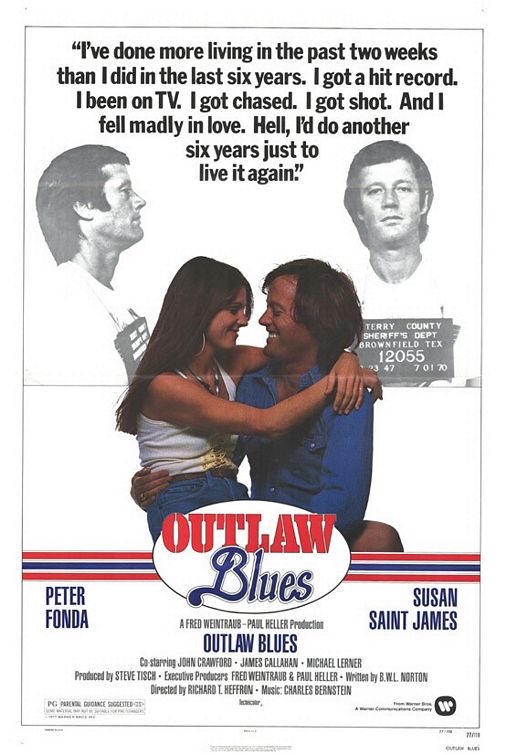
When country music giant Garland Dupree (James T. Callahan) visits a Texas prison in order to hold a Johnny Cash-like concert for the inmates he meets up with Bobby Ogden (Peter Fonda) a prisoner who while spending time in jail has written a song called ‘Outlaw Blues’. Garland likes the song so much that he decides to steal it and make it his own only to be confronted by Bobby who once out on parole will stop at nothing to get it back and expose Garland for the fraud he is. With the help of Tina (Susan Saint James) who acts as his manager he does just that, but finds himself again on the run from the cops after accidently shooting Garland during a confrontation inside a recording studio.

This film is notable for not only being filmed in Austin, Texas, but also being the first film to ever use Austin as a setting. The movie can be fun for people from the area especially those living in the city during the mid-‘70s. There are a lot of car chases that occur in the center of town making it entertaining to see all the old buildings some of which still stand today. The scene that takes place at what was then called Texas Memorial stadium during halftime of a Longhorn’s football game where Tina and Bobby take part as members of the marching band is pretty cool as is Tina’s serene houseboat that she lives in and has docked on the Colorado River.

Unfortunately the story itself evolves little and relies heavily on a lot of car chases and clichéd one-dimensional characters. Bobby’s hit song is too low key and melodic making it hard to imagine why so many people would get so crazy about it as a more up tempo country/rock sound would have worked better and given the soundtrack more of a kick.

The film also suffers from a few goofs and lapses of logic. The biggest one is when a lone cameraman films Bobby accidently shooting Garland and it gets replayed on the evening news. Yet when it gets shown it has several edits and footage of the incident from different viewpoints and angles, which if truly shot by just one camera wouldn’t have been possible. The idea of having Garland chasing Bobby down through the streets of Austin in broad daylight while shooting at him is utterly insane even for a deluded, egotistical character that he is as it would just get him thrown into jail. Since the Garland character is portrayed as having a lot of money then he should do what most rich people do when they want someone dead, which is hire someone else to do it while creatively covering up the paper trail.

Fonda too laid back in the lead and comes off as transparent and boring. Saint James, Callahan and John Crawford as an obsessed police chief lend some amusing support, but their presence as well as a nifty boat chase at the end cannot save a film that is otherwise generic and silly.

My Rating: 4 out of 10

Released: July 15, 1977

Runtime: 1Hour 40Minutes

Rated PG

Director: Richard T. Heffron

Studio: Warner Brothers

Available: VHS, DVD (Warner Archive)
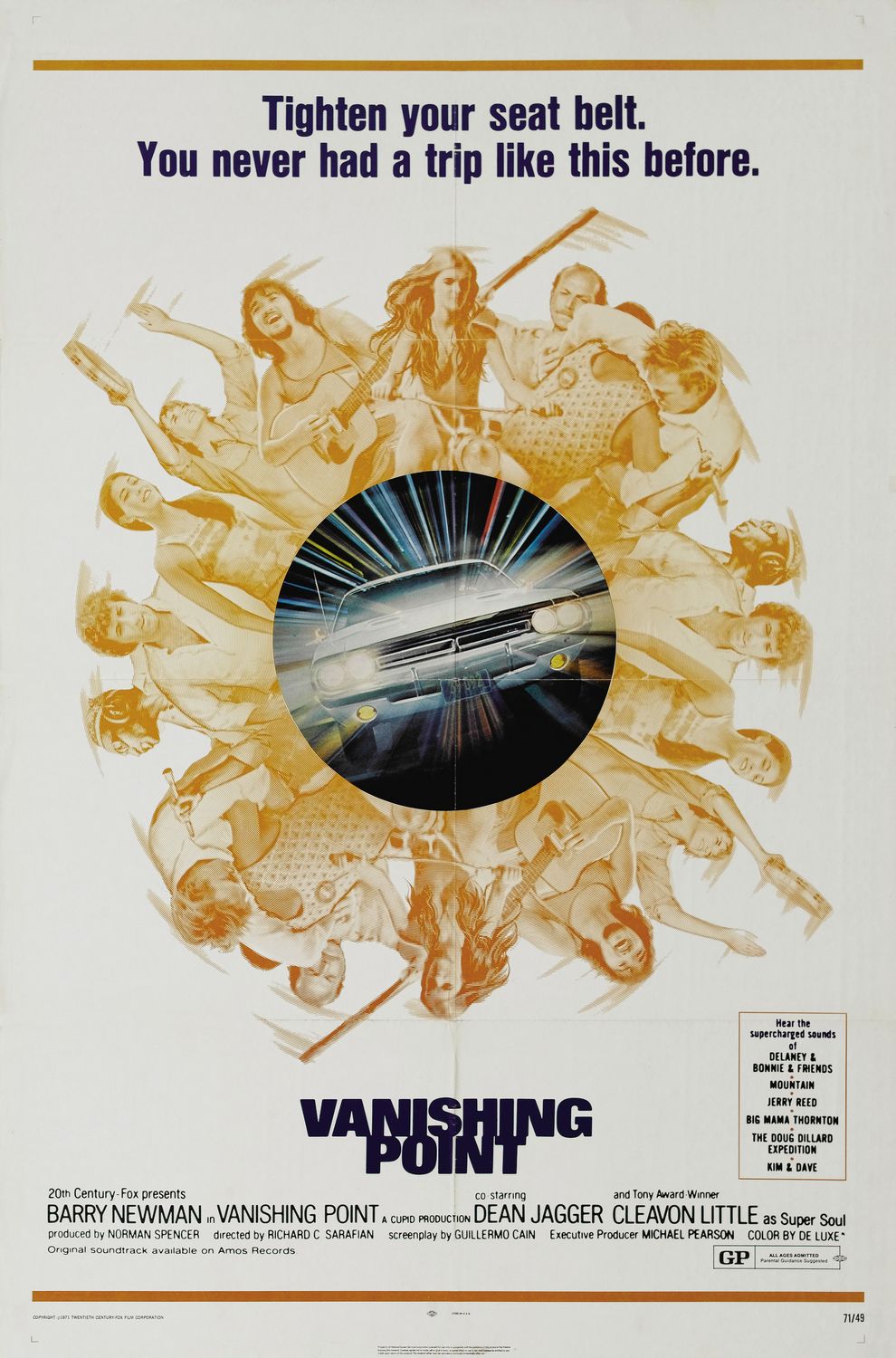
Vanishing Point (1971)

vanishing point 1

By Richard Winters

My Rating: 7 out of 10

4-Word Review: Racing to San Francisco.

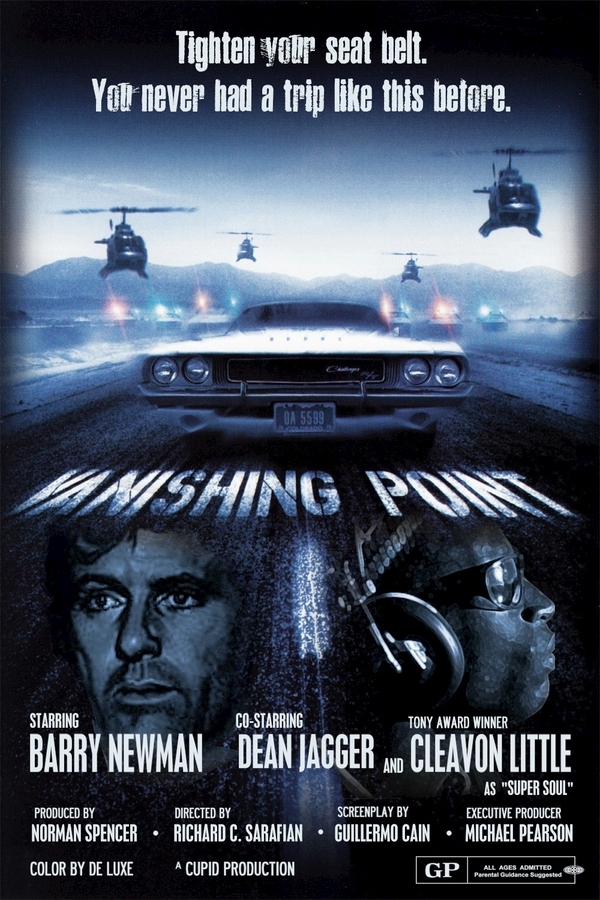
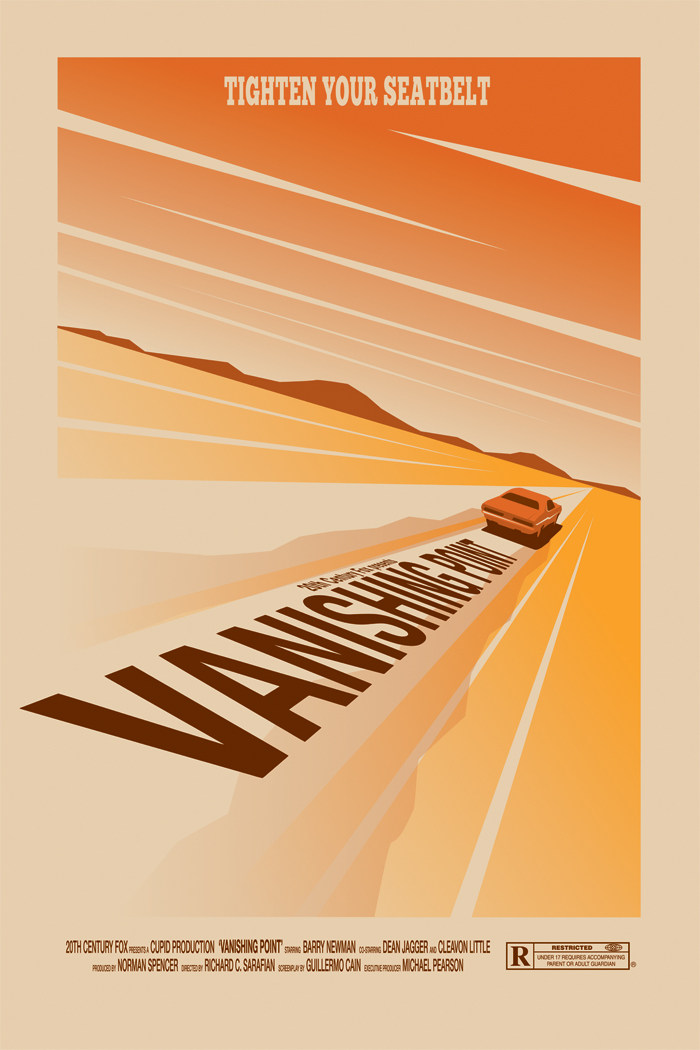
Kowalski (Barry Newman) is a car delivery driver whose next assignment has him driving a white Dodge Challenger R/T 440 Magnum from Denver to San Francisco. He is a former cop who seems disillusioned and detached from the world around him. To give his existence some meaning he decides to ‘challenge’ himself by making the delivery in record time and even makes a bet with a local drug dealer while purchasing some ‘uppers’ that he can get to San Francisco by 3:00 the next day. As his record drive proceeds he gets the attention of the local law enforcement from every state that he drives through, but none of them are able to stop him despite all efforts. He also attracts the attention of a local blind, black DJ named Super Soul (Cleavon Little) who has access to the police radio frequency and able to help Kowalski with his goal.

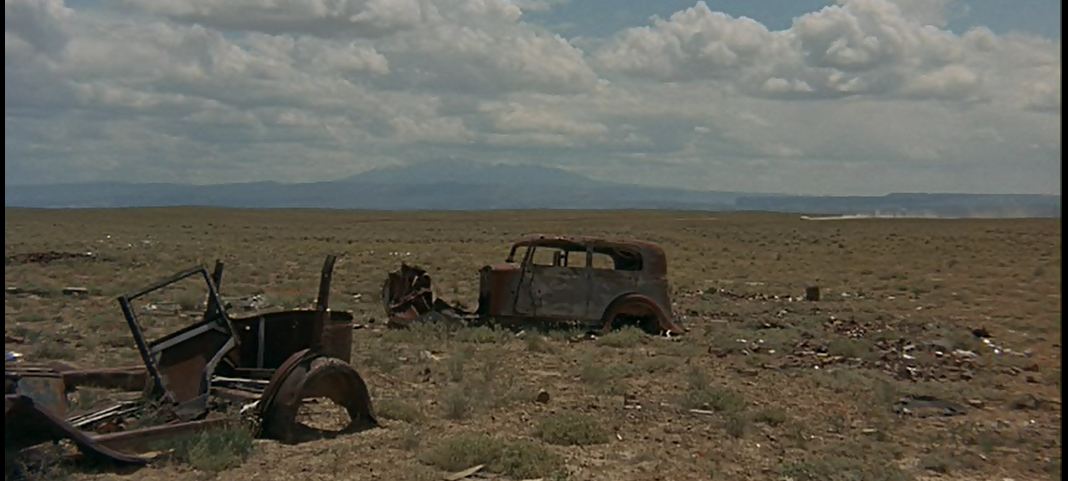
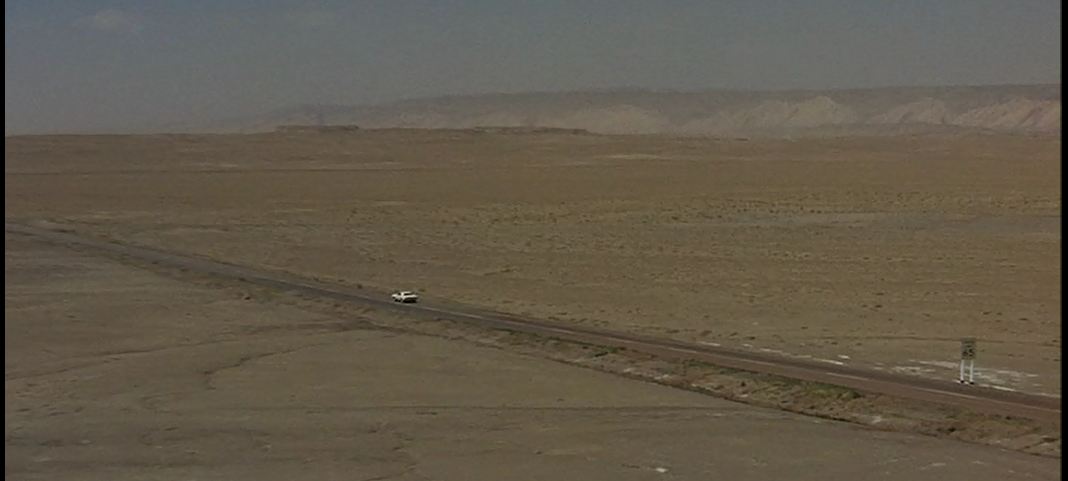
Richard C. Sarafain’s direction and John Alonzo’s cinematography are the real winners here. In fact my favorite scenes from this film are the long distance shots capturing the car driving along the lonely highways to the backdrop of the stunning western skies and its rugged, sandy landscape. This is a movie that will appeal to one’s emotional senses and bypass the need for logic. Certain things aren’t fully explained particularly Kowalski’s past, but the fact that it isn’t makes it more enjoyable. It’s the connection with his need for speed, escape and non-conformity that attracts us and it’s the adrenaline that propels the movie and viewer’s interest forward thus making this one of the quintessential road movies from its era or any other.

Capture 1


Capture 2

Newman seems an unusual casting choice as he really doesn’t have the dynamic star power or all that many lines of dialogue. He is also clearly in his mid-30’s for a part that seems better suited for some renegade, long haired 20-year-old, but in some ways his presence makes the movie more intriguing and distinctive by showing middle-aged people can have a dormant desire to rebel as well and sometimes even more so.

Little is terrific in what is probably the best performance of his career even though it seemed highly improbable and even ridiculous for a black DJ playing soul tunes at a radio station located in a small, isolated town inhabited by conservative, white, racist people. Severn Darden is edgy as a traveling evangelist and Dean Jagger is appealing as an old-time snake hunter. On the flip side of the 20th Century Fox DVD you can see the extended U.K. release that features a brief scene with Charlotte Rampling as a hitch-hiker. This sequence was intended to be allegorical, but really isn’t that impressive even though Rampling is quite attractive with her hair highlighted with blonde streaks.

Spoiler Warning!

The ending, which features Kowalski intentionally driving into some bulldozers parked in the middle of the road, which kills him instantly in a ball of flames, has proved through the years to be quite controversial and filled with many interpretations. I found it to symbolize Kowalski’s ultimate need for escape as he realized that he could never achieve the true freedom that he wanted, so he decided in a way to become a martyr and take his chances in another world beyond this one. The wry smile seen on his face just before he does it signifies the ‘fuck you’ that he gives to the authorities who are convinced that they finally have him cornered but really don’t. It also connects to the death of the counter-culture movement who by that time had realized that their dream of a utopian society filled with complete individual freedom and outside of mainstream control was never going to happen.

End of Spoiler Warning!

vanishing point 4


vanishing_point

My Rating: 7 out of 10

Released: January 15, 1971

Runtime:  1Hour 45Minutes (U.K. Version) 1Hour 39Minutes (U.S. Version)

Rated R

Director: Richard C. Sarafain

Studio: 20th Century Fox

Available: DVD, Blu-ray

Nobody’s Perfekt (1981)

nobodys perfekt 1

By Richard Winters

My Rating: 0 out of 10

4-Word Review: Crazies fight city hall.

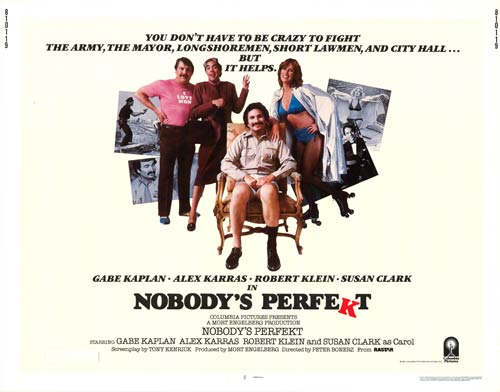
Dibley (Gabe Kaplan) who suffers from unpredictable memory loss, Swaboda (Alex Karras) who thinks his mother is still alive and with him at all times even when she really isn’t and Walter (Robert Klein) who has a split personality that can turn him from a gangster to Bette Davis at any given moment decide to steal an army tank and use it to force the mayor (Arthur Rosenberg) to pay for a new car when their old one gets damaged after driving through one of the city’s potholes. They get Dibley’s girlfriend Carol (Susan Clark) to go along with the scheme and in the process get caught up with a robbery of an armed bankroll truck.

If it was possible to give this thing a negative number rating I would and I seriously considered it, but decided to be generous and give it a 0 even though this thing has to be one of the dumbest comedies ever made. I’ve seen a lot of them, but at least they usually had one or two funny gags even if the rest fell flat, but this one has none. The humor is at a 6-year-old’s level and is painfully stupid from beginning to end without a shred of believability. It also features what has to be one of the slowest, most drawn out and boring car chases ever to be put on film

Mental illness is no laughing matter and the way it gets portrayed here could be considered offensive. Screenwriter Tony Kenrick, who also wrote the novel from which this film is based as well as director Peter Bonerz have clearly not done any research on the topic and portray those afflicted with it in the most sophomoric and benign way possible. In reality these characters would not have been able to hold down regular jobs like they do here and even if they did they would have been quickly fired once their mental problems became easily apparent. They would also most likely be on medications and even institutionalized instead of freely gallivanting around and only seeing an inept shrink (portrayed by Paul Stewart in a very clichéd send-up of Sigmund Freud) once a week who seems to have no insight on how to help them.

The ‘normal’ characters are just as annoyingly stupid. When the trio decide they want to steal a tank from a local plant that makes them they have Kaplan pretend to be from a ‘top secret’ government organization that tricks one of the employees, which is played here by director Bonerz, into believing that his company is secretly selling the tanks to the Soviets without him ever demanding any evidence or proof.

Kaplan may have been a great stand-up comedian and in recent years a good poker player, but as an actor he is one of the worst. In fact I always felt he was  the weakest link in the Welcome Back Kotter show as he always said his lines like he was reading them off of cue cards while constantly conveying a sheepish grin and here he is no better. Former football player Karras and fellow comedian Klein are equally weak. Only Clark is good, but why she would choose to do this after appearing in so much critical acclaimed stuff during the 70’s is a mystery, but she most likely did it to stay close to her then husband Karras and still manages to look great in a bikini.

If the filmmakers really thought that the American public would find this funny then they are the ones suffering from mental illness as only a mentally ill person could possibly find it amusing and if you watch it all the way through you more than likely will become one.

My Rating: 0 out of 10

Released: August 7, 1981

Runtime: 1Hour 36Minutes

Rated PG

Director: Peter Bonerz

Studio: Columbia Pictures

Available: VHS, DVD-R, Amazon Instant Video

Foolin’ Around (1980)

foolin around 2

By Richard Winters

My Rating: 4 out of 10

4-Word Review: Redneck falls for hottie.

Wes (Gary Busey) is a college student who has moved from Oklahoma to Minnesota to attend the university. Desperate for some extra cash he takes part in a program run by the student science department where he gets strapped to a chair and given an electrical shock every time he gives a ‘right’ answer. The procedure is facilitated by Susan (Annette O’Toole) who’s an attractive coed there. Wes is immediately smitten, but finds himself in an uphill battle as she is already engaged to Whitley (John Calvin) an obnoxious stuck-up social climbing man whose equally arrogant mother (Cloris Leachman) wants her to have nothing to do with Wes and tries to completely shut him out of her life.

Although far from a critic darling this obscurity still manages to have a few funny scenes. The best are Wes’s encounters with Whitley particularly when Whitley tries parking his car in wet cement or trying to subdue an out-of-control carpet cleaner in his office. Wes’s conversation with Susan’s grandfather (Eddie Albert) high up on the edge of a skyscraper under construction is nerve-wracking particularly when Albert walks out to the end of a beam hundreds of feet up and then challenges Busey to do the same. The film also has a unique car chase that features an automobile made to look like a giant hot dog as well as a hang gliding segment through the Minneapolis skyline that is downright exhilarating.

Busey does well as an amiable doofus in a part that seems best suited for his acting ability. O’Toole is at the peak of her beauty and Leachman manages to get a few choice moments as the meddling mother. Tony Randall is fun as a snooty butler with a French accent and it’s great to see William H. Macy in an early, but brief part near the beginning.

The on-location shooting done in the state of Minnesota adds some verve particularly the segment done on the sidelines of an actual Vikings-Rams football game. Unfortunately the script is threadbare with certain gags that become labored and lame and a romantic angle that is sappy and contrived. It is also hard to believe that Susan would for even a remote second consider marrying the Whitley character who is a one-dimensional arrogant asshole to the extreme. It is even more absurd that she would fall in-love with Wes as she is clearly out of his league both physically and intellectually and it’s about as farfetched as Busey ever one day winning the Academy Award.

My Rating: 4 out of 10

Released: October 17, 1980

Runtime: 1Hour 40Minutes

Rated PG

Director: Richard T. Heffron

Studio: 20th Century Fox

Available: VHS

The Thief Who Came to Dinner (1973)

the thief who came to dinner 3

By Richard Winters

My Rating: 5 out of 10

4-Word Review: Detective hounds jewel thief.

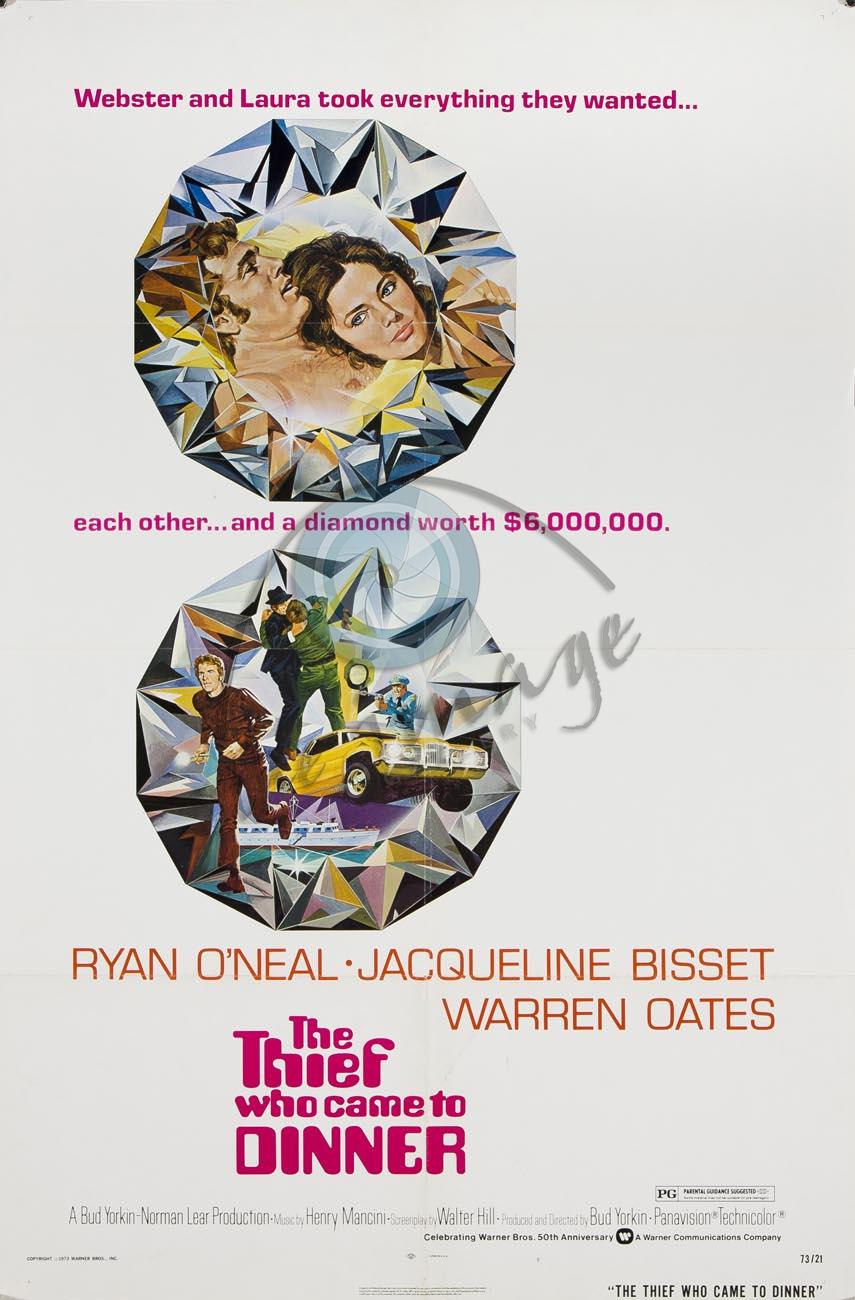
Webster (Ryan O’Neal) is a bored computer programmer who has grown cynical of the business world and decides to become a modern day Robin Hood. He does so by stealing paperwork listing illegal activities of a corrupt politician (Charles Cioffi) and uses this to blackmail him into giving the addresses of his rich and equally corrupt pals. He then robs them of their jewels while with the help of a local fence (Ned Beatty) resells them and keeps half the profits. He even manages to get into a hot relationship with a beautiful woman (Jacqueline Bisset), but just as things start to click insurance investigator Dave Reilly (Warren Oates) gets on the case who’s determined to expose and nab Webster anyway he can.

The film, which was written by Walter Hill and based on a novel by Terence Lore Smith, has a slick even smug attitude about it. It has some interesting ingredients, but never really gels. Webster pulls off these robberies with such relative ease that they are barely interesting to watch. The scene where he gets rear-ended by an old lady and then chased throughout the streets of Houston when he cannot produce proper identification to the police is fun, but there needed to be more of this and the otherwise laid-back pace does not help.

the thief who came to dinner 2

Despite his good looks O’Neal is a weak leading man although here he isn’t too bad. Still the supporting cast easily upstages him especially Oates and had he been made the star this film would’ve been far better. The scene where his car breaks down while tailing O’Neal and then having O’Neal turn around to help him fix it is quite amusing as is Oates’ final act of defiance towards his superiors after he gets fired.

Austin Pendleton is quite funny as an obsessed chess player and Beatty is great as a caricature of a ‘good ole’ boy’ Texas con-man and he really deserved more screen time. Bisset is wasted, but looks beautiful as always and I really digged her ritzy, spacious house that outside of a two lamps had no furniture at all.

The production has very much of a European flair, but its sophisticated façade quickly wears thin. You keep waiting for it to catch its stride, but it never does making it fluffy and forgettable including its wide-open non-ending.

the thief who came to dinner 1

My Rating: 5 out of 10

Released: March 1, 1973

Runtime: 1Hour 40Minutes

Rated PG

Director: Bud Yorkin

Studio: Warner Brothers

Available: VHS

Thunder and Lightning (1977)

thunder and lightning

By Richard Winters

My Rating: 2 out of 10

4-Word Review: More southern fried nonsense.

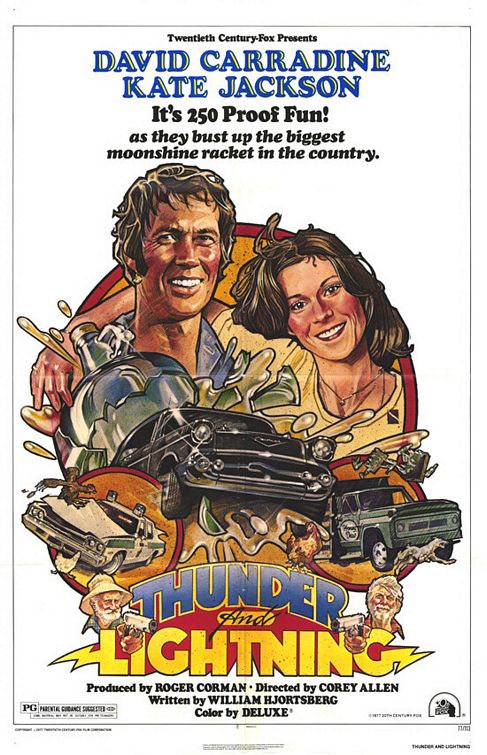
This is incredibly contrived good ol’ boy nonsense about competing moonshiners that gets taken into overdrive and just an excuse for a lot of smash-up car chases.

The filmmakers seem compelled to come up with every southern stereotype they can think of. There is the grizzled, uneducated, overall wearing, backwoods moonshiners, as well as the beer swilling pick-up truck driving rednecks with names like Bubba and Scooter, virtuous, but spunky southern daughter with an annoying hick accent and even a scene where a couple of down home boys jump into a car and shout “yahoo!” as it takes off. After about ten minutes this one-dimensional, uninspired mess makes you feel like you are brain dead.

The production values are poor with muffled sound and fast edits that makes some of the action hard to follow. The whole thing looks rushed and haphazardly put together simply so it could quickly cash in on the success of Smokey and the Bandit.

David Carradine’s performance is much too subdued as he seems to have no energy and is just mouthing his lines. Kate Jackson is pretty, but her personality is much too strong. The only fun piece of casting is Sterling Holloway in his last film appearance. He is probably best known as the voice of Winnie the Pooh and here plays a moonshiner.

The film does manage to have a few good moments. One is a unique speed boat chase done on a large swamp as well as is a segment where a minister preaches his sermon while wrestling with an alligator. There are also two hit men who like in Pulp Fiction have unusual conversations. Some of the strange topics include too much violence on TV, Captain Kangaroo, and even Norman Vincent Peale. There is even a cool inside joke that occurs when actor Charles Napier is having a fight with Carradine and he shouts out “Hey asshole knock off the Kung Fu shit!”

My Rating: 2 out of 10

Released: August 24, 1977

Runtime: 1Hour 35Minutes

Rated PG

Director: Corey Allen

Studio: 20th Century Fox

Available: VHS, DVD, Amazon Instant Video

Eddie Macon’s Run (1983)

eddie macons run 1

By Richard Winters

My Rating: 5 out of 10

4-Word Review: He runs across Texas.

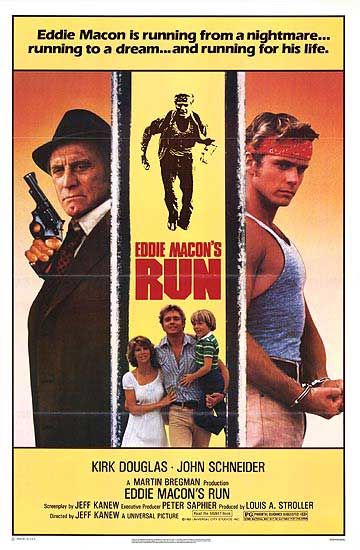
Each Monday during the month of September, in order to celebrate my impending move from Indianapolis to Austin, Texas, we will be reviewing an 80’s movie that takes place in Texas. We start with this film that is based on the James McLendon novel. Eddie Macon (John Schneider) is a young father wrongly accused of a crime who devises a plan to escape from prison and then run on foot from Hunstville to Laredo where he hopes to cross the Mexican border to freedom. The problem is dirty cop Carl (Kirk Douglas) who is holding a past grudge is determined not to let him do it and is hot-on-his-heals.

The film’s basic premise seems not only impractical, but wholly impossible. Per Mapquest the distance between Huntsville and Laredo is 385 miles and this man expects to somehow do it all on foot in only 4 days, which is ridiculous especially when his wife owns a car. Instead of having her drop off his backpack with all of his supplies at a certain strategic point why not have her waiting for him at that same spot with a car ready to whisk him off? The concept makes no sense. There is no reason why he has to do this all on foot and basic logistics of it are mind boggling.

I also had to a lesser extent issues with the Lee Purcell character that plays Jilly Buck. Eddie saves her from an attack by another man and then she helps him elude Carl with her connections through the governor that allows her to lead a rather privileged existence. I understood that she would want to help him a little since he helped her, but she goes far and beyond that and puts herself and her cushy lifestyle in jeopardy by doing it for a man that has clearly stated will stay faithful to his wife.

Schneider, who has too much of a boyish face, is quite weak in the lead with a performance that is dull and one-note.  The character is also painfully stupid as he doesn’t bother to pick-up his backpack that is sitting right at his feet and has everything he needs in it when he escapes from a house even though he had just grabbed a gun out of it only a few seconds earlier.

Douglas is by far the better actor and rightfully deserved the top billing. It is amazing how a man who has played so many good guys in his career could turn around and so easily play a bad guy with the same type of conviction, but he does and it is quite entertaining. His hairstyle looks terrible and almost like it’s a wig, but I think that was intentional as it gives him an appearance of being ugly, crazed and menacing all at the same time.

At times it relies too heavily on old Texas stereotypes, which borders on making the whole thing come off as one giant cliché, but the scene where Eddie gets kidnapped by rednecks and taken into ranch home that is filled with pinball machines and terrorized is fun and has a nice mix of whacky characters and dark humor that the rest of the film should have had. The on-location shooting nicely brings out the dusty, barren landscape as well as a dazzling bird’s-eye shot of the San Antonio skyline.

Norton Buffalo’s moody soundtrack is a major plus, but the two songs sung by Schneider are terrible and just about ruin the whole thing. The film is passable enough to be an adequate time-filler for a slow evening, but don’t expect too much. This also mark’s the official film debut of John Goodman who appears with a mustache as Eddie’s corrupt boss as well as J.T. Walsh who has a brief bit as a bar patron.

My Rating: 3 out of 10

Released: March 23, 1983

Runtime: 1Hour 35Minutes

Rated PG

Director: Jeff Kanew

Studio: Universal

Available: VHS, DVD, Amazon Instant Video

Honky Tonk Freeway (1981)

honky tonk freeway 4

By Richard Winters

My Rating: 4 out of 10

4-Word Review: Get off on it!

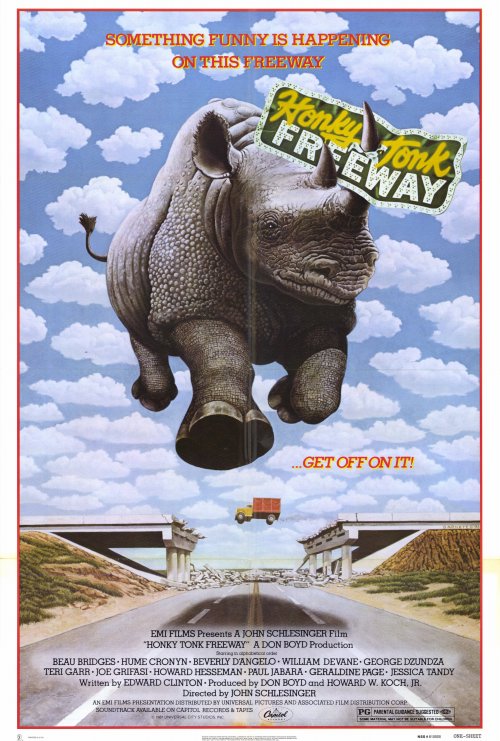
This exceedingly free-form style narrative follows several different oddball travelers from all areas of the country who converge on the small town of Ticlaw, Florida whose citizens are trying to build an exit ramp off of the freeway or risk having all of their shops and businesses go under.

The unusual narrative device might have worked had it been complimented by material that was more original. Instead it’s rather generic and bland. Things start off well with a biting, edgy flair, but this quickly drops off and becomes only mildly amusing afterwards. Some of it even gets silly with a lot of overused jokes aimed at easy targets. To me the only good moment is when a group of men try to trap a wild rhino into a cage.

Some people have compared this to Nashville; but that film at least had an overrunning theme that tied things together while this one has none and most of the time seems to go nowhere. I did like the script’s underlying concept of the randomness of our existence and where we end up and who meet a lot of times is just up to pure chance, but it doesn’t explore this enough or make any strong statement with it.

It also forces us to follow characters that aren’t captivating or interesting. The caricatures are too broad and their eccentricities go over-the-top. The only one I found slightly memorable is David Rasche as an overzealous pimp constantly trying to recruit women into his business even some nuns!

On the performance end Beverly D’Angelo comes off best as a nymphomaniac struggling to have a relationship with just one man. The rest of the cast though is pretty much wasted especially Hume Cronyn and Jessica Tandy as a bickering old couple. William Devane as the mayor is miscast and speaks in a southern accent that is horrible.

The film also contains a logic loophole as the townspeople blow up the bridge of a nearby busy freeway, which will then force all incoming traffic to exit into the town. This should then conceivably create a traffic overflow with more cars and people coming in than the town is equipped for and yet screenwriter Edward Clinton never bothers to touch on this very real issue and instead keeps things contained to only a few travelers.

I did like the on-location shooting, which was done in the small town of Mount Dora that is just a north of Orlando. Many times when films are made in Florida it is done in Miami or areas along the coasts, so it was nice instead to see something done in the countryside that takes advantage of its interesting and diverse topography.

My Rating: 4 out of 10

Released: August 21, 1981

Runtime: 1Hour 47Minutes

Rated PG

Director: John Schlesinger

Studio: Universal

Available: DVD, Amazon Instant Video, YouTube

Did You Hear the One About the Traveling Saleslady? (1968)

did you hear the traveling saleslady

By Richard Winters

My Rating: 3 out of 10

4-Word Review: Saleslady saves family farm.

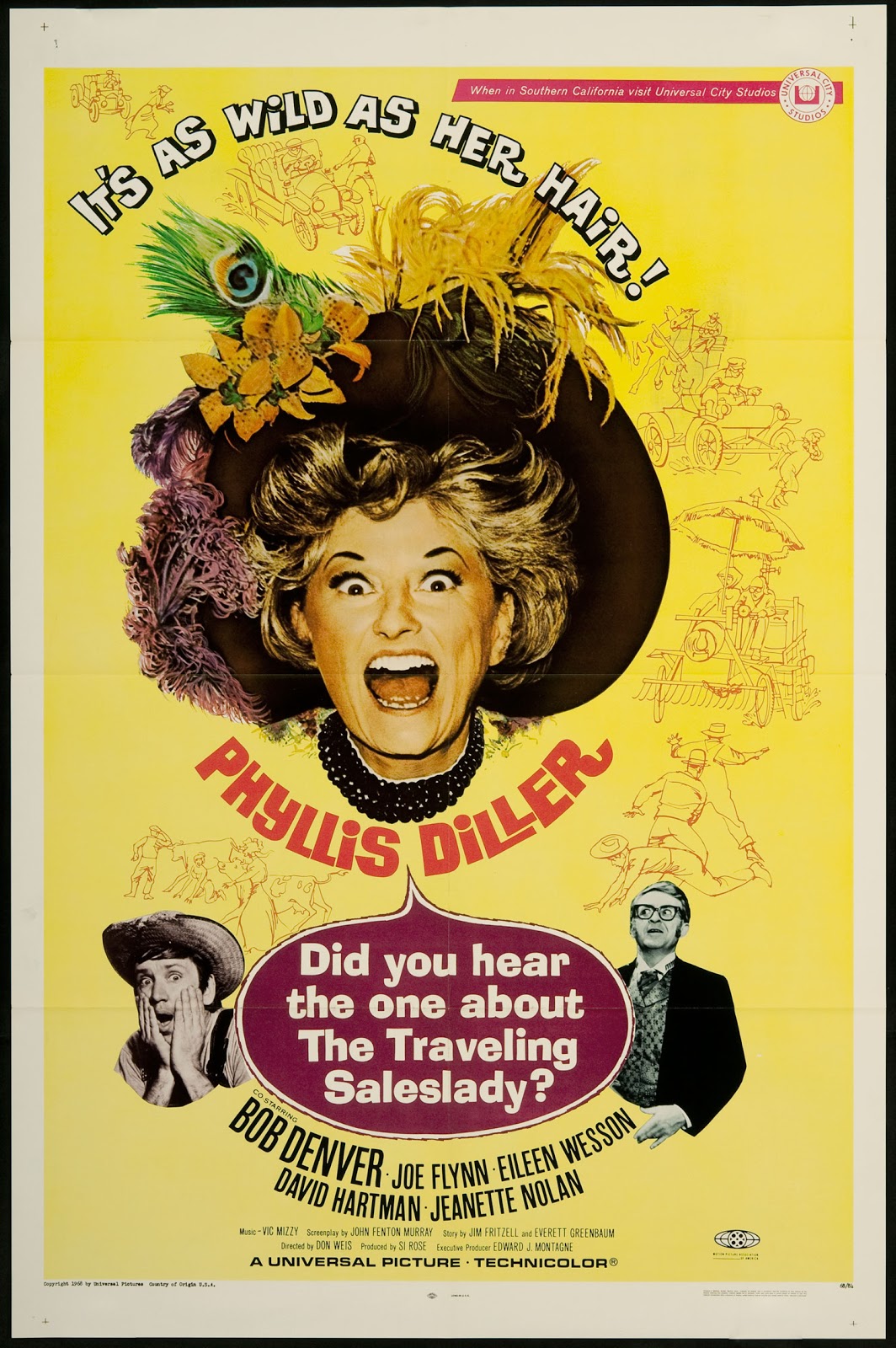
Agatha (Phyllis Diller) is a traveling saleswoman who arrives in a small Missouri town in the summer of 1910 trying to sell a piano that can play by itself. During a demonstration of it one of the townspeople, the kindly, but inept Bertram (Bob Denver) accidently destroys it. Agatha now finds herself stuck with a piano she can’t sell and nowhere to go. Bertram allows her to stay at his family farm, which is at risk of being foreclosed by the town’s greedy banker Hubert Shelton (Joe Flynn). Bertram and Agatha come up with a way to save the farm by winning an automobile race in a wild vehicle created by Bertram using parts from the destroyed piano.

It seems hard to believe in retrospect that eccentric comedian Diller was ever considered star making material, but she did 8 films during the 60’s with 4 of them centered on her flamboyant persona. All of them tanked both critically and at the box office with this one being the last of them. I imagine trying to come up with a scenario using Diller as the centerpiece would be no easy task, but this screenplay penned by John Fenton Murray is too broadly written to be even remotely interesting and seemed already badly dated even for its era. The humor is locked in a kiddie level with a plot that is excessively simplistic and won’t intrigue anyone over the age of 6.

Diller pretty much just plays herself, which would be alright if some her jokes and lines were actually funny, but none of them are. The reoccurring gags centered on her whacky outfits, ugly appearance and horses that go crazy the second she reveals any part of her legs gets old fast. Denver’s character is nothing more than an extension of Gilligan and Flynn is pretty much being the same character he was in ‘McHale’s Navy’.

The film is watchable if you come into it with extremely low expectations, but that is not saying much. None of the gags work and the town’s set was clearly filmed inside Universal’s studio lot, which looks phony and annoying. Denver’s milking machine invention, which can milk 6 cows at once, has potential, but when the cows escape and rampage the entire town it becomes forced humor at its worst, which goes likewise for the climatic and silly car race.

My Rating: 3 out of 10

Released: July 14, 1968

Runtime: 1Hour 34Minutes

Not Rated

Director: Don Weis

Studio: Universal

Available: None at this time.

Scavenger Hunt (1979)

scavenger hunt 3

By Richard Winters

My Rating: 6 out of 10

4-Word Review: Mad dash for money.

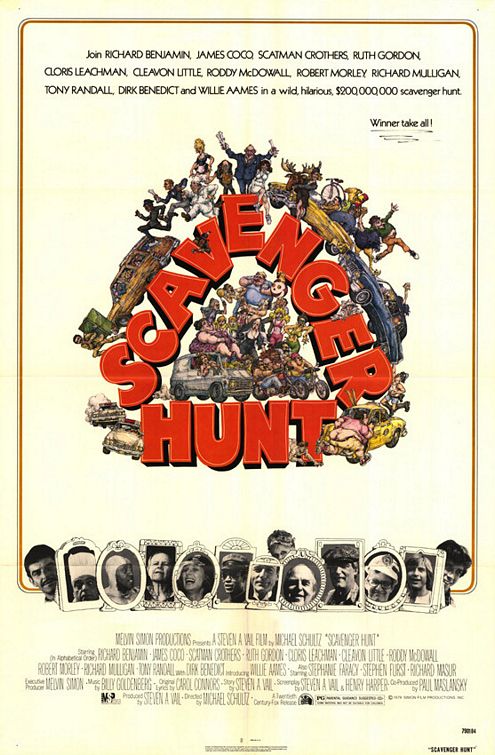
When rich toy inventor Milton Parker (Vincent Price) dies all of his relatives gather for a reading of his will hoping to get a giant share of his 200 million dollar estate. There’s his greedy sister Mildred (Cloris Leachman) along with her child-like grown son Georgie (Richard Masur) and shyster lawyer Stuart (Richard Benjamin) his servants (Cleavon Little, Roddy McDowell, James Coco, Stephanie Faracy) a dimwitted cab driver (Richard Mulligan), his nephews Kenny (Dirk Benedict) and Jeff (Willie Aames) as well as his son-in-law Henry (Tony Randall) and his four children.  At the reading they are given a list of items each having a certain point total and told that whoever can collect the most items by the end of the day will be given the inheritance. Everyone then splits off into five teams and scours the city of San Diego looking to collect everything from a fat person, to a toilet and even an ostrich.

The natural inclination would be to write this movie off as being lame right from the beginning as the characterizations are quite broad, the action very cartoonish and the humor at an almost kiddie level, but farce/slapstick is a legitimate movie genre, so lambasting it simply for being silly isn’t really fair. Yes, you will have to park your intellect at the door to enjoy this one, but I found myself laughing more than I thought and it is great mindless escapism for the whole family without ever being crude or offensive. It also has Cloris Leachman who adds to her already legendary and eclectic resume by playing another extreme character and flying with it.

The film has a few hilarious bits including the servants stealing a toilet inside the bathroom of a post hotel and then later on while in a science lab getting attacked by a ‘giant soufflé’. Benjamin’s confrontation with an angry gang of bikers led by Meat Loaf is pretty good and the wild car chase that ensues at the end isn’t bad either. The film successfully interweaves moments of cynical humor as well, which helps make it more agreeable to older teens and adults.

There are also a myriad of famous faces in bit parts that are funnier than the main cast. I loved Ruth Gordon as a tough talking old lady and Robert Morley as the lawyer heading the estate whose facial expression when Leachman hugs him is a gem. Henry Polic II appears as a motorcycle cop who comes into contact with laughing gas and then loses his uniform and there is Arnold Schwarzenegger as an overzealous fitness instructor. I also really liked Scatman Crothers who appears for a while as Mulligan’s partner and then disappears only to come back in a pivotal part at the very end and even sings over the closing credits.

The only thing that really got on my nerves was Richard Masur as the overgrown man-child named Georgie. Acting wise he does it pretty well, but there is never any explanation why a grown man would be acting so infantile. Was he mentally challenged, or just mentally ill? It is never explained, but comes off more as creepy than funny. I also didn’t like Faracy initially as the dumb French maid, but she grew on me and eventually I came to adore her especially when she tells off Coco. Randall, as a beleaguered father is pretty much wasted, but I did like Julie Ann Haddock as his oldest daughter who later went on to play Cindy Webster on the first three seasons of ‘Facts of Life’.

African American director Michael Schultz shows quite the flair for variety. He started his career doing black-themed films like the classic Cooley High and Car Wash only to turn around and direct the Bee Gees in Sergeant. Pepper’s Lonely Club Hearts Band and then this one, which is in every way diametrically different from his earlier work, but still an accomplishment for his ability to take on such varying works and genuinely be successful at them.

Filmed entirely on-location in San Diego this film can be great fun for kids of all ages even those that are over 40.

My Rating: 6 out of 10

Released: December 21, 1979

Runtime: 1Hour 55Minutes

Rated PG

Director: Michael Schultz

Studio: 20th Century Fox

Available: VHS, YouTube