Category Archives: Drama

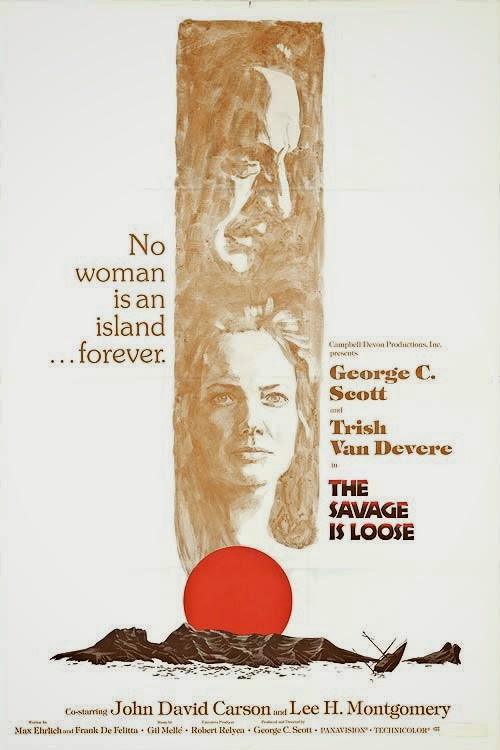
The Savage is Loose (1974)

savage1

By Richard Winters

My Rating: 3 out of 10

4-Word Review: Shipwrecked family becomes incestuous.

In 1902 John (George C. Scott) and his wife Maida (Trish Van Devere) take their infant son David (Lee H. Montgomery) on a sea cruise. Unfortunately the ship hits some rocks and sinks killing all those onboard except for the young family who manage to swim ashore to a deserted island. They make a home for themselves and slowly begin to age. By the time David reaches adolescence (now played by John David Carson) he begins to have sexual urges especially as he watches his father make love to his mother late at night. As his sexual feelings grow stronger he begins to lust after his own mother and compete with his father for her affections.

Unusual production that was directed by Scott and financed mostly with his own money. After the disaster of The Day of the Dolphin you’d think he’d have learned his lesson and gone with a script with a more mainstream storyline, but instead he dove into something that was sure to offend many and then proved incredulous when it didn’t score well with either the critics, or the box office. Despite starting the decade with an Academy Award win his career, especially after two financial duds back-to-back, began to peter-out after this one and he was really never able to regain his star status, or get offered top parts afterwards.

The film runs hot-and-cold. The opening is a bit cheesy as it features only a painting of a ship hitting some rocks and sinking, most likely the budget was too small to recreate an actual shipwreck, which surprisingly, despite the compromise, kind of works especially with the sound effects of the people screaming particularly the young child. It’s once they get on land that the action really begins to sink. The huts that they build, which we never actually see them make, but can only presume, look too well crafted, when factored in all the utensils, eating bowls, table, chairs, and even bamboo blinds, to have been built by two people with limited resources. It’s also hard to understand, with the front end of the ship still always in view, why they didn’t bother to create a raft, since their carpentry skills are clearly quite superior, in order to leave the island and find help. They eventually do, with relative ease but only after coming up with the idea 18 years later, but why the hell did it take them that long to eventually consider it?

The characters are quite dull and don’t have much to say and it would’ve helped had there been a fourth survivor on the island with them to allow for some diverse dramatic perspective, or even for some much needed comic relief. Montgomery plays the young David quite well, but Carson is terrible as the older version and fails to effectively convey the intense inner frustrations of his character and his acting delivery is robotic. Van Devere is okay as an actress, but her character fails to age. The father and certainly the son do have their appearances change, as you’d expect during almost two decades, but the mother remains youthful and glowing. Maybe this was done to keep her looking ‘desirable’ to the two men, but in reality she should’ve taken on gray hair and wrinkles especially after having to deal with all the stress and hardships of being stranded for some many years.

The incest theme is not handled in any type of interesting way. Instead of being this shocking twist that we’re not expecting it gets telegraphed right from the start and even ponderously talked about amongst all three of the characters until the viewer is totally expecting it to happen and to a degree even waiting for it. It’s confusing too why the son only has his eyes set on the mother. If his quandary is really just trying to release this strong sexual urges and having hardly anyone around to do it with then why doesn’t he try having sex with some of the animals that inhabit the island, or even the old man? Why not have sex, or at least attempt to, with all three at different times? Again, the movie wants to force the viewer out of their comfort zone by exposing the animalistic urges people can have, which in civilization will be repressed, but out in the wild it won’t. With that in mind then why not go ‘all-in’ and explore all the various types of perversions besides just the mother-son one?

Spoiler Alert!

While it remains strangely captivating, despite lots of lulls and slow spots, the ending doesn’t get played-up enough to make it worth it. I commend the idea, showing the mother deep kiss the grown son, but since they’re going for shock value why not show them from a bird’s eye view on the sand, naked and humping? Movies succeed by having unforgettable images and that would’ve been one hard to get out of most viewers heads. Having the father view them going at it was a bit ridiculous as he had been tied-up just moments earlier and trapped by a fast moving fire and no chance for escape, so how he was able to survive it is not clear and doesn’t make much sense.

My Rating: 3 out of 10

Released: October 30, 1974

Runtime: 1 Hour 54 Minutes

Rated R

Director: George C. Scott

Studio: Campbell Devon Films

Available: DVD

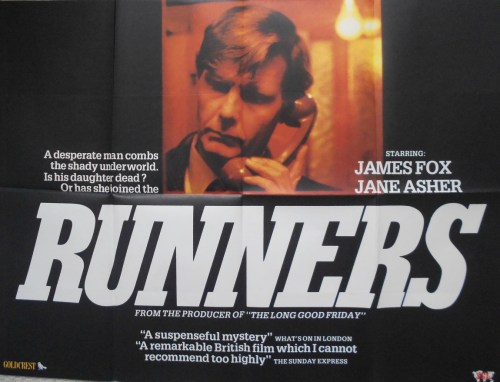
Runners (1983)

runners

By Richard Winters

My Rating: 5 out of 10

4-Word Review: Searching for teen daughter.

Tom (James Fox) is a suburban father who watches his teen daughter Rachel (Kate Hardie) ride off to school on her bike one day only for her to never come home. The police find her abandoned bike, but no signs of her, making it seem like she was snatched by someone driving in a car that was passing by. As the years go by Tom becomes even more fixated on finding her despite the lack of clues. His marriage begins to crack as his wife (Eileen O’Brien) feels it’s time to move on and that Tom needs to just ‘let it go’ though he refuses. He eventually moves out and into the city of London where he becomes determined to use what few leads he has to track her down on his own. Along the way he meets Helen (Jane Asher) a mother searching for her missing son and the two get into a relationship even as the challenges of finding their missing kids becomes even more daunting. Then one day by complete shock Tom finally sees Rachel and manages to corner her to have a brief conversation, but Rachel clearly does not want to see him and runs away again, but Tom becomes relentless to bring her home even if it means doing it by force.

Originally meant as a TV-movie the film did ultimately spend some time in theaters though it never managed to catch-on and was soon buried by bigger hits of the day. The film though still stands out as being the first appearance onscreen, outside of a brief cameo in a religious documentary from 1976, of actor James Fox, who left the movie scene after doing Performance, which was filmed in 1968, where he suffered a nervous breakdown. He then joined the Billy Graham ministries, known as The Navigators in England, and became a missionary, but found that his interest in acting never left and decided to make a foray back into it after 14 years and unlike other stars who drop out of the business and try to make a comeback, Fox found enviable offerings and even lead roles in major productions making it seem like he was still a much sought after commodity who had never left. His performance here is masterful and he looks like he hadn’t even aged a day as he’s clearly the one entity that helps carry the film and keep it interesting and insightful throughout.

Storywise I felt the first hour worked best and in many ways is highly gripping. The way it gets played-out has a certain spooky quality and the mystery element wraps you in and keeps you intrigued. The dynamics between the husband and wife are realistic and the film deserves props for examining how these situations can wear on people in different ways and how the ongoing stress can eat away at even the best marriages. Fox creates a compelling character and the viewer feels as emotionally worn-out as he does as he partakes on a grim search that manages to only give never ending bleak results.

Unfortunately the second hour is where it falls apart. To a degree it’s nice seeing him finally get a breakthrough, but there’s no explanation for why she ran away. In fact the daughter is almost like a ghost who says little and displays a continuous pouty expression and not much else. She’s shown passing out some sort of religious pamphlets, but we’re never told exactly what this literature says. Her motivations are vague as she expresses unhappiness with her upbringing, but never explicitly states what exactly they are. Without understanding what makes her tick, or why any of this happened, it hurts the film and makes it seem, despite its keen direction, as half-baked and ultimately empty-headed.

Apparently there was a rash of teens running away from home in England during the early 80’s and this film was produced in an attempt to tackle the subject as a sort of ‘ripped-from-headlines’ TV-movie of the week, but the filmmakers never made any effort to interview the kids to find out why they left home and without that understanding the rest of it is pointless. Showing things from the parent’s perspective is great, but at some point we need the kids point-of-view too and without that it lacks insight.

My Rating: 5 out of 10

Released: May 9, 1983

Runtime: 1 Hour 47 Minutes

Not Rated

Director: Charles Sturridge

Studio: Cinegate

Available: DVD-R 

Buster and Billie (1974)

buster2

By Richard Winters

My Rating: 5 out of 10

4-Word Review: Dating a loose woman.

Buster (Jan-Michael Vincent) is a high school senior living in rural Georgia during the late 1940’s. He’s been dating Margie (Pamela Sue Martin), but finds her to be stuck-up and her unwillingness to have sex makes him frustrated. He begins seeing Billie Jo (Joan Goodfellow), who has moved into town and due to having limited social skills puts-out for the other boys by allowing them to have sex with her, one after the other, in the woods late at night. Buster at first dates her simply for the action, but eventually the two get into a serious relationship and he breaks-up with Margie. They begin going out publicly letting the whole town know that they’re a couple, but the other boys become jealous as they can no longer have easy sex like they use to and thus plot a dark revenge.

The story is based loosely on an actual event that occurred in Florence, South Carolina in 1948 that the film’s screenwriter Ron Turbeville remembered hearing about growing up. The recreation of the era though lacks style and this may be in large part due the film’s limited budget. While it gets a zero in  atmosphere I did at least like the way it doesn’t sugar coat things for nostalgic purposes. The teens behave in the same ways they do now and thus it’s gritty on that level.

The acting is good surprisingly even from Jan-Michael who in his other films tended to have a cardboard presence, but here he gives the thing most of its energy. He even appears, shockingly, fully nude and in fact this was the first mainstream American movie to show a male naked from the front, of which Jan stated in later interviews he was quite proud to expose of his well-endowed ‘equipment’. Goodfellow is also seen nude and is quite attractive though I wish she had more to say. Robert Englund, in his film debut, is the most memorable playing an albino with brown hair and his pale complexion makes him look creepier, at least I felt, than he did as Freddy Kruegar.

I didn’t understand though why Buster would risk his social standing for this ostracized girl. I got that Margie was annoying, so breaking-up with her wasn’t a stretch, and Billie was essentially ‘easy-pickings’, but why go public with it? It made more sense that they would’ve seen each other on the sly, but not wanting to risk the social scrutiny of letting everyone know about it. This would’ve clearly lost Buster’s social status not only amongst his friends, but the town as a whole including his own parents, so why add on all that needless stress? Billie too was very shy, so becoming center stage and having all eyes on her would be something she most likely would’ve wanted to avoid, which makes the second act overly idealistic.

It’s also frustrating that Billie doesn’t say much. You want to get to know this person, but never really do. The only time she’s ever given any insight is when Buster explains to his parents why she had sex with all the other guys (in order to be liked), but this is something we should’ve heard coming-out of her lips instead of his. By having Buster do almost all the talking, even when they’re alone together, makes it seem like she’s mentally handicapped, which I don’t believe was the intent and yet ultimately that’s how it comes-off and thus making their romantic moments sterile and uninteresting.

Spoiler Alert!

The final sequence though is where it really falls apart as the boys inadvertently kill Billie when they gang rape her (during a rainstorm even though the sky is still clear and sunny). Buster then tracks them down at a pool hall where he single-handily beats them up and ultimately kills two of them, but the guys just allow themselves to be beaten without attempting to throw a punch, which is not only unrealistic, but boring. Having a big brawl, where each side fights equally would’ve been far more exciting. The twist in which Buster somehow gets released from jail the day after her funeral, so that he can decorate her gravesite with all the flowers that he’s stolen from everyone else in town is far-fetched and overly forces the sentiment.

My Rating: 5 out of 10

Released: August 21, 1974

Runtime: 1 Hour 40 Minutes

Rated R

Director: Daniel Petrie

Studio: Columbia Pictures

Available: Amazon Video

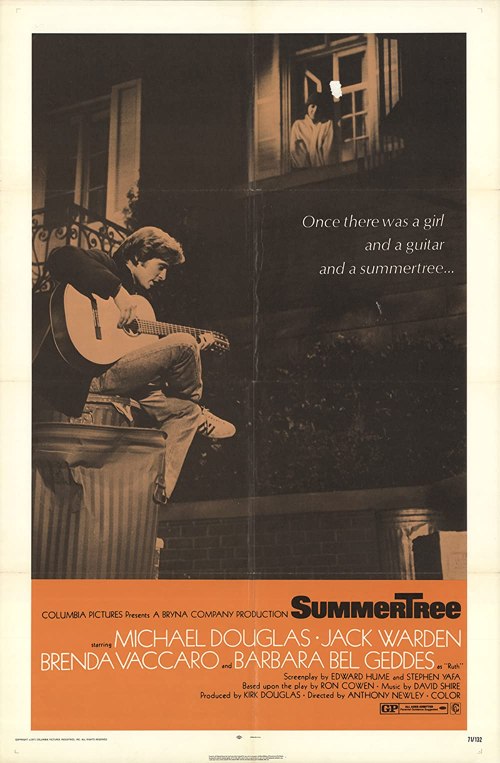
Summertree (1971)

summertree

By Richard Winters

My Rating: 6 out of 10

4-Word Review: Dropping out of college.

Jerry (Michael Douglas) is a 20-year-old university student who finds going to college to be drag as he’s disinterested in the subjects being taught and would rather play his guitar for a living. Since the year is 1970 his parents (Jack Warden, Barbra Bel Geddes) fear that this could get him drafted and advise against it, but Jerry refuses to listen convinced that he’ll get accepted into the conservatorium, which will restore his student draft deferral. In the meantime he also starts up a relationship with Vanetta (Brenda Vaccaro), a local nurse he meets when he brings in Marvis (Kirk Calloway), a black youth he’s spending time with through the big brother program, into the hospital after he skins his knee. Everything seems to be going Jerry’s way, he even gets a job playing his guitar at a local coffeehouse, but then the draft notice comes in the mail and the  music school decides, to his shock, not to accept him. He feels he has no other choice but to escape to Canada, but Vanetta does not want to go with him and his parents don’t think this is a good idea and secretly plot to prevent it.

The film is based on the stageplay of the same name by Ron Cowen that was produced in 1967 and originally had Douglas cast in the lead only for him to get fired during the rehearsal phase and replaced by David Birney, which so incensed his father Kirk, that he bought the rights to the play in order for it to be made into a film that his son could star in. It’s directed by Anthony Newley, which is an unusual choice since Newley was from Britain and not as affected by the Vietnam war and also for the fact that he was mainly known as an actor, writer, and singer with very little hand in directing. Overall he does okay, but the song done over the opening credits, which is sung by actor Hamilton Camp, is atrocious and makes you want to turn it off before it’s even begun. The stop-action ‘comedy’ done through a home movie type look, that gets shown while the horrible song is played, is bad too making this thing really stumble out of the gate though it manages to recover.

The plot works like three stories compressed into one. The segments dealing with Jerry’s relationship with the child, who is very streetwise and foul mouthed, but still quite engaging, are the best. His attempts to form a relationship with Vanetta though prove awkward as he follows her down a lonely dark alley late at night, which would make him seem by today’s standards like a stalker, and then taking her out to a cemetery on their ‘first date’ when it’s pitch black out would not be something most people would find romantic and instead quite creepy. Vaccaro is a great actress though more in roles featuring strong women and not necessarily as a love interest. This did precipitate a long on-going relationship between the two in real-life that lasted 6 years and for voyeurs you also get to see her topless as she rarely ever did nude scenes, but for whatever reason decided to do it here.

Spoiler Alert!

His relationship and conversations with his parents I initially found interesting. Coming into the movie I thought this would be a long, drawn-out arguments of conservative old-school parents and the liberal kid, but that’s not really the way it works. The parents are against him going to war as much as he is and it’s only the staying in school part that they find disagreement, but then when he decides to go to Canada in a last ditch effort to avoid the draft suddenly they’re against that too even to extent of trying to bribe a mechanic to fiddle with Jerry’s car, so he can’t drive it, but why? The shift in their perspectives seemed too quick. If they’re concerned they might not be able to see him much if he’s stuck in another country it would still be better than him coming home in a body bag and even if he does come out of it alive he’d be emotionally scared, or physically disabled for life, which wouldn’t occur if he was in Canada, so from my perspective the parents should’ve supported his ‘escape plan’ and the fact that they don’t needed more explaining.

The ending in which the parents are in their bedroom, with Jerry now off to war, and them acting like ‘everything will work out’, which is a far cry from what they thought before, gets botched. For one thing there’s an issue of Life magazine sitting on top of the TV talking about the weekly body count from the war on it’s cover, but I would think the parents would’ve thrown that out as they wouldn’t want to be reminded that their son may soon become one of those statistics and just leaving it in a place where they’d constantly be reminded of it didn’t seem realistic. They also both roll over and go to sleep while leaving the TV on, but who does that? Seeing an image of Jerry’s dead body being carried away on the TV isn’t the shocking surprise that the filmmakers though it would be as as the film spends a lot of time priming the viewer that is what it’s leading up to making the final image corny and even tacky instead of riveting.

My Rating: 6 out of 10

Released: June 9, 1971

Runtime: 1 Hour 29 Minutes

Rated R

Director: Anthony Newley

Studio: Columbia Pictures

Available: DVD, Amazon Video, YouTube

Corky (1972)

corky

By Richard Winters

My Rating: 7 out of 10

4-Word Review: Race driver self destructs.

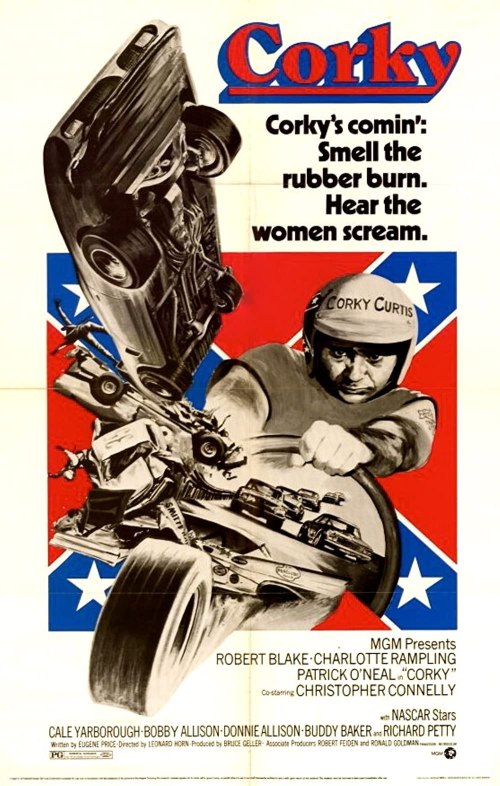
Corky (Robert Blake) works as a car mechanic during the day, but on weekends he drives in some of the local races. He’s aggressive nature though causes many accidents and damages in the race, so his boss Randy (Patrick O’Neal) decides to replace him with another driver named Steve (John Gruber). Corky resents being replaced and thus enters the next race anyways and rigs the front hood of his car, so it will pop-up at a strategic time, so that he can crash into Steve’s car while feigning that it was an ‘accident’ because he couldn’t see where he was going due to the hood. The crash though puts Steve in the hospital and it’s enoough for Randy to fire Corky from his job. Now, with no money left, he goes traveling to Georgia with his buddy Billy (Christopher Connelly). They enter a few races there, but Corky parties away all the winnings and eventually come back to Texas penniless. He tries to get back with his wife Peggy Jo (Charlotte Rampling), but finds that Randy has been helping her out and giving her enough money, so that she can go back to school to get a diploma and eventually be able to earn a living without Corky. This causes him to seethe with rage and he goes back to Randy’s place of work in order to exact a violent revenge.

The film was directed by Leonard Horn, who shot to fame for having directed some of the highest rated episodes of the ‘Mission Impossible’ TV-series, which garnard him enough attention to get him a contract to helm two cinematic features. His first one was The Magic Garden of Stanley Sweatheartwhich starred Don Johnson and while it wasn’t completely successful, and very little seen, it did have an interesting cinema verité style. This works the same way with a strong emphasis on atmosphere that gets small town living in rural Texas just right. Even the little moments like when Corky turns on his friend Billy in the middle of a desolate road during an impending rain storm leaves a memorable impression as does the envelope-pushing moment where Corky decides to strip down and go skinny dipping with two young boys (Matt Nelson Karstetter, Richard McGough) at a country watering hole.

Robert Blake is excellent. Sometimes it’s hard to imagine him as a leading man due to him at one time being a part of the ‘Little Rascals’ ensemble, and then rising to becoming a TV-star before falling into infamy at being accused of killing his child’s mother. However, with all that being said he was still a great actor who probably didn’t get as much starring roles as he deserved, but he plays the angry loner role to a perfect-T. Rampling as his wife, who was born in England, masks her British accent quite well and creates an odd, but interesting sounding Texas one in the process. I also liked that she sports blonde hair. O’Neal is good in support and there’s an fun collage of actual race driving champions like Richard Petty and Cale Yarborough who appear briefly as themselves though I was upset to read that Roddy McDowell’s scenes, where he plays a salesmen, got cut out completely as his appearance could’ve added an intriguing element.

Spoiler Alert!

The story itself is rather tepid at first. There were many films from the 70’s dealing with rugged individualists and hard drinking, womanizing rebels who couldn’t, or didn’t want to conform to societal rules and thus hit the road looking for adventure and to ‘find themselves’. This though, at least during the first two acts, adds nothing to the equation, or give us any new insights and in fact seems more like the same old, same old generic character study, but all that changes in the third act when Corky unravels completely and goes on a shooting spree. The films from that era always had the non-conformist getting ‘reeled-in’ at some point usually through the love of a romantic partner, or some familial obligation, but here it’s a meltdown to the extreme and it’s a movie way ahead of its time as it deals with what’s commonly known as a mass shooter these days. At that time this concept was rarely seen and for that it deserves definite kudos as does the message that being too irresponsible will catch-up with you and one can’t just live the outlaw image and not eventually have to pay the price.

My Rating: 7 out of 10

Released: March 15, 1972

Runtime: 1 Hour 28 Minutes

Rated PG

Director: Leonard Horn

Studio: MGM

Available: DVD-R (Warner Archive)

The Champ (1978)

champ1

By Richard Winters

My Rating: 7 out of 10

4-Word Review: Idolized by his son.

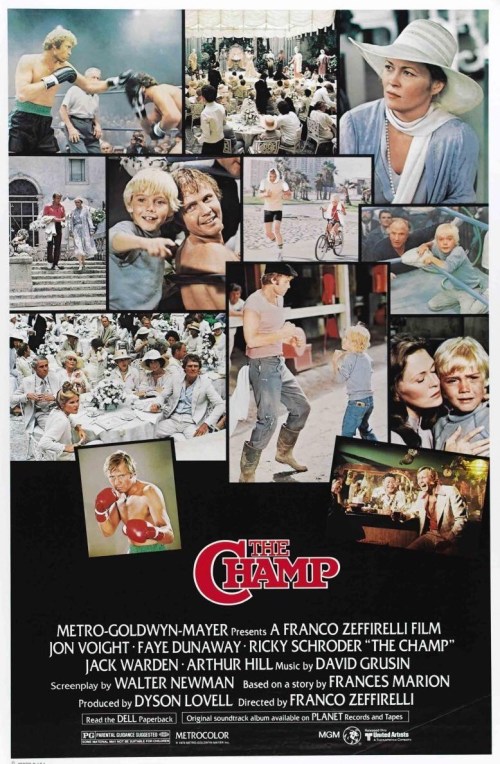
Billy (Jon Voight) is a former boxer whose been out of the ring for 7 years. Now at age 37 he works as a horse trainer. His 8-year-old son T.J. (Ricky Schroder) idolizes him and refers to his as ‘The Champ’ instead of dad. Billy though suffers from many inner demons including his perpetual drinking and gambling as well as not making enough money to sufficiently support either himself, or his son. Nonetheless he continues to go out gambling whenever given the chance and he manages to win enough money to buy his son a horse, which they name She’s a Lady. They enter Lady into a race where T.J. meets Annie (Faye Dunaway). Unbeknownst to T.J. Annie is his mother whom she gave up at birth, but now that she’s married to a wealthy man (Arthur Hill) she wants to have custody. Billy refuses to allow it, but when he loses the horse because of a gambling debt and Annie gives him the money to pay it off he eventually relents and has T.J. go live with her while he’s in jail for assault. Once he’s released the father and son reunite, but Billy realizes he must make more money in order to keep him and thus decides to go back into the ring one last time despite warnings from Jackie (Jack Warden), his former manager, that to do so could be life threatening.

The film is remake of the 1931 classic with Wallace Beery playing the part of the father and Jackie Cooper as the son. Director Franco Zeffirelli remembered watching it as a child and it having a profound effect on him. Then years later while he was in his hotel room while on-location filming another feature he saw it come on television and the film again moved him in such a way that he decided he wanted to do a remake. This though wasn’t the first remake as it had already been done in 1953 as The Clown starring Red Skelton though the story had been revised without the boxing theme and the climactic event at the end doesn’t take place at a sporting event, but instead a dangerous stunt that the lead character must do during a live broadcast of a TV special.

While this one stays more faithful to the original concept it was still panned by many critics as being overly sentimental and soap opera-like. Many who were fans of the original felt this one fell far short and complained about the long running time, this one runs of full 2-hours while the older one was only 83 minutes, with the feeling that it stretched the plot out too much and at spots was too slow. Though I’ve never seen the 30’s version I found myself genuinely wrapped up in the drama and the characters.

Many at the time complained that Voight was going back to the same type of Joe Buck character that he played in Midnight Cowboy, but I disagreed. That character was genuinely stupid, but Billy isn’t he’s just down-on-his-luck and suffering from basic human frailties, which made his situation far more compelling.

Schroder is an absolute jewel. He got the part after beating out over 2,000 others and it’s easy to see why. His ability to cry on demand with real tears streaming down his face is amazing and not something other actors are able to do. He’s cute and engaging without it ever getting forced, or overdone. His presence gives the film its energy and virtually the sole reason for why it works as well as it does.

The main complaint that I did have was with Annie. She’s marvelously played by Dunaway, who’s always been one of my favorite actresses and it’s a good role for her acting style as she’s excellent at playing characters that have a bit of a cold and aloof manner while not easily able to show their soft side, but with that said I still couldn’t understand what made the character tick, or her motivations. For one thing she seemed to have nothing in common with Billy, so what brought them together in the first place was a mystery and then having her abandon the kid while she went off living her life seemed pretty extreme. In most cases it’s the father that shirks the responsibility of raising the child, but here it’s reverse, but with no clear explanation as to why. There’s a vague excuse later on that it was so she could ‘pursue her career’, but then this doesn’t explain why she now wants to get close to her son. If she was selfish back then what made her change to suddenly want to be loving and caring? She went 7 years without ever seeing the kid, and did pretty well without him, so why now must she have him? I felt there needed to be some extra context added like she had been addicted to drugs when she had TJ, which then made her deemed unfit to raise him, but now that she had kicked the habit she wanted him back, or maybe she had suffered a miscarriage with her second husband and this made her feel guilty about the child she had let get away and this motivated her to want to seek out TJ, but without any of this added information the character comes-off as transparent, unrealistic, and unrelatable.

I will agree with Leonard Maltin in his review where he states that it looks like Faye wants to go to bed with her own kid. This occurs during the scene where Ricky is on her yacht and looking off in the distance while Faye comes up behind him and begins sniffing his hair like she’s getting turned-on by him. To call this a cringey, awkward moment is an understatement and it’s unintentionally laughable. Why it was left in, or why Zeffirelli thought it would be a good idea to put in I don’t know. The movie manages to recover, but it’s a segment that is indeed ridiculous.

The boxing element is another problem as it gets introduced way too late. It gets briefly mentioned throughout the first 2 acts and there’s even a quick scene where Billy shows up at a gym, but overall it gets played-out as a side-story only to suddenly, 90-minutes in, becomes the main focus, which gives the film a very disjointed feel. Jack Warden’s character doesn’t appear at all until near the end almost like it’s a tacked-on bit that doesn’t really flow with everything else that came before. The boxing scenes are impressive and helps to effectively expose the brutality of the sport, but I felt Billy’s training and decision to enter the ring should’ve been made sooner and the boxing scenes mixed-in throughout, but either way it’s still an competent tearjerker that shouldn’t leave a dry eye in the house.

champ2

My Rating: 7 out of 10

Release: March 20, 1979

Runtime: 2 Hours 3 Minutes

Rated PG

Director: Franco Zeffirelli

Studio: MGM

Available: DVD, Amazon Video, YouTube

The All-American Boy (1973)

american

By Richard Winters

My Rating: 4 out of 10

4-Word Review: Amateur boxer seeks fame.

While Jon Voight is best known in the world of boxing movies for having done The Champ in 1979, which some consider infamous, his first go-around was actually this one though it remained stuck on the studio shelf long after it was filmed only to be released after his success in Midnight Cowboy. He plays the character of Vic (Jon Voight) a talented, good-looking man whose shown ability in the amateur ring and now is ambitious about making the Olympic team. Arty (Ned Glass) takes him under-his-wing, even lets him stay at his place, while he trains him, but then all of sudden Vic decides he doesn’t want to be a boxer anymore, to the shock of everyone, and never bothers to give anyone any explanation as to why.

The script was written by Charles Eastman, who also directed, and who was the brother of Carole Eastman, who wrote the script for Five Easy Pieces under the pseudonym of Adrien Joyce. Like with his sister’s script it works as a character study and the story is broken up in sections, in this case ‘The Manly Art in Six Rounds’. At various times, usually every 10-minutes, a title will appear on screen such as ‘Round 1’, or ‘Round 2’, but honestly I didn’t see the point  and it doesn’t really make it more interesting and could’ve easily be discarded and probably should’ve been.

On the writing end, particularly the dialogue, it works. Eastman creates a conversational quality where what the characters say is never ‘too on the nose’ (screenwriter’s lingo for being too specific) and the viewer must read into it in order to understand what they mean. In that area the film works, but it’s also highly talky and begins to have a stagnant feel. There’s also very little about the actual sport of boxing. If you’re expecting something like Rocky where there were long segments dealing with the his preparation you’ll be out of luck here. I got particularly frustrated with the scene dealing with Vic getting ready for a contest where he’s seen standing around while other participants and fans enter into the arena, which gets drawn-out, and then just as the fight is supposed to begin it cuts away showing Vic on the phone describing what happened, but to have to sit through a long build-up just to see no action is a letdown.

There finally is some boxing about 50-minutes in and the choreography in the ring, with each participant getting some hits on the other, appears realistic though there’s no blood, or bruising. What makes this segment unusual is more what occurs amongst the audience where one of the spectators, played by Noble ‘Kid’ Chissell, a former professional boxer from 1924 to 1934, begins to masturbate underneath his raincoat, which he has over his lap, which becomes painfully obvious to the other people around him.  Why this was put-in I don’t know. It’s not clear either whether he’s getting-off on the two boxes, or his attraction is to one of the pretty ladies in the audience (I’d presume it was the boxers), but such a bizarre character doing such a strange thing in public needed better fleshing-out and quite frankly more screentime as cringe or not I found his appearance to be one of the few diversions and far more intriguing than the main star.

Seeing a young Anne Archer, who looks almost like an adolescent here, this counts as her film debut since it was filmed before either The Honkers or Cancel My Reservationwhich were both released earlier, is a pleasure though her character doesn’t have a lot to do. E.J. Peaker is quite good as Vic’s on-again, off-again girlfriend, who has a memorable bit inside a recording studio as she attempts to boost her singing career. Jeanne Cooper, better known for her work on ‘The Young and Restless’, which lasted for 5-decades, is quite striking. The best acting though goes to Ned Glass, who is engaging as the foul-mouth manager who spews the F-word seemingly non-stop.

The ending in which Vic gets on a helicopter and is cheered on by his fans and supporters who gather to see him off is the film’s best moment. It’s not like anything super exciting happens, but the location, filmed in the hills just outside of Vacaville, California, where the grass is dark brown, but the trees that dot the landscape remain green gives-off a surreal effect. It goes on for a full 20-minutes all in this vast brown countryside with characters running around in it and at certain points even sliding down the hillsides. The unusual topography leaves a lasting impression and I’ll give props to the filmmakers for taking full-advantaged of it and the one element that allows this otherwise sterile production to stand-out.

My Rating: 4 out of 10

Released: October 24, 1973 (Filmed in 1970)

Runtime: 1 Hour 58 Minutes

Rated R

Director: Charles Eastman

Studio: Warner Brothers

Available: DVD-R (Warner Archive), Amazon Video

The Baby Maker (1970)

babymaker1

By Richard Winters

My Rating: 4 out of 10

4-Word Review: Paid to give birth.

Tish (Barbara Hershey) is a young, free-spirited women who’s a part of the hippie movement and looking for alternative ways to make money without having to do the usual 9-to-5 job. She becomes aware of the idea of being a surrogate mother hired to give birth to a baby from a couple who cannot have one themselves. The couple in this case are Jay (Sam Groom) and Suzanne (Collin Wilcox Paxton) who are middle-aged and due to a medical complication the wife is unable to have children. They agree to pay Tish an upfront allotment of money as well as covering the rent for the apartment that Tish shares with her boyfriend Tad (Scott Glenn). Things start smoothly enough, but ultimately underlying tensions soon surface like Suzanne’s concern that Tish is getting involved in too much physical activity and with her husband’s seemingly infatuation with the young woman. Tish’s boyfriend also begins to have problems with the agreement especially since Tish has stated she’ll not have sex with him during the course of the 9-month pregnancy.

This was the first film directed by James Bridges, who got his start writing teleplays for the ‘Alfred Hitchcock Presents’ TV-show before blossoming into a career helming such critically acclaimed efforts as The Paper Chase and Urban CowboyWhile the film is not perfect I did feel on the technical end it was well done with vivid cinematography that makes the viewer feel quite intimate to both the characters and their setting as well as a good time capsule to how things looked back in that era. The subject matter was quite unique for the period that even had some film critics labeling it as a ‘travesty’ while another called it ‘insufferable’. While I didn’t find it to be either it does show how provocative the issue was and thus overall making it a groundbreaking movie.

More than anything I really enjoyed the performance by Hershey who seems born to play this role and like she’s hardly even acting and instead just being herself. The carefreeness of her character really comes through especially when she decides to impulsively take-off her clothes while in front of the couple whom she’s just met, and jump into their backyard pool. You feel like she’s a perfect composite of most of the flower children back then and highly revealing to what made them tick. What I didn’t like though was how we never learn what gave her the idea to be a surrogate mother and I felt the film should’ve started from this point instead of having her already done it one time before without any backstory to what first gave her the motivation to even consider what at the time was not a typical thing that most people even the young hippies were doing.

I found the supporting characters to less interesting. Glenn, in his film debut, was the most baffling as he plays this overly selfless boyfriend who goes along too graciously with Tish’s idea of having someone else’s baby. Most guys would not be cool with this, or need more time to warm-up to it especially since it would require her sleeping with a married man. Having her then refuse to have sex with him while the pregnancy went on would be way too much for most men to handle, so the fact that he stays with her even after being told this made him seem unrealistic. Had he gotten into the relationship knowing upfront this is what she did for a living then maybe, but she just springs it on him after she’s agreed to the contract, which would’ve made anyone in that same situation quite upset, and justifiably so. I felt too that him ending up sleeping with one of her friends (Helena Kallianiotes) should’ve been understandable given the circumstances and Tish, being the supposedly open-minded, unconventional person that she is, should’ve allowed for it and possibly even invited it instead of growing jealous and throwing blue paint on them like she does.

I had the same issues with the couple. Collin Wilcox Paxton is excellent and light years away from her most famous role of Mayella Violet Ewell, the backwoods southern white woman who falsely accuses a black man of rape in To Kill a Mockingbird, but there’s just not enough tension between her and Tish, or in the scenes with her husband, which is the film’s biggest failing. It seems more concerned with tackling a novel concept in as genteel a way as possible, but in the process forgets that this is a drama and there needs to be conflict going on in order to keep it riveting. Certain potentially explosive problems are brought-up, but then quickly downplayed. There’s no surprise twist or altercation. It leisurely limps itself along to a hum-drum finish that has no impact at all and unfortunately ruins an intriguing concept that could’ve gone in many different, interesting directions, but ultimately doesn’t.

My Rating: 4 out of 10

Released: October 1, 1970

Runtime: 1 Hour 49 Minutes

Rated R

Director: James Bridges

Studio: National General Pictures

Available: DVD-R (Warner Archive), Amazon Video

September (1987)

september1

By Richard Winters

My Rating: 7 out of 10

4-Word Review: Drama at summer home.

Layne (Mia Farrow) has decided to spend the summer at the country home of her mother’s (Elaine Stritch) in order to recuperate after a suicide attempt. With her during her stay is her best friend Stephanie (Dianne Wiest). Layne is also madly in-love with her neighbor Peter (Sam Waterston) who is a struggling author who wants to write a book about Layne’s mother’s life, who was at one time a well-known actress, but who also shot her late husband in self-defense though it was reportedly Layne who pulled the trigger. Howard (Denholm Elliott) is Layne’s other neighbor who is smitten with her though she has no feelings for him as all of her emotions are tucked away towards Peter, who is more into Stephanie, a married woman with children. During the course of one night while an electrical storm occurs and the power goes out everyone makes their true feelings for the other known, but not everyone responds to the revelations the way they’d like.

This movie is unusual, or at least the behind-the-scenes production, in that two to three versions of every scene was shot and then writer/director Woody Allen took all the footage and edited it together only to be dissatisfied with the final result and decided to shoot it again, but with different actors. In the original production Charles Durning played Layne’s stepfather, but in the second version he is replaced by Jack Warden, and Maureen O’Sullivan played Layne’s mother. Since Maureen was Mia’s real-life mother it’s ashame she wasn’t kept on for the second version. Granted Elaine is excellent, but seeing a mother and daughter acting together would’ve given an interested added nuance that unfortunately gets lost with the redo.

The scenario has its share of intriguing elements, but Allen’s concept of trying to create a filmed stageplay was a mistake as the whole thing has a very static feel right from the start. The internal conflicts are not apparent right away and the first act comes-off like nothing more than lingering conversations with no idea what connects them until the second act kicks, but by that time some viewers may have already gotten bored with it. In Interiors, which was Allen’s first drama, the story clicked quickly because there was a main nemesis, which helped create the tension that’s lacking here. Having a few more characters including a couple that was invited over, but calls-in when their house gets flooded, could’ve helped enliven things.

The acting is uniformly excellent especially Farrow, who’s always had a gift for playing vulnerable characters though with this one she’s more assertive. Wiest is fabulous too though with her super short brunette haircut she looks too similar to Farrow in Rosemary’s Baby and for that reason she should’ve been given a different hairstyle. The short cut also makes Wiest’s squinty look where she constantly appears like someone who’s just walked into bright sunlight, more apparent. The male cast is overall wasted. Warden gets one poignant moment where he describes the cold, lonely universe, but otherwise doesn’t have much else to say, or do and overall gets dominated and upstaged by the caustic and brassy Stritch as his wife. Elliot has one good line early on, but then disappears for a good chunk of it only to get a walk-on towards the end, but by that point I had quite literally forgotten all about him.

The film would’ve worked better had it had stronger character arcs, but overall not much really happens. There’s brief moments of confrontations, particularly Layne’s arguments with her mother, where things appear to be getting juicy only to have them pull back and become civil again. Same thing happens when Layne catches Stephanie with Peter, a slight blow-up and then back to mundane. The characters don’t really grow, or change and everything gets treated like a minor, little tiff that quickly blows-over making the viewer feel at the end that there wasn’t much point in watching it.

On a side note I was also disappointed to learn that the whole thing was shot on an indoor sound stage. With the title of September and the location being Vermont I was fully expecting sights of beautiful fall foliage as the northeast can be one of the best areas for that during the autumn. Since Allen’s dramas can get quite talky I thought the scenic locale could help at least visually fill-in the slow spots, but we ultimately get none of that. The intention was to shoot it at Farrow’s Connecticut country house, the house had inspired Allen to write the screenplay in the first place, but by the time he was finished with the script it was already winter and thus the autumn look and feel would’ve been lost. Credit though should go to the lighting and set design as you still get a feel of Vermont during the night time scenes where you hear realistic sounds of crickets and night bugs outside. The light coming through the windows certainly looks like actual sunlight, but why would people keep their blinds closed when most anyone would have them open to take in the majestic countryside. Why bother even having a home in the country if the idea is to close the windows off from it? It’s also not logical for the sunlight to be shining through all the windows from any direction in the house as the sun can only be in one place in the sky, so some of the windows should not have had sunlight coming through though here all of them do.

My Rating: 7 out of 10

Released: December 18, 1987

Runtime: 1 Hour 22 Minutes

Rated PG

Director: Woody Allen

Studio: Orion Pictures

Available: DVD-R, Blu-ray (Region B/2), Tubi, YouTube

Pieces of Dreams (1970)

pieces1

By Richard Winters

My Rating: 2 out of 10

4-Word Review: Priest breaks his celibacy.

Father Gregory (Robert Forster) is a priest working outside of Albuquerque, New Mexico with a mainly Hispanic church membership. He had been dealing with a 15-year-old boy who was in-trouble with the law only to be called into the hospital late one night to learn that he’d been killed while trying to steal a car. It’s there that he meets Pamela (Lauren Hutton) a social worker from the local community center. The two share widely different viewpoints particularly on the topic of abortion, but despite their differences the two eventually fall in love and their relationship turns intimate. Gregory feels guilty about this due to his vow of celibacy and tries to hide the affair from Paul (Ivor Francis) an older priest whom he lives with and is known to have a prying eye. Gregory decides to ask for a leave in order to get his thoughts together, but learns that trying to find a job on the outside with little work experience can be a difficult task. While he avoids Pamela in order to figure out what direction he wants to take his life the other priests put pressure on her to break it off permanently while trying to guilt-ridden her that she’s destroying a ‘good man’s career’.

This was an unusual career move for Forster who had just completed his signature role in Medium Cool where he was seen running around naked with a nude woman inside his apartment during a provocative moment, so I guess he wanted to tackle a completely different type of character for his next project in an effort to avoid being typecast, but it doesn’t really work. He’s a fine actor, but his streetwise personality trickles through and he never really comes-off as being all that devout and thus making the career arch very expected and no surprise at all. The voice-over narration that he has during the first act, in an attempt to convey to the viewer his inner thoughts, was not needed and off-putting.

Hutton is quite beautiful. She hit her career peak with her work in American Gigolo when she was already middle-aged, so seeing her still quite youthful looking is a treat, at least to the heterosexual male viewer, and you could easily see why she was a former model. Ivor Francis, not necessarily a household name, but competent character actor during the 60’s and 70’s, is quite good as the domineering senior Priest who has his own character flaws that he tries to cover-up even though he’s more than happy to readily expose the ones he sees in others. Will Geer also shines, but isn’t seen until the tail end playing a clergyman who has an amusing line when he tells Gregory that the celibacy demand for Priests ‘will soon be going away’ even though 50 years after this was filmed nothing has changed.

The theme dealing with how religion in theory is meant to be comforting, but in practice can become something that torments people by making them feel guilty and fearing the wrath for what could be considered to others as being minor infractions, like having sexual thoughts, is on-target though not necessarily ground-breaking. Some of the other issues will seem quite dated like the married woman who fears using the pill, or any other type of contraception, as it goes against the teachings of the catholic church, though through the decades this is no longer considered as much of a ‘sin’. There’s also the scene where Gregory lectures a youth who’s in jail for smoking cannabis about how he’s ‘thrown his life away’ while pot is now legal in many states.

The real problem, or when the film ultimately ‘jumps-the-shark’, is when Gregory goes to bed with Pamela, which came off as way too seamless and rushed. Up until then the couple really hadn’t had much in common and were usually arguing over political issues and weren’t for that matter even officially dating. It seemed to me that if someone like Gregory is made to feel extremely guilty for even thinking about sex that is ability to actually perform it would be questionable. Having him run away from her when he started feeling the urge and then avoiding her due to the temptations that she gave him would’ve made more sense then just having him casually hop in the sack without a second thought like he’s just a regular guy on the make and wearing the priest collar is some sort of performance art.

What the filmmakers apparently thought would be a compelling question of would he, or wouldn’t he stay in the church is ultimately given the placid treatment. The romance angle isn’t convincing and despite some good conversational dialogue, and nice on-location shooting of New Mexico in the autumn, the story fails to resonate making the movie woefully trite by the time it finally ends.

pieces2

My Rating: 2 out of 10

Released: September 23, 1970

Runtime: 1 Hour 39 Minutes

Rated GP

Director: Daniel Haller

Studio: United Artists

Available: DVD-R (MGM Limited Edition Collection), Amazon Video